Report to U.S. Congress on AUKUS agreement, allows Australia access to Highly Enriched Uranium and Plutonium
Report to Congress on AUKUS Nuclear Cooperation, News USNI, March 16, 2022 On December 1, 2021, President Joseph Biden submitted to Congress an “Agreement among Australia, the United Kingdom, and the United States for the Exchange of Naval Nuclear Propulsion Information.” This In Focus explains the agreement’s substance, as well as provisions of the Atomic Energy Act (AEA) of 1954, as amended (P.L. 83-703; 42 U.S.C. §§2153 et seq.), concerning the content and congressional review of such agreements.
An accompanying message to Congress explains that the agreement would permit the three governments to “communicate and exchange Naval Nuclear Propulsion Information and would provide authorization to share certain Restricted Data as may be needed during trilateral discussions” concerning a project to develop Australian nuclear-powered submarines. This project is part of an “enhanced trilateral security partnership” named AUKUS, which the three governments announced on September 15, 2021. The United States has a similar nuclear naval propulsion arrangement only with the United Kingdom pursuant to the bilateral 1958 Mutual Defense Agreement.
The partnership’s first initiative, according to a September 15 Joint Statement, is an 18-month study “to seek an optimal pathway to deliver” this submarine capability to Australia. This study is to include “building on” the U.S. and UK nuclear-powered submarine programs “to bring an Australian capability into service at the earliest achievable date.” The study is “in the early stages,” according to a November 2021 non-paper from Australia, the United Kingdom, and the United States, which adds that “[m]any of the program specifics have yet to be determined.”
Agreement Details
The agreement, which the governments signed on November 22, 2021, permits each party to exchange “naval nuclear propulsion information as is determined to be necessary to research, develop, design, manufacture, operate, regulate, and dispose of military reactors.”
As noted, this information includes restricted data; the AEA defines such data to include “all data concerning … the use of special nuclear material in the production of energy.” The AEA and 10 C.F.R. Part 810.3 define special nuclear material as plutonium, uranium-233, or enriched uranium.

The agreement, which entered into force on February 8, 2022, is to remain in force until December 31, 2023, when it will “automatically extend for four additional periods of six months each.” Any party may terminate its participation in the agreement with six months written notice. Should any party abrogate or materially violate the agreement, the other parties may “require the return or destruction” of any transferred data.
The agreement includes provisions to protect transferred data. For example, no party may communicate any information governed by the agreement to any “unauthorized persons or beyond” the party’s “jurisdiction or control.” In addition, a recipient party communicating such information to nationals of a third AUKUS government must obtain permission from the originating party. The agreement includes an appendix detailing “security arrangements” to protect transferred information. Download the document here. https://news.usni.org/2022/03/16/report-to-congress-on-aukus-nuclear-cooperation
Liberal Senator Concetta Fierravanti-Wells wants Port Kembla as nuclear submarine base – Dr Helen Caldicott and Wollongong Council disagree
Port Kembla the ‘obvious choice’ for nuclear submarine base, Liberal Senator says
ABC Illawarra / By Tim Fernandez 8 Mar 2022 Port Kembla could become the home of the first major military base to be built in Australia in more than 20 years, but the prospect of nuclear activity in the region has split the community.
Key points:
- Concetta Fierravanti-Wells says Port Kembla is the “obvious choice” for the base
- Nobel Prize-winning anti-nuclear activist Helen Caldicott says the base will turn Wollongong into a military target
- Wollongong has been a nuclear-free city since 1980
Prime Minister Scott Morrison confirmed yesterday that a submarine base would be built on Australia’s east coast as part of the AUKUS partnership with the US and the UK.
Port Kembla, Newcastle and Brisbane have been floated as possible locations for the base, but the ABC understands Wollongong is the Defence Department’s preferred site.
………………… Liberal Senator Concetta Fierravanti-Wells has been advocating for the Garden Island Naval Base in Sydney to be moved to Port Kembla since 2015.
‘Vote-buying gimmick’
The South Coast has a long history of community opposition to nuclear projects and the identification of Port Kembla as a possible destination for nuclear assets has reignited the debate.
One of the pioneers of the Australian anti-nuclear movement, Helen Caldicott, has spent decades raising awareness of the nuclear threat and won the 1985 Nobel Peace Prize for her work.
The Berry resident believed the base would pose an unmanageable risk to the area.
“Huge amounts of money being spent, nuclear activity at Port Kembla, which is always dangerous, and making it a target in the event of war, like Pine Gap,” Dr Caldicott said.
“It is just a vote-buying gimmick, obviously, when the Prime Minister should be spending that sort of money on the people in Lismore, many of whom have lost their houses.
“I think it should be treated with cynicism, and for Port Kembla to understand the dangers — both with dealing with nuclear activities and making it a possible target.”
The Labor Party supports the AUKUS partnership, but its candidate in the Wollongong-based seat of Cunningham, Alison Byrnes, has criticised the government’s secrecy around the plan.
“It has been really disrespectful for our community — they deserve to have all the details,” she said.
“The Prime Minister is using national security for his own job security, which suits his political timeline and not national security priorities.”
Nuclear-free zone
Wollongong council has been a nuclear-free zone since 1980 and in 2019 the council adopted the United Nations Treaty on the Prohibition of Nuclear Weapons…………………. https://www.abc.net.au/news/2022-03-08/port-kembla-submarine-base-proposal-reignites-nuclear-debate/100889814
Jellyfish would inevitably force nuclear submarines into shutdown, if fleet based in Brisbane

 | |||
Jellyfish would ‘inevitably’ force nuclear submarines into shutdown if fleet based in Brisbane, expert says
Leading marine scientist says Moreton Bay, one of three sites shortlisted, is bad choice due to risk to reactors if jellyfish sucked in. Guardian, Ben Smee in Brisbane, @BenSmee, Fri 11 Mar 2022 .
Australia’s nuclear-powered submarines would “inevitably” be forced into an emergency reactor shutdown by swarms of jellyfish if the fleet was based in Brisbane, a leading marine scientist says.
The Australian government this week released a shortlist of three sites – Brisbane, Newcastle and Wollongong – as a potential east-coast home port for the nuclear submarine fleet, which will arrive in about 2036 under the Aukus partnership with the US and the UK.
The Queensland government has been cagey when asked whether it supports a base in Brisbane, a position described as “very strange” by the federal defence minister, Peter Dutton, whose electorate is in Brisbane…………
Jellyfish expert Lisa-ann Gershwin, a leading marine biologist, says Brisbane is “close to the absolute worst place” for a nuclear submarine base, due to the conditions in Moreton Bay and the frequent jellyfish blooms.
In 2006, the US nuclear-powered supercarrier USS Ronald Reagan was forced into an emergency reactor shutdown in Brisbane after it sucked more than 800kg of jellyfish into its condensers, hindering coolant from reaching the main reactors.
Picture if you will America’s biggest, most expensive, most fearsome, awesome supercarrier is on its maiden voyage,” Gershwin said.
“It comes into the port of Brisbane and it sucks in thousands of jellyfish. It was a very embarrassing situation for the American navy. Luckily there was no major accident, nothing happened, nothing exploded.
“But when you’re dealing with nuclear anything, you’ve got to be [more cautious].”
The phenomenon of jellyfish shutdowns is surprisingly common in any power plant that sucks in water as a coolant
Gershwin says any base for a submarine with an in-built nuclear reactor could not be enclosed like Moreton Bay, which is sheltered by Moreton Island and North Stradbroke Island.
“Jellyfish act like plastic,” Gershwin said.
“If you’ve ever seen a pool filter that’s got a plastic wrapper caught, it clogs up … and floods all over the place because it’s not going through the filter. The water gets stopped by this ‘plastic’ and then the water can’t pass by that. Emergency shutdowns of power plants happen all the time, very frequently.”
Gershwin said that if Brisbane was used to base nuclear submarines, a jellyfish shutdown would be “inevitable”………
You’ve got to be really careful about where you put these things. Anywhere that you’ve got warm water, you’re going to have jellyfish. Moreton Bay is just sucked in with jellyfish.”
Brisbane ranked eighth of the sites considered by Defence as a potential submarine base in 2011, with Sydney listed as the best choice.…………. https://www.theguardian.com/australia-news/2022/mar/11/jellyfish-nuclear-submarine-emergency-reactor-shutdown-brisbane-base-moreton-bay-australia
Sydney ruled out as nuclear submarine base – despite topping list of sites in Defence study
Sydney ruled out as nuclear submarine base – despite topping list of sites in Defence study https://www.theguardian.com/australia-news/2022/mar/09/sydney-ruled-out-as-nuclear-submarine-base-despite-topping-list-of-sites-in-defence-study
Questions raised about how Coalition settled on its three potential locations Daniel Hurst Foreign affairs and defence correspondent, @danielhurstbne, Wed 9 Mar 2022
Sydney Harbour has been ruled out as a site for the proposed new base for Australia’s nuclear-powered submarines, with officials insisting it was not viable because of “limitations on berth space and shore facilities”.
Questions have been raised about how the Morrison government settled on the three potential sites it announced this week – Port Kembla in Wollongong, Newcastle and Brisbane – given that these were not among the top five options listed in a previous Defence review.
A 2011 Defence report ranked potential options for a new east coast home port for submarines. The top three options were in Sydney Harbour, followed by two options in Jervis Bay, south of Sydney.
The same study said it “would be impractical” to develop a future submarine basing capability at Port Kembla, noting it had previously been found to be “a small and congested harbour with little space for substantial expansion”.
When asked by Guardian Australia to explain what had changed since that review, a Defence spokesperson said changes in commercial activity at Port Kembla had released a large pocket of land which was “now potentially suitable for creation of a new naval base”.
Jervis Bay had been “discounted as it is a gazetted marine park”, the spokesperson said.
The Garden Island defence precinct in Sydney Harbour, which already serves as the navy’s key operational base on the east coast, was also “not considered a viable long-term solution” for a permanent submarine base.
“The site is constrained with limitations on berth space and shore facilities and suffers considerable encroachment,” the Defence spokesperson said. “Construction of dedicated submarine facilities at GIDP would exacerbate existing pressures and further limit expansion options.”
Scott Morrison announced the three potential sites in a national security speech on Monday, even though the selection process will not be complete until next year. That sparked Labor accusations of a pre-election marketing “ploy”.
Both the prime minister’s speech and the government’s subsequent press release contained ambiguous language about who precisely had settled on the three final sites, after Defence did “significant work” to review “19 potential sites”.
“Three preferred locations on the east coast have been identified,” Morrison said. He did not explicitly state whether it was the department or cabinet ministers who had done the identifying, or whether the government’s decision was in line with Defence’s recommendations.
The employment minister, Stuart Robert, told Sky News on Tuesday: “The national security committee of cabinet has worked through a range of options and narrowed it down to three.”
That committee is chaired by Morrison and includes senior ministers, including the defence minister, Peter Dutton, and the foreign affairs minister, Marise Payne. Robert is not listed as a member.
But the Defence spokesperson told Guardian Australia each site had been “assessed against Defence’s evaluation criteria”.
The factors included “access to exercise areas and proximity to industrial infrastructure and significant population centres to support personnel and recruitment”.
The three options would be “subject to further review and consultation”, the spokesperson said.
In Defence’s 2011 future submarine basing study, Newcastle port was ranked sixth and the Port of Brisbane eighth. That review said Newcastle’s strengths were “compromised by its isolation from any other naval infrastructure, its susceptibility to flooding, and its sometimes difficult harbour entrance”.
Dutton was asked on Tuesday whether a Chinese state-owned corporation’s part-holding of the long-term lease over the port would affect the eventual decision on where to build the submarine base.
“All of that would be taken into consideration,” he told the ABC.
He bristled at any suggestion he and Morrison were at odds on the timeframe for deciding which submarine design Australia would adopt under the much-trumpeted Aukus partnership with the US and the UK.
Dutton had said on Sunday the government would announce the selected boat “within the next couple of months”, sparking speculation this may occur before the federal election due in May.
But Morrison ruled out making a decision before the election, noting that caretaker conventions were due to begin by April.
The defence minister told the Nine Network: “I didn’t say it would be before the election. Of course the ABC and the Guardian and others have tried to spin it into that but that’s not the case.”
The Labor party has offered its support for the Aukus, saying it accepts advice that the deteriorating strategic environment in the Indo-Pacific justifies the need for less easily detectible nuclear-propelled submarines.
That committee is chaired by Morrison and includes senior ministers, including the defence minister, Peter Dutton, and the foreign affairs minister, Marise Payne. Robert is not listed as a member.
But the Defence spokesperson told Guardian Australia each site had been “assessed against Defence’s evaluation criteria”.
The factors included “access to exercise areas and proximity to industrial infrastructure and significant population centres to support personnel and recruitment”.
But Labor’s defence spokesperson, Brendan O’Connor, said the party was seeking a briefing on the east coast base plans. He said Morrison had “taken a leaf out of his marketing playbook by making an announcement about a decision that will be made in 2023”.
Officials from the US and the UK have visited Australia in recent weeks. It is understood the three governments are examining the full set of requirements to allow for the delivery of at least eight nuclear-propelled submarines under Aukus.
These include the submarine design, construction, safety, operation, maintenance, disposal, regulation, training, environmental protection, installations and infrastructure, industrial base capacity, workforce and force structure.
While Morrison has previously said the first submarine was expected to be in the water by about 2040, Dutton has since argued the may be achievable sooner.
The government has also foreshadowed a likely increase in visits by British and US nuclear submarines in the meantime.
$10b plan for nuclear submarine base under fire over timing, potential site
$10b plan for nuclear submarine base under fire over timing, potential site, The Age, By David Crowe, March 7, 2022 . A federal plan for a $10 billion nuclear submarine base on Australia’s east coast has sparked Labor claims that the move is a ploy to get a headline while others say Sydney would be a better location than the official options of Brisbane, Newcastle or Port Kembla.
Labor has backed the plan to build a fleet of nuclear-powered submarines under the AUKUS alliance signed last year with the United Kingdom and United States but has demanded a briefing on the new base after being promised regular briefings last year.
Independent Senator Rex Patrick, a former submariner, also questioned the timing of the government move and said the Department of Defence had favoured Sydney in previous plans, questioning whether election factors had influenced the new proposal.
Prime Minister Scott Morrison outlined the options for the new base in a speech to the Lowy Institute on Monday that said Defence had reviewed 19 potential sites and estimated a $10 billion cost for the base at one of the preferred east coast sites to add to an existing base near Perth.
While Defence Minister Peter Dutton said on Sunday the government would bring forward a decision on whether to choose British or American nuclear submarines for construction in Australia, Mr Morrison said on Monday this did not mean an announcement before the election.
The timelines for the vast project suggest a decision on the east coast base should be made in 2023 and the first submarine would be in the water by around 2040.
Senator Patrick said a process to choose the new submarines began in 2009 but the government had failed to deliver since coming to power in 2013.
“We’re 13 years and $3 billion into a future submarine project and what do we have to show for it? We’ve got a study into getting a nuclear submarine and, now, a study into where we might put them,” he said.
“Call me cynical, but this is another Scott Morrison announcement designed to gloss over his government’s disgraceful national security failures that have left our country vulnerable.”
Senator Patrick gained documents from the Department of Defence under freedom of information law that showed the search for an east coast base canvassed locations including Jervis Bay on the south coast of NSW and Western Port Bay in Victoria as well as Sydney…….
Mr Patrick said Sydney should remain the leading option but appeared to be dropped for political reasons.
“The fact that Sydney is the only city in Australia with a nuclear reactor, and the experienced personnel that maintain and operate it, only strengthens Sydney’s case,” he said.
……………………… Labor candidate Alison Byrnes, who is aiming to replace sitting Labor MP Sharon Bird in the seat of Cunningham around Wollongong and Port Kembla, called for a full briefing from the government rather than being asked to respond to a government “drop” to the media.
With a decision not likely until 2023, critics of the government questioned the timing of Mr Morrison’s announcement and the need for a swift response to his proposal.
“The suggestion for a base for nuclear-powered submarines is just another ploy from the Prime Minister to get a headline without providing any detail of how this will be implemented or even when it will be delivered,” Labor defence spokesman Brendan O’Connor said.
“It seems like Scott Morrison is trying to divert attention from the fact the nuclear-powered submarines won’t come into effect for more than a decade, leaving Australia with a significant capability gap. https://www.theage.com.au/politics/federal/10b-plan-for-nuclear-submarine-base-under-fire-over-timing-potential-site-20220307-p5a2bi.html
Morrison’s selected sites for nuclear submarine base were not the Defence Dept choices – and opposed by the local towns.
Coalition shortlist for nuclear submarines base were not in Defence’s top five in 2011 review, https://www.theguardian.com/australia-news/2022/mar/08/coalition-shortlist-for-nuclear-submarines-base-were-not-in-defences-top-five-in-2011-reviewDaniel Hurst and Royce Kurmelovs. 8 Mar 22, ‘We are not getting lumped with their mess’, Newcastle mayor says of prospect of basing nuclear fleet in city while Wollongong mayor also concerned.
The mayors of Newcastle and Wollongong have expressed unease at the Morrison government naming their cities as a potential base for nuclear-powered submarines, with one describing the Aukus plans as a “fantasy”.
Questions have also been raised about the government’s process for shortlisting Newcastle, Port Kembla in Wollongong and Brisbane for a new east coast base, given that a previous Defence review had not backed them as most-preferred sites.
The South Australian independent senator Rex Patrick, a former submariner, said Scott Morrison’s announcement on Monday was “thick with political fog” with an election looming, noting the final site would not be selected until 2023.
Patrick said: “Why pork barrel in one electorate when you can – for the same price – pork barrel in three?”
Morrison said the government had “provisioned more than $10bn to meet the facilities and infrastructure requirements” for the transition from Australia’s existing Collins-class submarines to the nuclear-powered submarines to be acquired under the Aukus pact with the UK and the US.
He said Defence had looked at 19 potential sites and narrowed them down to the three preferred locations. Defence would now discuss the plans further with state and local governments and “begin negotiations on what will be an enormous undertaking”.
The moves come amid continuing uncertainty about when the first of the nuclear-powered submarines will be operating. Morrison originally estimated it would be by about 2040 but the government now insists it may be sooner.
The new base – which the Coalition wants to build in either Brisbane, Newcastle or Port Kembla – would “enable the regular visiting of US and UK nuclear-powered submarines”, Morrison said in a virtual address to the Lowy Institute.
However, the mayors of Newcastle and Wollongong both said they were not consulted about the decision. With both cities historically home to anti-war movements they expected considerable community opposition.
Both cities have passed official resolutions to make them nuclear-free zones.
There is also believed to be opposition to nuclear power, particularly where it is used to propel a weapon of war – although spent fuel rods from the Lucas Heights reactor have passed through Port Kembla on their way for processing in France.
Wollongong’s lord mayor, Gordon Bradbery, an independent, said he was waiting for more detail about the proposal before he would consult the local community.
“It’s not only nuclear power and nuclear-powered submarines, but it’s the location of a strategic defence asset and that would make anyone who gets this particular facility a target,” Bradbery said.
“International tensions now are playing on a lot of people’s minds and there would be concerns about our city as a location for nuclear-powered submarines.”
Bradbery said Wollongong city council had previously worked with Regional Development Australia to make a submission to the federal government to relocate naval activities from Garden Island in Sydney Harbour to Port Kembla, but this was for conventional submarines only.
“It just disappeared into the ether at the time,” Bradbery said. “Many suggested it was pie in the sky as the navy wasn’t keen on relocating from Garden Island.”
Newcastle’s Labor lord mayor, Nuatali Nelmes, said the city had no intention of giving up its nuclear-free status over a “fantasy”.
“The whole deal is a fantasy,” Nelmes said.
“This announcement, the Aukus decision and the absolutely hopeless way they have handled this submarine contract – we are not getting lumped with their mess.
“It is also typical of the federal government to have unilateral decision making where cities like Newcastle, which have been for many decades, a nuclear-free zone, would even be considered.”
But the Liberal premier of New South Wales, Dominic Perrottet, welcomed the inclusion of Port Kembla and Newcastle on the federal government’s shortlist , saying the world faced “very uncertain times”.
“Defence protection for our country is paramount and we have worked very closely with the federal government to identify these sites for our state,” Perrottet told the Nine Network.
A spokesperson for the Queensland Labor government said it was “yet to receive any detailed information from the commonwealth”.
Study found Port Kembla ‘impractical’
A 2011 Defence report ranked potential options for a new east coast home port for submarines. The top three options were in Sydney Harbour, followed by two options in Jervis Bay, south of Sydney.
“Newcastle has its strengths, but the slight edge that it has with respect to positive people factors is compromised by its isolation from any other naval infrastructure, its susceptibility to flooding, and its sometimes difficult harbour entrance,” the future submarine basing study said.
Newcastle Port was sixth on the list and the Port of Brisbane was eighth.
The report included the caveat that detailed costing and environmental impact analysis “may generate a different outcome”. It placed a priority on the proximity to fleet assets in Sydney.
Brisbane, Newcastle and Port Kembla shortlisted for nuclear submarine base on Australia’s east coast
Brisbane, Newcastle and Port Kembla shortlisted for nuclear submarine base on Australia’s east coast, ABC By defence correspondent Andrew Greene 7 Mar 22, A new submarine base will be built on Australia’s east coast to support the future nuclear-powered fleet being acquired under the AUKUS partnership, with Defence identifying Brisbane, Newcastle and Port Kembla as the most suitable locations.
Key points:
- The Prime Minister will announce a new “future submarine base” for Australia’s east coast to accommodate a nuclear fleet
- Defence believes Port Kembla in NSW is the best option, but the Commonwealth will also consider Brisbane and Newcastle
- The government is playing down the Defence Minister’s suggestion of a submarine design announcement ahead of this year’s election
Prime Minister Scott Morrison will unveil the plan in a national security speech today, when he will warn the strategic, political, economic and social implications of Russia’s invasion of Ukraine will “inevitably stretch to the Indo-Pacific”.
Australia’s fleet of six Collins-class submarines are currently based at Perth’s HMAS Stirling (Fleet Base West), while the ageing boats also regularly operate out of Sydney’s Garden Island Naval base (Fleet Base East).
During an address to the Lowy Institute, Mr Morrison will confirm the government has decided to establish “a future submarine base on the east coast of Australia to support basing and disposition of the future nuclear-powered submarines“. ……..
Australia’s fleet of six Collins-class submarines are currently based at Perth’s HMAS Stirling (Fleet Base West), while the ageing boats also regularly operate out of Sydney’s Garden Island Naval base (Fleet Base East).
During an address to the Lowy Institute, Mr Morrison will confirm the government has decided to establish “a future submarine base on the east coast of Australia to support basing and disposition of the future nuclear-powered submarines“.
The new facility would be the first new major defence base built in Australia since the Robertson Barracks in Darwin in the 1990s, with initial works expected to be completed by next year ahead of a final decision on the location.
Early estimates from Defence suggest more than $10 billion will be needed for facilities and infrastructure requirements to transition from Collins submarines to the future nuclear-powered fleet.
With the Coalition continuing to push national security as a major election issue against the backdrop of growing worldwide military tensions, Mr Morrison will declare Australia faces its most difficult and dangerous security environment in 80 years.
In his Monday speech, he will accuse Russia and China of aligning to try and reshape the international order to create a “transactional world, devoid of principle, accountability and transparency”.
A new arc of autocracy is instinctively aligning to challenge and reset the world order in their own image,” Mr Morrison will say, invoking President George W Bush’s 2002 declaration that Iran, North Korea, and Iraq formed an “axis of evil”.
Decision on sub design in ‘next couple of months’
On Sunday, Defence Minister Peter Dutton told the ABC’s Insiders program the government would decide “within the next couple of months” what submarines it would acquire under the AUKUS partnership
He said the nuclear-powered boats would be in Australia “much sooner” than 2040 and there would be a plan to provide capability in the interim, although the government later played down suggestions a design would be announced before the election.
Mr Dutton’s initial suggestion of a pre-election decision on Australia’s choice of nuclear-powered submarines caused shock among officials from AUKUS partners the United Kingdom and the United States.
“A lot of effort has gone into taking partisan politics out of the whole process – hopefully, this doesn’t derail it,” one diplomatic official told the ABC, speaking on the condition of anonymity. https://www.abc.net.au/news/2022-03-07/nuclear-submarine-base-shortlist-brisbane-newcastle-port-kembla/100887204
Peter Dutton enthuses – weapons to Taiwan, nuclear submarines ASAP
Peter Dutton flags Australia sending weapons to Taiwan, acquiring nuclear submarines before 2040, ABC 6 Mar 22
By political reporter Henry Belot and Jane Norman Defence Minister Peter Dutton has indicated Australia may send weapons to Taiwan in response to any future Chinese military aggression, drawing a direct comparison to support currently being sent to Ukraine in its fight against Russia.
Key points:
- Mr Dutton said China was acquiring nuclear weapons and amassing “huge” forces
- Labor said it was wrong for the Defence Minister to answer hypotheticals about military action
- Mr Dutton said Australia could acquire nuclear submarines earlier than 2040
Mr Dutton also revealed Australia might acquire nuclear submarines earlier than the expected 2040 timeline, with details on design and construction to be announced “within a couple of months” and possibly before a federal election.
Federal Labor has criticised Mr Dutton for previously saying it would be “inconceivable” for Australia not to join military action if the US defended Taiwan.
“It would be completely wrong and wrongheaded for us to be answering such hypotheticals, and we think the Defence Minister made a mistake in that regard,” Shadow Defence Minister Brendan O’Connor said on Sunday.
“I don’t recall any defence minister in our history, certainly recent history, that would ever answer a question in the positive about a hypothetical question about whether we would find ourselves engaged in a full-blown war with a nuclear superpower.”……………….
Mr Dutton confirmed that missiles and ammunition supplied by Western nations – including Australia – had now arrived in Ukraine.
Submarine timeline condensed
Mr Dutton also revealed the government would announce “within a couple of months” which nuclear-powered submarines it planned to acquire as part of the new AUKUS alliance with the United States and United Kingdom.
When AUKUS was unveiled in September last year, torpedoing Australia’s $90 billion submarine contract with France, the government said it would take 18 months to identify the best way to acquire and build the new fleet, using either US or UK technology.
However Mr Dutton is now indicating that timeline has been dramatically condensed, raising the prospect of a pre-election announcement.
“We will have an announcement within the next couple of months about which boat we are going with, what we can do in the interim,” he said……….. https://www.abc.net.au/news/2022-03-06/peter-dutton-flags-australian-military-support-for-taiwan/100886412
Peter Dutton’s war machine cult
Independent Australia, By Binoy Kampmark | 19 January 2022, The Federal Government has spent billions on defence equipment, ignoring issues such as the climate crisis and pandemic, writes Dr Binoy Kampmark.
THE OPERATING DOCTRINE of many a defence ministry is premised on fatuity. There is the industry prerogative and need for employment. There are the hectoring think tanks writing in oracular tones of warning that the next “strategic” change is peeking around the corner.
Purchases of weapons are then made to fight devils foreign and invisible, with the occasional lethal deployment against the local citizenry who misbehave. This often leads to purchases that should put the decision maker in therapy.
Australia’s war-wishing Defence Minister Peter Dutton may be in urgent need of such treatment, but he is unlikely to take up the suggestion, preferring to pursue an arms program of delusional proportions. His mental soundness was not helped by last year’s establishment of AUKUS and the signals of enthusiastic militarism from Washington.
Having cut ties with the French defence establishment over what was a trouble-plagued submarine contract, Dutton has been an important figure in ensuring that Australia will continue its naval problems with a future nuclear-powered submarine.
Submarines are seaborne phallic reassurances for the naval arm of defence. Stubbornly expensive and always stressing celebrated potential over proven reality, they stimulate the defence establishment. The land-based forces, however, will also have their toys and stimulants, their own slice of make believe. And Dutton is promising them a few, including tanks.
This month, the Minister announced that Australia will be spending $3.5 billion on 120 tanks and an assortment of other armoured vehicles, including 29 assault breacher vehicles and 17 joint assault bridge vehicles. All will be purchased from the U.S. military machine. This will also include 75 M1A2 main battle tanks, which will replace the 59 Abrams M1A1s purchased in 2007 and kept in blissful quarantine, untouched by actual combat.
Reading from the script of presumed military relevance, Dutton declared that:
“Teamed with the Infantry Fighting Vehicle, Combat Engineering Vehicles and self-propelled howitzers, the new Abrams will give our soldiers the best possibility of success and protection from harm.”
………….. To dispel any notion that this purchase simply confirmed Australian deference and obedience to U.S. military power, the Defence Minister also claimed that the new Abrams:
“…will incorporate the latest developments in Australian sovereign defence capabilities, including command, control, communications, computers and intelligence systems, and benefit from the intended manufacture of tank ammunition in Australia.”
In other words, once Australia finishes with these cherished, dear imports, adjusted as they are bound to be for the ADF, they are more likely to be extortionately priced museum pieces rather than operable weapons of flexible deployment…………
The last time Australia deployed tanks in combat was during the Vietnam War, that other grand failure of military adventurism. They were never used in Australia’s engagements in Iraq and Afghanistan, despite being lauded as being a necessary vehicle in beating down insurgency movements…………………….
Critics of the purchase have included otherwise hawkish pundits such as Greg Sheridan of The Australian, who spent some of last year shaking his head at the proposed acquisition after it was announced by the U.S. Defence Security Cooperation Agency. The decision, he opined unleashing his talons, was one of ‘sheer idiocy’, an ‘anachronistic frivolity’. Tanks and other heavy, tracked vehicles would ‘never be of the slightest military use to us’……………………..
The tank fraternity, a gathering of near cultic loyalty, are swooning in triumph. As Peter J Dean, director of the Defence and Security Institute at the University of Western Australia remarked last year, their membership has never proven shy. Cults tend to show that utility is secondary to the importance of st https://independentaustralia.net/politics/politics-display/peter-duttons-war-machine-cult,15952
Australian Security Policy Institute – funded by weapons corporations, and federal govt – drumming up the frenzy for war with China
Guns still point to China: Ukraine a backdrop for national security panic merchants https://www.michaelwest.com.au/guns-still-point-to-china-ukraine-a-backdrop-for-national-security-panic-merchants/, Michael West Media, By Marcus Reubenstein, March 4, 2022
After a two-decade wait, Australia’s ”defence and strategic policy think tank” ASPI finally has a new war, one that will be a financial boon for its murky weapons maker backers. Backed also by Scott Morrison and Peter Dutton, this “independent” think tank is a key player in drumming up a pre-election China threat, writes Marcus Reubenstein.
The Australian Strategic Policy Institute (ASPI) is busy not so much with a conflict on the other side of the globe but finding a way to spin the misery of the people of Ukraine into anti-China propaganda. It’s just the kind of propaganda Scott Morrison wants, and the prime minister clearly thinks he needs, in the run up to a likely May federal election.
For years ASPI has suckled at the teat of the weapons industry; but far and away the most generous of ASPI’s benefactors is the Morrison government.
That makes sense because ASPI is not an independent research group. It is an Australian Commonwealth company, which reports directly to Defence Minister Peter Dutton and the appointment of its executive director must be ratified by cabinet.
When Morrison replaced Malcolm Turnbull as prime minister in 2018, ASPI was receiving around $1.6 million in annual government contracts over and above its core Defence Department funding of $3.5 million.
Faced with the real prospect of losing the 2019 election, Morrison and then defence minister Christopher Pyne changed the funding agreement to lock in $4 million of Defence funding for each year over five years.
What both ASPI and the government failed to mention was the Morrison government was about to embark on a gargantuan funding top-up strategy through the awarding of numerous government contracts.
Department of Finance figures show ASPI was awarded $9,497,783.88 in Commonwealth contracts in the 2020-2021 financial y
The 500 per cent increase in Commonwealth contracts awarded to a group parroting, and amplifying, the key national security message of the Morrison government suggests ASPI has been politically shifted from strategists to propagandists.
Prior to a detailed examination of ASPI’s funding sources published by Michael West Media in 2020, there had been zero disclosure as to the level of funding ASPI received from its benefactors.
These amounts are not insubstantial; in total ASPI has generated more than $100 million in revenue.
With a light shining on its finances ASPI now discloses the payments it gets from its funders. Outside Australia, that is principally a handful of foreign governments, weapons makers, and tech companies with a vested interest in crippling China’s rise as a global technology provider.
Buried on page 152 of the latest ASPI annual report is the claim that it received $2,620,978.73 in funding from government contracts. This does not reconcile with the Department of Finance’s figure of almost $9.5 million.
According to the Department of Finance, ASPI racked up 25 Commonwealth contracts while ASPI claims the figure is 21 contracts. ASPI’s accounts are audited by the Australian National Audit Office and there is no suggestion of impropriety in its reporting of income.
Three substantial contracts, two from Defence and one from the Department of Foreign Affairs, were multi-year agreements totalling $8,969,783.80. For reporting purposes, it appears there’s no requirement for disclosure of these specific payments in that reporting period.
One oddity is a contract of $1.5 million (CN3757203) awarded to ASPI in March 2021. Outside Defence, it is far and away the biggest single Commonwealth contract ever awarded to ASPI, yet there is not a single mention of it in the 2020-2021 annual report.
Transparency has never been ASPI’s strong suit.
Putin, payments and propaganda
No sooner had Prime Minister Scott Morrison announced Australian taxpayers were doling out $70 million to NATO for weapons to be sent to Ukraine, the Australian Strategic Policy Institute (ASPI) jumped in with its comprehensive analysis.
n line with its constant drone of “independence” from Canberra policy thought, ASPI challenged the wisdom of Defence Department policy. However, the main tenet of its criticism was that the Australian government has not bought enough missiles.
And who makes the shoulder-launched anti-tank Javelin missiles, en “kangaroo” route to Kyiv? Long-time ASPI sponsors Lockheed Martin and Raytheon.
The latter for years was the world’s biggest manufacturer of child-killing cluster munitions. Though they stopped making them in 2016, Raytheon cluster bombs have been stockpiled and reportedly are still being launched on civilian targets in the forgotten war in Yemen.
Raytheon is no longer an ASPI sponsor but there was zero disclosure in the ASPI missile piece that it took money from Raytheon between 2013 and 2019. Annual reports reveal Lockheed Martin – which makes the dud F-35 Strike Fighters which have soaked up billions in Defence spending – has been pouring money into ASPI’s coffers for the past 18 years.
ASPI presumably justified its non-disclosure of these sponsors because it had not identified they manufactured the Javelin missile in the report.
In late January, independent US website In These Times reported the CEO’s of Raytheon and Lockheed Martin both “boasted” on conference calls with Wall Street analyst that conflict between Russia and Ukraine was a “boom for business.”
One analyst reported Raytheon CEO Greg Hayes had said, in reply to a question about arming US allies: “Obviously we have some defensive weapons systems that we could supply which could be helpful, like the patriot missile system”. While commenting on rising geopolitical tensions, including both Ukraine and China, he said: “I fully expect we’re going to see some [financial] benefit from it.”
Spike in spruiking
When ASPI criticises Australia’s armed forces for the purchase of one type of weapons system it usually suggests an alternative — often the alternative just happens to be made by an ASPI sponsor.
In this case, ASPI’s Marcus Hellyer argued Australia’s shoulder-launched Javelin missile largesse had missed the mark. According to Hellyer, Australia has the wrong missile; instead we should be armed with Israeli-built Spike missiles, which were ordered two years ago by the ADF. There’s no sign of them yet.
And who makes the Spike? Another ASPI sponsor, Rafael. ASPI did disclose this at the end its article, in rather meek terms, that Rafael had hosted a workshop for the think tank in the previous year.
One thing ASPI has consistently never publicly discussed is the money its weapons industry sponsors get from the Australian government. In its 2018-19 annual report, ASPI boasted that it facilitates access to highly placed government officials for its sponsors. Between ASPI’s establishment and 2020, its sponsors collected more than $80 billion in Defence Department contracts.
ASPI’s China syndrome
ASPI’s analysts have been all over this latest conflict running two familiar lines: Western nations need more weapons and China is the real threat.
On February 24, ASPI executive director Peter Jennings, who is a columnist at Murdoch’s The Australian, wrote an opinion piece in which he asserts “China wins from this conflict.” Clearly there are geopolitical ramifications for China that will concern Australia, but to effectively put China front and centre in an eastern European conflict is straight out of the ASPI playbook.
In that same article Jennings argued that the failure of the Afghan military forces against the Taliban boiled down to one crucial factor — a lack of military hardware.
Imagine the price tag on hardware needed to fight a war with China that some of our politicians and security establishment as apparently salivating for.
Australia’s Defence Department silent about its slippery dealings using tax-payers’ money, involving Russian contractors

With very little disclosure, the contract was awarded to Vertical Australia, a company newly minted as the local agent for a Russian company, Air Company Vertical-T. The services would include the use of a Russian Mil Mi-26, the largest and most powerful helicopter ever produced.
And now the Australian partners, Michael West Media and CrikeyINQ have found a disturbing story about the Australian Defence Force and a web of intrigue involving contracts that include Russian contractors and what appears to be money laundering using Australian taxpayers money…………………
Operation Slippery: Russian aviation magnate diverts Australian Defence profits to tax havens, Michael West Media By Michael West|, December 4, 2019 Australia’s Department of Defence is keeping silent. Yet it has serious questions to answer over its dealings with an elusive Russian aviation tycoon, an American mercenary outfit and a money trail which winds from Canberra to the Seychelles via Cyprus. Thanks to the #29Leaks data leak unveiled today in a global collaboration of investigative journalists by the Organised Crime and Corruption Reporting Project, Michael West Media and Crikey INQ raise serious questions about how the Government is spending our taxes. Kim Prince, Suzanne Smith and Michael West report.
In late 2010, a Department of Defence tender was issued for cargo helicopters to support Australia’s war effort in Afghanistan. At the time, Operation Slipper was in full swing, an operation notable for the first deaths of Australian soldiers in battle since the Vietnam War: 41 soldiers died and 261 were wounded fighting jihadist groups during the operation which began in October 2001 and ended in 2014.
With very little disclosure, the contract was awarded to Vertical Australia, a company newly minted as the local agent for a Russian company, Air Company Vertical-T. The services would include the use of a Russian Mil Mi-26, the largest and most powerful helicopter ever produced.
The businessman behind Vertical Australia was a Russian aviation entrepreneur, Vladimir Skurikhin, who is connected to a slew of companies and partnerships around the world, from Cyprus to the Seychelles to the City of London. His deal with Australia’s Defence Department appears to involve leasing high-tech helicopters replete with pilots and crew.
On the face of it, the defence contract proceeded unremarkably; with the exception of a minor dispute that found its way to the NSW Supreme Court. The dispute was not between the Australian Defence Force (ADF) and its supplier Vertical Australia, but within the supplier’s own payment chain, which included a mysterious entity in Cyprus, a banking haven for Russian oligarchs.
Vladimir Skurikhin, the General Director of Vertical-T, would later attest that the complex chain was in place due to a mistaken belief that Australian companies were forbidden from making payments directly to Russia.
The upshot of the dispute was twofold. Firstly, Vertical Australia paid more than $2.3 million into the Supreme Court of NSW, leaving the court to decide to whom it should be remitted. Should it be paid directly to the Russian supplier Vertical-T, or to its erstwhile intermediary, Wellman Limited of Cyprus? On this score, the court would ultimately rule in favour of Vladimir Skurikhin’s military contracting company Vertical-T.
The second effect was that DynCorp Australia was appointed as Vertical-T’s new agent, and Vertical Australia folded. DynCorp, part of the controversial US defence contractor DynCorp International, had been trying to get a foothold in Australia for eight years. Its parent, DynCorp International, which is owned by a New York private equity firm Cerberus Capital, has been embroiled in a suite of scandals including corruption allegations over US military contracts in Iraq and sex-trafficking in Bosnia. It has been labelled a “mini-Blackwater”, a reference to its history of providing mercenary services.
All of this was water under the bridge until October this year, when Michael West Media and Crikey INQ were invited to participate in a cross-border investigation. The Sarajevo-based Organised Crime and Corruption Reporting Project (OCCRP) had received a massive leak of data from UK-based Formations House. It would require an international team of investigative journalists to extract maximum advantage from it.
Formations House
Formations House is a company formation agent, sometimes referred to as a shell company factory. They offer a range of services for creating and operating corporate entities in a number of countries including offshore secrecy jurisdictions, aka tax havens, such as the British Virgin Isles and the Seychelles.
Although legitimate companies use the services of Formations House too, many others enlist it to hide their murky deals, to avoid tax and inspection from financial regulators. Part of the lure for business people keen to hide things is the prestigious address, — number 29 Harley Street in London. Besides the offer of an upmarket address, Formations House provides a local phone number, a bank account, and preparation of annual accounts and company filings. For those seeking a business façade and a degree of anonymity, this is a one-stop-shop.
Although legitimate companies use the services of Formations House too, many others enlist it to hide their murky deals, to avoid tax and inspection from financial regulators. Part of the lure for business people keen to hide things is the prestigious address, — number 29 Harley Street in London. Besides the offer of an upmarket address, Formations House provides a local phone number, a bank account, and preparation of annual accounts and company filings. For those seeking a business façade and a degree of anonymity, this is a one-stop-shop……………..
And now the Australian partners, Michael West Media and CrikeyINQ have found a disturbing story about the Australian Defence Force and a web of intrigue involving contracts that include Russian contractors and what appears to be money laundering using Australian taxpayers money…………………
STS Corporation and the MH17 disaster
Deep in the Formations House leak is a UK-based company, STS Corporation. Its bank statements show tranches of cash arriving from various countries including Afghanistan, Russia and Australia. There are also frequent outbound transfers from STS to entities in tax havens where, in many cases, the real beneficiaries of the money are simply unknowable……………
Defence Department refuses to respond
Questions were put to the Department of Defence about its knowledge of the beneficiaries of the Vertical Australia contract payments and the money trail through tax havens. No answer has been forthcoming, including answers to questions about money-laundering and the flow of Australian taxpayer dollars to Russian interests in tax havens. …………………….
Contacted for this story, Centre Alliance senator Rex Patrick said the intrigue surrounding the Skurikhin transactions reflected the urgent need for greater transparency in Defence and in the way the Federal Government went about its procurement…………….
“I will be making further inquiries in the Parliament in relation to this procurement. Part of the solution to this is my ‘Tax Transparency in Procurement and Grants” bill which requires companies to disclose their structure, particularly in respect of related entities domiciled in tax havens, as they tender for work.”
The Seychelles Connection……………..
The rise of DynCorp
On the Australian front, the Formations House leak includes an agreement, signed by a former director of DynCorp Australia, in which STS is to act as agent for DynCorp Australia, representing the company in business dealings in Europe and the Middle East.
On its website, DynCorp says it “…sustains and improves the ADF’s operational capabilities through logistic support, facilities maintenance, and project management services”. So what products or services would this defence contractor, who is presumably entirely dependent on the public purse, have to export via its agent? We attempted to contact the Dyncorp director, and later put this question to an associate, but at the time of publication there had been no response. …………………….
Spectre of money-laundering through Australian courts
So, what are two companies controlled by a Russian tycoon doing soaking up the resources of Australia’s court system in a dispute and why would the payments be described as refunds on legal fees?
Around the time in question, sham litigation had become a popular tool for money launderers. ………………………https://www.michaelwest.com.au/operation-slippery-russian-aviation-magnate-diverts-australian-defence-profits-to-tax-havens/
Perth could be the first city in the world to be nuclear bombed, in the (unlikely)event of Putin deciding on a show of nuclear strebgth
| |||

Frightening graphic reveals the horrific carnage a nuclear bomb would cause in Australia’s biggest cities – as Vladimir Putin’s nuclear sabre-rattling sparks global fears
- President Putin has put his military on ‘nuclear alert’ over war in Ukraine
- Such an attack would cause mass devastation and prove a point to the west
- However experts say it’s highly unlikely Putin will want to start a nuclear war
By KEVIN AIRS FOR DAILY MAIL AUSTRALIA, 3 Msr 22, A devastating Russian nuclear missile nicknamed ‘Satan’ could flatten every major Australian city if it’s unleashed in the very unlikely event of all-out nuclear war, experts have warned…………………………….
Curtin University nuclear expert Victor Abramowicz …..
‘Using battlefield nuclear weapons would be an unmitigated disaster for Ukraine, but you’d need multiple steps for that to lead to missiles flying at Washington and Moscow”. ‘
Bizarrely though, Perth in Western Australia could be the first place in the world to be targeted if Putin tries to prove a point and frighten the west into thinking a bigger city could be on the cards next.
NATO generals have war-gamed various situations to pinpoint where Russia may target if it was ever to lash out in a bid to get the West to buckle to its demands.
And bombing Perth – because of its remoteness from nearby civilisation – emerged as a terrifying possibility.
They feared Russia may nuke Perth as a show of power and determination while still avoiding engaging the US in mutually-assured nuclear Armageddon.
Despite potentially killing up to half a million in the nuclear bombing, future effects would be limited, with the radiation fallout confined to the vast desert outback. …………
If Perth was specifically targeted by one of the Satan missiles, the effects would be devastating
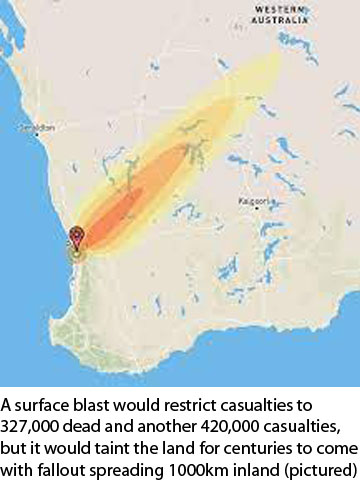
If the Satan warheads explode in a 10MT airburst over Perth, modelling by Nukemap predicts 505,000 fatalities instantly, with another 575,000 injured.
A surface blast would restrict casualties to 327,000 dead and another 420,000 casualties, but it would taint the land for centuries to come with fallout spreading 1000km inland…………….. https://www.dailymail.co.uk/news/article-10562917/Russia-Ukraine-war-happen-nuclear-bomb-dropped-Australia.html
A nuclear bomb on Sydney would mean umimaginable carnage
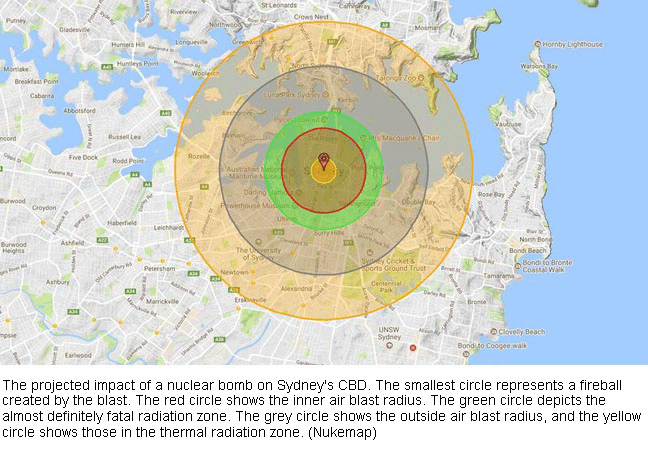
Frightening graphic reveals the horrific carnage a nuclear bomb would cause in Australia’s biggest cities – as Vladimir Putin’s nuclear sabre-rattling sparks global fears, By KEVIN AIRS FOR DAILY MAIL AUSTRALIA, 3 Mar 22, ”……………………But if the attack was to target Sydney or Melbourne, the carnage would be almost unimaginable.
Almost a million would die instantly in a 5km fireball which would engulf Sydney city centre, turning the inner-west, CBD and Eastern Suburbs to ash.
Buildings would be crushed to dust from Homebush to Collaroy to Cronulla.
If the airburst happened over Parramatta, the devastation would be even greater. The entire greater Sydney area from Penrith to Richmond to Palm Beach to Camden and the Royal National Park would be ablaze.
Anyone in the city left alive after the nuclear fireball and initial blast would be suffering third degree radiation burns all over their body, with many losing limbs.
The only saving grace might be that all their nerve-endings would probably be burnt away and they’d feel little to no pain.
Further out and windows in the Illawarra and Central Coast would be blown out by the blast, inflicting maiming injuries on locals, many of whom would be standing by a window to watch the distant explosion.
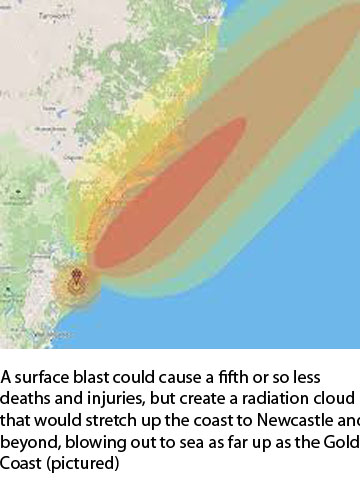
A surface blast could cause a fifth or so fewer deaths and injuries, but create a radiation cloud that would stretch up the coast to Newcastle and beyond, blowing out to sea as far up as the Gold Coast.
‘There’s no doubt that any large-scale nuclear weapons use would be quite catastrophic,’ Australian National University Professor Stephan Fruehling told the I’ve Got News For You podcast.
If you have a nuclear weapon that’s exploded on the ground, you’re looking at a very significant fallout plume and local contamination, which is essentially dangerous because of the radiotoxicity and contaminating water supplies and food chains.’

In Melbourne, a similar airburst explosion would instantly destroy everywhere around the CBD including Docklands, South and East Melbourne and Carlton in a deadly fireball.
More than 900,000 would die in a blink of an eye with another 1.3 million injured.
Everything from Sunshine West to Box Hill and north to Broadmeadows would be flattened in a 30km-wide blast range.
Everyone from Orangefields to Boronia to Whalan would be burnt to a crisp, with windows blown out and property damaged 85km from the epicentre, stretching from Frankston to Bacchus Marsh to Wallan.
A surface explosion would reduce the death total by a couple of hundred thousand, but the radiation cloud would stretch across Victoria, over Albany and Canberra and reach Sydney and Newcastle…………… https://www.dailymail.co.uk/news/article-10562917/Russia-Ukraine-war-happen-nuclear-bomb-dropped-Australia.html
Australia’s rushed nuclear submarine plan- irrelevant, as China’s technology will outpace it.
Australia’s hasty nuclear submarine plan to be outpaced by China’s development: experts, Global Times, By Liu Xuanzun and Leng Shumei: Feb 08, 2022 In an attempt to contain China, Australian Defense Minister recently said that Australia could get the first nuclear submarine under the framework of AUKUS before 2038. However, Chinese military experts said on Tuesday that this delivery schedule is too hasty and China’s rapid development during this period will outpace the Australian one……………..
When the AUKUS agreement was announced, an 18-month process was launched by all members to figure out the best way to deliver Australia nuclear submarines, according to the report by the Sydney Morning Herald.
“From a technological perspective, it is possible that Australia could get its first nuclear submarine by 2038 since the US and the UK are indeed capable of building this kind of submarine,” Zhang Junshe, a senior research fellow at the Naval Research Academy of the People’s Liberation Army, told the Global Times on Tuesday.
However, the question remains on exactly what kind of nuclear submarine Australia will get.
If, for example, the US is willing to sell its off-the-rack Virginia-class submarine or transfer its technology and production lines to Australia, then, 2038 is possible. But, if the three countries are thinking about a customized or a completely new submarine, which is more likely in this case due to the high sensitivity of this kind of military hardware, it will likely take longer, analysts said.
“2038 sounds hasty to design and build a new nuclear submarine for a country with no experience, even with technology transfer,” a Chinese military expert who requested to remain anonymous told the Global Times on Tuesday.
Australia is not a nuclear power and the plan by the US and the UK to grant Australia nuclear-powered submarines increases the risks of nuclear proliferation and an arms race, experts said.
“From a political point of view, the three countries would also have to face the pressure from the international community to meet that schedule,” Zhang said, adding that “even if Australia does get the nuclear submarine, it will not be such a big threat to China, since war cannot be won with just one or two types of weapons.”
“2038 sounds hasty to design and build a new nuclear submarine for a country with no experience, even with technology transfer,” a Chinese military expert who requested to remain anonymous told the Global Times on Tuesday.
Australia is not a nuclear power and the plan by the US and the UK to grant Australia nuclear-powered submarines increases the risks of nuclear proliferation and an arms race, experts said.
“From a political point of view, the three countries would also have to face the pressure from the international community to meet that schedule,” Zhang said, adding that “even if Australia does get the nuclear submarine, it will not be such a big threat to China, since war cannot be won with just one or two types of weapons.”…………………………..
China did not militarize the South China Sea, as all Chinese presence in the region serves only to safeguard national sovereignty and territorial integrity, the expert said, noting that countries from outside of the region like the US, which have been sending warships and warplanes, are the real ones responsible for the militarization in the South China Sea.
”Taskforce” of 400 people joins exclusive discussion on how Australia can get nuclear submarines
Defining’ month for Australia’s nuclear subs program, Innovation, Joseph Brookes 23 Feb 22, The taskforce scoping Australia’s options for acquiring nuclear powered submarines has had its “defining month” in February, passing 200 members and gaining access to a nuclear information sharing agreement with the US and UK.
Defence officials said the “treaty-like” agreement effectively added Australia to the exclusive discussion the US and UK have been having on nuclear technology for more than 50 years and will propel the current nuclear-powered submarine program through its scoping phase…………..
However, while the intention continues to be to build the vessels in South Australia, officials confirmed no explicit minimum local industry involvement has been made yet, with few details – including submarine type – locked in………..
The Canberra-based group grew to 137 members by December and passed 200 this month.
It includes officials from several government departments and agencies as well as at least 10 unidentified private contractors, split into several working groups around the key areas. It also liaises with counterparts in the US and UK, including hosting a formal visit this month.
The taskforce has been given 18 months to identify the optimal pathway to deliver at least eight nuclear powered submarines………………
The agreement, which was signed in November by Defence Minister Peter Dutton but only came into effect this month, allows a deeper level of engagement on sensitive areas like nuclear technology, and its first use has coincided with visits from US and UK defence officials. https://www.innovationaus.com/defining-month-for-australias-nuclear-subs-program/
1 This month

of the week – Australians for War Powers Reform (AWPR)
To see nuclear-related stories in greater depth and intensity
 Antinuclear