US bases including Pine Gap saw Australia put on nuclear alert, but no-one told Gough Whitlam.
By Alex Barwick for the Expanse podcast Spies in the Outback
When Australia was placed on nuclear alert by the United States government in October 1973, there was one major problem.
No-one had told prime minister Gough Whitlam.
One of the locations placed on “red alert” was the secretive Pine Gap facility on the fringes of Alice Springs.
Officially called a “joint space research facility” until 1988, the intelligence facility was in the crosshairs with a handful of other US bases and installations around Australia.
In fact, almost all United States bases around the world were placed on alert as conflict escalated in the Middle East. Whitlam wasn’t the only leader left out of the loop.
A prime minister in the dark
“Whitlam got upset that he hadn’t been told in advance,” Brian Toohey, journalist and former Labor staffer to Whitlam’s defence minister Lance Barnard, said.
Toohey said Whitlam should have been told that facilities including North West Cape base in Western Australia, and Pine Gap were being put on “red alert”.
“There had been a new agreement knocked out by Australian officials with their American counterparts, that Australia would be given advance warning.”
They weren’t.
Suddenly, the world was on the brink of nuclear war.
Why were parts of Australia on ‘red alert’?
The Cold War superpowers backed opposing sides in the Yom Kippur War.
The Soviet Union supported Egypt and the United States was behind Israel.
As the proxy war escalated in October 1973, United States secretary of state Henry Kissinger believed the crisis could go nuclear and issued a DefCon 3 alert.
A DefCon 3 alert saw immediate preparations to ensure the United States could mobilise in 15 minutes to deliver a nuclear strike.
The aim was to deter a nuclear strike by the Soviets.
And, it simultaneously alerted all US bases including facilities in Australia that a nuclear threat was real.
This level of alert has only occurred a few times, including immediately after the September 11 attacks.
Politics, pressure and protest
The secretive intelligence facility in outback Australia caused Whitlam more trouble beyond the red alert.
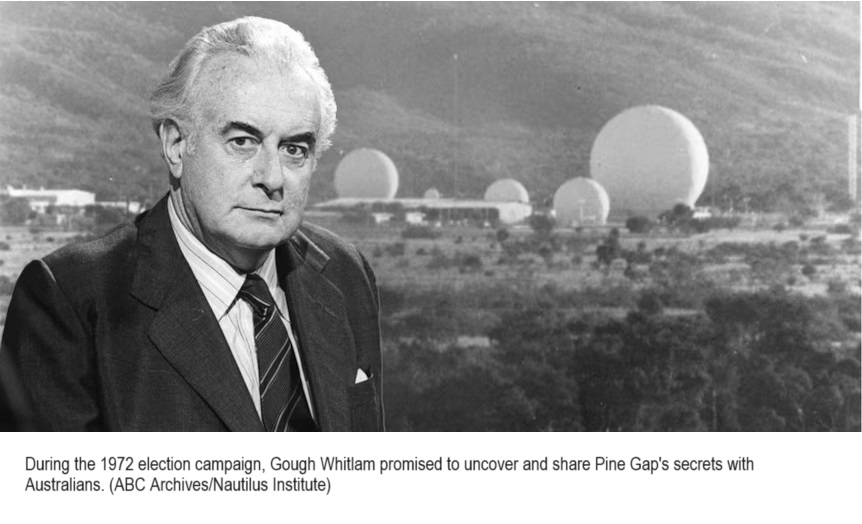
During the 1972 election campaign, the progressive politician had promised to lift the lid on Pine Gap and share its secrets with all Australians.
“He gave a promise that he would tell the Australian public a lot more about what Pine Gap did,” Toohey said.
But according to Toohey, the initial briefing provided to Whitlam and Barnard by defence chief Arthur Tange left the prime minister with little to say.
“Tange came along and he said basically that there was nothing they could be allowed to say. And that was just ridiculous,” Toohey said.
“He said, the one thing he could tell them was the bases could not be used in any way to participate in a war. Well, of course they do.”
Whitlam would cause alarm in Washington when he refused to commit to extending Pine Gap’s future.
In 1974 on the floor of parliament he said:
“The Australian government takes the attitude that there should not be foreign military bases, stations, installations in Australia. We honour agreements covering existing stations. We do not favour the extension or prolongation of any of those existing ones.”
According to Toohey, “the Americans were incredibly alarmed about that”.
“As contingency planning, the whole of the US Defence Department said that they would shift it to Guam, a Pacific island that America owned,” he said.
And the following year, allegations would emerge that the CIA were involved in the prime minister’s dismissal on November 11, 1975.
Former Labor defence minister Kim Beazley labels the scuttlebutt as “bulldust”.
“I’d heard that stuff about the Americans getting frightened and therefore getting involved. I put the matter to study, I got a couple of senior public servants to have a look at it, nothing there, nothing there.”
Despite no conclusive evidence, the rumours continue to swirl.
Episode Two of the ABC’s Expanse podcast: Spies in the Outback is now available. This episode explores the wild political tensions surrounding the spy base in Australia’s backyard. Listen here.
Billions in Israel defence contracts put Australia at risk.
by Stephanie Tran | Aug 17, 2025, https://michaelwest.com.au/billions-in-israel-defence-contracts-put-australia-at-risk/
The Australian Government risks breaking international law, splashing billions in public money on Israel weapons deals. A Stephanie Tran analysis.
The Australian government has funnelled $2.5 billion of taxpayer funds to Israeli arms manufacturers over the past two decades via government contracts.
An analysis of Austender data shows that since 2004, the Australian government has signed dozens of deals with Israel’s largest defence companies, making them some of the country’s most significant foreign suppliers of arms.
But this is just the tip of the iceberg. The true sum is certainly much higher, as the government is not required to disclose subcontracting arrangements, such as the $900 million deal between Elbit Systems and South Korean firm Hanwha to supply the Australian Army with armoured vehicles.
The breakdown of the funds is as follows:
- $1.92 billion to Elbit Systems and its subsidiaries Elistra Electronic System Ltd, Universal Avionics Systems, Geospectrum Technologies and Ferranti Technologies
- $307 million to Israel Aerospace Industries and its subsidiaries, Elta Systems and Elta Electronics industry
- $180 million to Rafael Advanced Defense Systems, its subsidiary Pearson Engineering and a joint venture with Australian company Varley Group, “Varley Rafael”
- $10 million to Israel Military Industries, also known as IMI Systems. (Note: IMI Systems was acquired by Elbit Systems in 2018)
- $870,000 to Plassan
- $210,00 to Rada Electronic Industries
Breaking international law
Lara Khider, Senior Lawyer at the Australian Centre for International Justice, said the contracts place Australia at risk of breaching its international legal obligations.
“States have been put on notice that Israel may be committing internationally wrongful acts in relation to its military and other operations in Gaza and through its unlawful occupation of Palestinian territory,” Khider said, citing multiple International Court of Justice (ICJ) rulings in the South Africa v Israel genocide case and its advisory opinion on Israel’s occupation of Palestinian territory.
“On this basis, States have an obligation to cease aid and assistance to Israel in relation to the commission of these acts. Otherwise, States may be deemed complicit in internationally wrongful conduct.”
She said the ICJ was unequivocal that all states must avoid trade or economic dealings that entrench Israel’s unlawful presence in occupied Palestinian territory and refrain from aiding or assisting its maintenance. Under the Arms Trade Treaty, to which Australia is a signatory, governments are required to block weapons transfers if there is an overriding risk they would be used to commit serious violations of the Geneva Conventions.
The Australian Centre for International Justice has called for a two-way arms embargo “as a bare minimum” to ensure Australia does not contribute directly or indirectly to violations of international law in the Occupied Palestinian Territories.
Department of Defence did not respond – does it ever?
The Department of Defence did not respond to a request for comment regarding whether it would cancel its existing contracts and refrain from entering into new contracts for the procurement of arms from Israeli defence companies in light of the ongoing genocide in Gaza.
Greg Barns SC, a spokesman for the Australian Lawyers Alliance, said continuing the contracts undermines Australia’s moral and legal credibility.
“Australia has an obligation to comply with all of the international agreements, treaties and covenants to which it is a signatory. That any Australian government would allow the supply of defence equipment to a country committing war crimes and genocide is morally reprehensible and a clear breach of international law,” Barns said. “This reduces Australia’s standing globally in terms of adherence to the rule of law.”
Australia’s F-35 exports a “facilitation of war crimes”: US expert.

Following Sydney’s huge protest against Israel’s killing and starvation of Palestinians in Gaza, the federal government has doubled down on its misinformation about Australia’s arms exports to Israel
Undue Influence, Michelle Fahy and Elizabeth Minter, Aug 17, 2025
The Labor government’s word games continue as it tries to persuade an increasingly sceptical public that Australia’s hands are clean when it comes to complicity in Israel’s genocidal war against the Palestinian people.
An expert on US arms exports has given short shrift to the Albanese government’s misleading mantras, telling ABC radio last weekend that Australia was facilitating war crimes by exporting F-35 parts and components to Israel.
When asked how he would describe the Australian military’s recent direct supply of F-35 parts to Israel, former US State Department official Joshua Paul said: “It’s directly a facilitation of war crimes. There’s no question about it, to my mind.”
Mr Paul made international headlines in 2023 as the first US official to resign publicly in protest over the Biden administration’s policy of expediting weaponry to Israel for its current war on Gaza, stating that America knew the weapons were to be used to commit human rights violations. Mr Paul was director of congressional and public affairs at the Bureau of Political-Military Affairs, a US State Department agency that works closely with the Pentagon on weapons transfers.
Defence Minister Marles squirms under scrutiny
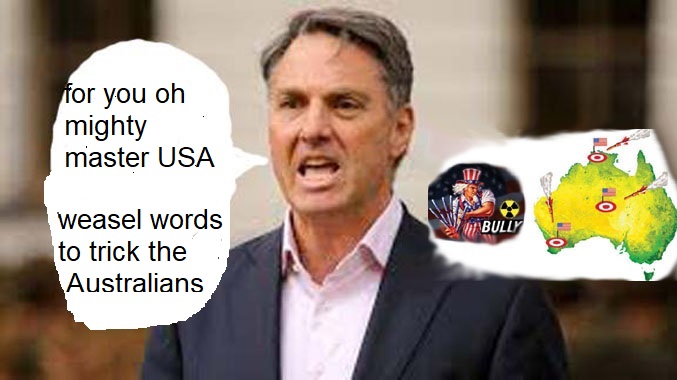
Also last weekend, on ABC TV’s Insiders, Defence Minister Richard Marles criticised what he labelled “misinformation” about Australia’s arms exports to Israel. Yet he refused to answer basic questions on the topic, resorting repeatedly to the government’s discredited mantra that Australia is not supplying weapons to Israel.
Mr Marles also passed the buck for his role in personally approving Australia’s continued export of F-35 parts and components, deflecting responsibility for the F-35 global supply chain onto prime manufacturer, Lockheed Martin.
Without providing any justification, Mr Marles claimed that Australia’s F-35 exports presented a “very different question” and were a “separate issue” from other arms exports.
Australia’s F-35 exports cannot be separated out from the overarching question of Australia’s arms exports to Israel during its genocidal war on Gaza.
The Defence Department has stated that more than 75 Australian companies have contributed to the F-35 global supply chain, which has been working overtime – at “breakneck speed” – for almost two years to increase spare part supply rates to ensure Israel’s F-35s remain operational.
In her June report, From economy of occupation to economy of genocide, the UN’s Special Rapporteur on human rights in the occupied Palestinian territories, Francesca Albanese, named Lockheed Martin and the members of its F-35 supply chain as enhancing Israel’s ability to sustain its genocide of Palestinian people.
Mr Marles’ claims are also at odds with a significant UN statement last year: ‘States and companies must end arms transfers to Israel immediately or risk responsibility for human rights violations’, which named 11 multinationals, including Lockheed Martin and BAE Systems. These companies, by sending weapons, parts, components, and ammunition to Israeli forces, risk being complicit in serious violations of international human rights and international humanitarian laws, the statement said.
UK-based BAE Systems is one of Lockheed Martin’s three major partners in the F-35 supply chain. Its Australian subsidiary is also involved in supplying parts and components.
Australia’s export of F-35 parts and components into the supply chain is essential to the assembly of new aircraft and the maintenance and operation of the global fleet, including Israel’s F-35s.
Australia is the sole global source of some F-35 parts and components including, for example, the high-tech mechanism that opens and closes the weapons bay doors, enabling Israel to drop bombs on Gaza.
Despite this, foreign minister Penny Wong repeated in the Senate last month the ludicrous assertion she and Richard Marles first aired last year that the Australian-made parts and components in the world’s most lethal fighter jet are “non-lethal”. (Watch SBS News clip.)………………………………………………………………………………………………………………………….
Could Australia make a difference?
Undue Influence last year reported comments by the head of the US-based F-35 joint program office, Lieutenant General Michael Schmidt, that the just-in-time F-35 global supply situation was “too risky”.
Despite claims from Mr Marles and Ms Wong that Australia has no power to make any impact on Israel’s military activities in Gaza, Josh Paul’s insights reinforce the fact that Australia could make a difference, should it have the courage to do so.
Australia could announce it will cease its export of F-35 parts and components unless or until the other member nations of the F-35 consortium agree to cease exporting to Israel. https://undueinfluence.substack.com/p/australias-f-35-exports-a-facilitation?utm_source=post-email-title&publication_id=297295&post_id=171175147&utm_campaign=email-post-title&isFreemail=true&r=1ise1&triedRedirect=true&utm_medium=email
The AUKUS Submarine Deal is Dead

National Security Journal, By Andrew Latham, 7 Aug 25
– Key Points and Summary – The central promise of the AUKUS security pact—to provide Australia with nuclear-powered submarines—is reportedly no longer viable due to a severe crisis in the U.S. and UK defense industrial bases.
-The U.S. Navy is struggling to build and maintain its own submarine fleet and cannot spare any Virginia-class boats, while the UK’s industry has no surplus capacity to make up the shortfall.
-This leaves Australia facing a dangerous capability gap.
-As a result, Canberra is now forced to upgrade its aging Collins-class submarines and fast-track its own domestic submarine production, a process that will take over a decade.
The AUKUS Submarine Deal Looks RIP
The central element of AUKUS was always the promise to provide Australia with nuclear-powered submarines. According to the terms of the agreement, the US would provide Australia with at least three Virginia-class boats, and the UK and Australia would begin development on their own SSN-AUKUS platform. This plan is no longer viable.
The United States can’t provide the submarines; the United Kingdom can neither make up for the shortfall nor co-develop such a submarine in a reasonable timeframe; and Canberra must now face the unpleasant truth that the promises made in 2021 were more fantasy pledges than realistic commitments.
…………………..there was a tacit acknowledgement all along that a nuclear submarine program was more than a propulsion system—it was an entire industrial ecosystem. It needs an industrial base, a trained workforce, a secure supply chain, and, most critically, decades of institutional memory. AUKUS made the assumption that the United States could build Virginia-class submarines for itself and its AUKUS partners. That is no longer a reasonable assumption.
The US Navy is two boats short of its target force, it’s fielding a rate of barely 1.2 boats a year (far short of a two-per-year benchmark), and it has a chronic maintenance backlog that leaves a third of its force in port. It is unable to uprate its skilled labor pool, reactor modules, or dry dock capacity, and there is no margin in the shipyards even with billions in new money being injected into the program. Canberra had pledged US$2bn by the end of 2025 to help build up US industrial capacity. The yards at Groton and Newport News have no space to spare even for that investment. The bottleneck is a systemic one.
Admiral Daryl Caudle was frank in testimony last month. The US industrial base, he testified, would have to double its attack submarine output for America to meet its obligations under the AUKUS agreement with Australia and the United Kingdom. In April, the Pentagon initiated a 30-day review to see if it could simultaneously meet the needs of the US Navy and the Australian demand. Four months later, the review is still not public, but the answer is already clear: the US cannot do both. It cannot, even if it wanted to, turn over one or two boats to Australia, because the Navy has none to spare. Even if it did, the optics of transferring high-end submarines to another country while its own force contracts would be impossible for Congress to accept.
And the UK simply cannot provide subs in place of the promised but undeliverable American boats. The Royal Navy has already made an in-principle commitment to the SSN-AUKUS program. Still, Britain’s existing submarine program, which produces the Astute-class submarine, has suffered from years of delays, budget overruns, and production shortfalls since it was first launched. And BAE Systems, the prime contractor in the British submarine industry, has minimal spare capacity to increase the rate of production beyond its existing domestic orders. In short, there are no surplus subs—and, more importantly, no realistic possibility of any near-term export of nuclear-powered boats to Australia before the 2040s. Political will aside, industrial capacity isn’t there. The UK cannot bail out the US shortfall, and the AUKUS partnership as a viable trilateral supply chain has effectively ceased to exist. That, in turn, leaves Australia with no option but to fast-track its submarine industrial base; a process which it is already doing, quietly but steadily.
Canberra is already responding. The Collins-class submarines, at more than 20 years old, are being upgraded and their lifespan extended………………………. Australia will not be launching a domestically built nuclear submarine before the late 2030s. That is a decade away. The capability gap is real, and the risk profile is increasing.
The idea that the US could transfer a Virginia-class boat or two to make good the gap was floated early on. The politics have since moved against it. Congress is increasingly dubious about hardware transfers when the state of American readiness is already so poor. The Navy itself is against anything that would take boats from its already underpowered undersea fleet. The situation is not in flux: it is set. Washington cannot deliver what it promised. The internal Pentagon review, which has already been provided to Congress, reportedly makes that clear. The language might be diplomatic; the reality is not…………………………………………………… https://nationalsecurityjournal.org/the-aukus-submarine-deal-is-dead/
Australia won’t receive Aukus nuclear submarines unless US doubles shipbuilding, admiral warns
Former prime minister Malcolm Turnbull says there is a ‘very, very high’ chance Virginia-class subs will never arrive under Australian control.
Ben Doherty, 28 July 25, https://www.theguardian.com/world/2025/jul/28/aukus-australia-nuclear-submarines-us-subs-navy-admiral
The US cannot sell any Virginia-class nuclear submarines to Australia without doubling its production rate, because it is making too few for its own defence, the navy’s nominee for chief of operations has told Congress.
There are “no magic beans” to boosting the US’s sclerotic shipbuilding capacity, Admiral Daryl Caudle said in frank evidence before a Senate committee.
The US’s submarine fleet numbers are a quarter below their target, US government figures show, and the country is producing boats at just over half the rate it needs to service its own defence requirements.
Testifying before the Senate Committee on Armed Services as part of his confirmation process to serve as the next chief of naval operations, Caudle lauded Royal Australian Navy sailors as “incredible submariners”, but said the US would not be able to sell them any boats – as committed under the Aukus pact – without a “100% improvement” on shipbuilding rate
The US Navy estimates it needs to be building Virginia-class submarines at a rate of 2.00 a year to meet its own defence requirements, and about 2.33 to have enough boats to sell any to Australia. It is currently building Virginia-class submarines at a rate of about 1.13 a year, senior admirals say.
“Australia’s ability to conduct undersea warfare is not in question,” Caudle said, “but as you know the delivery pace is not what it needs to be to make good on the pillar one of the Aukus agreement which is currently under review by our defence department”.
Caudle said efficiency gains or marginal improvements would not be sufficient to “make good on the actual pact that we made with the UK and Australia, which is … around 2.2 to 2.3 Virginia-class submarines per year”.
“That is going to require a transformational improvement; not a 10% improvement, not a 20% improvement but a 100% improvement,” he said.
Under pillar one of the Aukus agreement, Australia is scheduled to buy between three and five Virginia-class nuclear-powered submarines from the US, starting in 2032.
The UK will build the first Aukus-class submarine for its navy by “the late 2030s”. The first Australian-built Aukus boat will be in the water “in the early 2040s”. Aukus is forecast to cost Australia up to $368bn over 30 years.
US goodwill towards Australia, or the import of the US-alliance, would be irrelevant to any decision to sell submarines: Aukus legislation prohibits the US selling Australia any submarine if that would weaken US naval strength.
Australia has already paid $1.6bn out of an expected total of $4.7bn (US$3bn) to help the US boost its flagging shipbuilding industry.
But the US itself has been pouring money into its shipbuilding yards, without noticeable effect.
A joint statement on “the state of nuclear shipbuilding” issued by three rear admirals in April noted that while Congress had committed an additional US$5.7bn to lift wages and shipyard productivity, “we have not observed the needed and expected ramp-up in Columbia-class and Virginia-class submarine production rates necessary”.
Caudle, himself a career submariner, said the US would need “creativity, ingenuity, and some outsourcing improvements” if it were to meet its shipbuilding demands and produce 2.3 Virginia-class vessels a year.
“There are no magic beans to that,” he told the Senate hearing. “There’s nothing that’s just going to make that happen. So the solution space has got to open up.”
‘Why is there no plan B?’
The former prime minister Malcolm Turnbull, who first reported on Caudle’s testimony to the Senate, told the Guardian that there was “no shortage of goodwill towards Australia” from the US in relation to Aukus, but the realities of a shortfall of submarines meant there was a “very, very high” probability that Virginia-class submarines would never arrive under Australian control.
Turnbull said the language coming from US naval experts was “framing expectations realistically”, essentially saying that, without dramatic reform, the US could not sell any of its Virginia-class boats. With the Collins class nearing the end of their service lives, and the Aukus submarine design and build facing delays in the UK, Australia could be left without any submarine capability for a decade, potentially two, Turnbull argued.
“The risk of us not getting any Virginia-class submarines is – objectively – very, very high. The real question is why is the government not acknowledging that … and why is there no plan B? What are they doing to acquire alternative capabilities in the event of the Virginias not arriving?”
Turnbull – who, as prime minister, had signed the diesel-electric submarine deal with French giant Naval that was unilaterally abandoned in favour of the Aukus agreement in 2021 – argued the Australian government, parliament and media had failed to properly interrogate the Aukus deal.
“When you compare the candour and the detail of the disclosure that the US Congress gets from the Department of the Navy, and the fluff we get here, it’s a disgrace. Our parliament has the most at stake, but is the least curious, and the least informed.
On Friday, the defence minister, Richard Marles, told reporters in Sydney “work on Aukus continues apace”.
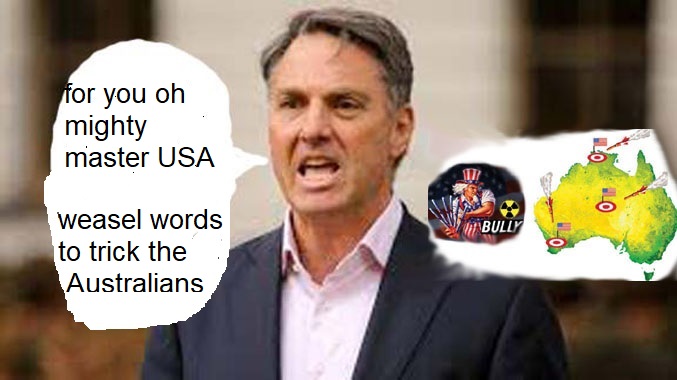
“We continue to work very closely … with the United States in progressing the optimal pathway to Australia acquiring a nuclear-powered submarine capability,” he said.
“In respect of the production and maintenance schedule in the United States, we continue to make our financial contributions to that industrial base.”
Marles cited the $1.6bn paid to the US to boost its shipbuilding industry already this year, with further payments to come, and said that 120 Australian tradespeople were currently working on sustaining Virginia-class submarines in Pearl Harbor.
“All of that work continues and we are really confident that the production rates will be raised in America, which is very much part of the ambition of Aukus.”
The Guardian put a series of questions to Marles’s office about Caudle’s Senate testimony.
AUKUS Submarine Regulations: FoE Adelaide submission
Friends of the Earth Adelaide > Publications > Adelaide FoE Notes > AUKUS Submarine Regulations: FoE Adelaide submission
Philip White July 24, 2025, https://adelaidefoe.org/aukus-submarine-regulations-foe-adelaide-submission/
Friends of the Earth Adelaide today (24 July 2025) sent a submission in response to the government’s call for public comments on draft Australian Naval Nuclear Power Safety Regulations. These Regulations were drafted under the Australian Naval Nuclear Power Safety Act, which was passed in October last year. Our submission can be accessed here.
The consultation is open until 30 July 2025. Details can be found on the following web site: https://www.defence.gov.au/about/reviews-inquiries/australian-naval-nuclear-power-safety-regulations-public-consultation
FoE Adelaide’s submission can be summarised as follows:
— AUKUS should be cancelled. It compromises Australia’s sovereignty and is not in our strategic, economic, or environmental interests.
— If it is not cancelled, there should be a proper consultation about the Stirling and Osborne designated zones, which were declared in the Australian Naval Nuclear Power Safety Act without consultation.
— The principles of “free, prior and informed consent” should be followed in siting any site for storage and disposal of radioactive waste.
— That includes respecting laws of State and Territory governments that restrict or prohibit siting of nuclear waste facilities.
— The Regulator must be completely independent of the Defence portfolio. In the current proposal it will be answerable to the Minister for Defence.
— All submissions should be published in full, unless the submitter specifically requests otherwise. Government representatives informed us on 17 July at a public forum in Port Adelaide that they only intend to publish a summary put together by bureaucrats.
Trillion dollar AUKUS subs plus nuclear waste in perpetuity?
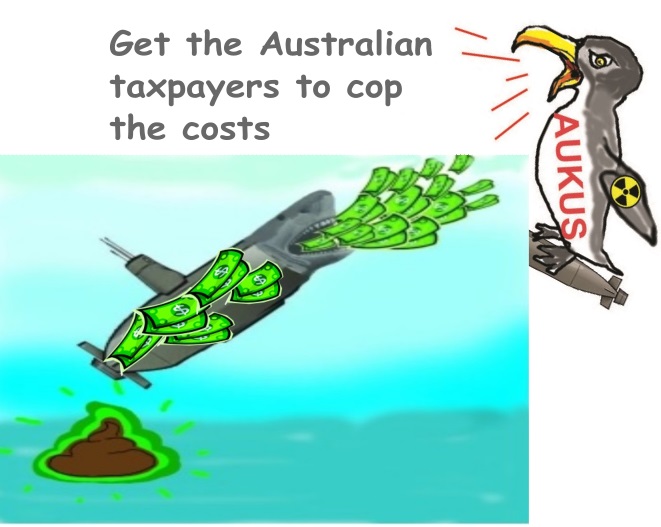
by Rex Patrick | Jul 22, 2025 , https://michaelwest.com.au/trillion-dollar-aukus-subs-plus-nuclear-waste-in-perpetuity/
Everything about AUKUS nuclear waste is a political secret, including the cost, which will more than double the $368B announced AUKUS price tag. Former submariner Rex Patrick with the story.
Rex Patrick with the story.
If we ever get these subs, the total price tag may well be over $1 trillion. I’m in the Federal Court at present, trying to pry open a November 2023 report into how the Government intends to deal with the high-level nuclear waste from AUKUS submarines.
But there’s already a lot we can deduce by combining what has been extracted from the Government using Freedom of Information (FOI) laws, from Senate testimony and also looking at how the United States does and doesn’t take care of its naval nuclear waste.
Cost explosion
For starters, there was a short but insightful exchange in Senate Estimates last year between Senator Lidia Thorpe and the head of the Australian Submarine Agency (ASA), Admiral Jonathon Mead.
After making quick reference to the cost of nuclear waste facilities overseas, Senator Thorpe asked about the waste costs for AUKUS, “There’s no costing as yet; is that right?” Mead responded, “That’s correct”.
For an organisation that is required to cost its capability from cradle to grave, including support facilities, it’s a huge omission. It might be the case that
“they’re too frightened to do the math.”
As I will set out below, the price of safely storing AUKUS waste is likely to double the AUKUS price tag. But first, we need to take a look at what radioactive waste AUKUS will produce and what will be done with it.
Low-level waste
We know that Australia’s nuclear-powered submarines will produce small amounts of low-level waste every year (disposable gloves, wipes, reactor coolant and Personal Protective Equipment). ASA Senate Estimates briefs obtained under FOI suggest that this will amount to “roughly the volume of a small skip bin each year.”
This, along with low-level waste from US and UK submarines operating out of Perth, will be stored at HMAS Stirling until the Australian Waste Management Agency builds and commissions the National Radioactive Waste Management Facility.
Barely noticed by the national media, the Parliamentary Standing Committee on Public Works approved the construction of a ‘Controlled Industrial Facility’ at HMAS Stirling in August 2024.
High-level waste
When each AUKUS submarine decommissions, Australia will need to handle the recovery, transport, storage and disposal of two different types of high-level nuclear waste: spent nuclear fuel, about the size of a small hatchback, and the reactor compartment, about the size of a four-wheel drive.
Noting the total lack of transparency around Australia’s plans, MWM is making a reasonable assessment as to how this waste will be handled by looking to the US.
Fuel rods will be removed from the submarine at a decommissioning yard (possibly Henderson in WA for the Virginia Class and Osborne in SA for the SSN-AUKUS submarines).
The hull is cut open, and a defueling enclosure is installed on the submarine to provide a controlled work area. The fuel is removed into a shielded transfer container and moved to a wharf enclosure. It’s then placed into a specially designed shipping container for transfer to, in the case of the US, an intermediate ‘storage site’ in Idaho. Despite 70 years of nuclear-powered submarine operations (USS Nautilus was commissioned in 1955), the US has not yet sorted out its long-term ‘disposal site’.
It is not clear whether Australia will have an intermediate ‘storage site’ and a ‘disposal site’ or a combined site. Certainly, both storage and disposal are talked about in the information that has been released under FOI.
Australia is not permitted, by the text of the AUKUS Treaty and by commitments made to the International Atomic Energy Agency, to reprocess the fuel. Reprocessing involves separating the plutonium and fissile uranium from the spent fuel to reduce the amount of spent fuel that needs to be stored long term, but doing so raises nuclear weapon proliferation concerns.
For Australia, we have to find a geologically suitable place to bury the fuel in the state it was when it left the submarine. Whilst the Defence Minister has declared this will be on ’Defence land’, the ASA can identify a news site and the Minister can compulsory acquire it – anywhere in Australia.
Reactor compartment
To deal with the reactor compartment, all of the elements of the reactor that will remain in the compartment – the pressure vessel, piping, tanks and fluid system components – are drained to the maximum extent practicable. About 2% of the liquid remains trapped in discrete pockets.
All openings are then sealed.
The reactor compartment is then cut from the submarine, and with the pressure hull remaining as part of the disposal package, the high-strength steel serves as an outer seal.
In the United States, the reactor compartment is transported to “Trench 94” in Washington state.
It is not yet known whether the Australian Government will bury the reactor compartments in a final disposal site.
Looking after high-level nuclear waste is complex. You can’t responsibly just bury it or dump it in a deep mine shaft.
Nuclear waste facility
A waste facility must be carefully located, away from seismic activity, away from flooding and other weather events and generally where geological structure allows for deep, very long-term storage. Geoscience Australia has looked at suitable locations for a high-level radioactive Waste store on occasions between 1976 and 1999 (subject to a National Archives request).
It must also be located with suitable transport pathways from the submarine dismantling yard or possibly several yards.
The site must be prepared and built/bored. It must have access to electricity supplies, water, communications and sewerage. It must allow for the safe receipt and storage of fuel and the reactor compartments, it must be resilient to loss of heating or ventilation, loss of electricity, flow blockages, structural failures, etc.
“It must be resilient for well over a millennium.”
It must also be designed with the necessary security in mind, with access control, constant monitoring, intrusion detection and central alarms in place, and be secure in relation to protest and sabotage and have a co-located response capability. It must provide for safe long-term storage, with multiple barriers in place to prevent release of radioactive material, and be designed to deal with large accidental radioactive releases.
At the same time, the facility will be subject to international non-proliferation safeguards overseen by the International Atomic Energy Agency, which will require periodic access and perhaps remote monitoring and surveillance.
It will likely need a level of remoteness, but be able to be staffed by relevantly qualified personnel, and to receive surge responders in the event of an emergency.
Design and construction would take close to ten years.
What will it take?
The Government has committed to consultation as it selects a site for long-term disposal, yet the law does not require it.The decision to locate a National Radioactive Waste Management facility at Kimba in South Australia involved a lot of communication, some consultation, but very little listening. The Federal Court ultimately found that the decision-making process for that site was seriously flawed. The Liberals get a D minus.
Labor got the Parliament to declare both HMAS Stirling in Perth and the shipyard precinct at Osborne in Adelaide a ‘designated zone’ for nuclear activities. There was no consultation, so they get an F.
Section 10(2)(c) of the Australian Naval Nuclear Power Safety Act 2024 allows the minister to designate more zones. The consultation can be of a ‘tick-the-box’ nature.
While we don’t know what the cost of an underground storage/disposal facility would be, documents released under FOI show that a 2019 cost estimates study by Altus Expert Services placed the cost of an above ground facility at Kimba at $923 million. We could reasonably expect a deep storage facility could cost billions.
Then there are the ongoing operational costs of the facilities, over several hundred years.
Even at an annual cost of only $30 million per annum, that’s close to $4B over 120 years. And if the site is then sealed for 100,000 years, as the Finnish intend to do with their underground facility, there’s even more cost. Even if monitoring of sealed waste only cost 1/10th of the yearly operating cost, say $3million, the cradle-to-grave cost of dealing with AUKUS high level waste will add up to more than $300 billion; $300B that seems to have slipped ASA’s minds.
One thing’s for sure, there’s been too much secrecy around this radioactive hot potato. Maybe things will fall my way in the Federal Court. But it would be much better if the Government was just be up-front with everyone, particularly as we tax-payers have to pay for it.
Rex Patrick
Rex Patrick is a former Senator for South Australia and, earlier, a submariner in the armed forces. Best known as an anti-corruption and transparency crusader, Rex is also known as the “Transparency Warrior.”
Australians recruited for Israel’s ‘weaponised aid’ project in Gaza
by Yaakov Aharon | Jul 1, 2025 , https://michaelwest.com.au/australians-recruited-for-israels-weaponized-aid-project-in-gaza/
A Melbourne company is recruiting Australians to work on a mysterious Israeli and American-backed aid project in Gaza. Could it be the infamous Gaza Humanitarian Foundation?
An ad posted by Claymore Personnel – named after an anti-personnel landmine – promises that successful candidates will “be looked after.”
Workers will have accommodation expenses in Israel covered, operate in American-led teams, and receive payment in US dollars.
While it remains impossible to verify exactly who Claymore is working with, the shortlist of aid agencies that fit Claymore’s description ranges from bad to worse.
There is precisely one self-described ‘aid agency’ thriving in Gaza right now, and that is the Gaza Humanitarian Foundation (GHF). Fogbow lags in a distant second place.
The Israeli and American governments back both agencies; both agencies rely on private security contractors to distribute aid; both agencies’ founders are American military and intelligence officials; both have been implicated in massacres at Gaza aid sites.
This month alone, at least 450 have been killed and 3500 injured while waiting for food at sites operated by GHF, a Mossad and CIA-backed front.
Looking for adventure?
Before GHF had begun its Gaza operations on May 27, it was already the subject of condemnation in a joint statement issued by aid agencies. The letter condemned GHF as “a dangerous and politicised sham” and “a blueprint for ethnic cleansing”.
Claymore posted ads on seek.com and on its official website on May 28, a day after GHF hit the ground. The first batch of recruits left for Gaza two weeks later.
Reports of massacres at sites of American-led aid projects did not dampen Claymore’s spirits. Its mission to recruit carried on throughout June, with the ad saying workers deployed to Gaza will have a “3-month contract with strong potential for multiple extensions”.
While most aid sites in Gaza were closing down, prospects for Claymore’s partners were expanding. “A large humanitarian distribution centre is now operating in Gaza”, Claymore’s ad said.
The recruitment agency sought Australian labourers, truck drivers, and forklift operators willing to work for low wages paid in USD ($3250-$6000 monthly). Successful candidates enjoyed full travel sponsorships. The ad on Claymore’s website assured applicants that there would be no police checks. The seek.com ad said otherwise.
On each workday, the workers would be provided with “secure transport” from Israeli accommodation to worksites at “secure zones” in Gaza.
MWM spoke to Senator Mehreen Faruqi, the Greens Spokesperson for International Aid, who condemned “any so-called ‘humanitarian’ effort that operates at the whim of the genocidal Israeli military”.
“I’m concerned that Australian companies appear to be inserting themselves into a brutal system where ‘aid’ is delivered at gunpoint, guarded by soldiers and private contractors, while starving Palestinians are forced to risk their lives just to access basic supplies.”
Chasing ghosts
Tracking yesterday’s leftover footprints at Bondi Beach is easier than following Claymore’s digital footprints.
The LinkedIn profile of the company’s sole director, Tanya Molloy, provides no information beyond her role at the small business, which was founded in 2023. Trusted aid agencies and union officials told MWM on background they were not aware of Claymore, nor of any project it may be associated with in Gaza.
The recruitment agency’s address is listed as CSS Partners, a small accounting firm in Keilor East, Victoria. MWM called CSS’s landline and asked to be put through to Claymore. The receptionist said they were not aware that Claymore had listed its address as CSS Partners, and that the company’s relations were with an accounting firm to a client.
An associate of MWM visited the address listed on government records as Claymore’s principal place of business in Altona North, Victoria.
“It is in a large, remote industrial area,” was the report back from the Altona North office. “There is no sign or even a number on a door. I think it’s empty.”
Playing mum against dad
Tanya Molloy lives with Claymore’s secretary, the American-born Calum McEwan, in a suburban Melbourne townhouse.
When MWM asked Molloy who Claymore was working with, she was coy.
“Claymore Personnel is a recruitment agency only — we are not involved in the political, logistical, or operational aspects of any aid delivery. We supply skilled workers for overseas roles, and once placed, our involvement ends. We’re not affiliated with any government, military, or aid organisation.”
Due to the sensitivity of the work and the well-being of those on the ground, I won’t be commenting further.”
Further statements by Molloy deny any association with GHF.
If nothing else, Claymore’s footsteps follow the lead of GHF, which also lists its address as an abandoned warehouse in Delaware, USA.
Text messages leaked to MWM raise doubts about Molloy’s firm assertion that Claymore has no association with GHF.
“The company the candidates will be working for is JK International – jkiglobal.com”, Calum McEwan said, in a response to a concerned humanitarian last month.
When the recipient of the texts asked McEwan if JK International works for GHF, McEwan responded “I don’t have this information.”
Claymore’s ad says it is “the only Australian contact point for this operation”, after being “personally engaged by [an] international logistics group”.
JK International is a global logistics and shipping company based in Tennessee, USA. Its business partners include the USA’s Department of Homeland Security and Customs Trade Partnership Against Terrorism, as well as Israel’s largest shipping company, Zim – a key player in the global weapons supply chain.
Supply and demand
Israeli Prime Minister Benjamin Netanyahu is wanted for arrest by the International Criminal Court for charges of war crimes, including ‘starvation of civilians as a method of warfare’.
Rather than heeding calls to obey international law, Israel has doubled down. Israel says it has no obligation to provide aid to Palestinians, given its allegations that Hamas steals aid at gunpoint and has infiltrated the United Nations.
Israel’s parliament passed sweeping restrictions on aid agencies working in Gaza. UNWRA and UNICEF were banned from delivering aid into the Occupied Palestinian Territory, in breach of orders issued by the International Court of Justice.
Any worker or organisation that has expressed the wrong political opinions will be refused entry by Israel. Background checks will ensure workers have never made statements that “delegitimise” Israel or question its identity as “a Jewish and democratic state” ($).
Each Palestinian who receives aid is also vetted to ensure they have no connections, according to Israel’s standards, to a Palestinian resistance group.
A government statement said these changes guarantee aid is distributed “in a manner aligned with Israel’s national interests”.
Funding criminal gangs in Gaza
Instead of trusted agencies, aid is increasingly provided by American private military contractors, as well as Israeli-backed gangs.
Earlier this month, Israeli opposition figure Avigdor Lieberman revealed that Mossad and the Ministry of Defence were arming and funding criminal gangs in Gaza. Further reports reveal security at GHF aid sites is provided by mercenaries from Safe Reach Solutions, a firm founded by former CIA officers.
These reforms weaponised aid to undermine Hamas on a grassroots level.
After reports that Israeli Forces massacred Palestinians at a GHF site in Rafah, Israel released footage that it claimed showed Hamas fighters were responsible. In fact, the footage depicted a different massacre, at a different GHF site, committed by Israeli-backed gangs as they stole aid.
Government declines to answer
Greens Senator Mehreen Faruqi called on the Albanese Government to “urgently clarify whether it has had any involvement in authorising or facilitating this project, and whether it has provided any diplomatic, logistical or intelligence support to Claymore Personnel or related actors.”
“DFAT has a clear responsibility to ensure any Australian-linked aid effort operates fully in line with international humanitarian law,” Faruqi said. “That includes not participating in a system where aid is used as a tool of control and oppression.”
Several international humanitarian law organisations cosigned a letter yesterday expressing concern about Gaza’s privatised “humanitarian” operators.
The letter issues a warning to all those involved with GHF — including states, companies, and contracted workers – of their potential liability for complicity in genocide.
MWM spoke to Lara Khider, acting executive director of the Australian Centre for International Justice, which was among the organisations that signed the letter.
“Any recruitment of civilians into areas of conflict or occupied territory must be approached with the utmost caution and transparency,” Khider said. “Particularly where international humanitarian law and the risk of complicity in grave breaches of international law may be engaged.”
“It is imperative that Australian nationals and entities exercise due diligence and avoid any involvement that could directly or indirectly support or legitimise unlawful conduct.”
Another government official told MWM that state funding is directed toward United Nations agencies, the Red Cross and the Red Crescent – but refused to answer if the government supported Claymore or its associates.
MWM asked the Department of Foreign Affairs and Trade (DFAT) if it was aware of – and approved – Claymore’s aid project.
To say DFAT dodged the question is to compliment it unfairly for showing grace and dexterity.
“Any Australian travelling overseas for employment should ensure they are not in breach of Australian law and follow all travel advice on Smartraveller,” a department spokesperson said.
To DFAT’s credit, Smartraveller is clearer in its profile on Gaza and Israel: “Do not travel.”
Shayne Chester contributed to research.
Interviewed Israeli soldiers claimed their commanders ordered them to shoot civilians collecting aid at GHF sites. The Military Advocate-General then instructed the IDF to investigate these reported war crimes.
Time for Australia to sign non-nuclear treaty

Tilman Ruff says support for the “illegal and unwarranted” US military action in Iran has damaged Australia’s global reputation, and ratifying the treaty would help to repair its credibility.
The Australian co-founder of a Nobel Prize-winning advocacy group says it is time for Labor to honour its promise, while in opposition, to ratify the UN’s nuclear weapons ban treaty.
The Saturday Paper, By Kristina Kukolja, 28 June 25
Australia has long been at the forefront of global efforts towards the containment of nuclear threats. Now, in the wake of the American military strikes on Iran, the International Atomic Energy Agency says the global nonproliferation system is on the brink of collapse. Australian campaigners are calling on the government to step up its advocacy for nuclear disarmament.
“It’s an alarmingly dangerous time – the nonproliferation regime is under severe threat,” says Dr Tilman Ruff, who is co-founder of the International Campaign to Abolish Nuclear Weapons (ICAN), a Nobel Prize-winning advocacy group founded in Australia.
He calls the United States attack on Iran a “frightening escalation” that dealt a “body blow to the peaceful nonproliferation regime … which was already in a parlous state”.
Ruff says Australia must urgently show it is serious about nuclear disarmament by signing and ratifying the Treaty on the Prohibition of Nuclear Weapons (TPNW). Now in its second term, the Labor government has yet to act on a commitment it made while in opposition to sign and ratify the treaty. Ruff is concerned the US is putting pressure on the Albanese government not to sign. He says ICAN has been told that ratification of the treaty hasn’t been raised in cabinet, and it must be. “The issue needs prime ministerial leadership,” Ruff says.
“The reasons for the delay are American pressure and the displeasure that the US would indicate when Australia does this.”
He says support for the “illegal and unwarranted” US military action in Iran has damaged Australia’s global reputation, and ratifying the treaty would help to repair its credibility.
“Australia joining the TPNW would be of global significance, especially if it became the first nuclear weapons supporting and assisting ally of a nuclear-armed state to do so. It would be the most effective way we could support peace and nuclear disarmament, prevent nuclear war and reinforce the rule of law.”
Australia has maintained a strong bipartisan nuclear nonproliferation stance for decades. The Whitlam Labor government established the Australian Safeguards and Non-Proliferation Office (ASNO) more than 50 years ago. It was a Coalition foreign affairs minister, Alexander Downer, who took the test ban treaty to the United Nations General Assembly in 1996, and Australia now has the third-biggest network of stations monitoring for signs of nuclear testing in the world…………………………………………………………………….
Australia’s decision to join AUKUS has raised questions in the Pacific about its ability to meet its own obligations, as a signatory to the South Pacific Nuclear Free Zone Treaty, also known as the Treaty of Rarotonga.
“Pacific peoples feel a great sense of betrayal from what Australia did,” says Fiji-based Epeli Lesuma, a demilitarisation campaigner with the Pacific Network on Globalisation.
“Australia uses a term in Fiji called the ‘Vuvale’ partnership, which means ‘family’. ‘Vuvale’ and ‘Pacific family’ are thrown around by people in Canberra, but the sentiment behind it is hollow – particularly when you think about what Australia did with AUKUS.”
Lesuma says AUKUS is a danger to the Pacific because it will potentially bring nuclear-powered submarines into the region and has pushed island nations into the geopolitical competition between the US, China and Australia.
“The Australian government chose to betray all of us by exposing us to greater nuclear risk and nuclear violence, submarines cutting through the Pacific Ocean – creating a bigger target on our backs.”
“There is no trust,” agrees Samoan-born Maualaivao Maima Koro, a Pacific security expert at the University of Adelaide. She says Pacific nations are looking to Australia for leadership on nuclear issues, in a region that – decades on – is still living with the health and environmental harms of nuclear testing by France, Britain and the US.
“Pacific leaders have the view that Australia will step up because it is the country that can. It is the country with the means, alliances and exposure to do so,” says Koro.
“The idea of Australia’s responsibility to the Pacific Islands Forum is that you can advocate for the interest of the region – but it’s not happening. Pacific Island states want Australia to commit to the Rarotonga treaty and uphold it.” https://www.thesaturdaypaper.com.au/news/defence/2025/06/28/time-australia-sign-non-nuclear-treaty
Aukus will cost Australia $368bn. What if there was a better, cheaper defence strategy?
Jonathan Barrett and Patrick Commins, Guardian, 15 June 25
As questions swirl around the nuclear submarine deal, some strategists are pushing for an alternative, ‘echidna’ policy that focuses less on offensive capability
As Australia’s nuclear submarine-led defence strategy threatens to fray, strategists say it’s time to evaluate whether the military and economic case of the tripartite deal still stacks up.
The defence tie-up with the US and UK, called Aukus, is estimated to cost up to $368bn over 30 years, although the deal could become even more costly should Donald Trump renegotiate terms to meet his “America first” agenda.
The current deal, struck in 2021, includes the purchase of three American-made nuclear-powered submarines, the construction of five Australian-made ones, as well as sustaining the vessels and associated infrastructure.
Such a price tag naturally comes with an opportunity cost paid by other parts of the defence force and leaves less money to address societal priorities, such as investing in regional diplomacy and accelerating the renewable energy transition.
This choice is often described as one between “guns and butter”, referring to the trade-off between spending on defence and social programs.
Luke Gosling, Labor’s special envoy for defence and veterans’ affairs, last year described Aukus as “Australia’s very own moonshot” – neatly capturing both the risks and the potential benefits.
Opportunity cost
Sam Roggeveen, director of the Lowy Institute’s international security program, says there are cheaper ways to replicate submarine capabilities, which are ultimately designed to sink ships and destroy other submarines.
These include investing in airborne capabilities, more missiles, maritime patrol aircraft and naval mines, he says.
“If you imagine a world without Aukus, it does suddenly free up a massive portion of the defence budget,” says Roggeveen.
“That would relieve a lot of pressure, and would actually be a good thing for Australia.”
Roggeveen coined the term “echidna strategy” to argue for an alternative, and cheaper, defence policy for Australia that does not include nuclear-powered submarines.
Like the quill-covered mammal, the strategy is designed to build defensive capabilities that make an attack unpalatable for an adversary. The strategy is meant to radiate strength but not aggression.
“The uncertainty that Aukus introduces is that we are buying submarines that actually have the capabilities to fire Tomahawk cruise missiles on to an enemy land mass,” says Roggeveen.
“That is an offensive capability that’s ultimately destabilising. We should be focusing on defensive capabilities only.”
Those advocating for a more defensive approach, including Albert Palazzo from the University of New South Wales, point out that it is more costly to capture ground than it is to hold it…………………..
Social cost
…………………..Saul Eslake, an independent economist, says higher defence spending is coming at a time of substantially higher demands on the public purse across a range of areas, from aged care, to disability services and childcare………………………..
Political cost
While expert opinion divides over whether nuclear-powered submarines are the best strategic option for Australia’s long-term defence strategy, there’s a separate question over whether the submarines will be delivered……………………………….. https://www.theguardian.com/world/2025/jun/15/aukus-will-cost-australia-368bn-what-if-there-was-a-better-cheaper-defence-strategy?fbclid=IwY2xjawLHNQpleHRuA2FlbQIxMQBicmlkETFyMEl3YVlwYXlzdE5HaUFzAR7t2VVyRqzmPs-WhsC_dhvz9susqUAqTdxsascsmPSKfkWBQ93MS4DJ24z_9Q_aem_lR5byRgSjQDcUUkIsx-k0w
AUKUS collapse offers Australia the chance to navigate an innovative future.
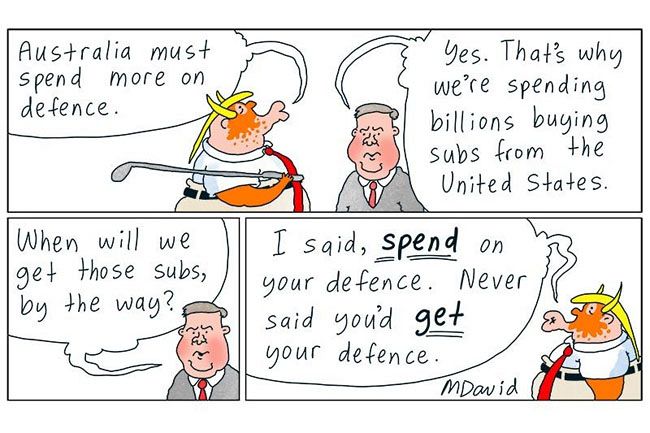
(Cartoon by Mark David / @MDavidCartoons)
By Alan Austin | 23 June 2025, https://independentaustralia.net/politics/politics-display/aukus-collapse-offers-australia-the-chance-to-navigate-an-innovative-future,19859
Donald Trump’s likely abandonment of the AUKUS contract offers the Albanese Government a welcome reprieve from a costly folly, as Alan Austin reports.
THE USA LOOKS LIKE it is abandoning the controversial AUKUS contract signed by the miserably inept Morrison Government in its dying days.
The corrupt and incompetent U.S. President Donald Trump wants out. He has proven to the world that the only projects he strongly supports are those that enrich himself and his companies directly. Australia, with other Westminster nations, refuses to pay direct bribes to individual national leaders — as it should.
Now showing advanced cognitive decline and a failing grip on reality, Trump has effectively signalled the contract’s demise by calling for a formal review by Defence Under Secretary Elbridge Colby. Colby has long been a vocal AUKUS critic and will probably recommend cancellation.
Sound reasons to abandon AUKUS
The first pillar of the deal between Australia, the UK and the USA is for the Americans to supply Australia with nuclear-powered attack submarines for its defence, starting with three Virginia-class submarines in the early 2030s.
The second pillar is collaboration between the three nations on new military technology. These include undersea capabilities, artificial intelligence, electronic warfare and advanced cyber, hypersonic and counter-hypersonic capabilities.
Colby’s argument against the AUKUS deal is simply that the USA doesn’t have enough submarines for their own needs and can’t build them fast enough to have any to spare in the foreseeable future. That is true. The current U.S. Administration is the least competent in its history.
Other AUKUS critics have more compelling reasons for its abandonment. The most cogent of these, articulated by former prime ministers Paul Keating and Malcolm Turnbull and others, is that nuclear subs supplied by the USA will necessarily be operated by American personnel and automatically commandeered by the U.S. military in the event of hostilities between the USA and China, over Taiwan or any other conflict.
It would be disastrous for Australia’s relationship with China and other nations, Keating argues, to be dragged into such a war.
Resources lost forever
If AUKUS collapses, Australia has little chance of getting back the billions already invested.
Among the countless failures of the monumentally inept Morrison Coalition Government was leaving out of the contract any penalties for defaults.
In any event, the lifelong criminal grifter currently running the White House has never felt obliged to fulfil contracts, however legally or morally binding.
The losses to Australia as a result of the incompetence of the Coalition from 2014 to 2022 now amount to hundreds of billions of borrowed dollars, including the billions paid out for AUKUS so far.
These simply have to be accepted as penalties citizens must bear for the abject stupidity of those who elected such a hopeless rabble to try to run the country.
Visionary naval future
If AUKUS fails and Australians write off the losses, they can then grasp this as an opportunity to pursue advantageous alternatives.
The future of underwater naval warfare increasingly appears to be in unmanned underwater vessels (UUVs). Australia is well-placed to build these for its own purposes and then sell them to regional neighbours and beyond.
This may seem a quantum leap for shipbuilding in Australia, but it can be accomplished.
Australia proved to the world it could build the Collins-class submarines during the Hawke/Keating period and has successfully procured other military ordnance since then.
In its first term, the Albanese Government began its investment in small UUVs. Australian marine vessel manufacturer Anduril Australia, a subsidiary of the American Anduril Industries, is already building a modest UUV which it calls Ghost Shark.
Although technical information is restricted, military monitor The War Zone has revealed details of the partnership involving Anduril, the Royal Australian Navy (R.A.N.) and the Defence Science and Technology Group.
A Ghost Shark prototype, according to The War Zone, has a 3D-printed exterior, weighs 2.8 tons, is 5.6 metres long and can operate at a depth of 6,000 metres for ten days. Advanced AI technology enables autonomous operations.
The R.A.N. hopes to get three UUVs suitable for both military and non-military missions between 2025 and 2028.
Challenges for the future, beyond Ghost Shark, are for vessels capable of higher speeds, deeper dives, longer missions, greater stealth and more advanced assignments, including accurate delivery of lethal weapons.
If Australia’s current submarines can be replaced with technologically advanced UUVs, costs will be much lower and risks to personnel dramatically reduced. This may allow Australia to cut military spending overall.
Potential partnerships
Australia does not have the resources to build UUVs alone. Just as the Collins-class submarines were built collaboratively with Swedish shipbuilder Kockums, new ventures will require partners.
Possibilities, besides American firms like Anduril, are many. Current UUVs in service include Germany’s Greyshark, France’s XLUUV and vessels from Japan and South Korea.
Prime Minister Anthony Albanese’s discussion topics with his Canadian counterpart, Prime Minister Mark Carney, at last week’s G7 meeting included Canada joining AUKUS. That’s another possible partner.
Grounds for optimism
Australia has shipyards in South Australia and the solid experience of designing, building and maintaining the Collins-class submarines from the 1980s to the present.
Australia enjoys the goodwill of all neighbouring nations, has no current engagement in any conflict and sees no threats on the horizon.
Australians have banished the destructive Coalition parties from any chance of forming government for the foreseeable future.
So, to borrow a line from Michael J Fox in The American President, let’s take this 94-seat majority out for a spin and see what it can do.
Out of pocket and stranded: What happens if Trump pulls out of AUKUS | Four Corners Documentary
Cross your fingers, Australia, and hope the AUKUS deal collapses

he Americans agreed to the deal because they saw it to be in their strategic interest, not ours. As then-U.S. Deputy Secretary of State Kurt Campbell observed (indiscreetly) last year, “we have them locked in now for the next 40 years.”
All that AUKUS and its associated alliance commitments have done for Australia is paint more targets on our back.
The crazy irony is that we are spending huge sums to build a new capability intended to defend us from military threats that are most likely to arise simply because we have that capability
The U.S. sub purchase was a bad deal then and it makes even less sense now.
By Gareth Evans, Project Syndicate, https://www.japantimes.co.jp/commentary/2025/06/18/world/australia-should-hope-for-aukuss-collapse/
MELBOURNE –
The AUKUS partnership, the 2021 deal whereby the United States and the United Kingdom agreed to provide Australia with at least eight nuclear-propelled submarines over the next three decades, has come under review by the U.S. Defense Department.
The prospect of its collapse has generated predictable handwringing among those who welcomed the deepening alliance, and especially among those interested in seeing Australia inject billions of dollars into underfunded, underperforming American and British naval shipyards. But in Australia, an AUKUS breakdown should be a cause for celebration.
After all, there has never been any certainty that the promised subs would arrive on time. The U.S. is supposed to supply three or possibly five Virginia-class submarines from 2032, with another five newly designed SSN-AUKUS-class subs (built mainly in the U.K.) coming into service from the early 2040s. But the U.S. and the U.K.’s industrial capacity is already strained, owing to their own national submarine-building targets and both have explicit opt-out rights.
Some analysts assume that the Defense Department review is just another Trumpian extortion exercise, designed to extract an even bigger financial commitment from Australia. But while comforting to some Australians (though not anyone in the Treasury), this interpretation is misconceived.
There are very real concerns in Washington that even with more Australian dollars devoted to expanding shipyard capacity, the U.S. will not be able to increase production to the extent required to make available three — let alone five — Virginia-class subs by the early 2030s. Moreover, Elbridge Colby, the U.S. under-secretary of defense for policy who is leading the review, has long been a skeptic of the project and he will not hesitate to put America’s own new-boat target first.
Even in the unlikely event that everything falls smoothly into place — from the transfers of Virginia-class subs to the construction of new British boats, with no human-resource bottlenecks or cost overruns — Australia will be waiting decades for the last boat to arrive. But given that our existing geriatric Collins-class fleet is already on life support, this timeline poses a serious challenge. How will we address our capability gap in the meantime?
Cost-benefit analysis should have killed the project from the outset. But in their eagerness to embrace the deal, political leaders on both sides of parliament failed to review properly what was being proposed. Even acknowledging the greatly superior speed and endurance of nuclear-powered subs and accepting the heroic assumption that their underwater undetectability will remain immune from technological challenge throughout their lifetimes, the final fleet size seems hardly fit for the purpose of national defense.
Given the usual operating constraints, Australia would have only two such subs deployed at any one time. Just how much intelligence gathering, archipelagic chokepoint protection, sea-lane safeguarding or even deterrence at a distance will be possible under such conditions? Moreover, the program’s eye-watering cost will make it difficult to acquire the other capabilities that are already reshaping the nature of modern warfare: state-of-the-art drones, missiles, aircraft and cyber defense.
The remaining reason for believing, as former Australian Prime Minister Paul Keating put it, that an American opt-out “will be the moment Washington saves Australia from itself,” concerns AUKUS’s negative implications for Australia’s sovereignty. The Americans agreed to the deal because they saw it to be in their strategic interest, not ours. As then-U.S. Deputy Secretary of State Kurt Campbell observed (indiscreetly) last year, “we have them locked in now for the next 40 years.”
It defies credibility to believe that the U.S. would transfer such a sensitive technology to us — with all the associated emphasis on the “interchangeability” of our fleets and new basing arrangements in Australia — unless it could avail itself of these subs in a future war. I have had personal ministerial experience of being a junior U.S. ally in a hot conflict situation — the first Gulf War in 1991 — and my recollections are not pretty.
Alongside the Pine Gap satellite communications and signals intelligence facility — which has always been a bull’s-eye — one can add Perth’s Stirling submarine base, the Northern Territory, with its U.S. Marine and B-52 bases and possibly a future east-coast submarine base.
The crazy irony is that we are spending huge sums to build a new capability intended to defend us from military threats that are most likely to arise simply because we have that capability — and using it to support the U.S., without any guarantee of support in return should we ever need it.
If the AUKUS project does collapse, it would arguably still be possible for Australia to acquire replacements for its aging submarine fleet within a reasonable time frame — and probably at less cost, while retaining real sovereign control — by purchasing off-the-shelf technology elsewhere. One can even imagine us going back to France, which was snubbed in the AUKUS deal, and making a bid for its new-generation Suffren-class nuclear-powered sub.
But a better defense option may simply be to recognize that the latest revolution in military technology is real and that our huge continent and maritime surroundings will be better protected by a combination of self-managed air, missile, underwater and cyber capabilities than by a handful of crewed submarines. There is no better time to start thinking outside the U.S. alliance box.
Gareth Evans was Australia’s foreign minister (1988-1996), president of the International Crisis Group (2000-2009) and chancellor of the Australian National University (2010-2019). © Project Syndicate, 2025
Going to war with China will be an unequivocal disaster for Australia

Perhaps the Honourable Minister should also be and remain quiet – or better still be removed from his portfolio – because he is doing nothing for the Labor cause; and seems to be actively attempting to reduce Labor’s chance at a second term. He should unequivocally realise that if Australia goes to war the Liberal mantra will become, ‘this is on you Labor, you dragged us into this war and it is up to the LNP to get us out.’
the US will not place any of its assets at risk in order to defend Australia, this should be fundamentally and clearly understood by the people of Australia.
19 June 2025 AIMN Editorial, By Dr Strobe Driver https://theaimn.net/going-to-war-with-china-will-be-an-unequivocal-disaster-for-australia/
“Up shit creek in a barbed-wire canoe, without a paddle”: The implausible direction Australia’s current Defence Minister is taking the country.
For those of you who aren’t familiar with the above mentioned expression it means things are about as bad as they can get; likely to get worse; and are as it stands, a continuum of a disaster.
This is where Australia stands at the moment when examining Australia’s role in the Asia-Pacific; the rise of China; the ‘position’ this is placing Australia in terms of it being a ‘middle power’ in the region; the dependence on the United States of America (US) as an ally; and the way in which the current Defence Minister (the Honourable Richard Marles (MP) is approaching the current and future components of the regional strategic situations.
The spat between former prime minister Keating and the current Deputy Prime Minister and Defence Minister Marles is ongoing and is far too detailed to go into here other than to mention Keating believes Marles has essentially ‘ceded Australia’s sovereignty’ to another country (the US); and Marles wants ‘strategic transparency from China in its regional military build-up’ and of course the well-worn argument that Australia will be dragged into a war should the US-China situation become ‘kinetic’ – in other words the fighting becomes real. So, with this in mind let’s ‘cut to the chase’ and figure out how Australia would actually ‘fair’ in the outbreak of a war with China and utilise some rationale.
First and foremost, and as I have previously stated in my book The Brink of 2036, the US having sought and gained assurance that Australia is its ‘closest ally’ decides it will ‘go after’ China over its retrocession claims on Taiwan and a war breaks out – the question that begs is, what does that make Australia? This makes Australia an enemy of China and therefore, the Chinese military is now legally entitled to strike Australia.
China would veto any and all conversation in the UNSC (as it is a Permanent Five (P5) member) and use all of its legal powers to circumvent any and all United Nations’ debate about its use of force against US allies. Secondly, the US will not place any of its assets at risk in order to defend Australia, this should be fundamentally and clearly understood by the people of Australia. The US may come to Australia’s aid – it will utilise discretion – however, should it be deemed necessary, it will only enter into any and all aspects associated with the protection of Australia when its assets are not at a high risk of destruction/incapacitation. Where does this leave Australia? One could safely argue a dyad: alone, unless the US’ intervenes.
For the purpose of this essay war has been declared and therefore, a perspective is needed.
The most telling perspective is that Australia faces a rising power and bearing in mind China has continued its rise exponentially since circa-2010, as before that one could safely argue its rise was only incremental, and thus, it is now a major regional power – soon to become a global one. Hence, Australia will have become the enemy of an enormously powerful country.
What then, would said country do to its middle-power regional enemy? There are no surprises here as it is being played out by Israel in the Gaza strip; and the Russian Federation in Ukraine and moreover, it is exceedingly visible; and easy-to-understand. As a side issue, though an important one, and just to strike further terror into the hearts of Australians, the US and Russia as members of the P5 have shut down through the power of veto any and all conversation about whether Israel’s incursion into Gaza and Russia’s invasion of Ukraine are not warranted. One need not even bother to assume what pathway China will take in its war/fight with Australia. With this in mind let’s move towards China’s kinetic tactics on Australia.
As with any war the first things that need to be destroyed are ‘bases and bridges.’ Bases because they house personnel and vital equipment and bridges which essentially refer to anything (not just bridges over a waterway) that equipment can be transported from in order to get ‘to’ a place/location. China with its significant and enormous amount of missiles and the ability to place them through assets (submarines in particular), will fire hundreds of them into Australian assets – some for advantage and some for ‘publicity,’ that is to say, ‘here’s what we can do.’ The former will be RAAF bases, RAN and RAA bases with a single focus on maintenance and repair facilities; and the latter will be major railway lines (the Ghan; Indo-Pacific; and north east coast public lines); and then major highways the Bruce Highway in particular, will be targeted as will the Darwin-Adelaide highway.
As with any war the first things that need to be destroyed are ‘bases and bridges.’ Bases because they house personnel and vital equipment and bridges which essentially refer to anything (not just bridges over a waterway) that equipment can be transported from in order to get ‘to’ a place/location. China with its significant and enormous amount of missiles and the ability to place them through assets (submarines in particular), will fire hundreds of them into Australian assets – some for advantage and some for ‘publicity,’ that is to say, ‘here’s what we can do.’ The former will be RAAF bases, RAN and RAA bases with a single focus on maintenance and repair facilities; and the latter will be major railway lines (the Ghan; Indo-Pacific; and north east coast public lines); and then major highways the Bruce Highway in particular, will be targeted as will the Darwin-Adelaide highway.
As with any war the first things that need to be destroyed are ‘bases and bridges.’ Bases because they house personnel and vital equipment and bridges which essentially refer to anything (not just bridges over a waterway) that equipment can be transported from in order to get ‘to’ a place/location. China with its significant and enormous amount of missiles and the ability to place them through assets (submarines in particular), will fire hundreds of them into Australian assets – some for advantage and some for ‘publicity,’ that is to say, ‘here’s what we can do.’ The former will be RAAF bases, RAN and RAA bases with a single focus on maintenance and repair facilities; and the latter will be major railway lines (the Ghan; Indo-Pacific; and north east coast public lines); and then major highways the Bruce Highway in particular, will be targeted as will the Darwin-Adelaide highway.
The Honourable Defence Minister should cease and desist with his current monologue and political ineptness toward China and should be upfront with the Australian people in what will happen, should we go down this ‘rabbit hole’ of exceptionalism in the region; and yet, willingly yet aimlessly back the US. Australia will become a failed state if we go to war and it is timely to remind the Australian public there are (approximately) as many personnel in the NYPD as there are personnel in the Australian Defence Force.
Perhaps the Honourable Minister should also be and remain quiet – or better still be removed from his portfolio – because he is doing nothing for the Labor cause; and seems to be actively attempting to reduce Labor’s chance at a second term. He should unequivocally realise that if Australia goes to war the Liberal mantra will become, ‘this is on you Labor, you dragged us into this war and it is up to the LNP to get us out.’
The level of political-ineptness and downright political-maladroitness shown by this minister is however nothing new, as Australia seems to have had a cavalcade of utterly hopeless defence ministers over the past three decades. The real problem this time is this one is politically stupid-to-the-core when Australians need astute, articulate and well-defined decision-making.
Meanwhile, China continues to plan its ongoing rise to ‘pax-Sino’ and we have someone at the helm who is plainly and insufferably politically incompetent when there is a dire need to truly understand the milieu of Australia’s defence needs.
‘Punishment phase’ explained: The punishment phase of aerial bombardment is designed to ‘inflict enough pain on enemy civilians to overwhelm their territorial interests’ and in doing so induce surrender, or hasten total defeat. See: Robert Pape. Bombing To Win: Air Power and Coercion in War. New York: Cornell University Press, 1996, 59.
Dr Strobe Driver – Strobe completed his PhD in war studies in 2011 and since then has written extensively on war, terrorism, Asia-Pacific security, the ‘rise of China,’ and issues within Australian domestic politics. Strobe is a recipient of Taiwan Fellowship 2018, MOFA, Taiwan, ROC, and is an adjunct researcher at Federation University.
Warmongering Marles commits Australia to US war against China amid Iran mayhem.
Let’s never forget the truth, that Iran is compliant with its international nuclear reporting; Israel is not. Israel doesn’t even allow the IAEA to check their nuclear facilities, Iran is a member of the Nuclear Non-Proliferation Treaty, unlike Israel.
It is not the generals emblazoned with their medals who will pay the price if we march off to another worthless American war. It is not the pusillanimous media pundits, nor the preening politicians. It is young Australians who will pay the price.
by Michael West | Jun 17, 2025 | https://michaelwest.com.au/warmongering-marles-commits-australia-to-us-war-against-china-amid-iran-mayhem/
The craven appeasement of Benjamin Netanyahu by Western media and political elites has brought the world to the brink of war. Now Richard Marles says Australia’s part in a US war against China is a fait accompli. Michael West reports.
The closest Deputy PM Richard Marles has come to war may well be a school debating stoush at Geelong Grammar but here he is today, on page 1 of Rupert Murdoch’s warmongering The Australian, committing young Australians to war against China. Should it transpire.
Our major trading partner, which has posed us no threat but buys 40% of our exports and has delivered nothing but prosperity to The Lucky Country.
Given the way things are shaping up in Europe, America and the Middle East, the spectre of World War 3 has never loomed so large. This morning Donald Trump warned Iranians to evacuate Tehran, the capital and home to 10 million people. Now there are reports of Trump seeking executive orders to invade.
There is little doubt that the Neville Chamberlains in Western governments and media, these sapless appeasers of the political and media elites, who have supported ‘our friend Israel’ and its demonic leadership of genocidaires, are culpable for the deaths of thousands (in Gaza and the West Bank, Syria, Lebanon and now Iran). They are guilty of genocide, the world’s most egregious crime, and now Israel’s attacks on Iran, in a world daily edging closer to WW3.
They could have stopped this. Cowed by Israel money and the fear of being called antisemitic, they didn’t. Who loses this? Everybody, Israel included. The first casualty of Israel’s unprovoked assault on Iran last week was a child, buried under rubble.
It is Western appeasement of the Netanyahu government which has led to this; principally the US, UK and Germany, with Australia a bit player albeit with blood dripping from its hands.
Sucked in by Benjamin Netanyahu, again, sucked in by the Israel propaganda of Iran’s nuclear program, world mainstream media again – the very people who fell for the ’40 babies beheaded’ and mass rapes of October 7 – are now running Israel’s ‘regime change’ narrative.
Plus ca change
We’ve seen it before: in Vietnam the ‘domino theory’, in Iraq the fabled WMD which turned regime change when that was found out. “Liberty, freedom and democracy” they cried, after Netanyahu sold them into that war. A million dead, a spate of world terrorism. Islamic State.
And Afghanistan, whose cause turned from Osama bin Laden to regime change to remove the Taliban. Twenty years later the Taliban were back in office.
These abysmal failures, one after another, and now we’ve got Murdoch again beating the drums of war for an attack on China.
Australia is walking into another disastrous war by kowtowing to the US. AUKUS – the controversial security alliance – has made us less safe, not more safe.
The government of Anthony Albanese, feebly abetted by a warmongering Coalition and media, dead-set scared of what the US will say, or the chicken-hawk Coalition, is wedged … if they don’t go all the way with Donald J.
Real strength is being able to stand up to bullies and make the right decisions, not cravenly cave to the demands of our ‘allies’ carrying out a genocide in Gaza and now destabilising the whole world. The ‘global rules based order’ is a sick joke.
Iran support
And make no mistake, that is what we are doing, destabilising the world. China has said it would back Iran in the face of Israeli aggression, Russia has its own thing going with Ukraine but presumably backs Iran. Pakistan, a neighbour and ally of Iran, says it will nuke Israel if Israel nukes Iran.
North Korea – whose decision to get nukes has been entirely vindicated by Western aggression – backs Iran. It is topsy turvey. In Syria, Israel and the US have installed a puppet regime of former Isis and Al Qaeda types – yes the very terrorists who they funded to commit war crimes are now their allies.
This is an almighty mess, and at its epicentre is Israel which decries the regime in Iran, a country which has not attacked another country in 300 years, a country where, despite an authoritarian government, embraces freedom of religion. Mosques, churches and synagogues are free.
In Palestine and Lebanon, Netanyahu and his cronies have been gleefully bombing mosques and churches. No arabs or Thai workers have been crowding the bomb shelters this week as Israelis scurried for cover from Iran’s retaliatory strikes, crying victimhood. In this apartheid state, bomb shelters are only for Jews.
Plainly, we are on the wrong side, the ‘genocide’. And now we see Richard Marles and his media proxies talking about the threat from China and the inevitability of joining a US war.
As Israel continues to murder dozens of civilians daily under cover of media blackouts, starving and murdering Gazans as they scramble for food – and annexing the West Bank – the war crimes by the US/Israel alliance are legion, too many to be listed here; they are daily.
This morning Israel bombed an Iranian TV station mid-broadcast, unapologetically gloating about it in the media; like the grotesque terrorism of its pager explosives, another war crime, targeting journalists going about their jobs.
Follow the money
Trump, the self-described peacemaker, has lost control. And behind it, if we follow the money is an epic laundering operation which has dragged in the entire political class in the US.
It is quite simple: America sends billions in public money, earned by their taxpayers, to support Israel every year. Israel in turn sends money to its lobby groups such as AIPAC, bribing almost every politician on Capital Hill to support its genocide and deny its daily war crimes, its land theft, rape and torture of prisoners, its unrelenting, barbaric military aggression.
And Australia, we are sending our tributes to these US warmongers via AUKUS for submarines which may never arrive, certainly not in time for this looming war, if it occurs. We can only hope common sense prevails. But when it comes to cajoling Australia into its next useless war, the US only has to pamper one man, and that’s Albo.
War powers reform
We can be thankful it’s not Peter Dutton. But few would put store in Albo to stand up to US pressure. The rub is that, in the UK and US, the decision to go to war is made by a vote of Parliament or Congress. In Australia, there is no vote. It is down to the PM, one man. It’s Albo’s call.
So what can we expect? The warmongers of the media are stepping up their campaigns. We have seen it all before, it will all be about downplaying Israel’s aggression. It will all be about demonising the Iranian regime, driving spurious arguments for regime change as if it is our right to meddle in the affairs of countries which want peace and which have done no wrong.
It will be about the elusive, unfounded threat of Iranian nukes, it will dehumanise Iranians, just like it did the people of Gaza. the machine will do all it can to manufacture consent for war. This – Fox News ‘secret Iranian nuclear weapons site revealed’ – is a taste of things to come.
Iran compliant, Israel not
Let’s never forget the truth, that Iran is compliant with its international nuclear reporting; Israel is not. Israel doesn’t even allow the IAEA to check their nuclear facilities, Iran is a member of the Nuclear Non-Proliferation Treaty, unlike Israel.
These facts will be dutifully buried in an avalanche of lies and spin but if the world needs regime change, they should start with Israel, not Iran. Somehow Netanyahu has managed to – in his jungle of lies – inveigle the US into war with Iraq and ‘regime change’ in a plethora of countries.
He has trashed the reputation of his country forever, demolished any credibility it might have enjoyed, lost to the Palestinian resistance in Gaza after almost two years, and failed miserably in his two stated aims of ousting Hamas and returning the hostages.
And this despite America and the US deploying more firepower than Nagasaki and Hiroshima, killing and maiming 100s of thousands of civilians. And now starving them to boot.
Still the IDF can’t summon the guts to go down in the tunnels and take Hamas on, mano a mano, preferring instead to frock up in the lingerie of their victims and blithely prance around on social media celebrating their war crimes.
Netanyahu and his cronies, including America, have destroyed Israel through their brutality and stupidity and given rise to antisemitism. While blaming everybody else from peace protestors to Palestinians, they are squarely to blame.
It is not the generals emblazoned with their medals who will pay the price if we march off to another worthless American war. It is not the pusillanimous media pundits, nor the preening politicians. It is young Australians who will pay the price.
Why the AUKUS ‘dream’ was never realistic and is likely to die

it has always been clear that Washington will sell us its submarines only if it is absolutely certain Australia would commit them to fight if the US goes to war with China.
The Albanese government has never acknowledged it is willing to make that commitment.
it has always been clear that Washington will sell us its submarines only if it is absolutely certain Australia would commit them to fight if the US goes to war with China.
The Albanese government has never acknowledged it is willing to make that commitment.
Hugh White, Jun 16, 2025, https://www.thenewdaily.com.au/opinion/2025/06/16/aukus-submarines-review-australia
The first clear sign the Trump administration was taking a long hard look at AUKUS came two weeks ago, when US Secretary of Defence Pete Hegseth gave his first major speech on US strategic policy in Asia at the annual Shangri-La Dialogue in Singapore.
In a long presentation that catalogued a host of initiatives with America’s Asian allies, AUKUS was not mentioned once.
This was noteworthy, because under the Biden administration, AUKUS was the poster-child for US military engagement in the region, name-checked at every opportunity. Now we understand why.
The Pentagon’s review of AUKUS, announced last week, marks the first time any of the three partners – the US, Britain and Australia – has tested the AUKUS dream against hard military and strategic realities. It is unlikely to survive.
AUKUS was always a long shot, right from the start. That was clear from the moment, back in September 2021, that then prime minister, Scott Morrison, sprung the dream of an Australian nuclear-powered submarine force on an astonished public. For that dream to be realised, a lot of things would have to go right, and most of them were much more likely to go wrong.
But the flaw that looks set to kill the AUKUS dream is one that was not part of the original plan. The way Morrison and his then defence minister, Peter Dutton, originally conceived it, there would be no need for Australia to acquire US-built Virginia-Class subs in the 2030s before taking delivery of Australian-built subs to replace the Collins-class boats. They were confident that subs built in Australia, almost certainly to a British design, could be delivered fast enough to enter service as the old Collins subs were being retired, ensuring no gap in our capability.
It became clear this was not going to work out only after Labor took office in 2022, as the new government tried to turn Morrison’s vague idea into a viable project. It soon found there was simply no way to bring new Australian-built nuclear subs into service until long after the Collins boats had to be retired.
To save the AUKUS dream, it was necessary to fill the gap between the retirement of the Collins and the delivery of the first of what we now know as the UK-designed, Australian-built SSN-AUKUS class of submarine. That was when the idea of Australia getting ex-US Navy Virginia class boats first surfaced.
It was a desperate measure that vastly increased the already formidable risks of the whole AUKUS idea. One reason is that it meant the Royal Australian Navy had the almost impossible task of managing and operating not one but two very different kinds of nuclear submarine, powered by two very different nuclear power plants.
For a navy that has struggled to keep the much simpler Collins subs at sea, the task of operating just one class of nuclear-powered subs was truly formidable. To expect it to effectively operate two quite different classes of nuclear submarine simultaneously was frankly absurd.
But there is another reason why the decision to buy Virginia subs to cover the capability gap undermined the viability of the whole AUKUS plan.
Very simply, the US has no submarines to spare. The facilities and workforce that build and maintain its submarines have never recovered from the savage cuts imposed in the 1990s after the end of the Cold War. No serious steps were taken to rebuild it even after it became clear China had become a formidable new maritime rival.
The result is that America’s two submarine construction yards have for many years been delivering barely half as many Virginia-class subs as the Pentagon now says America needs – about 1.2 a year instead of two a year.
This problem was acknowledged when the AUKUS partners announced the detailed plan in 2023. It was optimistically claimed that everything necessary would be done to increase production to the level of 2.3 subs a year required to meet US needs and provide extra boats for Australia.
So far, there is no sign of that happening. Elbridge Colby, the senior US official conducting the Pentagon’s AUKUS review, will almost certainly puncture the irresponsible optimism around this crucial issue and make it clear that unless there is a miracle in US submarine production, America will not sell any Virginia-class subs to Australia.
But that’s not all. Even if that miracle is achieved, US leaders and officials still have to ask whether it makes sense for America to pass the extra submarines to Australia rather than bring them into service with the US Navy.
Any subs sold to Australia weaken America at a time when it is already struggling to match China’s fast-growing navy. So it has always been clear that Washington will sell us its submarines only if it is absolutely certain Australia would commit them to fight if the US goes to war with China.
The Albanese government has never acknowledged it is willing to make that commitment. The Biden administration, desperate for its own reasons to keep the AUKUS dream alive, did not press Canberra on this very sensitive point.
The Trump administration will be much tougher. Colby’s review will also certainly conclude that America should not sell Virginia-class subs to Australia, unless Canberra offers much clearer and more public guarantees that Australia will go to war with China if the US ever does.
For Canberra, this could well be a deal-breaker, making the end of the AUKUS dream. It certainly should be.
Hugh White’s new Quarterly Essay, Hard New World: Our Post-American Future, is published this month.
Hugh White, Emeritus Professor of Strategic Studies at the Strategic and Defence Studies Centre, Australian National University
1 This month

of the week – Australians for War Powers Reform (AWPR)
To see nuclear-related stories in greater depth and intensity
 Antinuclear