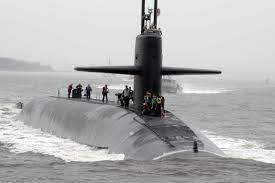
USS Charlotte was at periscope depth, but the periscope was down, reducing the chance of it, or the wake it creates, being seen by the enemy. It was a tense moment.
“Safe/Fire key to Fire”, ordered the captain.
The officer manning the fire control console repeated the order, “Safe/Fire key to Fire” and then advised the captain, “Safe/Fire key is to Fire”.
“Fire 4 tube at Target 1”, the captain stated in a raised and clear voice.
The officer repeated the order and hit the ‘Fire’ button. A low-level thud was both felt and heard throughout the submarine as the pressurise discharge system pushed the Mk 48 Torpedo from the tube. “Weapon running” the officer called.
As the weapon ran towards the Iranian frigate the submarine carried out a further visual set-up through the periscope to update the weapon. The updated targeting solution was transmitted down the very long and thin guidance wire connecting the torpedo to the submarine.
The update was also loaded into the second torpedo’s guidance system. “Fire 1 tube at Target 1”.
The first torpedo did not do its job. The second exploded directly under the target, lifting the hull out of the water and sending a violent shock wave through it. The structural damage was completed as the hull dropped back into the water.
The first the Iranian captain of the frigate would have known about the US submarine would have been when he felt the explosion underfoot.
Queuing
USS Charlote did not just stumble across the INS Dena. Rather, days before, it had been queued to the target by folks back in the US tracking where every surface ship in the world is located.
The submarine travelled at high speed, around 30 knots (55 km/h), for days getting from its routine Indian Ocean patrol area to the waters south of Sri Lanka. That’s one of the key advantages of a nuclear-powered submarine. They can travel long distances fast.
As it arrived in the area the submarine’s crew would have detected (found it) and tracked the contact (worked out its range, course and speed), and then classified (identified) it using a combination of acoustic and electronic emissions, and finally confirmed it was the INS Dena visually through the periscope.
“Then ‘bang’.”
AUKUS implications
The Iran War has shown that submarines are 21st century war fighting assets with ever relevant capabilities; they can collect intelligence, conduct reconnaissance, launch land attack missiles, covertly land special forces, covertly lay mines, and sink submarines and surface ships.
But the events from 28 February onwards have shown us other things.
AUKUS has been described by many as a program that facilitates close alliance and force integration with the United States.
As Donald Trump broke its written Free Trade Agreement commitments to Australia on ‘Liberation Day”, those in the Canberra bubble were blind to that breach’s relevance to the ANZUS treaty and AUKUS agreement. Surely the US’s defence treaty with Australia would be treated differently.
As the US initiated an AUKUS review, that was to see AUKUS sceptic Elbridge Colby recommend stopping the program until Trump realised the financial benefit in continuing with it and overrode Colby, those in the Canberra bubble breathed a collective sigh of relief and chose not to think it too much.
Ruptured
As Trump, to use the words of Canadian Prime Minister Mark Carney, ‘ruptured’ the international rules-based order – carrying out a military operation in Venezuela, threatening Panama, bringing NATO to the brink by threatening to invade Greenland, attacking Iran and now threatening Cuba – those in the Canberra bubble didn’t seem to recognise the US Administration’s departure from Australian values; or perhaps likely they did but decided not to respond to it.
Only over the past month Prime Minister Albanese has responded properly to the ‘rupture’, not blindly committing Australian forces to follow the US into war, as has so often been the case (as a downpayment for US support for Australia if it needed it).
Albanese has despatched a RAAF early warning aircraft to support the air defence of the United Arab Emirates and other Gulf states, but we haven’t joined a US-led effort as has been the case in the past.
Sovereign thought
Albanese has it right. The US did not seek to build international support, and/or UN approval, for a strike on Iran. Instead it chose to plan in secret in cahoots with Israel and then launch a surprise attack to kill Iran’s leadership while negotiations with Iran were supposed to be ongoing.
Only when the going got tough did Washington call on allies for assistance, and under the circumstances where they rightly refused.
“Trump’s Iran War has caused harm to Australia.”
The impact of Trump’s war is causing economic harm right across the globe.
The war has also brought home Australia’s vulnerabilities. For decades distance has kept us relatively isolated from conflict, but this conflict directly affected us as world fuel supplies are disrupted and prices have sky rocketed. And the full extent of this new energy shock still lies ahead.
“Perhaps it’s the shock that we needed to have”
a chance to reflect on our need to take a more independent pathway in a world in which many past assumptions are being overturned.
US submarine shortages
Australia has long relied on the naval might of what Prime Minister Robert Menzies liked to call our “great and powerful friends” – first the British Empire and the Royal Navy; then Pax Americana upheld by the United States Navy. Now times are changing,
“and they are changing rapidly.”
The US Navy has gone from a Cold War era 1000-ship navy to a 600-ship navy during the Reagan era, to a current fleet of just 300 ships. China now has the world’s largest navy, 350 to 370 vessels, and Chinese shipyards are turning out warships much more rapidly than their counterparts in the US.
The US Navy still has a qualitative edge, but the US Navy is not what it was, and its well understood that quantity has a quality all of its own.
The US has been aiming to increase its number to 381 combat ships. 66 is the desired number for nuclear attack submarines – they have only 49 at the present moment.
Since 2011 the USN has purchased 2 submarines a year (this last year it was only one – because deliveries are so far behind).
The actual Virginia-class production rate has never reached 2.0 boats per year, and since 2022 has been limited to about 1.1 to 1.2 boats per year, resulting in a growing backlog of boats procured but not yet built.
They can’t build enough boats to meet their own needs,
“let alone ours.”
A school of thought in the US had been that submarines transferred to the Royal Australian Navy would be available for US in time of conflict, but the Iran War has speared that assumption.
And Trump noticed this week, first expressing disappointment at the UK’s refusal to become directly involved in the Iran War and then turning his thoughts to Australia, saying “Australia too, Australia was not great. I was a little surprised by Australia”.
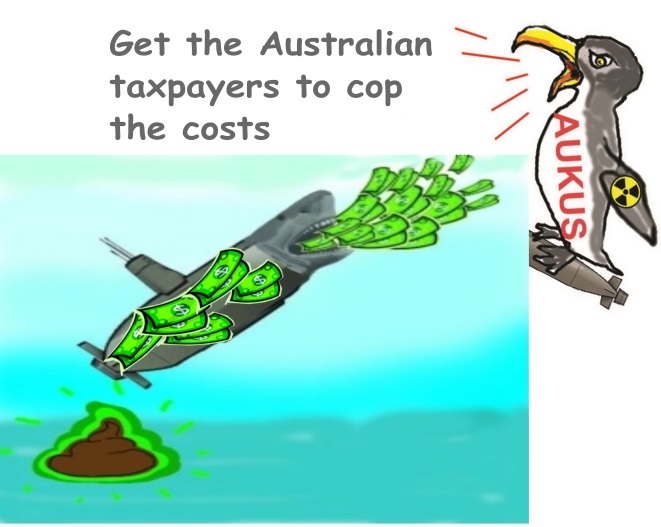
Trump is well known to hold a grudge. The one thing that will keep him supportive of AUKUS will be the money flowing from the Australian taxpayers to US shipyards, with no contract in place for delivery and no claw back option for the Australian contribution is the US does not deliver. That’s the sort of deal that Trump likes.
UK submarine shortages
And the United Kingdom are in a worse position than the US. The Royal Navy has one nuclear attack submarine available for operations – a fact made obvious to Australians when that sole submarine cut short a visit to Western Australia to head towards the Iran conflict zone.
Retired Rear Admiral Peter Briggs, in an event at the Canberra Press Club, organised by Malcolm Turnbull, said it all, warning the UK had “dropped below the minimal sustainable force” for submarines and the country would be late in delivering its first SSN-AUKUS boat, a design which Australia is also hoping to start building in Adelaide in the 2030s.
“It is queued up behind the final two (Astute-class boats) and four critically important ballistic missile submarines, the Dreadnoughts, that are being built in the shipyard.”
“You cannot get the first SSN-AUKUS out until the fourth ballistic missile submarine is clear of the yard. That is the UK’s national priority.”
Defence incompetence
Listen to this story
12 min
The US war on Iran has exposed Australia’s incompetent defence and procurement. Rex Patrick reports implications for AUKUS submarine program.
A tense moment
USS Charlotte was at periscope depth, but the periscope was down, reducing the chance of it, or the wake it creates, being seen by the enemy. It was a tense moment.
“Safe/Fire key to Fire”, ordered the captain.
The officer manning the fire control console repeated the order, “Safe/Fire key to Fire” and then advised the captain, “Safe/Fire key is to Fire”.
“Fire 4 tube at Target 1”, the captain stated in a raised and clear voice.
The officer repeated the order and hit the ‘Fire’ button. A low-level thud was both felt and heard throughout the submarine as the pressurise discharge system pushed the Mk 48 Torpedo from the tube. “Weapon running” the officer called.
As the weapon ran towards the Iranian frigate the submarine carried out a further visual set-up through the periscope to update the weapon. The updated targeting solution was transmitted down the very long and thin guidance wire connecting the torpedo to the submarine.
The update was also loaded into the second torpedo’s guidance system. “Fire 1 tube at Target 1”.
The first torpedo did not do its job. The second exploded directly under the target, lifting the hull out of the water and sending a violent shock wave through it. The structural damage was completed as the hull dropped back into the water.
The first the Iranian captain of the frigate would have known about the US submarine would have been when he felt the explosion underfoot.
Sinking of INS Dena (Source: US Department of War)
Queuing
USS Charlote did not just stumble across the INS Dena. Rather, days before, it had been queued to the target by folks back in the US tracking where every surface ship in the world is located.
The submarine travelled at high speed, around 30 knots (55 km/h), for days getting from its routine Indian Ocean patrol area to the waters south of Sri Lanka. That’s one of the key advantages of a nuclear-powered submarine. They can travel long distances fast.
As it arrived in the area the submarine’s crew would have detected (found it) and tracked the contact (worked out its range, course and speed), and then classified (identified) it using a combination of acoustic and electronic emissions, and finally confirmed it was the INS Dena visually through the periscope.
Then ‘bang’.
AUKUS implications
The Iran War has shown that submarines are 21st century war fighting assets with ever relevant capabilities; they can collect intelligence, conduct reconnaissance, launch land attack missiles, covertly land special forces, covertly lay mines, and sink submarines and surface ships.
But the events from 28 February onwards have shown us other things.
AUKUS has been described by many as a program that facilitates close alliance and force integration with the United States.
As Donald Trump broke its written Free Trade Agreement commitments to Australia on ‘Liberation Day”, those in the Canberra bubble were blind to that breach’s relevance to the ANZUS treaty and AUKUS agreement. Surely the US’s defence treaty with Australia would be treated differently.
As the US initiated an AUKUS review, that was to see AUKUS sceptic Elbridge Colby recommend stopping the program until Trump realised the financial benefit in continuing with it and overrode Colby, those in the Canberra bubble breathed a collective sigh of relief and chose not to think it too much.
Ruptured
As Trump, to use the words of Canadian Prime Minister Mark Carney, ‘ruptured’ the international rules-based order – carrying out a military operation in Venezuela, threatening Panama, bringing NATO to the brink by threatening to invade Greenland, attacking Iran and now threatening Cuba – those in the Canberra bubble didn’t seem to recognise the US Administration’s departure from Australian values; or perhaps likely they did but decided not to respond to it.
Only over the past month Prime Minister Albanese has responded properly to the ‘rupture’, not blindly committing Australian forces to follow the US into war, as has so often been the case (as a downpayment for US support for Australia if it needed it).
Albanese has despatched a RAAF early warning aircraft to support the air defence of the United Arab Emirates and other Gulf states, but we haven’t joined a US-led effort as has been the case in the past.
Sovereign thought
Albanese has it right. The US did not seek to build international support, and/or UN approval, for a strike on Iran. Instead it chose to plan in secret in cahoots with Israel and then launch a surprise attack to kill Iran’s leadership while negotiations with Iran were supposed to be ongoing.
Only when the going got tough did Washington call on allies for assistance, and under the circumstances where they rightly refused.
Trump’s Iran War has caused harm to Australia.
The impact of Trump’s war is causing economic harm right across the globe.
The war has also brought home Australia’s vulnerabilities. For decades distance has kept us relatively isolated from conflict, but this conflict directly affected us as world fuel supplies are disrupted and prices have sky rocketed. And the full extent of this new energy shock still lies ahead.
Perhaps it’s the shock that we needed to have ;
a chance to reflect on our need to take a more independent pathway in a world in which many past assumptions are being overturned.
Australia has long relied on the naval might of what Prime Minister Robert Menzies liked to call our “great and powerful friends” – first the British Empire and the Royal Navy; then Pax Americana upheld by the United States Navy. Now times are changing,
and they are changing rapidly.
The US Navy has gone from a Cold War era 1000-ship navy to a 600-ship navy during the Reagan era, to a current fleet of just 300 ships. China now has the world’s largest navy, 350 to 370 vessels, and Chinese shipyards are turning out warships much more rapidly than their counterparts in the US.
The US Navy still has a qualitative edge, but the US Navy is not what it was, and its well understood that quantity has a quality all of its own.
The US has been aiming to increase its number to 381 combat ships. 66 is the desired number for nuclear attack submarines – they have only 49 at the present moment.
Since 2011 the USN has purchased 2 submarines a year (this last year it was only one – because deliveries are so far behind).
The actual Virginia-class production rate has never reached 2.0 boats per year, and since 2022 has been limited to about 1.1 to 1.2 boats per year, resulting in a growing backlog of boats procured but not yet built.
US Naval Shipbuilding Plan (Source: Congressional Budget Office).
They can’t build enough boats to meet their own needs,
let alone ours.
A school of thought in the US had been that submarines transferred to the Royal Australian Navy would be available for US in time of conflict, but the Iran War has speared that assumption.
And Trump noticed this week, first expressing disappointment at the UK’s refusal to become directly involved in the Iran War and then turning his thoughts to Australia, saying “Australia too, Australia was not great. I was a little surprised by Australia”.
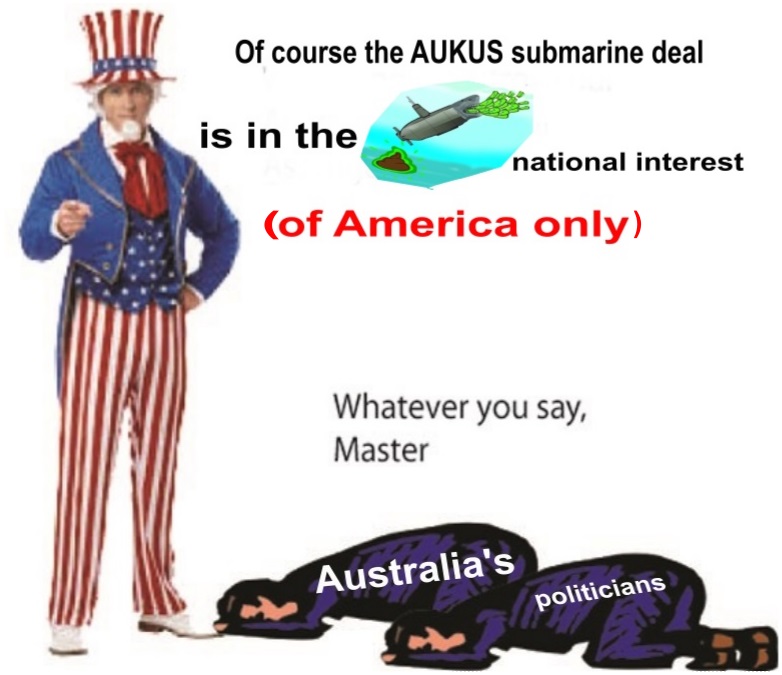
Trump is well known to hold a grudge. The one thing that will keep him supportive of AUKUS will be the money flowing from the Australian taxpayers to US shipyards, with no contract in place for delivery and no claw back option for the Australian contribution is the US does not deliver. That’s the sort of deal that Trump likes.
And the United Kingdom are in a worse position than the US. The Royal Navy has one nuclear attack submarine available for operations – a fact made obvious to Australians when that sole submarine cut short a visit to Western Australia to head towards the Iran conflict zone.
Retired Rear Admiral Peter Briggs, in an event at the Canberra Press Club, organised by Malcolm Turnbull, said it all, warning the UK had “dropped below the minimal sustainable force” for submarines and the country would be late in delivering its first SSN-AUKUS boat, a design which Australia is also hoping to start building in Adelaide in the 2030s.
“It is queued up behind the final two (Astute-class boats) and four critically important ballistic missile submarines, the Dreadnoughts, that are being built in the shipyard.”
“You cannot get the first SSN-AUKUS out until the fourth ballistic missile submarine is clear of the yard. That is the UK’s national priority.”
Defence incompetence
At the same conference, our Defence Department’s incompetence was on full display.
A Defence representative laid it out., After decades of submarine procurement failures (including the spending of $4B on French submarines we never got), it’s still “full speed ahead” in the best spirit of Captain Smith on the bridge of the Titanic.
In response to a question from Turnbull as to “what’s the plan B if we end up with no new subs” from the United States, Deputy secretary for strategy and policy, Hugh Jeffrey, answered, “You know, it’s not my job as a public servant, to talk about Plan Bs that’s the prerogative of government”.
He went on to lecture AUKUS sceptics,” If you really want to be in a position where we have no submarines then ‘turn back’. I do think, speaking as an apolitical public servant, we need to get out of this relentless politicisation of defence capabilities.”
AUKUS end
He surely did not realise what he said. He warns we’ll “be left with no submarines if the project is dumped”. The problem is that we’ll also be left with no submarines if AUKUS isn’t dumped. And we will have paid a lot for those no submarines.
After a failure on fuel security, with a failure on procuring submarines, and with the rules-based order ruptured by the very country we’re relying in respect of the program, maybe Albanese will finally cut this foolish program and move towards a more realistic, self-reliant and sustainable strategic policy.
If we don’t, we may well find our sovereignty to be hollow and that others will decide our nation’s future.
The dreams of the U.S. President, that it would all be over in days – that the Iranian people would rise against their tyrannical regime – is now a nightmare that Trump has visited upon the world.
The global economy is on the brink of disaster as oil dries up. America and Israel have further isolated themselves from world public opinion and, apart from an ever- shrinking clique of semi-vassal states like Australia, Trump appears to be alone and increasingly dangerous.
The war offers a great many lessons, but while life and history can be great teachers, there seem to be precious few pupils ready to learn those lessons. This applies equally to apologists for U.S. power, to governments of all stripes and to many of those who inhabit the Left and lay claim to Marxist credentials.
The war was never about “liberating” the Iranian people from the right-wing theocracy. It was about securing a compliant regime that would ensure the flow of oil and to make sure that the USA, as a fading imperial power, maintained global hegemony — both politically and economically.
The slogan that accompanied the wars of aggression against Iraq, that tore Libya apart and which laid waste to so much of the Middle East was simply, No Blood for Oil! The years have slipped by, and yet the same foul motivation for despoiling the globe and destroying a people remains.
Our mainstream media know this to be true, even as the “story” turns its focus to the retaliation by Iran and to the oil pressure that the blocking of the Straits of Hormuz entails. The same media focuses on potential oil shortages, and rightly so, but seems less keen to link that invasion to the fact that people are paying stupid prices for petrol and diesel.
Fewer voices can be heard that would remind the people of how the war started and who is responsible. That has become largely the responsibility of the Left — the Marxists, the campaigners against war and imperialism.
This is as it should be, but something is very wrong. Marxism is quite clear that economics is the defining factor and that politics works with and responds to economic demands. The war, then, can only be understood from an economic perspective. But is it being understood in this way? Sadly, no.
Some see it as a political gamble by a beleaguered and dangerously unhinged U.S. President. Some portray it as a means, by Israel, of destroying any potential risk to its domination of the region. Some come a step closer by recognising the strategic desire to weaken China, as it is a principal customer for Iranian oil.
Any and all of these considerations are enough to allow blame to be sheeted home to the USA and Israel, but there is a deeper, more worrying aspect to this. The United States has been and remains the single biggest military force and greatest economic power that the world has seen. It is, as the Marxist Left will say, an imperialist power. It is also a declining power.
For decades, its main preoccupation has been how to hold back the rising tide of its one great rival. China’s rise, accompanied by a global capitalist economy that has run out of ideas and resilience, ensures that wars are either finishing, beginning, or in the planning stage. A failing economic structure is driving the world to the point of no return. The war against Iran is one battle in this endless spiral into decay. The USA, as the central power in the capitalist global economy, is more than willing to destroy entire nations in its quest to keep the sinking ship afloat.
No crime is too much. The U.S. bombing the girls’ school in Iran, the Israeli destruction of oil facilities on the edge of Tehran that have led to acid rain and an unimaginable civilian health disaster, sicken all reasonable people. But those who plan such actions are not among the reasonable.
These acts need to be condemned. Governments need to show at least a modicum of decency. Our Prime Minister needs to stop slinking in the shadows and act. He needs to denounce such actions. He needs to find the courage to say “No!” and to work to secure the natural resources needed to keep Australia functioning. This is unlikely. Our political structures are such that we remain totally subservient to the demands and interests of the USA..
Those whose anger compels them to take to the streets deserve better than the Babel that has become the protest movement. The most recent action in Melbourne, which was dominated by ever more shrill denunciations of Israel, while mention of the USA and its causal responsibility for the war was at best an afterthought. Protest has merit, it is necessary and has purpose. It also needs focus, if it is to have either merit or purpose.
Protest is also about winning the hearts and minds of people. Sound and fury might be a therapy for some, but numbers count and numbers must grow, people must be educated, encouraged to talk to others, to build a movement that can go beyond noise.
Part of that building process must include the raising of collective consciousness. It must be able to show and convince people that this or that crime of the USA, of Israel, of imperialism, is not isolated, or in any way an aberrant thing, but is a symptom of a deeper, structural crisis. It is not enough for the ideologues to make demands that cannot be achieved. The protest movement, the anti-war movement, should aim at providing a vehicle, a voice for those who want something better than news screens full of war stories and a Federal Government pathetically marching to the fifes and drums of a fading U.S. empire.
European Union leaders have been prepared to stand back a little; to say that the war is not their war. It is hard to imagine an Australian government being daring enough to question anything that comes from Washington. As the sun sinks on U.S. hegemony, Australia seems ready to go down with the American ship.
After all, this is a man with the capacity to blunder into World War 3 without having any idea what he’s doing.
The complete absence of any plan or exit strategy in the escalating conflict with Iran demonstrates that even the most apocalyptic of unforeseen consequences cannot be ruled out
Trump’s Iran war raises fears of global conflict — while allies stay silent and diplomacy collapses, writes Mark Beeson.
U.S. PRESIDENT DONALD TRUMP is the most dangerous man in the world. Why are we supporting him?
Many people were concerned about what a second Trump presidency might look like, but it’s uncontroversial to claim that it’s much worse than even the gloomiest pessimists feared.
It has been plain for a long time that Trump has little regard for the truth and is determined to silence independent media. But the one thing his supporters and the world in general might have hoped for was that he wouldn’t have gone back on his promise to not start unnecessary, ill-conceived wars, especially in the Middle East.
And yet, not only has Trump launched an illegal war with Iran, which has already resulted in the deaths of thousands, including innocent schoolgirls, but he is also displaying a psychopathic delight in using America’s overwhelming military might ‘just for fun’.
Given that the assault on Iran is being conducted with – or even on behalf of – Israel there is a breathtaking irony in the fact that Trump is displaying the same sort of indifference to human suffering that allowed individual Nazis to take part in the ‘final solution’ and the murder of six million Jews.
It is, of course, entirely possible that Trump doesn’t really know what’s going on given his increasingly obvious cognitive decline, but he has never exhibited much human empathy and is a compulsive liar and confabulator. These qualities arguably made him unfit to be a property developer, much less the most powerful man on Earth.
Given his famously child-like need for attention and adulation, which his courtiers and cronies are only too willing to provide, there is absolutely no chance of him changing. On the contrary, his belief that God is proud of him ought to alarm ought to alarm friend and foe alike.
After all, this is a man with the capacity to blunder into World War 3 without having any idea what he’s doing. The complete absence of any plan or exit strategy in the escalating conflict with Iran demonstrates that even the most apocalyptic of unforeseen consequences cannot be ruled out.
While an international economic crisis may not be the worst thing that could happen, for those of us fortunate enough to live in peaceful Australia it really ought to demonstrate that Trump is a threat to supposed friends and allies, as well as the innocent Iranians he promised to help.
If nothing else, Trump’s behaviour should make the danger and folly of relying on someone quite so delusional and self-obsessed clear to even our most unthinking policymakers. Trump will be satisfied with nothing less than the complete support and cooperation of allies, no matter how misguided or inhuman his policies may be.
Given the decades of uncritical fealty Australia’s leaders have displayed to the United States, it is no surprise that there has generally been an uncomfortable silence about ‘our’ response to the latest American-led fiasco.
‘We (sic) support the United States acting to prevent Iran from obtaining a nuclear weapon and to prevent Iran continuing to threaten international peace and security.’
It’s worth remembering that Iran was attacked while trying to negotiate a new agreement to replace the one Trump tore up, a tactic that may have allowed the U.S. to decapitate Iran’s leadership but won’t making resolving the conflict any easier. Truth, diplomacy and trustworthiness are clearly for losers. Might clearly does make right in Trump-world. This reality may help to explain why the Albanese government is keeping its collective head down.
Other leaders have not been quite so supine and gutless, however. German Chancellor Friedrich Merz, after fruitless attempts at ingratiating himself with Trump, unambiguously stated that the “government will not participate in this war”. Moreover, Merz pointed out that Trump’s war had nothing to do with NATO, which was a defensive alliance, not one designed for wars of aggression.
Trump responded in his usual fashion with threats and bluster, suggesting a failure to support his ill-conceived war would be ‘very bad’ for NATO. Although we have learned not expect truth or consistency when dealing with Trump, suggesting that the foundation of the Western alliance may be in jeopardy is hardly a minor threat. Trump’s great friend Vladimir Putin must be delighted.
If our leaders are too unimaginative and cowardly to speak up in defence of international law, or to criticise unilateralism and the intensification of great power politics, civil society must do what it can. The absence of the sort of activism and protests that characterised opposition to the equally ill-conceived and pointless Vietnam War is disappointing and revealing, however. Perhaps it takes 500 actual combat deaths and the prospect of being called-up to bring home the reality of war to Australians.
Or perhaps rising interest rates, the cost of filling up a monstrous SUV, or re-routing your European holiday might do the trick. Either way, it’s reassuring to know that President Trump thinks the war with Iran is going so well that he gives if 15 out of 10. Nothing for our leaders to worry about after all.
It seems incongruous that with a fleet of nine nuclear powered submarines the United Kingdom has only one operational vessel from the fleet which has been sent to Garden Island in Western Australia instead of using it for protective deployment around the British Isles
That submarine being HMS Anson still requires some minor maintenance work for its continued operations which is being undertaken at Garden Island
It appears that the real reason for Anson being sent to Australia is for the United Kingdom to demonstrate some capacity in being able to be an active participant in the AUKUS agreement but this may be a rather hopeless exercise in view of the strained relationship with the United States over the Iran war
The lack of naval capacity of the United Kingdom is best demonstrated by the fact that the destroyer HMS Dragon proposed to be send to Cyprus for protection of its naval 1 of 2 base on the island cannot be put to sea due to the incapacity of undertaking the necessary dockyard work for it seagoing status
All of this should be borne in mind when planning for the future development of the AUKUS proposals
It is therefore beyond the wildest dreams to contemplate
the design and subsequent construction of the SSN- AUKUS submarine
How will the Australian government react to this situation when AUKUS is a major part of its defence strategy?
The US and Israeli strikes on Iran on the weekend present Australia with a difficult but necessary question: what does it mean to defend an “international rules-based order” if that defence is applied selectively?
Moments like this test whether our commitment to international law is principled or contingent.
Australia’s Foreign Minister moved swiftly to express support for the strikes. Yet their illegality was immediately apparent to leading legal experts worldwide, including clarion calls from Australia’s own Professor Ben Sauland Donald Rothwell. The unanimous verdict of the legal community is that the strikes were again, as was the case in June 2025, manifestly illegal under the UN Charter.
The prohibition on the use of force is a cornerstone of international law. Kick at it repeatedly, dislodge it enough, and the foundations begin to give way. Don’t for a moment let the flurry of legal opinions suggest that this is a rhetorical disagreement; it is a serious legal dispute about the limits of military power.
When powerful states stretch those limits, the consequences ripple outward. International law depends not only on formal enforcement, but on perception, consistency and restraint. If some states vest in themselves the authority to determine when force is justified, others will inevitably take note.
For a middle power like Australia, which relies on stable legal frameworks rather than strategic dominance, that erosion carries real cost. If Australia is serious about international law, it must apply the rules consistently to everyone, everywhere, at all times, including to its closest partners.
Then there is the deeper nuclear dimension.
Both the United States and Israel are nuclear-armed states. When nuclear-armed governments conduct strikes framed as counter-proliferation measures, it reinforces perceptions of hierarchy and hypocrisy in the global non-proliferation regime, centred on the Nuclear Non-Proliferation Treaty (NPT).
The NPT rests on a two-part bargain dating back to 1968: non-nuclear-weapon states agreed to forgo nuclear weapons while the five permanent members of the Security Council, who are nuclear-armed, promised that they would pursue disarmament “in good faith on effective measures relating to cessation of the nuclear arms race…and a treaty on general and complete disarmament“. Progress by the nuclear-armed states on that second pillar stalled, while reliance on nuclear deterrence has become more deeply embedded in strategic doctrine, and four additional states have developed their own nuclear weapons.
This credibility gap is precisely why the citizen-led coalition, International Campaign to Abolish Nuclear Weapons (ICAN), created in Melbourne in 2007, worked with humanitarians worldwide, in particular the Red Cross Red Crescent Movement, to develop a treaty that makes nuclear weapons illegal and sets the stage for their elimination.
This treaty-led approach to banning inhumane weapons has already been achieved for all other weapons of mass destruction. ICAN is now led from Geneva by former ALP Federal Member for Fremantle, Melissa Parke, and has over 700 partner organisations who continue to advocate for the Treaty on the Prohibition of Nuclear Weapons, the only legally binding global instrument that comprehensively prohibits nuclear weapons and establishes a pathway toward their elimination. Ninety-nine countries have joined this treaty.
Australia is not one of them.
Given our historical good standing on arms control, I’m often asked why this is, including by state and federal parliamentarians. The straight answer is that our government is fearful to confront our powerful ally, even on this topic on which the safety of life on earth rests, in fact, particularly on this topic.
Australia occupies an unusual position in the nuclear debate. We are not a nuclear-armed state. We do not host our own nuclear weapons. Yet we are deepening defence integration with nuclear-armed AUKUS allies, expanding force posture initiatives, hosting joint facilities, and embedding ourselves more tightly within extended deterrence arrangements. Alliance cooperation, we are told, brings clear benefits. It also brings exposure.
Retaliatory strikes on US facilities across the Gulf illustrate a basic reality: infrastructure associated with military operations become targets. As Australia expands access and interoperability, it is prudent, not disloyal, to assess how that affects our own vulnerability in a crisis. This is not an argument for abandoning alliances. It is an argument for clarity about trade-offs.
If Australia is prepared to criticise breaches of international law by adversaries, it must also be prepared to express principled concern when allies test those same rules. Selective application weakens the normative architecture we claim to uphold.
Military strikes can delay technical capabilities, but they don’t resolve the political drivers of proliferation. Durable non-proliferation outcomes have historically depended on negotiated constraints, verification and reciprocal commitments, not cycles of force and retaliation.
Security built on nuclear brinkmanship is brittle security.
The Australian government is not living up to the image of our nation as a principled, multilateral middle power that Prime Minister Albanese painted at the UN General Assembly last year when he said:
“If we give people reason to doubt the value of co-operation, then the risk of conflict becoming the default option grows. If we allow any nation to imagine itself outside the rules, or above them, then the sovereignty of every nation is eroded.”
Australia should walk the talk and swiftly reposition itself to buttress confidence in international law. The government should begin by publicly and repeatedly reaffirming that international law consistently, to allies and adversaries alike.
Next, it has a responsibility to clarify for itself and inform the public whether any joint facilities based in Australia played a role in supporting the strikes and take measures to ensure that Australian territory is not used to facilitate unlawful military action. Not to satisfy a journalist’s curiosity, but because it’s an obligation under international law.
Lastly, the government should demonstrate its commitment to diplomacy and, without further delay, join the Treaty on the Prohibition of Nuclear Weapons as part of a credible strategy to reduce nuclear risk. Numerous cities, councils and state and territory parliamentarians have signed a pledge in support of taking this action. So have a majority of federal Parliamentarians.
Australians want a world in which law constrains power. Our government must be prepared to defend that principle confidently and consistently, even and especially among allies.
At present, Australia risks being too quick to support force, and too slow to grow peace.
About the author
Tara Gutman is a lawyer and strategist specialised in international law at Lexbridge Lawyers. Tara is also Co-Chair of ICAN Australia.
Under secretly-concluded arrangements with our allies, Australia is now on track to have US nuclear weapons on Australian soil for lengthy periods, starting very soon.
A new report released today details this dangerous development and exposes how the Australian community is being kept in the dark about it.
The report by civil society group Australians for War Powers Reform (AWPR) examines efforts by the Albanese government to facilitate the increasing presence of nuclear weapons capable aircraft and submarines.
“Many Australians are completely unaware that under current agreements with the US Australian airfields and port facilities will be hosting US aircraft and subs that could be carrying nuclear weapons. And those visits will increase dramatically, possibly in breach of the South Pacific Nuclear Free Zone Treaty,” said AWPR spokesperson Peter Murphy.
“A massive 1.6 billion dollars is currently being spent to upgrade the Tindal RAAF base in the Northern Territory and media reports describe six B-52, long-range, nuclear-capable bombers being “housed” there. But so far there’s been no proper public debate about Australia’s increasing involvement in the US nuclear weapons system.”
The Albanese government currently has a “we don’t ask” policy when it comes to whether US aircraft and ships are carrying nuclear weapons while in Australia. At the same time the US has a “neither confirm nor deny” policy on nuclear weapons. These policies are unwarranted and unacceptable.
“It’s time to end the secrecy on nuclear weapons and let the public have an informed debate. Do we really want these weapons of mass destruction in Australia? Shouldn’t the parliament discuss and vote on these matters?”
Australians have consistently rejected any role for nuclear weapons in our defence policies. A national poll last year revealed that two-thirds of Australians want the government to sign and ratify the UN Treaty on the Prohibition of Nuclear Weapons (TPNW).
“In this new report we are also urging the government to initiate a full independent inquiry into the AUKUS pact, as repeatedly called for by civil society and former prime ministers and foreign ministers. It should include a comprehensive review of Australia’s policies on nuclear weapons,” Peter Murphy said.
The full report “Australia and US Nuclear Weapons: Time to End the Secrecy” is available here
Australia’s acquisition of nuclear-powered submarines is not in fact the most important part of the AUKUS deal – they are a distraction … AUKUS’s main game is the base that Australia intends to give to the US at HMAS Stirling in Western Australia
It is tempting to label the AUKUS project an exercise in self-delusion and self-denial. The number of commentators who believe the project’s core promise will actually be honoured – the transfer of Virginia-class nuclear-powered submarines from the United States to Australia – is astonishingly small and mainly limited to politicians and their hangers-on.
Even in the US, the likelihood of the transfer taking place is openly discounted, including by the chief of naval operations, Admiral Daryl Caudle. As if preparing for a let-down, a new report from the Congressional Research Service advances alternatives to the transfer of the promised submarines that will still allow the US to meet its strategic priorities.
In addition, it is hard to square the submarine promise with the reality that is Washington these days. US President Donald Trump’s willingness to pressure America’s allies and turn the US into a rogue superpower is well documented – just ask the Canadians and Danes. We have witnessed in real time his destruction of the global rules-based order as the US withdraws from dozens of international organisations and agreements.
That the US warship-building industry is in poor shape is also no secret. The odds of the nation being able to increase its submarine build rate to the required level for the transfer to go ahead without a loss of US operational capability is virtually nil, according to a December 2025 report from the Washington-based Center for Strategic and International Studies.
One must accept that Australia’s politicians are reasonably intelligent, yet with the myriad well-known problems facing the nuclear-powered submarine transfer it is hard to understand how they can still insist that the project is “full steam ahead”. Nor is this insistence without cost to the taxpayer, as evidenced in the recent promise to spend $30 billion on South Australia’s Osborne shipyard to make it AUKUS ready. How can our politicians sustain their faith in AUKUS and not be rightly labelled as delusional?
The answer to this contradiction lies in recognising what AUKUS is really about – what the parties actually expect to gain from the agreement. Australia’s acquisition of nuclear-powered submarines is not in fact the most important part of the AUKUS deal – they are a distraction. There are too many challenges to Australia’s acquisition, operation and maintenance of these boats for any rational person to believe they will arrive as promised. Hence AUKUS’s main game is the base that Australia intends to give to the US at HMAS Stirling in Western Australia.
This base may be on Australian soil but its primary beneficiary will be the US, just as it is the US that disproportionately gains from the seemingly “joint” military facilities at Pine Gap and North West Cape.
The forthcoming nuclear submarine base is part of a wider American preparation for a possible war between the US and China. From the base, American submarines will be able to operate against China’s southern flank and sever its lines of communication across the Indian Ocean. In addition, the base allows the US to complicate China’s security arrangements by allowing American forces to operate on multiple lines of attack – westwards across the Pacific Ocean and northwards from Australia.
For the US, the defence of Australia is a distant secondary goal for this base. Our politicians are not therefore being delusional; they are being actively deceptive to their voters, since they must know what it is that the US really wants.
Australia is making enormous improvements to Fleet Base West (Stirling). The base is being upgraded so it can sustain and maintain a fleet of foreign nuclear-powered submarines, principally the US Navy’s Virginia-class attack boats, Ohio-class nuclear-armed missile submarines and the occasional British submarine.
The Stirling upgrade is similar in intent to what is happening at RAAF Base Tindal in the Northern Territory, which is being improved to accept US heavy bombers, presumably including nuclear-armed ones.
As a second order effect, the US presence at Stirling will see a significant influx of American sailors, maintenance personnel and administrative staff to the area. So determined is our government to meet its AUKUS responsibilities and make the US submarine base a reality that it plans to build new homes for the 1200 mainly American military personnel and their families who will be calling Australia home.
In the midst of a national housing crisis, and in a region where home prices increased by 15 per cent in a single year, a similar urgent housing build for Australian citizens is apparently not on the cards.
If one examines AUKUS from the perspective of Australia’s longstanding security practice, what appears to be merely senseless starts to reveal a disturbing logic.
Since the end of World War II, Australian governments have gone to great lengths and expense to keep the US interested in our part of the world. Australia needs to get US attention because the south-west Pacific has never been – and still isn’t – an important part of the world in the eyes of our great power leader.
In order to keep our protector onside and interested in our fate, Australia has had to demonstrate repeated and enthusiastic support for American policy. The need to maintain relevance explains why Robert Menzies encouraged the US to fight in Vietnam, why Australia then invited itself to the war, and why this country went to such great lengths to be included in the 2003 invasion of Iraq, as well as other military missions. Of course, getting into such conflicts was easy. Getting out again can be a lot harder. Any early withdrawal risks offending the US, so Australians have fought to the end.
Generating relevance also explains the readiness with which successive governments have accepted the establishment of US military bases on Australian soil. The most important of these are the spy and signals establishment at Pine Gap and the Naval Communication Station Harold E. Holt.
Just how vital these facilities are to America should not be minimised – they are critical for the conduct of US military and CIA operations, as well as the interception of communications by individuals ranging from actual terrorists to ordinary people, including Australians. The submarine base at Stirling will join Pine Gap and Naval Station Holt as a third facility of great operational importance.
AUKUS has a grim rationale when it is seen as the latest initiative in Australia’s longstanding tradition of seeking American attention. What is different in this case is that Australia’s leaders have increased the nation’s exposure to risk in any future war to a potentially existential level.
In the past, our participation in Vietnam, Iraq and Afghanistan did not create any threat to Australia itself. Only those who served were placed in harm’s way. That is no longer the case.
China is a great power and, unlike Vietnam 60 years ago, has power projection capabilities that can hold Australian territory and population centres at real risk. The Australian government has placed a bullseye on Australia’s back and it isn’t clear if our leaders understand this.
Since the US bases are of great military importance, China would likely seek to destroy them in order to protect its own interests. Worse, China could safely employ nuclear weapons against Australia because the US would be unlikely to retaliate against such distant damage and risk the incineration of one of its own cities.
Without any commensurate benefit, the Australian government has embraced AUKUS and accepted the tremendous costs and risks it entails. It has done so with an appalling lack of honesty towards the Australian public, using the submarine promise like a set of shiny keys in front of a baby.
Our leaders must know that the US will not have submarines to spare when the time comes for the transfer. Instead, they employ deception to distract from the real game – a US submarine base and the unstated commitment of Australia to the American side in a war between great powers.
Of course, this need not be the outcome. Despite tradition and reluctance by our political leaders to embrace new ideas, policy can change. An independent defence policy that puts Australian sovereignty first is within reach, and the military technologies to enact it already exist.
The impediment is the Australian government’s inability to accept the reality of the present security situation. Instead, it opts for nostalgia. Australia needs a government that is willing to embrace the necessary changes in perspective and culture that will allow it to consider other security options.
Perhaps one day our politicians can rise to conceiving and implementing a different security policy, rather than falling back on the traditional default response of jumping up and down to get the attention of Washington. One can only hope.
Today, to hold a principled anti-war stance is often derided as “un-Australian” or weaponised through accusations of anti-Semitism, all while a new cycle of state-sanctioned Islamophobia plays out under the guise of national security. We are witnessing the return of “One Nation” rhetoric: a toxic mix of division and rabid ignorance.
Australia is not a bystander. Firms like Palantir and Anduril have successfully blurred the lines between civilian and military data. In February 2026, the Labor government quietly awarded Palantir a fresh $7.6 million contract for Defence’s Cyber Warfare Division. Meanwhile, Canberra has committed $1.7 billion to Anduril’s “Ghost Shark” program—autonomous undersea vehicles designed for strike operations.
Fresh from their “snuff-movie” hit incinerating Venezuelan fishermen, Team Trump moves yet another carrier strike group into the Persian Gulf. Suddenly, our infotainment airwaves are full of experts spruiking “clean, surgical strikes,” while our media eagerly repeats the Pentagon’s propaganda. An old fat sea-cow, the USS Abraham Lincoln, and her tattooed bouncers are framed as instruments of precision and humane restraint, hovering just over the horizon of Iran’s ruggedly spectacular coast.
“Surgical strikes?” Pentagon experts now propose to kill and maim Iranians in an illegal blitzkrieg or perhaps three months of “boots on the ground” – the messages are as garbled as a Trump rally speech. But what is clearly being sold is the old lie that war is glorious, noble, and heroic. The US is supposedly ready to “send a message” without another Iraq-style quagmire because, this time, war will be data-driven, algorithmically optimised, and somehow morally minimised.
Modern warfare has never been more complex, nor more bloodthirsty. Today, to hold a principled anti-war stance is often derided as “un-Australian” or weaponised through accusations of anti-Semitism, all while a new cycle of state-sanctioned Islamophobia plays out under the guise of national security. We are witnessing the return of “One Nation” rhetoric: a toxic mix of division and rabid ignorance. From the White House, the lies arrive with such velocity that they overwhelm the public’s ability to process them. Above all, we are sold an antiseptic fantasy: that the next war will be a clean victory won by Artificial Intelligence, where autonomous drones and “algorithmic warfare” replace the messy reality of human slaughter.
We are rarely told who taught the machines to kill. And at what human cost.
The reality of 2026 is that the “intelligence” in AI remains deeply, painfully, and inexorably human. AI-enabled targeting, surveillance, and logistics systems require billions of data points to be labelled, sorted, and refined before a single model can be deployed. Every box drawn around a body in a blurry image, every classification of rubble, every tag of “weapon” versus “non-combatant” has been performed by a human being. Not by Silicon Valley engineers, but by a vast, hidden army of pieceworkers scattered across the Global South.
In refugee camps in East Africa, in cramped internet cafés in South Asia, and in crowded apartments in Latin America, workers are paid the equivalent of a few dollars an hour to sit at flickering screens and trace rectangles around human silhouettes. Behold the invisible pedagogues of the war machine, providing the labelled examples that allow military AI to distinguish “target” from “background,” “combatant” from “crowd.”
The irony is dark and palpable. Many of these workers live in regions already wrecked by Western interventions. Some fled earlier conflicts in Iraq, Syria, or Afghanistan; others live under permanent austerity. Men and women now find themselves training systems that may one day patrol their own skies. It is a grim circularity: the global poor – the “wretched of the earth,” as Frantz Fanon termed them – are pressed into teaching the next generation of weapons how to see.
This is the new “Digital Taylorism.” Just as 20th-century manufacturers broke down manual labour into minute, repetitive tasks, 21st-century AI firms have fragmented intellectual labour into atomised micro-gestures. For those training military models, the work is often traumatic. Investigations into data-labelling hubs in Kenya, India, and Colombia document the harm: workers are forced to view thousands of hours of violent, graphic content—war footage, torture, and the aftermath of bombings—to “fine-tune” the algorithm’s recognition.
Unlike the soldiers who will eventually operate these systems, these digital labourers have no veteran status, no medals, and no guaranteed access to mental health care. When their performance drops due to the trauma, the solution is simple: deactivate their account and hire another worker from the endless queue.
Australia is not a bystander. Firms like Palantir and Anduril have successfully blurred the lines between civilian and military data. In February 2026, the Labor government quietly awarded Palantir a fresh $7.6 million contract for Defence’s Cyber Warfare Division. Meanwhile, Canberra has committed $1.7 billion to Anduril’s “Ghost Shark” program—autonomous undersea vehicles designed for strike operations.
When these systems are woven into civilian infrastructure, the war machine becomes an everyday reality. The same optimisation logic used to squeeze more deliveries out of a warehouse worker is repurposed to accelerate the “sensor-to-shooter” loop. In Australia, we saw a prototype of this in Robodebt: the weaponisation of data against the poorest, treating them as problems to be hunted by algorithms long before any human looks at the facts.
This is not a glitch. It is how capital has integrated AI into the security state. A data labeller in Nairobi might make less in a day than a single second of flight time for a carrier-based fighter jet. The system depends on the invisibility of the connection between the micro-task on a screen and the missile in the sky.
We must refuse the comforting illusion that the coming war will be “clean” because it is “smart.” If our automated future is built on a foundation of traumatised, underpaid labour, then it is not a technological triumph. It is a moral failure disguised as innovation. The cost of the next war will not only be counted in missiles fired and lives lost in Tehran or the Strait of Hormuz. It is already being paid, quietly, in the human dignity we have sacrificed to train the machines that will fight it.
Coda: The Sycophant’s Algorithm
And so, we find ourselves back in the familiar, fawning posture of the Australian security establishment – a collection of strategic wallflowers so desperate for an invitation to the dance that they have handed the keys to the kingdom to a band of Silicon Valley carpetbaggers. We are told that by tethering our national interest to the likes of Palantir and Anduril, we are buying “security.”
In reality, we are buying a front-row seat to our own irrelevance.
We have become the regional branch managers for a war machine we neither control nor understand. To watch a Labor government – the party that once spoke of “national sovereignty” – quietly outsource our military intelligence to foreign algorithms trained by the global dispossessed is more than a policy failure; it is a spiritual surrender. It is the triumph of the technocrat over the citizen, the dashboard over the diplomat. We are being marched into a conflict in the Middle East not by the force of reason, but by the relentless, unthinking click of a mouse in a Nairobi sweatshop. It is a spectacle of profound hollowness, orchestrated by people who wouldn’t know a national interest if it bit them on the leg in the middle of a Canberra cocktail party.
When the United States and Israel launched coordinated strikes on Iran, the immediate international reaction ranged from firm endorsement to urgent calls for restraint.
In Canberra, the response was swift and clear. Prime Minister Anthony Albanese announced Australia’s support for the action, framing it within longstanding concerns about Iran’s regional conduct and nuclear ambitions. Foreign Minister Penny Wong and Defence Minister Richard Marles reinforced the government’s position, while travel advisories were updated and contingency arrangements activated for Australians in the region.
Diplomatically, the decision reflects a familiar pattern. Australia has historically aligned with its principal security partner in moments of escalation. Alliance credibility, non-proliferation principles and strategic continuity remain central pillars of Canberra’s foreign policy.
The domestic response, however, is less predictable.
For many Australians – particularly those who prioritise national security and alliance stability – support for the strikes follows a straightforward logic. Iran’s nuclear program has long been a source of international tension. Its involvement in regional proxy conflicts is widely documented. From this perspective, action aimed at preventing further escalation or nuclear capability can be seen as a deterrent measure rather than a provocation.
There is also the matter of alliance expectations. Australia’s security architecture is deeply interwoven with that of the United States. Moments of crisis test not only military capability but diplomatic reliability. Governments in Canberra, of both major parties, have historically erred on the side of solidarity.
At the same time, military action in the Middle East carries a long and complicated legacy. Public memory of Iraq and Afghanistan informs contemporary debate. For some Australians, the threshold for supporting overseas strikes is higher than it once was.
That caution has precedent. In the years following the 2003 Iraq invasion, polling consistently showed a majority of Australians believed Australia should not have participated – a reminder that public sentiment can shift sharply once the long-term consequences of intervention become clear.
Concerns now being raised focus less on defending Iran’s government and more on the risks inherent in escalation: retaliation across the region, disruption to global energy markets, and the possibility of a broader conflict drawing in additional powers.
Within parts of Labor’s traditional base – already engaged in debates over AUKUS and Australia’s expanding strategic footprint – questions about proportionality and long-term consequences have already surfaced. Peace organisations and some crossbench figures have signalled the need for restraint and renewed diplomatic channels.
Reasonable observers can hold two positions simultaneously: that Iran’s regime presents genuine strategic challenges, and that military escalation carries unpredictable consequences.
The Political Test Ahead
At this early stage, comprehensive polling on the current strikes is limited. Historically, Australian public opinion on international conflicts has tended toward caution. Support for allies often coexists with reluctance for deeper involvement.
What may ultimately shape domestic opinion is not the initial decision, but what follows. If the strikes remain contained and diplomatic efforts regain momentum, public reaction may remain measured. If escalation broadens – affecting global markets, regional stability, or Australian nationals abroad – scrutiny of Canberra’s stance will intensify.
For the Albanese government, the immediate decision aligns with longstanding strategic settings. The longer-term test will be flexibility: whether Australia can both maintain alliance solidarity and adapt its position as events evolve.
Foreign policy decisions made in the opening hours of a crisis often appear decisive. Their durability depends on what unfolds next.
In moments like this, governments act quickly. Public opinion tends to move more gradually – but it is rarely indifferent to outcomes.
Minister for Defence Industry Pat Conroy has announced an increased investment into the AUKUS program to bolster the nation’s military capabilities during talks in London
Minister for Defence Industry Pat Conroy has announced an increased investment of $310m into the AUKUS program to bolster the nation’s military capabilities during a meeting with British counterparts.
Minister Conroy met with the UK’s Defence Minister Luke Pollard in London this week — the first meeting for the Australia-United Kingdom Defence Industry Dialogue (AUKDID) since 2018 — and he said there will be further investment in the AUKUS program’s Pillar One including the construction of the very first parts to go into the nuclear reactors.
“I’m announcing that we have invested $310m in long-lead items for the reactors for the first two SSN-AUKUS boats,” Minister Conroy said.
“We just spent $310m acquiring the very first parts that will go into the reactors for the first two submarines that we will construct in Adelaide beginning later this decade.
“This project will create 20,000 high-skilled secure jobs making the most advanced submarines in the world, equipping the Royal Australian Navy with the capabilities it needs to deter conflict in our region”.
Mr Conroy will this week visit Rolls Royce Derby, northwest of London, to inspect reactors and also visit BAE Systems at Barrow-in-Furness in Cumbria to discuss the progress of the SSN-AUKUS program.
“The defence relationship between Australia and the United Kingdom is going from strength to strength,” he said.
“Today’s announcements demonstrate further integration … to grow our industrial bases to give our respected forces the equipment they need to make both our countries safer in an increasingly uncertain world”.
Minister Conroy said the AUKUS timeline remains “on track” and the government was “hitting all major milestones” including the arrival of HMAS Anson.
It arrived at WA’s HMAS Stirling on Sunday to undergo its first maintenance of a UK nuclear-powered submarine in Australia.
Minister Conroy said the latest meetings between the two governments was a sign “relationship is the strongest that it’s been for a long, long time, we are the best of friends”.
He said the discussions also included: “Deepening co-operation on advanced radar technology including exploring the use of Australian radar technologies on UK projects”.
“We also flagged greater work on resilience supply chains and critical minerals and we’ve also flagged an increase on a number of Australian embeds at the BA submarine construction yard at Barrow,” he said.
“We are also supporting UK weapons testing of systems destined for Ukraine”.
Retired rear admiral Philip Mathias, a former director of nuclear policy with the UK Ministry of Defence, told this masthead last month he feared Australians were not adequately informed about how the troubles plaguing the British navy could scuttle the SSN-AUKUS plan.
“ there is a high probability that the UK element of AUKUS will fail,”
“Australia has shown a great deal of naivety and did not conduct sufficient due diligence on the parlous state of the UK’s nuclear submarine program before signing up to AUKUS – and parting with billions of dollars,”
A British nuclear-powered submarine has arrived in Australia for an unprecedented month-long visit despite the well-chronicled problems plaguing the British navy’s ability to send its vessels to sea.
The British and Australian governments are holding up the visit as a sign of the countries’ commitment to the AUKUS pact, even as the United Kingdom views Russia as its most pressing security threat.
HMS Anson, an Astute-class nuclear-powered submarine, arrived on Sunday at the HMAS Stirling naval base in Perth for a month-long maintenance visit.
described the first such visit by a UK nuclear‑powered submarine in Australia as a “historic step in our nation’s readiness to operate and maintain conventionally armed, nuclear‑powered submarines”.
HMS Anson, which was commissioned in 2022, is reportedly the only available submarine in the British navy’s fleet of five Astute-class boats, highlighting the significance of the extended deployment to Australia.
British defence publication Navy Lookout has written that the “timing of the deployment seems extraordinary” as the British navy does not have any other Astute-class submarines available.
“The UK must continue to play its part in AUKUS, but in the short term, perhaps more local concerns should be the priority,” the publication argued this month.
“Placing the sole attack submarine on the other side of the globe appears to be at odds with vigorous official warnings to Russia that ‘any threat will be met with strength and resolve’.”
Navy Lookout said the British navy’s other four Astute-class submarines were “all at low or very low readiness”…………………………………………………………………………………
The plan involves the US selling Australia at least three Virginia-class submarines while the UK and Australia partner on the development of a new class of submarine known as the SSN-AUKUS………….
Retired rear admiral Philip Mathias, a former director of nuclear policy with the UK Ministry of Defence, told this masthead last month he feared Australians were not adequately informed about how the troubles plaguing the British navy could scuttle the SSN-AUKUS plan.
“Whilst the United States may sell some [nuclear-powered submarines] to Australia, there is a high probability that the UK element of AUKUS will fail,” he said
Mathias, who led a 2010 review of the UK Trident nuclear-weapons system, said: “It is clear that Australia has shown a great deal of naivety and did not conduct sufficient due diligence on the parlous state of the UK’s nuclear submarine program before signing up to AUKUS – and parting with billions of dollars, which it has already started to do.”
The head of the British navy, First Sea Lord Gwyn Jenkins, ordered an urgent 100-day drive to tackle systemic delays in the UK submarine program in October.
They reneg on delivering the “goods” sold, but keep the $368 billion!
the Congressional Research report describes an alternative “military division of labour”, under which the US would not sell any Virginia-class submarines to Australia.
Report offers alternative of the US navy retaining boats and operating them out of Australian bases
A new United States congressional report openly contemplates not selling any nuclear submarines to Australia – as promised under the Aukus agreement – because America wants to retain control of the submarines for a potential conflict with China over Taiwan.
The report by the US Congressional Research Service, Congress’s policy research arm, posits an alternative “military division of labour” under which the submarines earmarked for sale to Australia are instead retained under US command to be sailed out of Australian bases.
One of the arguments made against the US selling submarines to Australia is that Australia has refused to commit to supporting America in a conflict with China over Taiwan. Boats under US command could be deployed into that conflict.
The report, released on 26 January, cites statements from the Australian defence minister, Richard Marles, and the chief of navy that Australia would make “no promises … that Australia would support the United States” in the event of war with China over Taiwan.
“Selling three to five Virginia-class SSNs [nuclear-powered general-purpose attack submarines] to Australia would thus convert those SSNs from boats that would be available for use in a US-China crisis or conflict into boats that might not be available for use in a US-China crisis or conflict,” the report argues.
“This could weaken rather than strengthen deterrence and warfighting capability in connection with a US-China crisis or conflict.”
Under the existing Aukus “optimal pathway’, Australia will first buy between three and five Virginia-class nuclear-powered conventionally armed submarines, the first in 2032.
Following that, the first of eight Australian-built Aukus submarines, based on a UK design, is slated to be in the water “in the early 2040s”.
But the Congressional Research report describes an alternative “military division of labour”, under which the US would not sell any Virginia-class submarines to Australia.
The boats not sold to Australia “would instead be retained in US Navy service and operated out of Australia” alongside US and UK attack submarines already planned to rotate through Australian bases.
The report speculated Australia could use the money saved to invest on other defence capabilities, even using those capabilities as a subordinate force in support of US missions.
“Australia, instead of using funds to purchase, build, operate, and maintain its own SSNs, would instead invest those funds in other military capabilities – such as … long-range anti-ship missiles, drones, loitering munitions, B-21 long-range bombers … or systems for defending Australia against attack … so as to create an Australian capacity for performing other missions, including non-SSN military missions for both Australia and the United States.”
The report also raises cybersecurity concerns, noting that “hackers linked to China” are “highly active” in attempting to penetrate Australian government and contractors’ computers.
It argues that sharing nuclear submarine technology with another country “would increase the attack surface, meaning the number of potential digital and physical entry points that China, Russia, or some other country could attempt to penetrate to gain access to that technology”.
The debate over whether the US should sell boats to Australia is also grounded in ongoing concern over low rates of shipbuilding in the US: the country’s shipyards are failing to build enough submarines to supply America’s own navy, let alone build boats for Australia.
For the past 15 years, the US Navy has ordered boats at a rate of two a year, but its shipyards have never met that build rate “and since 2022 has been limited to about 1.1 to 1.2 boats per year, resulting in a growing backlog of boats procured but not yet built”.
The US fleet currently has only three-quarters of the submarines it needs (49 boats of a force-level goal of 66). Shipyards need to build Virginia-class submarines at a rate of two a year to meet America’s own needs, and to lift that to 2.33 boats a year in order to be able to supply submarines to Australia.
Legislation passed by the US Congress prohibits the sale of any submarine to Australia if the US needs it for its own fleet. The US commander-in-chief – the president of the day – must certify that America relinquishing a submarine “will not degrade the United States undersea capabilities”.
The report argues that Australia’s strict nuclear non-proliferation laws could also weaken US submarine force projection under the current Aukus plan.
Australian officials have consistently told US counterparts that, in adherence to Australia’s commitments as a non-nuclear weapon state under the Treaty on the Non-Proliferation of Nuclear Weapons, Australia’s attack submarines can only ever be armed with conventional weapons.
“The Aukus deal is a very attractive one for the Americans because they get a submarine base and dockyard at Australia’s expense in Western Australia, and they do not have any obligation to sell any Virginia-class submarines to us unless their navy can spare them.
“If the US say ‘there are no subs for you Australia’, it is not reneging on the deal: that is the deal, that is what Australia signed up to. That’s why it’s always been a bad deal for Australia.”
“The Australian government seems to be engaged in an exercise of denial: whenever these figures come out they have apologists who say ‘everything’s fine, there’s nothing see here’.
Malcolm Turnbull says government is ‘engaged in an exercise of denial’, as defence minister insists $368bn deal is ‘full steam ahead’
Australia’s submarine agency insists the Aukus agreement is progressing “at pace and on schedule”, but sceptics of the $368bn deal argue the chances of the US ever selling promised Virginia-class submarines to Australia are increasingly remote.
The former prime minister Malcolm Turnbull has said the Australian government is engaged “in an exercise of denial” about the parlous state of Aukus’s progress, while the Greens senator David Shoebridge said the deal was a “pantomime”, hopelessly one-sided in the US’s favour.
A new United States congressional report has openly contemplated the US navy not selling any nuclear submarines to Australia – as promised under Aukus – because the US wants to retain control of the submarines for a potential conflict with China over Taiwan.
The US fleet currently has only three-quarters of the submarines it needs (49 boats of a force-level goal of 66). Shipyards need to build Virginia-class submarines at a rate of two a year to meet the US’s own needs, and to lift that to 2.33 boats a year in order to be able to supply submarines to Australia.
Legislation passed by the US Congress prohibits the sale of any submarine to Australia if the US needs it for its own fleet. The US commander in chief – the president of the day – must certify that the US relinquishing a submarine “will not degrade the United States undersea capabilities”.
Turnbull said US shipbuilding rates had “remained stubbornly set at that low level for a long time, despite many billions of dollars of extra investment”, and that expecting build rates to almost double within a couple of years in order to supply Australia with vessels was unrealistic.
“The Australian government seems to be engaged in an exercise of denial: whenever these figures come out they have apologists who say ‘everything’s fine, there’s nothing see here’.”
The January report by the US Congressional Research Service, Congress’s policy research arm, posits an alternative “military division of labour” under which the submarines earmarked for sale to Australia are instead retained under US command to be sailed out of Australian bases.
The report argues both for and against the US selling three Virginia-class submarines to Australia, beginning in 2032. But it makes the case that, in the event of a “conflict or crisis” with China over Taiwan, submarines under Australian command could not be ordered into operation, whereas US-commanded vessels, operated out of Australian bases, could be immediately deployed. Australia has consistently maintained it could offer no guarantees of supporting the US in a conflict with China.
“This could weaken rather than strengthen deterrence and warfighting capability in connection with a US-China crisis or conflict,” the report says.
The defence minister, Richard Marles, dismissed the report as “commentary” when asked on Thursday, insisting Aukus was “full steam ahead”.
“You’re going to hear a whole lot of commentary at the end of the day from the US Congress,” Marles said.
“We’ve heard the US president make clear the position of the United States in respect of this question, and he has said that we are full steam ahead in respect of this, and it includes the transfer of the Virginias.”
A spokesperson for the Australian Submarine Agency told the Guardian that Aukus remained firmly in the strategic interests of its three partners – Australia, the US and the UK – and that “Australia’s commitment to the Aukus partnership is unwavering”.
“All three Aukus partners are investing significantly in our respective industrial bases to ensure the success of Aukus, to meet respective requirements and timelines, including the delivery of three Virginia-class submarines to Australia by the US.”
The spokesperson said Aukus was progressing “at pace and on schedule”.
“The optimal pathway has been designed to ensure a methodical, safe and secure transition from Australian conventional submarines, drawing on more than 70 years’ experience and expertise of our Aukus partners in the safe and effective operation of naval nuclear propulsion.”
Turnbull: ‘It’s always been a bad deal for Australia’
Politically, in the US the Aukus agreement won approval from a Pentagon review last year, which supported the deal continuing. President Donald Trump – who won’t be the president to decide whether or not to sell US submarines to Australia – told reporters the deal was “full steam ahead”.
But Turnbull, the prime minister whose deal to buy submarines from the French group Naval was torn up by Scott Morrison in favour of Aukus, has long argued the Aukus agreement has always been irretrievably lop-sided in the US’s favour.
“The Aukus deal is a very attractive one for the Americans because they get a submarine base and dockyard at Australia’s expense in Western Australia, and they do not have any obligation to sell any Virginia-class submarines to us unless their navy can spare them.
“If the US say ‘there are no subs for you Australia’, it is not reneging on the deal: that is the deal, that is what Australia signed up to. That’s why it’s always been a bad deal for Australia.”
The congressional research report highlighted, again, the lagging rates of US shipbuilding.
For the past 15 years, the US navy has ordered Virginia-class submarines at a rate of two a year, but its shipyards have never met that build rate “and since 2022 has been limited to about 1.1 to 1.2 boats per year, resulting in a growing backlog of boats procured but not yet built”.
Senator David Shoebridge, the Greens’ defence and foreign affairs spokesperson, said the US’s division of labour proposal exposed the “pantomime” that the Aukus agreement was concerned with Australia’s defence.
“No matter what flag is painted on the side of any nuclear submarines Australia gets, they will be US-controlled and US-directed.
“Critics of Aukus have always assumed that the US will not hand over any nuclear submarines unless Australia guarantees they will use them in a US war with China. This report now confirms this is the dominant view in Washington.”
Shoebridge said the Aukus deal was dangerously compromising Australian sovereignty to US interests, at the cost of billions in public funds.
“The fact that Trump, with his ‘America first’ approach to squeezing and humiliating US allies, is willing to press on with Aukus tells you all you need to know about the one-sided deal. If Trump wants it, we should resist it.”
The UK’s Royal Navy will soon deploy a nuclear-powered attack submarine (SSN) to Australia for six months as part of its commitment to the AUKUS construct and to its presence in the wider Indo-Pacific region.
The Astute-class submarine HMS Anson arrived in Gibraltar earlier this month after it departed its home base of Faslane in Scotland on 10 January.
The boat is expected to patrol the Indian and western Pacific oceans during its deployment, and will be the UK’s first commitment to the Submarine Rotational Force–West (SRF-West) that was established under Pillar 1 of AUKUS in 2022.
The respected independent online news site Navy Lookout says, of the five Astute-class SSNs to enter RN service to date, HMS Anson is currently the only boat capable of being deployed. The class has suffered from build delays and poor availability since the lead boat, HMS Astute was commissioned in August 2010, and the remaining four boats are laid up at Faslane undergoing various stages of maintenance.
Two more Astute-class SSN boats are planned, with one currently undergoing sea trials, and the seventh boat scheduled to enter service in late 2028. After this, development of the planned SSN-AUKUS class boats – for which Australia will be a partner – is expected to gain pace.
The UK’s Defence Minister Luke Pollard told the British Parliament in December that an Astute-class boat would join SRF-West as “a core planning assumption for the RN under AUKUS”. Despite very low availability of the Astute-class in recent months, Mr Pollard said the government judges the commitment to be “both realistic and manageable within existing force planning”.
SRF-West is based at HMAS Stirling south of Fremantle in WA, and the Australian Government has committed billions of dollars to upgrade the base and the adjacent Henderson shipyard to support not only UK and US nuclear-powered submarine deployments, but also those of Australia from the mid-2030s, and to boost Australia’s shipbuilding capabilities.
SRF-West has taken its first few tentative steps forward, with a US Navy Virginia class SSN USS Vermont having completed a Submarine Maintenance Period at Stirling in November using a mixed US Navy and Australian maintenance workforce.
Other US Navy SSNs have conducted port visits to Stirling in recent years and these visits are expected to increase as the base and its infrastructure become more capable of supporting these vessels.
The crazy irony of the whole project (AUKUS) has always been that it commits Australia to spending eye-watering amounts to build a capability supposed to defend us from military threats which are in fact most likely to arise simply because we have that capability and are using it to support the US in some conflict not in our interests to engage,
As I’ve grown older, I’ve seen that in tough times, the United States often puts its own interests before its promises to allies or countries with shared goals. For instance, the Nixon Doctrine of 1971 (also known as the Guam Doctrine) suggested that the U.S. would reduce its military involvement in Asia, leaving allies to fend for themselves more. Similarly, the 2013 Syria “red line” incident highlighted a significant deviation when the U.S. decided against military intervention, despite previously asserting that chemical weapons use would provoke a response. In 2016, former Prime Minister Paul Keating told Lee Sales that after Donald Trump’s election, Australia should “cut the tag” from American foreign policy and focus more on building ties within Asia.
I remember a particular day in my childhood when I sat in my classroom, gazing at a poster of Superman next to a map of the world. Our teacher spoke of the United States as a beacon of hope, a nation that would stand up and help when others were in need, embodying the ideals of justice and freedom. As I grew older, my once clear-cut view was challenged by global events. Reality hit as I realised that America’s priorities shifted with its interests, and my hero, once steadfast in my young eyes, began to seem fallible.
Recently, two former Foreign Ministers, Bob Carr and Gareth Evans, have expressed views similar to those of Paul Keating. Both have distinguished themselves in international affairs. Carr suggested that:
“Our US ally is fiercely unpredictable and dedicated ruthlessly to American national interests, without any pretence of being committed to universal values or a global, rules-based order.”
“This is a big challenge for Australia and its security leaders. Our government needs to make it clear to Trump that Australians do not support his self-focused politics.”
Prime Minister Albanese should make this clear and stand firm.
Trump’s administration now poses a real threat to Australia’s interests and the safety of its people. He could use tariffs to pressure other countries and shows little ethical restraint. For instance, economic analysts suggest that U.S. tariffs could reduce Australia’s GDP, posing significant risks to sectors such as agriculture and manufacturing. This quantifiable threat underscores the need to solidify Australia’s international alliances, rather than relying solely on the U.S.
Trump’s administration once claimed that the United States sought to acquire Greenland, an approach marked by aggressive language and a lack of diplomacy. This startling ambition underscored the need for allies to support each other rather than resort to tactics reminiscent of territorial ambitions.
Greenland has made it clear that it would rather remain part of the Kingdom of Denmark than join the United States. That is their democratic right.
Australia should reconsider its role as the United States’ deputy sheriff. Prime Minister Anthony Albanese could use the nearly four hundred billion dollars set aside for old submarines to build drone defenses, address climate change, and help solve the housing crisis by creating hundreds of thousands of homes. To effectively transition this budget into actionable governance, a dedicated budget reallocation committee should be established to oversee the strategic deployment of funds. Inter-state accords can be formed to ensure cooperation and optimise resource distribution across regions. Such steps would provide a structured approach to transforming these alternative spending ideas into tangible outcomes, thereby enhancing Australia’s national resilience and improving the quality of life for its citizens.
Gareth Evans says America’s recent actions “put beyond doubt that America has zero respect for international law, morality, and the interests of its allies and partners.”
The crazy irony of the whole project (AUKUS) has always been that it commits Australia to spending eye-watering amounts to build a capability supposed to defend us from military threats which are in fact most likely to arise simply because we have that capability and are using it to support the US in some conflict not in our interests to engage, without any guarantee of support in return should we ever need it. In democracies like Australia, this considerable expenditure necessitates rigorous oversight to ensure accountability. Establishing strong parliamentary scrutiny and oversight committees could be an effective way to prevent strategic overreach and ensure that such commitments align with national interests. This level of democratic oversight could safeguard against unnecessary or misguided defense spending, illustrating how systems of accountability can help navigate complex international alliances.
Trump’s recent actions and words show he is now in a very dark and dangerous mindset, where anything could happen, even a third world war. Why aren’t we saying this openly?
He now thinks he can do whatever he wants. Reports have surfaced alleging that he ordered the kidnapping of Venezuela, intending for American companies to take over the country’s substantial oil reserves.
David Noonan will speak on public interest concerns over the new Roxby Downs Indenture Act 2026 on BHP copper-uranium mining and ore processing in SA, and on how AUKUS may face SA with a High-Level nuclear waste agenda.
Dr Jim Green will discuss international developments in the field of nuclear power including ‘small modular reactors’ and Generation 4 ‘advanced’ nuclear reactor concepts.