Unrelenting dishonest propaganda leading us to war against China
Not sleepwalking but marching with eyes wide open to war. Independent Australia, By William Briggs | 13 April 2021 While the USA moves towards war, anti-China rhetoric grows on a daily basis and the idea of war is being sold as the “right” thing, writes Dr William Briggs.
A LIE told often enough can become accepted, but it can never be the truth. China has been declared a threat to all that we hold dear, but it is just not so. China, for all its faults, is not a threat and nor is it practising genocide!
The Uyghur genocide claim gets bigger as each day dawns. Peter Hartcher, in The Age on the 10 April, writes of this genocide and of ‘the evil genius of the system of genocide with Chinese characteristics.’ The “genius” according to Hartcher is that the Chinese are allowing the Uyghurs to live. What a clever and cunning genocide that is!
The plight of the Uyghurs is but the latest lurid episode in a sustained and enormously successful push to demonise China in the eyes of the world. The motivations behind this are simple enough. China’s economic star is rising and America’s best days are behind it.
The world is certainly on the edge of a precipice. There is a broad acceptance, despite an embarrassing lack of evidence, that China is an enemy and, as an enemy, a threat. Nobody is ever eager for war, but people have often enough been persuaded that war is an acceptable option. This is particularly so when an existential threat exists, or in this case, is manufactured. The potential for war, justifications for it and warnings of how it might almost “accidentally” become a reality have come to dominate thought……..
If the USA goes to war with China, it will not be by chance. It has been meticulously planned, costed, budgeted for and the weapons, including “low-yield” nuclear weapons, have been manufactured and deployed by the USA. The world should be aghast at such blatant preparations, but it is not. Those who would take us to war need first to convince us that we have no option, that we are protecting freedom, that we are standing for justice and that a threat exists that the enemy is engaging in genocide.
In the space of just a decade, the people have come to accept this. China has gone from economic saviour of the world to arch enemy. Governments begin the process but could not be expected to convince the people alone. Television and print media: editorials, opinion pieces from leading journalists and international editors, columnists and experts, have all played a decisive role.
A recent poll by the Lowy Institute showed that in 2018, 52 per cent of Australians believed that China would act responsibly in the world. Two very short years later and that figure had dropped to just 23 per cent! The polls are then used by the same anti-China crusaders to prove that a problem exists. They are happy to ignore the effect that a daily barrage of anti-China campaigning can do and how it can shift people’s views…….
The most recent reporting of the treatment of the Uyghurs is that the Chinese are engaged in a campaign of genocide. Genocide was practised in Nazi Germany, in Kampuchea, in Rwanda, in Armenia, in Australia, but to suggest that the Chinese behaviour towards the Uyghurs, while quite possibly repressive, even reprehensible, is genocidal is ludicrous.
There has been discrimination and persecution. Life, for the Uyghurs, has never been easy. However, the West paid little or no attention to these people until about the time that the USA began to talk of “containing” China. It was, for the USA, a fortuitous discovery.
The Chinese, at the end of the 20th Century, waged a campaign against Islamist separatist groups that had become active within the Uyghur population. Violence met violence and conditions worsened for the Uyghurs. None of this concerned Washington. What happened to make things change so dramatically? The Chinese, in all likelihood, did step up repressions but the USA have manipulated events to suit a specific propaganda purpose.
Uyghur stories become more and more horrifying. The Western media was once content to rail against the existence of “re-education” camps. Then it was reports of campaigns of mass rape and then mass sterilisation programs. This morphed into claims of social genocide. Reports of forced labour emerged and evolved into stories of slave labour. The term “social” genocide came into use but has now been shortened to genocide.
This ramping up of rhetoric has one real purpose. China must, at every turn, be shown to be a malignant force. The editorialists, international editors, columnists and journalists have become a willing and shameless weapon in this campaign. If it all ends in war it will not be a chance thing. The world will not be “sleepwalking”.
Nobody wants war but we are being prepared for it. https://independentaustralia.net/politics/politics-display/not-sleepwalking-but-marching-with-eyes-wide-open-to-war,14982#.YHZ_2MRzAdY.twitter
Australia’s part in continuing nuclear havoc in Pacific islands – legacy of atomic bomb tests
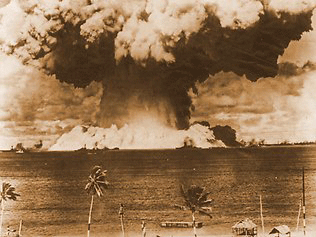
| 75 years after nuclear testing in the Pacific began, the fallout continues to wreak havoc https://theconversation.com/75-years-after-nuclear-testing-in-the-pacific-began-the-fallout-continues-to-wreak-havoc-158208?fbclid=IwAR3q9QJvy507ds2kD0ibOvkD6ZzxFqgGjfHsGrwqJUVMNpujOu8sAeLVPtY April 6, 2021 Patricia A. O’Brien Patricia A. O’Brien is a Friend of The Conversation.Historian, Visiting Fellow in the School of History, Australian National University and Adjunct Professor in the Asian Studies Program, Georgetown University, This year marks 75 years since the United States launched its immense atomic testing program in the Pacific. The historical fallout from tests carried out over 12 years in the Marshall Islands, then a UN Trust Territory governed by the US, have framed seven decades of US relations with the Pacific nation.Due to the dramatic effects of climate change, the legacies of this history are shaping the present in myriad ways. This history has Australian dimensions too, though decades of diplomatic distance between Australia and the Marshall Islands have hidden an entangled atomic past. In 1946, the Marshall Islands seemed very close for many Australians. They feared the imminent launch of the US’s atomic testing program on Bikini Atoll might split the earth in two, catastrophically change the earth’s climate, or produce earthquakes and deadly tidal waves. A map accompanying one report noted Sydney was only 3,100 miles from ground zero. Residents as far away as Perth were warned if their houses shook on July 1, “it may be the atom bomb test”. Australia was “included in the tests” as a site for recording blast effects and monitoring for atom bombs detonated anywhere in the world by hostile nations. This Australian site served to keep enemies in check and achieve one of the Pacific testing program’s objectives: to deter future war. The other justification was the advancement of science. The earth did not split in two after the initial test (unless you were Marshallese) so they continued; 66 others followed over the next 12 years. But the insidious and multiple harms to people and place, regularly covered up or denied publicly, became increasingly hard to hide. Radiation poisoning, birth defects, leukaemia, thyroid and other cancers became prevalent in exposed Marshallese, at least four islands were “partially or completely vapourised”, the exposed Marshallese “became subjects of a medical research program” and atomic refugees. (Bikinians were allowed to return to their atoll for a decade before the US government removed them again when it was realised a careless error falsely claimed radiation levels were safe in 1968.) In late 1947, the US moved its operations to Eniwetok Atoll, a decision, it was argued, to ensure additional safety. Eniwetok was more isolated and winds were less likely to carry radioactive particles to populated areas. Australian reports noted this site was only 3,200 miles from Sydney. Troubling reports of radioactive clouds as far away as the French Alps and the known shocking health effects appeared. Dissenting voices were initially muted due to the steep escalation of the Cold War and Soviet atomic weapon tests beginning in 1949. Opinion in Australia split along political lines. Conservative Cold War warriors, chief among them Robert Menzies who became prime minister again in 1949, kept Australia in lockstep with the US, and downplayed the ill-effects of testing. Left-wing elements in Australia continued to draw attention to the “horrors” it unleashed. The atomic question came home in 1952, when the first of 12 British atomic tests began on the Montebello Islands, off Western Australia. Australia’s involvement in atomic testing expanded again in 1954, when it began supplying South Australian-mined uranium to the US and UK’s joint defence purchasing authority, the Combined Development Agency. Australia’s economic stake in the atomic age from 1954 collided with the galvanisation of global public opinion against US testing in Eniwetok. The massive “Castle Bravo” hydrogen bomb test in March exposed Marshall Islanders and a Japanese fishing crew on The Lucky Dragon to catastrophic radiation levels “equal to that received by Japanese people less than two miles from ground zero” in the 1945 Hiroshima and Nagasaki atomic blasts. Graphic details of the fishermen’s suffering and deaths and a Marshallese petition to the United Nations followed. When a UN resolution to halt US testing was voted on in July, Australia voted for its continuation. But the tide of public opinion was turning against testing. The events of 1954 dispelled the notion atomic waste was safe and could be contained. The problem of radioactive fish travelling into Australian waters highlighted these new dangers, which spurred increasing world wide protests until the US finally ceased testing in the Marshalls in 1958. In the 1970s, US atomic waste was concentrated under the Runit Island dome, part of Enewetak Atoll (about 3,200 miles from Sydney). Recent alarming descriptions of how precarious and dangerous this structure is due to age, sea water inundation and storm damage exacerbated by climate change were contested in a 2020 Trump-era report. The Biden administration’s current renegotiation of the Compact of Free Association with the Republic of the Marshall Islands, and its prioritisation of action on climate change, will put Runit Island high on the agenda. There is an opportunity for historical redress for the US that is even more urgent given the upsurge in discrimination against US-based Pacific Islander communities devastated by the COVID-19 pandemic. Some are peoples displaced by the tests. Australia is also embarking on a new level of engagement with the Marshall Islands: it is due to open its first embassy in the capital Majuro in 2021.It should be remembered this bilateral relationship has an atomic history too. Australia supported the US testing program, assisted with data collection and voted in the UN for its continuation when Marshallese pleaded for it to be stopped. It is also likely Australian-sourced atomic waste lies within Runit Island, cementing Australia in this history. |
Scott Morrison’s $billion missile spend, a gift to foreign war companies and their sponsor, the Australian Strategic Policy Institute, (ASPI)
Foreign war lobby gets a $billion for missiles – media fawns
https://www.michaelwest.com.au/foreign-war-lobby-gets-a-billion-for-missiles-media-fawns/ 4 Apr 21,
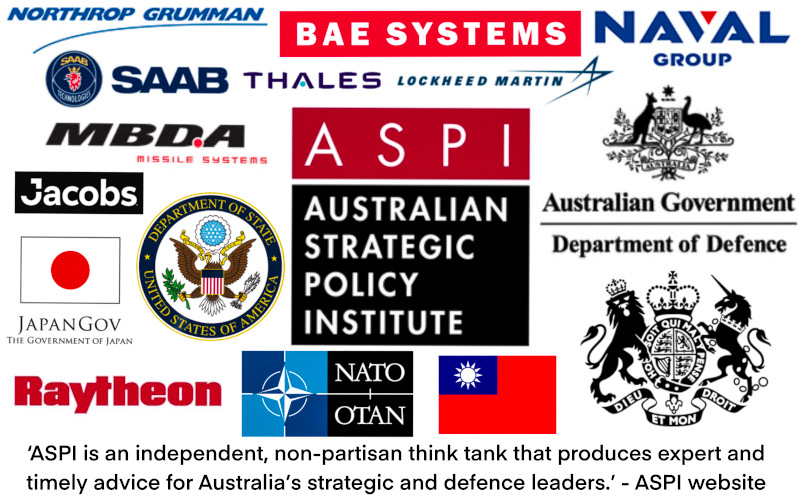
Scott Morrison’s latest billion-dollar missile spend was deftly leaked to the media then talked up by ASPI whose sponsors have raked in $51 billion in Defence Department contracts while doling cash to the conflicted “think-tank”. Marcus Rubenstein investigates.
No sooner had Scott Morrison’s new cabinet been sworn in than it was back to business, feeding out distractions to the Canberra press gallery.
Nearly 14 hours before the prime minister announced to the nation that Australia was going to spend a billion dollars on building “our own missiles” Greg Sheridan from The Australian had the scoop—along with The Age/SMH, Nine Newspapers stablemate Australian Financial Review and the ABC. Along with the ranks of metropolitan mainstream media dailies who all fell in line behind the announcement.
And with military precision they all fired off their online reports at 10:30pm… or, to be more precise, 22:30 hrs.
The Age and Sydney Morning Herald both quoted ASPI (Australian Strategic Policy Institute) in their coverage as did The Conversation, along with others they listed potential weapons maker partners for this home grown missile mission.
Apart from the glaring fact that none of these companies are actually Australian, most were listed by ASPI in a report it published last year. Of the five potential partner companies being touted by mainstream media— Raytheon (USA), Lockheed Martin (USA), Kongsberg (Norway), Rafeal (Israel) and BAE Systems (UK)—all but one is a long-term financial backer of ASPI.
As is de rigueur there was no mention that ASPI’s enthusiasm for substantial new military expenditure was directed towards spending on weapons made by their sponsors.
A number of media reports included PR handout images from US missile maker Raytheon, which for years was a loyal ASPI sponsor and also the former employer of, recently demoted, Defence Minister Linda Reynolds.
The actual announcement was made by the prime minister, not at Parliament House, but at the South Australian facility of Raytheon.
Government access for weapons makers
Since ASPI’s foundation in 2001, when it was created to challenge the policy direction of Defence, it has become more and more commercialised.
This fact was highlighted by ASPI’s founding Executive Director Hugh White, who wrote on the 15th anniversary of its foundation, “The quality of defence policy slumped… [and] ASPI’s focus inevitably swung round to contributing to public debates not government policy-making.”
Under Hugh White’s leadership, ASPI preserved a great deal of independence and only took an average of $28,000 per year in commercial revenue.
In the last financial year, under the leadership of (former Howard Government adviser) Peter Jennings, ASPI raked in $6,953,000 in commercial revenue. Yet it maintains its façade of independence of outside influence.
ASPI sponsor, French-owned Naval Group was awarded the contract for Australia’s controversial $80 billion future submarine project. It has been in the headlines recently after an independent report released in March found the project was “dangerously off track”.
In 2016, when the contract was awarded Jennings, wrote a glowing opinion piece, about his sponsor, under the headline “Vive Australia’s choice of a French submarine”.
The release of the Future Submarines Report was very critical of the entire project and there were suggestions from highly credentialed defence strategists that Australia should walk away from the deal.
In response, ASPI wrote that not only should Naval Group keeps its contract but the Royal Australian Navy should commission un-maned Orca submarines whilst waiting decades for the French submarines order to be fulfilled.
And who makes the Orca? Another ASPI sponsor, Boeing Defense.
This comes after revelations in March that ASPI had been commissioned to write a report critical of the federal government’s awarding of cloud computing contracts to Australian company Canberra Data Centres (CDC).
As it transpires, ASPI had been commissioned to write the report by lobbying firm Australian Public Affairs (APA); the Commonwealth Lobbyists Register reveals APA represent CDC’s three main commercial rivals.
Last October, ASPI’s Peter Jennings told the ABC, “ASPI’s work as a think tank is genuinely independent” and suggestions it was controlled by sponsors were “frankly nonsense”.
The massive ASPI payoff
ASPI is not an independent think tank, it is in fact a Commonwealth Company which reports to the parliament through the Defence Ministry. In its latest annual report ASPI singled out the then Defence Minister for her “continuing close personal engagement and support”.
In her first speech as Defence Minister, Linda Reynolds boasted of her close friendship with ASPI’s Peter Jennings.
Clearly ASPI’s boss and his board, which is chaired by former Chief of the Army, Lt Gen (Ret’d) Kenneth Gillespie and includes former Liberal Defence Minister Brendan Nelson, has access to the highest levels of government and the Defence Department.
Since ASPI’s inception it has received sponsorship from 12 manufacturers of weapons and weapons systems. Over that period, they have been awarded 9,423 Defence Department contracts with a total value of $51.2 billion.
This does not include another 49 ASPI sponsors who do not manufacture weapons, yet Department of Finance data, reveals have benefitted from more than $30 billion in defence contracts since 2001.
ASPI’s most recent annual report revealed that in the year before the COVID-19 pandemic, it hosted 142 separate events and meetings, many of them bringing together defence policy makers and defence suppliers.
At one such event in 2019, sponsored by Thales, Northrop Grumman and Lockheed Martin, then Defence Minister Linda Reynolds was keynote speaker. Presumably executives from these foreign weapons makers had some level of access to the minister.
Department of Finance figures later revealed that ministerial and department staff were charged $30,723 by ASPI in order to attend that speech.
New research into the effects of nuclear bomb tests on Montebello islands
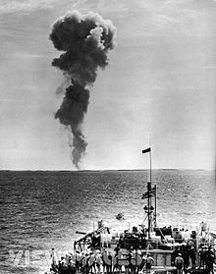 By Susan Standen 22 Mar 21, A new Edith Cowan University research project hopes to collect important data on the impact of historical nuclear testing in the remote Montebello Islands area. Key points:
Sixty years after the British government conducted nuclear explosion testing on the islands, there is little data available to find how much residue plutonium still exists. The project hopes to be the first study to outline how and where man-made radioactivity is still existing in the marine sediment. Collections of sediment are being collected from remote field trips to the islands to analyse amounts of residue plutonium radionuclides.,,,,,,,,,,,, Ms Hoffman says other island nations affected by nuclear blasts will be able to use the Montebello Islands research as a reference baseline to start their own investigations. Will it inform health research? Ms Hoffman says the first step is to find out what remains there as a legacy………….. The project is a collaboration between the Edith Cowan University, the Department of Biodiversity and Conservation and the Australian Radiation Protection and Nuclear Safety Agency. https://www.abc.net.au/news/2021-03-22/montebellos-nucelar-fallout-research/13260242 |
|
Australia’s purchase of vastly expensive French nuclear-powered submarine design, adapted to diesel, now to be scrapped?
 These submarine designs were adapted from the French nuclear submarines. I thought, at the time, that they were chosen in preference to the more suitable, and more affordable German design, under the pressure of the nuclear lobby. Presumably, it would be practical to later adapt these submarines to be nuclear-powered.
|
Government submarine contract sunk and unlikely to resurface, Independent Australia, 1 Mar 21, The submarine deal France proudly called ‘the contract of the Century’ appears to have collapsed, reports Alan Austin.IF THERE WAS one thing which should unite all media commentators, economic and military analysts, and informed citizens in outrage against the Morrison Government, it is this. The Government has wasted billions of dollars on a deal to buy 12 new submarines which have virtually no chance of fulfilment. As this is written, the head of the French naval construction company Naval Group, Pierre Eric Pommellet, is in Australia meeting federal ministers in an attempt to rescue the contract. Tragically for Australia – and for Monsieur Pommellet – not one of those ministers has the experience or competence to wrangle a successful result. Many informed commentators in France, Australia and elsewhere now expect the much-celebrated deal to be abandoned. If that happens, replacing the current ageing submarines would be delayed many years, depending on the timing of the change of government to a capable administration. Although defence is just one example of Coalition mismanagement, this is where Australia’s losses are arguably most devastating: both in billions of dollars wasted and in the risk to national security. Responsibility for the projectMultiple failures are evident. The most basic is accountability. Since negotiations with France began, Australia has had three prime ministers, three deputy PMs, three failed treasurers, five defence ministers and four ministers for defence industry. Of the 15 individuals to have held these portfolios, seven have left the Parliament. None remaining has the competence to deliver for Australia or the mettle to take responsibility. The current Defence Minister is in hospital on leave. Political priorities paramountA major factor in dashing into the connection with France was the set of promises the Coalition hoped to make chasing votes. In the run-up to the 2019 election, then Minister for Defence Industry Christopher Pyne promised hundreds of new jobs, the “majority of which will be based in South Australia”. Cost and defence considerations were secondary. Many military observers were dismayed at Australia taking the French Shortfin Barracudas over the lower-cost and more suitable alternatives tendered by Japan and Germany. Design and cost errorsSeveral of Australia’s specifications were plain foolish, as Binoy Kampmark summarised for IA. A nuclear submarine with a diesel-electric engine is a fail. An American combat system won’t work in a French vessel because the Americans and the French do not talk. Lead-acid batteries will be obsolete well before the subs are delivered. France’s original tender documents put the cost of the project at between $20 billion and $25 billion. The cost in the initial agreement signed in late 2016 was $50 billion. By February 2020, the Parliamentary Library research service reported that the acquisition cost:
Today, estimates range up to double that quantum. Missed deadlinesDelays so far have pushed back delivery of the first Barracuda from the mid-2020s to the early 2030s and now to the 2040s. The latest missed date was finalising the critical Strategic Partnering Agreement which governs the entire project. This was due before last Christmas………… Excessive secrecy, even from the SenateCompounding all these failures is Morrison’s Cabinet refusing to be answerable to the Parliament. In an ugly confrontation in last month’s Senate Economics References Committee, Defence Department head Greg Moriarty refused point-blank to provide documents which the Committee had the constitutional right to access. Independent Senator Rex Patrick warned Moriarty:
Moriarty steadfastly refused the Committee’s requests, insisting he would do the bidding of the craven Minister and Cabinet. The remedyThus the solution is for the people of Australia to get rid of this secretive bungling regime at the earliest opportunity: to save hundreds of billions of dollars and to ensure effective military capability. https://independentaustralia.net/politics/politics-display/government-submarine-contract-sunk-and-unlikely-to-resurface,14846 |
|
Australian Strategic Policy Institute – a stooge for weapons industries and China-haters
|
Independent” think-tank ASPI behind push for more defence spending rakes in advisory fees, Michael West Media, 1 Mar 21, by Marcus Reubenstein | Jul 1, 2020 Funded by the Department of Defence, the Australia Strategic Policy Institute collects millions more as it drives the “China threat” narrative. As Marcus Reubenstein reports, while ASPI is the media’s go-to experts for public comment, ASPI is remarkably coy about revealing all its funding sources.
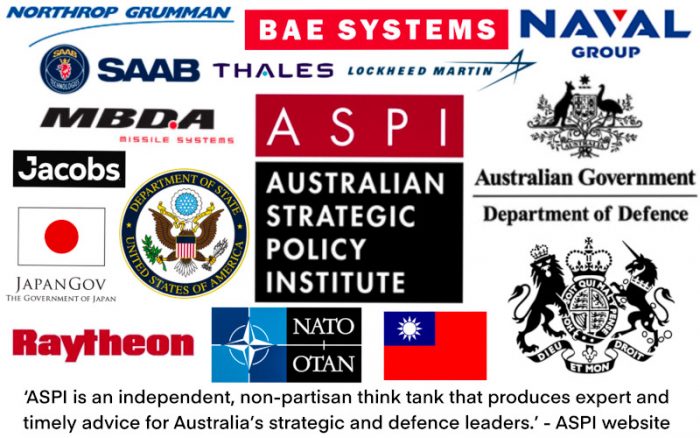
On the day the Prime Minister Scott Morrison announced a $270 billion defence spending plan, the Department of Defence paid the Australian Strategic Policy Institute (ASPI) a $214,500 contract for “management advisory services”. Exactly one year ago today, it was awarded a similar “management advisory services” contract for the considerably larger amount of $614,536. ASPI has pushed hard for boosts to defence spending, in particular an upgrade of Australia’s missile capabilities. The Government says it will spend $800 million on the US-made AGM-158C Long Range Anti Ship Missile, manufactured by Lockheed Martin, which gave ASPI $135,909 in sponsorship funds in 2018-19. Go-to think tank on ChinaThe Australian Strategic Policy Institute is the “go to” think tank for the mainstream media seeking an “independent voice” to make sense of troubled times with China. Its analysts are knowledgeable and articulate, always forthcoming with research pointing to the strategic threat of China. However, it is less forthcoming about the funders of its research, although it is an open secret that foreign governments and multi-billion-dollar weapons makers are generous supporters. What is not widely known is the extent to which taxpayers are propping it up, through dozens of small contracts not listed in its annual reports. Last year, these contracts amounted to more than $2 million and were signed by the chiefs of a small group of government departments which, say ASPI’s critics, have vested interests in promoting China as Australia’s No. 1 strategic threat. On China’s radarTwo weeks ago, ASPI was again thrust into the international limelight after China’s foreign ministry directly named it as the source of claims by Prime Minister Scott Morrison that Australia was the victim of a sustained cyber security attack. Morrison did not name China but, ASPI’s executive director, Peter Jennings did. He told journalists it was a “95%” likelihood that China was behind the alleged attacks. Critics, including former foreign ministers, ambassadors and senior figures within the defence establishment, contend that ASPI is an anti-China lobby that has hoodwinked the media into believing it is independent. Labor Senator Kim Carr, who is pursuing ASPI through a Senate committee, argues it’s a conflicted government-funded body that lacks transparency, particularly in the way it reports who funds its research. It is an Australian government organisation, a Commonwealth company, and they’ve been at the centre of Sinophobia. This is what happened in the Cold War, you set up a front and create a world view that’s unchallengeable. Then you de-legitimize anyone who argues for engagement with China. Ironically, engagement with China remains official government policy”. Disguised defence largesseThe Howard Government set up ASPI in 2001 as an independent think tank that would challenge a supposed culture of stagnated thinking, weighed down by the defence bureaucracy. Its main funding was an annual grant from the Defence Department but over the past decade it has developed more and more revenue streams — and no obligation to reveal exactly who pays it what. Defence remains its biggest benefactor. Before the federal election, the Morrison Government not only increased this funding by more than 13%, it locked in a guaranteed $20 million until 2023. This largesse does not include one-off payments for sponsorship and commissioned reports. In its annual reports, ASPI declares the $4 million annual Defence grant but opaquely refers to this as “core funding”. According to Department of Finance figures, in 2018-19 it received an additional $1,363,002.84 in funding from Defence, which was not publicly declared. According to answers it provided to a Senate Estimates committee in February, ASPI collected $1,158,581.63 (pre-GST) in funding from Defence without clearly declaring the source of those funds. ASPI didn’t explain the discrepancy between its two reported figures. Shrinking support?In its annual report, ASPI splits income into two sources: “Defence funding” and “Sale of goods and rendering of services”. It also produced a gloomy graph [on original] showing how “core” funding had withered away from 100% of its income to a moderate 43%. However, the graph doesn’t take into account its numerous government tenders and contracts that have delivered a financial windfall. In the past five years the value of its government contracts has increased by more than 300%. (second graph on original] Figures from the Department of Finance’s procurement website AusTender show ASPI was awarded $2,133,716.62 in contracts between July 2019 and June 2020. ASPI records all these government payments in its annual reports but muddies the waters by consolidating them with sponsorships and other commercial revenue. ASPI has received 37 government contracts in the past two years. See below [on original] or click here for easier viewing………. Major backersASPI has received funding from the governments of Britain, Japan and Taiwan as well as NATO. Among its corporate supporters are global weapons makers Thales, BAE Systems, Raytheon, SAAB, Northrop Grumman, MDBA Missile Systems and Naval Group. Yet their contribution of over $330,000 last year is dwarfed by that of a handful of government departments and agencies. Disclosures to the Senate revealed that ASPI had at least 56 sources of income in 2018-19 which it categorised as either sponsorships or commissioned income. Critics might accuse ASPI of having a narrow world view, but its views are financially supported by a very broad base of benefactors. Michael West Editor’s Note: This is a special investigation by APAC News, Michael West Media and Pearls & Irritations https://www.michaelwest.com.au/independent-think-tank-aspi-behind-push-for-more-defence-spending-rakes-in-advisory-fees/ |
|
Mount Isa City Council supports nuclear weapons ban
 Mount Isa City Council supports nuclear weapons ban, Derek Barry, 10 Feb 21,
Australian Capital Territory politicians join calls for Australia to sign nuclear ban treaty
|
ACT politicians join calls for Australia to sign nuclear ban treaty https://www.canberratimes.com.au/story/7097235/act-politicians-join-calls-for-australia-to-sign-nuclear-ban-treaty/, Jasper Lindell 24 Jan 21,
ACT politicians have renewed their calls for the federal government to join a United Nations treaty banning the use of nuclear weapons, which came into force on Friday. Politicians and members of the international diplomatic corps gathered on Saturday at the Canberra Rotary peace bell in Nara Peace Park to mark the entry-into-force of the treaty. Greens member for Ginninderra Jo Clay said Australia’s continued relationship with uranium mining and the creation of nuclear weapons was unacceptable.
“With climate change upon us, the ACT Greens believe that there has never been a more urgent time for Australia to join its 86 international counterparts and show its commitment to a more peaceful and sustainable future for all of us,” Ms Clay said in a statement. All Greens members of the Legislative Assembly have signed the International Campaign to Abolish Nuclear Weapons’ parliamentary pledge.
Some Labor members, including Chief Minister Andrew Barr and Deputy Chief Minister Yvette Berry, have signed the pledge. Federal member for Canberra Alicia Payne has also signed. The Australian government has not signed the treaty, which compels signatories to stop developing, testing, producing or stockpiling nuclear weapons. Signatories are also banned from threatening to use the weapons. Fifty countries ratified the treaty in October, which was condemned by the United States. Red Cross International humanitarian law adviser Tara Gutman welcomed the treaty, saying the law was the cornerstone of a world free of nuclear weapons. “There has been no humanitarian response developed that is remotely capable of being applied to a nuclear weapon attack. We simply will not be there to assist victims,” she said. “These weapons are an inhumane response to any military threat … They decimate populations, cause untold and needless suffering, and their environmental impact would accelerate climate change making some areas of the planet uninhabitable. |
|
Red Cross celebrates Nuclear Ban Treaty- an incremental process towards elimination of nuclear weapons
 Crucial to sign up for a nuclear-free celebration. https://www.theage.com.au/national/crucial-to-sign-up-for-a-nuclear-free-celebration-20210121-p56vtl.htmly Kym Pfitzner Crucial to sign up for a nuclear-free celebration. https://www.theage.com.au/national/crucial-to-sign-up-for-a-nuclear-free-celebration-20210121-p56vtl.htmly Kym Pfitzner
January 22, 2021 — It’s taken 75 years since the bombing of Hiroshima and Nagasaki to reach the historic day when we finally have a ban on nuclear weapons enshrined in international law.
Today is a day for celebration. From January 22, all nations that ratified the Treaty on the Prohibition of Nuclear Weapons are banned from possessing, developing or having any direct dealings with these weapons of mass destruction. This development heralds progress towards a safer and more humane world. The Red Cross and Red Crescent Movement across the globe has been striving towards this moment for three-quarters of a century. How timely it is to achieve this milestone after a year of uncertainty and difficulties. I commend the 86 countries which have already signed this important treaty – from Austria to Zimbabwe – and particularly the 51 nations that have ratified it. They’ve put the interests of humanity and the environment above other considerations. I’d like to remind all other nations of our organisation’s inability to provide any remotely adequate medical or humanitarian response to a nuclear crisis and call on all countries which are yet to sign – including Australia, the nuclear-armed nations, and some of their allies – to do so now. But today should still be celebrated. It’s the dawn of new era in which the last weapon of mass destruction to be regulated by international law will finally begin to be controlled. Other weapons that cause unacceptable harm – contrary to the laws of war – have already been banned, such as cluster munitions, anti-personnel landmine and chemical weapons. Nuclear weapons are incompatible with the rules of international humanitarian law. The laws of war are unambiguous: weapons must be able to distinguish between civilians and combatants, as only combatants can be legally attacked. Weapons must not cause superfluous injury or unnecessary suffering. Their effects must be proportionate to their military objective. And weapons cannot be used if they cause widespread, long-term and severe damage to the environment. Rather than leaving the fate of these weapons to the handful of countries that legally own them, and which were not fulfilling their obligation to work towards their elimination, the public debate has been reframed from being defined as a matter of defence policy, to being about the unacceptable humanitarian consequences of use of nuclear weapons. We know all about those consequences. Members of the Red Cross and Red Crescent Movement were there when the bombs fell on Hiroshima and Nagasaki. There was little they could do to deal with the immediate needs of those needing help, or to alleviate the long-term suffering of the people on the ground. The impacts lasted decades and, devastatingly, even affected the children of those who survived those bombs. Research is still being conducted to determine whether the illnesses being experienced by descendants – two generations later – can be explained by mutations in their DNA that was caused by radiation. With the coming into force of this treaty, let’s hope we’re getting closer to the time that we’re never that helpless again. We want Australians to know that nuclear weapons are not an acceptable defence policy option. They are barbaric tools that cause hellish devastation and untold suffering to civilians. Some critics argue the treaty is toothless because the nuclear-armed nations and their allies have not yet signed it. This ignores the reality of International law-making, which is that creating new norms is an incremental process. It takes patience and persistence. No weapon has ever been eliminated without first being studied, stigmatised and prohibited. With the advent of a vaccine for COVID-19, we can be cautiously hopeful that the end of the current global pandemic is in sight. Unfortunately, though, we can’t rely on medical science to save us from the impacts of a nuclear attack. There can be no vaccine for the health effects of a nuclear weapon. Elimination is the only option. This is why we believe in a future without nuclear weapons. Kym Pfitzner is the CEO of Australian Red Cross. |
|
|
Australia could sign the Nuclear Ban Treaty and still keep its military co=operation with America
 The nuclear weapons ban treaty is groundbreaking, even if the nuclear powers haven’t signed The Conversation 22, 2021 Tilman Ruff– Honorary Principal Fellow, School of Population anobal Health, University of Melbourne,
The UN Treaty on the Prohibition of Nuclear Weapons (TPNW) was adopted at the United Nations in 2017 and finally reached the milestone of 50 ratifications in October. The countries that have signed and ratified include Austria, Ireland, Mexico, New Zealand, South Africa, Nigeria and Thailand.
The treaty completes the suite of international bans on all major weapons considered unacceptable because of their indiscriminate and inhumane effects, including anti-personnel landmines, cluster munitions, biological and chemical weapons………
The TPNW strengthens the current nuclear safeguards found in the 1970 Treaty on the Non-Proliferation of Nuclear Weapons by requiring all states that join to have comprehensive provisions in place and not allowing states to weaken their existing safeguards.
The treaty provides the first legally binding multilateral framework for a process by which all nations can work toward eliminating nuclear weapons………
Further, the TPNW is the first treaty to commit member nations to provide long-neglected assistance for the victims of atomic bombs and weapon testing. It also calls for nations to clean up environments contaminated by nuclear weapons use and testing, where feasible.
Nuclear-armed states have been put on notice
Currently, 86 nations have signed the TPNW, and 51 have ratified it (meaning they are bound by its provisions). The treaty now becomes part of international law, and the number of signatories and ratifications will continue to grow……..
While any treaty is technically only binding on the states that join it, the TPNW establishes a new international legal standard against which all nuclear policies will now be judged.
The treaty, in short, is a game-changer, and the nuclear-armed and dependent countries have been put on notice. They know the treaty jeopardises their claimed right to continue to threaten the planet with their weapons, as well as their plans to modernise and maintain their nuclear arsenals indefinitely…………
The strength of the opposition is a measure of the treaty’s importance. It will have implications for everything from defence policies and military plans to weapons manufacturing to financial investments in the companies that profit from making now illegal nuclear weapons………….
A ‘dangerous’ belief nuclear weapons enhance securityWould joining the treaty mean nations like Australia, Japan, South Korea and NATO members would have to end their military cooperation with nuclear-armed states like the US? No. There is nothing in the TPNW that prevents military cooperation with a nuclear-armed state, provided nuclear weapons activities are excluded. Countries like New Zealand and Kazakhstan have already demonstrated that joining the treaty is fully compatible with ongoing military cooperation with, respectively, the US and Russia. In a recent letter urging their governments to join the treaty, 56 former presidents, prime ministers and defence and foreign ministers from these nations said: By claiming protection from nuclear weapons, we are promoting the dangerous and misguided belief that nuclear weapons enhance security. As states parties, we could remain in alliances with nuclear-armed states, as nothing in the treaty itself nor in our respective defence pacts precludes that. But we would be legally bound never under any circumstances to assist or encourage our allies to use,
The signatories include two former NATO secretaries-general, Willy Claes and Javier Solana. Ban treaties have been proven to work with other outlawed weapons — landmines, cluster munitions and biological and chemical weapons. They have provided the basis and motivation for progressive efforts to control and eliminate these weapons. They are now significantly less produced, deployed and used, even by states that haven’t joined the treaties. We can achieve the same result with nuclear weapons. As Hiroshima survivor Setsuko Thurlow said at the UN after the treaty was adopted, This is the beginning of the end of nuclear weapons. https://theconversation.com/the-nuclear-weapons-ban-treaty-is-groundbreaking-even-if-the-nuclear-powers-havent-signed-153197 |
|
|
Morrison government gets in early to disparage nuclear ban treaty, but Labor supports it
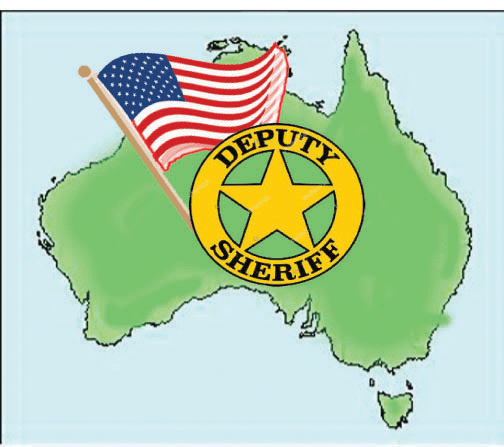 New nuclear treaty will be ‘ineffective’: DFAT, SMH, Anthony Galloway, January 21, 2021, Australia says a new United Nations nuclear treaty signed by more than 80 countries will be ineffective in eliminating nuclear weapons from the world.The Morrison government has not signed the Treaty on the Prohibition of Nuclear Weapons, which comes into effect on Friday.
The treaty, signed by 86 countries, bans signatories from testing, developing, producing, stockpiling or threatening to use nuclear weapons.
The Australian government decided not to sign the treaty on the basis that it failed to recognise the realities of the current international security environment.
Government sources confirmed there was concern about how the treaty would affect Australia’s dealings with the United States, including intelligence sharing through the Pine Gap satellite surveillance base near Alice Springs, because it banned signatories from doing anything to assist a nuclear weapon state in its nuclear plans.
New Zealand, which is part of the Five Eyes intelligence-sharing agreement with the US, Australia, Canada and Britain, has signed the treaty…….
Opposition foreign affairs spokeswoman Penny Wong said Labor welcomed the treaty.
“After taking into account the need to ensure an effective verification and enforcement architecture, the interaction of the treaty with the Nuclear Non-Proliferation Treaty, and achieve universal support, a Labor government would sign and ratify the treaty,” she said.
“Australia can and should lead international efforts to rid the world of nuclear weapons. A Labor government would work with our allies and partners to this end and would always act consistently with the US alliance.”
Helen Durham, director for international law and policy at the International Committee of the Red Cross, said all countries should sign the treaty as it was the “most explicit and clearest expression that the horrific weapons need to be banned”.
“It deals not only with their use but also with their threat of use, with their stockpiling, with their production, with their development and their testing,” she said.
“This treaty is a great opportunity to move a very stagnated, to date, agenda forward and we would encourage every state to take up this opportunity.”
Dave Sweeney, co-founder of the International Campaign to Abolish Nuclear Weapons, said the treaty was a “sign of hope for our planet”.
“The changed status of nuclear weapons means Australia faces a clear choice,” he said. “We either choose to be a responsible and lawful member of the global community or we remain silent and complicit in plans to fight illegal wars https://www.smh.com.au/politics/federal/new-nuclear-treaty-will-be-ineffective-dfat-20210121-p56vst.html
Australian government complicit in nuclear weapons, silent on Nuclear Weapons Ban Treaty
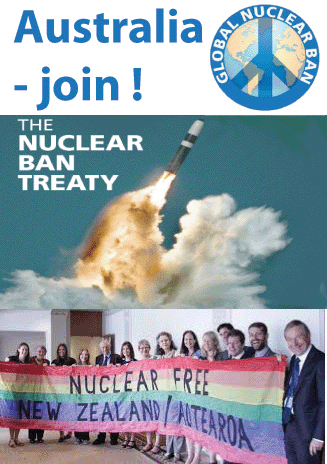 Nuclear weapons illegal from 22 January https://www.miragenews.com/nuclear-weapons-illegal-from-22-january/ 21 Jan 21, As President Joe Biden takes charge in the United States – and is expected to immediately move to rejoin the Paris climate agreement – this week also sees a very significant shift in the global status of nuclear weapons. Nuclear weapons illegal from 22 January https://www.miragenews.com/nuclear-weapons-illegal-from-22-january/ 21 Jan 21, As President Joe Biden takes charge in the United States – and is expected to immediately move to rejoin the Paris climate agreement – this week also sees a very significant shift in the global status of nuclear weapons.On Friday 22 January the UN Treaty on the Prohibition of Nuclear Weapons takes effect, making nuclear weapons finally and formally illegal under international law. “This is a sign of hope for our planet,” said Dave Sweeney, ACF nuclear free campaigner and co-founder of ICAN, the International Campaign to Abolish Nuclear Weapons. “Nuclear weapons pose an existential threat. They are weapons of mass and indiscriminate murder. From this week, they are illegal under international law.” The treaty prohibits signatories from testing, developing, producing, stockpiling or threatening to use nuclear weapons. It also obliges parties to support the widespread adoption of the treaty and address the human and environmental impacts of nuclear testing. While the treaty cannot force non-signatories – including the USA, China and Russia – to disarm, it will increase the political, legal and economic pressure on these nations and their allies. The Morrison government has opposed the progress of the treaty and refuses to support or sign the initiative. Labor has committed to sign and ratify the treaty when it is next in government. The Greens and some cross benchers also support the treaty. “The changed status of nuclear weapons means Australia faces a clear choice,” Dave Sweeney said. “We either choose to be a responsible and lawful member of the global community or we remain silent and complicit in plans to fight illegal wars. “It’s time for Australia to be on the right side of law and history – this treaty is the best way to finally get rid of the world’s worst weapons. We should celebrate it and support it.” The ban follows years of advocacy led by ICAN, the International Campaign to Abolish Nuclear Weapons, which started in Melbourne in 2007 and was awarded the Nobel Peace Prize in 2017 for drawing attention to the catastrophic humanitarian consequences of any use of nuclear weapons and for its efforts to achieve a treaty-based prohibition of such weapons. ICAN briefing paper on the Treaty on the Prohibition of Nuclear Weapons and Australia /Public Release. The material in this public release comes from the originating organization and may be of a point-in-time nature, edited for clarity, style and length. View in full here. |
|
|
Nuclear weapons ban treaty: more than a symbolic victory
Nuclear weapons ban treaty: more than a symbolic victory, https://www.croakey.org/nuclear-weapons-ban-treaty-more-than-a-symbolic-victory/ Editor: Nicole MacKeeAuthor: Sue Warehamon: January 18, 2021
As the Treaty on the Prohibition of Nuclear Weapons (TPNW) comes into force later this week, Dr Sue Wareham of the Medical Association for Prevention of War outlines the local and global implications. And, she calls on the Federal Government to make an explicit declaration that nuclear weapons must never be used again under any circumstances.
Sue Wareham writes:
Here’s a good news story about health to kick off 2021. It’s not about vaccines (despite their critical importance), but about the only weapons that threaten all of us and the environment we depend on: nuclear weapons.
On Friday 22 January, the Treaty on the Prohibition of Nuclear Weapons (TPNW), or nuclear weapons ban treaty, will legally come into effect. From that date, nuclear weapons – and every aspect of their existence including their development, testing, production, transfer, use and even possession – will be illegal under international law.
This is a huge achievement, and celebrations will be held around the globe, including in Australia.
Health professionals push
The legal prohibition stemmed from the health and humanitarian impacts of the weapons. They incinerate cities, kill, maim, burn and irradiate humans by the million, and destroy just about everything that health professionals need in the event of disaster. Their use could well trigger a nuclear winter that reduces food crops to starvation levels. By any measure, that’s an unconscionable affront to the healing professions.
Similarly, the momentum that led to the ban treaty was driven by health and humanitarian organisations and practitioners, in collaboration with progressive governments.
The message of prevention, especially of catastrophes for which there would be little that health professionals could do in response, was key, and remains so.
 The ban treaty is an especially proud achievement for health professionals in Australia, where in 2007 the Medical Association for Prevention of War (MAPW) initiated the International Campaign to Abolish Nuclear Weapons (ICAN), which played a leading role in the achievement of the Treaty.
The ban treaty is far from a symbolic victory; the  are huge, even without all nations – including those with the weapons – yet coming on board.
Associated with illegality
Nuclear weapons and those nations that possess or promote them will now be associated with illegality, which provides strong political leverage with which to press for abolition of the weapons.
This has certainly been the experience with the prohibition by treaty of other unacceptable weapons systems such as chemical and biological weapons, landmines, and cluster bombs.
Pressure will be brought to bear on financial, academic and other institutions that receive funding from, or invest in, the companies that make the weapons, to dissociate themselves from the purveyors of illegal goods; this has already begun (see, for example, here, here, and here) and will increase.
This is not only morally and medically repugnant, but such implicit threats of nuclear terror will now be, as of 22 January, illegal under international law.
The ban treaty comes none too soon. The Bulletin of the Atomic Scientists warned in January 2020 of the undermining of “cooperative, science- and law-based approaches to managing the most urgent threats to humanity”, and that “civilisation-ending nuclear war – whether started by design, blunder, or simple miscommunication – is a genuine possibility”.
The risk of nuclear war was assessed as higher than it’s ever been. If any further evidence were needed of the perilous state in which humanity exists, we were reminded recently that the US nuclear arsenal can be launched by one person, the president, regardless of whether that person happens to be an unhinged narcissist.
Call for change
Australia’s policy must change. There must be an explicit declaration that nuclear weapons must never be used again under any circumstances. And there must be a commitment to the urgent abolition of these weapons as the only way to ensure this.
Preventive health demands nothing less, and the Treaty on the Prohibition of Nuclear Weapons is the only global initiative that is leading us towards these goals. Australia must sign and ratify it.
The nuclear weapons ban treaty is supported by peak Australian and global health bodies, including the Australian Medical Association, the World Medical Association, the Australian Nursing and Midwifery Federation, the International Council of Nurses, the Public Health Association of Australia, and the World Federation of Public Health Associations.
MAPW is calling on the Health Minister Greg Hunt to declare that:
- Nuclear weapons must never be used, under any circumstances; and
- It is a medical and public health imperative to prohibit and eliminate nuclear weapons.
Readers are encouraged to join the call; you can do so here. It will be delivered to the Minister on 22 January, the day the TPNW comes into force. It will also be sent to the Shadow Health Minister Chris Bowen. Pleasingly, ALP policy is to support the TPNW when in government; that commitment must remain solid.
Since the first – and, thus far, the only – use of nuclear weapons in war in 1945, health professionals have played leading roles in the quest for their elimination. This critically important role continues. We have the weight of medical authority, moral authority and now unequivocal legal authority with which to exert political pressure.
Dr Sue Wareham OAM is President of the Medical Association for Prevention of War, and board member, ICAN (the International Campaign to Abolish Nuclear Weapons) Australia.
How will Entry Into Force of the Nuclear Weapons Ban Treaty impact non weapons states parties, including Australia?
|
How will EIF impact non states parties, including Australia? https://icanw.org.au/wp-content/uploads/Australia-EIF-of-the-TPNW.pdf 16 Jan 21, While non states parties are not legally bound to the terms of the treaty, the norms set out and strengthened by the treaty can shape their behaviour and build pressure for them to join. The entry into force of the treaty puts Australia out of step with international law. While Australia has joined every other treaty that prohibits indiscriminate or inhumane weapons, the Nuclear Non-Proliferation Treaty and the South Pacific Nuclear Free Zone Treaty, it has not yet signed or ratified the ban on nuclear weapons. This position is contested by a growing nationwide movement and at all levels of government. The treaty reveals Australia’s complicity in the problem by including nuclear weapons in its defence posture.
****
As a country with a devastating history of nuclear testing, Australia will be obliged to take action as a state party to assist survivors of nuclear testing and take steps towards remediating contaminated environments. These obligations should be informed by and developed in collaboration with impacted First Nations people, nuclear test veterans, civil society, public health and other experts.
****
Entry into force of previous ban treaties has led to a substantial decrease in the production and deployment of prohibited weapons such as cluster munitions and landmines, both by states parties and non states parties. EIF will also impact the flow of funds to nuclear arms producing companies. Financial institutions often choose not to invest in “controversial weapons,” which are typically weapons prohibited by international law. The entry into force of the TPNW clearly puts nuclear weapons in this category and will likely trigger additional divestment, including by Australian banks and superannuation funds.
****
EIF of the treaty will further stigmatise nuclear weapons, including in Australia, by: Prompting further debate: more than 250 federal, state and territory parliamentarians have declared their support for the treaty and the federal Opposition, the Australian Labor Party, has committed to sign and ratify the treaty in government. Decision-makers will continue to be asked to engage with this new piece of international law.
****
Institutionalisation: entry into force will entrench the treaty’s place in the international legal architecture for nuclear weapons. It is already referenced in international fora as signatories and states parties proudly declare their commitment to nuclear disarmament.
****
Impacting alliances: all states parties in alliances with nuclear-armed states will be required to renounce the use of nuclear weapons on their behalf, and ensure they are not assisting with the use or threat of use of the weapons. Once a state party, Australia will need to cease any policy that countenances and supports the use of nuclear weapons. Other US allies, including New Zealand and Thailand, have already joined the treaty.
****
It will take years to build the necessary political will for some states to join the nuclear weapon ban treaty. Shifting nuclear weapons from a symbol of status to a liability of shame is slow, yet crucial, work. As the signatures and ratifications of the treaty continue beyond entry into force, non states parties will face increasing criticism from their citizens, international organisations and other states. Almost all of Australia’s neighbours in the Pacific and Southeast Asia support the treaty. It is only a matter of time before Australia joins the treaty and thereby becomes part of the solution to these abhorrent weapons.
|
|
Treaty – a step on the long path towards nuclear disarmament.
 Australia: The UN Treaty on the Prohibition of Nuclear Weapons: Corrs Australia: The UN Treaty on the Prohibition of Nuclear Weapons: Corrs  Human Rights Day event recap https://www.mondaq.com/australia/human-rights/1019602/the-un-treaty-on-the-prohibition-of-nuclear-weapons-corrs-human-rights-day-event-recap Human Rights Day event recap https://www.mondaq.com/australia/human-rights/1019602/the-un-treaty-on-the-prohibition-of-nuclear-weapons-corrs-human-rights-day-event-recap23 December 2020 Corrs Chambers Westgarth On 10 December 2020, Corrs marked Human Rights Day with an ‘In Conversation’ event focused on the UN Treaty on the Prohibition of Nuclear Weapons (Treaty).
The event brought together leading experts in the field of nuclear disarmament and the humanitarian impacts of a nuclear event, including;
Discussion between the panellists focused on the significance of the Treaty and how it may shape future obligations of states and corporates in connection with nuclear weapons and nuclear disarmament. The Treaty currently has 51 parties and 86 signatories and is set to enter into force on 22 January 2021, cementing a categorical ban on nuclear weapons, 75 years after their first use. Australia has yet to ratify the Treaty. A number of themes that emerged from the conversation are explored below. Why is this conversation so critical?The panellists agreed that the prohibition of nuclear weapons is perhaps more urgent now than ever before. In early 2020, the Doomsday Clock – which symbolises the gravest existential dangers facing humankind – was moved to 100 seconds to midnight, indicating that humankind was closer to the apocalypse than ever in history. This movement was attributed to the increased threats of nuclear war and the continued global failure to address climate change. The adjustment was described as indicative of ‘the most dangerous situation that humanity has ever faced’. This is unsurprising. Today, there remain around 13,500 nuclear weapons in the hands of only a few states. Many are in a high operational readiness, and have the ability to be rapidly deployed. It is well understood that the use of even a fraction of these weapons would result in unimaginable loss of human life and have long-term effects on human health, the environment and global food supplies. The World Health Organisation (WHO) has consistently found that all the world’s health resources would not be effective in responding to even a singlenuclear attack. A paradigm shiftThe Treaty was born out of a shift in focus from the assumed defence and international security benefits of nuclear weapons to the catastrophic humanitarian consequences they would incur. The Red Cross, ICAN and members of civil society played a vital role in shaping that discussion. Dr Durham noted that this shift in momentum began when then President of the ICRC Jakob Kellenberger addressed the Geneva Diplomatic Corp in the lead up to the Non Proliferation Treaty Review Conference in 2010, declaring that the debate on nuclear weapons must be guided not by ‘military doctrine and power politics’, but by ‘human beings, . the fundamental rules of international humanitarian law, and . the collective future of humanity’. The humanitarian focus of the discourse continued its momentum with a series of conferences convened to consider the humanitarian impact of nuclear weapons in Norway (2013), Mexico (2014) and Austria (2014). Dr Durham and Dr Ruff reflected on their respective involvement in these conferences, observing how they provided a platform to discuss the humanitarian consequences of nuclear weapon use at the international level, significantly shifting the debate and bringing to bear increased urgency in the need to ban nuclear weapons. Legal significance and relationship with other treatiesWhen the Treaty enters into force, it will be the first international legal instrument which makes nuclear weapons illegal, prohibiting their development, testing, production, acquisition, stockpiling, use, deployment or threat of use. The Treaty will also prohibit the provision of assistance to any state in the conduct of prohibited activities. It is notable that, even with all their destructive power, nuclear weapons are the last form of weapons of mass destruction to be prohibited. The Treaty will only bind those states which have formally signed and ratified it, which means that non-parties (such as Australia) do not have any formal obligations under the Treaty. Other nuclear weapons treaties, including the nearly universal Treaty on the Non-Proliferation of Nuclear Weapons (NPT) which has been in force since 1970, will continue as a cornerstone in the international legal framework governing nuclear weapons. In this regard, Dr Durham observed that the NPT and the Treaty are complimentary rather than conflicting in their shared aspiration to eliminate nuclear weapons. Legal ramifications for the commercial sectorFor businesses, the Treaty will begin a process of stigmatisation of companies that are involved in the production of nuclear weapons. It may also render their operations unlawful. Tara Gutman observed that the impact of the Treaty’s prohibitions is already being felt, noting that:
In addition, state parties to the Treaty are expected to make the manufacture of nuclear weapons or their components unlawful under domestic laws in their territories. How these matters impact the commercial sector in the coming years will be interesting to follow. What’s next?The panellists reminded us that the entry into force of the Treaty is but a step on what has been a long path towards nuclear disarmament. Other nuclear weapons treaties, including the nearly universal Treaty on the Non-Proliferation of Nuclear Weapons (NPT) which has been in force since 1970, will continue as a cornerstone in the international legal framework governing nuclear weapons. In this regard, Dr Durham observed that the NPT and the Treaty are complimentary rather than conflicting in their shared aspiration to eliminate nuclear weapons. Legal ramifications for the commercial sectorFor businesses, the Treaty will begin a process of stigmatisation of companies that are involved in the production of nuclear weapons. It may also render their operations unlawful. Tara Gutman observed that the impact of the Treaty’s prohibitions is already being felt, noting that:
In addition, state parties to the Treaty are expected to make the manufacture of nuclear weapons or their components unlawful under domestic laws in their territories. How these matters impact the commercial sector in the coming years will be interesting to follow. What’s next?The panellists reminded us that the entry into force of the Treaty is but a step on what has been a long path towards nuclear disarmament. |
|
1 This month

of the week – Australians for War Powers Reform (AWPR)
To see nuclear-related stories in greater depth and intensity
 Antinuclear