Australia’s nuclear submarines – a grand announcement leading to a grand shambles.
Bitter truth is we will likely never get any nuclear subs, https://www.theaustralian.com.au/commentary/yes-weve-cancelled-the-french-but-now-what/news-story/99b43465c2124c01a579672d8ef19349 Greg Sheridan, 30 Sept 21, As things stand, it is unlikely Australia will ever get a nuclear submarine. All that we have done so far is cancel the French submarine. My guess is this delays any submarine at all by at least 10 years. It fills me with regret to say this, but analytically the conclusion is inescapable that the nuclear subs under the AUKUS rubric will probably proceed the way of all our other submarine announcements. They will enjoy a brief flower of credibility before doubts creep in, critics become mobilised, the prime minister who ordered them moves on and eventually they are consigned to the dustbin for a new submarine announcement that can enjoy its brief season in the sun.
Our submarine acquisition process remains a complete shambles and the chances of anything significant emerging from it remain remote.
My colleague Dennis Shanahan reported from the recent prime ministerial trip to the US that the government was not interested in leasing a nuclear submarine from the US over the next several years. Instead it wanted to add new submarines to the allied fleet, rather than take a sub or two out of the existing US and British lines. On its own, this approach probably guarantees that nothing of consequence comes of this initiative.
It is impossible to understand why the Brits are in the mix, apart from PR. If we choose the British Astute sub and don’t modify it, that means ditching the jewel of our defence technology, the US combat system that we have on the Collins, as well as most of the US weapons we use on the Collins. So the US, at the end of all this, would be getting billions of dollars less work from us and our navies would be less integrated.
Malcolm Turnbull was savage in his National Press Club attack on the Morrison government’s decision to ditch the French subs and go nuclear. Turnbull exaggerates the diplomatic cost. However, his technical critique of the nuclear subs proposal was substantial. He drew attention to obvious contradictions in the process.
All we have done so far is cancel the French subs. As of now, we have no future submarine program at all. The Morrison government scored a diplomatic triumph in getting the Americans to agree to transfer nuclear submarine propulsion to us and in the way AUKUS was presented.
But the global reaction was based on the idea, wholly mistaken, that we would be getting the nuclear subs some time soon.In his first press conference, Scott Morrison said the subs would be built in Adelaide and he hoped we might start the build before the end of this decade and get the first one into service before the end of the next decade; that is, 2040. Here are some laws of the physical universe and the operation of logic that cannot be contradicted or transcended. If we do not lease a sub and instead make them all in Adelaide we will not get the first one before 2040. Frankly, even that date involves almost miraculous virtuosity.
Every major, complex naval build we’ve undertaken has come in way over budget and long over schedule.In the history of human habitation of this continent, nothing remotely comparable in complexity to building a nuclear submarine has ever been attempted.
Obviously, it makes no industrial or military sense to build the subs in Adelaide. Doing so will add years to the schedule and tens of billions of dollars to the cost. The French are criticised for prospective delays in their conventional subs, but we could have had them much more quickly if they were built in France.But here is a moral certainty. The dialectics of Australian politics will force both the Coalition and Labor, before the next election, to commit to building all the subs in Adelaide.
Say by some miracle the process stays on track and we actually get a boat in the water by 2040 – pretty unlikely, but not absolutely impossible – that does not mean we have our replacement submarine fleet by 2040. If we can build one nuclear sub every three years after that we will be doing very well. That means we would get our fleet of eight subs by 2061.In terms of military capability in the face of the strategic challenges we face in the next decade or two, that is truly a sick joke. It’s the three-card trick all over again.
The capability gap we have to bridge is not up to 2040 but up to, say, 2055, when we might get the sixth nuclear boat and can therefore replace, one for one, the Collins boats. Of course the nuclear subs will be much more capable than the Collins, but they’re no good at all if they don’t actually exist.
Australian submarine policy right now requires the Collins boats to remain our frontline submarine capability until at least the 2040s. No living Australian prime minister has commissioned a sub that actually got built. The last prime minister to do so was Bob Hawke. The Collins boats were commissioned in the 1980s, yet must serve into the 2040s. The frankly batshit crazy quality of our circumstances is evident in this comparison: it would be as if Britain commissioned a new weapons system under Queen Victoria in 1901 and it was still in service as the main British weapons system at the time of the Beatles in the 1960s.
It is impossible to understand why the Brits are in the mix, apart from PR. If we choose the British Astute sub and don’t modify it, that means ditching the jewel of our defence technology, the US combat system that we have on the Collins, as well as most of the US weapons we use on the Collins. So the US, at the end of all this, would be getting billions of dollars less work from us and our navies would be less integrated.
Alternatively, there is talk of choosing the Astute but putting a US combat system, US weapons and even US propulsion system into it. Dear God in heaven, if we embrace the insanity of designing a new nuclear sub just for Australia, even 2060 will be optimistic for the first boat.Or if we choose the Virginia, as we must, the Brits get nothing, yet Boris Johnson was assuring the British public that AUKUS meant hundreds and hundreds of well-paid jobs in Britain’s north. We made a mistake choosing the British Type 26 frigate, which still is not in service even in Britain and is two years behind schedule and counting. Just imagine a Brit submarine saga.
So the government has solved only the problem that its own incompetent, lazy and inexplicable failure to champion its own defence programs brought about, but so far has substituted nothing concrete for it.
The result is likely no submarine capability for us at all, except museum piece Collins boats and whatever submarine visits the Americans or Brits send along. We should have kept the French subs going, perhaps at a reduced number of six or even three, then gone nuclear in an orderly way.
Instead we have once more followed our own traditions of grand announcement leading to grand shambles.
A cynical interpretation might be that the Liberals never explained, championed or campaigned for their own choice of the French sub. Choosing Marise Payne and then Linda Reynolds as defence ministers was grotesque, by Turnbull and Morrison respectively, as neither could carry the debate or the portfolio.
So the government has solved only the problem that its own incompetent, lazy and inexplicable failure to champion its own defence programs brought about, but so far has substituted nothing concrete for it.The result is likely no submarine capability for us at all, except museum piece Collins boats and whatever submarine visits the Americans or Brits send along. We should have kept the French subs going, perhaps at a reduced number of six or even three, then gone nuclear in an orderly way.
Instead we have once more followed our own traditions of grand announcement leading to grand shambles.
Australia’s nuclear submarine deal a distraction from international climate action

the main focus of Australia’s government has remained on the continuing mining and export of fossil fuels (for reasons I’ve detailed in The Hill previously). Even while Australian Prime Minister Scott Morrison was in Washington his government was attempting to persuade the Australian States to adopt a “Coalkeeper” policy that seemingly would continue to protect the fossil fuel industry and constrain new renewable energy projects
 |
Is Australia’s nuclear submarine deal a distraction from international climate action? The Hill, BY DAVID SHEARMAN, — 09/28/21 Climate warming and environmental degradation are damaging humanity each and every day and all the decisions we make must be questioned for their human health and survival implications.
The fundamental issue at the UN climate conference COP26 is not the distant target of zero emissions by 2050 but the need to focus on the huge task of delivering emission reductions of 45 percent or more by 2030 to limit a temperature rise to 1.5 degrees Celsius. Currently, the contribution of nations in the Paris Agreement will lead to an emissions rise of 16 percent and a 2.7 degree Celsius rise.
Australia and indeed some other countries must ask themselves if nuclear submarines will be relevant to their likely plight in 2050 or whether the $90 billion (AUD) should be a small down payment on the huge ongoing costs of survival from the predicted climatic ravages which have already commenced worldwide.
One positive has arisen from Australia’s shameful diplomatic treatment of France, whose earlier defense deal with Australia was abruptly canceled and replaced with AUKUS. There will now be much greater scrutiny of the proposed Australia-EU trade deal to ensure Australia complies with climate and environmental needs, as well as with means to assess compliance. Such pressure on Australia’s trading future is already having an impact on policy.
Impact on Australia’s Pacific policy
Trust and cooperation between Australia and France are essential for the needs of the Pacific Island nations. It had been expected that the French through their Pacific territories and commitment to climate change would encourage Australia to recognize its responsibilities.
Over many years, Australia has continued to dismiss the pleas of the islands for a climate policy that would help them avoid inundation. At the time of the 2019 Pacific Island Forum in low-lying Tuvalu, Australia’s Deputy Prime Minister Michael McCormack infamously said that Pacific island nations affected by the climate crisis will continue to survive “because many of their workers come here to pick our fruit.”…………
Even more shaming is Australian indifference to the needs of the Torres Strait Islanders who are the Indigenous peoples of this Australian territory. They have claimed before the UN Human Rights Committee that Australian inaction infringes their human rights. Australia has opposed their claim………
In 2050, conflicts will likely be within countries and between close neighbours over resources such as water and productive land — not based on nuclear threat. Defense services including those of the United States and China will be engulfed in saving lives and infrastructure from fire, flood, storm and drought.
Such conflicts are already with us and U.S. Secretary of State Antony Blinken has cited war in Syria, Mali, Yemen, South Sudan and Ethiopia due to water shortages.
Currently, Australia spends $45 billion (AUD) or 2.1 percent of GDP on defense. It has spent $130 billion on the economic recovery from COVID-19 much by increasing gas mining for export, but less than 2 percent of which has been spent on solutions to reduce emissions and even less on climate adaptation. Indeed, Australia does not have a national coordinated national adaptation policy.
The relevant questions are whether the defesnse agreement between the U.S., UK and Australia to provide nuclear submarines, dubbed AUKUS, has encouraged or coerced Australia to accept and deliver even a 2050 emission target —and how Australia can now cooperate on emission reduction within the Asian Pacific region and particularly the Pacific Island States.
Impact on Australian climate policy
The AUKUS agreement has already resulted in the re-examination of climate policy but discussion has been distracted by worries about AUKUS compromising our sovereignty in the event of armed conflict — and by the diplomatic failure to discuss the issue with Pacific neighbours. There are also concerns about the weakness of U.S. democracy and the possible irrationalities of any future president that could lead to Australian involvement in unnecessary conflict.
However, the main focus of Australia’s government has remained on the continuing mining and export of fossil fuels (for reasons I’ve detailed in The Hill previously). Even while Australian Prime Minister Scott Morrison was in Washington his government was attempting to persuade the Australian States to adopt a “Coalkeeper” policy that seemingly would continue to protect the fossil fuel industry and constrain new renewable energy projects
No wonder many Australian eyebrows were raised when U.S. House Speaker Nancy Pelosi (D-Calif.) hailed Australia as a global leader on climate change.
Currently, Australia is ranked 15 highest of 90 countries for domestic emissions and fifth or sixth if exports of fossil fuels are included. Clearly, Australia is the world’s laggard when the country has the wealth and expertise to take action.
Australia’s nuclear submarines likely to be obsolete and useless.
When Australia decided to buy a fleet of new nuclear-powered attack submarines earlier this month, it sparked international outrage. China labelled it a “cold war, zero sum mentality”. France was enraged at
being left out.
The deal will cost Australia $100 billion, and hand UK and US technology to a fleet of attack submarines, the apex predators of naval warfare. But by the time they are delivered in 20 years’ time, these submarines could be obsolete.
No one really knows how these submarines would perform in a conflict situation. It’s true that submarines have occasionally launched cruise missiles at land targets, but there has been no real submarine combat since 1982, when HMS Conqueror torpedoed the General Belgrano off the Falklands. Exactly how well submarines fareagainst modern anti-submarine warfare (ASW) forces is a continuing debate.
Wired 29th Sept 2021
https://www.wired.co.uk/article/aukus-nuclear-submarines-australia-warfare
The giant question: is Australia able to deal with submarine nuclear wastes?

So, what are the parts of the submarine that require dismantling and does Australia have the capability?
Retired submarines generate three levels of radioactive material, which raises challenges for how parts can be handled, transported and stored. The NAO report summarises the submarine parts as:
- Irradiated fuel from within the submarine’s reactor core. As it continues to generate heat, fuel will be stored under water at the Nuclear Decommissioning Authority’s (NDA’s) Sellafield site.
- Intermediate-level waste, primarily the Reactor Pressure Vessel (RPV) and other parts from within the reactor compartment, which had been close to the nuclear fuel. This waste comprises about 1 per cent (50 tonnes) of the boat; and
- Low-level waste that needs to be handled and disposed of within the regulatory framework but does not meet the criteria for intermediate-level waste. This covers the remainder of a submarine’s reactor compartment such as pipework and comprises around 4 per cent (176 tonnes) of the boat, to be disposed of in a low-level waste repository…………………
The giant question mark over SA’s role in nuclear submarine push, InDaily, Kevin Naughton, 30 Sep 21, Australia’s nuclear submarine ambition has few knowns and many unknowns – and one of these casts a giant shadow over South Australia’s role. Kevin Naughton analyses the uncertainties and responsibilities that come with owning a set of submarine-encased nuclear reactors and more than 220 tonnes of nuclear waste per boat.
The UK is one of the three partners in the recently announced AUKUS alliance, whose first major initiative will be to “deliver a nuclear-powered submarine fleet to Australia”, as Prime Minister Scott Morrison trumpeted on Thursday, September 16.
Australian govt will take 18 months at least to find out if we’re leasing nuclear submarines
Will the RAN lease nuclear-powered submarines? ADM By Max Blenkin | Canberra | 30 September 2021
There’s much we don’t yet know about how we will acquire our new submarines. Even the Government and Defence don’t know, which is why they have launched a task force, led by Vice Admiral Jonathan Mead, to consider the way ahead, reporting back in around 18 months.
There appear to be just two contenders – the US Virginia-class SSN and the British Astute-class SSN, both in-service and in current production.
Of the Astutes, seven are planned, with four in service and two under construction. Boat number one, HMS Astute, was laid down in 2001 with the last, HMS Agincourt, to be commissioned in 2026.
Of the Virginias, 66 are planned, with 19 completed and 11 under construction. The first boat, USS Virginia, was laid down in 1999. No date has been set for the last, but, assuming it happens and the current production schedule is maintained, it’s likely to be in the late 2030s with service life through to the 2060s.
On the face of it, the Virginias seem the best boat for Australia, with live production in the period Australia stands up its line and significant commonality of combat system and weapons with the Collins boats.
On the other hand, the Astute’s Thales and Atlas sensors have significant commonality with Collins…………
Defence Minister Peter Dutton acknowledged on September 21 he’s amenable to leasing, which isn’t a new idea.
Here’s analyst Professor Ross Babbage in a paper published by the Kokoda Foundation in 2011:
“A variant of this military off-the-shelf (MOTS) approach with yet other potential advantages would be to enter into a long-term leasing arrangement with the USN whereby the RAN simply operated ten or twelve Virginia boats for a specified number of years (say 25) with the USN contracted to provide all, or most, of the logistic support within its own supply system.”
The big question is: will this approach get Australian submariners into nuclear submarines a decade or more sooner than waiting for Australian-manufactured boats?
With AUKUS comes reports from the UK that Britain will base some of its Astute-class nuclear attack submarines in Australia under the agreement to achieve a persistent presence in the Indo-Pacific.
The Times newspaper quoted unnamed UK government sources saying AUKUS opened opportunities for basing in Australia which could include deep maintenance, so boats did not need to return to their home port in Faslane, Scotland, for upkeep.
This is still a long way off, with The Times report saying this would happen once Australia began building a fleet of nuclear boats.
The report seems to indicate this would be more like extended deployments down under, rather than permanent basing of RN boats and their crews in Australia.
It would surely follow that this applies just as well to US submarines, which currently make only occasional port visits…… https://www.australiandefence.com.au/news/will-the-ran-lease-nuclear-powered-submarines
Malcolm Turnbull on nuclear submarines – nothing is agreed. There is no design, no costing, no contract.
But nothing is agreed. There is no design, no costing, no contract. The only certainty is that we won’t have new submarines for 20 years and their cost will be a lot more than the French subs. However, high hopes and good intentions are in abundance. But there were plenty of them when we did the deal with France too.
Is it credible to have a hands-off plug and play nuclear reactor filled with weapons grade uranium and not inspect it for 35 years? The US and UK will know for sure in about thirty years. And until then if something does go wrong, both nations have extensive nuclear facilities and expertise to deal with it.
The French nuclear propulsion system however uses low enriched uranium (LEU) – somewhat more enriched than that used in civil nuclear plants. By law they inspect their reactors and refuel them every ten years. All submarines go in for a lengthy, year or more, refit every decade. The refueling of the French naval reactor takes a few weeks. In this regard at least, French naval nuclear reactor safety standards are stricter than those applied in the United States and the UK.
Australia does not.

Address to the National Press Club Malcolm Turnbull, September 29 2021 With the swirl of media soundbites, the impression has been created that the Australian Government has replaced a diesel electric French designed submarine for a nuclear powered American, or British, one. This is not the case.Australia now has no new submarine programme at all. We have cancelled the one we had with France and have a statement of intent with the UK and the US to examine the prospect of acquiring nuclear powered submarines.
Over the next eighteen months there will be a review of the possibilities – the biggest probably being whether the new submarine should be based on the UK Astute[1] submarine or the larger US Virginia class[2].
The hyperbole around the new AUKUS partnership has been dialed up to 11. No three nations in the world already have closer security, intelligence, and technology collaboration than Australia, the US and the UK. And it has been getting closer in recent years. As Canada’s Justin Trudeau observed this is all about selling submarines to Australia[3].
The Australian Government has chosen to terminate a contract with France’s largely state-owned Naval Group to build 12 Attack class submarines. While based on the design of France’s latest nuclear sub they were to be conventionally powered – a modification stipulated by Australia in the competitive tender process begun in 2015 and concluded in April 2016 when it was approved by my Government’s NSC of which the current Prime Minister, Defense Minister and Foreign Minister were all members.
But nothing is agreed. There is no design, no costing, no contract. The only certainty is that we won’t have new submarines for 20 years and their cost will be a lot more than the French subs. However, high hopes and good intentions are in abundance. But there were plenty of them when we did the deal with France too.
The first of the Attack class[4] submarines was to be in the water by 2032, with the rest of the fleet coming out of the shipyards every two years until the full complement had been constructed. It was the largest defence procurement in our history – a partnership of generations between France and Australia……………….
One of the attractions of the French subs was that they were originally designed for nuclear propulsion. So, if we decided to switch to nuclear we had a partner that had the expertise to do it with us.
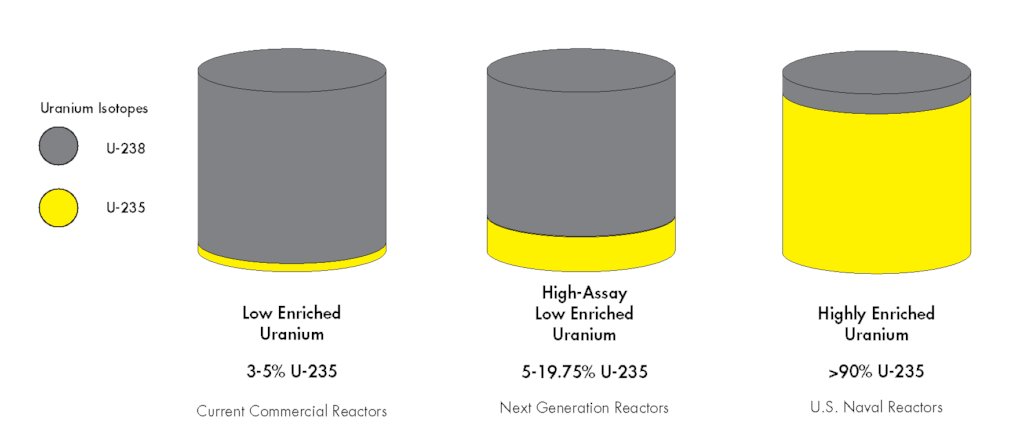
n its natural state uranium is 99% made up of a stable isotope U238, the unstable radioactive isotope U235 is only about 0.7%. The more U235, the more radiation, reactivity and energy. Highly enriched Uranium (HEU) has a concentration of 20% or more U235. Low enriched uranium (LEU) as used in nuclear power stations is typically between 2-5%.
The United States, United Kingdom and Russia are the only countries still to use HEU in their naval reactors. It is enriched to about 95% and is drawn from stockpiles built up for nuclear weapons.
For Australia, a non-nuclear weapons state, using HEU in a submarine is not a breach of the Treaty on Non Proliferation (NPT), but it does set a precedent which other currently non-nuclear weapons states, like Iran, will seek to exploit as a justification for producing HEU.
Following the AUKUS announcement, I was advised by the Government that the work I had commenced on nuclear options continued and it had been concluded that Australia could use the modular HEU reactors currently deployed in the UK Astute and US Virginia class submarines which, because of their HEU fuel, do not require replacement during the 35 year life of the sub. This, it is contended, means that Australia could have a nuclear-powered submarine without any need to maintain, service or refuel the nuclear reactor.
This is very different advice to that given to the Government as recently as three years ago. It sounds too good to be true; Australia would have submarines powered by nuclear reactors running on weapons grade uranium. And we would not need to have any of our own nuclear facilities or expertise?
Is it credible to have a hands-off plug and play nuclear reactor filled with weapons grade uranium and not inspect it for 35 years? The US and UK will know for sure in about thirty years. And until then if something does go wrong, both nations have extensive nuclear facilities and expertise to deal with it.
Australia does not.
The French nuclear propulsion system however uses low enriched uranium (LEU) – somewhat more enriched than that used in civil nuclear plants. By law they inspect their reactors and refuel them every ten years. All submarines go in for a lengthy, year or more, refit every decade. The refueling of the French naval reactor takes a few weeks. In this regard at least, French naval nuclear reactor safety standards are stricter than those applied in the United States and the UK.
The new AUKUS submarines, we are told, will still be built in Adelaide. But if there are no nuclear facilities there, that must mean the submarine hulls will be transported to the US or the UK to have the reactor installed together with all of the safety and other systems connected to it.
You don’t need to be especially cynical to see it won’t be long before someone argues it looks much simpler to have the first submarine built in the US or the UK, and then the second, third and so on…..
Australia will be the first country without any civil nuclear industry to operate a nuclear submarine and the first non-nuclear weapon state to use HEU in a naval reactor. So, if we are not going to develop nuclear facilities of our own (as Mr Morrison has promised) then we will no more be sharing nuclear technology with the US than the owner of an iPhone is sharing smartphone technology with Apple.
A new submarine, under the new AUKUS arrangement, would not be in the water until 2040, we are told. That is about eight years after the first Attack class sub would have been in service. So, we are now without any new submarines for the best part of 20 years.
…………. Of course, now that the flurry of the media announcement is over, the question remains whether we will be able to negotiate a satisfactory deal with the US and UK to deliver a nuclear-powered submarine for Australia. If the Astute is preferred because of its size, then for practical purposes we will be price takers.
…………..the way we are getting there has been clumsy, deceitful, and costly. Too many questions are not being asked, and fewer answered. The blustering attempts to wedge those who seek answers do not serve our national interest.
Our national security does not rely on fleets and armies alone. And that is just as well, for we will never have military might to match that of potential rivals.
…..Diplomacy matters, and at the heart of diplomacy is trust. Australia’s reputation as a trusted and reliable partner has been an enormous asset to us on the international stage, just as a trustworthy reputation is an enormous asset to someone in business.
………….. . It was only a few years ago that our partnership with France was to be one for generations. As the sun set over Sydney Harbour in March 2018, from the deck of HMAS Canberra, President Macron described the partnership with Australia as the cornerstone of France’s Indo Pacific strategy. This was not just a contract to build submarines, it was a partnership between two nations in which France chose to entrust Australia with its most sensitive military secrets – the design of their latest submarines.
France is an Indo Pacific power. With two million citizens and 7,000 troops across the two oceans, drawing closer to France as a security partner made enormous sense both for us and the United States……….
Mr Morrison has not acted in good faith. He deliberately deceived France. He makes no defense of his conduct other than to say it was in Australia’s national interest. So, is that Mr Morrison’s ethical standard with which Australia is now tagged.: Australia will act honestly unless it is judged in our national interest to deceive?
It was as recently as 30 August that our Defence and Foreign Ministers met with their French counterparts and publicly re-emphasised the importance of the submarine programme. Two weeks later, on the day Mr Morrison dumped the President of France with a text message, the Department of Defence formally advised Naval Group that the project was on track and ready to enter into the next set of contracts.
The media has been gleefully briefed that Mr Morrison struck the deal with Boris Johnson and Joe Biden at the G20 in July shortly before going to Paris where the PM confirmed to President Macron his continuing commitment to the submarine deal.
France’s Foreign Minister has described Australia’s conduct as a stab in the back, a betrayal. Macron recalled his Ambassadors to Canberra and Washington. Dan Tehan can’t get a meeting with the French Trade Minister any more than he can with the Chinese Trade Minister.
France’s Europe Minister has already poured cold water on the prospects of concluding an EU-Australian free trade agreement. Australia has proved it can’t be trusted, he has said.
France believes it has been deceived and humiliated, and she was. This betrayal of trust will dog our relations with Europe for years. The Australian Government has treated the French Republic with contempt. It won’t be forgotten. Every time we seek to persuade another nation to trust us, somebody will be saying “Remember what they did to Macron? If they can throw France under a bus, what would they do to us?”
…………….. As Paul Kelly records[10] (with approbation), Scott Morrison deliberately and elaborately set out to persuade the French their deal was on foot and proceeding until he knew he had an alternative deal whereupon he dumped the French and his deceitful conduct was exposed………… https://www.malcolmturnbull.com.au/media/address-to-the-national-press-club-september-2021
IAEA concerned that AUKUS coud weaken non-proliferation system
Nuclear inspection under AUKUS deal ‘very tricky’ – IAEA chief, Sky News, Jonathan Talbot, Deputy Editor, 430 Sep 21,
Nuclear inspections of Australia under the AUKUS deal will be “very tricky” and could lead to a weakened non-proliferation system, says the head of the UN International Atomic Energy Agency.
The AUKUS deal which sees Australia acquire nuclear-powered submarine technology will make nuclear inspections “very tricky”, according to the head of the United Nations International Atomic Energy Agency (IAEA).
“It is a technically very tricky question and it will be the first time that a country that does not have nuclear weapons has a nuclear sub,” IAEA Director General Rafael Grossi told BBC’s HARDtalk.
The IAEA keeps track of all nuclear material in countries – like Australia – that have ratified the Non Proliferation Treaty (NPT).
One of its primary tasks is to ensure nuclear materials are not being siphoned off for use in a nuclear bomb.
Mr Grossi confirmed NPT signatories can exclude nuclear material from IAEA inspection while that material is fueling a submarine – a rare exception to the agency’s supervision of nuclear materials.
“A country… is taking highly enriched uranium away from inspection for a period of time, which could result in a weakening of the nuclear non-proliferation regime,” he said.
“What this means is that we, with Australia, with the United States and with the United Kingdom, we have to enter into a very complex, technical negotiation to see to it that as a result of this there is no weakening of the nuclear non-proliferation regime.”
One challenge posed by Australia’s purchase of nuclear-powered submarines concerns the fact these vessels are designed to be undetectable and therefore beyond the reach of IAEA inspectors…
“China has taken note of the statements of Director General Grossi” and is “vigilant about AUKUS and the plan for nuclear submarine cooperation,” spokesperson of the Chinese Foreign Ministry, Hua Chunying, said during the ministry’s daily press conference.
The provision of nuclear materials to a non-nuclear-weapon state will exclude weapons-grade highly-enriched uranium from necessary supervision and pose huge nuclear proliferation risks.”
Ms Hua also said AUKUS displayed a “typical contempt of rules” by the “Anglo-Saxon clique” and will undercut the non-proliferation system and other efforts to create nuclear free zones. “In brief, this is a malicious exploitation of loopholes in international rules for out-and-out proliferation activities.
“Supervisions on the Australian nuclear submarines will set a precedent, concerns the rights and obligations of all IAEA member states, especially signatories to the NPT, and will have far-reaching impact on the international non-proliferation system.”
China is not alone in its concerns about AUKUS.
Indonesia and Malaysia have come out strongly against Australia’s acquisition of nuclear-powered submarines.
Singapore – Australia’s most reliable ally among ASEAN member states – has also expressed worry.
Writing in The Conversation, James Chin, Professor of Asian Studies at the University of Tasmania, said this is because “many of them think there is no such thing as acquiring nuclear-powered submarines without the prospect of acquiring nuclear weapons in the future.”……. https://www.skynews.com.au/australia-news/defence-and-foreign-affairs/nuclear-inspection-under-aukus-deal-very-tricky-iaea-chief/news-story/1e5b391af8622cbc9450f181c1a28047
Australia’s Nuclear-Sub Shakeup Hits Shipbuilding Supply Chain
Australia’s Nuclear-Sub Shakeup Hits Shipbuilding Supply Chain, The Maritim Executive By Charlie Turner] 27 Sept 21,
The abrupt announcement by the Australian government that it was scrapping its plans to build a fleet of diesel-electric submarines in favor of nuclear-powered boats will have a ripple effect throughout the defense industry. The sunk cost of five years’ work and $1.7 billion has inflicted greater damage on domestic relations than on bilateral relations with the French government—it has broken the trust between defense leaders and Australian industry………
Industry bodies and lobby groups in Team Defence Australia, the Industry Capability Network and the Australian Industry & Defence Network have spent the past five years encouraging companies to invest time and resources to expand or set up a capability to service the submarine program. There have been multiple government-supported trips to Europe inviting Australian companies, at their own expense, to interact within the supply chain to develop relationships and encourage the coveted ‘knowledge sharing’ between French and Australian companies necessary to find success in such a technology leap. Follow-on trips and other efforts have been undertaken in the development of relationships and strategies centered around the program.
Those investments are a sunk cost for the Australian businesses that provide the critical operational services to support Australia’s defense capability.
Crucially, a significant number of Australian companies investing in these initiatives were small and medium enterprises that wouldn’t hold contracts directly with the defense organization but rather with the large prime contractors. They have no claim for losses—and it’s unlikely that the multinational primes will miss out on any penalty clauses contained in their contracts’ cancellation terms.
The repercussions of these actions will have long-lasting implications for the new program, in whatever form it takes. Initial indications are for a reduction in Australian industry content by 30 percent, down to 40 percent of the total build of the new submarines from the 60 percent under Naval Group. The absence of a commitment to 12 submarines under the AUKUS pact (the statement that there will be ‘at least eight’ is suitably vague) further reduces the market by another 30 percent.
With the Attack-class submarine program failing to survive a change in government leadership, how much confidence can industry maintain for investment when the new program has now apparently bypassed the strategic and political discussions about the requirement for nuclear-powered vessels?
Notably, the current and previous two prime ministers have had different preferred submarine suppliers despite being from the same political party. In the context of a change in government, the opposing major political parties have previously maintained a resolute opposition to any nuclear energy in Australia, and while Labor says it supports the new plan (with conditions), it will potentially be put in jeopardy at each federal election.
The AUKUS announcement gave an 18-month period for the examination of requirements for nuclear stewardship………..
Public discussion on the practical and political ramifications of a nuclear-propulsion solution within the country, our region and globally is the next step. Finally, continued bipartisan support for the program, in its latest form, will be required to avoid another calamity following an election or leadership spill. https://www.maritime-executive.com/editorials/australia-s-nuclear-sub-shakeup-hits-shipbuilding-supply-chain
Much posturing, but little content, on how AUKUS, and the nuclear submarines, will work
what does not make sense is a decision which, in essence, announces you are going to have a glorified interdepartmental committee look at whether it will actually work (the only missing ingredient from the Prime Minister’s usual modus operandi is mention of his department head Phil Gaetjens).
There are no details on just how this new alliance will work, but vast quantities of posturing, which is presumably designed to show the Chinese that we mean business.

However, a government desperate to avoid a referendum on pandemic management — and now threatened by challenges from independent candidates in blue-ribbon seats such as Kooyong and Wentworth over its inaction on climate change —— desperately needs something else to talk about.
Scott Morrison’s AUKUS submarine deal and ‘BFF theatre’ leaves Australia in a tricky spot, https://www.abc.net.au/news/2021-09-25/missing-details-on-australia-uk-us-submarine-deal/1004905647.30 / By Laura Tingle Sat 25 Sep 2021 The federal Coalition have always been keen advocates of contracting things out.
It started in the Howard years, when the delivery of services was contracted out and, over the intervening years, spread to contracting out policy advice — from the public service to richly rewarded consultants who sometimes produce little more than vacuous PowerPoint presentations.
The COVID-19 pandemic has shown the current government is willing to contract out responsibility for things such as quarantine, vaccines and vaccine-mandating rules to the states.
But who would ever have thought it would contract out our national security and defence strategy?
For, in a nutshell, that’s what has happened in the past week with the decision to embrace a new alliance with our old allies and “forever” friends, based on the decision to buy an (unspecified) nuclear submarine that will not go into service until 2040.
Capability gap
There is a vast amount to unpack in this decision, even amid a sense that, by the end of the week, the political caravan was moving on to climate change.
It is hard to think of a decision by Australia with such profound implications for our future that has been so redolent of symbolism, yet so completely lacking in substance.
A decision driven so much by valid concerns about defence capability, that leaves us so exposed as to not having any of that capability for the next 20 years — the time period when the power balance in our region is going to be decided.
In short, a massive strategic step-up announced to cover a massive capability gap.
The majority view in the political and strategic establishment in Australia says the strategic position has fundamentally shifted in the past five years and continues to rapidly evolve.
China’s capacity to scan the oceans, as well as both its military firepower and assertiveness, have all grown exponentially.
And most think that makes nuclear submarines, rather than conventionally powered ones, a rational decision.
It might also make sense to ramp-up your armaments — such as long-range Tomahawk Cruise Missiles — and talk of more US troops, planes and ships, and even British submarines, being based in Australia.
Looking to the US
However, what does not make sense is a decision which, in essence, announces you are going to have a glorified interdepartmental committee look at whether it will actually work (the only missing ingredient from the Prime Minister’s usual modus operandi is mention of his department head Phil Gaetjens).
There are no details on just how this new alliance will work, but vast quantities of posturing, which is presumably designed to show the Chinese that we mean business.
Things such as getting all our spooks to go to Washington this week.
Things such as emphasising the so-called Quad arrangement between the US, Australia, India and Japan, which makes it look like we have even more friends on our side.
Yet, when the Prime Minister holds a press conference in Washington DC ahead of the Quad meetings, what do you say it is about? Vaccines and energy policy.
No mention of China or strategic alliances here. And that sort of makes sense, given the constraints on Japanese military action, and that India has a very different take on Chinese issues to the Americans.
The implication in all this announcing is that the Americans are now committing to the region. That we can rely on Dad to sort out China for us.
All the talk of the new Cold War in the East raises obvious comparisons with the one in the West that occurred last century — and possibly even the crucial role the US played in Europe at that time.
Enduring questions
However, even among the more hawkish analysts, there is a gnawing question of how we (Australia) actually hold the feet of the Americans — and the British with their splendid history of reliable commitment to Asia and Australia in the 20th century — to the fire if things do indeed escalate with China.
And how do we now, on a day-to-day basis, differentiate ourselves from the US position on China when we have made so much not just of our operational dependence, but also of the whole “BFF theatre”?
This goes to questions of sovereign capability. That is, our capacity to run our own strategic policy, both in an operational sense and a diplomatic one.
Labor has backed the government’s decision on nuclear submarines with three caveats.
However, its foreign affairs spokesperson, Penny Wong, asked some valid questions on the point of sovereign capability in a speech on Thursday, such as: “How will we control the use of technology and capability that is not ours?”
“With the prospect of a higher level of technological dependence on the US, how does the Morrison-Joyce government assure Australians that we can act alone when need be; that we have the autonomy to defend ourselves, however and whenever we need to,” she said.
The alacrity and misrepresentation of Wong’s remarks by the Prime Minister in response only added to the suspicion that there is just a tad too much politics in the way this momentous dogleg in the country’s strategic position has been undertaken.
“Well, I think Australians would be puzzled as to why there can be bipartisan support for this initiative in the United States and within days, within days, the Labor Party seems to be having an each-way bet,” he said.
You can see why Labor has chosen to just stay as far away from this issue as it can, within the constraints of a responsibility to set out some reasonable questions about strategy, rather than nuclear submarines per se.
It is determined not to get wedged as it once was on Tampa.
The fallout
Labor’s determination not to get wedged may have taken away some of the political dividends of this huge shift, as has the debacle over informing the French of the decision, which has embarrassed not just Australia but the US.
And, of course, the Prime Minister’s ever-changing descriptions of how he had informed France’s Emmanuel Macron that he was tearing up a multi-billion dollar contract has been, well, just embarrassing.
“What I said was, is that I made direct contact with him,” he said in Washington on Thursday.
Having been unable to get Macron on the phone the night before the announcement, he said he “directly messaged him Australia’s decision in a personal correspondence”.
Australia dumped France, it appears, in a text message: A modus operandi more usually associated with 14-year-olds.
The nuclear subs decision may have all sorts of ramifications, from halting negotiations on a European Free Trade Agreement to entertaining prospects for cooperation between the US and China on climate change.
Its complexities are not best teased out in the lead-up to an election.
However, a government desperate to avoid a referendum on pandemic management — and now threatened by challenges from independent candidates in blue-ribbon seats such as Kooyong and Wentworth over its inaction on climate change — desperately needs something else to talk about.
Maralinga – ushered in Australia’s nuclear age

A picture in time: Maralinga, the blinding flash that ushered in Australia’s atomic age. https://www.theguardian.com/australia-news/2021/sep/27/a-picture-in-time-maralinga-when-the-atomic-age-reached-australia
Nuclear tests conducted in South Australia from 1956 resulted in swaths of countryside obliterated and decades of highly contaminated land.
The atomic age reached Maralinga with a blinding flash. At 5pm on 27 September 1956, a 15-kilotonne atomic device was detonated at the site in the western plains of South Australia.
The ensuing blast had as much explosive strength as the weapon which fell on Hiroshima 11 years earlier.
More than a decade after that horror struck Japan, Australia had become tangled up in the UK’s nuclear testing program, which saw swaths of countryside obliterated to further the nuclear arms race.
The atomic test at Maralinga was carried out by the British government as part of Operation Buffalo, run by the UK’s Atomic Weapons Research establishment.
In the moments after the detonation, RAAF personnel flew through the mushroom cloud to carry out tests with little instruction or protective equipment to shield them from the radiation.
For the next seven years, major and minor nuclear tests were carried out at Maralinga. The minor tests led to contamination of the area with plutonium-239, which has a radioactive half-life of 24,000 years.
Prior to the test, very little effort was put into finding and notifying the Anangu Pitjantjatjara people who lived on the land. In addition to the obvious immediate dangers of nuclear fallout in the area, the Indigenous community would endure the long term hazards of poisoned land and water for more than thirty years.
Maralinga was not the first nuclear weapons test conducted on Australian soil. Three years earlier, on 3 October 1952, Britain detonated a nuclear weapon on the Montebello Islands off the coast of Western Australia.
A further two detonations were carried out at Emu Field. Britain moved the testing site to Maralinga after previous locations were deemed to be too remote for nuclear weapons tests.
When Maralinga was eventually closed as a testing site in 1967, the British government began the process of cleaning the 3,200 sq km of contaminated land.
By 1968, the Australian and British governments agreed that Britain has successfully decontaminated the area by covering contaminated debris in concrete and ploughing the plutonium-laden soil into the ground.
In 1984, as the land was slated to be returned to the Tjarutja people, scientists found the land was still highly contaminated.
Nine years later, in 1993, following a royal commission, and after mounting pressure, the British government agreed to pay a portion of the estimated $101m cleanup cost.
It wasn’t until 1994, 38 years after the initial blast, that the Australian government paid $13.5m to the Indigenous people of Maralinga as compensation for what had been done to the land.
Talk of war with China reveals Australia’s delusions of grandeur
Talk of war with China reveals Australia’s delusions of grandeur, Independent Australia, By Dean Aszkielowicz | 26 May 2021, Australians need to be realistic when it comes to China, write Dr Dean Aszkielowicz and Paul Taucher.
THE LAST MAJOR CONFLICT in the Pacific ended over 75 years ago. Japan, the United States, China and the European colonial powers fought a war that cost millions of lives. It contributed to the downfall of several empires and overturned the regional political order.
Further, the American use of atomic bombs against Japan led to subsequent generations living with the fear of nuclear war.
Public figures in Australia who are now loudly predicting that a war with China is looming, ought to think carefully about something like this scenario playing out again. No matter what the behaviour of the Chinese regime is, or what the status of bilateral relations are, war is not an option.
Australia’s message must be peace. At the end of both World War I and
World War II, and again in the wake of the Cold War, political leaders and diplomats insisted that dialogue and international institutions are the key to a peaceful world. This view has persisted and the hope is that cooperation in politics, economics and security will protect sovereignty, increase prosperity, and allow smaller countries to determine their own path in world affairs.
This framework is known as a rules-based order and for much of the post-war era, many countries – including Australia – invested heavily in it. Indeed, much of the recent Australian angst over China stems from a belief that the regime is acting in a way that does not meet these international expectations.
Lately, however, the talk of war in Australia reflects its own emerging lack of faith in the rules-based order and a belief that ultimately the region will collapse into war. This belief downplays Australia’s ability to achieve its goals through diplomacy in the international arena.
Australians who entertain the thought of war also dramatically overstate the ability of the military in the face of an opponent like China. The Australian Defence Force (ADF) is effective, technically advanced and has a proud history. It has made major contributions to peacekeeping operations and supported the U.S. military.
The ADF has been most effective is as a diplomatic tool, by responding to disasters across the globe and through peacekeeping. In these kinds of deployments, the ADF makes an important contribution to supporting a rules-based order.
Much of Australia’s international reputation is built on these operations, and this work is indispensable in building and maintaining partnerships. The most challenging deployments, on the other hand, have been when the ADF has paid the price on behalf of the government for political crusades into practically unwinnable wars.
Australia does not have the capacity to fight a major war with China and deliver results that the Australian people would find acceptable in the aftermath of it. China is a major military and industrial power, whereas Australia is not.
When people predict a war is coming, they are predicting the deaths of thousands of Australians, the destruction of millions of dollars of ADF equipment and the collapse of a key Australian trade relationship.
This needs to be discussed much more openly if people are talking about war.
Even a limited war with China would deliver these outcomes. There are no guarantees, however, that a war would be contained at all, in which case the consequences for Australia would be an order of magnitude larger.
CNN made its thoughts clear when it called the notion of Australia fighting a war with China “ridiculous”.
Of course, those who insist that war with China is looming assume that Australia would not be on its own and would take part in the conflict in support of the U.S. They probably see war talk, in this context, as supporting the American agenda for the region. When the positions of Australia’s partners are considered, however, the recent war talk seems much more like Australia further escalating a situation that others would pay the highest price for.
Opinions in the U.S. are divided over how close war with China really is and over whether America is likely to win a war in the South China Sea. Some projections are very bleak.
Tellingly, Australia finds itself largely on its own in escalating war talk with China. Neither the U.S. nor China seem to want to go to war at the moment………
The hawkish tone of recent comments in Australia are currently out of step with the other major players. They convey an inflated sense of the country’s readiness for such a war and represent a loss of faith in a regional order that Australians spent decades helping to build.
If people in government or the military feel war with China is likely, then they must do everything they can to cool tensions, which is something diplomatic institutions are well equipped for. Issues with China over territory, human rights, or trade, need to be addressed through a renewed commitment by Australia to international institutions and international conventions……….. https://independentaustralia.net/article-display/talk-of-war-with-china-reveals-australias-delusions-of-grandeur,15122
Nuclear submarines – a step towards full nuclear chain, importing wastes, and joining in USA nuclear brinkmanship
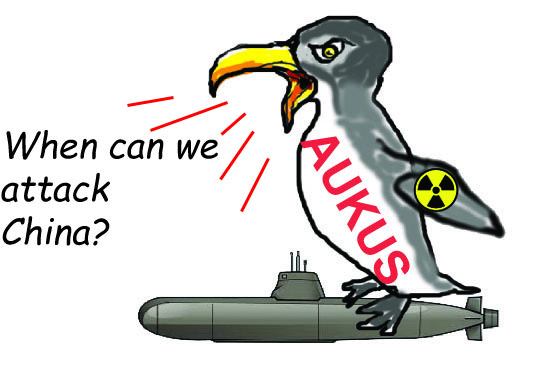
Nuclear Submarines – just a foot in the door, Echo By Richard Staples, September 24, 2021 ”…………. Admittedly, nuclear-powered subs can stay underwater virtually indefinitely, but they are relatively noisy. A nuclear reactor with its pumps and heat transfer systems cannot help but make noise continuously. There is only so much that can be done to muffle or quieten them down. In contrast, a submerged conventional submarine can switch off all its motors, and survive on battery power. Provided the crew don’t fart or sneeze, they can be very quiet indeed. And contemporary subs equipped with fuel cells as well as batteries can operate submerged for up to three weeks.
In the next few months we will hear a lot about how superior nuclear-powered submarines are. Vice Admiral Mike Noonan is even claiming superior stealth characteristics – which is simply not true. Yes, they tend to be faster. This is great if you want to go thousands of kilometres in a matter of days. But they are also much more expensive.
A conventionally powered sub like the German-Italian Type 212 costs between €280 and €560 million. Even allowing for Australia paying mug’s prices, we could acquire and run one for far less than a billion dollars. Contrast that with the proposed boats, each of which will probably cost ten times that much. The money we could save could be used to preserve an Australia worth defending – a fleet of firefighting aircraft, stopping the erosion of our health care system, free university education… you fill in the rest.
So, why nuclear subs?
Elements of the Federal coalition and the media are very keen on Australia getting more involved in the nuclear fuel cycle. The Financial Review has jumped straight in lobbying for nuclear power. On July 29 there was kite-flying in the West Australian newspaper about building a nuclear reactor in WA (with UK involvement). This would probably be sited in a remote location (to avoid the NIMBYs) – maybe the Kimberley – and primarily tasked with producing hydrogen. Expect an announcement if the Morrison government is returned at the next election.
Meanwhile the planned nuclear waste dump in SA could very profitably be expanded. High-level N-waste could be taken, not just from military sources. Countries like the UK and Germany (and I dare say France) could solve their dilemma of N-waste by exporting it to a remote location in the third world (Aboriginal land in Australia). So the move to N-powered ships can be seen as a slip into the whole nuclear cycle.
Meanwhile Defence Minister Dutton beats the drums of war, trying to terrify us regarding China’s ‘huge military buildup’ (China is spending less than one-third what the US does). Our own military bill is huge and increasing – $45 billion this year. The recent announcement of AUKUS, a strategic partnership obviously aimed at China, identifies an enemy, and offers a strategic excuse for this expenditure. It is about this country playing a minor role in a US-led game of brinkmanship and global hegemony. We would base our nuclear subs at HMAS Stirling near Fremantle and play the role of Deputy Sheriff in the Indian Ocean, targeting Chinese assets in the Horn of Africa, Pakistan, Bangladesh and Burma. Then there is Dutton talking about more US weapons and GIs being based in Australia. This is AUKUS.
The alternative scenario is that Australia protects itself. In 1986 the Hawke Government received the Dibb Report, which proposed such an approach, but gained little traction. This might include conventionally powered attack submarines that would be far better equipped to deal with any seaborne invasion. Unmanned Undersea Vehicles are a rapidly emerging technology that could also play a role. (Such drones may render crewed subs obsolete anyway).
But rather than preparing for war, we could enhance the prospects for peace.
Above all, Australia is desperately in need of an independent foreign policy and a competent diplomatic service. Building trust and friendship with neighbours to the near north and in the Pacific would be a good start. https://www.echo.net.au/2021/09/nuclear-submarines-a-foot-in-the-door/
This week – AUKUS, nuclear submarines and the new dangers of weapons proliferation and war.
Paul Keating has explained the folly of antagonising China, constantly provoking further militarisation. Regional countries are concerned at the heightened militarisation, and the passage of nuclear submarines through their waters. The use of Highly Enriched Uranium (HEU) fuel brings risks of weapons proliferation. Now the previously nuclear-free zone looks like soon to be bristling with nuclear weapons .

And the big corporations that rule USA policy, UK policy, and now Australian policy, will be rejoicing. Watch as UK’s BAE Systems and USA’s General Dynamics fight it out for the loot from Australian tax-payers.
AUKUS, nuclear submarines, Highly Enriched Uranium and weapons proliferation
The AUKUS decision to equip Australia with SSNs not only is a fool’s errand but also could pose a grave threat to regional and international security.
Australia’s acquisition of SSNs under AUKUS could well open a Pandora’s box of proliferation with non-nuclear-weapon states such as Argentina, Brazil, Canada, Iran, Japan, Saudi Arabia and South Korea among others also going in for nuclear-powered submarines and keeping nuclear fuel (both low- and highly-enriched uranium) outside the scope of IAEA safeguards. This would weaken the IAEA safeguards (verification) system already facing challenges from new technologies and open up possibilities of diversion of nuclear material for nuclear weapons.
Australia’s nuclear-powered submarines will risk opening a Pandora’s box of proliferation, https://johnmenadue.com/australias-nuclear-powered-submarines-will-risk-opening-a-pandoras-box-of-proliferation/ By Tariq Rauf, 22, 2021 The AUKUS decision to equip Australia with SSNs not only is a fool’s errand but also could pose a grave threat to regional and international security.
After first suffering a seeming “brain snap” to acquire a fleet of nuclear-powered submarines (SSNs) some years back, at long last Australia has been promised a fleet of eight SSNs by the Biden administration under the newly minted and awkwardly named AUKUS (Australia, United Kingdom and United States) alliance against China.
Fresh from an ignominious debacle in Afghanistan that led to that bedevilled country once again falling under the repression of the murderous Taliban, the Biden administration has capped off its recent Afghan escapade by driving a stake through the global nuclear non-proliferation regime through its ill-advised decision to supply SSNs and related technology to Australia.
The problem
Nuclear-powered submarines of the United States (and the United Kingdom) reportedly are fuelled with highly-enriched uranium (HEU) of 93 per cent to 97 per cent enrichment level that can last for up to 33 years — this is the same enrichment level as for use in nuclear weapons. In contrast, French nuclear-powered submarines run on low-enriched uranium 5 per cent to 7.5 per cent enrichment level and need to be refuelled on average after about 10 years but do not need weapon-grade enriched uranium.
Nuclear ship propulsion technology and reactor design for military vessels as well as the isotopic composition and quantity of their nuclear fuel remains highly classified. When Canada was considering acquiring a fleet of SSNs in 1987, the two potential suppliers were France (Rubis/Améthyste-class) and the United Kingdom (Trafalgar-class).
In the case of the United Kingdom, Canada was informed that US Congressional approval would be required for the UK to construct and supply SSNs (with US design reactors and nuclear fuel) to Canada. The nuclear ship propulsion reactor design and nuclear fuel information would be subject to a high level of classification. With this requirement for secrecy, Canada would not have been able to provide detailed information to the IAEA under its Treaty on the Non-Proliferation of Nuclear Weapons (NPT) safeguards agreement (INFCIRC/164) thereby creating a loophole or gap in IAEA safeguards coverage in Canada. A certain (likely unspecified) large quantity of HEU for naval nuclear fuel would be taken out of safeguards for use in the SSNs and the spent fuel coming out the boats after 30 years or more also would be subject to secrecy. Thus the IAEA would not be able to measure the quantity or isotopic composition or to verify the HEU in naval use.
The IAEA Additional Protocol, to safeguards agreements, provides for the “broader conclusion” regarding the absence of undeclared nuclear material or activities. As such, to be clear and precise, were Australia to withhold from the IAEA information on and access to its naval nuclear fuel, then the IAEA would be unable to provide a broader conclusion for Australia under its additional protocol INFCIRC/217/Add.1.
Australia and the two other AUKUS states have communicated to the IAEA director general their intention for the Royal Australian Navy to acquire a fleet of SSNs and this means that at some future time Australia would be invoking paragraph 14 of its NPT safeguards agreement to exclude significant quantities of highly-enriched uranium for naval nuclear fuel. Thus, the claim by AUKUS states “that a critical objective of this cooperation will be to maintain “the strength of both the nuclear non-proliferation regime and Australia’s exemplary non-proliferation credentials” and that they will be “engaging with the IAEA throughout the coming months” is at best an oxymoron.
It should be matter of serious concern for the IAEA board of governors that the “IAEA will engage with them [AUKUS] on this matter in line with its statutory mandate, and in accordance with their respective safeguards agreements with the agency” — as this does not make much sense in that the paragraph 14 provisions on keeping HEU naval nuclear fuel out of safeguards apply only to Australia and not to the UK and the US (the latter two being nuclear-weapon states).
The only responsible course for the IAEA board of governors should be to warn Australia regarding the deleterious effects on safeguards should it implement paragraph 14 provisions and keep large quantities of HEU for its fleet of SSNs outside of IAEA safeguards. The IAEA board would be well advised to reject any request placed before it from Australia or from any other NPT non-nuclear-weapon state to implement paragraph 14 provisions. Rather, the board should take the responsible decision to revoke application of paragraph 14 of INFCIRC/153 (Corr.) and in all related safeguards agreements, much like the board rescinded the original provisions of the Small Quantities Protocol in 2005.
Australia’s acquisition of SSNs under AUKUS could well open a Pandora’s box of proliferation with non-nuclear-weapon states such as Argentina, Brazil, Canada, Iran, Japan, Saudi Arabia and South Korea among others also going in for nuclear-powered submarines and keeping nuclear fuel (both low- and highly-enriched uranium) outside the scope of IAEA safeguards. This would weaken the IAEA safeguards (verification) system already facing challenges from new technologies and open up possibilities of diversion of nuclear material for nuclear weapons. The AUKUS decision to equip Australia with SSNs not only is a fool’s errand but also could pose a grave threat to regional and international security.
This article was first published by the Toda Peace Institute and is reproduced with permission. Tariq Rauf was formerly head of verification and security policy coordination, office reporting to the director general of the International Atomic Energy Agency and previously advised Canada’s parliamentary committees on national defence and foreign affairs.
USA has conned Australia into paying for its super-costly nuclear submarine project

Last week’s AUKUS announcement was nothing more than PR stunt in Australia, with the government merely committing to spend the next 18 months deciding what to buy—which conveniently kicks any actual the decision far enough down the road to avoid the next federal election.
Has PM put Australia on the hook to finance struggling UK, US submarine projects? Michael West Media, By Marcus Reubenstein| September 23, 2021,
“Almost comical”. Experts lambast Scott Morrison’s “crazy” AUKUS deal to buy nuclear submarine tech from parlous UK and US programs. Marcus Reubenstein finds a real prospect Australia will be used to “underwrite” the foundering foreign submarine industry.
Twenty-five years of ongoing maintenance delays for nuclear submarines, chronic shortage of both parts and skilled workers, under capacity at shipyards, and attack class submarines missing from deployments for up to nine months. These sound like potential problems for Australia’s future nuclear submarine fleet but they are actual problems right now confronting the US Navy and its fleet of 70 submarines.
The US is at the cutting edge of nuclear propulsion. It has the largest and most sophisticated submarine fleet in the world, its first nuclear submarine was commissioned 67 years ago, and the US has literally decommissioned twice as many nuclear subs as Australia is planning to buy.
If the US cannot manage to keep its fleet in the water, how can the Morrison government commit up to $100 billion of taxpayer money to secure nuclear submarines and guarantee they will be always operational and ready for deployment?
Professor Hugh White, ANU Professor of Strategic Studies, former Deputy Secretary of Defence and an eminent figure in strategic policy, wrote in The Saturday Paper, “The old plan was to build a conventionally powered version of a nuclear-powered French submarine. It was crazy.”
“The new plan—to buy a nuclear-powered submarine instead—is worse”.
Says White, “There is a reason why only six countries, all of them nuclear-armed, operate nuclear powered subs.”
The sales pitch is underway
Last week’s AUKUS announcement was nothing more than PR stunt in Australia, with the government merely committing to spend the next 18 months deciding what to buy—which conveniently kicks any actual the decision far enough down the road to avoid the next federal election.
The ripples of the announcement, however, reached British shores in double-quick time. Just two days after the AUKUS alliance UK Defence Secretary Ben Wallis announced a $320 million (£170m) grant to be shared between BAE Systems and Rolls Royce to develop technology for Britain’s next generation submarines.
According to Department of Finance figures, In the past twelve months BAE Systems has collected $1.88 billion from Australian taxpayers. The Astute class submarine, touted as one of the two options Australia is considering, is manufactured by BAE Systems.
US Naval analyst, and Forbes Defense columnist, Craig Hooper predicts AUKUS could give the US Navy a big shot in the arm as well. He says a deal with Australia could effectively underwrite major improvements to the US Navy’s outdated submarine maintenance facilities by supporting “America’s decade-long, $US25 billion ($34.6 billion) effort to refit the U.S. Navy’s four aging public shipyards. With yard repair costs already high, America would go to great lengths to welcome any additional bidders for shipyard capability improvements.”
US subs in dry dock In a report published six months ago, the US Congressional Budget Office (CBO) found: “The Navy’s four shipyards have experienced significant delays in completing maintenance on its submarines (all of which are nuclear-powered).” ………. Should Australia go down the nuclear sub path what choice will it have other than to outsource the fleet’s maintenance? …..
Her Majesty’s sub optimal fleet
Britain, touted as the alternative nuclear submarine supplier to Australia, has problems of its own. The Royal Navy operates ten submarines, only four of them were designed and commissioned this century.
Like their American nuclear counterparts there are systemic problems keeping these subs in service……
That report also indicated significant delays to the BAE Systems built Astute hunter-killer submarines, the same class of nuclear submarine being touted for Australian as part of the AUKUS deal………. https://www.michaelwest.com.au/has-pm-put-australia-on-the-hook-to-finance-struggling-uk-us-submarine-projects/
1 This month
17 October, Free Public Talk on Nuclear Issues in South Australia
David Noonan will speak on public interest concerns over the new Roxby Downs Indenture Act 2026 on BHP copper-uranium mining and ore processing in SA, and on how AUKUS may face SA with a High-Level nuclear waste agenda.
Dr Jim Green will discuss international developments in the field of nuclear power including ‘small modular reactors’ and Generation 4 ‘advanced’ nuclear reactor concepts.


Help Aunty Sue Protect Her Land and Sacred Sites From Destructive Rocket Testing.
.

Australians deserve the truth
about
AUKUS – https://aukuspublicinquiry.com/

PETITION – To: Prime Minister Anthony Albanese and the Australian Labor Government

of the week – Australians for War Powers Reform (AWPR)
To see nuclear-related stories in greater depth and intensity

