Former subs boss blasts ‘hocus pocus’ nuclear deal
Former subs boss blasts ‘hocus pocus’ nuclear deal
A former head of ASC has blasted Australia’s “insane deal” with the US and the UK to build nuclear-powered submarines in Adelaide, deriding a “hocus pocus” announcement he says raises major issues about nuclear and defence capability. https://indaily.com.au/news/2021/09/20/former-subs-boss-blasts-hocus-pocus-nuclear-deal/ Tom Richardson @tomrichardson
Hans Ohff, who was managing director and CEO of the then-Australian Submarine Corporation from 1993 to 2002, says he does not believe the mooted submarine deal will materialise as planned for Australia, saying: “I believe it will be stymied because the US military establishment will not underwrite the tacit agreement made between the US President, the British and Australian PMs.”
Ohff insists “there will be no transfer of technical know-how to Australia”, arguing “the submarine propulsion train – not just the reactor – will be a black box accessible only to the US”.
In an emailed statement sent to InDaily’s Your Views, Ohff, who is also a research fellow at Adelaide University, said it was incumbent on the federal government “to inform the Australian people on the strategic, environmental, commercial, and political ramifications and consequences before deciding on the acquisition of nuclear-powered attack submarines”.
“We need to fully appreciate the issues and complexities associated with the design, assembly, operation and maintenance of nuclear submarines powered with highly enriched… weapons-grade uranium,” he said.
“We need to understand that the acquisition of HEU [Highly Enriched Uranium]-235 fissile material would challenge the spirit if not the letter of the Treaty of Non- Proliferation of Nuclear Weapons.”
Speaking to InDaily, he went further, saying the plan would have “unbelievable consequences, both here and in Europe” as well as “massive consequences for Outer Harbor”.It’s almost comical – if it wasn’t so serious… Prime Minister Morrison and his Defence Minister have blown up the bridge behind them
“There are big issues with putting highly enriched uranium reactors anywhere in Australia, let alone Outer Harbor,” he said.
In further correspondence, he said “a nuclear-safe site has to be identified [and] a concerned population will have to agree to the warehousing, installation, launching and pre-commissioning of submarines that include HEU-235 reactors”.
Ohff described the centrepiece of the new AUKUS security pact as effectively “spur of the moment between Biden, Johnson and Morrison”, saying: “In the end we won’t get the subs the Government wants to procure – it’s all hocus pocus.”
In the end, the US military is unlikely to agree to the transfer of technology,” he said.
“It’s almost comical – if it wasn’t so serious.”
Ohff said he had received concerned reactions from industry contacts “all over the place”.
“In Europe, everyone over there is shaking their head,” he said.
Ohff said he “agreed entirely” with strong criticism of the new subs plan by independent senator and former submariner Rex Patrick, who – like him – has also been an outspoken critic of the now-scuppered deal with Naval to provide a fleet of Shortfin Barracuda Attack Class vessels.
Ohff wrote for the Australian Strategic Policy Institute in 2017 that the French model “unites design and building risks, high program costs and an extended delivery schedule [but] promises few or no capability gains.
He told InDaily today the design was “not suitable for anything” but “that’s not the issue”.
“The issue is how to get out of that contract properly and into a new one – who wants to deal with Australia now for next generation submarines?” he said.
“It appears that Prime Minister Morrison and his Defence Minister have blown up the bridge behind them before securing an alternative solution to the ill-conceived, impractical and expensive French Attack submarine design,” Ohff said.
He said if the nuclear-powered subs were built at all, “it won’t be till the 2040s, and the world will have changed dramatically by then”.
“By 2040 the Virginia class will be an outdated design, no longer built for the US Navy [and] unlikely to be relevant for warfare in the second half of the 21st century,” he said.
“Carrier Battle Groups will no longer be effective against autonomous weaponry; and the China question will be resolved one way or another.
“[Australia] requires submarines now.
“Nuclear boats in 20 to 30 years will not resolve this issue [and] leasing nuclear submarines from [Britain or the US] is unrealistic.”
Ohff said the Life-of-Type Extension of the Collins Class fleet would be “more complex, more time-consuming and more expensive” than the Government expects, “leaving the Navy without submarines to train submariners, let alone fight a war”,
“If the government doesn’t expedite the procurement of modern SSKs [diesel-electric submarines] for operational availability by the 2030s, the Royal Australian Navy will no longer be a submarine navy,” he said.
He said a next-generation Collins Class would have been the “obvious choice”, criticising diplomatic missteps to date, including “Tony Abbott’s handshake-agreement with Japanese PM Shinzo Abe being overturned by [Malcolm] Turnbull in favour of the French”.
He said the German tendered price had been “a fraction of the French proposal [but] they were not selected on unexplained or spurious grounds”.
He said Australians “need to be satisfied that we have capacity to develop and deploy the management systems and procedures necessary to safely operate and maintain these vessel at sea and in port
“Thus, if the government doesn’t immediately commit to six conventional-powered AIP [Air-independent propulsion] subs that can be in service by mid-2030 the RAN will have no submarine squadron, save for a few ageing Collins boats.”
He said basing “a squadron of US Navy nukes in Australian waters would be politically untenable”, arguing: “Deploying Astute or Virginia-type submarines in the littoral waters of the [South China Sea] would be suicidal.”
Morrison and cronies have really botched this nuclear submarine deal
With an election deadline approaching, Scott Morrison and Peter Dutton perhaps have judged that a campaign fought on national security concerns will be much more successful in motivating a fearful public to vote to the right on the spectrum.
‘Sub-standard’: Submarine deal botched by Morrison and his cronies, Independent Australia, By George Grundy | 23 September 2021 ”………………. It’s unclear just how much money has been wasted on the now-abandoned French project, but it’s in the billions. Extraordinarily, Morrison didn’t even have the good grace to inform France of the change in plans until just prior to fronting the media. His claim that he “tried” to speak to the French President the night before the announcement is just another example of how stupid he must think the Australian public are.
Imagine the damage this does to Australia’s reputation abroad. Just imagine trying to negotiate in good faith any kind of bilateral or multinational agreement with Morrison still in charge. Our word is our bond and Scott Morrison has guaranteed that, in the near future at least, Australia’s word is worthless and not to be trusted.
Actually, we won’t have to wait: Australia is currently negotiating a free trade agreement with the EU, of which France is a key member. The threat of tougher tariffs for countries that, like Australia, don’t meet their Paris Climate Agreement targets is likely to be rigidly enforced and France is already trying to delay negotiations in order to punish Australia.
The Glasgow Climate Conference, in just six weeks, is now sure to be a doozy.
Then there is, as with every Morrison announcement, the sheer emptiness in the details. There is no contract, no design, no agreed budget. It’s not clear where the submarines will be built, what level of Australian involvement there will be or how the nuclear fuel will be handled………
If Australia becomes the first nation to rely solely on the supply of enriched uranium from partners abroad, it means a significant element in national defence strategy is entirely dependent on another sovereign country.
After all that spending, Australia’s new military posture will be more assertive yet more reliant on allies abroad. And if we even consider the second option, homemade fuel, it merely confirms very reasonable suspicions that this inevitably paves the way for a domestic nuclear program.
This is something that has long been the dream of those on the far-Right, who will find any way to avoid stopping digging up coal and see the fictitious “zero emissions” allure of nuclear power as a salve to those who give a damn about the environment………….
It should also be noted that China hasn’t involved itself in a single war since 1945. Instead, we have thrown in our lot with the belligerence of the UK and America, which has invaded fifteen countries in the last 40 years.
The deal also greatly enhances the chances of America’s “rotation” troop bases in Australia becoming permanent and larger, something Defence Minister Peter Dutton has already discussed. American fighter jets on Australian soil would, correctly, be viewed as a dramatic escalation by China and other Asia-Pacific nations……..
It is possible to hold the belief that China is a vital trading partner whilst at the same time harbouring concerns about Chinese military and territorial expansion, but at best these submarines will be arriving in 20 years. Destabilising a region while hoping things hold together for two decades until the cavalry arrives is not generally noted as a sound military strategy.
The insanity of this decision is best exposed when you consider the climate change disasters that are already ravaging the world with terrifying regularity. $90 billion would offer so many opportunities for climate risk mitigation it boggles the mind………
With an election deadline approaching, Scott Morrison and Peter Dutton perhaps have judged that a campaign fought on national security concerns will be much more successful in motivating a fearful public to vote to the right on the spectrum……. https://independentaustralia.net/politics/politics-display/sub-standard-submarine-deal-botched-by-morrison-and-his-cronies,15547
Maritime and electrical trades unions stand against nuclear submarines
Maritime and electrical trades unions stand against nuclear submarines https://www.greenleft.org.au/content/maritime-and-electrical-trades-unions-stand-against-nuclear-submarines Kerry SmithSeptember 21, 2021Issue 1320Australia On September 21, International Day of Peace, the Maritime Union of Australia (MUA) said it opposed Prime Minister Scott Morrison’s reckless commitment to develop nuclear-powered submarines as part of a military alliance with the United States and Britain.
At a time when Morrison should have been pursuing vaccination supplies and providing maximum support to our health system and millions of people in lockdown, he has been pursuing secret military deals”, the MUA said.
“The deal will continue to escalate unnecessary conflict with China. Workers have already been impacted, with seafarers stranded on coal ships and some trades shut down.”
The MUA said $90 billion had been “wasted with the previous submarine contract”, scrapped just five years after it was signed. Nuclear submarines will cost much more.
“Only six countries in the world have nuclear submarines, and they all have nuclear power stations”, the MUA said, adding: “Advocates for nuclear power and nuclear weapons have been emboldened. The submarines will use highly enriched uranium ideal for nuclear weapons.”
The government has repeatedly tried to set up nuclear waste dumps on First Nations people’s land and the decision will intensify that pressure.
Instead, the union is calling for the billions to be redirected to: building a strategic shipping fleet in Adelaide that could operate in cabotage and international trades; building renewable energy and offshore wind turbines to ensure we prevent global heating from exceeding 1.5°C; raising JobSeeker payments to well above poverty levels; pay rises for health workers and investment in public health systems; pay rises for teachers and investment in public schools to make them COVID-19 safe; and investment in firefighting capacity to be ready for the next bushfire season.
Workers have no interest in war with China or any other country”, the MUA said, adding that it stands in “solidarity with workers in all countries in opposing war and wasteful environmentally harmful military spending”.
The Electrical Trades Union (ETU) is also opposed to the nuclear submarine deal, saying on September 16 that it would expose Australia to greater danger on multiple fronts.
ETU National Assistant Secretary Michael Wright said: “This decision represents a betrayal of responsibility to Australia’s non-nuclear policy and a betrayal of two generations of highly-skilled, secure, well-paying Australian shipbuilding jobs.”
Further, Wright said, nuclear technology is inherently dangerous: “Has Morrison given any thought to where the spent fuel rods from these nuclear submarines will be stored? Australians have a right to know the answers to these important questions before the prime minister makes such dangerous decisions on our behalf.”
Auustralia’s Nuclear submarines will be obsolete- this week we focus on the AUKUS submarine mess
Why will they be obsolete?
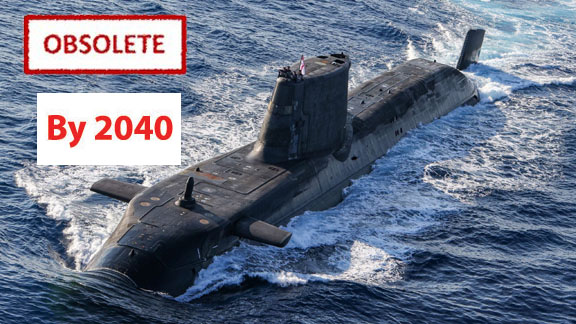
Because of the rapid advances in artificial intelligence (AI), detection systems and signal processing, combined with swarming autonomous unmanned systems – by 2040 these present USA and UK models will probably be too easily detectable, and so, effectively useless.
Why does Australia want nuclear submarines?

Other reasons – helping the USA by buying these very costly submarines which are not particularly useful for monitoring our coastline, but good for long distance. Helping Scott Morrison to look important on the world stage.
One white elephant submarine deal replaced with a worse one
Australia’s submarine policy has previously eschewed nuclear propulsion. Now, as a dowry for receiving such largesse, Canberra is offering up Australia as a confirmed US asset in policing the Indo-Pacific. US Navy commanders will be smacking their lips at maintaining attack vessels in Australia as part of the arrangement……
Nuclear white elephants: Australia’s new submarine deal, Green Left, Binoy KampmarkSeptember 16, 2021Issue 1319Australia Few areas of public expenditure are more costly and mindlessly wasteful than submarines. Australia’s effort is particularly impressive.
Pick a real winner by signing a contract for a yet-to-be-designed attack class submarine, supposedly “necessary” in an “increasingly dangerous” region. Ensure the submarine design is based on a nuclear model, but remove that attribute and charge at least twice as much for a less capable weapon. Make sure the order is for 12 of these yet-to-be-designed-and-built systems. And make sure that they are only ready sometime in the 2030s (by which time they risk being obsolete).
The dubious honour for this contract, initially costing $50 billion, went to the French submarine company DCNS (now called Naval Group), which nudged out German and Japanese contenders with pre-existing designs………
The French military establishment praised it as the “contract of the century”. Le Parisien’s editorial lauded the prospect of thousands of jobs. French Defence Minister Jean-Yves Le Drian proclaimed a “50-year marriage” had begun……..
On September 15, the Canberra press gallery was awash with rumours that a divorce was being proposed.
The following day, Prime Minister Scott Morrison announced a security ménage à trois with the United States and Britain, with Australia as the subordinate partner. The glue that will hold this union together is a common suspicion: China.
Replacing the Attack Class submarine will be a nuclear-powered alternative with Anglo-American blessing, based on the US Virginia class or British Astute class.
The joint statement announcing the creation of AUKUS said the three countries were “guided” by “enduring ideals and shared commitment to the international rules-based order”. They resolved “to deepen diplomatic, security, and defence cooperation in the Indo-Pacific region, including by working with partners, to meet the challenges of the twenty-first century.”
AUKUS, they said, would be a new “enhanced trilateral security partnership” to further such goals.
The agreement is nothing less than an announcement to the region that the Anglophone bloc intends to police, oversee and, if necessary, punish…….
The first initiative is a “shared” ambition “to support Australia in acquiring nuclear-powered submarines for the Royal Australian Navy”. US and British expertise will be drawn on to “bring an Australian capability into service at the earliest achievable date” from the submarine programs of both countries…..
Australia’s submarine policy has previously eschewed nuclear propulsion. Now, as a dowry for receiving such largesse, Canberra is offering up Australia as a confirmed US asset in policing the Indo-Pacific. US Navy commanders will be smacking their lips at maintaining attack vessels in Australia as part of the arrangement……
The enduring problem of Australia being able to build these submarines will have US lawmakers pushing for their construction on home soil, a situation that could mirror the Naval Group contract headaches. Australia also lacks a shipyard able to build or maintain such vessels.
In helping create AUKUS, Canberra has exchanged one white elephant of the sea for another. It has also significantly increased the prospects for a potential nuclear conflict in the Indo-Pacific region. The warmongers will be ecstatic.
[Dr Binoy Kampmark lectures at RMIT University, Melbourne. Email bkampmark@gmail.com.] https://www.greenleft.org.au/content/nuclear-white-elephants-australias-new-submarine-deal
Ballarat Council considers supporting the U.N. Treaty on the Prohibition of Nuclear Weapons
Question raised as to why Ballarat councillors are discussing nuclear weapons, https://www.3ba.com.au/news/local-news/108123-question-raised-as-to-why-ballarat-councillors-are-discussing-nuclear-weaponsNuclear arms will be on the agenda at Wednesday night’s City of Ballarat council meeting, with one councillor labelling it a waste of time.
Councillors will vote on whether or not to support a treaty on the prohibition of nuclear weapons.
Cr Ben Taylor says it’s disappointing they are dealing with items that have nothing to do with Ballarat.
“We’re in the middle of a lockdown, people are worried about their jobs and their kids not going to school and Ballarat City Council seems to want to put their attention on the prohibition of nuclear weapons.”
“It’s got nothing to do with Ballarat and nothing to do with Australia,” Cr Taylor said.
Nuclear submarines may never eventuate; it’s just Scott Morrison’s giant new election ploy

The timing of Mr Morrison’s announcements also merits some consideration. In our view, this project is a political stunt aimed to distract from Covid failures, please coalition constituencies, and split the Labor Party and render the Greens shrill and sidelined.
In reality, it is likely that after a passage of years of staged announcements and pseudo-planning there will be little to show for it, and the enormously expensive, strategically ill-considered, and force-structure distorting project will quietly die.
But, to use Prime Minister Morrison’s phrase, “let us be clear,” in terms of Australian security, it is a gigantic nuclear election stunt that in the long run may increase the risk of nuclear war while drawing Chinese return fire on our vulnerable export sectors, including iron ore.
“To be clear” again, it is utterly mendacious of Prime Minister Scott Morrison to say that these forces have nothing to do with nuclear weapons because Australian submarines won’t be so armed, assuming it does not cross that barrier in the future if the submarines ever come to pass. As noted above, they may play a crucial role in US nuclear strike and defence operations……..
Scott Morrison’s Giant Nuclear Election Ploy, APLN Asial Pacific Leadership Network. 19 Sep 21,
Even leaving aside the fiscal profligacy and defence opportunity costs for Australia of the literal blank cheque issued by the Morrison government, the nuclear submarine decision takes Australia into the heart of naval warfighting in East Asia and Southeast Asia.
Further, the Australian nuclear submarine decision will have knock-on effects in Japan and the Republic of Korea, leading them not only to move their already highly capable submarine fleets to nuclear power, but also thereby heighten the likelihood they will then equip those submarines with nuclear weapons.
For several decades the US has been concerned to negate two military advances the Chinese regard as essential protection against literally existential threats. The Australian submarines will be designed primarily to contribute to negating both of those military advances.
Continue readingHow much will Australia’s nuclear submarines cost the taxpayer?
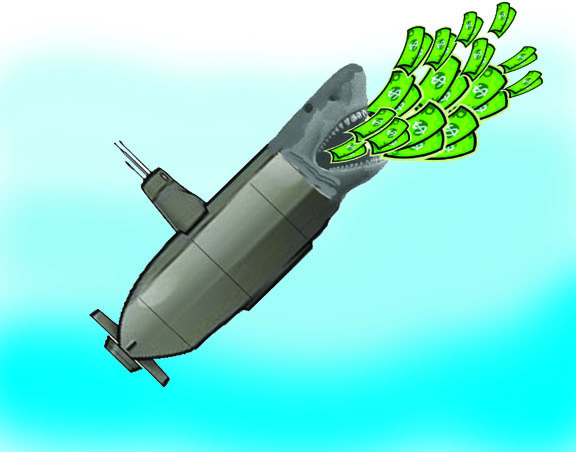
How much does a nuclear submarine cost?
Jessica YunFri, 17 September 2021 Is the new ‘AUKUS’ alliance to build Australia a fleet of nuclear-powered submarines battles growing criticism, a key question has emerged: how much do nuclear submarines actually cost?Before we get to that, what’s a nuclear submarine? It’s not considered a nuclear weapon, first of all. It all comes down to how it’s powered; a nuclear submarine works from its own miniature nuclear reactor, whereas conventional submarines use diesel-electric engines.In terms of how much they’ll cost, not even the Federal Finance Minister knows.
“Finalisation of those costs is something that will be assessed in [that] 12-18 month process we’re now embarking on with the UK and the US,” Finance Minister Simon Birmingham told ABC Radio National when asked about how much building the submarines would cost.
“The Prime Minister has acknowledged that it will likely cost more than what we had assessed for the conventionally powered submarines.”
Before the new AUKUS deal, Australia had a $90 billion contract with France to build 12 conventional submarines. To make way for the new defence pact, that deal has now been scrapped.
Opposition Leader Anthony Albanese has taken aim at the question marks around what this will cost Australian taxpayers.
“We know there are contracts in place already that will be breached. And we know there will be substantial compensation costs payable,” Albanese said. These ‘walk-away’ costs are estimated to be in the hundreds of millions.
“And Australian taxpayers are entitled to know, given that under this Government they began with arrangements with Japan, then arrangements with France, and now we have these arrangements with the United States and potentially the UK as well.”
What DO we know about the nuclear submarine deal and the costs so far?
T he new ‘AUKUS’ partnership will see Australia acquire a fleet of “at least eight” nuclear-powered submarines to “protect our national security interests” and “work with our partners across the region to achieve the stability and security of our region”, in Prime Minister Scott Morrison’s words………the new AUKUS deal means that we’ve torn up a $90 billion contract with France’s Naval Group to build 12 “Attack class” submarines, infuriating France along the way.
How much nuclear submarines cost around the world
The US Navy’s latest submarine model, the Virgina-class submarine, claims to have the latest tech in stealth, intelligence gathering and weapons system tech.
According to documents prepared for the US Congress, procuring a Virgina-class submarine is estimated to cost US$3.45 billion, or AU$4.73 billion, per boat.
Australia doesn’t currently have a domestic nuclear industry. SA Senator Rex Patrick told Yahoo Finance he expects each submarine will cost at least $5 billion to build.
Australian National University research fellow and nuclear science expert AJ Mitchell said there would be an “eye-watering cost” to constructing these high-tech watercrafts.
“Each nuclear submarine typically costs several billion dollars to build, and requires a highly skilled workforce with expertise in nuclear science,” Mitchell wrote in a new piece for The Conversation……… https://au.finance.yahoo.com/news/how-much-nuclear-submarine-cost-022130602.html
Big questions remain about Australia’s nuclear submarines, but it’s a massive financial gain for nuclear corporations

The possibility of a submarine deal with Australia came at an opportune moment. It provided Biden with a chance to demonstrate support for a close ally and boost its military strength. For Boris Johnson it could show that
relations with the US had not fallen apart because of the chaotic Afghanistan withdrawal, and it validated claims that the UK can play a prominent security role in the Indo-Pacific region.
For Australians it provides reassurance that it is still backed by its oldest allies. Having abandoned a “forever war”, the US and UK have signed up to what the Australian prime minister, Scott Morrison, has described as a “forever
partnership”. The test will lie in this submarine project being more successful than the French-backed one it has replaced. This is not something that can be taken for granted.
The big questions about the boats’ design and manufacture will not be answered until 2023. The value
of the contract will be massive, and we should expect the competing claims of all three partners to be pressed hard when they are deciding their contributions. Instead of building diesel-powered submarines with the French, Australia upgraded its requirement to nuclear-powered submarines. These are quieter, can spend more time at sea and can travel greater distances, but they are fiendishly difficult to construct. Although the UK’s Astute-class programme is now running reasonably smoothly, with each boat costing almost £1.5 billion, the first vessel was almost five years
late and massively over budget.
Times 19th Sept 2021
https://www.thetimes.co.uk/article/the-submarine-deal-is-a-real-downer-for-china-x6t89v022
Malaysia and Indonesia warn Australia’s Indo-Pacific pact could trigger nuclear arms race
Malaysia and Indonesia warn Australia’s Indo-Pacific pact could trigger nuclear arms race, Taipei Times, 19 Sep 21
The new AUKUS alliance will involve Australia, the US and Britain exchanging technology and intelligence
Australia will have access to US nuclear technology, which will enable it to build nuclear submarines
Australia’s nuclear arms ban remains in new deal
Birmingham said there was no “quid pro quo” in Australia agreeing to step up its strategic relationship with the UK and the US.
He insisted that nuclear weapons would not be based within Australia’s jurisdiction. “We’ve been clear, Australia’s position in relation to nuclear weapons does not change, will not change,” he said yesterday.
“We will meet all of our non-proliferation treaty arrangements and obligations and not be changing any of our policies in relation to the nuclear weapons technology.”
Birmingham did not rule out an increase in the number of UK and US military personnel on Australian shores. “We already have US troops and marines who work in Australia on rotational deployments at times,” he said………….
it is not just the French who have been made uneasy by the AUKUS arrangement, which is still to be worked out in detail. Australia’s allies in the Indo-Pacific have also raised concerns over what the deal will mean for tensions in the region.
Malaysia said on Saturday that Canberra’s decision to build atomic-powered submarines could trigger a regional nuclear arms race, echoing concerns already raised by Beijing.
“It will provoke other powers to also act more aggressively in the region, especially in the South China Sea,” the Malaysian prime minister’s office said, without mentioning China……https://www.taipeitimes.com/News/world/archives/2021/09/20/2003764684
China fears that the nuclear-powered submarines could be armed with nuclear weapons at short notice
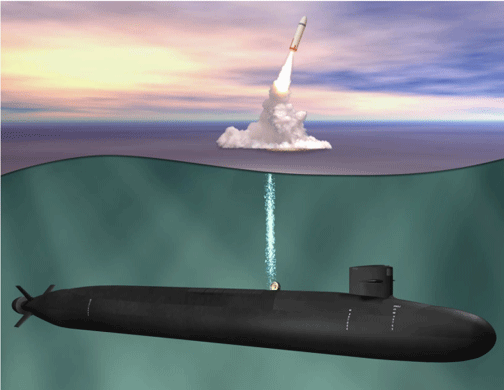
US FORCES US submarine launches Trident II nuclear missiles in stunning show of strength U.S,Sun Olivia Burke, Sep 19 2021
THE US Navy triumphantly test-launched Trident D5LE nuclear missiles on Friday in a stunning show of strength.
The scheduled two-missile deployment of the unarmed revamped weapon took place off the coast of Cape Canaveral, Florida from the USS Wyoming (SSBN-742) submarine……
The Navy boasted of the “unmatched reliability” of the new “sea-based nuclear deterrent” as tensions continue to increase with China.
It was the 184th successful Trident II (D5 & D5LE) SWS missile test flight and follows the last launch in February this year off the coast of Florida……..
“This same team is now developing the next generation of the Trident Strategic Weapon System, which will extend our sea-based strategic deterrent through 2084,”
The Navy also revealed the submarine missiles have been given “a life extension program to address potential impacts from aging and obsolescence”.
They are now primed to be stationed amongst the rest of the fleet alongside the UK Vanguard-class, US Colombia-class, UK Dreadnought-class.
With an estimated annual cost of $170million, the US spend a whopping $2.4million each year to run the Ohio-class submarines.
….the launch comes in the wake of the revelation of the UK’s and US’ plans to build nuclear-powered submarines for Australia.
AUKUS’ ALLIANCE
The alliance has angered China, who fear the subs could be armed at short notice with nukes, despite assurances they will only carry conventional weapons.
The countries leaders carefully navigated the announcement without directly mentioning China’s imposing power – but hinted at their intentions behind the move by discussing “democracy, freedom of navigation, and security.”
The new Indo-Pacific security pact, known as AUKUS, will give the land Down Under the technology to deploy nuclear-powered submarines.
It is part of an agreement intended to counter China’s rising military might – that they have splashed six times more cash on than Australia.
With 42 times more soldiers, 55 times more tanks, 13 times more submarines and 16 times more fighter jets, they eclipse the Aussies artillery.
And with 3.3 million troops in service, Beijing dwarves Australia’s 80,000 soldiers – but AUKUS has still managed to seriously ruffle some feathers.
CHINA’S FURY
Chinese Foreign Ministry spokesman Zhao Lijian condemned the alliance as “seriously damaging regional peace and stability, intensifying the arms race, and undermining the Treaty on the Non-Proliferation of Nuclear Weapons”.
China is believed to have between 250 and 350 nuclear weapons, compared to America’s colossal arsenal of 5,800 and Russia’s total of 6,375. ……. https://www.the-sun.com/news/3691458/us-submarine-trident-ii-nuclear-missiles-chinas-threats/
Nuclear submarine deal planned for 18 months – French ambassador says this is treasonous
Recalled French ambassador accuses Australia of ‘treason in the making’ https://www.theage.com.au/politics/federal/recalled-french-ambassador-accuses-australia-of-treason-in-the-making-20210918-p58ssg.html. By Anthony Galloway
France’s recalled ambassador to Australia has likened Canberra’s actions to treason after the Morrison government dumped a $90 billion submarine contract with Paris and instead decided to build nuclear-powered submarines with the United States and Britain.
France on Saturday has taken the extraordinary step of recalling its ambassadors from Australia and the US, as the fallout grows from a new defence pact that has infuriated French President Emmanuel Macron.
Speaking to The Sydney Morning Herald and The Age hours before he was recalled, France’s ambassador to Australia, Jean-Pierre Thebault, did not rule out suspending talks to allow French troops greater access to Australian military bases after his nation was “stabbed in the back”.
Adding insult to the process… we have very reliable reports from the independent press, which I thank, about the fact that all this was in the making for 18 months. Which means we have been blind-sided intentionally for 18 months…. The crime was prepared for 18 months,” he said.
France’s recalled ambassador to Australia has likened Canberra’s actions to treason after the Morrison government dumped a $90 billion submarine contract with Paris and instead decided to build nuclear-powered submarines with the United States and Britain.
France on Saturday has taken the extraordinary step of recalling its ambassadors from Australia and the US, as the fallout grows from a new defence pact that has infuriated French President Emmanuel Macron.
Speaking to The Sydney Morning Herald and The Age hours before he was recalled, France’s ambassador to Australia, Jean-Pierre Thebault, did not rule out suspending talks to allow French troops greater access to Australian military bases after his nation was “stabbed in the back”.
“Adding insult to the process… we have very reliable reports from the independent press, which I thank, about the fact that all this was in the making for 18 months. Which means we have been blind-sided intentionally for 18 months…. The crime was prepared for 18 months,” he said.
He slammed Australia for allowing a meeting to go ahead between Mr Dutton and Foreign Minister Marise Payne late last month with their French counterparts where they spoke about enhancing defence ties between the two countries.
“It is us, through letters that were sent by the President [Macron] some months ago to the Prime Minister [Scott Morrison], who proposed to look at more ambitious and new ambitious cooperations,” Mr Thebault said……….. The extraordinary move follows the Morrison government’s decision to tear up a $90 billion contract to buy 12 French submarines in favour of a new nuclear-powered fleet using technology from the US and United Kingdom under a new partnership called AUKUS.
Anger grows over Australia’s submarine deal
Anger grows over Australia’s submarine deal https://www.news.com.au/technology/innovation/military/anger-grows-over-australias-submarine-deal/news-story/2c14a4b514a7e24768696242428e6498
It’s not just the French who are angry about Australia’s submarine deal with the US and UK. Now, the outrage is closer to home.
When news broke that the US and UK will help Australia build nuclear-powered submarines by sharing their technology and knowledge, the French were furious. But they’re not the only ones.
As part of the new trilateral security agreement – known as AUKUS – the submarine deal will allow for the design and construction process to be sped up. It will help ensure the West maintains it’s edge in combat under water.
As part of the new trilateral security agreement – known as AUKUS – the submarine deal will allow for the design and construction process to be sped up. It will help ensure the West maintains it’s edge in combat under water.
Australia’s decision to tear up a deal for the French submarines in favour of US nuclear-powered vessels sparked outrage in France, with President Emmanuel Macron recalling the nation’s ambassadors to Canberra and Washington in an unprecedented move.
There’s also anger brewing from China, with Beijing describing the new alliance as an “extremely irresponsible” threat to regional stability. China has also quenstioned Australia’s commitment to nuclear non-proliferation, warning the Western allies that they risked “shooting themselves in the foot”.
Closer to home, New Zealand Prime Minister Jacinda Ardern has warned Scott Morrison to keep the nuclear submarines away from her country’s waters, CNN reports. New Zealand has been a nuclear-free zone since the 1980s.
And right on our doorstep, many Australian residents and antinuclear groups are angry, concerned it may be Trojan Horse for a nuclear power industry. Because while Australia’s nuclear-powered submarines will not be nuclear-armed, the small reactors used to power them do produce weapons-grade uranium as waste.
The Nobel Peace Prize-winning International Campaign to Abolish Nuclear Weapons (ICAN), Australia tweeted about the deal: “The nuclear-powered submarine deal raises serious concerns over nuclear proliferation as the UK and US’ models use highly enriched uranium.
“This is not prestige, this is provocation.”
The nuclear-powered submarine deal raises serious concerns over nuclear proliferation as the UK and US’ models use highly enriched uranium.
This is not prestige, this is provocation.#nuclearbanpic.twitter.com/QZLSTjhLoq— ICAN Australia (@ican_australia) September 17, 2021
“Important questions remain over construction of the submarines and the potential imposition of military nuclear reactors on Adelaide or other cities, making construction sites and host ports certain nuclear targets,” said Gem Romuld, Director of ICAN Australia.
“Military nuclear reactors in Australia would present a clear nuclear weapons proliferation risk and become potential sites for nuclear accidents and radiological contamination long into the future.”
Green Party leader Adam Bandt even likened the move to putting “floating Chernobyls in the heart of Australia’s cities”
Dr. Jim Green, National nuclear campaigner, Friends of the Earth Australia, said that nuclear powered submarines typically use highly-enriched uranium (HEU) fuel. This would undermine global efforts to phase out the use of HEU because of WMD proliferation and security concerns.
“The government wants to build nuclear submarines in suburban Adelaide. Does that put a target on our back? Is it prudent to build nuclear submarines in a city of 1.3 million people?
“What alternative locations have been considered, if any?”
Regarding waste products, Dr Green said: “The government has been silent about disposal of the high-level and intermediate-level nuclear waste generated by a nuclear submarine program.
“ … Waste from a nuclear submarine program would be dumped on Aboriginal land, as is the case with the federal government’s current plan to dump Australia’s nuclear waste at Kimba in SA despite the unanimous opposition of Barngarla Traditional Owners.
.
Russia urges IAEA monitoring, ‘transparency’ on US-Australia nuclear sub pact,
Russia urges IAEA monitoring, ‘transparency’ on US-Australia nuclear sub pact, Press TV, Friday, 17 September 2021 Russia warns against Australia’s attempt to becoming a nuclear power under a trilateral pact Canberra signed with the United States and Britain earlier this week.
Russian Permanent Representative to the International Atomic Energy Agency (IAEA) in Vienna Mikhail Ulyanov said on Friday that “time has not come yet for such estimations” about Australia turning into a nuclear power.
Under a new Australia-UK-US alliance (Aukus), Canberra would be building at least eight nuclear submarines, using US technology.
The first of the submarines is expected to enter service is 2036.
Ulyanov warned that the plan “is alarming and makes you keep a close eye on that.”
“Australia is a non-nuclear power,” he said, adding that “all this should be closely supervised by the IAEA and its inspection mechanism.”……..
Many observers warned that the trilateral pact could lead to a situation very similar to the US-Russian arms race during the cold war…… https://www.presstv.ir/Detail/2021/09/17/666731/Russia-Australia-nuclear-powered-submarines-Aukus-
Nuclear-powered submarines a ‘terrible decision’ which will make Australia ‘less safe – Australian Greens

Nuclear-powered submarines a ‘terrible decision’ which will make Australia ‘less safe’
Greens leader Adam Bandt has raised concerns over Australia’s acquisition of technology for nuclear-powered submarines from the US and UK, calling it a “terrible decision” which will make “our country less safe”.
While there have been no serious incidences with the UK and US nuclear-powered submarines in their history, Mr Bandt pointed out New Zealand will not allow the nuclear vessels in their waters.
“Australia will be writing a blank cheque, we will be spending untold billions on a fleet of floating Chernobyls,” Mr Bandt told Sky News Australia.
Mr Bandt said Australia was buying “a nuclear reactor in a box” and noted if the US decides to change the technology or withhold support, “we are at their mercy”.
“It’s really concerning the Prime Minister is calling this ‘a forever partnership’, because it means if another Donald Trump comes back in the United States, we are now … a small arm of their nuclear capacity.” https://www.skynews.com.au/australia-news/defence-and-foreign-affairs/nuclearpowered-submarines-a-terrible-decision-which-will-make-australia-less-safe/video/bc91f5690c3
1 This month
17 October, Free Public Talk on Nuclear Issues in South Australia
David Noonan will speak on public interest concerns over the new Roxby Downs Indenture Act 2026 on BHP copper-uranium mining and ore processing in SA, and on how AUKUS may face SA with a High-Level nuclear waste agenda.
Dr Jim Green will discuss international developments in the field of nuclear power including ‘small modular reactors’ and Generation 4 ‘advanced’ nuclear reactor concepts.


Help Aunty Sue Protect Her Land and Sacred Sites From Destructive Rocket Testing.
.

Australians deserve the truth
about
AUKUS – https://aukuspublicinquiry.com/

PETITION – To: Prime Minister Anthony Albanese and the Australian Labor Government

of the week – Australians for War Powers Reform (AWPR)
To see nuclear-related stories in greater depth and intensity

