Jervis Bay and previous governments’ secret plans for nuclear weapons

|
Nuclear reactor and steelworks plan once considered for pristine beaches of Jervis Bay Key points:
A steelworks, petrochemical plant and an oil refinery were also slated for the site at Jervis Bay, but what was not announced was a plan to generate weapons-grade plutonium that could have seen Australia become a nuclear power. Fifty years later, Australia is again mulling over the question of nuclear energy with two separate inquiries underway. A federal parliamentary committee is investigating the economic, environmental and safety implications of nuclear power in Australia. In NSW, meanwhile, a committee is looking into overturning a ban on uranium mining and nuclear facilities. While neither is talking specifics in terms of where nuclear enrichment technology or modern-day facilities like small modular reactors (SMRs) could be located, it has brought to the forefront questions of geography. Jervis Bay is a Commonwealth territory, located within NSW, but the laws of the Australian Capital Territory apply. Potential reactor sitesIn 2007, in the wake of the Switkowski nuclear energy review under the Howard government, the Australia Institute published a research paper identifying 19 of the most likely reactor sites. The sites were located across Queensland, Victoria, South Australia, NSW, and the ACT. It found the most suitable sites were close to major centres of demand and preferably in coastal areas to ensure easy access to water. Jervis Bay inevitably comes up as a potential reactor location due to its history as the only nuclear power plant to have received serious consideration in Australia. At the time it was promoted as the first of many. In February 1970, the Illawarra Mercury proclaimed:
That was the blueprint that nearly became a reality. Shrouded in secrecyThere was a darker side to the Jervis Bay reactor too, with evidence revealed in a 2002 ABC documentary, Fortress Australia, that the 500-megawatt fast breeder reactor was chosen due to its ability to generate weapons-grade plutonium for use in an Australian nuclear weapon Fortress Australia uncovered secret documents showing how the chairman of the Australian Atomic Energy Commission (AAEC), Phillip Baxter, influenced three Liberal prime ministers (Menzies, Holt and Gorton) to support the project. ….. Associate Professor Wayne Reynolds from the University of Newcastle told ABC podcast The Signal how Gorton pushed for the nuclear power station at Jervis Bay…….”They did the study, they worked out the capability, they had to go negotiate with the British about the technology, then they actually started to build this reactor at Jervis Bay.” The project was first delayed after William McMahon became prime minister in 1971 and was later put on hold indefinitely, despite efforts to keep the project alive. As late as March 1975, the Illawarra Mercury was reporting:
But the horse had bolted. Any hopes of a nuclear power industry in Australia effectively ended when McMahon lost government to Gough Whitlam’s Labor in December 1972. Whitlam’s signing of the Non-Proliferation of Nuclear Weapons Treaty in 1973 also ended any plans by the AAEC to provide Australia with the capacity to manufacture atomic weapons……. The Booderee National Park, meaning “bay of plenty” in the Dhurga language, was created out of the Jervis Bay National Park in 1992, which underlined the cultural significance of the lands and surrounding ocean. https://www.abc.net.au/news/2019-08-12/jervis-bay-once-site-for-nuclear-proposal/11371296?fbclid=IwAR16IqfL2gPD9lS6u9xoMkedjYNqJ1TKT_MoGww_5iwNVfq-vqYjfOrz3S4
|
|
Scott Morrison says no USA missile base in Australia – (not YET, anyway)
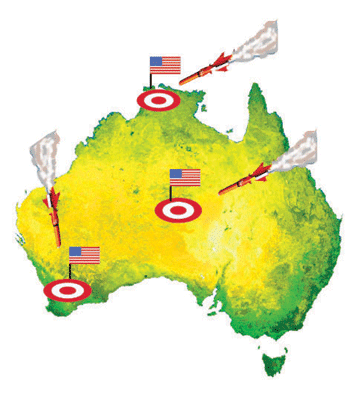
Defence Minister Linda Reynolds also emphatically ruled out any formal request by the United States. …..
Any use of Australian soil as a launch site for intermediate-range missiles would anger Beijing, given that could bring Chinese military installations in the South China sea within range.
US Defence Secretary Mark Esper had earlier canvassed placing conventional intermediate-range missiles “in Asia”, following the collapse last week of the US-Russian Intermediate-Range Nuclear Forces treaty, which aimed to limit development of such weapons.
Asked whether Australia might now also be under consideration for basing a conventional version of the weapons, with ranges of 500 to 5500 kilometres, Dr Esper did not give a direct answer…..
But Australia remains open to a US invitation to join a coalition of countries to protect oil tankers and cargo ships from attack by Iran in the Straits of Hormuz……. https://www.theage.com.au/politics/federal/no-request-has-been-made-linda-reynolds-rules-out-us-missile-base-in-australia-20190805-p52du1.html
Michael Kirby urges Australia to sign up to nuclear weapon ban treaty
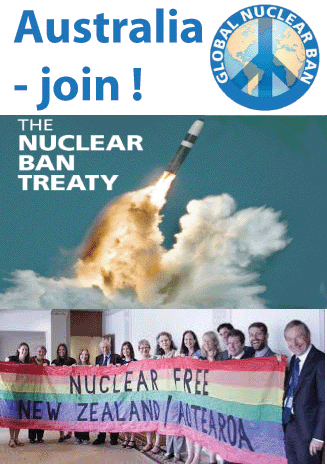 Michael Kirby urges Australia to sign up to nuclear weapon ban treaty, https://www.theguardian.com/world/2019/aug/05/michael-kirby-urges-australia-to-sign-up-to-nuclear-weapon-ban-treaty
Former high court judge says it’s a fluke the world has avoided nuclear disasters since the second world war and weapons remain a peril
The former high court judge Michael Kirby believes it was a fluke that the world has avoided further nuclear weapons disasters since the second world war and has urged Australia to sign up to a weapon ban treaty.
Kirby will launch a report in Sydney this week from the International Campaign to Abolish Nuclear Weapons, which calls for Australia to get on board.
Ican, which was founded in Melbourne, won the 2017 Nobel peace prize for leading the campaign for a global ban on nuclear weapons that resulted in a United Nations treaty being adopted in July 2017.
Kirby seized on the 74th anniversaries this week of the US detonating two nuclear bombs over the Japanese cities of Hiroshima and Nagasaki.
“That the world has survived seven decades since Hiroshima is more by good luck than effective management and there is no guarantee that it will continue to do so in an environment of proliferating nuclear weapons,” he said.
He acknowledged the nuclear weapons ban treaty was not perfect but “doing nothing is a far greater weakness”.
“Failing to address the challenges of nuclear weapons to humanity, the safety of the planet and the biosphere, highlights the global community’s failure to respond appropriately and effectively to the existential peril of nuclear weapons,” he said.
The nine nuclear powers, including the US, oppose the weapons ban treaty, arguing it could undermine nuclear deterrence.
More than 120 countries voted for the UN treaty and so far 70 have formally signed up and 24 have ratified the agreement. The treaty comes into force once 50 countries have ratified, which is expected in 2020.
Australia is not on the list. The federal government argues the ban treaty would not eliminate a single nuclear weapon. While Australia doesn’t have any nuclear weapons, it relies on “umbrella protection” under the US alliance.
can co-founder Dr Tilman Ruff said it is possible for Australia to keep its security pact with the US but sign the nuclear weapons treaty.
He pointed out 11 of 17 of the US’s regional allies have voted for the treaty’s adoption and three have signed up, including New Zealand.
“For none of those has there been any disruption or fuss with their ongoing military cooperation with the US,” Ruff said.
Ruff said if Australia was to sign up it would have to reconsider any nuclear weapons link to operations at joint facilities such as the satellite surveillance base Pine Gap in central Australia.
The report suggests the relay ground station at Pine Gap’s western compound would have to be closed or the US would have to separate out defensive functions from nuclear war-fighting.
It’s one of multiple redundant channels,” he said. “It’s clear that function of Pine Gap could easily be removed. Clearly this would need to be a negotiation, it would likely involve processes that would take a couple of years but we think that it’s eminently doable,” he said.
Anthony Albanese, who prosecuted that case at the conference, has as party leader reaffirmed his commitment.
“I’m a big supporter of nuclear disarmament. It is something that I’ve supported my entire political life,” Albanese told the ABC Insiders program on Sunday.
“We want to be a part of bringing the world with us. The fact is that over a period of time, issues like landmines and chemical weapons and other weapons have been outlawed, but nuclear weapons, the most catastrophic and damaging that can exist, still remain.”
In government ranks only Liberal MP Warren Entsch and Nationals MP Ken O’Dowd have publicly backed Australia joining the weapon ban treaty. Meanwhile, Australian foreign affairs minister Marise Payne and defence minister Linda Reynolds met with US secretary of state Mike Pompeo and defence secretary Mark Esper in Sydney on Sunday for annual talks.
Epser flagged on Saturday he supported placing ground-launched, intermediate-range missiles in the Asia-Pacific region in the short term.
Asked if northern Australia could be a potential site, he declined to speculate, saying the US deployed systems globally with friends and allies with consent and respect for sovereignty.
“We make decisions based on mutual benefit to each of the countries,” he said.
The US scrapped a nuclear arms pact with Russia on Friday. Both countries have pointed fingers at each other for violating the 1988 intermediate-range nuclear forces treaty.
What would it really take, for Australia to get “its own nuclear deterrent”?
 Counting the costs of an ‘independent nuclear deterrent’ The Strategist
Some would argue that the 1962 Cuban missile crisis was such a time. However, Khrushchev backed down not for fear of massive US retaliation but because he realised, only just in time, that the biggest danger came from losing control of his own deployed nuclear-armed forces who might start a war the USSR didn’t want.
It’s also significant that US nuclear weapons were irrelevant in the Vietnam War, in which Australia was deeply involved with its largest military commitment since World War II.
Furthermore, and more recently, the risk of nuclear war through miscalculation, mistake or malfunction has, if anything, increased ……
—the UK has decided to continue with its ‘independent nuclear deterrent’ into the 2060s at an estimated cost of around £150 billion.
However, for all the enormous expenditure, the UK Trident is not independent. In reality, the US—which leases its missiles to the UK from a common US pool, and whose technical design and support for every part of the weapon system to target and launch them is critical—can frustrate the UK from using Trident if it disapproves. So, unlike France, the UK has opted for nuclear dependence on the US.
A force of four nuclear-armed ballistic-missile-equipped nuclear-powered submarines (SSBNs) is required to maintain one continuously on patrol. In addition, to maintain its independence from the US, Australia, like France, would need to design and manufacture its own missiles and associated space-launch system, warheads, specialised satellite navigation, targeting and communications systems. And for that it would need to acquire nuclear submarine design, build, operation and maintenance skills. The UK’s decision to rely upon the US for all of that has predictably resulted in a heavy political as well as still onerous financial cost.
Then there’s the need for a nuclear-powered attack submarine (SSN), plus at least one surface ship and maritime patrol aircraft to protect the deployed SSBN. Experience shows that at least six SSNs are required to have one always available for this task. Keeping one UK SSBN continuously at sea and undetected places huge and growing strains on a now very depleted and imbalanced navy.
In fact, the cost of maintaining a UK ‘deterrent’ has led to the hollowing out of all the UK’s conventional armed forces to the point where it cannot deter, let alone respond effectively to, aggression against the homeland. ……
Australia, with no nuclear propulsion or missile experience to build on, must either be dependent on US technology and support, or embark on an even more costly all-Australian project. I would urge those who advocate either of these approaches to take a long, hard look at the counterproductive effect that sustaining the four UK Trident submarines has had on the defence of the homeland. Simply put, it has denied our armed services, especially the navy, the equipment and personnel they need to meet the wide variety of today’s actual threats……..https://www.aspistrategist.org.au/counting-the-costs-of-an-independent-nuclear-deterrent/
The cost if Australia were to get nuclear weapons – and it’s not only financial
Going Nuclear in the Antipodes: Australia’s megadeath complex, Online Opinion By Binoy Kampmark – , 10 July 2019 The antipodes has had a fraught relationship with the nuclear option. At the distant ends of the earth, New Zealand took a stand against the death complex, assuming the forefront of restricting the deployment of nuclear assets in its proximity. This drove Australia bonkers with moral envy and strategic fury. The New Zealand Nuclear Free Zone, Disarmament and Arms Control Act 1987 made the country a nuclear and biological weapons-free area. It was a thumbing, defiant gesture against the United States, but what is sometimes forgotten is that it was also a statement to other powers – including France – who might venture to experiment and test their weapons in the Pacific environs. ………
As Anglo-American retainer and policing authority of the Pacific, Australia has had sporadic flirts with the nuclear option, one shadowing the creation of the Australian National University, the Woomera Rocket Range and the Snowy Mountains hydro-electricity scheme. Australian territory had been used, and abused, by British forces keen to test Albion’s own acquisition of an atomic option. The Maralinga atomic weapons test range remains a poisoned reminder of that period, but was hoped to be a prelude to establishing an independent Australia nuclear force. Cooperation with Britain was to be key, and Australian defence spending, including the acquisition of 24 pricey F-111 fighter bombers from the US in the 1960s, was premised on a deliverable nuclear capability.
During John Gorton’s short stint as prime minister in the late 1960s, rudimentary efforts were made at Jervis Bay to develop what would have been a reactor capable of generating plutonium under the broad aegis of the Australian Atomic Energy Commission. Gorton’s premiership ended in 1971; Australia slid back into the sheltering comforts of Washington’s unverifiable nuclear umbrella.
Then comes the issue of a nuclear capability, previously unneeded given the pillowing comforts of the US umbrella, underpinned by the assurance that Washington was “the primary power in Asia”. White shows more consideration than other nuclear groupies in acknowledging the existential dangers. Acquiring such weapons would come at a Mephistophelian cost. “It would make us less secure in some ways, that’s why in some ways I think it’s appalling.”
The unlikely and unwise process towards Australia getting nuclear weapons
 Nuclear weapons? Australia has no way to build them, even if we wanted to https://theconversation.com/nuclear-weapons-australia-has-no-way-to-build-them-even-if-we-wanted-to-120075 Associate Professor of Physics, UNSWJuly 10, 2019 In his latest book, strategist and defence analyst Hugh White has gone nuclear, triggering a debate about whether Australia should develop and maintain its own nuclear arsenal.But developing and sustaining modern nuclear weapons requires a certain combination of technologies and industries that Australia simply does not have. In fact, it may be safely estimated on the basis of approval and construction times for nuclear power reactors in other western countries that it would take some 20 years to establish such capabilities in the present legal and economic environment. Nuclear weapons? Australia has no way to build them, even if we wanted to https://theconversation.com/nuclear-weapons-australia-has-no-way-to-build-them-even-if-we-wanted-to-120075 Associate Professor of Physics, UNSWJuly 10, 2019 In his latest book, strategist and defence analyst Hugh White has gone nuclear, triggering a debate about whether Australia should develop and maintain its own nuclear arsenal.But developing and sustaining modern nuclear weapons requires a certain combination of technologies and industries that Australia simply does not have. In fact, it may be safely estimated on the basis of approval and construction times for nuclear power reactors in other western countries that it would take some 20 years to establish such capabilities in the present legal and economic environment.
Opting for nuclear weapons also fails to consider the global implications of Australia abandoning its almost 50-year stance against nuclear proliferation. The first step: nuclear power generationWhite argues quite rightly that China may eventually overtake the US in terms of its industrial production and military reach. Speculating that this could entail a strategic withdrawal of the US from the western Pacific, he suggests Australia might find itself without the American defence umbrella to deter Chinese influence, or worse. But Australia would struggle to replace its long and successful alliance with the US with a limited nuclear deterrence capability. Even ignoring the issues generally involved in adopting new defence capabilities – evident in the many problems hindering Australia’s efforts to replace its ageing submarine fleet – the idea is fanciful given our current stance on nuclear energy. Nuclear power reactors, uranium enrichment plants, missile technology and high-tech electronics manufacturing would all be essential to support truly independent efforts to develop a compact nuclear weapon that could be delivered by missile from a submarine and kept in a permanent state of readiness. Neither power reactors nor enrichment facilities exist in Australia today, despite some pioneering research in both areas in the past. Australia’s missile development and high-tech electronics sectors, meanwhile, are in catch-up mode or in their infancy due to years of economic reliance on mining, tourism and services. Advancing and establishing nuclear industries for the sole purpose of developing a nuclear weapons program would neither be practically nor economically viable. Political will for nuclear energy?The only way such industries could be developed realistically would be if Australia added nuclear power to its suite of power generation technologies. Of course, Australia has large uranium deposits and a well-established uranium mining and export industry. And there appears to be increasing public support for nuclear power. A recent survey found that 44% of Australians support nuclear power plants, up four points since the question was last asked in 2015. Other polls indicate support might even be higher. A well-developed nuclear power industry would eventually give Australia almost all the necessary technologies, personnel and materials to make and maintain a nuclear weapon. This includes, in particular, the ability to enrich uranium and breed plutonium. But herein lies the problem. Even if the public did eventually support a nuclear energy program, it remains unclear whether the necessary political will would be there. Legally, the Howard government banned domestic nuclear power plantsin the late 1990s – an act that would now need to be overturned by parliament. In 2006, the federal government commissioned an inquiry led by Ziggy Switkowski into the future feasibility of nuclear power generation in Australia. The final report found that nuclear energy would be 20-50% more expensive than coal without carbon pricing. It also said a nuclear power industry would take between 10 and 15 years to establish. Recently, Energy Minister Angus Taylor said the Morrison government was open to reversing the country’s nuclear energy ban, but only if there was a “clear business case” to do so. With the current widespread availability of cheaper, renewable energies in Australia, this makes the economics of nuclear power generation less convincing. Lastly, in order to ensure true self-reliance, a delivery option for a nuclear weapon would have to be developed without purchasing technologies from other countries, such as the US. This would be incredibly costly and difficult to do. When it comes to this sort of missile technology and high-tech electronics manufacturing, Australia is currently not leading in research and development. Australia’s long-time stance against nuclear weaponsEven though Australia is not in a position to contemplate nuclear weapons due to its technological and industrial limitations, there are moral arguments against pursuing such a goal that should be considered carefully. The country has been at the forefront of the international non-proliferation movement, ratifying both the UN Treaty on the Non-Proliferation of Nuclear Weapons in 1973 and the Nuclear Test Ban Treaty in 1998. A 2018 poll also showed that 78.9% of Australians supported joining the UN Treaty on the Prohibition of Nuclear Weapons, while only 7.7% were opposed. Australians should remind themselves that these treaties have greatly contributed to peace and security in the world. Abandoning such longstanding principles of its foreign policy, which are aimed at creating a better, more peaceful world, would be an implosion of Australian character of massive proportions. |
|
|
A counterview to Hugh White’s book in favour of nuclear weapons for Australia
Australia, nuclear weapons and America’s umbrella business The Strategist , 9 Jul 2019, Rod Lyon Hugh White’s new book, How to defend Australia, has stirred up a hornet’s nest on the topic of potential nuclear proliferation. In one sense, that’s a surprise, since anyone who’s read the relevant chapter knows that it’s book-ended by carefully crafted paragraphs which state explicitly that White ‘neither predicts nor advocates’ Australia’s development of an indigenous nuclear arsenal.
But in between those paragraphs White explores the history of Australian interest in a national nuclear weapons program, underlines the dwindling credibility of US nuclear assurances to allies, canvasses a possible nuclear doctrine for Australia, and recommends a force structure—more submarines—suitable to what he sees as our new straitened strategic circumstances. If he’s not advocating a nuclear arsenal, why is he telling us so much about what it ought to look like?
Let’s start with the possibility of Australian nuclear proliferation up front. As I wrote recently for a chapter in After American primacy, there are five barriers to Australian proliferation: ideational, political, diplomatic, technological and strategic. Briefly, crossing the nuclear Rubicon would require:
- Australians to think differently about nuclear weapons—as direct contributors to our defence rather than as abstract contributors to global stability
- a bipartisan political consensus to support proliferation, during both development and deployment of a nuclear arsenal
- a shift in Australia’s diplomatic footprint, to build a case for our leaving the Non-Proliferation Treaty, and abrogating the Treaty of Rarotonga, while still being able to retail a coherent story of arms control and nuclear order
- serious investment in the technologies and skill-sets required to construct and deploy, safely and securely, both nuclear warheads and appropriate delivery vehicles
- and a strategy which gives meaning to our arsenal and an explanation of our thinking to our neighbours and our major ally.

The unwisdom of Australia mindlessly following USA into a war against Iran
 We must think very carefully before committing to war in the Gulf, The Age, By Hossein Esmaeili, July 8, 2019 Conflict between the United States and Iran is deepening and the two states are marching towards war. The Persian Gulf, where a third of the world’s natural gas and a fifth of the world’s oil is sourced, may soon see another large scale and probably long-lasting international conflict………
Australia has no legal obligations under the ANZUS Treaty, or any other international agreement, to join the US in another possibly long, chaotic and devastating regional conflict. Indeed, under the Charter of the United Nations, to which both Australia and the US are parties, the use of force is prohibited unless authorised by the Security Council of the United Nations.
the European Union is backing measures, provided by France, United Kingdom and Germany, known as Instruments In Support of Trade Exchange (INSTEX), to facilitate trade between the EU and Iran to partially get around the US sanctions, in order to save the 2015 nuclear deal, to maintain dialogue with Iran and to prevent an international military crisis.
Australia would be much wiser to join the EU’s INSTEX and engage in dialogue with Iran……..
Should Morrison decide to enter into a conflict in one of the most volatile regions of the world, he will not have the decision-making power to end it. He would do well not to drive Australia into such a war, instead, given Australia’s international reputation, he should help European countries, the world community and the United Nations to avoid a useless armed conflict, which will not benefit any country.
Hossein Esmaeili is an associate professor of international law at Flinders University. https://www.theage.com.au/world/middle-east/we-must-think-very-carefully-before-committing-to-war-in-the-gulf-20190708-p52566.html
A new book argues that Australia will need nuclear weapons

Nuclear arsenal must be on Australia’s agenda, argues defence expert, SMH, By Harriet Alexander, July 1, 2019 Australia can no longer rely on the United States to protect it in Asia and should consider developing its own nuclear weapons for the event that China becomes hostile, former defence strategist and security analyst Hugh White argues in a controversial new book.
Professor White argues in How to Defend Australia the assumption that the United States would protect the nation against any attack by a major power, which has underpinned Australian defence policy since the Cold War, is no longer true as China emerges as the dominant power in Asia.
For Australia to be self-reliant, it would need to boost defence spending from 2 per cent to 3.5 per cent of GDP – or $30 billion – and consider the “difficult and uncomfortable” question of developing its own nuclear capability, said Professor White, a professor in strategic studies at the Australian National University……..
Although most think tanks and strategic policy institutes in the United States continued to assert that dominance in Asia was a strategic priority, America’s global leadership has not figured as a priority for President Donald Trump nor for the contenders to the Democrat nomination, Professor White said. ……
Professor White said Australia should only consider defensive weapons such as submarine-launched ballistic missiles.
“We need to be extremely careful about how we talk about this and very conscious of the extraordinary cost to us of acquiring nuclear weapons,” Professor White said.
“It would make us less secure in some ways, that’s why in some ways I think it’s appalling.”
The last prime minister to canvass the development of nuclear weapons in Australia was Robert Menzies in the 1960s.
Professor White, a former deputy secretary for strategy and intelligence with the Department of Defence, was dismissed as alarmist when he first foreshadowed in 2010 the demise of American influence in Asia. But the Lowy Institute’s international security program director Sam Roggeveen said he had since been proved correct.
Mr Roggeveen said the regional complications of Australia developing nuclear weapons would be huge, with Indonesia probably having to follow suit, but the logic was inescapable.
“If we ever completely decouple from the [US] alliance then it’s hard to see how we could essentially maintain our independence against China’s coercion if we didn’t have nuclear weapons,” Mr Roggeveen said.
The bipartisan political consensus on Australian defence policy is opposed to the development of nuclear weapons, and the domestic shipbuilding program would leave Australia “hopelessly vulnerable” if it ever came to a fight with China, Mr Roggeveen said.
“According to White, we are locking in a defence force for a generation that will be totally unsuited to the world we are entering,” he wrote in a book review for The Interpreter. “That’s the scandal.”
The Minister for Defence, Linda Reynolds, said: “Australia stands by its Non-Proliferation Treaty pledge, as a non-nuclear weapon state, not to acquire or develop nuclear weapons.”
La Trobe Asia executive director Euan Graham said the US alliance was more resilient than Professor White described and China had shown no signs of aggression, but he agreed Australia should think about developing its nuclear capability.
“We’re talking about 15 to 20 years acquisition timeframe and the security environment that we’re facing will almost certainly be more severe then that it is now,” Dr Graham said.
“I think Australia has to be thinking about what will be be required to move to a nuclear weapon posture because that can’t happen overnight.” https://www.smh.com.au/politics/federal/nuclear-arsenal-must-be-on-australia-s-agenda-argues-defence-expert-20190701-p52306.html
Despite the evidence, the Australian government refuses to accept Chronic Radiation Syndrome in nuclear test veterans
 The concept of a Chronic Radiation Syndrome was first reported by Japanese doctors who observed survivors of the atomic bombs dropped upon Japan in 1945. There, the name for the syndrome is Bura Bura disease. It is not accepted by the West.
the USA was in possession of the 1971 Soviet description of Chronic Radiation Syndrome in 1973 at the latest.
In 1994 the US Armed Forces Radiobiology Research Institute Bethesda, Maryland, published “Analysis of Chronic Radiation Sickness Cases in the Population of the Southern Urals”.
From the 1950s, nuclear veterans and civilian Downwinders reported syndromes of ill health similar to Chronic Radiation Syndrome to their governments. This includes the government of the USA and the government of Australia. These reports certainly did not result in Chronic Radiation Syndrome entering the Western medical lexicon.
During the 40-year period of operations at Mayak, all studies on radiation exposure of personnel at the plant and of the off-site population, the doses of exposure, and the possible health effects from radiation exposure were classified for national security reasons”.
anyone who spoke of the reality of disease and disablement suffered by those afflicted by the nuclear weapons tests in Australia were subject to threats of imprisonment by government and to attempts of censorship by the British and Australian authorities (Marsden, cited in Cross). It took 3 decades for the Australian government to release nuclear veterans from the threat of legal action and imprisonment if they spoke.
 Chronic Radiation Syndrome, https://nuclearexhaust.wordpress.com/2014/05/01/chronic-radiation-syndrome/ Paul Langley, 9 June 19 The claim that Australian nuclear veterans suffer enhanced risk of cancer has been confirmed by the Australian Government only as recently as 2006. The official government position is that the enhanced risk suffered by the nuclear test veterans is shown in health survey results. However the Australian government refuses to acknowledge that radiation exposures due to the testing of nuclear weapons as the cause of this increased risk.
Scientists under contract to the Australian government located at Adelaide performed the analysis of the 2006 health survey results. These scientists initially suggested that exposure to petrol fumes in the Australian desert might be the cause of the increased cancer risk suffered by nuclear veterans.
This suggestion, present in the Health Survey draft report, did not make it into the final report. Instead, we are presented with a mystery. Though the scientists claim certainty in their position that the nuclear veterans’ exposure to nuclear weapons detonations was not the cause of their increased cancer risk, the scientists are unable to find any other cause.
It’s a mystery, apparently, to Australian science in the service of the State. Not that this is uniquely Australian. It is universal among the Nuclear Powers. (It is all the more perplexing given Dr. P. Couch’s compassionate and detailed submission to a Senate inquiry examining the impact of the British Nuclear Tests in Australia on the personnel involved. Dr. Couch’s submission described the suffering endured by Commonwealth Police personnel who guarded the Maralinga Nuclear Test Site after military activity had ceased. One would have logically thought that if personnel were affected by service at Maralinga in times after the cessation of weapons testing, then so were the military personnel who actually saw the bombs explode, and who saw the plutonium dust disperse during the “minor trials”. )
The report states:
“The cancer incidence study showed an overall increase in the number of cancers in test participants, similar to that found in the mortality study. The number of cancer cases found among participants was 2456, which was 23% higher than expected. A significant increase in both the number of deaths and the number of cases was found for (figures in
brackets show increase in mortality and incidence):
New Labor leader Anthony Albanese supports UN Nuclear Weapons Ban Treaty : News Corpse doesn’t like him!
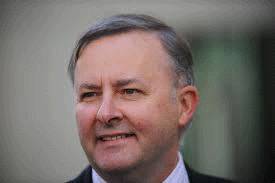 ALP leader’s stance on nuclear weapons risks backlash: MPs,
  THE AUSTRALIAN, Greg Brown 31 May 19, Anthony Albanese’s left-wing positions on foreign policy, including his support for a UN treaty that would pressure the US to eliminate its nuclear program, could become an electoral vulnerability, Labor MPs have warned.
The Opposition Leader, who has previously called for the phasing out of uranium mining and played down the Victorian Labor government’s support for China’s Belt and Road Initiative, is being closely watched by colleagues who want him to adopt a more hawkish foreign policy platform.
At the ALP national conference last December, Mr Albanese tried to move a motion that would oblige Labor to sign the UN Treaty on the Prohibition of Nuclear Weapons, which was opposed by his now deputy leader, Richard Marles, and foreign affairs spokeswoman Penny Wong.
The treaty, which has not been signed by the US or Britain, prohibits signatories from developing, testing and producing nuclear weapons. Its critics argue that rogue states such as Russia and North Korea would continue to develop weapons.
The motion passed after the Labor Right, led by Mr Marles, negotiated conditions on Labor signing the treaty.
“I am pleased that this motion before us today says that Labor in government will sign and ratify the UN Treaty on the Prohibition of Nuclear Weapons,” Mr Albanese said in December…….
Mr Albanese has historically promoted alternative foreign policy views within the labour movement, including his push against Julia Gillard’s move to export uranium to India.
The Grayndler MP also described the Andrews government’s BRI agreement as being “much ado about nothing”, and said concerns about Chinese influence were naive. During the election campaign, Mr Albanese said coming into contact with the Communist Party in China was “no more shocking than someone having contact with the Liberal Party or the Labor Party here because they don’t have a separation of state and party there”….. https://www.theaustralian.com.au/nation/politics/alp-leaders-stance-on-nuclear-weapons-risks-backlash-mps/news-story/ed7c7a12202704467eae9c5635c79116
Why is UK govt covering up the records on nuclear bomb tests in Australia in the 1950s?
|
It was a clusterfuck,” says Elizabeth Tynan, an Australian historian, and the award-winning author of Atomic Thunder: The Maralinga Story. “The disregard was partly driven by the fact they were in a rush. They cut corners. They did it on the cheap – and it showed. They had very little regard for safety. Cavalier. They knew about the risks. There were international protocols. Many were disregarded. I met one man, he was a technician with the British effort in Australia, and he said of Indigenous Australians that they were ‘nothing to do with us – it was the Australian government’s responsibility’.”
For Susanne Roff growing up in Melbourne in the 1950s was uneventful. But later, living in Scotland with her husband, William Roff, an eminent historian, she developed a dogged, almost obsessive interest in this chapter of British history that remains cloaked in secrecy.
Once a month, Roff takes the train south from her home in a Scottish fishing village – to archives in London, Birmingham and Cambridge. She’s still looking for answers. “Why was the purportedly Australia-controlled Atomic Weapons Tests Safety Committee so ineffective?” she asks. “Why was the UK able to continue testing at Maralinga until barely six weeks before opening of the 1956 Olympics despite the known hazards to east coast populations? Why didn’t [Sir Mark] Oliphant ever speak out against the tests and contamination, including when he was governor of South Australia?” Late last year, Roff had another question: Why, more than 60 years after the last nuclear test in Australia, had the British government suddenly vanished previously declassified documents about the tests from its national archives? Roff wasn’t alone in her surprise. The Campaign for Freedom of Information, a British not-for-profit organisation, described it as worrying. All that was certain was that the files had been removed on the order of the Nuclear Decommissioning Authority. “WE CAN BUT WONDER WHY THE WORLD’S THIRD ATOMIC AND THERMONUCLEAR POWER HAS SUDDENLY BECOME SO NERVOUS ABOUT EVENTS THAT HAPPENED DECADES AGO.”“The secrecy is arguably even worse today,” Tynan tells me. She is working on a second book about the British tests. “British service personnel have run into brick walls at every turn [in seeking compensation and acknowledgement]. One of the clues to the attitude of the British government is that it has not really ever properly acknowledged what they did. They were nuclear colonialists and they buggered up a part of our country. One former British personnel I met burst into tears when he thought about how Britain had never said sorry. The secrecy … seems incomprehensible. They continue to be secretive.” But not all documents are closeted. Susanne Roff has some, which she shared with me – British intelligence files on Dr Eric Burhop, an Australian physicist who had worked on the Manhattan Project, which ran from 1939 to 1946. ……. Robert Menzies agreed to the testing immediately, without bothering to consult cabinet. For a time, only three people in the country knew of the agreement: the prime minister, treasurer and defence minister. He asked few questions of the British. “But it wasn’t pure patriotic sycophancy,” Tynan says of Menzies’ decision. “The pragmatic response was: vast reserves of uranium in Australia. It’s central to weaponry and power. It was completely valueless until the Manhattan Project. Then it became a valuable commodity. Australia had a lot of it. That was a very significant part of his reasoning. The other thing that would’ve informed Menzies’ thinking was that he was anxious to ensure Britain and America would protect Australia.” They were also without the counsel of the Australians who had worked on the American tests – notably, Mark Oliphant and Eric Burhop. Both Susanne Roff and Elizabeth Tynan agree Oliphant would have been a strong head of the safety authority, which was otherwise feckless. Both men were long suspected of being Communist spies, and may have been excluded to mollify US doubts about British security. The files on Burhop that I’ve seen are voluminous. The FBI, MI5 and ASIO all had records on him. In England and America, he was aggressively surveilled. His phone was tapped. Even Joseph Rotblat had his doubts about his former colleague. The British intelligence historian Andrew Brown has written: “Rotblat remained convinced that Burhop and other left-wing scientists … opposed the [proposed nuclear] moratorium not for their stated reasons but because it would perpetuate the USA’s monopoly and place the USSR at a dangerous disadvantage.”…… In 1984, Australia held a royal commission into the British tests. It found a litany of negligence and cover-ups. “Britain had to be dragged, kicking and screaming, to it,” Elizabeth Tynan says. Today, their attitude is much the same. In 2015, Fiji – frustrated by Britain’s refusal to compensate its people who suffered radiation poisoning during the Pacific tests – declared it would compensate citizens itself. “We are bringing justice to a brave and proud group of Fijians to whom a great injustice was done,” Fiji’s prime minister said. “Fiji is not prepared to wait for Britain to do the right thing.” Meanwhile, in Britain’s national archives, the nuclear files are still gone. “The UK government has always [downplayed] risks to the servicemen who took part in the tests, the Aboriginal community in the immediate vicinity of them, and the general population downwind … as well as possible genetic effects on subsequent generations,” Susanne Roff says. “We see similar responses in relation to Fukushima in Japan. All the operational and scientific documents relating to the Australian tests that have been on open access in the National Archives have suddenly gone walkabout. We can but wonder why the world’s third atomic and thermonuclear power has suddenly become so nervous about events that happened decades ago.” https://www.thesaturdaypaper.com.au/news/law-crime/2019/05/18/unusual-secrecy-around-1950s-nuclear-testing/15581016008158 |
|


British exhibition on nuclear testing glosses over the impact on Aboriginal people
Cold War exhibition tries to airbrush Britain’s dark history of nuclear testing, The Conversation, Researcher, Social History/Tutor in Medical Education, University of Dundee, May 2, 2019 A new exhibition about the Cold War recently opened at the UK National Archives at Kew in south-west London. Protect and Survive: Britain’s Cold War Revealed seeks to tell the story of how the years of high nuclear tensions affected the UK, from spy paranoia to civil defence posters to communications at the heart of government. …..
Files under review
Remembrance, The omissions at the London Cold War exhibition are a reminder about the UK’s low-key approach to its weapons testing history. The story doesn’t only need to be properly told at this exhibition, it needs a permanent public space. Yet no existing museum dedicated to Britain’s wars is interested in giving it house room – not even the records and memorabilia of all the military personnel sent to observe the tests. A number of years ago I was quietly told while walking down a corridor in one major institution not to offer it my own records because “they will end up in the skip”.
UK nuclear testing in Australia – Trident anniversary – no cause for celebration.
Trident celebrations ignore Aboriginal victims of British nuclear weapons testing, Green Left, Linda Pearson, April 26, 2019 Issue 1218, Scotland
Campaign for Nuclear Disarmament (CND) General Secretary Kate Hudson said the plan is “morally repugnant” and the organisation is urging supporters to convey their opposition to Defence Secretary, Gavin Williamson. Two Bishops and more than 20 priests have called on Westminster Abbey to cancel the service, which is set to take place on May 3……
The rhetoric of “deterrence” and “defence” is routinely invoked by nuclear-armed states to obscure the horrifying truth about nuclear weapons and justify national security doctrines that rely on them. Nuclear weapons are unique in their destructive power; “designed to indiscriminately kill and destroy thousands of innocent civilians”, as the Bishop of Colchester told The Times last week. This reality was recognised by most of the world’s countries, which voted to ban nuclear weapons in 2017.
Britain’s nuclear weapons program has already destroyed the lives of countless innocent civilians. More than 1200 Indigenous Australians were exposed to radiation during British nuclear weapons testing in the 1950s and 1960s, while many others were displaced. The effects continue to be experienced by their families today. Some are now calling on the British government to apologise for the testing, instead of celebrating Trident.
Nuclear testing in Australia
Britain conducted 12 major nuclear weapons tests in Australia at the Montebello Islands, and at Emu Field and Maralinga in South Australia.
After securing the agreement of the Australian government, the British established a permanent test site at Maralinga in 1955. Seven major and several hundred “minor” tests were carried out there, releasing 100kg of radioactive materials into the surrounding area.
The British and Australian governments of the day demonstrated a callous disregard for the lives of Aboriginal people that is characteristic of the settler-colonial mindset. Permission to conduct the testing was not sought from Aboriginal landowners and the Australian government decided they should not be informed of the risks.
When an Australian scientist asked British authorities about the potential danger to local Aboriginal people, the response was that “a dying race couldn’t influence the defence of Western civilisation”.
Many Aboriginal people were forcibly removed from their land prior to the tests, destroying their way of life. Others experienced serious health issues as a result of their exposure to radiation.
Yankunytjatjara man Yami Lester went blind after a “black mist” from the explosions enveloped his country. Others experienced skin rashes, diarrhea and vomiting. Today, Aboriginal communities in the area experience high rates of diseases associated with the effects of radiation poisoning.
 Yami Lester’s daughter, Karina Lester, and her family played a crucial role in the International Campaign to Abolish Nuclear Weapons (ICAN). They collected and shared stories from the survivors of nuclear weapons testing that were instrumental in convincing 122 states that the only safe way to deal with nuclear weapons is to eliminate them.
ICAN won the Nobel Peace Prize for its efforts to bring about the 2017 United Nations Treaty on the Prohibition of Nuclear Weapons. The historic treaty recognises “the disproportionate impact of nuclear-weapon activities on Indigenous peoples”. The British and Australian governments boycotted the UN negotiations, however, and have ruled out signing the treaty.
No cause for celebration
Karina Lester said “survivors of the British Nuclear Tests carried out on Australian soil in the 1950’s and 1960’s in South Australia’s outback are still haunted. The Indigenous communities still suffer with high numbers of deaths, cancers, respiratory illnesses and autoimmune disease.”
Several attempts to clean up the Maralinga site have been made by British and Australian governments, thanks to the campaigning of survivors like Yami Lester, but contamination at the site remains. In 1995, Aboriginal peoples received just £7.5 million for the loss and contamination of their land. Only £110,000 has been paid to five Aboriginal people to compensate for their exposure to radiation. A class action was blocked by Britain’s Supreme Court in 2013.
Karina Lester said that the affected communities “have had no apology for the wrongdoings on our traditional lands to this day. As the British Government celebrates 50 years with nuclear weapons, Australia’s Indigenous communities in South Australia wear the scars.”
Instead of celebrating, Lester said, “we Indigenous South Australians urge the British government to own up and apologise for your actions…………”https://www.greenleft.org.au/content/trident-celebrations-ignore-aboriginal-victims-british-nuclear-weapons-testing
A Maralinga nuclear veteran’s grim story
Maralinga nuclear bomb test survivor reveals truth of what happened in the SA desert https://www.adelaidenow.com.au/messenger/east-hills/maralinga-nuclear-bomb-test-survivor-reveals-truth-of-what-happened-in-the-sa-desert/news-story/697b17f6d3427a78aa0262b09727c169, 24 Apr 19
The nuclear bomb tests, under British Government control, at Maralinga in far west South Australia in the 1950s were conducted at the highest level of secrecy. But they had thousands of witnesses. Most were Australian servicemen, innocently used as guinea pigs and exposed to deadly radiation. Craig Cook talks to a survivor, one of the last of a group of men who built the Maralinga camp as part of 23 Construction Squadron and watched in awe as the bombs were exploded, little knowing they were risking their lives and the futures of their children.
Tony Spruzen knew the drill at the top secret Maralinga facility in the South Australian desert in the spring of 1956.
Just like hundreds of others at the nuclear site at 11-mile camp during Operation Buffalo, he was told to turn his back and cover his eyes to protect himself from the gigantic glare of the exploding atomic bomb.
What they didn’t tell the Australian Army sapper was, at the moment of the flash of detonation, he would see the bones of his hand through his tightly shut eyelids.
“It was like a massive x-ray,” Tony, 83, from Glengowrie says. ‘Unlike anything I’d ever known before.”
A week after One Tree, on October 6, 1956, Spruzen witnessed the detonation of Buffalo 2, named Marcoo.
The bomb was only a tenth the size of One Tree but this time was detonated directly above and just under the ground.
“The bomb was in an amphitheatre of hills and we were far closer to that one, maybe only 200 yards away,” he remembers.
“We were close enough to see the trenches with dummy soldiers in them holding rifles and fake aeroplanes and tanks used to test the blast effect.
“And we could see the scientists walking around in their white suits checking out the site before and afterwards but we were just in khaki shorts and short sleeved shorts. Even the dignitaries had no protection.”
Every hour, from five hours out, an elaborate PA system across the complex announced the timing of the bomb detonation.
In the final 30 seconds, and with a rising and excited inclination, the voice on the PA dramatically counted….ten, nine, eight…down to zero.
When Marcoo exploded at 7am it only took a few seconds for a heavy shower of dust to descend on the witnesses.
“We had this large piece of litmus paper attached to our shirts,” Spruzen recalls
Spruzen, originally from Victoria and a carpenter by trade, enlisted in the Army at just 16.
Four year later he was at Maralinga as part of a detachment of 23 Construction Squadron, an acclaimed unit of the Royal Australian Engineers and exclusively raised in South Australia.
Around 40 young men were selected from the unit to build a desert tent camp with cook houses and latrines for the Commonwealth military ‘high-ups’ who were having their first look at the impact of the devastating nuclear weapon.
Around 200km from the ocean, the tent city gained the facetious name of the ‘Sea View Holiday Camp’.
“It was an adventure…we were all excited,” he recalls.
“A lot of young single guys together and we had some fun.”
The lads knew it was serious too as this was a hush-hush operation. They weren’t even allowed to take a camera along for snapshots so Spruzen has no personal photos from Maralinga.
“Then we all turned around to see this mushroom cloud climbing into the sky. The next thing was the blast. The boom was deafening…and then the wind came about thirty seconds after that blowing dust and soil and debris all over us.”
But he does have a terrible reminder of his three months spent in far western South Australia.
“Of the 40 men who went up with me I only know of three of us still around,” he says. “The rest have all died – many from cancers.”
The first Maralinga bomb, Buffalo 1, with the nickname One Tree, was detonated after being dropped from a 31m high tower.
At 15 kiloton it was the same size as Little Boy, the bomb dropped by the US air force that demolished the Japanese city of Hiroshima in August 1945, killing more than 100,000 instantly and tens of thousands slowly in the aftermath from burns and radiation poisoning.
“They said, keep an eye on that and if it changes to pink come and see us. Well it turned pink for every one of us.
“Had I have known what I know now I wouldn’t have been so close.”
Transferred to Sydney on a training course, Spruzen missed the final two detonations at Maralinga that year: on October 11, 1956, Buffalo 3 (Kite) was released by a Royal Air Force Vickers Valiant bomber, the first drop of a British nuclear weapon from an aircraft; and then on October 22, and again dropped from the 31m tower, (Buffalo 4) Breakaway exploded.
There were a total of seven nuclear desert tests at Maralinga performed during Operations Buffalo and Antler.
The 1985 McClelland Royal Commission heavily criticised the detonations, declaring the weather conditions were inappropriate and led to the widespread scattering of radioactive material.
The radioactive cloud from Buffalo 1 reached more than 11,000m into the air and with a northerly wind blowing radioactivity was detected across Adelaide.
Radioactive dust clouds from other bombs were detected in Northern Territory, Queensland and across New South Wales, as far away as Sydney, 2500km from Maralinga.
Around 12,000 Australian servicemen served at British nuclear test sites in the southern hemisphere between 1952 and 1963.
In recent years, the British Government’s claim that they never used humans “for guinea pig-type experiments” in nuclear weapons trials in Australia has been revealed to be a lie.
Tony Spruzen has struggled to come to terms with being placed in danger by his own government who had full knowledge of the consequences of exposure to radiation.
“Once we all found out later what we’d been exposed to at Maralinga it makes you very angry,” he says.
“We believed them when we were told we would be safe — but we haven’t been.”
Spruzen met his wife Shirley, the daughter of an army veteran, in Adelaide where they settled after marriage in June 1960. He left the army seven months later to work in civil construction. He thought his Maralinga days were well behind him but soon after they came to haunt him.
In the first four years of marriage, the couple agonisingly suffered six miscarriages, including twins.
Alarm bells started ringing when he was sent a survey from Veterans Affairs asking about his general health and, specifically his history of cancers.
“It turned out those involved in the atomic tests had a 30 per cent higher chance than getting cancers than the general public,” he says.
“Most of those got them within the first five years and a majority of those were dead before a decade had passed.”
Spruzen, who eventually had three children with Shirley, didn’t get cancer at that time, although he has since had several melanomas removed.
But when his son was diagnosed with acute myeloid leukaemia at the age of 41, he wondered about the possibility of faulty genes, damaged by exposure to radiation, as has been documented in Japanese survivors of the atomic bombs, jumping a generation.
“My son was told by the QEH (Queen Elizabeth Hospital) there was nothing could be done for him but we went up to Queensland and after a bone marrow transfer from his sister he survived,” he adds.
“A decade on he’s working as strong as he has but I don’t think his condition was a coincidence given my history.
“There’s been nothing (compensation) for those of us who were there although they gave us a white card for our cancers and now we have a (full health) gold card.”
Ken Daly, President Royal Australian Engineers Association says it is the least the men, who literally put their bodies on the line, deserve.
“You get these young men, aged around 25-30, with a history of exposure to radiation, coming down with cancers in those numbers and you just know what has caused it,” he says.
“Many died within a few years of being exposed to the fallout and many passed on generational health problems and birth defects to their children.”
Mr Daly, who was based at Warradale Barracks for 15 years, where 23 Construction was based until being disbanded in the early 1960s, hadn’t heard of the Squadron until around five years ago.
Since then he has been central to the group gaining due recognition.
In its earliest days the Squadron, with a strength of eight officers and 160 in other ranks, built the El Alamein Army Reserve camp, part of which later became the Baxter Detention Centre, outside of Port Augusta.
It also assisted the South Australian community by providing aid during bush fires, the grasshopper plague of 1955, and significant infrastructure construction.
During the record flood of 1956, while those squad members were at Maralinga, the rest of 23 Construction were out sandbagging River Murray towns and then cleaning up after the water receded.
In 2011, the Royal Australian Engineers constructed a memorial at Warradale to all who have served in its ranks.
This year a bronzed engineer’s slouch hat, of actual size, by Western Australian sculptor and former army engineer Ron Gomboc will be incorporated into the memorial.
“The hat will be mounted on the memorial in such a way it will look like it’s suspended in mid-air,” Daly adds.
“It acknowledges the ultimate sacrifice of the more than 1250 engineers who died in World War I and the remarkable service and sacrifice of 23 Construction Squadron that has never been recognised before.”
The slouch hat, costing $6,000 and one of only six to have been cast, will be unveiled during a service at Warradale Barracks at midday on Sunday April 28.
Contact Ken Daly at dailydouble@bigpond.com for further details.
1 This month

of the week – Australians for War Powers Reform (AWPR)
To see nuclear-related stories in greater depth and intensity
 Antinuclear