The horror legacy of Britain’s nuclear bomb tests
Britain’s nuclear bomb test legacy of early deaths and deformed children, Mirror,
The horrific story behind the UK’s nuclear experiments have been told in full for the first time. After the horrors of the Second World War, it was deemed necessary for Britain to have a weapon that could unleash hell.
When atom bombs were dropped on Japan in 1945, LIFE magazine reported: “People’s bodies were terribly squeezed, then their internal organs ruptured…….
Of the 22,000 scientists and servicemen who took part in radioactive experiments in Australia and the South Pacific, just a handful are alive.
Their families report cancers, rare medical problems, high rates of miscarriage – and deformities, disability and death for their children – and their grandchildren.
Now, the full story of Britain’s nuclear experiments has been told for the first time in a new Mirror website that details not only the scientific, military and political battles, but the human fallout.
DAMNED features top-secret documents, eyewitness accounts and searing testimonies.
The site takes its name from an editorial written in 2002 by Mirror editor Richard Stott, who thundered: “How many more generations of the damned will our politicians allow to suffer before they accept the calamities of their predecessors and the consequences of their own cowardice?”
In May, the Mirror called for an award for the veterans and Defence Secretary Gavin Williamson has ordered a medal review.
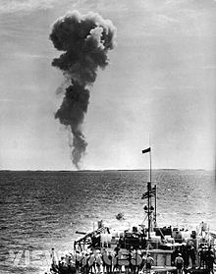
DAMNED begins with Operation Hurricane in 1952, when Britain exploded its first atomic bomb, covers the Minor Trials in South Australia, which left the landscape littered with plutonium debris for decades, and reports on Operation Grapple in 1958 when the UK detonated its biggest weapon.
It also details the human cost and shows how every other nuclear nation on Earth came to accept and recognise their nuclear heroes – leaving Britain the only one to deny a duty of care………
In May, the Mirror called for an award for the veterans and Defence Secretary Gavin Williamson has ordered a medal review……….
DAMNED has a memorial section with the pictures and health problems of every veteran from our archives. Some of their stories can be read here: …… https://www.mirror.co.uk/news/uk-news/britains-nuclear-bomb-test-legacy-13590455
City of Sydney calls on Australian govt to sign up to the UN Nuclear Weapons Ban Treaty
Last night, the City of Sydney unanimously adopted a motion calling on the Australian Government to sign and ratify the UN Treaty on the Prohibition of Nuclear Weapons. Congratulations!
We hope many cities and towns will join Sydney and Melbourne in endorsing the ICAN Cities Appeal.
Nuclear weapons for Australia? – at what cost?
The reactor would have been able to generate plutonium which, under the auspices of the Australian Atomic Energy Commission, could be used to manufacture nuclear weapons.
But the project did not survive an abrupt change of leadership and Australia ended up riding out the remainder of the Cold War as a non-nuclear player.
Five decades later the nuclear anxieties which coloured Mr Gorton’s foreign policy outlook are creeping their way back into international relations.
US President Donald Trump has announced that he will pull the US from the Nuclear Forces Treaty with Russia, as both countries expand their nuclear arsenals.
India is locked in a nuclear tit-for-tat with neighbouring Pakistan, while China has developed nuclear weapons capable of reaching anywhere in the US.
Historically Australia has sought shelter under the US ‘nuclear umbrella’, but is it time for that to change?
In a recent essay, Dr Stephan Fruhling, the Associate Dean of the College of Asia and the Pacific at the ANU, contemplated the “unthinkable option”, and suggested that a nuclear-armed Australia is more likely than ever before.
Fortress Australia
According to Dr Fruhling, Australia’s continuous coastline makes it uniquely positioned to ‘spike the moat’ with tactical, short-range nuclear weapons that could be used against air and maritime forces.
“In air and naval battle on the high seas, nukes can now be employed without significant risk of collateral damage, much like conventional war heads,” he told Late Night Live.
“Australia could establish a maritime exclusion zone in wartime, to increase the military risk for any country planning a major attack against the continent.”
But what would be the cost?
The strategic benefits of any nuclear capability would have to be balanced against the possible implications of breaking out of the US nuclear umbrella.
Australia’s access to US intelligence, technology, and weapons systems may be compromised if it chose to take on a defence strategy that was less reliant on the US.
“Before investing in a nuclear program I think we would have to make a genuine attempt at trying to draw closer to the United States and its nuclear arsenal,” Dr Fruhling said.
If Australia chooses to remain under the US nuclear umbrella, Indonesia presents a unique case in which American and Australian interests may not intersect.
Indonesia is also a US ally, and if it decided to begin its own nuclear program, the implications for the US security guarantee for Australia are not clear.
“Should Indonesia acquire nuclear weapons, relying on US deterrence against a nuclear attack would require a leap of faith about the alignment of Australian and US interests,” Dr Fruhling said..
An Australian nuclear program could lead to Indonesia following suit.
“Indonesia has regional leadership ambitions, and a strong sense of independence and will, in coming years, tower over Australia economically as well as in population terms,” Dr Fruhling said.
“Australian acquisition of nuclear weapons would strengthen Indonesia’s reasons to reciprocate, for status as well as security.”
In the meantime, however, Australia’s non-nuclear status is important in discouraging Indonesia and other regional players from going down the nuclear path……..https://www.abc.net.au/news/2018-10-24/should-australia-have-a-nuclear-weapons-program/10407610
Tim Flannery now sees nuclear power as useless, except for nuclear weapons
Steve Dale Nuclear Fuel Cycle Watch South Australia, 20 Oct 18, I note Tim Flannery’s words in the transcript. Listen to the pod cast below from the 21 minute mark to see how his position regarding nuclear has evolved – he talks about how solar and wind has become so cheap, so quickly, he talks about the Tesla battery, gearless wind turbines, how fantastic that South Australia is now coal free and that the only reason he can see why a country would fund nuclear these days is if they want to develop nuclear weapons...https://www.facebook.com/groups/1021186047913052/?multi_permalinks=2157916570906655&comment_id=2160264634005182¬if_id=1539904501184162¬if_t=feedback_reaction_genericTim Flannery on climate catastrophe and his new book Tim Flannery, head of the Climate Council, weighs in on this week’s IPPC report, the government’s greenhouse emissions report card, and discusses his new book Europe: a natural history https://www.abc.net.au/radionational/programs/latenightlive/tim-flannery/10361616?fbclid=IwAR0fUXgQJAHQ0HcHc30j057P60bpOMikYWKzKZYT3aT7gE5D1qX0BWtaY7M
Genetic effects of nuclear testing in Australia in the 1950s and 60s
UK to probe poisonous genetic legacy of nuclear test ‘guinea pigs’ SMH, By Nick Miller, 19 October 2018 London: The UK government is considering a new study into the health of the children of British veterans used as guinea pigs in its Australian and Pacific nuclear weapons tests, to test fears of a poisonous genetic legacy.
If a link can be found it may form the basis of a claim for compensation from the UK government, despite courts previously turning down such claims from the veterans themselves.
Defence Secretary Gavin Williamson has told officials in the Ministry of Defence to look at the feasibility of a study into the health and well-being of the children of nuclear test veterans, an MOD spokesman said.
Decades ago, around 22,000 British military personnel witnessed nuclear weapons tests in South Australia, on the Montebello Islands off Western Australia, and on Kiribati’s Christmas Island in the Pacific.
Some felt the heat of the explosion on their backs and were ordered to turn around and observe the mushroom cloud. One veteran told the BBC in February the tests “bowled people over” and left them on the ground screaming. He had watched “another sun hanging in the sky”, dressed only in a t-shirt, shorts and thongs.
“We were guinea pigs,” Bob Fleming, 83, said. He said 16 of his 21 children, grandchildren and great-grandchildren had birth defects or health problems: his youngest daughter has thyroid problems and severe breathing difficulties.
The family believe it is a result of the radiation Mr Fleming was exposed to during the test.
Another veteran, RAF sergeant Roy Kirkland, slept a half a mile from Ground Zero and was ordered to collect dead seabirds from the Christmas Island test site.
The new feasibility study follows a campaign by the Mirrorand Labour deputy leader Tom Watson, who have been pushing for recognition and compensation for the veterans who were exposed to radiation during the tests in the region between 1952 and 1967 – and their families.
In 2007 a study of New Zealand nuclear test veteransfound they had more than double the expected amount of genetic damage for men of the same age – even higher than that detected in workers close to the Chernobyl nuclear accident or involved in the clean-up.
The study by researchers from Massey University found the genetic damage was most likely attributable to the veterans having been on board NZ navy frigates observing nuclear tests at Christmas Island.
In 2014 a study by European researchers found a “significant excess” of infant mortality and congenital illnesses in nuclear test veterans’ children. The veterans’ wives had five times as many stillbirths, and 57 children of veterans had congenital conditions – ten times the rate in the control group and eight times the national average. There were also significantly higher congenital illnesses – and cancer – among the veterans’ grandchildren. The researchers said their results were “highly statistically significant”. …….. https://www.smh.com.au/world/europe/uk-to-probe-poisonous-genetic-legacy-of-nuclear-test-guinea-pigs-20181019-p50alz.html
City of Melbourne supports Australia joining UN Nuclear Weapons Ban Treaty
The City of Melbourne, birthplace of ICAN, just voted unanimously in support of a motion calling on the Australian government to join the UN #nuclearban treaty! @cityofmelbourne @dfat
Ex-Admiral says nuclear subs are vital for South China Sea
Australia needs a fleet of stealthy nuclear submarines to deal with potential threats in our region, most notably in the South China Sea, a strategic policy report says…. (subscribers only)
Weapons-making corporation, Raytheon hoping for nuclear industry in SouthAustralia?
‘Welcome’ to Steve Ciobo, the new Australian Minister for the Arms Trade
Australia won’t get the nuclear bomb – these are the reasons why not
The real problem is developing a credible, effective nuclear capability is about much more than possessing the bomb itself. Equally critical would be working out how to control and protect the weapon prior to use, and finally, deliver it. Doing this is, perhaps surprisingly, just as difficult – if not more so – than developing the device itself.
let’s look at what it would cost.This is where the extent of the fantasy becomes apparent.
there’s one other final, conclusive, and critical reason that not even our allies will assist an attempt to go nuclear. The truth is now they just don’t view Australia as a stable, mature democracy any more.
The one, conclusive reason why Australia won’t go nuclear, SMH, By Nicholas Stuart, 18 September 2018 There’s a massive, although subterranean, debate going on in the strategic community at the moment – one with huge ramifications. It’s whether Australia should possess its own nuclear deterrent. Continue reading
Defence officials become military lobbyists
| Defence officials turn lobbyists, sometimes weeks after leaving government
Eight former defence figures, most high-ranking, are now lobbyists for military contractors, Guardian, Christopher Knaus, @knausc, 18 Sep 2018 Senior defence officials and military figures are taking paid jobs with firms lobbying for arms manufacturers, sometimes within weeks of leaving their government posts. Guardian Australia has identified eight former military officers or defence bureaucrats, most of whom were high-ranking, who have publicly registered themselves as lobbyists for firms that represent military contractors. But many other defence lobbyists operate largely in secret, either because they work directly for military contractors, or because they simply refuse to put themselves on the lobbyist register, avoiding scrutiny for themselves and their clients without any real repercussion. One recent example of a lobbyist who placed himself on the lobbyist register is Tyson Sara, a former assistant secretary in defence’s naval shipbuilding taskforce, whose role was described as “leading the implementation of the Australian naval shipbuilding plan”. Sara left defence in March and soon after joined lobbying powerhouse Cmax Advisory as its chief operating officer and vice-president for strategy and government. Cmax represents the shipbuilder Navantia Australia, defence contractor Northrop Grumman, and the Israeli weapons manufacturer Rafael Advanced Defense Systems………. Military officers who held a rank above colonel or its equivalent are banned from lobbying for 12 months on “any matter they had official dealings with” during the last year of their employment. Senior executive service officers in the public service face the same cooling-off period. But the lobbying code of conduct, already weak by international standards, is rarely enforced and staff movements are poorly monitored. The code also fails to consider former defence employees who are employed directly by weapons companies, either as in-house lobbyists or senior executives. That means it does not apply to individuals such as Sean Costello, who worked as chief of staff to the then defence minister David Johnston between June 2014 and January 2015, as the government planned its $50bn future submarines program, according to evidence in Senate estimates. Costello left Johnston’s department and two months later became the chief executive of the Australian arm of French submarine manufacturer DCNS, a Senate committee heard. That company, now known as Naval Group, eventually won the submarines contract in 2016. In Senate estimates in 2015 Defence conceded that it was “a fair assumption” that Costello, in his role as chief of staff, would have had access to confidential documents and briefings on the submarine project. Defence said in evidence to the Senate that it provided Johnston’s office with 34 pieces of written advice relating to the submarine project in the time Costello worked in the office, on top of material provided to the minister in a daily briefing pack. ……. Tim Costello, chief advocate for World Vision and the executive director of Micah Australia, said the sheer value of defence contracts meant it was necessary to apply added scrutiny to the sector. “They are so lucrative,” Costello said. “It means that the transparency and accountability must be higher and commensurate with the goldfields they represent of taxpayer dollars.” The Centre Alliance senator Rex Patrick said it was clear the lobbying code needed to be enhanced for former defence personnel. Patrick said senior defence personnel were often exposed to privileged and sensitive information on policy, strategy, and commercial and tender requirements. “While I wouldn’t suggest that this information is shared amongst a lobbyist’s clients, when former officials service their clients, it’s simply not possible to unknow this information when formulating advice,” he said.
|
ICAN takes the Nobel peace message to country Australia
ICAN Nobel Peace Prize Ride: On the road to a future free of nuclear weapons https://www.examiner.com.au/story/5631777/on-the-road-to-a-future-free-of-nuclear-arms/?cs=97, Gem Romuld and Lavanya Pant, 7 Sept 18
Cycling through the green hills, surrounded by stately gums and wattle blossoms, it’s hard to believe that nuclear weapons pose a threat to everything we hold dear. Yet nine nations cling to 14,500 nuclear weapons, enough to annihilate our planet many times over.
The risk is real and growing. We know from the Red Cross Red Crescent movement that any use of nuclear weapons would have catastrophic humanitarian consequences and be impossible to respond to. This is something we cannot risk.
Driven by deep concern for the humanitarian impacts of nuclear weapons, a global majority of nations are taking action.
Chemical and biological weapons have long been outlawed by international treaty.
Last year, 122 nations united to put nuclear weapons in the same legal category. In July, they voted to adopt the Treaty on the Prohibition of Nuclear Weapons at the United Nations. This is the first agreement to clearly outlaw nuclear weapons, setting a standard for all nations and providing a legal pathway for their total elimination.
The Australian-founded International Campaign to Abolish Nuclear Weapons was awarded the 2017 Nobel Peace Prize for our role in helping to achieve this treaty.
Regrettably, Australia hasn’t yet signed on to the ban. Our government is a proud signatory to the treaties prohibiting landmines, cluster munitions, biological and chemical weapons, but is resisting signing the nuclear weapon ban treaty. This must change, to reflect the will of the vast majority of Australians who do not want weapons of mass destruction used in their name.
A diverse group of ICAN supporters is cycling the Nobel Peace Prize medal and a giant copy of the nuclear weapon ban treaty from Melbourne to Canberra to share this story with communities, and highlighting the imperative for Australia to join the ban.
We’re sleeping in church halls, sharing potluck dinners with locals and hosting events in Benalla, Albury and Gundagai.
Our journey culminates in Canberra on September 20, the first anniversary of the nuclear weapon ban treaty opening for signature at the UN. We’re hitting the road with our hand-sewn flags, Nobel medal in the backpack, to cycle a little closer to a future free of nuclear weapons.
Gem Romuld is Australian director of ICAN. Lavanya Pant is Nobel Peace Ride co-ordinator.
Australia, New Zealand launch planes to monitor nuclear North Korea
Defence Minister Christopher Pyne on Friday announced the deployment of two Australian AP-3C Orion patrol aircraft in addition to a P-8A Poseidon sent out earlier this year.
A“It is a continuation of our strong stand to deter and disrupt illicit trade and sanctions evasion activities by North Korea and its associated networks,” he said.
The planes will be based out of Japan.
Meanwhile, a New Zealand Air Force Orion P-3K2 would also be carrying out surveillance of international waters in north Asia, New Zealand Foreign Affairs Minister Winston Peters announced separately.
“We welcome the recent dialogue North Korea has had with the United States and South Korea,” he said.
“However, until such time as North Korea abides by its international obligations, full implementation of the United Nations Security Council Sanctions resolutions will be essential.”
In particular, the aircraft would be on the look-out for ship-to-ship deliveries that may contravene Security Council resolutions, he said.
The United States has been using sanctions to put pressure on the hermit kingdom to give up its nuclear weapons program.
In August, it announced penalties against two Russian companies over what is said were transfers of refined petroleum to North Korean ships.
Since US President Donald Trump’s high-profile meeting with North Korean leader Kim Jong-un this year, relations between their countries have cooled.
A diplomatic visit by US Secretary of State Mike Pompeo to North Korea was cancelled last month, with Mr Trump citing a lack of progress on denuclearisation.
New Zealand’s government recently agreed to replace its ageing fleet of six surveillance aircraft with four high-tech Boeing P-8A Poseidons.
Analysts said the purchase signalled New Zealand’s willingness to keep in touch with traditional allies such as the United States and Australia and showed its seriousness about military deployments in the region.
Cyclists start 900km journey to Canberra, with Nobel Peace Prize and aim to end nuclear weapons
Nobel Peace Ride: Cyclists carry medal to Canberra, urging end to nuclear weapons, A group of cyclists have set off from Melbourne, bound for Canberra to deliver a message to Australia’s new Foreign Minister on banning nuclear weapons. 2 Sept 18 , SBS News, By Biwa Kwan, Twenty cyclists have begun a 900km journey to Canberra from Melbourne.
Australian War Memorial: Stop accepting funding from weapon-makers
https://actionnetwork.org/petitions/53613dcb229db39047779e91f67b5f7060e257c4?hash=424680df7873d9763f53d440e6b7e3bf
The Australian War Memorial increasingly seeks and accepts sponsorships from the world’s largest multinational weapon manufacturers. These companies reap enormous profits from war; for them, ongoing warfare leads to greater business success. They have no place in a memorial to our war dead.
PETITION To: Australian War Memorial Director and Council
From: [Your Name]
To the Director and Council of the Australian War Memorial:
We are horrified to learn of AWM sponsorships from weapons manufacturers.
It is unacceptable that:
• Every visitor to the AWM is greeted by an illuminated screen featuring the corporate logos of these companies.
• The ‘BAE Systems Theatre’ is actively promoted for hire, thus marketing Britain’s biggest weapons maker. BAE Systems is a major military supplier to Saudi Arabia, a country known to sponsor terrorism, and which is currently committing atrocities against civilians in Yemen. BAE has been the subject of multiple corruption investigations, including for its dealings with Saudi Arabia.
• You have a three-year partnership deal with Lockheed Martin, the world’s largest weapons manufacturer, which also has a history of corruption. The deal includes assistance with commemorating the centenary of Armistice Day. During World War 1, the weapons industry made huge profits as Australians and others were slaughtered in unprecedented numbers.
We also note many other multinational weapons companies are sponsors and donors, including Boeing, Northrop Grumman, Raytheon, and Thales.
We would not accept cigarette or alcohol company sponsorship of hospital wards. It is totally inappropriate for weapons makers to sponsor our national War Memorial.
The Australian War Memorial should be a place of genuine commemoration and learning. Vested interests in warfare are incompatible with both of these goals. All funding from weapons companies should cease.