“The irony of the North Korean denuclearisation deal could be that everybody else decides to go nuclear. If it fails and Kim remains in power and countries doubt our commitment, then what’s to stop Japan or South Korea or Australia going nuclear?”
Trump triggers talk of Australia going nuclear, SMH, By Peter Hartcher
Should Australia develop its own nuclear weapons? It seems an outlandishly radical thought for such a safe country to consider. But a former adviser to Malcolm Turnbull and Julie Bishop thinks it’s an idea whose time is fast approaching.
In his book Why Australia Slept, launched this week, Peter Hendy says that Australia needs to consider nuclear weapons because “if we could financially afford them, [they] would secure an even more independent foreign policy” for the country.
Hendy, a former Liberal federal MP, former head of the Australian Chamber of Commerce and Industry and now a consultant, is not the first to raise this delicate subject. The way things are going he won’t be the last.
Three former deputy secretaries of Australia’s Defence Department – strategists Hugh White, Paul Dibb and Richard Brabin-Smith – have mooted the idea in the past year. Till these most recent months, it’s been something of a taboo topic in respectable circles.
One big reason? Australia already has the protection of the United States nuclear umbrella. Under this system, the US pledges that if anyone should launch a nuclear strike on one of its allies, Washington would retaliate against the aggressor.
So to suggest that Australia now needs its own atomic arsenal is to suggest that there has been a fundamental breakdown in trust. In short, that the US alliance is dead. Continue reading →
AVON Hudson is still fighting – but his crusade is becoming lonelier.
The Australian Nuclear Veterans’ Association founder has fought for the rights of those exposed to deadly radiation at Maralinga in the 1950s and ’60s.
But the association is crumbling since so many of the survivors of those long-ago explosions have died.
“We had so few members we couldn’t keep going. The members all died,” Mr Hudson, of Balaklava, says.
Describing himself as an OBE – “Over bloody eighty” – Mr Hudson is worried they will all be gone before an apology is offered for what they endured in the British nuclear test program. He reckons there are about 1500 veterans left – but no one really knows.
He wants proper compensation but, more than anything, he wants recognition that the government of the time put them, and their as-yet-unborn children, in danger.
From 1952 to 1963, men in flimsy clothing – such as shorts and singlets – watched mushroom clouds bloom as the British carried out nuclear bomb tests at three sites in Australia. They were military personnel or civilians with little or no idea what radiation could do to them.
Since then, many have suffered cancers and disabilities, and their children have had deformities. There have also been reports of early deaths and high numbers of stillbirths.
Maralinga’s Anangu Pitjantjatjara Yankunytjatjara people were hit by the fallout. They saw a black mist floating across the desert, blocking the sun. Then people started to get sick.
Britain wanted to develop a nuclear capacity, and Australia’s vast outback was the place to test the weapons. The UK’s then prime minister Winston Churchill struck a secret deal with Australia’s prime minister Robert Menzies, who wanted to keep Britain happy.
They called it Project Hurricane, and it started on October 3, 1952.
There were minor trials and major tests.
The Australian Radiation Protection and Nuclear Safety Agency describes the detonations setting off a large fireball. “Everything inside of this fireball vaporises and is carried upward creating a mushroom-shaped cloud,” ARPANSA says. “The material in the cloud cools into dust-like particles and drops back to the earth as radioactive fallout. This radioactive fallout is carried by the wind very long distances away from the site of the explosion.”
Mr Hudson, who worked at Maralinga while in the air force, has had cancer treatments and other health issues.
He is furious that the Government has spent millions on war memorials like the $100 million Sir John Monash Centre at Villers-Bretonneux in France.
“They spend $100 million on the dead but can’t even look after the living,” he said.
“It’s too late for the dead – they’ve got no more pain and suffering like we have.
“Why have we been sidelined? Aren’t we entitled to some compensation?”
Since the tests, there have been decades of court cases here and in the United Kingdom, but all legal avenues are now exhausted and the veterans’ hopes are pinned on the Government.
Last year’s Budget included $133 million for survivors exposed to radiation and they can now get Medicare gold cards – but that has come too late for many.
Part of the problem is the difficulty in ascribing a specific cancer to a specific incident. The Department of Veterans’ Affairs has previously said there is “no significant danger of ongoing health effects for the descendants of participants”, although some research has shown an elevated risk.
The department said there had been “decades-long controversies” over compensation. In a recent Senate estimates hearing, SA Labor senator Alex Gallacher asked if the department was considering further support.
“No,” DVA spokeswoman Lisa Foreman said. “We’re focusing on making known that the gold card is available to those veterans.”
Senator Gallacher asked if they knew how many veterans were still alive. They didn’t.
He then asked if they were tracking deformities or illnesses in the descendants of veterans. They are not.
Meanwhile, Mr Hudson vows to fight on as long as he is able.
“I will not go quietly, I’ll give them hell. They deserve it,” he said.
While Dr Wang and his team used data from seismic monitoring systems in China and the surrounding area, Australia has one of the best in the world, Professor Tkalcic said: the Warramunga monitoring station in the Northern Territory, near Tennant Creek.
It’s almost smack bang in the centre of the continent, in an incredibly quiet part of the world, seismically speaking; far from tectonic plate edges, cities and the shoreline, where waves crashing on the coast create seismic noise.
There is also an infrasound detection system at Warramunga station, which detects waves that travel through the atmosphere produced by bomb blasts.
The data is transmitted by satellite to the Comprehensive Nuclear-Test-Ban Treaty Organisation in Vienna, where it is monitored round the clock.
An underground North Korean nuclear test in September last year exploded with 10 times the energy of the atomic bomb that exploded over Nagasaki in 1945.
It also caused the overlying mountain peak to sink by half a metre and shift about 3.5 metres south.
Key points:
North Korea detonated a nuclear bomb under Mt Mantap on September 3, 2017
Using satellite measurements and seismic data, geophysicists calculated the strength of the test and its location — the first time satellite radar has been used this way
The blast was big enough to cause an earthquake and deform the mountain above
These are conclusions drawn by geophysicists, who used satellite radar and instruments that pick up waves travelling through the earth, to calculate the explosion’s depth and strength.
In the journal Science today, they also report signs that a subterranean tunnel system at the test site collapsed 8.5 minutes after the bomb detonated.
In the past, satellite technology — called synthetic radar aperture imagery — has mapped how the ground stretches and warps after earthquakes.
But this is the first time it has been used to examine a nuclear bomb test site, according to Teng Wang, study co-author and a geophysicist at Singapore’s Nanyang Technological University.
Since the United Nations General Assembly adopted the Comprehensive Nuclear-Test-Ban Treaty in 1996, nine nuclear tests have taken place.
Six of these were by North Korea, five of which were at its Mt Mantap facility in the country’s north.
The bombs were detonated in chambers tunnelled into the mountain itself — a granite peak that extends upwards just over 2,200 metres.
But this means the details of the tests, such as the energy produced by the bombs, have been largely unknown outside North Korea — until now.
Eye in the sky, ear to the ground
Dr Wang and his colleagues suspected they could deduce the strength and precise location of the bomb test on September 3 last year, which triggered a magnitude-6.3 earthquake.
Clandestine nuclear activities are tracked by a global monitoring system of sensors that pick up the faint shivers and shudders generated by distant underground blasts and earthquakes.
But while these instruments are capable of picking up the wave signature of a bomb blast thousands of kilometres away, more information is needed to pinpoint exactly where an explosion has taken place.
So in the weeks after the September North Korean bomb test, Dr Wang and his colleagues received images of the Mt Mantap terrain before and after the test, snapped by the German TerraSAR-X satellite.
To map the bumps and dips on the Earth’s entire surface, TerraSAR-X pings radar towards the ground and measures how long it before the signal is bounced back up again.
“As long as the ground is deformed, we can measure it from space using synthetic radar aperture,” Dr Wang said.
Combined with a bit of nifty mathematical modelling — the first time anyone’s modelled an underground nuclear test with radar data — he and his colleagues got a fix on the exact location of the detonation site.
This is a highlight of the work, said Hrvoje Tkalcic, a geophysicist at the Australian National University, who was not involved in the study.
“What’s always difficult is pinpointing an exact location [of a bomb test],” Professor Tkalcic said.
Dr Wang and his team calculated that the top of the mountain subsided about half a metre after the September test, and parts of it shuffled south.
To manage this deformation, the bomb released the energy equivalent to between 109,000 and 276,000 tonnes of TNT in a chamber 450 metres below Mt Mantap’s peak.
The “Fat Man” bomb that exploded over Nagasaki yielded an energy level equivalent to 20,000 tonnes.
Among the data, they found the seismic shivers of a second, smaller event — an aftershock that appeared 700 metres south of, and 8.5 minutes after, the explosion.
The waves produced by the aftershock weren’t consistent with an explosion; rather, it looked like the ground had imploded.
This, the geophysicists suggest, “likely indicates the collapse of the tunnel system of the test site”.
While Dr Wang and his team used data from seismic monitoring systems in China and the surrounding area, Australia has one of the best in the world, Professor Tkalcic said: the Warramunga monitoring station in the Northern Territory, near Tennant Creek.
It’s almost smack bang in the centre of the continent, in an incredibly quiet part of the world, seismically speaking; far from tectonic plate edges, cities and the shoreline, where waves crashing on the coast create seismic noise.
It uses an array of buried instruments to pick up waves that travel through the ground, acting as a giant antenna to amplify weak signals.
“They’re used in the same way as astronomers use arrays of antennas to look at deep space. It’s just that our antennas are pointed to the centre of the earth,” Professor Tkalcic said.
There is also an infrasound detection system at Warramunga station, which detects waves that travel through the atmosphere produced by bomb blasts.
The data is transmitted by satellite to the Comprehensive Nuclear-Test-Ban Treaty Organisation in Vienna, where it is monitored round the clock.
So how do geophysicists know if seismic waves are caused by bomb blasts and not, say, an earthquake or landslide?
In a subterranean explosion, the ground is pushed outwards and compressed, sending a particular type of wave through the ground, Professor Tkalcic said.
An earthquake’s seismic signature is different. If two plates collide, rub against each other or slip, they send out another type of wave.
“We can tell if the first motion was predominantly a compression or if it was a shear type of motion,” Professor Tkalcic said.
Washington report floats US nuclear attack subs and warships in Perth THE AUSTRALIAN, CAMERON STEWART, Washington correspondent@camstewarttheoz, –25 Apr 18
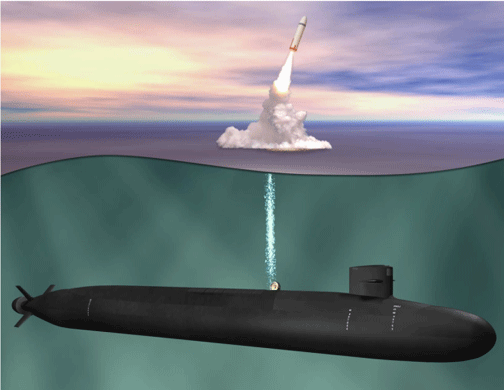
US nuclear attack submarines and navy warships should be based in Perth in response to China’s growing power projection into the Indo-Pacific, a new US report warns.
The report says Australia and its allies must “spotlight and push back” against China’s stepped-up efforts to project power and build military infrastructure in the region.
……..The report also comes a week after it was revealed that three Australian warships were challenged by the Chinese military as they travelled through the disputed South China Sea early this month.
Tensions between Australia and China have risen sharply, with China’s ambassador to Australia warning last week that the relationship between the two countries had been marred by “systematic, irresponsible and negative remarks” about China.
Beijing has not hosted a senior Australian minister for several months and was highly critical of Malcolm Turnbull’s new security laws announced last year to protect Australia from foreign interference.
Former prime minister Kevin Rudd this week further accused the current Prime Minister of undermining Australia’s relationship with China, saying Mr Turnbull’s public remarks about our largest trading partner were tantamount to “punching the Chinese in the face”……..
the CSIS calls for a range of measures, including a rotational presence of US warships at HMAS Stirling in Perth.
It also calls on the Turnbull government to “consider the possibility of investing in the nuclear support infrastructure necessary for the basing of (US) attack submarines as well”.
These military options have been considered by the Turnbull and Abbott Coalition governments and by the Gillard and Rudd Labor governments but they have never been acted upon.
New study reveals catastrophic death toll from a nuclear attack
WHAT would happen if a nuclear bomb went off in your backyard? A chilling new study estimates the death toll from an attack on Australia.Tom Livingstone, news.com.au, APRIL 15, 2018
“……Scientists from Virginia Polytechnic Institute and State University have created simulations of a potential outcome if an attack did occur, and found the best course of action for people was to take shelter first and then take steps to escape afterwards.
Those who tried to seek out family members and “aid and assist” others were more likely to die.
In the study, it showed some people would look out for family, while others wold panic and run blindly away.
When humans carried out “shelter-seeking, evacuation, healthcare-seeking, and worry combined,” they were more likely to survive.
The simulation, which was first revealed by Science Magazine, shows that venturing away from a safe place leaves civilians subjected to a higher dose of radiation, which would likely prove fatal.
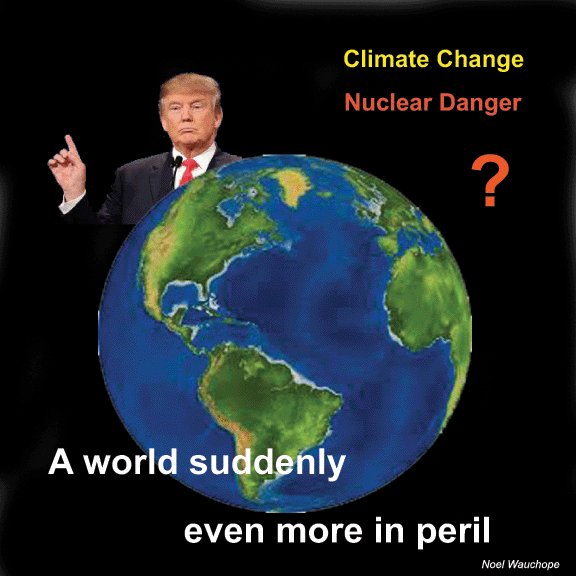
With President Trump’s consistent tweets threatening action against Russia and North Korea in a game of who has the bigger artillery, a dystopian future seems more and more possible.
Last month researchers created an interactive map that revealed the terrifying scope of a nuclear blast for any given area.
The map shows the extent of the fireball, radiation, shockwave, and heat spawned by different weapons, from the 15 KT ‘Little Boy’ dropped on Hiroshima to the largest weapon in the USSR’s arsenal, the 50,000 KT Tsar Bomba.
For example, if North Korea dropped the Hwasong-14, a 150 KT yield nuclear weapon on Sydney’s CBD, there would be more than 77,000 fatalities and 156,000 injured. The radiation from the blast would exceed 12 square kilometres and go further depending on wind patterns.
If Vladimir Putin dropped a 50,000 KT Tsar Bomba (Reportedly the biggest in his arsenal) on Sydney, there would be 1,513,303 fatalities, 1,111,725 injuries and radiation exceeding 80 square kilometres.
If the Aussies pissed off the US and Trump attacked us, it would most likely be with the 300KT W-87, which would kill an estimated 114,374 Sydneysiders, injure more than 227,000 and cause radiation exceeding 15 square kilometres on initial impact.
While scary to think about, it’s an important thing to get your head around in Trump’s 2018. Without coming off as alarmist we should understand the exact magnitude of a nuclear blast and how damaging it can potentially be.
The boycott comes in advance of a meeting next Monday in Geneva, Switzerland, of 123 member nations of the United Nations discussing the challenges posed by lethal autonomous weapons. Twenty-two of those nations have already called for an outright and pre-emptive ban on such weapons.
The open letter announcing the boycott against the South Korean university said autonomous weapons are the “third revolution in warfare” and warned about letting the genie out of the bottle.
“At a time when the United Nations is discussing how to contain the threat posed to international security by autonomous weapons, it is regrettable that a prestigious institution like KAIST looks to accelerate the arms race to develop such weapons,” the letter said.
“We therefore publicly declare that we will boycott all collaborations with any part of KAIST until such time as the President of KAIST provides assurances, which we have sought but not received, that the Center will not develop autonomous weapons lacking meaningful human control,” the researchers said.
“If developed, autonomous weapons will be the third revolution in warfare. They will permit war to be fought faster and at a scale greater than ever before. They have the potential to be weapons of terror. Despots and terrorists could use them against innocent populations, removing any ethical restraints. This Pandora’s box will be hard to close if it is opened.”
Professor Walsh organised the boycott which involves researchers from 30 countries and includes three of the world’s top deep learning experts, Professor Stuart Russell from the University of California, Berkeley, who authored the leading textbook on AI and roboticist Prof Wolfram Burgard, winner of the Gottfried Wilhelm Leibniz Prize, the most prestigious research prize in Germany.
“Back in 2015, we warned of an arms race in autonomous weapons,” Professor Walsh said in a statement alongside the letter. “We can see prototypes of autonomous weapons under development today by many nations including the US, China, Russia and the UK. We are locked into an arms race that no one wants to happen.
“KAIST’s actions will only accelerate this arms race. We cannot tolerate this.”
Professor Walsh has long campaigned against the development of autonomous weapons.
He has previously travelled to speak in front of the United Nations in an effort to have the international body prevent the proliferation of so-called killer robots with the ability to think for themselves.
He believes it’s no longer a question of whether military weapons are imbued with some level of autonomy, it’s just a matter of how much autonomy — which poses a number of worrying scenarios, particularly if they fall into the wrong hands.
“They get in the hands of the wrong people and they can be turned against us. They can be used by terrorist organisations,” he warned.
“It would be a terrifying future if we allow ourselves to go down this road.
Neighbours’ fury as man builds bunker for nuclear war, news.com.au, By Luke Mortimer • A Current Affair Producer Mar 20, 2018 He’s a former Yugoslavian who spent years guarding plutonium stockpiles and he refuses to be a sitting duck the day they may go off, preparing for all out nuclear war.
Jakov Loncarevic migrated to Australia in 1979 but in 1996 he fled Melbourne for Minyip, a tiny town 337 kilometres west. He purchased a block of land that he’s spent the past two decades making “nuclear proof” with a four-metre deep bunker in which he plans to wait out a nuclear winter.
Mr Loncarevic took A Current Affair reporter Martin King down into the bunker in which he claims he built by digging out 40,000 buckets of soil and constructing with 2500 bags of concrete, 40 tonnes of recycled steel and 20 tonnes of wood.
“(It’s my) emergency survival place,” he told King.“In case of unforeseen events … I will survive.“When the conditions become unbearable at floor level … I’m down here.
Mr Loncarevic says he has the supplies to wait out two years once a nuclear winter sets in, with a staggering 900 kilograms of sugar stored in industrial fridges, 200 kilograms of rice and dried beans, 6000 litres of water, 40 kilograms of washing detergent, 200 pairs of socks, 200 pairs of under wear, 100 t-shirts, and 120 kilograms of honey.
But despite being prepared for nuclear war, Mr Loncarevic is losing the war with his neighbours after council issued him with an order to stop building.
Neigbours fed up with living next door to the military-compound-style structure have told King of their embarrassment living next to it.
Mother Bec, a nurse who works in the nearby regional centre of Horsham, said her property’s value is in decline as no-one would want to buy in next to Mr Loncarevic’s house.
Her parents-in-law, Joe and Rae, lifelong Minyip residents who live another two doors up, told A Current Affair of how the house had transformed from a “lovely, little” weatherboard home owned by an elderly lady into a Soviet-style military compound. And Mr Loncarevic is losing popularity with his neighbours by the day.………..https://www.9news.com.au/national/2018/03/20/19/05/neighbours-fury-as-man-builds-bunker-for-nuclear-war
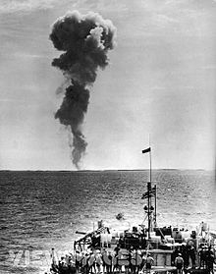
When Ray Whitby and a handful of Australian Navy colleagues stepped onto an island off the WA coast after Britain had just wrapped-up its nuclear weapons testing, they had no idea their lives would be changed forever.
“We were in shorts, sandals and short-sleeved shirts,” Mr Whitby said.
A scientist who was with them that day on the Montebello Islands off the Pilbara coast — and who was decked-out in full protective clothing — delivered a grim message.
“He told us ‘you guys shouldn’t be here, this is deadly’,” Mr Whitby said.
Later investigations found the weapons tested on those islands — believed to be around four times more powerful than those dropped on Hiroshima and Nagasaki in World War II — had left behind a level of radiation that was “definitely unacceptable to personnel”.
When Mr Whitby and his colleagues returned to their ship they attempted to decontaminate themselves, but were later told the water they used to do this, also contained high radiation levels.
So too, did the kitchen items they were using to prepare meals.
There’s no excuse whatsoever’
Mr Whitby said the effect was devastating, with many of his fellow servicemen on that HMAS Fremantle mission dying as early as their 30s, or suffering lasting health issues.
He has fought cancer and saw his wife miscarry five times.
“We were used as live guinea pigs,” Mr Whitby said.
“There’s no excuse whatsoever, we all joined the service to help our country and do our part.”
Many in similar circumstances to Mr Whitby had a big win last year, when the Federal Government announced a $133 million program to give nuclear veterans access to the gold card, which provides veterans with lifelong no-gap medical insurance.
But this would only apply to veterans exposed to radiation between October 3, 1952 and June 19, 1958.
Mr Whitby and his colleagues were exposed 85 days after the cut-off date.
One of those colleagues, ex-serviceman Jim Marlow, describes the situation as infuriating.
“Why it differentiates between one and the other I have no idea,” he said.
“We are not recognised, we simply get ignored.”
A small cost for a big benefit: veterans
Mr Marlow, Mr Whitby and others have spent years campaigning for access to the gold card, believing it to be a fair request given the challenges they have faced in their later lives.
“I paid hundreds of thousands of dollars out over the years on cancers and various medical situations that I had,” Mr Whitby said.
“It has been dreadful.”
The exact number of people in the same situation is unknown, but the Australian Ex-Services Atomic Survivors Association believes it to be relatively small and one that would not require a big financial outlay from the Federal Government.
Veterans affairs benefits are a federal issue, but the State Government has vowed to lobby the Commonwealth to extend medical benefits to Mr Whitby and others in the same circumstance.
Mr Whitby’s son, Reece, is a first-term Labor MP in WA and used his platform in State Parliament to urge the Commonwealth to act.
“If we can’t treat veterans from the 50s fairly, how can current members of our armed services have confidence they will be treated fairly in years to come?” Reece Whitby said.
A spokeswoman for Federal Veterans Affairs Minister Darren Chester said the eligibility dates were determined on the basis of scientific evidence.
Jim Green shared a link. Nuclear Fuel Cycle Watch South , 4 Feb 18 AustraliaBen Heard – the paid nuclear lobbyist whose so-called environment group ‘Bright New World’ accepts secret corporate donations – claims that “Peace is furthered when a nation embraces nuclear power, because it makes that nation empirically less likely to embark on a nuclear weapons program. That is the finding of a 2017 study published in the peer-reviewed journal International Security.”
That’s false twice over. Firstly, it isn’t true. Secondly, Heard’s assertion isn’t supported by the International Security journal article, written by Nicholas Miller from Dartmouth College.
Miller’s article downplays the power/weapons connections but much of the information in his article undermines his own argument. In Miller’s own words, “more countries pursued nuclear weapons in the presence of a nuclear energy program than without one”, “the annual probability of starting a weapons program is more than twice as high in countries with nuclear energy programs, if one defines an energy program as having an operating power reactor or one under construction”, and countries that pursued nuclear weapons while they had a nuclear energy program were “marginally more likely” to acquire nuclear weapons (almost twice as likely if North Korea is considered to have had a nuclear energy program while it pursued weapons).
Nuclear power/weapons connections are multifaceted, repeatedly demonstrated, disturbing and dangerous:
• Nuclear power programs were involved in the successful pursuit of weapons in four countries (France, India, Pakistan, South Africa) according to Miller (and India and North Korea could be added to that list) and have provided many other countries with a latent weapons capability.
• Power programs have provided ongoing support for weapons programs to a greater or lesser degree in seven of the nine current weapons states (the exceptions being Israel and North Korea).
• The direct use of power reactors to produce plutonium for weapons in all or all-but-one of the declared weapons states (and possibly other countries, e.g. India and Pakistan).
• The use of power reactors to produce tritium for weapons in the US (and possibly other countries, e.g. India).
• Power programs (or real or feigned interest in nuclear power) legitimising enrichment and reprocessing programs that have fed proliferation.
• Power programs (or real or feigned interest in nuclear power) legitimising research (reactor) programs which can lead (and have led) to weapons proliferation.
• And last but not least, the training of experts for nuclear power programs whose expertise can be (and has been) used in weapons programs.
So why does Heard claim that “when a nation embraces nuclear power, because it makes that nation empirically less likely to embark on a nuclear weapons program”? He ignores most of Miller’s article (and Miller himself ignores much that is known about power/weapons connections) and focuses on these findings:
1. The annual probability of starting a weapons program is more than twice as high in countries with an operating power reactor or one under construction (a statistically-significant finding).
2. The annual probability of starting a weapons program is somewhat lower in countries with operating power reactors compared to countries without them (a statistically non-significant finding).
So why does Heard privilege the second of those findings when only the first is statistically significant? Why does Heard privilege the finding that excludes countries with power reactors under construction (but not in operation) when the inclusion of such countries provides a fuller, more accurate assessment of the power/weapons connections? Perhaps Heard’s selectivity is connected to his work as a paid nuclear lobbyist whose so-called environment group accepts secret corporate donations. https://www.facebook.com/groups/1021186047913052/
Connections between civil and military nuclear programs Detailed 2015 paper: The myth of the peaceful atom – debunking the misinformation peddled by the nuclear industry and its supporters Nuclear power and weapons – explaining the connections 2017 – nuclear industry body and lobbyists acknowl…
Nuclear weapon testing killed and blinded Aussies in our own backyard But Australia isn’t among the 122 countries that banned them. now to love, FEB 28, 2018 BY KATE WAGNER
When we hear about nuclear weapons, we think of the notorious and devastating Hiroshima and Nagasaki bombings, but what about Australia? For years, Indigenous communities in South Australia endured extreme nuclear weapon testing at the hands of the British government. It resulted in devastating, long-lasting health effects, if not death. But unlike the bombings in Japan, Australia’s history of atomic testing is rarely discussed.
The British and Australian governments said they chose barren, largely unpopulated areas to conduct the testing. But people were living there and, in the fallout, some suffered immediate health problems like rashes and skin infections while others were hit with autoimmune diseases later in life.
From 1947 until 1996, the Pacific underwent315 nuclear testsand it was Indigenous people who felt the brunt of the fallout.
In Australia specifically, the UK carried out 12 major nuclear tests, even dropping a 15-kilotonned atomic device in Maralinga – a weapon with the same explosive strength as the infamous Little Boy dropped on Hiroshima, although a completely different design.
Hundreds of nuclear tests were conducted in Australia
They also carried out a few hundred smaller scale tests at Emu Field and Maralinga in South Australia throughout the ’50s and ’60s. Although the testing was shrouded in secrecy for decades, through oral history the Yankunytjatjara, Anangu and Pitjantjatjara people remembered the day the ground shook and the suffocating black mist rolled in.
The devastating effects of nuclear testing in South Australia is something prominent anti-nuclear activist Karina Lester knows all too well. Her father, Yami Lester, was an Aboriginal elder blinded by nuclear fallout when he was a child and he spent his life raising awareness for the dangers of nuclear weapons.
“My dad spoke of that day a lot. People in the community had skin infections, rashes, people were violently vomiting. The nuclear tests would happen in the morning and by the evening, people were already sick,” Karina told Now To Love.
“The older generations really felt the brunt of that fallout, and the younger generation too. Our young that were there at the camp, infants and young children, were really exposed to that radiation fallout as well, so death – people passed on.
“My grandmother would tell her own story about digging the graves for her parents, my great-grandparents, and they are just horrific stories.”
Even 60 years later, the effects of the testing are far from a distant memory for Karina’s family. Her sister, and fellow anti-nuclear campaigner, Rose Lester, suffers from an autoimmune disease she says was caused by the nuclear tests, and the pair’s father Yami saw his life change irreversibly just years later.
“In 1953, they conducted their nuclear testing in Emu Field. By 1957, Dad’s world was in total darkness,” Karina explained.
But it was more than just physical wounds
“Many of my older generations were loaded on a truck and moved far from their traditional lands to Yalata and Ceduna communities, or even as far as Gerard on the River Murray and then up to Port Augusta and Coober Pedy,” Karina told Now To Love.
“They were relocated off their traditional lands, moved from their homes, and it had a devastating impact on their mental health and wellbeing.
“Those lands they tested on, they were lands we traditionally used for hunting and gathering; lands we were spiritually connected to, and that was proven by Royal Commission.”
The physical and emotional pain caused by the testing was only magnified by the Australian government’s refusal to accept any wrongdoing.
“My dad heard an interview with Ernest Titterton [a British nuclear physicist] on ABC Radio saying indigenous people were informed about the testing in advance. He said that Aboriginal people had been cared for and moved away,” Karina remembers.
“Mr Titterton may have gone and spoken to the white pastoralists, but no one ever spoke to the Aboriginal community. They couldn’t, they didn’t speak our language.
“It was after that interview Dad decided he had to do something – to hold someone responsible. He talked to our people and they decided it was finally time our story was shared.”
Claudio PompiliNuclear Fuel Cycle Watch South Australia, 14 Feb 18,
By Andrew Farra, a former diplomat, trade adviser, and international lawyer…
The most articulate and informed assessment of the machinations by and aspirations of Australia’s military-industrial machine to align our foreign ‘defence’ policy with that of the US and, insidiously, surreptitiously create an environment for the potential acquisition of tactical nuclear weapons, either in our own right or by proxy. The new proposed ‘state secrets’ legislation by the LNP government is a necessary step in this direction.
This explains the persistent campaigns in Australia over recent decades to develop nuclear power generation programs that are acknowledged, critical enablers of military nuclear programs. The nuclear aspirations of the Menzies LNP governments of the 50s to own ‘the bomb’ are alive and well in Canberra.
The recent purchase of French-design nuclear submarines converted to diesel-powered drives is an obvious contender for such initiatives. Inexorably, the pro-nuclear cheer squad and its strategists, both in military-intelligence, such as the Australia Strategic Policy Institute, or in civil society, such as Ben Heard’s ‘nuclear will save the environment’ astro-turfing initiatives, will be clamouring to have the ‘real deal’ nuclear-powered subs.
SA’s NFCRC, led by former Rear Admiral Kevin Scarce, was an active promoter of nuclear military weaponry. His NFCRC demurred on outright recommending nuclear power generation, for now, but instead pushed for the world’s first international high-level nuclear waste dump in SA, based on a single, spurious economic cost-benefit analysis coupled with an illegal, publicly-funded propaganda juggernaut stemming directly from Premier Jay Weatherill’s department. This push was supported by powerful sectors of the Adelaide business establishment including Big Miners, such as BHP and Santos, and promoted by Murdoch’s The Adelaide Advertiser tabloid. A temporary reprieve in the nuclear industry campaign was effected by the majority report of the Second Citizen’s Jury that recommended ‘no expansion of the nuclear fuel cycle under any circumstances’.
Premier Weatherill has declared the nuclear dump initiative “dead” but Blind Freddy would add “for now”.
From the back-reaches of the ‘hidden state’ has come this latest batch of suppressive legislation ostensibly to protect our secrets and to counter surreptitious foreign influences. Instead it will …
As a survivor of the 1945 Nagasaki bombing, Terumi Tanaka says he has dedicated the last 70 years to creating a world free of nuclear weapons.
Mr Tanaka, 85, was with the Peace Boat organisation that advocates for nuclear disarmament when they addressed a crowd gathered outside the Australian Government and Japanese Consulate-General offices in Sydney on Monday. They urged the two countries to sign the UN Treaty on the Prohibition of Nuclear Weapons
“I hope that I will still be alive when this treaty comes into effect and all nuclear weapons are erased from the face of this planet,” Mr Tanaka said through a translator.
The speakers also included descendants of the Indigenous community who were affected by nuclear testing in Australia in the 1950s, as part of the organisation’s ‘Making Waves’ tour. The arrival of the Peace Boat in Sydney, and the group’s advocating that follows, aims to inform the public of the severe consequences of the use and testing of nuclear weapons.
Akira Kawasaki, an executive committee member of Peace Boat, told the crowd in Sydney he was sure the Australian and Japanese governments would sign the treaty eventually.
“It’s the end of nuclear weapons, or the end of us,” he said. He described the weapons as “inhuman” and “unacceptable on any ground”.
Karina Lester, whose father was blinded by the Emu Field nuclear tests of 1953 in South Australia, also travelled aboard the Peace Boat. Ms Lester says his community is still suffering from the impact of nuclear testing today – with skin irritations, eye infections, respiratory problems and autoimmune diseases among the effects.
“Do we want nuclear weapons to be killing us or do we want to get rid of nuclear weapons?” she said.
Peace Boat is a non-governmental and not-for-profit organisation based in Japan, where it has been working to promote peace, sustainable development and human rights since 1983.
Professor Tilman Ruff, a founding member of the International Campaign to Abolish Nuclear Weapons (ICAN) said the treaty recognises the “disproportionate impact of nuclear weapons on Indigenous people” while providing a “categorical, comprehensive prohibition on everything to do with nuclear weapons”.
Broken umbrellas were on display during the rally to symbolise the term ‘nuclear umbrella’. The term is often used to describe countries that don’t have nuclear weapons but depend on the nuclear weapons of another country.
“Potentially, we might be willing for nuclear weapons to be used in our name for our protection,” Professor Ruff told SBS News.
“If you’re threatening to use them you will become a target for other people’s nuclear weapons.”
Fifty states have signed the Treaty on the Prohibition of Nuclear Weapons.
The Making Waves tour started in Fremantle before making stops in Adelaide, Melbourne, Hobart, and now Sydney.
Secret men’s business of the arms industry needs exposure The Age, Stephanie Dowrick, 5 Feb 18, “…….. I woke to the news that the federal government had decided to unveil a new “defence export strategy” to propel Australia into the big league of global weapons exporters.
Then, in the wake of that news – which has left many speechless, even despairing – comes a newer announcement of a $3.8bn boost to the Export Finance and Insurance Corporation. This is a taxpayer-funded “national interest” loan facility that previously supported the exporting of wine and other relatively harmless products but is now set, with a massive boost to its funds, to finance loans to some of the world’s largest arms manufacturers. What’s more, those loans do not need to pass any test of “social risk evaluation” – a nod to caring for others – but can be approved at the discretion of Trade Minister Steve Ciobo.
Oddly enough, on the Blue Mountains drive my friend and I had discussed the weapons industries and the influence they have on the global economy. Their power to affect, even to drive governments’ policies, is immense. It is also profoundly undemocratic. Governments keep a tight grip on media revelations. The weapons world is “secret men’s business” from which the public is definitely shut out. My best sleuthing efforts came nowhere near discovering what this industry is really worth or who profits most.
What we can know is that these industries – and the governments that applaud them – depend on actual and perceived enemies, a fairly hysterical narrative of “terror” and a disturbing acceptance of the inevitability of armed conflict and war. We can also know that the No.1 exporter of major arms is the USA, followed by Russia. It was easy, too, to discover that between 2001 and 2014, reported global military expenditure rose from US$1.14 trillion to US$1.711 trillion. In a world ruled by greed and highly vulnerable to corruption, what chance does peace have?
“This strategy is about job creation,” Prime Minister Malcolm Turnbull assures us. His colleague Christopher Pyne, the Minister for Defence Industry in a cabinet lacking a minister for science, is already presiding over a submarine project set to cost us $50 billion. Pyne is promising “tens of thousands” of jobs could be involved in this weapons’ push. But the issue here is surely far less about job creation than it is about which industries the government, on our behalf, wishes to support. These opinions, these ideological choices determine where we are heading as a nation. This is where a government has huge power. It’s also where it most accurately reveals itself. ……
If “job creation” truly is our government’s motive, then let them choose honestly. The weapons industries lack accountability, transparency, moral and social value. They thrive in the presence or expectation of deadly conflict. Their cost to the world’s physical and social environments is incalculable.
There are many sectors in Australia and globally that produce jobs and social benefits. With generous investment, they could produce more. In land and agricultural regeneration alone, as well as high-tech research and manufacturing, in renewable energy, the arts, community development, health and education, defence-sized investment would undoubtedly pay employment dividends – while simultaneously boosting our social and moral wellbeing. These are choices that have profound consequences. They could make the world safer. Or not. Reverend Dr Stephanie Dowrick is a writer and social commentator www.stephaniedowrick.com www.facebook.com/StephanieDowrickhttp://www.theage.com.au/comment/secret-mens-business-of-the-arms-industry-needs-exposure-20180202-h0spx3.html
Japan’s Peace Boat has sailed into Sydney Harbour carrying survivors of the Hiroshima and Nagasaki bombings as well as descendants of Aboriginal survivors of the 1950s Maralinga nuclear testing, to advocate for nuclear disarmament.
The 11-storey vessel is visiting Sydney as part of its ‘Making Waves’ tour, which is exploring the devastating humanitarian consequences of the use and testing of nuclear weapons.
Survivors from the 2011 Fukushima nuclear disaster were also onboard.
“The world is closer to nuclear war today than it has been in decades,” Greenpeace Australia Pacific Campaigner Alix Foster Vander Elst said in a statement .
The Peace Boat, welcomed by the Maritime Union of Australia and Uranium Free NSW, entered the harbour at 7am on Monday.
Later in the day, a rally will be held outside official government offices, urging the Australian and Japanese governments to sign the UN Treaty on the Prohibition of Nuclear Weapons.
The Japanese survivors and Indigenous survivors of the 1950s British nuclear weapons testing at Maralinga in South Australia will address the midday rally at the Australian Government offices and the Japanese Consulate-General.







 Antinuclear