Dan Monceaux Nuclear Fuel Cycle Watch South Australia, 8 September 2017.
Naval defence interests (including ADF, ASC, DCNS, Thales) in the Port Adelaide area are expanding their presences as Australia’s Future Submarine Program advances. DCNS was awarded the contract in April 2016. The Shortfin Barracuda Block 1A was the chosen design.
The French fleet of Barracuda class submarines is being fitted with nuclear propulsion, provided by Areva. The Australian build is expected to use diesel propulsion, but the prospect of a hybrid (some diesel propelled, some nuclear) has been speculated upon.https://www.facebook.com/groups/1021186047913052/
Australia has uranium export agreements in place with all of the five ‘declared’ nuclear weapons states – the US, Russia, China, France and the UK – although none of these countries take seriously their obligations under the Nuclear Non-Proliferation-Treaty to pursue nuclear disarmament.
IAEA safeguards inspections in the declared weapons states are voluntary and, in general, tokenistic.
Australia, along with the weapons states, boycotted recent negotiations on a Treaty on the Prohibition of Nuclear Weapons, adopted by the United Nations in early July.
Australia has fallen into the trap of bending over backwards to support its allies on an international scale, and subordinating non-proliferation objectives to the commercial interests of the (mostly foreign-owned) uranium companies operating in Australia.
Australia’s contribution to nuclear proliferation risks,Bridget Mitchell and Jim Green, 6 Sept 2017, Online Opinion www.onlineopinion.com.au/view.asp?article=19268&page=0 Once again, the world finds itself in a dangerous place as one mad-man explodes increasingly powerful nuclear weapons and another mad-man threatens North Korea with “fire, fury and frankly power the likes of which this world has never seen before.”
There appears to be no solution to the North Korean problem. Diplomacy, threats and sanctions have not been effective. Military intervention would likely result in the slaughter of hundreds of thousands of people on both sides of the 38th parallel ‒ with or without the use of nuclear weapons.
Australia isn’t to blame for the dangerous and escalating situation in North Korea but it’s worth reflecting on how we ‒ or more to the point, how successive governments ‒ have made the world a more dangerous place.
According to the World Nuclear Association, from the 1950s until the 1970s, Australia’s uranium was “primarily intended for US and UK weapons programs”. Although we no longer supply uranium for weapons production, Australia does contribute to proliferation risks. Continue reading →
The good news for Australians and the world at large is that North Korea has no intention of using its nuclear arsenal.
North Korea has a very limited nuclear arsenal, and does not view Australia as a particularly worthy adversary. If they can reach Melbourne or Sydney, they could also reach the mainland United States, which would prove a more tempting target.
So even if Kim Jong-un were to push the button, it’s very unlikely the missiles will be aimed at Australia.
A 100 kiloton bomb was detonated under a mountain in North Korea over the weekend, and it would be capable of an extraordinary amount of damage if it targeted an urban area.
US academic Alex Wellerstein created a piece of software that estimates the scale of a nuclear attack on various locations.
At present only Darwin is potentially within the range of North Korea’s missiles. The regime also has not developed the technology to put a nuclear warhead on such a missile, so these estimations are at present, hypothetical.
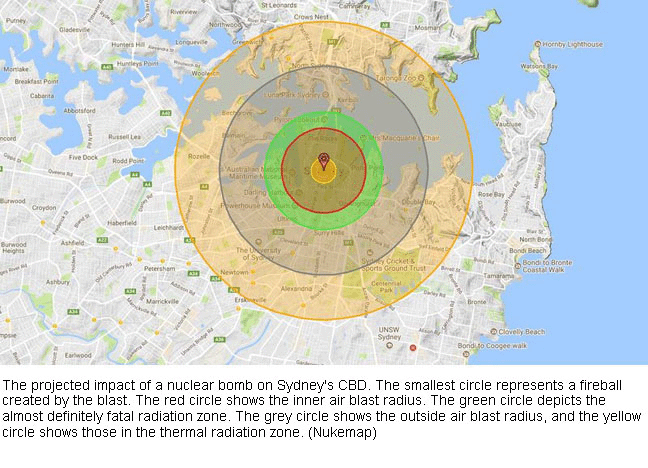
The bomb tested by North Korea on Sunday would kill an estimated 126,000 people straight away if dropped in the heart of Sydney.
If the bomb landed in Pitt Street Mall, it would create a fireball wide enough to destroy state parliament, St Mary’s Cathedral, Wynyard Station and Town Hall.
The air blast radius would flatten just about every building in the CBD, stretching from Circular Quay to Elizabeth Bay.
A slower death from radiation poisoning would affect up to 90 percent of people in the wider blast radius stretching from Kirribilli to Balmain to the University of Sydney.
Victims from Newtown to Taronga Zoo would suffer third-degree burns as part of the thermal radiation radius.
But survival outside the blast zone is reliant on the strength and direction of the wind. Continue reading →
Dan Monceaux Nuclear Fuel Cycle Watch South Australia 3 September 2017.
General Atomics popped up in the news yesterday, but their name wasn’t mentioned in the news report I saw. Apparently, Australia’s defence forces are interested in acquiring Reaper drones with lethal capabilities.
General Atomics already has a presence in South Australia through their ownership of two uranium mining projects. Their subsidiary companies are Quasar Resources and Heathgate Resources- both operate in-situ leach operations in the Frome Basin area: at Four Mile and Beverley https://www.facebook.com/groups/1021186047913052/
The North Korean TV newsreader announced with a flourish this was the state’s first hydrogen bomb.If that now means Pyongyang has the weapon and the delivery system that could wipe out a Los Angeles, a San Francisco or a Sydney in a flash, then the world is now a different place.
Nuclear weapons are supposed to be a deterrent — make yourself so dangerous no-one will ever dare challenge you — and it is a fact that barring some Scuds aimed at Israel during the 1991 Gulf War and some border skirmishes between China and Vietnam and India and Pakistan, no nuclear-armed state has ever faced a serious attack by another country.
Clearly the thinking for three generations of Kim is that the regime is made safe if everyone fears you. And the clear impression you are crazy helps too — no-one wants to aggravate a disturbed mind.
Appeasement was not working, he said, and the rogue nation has become a “great threat and embarrassment” to China. He later tweeted the US was considering “stopping trade with any country doing business with North Korea”.
That would include both China and Russia. While both signed on to the latest UN sanctions, cutting trade altogether would be a far more serious step.
Beijing would have to cut off oil supplies and Moscow send back the North Korean labourers who “volunteer” to work in Siberian forestry camps in what have been described as slave-like conditions.
The whole region and beyond is in a fix. China especially is feeling the squeeze from the United States, and even Australia has argued Beijing has not applied full muscle against North Korea to mend its errant ways.
But the Chinese Government has agreed to the latest sanctions and deeply resents the assertion it could stop Kim Jong-un if it really wanted to. There is nothing for the Chinese to gain from a nuclear war on the Korean Peninsula.
Not only would there be the risk of nuclear contamination, what really worries Beijing is the thought of millions of refugees pouring over the border seeking shelter from a nuclear storm. Not to mention the terrible human and economic cost of shattered neighbours.
The constant refrain from Mr Trump and Malcolm Turnbull for China to do more and do it now could soon become counterproductive. Beijing’s influence on North Korea’s leadership is often overstated.
Its troublesome neighbour has repeatedly embarrassed China by testing bombs or missiles at an inopportune moment. This latest test happened at the opening of a major BRICS (Brazil, Russia, India, China and South Africa) conference held in China and hosted by President Xi Jinping.
Not only was his thunder stolen, he and guest Vladimir Putin were forced to issue a joint statement condemning the test but urging a negotiated solution. Mr Trump underlined that via a tweet, saying: “North Korea is a rogue nation which has become a great threat and embarrassment to China, which is trying to help but with little success.”
For his part, the US leader has wedged himself with rhetoric — it was only a couple of days ago he said the time for talking was over. But what does that leave?
The US military will have its plans ready, just in case. And Mr Trump is the only person with power to order what would be the destruction of North Korea. Is he really contemplating the death of millions, the ruin of cites on both sides of the 38th parallel?
Only if North Korea crosses his red lines. Do they exist in the seas off Guam, Hawaii, or the West coast of the mainland itself?
Surely Mr Kim and his predecessors have not come all this way to self-destruct. After all, these bombs and missiles are supposed to protect, not trigger an end game conflict. No party to this conundrum wants this to happen.
But the scene is set, the main players less than predictable and the talk tough. North Korea will never willingly trade away its newfound military clout, it is seen as vital for survival, but successive US presidents have made it clear they will never live with a nuclear armed and able North Korea.
It is a country that revels in regular threats to wipe out entire US cities. It is no longer trash talk that can be ignored and no-one, it seems, has a plausible answer.
One commentator suggested arming both South Korea and Japan with nuclear weapons to act as a foil to the North. That would mean five countries in the region with the ability to erase entire cities from the planet.
Our once relatively safe and increasingly prosperous neighbourhood is taking a serious turn for the worse. Only two people on the planet can change all that, and neither is showing signs there is a safe way out.
Asked by a reporter if the US would attack North Korea, Mr Trump said: “We’ll see.”
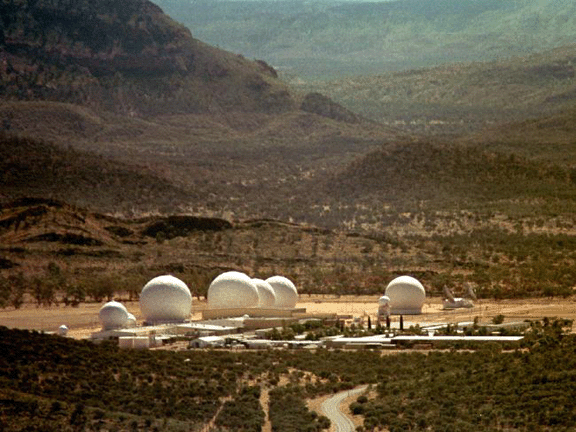
Fear Pine Gap role could lead to Australian war crime prosecutions, 9 News, By Richard Wood Aug 21, 2017 Australians directing US-led drone strikes from the top-secret base Pine Gap base, near Alice Springs, could face war crime prosecution if innocent civilians are killed.
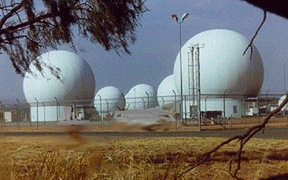
Leaked documents from the US National Security Agency provide a rare insight into the crucial role Pine Gap plays in collecting data from satellites which help guide drone strikes and special forces operations against terrorist targets, The Intercept and the ABC report.
Their findings were based on documents from within the NSA, leaked by former analyst Edward Snowden.
Emily Howie, the director of advocacy and research at the Human Rights Law Centre, told The Intercept the Australian government should provide greater accountability on its role in US drone operations.
“The legal problem that’s created by drone strikes is that there may very well be violations of the laws of armed conflict … and that Australia may be involved in those potential war crimes through the facility at Pine Gap,” Howie told The Intercept and the ABC.
The first thing that we need from the Australian government is for it to come clean about exactly what Australians are doing inside the Pine Gap facility in terms of coordinating with the United States on the targeting using drones.”
The leaked NSA documents reveal the crucial role Pine Gap plays today in the US war on terror.
One document, titled ‘NSA Intelligence Relationship with Australia’, says: “Joint Defence Facility at Pine Gap (RAINFALL) [is] a site which plays a significant role in supporting both intelligence activities and military operations.”
But the harvesting of satellite information for drone strikes and other military operations has sparked concern about Australia’s involvement.
Paul Keating: North Korea could collapse if it gives up nuclear weapons, SMH, James MassolaFergus Hunter, 12 Aug 17 “……..When asked if a missile shield was an option that Australia should pursue to protect the mainland, Mr Keating’s response was blunt.
“I think this is more than debatable. The offending missiles would approach their targets at something like Mach 20, a phenomenal speed. We could never know, until the fatal event, whether a missile defence system would effectively work, or work in respect of each and every missile,” he said.
“A more worldly and competent foreign and defence policy is by far the preferred first line of defence – rather than the default position of relying on expensive but problematic hardware.”
Mr Turnbull also disagreed with Mr Abbott and Mr Rudd – who have both told Fairfax Media in the last four weeks that Australia should pursue missile defence – on the need for such a shield.
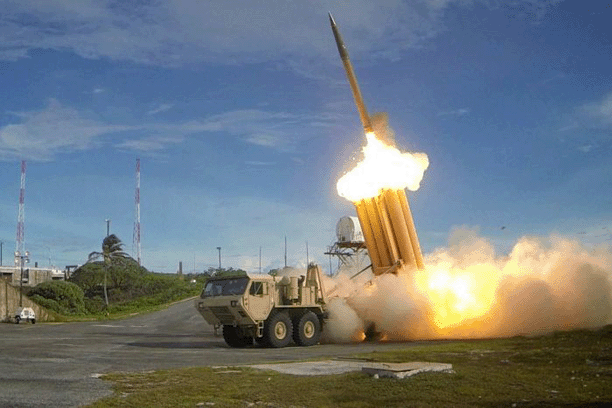
He said on Friday the current advice from Defence was that the terminal high altitude area defence [THAAD] system “is designed to provide protection for relatively small areas against short to intermediate range missiles”……..
Greens leader Richard Di Natale said “the last thing we need here is a Prime Minister backing an unhinged and paranoid leader into a conflict that could potentially end life on Earth as we know it”.
He called on Mr Turnbull to tell the President to “back off”.
Pine Gap hardwires Australia into a Korean war https://www.echo.net.au/2017/08/pine-gap-hardwires-australia-korean-war/ Whether we like it or not, Australia would be dragged into a conflict on the Korean Peninsula because of the critical role of Pine Gap in US military operations against North Korea.
Given the geography of Korea and the decades of military preparations of both sides, we could become a participant in a war likely to result in the deaths of hundreds of thousands of Koreans, with a high likelihood of uncontrollable escalation to involve regional conflict.
Informed commentators recognize that there is no military solution to this conflict, and talking is the only option to avoid unimaginable horror.
Difficult though it is to negotiate with North Korea, there is good reason to believe that its leaders are not bent on suicide. There are indications that negotiations could be possible, but they need to be genuine to have any chance of avoiding war.
The Australian government’s strategic response has for a long time been compliance with whatever constitutes United States policy of the day.
In the hands of President Trump, this places the future of both the Korean Peninsula and Australia in the hands of a deeply delusional narcissist who is incapable of comprehending the consequences of his actions.
The Joint Defence Facility Pine Gap will play a critical role in both conventional and nuclear-armed U.S. attacks on North Korea.
Pine Gap hardwires Australia into US combat operations in Northeast Asia. Pine Gap’s tasking will now be very actively focussed on North Korea.
The logic of nuclear weapons, epitomized by the United States’ nuclear posture, and fully supported by compliant Australian governments, has led to North Korea’s successful path to nuclear weapons state status.
Its goal has clearly been to deter US from attempting regime change, rather than suicidal nuclear aggression.
It is time for Australia to take an independent stance urging the utmost caution on its nuclear-armed ally as well as on North Korea, and actively oppose any action leading to what would be a catastrophic outbreak of war.
But equally, the present crisis makes clear that doctrines of nuclear deterrence – by any country – hold the whole world to ransom, with deterrence failure inevitable in the long run.
It is clear that only the abolition of nuclear weapons will offer any chance of planetary safety.
The Australian government’s craven acceptance of US demands that its allies boycott the treaty to prohibit nuclear weapons adopted at the United Nations indicates that we have no independent foreign policy.
Professor Richard Tanter, senior research associate at the Nautilus Institute and honorary professor in the School of Political and Social Sciences at Melbourne University.
Professor Tanter will address the issue ‘What would an independent Australian foreign policy look like?’ during the upcoming Independent and Peaceful Australia Network National Conference in Melbourne over the weekend of 8-10 September.
Tony Abbott calls for Australia to urgently consider missile defence shield, The Age, Peter Hartcher, 11 Aug 17, Tony Abbott has called for Australia urgently to consider a missile defence shield to protect against attack by nuclear-armed North Korea.
This means that Australia’s two most recent former leaders – one Labor and one Liberal – have now made such a call in the last four weeks. Australia has no defence against intercontinental ballistic missiles. The government has yet to indicate any interest in acquiring one.
After US President Donald Trump this week said he would deal with Pyongyang’s threats with “fire and fury”, North Korea said that “only absolute force can work on him”….
Foreign Affairs Minister Julie Bishop said on Wednesday that a North Korean ICBM capability posed “an unacceptable existential threat to our country” although she said Australia was “not a primary target”.
She said that Australia’s strategy was to deter North Korea through international solidarity and called on “all sides” to step back.
But Kevin Rudd and Tony Abbott separately are urging defensive steps:…..
This week the US Defence Intelligence Agency estimated that North Korea already has a miniaturised nuclear warhead to put atop the missiles, according to US media reports.
Mr Abbott said: “We should upgrade the capability of the air warfare destroyers so they’re not just able to track incoming missiles but shoot them down.”
“And we should look at the sort of system the US is installing in South Korea,” the Terminal High Altitude Area Defence system. Mr Abbott said that the main argument against a missile defence was cost.
“Some would say that it would contribute to an arms race, but it’s a race that others are already running,” he added.
Experts point out that neither system nominated by Mr Abbott is designed for intercepting intercontinental ballistic missiles but for shorter-range missiles.
Will Australia join in the war if Trump’s USA attacks North Korea?
Australia will join the conflict if North Korea attacks the US: Malcolm Turnbull, SMH Fergus Hunter, 11 Aug 17, Prime Minister Malcolm Turnbull has declared Australia would invoke the ANZUS security treaty for only the second time in its history in response to any attack by North Korea against the United States.
Mr Turnbull also pushed back against calls – including from former prime ministers Tony Abbott and Kevin Rudd – for Australia to develop a missile defence shield to protect the mainland from the threat of North Korea’s nuclear weapons and long-range missile program.
The Prime Minister’s commitment to assist the US caps off days of escalating tensions, with US President Donald Trump threatening to unleash “fire and fury” on the rogue state and the North Korean regime warning it would attack the US Pacific territory of Guam.”The United States has no stronger ally than Australia. We have an ANZUS agreement and if there is an attack on Australia or the United States … each of us will come to the other’s aid,” Mr Turnbull told Melbourne radio station 3AW on Friday……
After invoking ANZUS in 2001, Mr Howard said Australia would consult with the US and consider any requests “within the limits of its capability”.
A month later, the government committed Australian troops to the US-led invasion of Afghanistan.
Opponents have criticised the treaty, arguing it unnecessarily places Australia’s security at risk.
Greens leader Richard Di Natale said: “The last thing we need here is a Prime Minister backing an unhinged and paranoid leader into a conflict that could potentially end life on Earth as we know it.”
He accused Mr Turnbull of putting a target on Australia’s back and called on him to tell the US President to “back off”.
“If there was ever a clearer example of why Australia needs to ditch the US alliance and forge an independent, non-aligned foreign policy, this is it. Malcolm Turnbull now needs to pick up the phone, he needs to talk to Donald Trump and urge him to de-eascalate.”
The Japanese city of Hiroshima of around 350,000 people, was the first city to be attacked with a nuclear weapon when a single bomb was dropped by the USA on August 6, 1945 towards the end of World War 2.
The bomb and its firestorm destroyed two-thirds of the city, with an estimated 70,000 ordinary people killed immediately and a similar number over the next five years. These deaths resulted from the immediate explosion, burns, radiation and cancers.
The city was devastated with destruction of most buildings. Photos appear to show a scene from hell with the city burned out, and civilians with horrendous burns and injuries.
Nuclear proliferation has ensued internationally since then, with an estimated 19,000 nuclear weapons now in existence, all much more powerful than the bomb dropped on Hiroshima. The threat of nuclear war was strongly present throughout the Cold War, and is again rising today.
The cost of nuclear weapons is enormous with an estimated $40 billion spent annually by the US alone.
Countries known to possess nuclear weapons are Russia, USA, UK, France, China, India, Pakistan, Israel and North Korea — not necessarily all reliable international citizens whom we would trust to have a finger on the nuclear trigger, particularly in view of recent inquiries confirming that unreliable information led to the recent war in Iraq with ongoing consequences.
Some countries such as Australia without nuclear weapons choose to be under the US “nuclear umbrella”.
Today, the use of nuclear weapons would result in extraordinary numbers of immediate deaths, devastation of medical facilities to care for those injured, and destruction of infrastructure of a city on a much larger scale than seen in Japan.
It is also predicted that the atmospheric debris from a limited regional nuclear war could cause global cooling and prolonged worldwide famine.
The good news is that a new Treaty on the Prohibition of Nuclear Weapons has been adopted by the United Nations in July this year.
This treaty prohibits states from developing, testing, possessing, transferring or deploying nuclear weapons under any circumstances.
This treaty was passed by 122 nation, unfortunately not Australia, as our government decided not to attend these discussions. Unsurprisingly, those countries with nuclear weapons are also non-participants.
Nuclear weapons will now join the list of banned weapons such as chemical and biological weapons and cluster bombs, which seems highly appropriate given that they are designed primarily to indiscriminately cause death to massive numbers of civilians. In a recent poll about 75 per cent of Australians support nuclear disarmament.
Our government believes that the US nuclear umbrella provides protection for Australia.
Australia’s official view is that a “building block approach” is required towards improving global nuclear weapon safety, with the initial step being increased transparency regarding nuclear stockpiles among those possessing them, which seems highly unlikely to happen given the secrecy surrounding military matters.
Somewhat ironically, international nuclear weapon treaties until now have made it legal for those signatories with nuclear weapons to continue to have them, but illegal for non-nuclear countries to manufacture or buy them.
The current international situation with escalating conflict between North Korea and the US and their respective leaders, illustrates what a precarious situation the world is in with the threat of nuclear weapons being used again very real. There is also the possibility of terrorist groups gaining nuclear weapons.
Nuclear weapons are abhorrent to a civilised society. Whilst in existence they are a threat to all.
Their cost is enormous. The existence of nuclear weapons cannot enhance international safety
The only winners in the nuclear arms race are the arms manufacturers. Australia still has an opportunity to participate in this current UN nuclear abolition treaty, and truly make our country — and our planet — safer.Sally Atrill is Tasmanian GP and the Tasmanian convener for the Medical Association for Prevention of War.
Canberra hoped that aiding Britain might be a step toward its own bomb.
Australia took tentative steps to go it alone. This included the Lucas Heights nuclear plant on Sydney’s southern fringe. Still Australia’s only reactor, it began its life researching, among other things, nuclear weapons
“We have the people, the knowledge, the history, the uranium and we still have Lucas Heights.”
Australia’s secret plans to have its own nuclear arsenal, AMERICA. Russia. China. Britain. The world’s most powerful countries all have nuclear arsenals — and few people know Australia was almost one of them,Benedict Brook@BenedictBrook, news.com.au, JULY 11, 2017 “…….A military expert has told news.com.au, that top secret plans were so advanced Australia was considered “top of the pile” of countries expected to acquire its own nuclear arsenal
It was 60 years ago that the last nuclear bomb was detonated in Australia, a British weapon at the Maralinga test site in South Australia.
If you look closely, evidence of Australia’s plans for its own nuke remain. A few hours south of Sydney, at picturesque Jervis Bay, a small road leads into the bush. By a boat ramp is a large car park.
However, this was never designed to be a place for tourists’ vehicles. Rather, it is the unfinished foundations of Australia’s first commercial nuclear power station.
The public were told it would revolutionise the country’s energy needs. The truth was it would enrich uranium for Australia’s atomic bombs.
Associate Professor Wayne Reynolds is a defence and foreign policy expert at the University of Newcastle and author of the book Australia’s Bid for the Atomic Bomb….. “We wanted to have a navy; in WWII we wanted access to heavy bombers; and so we wanted nuclear weapons. We wanted to maintain a strategic leading edge.”
Australia didn’t want to go it alone. During WWII, British and Australian experts had worked alongside their American counterparts on the Manhattan Project to build the world’s first atomic bomb.
The expectation was that the US would share the results with its allies.
“In 1946, the Americans changed that calculation by announcing they would not share any of the technology or weapons,” says Prof Reynolds. “Britain and Australia were cut out from the club”……. Many in the government harboured a desire for a joint “Empire” bomb produced between Australia, Britain, Canada and South Africa.
Despite the UK’s ownership of the bombs it detonated at Maralinga, Canberra hoped aiding Britain might be a step toward its own bomb. Certainly, no one underestimated Australia’s atom ambitions. “German, Italy, the Netherlands — all wanted nuclear weapons but Australia was top of the list because of our uranium resources, our scientists and our enrichment program,” Prof Reynolds says.
Australia took tentative steps to go it alone. This included the Lucas Heights nuclear plant on Sydney’s southern fringe. Still Australia’s only reactor, it began its life researching, among other things, nuclear weapons…..
In the early 1960s, the Menzies Government was discussing with the US the top secret “SEATO plan 4” which could have seen American bombs on Australian soil.
“This were absolutely not known by the public and plan 4 was only declassified thirty years later,” says Prof Reynolds.
…..In 1968, ex-RAAF pilot Gorton became Prime Minister. The nuclear non-proliferation treaty (NPT) was already in the works. However, a big supporter of a homegrown nuclear deterrent, Gorton wanted to Australia to be on the “brink of manufacture” of a weapon, says Prof Reynolds…….
Gough Whitlam formally ended Australia’s atom ambitions by signing onto the NPT and tying the country’s security to the US…….
Prof Reynolds says it is unlikely Australia would seek to host nuclear bombs — its own or others. But history warns you to never say never.
What is more pressing for the Canberra apparatchiks is what a base like Pine Gap does in the context of spats with other powers which Australia shares ties with. The China rise is particularly problematic, given the teeth-gnashing belligerence being shown over maritime disputes.
Even as Chinese nationals purchase Australian real estate, tremors between Washington and Beijing can be felt as the base celebrates its half-century. A happy birthday it would have been, but only for some.
The Pine Gap Anniversary Partyhttps://intpolicydigest.org/2017/07/30/pine-gap-anniversary-party, Blony Kampmark /30 JUL 2017It all happened without much fuss, since fuss was bound to be the enemy. Dignitaries, guests and various partners lined up for a gathering at Alice Springs in Australia’s Northern Territory on Saturday, commemorating the secret base’s half-century.
The Alice Spring News Online described it, not inaccurately, as a “stealth party.” The Convention Centre hosting the dinner was tight lipped throughout the week about the guest list. “Unfortunately the details of this weekend’s event are not available for public release.” Not for residents in Alice Springs; not for the electors, or even the politicians. This would be an imperial, vetted affair.
A sense about how the base functions in a defiant limbo, one resistant to Australian sovereignty, can be gathered in various ways. The local federal member, Chansey Paech, whose constituency hosts the base, was not invited. Senator Nigel Scullion’s query about the exclusion of media from the event was rebuffed by the Defence department, with the Defence Minister keen to hold the line against her own colleague.
The Institute for Aboriginal Development (IAD), charged with supplying the indigenous “welcome to country” gathering at such bashes, seemed less than pleased to supply details. When the intrepid Alice Springs News Online dared ask, the CEO Kerry Le Rossignol responded with a dismissive “No comment.”
On July 25, a Defence spokesperson insisted that, “The Joint Defence Facility Pine Gap is proud to commemorate its 50th anniversary. However, celebrations are restricted to site personnel and invited guests only.” Power without perusal; might, without scrutiny. Continue reading →
At a time when recent US administrations have become more proactive about the need for solidarity within US Global Alliance Systems, there is a pressing need for elected leaders of both government and opposition parties to be more concerned about protection of our national sovereignty.
The Conference of The Independent and Peaceful Australia Network (IPAN) in Melbourne between 8-10 September 2017 will provide peace activists with a chance to interact with an array of local and overseas speakers
There is a problem for our national sovereignty if Australia’s official voice on the terrifying issue of nuclear proliferation is not being expressed to support the representatives of Ireland, Austria, South Africa, Brazil and Mexico as co-sponsors of the Draft Treaty on new Treaty on the Prohibition of Nuclear Weapons.
Support for the UN Draft Treaty on the Prohibition of Nuclear Weapons, or more comprehensive US nuclear weapons umbrellas?July 28, 2017, by: The AIM Network By Denis Bright
Where are the cheers across Australia for the new Draft Treaty on the Prohibition of Nuclear Weapons as finalized by the recent UN Conference on 7th July 2017?
In the past, Australia developed a bipartisan balance between continued membership of the Australia-US Alliance, support for the Charter of the United Nations and commitment to its own national sovereignty.Article 1 of the ANZUS Treaty of 1951 indeed rejected the need for sabre-rattling in the settlement of international disputes.
Barry McGuire – Eve Of Destruction
New Zealand officially left the Alliance in 1986 after continued participation compromised its national sovereignty (Office of the Historian, Bureau of Public Affairs, US Department of State Online).
In 1984, the ANZUS Treaty began to unravel when New Zealand declared its country a nuclear-free zone and refused to allow U.S. nuclear-powered submarines to visit its ports. Two years later, U.S. Secretary of State George P. Shultz and Australian Foreign Minister Bill Hayden concluded a series of bilateral talks by confirming that their countries would continue to honor their obligations to one another under the ANZUS Treaty, in spite of the fact that the trilateral aspects of the Treaty had been halted. On September 17, 1986, the United States suspended its treaty obligations toward New Zealand.
In Australia, the pendulum has swung in the opposite direction towards greater solidarity with the US Alliance and away from a diversity of foreign policies which required the US to adjust to policy diversity over issues like the Suez Crisis of 1956, the Cuban Missile Crisis of 1962, the War in Vietnam and even the presence of nuclear powered ships carrying nuclear weapons into New Zealand during the 1980s. Continue reading →
Why it’s time to fear North Korea, The Australian July 26, 2017, CAMERON STEWART North Korea will be able to reliably launch a nuclear-armed long range missile at Australia and the United States as early as next year, according to a stunning new assessment by the Pentagon.
The prediction brings forward by around two years previous US intelligence assessments of the progress of North Korea’s nuclear and missile programs.
It follows an analysis of recent missile tests by the hermit kingdom which found that scientists in Pyongyang have advanced their technology on the country’s missile testing program faster and more efficiently that was predicted by the west.
Senior US officials have told the Washington Post that the Pentagon’s Defense Intelligence Agency has concluded that North Korea’s leader Kim Jong-un will be able to make a ‘reliable, nuclear-capable Intercontinental Ballistic Missile’ sometime in 2018.
In July 4, Mr Kim launched his country’s first missile with the range to strike the US state of Alaska and northern Australia.






 Antinuclear