As a survivor of the 1945 Nagasaki bombing, Terumi Tanaka says he has dedicated the last 70 years to creating a world free of nuclear weapons.
Mr Tanaka, 85, was with the Peace Boat organisation that advocates for nuclear disarmament when they addressed a crowd gathered outside the Australian Government and Japanese Consulate-General offices in Sydney on Monday. They urged the two countries to sign the UN Treaty on the Prohibition of Nuclear Weapons
“I hope that I will still be alive when this treaty comes into effect and all nuclear weapons are erased from the face of this planet,” Mr Tanaka said through a translator.
The speakers also included descendants of the Indigenous community who were affected by nuclear testing in Australia in the 1950s, as part of the organisation’s ‘Making Waves’ tour. The arrival of the Peace Boat in Sydney, and the group’s advocating that follows, aims to inform the public of the severe consequences of the use and testing of nuclear weapons.
Akira Kawasaki, an executive committee member of Peace Boat, told the crowd in Sydney he was sure the Australian and Japanese governments would sign the treaty eventually.
“It’s the end of nuclear weapons, or the end of us,” he said. He described the weapons as “inhuman” and “unacceptable on any ground”.
Karina Lester, whose father was blinded by the Emu Field nuclear tests of 1953 in South Australia, also travelled aboard the Peace Boat. Ms Lester says his community is still suffering from the impact of nuclear testing today – with skin irritations, eye infections, respiratory problems and autoimmune diseases among the effects.
“Do we want nuclear weapons to be killing us or do we want to get rid of nuclear weapons?” she said.
Peace Boat is a non-governmental and not-for-profit organisation based in Japan, where it has been working to promote peace, sustainable development and human rights since 1983.
Professor Tilman Ruff, a founding member of the International Campaign to Abolish Nuclear Weapons (ICAN) said the treaty recognises the “disproportionate impact of nuclear weapons on Indigenous people” while providing a “categorical, comprehensive prohibition on everything to do with nuclear weapons”.
Broken umbrellas were on display during the rally to symbolise the term ‘nuclear umbrella’. The term is often used to describe countries that don’t have nuclear weapons but depend on the nuclear weapons of another country.
“Potentially, we might be willing for nuclear weapons to be used in our name for our protection,” Professor Ruff told SBS News.
“If you’re threatening to use them you will become a target for other people’s nuclear weapons.”
Fifty states have signed the Treaty on the Prohibition of Nuclear Weapons.
The Making Waves tour started in Fremantle before making stops in Adelaide, Melbourne, Hobart, and now Sydney.
Secret men’s business of the arms industry needs exposure The Age, Stephanie Dowrick, 5 Feb 18, “…….. I woke to the news that the federal government had decided to unveil a new “defence export strategy” to propel Australia into the big league of global weapons exporters.
Then, in the wake of that news – which has left many speechless, even despairing – comes a newer announcement of a $3.8bn boost to the Export Finance and Insurance Corporation. This is a taxpayer-funded “national interest” loan facility that previously supported the exporting of wine and other relatively harmless products but is now set, with a massive boost to its funds, to finance loans to some of the world’s largest arms manufacturers. What’s more, those loans do not need to pass any test of “social risk evaluation” – a nod to caring for others – but can be approved at the discretion of Trade Minister Steve Ciobo.
Oddly enough, on the Blue Mountains drive my friend and I had discussed the weapons industries and the influence they have on the global economy. Their power to affect, even to drive governments’ policies, is immense. It is also profoundly undemocratic. Governments keep a tight grip on media revelations. The weapons world is “secret men’s business” from which the public is definitely shut out. My best sleuthing efforts came nowhere near discovering what this industry is really worth or who profits most.
What we can know is that these industries – and the governments that applaud them – depend on actual and perceived enemies, a fairly hysterical narrative of “terror” and a disturbing acceptance of the inevitability of armed conflict and war. We can also know that the No.1 exporter of major arms is the USA, followed by Russia. It was easy, too, to discover that between 2001 and 2014, reported global military expenditure rose from US$1.14 trillion to US$1.711 trillion. In a world ruled by greed and highly vulnerable to corruption, what chance does peace have?
“This strategy is about job creation,” Prime Minister Malcolm Turnbull assures us. His colleague Christopher Pyne, the Minister for Defence Industry in a cabinet lacking a minister for science, is already presiding over a submarine project set to cost us $50 billion. Pyne is promising “tens of thousands” of jobs could be involved in this weapons’ push. But the issue here is surely far less about job creation than it is about which industries the government, on our behalf, wishes to support. These opinions, these ideological choices determine where we are heading as a nation. This is where a government has huge power. It’s also where it most accurately reveals itself. ……
If “job creation” truly is our government’s motive, then let them choose honestly. The weapons industries lack accountability, transparency, moral and social value. They thrive in the presence or expectation of deadly conflict. Their cost to the world’s physical and social environments is incalculable.
There are many sectors in Australia and globally that produce jobs and social benefits. With generous investment, they could produce more. In land and agricultural regeneration alone, as well as high-tech research and manufacturing, in renewable energy, the arts, community development, health and education, defence-sized investment would undoubtedly pay employment dividends – while simultaneously boosting our social and moral wellbeing. These are choices that have profound consequences. They could make the world safer. Or not. Reverend Dr Stephanie Dowrick is a writer and social commentator www.stephaniedowrick.com www.facebook.com/StephanieDowrickhttp://www.theage.com.au/comment/secret-mens-business-of-the-arms-industry-needs-exposure-20180202-h0spx3.html
Japan’s Peace Boat has sailed into Sydney Harbour carrying survivors of the Hiroshima and Nagasaki bombings as well as descendants of Aboriginal survivors of the 1950s Maralinga nuclear testing, to advocate for nuclear disarmament.
The 11-storey vessel is visiting Sydney as part of its ‘Making Waves’ tour, which is exploring the devastating humanitarian consequences of the use and testing of nuclear weapons.
Survivors from the 2011 Fukushima nuclear disaster were also onboard.
“The world is closer to nuclear war today than it has been in decades,” Greenpeace Australia Pacific Campaigner Alix Foster Vander Elst said in a statement .
The Peace Boat, welcomed by the Maritime Union of Australia and Uranium Free NSW, entered the harbour at 7am on Monday.
Later in the day, a rally will be held outside official government offices, urging the Australian and Japanese governments to sign the UN Treaty on the Prohibition of Nuclear Weapons.
The Japanese survivors and Indigenous survivors of the 1950s British nuclear weapons testing at Maralinga in South Australia will address the midday rally at the Australian Government offices and the Japanese Consulate-General.
What Dibb suggested is that Australia, under the guise of generating nuclear power or on another pretext, acquire the essential technology to produce the fissile material needed to build a nuclear weapon. The hypocrisy involved is staggering. Analysts making such proposals accuse countries like Iran and North Korea of putting such plans into practice, and support a US pre-emptive attack to eliminate the supposed threat.
Dibb is well aware that Australia is a signatory to the Nuclear Non-proliferation Treaty (NPT).
before signing the NPT in 1970 and ratifying it in 1973, the Australian government drew up plans for a commercial nuclear power plant at Jervis Bay, south of Sydney, that would covertly supply the enriched uranium needed to manufacture nuclear weapons. The Jervis Bay project, which was promoted by Prime Minister John Gorton, was mothballed after he was ousted in 1971 by Billy McMahon.
This discussion is tied to a broader push to boost military spending in preparation for war.
In its 2016 defence white paper the government already foreshadowed a multi-billion dollar military expansion, lifting the defence budget to at least 2 percent of gross domestic product and purchasing advanced weapons systems. In a related move, Prime Minister Malcolm Turnbull yesterday announced a vast expansion of military industries in the name of a drive to export arms and become one of the world’s top ten weapons exporters.
None of these steps has anything to do with “defence” or preserving peace.
A discussion has begun over the past month in Australian strategic and military circles about the necessity of building nuclear weapons, or developing the capacity to do so, against the alleged threat posed by nuclear-armed powers, above all China.
The debate, in public at least, is quite cautious, given the widespread popular hostility to war and thus the potential for protests to erupt against any move to create a nuclear arsenal. However, the very fact that the issue is actively being discussed is another sign of rapidly sharpening geo-political tensions and the accelerating arms race by major powers around the world. Continue reading →
In Australia, ICAN began with Felicity Ruby, Dimity Hawkins, Dr. Bill Williams, Dr. Tilman Ruff, and others who launched the global effort with a strong medical and scientific perspective. According to Dr. Kathleen Sullivan, a disarmament educator in the United States, and one of the campaign’s earlier members, “the initial thinking revolved around horror, humor, and hope—to amplify the need for a louder nuclear taboo, to educate the public, reignite the movement fueled more by what we love than what we fear.”
Tim Wright, director of ICAN Australia, was the very first volunteer back in 2006. Tim has advocated for ICAN in the Asia-Pacific region, and around the globe.
Oslo, Norway—From the indigenous communities exposed by remote nuclear tests, to activists living in bustling cities across the globe—a new resistance is growing. Peace Organizations worldwide have joined together to stand up to the nine nuclear-armed states in the form of the International Campaign to Abolish Nuclear Weapons, known commonly as ICAN. While many have hailed them for revitalizing the nuclear-disarmament movement, their greatest achievement to date is their influence on the creation of the Treaty on the Prohibition of Nuclear Weapons. This bold new step in disarmament stands out from previous anti-nuclear movements, because it went after a comprehensive ban. While it won’t as of yet directly eliminate a single nuclear weapon, as none of the current signatories have them, many believe it will significantly alter the nuclear-weapons industry. Continue reading →
Sisters of St Joseph January 2018 , The Sisters of St Joseph of the Sacred Heart, the religious Congregation founded by St Mary MacKillop, challenges the newly released plan of the Federal Government to increase weapons exports.
“Weapons are designed to kill and maim human beings,” said the Congregational Leader, Sister Monica Cavanagh. “We completely reject the philosophy which finds it acceptable to boost industry, create jobs, increase exports and protect local manufacturing via the arms trade.”
“We agree with Pope Francis that those who seek to benefit from trading in weapons are ‘merchants of death’,” she concluded.
Six major issues concern the sisters:
The “mutually assured destruction” of the last forty years cannot guarantee deterrence in the future. Violence is escalating in proportion to the availability and destructive effect of new weapons.
There is enormous difference between a defence manufacturing industry to protect Australia and the development of a weapons export industry.
It is a matter of great concern and sorrow that Australia’s overseas aid has dropped to its lowest level ever, while at the same time plans are underway to increase the sale of weapons.
The government’s assurances about establishing and maintaining “controls” over which nations access Australian weapons lack detail on methods of oversight and on how such controls would be policed.
Australian capacity to deal in arms ethically is not evident in Australian history. Australia continued to provide military hardware and training to Indonesia between 1975 and 1999 during the occupation of East Timor in which up to 182,000 people died violently.
Australia’s considerable design and production expertise would be better used in projects which promote peace among nations and care of earth, particularly in places and electorates where people lack employment opportunities.
The Sisters of St Joseph call on the Australian government to prioritise education, health and good governance initiatives among the deprived peoples and nations of the world, rather than spending billions of Australian people’s dollars on producing and exporting the means of destruction.
“We strongly urge the government to resist the hypocrisy of talking about peace while financing and supporting the arms trade,” Sister Monica reflected. “Over 90% of those who die in war zones are not soldiers, but civilians, including so many of the most defenceless humans – the children. It is reprehensible for government and industry authorities to pursue financial and electoral gain through promoting the weapons which enable the escalation of violence.”
Hawaii’s false alarm: we’re right to question our safety from nuclear annihilation, Brisbane Times, By Smriti Keshari, Hawaiians recently experienced the most unimaginable nightmare, when an accidental alert went out a statewide warning of a “ballistic missile system” heading to the island. It happened at 8.07am on a Saturday.
Distraught residents did their best to find safety, parents drove miles to see their children one last time and some surfers even decided to paddle out for what they imagined was their last wave.
It was a false alarm, caused by human error, when a technician clicked on the wrong prompt on a computer screen.
Yet it served as a global wake-up call, and many around the world have begun to question the reality of whether their own country could be vulnerable to a similar incident.
In Australia, statewide emergency systems regularly use text alerts and landline phone messages to warn about bushfires, floods and other natural disasters. But could residents be woken one day by the threat of a missile headed towards Canberra, Sydney, Melbourne or the Pine Gap military facility near Alice Springs?
With no nuclear weapons of its own and no real nuclear-armed adversaries, the idea of an atomic-bomb attack may seem abstract to most Australians. But no country is safe from the nuclear threat. Defence analysts believe North Korea’s longest-range missiles could reach Australia. And although Australia’s geographic location makes it seem safe, experts say it is vulnerable to the effects of an all-out nuclear war between India and Pakistan.
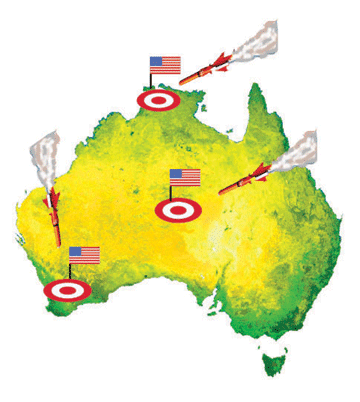
Additionally, as an ally of the United States, relying not only on the protection of America’s nuclear umbrella but also home to a strategic site in the US missile-defense system, Australia could be among the first targets to be hit in a surprise nuclear attack against the US………
Australia to become major defence exporter under $3.8b Turnbull plan, The Age, Adam Gartrell, 29 Jan 18,Australia is set to become one of the world’s top 10 defence exporters under an ambitious $3.8 billion government plan.
The new defence export strategy to be released by Prime Minister Malcolm Turnbull on Monday aims to put Australia on par with major arms-exporting countries like Britain, France and Germany within 10 years.
The government believes the strategy will create new jobs and bolster Australia’s troubled defence manufacturing industry, which struggles to sustain itself based on Australian Defence Force needs alone. A big boost in exports will insulate local manufacturers from the peaks and troughs – sometimes called the “valley of death” – of domestic demand.
“This strategy is about job creation. It will give Australian defence companies the support they need to grow, invest and deliver defence capability. It will make Australian defence exports among the best in the world,” Mr Turnbull said……..
The centrepiece of the strategy will be a new financing facility that will make up to $3.8 billion available to Australian defence companies looking to sell overseas…….
The government will seek to use the exports to cement relationships with key countries in volatile regions like the Middle East. Defence Industry Minister Christopher Pyne has previously nominated Australia’s relationship with the United Arab Emirates as one that could benefit from deeper, export-led economic ties…..
A new Australian Defence Export Office will be established to implement the strategy, and an Australian Defence Export Advocate will be appointed to co-ordinate with the industry, and state and territory governments.
The bomb for Australia? (Part 2) https://www.aspistrategist.org.au/bomb-australia-part-2/, 19 Jan 2018|Ramesh Thakur As we consider whether Australia should obtain nuclear weapons, we need to ask who might subject us to nuclear blackmail. In the authoritative statement of China’s strategic vision in President Xi Jinping’s address to the 19th Communist Party Congress on 18 October last year, the three core elements of China’s vision of the new world order were parity in China–US relations; growing Chinese influence in writing the underlying rules and in designing and controlling the governance institutions of the global order; and more assertive Chinese diplomacy in that new international system.
The world therefore should prepare for a surge in Chinese international policy activism. It seems reasonable to conclude that—regardless of who may be at fault in initiating hostilities—the possibility of a future conflict with China can’t be ruled out. At the same time, Paul Dibb and Richard Brabin-Smith argue in their recent ASPI report, Australia’s management of strategic risk in the new era, that ‘it’s difficult to imagine any other major power … attacking Australia’. And there, for ASPI’s Andrew Davies, lies the rub, because ‘China is a nuclear power’.
But it does not follow that Australia must prepare for Chinese military or political use of nuclear weapons. For eight years or so, China has indulged in bellicose rhetoric and engaged in assertive behaviour against several neighbours, stoking their fears about its motives and intentions with growing capabilities. That said, of the nine leaders with fingers on the nuclear button, whose quality of nuclear decision-making is likely to be more responsible than Xi Jinping’s? Certainly not those who boast about the size of their button.
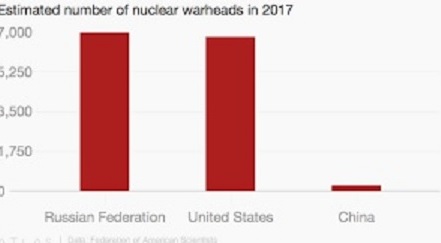
China’s nuclear stockpile is below 300, compared to nearly 7,000 warheads each for Russia and the US. Fan Jishe argues in an APLN policy brief that—notwithstanding its massively growing economy—China has consciously refrained from engaging in a sprint to nuclear parity with Russia and the US because its governing doctrine envisages only one role for nuclear weapons: to prevent nuclear blackmail.
Despite the total transformation in China’s economic fortunes since the 1960s, its nuclear doctrine, acquisitions program, and deployment and employment policies have remained essentially unchanged. It’s the only one of the nine possessor countries to be committed fully to an unequivocal no-first-use policy. Conversely, of the nuclear nine, only the US can be suspected of harbouring designs to shift from mutual vulnerability (the basis of deterrence) to nuclear primacy (which would enable use without fear of nuclear retaliation).
Of course, we can’t simply rely on the word of a potential adversary. But there are two further considerations. On the one hand, the international reputational cost to the next country to use nuclear weapons would be very high for breaking the global taboo. The cost would be even greater for a power that has a firm no-first-use policy. And the costs have been raised still higher by the new UN nuclear ban treaty. The treaty’s primary impact is intended to be normative, not operational, as I argue in the current issue of The Washington Quarterly, through moral stigmatisation and legal prohibition. It specifically prohibits the threat of use, along with banning any actual use of nuclear weapons. Instead of welcoming the treaty as a contribution to our national security, Australia has opposed and rejected it. On the other hand, an Australia reduced to a post-nuclear-attack atomic wasteland would be of no commercial, strategic or any other value to China, so the reputational cost would come with no compensating material or geopolitical gain.
According to a careful statistical analysis of 210 militarised ‘compellent threats’ from 1918 to 2001 by Todd Sechser and Matthew Fuhrmann (Nuclear weapons and coercive diplomacy, 2017), nuclear powers succeeded in just 10 of them, and even then the presence of nuclear weapons may not have been the decisive factor. Non-nuclear states were more successful at coercion than nuclear-armed states (32% of cases versus 20%) and nuclear monopoly gave no more assurance of success. In a different dataset of 348 territorial disputes between 1919 and 1995, possessor and non-possessor states won territorial concessions at almost the same rate (35% and 36%, respectively).
Lacking compellent utility against non-nuclear adversaries, nuclear weapons can’t be used for defence against nuclear-armed rivals either. Their mutual vulnerability to second-strike retaliatory action is so robust for the foreseeable future that any escalation through the nuclear threshold really would amount to mutual national suicide.
The only purpose and role of nuclear weapons, therefore, is mutual deterrence. They are credited with having preserved the long peace among the major powers in the north Atlantic (the argument that holds NATO to have been the world’s most successful peace movement) and deterred attack by the conventionally superior Soviet forces throughout the Cold War. Yet that too is debatable. How do we assess the relative weight and potency of nuclear weapons, West European integration and West European democratisation as explanatory variables in that long peace? No evidence exists to show that either side had the intention to attack the other at any time during the Cold War but was deterred from doing so because of the other side’s nuclear weapons.
Paul took that further in The Australian, canvassing the idea of investing in capabilities that would reduce the lead time for getting the bomb to give us more options for dealing with growing strategic uncertainty. North Korea’s nuclear advances and diminishing confidence in the dependability of US extended nuclear deterrence add to the sense of strategic unease.
In reply, Hughpolitely, gently but firmly rejected the implication that he’s a closet supporter of Australia taking the nuclear weapon path. He neither advocates nor predicts that Australia should or will go nuclear. He professes uncertainty about the role of nuclear weapons in shaping Asia’s emerging strategic landscape, highlights the importance of getting the decisions right on conventional capabilities first, and points to the choices and trade-offs that would then have to be made between the security benefits and risks of a weaponized nuclear capability.
Who will call out the nuclear emperor for being naked? Nuclear weapons haven’t been used since 1945—Hiroshima was the first time and Nagasaki the last. Their very destructiveness makes them qualitatively different in political and moral terms, to the point of rendering them unusable. A calculated use of the bomb is less likely than one resulting from system malfunction, faulty information or rogue launch.
On the other hand, the non-trivial risks of inadvertent use mean that the world’s very existence is hostage to indefinite continuance of the same good fortune that has ensured no use since 1945.
Curiously, Hugh, Paul and Andrew don’t explore the roles that nuclear weapons might play, the functions they would perform, and the circumstances and conditions in which those roles and functions would prove effective. This is a crucial omission. The arguments I canvassed in a review of the illusory gains and lasting insecurities of India’s nuclear weapon acquisition apply with equal force to Australia, albeit with appropriate modifications for our circumstances.
In short, the nuclear equation just does not compute for Australia.
Consistent with the moral taint associated with the bomb, the most common justification for getting or keeping nuclear weapons isn’t that we’d want to use them against anyone else. We’d only want them either to avert nuclear blackmail or to deter an attack. Neither of those arguments holds up against the historical record or in logic.
The belief in the coercive utility of nuclear weapons is widely internalised, owing in no small measure to Japan’s surrender immediately after Hiroshima and Nagasaki. Yet the evidence is surprisingly clear that the close chronology is a coincidence. In Japanese decision-makers’ minds, the decisive factor in their unconditional surrender was the entry of the Soviet Union into the Pacific war against Japan’s essentially undefended northern approaches, and the fear that the Soviets would be the occupying power unless Japan surrendered to the US first. Hiroshima was bombed on 6 August 1945, Nagasaki on 9 August. Moscow broke its neutrality pact to attack Japan on 9 August and Tokyo announced the surrender on 15 August.
There’s been no clear-cut instance since then of a non-nuclear state having been bullied into changing its behaviour by the overt or implicit threat of being bombed by nuclear weapons.
The normative taboo against the most indiscriminately inhumane weapon ever invented is so comprehensive and robust that under no conceivable circumstances will its use against a non-nuclear state compensate for the political costs. That’s why nuclear powers have accepted defeat at the hands of non-nuclear states (for example, Vietnam and Afghanistan) rather than escalate armed conflict to the nuclear level. Non-nuclear Argentina even invaded the Falkland Islands in 1982 despite Britain’s nuclear arsenal.
Australia’s nuclear breakout would also guarantee the collapse of the NPT order and lead to a cascade of proliferation. Each additional entrant into the nuclear club multiplies the risk of inadvertent war geometrically. That threat would vastly exceed the dubious and marginal security gains of possession. The contemporary risks of proliferation to, and use by, irresponsible states in volatile conflict-prone regions, or even by suicide terrorists, outweigh realistic security benefits. A more rational and prudent approach to reducing nuclear risks to Australia would be to actively advocate and pursue the minimisation, reduction and elimination agendas for the short, medium and long terms identified in the Report of the International Commission on Nuclear Non-Proliferation and Disarmament—an Australian initiative that was co-chaired by distinguished former Australian and Japanese foreign ministers.
In this three-part series, I examine the counter-arguments that proponents of Australia obtaining nuclear weapons need to address before the nation contemplates such a move.
Australian Defence Force on heightened alert during Russian military exercise in Indonesia ABC News Defence reporter Andrew Greene, 30 Dec 17, Defence personnel in Darwin were operating at “increased readiness” earlier this month as Russian strategic bombers conducted navigation exercises close to Australia, flying out of an Indonesian military base.
Key points:
RAAF Base Darwin placed on a “short period” of heightened alert
Russian Ministry of Defence claims it “carried out air alert mission over neutral waters of south Pacific Ocean”
Defence Department would have been concerned about Russian intelligence collection, defence expert says
The ABC can reveal RAAF Base Darwin was placed on a “short period” of heightened alert, while over 100 Russian personnel and several aircraft were stationed at the Biak Airbase in Indonesia’s eastern Papua province.
During the five-day stopover two nuclear-capable Tu-95 bombers flew their first ever patrol mission over the South Pacific, prompting concerns they may have been collecting valuable intelligence.
My name is Sue Coleman-Haseldine. I was born into poverty on the margins of Australian society on the Aboriginal mission of Koonibba in 1951. At this time my people were not allowed to vote and we had very few means to be understood, let alone be heard.
I was born into one of the oldest living cultures known on Earth and into a place that I love – a dusty, arid paradise on the edge of a rugged coastline. Our land and waters are central to our outlook and religion and provide the basis for my people’s health and happiness.
And I was born just before the desert lands to our north were bombed by the deadliest weapons on Earth in an extensive, secretive and devastating manner by the Australian and British governments.
In the 1950s, areas known as Emu Fields and Maralinga were used to test nine full-scale atomic bombs and for 600 other nuclear tests, leaving the land highly radioactive. We weren’t on ground zero, but the dust didn’t stay in one place. The winds brought the poison to us and many others.
Aboriginal people, indeed many people at that time, knew nothing about the effects of radiation. We didn’t know the invisible killer was falling amongst us. Six decades on, my small town of Ceduna is being called the Cancer Capital of Australia. There are so many deaths in our region of various cancers. My grand-daughter and I have had our thyroids removed, and there are many others in our area with thyroid problems. Fertility issues appear common.
But there has been no long-term assessment of the health impacts in the region and even those involved in the botched clean-ups of the test sites have no recourse because they cannot prove their illness is linked with exposure to nuclear weapons testing.
The impact of the Maralinga and Emu Fields testing has had far-reaching consequences that are still being felt today. Ask a young person from my area, “What do you think you will die from?” The answer is, “Cancer, everyone else is”.
I have lived my life learning about the bomb tests and also learning that the voice of my people and others won’t always be understood or heard. But I learnt from old people now gone that speaking up is important and by joining with others from many different places and backgrounds that our voices can be amplified.
Through these steps I found the International Campaign to Abolish Nuclear Weapons (ICAN), or perhaps ICAN found me.
ICAN – as an organisation, as a collective of passionate, educated people working for a clear goal – has been so important to me. To know that my story and my voice helps bring recognition to the past and can shape the future of nuclear prohibition has strengthened my resolve.
Being involved in ICAN has been a double-edged sword. On one hand and for the first time in my life, I no longer feel alone or isolated. I have met others from many parts of the globe who have similar stories and experiences and who are passionate advocates for a nuclear-free future.
But the flip side of this is my understanding of just how widespread and just how devastating the nuclear weapons legacy is across the globe. To learn that so many weapons still exist sends fear to my heart. ICAN is a worthy winner of the Nobel Peace Prize – in a short time we have gathered support for a treaty to finally outlaw nuclear weapons and help eliminate the nuclear threat.
The vision was reached in part with so many nations adopting the Treaty on the Prohibition of Nuclear Weapons in July 2017. And we should celebrate this win and the opportunity to work together to stop the suffering and assist countries to make amends to nuclear weapons victims by acknowledging the permanent damage done to land, health and culture.
Unfortunately, the Australian government, along with other first world nations, didn’t even participate in the treaty negotiations, and they haven’t signed the treaty yet, but over time we feel confident they will.
A lot has changed since I was born. Aboriginal people now have the right to vote in Australia, but still we battle for understanding about our culture and the Australian nuclear weapons legacy. My home is still remote and most of my people still poor. But we are also no longer alone. We have the means and the will to participate – to share and to learn and to bring about lasting change.
ICAN’s work is not done, our work is not done. We will continue to work together. A world without nuclear weapons is a world we need and are creating. I stand here in hope and gratitude for the opportunity to participate. I stand here with pride and I stand here for our future and the generations to come.
Sue Coleman-Haseldine is a Kokatha woman who lives in Ceduna, South Australia. This is an extract of her speech in Oslo marking the awarding of the Nobel Peace Prize to ICAN.
Nobel Peace Prize: Does an Australian-born anti-nuke group’s award achieve anything? ABC News By Europe correspondent James Glenday , 9 Dec 17 It has been dubbed an “ambassador boycott”, a Nobel Peace Prize ceremony snub.
When an Australian-born movement to ban nuclear weapons receives the world’s most prestigious award this weekend, Russia will be the only declared nuclear power with a top diplomat present.
Israel is sending an ambassador, though it does not confirm or deny it has nuclear warheads, while the US, the UK and France have chosen to make a statement — they will only be represented by deputies.
It has fought for a global treaty banning nuclear weapons, which now has 53 signatories.
But the document remains somewhat symbolic because no nuclear powers have signed it and neither have many of their close allies.
Australia, for example, has long argued banning the bomb outright — while emotionally appealing — will not lead to any meaningful reduction in nuclear weapons and may divert attention from existing treaties aimed at preventing nuclear proliferation.
Thus far, the Turnbull Government has stopped short of congratulating ICAN, which began in Melbourne……..
There has been controversy and contradictions surrounding the Nobel Peace Prize ever since it was founded by Alfred Nobel, a Swedish businessman who invented dynamite and traded arms……..
This year the award is worth 9 million Swedish kronor, more than $AU1.411 million. “That money helps a young NGO [like ICAN], one that doesn’t have much access to funds, one that is perhaps being denied funds because of some political problems,” Dr Lewis said.
“ICAN was founded in Australia. It’s something that Australians have achieved.”……..
ICAN is, of course, hoping the prize will convince more people to back its bomb ban.
But it also wants more public debate about the pace of nuclear disarmament — many nuclear experts agree things have moved too slowly, for too long.
“I would hope [ICAN’s work] generates some momentum within existing processes for disarmament,” Mr Dall said.
“If it doesn’t, then the long-term impact could be that nothing is going to happen and that really is the worst possible long-term impact.”
Regardless, the prize, the controversy and “ambassador boycott” is all invaluable for ICAN itself.
Former national servicemen involved in British nuclear test have gold card bids rejected ABC, 4 Dec 17,By political reporter Dan ConiferA former national serviceman involved in a 1950s nuclear test in Australia is pleading for his lifetime healthcare application to be reconsidered.
Key points:
Operation Hurricane was the first British nuclear test in Australia and took place at the Montebello Islands
Ken Palmer believes exposure to radiation from a nuclear blast contributed to his illnesses
The national servicemen are now pleading to have their cases reviewed by Dan Tehan
Ken Palmer, 83, believes exposure to radiation from the blast has contributed to illnesses, including cancers.
“Please Mr Minister … you’ll still be in the job for a little while, make a clean breast of things, let your guard down a bit,” he said, referring to Veterans’ Affairs Minister Dan Tehan.
Mr Palmer was a teenager aboard HMAS Murchison in October 1952 when he saw “a big mushroom cloud” form on the horizon.
Operation Hurricane was the first British nuclear test in Australia and took place at the Montebello Islands, off Western Australia’s coast.
“It’s about five operations I could safely put down to being at Montebello,” Mr Palmer said.
He attributed having both thyroid glands removed to the nuclear test, along two hip procedures, back surgery, and having his prostate removed.
But Mr Palmer’s application was rejected by the Department of Veterans’ Affairs…….
Those aboard the ship have long argued they were as close as nine kilometres away, saying photographs taken moments after detonation prove their claims.
To qualify for gold cards, the national servicemen had to be within 10 kilometres.
“Was there a curtain they put up to stop the radiation heading towards our ship? I doubt it. I didn’t see it,” Mr Palmer said.
Veterans advocates estimate about 60 national servicemen were on the navy ship.
Another former ‘nasho’ aboard the HMAS Murchison, who has also been knocked back, estimated fewer than a dozen of his crewmates were still alive.
David Noonan will speak on public interest concerns over the new Roxby Downs Indenture Act 2026 on BHP copper-uranium mining and ore processing in SA, and on how AUKUS may face SA with a High-Level nuclear waste agenda.
Dr Jim Green will discuss international developments in the field of nuclear power including ‘small modular reactors’ and Generation 4 ‘advanced’ nuclear reactor concepts.