$480 million facility to train Australia’s nuclear submarine builders

COMMENT. I wonder which services will be cut to fund this folly? Health? Education? Welfare? The regular military?
By Gus Macdonald • State Political Reporter Mar 5, 2025, https://www.9news.com.au/national/training-centre-australia-nuclear-powered-submarines-aukus/772e5e1d-4cae-4ee1-bab7-d048b46e7241
Australia’s nuclear-powered submarines are one step closer to fruition, with work starting on the academy to train builders in South Australia.
The $480 million facility is being described as the cornerstone of the nation’s naval future under the AUKUS partnership, and promised to provide students in South Australia with safe and sustainable employment for life.
“This is the single biggest industrial endeavour that our nation has ever attempted and today is a day that marks that endeavour is well underway,” Deputy Prime Minister and Defence Minister Richard Marles said.
The Skills and Training Academy in Osborne will provide education in various disciplines, ranging from new trades to nuclear engineering.
It aims to accommodate 800 to 1000 students, mirroring the successful model of the Barrow-in-Furness academy in the United Kingdom, where students contribute to building Britain’s nuclear-powered fleet.
While sourcing teachers to skill workers with the tools to create nuclear submarines will be a challenge, the government confirmed today it will recruit internationally with the intention to eventually have Australians teaching at Osborne.
How US Military Bases in Australia Threaten Our Future & How to Remove Them

March 5, 2025 AIMN Editorial, By Denis Hay, https://theaimn.net/how-us-military-bases-in-australia-threaten-our-future-how-to-remove-them/
US military bases in Australia endanger our environment and security. Discover the damage they cause and how Australians can push for their removal.
Introduction
Picture this: A farmer in Williamtown, NSW, watches helplessly as his once-fertile land becomes toxic. His water source is contaminated, his livestock is sick, and his family’s health is deteriorating. The culprit? The nearby U.S. military base is leaking toxic PFAS chemicals into the environment.
Australians have long been told that hosting U.S. military bases makes the country safer, but at what cost? The presence of these bases has led to severe environmental degradation and heightened national security risks. This article explores the damage caused by U.S. military installations in Australia and how citizens can push for their removal.
The Environmental Destruction Caused by U.S. Military Bases in Australia
PFAS Contamination – Poisoning Our Water and Soil
Families in towns like Williamtown and Oakey are forced to buy bottled water because their groundwater is contaminated with per and poly-fluoroalkyl substances (PFAS). These toxic chemicals, used in firefighting foams on U.S. military bases, have been linked to cancer, liver damage, and immune system disorders.
Environmental reports indicate that PFAS contamination from military bases has made land unusable and driven down property values. This is not an isolated issue—similar contamination has been reported in the U.S. and other host countries.
Real-World Example: Residents of Oakey filed a class-action lawsuit seeking compensation for the damage caused by PFAS contamination, highlighting the devastating impact on their health and livelihoods.
Land Degradation and Destruction of Ecosystems
Military exercises have wreaked havoc on Australian ecosystems. Take Puckapunyal, where years of heavy military training have led to severe soil erosion, deforestation, and destruction of native habitats. The Australian Defence Force (ADF) has had to implement large-scale rehabilitation projects to restore these lands, but the damage is still significant.
Additionally, invasive species such as fire ants have spread due to poor biosecurity measures on military bases, further threatening Australia’s fragile biodiversity.
Historical Context: During World War II, military use of Australian land led to long-term damage, including unexploded ordnance in training zones, which is still an issue today.
Greenhouse Gas Emissions – A Major Polluter
The ADF is one of Australia’s largest carbon emitters, generating over 1.7 million tonnes of CO₂ annually. The U.S. military is even worse – if it were a country, it would rank as the world’s 47th largest carbon emitter. Hosting U.S. military operations means Australia bears part of that environmental burden, contradicting national climate goals.
Expert Opinion: Environmental scientists have called for stricter regulations on military emissions, arguing that they undermine Australia’s commitment to reducing its carbon footprint.
The National Security Threat of Hosting U.S. Military Bases
U.S. Military Presence Makes Australia a Target
Imagine a future conflict between the U.S. and China. Australia automatically becomes a military target with Darwin, Pine Gap, and Tindal bases. A Chinese missile strike on these bases would devastate Australian communities, dragging us into wars we did not choose.
Experts warn that hosting U.S. bases places Australia in a dangerous position, increasing the likelihood of conflict instead of deterring it.
Military Analysis: Former Australian Defence officials have voiced concerns that U.S. bases undermine our national security by making Australia an extension of American military strategy.
Imagine a future conflict between the U.S. and China. Australia automatically becomes a military target with Darwin, Pine Gap, and Tindal bases. A Chinese missile strike on these bases would devastate Australian communities, dragging us into wars we did not choose.
Experts warn that hosting U.S. bases places Australia in a dangerous position, increasing the likelihood of conflict instead of deterring it.
Loss of Sovereignty – Who Controls Our Defence Policy?
Successive Australian governments have signed defence agreements with the U.S. without public consultation. AUKUS, the latest military deal, commits Australia to long-term U.S. military priorities, undermining our independence.
When Australia allows U.S. forces to operate freely on its soil, it loses control over its military decisions. This compromises Australian sovereigntyand prioritises American interests over national security.
Political Insight: Documents leaked in 2023 revealed that U.S. military officials exert considerable influence over Australian defence planning, reinforcing concerns about eroded sovereignty.
How Australian Citizens Can Demand the Removal of U.S. Military Bases
Raising Public Awareness
The first step is education. Many Australians are unaware of U.S. bases’ environmental and security risks. Sharing this information through independent media, social movements, and community discussions can build momentum for change.
Pressuring Politicians to Take a Stand
• Demand transparency in defence agreements.
• Call for national referendums on foreign military bases.
• Support politicians who prioritise Australian sovereignty over U.S. interests.
Protesting and Direct Action
• Organise mass demonstrations against U.S. military expansion.
• Boycott defence contractors profiting from war.
• Push for divestment from institutions supporting militarism.
Historical Success: The Philippines removed U.S. bases in the 1990s after public outcry and political pressure, proving that citizen activism can lead to change.
Conclusion – Time for an Independent Australia
For decades, Australia has allowed foreign military bases to dictate its defence policies. These bases have contaminated our environment, threatened our sovereignty, and increased our risk of war.
The time for action is now. Australians must demand accountability, advocate for policy changes, and work towards a truly independent national defence strategy.
Chinese warships sailing the Tasman Sea expose AUKUS folly
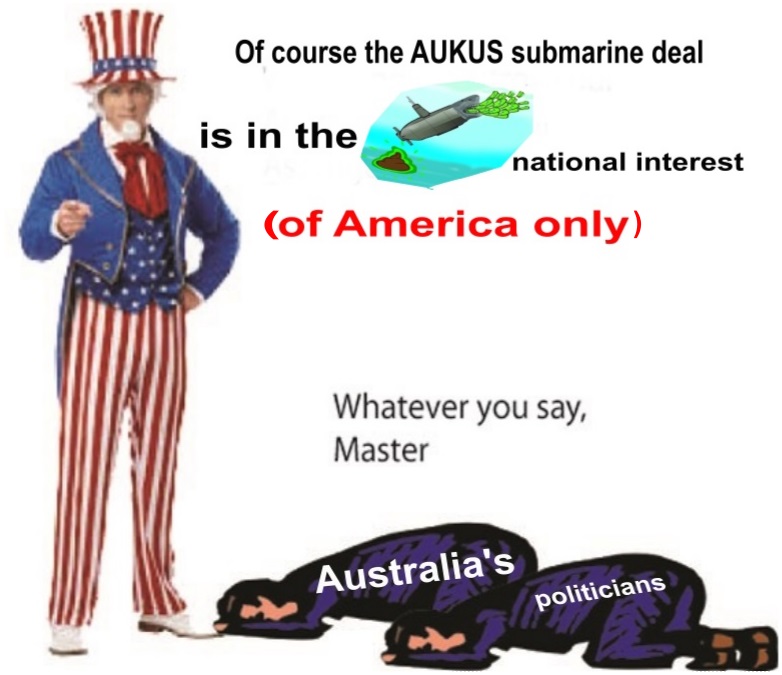
Australia needs to abandon its bankrupting $368B all-eggs-in-one-basket monolithic AUKUS nuclear submarine program and get back to Defence basics.
MichaelWest Media, by Rex Patrick | Feb 28, 2025
China exposes a fundamental flaw in Australia’s nuclear submarine project. While their navy operates off our coast, AUKUS is sapping funds from capabilities needed today. Former submariner Rex Patrick reports.
Rex Patrick reports.
Many Australians have been disturbed, indeed angered, by Chinese warships operating in our exclusive economic zone over the past weeks. How dare they! But the fact is that the Chinese vessels – a destroyer, a frigate and a replenishment ship – are operating in accordance with international law and simply doing to us what we’ve done to them for decades.
Readers will remember a number of recent incidents in which the Chinese military confronted Australian military assets conducting maritime operations in areas of interest to China.
In April 2018, three Australian Naval vessels operating in international waters off Vietnam were challenged by People’s Liberation Army Navy (PLAN) warships.
On all of these occasions, Australia asserted the right of our navy and air force to operate freely in international waters and air space.
Maybe we need to contain our anger!
Strategic takeaways
There are a couple of significant takeaways from the Chinese task group deployment.
The first is that PLAN is no longer a ‘brown-water navy‘. It’s a blue-water navy that can project itself at significant range. In months and years to come, we can expect to see more PLAN warships in Australia’s immediate region and, indeed, in our Exclusive Economic Zone. That’s inevitable.
The second thing to recognise is the fact that our AUKUS submarine strategy is fundamentally flawed.
AUKUS flaw
As the Chinese are operating off the coast of Australia now, we might, and it’s a big might, get our first Virginia Class nuclear-powered submarine in a decade, around 2035.
Whilst Australia embarks on a $368B submarine procurement program, money is being sapped from current programs that would deliver relevant capability now. There is also a huge opportunity cost for procuring other relevant capabilities that could be purchased for near-term delivery.
As PLAN warships were conducting live-fire exercises off the coast of Australia, the only possible contribution that the AUKUS project team could have made in response to it would have been to visually identify those ships by one of its team members flying in a commercial jet over the Tasman Sea en route to another taxpayer-funded junket in Washington.
Furthermore, the nuclear submarines we are currently trying to acquire have the capability to operate for extended periods off the coast of China, but that’s simply unnecessary – the PLAN has well and truly arrived off our coast. They’re bringing the party to us. Even a relatively modest PLAN deployment across our sea lanes would keep our modestly sized navy well and truly tied up.
President Trump may well just see the fate of Taiwan as another real estate deal, something to be traded away for the right price.
This PLAN ‘visit’ to Australian waters highlights our current force weakness. Whilst we have been cooperating with New Zealand in shadowing the three-ship task group, we really don’t have much in the way of assets to deal with the PLAN’s enhanced capabilities.
Indeed, the Chief of Defence Force has advised the Senate that, despite having a budget this financial year of $58B, it was a Virgin Australian pilot that first advised the Australian Government that the PLAN was conducting live-fire exercises off the east coast…………………………………………………………………………………………………………………………………….
needs to be asking the same questions as the Europeans.
Stand on our own
Two decades ago, Australia had a capable, flexible defence force configured for the defence of Australia with the option of expeditionary deployments where our capabilities complemented a multinational operation.
“The current plan on record has abandoned that sovereign goal and focussed on total integration with the US armed forces.”
Our forces are now so integrated with and reliant upon the US military that not only is our capability to defend Australia gravely weakened but our own sovereign decision-making is compromised.
Maybe it’s not just the Chinese that have done us a favour with their task group deployment. President Trump is helping out too.
Australia needs to abandon its bankrupting $368B all-eggs-in-one-basket monolithic AUKUS nuclear submarine program and get back to Defence basics. We need a modern, capable, flexible and self-reliant Defence force that can meet our own sovereign needs. That is entirely achievable and affordable, provided we make the right decisions now.
Rex Patrick
Rex Patrick is a former Senator for South Australia and earlier a submariner in the armed forces. Best known as an anti-corruption and transparency crusader, Rex is running for the Senate on the Lambie Network ticket next year – www.transparencywarrior.com.au.
Why the USA’s Endless Wars Harm Global Stability & Australia

February 12, 2025 AIMN Editorial, By Denis Hay
Discover how USA’s endless wars destabilise nations and why Australia’s alignment with the US military threatens its sovereignty and security.
Introduction
For over a century, the United States has engaged in military interventions worldwide, often framed as efforts to spread democracy and protect human rights. However, history shows these interventions have frequently served corporate interests, ideological dominance, and geopolitical strategies rather than humanitarian concerns.
From orchestrating coups to funding proxy wars and setting up military bases across the globe, US actions have led to mass displacement, economic turmoil, and loss of sovereignty in many nations. Australia’s increasing alignment with the US military brings significant risks, potentially compromising national security and financial independence.
This article examines the history of US interventions, their consequences, and why Australia must develop an independent foreign policy free from US influence.
The Foundation of US Imperialism
Colonial Expansion and the Displacement of Indigenous Peoples……………….
Military Interventions for Economic and Geopolitical Gain…………………………
US Corporate Interests and Nazi Germany……………….
The Korean War: US Expansion Beyond the 38th Parallel…………………..
Regime Change and Proxy Wars in the Cold War Era………………….
US-Backed Coups in Latin America……………………….
The Vietnam War: A 30-Year US Military Disaster……………
The Post-Cold War Era and US Hegemony……………….
The US Military Empire – 800 Bases Worldwide………………
The Dangers of Australia Aligning with the US Military
Loss of Australian Sovereignty
• The increasing military integration between Australia and the US, including bases and joint operations.
• The AUKUS agreement and its implications for Australian independence.
Increased Risk of Conflict
• Australia’s involvement in US-led wars in Iraq and Afghanistan, despite no direct national security threat.
• Potential entanglements in US-China tensions and future conflicts in the Indo-Pacific.
Economic and Social Costs
• Military spending redirected toward US-led initiatives rather than domestic priorities.
• The risk of Australia becoming a target in global conflicts due to its close military ties with the US.
Conclusion
…………………………………………….. For Australia, continued alignment with US military strategies poses significant risks. By participating in US-led wars, maintaining military bases, and deepening its commitment to the AUKUS agreement, Australia risks being drawn into unnecessary conflicts that do not serve its national interests. Moreover, prioritising militarism over diplomacy diminishes Australia’s ability to foster independent international relationships, negotiate trade agreements on its own terms, and establish a sovereign defence strategy that prioritises regional stability over foreign interventions.
To protect its sovereignty and long-term security, Australia must adopt a foreign policy that prioritises diplomacy, peace-building, and multilateral cooperation rather than blindly following US military agendas. A truly independent approach would involve reassessing military alliances, reducing foreign troop presence, and focusing on strengthening regional partnerships, particularly within the Indo-Pacific, to ensure a more balanced and peaceful international order. Australia has the resources, economic power, and global standing to lead by example – choosing peace over war, cooperation over subservience, and true independence over external influence………………. more https://theaimn.net/why-the-usas-endless-wars-harm-global-stability-australia/
Submarine nuclear core project faces ‘challenges’
The Core Production Capability programme, tasked with delivering safe
nuclear reactor cores for the UK’s submarine fleet, remains under pressure
as highlighted in the latest Infrastructure and Projects Authority (IPA)
Annual Report.
Maintaining its Red rating, the programme faces critical
challenges in achieving key milestones crucial to sustaining the Continuous
At Sea Deterrent (CASD). According to the report, the programme is
fundamental to providing the Royal Navy with the capability to propel the
Dreadnought-class submarines and a “modern, safe, and sovereign
capability to manufacture further cores” for a future fleet of attack
submarines.
This capability is also essential for fulfilling the UK’s
commitments under the AUKUS defence partnership.
UK Defence Journal 17th Jan 2025 https://ukdefencejournal.org.uk/submarine-nuclear-core-project-faces-challenges/
Virginia, we have a problem

14 Jan 2025, |Peter Briggs, https://www.aspistrategist.org.au/virginia-we-have-a-problem/
Australia’s plan to acquire Virginia-class submarines from the United State is looking increasingly improbable. The US building program is slipping too badly.
This heightens the need for Australia to begin looking at other options, including acquiring Suffren-class nuclear attack submarines (SSNs) from France.
The Covid-19 pandemic dramatically disrupted work at the two shipyards that build Virginias, General Dynamics Electric Boat at Groton, Connecticut, and Huntington Ingalls Industries’ yard at Newport News, Virginia. It badly hindered output at many companies in the supply chain, too. With too few workers, the industry has built up a backlog, and yards are filling with incomplete submarines.
Within six years, the US must decide whether to proceed with sale of the first of at least three and possibly five Virginias to Australia, a boat that will be transferred from the US Navy’s fleet.
Nine months before the transfer goes ahead, the president of the day must certify that it will not diminish USN undersea capability. This certification is unlikely if the industry has not by then cleared its backlog and achieved a production rate of 2.3 a year—the long-term building rate of two a year for the USN plus about one every three years to cover Australia’s requirement.
The chance of meeting that condition is vanishingly small.
The situation in the shipyards is stark. The industry laid down only one SSN in 2021. It delivered none from April 2020 to May 2022. The USN has requested funding for only one Virginia in fiscal year 2025, breaking the two-a-year drumbeat, ‘due to limits on Navy’s budget topline and the growing Virginia class production backlog’.
As of January 2025, five of 10 Block IV Virginias ordered are in the yards, as are five of 12 Block Vs for which acquisition has been announced. (Work has not begun on the other seven Block Vs.)
The building time from laying down until delivery has increased from between 3 and 3.5 years before the pandemic to more than 5 years. The tempo is still slowing: the next Virginia, USS Iowa, is due to be delivered on 5 April 2025, 5.8 years after it was laid down.
On the original, pre-pandemic schedule, all the Block IVs could probably have been delivered to the USN by now. This is a gap that cannot be recovered in a few years, despite all the expensive manpower training and retention programs in hand.
Exacerbating the problem for the yards, the Block V submarines are 30 percent larger, and more complex to build, making a return to shorter build times unlikely. Speaking to their shareholders in October, the chief executives of Huntington Ingalls and General Dynamics blamed their slowing delivery tempo on supply chain and workforce issues. HII says it is renegotiating contracts for 17 Block IV and Block V Virginias.
Furthermore, Electric Boat has diverted its most experienced workers to avoid further slippage in building the first two ballistic missile submarines of the Columbia class, the USN’s highest priority shipbuilding program, in which the Newport News yard also participates.
It gets worse. Many USN SSNs that have joined the US fleet over the past few decades are unavailable for service, awaiting maintenance. The pandemic similarly disrupted shipyards that maintain the SSNs of the Los Angeles and Virginia classes. In September 2022, 18 of the 50 SSNs in commission were awaiting maintenance. The Congressional Budget Office reports lack of spending on spare parts is also forcing cannibalisation and impacting the availability of Virginia class SSNs.
Australia’s SSN plan must worsen the US’s challenge in recovering from this situation, adding to the congestion in shipyards and further over loading supply chains already struggling to deliver SSNs to the USN.
A US decision not to sell SSNs to Australia is inevitable, and on current planning we will have no stopgap to cover withdrawal of our six diesel submarines of the Collins class, the oldest of which has already served for 28 years.
In the end, Australia’s unwise reliance on the US will have weakened the combined capability of the alliance. And Australia’s independent capacity for deterrence will be weakened, too.
As I wrote in December, it is time to look for another solution. One is ordering SSNs of the French Suffren class. The design is in production, with three of six planned boats delivered. It is optimised for anti-submarine warfare, with good anti-surface, land-strike, special-forces and mining capability. It is a smaller design, less capable than the Virginia, but should be cheaper and is a better fit for Australia’s requirements.
Importantly, it requires only half the crew of a Virginia, and we should be able to afford and crew the minimum viable force of 12 SSNs.
Let’s build on the good progress in training, industry and facility preparations for supporting US and British SSNs in Australia, all of which should continue, and find a way to add to the alliance’s overall submarine capability, not reduce it.
Sovereignty not worth a nickel?
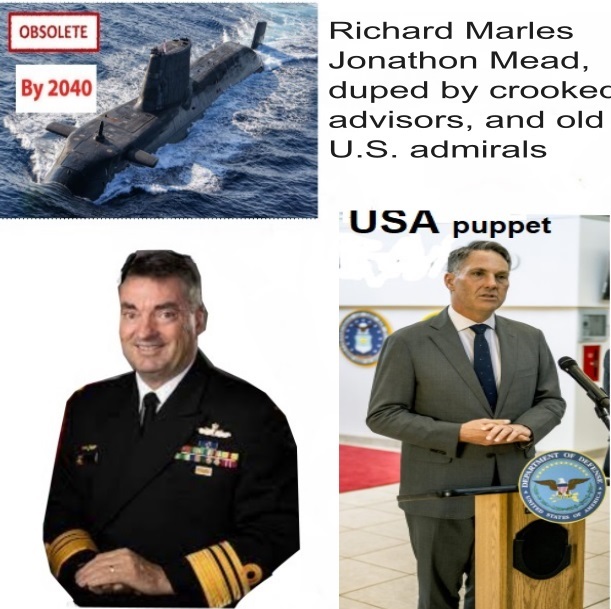
A terse exchange between Greens Senator David Shoebridge and Vice Admiral Jonathan Mead during a Senate Estimates hearing earlier this year revealed that contracts signed by the Australian government that have handed billions of taxpayer dollars to American and British shipyards, supposedly to support the faster delivery of submarines, did not include standard protective clawback provisions.
If we never see a submarine—as is possible—we don’t get any of our billions back.
In influence and dollar terms, foreign-owned companies comprise the vastly dominant proportion of the industrial base, not “part of” it. Research by the Australian Strategic Policy Institute in 2017 showed that the top 15 weapons contractors received 91 per cent of the Department’s expenditure.
A decade of spin from both sides of politics has inured Australians to the stark reality of our loss of independence inside the US alliance. At what cost?
Michelle Fahy, Jan 12, 2025, https://undueinfluence.substack.com/p/sovereignty-not-worth-a-nickel?utm_source=post-email-title&publication_id=297295&post_id=154382292&utm_campaign=email-post-title&isFreemail=true&r=1ise1&triedRedirect=true&utm_medium=emailAustralia’s independence has been dangerously compromised by Labor and Coalition governments, which have signed up to deep-rooted military agreements with the United States of America. These agreements have also underpinned the increasing militarisation of Australia: witness the 2022 speech by Labor’s Richard Marles, the newly appointed deputy prime minister, in Washington DC when he announced that Australian military forces would now become interchangeable with those of the United States.
In August, after this year’s formal annual talks with the United States, Defence Minister Marles announced that the meeting had “built on the last two in seeing a deepening of American force posture in Australia”.
He added: “American force posture now in Australia involves every domain: land, sea, air, cyber and space.”
A decade of spin from both sides of politics has inured us to the stark reality of our loss of independence. Much is made of “defence industry cooperation” with the United States, for example, but this is simply code for the expansion of the US arms industry in Australia in support of its increasing military presence on our soil.
The day before AUKUS was launched in 2021, the US State Department made plain the importance of Australia in supporting America’s military-industrial base:
Australia is one of America’s largest defence customers, supporting thousands of jobs in the United States … The United States is Australia’s defence goods and services partner of choice … the partnership is expected to deepen further over the coming decade, including in the area of defence industry cooperation.
Soon after this statement was published, Marles flew to Washington to endorse its sentiment. He reassured the Americans that when it came to arms production, “our ultimate goal is to supplement and strengthen US industry and supply chains, not compete with them”.
Meanwhile, our much-trumpeted “sovereign defence industrial base” is simply a collection of the world’s top arms multinationals, dominated by the British-owned BAE Systems, the French-owned Thales, and the American-owned Boeing.
Then there is the egregious erosion of Australia’s sovereignty contained within the little-known Force Posture Agreement (FPA) with the United States, which the Abbott Coalition government signed in 2014.
In short, the FPA permits the US to prepare for, launch and control its own military operations from Australian territory.
Yet AUKUS dominates the headlines, even though other decisions by our political leaders that have sold out the public interest have received little coverage in the mainstream media.
A terse exchange between Greens Senator David Shoebridge and Vice Admiral Jonathan Mead during a Senate Estimates hearing earlier this year revealed that contracts signed by the Australian government that have handed billions of taxpayer dollars to American and British shipyards, supposedly to support the faster delivery of submarines, did not include standard protective clawback provisions. If we never see a submarine—as is possible—we don’t get any of our billions back.
The single most important downside of the US alliance, rarely mentioned, is arguably Australia’s military dependence on a foreign power. The Australian Defence Force is critically dependent on US supply and support for the conduct of all operations except those at the lowest level and of the shortest duration.
We were warned about this substantial sacrifice of national freedom of action. In 2001, a Parliamentary Library research paper stated that “it is almost literally true that Australia cannot go to war without the consent and support of the US”.
Foreign-dominated “sovereign” defence industry
Australia’s political and defence hierarchy regularly assert the need to build “a sovereign defence industrial base”. Most people would assume this to mean Australian-owned defence companies, with profits that stay local. This is not what the Defence Department means by it.
The world’s largest weapons companies, including BAE Systems (UK), Thales (France) and US companies Boeing, Lockheed Martin, Raytheon and Northrop Grumman, dominate the local defence industry. Almost all of the top 15 weapons contractors to the Defence Department are foreign-owned. In June 2024, Deputy Secretary Christopher Deeble, the head of the Capability Acquisition and Sustainment Group—the Department’s arms-buying group—explained in a Senate Estimates hearing the government’s definition of “sovereign” in this regard. Deeble agreed with independent senator David Pocock that the local subsidiaries of foreign weapons multinationals, such as Lockheed Martin Australia, were not “sovereign” Australian companies. Nevertheless, he said, the Department considers such foreign-owned subsidiaries to be “part of the sovereign defence industry base here in Australia”.
In influence and dollar terms, foreign-owned companies comprise the vastly dominant proportion of the industrial base, not “part of” it. Research by the Australian Strategic Policy Institute in 2017 showed that the top 15 weapons contractors received 91 per cent of the Department’s expenditure.
Force Posture Agreement
The erosion of Australian sovereignty accelerated in 2011, when Labor prime minister Julia Gillard agreed that up to 2,500 US Marines could be stationed in Darwin on a permanent rotation, and that an increased number of US military aircraft, including long range B-52 bombers, could fly in and out of the Top End and use Australia’s outback bombing ranges.
This agreement was expanded dramatically a few years later by the Force Posture Agreement, which provides the legal basis for an extensive militarisation of Australia by the US, particularly across the Top End.
The tri-nation military pact AUKUS, between Australia, the United Kingdom and the United States, was later negotiated and agreed to, in secret, by the Morrison Coalition government. AUKUS gained bipartisan support within one day of it being revealed to Anthony Albanese’s Labor opposition in September 2021. Among other things, AUKUS, in conjunction with the FPA, ensures that Australia’s navy will be tightly integrated with the US navy for the purpose of fighting China, and that the two navies can operate as one from Australian ports and waters.
Two months after Labor assumed office in May 2022, Marles was in Washington DC announcing that Labor would “continue the ambitious trajectory of its force posture cooperation” with the United States. Australia’s engagement with the US military would “move beyond interoperability to interchangeability” and Australia would “ensure we have all the enablers in place to operate seamlessly together, at speed”.
Non-lethal” F-35 parts
Australia’s newest high-tech major weapons systems make us more reliant than ever on the United States. As veteran journalist Brian Toohey reported in 2020, “The US … denies Australia access to the computer source code essential to operate key electronic components in its ships, planes, missiles, sensors and so on”. This includes the F-35 fighter jets, which both Foreign Minister Penny Wong and Defence Minister Marles have noted form the largest proportion of the air force’s fast jet capacity.
When it agreed to buy Lockheed Martin’s expensive and controversial fifth generation fighter jets, Australia became one of the early members of the F-35 consortium. As part of the deal, Australia negotiated a role for local industry in the F-35 global supply chain. As of June 2024, more than 75 Australian companies had shared in $4.6 billion worth of work, according to the Defence Department.
But there’s been a significant ethical downside. Israel, also a member of the F-35 consortium, is using its F-35s in its war against Gaza. Israel stands accused in the world’s highest court of conducting a genocide in Gaza. Every F-35 built contains Australian parts and components, and for some of these Australia is the sole source.
A senior Defence Department official, Hugh Jeffrey, said in a Senate Estimates hearing in June 2024:
“We are a member of the F-35 consortium [which] exists under a memorandum of understanding … That gives the defence industry opportunity to contribute to that supply chain. It also requires Australia to provide those contributions in good faith…” [emphasis added]
Jeffrey also noted that when assessing any export permit, “we have to have high confidence that, in agreeing to the permit, it’s consistent with our national security requirements and with our international legal obligations”.
What happens if the Department perceives a conflict between Australia’s “national security requirements” and its “international legal obligations”? Is Australia “required” to continue supplying Australian-made arms “in good faith”?
In June, after nine months of spreading disinformation, the Australian government was forced to admit that Australia was still supplying parts and components to the F-35 global supply chain. At the time of writing, the government was allowing this supply to continue despite repeated calls from the UN asking nations—and multinational weapons makers—to cease supplying weapons to Israel, including parts and components, or risk being responsible under international law for serious human rights violations.
Decoded: Defence Department’s deadly deceits
Michelle Fahy, July 10, 2024
Australian navy advertises nuclear submarine job with $120,000 salary and ‘no experience’ needed
Defence outlines long-term strategy to staff US-built Virginia-class submarines expected in 2030s as part of Aukus deal.
Henry Belot, Guardian, 24 Dec 24
The Australian Navy is offering high school graduates “with no experience at all” up to $120,000 to become nuclear submarine officers who will eventually manage nuclear reactors and weapons systems.
The recruitment drive has been launched despite Defence not being expected to receive a Virginia-class submarine from the US as part of the Aukus deal until at least the early 2030s and amid warnings of cost blowouts and delays.
A navy job ad targets people who may have “recently finished school or are currently studying” with the promise of eventually “driving the vessel and charting its position”.
“Your training will first equip you with technical expertise in nuclear propulsion, the platform, and its equipment,” the ad said. “You will then move into your submarine qualification and oversee day-to-day operations, and you could one day lead the entire crew as commanding officer.”
A Defence spokesperson said the hiring drive was part of a long-term strategy to ensure it had enough specialist staff to deploy the submarine once acquired.
“This is to ensure we have the right mix of candidates and to ensure there is time to generate a sustainable career pathway,” the spokesperson said.
Once accepted, an officer would undergo 12 months of nuclear training in the US along with three months of basic submarine and warfare courses. The officers would then be posted to a seagoing submarine for further training.
Nuclear submarine technicians would receive 18 months of training in the US including six months of nuclear theory and 12 months of practical training on existing vessels. The technicians would also be posted to seagoing submarines…
The job ad also offers recruits “travel opportunities, job security, incremental salary increases as you progress through training and ranks, chef made meals at sea, social and fitness facilities, balance of shore and sea postings [and a] variety of allowances”…………
Defence has previously struggled to recruit enough personnel. In a briefing to Marles in 2022, obtained under freedom of information laws, Defence warned: “The last year has seen lower recruiting achievement and higher separation rates, which have resulted in the ADF and [Department of Defence] workforce size being below approved levels.”
The federal government also funded a new training centre at HMAS Stirling, a Royal Australian Navy base in Western Australia, to train a local workforce to deploy the Virginia-class submarines.
The US plans to sell Australia at least three and potentially five nuclear-powered Virginia-class submarines in the 2030s, before Australian-built submarines enter service in the 2040s.
In the lead-up of the acquisitions, from 2027 at the earliest, there are plans to establish a rotational presence of one Royal Navy Astute-class submarine and up to four US navy Virginia-class submarines at HMAS Stirling. https://www.theguardian.com/world/2024/dec/24/australia-navy-nuclear-submarine-job-salary
Greens welcome Victorian government ending agreement with Elbit
Guardian, 28 Nov 24
The Greens MP Gabrielle de Vietri has welcomed the news the Victorian government has ended its agreement with weapons manufacturer Elbit Systems:
Relentless community pressure has forced Victorian Labor to end its partnership with Elbit – a company whose drones killed Australian aid worker Zomi Frankcom and countless Palestinian and Lebanese civilians. It shouldn’t have taken this long for Labor to cut its ties with genocide.
She questioned why the government hadn’t announced the Elbit decision since writing to the Labor MP Bronwyn Halfpenny last week:
This is an important step in the right direction, but why are Labor still leaving Victorians in the dark, they clearly have something to hide. https://www.theguardian.com/australia-news/live/2024/nov/28/australia-politics-live-climate-super-social-media-ban-senate-anthony-albanese-peter-dutton-question-time
AUKUS will ‘cannibalize’ other programs with no budget boost: Former top Aussie general
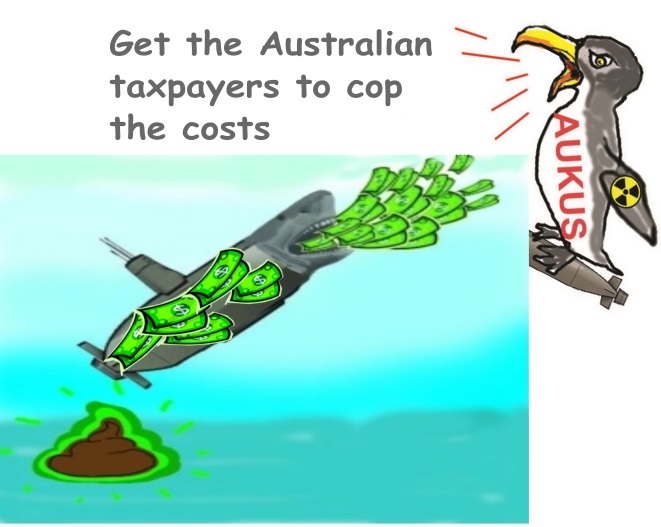
At the same conference, US Deputy Secretary of State Kurt Campbell urged the incoming Trump administration to work closely with Australia and New Zealand to counter a “relentless” China and not to turn inward.
BREAKING DEFENSE, By Colin Clark November 20, 2024
SYDNEY — Sounding the alarm that the AUKUS nuclear submarine deal will eat into non-naval priorities, the former head of the Australian Defense Force today called for a significant boost in defense spending, up to 3 percent of GDP.
Sir Angus Houston was Australia’s top military officer from 2005-2011 and was tapped to co-lead the recent Defense Strategic Review, making him a key, respected voice on matters of defense. While the DSR TKTKT, his comments today reflect what he sees as changed situation. The review and its Integrated Investment Plan projected a $55.5 billion AUD budget for 2024-25, rising to $67.9 billion in 2027-28 — roughly 2.2 percent of GDP.
………………………in comments at the US Studies Centre here, Houston made clear he wasn’t just talking about spending more because of the threats. He made an important structural point, that Australia must increase its defense spending so that buying and building nuclear powered attack submarines — the AUKUS program with the US and UK — does not consume too much of the defense budget.
Houston said the AUKUS boats “must be a net addition to Australia’s military capability. The only way they can be a net addition to Australian military capability is to increase our defense spending by 3 percent plus of GDP as we move into and through the 2030s.”
If that does not happen, it will mean the military can only buy the subs “through the cannibalization of other military capability. So that is the challenge for us. And I don’t think either side of the body politic in Australia has really come to terms with that.”
The question of whether AUKUS will eat up other programs for the Australian defense community has been an open one ever since the project, the most expensive endeavor in the country’s history, was launched. Officials have largely towed the line that the Lucky Country can do everything.
………………………………..there may be signs of budget pressure emerging already. Earlier this month, Australia killed a $5.3 billion AUD satellite contract with Lockheed Martin, with one analyst saying more cuts will likely have to happen as the true cost of AUKUS emerges.
The current government in Canberra has pledged to increase defense spending by $50.3 billion over the next decade, with the plan being to hit $100 billion by 2033. That would put the country at 2.4 percent — well below what Houston believes is needed……………………………………………………………………………………………
Unlike some NATO countries, which Trump has criticized for spending too little, Australia has committed more than $6 billion USD to expanding the tripartite sub industrial base and plans to spend a total of $368 billion on Virginia- and SSN AUKUS-class subs. https://breakingdefense.com/2024/11/former-top-aussie-general-warns-aukus-will-cannibalize-other-programs-with-no-defense-boost/
B-2 Bomber Strikes in Yemen and their significance for Australia
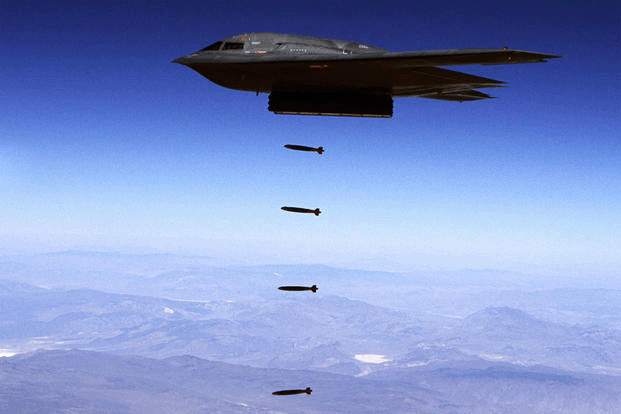
Australia is the only foreign country publicly known to have provided direct military support for the B-2 strikes in Yemen.
The obvious question that comes to mind therefore is why the Australian government acquiesced to involving Australia in the B-2 strikes?
what, if any, are the limits to Australia’s support for US strategic bomber operations should the region become engulfed in all-out war?
s. Washington now views Australia as ‘the central base’ of its Indo-Pacific operations squarely targeted at China
By Vince Scappatura Nov 12, 2024
Australian territory has been used in supporting US B-2 bombers en route and in return from strikes against Houthi targets in Yemen on October 17, and highlights the profound strategic significance of this event for the future role Australia may play in US strategic bomber operations against China, in the Asia Pacific and beyond.
NAPSNet Special Report:
Vince Scappatura, “B-2 BOMBER STRIKES IN YEMEN AND THEIR SIGNIFICANCE FOR AUSTRALIA”, NAPSNet Special Reports, November 11, 2024, https://nautilus.org/napsnet/napsnet-special-reports/b-2-bomber-strikes-in-yemen-and-their-significance-for-australia/
I. Introduction
Washington now views Australia as ‘the central base’ of its Indo-Pacific operations squarely targeted at China; and the strikes in Yemen make clear that the United States is willing and able to utilise its new base capabilities in Australia to devastating effect.[1]
Vince Scappatura documents the novel use of Australian territory in supporting US B-2 bombers en route and in return from strikes against Houthi targets in Yemen on October 17, and highlights the profound strategic significance of this event for the future role Australia may play in US strategic bomber operations in the Asia Pacific and beyond.
Vince Scappatura is Sessional Academic in the Macquarie School of Social Sciences at Macquarie University, and author of The US Lobby and Australian Defence Policy,………………………………………….
The global significance of B-2 strikes in Yemen
In a statement published late on the evening of Wednesday 16 October 2024 (EDT), Secretary of Defense Lloyd Austin revealed US forces had conducted strikes against five hardened underground weapons storage locations in Houthi-controlled areas of Yemen.[1] Although the US Navy also played a role in the operations, US Central Command announced the use of US Air Force B-2 Spirit long-range stealth bombers.[2]
The decision to launch strikes using the distinctive bat-wing bomber, which has been employed relatively infrequently in combat operations, contains a significance beyond the immediate conflict with the Houthis and carries implications that have assumed greater importance in light of the results of the recent US presidential election.
In the first instance the strikes signal the possibility of a larger conflagration in the Middle East, with the B-2’s unique combination of stealth and ‘bunker buster’ capabilities sending a clear message to Iran about America’s commitment to the defence of Israel; a commitment Washington has made even as Israel has taken a series of escalatory steps against Iran that have placed the region on the brink of all-out war.
However, they also carry a broader significance in demonstrating the ability of the US Air Force to deliver devastating strikes worldwide, including nuclear strikes due to the dual-capable role of the B-2, which is particularly salient for any future operations against both China and Russia.
Moreover, the B-2 strikes have momentous strategic implications for Australia, although this fact was left unexamined in media coverage of the event.
The Australian Department of Defence (hereafter Defence) confirmed to the Australian Broadcasting Commission (ABC) that Australian airspace and airbases were accessed in support of the strikes.[3] This participation marks the first time since World War II that Australian territory has been directly used to support US strategic bomber operations.
This novel use of Australian territory follows significant infrastructure developments at airbases across the north of the country, still ongoing, that are ultimately being developed to enable full-spectrum support for US ‘deterrence’ operations against China.[4]
The B-2 strikes in Yemen are the first active demonstration of these developing capabilities and a harbinger of more comprehensive Australian support for any future US strategic air operations, including potential nuclear missions, perhaps in the Middle East, but also ultimately against China and even Russia.
The Australian government is yet to acknowledge the profound strategic implications foregrounded by the strikes in Yemen, while Defence has been unnecessarily opaque about the details of the operation. A full account and wide understanding of Australia’s role in the strikes and what it portends are crucially important for democratic transparency and accountability, while the spectre of the forthcoming Trump administration contributes to the urgency.
Trump’s erratic and unpredictable decision-making, combined with the president’s sole authority over the use of nuclear weapons, highlights the risks of the United States, and by implication, Australia, becoming engulfed in a fateful conflict that is neither anticipated nor desired by their respective peoples. If there was a time for Australian political leaders to be forthright about the dangers of positioning Australia in the frontline of US strategic bomber operations it is now more than ever.
A rare bomber strike; and a message to Iran
…………………………………………….The Pentagon refused to divulge the specific type of ordinance that was employed in the strikes, although an anonymous source revealed to a specialist military journal that the B-2s dropped 2,000-pound BLU-109 JDAM ‘bunker buster’ bombs.[8]
Of particular significance for Iran is the fact that the B-2 is uniquely capable of employing the 30,000-pound GBU-57 Massive Ordinance Penetrator (MOP) in combat operations, reportedly reaching targets of up to 200 feet underground.[9] Iran’s nuclear facilities are known to be deeply embedded underground at Fordow and Natanz and could only plausibly be destroyed by the employment of the MOP.[10]
Although Iran wasn’t mentioned by name, the Pentagon made it clear that the employment of the B-2 was not only a message to the Houthis but any ‘potential adversaries that hide things deep underground. It’s a message to them as well.’[11]
An historic first for Australia
Although aspects of the Australian role in supporting the B-2 strike mission remain unclear, the fact that it prefigures future support for a range of US missions involving conventional and nuclear forces in contingencies anywhere in the world demands a full account and understanding.
Australia is the only foreign country publicly known to have provided direct military support for the B-2 strikes in Yemen. Moreover, achieving this level of logistical cooperation represents a significant milestone in Australia-US military cooperation.
In its statement to the ABC, Defence declared that support for US strikes in Yemen was provided ‘through access and overflight for US aircraft in northern Australia’. The ABC also reported that air-to-air refuelling aircraft were part of the mission, although Defence declined to confirm this claim.[12]
The precise extent and nature of Australia’s support is still unknown, including whether any Australian Defence Force (ADF) capabilities were employed in support of the B-2 bombers. Defence has so far declined to comment further about Australia’s involvement, citing operational security. However, a Defence department spokesperson did issue a clarification to the ABC that American B-2s were not operating out of RAAF Base Tindal in the Northern Territory at the time of the strikes.
RAAF Base Tindal is currently undergoing a major infrastructure expansion project to support the future forward-deployment of up to six B-52 (and eventually, possibly B-2 and B-1) strategic bombers, along with refuelling and transport aircraft. The upgrades include a squadron operation facility for mission planning, crew briefings and intelligence, along with maintenance facilities, strategic fuel reserves, and earth covered magazines for stockpiling munitions. The massive fuel storage facilities at Tindal have already been completed.[13]
B-2 bombers are known to have been operating out of RAAF Base Amberly in Queensland across the months of August and September in a Bomber Task Force mission that saw the aircraft covering vast distances throughout Australia and the Indo-Pacific, including ‘hot pit’ refuelling at the US base in Diego Garcia. However, the BTF mission had concluded by September 18.[14]
The clarification about Tindal issued by Defence, along with the nondescript use of the term ‘US aircraft’, leaves open the possibility that B-2 bombers operated from other RAAF bases in northern Australia, either en route or in return from Yemen, although there is no operational reason for the B-2s to have landed in Australia as against overflying and refuelling from aircraft operating from Australian airfields.
……………………………..photos taken by local Australian aviation enthusiasts provide evidence for a plausible scenario whereby US tankers operating out of Australia were used to refuel US B-2 bombers both enroute and in return from strikes in Yemen.
Western route to the Middle East
To fly over Australian airspace enroute to Yemen, US B-2 bombers are likely to have flown west over the United States and out across the Pacific Ocean before continuing over northern Australia and across the Indian Ocean to their eventual target.
A similar route, although traversing further to the north of Australia into Southeast Asia, was used when B-2 bombers launched strikes against the Taliban in Afghanistan in the aftermath of the terrorist attacks on 11 September 2001. To reach their targets without landing, the bombers were required to carry out aerial refuelling five times off the coasts of California, Hawaii, Guam, the Strait of Malacca and finally Diego Garcia (see figure 1).[16]
Although there is a shorter and more direct route to Yemen flying east from the United States, this path has the advantage of avoiding the need to inform and seek permission from several countries in Europe and the Middle East whose airspace would otherwise be traversed. Flying a carefully plotted western path over northern Australia would avoid the airspace of several Southeast Asian states with large Islamic populations and potential political sensitivities to the strikes. Whether intended or not, it also signals to China and Russia that US strategic airpower can attack them via their ‘soft’ southern underbelly as was planned and exercised during the Cold War.
Overflying northern Australia
The presence of B-2s over Australian airspace at the time of the strikes in Yemen can be confirmed by aircraft communications with civilian air traffic control towers responsible for managing Australia’s airspace.[17] This type of communications is publicly available via online sources such as LiveATC.net.[18]
………………………………………………….Having left their location in the Coral Sea after checking in with the Brisbane Centre on October 16 at 3pm AEST, the B-2 bombers arrived at their target destinations in Yemen approximately 19 hours later at around 3am in local time on October 17.[24]
As reported by ABC News, air-to-air refuelling aircraft were a part of the B-2 mission that logistically required ‘access and overflight’ in northern Australia. This claim was neither confirmed nor denied by Defence…………………………………………………………………………………………………………………..
Unanswered questions
There was no immediate post-strike assessment provided by the Pentagon when the strikes in Yemen were first announced on October 16………………………………………..
Although the Pentagon provided only scant details of the strikes, there has not to date even been an official statement about Australia’s participation in the operation made by the Minister for Defence or released on the website of the Australian Department of Defence. Nor has there been a post-operation account about the success or otherwise of the strikes.
This lack of transparency by Defence is typical but especially unwelcome given the operation marks an escalation in Australia’s participation in the conflict in the Middle East and especially its contested role in providing direct and indirect support to Israel in its wars in Gaza and Lebanon where there are reasonable grounds for believing war crimes and even genocide have been committed.[33]
Defence frequently promotes capability demonstrations of increased interoperability between the ADF and US military forces in official media releases, and Australia’s participation in the US strikes in Yemen represents the first combat demonstration of how Enhanced Air Cooperation under the framework of the US Force Posture Initiatives can be successively used for strategic bomber operations.[34] But if the joint operation was intended to contribute to ‘deterrence’ then the logical approach would have been to draw attention to it.
The obvious question that comes to mind therefore is why the Australian government acquiesced to involving Australia in the B-2 strikes? Australia’s long history of reflexive support for US military operations probably goes a long way in explaining the decision. But incremental decisions announced in a series of recent AUSMIN consultations has led to an unprecedented degree of Australia-US defence integration with implications for Australian participation in US global military operations that political leaders in Australia may not have fully appreciated.[35]
Whatever the rationale, Australians have a right to know about the nature and extent of Australia’s support for the strikes in Yemen, including what US aircraft were involved and what Australian bases they may have operated from. Specifically, Defence should be transparent with the Australian people about the following questions:
- Although it seems unlikely, did the B-2s in fact land at any Australian bases?
- US aerial refuelling aircraft were undoubtedly part of the mission. But did they draw from Australian or US dedicated fuel reserves?
- Were any ADF capabilities employed to support the B-2 strikes during their overflight of Australia or in the region more broadly?
- What assessment was made to ensure Australia’s participation in the strikes was compliant with International Humanitarian Law?
Finally, participation in the B-2 strikes in Yemen have taken Australia a step closer to becoming further entangled in the conflict in the Middle East. This leads to the obvious question of what, if any, are the limits to Australia’s support for US strategic bomber operations should the region become engulfed in all-out war?
Merely citing ‘operational security’ in refusing to answer such questions is wholly inadequate. Democratic transparency and accountability require any potential operational security concerns to be fully explained and justified.
The future of US strategic bomber operations in Australia
Although the strikes in Yemen point to the risks Australia faces in reflexively supporting its ally in yet another conflict in the Middle East, ultimately this unique demonstration of Australia’s growing capabilities to contribute to US strategic air operations is a harbinger of more comprehensive support for any future US conflict with China and/or Russia.
The Australian government has displayed no willingness to publicly acknowledge, let alone debate, the implications of America’s steady military buildup in the north of the country and the deepening integration of the ADF with US armed forces. Washington now views Australia as ‘the central base’ of its Indo-Pacific operations squarely targeted at China; and the strikes in Yemen make clear that the United States is willing and able to utilise its new base capabilities in Australia to devastating effect.[36]
It is critical therefore that the Australian public and its political leaders at all levels comprehend the profound implications of participating in the B-2 strikes in Yemen. It prefigures similar and more prominent roles for Australia in American conventional and nuclear operations not only in the Middle East, but in East Asia and the Pacific, and especially around China and even Russia.
Although tactical surprise may require opacity before and during such a joint operation, there is no excuse for the failure to share with the Australian people what Australia has done, not least so that they are prepared to make informed judgements that will restrain or enable future expanded joint operations now envisioned by the two governments under the 2014 Force Posture Agreement and more recent AUKUS rubric, but not shared with their respective peoples.[37]
Until a full official account is provided, observers could be forgiven for assuming that supine acquiescence on the part of the Australian government in supporting American strikes combined with Defence’s utter lack of accountability explains how Australian airbases and airspace were utilised to support the B-2 strikes in Yemen.
III. ENDNOTES – 1 – 37…………………………………more https://johnmenadue.com/b-2-bomber-strikes-in-yemen-and-their-significance-for-australia/
Nuked: The Submarine Fiasco that Sank Australia’s Sovereignty, book by Murray Horton

Global Peace and Justice Aotearoa, 12 Nov 24, Reprinted from Covert Action Magazine
Andrew Fowler’s book Nuked: The Submarine Fiasco That Sank Australia’s Sovereignty (Melbourne University Press, 2024) was not written by a member of the peace movement. That is both a strength and a weakness. A strength, because Andrew Fowler is an award-winning investigative journalist, who has worked in mainstream Australian current affairs TV. So, it can’t be dismissed as “anti-American, anti-military” propaganda.
But it is a weakness because the author never questions the basic tenet of the book’s subject—why does Australia need any submarines at all, regardless of whether they are conventionally powered or nuclear powered. The book’s focus is a forensic analysis of who won the highly lucrative battle to supply Australia’s new subs—it was all set up to be France but then, after hidden, sub-surface maneuvering worthy of one of the book’s subjects, Australia and the U.S. torpedoed the French and did a deal among themselves.
This book is about AUKUS (Australia, UK, U.S.), the new kid on the “Indo-Pacific” block—although it should be pointed out that the UK is an awfully long way away from either the Indo or the Pacific. It is an attempt to build a new Western military alliance, initially between those three countries but with the prospect of other countries (including New Zealand) joining the ill-defined AUKUS Pillar Two at some unspecified time in the future. But let’s not get ahead of ourselves. The book is about the birth of AUKUS, which is all about submarines.
AUKUS
I’ve written about AUKUS previously in Covert ActionMagazine, so I refer you to that for the back story. In 2016 Australia signed a $A50 billion contract for France to build it 12 state of the art conventionally powered submarines for the Australian Navy. It was the largest defence contact in the history of both France and Australia. The right-wing Liberal Party was in Government in Australia, headed by Prime Minister Malcolm Turnbull…………………………………………………………………………………………………………………….
The book names names—the man who fronted the deception and betrayal of France was Scott Morrison, who replaced Turnbull as the Liberal Prime Minister in 2018, in an internal Party coup (a common occurrence in Australian politics). Behind the scenes, the key man was Andrew Shearer, “a vehemently pro-American China hawk” who went on to become Director-General of National Intelligence. Right up until just before AUKUS was announced in 2021, Morrison’s government continued to assure France that it was proceeding with the contract to buy French submarines.
Dumping France For the U.S.
Instead of 12 diesel-powered French subs, Australia signed up to have the U.S. and UK build eight nuclear-powered (but not nuclear-armed) subs for its Navy. The cost is astronomical—up to $A368 billion by 2055. Yes, that’s right—those eight subs will not be ready for more than 30 years. The first of them is unlikely to be ready until the 2040s so, to fill that gap, Australia will buy three existing U.S. subs from the early 2030s, at a cost of up to $A58b, with an option to buy two more. This is a staggering amount to spend on one military project from a country with a population of just under 27 million people.
“(AUKUS) was a clear victory for Washington, which had been concerned for some time that France had a different view on how to deal with the rise of China… There was barely a murmur of opposition from the media. Morrison had pulled off a major achievement of what U.S. public intellectual Noam Chomsky describes as the political art of ‘manufacturing consent’…”.
“How did it happen that the bulk of analysis and criticism of the submarine deal came from two former Prime Ministers, Paul Keating (Labor) and Malcolm Turnbull (Liberal) who, though on opposing sides of politics, were united in warning that the submarine deal stripped away Australia’s sovereignty……………………………..
Australia Expected To Fight Alongside U.S. In War With China
There is only the feeblest pretense that these nuclear submarines (still decades away from reality) will be used to defend Australia. Their role will be to patrol close to the Chinese coast, to hem in the Chinese Navy and, in the event of war, to attack China with cruise missiles. That’s the theory, anyway. The advantage of their being nuclear-powered is that they don’t have to return to port to refuel. U.S. hawks expect Australia to fight on its side in any war with China over Taiwan………………………………………………………………………………………..
Integration With U.S. Military
There is a lot more to the U.S.-Australia military relationship than some exorbitantly expensive nuclear submarines that may or may not ever materialise. There is the top-secret Central Intelligence Agency/National Security Agency Pine Gap spy base near Alice Springs, in central Australia, which is crucial to the global warfighting abilities of the U.S. There is the North West Cape facility on the westernmost point of mainland Australia, which the US Navy uses to communicate with its nuclear attack subs. There is Australia’s increasing involvement with the U.S. military and intelligence satellite programme, in preparation for war in space.
“Australia’s integration with the U.S. military was, of course, well underway before the AUKUS agreement. As already noted, Pine Gap and North West Cape are part of this. But there is also the basing of thousands of U.S. Marines in Darwin (northern coast), the stationing of nuclear-capable B-52s at Tindal (Australian Air Force base, northern Australia), and the stationing of U.S. military throughout the Australian Defence Force, including from the National Reconnaissance Office at the military headquarters in Canberra… Though Defence Minister Richard Marles has ruled out automatic support of the United States in any war over Taiwan, it is difficult to see how Australia won’t be involved. Pine Gap, Tindal, North West Cape and Perth (Western Australia’s biggest city) will all be integral to the battle.”
Change Of Government; No Change Of Foreign Policy
Scott Morrison’s Liberal government was voted out at the 2022 Australian election and was replaced by Anthony Albanese’s Labor Party. But Australia’s commitment to AUKUS remained unchanged………………………………………………………………………………
“Nuked” specifically attributes Labor’s fervent desire not to be seen as “anti-American” to the events of 1975, when the Central Intelligence Agency and its local collaborators, succeeded in getting Gough Whitlam’s Labor government overthrown in a bloodless coup. The U.S. covert state was particularly concerned about Whitlam’s revelations about its Pine Gap spy base and possible threats to close it. Jeremy Kuzmarov has recently written about this in CovertAction Magazine (15/11/23), so I refer you to that.
For half a century the Australian Labor Party has lived in fear of the same thing happening again, and has bent over backwards to prove its loyalty to the U.S.
………The consequences of the fear that drove the ALP leadership to embrace AUKUS with barely a second thought will haunt them for years to come. Just as Morrison was only too willing to trade Australian’s independence for the chance to win an election, so too was Labor. Now it is left to make work a deeply flawed scheme that, more than ever before, ties Australia’s future to whoever is in the White House.”
Jobs For The Boys
And what has happened to Scott Morrison, who retired from politics in 2024? “Along with Trump’s former CIA Director, Mike Pompeo, Morrison became a strategic adviser to U.S. asset management firm DYNE Maritime, which launched a $157 U.S. million fund to invest in technologies related to AUKUS. ………
“Morrison also became Vice-Chair of American Global Strategies (AGS), headed by former Trump National Security Advisor Robert O’Brien. AGS, stacked with former Pentagon, White House and State Department officials, boasts that it ‘assists clients as they navigate U.S. government processes,’ a useful addition to any company wanting to boost profits in the burgeoning area of military spending.”
New Zealand & AUKUS
…………………………………………………………………………… There are plenty of similarities between Australia and New Zealand but also significant differences. Whereas Australian governments of either party fall over themselves to loyally serve the U.S. empire, New Zealand has been nuclear free by law since the 1980s (and it was an Australian Labor government, on behalf of the U.S., which tried to pressure New Zealand to drop the policy. That pressure backfired).
……………………………………………………………….But there is a constant push to get New Zealand further entangled in the U.S. war machine, including Pillar Two of AUKUS (which has been, thus far, only identified as involving “advanced military technology”). New Zealand currently has a very pro-American Government, which is already a non-member “partner” of NATO and which is eager to serve the U.S……………………………………..
Not All New Zealand Politicians Lining Up To Grovel To Uncle Sam.
For a refreshing contrast, here’s an extract from a recent (2/10/24) press statement from Te Pāti Māori, the indigenous party, which has six Members of Parliament (out of 123). “Meanwhile the New Zealand Government is in talks with the United States about joining AUKUS to further support their war efforts. This represents the next phase of global colonisation, and it is being negotiated behind closed doors,” Co-Leader Rawiri Waititi said.
“The U.S. wants to use Aotearoa as a Pacific spy base. This could mean the end of our longstanding nuclear free policy to allow their war ships into our waters. AUKUS threatens our sovereignty as an independent nation, and the Mana Motuhake of every nation in the Pacific. It threatens to drag Aotearoa into World War 3,” said Waititi.
“The New Zealand government is putting everyone in Aotearoa at risk through their complicity. They must end all talks about joining AUKUS immediately. They must sanction Israel and cut ties with all countries who are committing and aiding war crimes,” said Co-Leader Debbie Ngarewa-Packer………………………………. more https://gpja.org.nz/2024/11/12/nuked-the-submarine-fiasco-that-sank-australias-sovereignty-by-murray-horton/
Airstrip One: How Albanese has integrated us into Trump’s military machine
Thanks to the Albanese government, the new Trump administration will find Australia a well-established launch pad for any conflict with China.
Bernard Keane, Nov 11, 2024, https://www.crikey.com.au/2024/11/11/anthony-albanese-australia-us-military-integration-donald-trump/
The next Trump administration will arrive in power to learn that Australia is far more deeply enmeshed in in the US military and intelligence apparatus than in 2020, partly thanks to an eager Albanese government subordinating Australian sovereignty to Washington.
AUKUS is a Biden-era initiative that advocates worry Trump may look askance at, given the pressure it will place on US nuclear submarine production — although the fact that America and the UK can walk away whenever they like, and that Australia is handing $5 billion to each for the privilege of participating, should mitigate Trump’s hostility. That AUKUS will effectively place Australia’s submarine fleet — if it ever arrives — under US control in the 2040s and 2050s may be appealing, but that’s far beyond Trump’s short-term mindset.
But the bigger story of Australian sovereignty under the Albanese government isn’t AUKUS but the steady integration of Australia’s military systems into America’s, and Australia’s transformation into a launch pad for the deployment of American power. The Albanese government has:
- Facilitated “regular and longer visits of US [nuclear submarines] from 2023 to Australia, with a focus on HMAS Stirling. These visits would help build Australia’s capacity in preparation for Submarine Rotational Force-West, an important milestone for the AUKUS Optimal Pathway that would commence as early as 2027”. Submarine Rotational Force-West is the permanent operation of one British and four US nuclear submarines from Perth.
- Allowed US intelligence officials to be embedded in the Defence Intelligence Organisation, a “significant step” toward what Defence Minister (and, as he always insists on being called, Deputy Prime Minister) Richard Marles hailed as “seamless” intelligence ties between the US and Australia.
- Established sharing of satellite imagery “and analysis capability” between Geoscience Australia and the US government.
Established rotation of State Department officials through the Department of Foreign Affairs and Trade “in the areas of technical security, cyber security, and threat analysis”.- Upgraded Top End RAAF airfields to accommodate more US military aircraft, with more upgrades planned, in work hailed by Stars and Stripes as reflecting how “Australians are alarmed at Chinese efforts to gain influence among their South Pacific neighbours”.
- Established facilities for “prepositioning of initial US Army equipment and materiel in Australia at Albury-Wodonga”.
- Continued the Morrison government’s support for the expansion of the Pine Gap surveillance facility, while it is being used, inter alia, to provide intelligence to the Israeli Defence Forces in their genocidal campaign against Palestinians.
- US Marine rotations through Darwin have also been used as “a hub in a lengthy kill web that could protect the region, should Australia face outside threats. ‘Every single day Darwin is becoming more of a hub for us, not just in Australia but through the island chain,’” one American officer says.
In one recent exercise, “Marines set up a bare bones air base on the York Peninsula, Queensland, Australia complete with a fires unit armed with anti-ship missiles and a sensing unit to run air defense … Marines also used their own and Australian aircraft, including C-130s, C-17s and Ospreys to establish an Expeditionary Advanced Base that set up an Osprey maintenance base to extend the aircrafts operations during military exercises. ‘These are real posture gains being made there that will be useful for us in conflict.’”
This demonstrates the validity of Paul Keating’s description of Australia under Albanese as becoming “a continental extension of American power akin to that which it enjoys in Hawaii, Alaska and more limitedly in places like Guam … the national administrator of what would be broadly viewed in Asia as a US protectorate”.
The difference now is that from January, this “continental extension” will be under the control not of a traditional centrist Democrat, but an unstable populist with a deep hostility to China and a stated determination to weaken the country he believes caused the COVID pandemic, as well as an outright hostility to international law and desire to unshackle Israel from any limitations on its mass slaughter of Palestinians. In the event Trump’s proposed trade war with China significantly increases military tensions, Australia will be Airstrip One for the deployment of American power.
Ambassador John Bolton tells 7NEWS Donald Trump re-election could mean AUKUS nuclear submarines plan torn up
7 News, By David Woiwod – US Bureau Chief, 27 Oct 24
Australia’s plans to acquire a fleet of nuclear-powered submarines would be torn-up if Donald Trump is re-elected next week, according to a former top Republican party security advisor.
The AUKUS defence pact would be one of the first US alliances to undergo a major review under an incoming Trump administration – with the official warning Australia not to take the agreement “for granted”.
“I think it could be in jeopardy,” former US ambassador to the United Nations, John Bolton told 7NEWS.
“All Trump looks at is the balance sheet, and if he sees more US expenditure than those of other parties to the agreement, then I think there will be trouble.”
The defence bill that passed on Capitol Hill late last year requires the president of the day to give the final tick of approval before any US submarines are delivered to Australia.
And Ambassador Bolton is now encouraging America’s ally to immediately mount arguments in favour of the alliance if Trump wins the November poll……..
The Australian government forked out $4.5 billion dollars to help soothe US fears after lawmakers questioned America’s ability to deliver the specialised boats while meeting its own submarine production targets.
Under the first steps of the deal aimed at deterring Chinese aggression, Australia is set to receive at least three Virginia Class nuclear-powered submarines before Australian-built vessels enter service in the 2040s. https://7news.com.au/news/ambassador-john-bolton-tells-7news-donald-trump-re-election-could-mean-aukus-subs-plan-torn-up-c-16518429
Australia’s evolving nuclear posture: avoiding a fait accompli (Part 1 of 2)
Pearls and Irritations, By Vince Scappatura, Oct 12, 2024
A monumental transformation: There has been a great deal of public criticism of Australia’s decision to acquire a fleet of nuclear-powered submarines (SSNs) via the AUKUS security partnership. The criticism has been both broad and deep, spanning political and industrial challenges, budgetary consequences, safety and environmental concerns, strategic risks, and the erosion of national sovereignty.
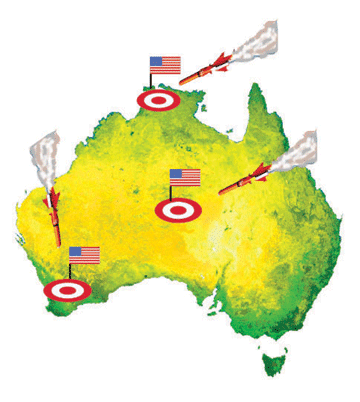
While these are all worthy issues to bring to the fore of the public debate, one set of issues that have not received nearly as much attention are the ways in which AUKUS implicates Australia in US nuclear war planning.
From one perspective this is understandable given AUKUS does not involve plans for Australia to acquire nuclear-armed submarines or to station US nuclear weapons on Australian soil. However, when viewed from a wider perspective, AUKUS epitomises Australia’s geostrategic transformation and evolving nuclear posture within the US alliance.
The significance of this transformation is reflected in the fact that Australia will soon become ‘the only ally in the world to host and support military operations by forward-deployed US strategic bombers and SSN attack submarines’. This comes in addition to hosting mature US expeditionary Marine capabilities and a more recent rotational presence of US Army personnel and permanent associated support infrastructure.
Perhaps more significant than providing a ‘vast military launchpad’ for multiple forms of US power projection is the developing role of the ADF to seamlessly integrate with American military forces and to provide what is approaching full-spectrum support operations, including for nuclear missions.
AUKUS and nuclear war
Although the focus of AUKUS ‘pillar one’ is the acquisition by Australia of nuclear-powered, but conventionally-armed submarines, there are in fact several nuclear war planning dimensions to the broader security partnership.
The Australian government refuses to publicly broach the questions of how, where and against whom Australia’s future SSN force might be expected to operate both in peacetime and in the event of conflict. …………………………………………….
It would not be surprising if all of these contingencies are perceived by Beijing as posing an existential threat, particularly as China’s nuclear submarine deterrent continues to develop into an assured second-strike capability…………………………………………………………………
Australia’s evolving nuclear posture
AUKUS is more than just an international arms agreement. By Scott Morrison’s admission the political framework is intended to secure a ‘forever partnership’ and a ‘forever responsibility’ between Australia and the United States. The unprecedented scale, cost, time frame and interdependence generated by the singular AUKUS deal clearly signals a decision to lock Australia into America’s distinctive military strategy for containing China into the future.
A key objective of America’s strategy is to achieve seamless high-end defence integration with its global network of allies and partners. While obstacles to full realisation remain, Canberra’s embrace of ‘integrated deterrence’ is already transforming Australia into both a critical base of operations and provider of full-spectrum support for US force projection into the region. It is also leading to the development of a new and unprecedented role for the ADF in support of US nuclear operations.
………………………………………………………………………………………. Avoiding a fait accompli
The situation emerging is one of enduring high-level tactical and institutional integration between the defence forces of Australia and the United States, creating the conditions for extreme political pressure and expectations from Washington of Australian support for any future US war with China……………………………………………………………..
The time to put a halt to any plans for expanding Australia’s nuclear posture is now. If no public pressure is forthcoming the Australian government is likely, in time, to move forward with precommitments to support US nuclear operations behind closed doors, and if presented to the public at all, will be done so as a fait accompli, as was the case with AUKUS, the forward-deployment of B-52 bombers and the US Force Posture Initiatives generally. https://johnmenadue.com/australias-evolving-nuclear-posture-avoiding-a-fait-accompli-part-1-of-2/
1 This month

of the week – Australians for War Powers Reform (AWPR)
To see nuclear-related stories in greater depth and intensity
 Antinuclear