A toxic legacy : British nuclear weapons testing in Australia
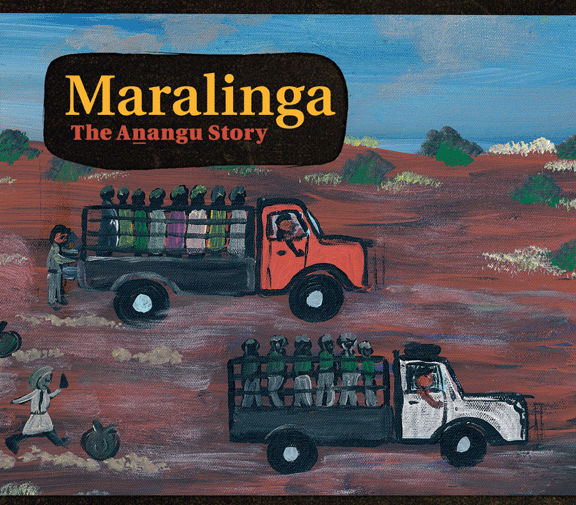 Australia’s hospitality, largesse and loyalty to Britain were not without their costs. Moreover, the sacrifices made by Australians on behalf of the ‘motherland’ were not equally borne. Whilst low population density and remoteness from major population centres were among the criteria for the selection of the testing sites, the Emu and Maralinga sites in particular were not uninhabited. Indeed, they had been familiar to generations of Aboriginal Australians for thousands of years and had a great spiritual significance for the Pitjantjatjara and Yankunytjatjara people.
A variety of factors underlay the harm to public health, Aboriginal culture and the natural environment which the British tests entailed. Perhaps most significant was the secrecy surrounding the testing program.
During the entire course of the testing program, public debate on the costs and risks borne by the Australian public was discouraged through official secrecy, censorship, misinformation, and attempts to denigrate critics
Wayward governance : illegality and its control in the public sector / P N Grabosky
Canberra : Australian Institute of Criminology, 1989 “……. In 1950, Labor Prime Minister Clement Atlee sent a top secret personal message to Australian Prime Minister Menzies asking if the Australian government might agree to the testing of a British nuclear weapon at the Monte Bello Islands off Western Australia. Menzies agreed in principle, immediately; there is no record of his having consulted any of his Cabinet colleagues on the matter.
The Monte Bello site was deemed suitable by British authorities, and in a message to Menzies dated 26 March 1951 Atlee sought formal agreement to conduct the test. Atlee’s letter did not discuss the nature of the proposed test in minute detail. He did, however, see fit to mention the risk of radiation hazards:
6. There is one further aspect which I should mention. The effect of exploding an atomic weapon in the Monte Bello Islands will be to contaminate with radio activity the north-east group and this contamination may spread to others of the islands. The area is not likely to be entirely free from contamination for about three years and we would hope for continuing Australian help in investigating the decay of contamination. During this time the area will be unsafe for human occupation or even for visits by e.g. pearl fishermen who, we understand, at present go there from time to time and suitable measures will need to be taken to keep them away. We should not like the Australian Government to take a decision on the matter without having this aspect of it in their minds (quoted in Australia 1985, p. 13).
Menzies was only too pleased to assist the ‘motherland’, but deferred a response until after the 195 1 federal elections. With the return of his government, preparations for the test, code-named ‘Hurricane’, proceeded. Yet it was not until 19 February 1952 that the Australian public was informed that atomic weapons were to be tested on Australian soil. On 3 October 1952 the British successfully detonated a nuclear device of about 25 kilotons in the Monte Bello Islands. Continue reading
Australia – America’s Deputy Sheriff again, as USA opposes nuclear-weapons-ban talks
UN nuclear treaty: Australia plays deputy as US ‘sheriff’ baulks at ban Daniel Flitton, The Age, 29 Mar 17 Nikki Haley marched in on her first day as Donald Trump’s ambassador to the United Nations with a blunt warning to the world: “For those who don’t have our backs, we’re taking names.”
Australia has now gone to extraordinary lengths to make sure its name stays off Trump’s naughty list. With negotiations for a new treaty to outlaw nuclear weapons kicking off on Monday (New York time), Haley called an extraordinary press conference outside the UN to declare the US opposition to the talks.
And there, at her heels, was Australia.
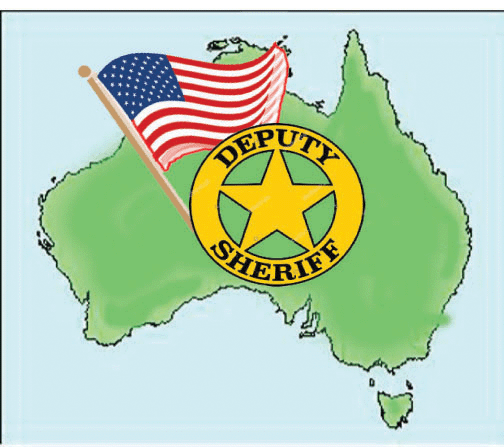
At the very moment representatives from more than 120 countries were starting their negotiations inside, Australia stood with Trump’s appointee and a group widely known as the “weasel countries” who are opposed to banning the bomb.
According to anti-nuclear campaigners, 21 countries joined Haley’s protest. They included Albania, Turkey, Croatia, Romania, Poland, Estonia, Slovenia, Hungary and South Korea. Britain and France, both nuclear armed, also spoke against a ban. Other NATO allies joined in, although not all……
Back in January, Haley had made plain the attitude the Trump administration would take to the world body. “Our goal … is to show value at the UN, and the way to show value is to show our strength, show our full voice,” she declared. “Have the backs of our allies and make sure our allies have our backs as well.
“For those who don’t have our backs, we’re taking names, and we will make points to respond to that accordingly.”
On Monday, after the protest at the UN, she told a key lobby group for Israel in Washington: “For anyone who says you can’t get anything done at the UN, they need to know there’s a new sheriff in town.”
And she made the nuclear issue personal…….
Tilman Ruff, of the International Campaign to Abolish Nuclear Weapons, told Fairfax Media from New York that the US action was alarming and Australia was “aligning itself with the extremes of the Trump administration”.
“What credibility does Australia have to criticise North Korea’s reckless nuclear proliferation when it continues to claim protection itself through the very same weapons, and oppose efforts to ban them?” Dr Ruff said. http://www.theage.com.au/federal-politics/political-news/un-nuclear-treaty-australia-plays-deputy-as-us-sheriff-baulks-at-ban-20170328-gv8bge.html
Australian public supports UN talks towards a ban on nuclear weapons, but the Australian government is not listening.
Nuclear test survivor Sue Coleman-Haseldine International Campaign to Abolish Nuclear Weapons look what Aunty Sue Coleman-Haseldine said to 115 Governments assembled at the UN to ban nuclear weapons!
Australia has consistently maintained that as long as nuclear weapons exist, it must rely on the American nuclear umbrella, the protection of the deterrent effect of the US’s nuclear arsenal, the second largest in the world.
But political sentiment in Australia appears to support the ban treaty negotiations.
The Australian Senate passed a motion Monday urging the government to participate in the talks, and polling shows nearly three-quarters of Australians want Australia to be part of negotiations on a nuclear weapons ban treaty.
proponents say a nuclear weapons ban will create moral suasion – in the vein of the cluster and landmine conventions – for nuclear weapons states to disarm, and establish an international norm prohibiting nuclear weapons’ development, possession and use.
 Negotiations to ban nuclear weapons begin, but Australia joins US boycott https://www.theguardian.com/world/2017/mar/28/negotiations-to-ban-nuclear-weapons-begin-but-australia-joins-us-boycott At least 113 countries meet at UN to discuss ban, but US ambassador says the world is too unsafe for the US not to have nuclear weapons, Guardian, Ben Doherty, 28 Mar 17, Negotiations on a treaty to outlaw nuclear weapons have begun in New York, but have been publicly condemned by the United States, which is leading a coalition of more than 40 countries – including Australia – boycotting the talks.
At least 113 countries are part of the negotiations which have begun at UN headquarters in New York this week, aiming to negotiate a “legally binding instrument to prohibit nuclear weapons, leading towards their total elimination”.
But, Nikki Haley, appointed as the United States’ ambassador to the UN by Donald Trump in January, spoke outside the meeting saying the world was too unsafe for the US not to have nuclear weapons……
France and the UK, fellow nuclear weapons states, also spoke against the ban treaty negotiations, saying they would not assist in disarming nuclear states.
Support for a ban treaty has been growing steadily over years, with frustration at the ineffectiveness of the nuclear non-proliferation treaty in reducing nuclear arsenals. More than 123 nations – the majority of nations at the UN – voted in favour of negotiations to outlaw nuclear weapons.
But a ban treaty has no support from the states that actually have nuclear weapons. The nine known nuclear states – the US, China, France, Britain, Russia, India, Pakistan, Israel and North Korea – all oppose a ban treaty.Of the non-nuclear states opposing the ban treaty, Australia has been one of the most outspoken. Continue reading
Australian government is wrong to boycott UN conference on banning nuclear weapons
The only true guarantee to save humanity from its own destructive ability is to completely rid the world of nuclear weapons stockpiles. Much as we have become inured to the danger over the years since Hiroshima and Nagasaki, and the heightened tension of the Cold War, there is no managing this risk. Too many atomic bombs remain ready to fire at a moment’s notice; there are too many chances for human error that would see a catastrophic mistake.
At a time when the temperament of many leaders is rightly questioned, this should be the time to redouble efforts for nuclear disarmament, rather than trust the luck of the last 70 years will hold.
In that spirit, on Monday, negotiations will commence in New York for a new treaty that would outlaw nuclear weapons – not regulate, but ban the bomb outright. More than 120 countries have pledged to participate. Regrettably, however, Australia is not among them.
The Turnbull government has decided to stand apart from the negotiations believing that the proposed treaty is not “practical”.
The declared nuclear-armed powers, the US, Russia, France, Britain and China, have refused to participate, nor will the rogue nuclear states, Pakistan, India, Israel and North Korea, who have developed atomic weapons in the face of international law.
But a proposed ban on nuclear weapons offers the chance for the rest of the world to declare, forthrightly, that it has tired of living under the ever-present threat of annihilation.
Australia’s boycott sends a poor signal about this nation’s commitment to disarmament, especially as a crucial player in the nuclear industry as a supplier of uranium. Such a treaty would carry moral force, to pressure the nuclear-armed powers to fulfil the obligations of what the government presumably does see as a practical agreement, the 1968 Nuclear Non-Proliferation Treaty.
The genius of that document was to strike a grand bargain between the nuclear-armed countries and the rest of the world; forgo the pursuit of the bomb, and in turn, the nuclear powers agreed to eliminate their own over time. For nations such as Australia, this swayed a decision not to pursue an independent nuclear weapon capacity.
The non-proliferation treaty has been extraordinarily successful, in that no signatory (other than North Korea, who withdrew as a party to the treaty) has developed a nuclear weapon. But the pledge by the nuclear powers to work towards disarmament has been fitful at best and at worst cynical, as the trend appears to be the opposite.
Under the guise of a modernisation program, the United States is actually increasing the destructive yield of its nuclear arsenal, while Donald Trump complains about past disarmament deals with Russia. Meanwhile, Vladimir Putin has belligerently pushed the flight path of Russia’s strategic bombers closer to European nations in blatant provocation.
The conundrum to solve has always been one of trust. How can anyone be sure that a country would truly surrender its nuclear weapons, and who will have the faith to move first? Australian defence planners may feel a need to rely on the nuclear arsenal of its US ally for deterrence, but that deterrence is only required as long as nuclear weapons exist.
Australia isolated on UN nuclear treaty boycott
 Protest outside Parliament House, Canberra, Tuesday 28th March at 8am
On Monday 27th March, the United Nations will begin the first of two sessions to negotiate a legally binding instrument for the prohibition and elimination of nuclear weapons. This conference was launched by a resolution at October’s UN General Assembly, with support from 123 nations.
Australia announced it will boycott the negotiations despite being obliged by Article VI of the nuclear Non-Proliferation Treaty (NPT) to pursue negotiations on effective measures relating to nuclear disarmament in good faith. The Government believes that nuclear weapons should remain an Australian defence option, via the policy of US weapons based ‘extended nuclear deterrence’. This contrasts to strong support for a ban amongst almost all neighbouring countries in South-East Asia and the Pacific.
Protestors will gather outside Parliament at 8am on Tuesday March 28 to support a ban treaty. Speakers will include Senator Lisa Singh, Senator Scott Ludlam and Bishop Pat Power.
The ban treaty negotiations have arisen from a series of conferences examining the devastating and long-term impacts of any nuclear weapon detonation. A critical mass of nations is now pursuing a new legal instrument to outlaw nuclear weapons, creating a global stigma on their production, stockpiling, possession, use and threat of use.
The US Government has pressured its allies not to participate in the negotiations over concerns of the impact a ban will have on the ability to plan for nuclear war. The US Ambassador to the UN, Nikki Haley, will deliver a statement outside the General Assembly Hall as ban negotiations kick off on Monday.
A new poll* shows that 74% of Australians want the Government to support the UN ban negotiations, while only 10% agree with the boycott.
The major parties are divided on the issue, with the ALP platform firmly supporting “the negotiation of a global treaty banning [nuclear] weapons”. Anthony Albanese MP and Senator Lisa Singh have introduced motions in both chambers urging the Government to participate in the ban negotiations.
Indigenous nuclear test survivor Sue Coleman-Haseldine is in New York to speak at the negotiating conference on the impact of nuclear weapons testing. “The new treaty should make sure that countries have to look after the needs of impacted people. To look after us is also to look after our land,” she said.
“In a time of global insecurity, our world urgently needs this new action plan for pursuing nuclear disarmament – and Australia should embrace it,” said ICAN’s Outreach Coordinator, Gem Romuld. “The ban negotiations are modelled on comparable bans on chemical and biological weapons and landmines. This is a timely and historic opportunity to make nuclear weapons illegal along with the other weapons of mass destruction”.
“Boycotting the ban talks flies in the face of Australia’s international obligations and casts doubt on our commitment to the UN. Australia must choose the right side of history and join the ban negotiations without delay”.
Aerospace Australia Ltd a registered charity? why Australia’s defence splurging?
AIRSHOW 2017 will feature the raw potency and power of modern military aviation. The thrust and grunt of the latest military heavy metal will take centre stage. The stars of the show will be state-of-the-art jet fighters, bombers and giant heavy lift leviathans from home and abroad. See them so close you could almost touch them. Shudder to the roar of their mighty jet turbines as they perform high octane routines and simulated combat manoeuvres. Marvel as swarms of attack helicopters join in the fray.
Oh, and it’s free for the under fives and there’s plenty of parking!
Avalon airport has a long-standing military connection. Currently owned by the Linfox group the strip was first used by federal agencies 65 years ago as the site for the development of the RAAF’s Canberra bomber.
Over the course of the week long event, around 200,000 people are expected to join air force representatives from Australia, France, Japan, Singapore, the UK, Canada, New Zealand and, of course, the US to ‘feel the power’.
Behind the disturbing images exhorting civilian families to bring their loved ones to the new Colosseum is a far more deeply disturbing trend towards uncontested war planning, spending and legitimising.
The sponsors of the event include the Federal and state governments, along with a who’s who of arms corporations.
BAE and Raytheon are giving away show bags, while nuclear weapons heavyweight Lockheed Martin will no doubt be spruiking its controversial new relationship with Melbourne University.
General Atomics, a shadowy group that has a finger in poisoned pies from drones to uranium mining in South Australia, is hosting the reception at the U.S. pavilion. Northrop Grumman, which has a cyber division that boasts of being able to “project force” globally is another of the cash-splashers.
And these corporations have cash to splash.
In 2015, the leading U.S. arms corporations generated more than $US200 billion.
A recent analysis by the International Institute for Strategic Studies shows with an annual spend of around $600 billion the U.S. is home to 40 per cent of the entire globe’s annual military outlay.
And with the new U.S. President planning a “massive” military budget increase and trumpeting “peace through strength“, these are good times for the MBA heavy masters of war.
But there are big questions that should be ventilated, along with the jet fuel and av-gas.
With the state governments of South Australia, Victoria and Queensland all touting for contracts, what is the role of the defence sector? Should Australian academic institutions enter into commercial-in-confidence research arrangements with corporations that trade in weapons, including nuclear weapons? Why is Australian defence spending growing and who are we protecting – and from what threat – with our $20 billion plus annual spend? And how can the event’s organiser, Aerospace Australia Ltd, be a registered charity?
Alongside the warplanes, it’s time for some plain truths and some “full throttle” answers.
Dave Sweeney is the nuclear free campaigner with the Australian Conservation Foundation. You can follow him on Twitter @nukedavesweeney. https://independentaustralia.net/article-display/melbournes-air-warfare-convention-the-ultimate-family-adventure,10073
AUSTRALIA MUST PLAY ITS PART IN ABOLISHING NUCLEAR WEAPONS – ANTHONY ALBANESE
There is no reason why we should not be providing leadership in the effort to ban nuclear weapons.
Australia must play our part. Malcolm Turnbull should commit to attending the 2017 negotiating conference. If Australia fails to participate, this will tarnish our international reputation as a disarmament supporter and, in doing so, fail to act to promote safety in our world.
 AUSTRALIA MUST PLAY ITS PART IN ABOLISHING NUCLEAR WEAPONS , ANTHONY ALBANESE MP, SPEECH TO THE TOM UREN MEMORIAL FOUNDATION FOR THE INTERNATIONAL CAMPAIGN TO ABOLISH NUCLEAR WEAPONS , 12 Feb 17
 Today, every inhabitant of this planet must contemplate the day when this planet may no longer be habitable. Every man, woman and child lives under a nuclear sword of Damocles, hanging by the slenderest of threads, capable of being cut at any moment by accident or miscalculation or by madness. The weapons of war must be abolished before they abolish us.
It is incredible to think that almost six decades on, this threat still exists. We must continue to dedicate ourselves to eliminating this threat. Every nation has a responsibility to work for a world free of nuclear weapons.
Australia is no exception.
That is why the work of ICAN in Australia and around the world, in helping to progress the disarmament agenda, is so important.
I come to this debate with the benefit of the testimony of a man who saw the horror of nuclear weapons first hand. Tom Uren was imprisoned in a POW camp on the island of Omuta on 9 August 1945. Just after 11am, the US detonated an atomic bomb over the city of Nagasaki about 80km away. Estimates of the death toll ranged between 40,000 and 80,000. That’s men, women and children. Nuclear weapons don’t discriminate.
Australia stands out- in self-imposed exile from global summit on treaty to ban nuclear weapons
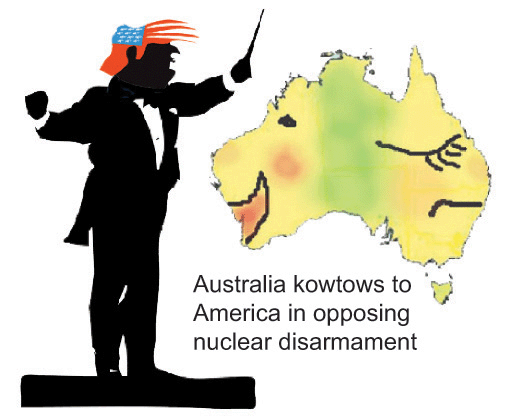
Tim Wright, the Asia-Pacific director of the International Campaign to Abolish Nuclear Weapons, said Australia was turning its back on the UN at a time when multilateral cooperation was more important than ever. He accused Australia of “taking orders from the Trump administration”.
“Every country in south-east Asia and nearly all countries in the Pacific have declared their strong support for the upcoming UN negotiations. Australia will be sitting in self-imposed exile from one of the biggest and most important international treaty-making initiatives in recent history.
“This will be the first time that Australia has ever boycotted disarmament negotiations.
Australia to boycott global summit on treaty to ban nuclear weapons https://www.theguardian.com/world/2017/feb/17/australia-to-boycott-global-summit-on-treaty-to-ban-nuclear-weapons
Anti-nuclear campaigners accuse Australia of turning its back on the UN and ‘taking orders from the Trump administration’, Ben Doherty, Australia will boycott global negotiations on a treaty to ban nuclear weapons at the United Nations next month.
The global summit, to be held in New York on 27 March, will go ahead with Australia out of the room. Continue reading
Final indignity for tiny Aboriginal atomic test victim
 , NT News Nigel Hunt, February 5, 2017 THE exhumation of an Aboriginal infant’s remains from a sacred burial cave in the state’s Far North has provoked outrage from community elders, who are demanding an inquiry to determine how it was allowed to occur.
Trump’s military power – timr for Australia to re-evaluate its US bases
Australia urgently needs to re-evaluate its American bases and promote steps that defuse rather than intensify regional tensions. Having senior Australian defence personnel integrated into the US defence force hinders Australia acting independently. Do we want Australia to be capable of making strategic decisions in the national interest? New Zealand clearly acts in its own interest and remains an ally.
With Trump now the new US Commander-in-Chief, is it wise that we allow ourselves to be so automatically tied to American foreign policy? War in our region would be a humanitarian catastrophe for all involved.
With Donald Trump in power, Australia urgently needs to re-evaluate its US bases http://www.smh.com.au/comment/with-donald-trump-in-power-australia-urgently-needs-to-reevaluate-its-us-bases-20170131-gu2qph.html, Margaret Beavis
Recent changes to the US National Security Council should be ringing loud alarm bells in Canberra.
By demoting the highest-ranking military officer and the highest-ranking intelligence officer, and appointing political adviser Stephen Bannon as a permanent member of the NSC, Donald Trump has seriously escalated the risk of the US launching into ill-advised conflicts. Bannon comes from a role as chairman of the racist, Islamophobic website Breitbart.com, and is reported as having been in charge of writing the recent executive order that has banned US entry for refugees and citizens from seven Muslim-majority nations.
It is no secret that Australian foreign policy and defence forces are closely enmeshed with the US. Since Trump has taken office he has loudly proclaimed an “America first” foreign policy, and his Secretary of State, Rex Tillerson, talks of denying China access to artificial islands in the South China Sea. Any such blockade is likely to be seen by the Chinese as an act of war. Continue reading
Federal govt embarrassed over backlash to its plan to expand Shoalwater Bay military training area
Defence told to look elsewhere as plan to seize Queensland cattle country sparks outcry
PM tells defence to find other sites to train foreign troops amid anger at plan to expand Shoalwater Bay training area, Guardian, Joshua Robertson, 2 Feb 17, Malcolm Turnbull has ordered the Department of Defence to find alternative sites for foreign military training in Queensland after uproar over plans to take over as many as 60 grazing properties in prime cattle country.
The state opposition leader, Tim Nicholls, on Thursday said the prime minister intervened after a growing backlash over the prospect of compulsory acquisitions, revealed months after an election campaign in which the federal government trumpeted a $2.2bn training deal with Singapore.
The controversy prompted Nicholls to write to Turnbull imploring him to step in after what he said was defence’s mishandling of the proposed training site expansion at Shoalwater Bay and near Townsville.
The federal opposition leader, Bill Shorten, wrote to Turnbull on Wednesday calling for him to urgently review the matter and explain what “alternatives to acquiring prime grazing land” had been considered.
Nicholls’ statement raised doubts about what other options defence, which has compulsory land acquisition powers, had explored to date for expanding training bases to host 14,000 Singapore troops a year………
The LNP this week joined state and federal Labor, Katter’s Australian party and One Nation in publicly criticising the process for the land expansion, after the federal government signed the deal with Singapore in May last year to train 14,000 of its troops.
The parties all warned the loss of drought-resistant grazing land in areas that contain up to 100,000 head of cattle would have a dramatic and harmful impact on the beef industry.
In November landholders in the Marlborough and Charters Towers regions first learned of the possibility their properties would be acquired in letters from defence, which had planned an expansion of about 170,000 hectares.
Defence is yet to decide which properties it will target but the defence minister, Marise Payne, recently ordered the process be sped up with those plans to be revealed next month.
Those under pressure include federal backbencher Michelle Landry, whose central Queensland seat of Capricornia is one of the nation’s most marginal……….https://www.theguardian.com/australia-news/2017/feb/02/defence-shoalwater-bay-queensland-compulsory-acquisition?CMP=share_btn_fb
Australia must stop undermining the nuclear disarmament process
To realise the full significance of this, consider the fact that other weapons of mass destruction – chemical weapons, biological weapons, landmines, cluster bombs – have all been prohibited by their respective treaties, and the threats posed by these weapons dramatically reduced as a result. But for nuclear weapons, which literally threaten life on Earth, there is currently no equivalent.
One might have expected that our Foreign Minister, Julie Bishop, who likes spruiking Australia’s commitment to a “rules-based international order”, would welcome the imminent closure of this legal anomaly. On the contrary, however, Australia has been leading the charge to undermine the process.
Australia claims that the ban treaty process has not taken into account the security needs of “all nations” (for which read the US), a curious claim given that our ally stands out as more vulnerable than most to a nuclear weapons attack. In any event, is she really suggesting that the security needs claimed by the nine nuclear-armed nations outweigh the right of the other 187 of us to be rid of this diabolical threat?
That’s a bit like cutting President Bashar al-Assad some slack over his alleged use of chemical weapons in Syria because he has “security needs”. Weapons of mass destruction are not somehow more acceptable because a handful of nations claim that they, and only they, must have them. But, the ban treaty critics say, nuclear weapons are different, and the countries with the weapons will just thumb their collective noses at it.
Not according to a letter in October from the US mission to NATO to its European allies, urging that they oppose the treaty. With an air of desperation to sabotage the whole thing, the US stated that efforts to delegitimise nuclear weapons are at odds with its policy of nuclear deterrence, including extended deterrence for its allies (such as NATO members and Australia). Further, horror of horrors, it “could make it impossible to undertake nuclear planning or training”. Well, yes, that’s the general idea, to delegitimise every aspect of nuclear weapons possession and planning; and all indications are that that goal will be achieved, regardless of who signs the treaty. So much for the toothless tiger notion.
Nevertheless, Australia presses on with its defence of US nuclear weapons, including their possible use on our behalf, not veering from its chosen “progressive” approach to disarmament. This consists of a number of steps that have progressed more slowly over decades than a drunken snail.
The Comprehensive Test Ban Treaty has languished since it was completed in 1996, with little prospect of ever coming into force, and the Fissile Material Cut-off Treaty has been moribund for even longer. In other words, we are told that a stagnant business-as-usual agenda is the way to go, even as 15,000-plus nuclear weapons – 1800 of them still on hair-trigger alert – continue to threaten human suffering of the most grotesque proportions, and all warnings point to increasing risk of their use.
Australia will have to decide very quickly whether we support the majority of nations that have come to their senses and are about to outlaw nuclear weapons, or the Trumps and Putins of this world with their chilling Cold War-style ravings. For a nation that boasts commitment to a “rules-based international order”, the choice hardly seems difficult.
The reality of moving one big step closer to stigmatising, prohibiting and eliminating the most destructive, inhumane, indiscriminate devices ever created is cause for celebration. However, there is another cause for celebration, and that is the capacity of civil society – without which the nuclear weapons ban would not be happening – to mobilise, organise, work with supportive governments and set the agenda for a better world. As the politics of violence, division and hatred loom large on many fronts, such capacity is desperately needed for the huge challenges ahead.
Dr Sue Wareham is a board member of ICAN (Australia), the International Campaign to Abolish Nuclear Weapons.
Maralinga nuclear compensation cases blocked by Bob Hawke when PM
 Hawke government schemed to stymie Maralinga nuclear test compensation, cabinet documents reveal http://www.adelaidenow.com.au/news/south-australia/hawke-government-schemed-to-stymie-maralinga-nuclear-test-compensation-cabinet-documents-reveal/story-fni6uo1m-1227171284110 PETER JEAN POLITICAL REPORTER THE ADVERTISER JAN 1, 2015 THE statute of limitations was invoked by the Hawke Government to prevent hundreds of compensation actions being pursued in court by veterans of British nuclear tests in Australia.
Government documents from 1988 and 1989 released by the National Archives of Australia reveal that cabinet decided to try and invoke time-limit rules to fight court compensation actions launched after 1988. Continue reading
Australia on the wrong side of nuclear disarmament history
As the world pushes for a ban on nuclear weapons, Australia votes to stay on the wrong side of history, The Conversation, Associate Professor, International Education and Learning Unit, Nossal Institute for Global Health, School of Population and Global Health, University of Melbourne November 16, 2016 “………Australia’s role in fighting a nuclear weapon banIn voting “no”, Australia stuck out like a sore thumb among Asia-Pacific nations in at October’s UN committee meeting. All of the Association of Southeast Asian Nations (ASEAN) members – including Indonesia, Malaysia, Singapore and Thailand – as well as New Zealand and ten out of 12 Pacific island countries voted yes.
Australia is signatory to all the key international treaties banning or controlling weapons. On some, like the Chemical Weapons Convention, Australia was a leader. Australia’s active opposition and efforts to undermine moves towards a treaty banning nuclear weapons stand in stark contrast.
Australia’s stated arguments for opposing a ban treaty have varied, including that there are no “shortcuts” to disarmament; that only measures with the support of the nuclear-armed states are worthwhile; that a ban would damage the nuclear non-proliferation treaty, causing instability and deepening divisions between states with and without nuclear weapons; that it wouldn’t address North Korea’s threatening behaviour; and that it does not take account of today’s security challenges.
Perhaps the most extraordinary justification of Australia’s position came from Department of Foreign Affairs and Trade’s first assistant secretary, Richard Sadleir, who said at a Senate estimates hearing on October 20, 2016:
it is not an auspicious time to be pushing for a treaty of this sort. Indeed, in order to be able to effectively carry forward disarmament, you need to have a world in which there is not a threat of nuclear weapons and people feel safe and secure.
Can anyone seriously imagine Australian officials arguing that we need to keep stockpiles of sarin nerve gas, plague bacteria, smallpox virus, or botulism toxin for deterrence, just in case, because we live in an uncertain world?
Yet that is what Australia continues to argue about nuclear weapons. Sadleir is saying that disarmament is only possible after it has happened, when we live in an impossibly perfect world. It’s a nonsensical argument that puts off nuclear disarmament indefinitely.
As revealed in Department of Foreign Affairs and Trade internal documents, released through a Freedom of Information request, the real reason that Australia opposes a ban treaty is that it would jeopardise our reliance on US nuclear weapons.
How Australia can help with disarmament
It’s 71 years since the Hiroshima bombing, and 46 years since the nuclear non-proliferation treaty came into force, committing all governments to bring about nuclear disarmament. But that treaty is too weak: no disarmament negotiations are underway or planned.
Instead, every nuclear armed state is investing massively in keeping and modernising their nuclear arsenals for the indefinite future. The US alone has said it plans to spend about US$348 billion over the next decade on its nuclear arsenal.
Nations like Australia cannot eliminate weapons they don’t own. But they can prohibit them, by international treaty and in domestic law. And they can push other nations to do more to reduce threats to humanity – just as Australia has done with every other weapon of mass destruction.
An overwhelming majority of Australians have said in the past that they support a treaty banning nuclear weapons: 84% according to a 2014 Nielsen poll commissioned by the International Campaign to Abolish Nuclear Weapons, with only 3% opposed.
This is an issue that should be above party politics. In 2015, the Labor Party adopted a new national policy platform committing to support the negotiation of a global treaty banning nuclear weapons. At a public meeting in Perth last month, Bill Shorten said that a Labor government would support the UN resolution for a ban treaty.
In October 2016, our government let us down by voting to be counted on the wrong side of history. Thankfully, we can still expect to see the United Nations ratify the move towards a new treaty banning nuclear weapons in December, with negotiations set to begin in March 2017 in New York. It’s still not too late for Australia to change its vote, and participate constructively in the negotiations next year. https://theconversation.com/as-the-world-pushes-for-a-ban-on-nuclear-weapons-australia-votes-to-stay-on-the-wrong-side-of-history-68337
Australia’s ignominious opposition to UN resolution towards nuclear disarmament
Rattling the nuclear cage, and look who is terrified, Japan Times, BY RAMESH THAKUR , 4 Nov 16, “…….on Oct. 27 the First Committee of the U.N. General Assembly adopted, by the overwhelming vote of 123-38 (with 16 abstentions), Resolution A/C.1/71/L.41, which calls for negotiations on a “legally binding instrument to prohibit nuclear weapons, leading toward their total elimination.” Two conferences will be convened next year in New York (March 27 to 31 and June 15 to July 7). The resolution fulfills the 127-nation humanitarian pledge “to stigmatize, prohibit and eliminate nuclear weapons.”
1 This month
17 October, Free Public Talk on Nuclear Issues in South Australia
David Noonan will speak on public interest concerns over the new Roxby Downs Indenture Act 2026 on BHP copper-uranium mining and ore processing in SA, and on how AUKUS may face SA with a High-Level nuclear waste agenda.
Dr Jim Green will discuss international developments in the field of nuclear power including ‘small modular reactors’ and Generation 4 ‘advanced’ nuclear reactor concepts.


Help Aunty Sue Protect Her Land and Sacred Sites From Destructive Rocket Testing.
.

Australians deserve the truth
about
AUKUS – https://aukuspublicinquiry.com/

PETITION – To: Prime Minister Anthony Albanese and the Australian Labor Government

of the week – Australians for War Powers Reform (AWPR)
To see nuclear-related stories in greater depth and intensity

