Australia sabotages international nuclear disarmament effort
Tim Wright, Asia-Pacific director of the International Campaign to Abolish Nuclear Weapons (Ican), said it was thought that Australia’s foreign minister, Julie Bishop, instructed her diplomats to disrupt the international gathering late on Friday afternoon by forcing a vote. While others then joined Australia to vote against the report, Australia was alone in forcing the vote to happen.
 Australia attempts to derail UN plan to ban nuclear weapons Diplomats force a vote
  on a report to begin negotiations on a ban in 2017 that had been expected to pass unanimously, Guardian, Michael Slezak, 21 Aug 16, Australia has attempted to derail a ban on nuclear weapons at a UN meeting on disarmament, by single-handedly forcing a vote on a report that had been expected to pass unanimously.
The report, which recommended negotiations begin in 2017 to ban nuclear weapons, was eventually passed by 68 votes to 22. An Austrian-led push for the treaty had reached a milestone on Friday, when the report was presented to representatives of 103 nations in Geneva.
Moves towards a ban have been pursued because many saw little progress under the existing non-proliferation treaty, which obliges the five declared nuclear states to “pursue negotiations in good faith” towards “cessation of the nuclear arms race … and nuclear disarmament”.
The proposal recommended a conference be held next year to negotiate “a legally binding instrument to prohibit nuclear weapons, leading towards their total elimination”.
The text was carefully negotiated, and compromise was attempted on contentious paragraphs.
Anti-nuclear campaigners involved in the process expected the report would pass without objection. But Australia surprised observers by objecting and forcing a vote.
The vote was accepted by an overwhelming majority, with 68 voting in favour, 22 against and 13 abstaining.
The next step will be for the proposal for negotiations to begin in 2017 will be tabled at the United Nations general assembly, after which it is likely formal negotiations will begin.
In an opening statement the Australian diplomat Ian McConville told the meeting: “A simple Ban Treaty would not facilitate the reduction in one nuclear weapon. It might even harden the resolve of those possessing nuclear weapons not to reduce their arsenals.”
The Department of Foreign Affairs and Trade said on its website that it opposed a ban on nuclear weapons because although it “might seem to be a straightforward and emotionally appealing way to de-legitimise and eradicate nuclear weapons,” it would actually “divert attention from the sustained, practical steps needed for effective disarmament”.
But in 2015, documents obtained under Freedom of Information revealed Australia opposed the ban on nuclear weapons, since it believed it relied on US nuclear weapons as a deterrent.
“As long as the threat of nuclear attack or coercion exists, and countries like the DPRK [North Korea] seek these weapons and threaten others, Australia and many other countries will continue to rely on US extended nuclear deterrence,” said one of the briefing notes for government ministers.
The documents revealed however that Australia and the US were worried about the momentum gathering behind the Austrian-led push for a ban nuclear weapons, which diplomats said was “fast becoming a galvanising focus for those pushing the ban treaty option”.
Japan’s ambassador to the UN conference on disarmament expressed disappointment that a vote was required.
“We are deeply concerned that the adoption by voting will further divide the international disarmament community and undermine the momentum of nuclear disarmament for the international community as a whole,” he said.
Tim Wright, Asia-Pacific director of the International Campaign to Abolish Nuclear Weapons (Ican), said it was thought that Australia’s foreign minister, Julie Bishop, instructed her diplomats to disrupt the international gathering late on Friday afternoon by forcing a vote. While others then joined Australia to vote against the report, Australia was alone in forcing the vote to happen.
“Australia is resisting the tide of history. A majority of nations believe that nuclear weapons are unacceptable and must be prohibited. And now they are ready to negotiate a ban,” Wright said.
“Australia’s attempt to derail these important disarmament talks was shameful and outrageous. It provoked strong criticism from some of our nearest neighbours in Asia and the Pacific, who believe that the world should be rid of all weapons of mass destruction,” he said.
The acceptance of the report was seen as a major milestone by anti-nuclear campaigners.
“This is a significant moment in the seven-decade-long global struggle to rid the world of the worst weapons of mass destruction,” said Beatrice Fihn, executive director Ican. “The UN working group achieved a breakthrough today.”
“There can be no doubt that a majority of UN members intend to pursue negotiations next year on a treaty banning nuclear weapons,” said Fihn.
“We expect that, based on the recommendations of the working group, the UN general assembly will adopt a resolution this autumn to establish the mandate for negotiations on a ban on nuclear weapons in 2017.”
A Department of Foreign Affairs spokesman said: “Australia called for a vote on the report as it was the most effective way to register our opposition to a recommendation to start negotiations on a ban treaty. A consensus report was not possible in the circumstances…..https://www.theguardian.com/world/2016/aug/21/australia-attempts-to-derail-un-plan-to-ban-nuclear-weapons
Secretive Pine Gap remains an integral part of USA’s nuclear ‘star wars’ plans
Strategic US Military Intel Base in Pine Gap, Australia, By Richard Neville Global Research, April 30, 2008 PINE GAP MIND GAP: A TERROR CELL THAT NEVER SLEEPS. “…..This is Pine Gap, a US military base built on the traditional land of the indigenous Arrernte people, which started life in 1966. Australians were told the facility was to be a weather station. Later the official cover was a “Space Research Centre”. Our citizens remained in the dark until 1975, when Prime Minister Whitlam revealed that Pine Gap’s boss, Richard Stallings, was an agent of the CIA.
Up till then, according to former Minister Clyde Cameron, politicians had regarded the base as “a pretty harmless sort of operation”. Whitlam demanded a list of all CIA agents in the country. This infuriated US spy masters, who put pressure on the Australian Security Intelligence Organisation (ASIO) to shut him up. CIA fears over the leaking of Pine Gaps’ secret activities helped to trigger the murky events that toppled the Whitlam government.

Pine Gap’s first generation of satellites was designed to monitor Soviet missile developments and for espionage in South East Asia, especially Vietnam, and later to spy on China. Since then, both its mission and capabilities have expanded dramatically. The base is believed to have provided targeting information for Israel’s 2006 bombing of Lebanon.
Pine Gap is one of largest and most sophisticated satellite ground stations in the world. Its 26 antennas suck information from the sky and distribute it to US commanders in the field, including in Iraq and Afghanistan, where it is used to co-ordinate air strikes…….
If Australia wishes to regain its reputation as a fair minded nation, the government will need to take a closer look at this secretive installation, an integral part of the US National Missile Defense scheme, or Star Wars.
It aims to put satellite based weapons in space to shoot down any incoming missiles. New radomes (radar + dome) to accommodate the system have already been installed.
The majority of Pine Gap’s 1000 staff are Americans drawn from branches of the US military, including the National Security Agency, Army and Navy Information Operations Command, US Navy and Combined Support Group, Air Intelligence Agency, US Air Force, 704th Military Intelligence Brigade, 743rd Military Intelligence Battalion, Marine Cryptologic Support Command, etc. The base is described as a “joint facility”, although key areas are out of bounds to Australians. While visiting US lawmakers are taken on tours of Pine Gap, Federal MP’s are denied entry. (Members of Congress have collectively invested up to $US196 million in companies with Defense Department contracts, earning millions since the onset of the Iraq invasion. Until May 2007, Hillary Clinton held holdings in Honeywell, Boeing and – yes – Raytheon).
In 2000, the Howard Government rejected calls by Parliament’s Joint Committee on Treaties for a classified briefing on its operations. There is no public debate on the role of Pine Gap, despite its unbending support of all US military actions, regardless of legality or morality. As for the media, they’re asleep at the wheel……..http://www.globalresearch.ca/strategic-us-military-intel-base-in-pine-gap-australia/8858
Botched clean-up of the Maralinga nuclear test site
 Radioactive waste and the nuclear war on Australia’s Aboriginal people, Ecologist Jim Green 1st July 2016 “……..The 1998-2004 debate over nuclear waste dumping in South Australia overlapped with a controversy over a botched clean-up of the Maralinga nuclear weapons test site in the same state.
The British government conducted 12 nuclear bomb tests in Australia in the 1950s, most of them at Maralinga. The 1985 Royal Commission found that regard for Aboriginal safety during the weapons tests was characterised by “ignorance, incompetence and cynicism”.
The Australian government’s clean-up of Maralinga in the late 1990s was just as bad. It was done on the cheap and many tonnes of plutonium-contaminated waste remain buried in shallow, unlined pits in totally unsuitable geology.
Nuclear engineer and whistleblower Alan Parkinson said of the clean-up: “What was done at Maralinga was a cheap and nasty solution that wouldn’t be adopted on white-fellas land.”
Dr Geoff Williams, an officer with the Commonwealth nuclear regulator, the Australian Radiation Protection and Nuclear Safety Agency, said in a leaked email that the clean-up was beset by a “host of indiscretions, short-cuts and cover-ups”.
Nuclear physicist Prof. Peter Johnston noted that there were “very large expenditures and significant hazards resulting from the deficient management of the project”.
Prof. Johnston (and others) noted in a conference paper that Traditional Owners were excluded from any meaningful input into decision-making concerning the clean-up. Traditional Owners were represented on a consultative committee but key decisions – such as abandoning vitrification of plutonium-contaminated waste in favour of shallow burial in unlined trenches – were taken without consultation with the consultative committee or any separate discussions with Traditional Owners.
Federal government minister Senator Nick Minchin said in a May 2000 media release that the Maralinga Tjarutja Traditional Owners “have agreed that deep burial of plutonium is a safe way of handling this waste.” But the burial of plutonium-contaminated waste was not deep and the Maralinga Tjarutja Traditional Owners did not agree to waste burial in unlined trenches – in fact they wrote to the Minister explicitly dissociating themselves from the decision.
Barely a decade after the Maralinga clean-up, a survey revealed that 19 of the 85 contaminated waste pits have been subject to erosion or subsidence.
Despite the residual radioactive contamination, the Australian government off-loaded responsibility for the contaminated land onto the Maralinga Tjarutja Traditional Owners. The government portrayed this land transfer as an act of reconciliation. But it wasn’t an act of reconciliation – it was deeply cynical. The real agenda was spelt out in a 1996 government document which said that the clean-up was “aimed at reducing Commonwealth liability arising from residual contamination.”……http://www.theecologist.org/News/news_analysis/2987853/radioactive_waste_and_the_nuclear_war_on_australias_aboriginal_people.html
First a propaganda push for nuclear waste importing, then one for nuclear submarines
Federal election 2016: nuclear-powered subs needs discussion, PETER JENNINGS, THE AUSTRALIAN, JUNE 7 “……..Readers will appreciate the irony of Australia selecting the French-designed Shortfin Barracuda — a nuclear submarine that will be adapted to conventional propulsion……….
[2016 white paper] –
“During the long life of the new submarines, the rapid rate of technological change and ongoing evolution of Australia’s strategic circumstances will continue. As part of the rolling acquisition program, a review based on strategic circumstances at the time, and developments in submarine technology, will be conducted in the late 2020s to consider whether the configuration of the submarines remains suitable or whether consideration of other specifications should commence.”
This could be hinting that nuclear propulsion may be considered a decade or more from now. However, no Australian government in the 2030s or later will be in a position to adopt nuclear propulsion unless earlier decisions have been taken to prepare the ground for such a major development…….
After the 2016 election, the government should start to scope out what steps might sensibly be taken to create a realistic option for nuclear propulsion at the end of the 2020s. A key part of this strategy should be to have an open discussion with the Australian people explaining the basis for the submarine design decision. Government should consider the following steps:
1. Commission an expert panel to evaluate the necessary steps to position for a nuclear propulsion option. The panel should produce a public discussion paper setting out the challenges, risks, opportunities, financial cost and industry requirements necessary to support this technology. Continue reading
Montebello nuclear test veterans return to site – no compensation over 60 years later
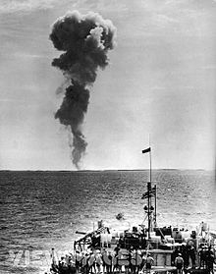 Atomic test veterans back at Montebello Islands as compo bid drags on Malcolm Quekett – The West Australian on May 4, 2016 “……After returning to HMAS Fremantle, the sailors were tested with the Geiger counter and told they had to decontaminate themselves using a hard brush and soap under the shower.
They stayed under the water for hours and scrubbed. But they were then told they were wasting their time. They were showering under sea water which was itself contaminated.
Mr Whitby said he collapsed soon afterwards and was taken to a naval hospital in Darwin where he stayed for a week, lost one-third of his body weight and developed extreme anxiety and a chronic cough.He was transferred to hospital in Perth for another two weeks. “No one had any knowledge of radiation illness,” he said.
Mr Whitby was eventually discharged from the Navy in 1961, but the problems have followed him to this day. He said he developed skin cancers that had to be removed, and he still had the anxiety and the cough.
His best man, who had gone ashore with him, died at the age of 38 from cancer, and another mate died before turning 40. Wives of men on the ship suffered miscarriages.
After years of struggling to have his case acknowledged by officialdom, the Administrative Appeals Tribunal found in 2012 that he should be paid compensation and have his legal bills met.
Mr Whitby, 76, of East Fremantle, said he was still waiting. A Department of Veterans’ Affairs spokesman said the DVA was “investigating the claims and will be in a position to respond when that investigation is complete”.
Mr Whitby has allies among the other members of the Australian Ex-Services Atomic Survivors Association. Between 1952 and 1957, Britain conducted 12 atomic tests at the Montebellos as well as Emu Field and Maralinga in South Australia.
“Minor trials” were also conducted at Emu Field and Maralinga between 1953 and 1963. Next month, members of the association and family members will journey to the Montebellos to place a plaque to mark the 60th anniversary of the last test.Among them are Jim Marlow, 80, of Canning Vale, Rex Kaye, 76, of Melville, and Denis Flowers, 80, of Ferndale, who will all pay their own costs to be part of the expedition.
Mr Marlow was aboard HMAS Karangi near the Montebellos when one of the tests took place. He said the crew assembled on deck and were told to turn their backs just before the explosion, and then turned back again to see the massive cloud build up.
Mr Kaye was a general hand in the Royal Australian Air Force and worked with planes used in the SA tests. He said he was still fighting leukaemia and side effects……..https://au.news.yahoo.com/thewest/wa/a/31511899/atomic-test-veterans-back-at-montebello-as-compo-bid-drags-on/
The submarine boondoggle- over $2000 per each Australian
4. BUT WAIT THERE’S MORE So we spend $2,000 each. That just gets us the big lumps of steel. If you actually want to use them, you’re paying more. It could be another $2,000 to $4,000 per Australian….
OPTIONS The great thing about the way the acquisition will work is there should be the opportunity to cut back from 12 when the inevitable delays and cost blowouts happen. From here we can’t save the whole $2000 but maybe we can save some, for better uses.
 Sub standard: why the $2,000 we are each spending on submarines will probably be a terrible waste http://www.news.com.au/technology/innovation/design/sub-standard-why-the-2000-we-are-each-spending-on-submarines-will-probably-be-a-terrible-waste/news-story/6922de6f6a72657c669fdc1a1248916f APRIL 30, 2016, Jason Murphy news.com.au@jasemurphy AUSTRALIA is spending $50 billion to buy submarines. The biggest whack of money we’ve ever spent on a Defence project. It comes out at $2000 per person. And it’s probably a shocking idea. Continue reading
Liberal coalition plans nuclear submarine fleet so that we can fight China
Coalition plans nuclear-powered submarine fleet over long term. Fin Rev, by Aaron Patrick and Phillip Coorey, 1 MAY 16
Some of Australia’s new submarines could be nuclear-powered by the time they enter service, making them much more potent against the huge Chinese navy.
One of the reasons French ship builder Direction des Constructions Navales Services, also known as DCNS, won the $50 billion contract was its ability to switch easily to a nuclear version of the submarines being designed for the Royal Australian Navy.
That is because the Australian diesel-powered Shortfin Barracuda will be a shorter, lighter version of a nuclear submarine already being manufactured by DCNS in Cherbourg on the English Channel.
Cabinet ministers and defence officials have already discussed the possibility of switching from diesel engines to nuclear power part-way through the construction contract, political, government and industry sources say.
The Coalition wants to keep the option open in case public opposition to nuclear power changes in the future. National polls taken from 2006 to 2009 found between 35 and 50 per cent of Australians supported introducing nuclear power, a study by the National Academies Forum showed.
DCNS, which is majority owned by the French government, is expected to start building the Australian submarines in Adelaide next decade. The last one might not be completed until 2050.
The other bidders for the contract, Germany’s Thyssenkrupp Marine Systems and Japan’s Kawasaki Heavy Industries and Mitsubishi Heavy Industries, don’t make nuclear submarines………..
The government, which has been criticised for opting to build the submarines in Australia, said it was not considering switching to a nuclear-powered version………
Another drawback of nuclear reactors is that, unlike diesel motors, they can’t be turned off to make the submarine silent.
Australia’s submarines are unusual. They would be the only conventionally powered ones that used pump jets for propulsion rather than propellers, Stephan Fruehling, a defence expert at the Australian National University’s College of Asia and the Pacific, said.
The Coalition government quietly supports developing a nuclear industry in Australia and on Friday proposed storing radioactive waste on a remote South Australian cattle station.
It has encouraged the South Australian Labor government to push ahead with a debate over storing spent nuclear rods from overseas. Given the submarines will be built in Adelaide and South Australia has some of the largest uranium deposits in the world, the state could one day become the centre of an Australian nuclear industry. http://www.afr.com/business/manufacturing/coalition-plans-nuclearpowered-submarine-fleet-over-long-term-20160429-goieal
Australia’s unrecognised nuclear test veterans – sailors on HMAS Murchison 1952
HMAS Murchison conscripts still seeking recognition as nuclear participants, SMH, Lucy Cormack April 24, 2016 – Ken Palmer remembers standing on the upper deck of the HMAS Murchison in 1952. Dressed with his fellow national serviceman in “shorts and sandals,” he remembers the mushroom cloud, formed from the explosion of Britain’s first atomic bomb at the Monte Bello archipelago, off Western Australia.
“They said, don’t face the blast and when I tell you, you can turn around. We had just left our mother’s breast, we didn’t think much about it,” said Mr Palmer, now in his 80s.
“When we got to Monte Bello it was a complete surprise to us. Nobody ever told us we were there . . . circling [to keep] everybody else out of the road until the climate was right to explode this atomic bomb in the bowels of the H.M.S. Plym.”
Mr Palmer is one of 23 surviving national serviceman of the 62 that were conscripted to serve on the Murchison in October 1952.
This Anzac Day Mr Palmer is hoping to reignite a long-running campaign of the surviving servicemen, seeking recognition as “Australian Participants” in the British government’s nuclear tests at the Monte Bello archipelago.The campaign was launched around eight years ago by the late Michael Rowe, who also served on the Murchison. He believed many of the cancers and illnesses suffered by his shipmate were related to nuclear radiation, following their time on the Murchison.
Mr Rowe began the campaign after a 2006 decision to award health care assistance to participants in Britain’s atomic bomb tests, with the exclusion of all serviceman on the Murchison, on grounds they were not close enough to the blast site.
Radiation exposure claims not accepted
A Department of Veterans’ Affairs spokesperson said Defence Force members who served on the Murchison could claim compensation and benefits under the Safety, Rehabilitation and Compensation Act for any condition, however any claim based on radiation exposure “would not be accepted.”………
Another national serviceman, Col Crawford, said “there was no denying we were there,” adding that he had given up the fight long ago, as it had become “complete and utter bureaucratic nonsense”.
Sandy Godfrey, who has assisted Mr Palmer and his fellow serviceman with their campaign over the years, said he cannot understand the “arbitrary” barriers being put up by the government.”The way the nuclear test participant has been defined in the Veterans Entitlement Act gives an arbitrary 10 kilometre radius, which excludes an enormous number of people that actually participated in the testing in the 50s,” he said.
“From our point of view it appears the government are waiting for them to die, so the issue will disappear.” http://www.smh.com.au/national/hmas-murchison-conscripts-still-seeking-recognition-as-nuclear-participants-20160422-gocy6r.html
Australia’s $150 billion Defence white elephant spending
Sub-standard plan for Defence, SMH, February 27, 2016 Michael West Business columnist After a welter of strategic press leaks, targeted with the precision of a laser-guided missile, the 2016 Defence white paper was finally unveiled this week.
Defence spending has the added allure of political expedience. Who can argue with a government bent on safeguarding its citizens from future unspecified invaders? Certainly not the opposition……
It may cost taxpayers $150 billion.
 Although the cost to design and build each of the 12 submarines is mooted at $4 billion – just shy of a Medibank float – the cost of running them is far greater. They describe the submarine spend as the “largest defence procurement program in Australia’s history”.
Chance of attack is small
The white paper concedes there is but a remote chance of a military attack on Australian territory by a hostile foreign power. Further, it says Australia cannot afford to equip, train and prepare its military forces solely for the remote prospect of such a major attack.
This would leave the defence forces less capable of addressing the wide range of more likely threats Australia faced to 2035.
So the policy is therefore to devote unprecedented billions of dollars, the biggest defence outlay ever, to build submarines on the implausible chance of a foreign military attack.
China is not discussed much, though it is deemed by Defence to be the biggest threat. There are a few brief references in the paper though there is no discussion of what sort of force we would need if China were to attack.
And you don’t have to be a defence guru to work out that Australia would stand little chance of withstanding a Chinese military with its 70 submarines, 2.3 million frontline personnel and $US155 billion defence budget.
The white paper’s submarine analysis is flimsy. The first subs only become operational in the 2030s, at the end of the strategic environment which the paper addresses.
It fails moreover to establish why this weapon system is superior to far more agile, responsive and modern air and surface weapon systems for meeting the faint threat of invasion, or how the huge outlay is justified……
The public deserves better than for this critical issue of defence spending to be treated as such a sacred cow that there is no debate about it in Parliament and no more than feeble inquiry in the mainstream media.
You could select the tiniest thing on the share market and bet it would boast superior disclosures to Defence white paper 2016.
Rather than having cash thrown at them willy-nilly, the armed forces should undergo the same blow-torch as other institutions. You can bet there is a lot more fat in defence than the ABC (whose white paper coverage has also been lame).: http://www.smh.com.au/business/comment-and-analysis/substandard-plan-for-defence-20160226-gn4cx3.html#ixzz41PkqKAgL
Australia’s nuclear weapons plan, and the connection with NSW nuclear reactor
On Nov. 2, 1956, Australia’s Defense Committee formally recommended the acquisition of kiloton-range tactical nuclear weapons.
In 1969, the government announced plans to construct a 500-megawatt nuclear reactor at Jervis Bay in New South Wales.
The intention was clear — this reactor was to support a nuclear weapons program. The reactor project pushed ahead and preliminary site work commenced.
 Revealed: Australia’s Failed Bid for Nuclear Weapons, Chris Walsh, The
  National Interest 16 Sept 15, At 9:00 in the morning on Oct. 3, 1952, a 25-kiloton nuclear explosion vaporized the retired British frigate HMS Plym off Australia’s remote western coast. The Operation Hurricane detonation in the Monte Bello Islands was a seminal moment for Britain and marked its return to the club of great powers.
But for Australia, these tests and others served a murkier purpose – as important and deliberate steps toward Australia’s own acquisition of nuclear weapons. It was in the tense Cold War environment of the late 1950s and early 1960s that these aspirations moved beyond talk and into concrete action.
By the time the Hurricane detonation took place, Australia was already experienced in weapons of mass destruction. From 1943 and in the shadow of a possible Japanese invasion, Australia built extensive stocks of chemical weapons and delivery systems…….
Australia — with its vast coastlines and deserts — emerged as a key player in Britain’s nuclear strategy.
When Britain approached Australia to host nuclear tests, a sympathetic government led by Prime Minister Robert Menzies readily agreed. While Menzies — an Anglophile — focused on his relationship with the United Kingdom, others saw this as an opportunity for Australia to buy membership into the nuclear club. Continue reading
Australia, formerly a leader on nuclear disarmament, now a leper in the regional disarmament movement
 Australia’s earlier leadership on nuclear disarmament had diminished over the past four years.
“We know what Australia is saying ‘no’ to. It is saying ‘no’ to the humanitarian consequences pledge. Well, what is it saying ‘yes’ to?”
Australia resists new global push for nuclear disarmament, Guardian, Ben Doherty, 16 Sept 15 Diplomatic cables reveal prospects for nuclear disarmament are ‘bleak’ as Australia becomes increasingly lonely in opposing 116-nation push for ban
Prospects for nuclear disarmament are “bleak” under the current non-proliferation treaty, Australian diplomats have conceded in cables back to Canberra, but the country will resist growing global support for a new treaty banning nuclear weapons because of a dependence on the nuclear deterrent capability of the US.
A tranche of internal government emails from within the Department of Foreign Affairs and Trade reveals Australia’s opposition to a 116-nation push to ban nuclear weapons is leaving it increasingly isolated globally, and especially among anti-nuclear neighbours. The emails, released under freedom of information, reveal Australia is increasingly worried about an Austrian-led push for a treaty to ban all nuclear weapons. Continue reading
Australia’s history of trying to get nuclear weapons
 In 1969, the government announced plans to construct a 500-megawatt nuclear reactor at Jervis Bay in New South Wales. The intention was clear — this reactor was to support a nuclear weapons program.
in 1972, the conservative Gorton government was swept from power and replaced. Gough Whitlam, a longtime advocate of arms control, wasted no time ratifying the NPT and abandoning the Jervis Bay reactor. In a heartbeat, the 40-year quest for Australian nuclear capability was over.
Australia’s Failed Bid for the Bomb, War Is Boring, Chris Walsh, 15 Sept 15 Canberra was captivated by atomic weapons in the 1950s — then ruined its chances of ever getting them
At 9:00 in the morning on Oct. 3, 1952, a 25-kiloton nuclear explosion vaporized the retired British frigate HMS Plym off Australia’s remote western coast. The Operation Hurricane detonation in the Monte Bello Islands was a seminal moment for Britain and marked its return to the club of great powers.
But for Australia, these tests and others served a murkier purpose – as important and deliberate steps toward Australia’s own acquisition of nuclear weapons.
Joint Standing Committee on Treaties (JSCOT) shows big hurdles in selling uranium to India
 Miles to go: exporting uranium to India http://www.onlineopinion.com.au/view.asp?article=17665, By M V Ramana – 11 September 2015 Plans to export uranium from Australia to India may have hit their most significant hurdle so far in the form of Report 151 of the federal Parliament’s influential Joint Standing Committee on Treaties (JSCOT). After much deliberation and expert testimony, the Committee has put forward a number of recommendations that India has to abide by before Australian uranium is sold to India. The history of India’s nuclear programme and the country’s stand in various diplomatic fora suggest that there is little chance of India agreeing to these conditions.
The first three recommendations laid out in the JSCOT report are particularly important. The first and second recommendations pertain to India acceding to the Comprehensive Test Ban Treaty (CTBT) and negotiating a fissile material cut-off treaty as well as a nuclear arms limitation treaty for the Indian subcontinent region. The third recommendation is focused on the safety and efficacy of the safeguards and standards of nuclear facilities in India arguing that a series of key checks and balances must be put into practice and proven to work before any uranium sales. If taken seriously, these recommendations will make it all but impossible for the Australian government to sell any uranium to India. Continue reading
Increasing danger of #nuclear submarines in Indo Pacific oceans
‘the more submarines you put in the same body of water, the higher the probability they might collide’.
Indo-Pacific nuclear sub threat to rival Cold War AFR, by John Kerin, 3 Sept 15 The Indian and Pacific Oceans are becoming increasingly crowded with nuclear armed and conventional submarines increasing the risk of collision and nuclear conflict.
The warning is contained in a new Lowy Institute of International Affairs paper to be released on Friday which argues the region faces the greatest threat of a miscalculation involving nuclear armed submarines since the Cold War era.
“The regional contests for influence between the United States and China and China and India do not yet have the existential or ideological ‘life or death character’ of the Cold War,” the paper by Professor Rory Medcalf of the ANU based National Security College and Brendan-Thomas Noone from the Lowy International Security Program says.
“But quite literally below the surface a new and dangerous competition is emerging as China and India in particular start deploying nuclear weapons at sea………. Continue reading
Australia, India hold naval exercise, ramping up tensions in Indian Ocean
Australia, India to Hold First Ever Naval Exercise Amid China Concerns ( Source- The Diplomat / Author- Prashanth Parameswaran) September 1, 2015, Manoj Ambat, Prashanth Parameswaran
1 This month
17 October, Free Public Talk on Nuclear Issues in South Australia
David Noonan will speak on public interest concerns over the new Roxby Downs Indenture Act 2026 on BHP copper-uranium mining and ore processing in SA, and on how AUKUS may face SA with a High-Level nuclear waste agenda.
Dr Jim Green will discuss international developments in the field of nuclear power including ‘small modular reactors’ and Generation 4 ‘advanced’ nuclear reactor concepts.


Help Aunty Sue Protect Her Land and Sacred Sites From Destructive Rocket Testing.
.

Australians deserve the truth
about
AUKUS – https://aukuspublicinquiry.com/

PETITION – To: Prime Minister Anthony Albanese and the Australian Labor Government

of the week – Australians for War Powers Reform (AWPR)
To see nuclear-related stories in greater depth and intensity

