Nuclear veterans failed by Australian Human Rights Commission
The Australian Human Rights Commission shot down on Tuesday the nuclear veterans’ last legal avenue on a technicality – after 10 months they have just decided they can’t do anything as they don’t think they have jurisdiction.
Can you imagine finding out that our military personnel, our diggers, were sent into the desert, into the sky and out into our oceans to supervise, watch and secure, the explosion of radioactive nuclear weapons with little more protection than the shirt on their back?
You need not imagine because 61 years ago the Australian government, under the guise of former Prime Minister Sir Robert Menzies, approved radioactive nuclear weapons to be detonated on Australian soil, and in our oceans, not once but hundreds of times between 1952 and 1963.
The result is a generation of our diggers lost to horrific radiation related cancers and illnesses. Out of the 8000 servicemen sent to Maralinga, Emu Field and the Monte Bello islands, some 2,000 remain living, fighting and suffering amongst us.
To think of the prospect that any human being, let alone our diggers, would be knowingly exposed to the effects of radiation after seeing the consequences of atomic weapons just seven years earlier in Japan is unforgiveable. Continue reading
The few surviving Maralinga nuclear veterans lose yet another case for justice
 Australian veterans affected by nuclear testing lose final bid for case to be heard http://www.abc.net.au/news/2013-12-10/veterans-affected-by-british-nuclear-testing-lose-court-bid/5147678 By Sally Block 10 Dec 2013 Australian veterans of British nuclear testing in the 1950s and 1960s have lost their bid to have their case investigated.
About 300 surviving members of the Australian Defence Force applied to the Australian Human Rights Commission to have their case heard.
The veterans were involved in the nuclear tests by the British at Maralinga, Emu Field and Monte Bello islands. Their lawyers argued the Menzies government at the time exposed them to the harmful effects of radiation in full knowledge of the damage to their health and that is a breach of the Universal Declaration of Human Rights.
The Commission knocked them back, saying it is out of their jurisdiction to inquire into the acts or practises by the Commonwealth that are alleged. Continue reading
Australia lags in acknowledging the humanitarian impact of nuclear weapons
The next conference addressing the humanitarian impact of nuclear weapons will be held in Mexico City in February 2014. Australia should strongly support recognition of the following four points being argued by the Red Cross: 1) the catastrophic humanitarian consequences of any use of nuclear weapons; 2) the lack of any adequate humanitarian response capacity; 3) the incompatibility of any use of nuclear weapons with the rules of international humanitarian law; and 4) the need for concrete action leading to a prohibition on the use of nuclear weapons and their elimination.
 Underlining the horror of nuclear arms http://www.japantimes.co.jp/opinion/2013/11/26/commentary/underlining-the-horror-of-nuclear-arms/#.UpY1NNJwo7o BY RAMESH THAKUR NOV 26, 2013CANBERRA – Because of the unique destructive capacity and uncontrollable effects of nuclear weapons, the almost indescribable horror associated with their use informed the very first resolution of the U.N. General Assembly in 1946 and has been a recurring theme ever since in blue ribbon international commissions, NPT review conferences and preparatory committee meetings, and General Assembly committee debates.
Given the presently stalled nuclear disarmament agenda, the most productive way forward for both committed state and civil society actors to generate political momentum for the cause may be to emphasize the catastrophic humanitarian consequences of any use of nuclear weapons. The only way to guarantee their non-use ever is their total, irreversible and verifiable elimination under effective international control.
On Oct. 21, speaking in the U.N. General Assembly’s First Committee on behalf of 123 countries and the Holy See, New Zealand’s outgoing disarmament ambassador Dell Higgie issued a statement on the humanitarian consequences of nuclear weapons.
It noted that the broad participation at the March 2013 Oslo Conference, with attendance by 128 states (but not one nuclear-armed state nor most who shelter under their nuclear umbrellas), the ICRC, and several U,N, and civil society humanitarian organizations, reflected the recognition that the catastrophic humanitarian consequences of nuclear weapons are a major global concern. Yet no country or international body has the capacity to address the immediate humanitarian emergency caused by a nuclear weapon detonation or provide adequate assistance to victims.
Intriguingly because of their close relations on so many issues, on the same occasion Australia’s ambassador to the U.N. in Geneva, Peter Woolcott, issued a parallel statement on behalf of 17 countries, mainly those protected by U.S. nuclear weapons under extended nuclear deterrence (Belgium, Canada, Germany, Italy, Netherlands, Poland, Spain, Turkey, etc.).
Japan was the only country to sign both statements. The Australia statement emphasized “both the security and the humanitarian dimensions of the nuclear weapons debate.”
It is not clear that the different Australian position was actually ever signed off by the minister in the last Labor government, as opposed to being official Australian policy as determined and articulated by the bureaucracy. Continue reading
Bikini nuclear tests as cause of 1954 Adelaide earthquake?
The electromagnetic pulse and ionization of the atmosphere resulting from the high-yield nuclear bomb Bravo was clearly associated with Adelaide earthquake.
 The Castle Bravo nuclear explosion of 1954. Part 1: Bobby 1’s Blog 21 Nov 13 In the Adelaide, Australia earthquake in the early morning of March 1, 1954, residents of Adelaide, Australia were awakened to a violent shaking in their beds. When they went outside, they saw a brilliant glow in the east. The United States had just set off the Castle Bravo nuclear bomb on Bikini Island, 3,600 miles away.On March 1, 1954, the detonation of an estimated 15 megaton thermonuclear weapon, known as “Bravo” took place – as part of the “Castle” test series. According to the U.S. Radiochemistry Society, “the Bravo test created the worst radiological disaster in US history ….the yield of Bravo dramatically exceeded predictions, being about 2.5 times higher than the best guess and almost double the estimated maximum possible yield (6 Mt predicted, estimated yield range 4-8 Mt).” The bomb was over 1000 times more powerful than those exploded over Hiroshima and Nagasaki in 1945. The Bravo crater in the atoll reef had a diameter of 6,510 ft, with a depth of 250 ft. The cloud top rose and peaked at 130,000 feet (almost 40 km) after only six minutes. Eight minutes after the test the cloud had reached its full dimensions with a diameter of 100 km, a stem 7 km thick, and a cloud bottom rising above 55,000 feet (16.5 km), and after 10 minutes had a diameter of more than 60 miles.
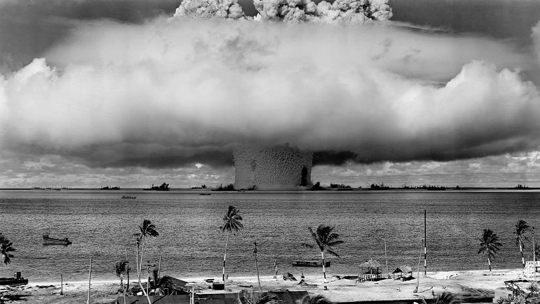
The radioactive fallout from Bravo covered the planet, including the Southern Hemisphere. It was a fission-fusion-fission bomb, designed to release high levels of radioactivity. Its yield was 15 megatons, but it released almost seven times as much radiation than the Russian Tsar Bomba, which had a yield of 50 megatons. Continue reading
Australia’s forgotten nuclear veterans
LEST WE FORGET NUCLEAR VETERANS HTTP://GREENS.ORG.AU/NEWS/LEST-WE-FORGET-NUCLEAR-VETERANS Between 1952 and 1963, approximately 16,000 Australian civilians and serviceman were exposed to nuclear fallout when British nuclear weapons were tested at the Montebello Islands in Western Australia, Maralinga and Emu fields in South Australia, and over the Christmas and Malden Islands.
“Today Australians mark the sacrifice, suffering and deaths of our servicemen and women in all wars, but unfortunately some of our veterans have been forgotten,” said Australian Greens spokesperson on nuclear policy, Senator Scott Ludlam.
“We are running out of time to exercise our duty of care to the 1892 Australian nuclear veterans that are denied Gold Card health care costed by the Parliamentary Budget Office at less than $30m per year. Continue reading
Tribunal awards war widow pension regarding veteran harmed by Monte Bello nuclear radiation
A decision this month by the Veterans’ Appeals division of the Administrative Appeals Tribunal upheld the finding that Mr Prior’s death was linked to his work with the British Nuclear Test Defence Service.
Relying on 57-year-old log books of Operation Mosaic – the code name given to the atomic weapons testing at the Monte Bello islands – as well as a witness account of the explosion and design points of the aircraft, the tribunal found Mr Prior would have suffered contamination.
 The tribunal heard Mr Prior suffered from a very rare skin condition that could have been caused by ionising radiation.
Specialists said the itching and pain could be so severe as to lead to depression and suicidal thoughts, with itching permeating every aspect of live, including sleeping.
The court found “there was a connection between Mr Prior’s exposure to ionising radiation and his skin condition which caused chronic pain” and upheld the decision to award the pension.
 Wife of veteran involved in Monte Bello Island nuclear test wins war widow pension JESSICA MARSZALEK NEWS LIMITED NETWORK OCTOBER 07, 2013 http://www.couriermail.com.au/news/national/wife-of-veteran-involved-in-monte-bello-island-nuclear-test-wins-war-widow-pension/story-fnihslxi-1226734294281A VETERAN’S wife has won a 10-year fight for the war widow’s pension after she successfully argued her husband committed suicide because of his involvement in atomic bomb testing in Australia.
The retired Air Commodore, who was stationed at Richmond in NSW and served in Vietnam, was 67 years old when he died in October 2001 – a death deemed not to attract the $840 fortnightly war widow payment. Continue reading
Abbott govt accelerates sale of uranium to India, as India fires another nuclear-capable missile
 India, Australia to hold third round of nuclear talks IANS | http://ibnlive.in.com/news/india-australia-to-hold-third-round-of-nuclear-talks/427039-3.html?utm_source=ref_article Oct 07, 2013 New Delhi: India and Australia, under the new dispensation of Prime Minister Tony Abbott, are hoping to hold a third round of talks on nuclear cooperation in December this year, said a top official on Monday. Secretary (East) in the external affairs ministry Ashok K Kantha said Abbott has “made positive comments about the need for expediting, accelerating negotiations between India and Australia on nuclear cooperation”.
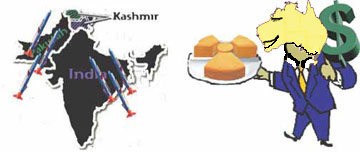
“We already have held two rounds of negotiations, and we are hoping to hold a third round of negotiations if possible in December this year.  We have not yet firmed up the dates. But I believe there is a strong desire on both sides to try and bring these negotiations to a successful conclusion at an early date,” said Kantha at a briefing in New Delhi.
India test fires nuclear capable missile from Odisha Tribune, By Web Desk October 7, 2013 ODISHA: India test-fired a nuclear-capable Prithvi-II missile from a test range at Chandipur, Odisha on Monday, Express News reported……The Prithvi II missile was inducted into India’s Strategic Forces Command in 2003 and is the first missile developed by DRDO under India’s IGMDP (Integrated Guided Missile Development Program.
The missile is capable of carrying 500 to 1000 kilograms of warheads according to The Hindu.
On September 14, India successfully test-fired for a nuclear-capable missile that can reach Beijing and much of Europe. http://tribune.com.pk/story/614650/india-test-fires-nuclear-capable-missile-from-odisha/
Hypocrisy of Australian Government’s opposition to nuclear disarmament
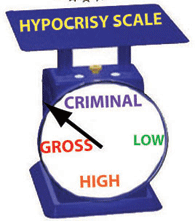 ”These declassified exchanges between government officials clearly demonstrate that Australia’s talk of nuclear disarmament has been insincere and hollow.”
Diplomats ducked push for nuclear ban in favour of defence http://www.smh.com.au/federal-politics/diplomats-ducked-push-for-nuclear-ban-in-favour-of-defence-20131001-2uqs2.html October 2, 2013 Philip Dorling The former Labor government in effect abandoned its advocacy of nuclear disarmament because it considered continued reliance on ”extended nuclear deterrence” provided by the US to be an essential foundation for Australia’s defence strategy.
Australian officials are also planning to work against humanitarian organisations campaigning for a ban on nuclear weapons, according to diplomatic documents released under freedom of information.
Declassified diplomatic cables, emails and briefings show the Australian government refused to endorse an 80-nation statement delivered at this year’s non-proliferation treaty meeting in Geneva in April because it included a reference to an International Red Cross resolution highlighting ”the incalculable human suffering associated with any use of nuclear weapons”.
Australian officials considered this reference to be part of a campaign to delegitimise the possession of nuclear weapons, including by Australia’s ally the US.
Adelaide to Darwin rail line to be a military transport every fifth day?
 Defence bid to control section of the Adelaide to Darwin rail line on one in every five days of the year MILES KEMP THE ADVERTISER SEPTEMBER 11, 2013 http://www.couriermail.com.au/news/national/defence-bid-to-control-section-of-the-adelaide-to-darwin-rail-line-on-one-in-every-five-days-of-the-year/story-fnii5yv5-1226717271710 SOUTH Australia’s iconic Ghan rail journey is under threat by a Defence Department bid to control a section of the Adelaide to Darwin rail line on one in every five days of the year. Continue reading
Radio: Adelaide the hub of military industrial intelligence nuclear complex
The issue isn’t nuclear power. The issue is processing uranium for nuclear power that then can be used for defence
You have to understand this in terms of in terms of Adelaide, -it’s a military industrial intelligence complex
Simons is connected to the University College of London but basically he’s a front man for business interests, We can clearly question what he is doing given the fact that he’s getting funding from indirect corporate sources.

 AUDIO: https://radio.adelaide.edu.au/nuclear-power-in-south-australia-a-golden-age/ Nuclear Power in South Australia – a golden age? Radio Adelaide 23 Aug 13 Chris Komorek spoke with Dr David Palmer from Flinders University to explore the changing landscape. Produced by Ian Newton. TRANSCRIPT by Christina Macpherson
Chris Komorek As the uranium debate heats up, so does the destroyed reactor in Fukushima, Japan.The International Energy Policy Institute at the University College London’s Adelaide campus is advocating a ramped up nuclear industry here in South Australia. We’re joined by Dr David Palmer from Flinders University.
Australia’s hypocrisy on the South Pacific Nuclear Free Zone Treaty
Declassified documents from the National Archives of Australia, including the 1985 Cabinet minute about the SPNFZ Treaty, show clearly that Australia designed the treaty to protect US interests in the Pacific, including the deployment of nuclear-armed warships and the testing of nuclear missiles.
Hayden’s cabinet submission includes details of Australian negotiating positions in the final months before the treaty was signed:
(iii) Australia oppose the inclusion in the draft SPNFZ Treaty of a ban on missile tests.
(iv) Australia oppose the inclusion in the draft SPNFZ Treaty of a ban on the facilitation of the stationing of nuclear weapons,
Delaying the nuclear-free zone in the Pacific, Inside story, 27 Aug 13 As Pacific leaders gather this week in the Marshall Islands, the United States continues to delay ratification of the South Pacific Nuclear Free Zone Treaty. Using previously classified documents Nic Maclellan recounts a history of opposition to a nuclear free Pacific, and a reminder that Australia could be breaching the treaty
AT THE height of the nuclear arms race between the United States and Soviet Union, a treaty to create a South Pacific Nuclear Free Zone, or SPNFZ, was opened for signature on Hiroshima Day, 6 August 1985, at the Pacific Islands Forum meeting in Rarotonga. Twenty-eight years after it was signed on that day by Australia, New Zealand and island nations, the United States still hasn’t ratified its protocols, Continue reading
ICAN calls on universities, Future Fund, to stop investing in nuclear weapons,

A lot of Australians would be shocked to learn that the Future Fund has more than A$130 million invested in companies that manufacture nuclear arms.
“It’s easy to imagine that Australia is not involved in the global nuclear weapons trade, but with the Future Fund’s investments in nuclear weapons companies and the Federal Governments intentions to export uranium to India and other nuclear weapons states, it most certainly is,” ICAN Australia’s Outreach Coordinator, Gem Romuld, told IDN.
ICAN AUSTRALIA SHOWS THE WAY TO ABOLISH NUKES BY NEENA BHANDARI | IDN-INDEPTH NEWSANALYSIS, 28 AUG 13, SYDNEY (IDN)
“………..The Future Fund ICAN is calling on universities to develop ethical investment policies that exclude nuclear weapons companies both from their direct investments and their investments through fund managers. An Australian Government investment fund, The Future Fund, currently invests A$227 million in nuclear weapons companies.
A petition with 14,000 signatures was delivered in August 2013 to the Fund’s board members and ICAN members visited the Fund’s head office in Melbourne on Hiroshima Day (August 6) and Nagasaki Day (August 9), demanding that it divests from nuclear weapons companies.
Wright said, “The Fund has divested from companies involved in the production of other inhumane weapons such as cluster munitions and landmines. They recently excluded tobacco companies from their investments in response to public pressure, so we are optimistic that we can also convince them to exclude nuclear weapons companies.” Continue reading
International Campaign to Abolish Nuclear Weapons (ICAN) gathers strength, especially among the young
Students across the world are participating in the campaign. Earlier this year, students from Gisborne Secondary College in Victoria (Australia) made 1000 paper cranes and delivered them to the parliamentary secretary to Australian prime minister, calling for ban on nuclear weapons.
The school’s Japanese language teacher, Noriko Ikaga, has been taking Years 10 and 11 students to Japan every alternate year. “It has become a tradition to make 1000 paper cranes when we visit the Hiroshima Peace Memorial Museum. This year, the students also folded another 6000 paper cranes for the kids affected by the Fukushima nuclear disaster,” Ikaga told IDN.
With Australia going to polls on September 7, these students are hoping that future leaders will take Australia’s nuclear obligations seriously.
ICAN AUSTRALIA SHOWS THE WAY TO ABOLISH NUKES BY NEENA BHANDARI | IDN-INDEPTH NEWSANALYSIS, 28 AUG 13, SYDNEY (IDN) – Even as the nuclear-armed countries continue to amass new warheads and build and modernise ballistic missiles, bombers and submarines to launch them, the campaign for nuclear abolition is growing from strength to strength.
International Campaign to Abolish Nuclear Weapons’ (ICAN) Paper Cranes Project – symbolizing support for nuclear disarmament – is urging governments to begin negotiations on a global treaty banning nuclear weapons this year. More than 190,000 paper cranes have already been delivered to world leaders, and messages of support have been received from the Secretary-General of the United Nations and amongst others national leaders of Australia, Afghanistan, Greece, Kazakhstan, the Marshall Islands, Mozambique, Slovenia and Switzerland. Continue reading
Australia very much involved in nuclear deterrence, and nuclear weapons worldwide
 ICAN AUSTRALIA SHOWS THE WAY TO ABOLISH NUKES BY NEENA BHANDARI | IDN-INDEPTH NEWSANALYSIS, 28 AUG 13, SYDNEY (IDN)
“……..Doctrine of extended nuclear deterrence While Australia doesn’t have any nuclear weapons, it subscribes to the doctrine of extended nuclear deterrence under the United States alliance. The supposed protection afforded by the US nuclear weapons is seen as key to Australia’s national security. It also has almost 40 per cent of the world’s known uranium reserves and supplies 19 per cent of the world market.
All of Australia’s uranium is exported, including to countries who continue to produce nuclear weapons. TheAustralian Conservation Fund has consistently opposed uranium mining and worked to highlight the threats it poses to the environment, sensitive ecosystems, Indigenous cultures and local communities.
In May this year, ICAN Australia launched a booklet entitled Disarmament Double-Speak assessing Australia’s record on nuclear weapons, its continuing support for the United States extended nuclear deterrence, its resistance to a global ban on nuclear weapons, the inadequacy of safeguards on uranium exports and investments in nuclear arms companies.
Today, there are at least 20,000 nuclear weapons worldwide, around 3,000 of them on launch-ready alert. The potential power of these would roughly equate to 150,000 Hiroshima bombs. Sixty- eight years on since the atomic bombs were dropped on Hiroshima and Nagasaki, the need to develop a legally binding tool to prohibit and ultimately eliminate nuclear weapons is more than ever before. [IDN-InDepthNews – August 27, 2013] The writer’s previous articles on IDN: http://www.indepthnews.info/index.php/search?searchword=Neena%20Bhandari&ordering=newest&searchphrase=all
2013 IDN-InDepthNews | Analysis That Matters http://www.indepthnews.info/index.php/global-issues/1742-ican-australia-shows-the-way-to-abolish-nukes
Nuclear Weapons company gets go-ahead for South Australian uranium mine

 Final environmental OK for Four Mile World Nuclear news, 16 August 2013 The start of operation of the Four Mile uranium mine in South Australia has moved a step closer with final environmental approval. However, the project partners have yet to agree on a development plan.
| r) |
The state Environmental Protection Authority (EPA) has now granted a mining and mineral processing licence for Four Mile. The licence also covers radiation and radioactive waste management plans for the in-situ leach (ISL) mine…..
The Four Mile project is a joint venture between Alliance Resources (25%) and Quasar Resources (75%). The project is managed by Heathgate Resources affiliate Quasar. Both Quasar and Heathgate are subsidiaries of US-based General Atomic Technologies Corp.….
Disputes delay start-up
The start of production from the project has been stymied by legal disputes between Alliance, Quasar and Heathgate. There are on-going Federal Court proceedings by Alliance seeking restitution of its full ownership of the Four Mile deposit due to delays and disagreements.
In May 2012, Alliance said it had agreed to form a strategic alliance with Japanese trading house Itochu Corporation. Under the terms of this, Itochu will have the right to acquire a 14.9% shareholding in Alliance within six months of all litigation being finally determined. Furthermore, within 12 months of that final determination, Itochu will have an option to acquire a further 25.1% shareholding in Alliance.
1 This month

of the week – Australians for War Powers Reform (AWPR)
To see nuclear-related stories in greater depth and intensity
 Antinuclear