Australia’s supposed nuclear non proliferation policy: it’s hypocrisy
 Australia’s retreat on nuclear non-proliferation http://www.independentaustralia.net/2013/environment/australias-retreat-on-nuclear-non-proliferation/?utm_source=rss&utm_medium=rss&utm_campaign=australias-retreat-on-nuclear-non-proliferation 11 Aug 13, This week marked the anniversaries of the bombing of Hiroshima and Nagasaki, and Australia’s signing of the South Pacific Nuclear Weapons Free Zone Treaty. Dave Sweeney comments.SIXTY-EIGHT YEARS AGO this week our world changed forever – and tens of thousands of lives instantly ended – when the atomic bomb was unveiled.
The destruction of the Japanese cities of Hiroshima (6 August) and Nagasaki (9 August) in 1945 heralded the end of the Second World War and the beginning of the nuclear age.
It is a long way from Hiroshima in 1945 to election mode Canberra in 2013, but lessons learned and actions taken to stop the chance of further nuclear threats are being forgotten in the rush to advance risky Australian uranium sales.
In December 2011, the Labor Party narrowly voted to overturn a long standing ban on the sale of uranium to countries that had not signed the Nuclear Non-Proliferation Treaty (NPT) — the world’s main check and balance on the spread of the world’s worst weapons.
Labor’s backflip was designed to allow uranium sales to India, a nuclear weapon state that has consistently refused to sign the NPT.
The move was condemned by the Australian Greens but enthusiastically welcomed by the Coalition, which paved the way with its August 2007 decision to support uranium sales to India and is an active supporter of an expanded uranium sector.
But the controversial sales plan is in clear conflict with Australia’s obligations under the South Pacific Nuclear Weapons Free Zone Treaty – also known as the Treaty of Rarotonga – and is putting Australia on a collision course with our Pacific neighbours.
Professor of International Law at ANU, Professor Donald Rothwell, has examined the treaty and the planned sale deal and concluded ‘Australia is obligated under the Treaty of Rarotonga to not provide India with nuclear materials until such time as India has concluded a full-scope safeguards agreement.’
The Treaty, signed twenty eight years ago this week in the Cook Islands, bans the use, testing and possession of nuclear weapons within the South Pacific region and places constraints on non-military nuclear activities, including the export of uranium. Continue reading
Australian Greens call for health care justice for nuclear test veterans
 GREENS CALL FOR MEDICAL CARE FOR AUSTRALIA’S NUCLEAR VETERANS HTTP://WWW.GREENS.ORG.AU/GREENS-CALL-MEDICAL-CARE-
 AUSTRALIA%E2%80%99S-NUCLEAR-VETERANS The Australian Greens have called for hundreds of Australian soldiers who were exposed to radiation from British nuclear bomb testing in the 1950s and ‘60s to automatically receive Veterans’ Gold Card health care.
“Between 1952 and 1963, more than 16,000 Australian civilians and serviceman were exposed to nuclear fallout when British nuclear weapons were tested at the Montebello Islands in Western Australia, Maralinga and Emu fields in South Australia, and over the Christmas and Malden Islands,” spokesperson Assisting on Defence, Senator Scott Ludlam said.
“Some servicemen were clad only in shorts and t-shirts when they were sent into contaminated areas while British scientists in charge looked on wearing full body protective suits.
“In the decades following, many of these men, their wives and families have reported a range of radiation-related disorders ranging from multiple miscarriages to leukaemia, cancers, and respiratory conditions.
“While many radioactive illnesses take decades to manifest after the initial exposure it is widely acknowledged that these men were dangerously exposed. Continue reading
Australia’s Silex laser uranium technology – a Faustian bargain
 The global implications are profound according to the American physicists’ society and non-proliferation groups who fear the
Silex technology will promote the spread of nuclear weapons.
DAVID BRADBURY, FRONTLINE FILMS: The long-term repercussions of it is that we’re going to have more uranium being enriched around the
planet, it’s going to lead to a mountain of nuclear waste for which we have not created any solution to be able to store it safely and so in
so doing it’s going to create a nightmare for present and future generations to deal with.
Nuclear Enrichment Revolution Meets Weapon Fears James M. Acton ABC TV/RADIO BROADCAST AUGUST 1, 2013 An Australian
nuclear physicist has developed a new enrichment process and been granted approval by US regulators to develop it commercially, despite fears it could promote the proliferation of nuclear weapons. Carnegie’s James Acton talks to Australia’s ABC News.
LEIGH SALES: Two years after the disastrous meltdown of the Fukushima power plant, the Japanese people are still dealing with the fall-out
and the debate over nuclear energy is as polarised as ever. In Australia, proponents of nuclear power are stepping up their efforts
to win support. One Australian physicist has developed a revolutionary new enrichment process which has been given the go-ahead by regulators in the United States to the alarm of anti-nuclear activists. Greg Hoy reports.
GREG HOY, REPORTER: Inside Australia’s top-secret nuclear facility, Lucas Heights, in Sydney, a ground-breaking development is under way.
Australian nuclear physicist Dr Michael Goldsworthy and his company Silex are refining top-secret laser technology. While filming the real
lasers is prohibited, this technology will revolutionise enrichment of uranium for the world’s nuclear power plants, slashing costs and the
scale of production……..
TV REPORTER: Earlier this week the GE Hitachi facility in Castlemaine received federal approval to enrich uranium using laser technology,
but what exactly does that mean and what are the implications to our community? Continue reading
Australian Silex laser technology brings danger of nuclear weapons proliferation
DAVID BRADBURY: I went to the children’s hospital in Basra, I went to the General Hospital in Fallujah where there was a baby being born with a twisted cleft palette, spin bifida, with organs that were displaced in its body and the likelihood of autism according to the English-speaking doctor who’s been through this nightmare for the last 10 or 15 years. They can’t cope with it.
Even advocates of nuclear energy like Paul Barratt are concerned about the increasing use of depleted uranium munitions.
PAUL BARRATT: It is a toxic metal. It’ll be there in the environment, kids playing in the dust, people growing vegies, who knows. There is controversy about the extent of the health effects, but there seems to be good reason to believe there are long-term genetic effects, birth defects and what have you.
 http://www.abc.net.au/7.30/content/2013/s3816411.htm Australian Broadcasting Corporation Nuclear enrichment revolution meets weapon fears Broadcast: 01/08/2013 Reporter: Greg Hoy An Australian nuclear physicist has developed a new enrichment process and been granted approval by US regulators to develop it commercially, despite fears it could promote the proliferation of nuclear weapons.
Transcript……………..
TV REPORTER: Earlier this week the GE Hitachi facility in Castlemaine received federal approval to enrich uranium using laser technology, but what exactly does that mean and what are the implications to our community?
GREG HOY: The global implications are profound according to the American physicists’ society and non-proliferation groups who fear the Silex technology will promote the spread of nuclear weapons. Continue reading
Plutonium blown up at Maralinga, in secret “Vixen B” tests
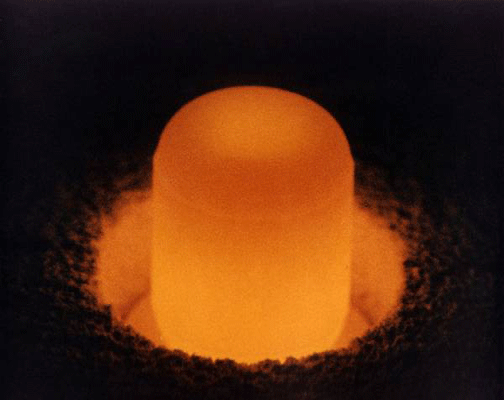 Dig for secrets: the lesson of Maralinga’s Vixen B The Conversation, Liz Tynan, 26 July 13 “……….The tests of far greater consequence were the 12 Vixen B tests, only held at Maralinga These experiments used TNT to blow up simulated nuclear warheads containing a long-lasting form of plutonium.
Vixen B scattered 22.2kg of plutonium-239 around the Maralinga test site known as Taranaki. This form of plutonium has a half-life of over 24,000 years. The extreme persistence of radiation and the threat of cancer posed by inhaling small particles in dust at the site make it especially dangerous.
The Vixen B tests took place amid total secrecy in 1960, 1961 and 1963. Maralinga’s toxic legacy can be summed up in one word: plutonium. When the Maralinga Rehabilitation Technical Advisory Committee (MARTAC) reported in 2002 on efforts to remove contamination from the area it said “Plutonium … was almost entirely the contaminant that determined the scope of the [Maralinga rehabilitation] program.”
The British carried out some clean-up operations after Vixen B and provided a report (by British physicist Noah Pearce) in 1968 that made claims about the level of plutonium contamination at the site. The Pearce report provided the technical basis for the Australian Government to release the UK from any further liability for the Maralinga site.
The technical advisory committee later confirmed that the plutonium contamination at Taranaki was wrong by a factor of 10: “A comparison between the levels reported by the UK at the time (Pearce 1968) and the field results reported by the Australian Radiation Laboratory…(Lokan 1985) demonstrates an underestimate of the plutonium contamination by about an order of magnitude.”……..” http://theconversation.com/dig-for-secrets-the-lesson-of-maralingas-vixen-b-15456
Call for US bombs to be removed from Great Barrier Reef
Great Barrier Reef Marine Park Authority boss wants US bombs removed BRIAN WILLIAMS AND ROBB KIDD THE COURIER-MAIL JULY 23, 2013 FOUR bombs dropped on the Great Barrier Reef will be recovered but the US Navy will not face any penalties because they were offloaded during an emergency.
Great Barrier Reef Marine Park Authority chief executive Russell Reichelt yesterday said he was not concerned the 3m long, 226kg bombs would explode but he wanted them removed from the World Heritage area.…..
Pine Gap: Australia completely involved in USA military operations
Perhaps the bigger question, however, is whether Pine Gap’s deep and growing engagement with US military operations is something that has foreclosed Australia’s diplomatic and military options in relation to future crises and conflicts.
Pine Gap’s capabilities are now deeply and inextricably entwined with US military operations, down to the tactical level, across half the world.

Desert secrets – Sydney Morning Herald by Steins Glassware at July 21st, 2013 It is a piece of America. At least that’s the vibe in the large cafeteria at the top-secret Joint Defence Facility at Pine Gap near Alice Springs….. one effectively needs a top-secret clearance to visit. …
Australia and the US are certainly united at Pine Gap. It is the crux of an electronic espionage alliance that is nearly five decades old. It is also the most secret place in Australia….. Continue reading
Nuclear submarines, later nuclear weapons? – phallic symbols for Australian politicians
 All those who sit in power – whether it’s in Tokyo or on Adelaide Avenue – seemingly can’t quite resist the temptation to hold their own firm, erect missiles. And this is the reality that lurks behind the submarine debate here in Australia.
And that is the whole point of the bigger submarines our politicians are determined to buy. They aren’t being designed for carrying nuclear missiles, of course, but they will be able to do so.
As Britons posture on nuclear needs, reflect on what is happening at home Canberra Times , Nicholas Stuart, 20 July 13 Imperial hubris dies hard. Britain still can’t quite get used to the idea that it is no longer ”Great”. This week five former Conservative and Labor defence ministers, together with their force’s chiefs, warned the country it must never, ever, abandon its own nuclear deterrent. Even though Australia remains the only country on which Britain has ever successfully detonated a bomb, a small and vociferous lobby group of apoplectic lords, sirs and doctors have joined bewhiskered admirals and fuming former military chiefs to demand and insist that Britain must never reduce its own independent fleet of nuclear submarines.
We are not talking about abandoning the bomb, mind you. The proposal on the table is simply to reduce the number of missile-carrying submarines to two, instead of four. A mere 96 nuclear-tipped warheads, instead of 192. The ability to utterly destroy a continent, rather than the world. And why?……… Continue reading
Australia is big on nuclear disarmament talk, but bad on nuclear disarmament action
Australia is good at talking the talk. Yet when it comes to taking action, Australia’s governments have fallen far short of their heroic rhetoric.
The 2009 Lowy Institute poll report stated that seventy-five per cent of Australians “somewhat” or “strongly” agree that “global nuclear disarmament should be a top priority for the Australian government”.
On Australia Day in 2012, nearly eight hundred Order of Australia recipients – including former prime ministers, governors-general, foreign affairs and defence ministers, premiers, governors, High Court justices and chiefs of the armed forces – called on the government to adopt a nuclear weapon-free defence posture and work towards a nuclear weapons convention.
If we want to play a proactive role on disarmament, Australia should end its hypocritical reliance on US nuclear armaments by renouncing extended nuclear deterrence.
 AUSTRALIA’S NUCLEAR DISARMAMENT HYPOCRISY , Right Now, BY DAVID DONALDSON 4 July 13 On the face of it, Australia is a great advocate for global peace and disarmament efforts. It played a proactive role on banning chemical weapons, giving its name to the Australia Group of countries aimed at preventing the spread of chemical weapons. The Keating government created the Canberra Commission on the Elimination of Nuclear Weapons, which illustrated the necessity – and possibility – of complete nuclear disarmament.
In the same vein, the Rudd government initiated the widely cited joint Australian-Japanese International Commission on Nuclear Non-Proliferation and Disarmament (ICNND), whose report argued that nuclear weapons are “the most inhumane weapons ever conceived, inherently indiscriminate in those they kill and maim, and with an impact deadly for decades.”
In 2008 Kevin Rudd declared that “we must be committed to the ultimate objective of a nuclear weapons free world.” At diplomatic meetings, Australia says it wants a reduced role for nuclear weapons in military doctrines, and that it believes that nuclear weapons states “need to do more to reduce and ultimately eliminate all types of nuclear weapons.” Continue reading
The reality of Australia’s sorry history on nuclear disarmament policy
 AUSTRALIA’S NUCLEAR DISARMAMENT HYPOCRISY , Right Now, BY DAVID DONALDSON 4 July 13 “……..The Australian government’s submission also noted that extended deterrence has “removed the need for Australia to consider more significant and expensive defence options” – defence-speak for Australia developing its own nukes. Linking Australia’s decision not to develop nuclear weapons – a position to which it is bound by international law – to extended nuclear deterrence amounts to little more than an absurd threat to the Americans not to remove a guarantee that has never been publicly acknowledged.
Such statements demonstrate the lack of real commitment by the Federal Government to disarmament, and have no doubt made Obama’s stated desire to reduce the number of nuclear weapons in the world that little bit harder. Faced with an inevitably sceptical Pentagon and obstructive allies like Australia, the soaring anti-nuclear rhetoric of Obama’s 2009 Prague Speech has brought few results.
More recently, Australia refused to sign on to an 80-nation statement on the humanitarian impact of nuclear weapons at the 2013 Nuclear Non-Proliferation Treaty Preparatory Committee. The statement sought to address the fact that, in spite of the widely acknowledged catastrophic effects of any use of nuclear weapons, such concerns have “not been at the core of nuclear disarmament and nuclear non-proliferation deliberations for many years.”
While more than 150 countries have expressed support for a treaty banning nuclear weapons under international law – based on similar conventions on landmines and cluster munitions – the Australian government is not among them.
Moreover, the Future Fund continues to invest in nuclear weapons companies, despite having agreed to divest from tobacco, cluster munitions and landmines companies……. HTTP://RIGHTNOW.ORG.AU/WRITING-CAT/ARTICLE/AUSTRALIAS-NUCLEAR-DISARMAMENT-HYPOCRISY/
Green light for USA military bases in Australia
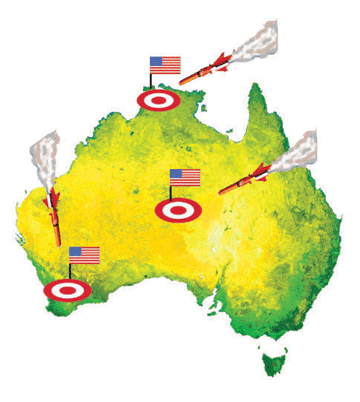 Stephen Smith gives tick to joint US-Aust bases From:THE AUSTRALIAN, AAP June 26, 2013 THE federal government has again expressed its support for the presence of US defence bases on Australian soil, declaring they offer access to intelligence unavailable elsewhere…….
Australia currently hosts two facilities – Pine Gap, commissioned in 1967 and the Joint Geological and Geophysical Research station, both of which are near Alice Springs.
Pine Gap collects intelligence data for the US and Australia and provide ballistic missile early warning information.
The radioactive poisoning of Maralinga
 Historic records of Radiation Monitoring at Australian Nuclear Test Sites, Paul Langley’s Nuclear History Blog 3 June 13“……..RETURN TO MARALINGA, Australia Bomb Test Site On 24 May 1984 a special VIP flight to the RAAF left Adelaide for Maralinga. On board were the Minister of Resources and Energy, Senator Walsh, and the south Australian Premier, John Bannon, accompanied by scientists of the Australian Radiation Laboratory. The tour of the bomb sites took no more than four hours and the politicians learned little more than they already knew from their briefings in Canberra and Adelaide. But the importance of the trip was symbolic. The representatives of the Federal and South Australian Government were there jointly to express their regret that the atomic test series had ever been allowed to take place in Australia and to pledge their support for all investigations into the possible harm done to servicemen, Aborigines and the environment…….
Military and Mining to rule Woomera – an area larger than England
 Australia eases access to world’s biggest weapon range, SMH, 30 May 13 , Australia will ease access restrictions on the world’s largest weapons test range in the remote outback – an area larger than England – to unlock an estimated $35 billion in untapped mineral resources, with legislation for the change unveiled on Thursday.
Australia will ease access restrictions on the world’s largest weapons test range in the remote outback – an area larger than England – to unlock an estimated $35 billion in untapped mineral resources, with legislation for the change unveiled on Thursday.
The Woomera Prohibited Area covers 127,000 square km of mostly barren desert and has been closed to the public since 1947, when it was used for Cold War rocket and nuclear tests by Britain, Australia and the United States.
The sprawling site, which is almost free from electronic signal interference, was also chosen this year as test site for the joint British-French unmanned supersonic stealth drone Taranis, under development by BAE Systems Plc. Defence Minister Stephen Smith told MPs that new legislation would allow miners and some members of the public with reason to be there to share access to the land with the military, to better balance national security and economic concerns………
Parts of Woomera, which hosted British nuclear weapons tests between 1955 and 1963, also lie adjacent to the Olympic Dam site, which BHP Billiton decided not to expand last year as Australia’s mining boom stalled. A small number of mines already exist in the area, including Prominent Hill and Kingsgate Consolidated Ltd’s Challenger gold mine.
Under the new access arrangements, the military would remain in charge of the area, but a permit system would give civilians the right to enter Woomera. As well as miners, indigenous Aboriginal residents can also enter the zone, and environmental or other researchers.The legislation sets up a series of zones, some of which would be zoned red for “continuous defence use” and others which would exclude mining and exploration for between 14 and 70 days a year, in a timeshare arrangement with the military.
“It allows users to make commercial decisions with some assurance as to when they will be required to leave the Area because of defence activity,” Smith said……Smith said the legislation would be passed as a priority before parliament was dissolved for September elections.: http://www.smh.com.au/business/australia-eases-access-to-worlds-biggest-weapon-range-20130530-2ne3a.html#ixzz2Uuz6nLoX
Human Rights lawyer seeks justice for Australia’s Maralinga nuclear veterans
 Australia: Last chance of justice for nuclear veterans http://www.mondaq.com/australia/x/236534/Personal+Injury/Last+chance+of+justice+for+nuclear+veterans 03 May 2013 by Joshua Dale An appeal to the Australian Human Rights Commission by Australian military veterans arising from Britain’s nuclear bomb tests in the Outback is gaining momentum.
Lodged by Stacks human rights lawyer Joshua Dale representing several hundred nuclear veterans, the appeal asks the commission to find the government of the 1950s and 60s breached their human rights by ordering them to be exposed to deadly radioactive fallout. Continue reading
Despite their high cancer rates, Australia’s Maralinga veterans get rejection from British govt
No compensation for Maralinga radiation victims, SMH, April 29, 2013 Bianca Hall The British government has ruled out paying ”act of grace” compensation to Australian soldiers deliberately exposed to nuclear bomb testing at Maralinga in South Australia 61 years ago.
Greens senator Scott Ludlam wrote to Foreign Secretary William Hague in January seeking an undertaking that Britain would pay compensation to victims of its nuclear testing program.
”Of the British and Australian veterans who were involved in the testing, and the Aboriginal people in the area at the time of the blasts, only 29 Aboriginal people have ever received compensation from the Australian government and veterans continue to struggle to obtain the medical support they need,” Senator Ludlam said.
A 2006 report commissioned by the Australian government showed the Australians at the Maralinga and Emu Field sites were 23 per cent more likely than the general population to develop cancer, and 18 per cent more likely to die from cancer. But it found it was impossible to conclude whether that was due to radiation…….http://www.smh.com.au/opinion/political-news/no-compensation-for-maralinga-radiation-victims-20130428-2imrw.html#ixzz2RteYnZ00
Letter from UK Ministry of Defense http://xa.yimg.com/kq/groups/18059953/1363946993/name/maralinga.pdf
1 This month

of the week – Australians for War Powers Reform (AWPR)
To see nuclear-related stories in greater depth and intensity
 Antinuclear