For Australia – a cautionary nuclear tale from New Brunswick, Canada

New Brunswick’s nuclear-powered rate hikes, Commentary, by Janice Harvey, July 8, 2024, https://nbmediacoop.org/2024/07/08/new-brunswicks-nuclear-powered-rate-hikes/
The abject failure of this and previous governments’ energy policies is on full display these days. In the 1970s, New Brunswick was one of only three provinces that bought into the federal government’s agenda to build out a civilian nuclear power industry. Quebec has since shut its nuclear generators down, leaving only Ontario and New Brunswick as the nuclear flag-bearers. How has that worked out for us?
NB Power has come to the Energy and Utilities Board (EUB) with a request for the biggest rate hikes in the utility’s history. While the details are buried in thousands of pages of documents filed with the EUB, evidence from previous EUB hearings makes it crystal clear that the utility’s single greatest financial liability driving up power rates is the much-vaunted Point Lepreau Nuclear Generating Station.
Point Lepreau has been a financial white elephant since its construction ended up costing three times the original price tag. Its planned 30-year lifespan (over which all this extra cost was to be amortized) was cut short by premature aging of critical reactor components, prompting a decision to undergo an expensive refurbishment, which was to extend the life of the plant by a fantastical 40 years. At the time, the then-PUB determined based on the evidence that refurbishment was too big a financial risk for New Brunswickers to handle and recommended against it. The Lord government went ahead anyway.
Like the original construction, the refurbishment went way over the timeline and budget. The result has been very poor performance, a miserable 60 per cent in 2022 compared to the wildly optimistic 90 per cent capacity assumption that the EUB rejected. The costs of replacement power alone during these shutdowns have repeatedly sabotaged annual financial performance projections. Now, Point Lepreau is facing even more expensive upgrades to fix problems that were not dealt with during the refurbishment.
In short, Point Lepreau is the most unreliable and most expensive power generator on the grid, responsible for the lion’s share of NB Power’s debt. It is not going to get any better. Keeping it afloat until 2040, its new end-of-life target, is going to mean more of the same – throwing scarce money down a deep, black hole paid for by ever-rising power rates.

Despite the overwhelming evidence that New Brunswickers cannot afford nuclear power, the Higgs government has doubled down on nuclear, floating an equally fantastical proposition that the next generation of nukes – so-called small modular reactors – will quarterback New Brunswick’s climate change strategy, while an SMR export industry is expected to drive economic growth. To that end, New Brunswick taxpayers have already fronted a total of $35 million to two private nuclear upstarts, neither of which has designed or built a reactor. This is despite lots of reasons to put their rosy promises of “clean” nuclear-fueled prosperity in the same wishful thinking category as JOI Scientific’s power-from-water scheme that so beguiled NB Power executives.
Just as the EUB rate hearings got underway, an entirely predictable hitch in the Higgs’ nuclear dream occurred. It seems like the SMR upstart ARC Clean Energy is on its way down and out, taking $25 million provincial dollars and $7 million federal with it. If we’re lucky, Moltex Energy, propped up by $10 million in provincial and $50.5 million in federal tax dollars, will be close behind, and we can breathe a sigh of financial relief. The longer this nonsense persists, the more of our tax dollars will go into the nuclear black hole, and the greater the delay in meeting our climate change pollution targets.
Even if Moltex hangs on, or some other SMR promoter replaces them, any electricity that might eventually flow from an SMR will be, like Point Lepreau, the most expensive power on the grid – entirely unaffordable and unnecessary. The Higgs government knows this, passing legislation this spring requiring NB Power to buy electricity from the planned privately-owned SMRs regardless of price, a silent admission that electricity from SMRs, should they ever see the light of day, will be more expensive than any alternative. In other words, SMRs will drive up your power bill.
Meanwhile, the June 22nd issue of The Economist features the exponential growth of solar energy worldwide, the cost of which – even with storage – is falling exponentially. Other than home retrofits, this is the cheapest new power on offer.
The nuclear cost numbers are there for all to see. For elected representatives to support this industry, knowing people cannot tolerate higher power rates, is grossly irresponsible and a betrayal of trust. Renewables naysayers are depriving New Brunswickers of the benefits of this global energy transition. This – and our nuclear-powered rate hikes – need to be on the ballot on October 21.
Janice Harvey is the chair of the Environment and Society program at St. Thomas University
“The Sun has won”: exponentially growing solar destroys nuclear, fossil fuels on price

Given Dutton’s claims about solar power costing more than nuclear are made ridiculous by the fact that solar’s break-even price has fallen by a factor of more than 1000 and the trend is continuing.
Meanwhile cost overruns in nuclear are endemic and SMR’s only exist in Dutton’s imagination.
By Noel Turnbull, Jul 11, 2024, https://johnmenadue.com/the-sun-has-won-exponentially-growing-solar-destroys-nuclear-fossil-fuels-on-price/—
It’s not known if Peter Dutton reads The Economist but if he does, he must probably think from time to time that it is sometimes dangerously left wing.
In the 22 June issue, it had a special essay on solar power – headlined ‘The Sun Machine’. The sub-head was “An energy source which gets cheaper the more you use it marks a turning-point in industrial history’.
The essay is a total contradiction of almost everything Dutton is claiming about nuclear and renewable energy.
“What makes solar energy revolutionary is the rate of growth which brought it to this just-beyond the marginal state”, the essay says.
They cite a veteran energy analyst, Michael Liebreich, who shows that in 2004 it took a year to install a gigawatt of solar power capacity; in 2010 it took a month; in 2016 a week; and in single days in 2023 there were a gigawatt of installation worldwide.
Current projections are that solar will generate more electricity than all the world’s nuclear plants in 2026; than wind turbines in 2027; dams in 2028; gas-fired plants in 2026; and coal-fired ones in 2032.
All that well before Dutton’s nuclear plants – if at all – start generating power. Moreover, unlike nuclear power which notoriously always takes longer to build than predicted, predictions about the rate of solar power roll-out are consistently under-estimates.
The Economist points out that in in 2009 The International Energy Agency (IEA) predicted solar would increase from 23GW to 244GW by 2030. It hit that milestone in 2016 – less than a third of the predicted time. The world capacity was 1419GW by 2023.
Ironically, one of the few organisations which got their predictions roughly right was Greenpeace – yet even their prediction was an under-estimate.
Given Dutton’s claims about solar power costing more than nuclear are made ridiculous by the fact that solar’s break-even price has fallen by a factor of more than 1000 and the trend is continuing. Meanwhile cost overruns in nuclear are endemic and SMR’s only exist in Dutton’s imagination.
Dutton is stronger on ideology and outrageous claims than economics, but the manufacture of photovoltaics is a classic example of the benefits of mass production – benefits which have always eluded the nuclear power industry.
As The Economist points out solar cells are standardised products all made in basically the same way and “they have no moving parts at all, let alone the fiendish complexity of a modern turbine.”
“Manufacturers compete on cost, by either making cells that make fractionally more electricity, by either making cells that make fractionally out of a given amount of sunshine or which cost less.”
Economics 101 teaches us that a commoditised product does not lead to more and more aggressive competition on the supply side – simply in this case by getting more electricity out of any given amount of sunshine or by costing less.
Rob Carlson, a technology investor, told The Economist: “There is no other energy-generation tech where you can install one million or one of the same thing depending on your application.”
“The Sun has won” he says.
The Economist said: “From the mid-1970 to the early 2020s cumulative shipments of photovoltaics increased by a factor of a million which is 20 doublings. At the same time prices dropped by a factor of 500. That is a 27% decrease in cost of doubling of installed capacity, which means a halving of costs every time installed capacity increases by 360%.
Adair Turner, an eminent economist and financial services executive, was Chair of Britian’s Climate Change Committee which was set up to help transition to zero emissions.
He told The Economist: “We totally failed to see that solar would come down so much.”
BloombergNEF estimated, in 2015, that the cost for solar on a global basis was $122 per MWH – higher than on shore wind and coal. Today both solar and onshore wind are almost half the cost of coal.
Meanwhile, Dutton has welcomed Keir Starmer’s election win by pointing to his support for nuclear power. Which, given that the UK has already installed nuclear power, the cautious Starmer is unlikely to announce that he is closing it down.
Moreover, Starmer’s major problem with nuclear is managing the spiralling delays in, and cost of, nuclear plants being constructed following typical Tory blunders.
The question which Dutton needs to answer is why he knows more about nuclear and solar power than The Economist reporters, Bloomberg, Adair Turner, Rob Carlson, many major investment funds and the overwhelming majority of Australian scientists?
He might ponder all that while the Murdoch media is becoming a tad critical of him – criticising his policy on supermarket divestment and speculating on who might be the Liberal Party leader if Dutton loses the next election.
Meanwhile, notwithstanding their doubts about Dutton’s chances and policies (other than nuclear) The Australian never totally loses its manic opposition to anything progressive. The inimitable Greg Sheridan opined on The Australian front page (6/7) that Labour had not won but the Tories had lost. Partly true obviously, but his piece was enough to prompt the subs to headline the piece with “Self-described socialist is set to drag Britain far to the left”.
Sheridan also rehearsed his regular hates and speculated how it would all come undone.
Jeremy Corbyn would love that to be the case but Starmer not so.
Perhaps the funniest lines in Sheridan’s’ piece were: “Starmer is brainy and works hard. Too deep immersion in the law has rendered it impossible for Starmer to write felicitous prose or create memorable images.”
From a journalist who year after year simply reproduces the same old opinions on the same old subjects that is, to say the least, a bit much.
The IPA just exploded their argument that the “Atlas Network” is tinfoil hat conspiracy

Lucy Hamilton, 11 July 24 https://theaimn.com/the-ipa-just-exploded-their-argument-that-the-atlas-network-is-tinfoil-hat-conspiracy/
The Institute of Public Affairs (IPA) has just shown its links to the Atlas Network, the group to which the Heritage Foundation and Project 2025 belong. The IPA has been a blight on the Australian scene since some of its senior figures went to a Mont Pelerin Society meeting in Hong Kong in 1978 and determined to change it from being a body that promoted the market for businessmen (but with checks and balances) to a much more extreme agenda. Mike Seccombe recounted the story from the old guard’s explanation: “Former IPA head: radicals ‘hijacked’ thinktank.”
This reflects the fact that the IPA was established – in 1943 – before the Mont Pelerin Society first met in 1947. Both bodies grew out of a business world that was terrified by the New Deal and other Keynesian responses to the Great Depression and the Great War. The aristocrats and robber barons were aghast at the thought that they might lose property to the filthy masses as the Russian elites had in the revolution. They perceived government efforts to hold off revolution by offering some support to the population, immiserated by capitalism’s failure in the late 20s, as the first step to their own impoverished exile.
The program was funded and fostered by resource extraction money from the earliest days at both the Mont Pelerin Society and the IPA.
This Cold War bogeyman continues to haunt the IPA. It is campaigning to demonise socialism on social media, using propaganda resources manufactured by its partner organisations in the Atlas Network.
The IPA is terrified of a world where young people have seen the ugliness of neoliberalism. That term is best defined not so much as an ideology, but as the network of people and organisations which have worked over decades to turn us from societies into a global market of consumers. The massive inequality it has fostered since the Mont Pelerin Society’s campaigning moved from the fringes in the 1940s to power under Reagan, Thatcher, Pinochet and Rogernomics is clear and miserable. Social democracies seem a much sounder path to a sustainable society and world.
The Mont Pelerin Society first colonised the Chicago School. The laissez faire economics taught there had been fighting monopoly power as a distortion of the free market. Under Friedrich Hayek’s influence, they converted to fighting the antitrust law that impeded monopolists. The new agenda of Hayek’s Chicago School was for the big money to control government. Thus they would shackle their less-connected competitors, and prevent the masses standing in their way. Milton Friedman was their great salesman. His work became systemised, by founder Antony Fisher at Hayek’s instigation, in junktanks that pretended to be think tanks or university centres or phoney grass-roots civil society organisations.
There was no “free market.” That was propaganda. This is visible in the long trajectory of the campaigns the neoliberal network pursues. In America’s Republican states, it is stark. The blocking of union formation is a mission to prevent the worker having any power over their conditions. The campaign does not stop there. This is accompanied by non-compete clauses so that a worker who does not like their conditions of employment, in the most menial of jobs, cannot move to a rival who provides better conditions. Not only that, but state laws (of the kind written by these networks) punish employers within their state boundaries that offer better conditions.
Labor conditions in Republican states are appalling. It is worse in these Confederate states for non-White people. Through a raft of laws that make it miserable to exist, through to an entire infrastructure designed to imprison Black men and hire out their bodies as slave labour, the intent is clear. There is no free market for labour.
The redistribution of society’s tax money to the rich in a variety of ways (think Jobkeeper and Harvey Norman) shows, just as the Republican state experiment does, that the neoliberal experiment is not about “property rights” but “property rights for the rich.” Our property is their property.
If they wish to make our property worthless by fuming poisoned air over it, that is our tough luck.
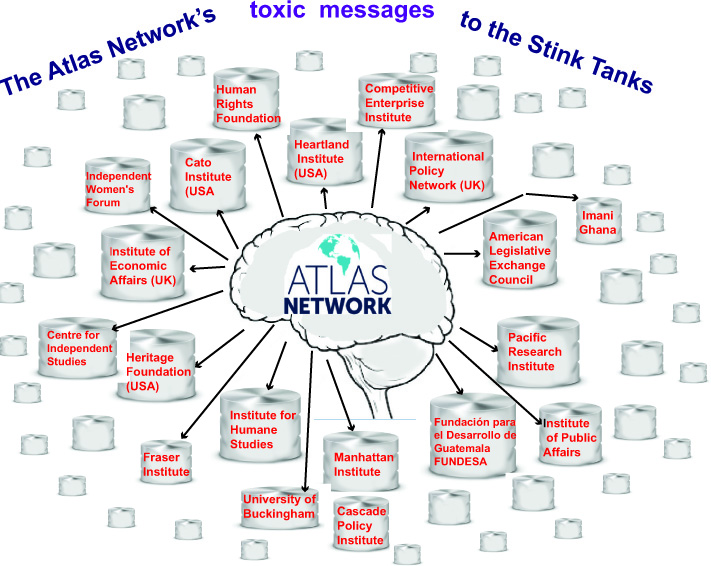
When one of the Atlas Network’s favourite IPA apparatchiks, Tim Wilson, was made Human Rights Commissioner by IPA-affiliate Tony Abbott, his public campaign was for free speech rights. Of course Yassmin Abdel-Magied’s free speech was not to be protected. Free speech is for their faction, not the Other.
Behind closed doors, however, Wilson’s primary battle for rights was for property rights. He spoke at the libertarian Friedman Conference with utter scorn of the high-ranking rights experts with whom he was forced to work in that role. His infantilised distortion of the British tradition of liberalism placed property rights as the prime factor. Their more sophisticated (French?) tradition of liberalism treated the rights of oppressed humanity as a higher priority.
Anyone watching the authoritarian intent behind the Project 2025 mission that threatens to accompany a Trump victory in November sees that it protects the property rights of the rich as much as key Atlas funder and strategist Charles Koch could demand. The human rights of anyone who fails to live as the obedient “traditional” identity, however, is under serious threat. The fact that the humanity of the gestating woman or pregnant person is made invisible, a machine gestating the potential humanity of a small ball of cells inside, illustrates the threat. Control of anyone who does not play by their rules is already a life and death matter in American Republican states.
The IPA shared a snippet of video made by one of the American Atlas partners, the Liberty Fund. In this, grim socialist footage of communist Estonia illustrates that “socialism” is ugly, monotone suffering not Bernie Sanders. The youth must be chastened out of the idea that their humanity deserves rights or that they have a justifiable claim for a decent standard of living, even if the plutocrats have to give up a little of their extraordinary wealth. At the bottom of that Liberty Fund page, key partners in the Atlas Network are listed.
The low-rent IPA campaigns on social issues to foment culture war. They aim to distract those most disadvantaged in neoliberalism’s world. They have not, however, forgotten the main game. A more equitable society means the rich must pay their fair share of tax. The financial, legal, governmental systems that they have gamed must be deconstructed. Before 2020, eight men alone owned as much property as that held by 3.6 billion people. Since the pandemic, that situation has worsened dramatically. In the years since 2020, 26 trillion dollars of new wealth has been snatched by the 1%. By contrast the rest of the world’s population gained $16 trillion. A 5% wealth tax on the handful of billionaires could raise enough to bring 2 billion people out of poverty.
Business has always benefitted from tax-funded infrastructure. Hospitals, schools, roads, railway, the internet etc make businesses possible. The bunk economics of neoliberalism denies that fact. Their friends at ultraconservative Quadrant warned that neoliberalism’s zero sum game would destroy the Australian way of life, and they are being proved right.
This impoverished world has been created by the plutocrats’ influence network and their junktanks infesting our public debate, media, academia and government. Neoliberalism was their construction and continues to threaten our survival by their obdurate refusal to transition away from carbon-based energy.
We should thank the IPA for sharing Koch (and Templeton) propaganda. Next time they say that talk of the Atlas Network is tin-foil hat conspiracy theory, we can remind them that they proved our point themselves.
Australia’s dark, twisted nuclear fantasy

Can we assess the merits of nuclear energy in isolation from its possible contribution to a new nuclear arms race that could once again place humanity under imminent threat of civilisation-ending catastrophe? We could, but it would be delusional
Red Flag, 9 July 2024, James Plested
Australia’s political class is busy transforming the country into a base of operations for a possible US war with China. That, you might think, is bad enough. Now Peter Dutton wants—with his nuclear power plan—to throw a significant new bit of (radioactive) “spice” into the mix.
Just imagine. It’s 2040, and China has just launched an invasion of Taiwan. The US declares war, and begins the mobilisation of its and its allies forces across the Indo-Pacific region. Tens of thousands of US and Australian military personnel are massed, ready for action, on bases around Australia. British and US nuclear-powered submarines are dispatched from ports in Western Australia and Queensland (parking their submarines in Australian ports being the only part of the AUKUS deal that was actually delivered).
The Chinese military has meticulously prepared for this scenario over many years. It knows its only hope for a quick and relatively casualty-free victory lies in crippling, as much as possible, the other side’s ability to counterattack before it gets started. So at this point the first barrage of Chinese hypersonic missiles rains down. The targets aren’t just military facilities but also critical infrastructure—ports, major highways and bridges, data centres and (of course) power stations.
How would you feel about living next to one of Dutton’s seven planned major nuclear power stations in this situation? You might think an attack like this is unlikely. Surely, even in the event of a major war, the contending powers would stop short of targeting civilian infrastructure in such a destructive way. This belief is, unfortunately, a fantasy. You need only look at what the Israelis have done to Gaza—with the full support of their allies in countries like the US and Australia—to know that in a situation of all-out war, anything and everything would be deemed “fair game”.
Some of Australia’s foreign policy establishment believe that a scenario like this might be avoided if only we take the next step after establishing a nuclear power industry and create our very own nuclear weapons “deterrent”. It’s possible Dutton himself has an eye to taking this path. He’s no doubt aware that the kinds of resources, skills and technology that would be needed to establish a “peaceful” nuclear power industry are exactly the same resources, skills and technology needed to produce nuclear weapons (hence Western hysteria about Iran’s “peaceful” nuclear program).
Continue readingNo to nuclear in the Latrobe Valley
9 July 2024, Cormac Mills Ritchard, https://redflag.org.au/article/no-to-nuclear-in-the-latrobe-valley
“Don’t dump on us again”, says Wendy Farmer, president of the Latrobe Valley community group Voices of the Valley and a local community organiser for Friends of the Earth. The Latrobe Valley is one of Liberal Party leader Peter Dutton’s proposed sites for nuclear power reactors, which would replace the Loy Yang coal power station.
The region is already saddled with several toxic industries. As Farmer explains to Red Flag, “We have a waste-to-energy, we have a lead smelter, we have a magnesium smelter, we have the power stations … Just today I’ve gone outside and you should see the coal dust on my rubbish bins. It is just everywhere. People are like, ‘Why are we being the dumping ground again? Why are we just being told once again what’s good for us and what we need?’”
Wendy knows what it’s like for a community to be treated as expendable. She became an activist in 2014 during the Hazelwood coal mine fire, which lasted for 45 days. The fire blanketed the area with smoke, causing the deaths of at least 60 people according to extensive research carried out by Voices of the Valley. This was no accident, but a result of the owner ENGIE’s cost-cutting and negligence. “They knew the risks two days before the fire got into the mine and chose to ignore it. I think they put a couple of extra staff on over the weekend, when we were gonna have the hottest, windiest weekend. Any fool could have read that.”
The fire might also have been prevented through the mine’s watering system, a critical safety measure meant to keep the coal face wet and guard against bushfires, which the owners had previously dismantled.
“My husband at the time worked at Hazelwood”, Wendy says. “Hazelwood knew that things needed to be repaired. Hazelwood knew that they didn’t have the water where they needed it.” You can never completely trust a company, she says. “Industry has known about asbestos, yet they’ve used it. Industry has known about the stone [in kitchen bench-tops], yet they’ve used it. Industry has known about dangers before and covered them up.”
If companies like ENGIE axe safety measures and governments cover up their crimes, why should we expect nuclear to be any different? Wendy describes Dutton’s nuclear proposal as a fantasy: “No plan, no proposal, no detail”. But her objections run deeper than that. The risks of a nuclear failure weigh heavily on a community with such a recent history of disaster and injustice.
“If there’s a failure and the kids are at school or anywhere else”, Wendy says, “nuclear disaster would kill … That sort of radiation you don’t have much chance. If the kids are at school, it’s too late to go and get them. And if they’re not dead, the damage is done. You can’t reverse the damage”. Worse still, Wendy explains, the valley sits on an earthquake fault line. “We’ve had many earthquakes. It’s only a matter of time before we have a big one.”
Fortunately, through Hazelwood the community taught itself how to fight toxic industries. On the morning Dutton’s proposed sites were revealed, Wendy organised a snap protest outside local Nationals MP Darren Chester’s office. “The people who joined the anti-nuclear rally were pretty upset, pretty pissed off”, Wendy says. “‘How dare they? We don’t want nuclear reactors.’”
Not everyone is opposed to nuclear, however; the community’s views are mixed. According to a News Corp survey last month (which polled only 113 people), 59 percent of Latrobe Valley residents would be comfortable with a nuclear reactor being built in their state or region. “A lot of people who support nuclear are supporting it because there will be jobs. But in fact there won’t be jobs for 30 or 40 years”, says Wendy. Construction on the nuclear power plant cannot begin, Wendy explains, until after Loy Yang has been shut down and rehabilitated, which won’t be for at least a decade.
Affordable energy is the other argument opening people to nuclear. But nuclear-generated power is far more expensive than renewables, given the extensive capital costs. According to the GenCost 2023-24 report published by the CSIRO and the Australian Energy Market Operator (AEMO), while wind and solar PV combined are estimated to cost between $73 and $128/MWh, large-scale nuclear will cost between $141 and $233/MWh, or $230 to $382/MWh for small modular reactors.
“Hazelwood was a David and Goliath”, Wendy says. “I felt the community won. For sure the company weren’t punished enough, but the community won. We have to stand together and we can win this.”
Aboriginal supporter of right-wing racism, Warren Mundine’s interests in mining uranium -not doing too well.
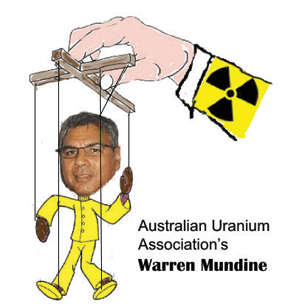
Mundine was one of the two main faces of the “No” campaign against last year’s Indigenous Voice to parliament referendum, campaigning against so-called “elites”.
The Voice “No” campaign was run by far-right lobby group Advance which ran a campaign of aggressively attacking so-called “elites” who it said were behind the Voice.
In fact, as previously reported, the No campaign was bankrolled by a handful of mega wealthy individuals, many with deep ties to the mining and fossil fuels sector.
The struggles facing Aura Energy coincide with a fierce political debate over the future of nuclear energy in Australia, with the federal Opposition calling for a nuclear rollout despite it being vastly more expensive than renewables.
Mundine uranium company shares collapse
ANTHONY KLAN, 9 July 24 https://theklaxon.com.au/mundine-uranium-company-shares-collapse/
A uranium exploration company overseen by businessman Warren Mundine has seen its share price crash after its auditor warned it was in danger of collapse.
Over $60 million has been wiped from the value of ASX-listed Aura Energy since its auditor waived the red flag — and a subsequent emergency capital raising has seen new investors left heavily in the red.
Company document show that on March 15 the auditor of Aura Energy — which states it has “major uranium projects” in “Africa and Europe” — warned there was a “material uncertainty” that it would be able to remain solvent.
Aura Energy had made losses of $9.79m in the 18 months to December 31 and had a remaining cash balance of just $5.86m.
Shares in the company — which is not covered by any analysts or stockbrokers — immediately crashed 33%, to 16.5c.
Aura Energy conducted a capital raising to help it stave off insolvency, but shares it sold under the offer only six weeks ago at 18c yesterday closed at just 13.5c.
Since January — while Australia has been engaged in a fierce debate over nuclear energy — the share price of Aura Energy has halved.
Mundine, who was appointed a director of Aura Energy in December 2021, is a major public advocate of nuclear energy was previously a director of Australian Uranium Association.
The woes facing Aura Energy follow the collapse of the planned $10m IPO of Mundine’s “minerals exploration” company Fuse Minerals in April.
That company, chaired by Mundine, was forced to scrap its plans to float on the ASX after failing to raise enough funds, despite it extending its capital raising period by more than eight-fold, from two weeks to more than four months.
Fuse Minerals had never earned a cent in revenue or conducted a single drill.
Mundine was one of the two main faces of the “No” campaign against last year’s Indigenous Voice to parliament referendum, campaigning against so-called “elites”.
He has repeatedly refused to comment when contacted by The Klaxon.
Company filings show Aura Energy entered a trading halt on March 15 and three days published its accounts for the six months to December 31.
In the six months it lost $2.99m, on the back of $6.80m in losses in the year to June 30, 2023.
In the half-year report, Aura Energy’s auditors Hall Chadwick state there is a “material uncertainty that may cast significant doubt” over the company’s “ability to continue as a going concern”.
In the report Aura Energy’s directors state the company is “dependent on further capital raises or external financing” to stay afloat.
“As the Group is in the exploration stage and does not generate operating cash inflows, the Group is dependent on further capital raises or external financing to maintain operations which results in a material uncertainty which may cast significant doubt on whether the Group can continue as a going concern,” the directors state.
On March 18 — the same day it published those half-year accounts — Aura Energy announced it had conducted a “successful placement” to raise $16.2m from “professional and sophisticated investors” by issuing 90.2m shares at 18c a share.
It would also raise $2m from the public, also at 18c a share, with those shares listed on the ASX on May 30.
Under both raisings, for every four shares bought there were also three “free” attached options, with an exercise price of 30c and a two year expiry. (Meaning they would have value if Aura Energy’s share price goes above 30c in the next two years).
In advertising the public raising, Fuse Minerals said the price of 18c a share was at an “18.2% discount” to the 22c a share they were trading at on the day the offer was announced.
Further, 18c a share was a “23.5% discount” to the average price the shares had been trading at over the five days before the offer was announced.
On the day the public offer shares were listed on the ASX, May 30, the company’s shared were trading at 16.5c.
Yesterday they closed at 13.5c.
At January 1 the company had 623m shares on issue and a share price of 26.5c, giving it a “market capitalisation” of $165.1m.
Yesterday its market capitalisation was $103m, down $62.1m.
The struggles facing Aura Energy coincide with a fierce political debate over the future of nuclear energy in Australia, with the federal Opposition calling for a nuclear rollout despite it being vastly more expensive than renewables.
Mundine and Senator Jacinta Price were the most prominent faces of the “No” campaign against the Indigenous Voice to parliament, which was voted down in October.
Two weeks later Mundine announced he was chair of Fuse Minerals — and that the company was seeking to raise up to $10m and list on the ASX.
The Klaxon subsequently revealed Fuse Minerals owned only one of the nine exploration licences listed in its prospectus — and that its own “independent expert” had warned it was in danger of collapse.
By January Fuse Minerals had raised just $1.86m, well short of the $6m-$10m sought and was legally required to refund money to investors seeking to exit.
On March 28 Fuse Minerals was forced to scrap the offer entirely.
The Voice “No” campaign was run by far-right lobby group Advance which ran a campaign of aggressively attacking so-called “elites” who it said were behind the Voice.
In fact, as previously reported, the No campaign was bankrolled by a handful of mega wealthy individuals, many with deep ties to the mining and fossil fuels sector.
No room for nuclear: AGL says flexibility is key as it plans to dump coal for renewables in a decade

ReNewEconomy Giles Parkinson, Jul 9, 2024
Australia’s biggest supplier of coal generation and baseload power, AGL Energy, has again underlined the fact there is no room for nuclear in Australia’s transition to renewables – neither on a grid dominated by wind and solar nor at its coal sites that it intends to transform into clean industrial hubs.
“I’d like to clarify – as I did in March – that nuclear energy is not part of our strategy and our position on this remains unchanged, AGL CEO Damien Nicks said in a presentation to a CEDA event in Sydney on Tuesday.
Nicks’ position is important because two of AGL’s coal generation sites have been identified by the federal Opposition for its nuclear power plans, which it says could see seven reactors, or more, start construction sometime in the 2030s or 2040s – should they be elected, be able to remove the bans, find the technology and finance, and the sites to host it.
AGL – and the owners of other mooted nuclear sites – have no intention of giving up their assets for nuclear power plants, despite the threats of compulsory acquisition, largely because they have their own plans.
Nicks says the site of the recently shuttered Liddell coal generator in the Hunter Valley is already accounted for, with plans for a giant battery, solar module manufacturing, panel recycling, a link to a planned 400 MW pumped hydro facility and multiple green industries including hydrogen, metals and other activities.
“The Hunter Hub is actively progressing opportunities across a variety of industries, including; solar thermal generation, solar PV manufacturing, battery and solar recycling, waste-ash-to-materials and hydrogen,” Nicks says.
“Our recent announcements with SunDrive and Elecsome are examples of the businesses we’re looking to work with.
“We’re committed to creating opportunities for our people and local communities, as well as partnering with like-minded industries to support economic diversification and jobs in the Upper Hunter.”
The point that Nicks made around the Hunter hub is that – because of its multi-billion dollar investment plans in new industries – there is no spare capacity for the sort of big nuclear projects that the Coalition wants to build. Or even small ones.
It points to the hot air behind the Opposition position on nuclear, and it’s complete of planning and consultation, something it plans to ignore by riding roughshod over opposition from state governments, asset owners, and local communities.
But the nuclear plan also makes little sense for Australia’s solar dominated grid, as so many energy experts have pointed out. Nicks once again highlighted this, saying the nature of a grid dominated by wind and solar needs flexibility rather than the “always-on” base-load design relied on by nuclear.
AGL intends to shutter the last of its coal generators by 2035, and is working to make them more flexible in the meantime so they can to respond to the generation patterns and “solar duck curves” created by rooftop PV, which will account for most of demand in daytime hours, and large scale wind and solar.
It’s critical we have the flexibility within our portfolio to firm capacity and help us manage some of the changing peaks and troughs in the renewable energy market,” he said
These include expanding its grid scale battery assets, boosting its capacity of hydro and gas peakers, and growing its portfolio of distributed energy assets to 1.6 GW by 2027, to support load shifting and orchestration of rooftop solar.
The slide provided above [on original] indicates a number of new wind, solar and battery projects, including the already announced Pottinger Energy Park in the Riverina, the proposed 500 MW, 2000 MWh Tomago battery, the newly approved Bowmans Creek wind project, and several other projects that have not yet been publicly named.
“We’ve undertaken significant upgrade works at our Bayswater plant in NSW and Loy Yang in Victoria that means these plants can now be flexed down approximately 60-70 per cent of their full operating capacity.
“This means we’re able to further ramp down during those daytime periods of peak solar generation which is commercially beneficial as it minimises production at negative pricing, using less coal and producing less emissions,” he said. …………………….. more https://reneweconomy.com.au/no-room-for-nuclear-agl-says-flexibility-is-key-as-it-switches-from-coal-to-renewables-in-a-decade/
Book – “Nuked” on Aukus ‘fiasco’ says decision to embrace pact will ‘haunt’ Labor for years

“undermines any argument that the new submarines – whether nuclear or not – would be used primarily to defend Australia or to protect the nation’s shipping lanes”.
“at least one new cabinet minister wondered if it was possible to stop Aukus, but the suggestion went no further”.
Fowler said he did not believe there had been adequate public debate in Australia about the merits of Aukus,
Andrew Fowler’s book reveals one of Australia’s most important requirements for its submarines was the ability to work alongside the US in South China Sea
Daniel Hurst , 7 July 24, https://www.theguardian.com/world/article/2024/jul/07/book-on-aukus-fiasco-says-decision-to-embrace-pact-will-haunt-labor-for-years
One of Australia’s most important requirements for its new submarines is the ability to work alongside the United States in the South China Sea, a new book discloses.
The book by Andrew Fowler, a former investigative journalist for the ABC’s Four Corners and Foreign Correspondent programs, also predicts that Labor’s rush to embrace the Aukus pact “will haunt them for years to come”.
Fowler examines the Morrison government’s cancellation of the French submarine contract and its pursuit of a nuclear-powered alternative in the book Nuked: The Submarine Fiasco that Sank Australia’s Sovereignty.
The book makes the case that Aukus is a “deeply flawed” scheme that, when combined with a parallel effort to deepen military integration with the US, effectively ties Australia’s future “to whoever is in the White House”.
It includes an interview with David Gould, a former UK undersecretary for defence, who was headhunted by the then Gillard Labor government in 2012 as a consultant on a replacement for Australia’s ageing Collins-class submarines.
“As we sat talking, Gould revealed for the first time what has long been suspected: one of the submarine’s most important requirements would be to work with the Americans in the South China Sea,” Fowler writes.
“He explained that the submarine would need ‘to get through the archipelago to the north of Australia and into the South China Sea and operate in the South China Sea for a reasonable period of time and then come back again, without docking, or refuelling or anything. That’s what it needs to do.’”
The book quotes Gould as saying that the submarine would work alongside the US and Japan in an “integrated system”, which had become “even more pertinent with China”.
Fowler writes that the statement “undermines any argument that the new submarines – whether nuclear or not – would be used primarily to defend Australia or to protect the nation’s shipping lanes”.
Fowler contends that the focus is “to contain China and threaten its trade routes and food and energy supplies in a crisis”.
The Australian government has repeatedly said that its strategic motivation for acquiring nuclear-powered submarines is to “contribute to the collective security of our region” and maintain the global rules-based order.
The Labor defence minister, Richard Marles, has argued that the defence of Australia “doesn’t mean that much unless we have the collective security of our region” and that the nuclear-powered submarines would put a “question mark in any adversary’s mind”.
Fowler contends that the focus is “to contain China and threaten its trade routes and food and energy supplies in a crisis”.
The Australian government has repeatedly said that its strategic motivation for acquiring nuclear-powered submarines is to “contribute to the collective security of our region” and maintain the global rules-based order.
The Labor defence minister, Richard Marles, has argued that the defence of Australia “doesn’t mean that much unless we have the collective security of our region” and that the nuclear-powered submarines would put a “question mark in any adversary’s mind”.
The book reveals that after Labor won the 2022 election, “at least one new cabinet minister wondered if it was possible to stop Aukus, but the suggestion went no further”.
In an interview with Guardian Australia, Fowler said he began researching the book after becoming fascinated with “the overuse of executive power of government in the Morrison government, particularly the exposure of his five secret ministries”.
“I thought that the arrival of a $368bn secret deal that was done and then sprung on the public and the opposition party at the last moment would require an investigation,” he said.
Fowler said he did not believe there had been adequate public debate in Australia about the merits of Aukus, the security partnership with the US and the UK that involves the nuclear-powered submarine project but also collaboration on other advanced defence technologies.
“I think we debate the dollar-and-dime arguments, as the Americans might say, but we don’t debate the really big issues,” Fowler said.
“I don’t give advice to government but I think the Australian people have a right to know what the submarines are being bought for. They’re being bought to run with the Americans and Japan to contain the rise of China.”
Fowler said the then Labor opposition was put “in a diabolical position” when forced by Scott Morrison to make a quick decision on whether to support Aukus in 2021.
“This was a calculated attempt to wedge Labor on this issue and Labor only had 24 hours to make a decision,” he said. “It was obscene and absurd, and yet they made the decision fearing that if they opposed it they would be accused of being anti-American and weak on national security.
“I do understand why they went with it, but I think they also had some time to do some backtracking.”
Fowler called for an inquiry focused on “a failure of due process” in the cancellation of the French contract and the decision to pursue the Aukus arrangement, which officials admitted during Senate estimates hearings had not gone through the normal two-gate process for defence acquisitions.
Instead, the Morrison government announced Australia, the US and the UK would carry out an 18-month joint study to work out how to deliver the project. That led to the Albanese government’s March 2023 announcement of more detailed plans.
The book argues the French submarines would have given Australia “greater independence”, noting the president, Emmanuel Macron, had described Australia, India and France as being at the heart of a “new Indo-Pacific alliance and axis”.
The book says this “more independent thinking” caused “consternation in Washington”.
Gas before nuclear ‘thought bubble’ as coal reign ends
Yahoo/Finance! Jack Gramenz, Tue 9 July 2024
Federal opposition plans to roll out nuclear energy have been dismissed as a thought bubble as the nation races to replace coal power.
Alternatives to the fossil fuel – which still powers much of the grid in NSW, Victoria and Queensland – are being rapidly rolled out with coal’s reign “swiftly ending,” according to electricity company bosses.
Proposals to increase natural gas supplies for the nation’s most populous state are being assessed and welcomed as renewable projects come online, NSW Energy Minister Penny Sharpe says.
“We don’t want to see price spikes and we don’t want to see uncertainty for industry,” she told a Committee for Economic Development of Australia event on Tuesday………………….
“More and more renewable energy is entering the system, but it’s always happening more slowly than we would like,” Ms Sharpe said.
The state Labor minister said she was “unimpressed” by a proposal from the federal coalition to roll out nuclear power stations.
The plan posed too many important but unanswered questions and threatened to smash a hole in the certainty provided by the state’s energy strategy, she said.
“NSW will not be risking our future economic prosperity for a policy thought bubble designed to play politics,” Ms Sharpe said……………………..
The chief executive of Australia’s largest energy generator and greenhouse-gas emitter reaffirmed nuclear power was not part of the company’s future.
AGL’s Damien Nicks told the same event the electricity supplier focused on renewable generation and storage.
“AGL’s generation portfolio will look completely different by 2035, when we’re no longer generating electricity from coal,” he said……………
The transmission network operator is building 2500km of new lines to carry an expected 17-gigawatt surge in renewable generation as more projects enter the grid.
Ms Sharpe on Tuesday announced the inaugural chair and seven commissioners for the state’s Net Zero Commission……. https://au.finance.yahoo.com/news/gas-nuclear-thought-bubble-net-044223314.html
Too uncertain, too slow: funds rule out financing Dutton nuclear plan
The investment bosses of half a dozen funds also agreed there was not enough policy certainty to justify any serious consideration of nuclear energy investments.
In a public consultation paper released in May, the groups proposed excluding nuclear power as a sustainable investment option under the taxonomy as its development is currently illegal in Australia.
AFR, Hannah Wootton 7 July 24
Investment chiefs from the country’s biggest superannuation funds will not bankroll Opposition Leader Peter Dutton’s nuclear power plan, despite strong appetite for other energy transition assets and a shortage of domestic investment opportunities.
Aware Super CIO Damian Graham said the production timelines on nuclear were too long to help meet the fund’s own net-zero targets. His counterpart at UniSuper, John Pearce, said nuclear investments would not make money for members fast enough, while Cbus ruled it out completely.
The investment bosses of half a dozen funds also agreed there was not enough policy certainty to justify any serious consideration of nuclear energy investments.
Broader appetite for private investment in nuclear has been low, with Mr Dutton conceding his scheme will need to be publicly funded despite the Liberal Party’s historic dislike of state-owned energy.
Funds’ dismissal of nuclear also comes as they pour billions of dollars into renewables, and Treasurer Jim Chalmers calls on the $3.6 trillion sector to deploy some of its ever-growing asset pool into “nation building” areas like the energy transition.
“The main reason [we won’t] is the payback time is way too long for us – we’re talking decades, not just years,” Mr Pearce said on possible investments in nuclear.
“We know that nuclear is proven, scalable technology, and you’ve got your ESG considerations as well as economic, but from that economic side, it just doesn’t stack up [as an investment] for a super fund for us.”
Cbus’ CIO Brett Chatfield said: “We don’t see nuclear as a part of the energy transition going forward.”
Cbus, which is chaired by former Labor treasurer Wayne Swan, has been the biggest backer of “nation building” projects to date, including as the only super fund to invest in the government’s controversial Housing Australia Future Fund.
But Mr Chatfield said the fund was “much more focused on the renewable area, particularly onshore and offshore wind and solar” when it came to supporting the energy transition.
Too slow
For Mr Graham, nuclear did not meet the “near time” emissions reduction strategies Aware needed to invest in to meet its energy transition targets.
These include a 45 per cent reduction in scope one and two emissions in its portfolio and net zero by 2050.
“We’re working towards that, and that doesn’t involve investing in nuclear,” Mr Graham.
“If there was a change [in policy] and there were new opportunities, we’d need to understand them … but the general view we have is we need to be making more near-time progress that I think nuclear appears to provide.
“It’s a long-term build, no doubt about it, and we need to be making really clear progress by 2030.”
He pointed to renewables and other transition-supporting technologies as attractive investment opportunities for the $170 billion super fund instead.
Mr Dutton pledged two nuclear power plants would be operational by 2035 under his plan and more potentially by 2037 if he was elected next year, despite the CSIRO estimating the first full operation of a station could be “no sooner” than 2040.
HESTA head of portfolio management Jeff Brunton declined to comment categorically on whether the healthcare workers’ fund would invest in nuclear, but noted some of its decarbonisation targets also had deadlines of 2030 rather than 2050.
It planned to invest 10 per cent of its funds under management into “green solutions” such as renewable energy and cut the carbon intensity of its overall portfolio by 50 per cent by 2050.
“So we need to deploy into those sorts of ideas – batteries, solar, wind farms – now,” Mr Brunton said.
He also noted HESTA would invest in line with the Australian Sustainable Finance Institute and Commonwealth Treasury’s sustainable investment taxonomy, which is currently being developed.
In a public consultation paper released in May, the groups proposed excluding nuclear power as a sustainable investment option under the taxonomy as its development is currently illegal in Australia.
Uncertainty abounds
Other CIOs said proposed policies to introduce nuclear power in Australia were too vague to justify considering investment.
Mr Dutton was criticised when he released his plan to introduce nuclear power to Australia for its lack of detail. He proposed seven sites for government-owned power plants, but did not provide any costing for the scheme and partly relied on technology that is not yet commercially viable.
“We don’t want to front-run [nuclear] saying we see an opportunity when there’s not the policy,” Mark Delaney, who runs AustralianSuper’s $335 billion investment portfolio, said.
He said nuclear was “a classic ESG issue” as it involved looking for long-term issues – in this case decarbonisation – that could positively or negatively affect returns, but there were still too many uncertainties.
“The policy will set the topography which any investment takes place in … [so] when they’ve worked out their policy, we will look for the opportunities.”
Colonial First State CIO Jonathan Armitage was on the hunt for undervalued infrastructure assets to bolster his fund’s unlisted exposure, but said nuclear was not part of that mix.
“Right now, there’s not enough information to make an informed decision,” he said. It would take “a lot more” to enable any serious consideration.
The Atlas Network and the Council for National Policy: America’s global revolution

In Australia, the presence of these Atlas junktanks has been primarily deployed to reinforce “business propaganda,” but the social messages of disgust for modern, inclusive society are readily apparent too. The interlinked Ramsay Centre seems to be the strongest voice for outright Christian goals. That may relate to the close involvement of Atlas-connected Tony Abbott who is a key figure in the global campaign to place Christianity both as a religion and as a cultural signifier for White Western “civilisation” to the forefront of politics. This is visible in his work with Viktor Orbán and also on the Alliance for Responsible Citizenship Advisory Board./
Atlas has tended to function to create neoliberal conditions in America and across the globe: the purpose of this was to erase every obstacle to American corporations’ profit and growth.
The Atlas project, like that of its Mont Pelerin Society inner sanctum, has never been invested in democracy, which leading members saw as a threat to business interests. Democracy was a risk to be controlled or eliminated, not an aspirational form of government.
the movement that drives Atlas emerges out of the Cold War battle by business that asserts any social wage is a slippery slope to totalitarianism.
July 8, 2024, Lucy Hamilton, https://theaimn.com/the-atlas-network-and-the-council-for-national-policy-americas-global-revolution/
Twice in a fortnight, the president of the Heritage Foundation has declared that America is experiencing its second revolution. The revolution would remain bloodless (because their side is “winning”) “if the left allows it to be.” The two bodies whose acts provoked the announcements are leading Atlas Network partners; they are, furthermore, listed on the Council for National Policy (CNP) rolls. The two junktanks – and their partner organisations – are also spending millions of dollars in Europe to roll back rights for women and LGBTQIA people. The revolution is transnational. It is working to destroy rights and democratic projects around the world. The relentless pursuit of profit and the determination to impose virtue on an unruly world are united in authoritarian intent.
The Revolution
Both Heritage’s president Kevin Roberts’ announcements were made on Steve Bannon’s War Room broadcast, central to the Trumpist movement and its efforts to remake America from every school board and electoral precinct upwards.
The first announcement of revolution was made on the 22nd June. It functioned as an advertisement for the MAGA audience to take part. Becoming a revolutionary involves undertaking Project 2025’s recruitment and training of loyalists to staff the incoming Trump administration, but also at state and local government levels. Roberts declared they were building not just for 2025, but for the next century in the United States.
Project 2025 is the most recent iteration of Heritage’s Mandate for Leadership. The first was written for Ronald Reagan, spelling out his massive reforms. He implemented two thirds in his first term. The last iteration for Donald Trump’s first term was similarly “business Republican” in tone, and Trump too implemented two thirds in his first year. The newest iteration is, as Roberts describes, revolutionary. It dictates the process for the dismantling most of the federal government as well as setting America on track to eliminate reproductive and Queer rights.
It also sets out the intention to dismantle the vital energy transition work underway as a result of the Inflation Reduction Act, with plans to boost fossil fuel production instead. This is fitting as much of Heritage’s funding comes from fossil fuel sources. This is true for the Atlas Network generally, although it has tobacco and other unpopular corporate sectors as donors.
Project 2025 is a joint Atlas Network and CNP project.
The second announcement of revolution was made after the Supreme Court’s dramatic week of judgements. In particular, the one that granted the President of the United States immunity for the vaguely worded field of “official acts.” Naturally the partisan court will make the determination which acts are “official.”
The week also compounded the Trumpist Supreme Court’s norm-violating series of decisions that have rolled back reproductive healthcare access for women across Republican states, further damaged voters’ representation, and frozen programs that aim to address entrenched disadvantage.
As a footnote, the same week revealed a decision that said regions could make it illegal to be homeless. This can provide numbers for private prison operator profits. There prisoners are hired out to businesses for near slave-labour wages.
No matter who wins the election in November, the radical right majority on the court can now prevent action their faction rejects: they have created an imperial juristocracy.
All these decisions have resulted from the years of work by the Federalist Society which handed Trump his literal list from which to choose judges. Republicans had stalled appointments to federal benches over the Obama era, granting Trump the gift of over one hundred appointments; some appointees were considered scandalous.
The years of surreptitious work by the Federalist Society and its Machiavellian leader, Leonard Leo, have been documented by Pro Publica. The body made headlines when it was gifted $1.6 billion by a single donor. The corruption that pervades the Supreme Court features several Atlas and CNP junktanks. Heritage paid Justice Thomas’s insurrectionist wife a secret salary amounting to almost $700,000 between 2003 and 2007. The Federalist’s Leo paid Ginni Thomas through her “consulting” firm. An Atlas Partner, the Islamophobic Center for Security Policy, paid her. Another Project 2025 Advisory Council and CNP member, Hillsdale College, also “employed” her. The coup being perpetrated by the court is funded by plutocrat donors to remove any constraints on their action. It is also used, by the filing of amicus briefs, to achieve goals such as restricting voting rights.
Why are fossil fuel magnates working with Christian extremists?
Both Heritage and the Federalist Society are Atlas Network partners.
They are also Council for National Policy (CNP) members. The CNP is the Atlas-interlinked network that has been driving the Christian Nationalist takeover of America. In 2019, Columbia School of Journalism lecturer Ann Nelson documented that organisation, founded in 1981, in Shadow Network: Media, Money and the Secret Hub of the Radical Right. As with Atlas, Charles Koch is a major donor. The CNP has steered the evangelical television and radio media organisations that have helped turn (Heritage co-founder) Paul Weyrich’s Moral Majority from a marginal array of individual churches and groups into a more unified force with coherent policy platforms. The latest leaked CNP membership list from Documented includes several Atlas junktanks as integrated into that network as well as key players in American politics and media ranging from Mike Pence to Steve Bannon. Pence represents the Evangelical alliance that made Trump’s first term possible. Bannon represents both Rad Trad Catholicism and the esoteric “philosophy” of Traditionalism. This apocalyptic belief was explored in 2021’s The War for Eternity: The Return of Traditionalism and the Rise of the Populist Right by University of Colorado ethnography professor Benjamin Teitelbaum. Bannon was a leading figure in the Rad Trad Catholicism that has been fighting as sedevacantists to say that the Catholic Church has no Pope but has been infiltrated by a socialist. They place Putin as a hero of Christians, with Moscow as the Third Rome. Another of its leaders, Archbishop Viganò, has just been excommunicated.
Charles Koch by contrast has been one of the drivers of the most extreme libertarianism in America. His brother, David, was placed at the forefront of their goals as their Libertarian Party vice-presidential candidate in 1980. It was a disastrous experiment, with its brutal policies attracting a tiny percentage of the vote. The libertarian project needed a veil to win enough votes to enact it. Project 2025 is, likely, ultimately that veil. The Libertarian Party platform is expanded there, but so is the devastating statist authoritarianism of the Christian Nationalist movement. It appears that Charles Koch, unsurprisingly for anyone who has followed his career, will do anything to ensure his own freedom from constraint. Disdain for “woke” talking points might bolster that readiness.
Other key figures amongst the oligarch donors and their operatives appear much more committed to a statist agenda, whereby the government will enforce “Christian” virtue upon an immoral population. Their definition of virtue is distinctive. While the project to ensure women’s inability to engage in sexual activity outside inescapable marriage might not shock mainstream Christians, the concurrent oligarch campaign to prevent employers being compelled to ensure child labourers have a meal break should disturb them. The neofeudal truths at the core of the neoliberal branding are becoming clearer: to believe that employers will act responsibly without enforcement is to be their gull.
Both Heritage and the Federalist Society are run by Rad Trad Catholic extremists. Kevin Roberts has taken the Heritage Foundation from being the leading “business Republican” junktank in America to being at the tip of the spear of the Christian Nationalist attempt to turn the USA into a theocratic autocracy. Leonard Leo, who has orchestrated five radical Catholic appointments to the Supreme Court, is an extremist. The exact nature of the interactions between the two secretive networks is unclear.
The Atlas Network
Atlas has tended to function to create neoliberal conditions in America and across the globe: the purpose of this was to erase every obstacle to American corporations’ profit and growth. Local aspiring oligarchs are enlisted to fund the project within their own terrain for those same goals. While the intent was ostensibly free market, the impact has always been to promote the interests of monopolists and oligopolists at the expense of competitors and the society around them. Some of the junktanks in Atlas have promoted reactionary social messaging as their bailiwick. The Acton Institute for the Study of Religion and Liberty has been the highest profile example. It exists to educate business leaders and academics in “the connection that can exist between virtue and economic thinking.” Leonard Leo joked to the Institute in 2017 about not yet managing to “launch a hostile takeover” of the Supreme Court.
There appear to be two main intents for this aspect of the Atlas information campaign. One is to conceal the immorality of the “free market” project stripped of any constraints on the actions of business no matter the harm done. To appeal to a sufficient electoral percentage to gain power, they deployed a social message that endorsed individual “virtue.” The strategy was called paleoconservativism.
Evangelicals had worked in cooperation with the interests of fossil fuel (at the expense of First Peoples) for decades beforehand, but the movement that drives Atlas emerges out of the Cold War battle by business that asserts any social wage is a slippery slope to totalitarianism. During the Cold War, communism was depicted as deadly to business but also atheist and immoral: the Manichaean battle between good and evil made a Christian Libertarianism (or religious neoliberalism) the answer. It promoted both ultimate freedom for business and the enforcing of religion and virtue on the population.
This cynical project had the additional important role of ensuring that the damage done to society and family by the Fordist economic model was mitigated by pressure on individuals (mainly women) to fill the cracks in family and community created by ruthless market societies.
The Atlas project, like that of its Mont Pelerin Society inner sanctum, has never been invested in democracy, which leading members saw as a threat to business interests. Democracy was a risk to be controlled or eliminated, not an aspirational form of government.
Investigative journalist at the New Yorker Jane Mayer revealed Atlas’s American operations in Dark Money: How a Secretive Group of Billionaires is trying to buy Political Control in the US in 2016. She used the label “Kochtopus” after the networks’ biggest funders and strategists. In 2018, Duke University history Professor Nancy MacLean documented its longer history in Democracy in Chains: the deep history of the radical right’s stealth plan for America. It was only after the book’s completion that MacLean became aware of the network’s secretive global ramifications as Atlas.
Also founded in 1981, the Network systematises propaganda for the Chicago School’s bunk economics, so ably disseminated by Milton Friedman. It now has around 600 partner organisations in over 100 countries, but its global operations remain less obvious because the system is intentionally covert. Local transparency failures suppress information about its funding and impact.
The central “think” tanks foster the replication of more such bodies, providing seed funding if necessary and training in fundraising and public relations strategies to help the local offshoots become independent. They network. The primary function is to sell the donors’ messages by advertising them constantly: in 1985, Heritage Foundation co-founder Ed Feulner told Australian operatives to treat campaigns as if they were for a toothpaste brand that needed constant reinforcing. The messages: low tax, deregulation, small government, dismantling of social safety nets. Together the junktanks, as journalist George Monbiot has labelled them, create a chorus of voices from university centres and civil society bodies reinforcing the wishlist.
Dr Jeremy Walker explained the process by which the Atlas Network architecture of influence operates in the lead-up to the Voice referendum in 2023. His “Freedom to Burn” essay details the intimate connections in Australia between mining goals and the the Atlas Network’s architecture of influence. The sideline in culture war battles promoted by the low-rent Atlas junktanks like the Institute of Public Affairs (IPA) and LibertyWorks, aided by ally Atlas-connected Rupert Murdoch, both divides voters from their economic interests and fosters the demonisation of rights culture. Without rights, women, LGBTQIA people, non-White and non-Christian people can be returned to their traditional subservience.
Quinn Slobodian is tracking the interaction of (Atlas) junktanks and the European far-right. A French investigation has detailed the way that corporate goals are being pursued by Atlas affiliates in Europe. An Italian investigation explored corporate money and Atlas connections supporting far right politics there. Hungary’s Viktor Orbán is a leading figure in the transnational movement. Heritage has connections with these far-right parties.
The Washington Post last week featured the damage done in New Zealand/Aotearoa by Atlas operatives in government. Byline Times and investigative reporters such as Peter Geoghegan have tracked the deep corruption and devastation of Atlas’s influence on the UK through its Tufton Street operations and their American fundraising arms.
Hindsight reveals the way revolutionising political economy and the law to grant monopolist corporations their every goal has failed to produce the economic paradise promised by the Chicago School’s plutocrat economics. This year, UC law professor Mehrsa Baradaran has detailed in The Quiet Coup: Neoliberalism and the Looting of America the role that Atlas and Chicago School economics played in rewriting the law to oblige plutocrats. Columbia Law School professor Katharina Pistor has documented how contract law is used to concentrate power in the hands of the wealthy in The Code of Capital: How the Law Creates Wealth and Inequality.
In Australia, the presence of these Atlas junktanks has been primarily deployed to reinforce “business propaganda,” but the social messages of disgust for modern, inclusive society are readily apparent too. The interlinked Ramsay Centre seems to be the strongest voice for outright Christian goals. That may relate to the close involvement of Atlas-connected Tony Abbott who is a key figure in the global campaign to place Christianity both as a religion and as a cultural signifier for White Western “civilisation” to the forefront of politics. This is visible in his work with Viktor Orbán and also on the Alliance for Responsible Citizenship Advisory Board./
Atlas’s extremist connections
The more toxic and bigoted “family values” groups tend to appear interconnected with Atlas rather than Atlas partners themselves. Trump appointee Betsy DeVos, for example, links the two. She has been chair and on the board of two Atlas partners: the American Federation for Children that aims to replace the public school system with privatised charter schools and the Acton Institute Both her Prince and DeVos families are substantial donors to the anti-LGBTQIA group Focus on Family. Focus is part of the CNP, whose donors include Charles Koch and the Prince and DeVos families.
Both the extremist Christians and the libertarians are close to achieving their goals in America. Apart from the impact the implosion of the United States government and civil rights framework will have on the rest of the world, this is relevant because the very global nature of Atlas means that its outposts are trying to replicate its work outside the American homeland. These campaigns are reinforced by the fact that America’s homegrown Pentecostal form of Christianity has been an aggressively international missionary project from its earliest days.
The European Parliament conducted a study affirming reporting that $280 million dollars have been funnelled into the EU over the last decade by Atlas and CNP partners as well as by Evangelical mission programs. Heritage and Federalist stand alongside the Cato Institute, the Leadership Institute and Acton as having donated roughly $20 million towards European groups fighting to repeal reproductive healthcare rights and LGBTQIA rights. Another American body, the CNP-connected American Society for the Defense of Tradition, Family and Property (TFP) has also been training European groups in strategy in cooperation with Bruce Eberle a “visiting professor” at the Leadership Institute. The Koch, DeVos and Prince families are named as major sources of the money. (These donations are overshadowed in scale by those from European and Russian sources.)
Atlas and CNP seem to be convening around the National Conservative (NatCon) project. This is a transnational exercise that manifests in various conferences. Some are NatCon, or PopCon or CPAC or Faith and Freedom. The Alliance for Responsible Citizenship (in large part funded by the Atlas-partner, the Legatum Institute) would fall within the parameters. NatCon is a network of religio-ethnonationalist operators. The Christian Nationalists are supported by, and supportive of, extremist nationalist projects focused on religion as an ethnic identifier. A Jewish nationalist is one of the founders of the movement, and Modi’s Hindutva nationalism is also befriended. The projects all denote Muslims as a chief enemy, with ethnic cleansing implied and even stated. Each dictates a “traditional” identity and social roles as key to their mission. Natalist policies supporting higher birth rates in the approved identity group accompany such goals, often linked to attacks on feminism and LGBTQIA rights. Race suicide is the result of these “evils.”
The message of “freedom” is endorsed for business and the individual. The individual must be free from public health measures of protective regulations by demonised bodies such as the UN or EU or WHO. The freedom of “woke” people, by contrast, is a threat rather than a consideration.
Rod Dreher’s account of last October’s inaugural Alliance for Responsible Citizenship event focused on the extreme Christianity that underpinned it, not surprising since Dreher has converted twice in pursuit of a more rigorous faith. The (Atlas) Australian Institute for Progress reports emphasised that feature too. The populist NatCon events such as CPAC unite conspiracists with libertarians and preachers. Australia saw such a conference in Albury in March.
A key purpose of these events is shaping a communal identity in the face of a manufactured existential threat. The identity being forged stands in opposition to modern, inclusive and knowledge-based societies. The diagonalist ideology visible there too – where left and right attributes are muddied – is drawing Christianity in as a key component for that identity. Russell Brand is not the only influencer to have ostentatiously converted to Christianity recently.
For many of the participants, the identity they are building together is connected to being White. The Atlas Network, like the Kochs, emerges out of the John Birch Society era of American conspiracist racism. Christianity is the code.
Christianity has the added advantage for an extreme libertarian project of demanding obedience and promising rewards for it in the Afterlife.
The NatCon project is often intertwined with fossil fuel money. It is, unsurprisingly, also deeply antagonistic to climate action.
Conclusion
Evangelical groups in Australia are often transnational and importing ultraconservative goals here.
A separate presence of CNP groups is not yet obvious, but it is worth noting that Feulner, speaking to Atlas junktanks in Australia in 1985, would have been as much connected to the CNP as Atlas.
Australia’s Centre for Independent Studies (CIS) mostly leaves the culture war battles on gender and religious virtues to the IPA and their media ally, News Corp. This October’s CIS Consilium event where the Atlas pipeliners intermingle with local and international talking heads is running adjacent to the inaugural conference of the Australian Chapter of the Alliance for Responsible Citizenship. The consecutive timing is convenient for international guests to attend both.
America’s second revolution is frightening. While Trump disavows Project 2025, his current spokesperson is part of the project. It will be difficult for him to step away from a strategy designed by people he has worked with, setting out the steps his people need to take and providing him with the partisan leaders and employees he will need to enact his dreams of vengeance. He is too lazy not to accept the process.
The rest of us must remain focused on the fact that these networks operate transnationally. They share talking points, strategies, people and money. The revolution that Kevin Roberts has declared they are winning in the US is to be reenacted, piecemeal, for all of us.
It’s past time we fought back.
Don’t let Dutton nuclear waste our taxes
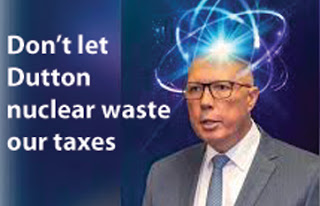
Philip White – letter sent to Adelaide Advertiser, 8 July 24
Nuclear proponents have to discredit CSIRO’s costings, or the Coalition’s nuclear energy policy looks ridiculous. They say CSIRO underestimates reactors’ operating lives and utilisation rate.
Due to the time value of money, increasing the lifespan doesn’t make as much difference as you might think. But what sensible person would base their investment decision on 60, or 80, or even 100 year lifespans?
The oldest operating reactor in the world is 54 years old, while the mean age of the 29 units taken off the grid between 2018 and 2022 was 43.5 years.
As for utilisation, the Coalition’s suggested 90% plus rate would actually present a problem for the grid. When demand is low you’d have to shut down all other generation.
But it’s not realistic anyway. Nuclear proponents love to point to France as their poster child, but its utilisation rate in 2022 was just 62%. More than half of its reactors were taken offline due to maintenance or technical problems. It also had to limit output due to problems cooling the reactors during the hot summer.
Starmer’s role in Assange’s persecution
As head of the UK Crown Prosecution Service, the newly elected British PM Keir Starmer played a key role in setting in motion the infernal legal machinery that crushed Assange for 14 years
THOMAS FAZI, JUL 05, 2024, https://www.thomasfazi.com/p/starmers-role-in-assanges-persecution
Even though Julian Assange was finally freed last month, after a 14-year-long ordeal, many myths still endure about the whole affair. One of these is that the case concerning Assange’s alleged rape of two girls in Sweden, in 2010, never went to trial because Assange evaded justice. In reality, Assange, who was then in the UK, made himself available for questioning via several means, by telephone or video conference, or in person in the Australian embassy. But the Swedish authorities insisted on questioning him in Sweden. Assange’s legal team countered that extradition of a suspect simply to question him — not to send him to trial, as he had not been charged — was a disproportionate measure.
This was more than a technicality: Assange feared that if he were extradited to Sweden, the latter’s authorities would extradite him to the US, where he had good reason to believe that he wouldn’t be given a fair trial. Sweden, after all, always refused to provide Assange a guarantee of non-extradition to the US — the reason why, when in 2012 the British Supreme Court ruled that he should be extradited to Sweden, Assange sought political asylum in the Ecuadorian embassy. From there, however, he continued to make known his availability to be interrogated by the Swedish authorities inside the embassy, but they never replied.
Thanks to a FOIA investigation by the Italian journalist Stefania Maurizi, it would later emerge that a crucial role in getting Sweden to pursue this highly unusual line of conduct was played by the UK Crown Prosecution Service (CPS), the principal public agency for conducting criminal prosecutions, then led by one Keir Starmer. In early 2011, while Assange was still under house arrest, Paul Close, a British lawyer with the CPS, gave his Swedish counterparts his opinion on the case, apparently not for the first time. “My earlier advice remains, that in my view it would not be prudent for the Swedish authorities to try to interview the defendant in the UK”, Close wrote. Why did the Crown Prosecution Service advise the Swedes against the only legal strategy that could have brought the case to a rapid resolution, namely questioning Julian Assange in London, rather than insisting on his extradition?
In hindsight, it seems clear that the CPS’s aim was precisely that of keeping the case in a legal limbo, and Assange trapped in Britain, for as long as possible, especially considering how shaky the case against Assange was in the first place. After all, what better outcome for Assange’s enemies than keeping him under investigation for years, suspected of being a rapist but never either charged or cleared once and for all, thus justifying his arbitrary detention? The CPS’s hostile treatment of Assange, the citizen of an allied country, continued even after he sought refuge in the Ecuadorian embassy, for example by insisting on denying him “safe passage” in UK territory in order to be treated in a hospital for a shoulder problem.
A year after Assange had taken refuge in the embassy, it appears that the Swedish prosecutor was considering dropping the extradition proceedings, but she was deterred from doing so by the CPS. The prosecutor was concerned, among other things, about the mounting costs of costs of the Scotland Yard agents guarding the embassy day and night. But for the British authorities this was not a problem; they replied that they “do not consider costs are a relevant factor in this matter”.
As a result of the Swedish authorities’ highly unusual behaviour, Assange had, by then, been arbitrarily and illegitimately forced into detention for seven years, as was concluded even by the UN Working Group on Arbitrary Detention.
What role, if any, did Keir Starmer play in all this as head of the CPS? During the period when the body was overseeing Assange’s extradition to Sweden, Starmer made several trips to Washington. US records show Starmer met with Attorney General Eric Holder and a host of American and British national security officials. Using the Freedom of Information Act, the British media organisation Declassified UK requested the itinerary for each of Starmer’s four trips to Washington with details of his official meetings, including any briefing notes. CPS replied that all the documents relative to Starmer’s trips to Washington had been destroyed. Asked for clarification — and whether the destruction of documents was routine — the CPS did not respond.
Similarly, when Maurizi submitted a FOIA request to the CPS to shed light on the correspondence between Paul Close and the Swedish authorities, she was also told that all the data associated with Paul Close’s account had been deleted when he retired and could not be recovered. This only beckoned more questions: why did the CPS destroy key documents on a high-profile, ongoing case? And what did the CPS destroy exactly, and on whose instructions? The CPS added that Close’s email account had been deleted “in accordance with standard procedure”. However, Maurizi would later discover that this procedure was by no means standard. The destruction of key emails was distinctly suspicious.
Since then, Maurizi has been waging a years-long legal fight to access documents related to the CPS and Assange case, but she has been systematically stonewalled by CPS — even despite a judge order ordering the CPS to come clean about the destruction of key documents on Assange. One cannot help but wonder: what are they trying to hide? It’s hard to shake the conclusion that the real purpose of the Swedish investigation, and of CPS’s unusual behaviour, was simply to keep Assange detained for as long as necessary to get him extradited to the US.
Now that one of the key people behind all this has just been elected prime minister, it’s even less likely that we’ll ever learn the truth. Indeed, one cannot help but wonder if releasing Assange just before the election wasn’t a way — for Starmer and everyone else involved — to make this story go away once and for all.
No House? Two-party Senate squeeze on cross-bench locks in Defence spending debacle
Defence has little oversight. Whenever they turn up to Senate Estimates or the Joint Parliamentary Committee on Accounts and Auditing, and the subject matter strays into areas of embarrassment, Defence pleads “it’s classified, we can’t talk about it.”
by Rex Patrick | Jul 8, 2024, https://michaelwest.com.au/no-house-two-party-senate-squeeze-on-cross-bench-locks-in-defence-spending-debacle/ (sorry about the coloured bits – my ludditeness)
On the last day of sitting before the winter parliamentary break, the Albanese Government, who’ve had bills delayed and amended, for the first time in the 47th Parliament had a piece of legislation voted down in the Senate. It’s an outcome that does not serve Australians well. Rex Patrick reports.
Comedy in the Senate
Last Thursday in the Senate, Greens’ Senator David Shoebridge rose from his seat and gave an impromptu speech on Defence. Anyone watching might reasonably have thought he was engaging in a moment of comedy, but he wasn’t; the topic was deadly serious.
“It’s hard to know where you end the list of defence procurement disasters which have happened because, whether it’s Labor in government or the Coalition in government, whether it’s Labor in opposition or Coalition in opposition, the usual practice is that the club doesn’t hold Defence to account.“
The club just signs off on whatever new funding fantasy Defence comes up with and pretends that Defence can achieve it.
Zero, zero,zero
Shoebridge then made some blunt observations on submarine procurement.
“Two decades of this nonsense on submarines has given us a $20 billion hole. I’m trying to think how many submarines we got in the last 20 years – oh, zero. We’ve given $5 billion to the French for no subs, $5 billion to the US for no subs, $5 billion to the UK for no subs and $5 billion trying to keep the Collins class going for another ten years under an experimental project. How many new subs have we got? Zero”
He moved on to frigates.
“I think we were meant to get nine frigates for $45 billion. Now it looks like we’re going to get six frigates, and guess what the price tag will be? It’s $45 billion and counting.”
“Let’s be clear: the $45 billion on the Hunter frigates is to date the single largest procurement contract ever signed by the Commonwealth, and it’s a disaster zone. How many Hunter frigates do we have? You’ll be pleased to know we have the same number of Hunter frigates in service as we have new submarines. Zero.”
He finally turned to the Navy’s Offshore Patrol Vessels……………………………
A mess that needs fixing
Defence, by far, has the most public money committed to projects. If you wanted only one agency of government to spend money wisely, it would be Defence.
But they don’t spend it wisely. Defence procurement is an absolute mess. [excellent chart here on original]
The starting point for that mess is Admirals, Air Marshalls and Generals with little project and risk management experience making purchasing recommendations to Cabinet ministers with no experience in project and risk management.
Senator Shoebridge rightly pinged the timidity of successive governments, cabinets and ministers when it comes to defence:
“They pretend they’re tough on Defence until somebody strides into the room with a little bit of gold braid on their shoulder, and then there’s this obscene subservience from both the Labor party and the coalition: ‘Oh, Sir! Oh, Madam! How much money can we give you? Does it go ‘whoosh’? Will it go ‘bang’ at some point? Oh, that’s great! You can have the money.”
Oversight vacuum
And that leads us to the failed Bill last Thursday.
.
Defence has little oversight. Whenever they turn up to Senate Estimates or the Joint Parliamentary Committee on Accounts and Auditing, and the subject matter strays into areas of embarrassment, Defence pleads “it’s classified, we can’t talk about it.”
In late May, the Government introduced a Defence Amendment (Parliamentary Joint Committee on Defence) Bill 2024 that would establish a parliamentary committee that would meet in secret (by default) and have the power to inquire into just about any aspect of Defence.
The Committee, as prescribed in the Government’s Bill, was to consist of 13 Senators and MPs: seven Government members and six non-government members. The Liberals and Nationals went into a cataclysmic spasm. This would allow the Prime Minister to appoint a cross-bencher or two. OMG!
We have 14 cross benchers in the House (out of 151 MPs – 9%) and 20 cross benchers in the Senate (out of 76 senators – 26%). Having their representation on the Committee is appropriate, particularly given that most Defence projects are so long they extend across parliamentary terms and indeed several changes of government. Both Labor and the Coalition are to blame for the many screw-ups and are hesitant to engage in vigorous scrutinise.
So, Senator Birmingham moved an amendment to restrict the membership to seven government members and six opposition members. That amendment went down, and the Government and cross-bench voted against his changes. This put a nail in the Bill’s coffin, ensuring the Coalition would eventually vote against it.
So, Senator Birmingham moved an amendment to restrict the membership to seven government members
Two-party squeeze
Senator Shoebridge, rightly suspicious of the wording of Labor’s Bill, sought to amend it from seven Government members and six non-government members (which could easily just mean opposition members) to seven government members, four opposition members and two cross-benchers, one from the House and one from the Senate. That option was not supported by Labor or Liberal and was voted down.
That left the original wording of the Bill without Liberal or cross-bench support. The Bill went then went down in flames. It was Labor’s first comprehensive legislative failure in this Parliament.
There were some happy winners though; Defence’s bloated and complacent bureaucratic leadership. For them it’s business as usual; billions of taxpayers’ dollars to splurge with little scrutiny and even less accountability. There were, no doubt, a few bottles of (contractor supplied) champagne popping at Defence central on Russell Hill. They had dodged a bullet.
Politics, as it so often does, got in the way of a good outcome for the Australia public.
Latest nuclear news 9th to 16 July
Headlines this week
- Experts argue for an Australian ban on nuclear weapons ahead of UN Summit
- Nuclear energy a ‘job killer’ for the Hunter Valley, senator declares
- Renewables v nuclear: the facts point to one clear winner
- No room for nuclear power, unless the Coalition switches off your rooftop solar.
- South Australia’s renewable triumph is stunning proof that Dutton’s nuclear plans are a folly
- Peter Dutton’s nuclear proliferation claims. What’s the scam?
- The Sun has won”: exponentially growing solar destroys nuclear, fossil fuels on price.
- South Australia locks in federal funds to become first grid in world to reach 100 per cent net wind and solar.
- Don’t make my home a nuclear power hub– nuclear reactors in Latrobe Valley unsafe and unrealistic
- Aboriginal supporter of right-wing racism, Warren Mundine’s interests in mining uranium -not doing too well.
- No to nuclear in the Latrobe Valley.
- Power-hungry data centres are booming in Australia. Can the grid cope?
- No room for nuclear: AGL Energy, Australia’s biggest supplier of AGL baseload power, says flexibility is key as it plans to dump coal for renewables in a decade.
- Dutton’s claim that Australia is the only G20 nation not using nuclear power is misleading.
- CSIRO brings science, not politics, to electricity cost debate. Don’t let Dutton nuclear waste our taxes.
- Squadron Energy says innovation needed to overcome jump in wind costs, but nuclear not the answer.
- Book – “Nuked” on Aukus ‘fiasco’ says decision to embrace pact will ‘haunt’ Labor for years.
- Gas before nuclear ‘thought bubble’ as coal reign ends. Australia’s dark, twisted nuclear fantasy.
- How would a switch to nuclear affect electricity prices?
- The dirty history of ‘Nukey Poo’, the reactor that soiled the Antarctic. ….
1 This month
Chernobyl: The Lost Tapes – A good documentary on Chernobyl on SBS available On Demand for the next 3 weeks– https://www.sbs.com.au/ondemand/tv-program/chernobyl-the-lost-tapes/235274195556
20 May – Webinar – The dangerous world of AUKUS, US, military occupation and suppression of dissent
National Webinar, 20th May, 2026, 6.30pm AEST. Confronting laws restricting/suppressing protest speech and action
Speakers: Former Sen. Rex Patrick, Lawyer Nick Hanna ,Arthur Rorris ,Jorgen Doyle, Sen David Shoebbridge,
Facilitator Kelley Tranter.

of the week – Australians for War Powers Reform (AWPR)
To see nuclear-related stories in greater depth and intensity
 Antinuclear