US, UK (and Australia) boycott Japan nuclear bomb memorial after Israel snubbed

The Mayor of Nagasaki said that there was a possibility of protests against the Israeli presence over it’s war on Gaza.
The New Arab Staff & Agencies, 07 August, 2024
Ambassadors from Western countries – including the US and UK – will skip a ceremony marking the 79th anniversary of the nuclear bombing of Nagasaki after Israel was snubbed, officials said Wednesday.
Nagasaki’s mayor said last week that Israel’s ambassador Gilad Cohen was not invited to Friday’s event in the southern Japanese city because of the risk of possible protests over the Gaza conflict.
The US and UK embassies said on Wednesday their ambassadors would not take part as a result and that their countries would be represented by lower-ranking diplomats.
Media reports said Australia, Italy, Canada, and the EU, who together with the US, UK, and Germany signed a strongly worded joint letter to Nagasaki’s mayor last month, would follow suit.
US ambassador Rahm Emanuel will not attend “after the mayor of Nagasaki politicised the event by not inviting the Israeli ambassador”, an embassy spokesperson told AFP.
nstead, Emanuel, 64, who was ex-president Barack Obama’s chief of staff, will go to a separate event at a temple in Tokyo, the spokesperson said.
Emanuel is fiercely pro-Israel, with his father being a former member of the Irgun, a Jewish paramilitary group that targeted British soldiers and Palestinian civilians in mandatory Palestine.
The British embassy said Ambassador Julia Longbottom would also not be in Nagasaki, adding that not inviting Israel “creates an unfortunate and misleading equivalency with Russia and Belarus – the only other countries not invited to this year’s ceremony”.
A spokesperson for the French embassy said its number two would attend, telling AFP that the “decision not to invite the representative of Israel is regrettable and questionable”.
The European Union’s ambassador would not take part “due to his agenda” and the bloc would be represented by a lower-level diplomat, a spokesperson told AFP.
The German embassy told AFP that the head of its political division would attend, with the decision made “in light of the absences and availability” of senior embassy staff………………………………………………………………………………….https://www.newarab.com/news/us-uk-boycott-japan-nuclear-bomb-memorial-after-israel-snubbed
All six UK Astute-class nuclear submarines stuck in port for repairs
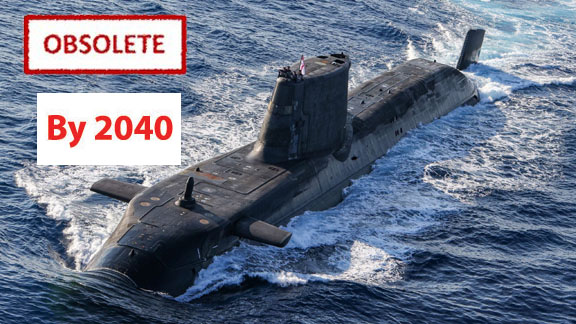
ALL six of the UK’s Astute-class nuclear submarines are stuck in port
– Faslane included – for repairs. The Royal Navy currently has no
working docks for repairs, which has led to the fleet’s newest subs not
conducting a single operation village this year. HMS Ambush — which is
stationed at Faslane – has not sailed for two years.
The National 6th Aug 2024
For Australia, AUKUS and the planned nuclear submarines create more problems than solutions
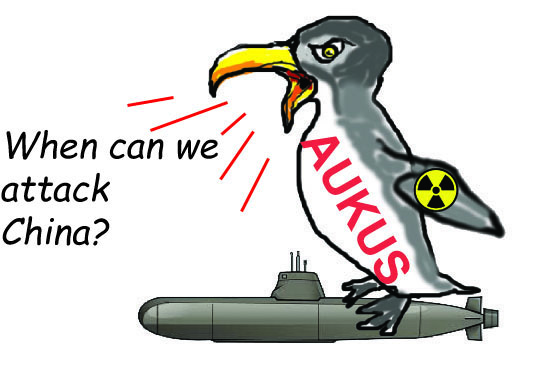
Preposterous’: AUKUS creates more problems than solutions THE AUSTRALIAN,
The timelines for Australia’s transition from ageing Collins-class to its first nuclear-powered sub just don’t add up. There is hardly a single strategist in the country who believes it will happen. By CAMERON STEWART 10 Dec 21

Now that Australia has finally weathered the diplomatic fallout caused by the creation of the three-nation AUKUS pact, it is time to work out exactly what it means for the nation’s security.
The Morrison government faces a series of critical multi-billion dollar decisions in the coming year that will set the course of Australia’s maritime defence for the next half a century.
These will require Canberra to test the limits of its alliance with both the US and the UK to ensure they make good on their AUKUS promise to share their sensitive nuclear know-how to help Australia acquire a nuclear-powered submarine fleet.
………….But the not-so-good news is that AUKUS has delivered as many conundrums for Australia as it has solutions.
………. the AUKUS announcement and the related scrapping of the French submarine project offers far more problems than solutions.
The timelines for Australia’s transition from its ageing Collins-class submarines to its first nuclear-powered submarine just don’t add up. Put simply, unless something changes, Australia risks having either no submarine fleet or a grossly antiquated one in the late 2030s and early 2040s……..
The government has given itself up to 18 months from the AUKUS announcement in September to study its options, although it says it hopes to decide on a plan of action earlier.
………………… The trouble is that the government’s initial projection for the completion of the first of eight nuclear-powered submarines, which it claims will be built in Adelaide, is not until 2038, meaning it would not be brought into naval service for another two years after that, in 2040, with one new nuclear boat every three years after that. This timetable is hugely ambitious and there is hardly a single strategist in the country who believes this will happen. The lessons of naval shipbuilding in Australia is that a first-of-class boat is never completed on time, much less the building of a nuclear submarine – easily the most complex construction of its kind in the country’s history.
……….
The solutions that have been floated, in no particular order, are to shorten the process by building at least some of the nuclear submarines overseas rather than in Australia; lease nuclear submarines from the US or UK; build a new conventional submarine in Australia as an interim measure; or extend the life of the Collins for a second refit cycle, meaning they would be sailing into the 2050s.
Every one of these proposals is problematic.
………………….. if the government chooses not to build a new conventional submarine and it deems that the Collins can be extended only for a decade, rather than two decades, then the only option is to acquire nuclear submarines more quickly than the current 2040 guideline.
This is the option that Dutton is pursuing but it requires delicate diplomacy with Australia’s AUKUS partners. First, Dutton must decide whether to ditch the government’s intention to build the eight nuclear submarines in Adelaide. While building all boats here will maximise Australian defence industry content, it will almost certainly slow the project down compared to a decision which would allow at least the first few boats to be constructed in US or UK shipyards.
Second, Dutton must choose between acquiring the US Virginia-class or the UK’s Astute-class submarines. Neither the UK nor the US production lines have room to include Australian boats in the foreseeable future. Dutton would need to lean heavily on London or Washington to make room for Australian boats to be constructed in their own shipyards. In the US, it would probably require Australia to partly fund a third shipyard to build the Virginia-class boats because the current two shipyards are struggling to keep up with the orders of the US Navy.
Hellyer believes the choice between the two countries is simple. “With nuclear submarines, we are not just picking a boat we are picking a strategic partner and that can only be the US,” he says…….
However, ditching the British submarine option would require delicate diplomacy from Canberra given that Britain’s prime minister Boris Johnson promised that the AUKUS deal would create “hundreds” of highly skilled jobs across the UK and would reinforce Britain’s place “at the leading edge of science and technology”.
The Morrison government appears to have gone cold on the option of leasing nuclear submarines to get them into the navy earlier. On closer inspection, neither the UK or the US have submarines available to lease. And in any case, Australia does not have the crews or the skills to sail them.
It will take at least a decade and probably longer for Australia to be able to train enough crew to the high levels required to man a nuclear-powered boat. A vast amount of that training will need to be done in the US or UK while Australia builds up the nuclear infrastructure and knowledge that will be needed to crew, maintain and manage a nuclear fleet.
All of these options amount to multi-billion dollar decisions by the government. If the wrong option is chosen, it will not only hit taxpayers, but it could severely compromise the country’s defence for decades.
The stakes could not be higher as the government moves to turn AUKUS from rhetoric to reality. www.theaustralian.com.au/inquirer/aukus-gives-us-more-problems-than-solutions-and-our-safety-is-at-stake/news-story/fff5b011740957f5cc246eb641408894
Hidden in mainstream Olympic Games news – an incisive comment on nuclear costs!

This naughty journalist understood that the news, at the present dragging-on time must be dominated by the Olympic Games, and nothing else matters.
So he wrote in a half page article -a quarter of a page virtuously all about the Olympic Games. Then – shock horror! He aberrated!
Taxpayers will come dead last at the Brisbane Games
Shane Wright, The Age, Business Section, 6 August 24
“……………………….There are myriad reasons why these costs blow out. Governments have a political incentive to under-estimate so they can win taxpayers over to the idea. Requirements for sports change. Organisers ignore inflation risks. And they have strict deadlines, which means paying whatever it takes to get everything ready on time………………….
Last year, Flyvberg and Dan Gardner published a book, How Big Things Get Done — a text that should be mandatory reading for every politician and engineer.
Based on a global database covering 16,000 major projects (including Olympic Games) from around the world and their cost to taxpayers, and stripped of the usual political spin used by every government and political party to sell their projects, it shows the single largest cost overruns for major projects are for nuclear storage projects. In third place is nuclear power itself. Taking out the silver medal for cost overruns is hosting the Olympic Games.
Of note to Dutton should be that the average cost blowout for nuclear storage is 238 per cent, with just under half of all projects suffering an overrun of at least 50 per cent.
Then, there’s nuclear power itself, where the average cost overrun is 120 per cent (the research covers almost 200 separate power plants). In terms of dollars, that means those who think – and will potentially promise voters – the nuclear dream will cost $10 billion will actually wind up billing taxpayers about $22 billion.
Also worthy of note is that in 55 per cent of all nuclear power cases, the overrun is at least 50 per cent. Of that subset, the average blowout is 204 per cent. Again, in terms of dollars, that would mean the $10 billion nuclear program would actually cost a little over $30 billion.
The project with the lowest risk and lowest overall cost of overrun?
Solar power.
Ultimately, the choice is to believe the reality of 16,000 projects from around the world, or politicians who have every reason not to be upfront about the true cost of their various promises.
There’s just one winner in that race, and unlike the Olympics, nuclear blowouts can’t be fixed with a cardboard bed. https://www.theage.com.au/politics/federal/taxpayers-will-come-dead-last-at-the-brisbane-games-20240805-p5jzio.html
TODAY. Relief – Hiroshima Day is over – now to our glorious $2 trillion nuclear weapons “modernization”!

August 7th. Hiroshima day is over. We can all breathe a sigh of relief. No need to be sad any more , about nuclear bombing. (Oh wait – there’s Nagasaki Day on the 9th. No matter, there’s very little coverage of that, and the people who count – the smart young people, probably have neder heard of it,
The good thing is – industry races on! Especially the USA nuclear weapons industry. Ain’t that great! They’re going to spend $2 trillion on “modernizing” nuclear weapons. And if Donald Trump gets in, backed by the Heritage Foundation, well – it will be more than $2 trillion.
I mean – think of the jobs jobs jobs! Think of the return to shareholders!
(Think of the American national debt – Nah – don’t go there. That is communist -style thinking and negativity)
No we don’t need negativity. Some people moan about not spending enough money on combatting climate change, on cleaning up plastic pollution, on preserving biodiversity, or even on feeding the world’s refugees and the hungry second-rate peoples.
No – positivity is the way to go. A positive approach to later on having a war against the evil Chinese and the evil Russians.
A revised AUKUS agreement. Dunno what it means yet
#Breaking. The White House has just revealed #AUKUS Govts have settled a new agreement to supersede the original AUKUS treaty. Significantly there is also an “understanding” including “additional related political commitments”. No details yet. 1/2
Letter to the Speaker of the House and President of the Senate on the Agreement Among the Government of the United States of America, the Government of Australia, and the Government of the United Kingdom of Great Britain and Northern Ireland for Cooperation Related to Naval Nuclear Propulsion
“………………………………………………….The Agreement, which would supersede the ENNPIA, would permit the continued communication and exchange of NNPI, including certain RD, and would also expand on the cooperation between the governments by enabling the transfer of naval nuclear propulsion plants of conventionally armed, nuclear-powered submarines, including component parts and spare parts thereof, and other related equipment. The Agreement also enables the sale of special nuclear material contained in complete, welded power units, and other material as needed for such naval nuclear propulsion plants. Equipment transferred in accordance with the Agreement could include equipment needed for the research, development, or design of naval nuclear propulsion plants, including their manufacture, operation, maintenance, regulation, and disposal, and could also include training, services, and program support associated with such equipment.
…………………………….The trilateral partners also concluded a non-legally binding Understanding Among the Government of the United States of America, the Government of Australia, and the Government of the United Kingdom of Great Britain and Northern Ireland (Understanding), which reflects the governments’ intended approach to certain articles of the Agreement and provides additional related political commitments. The Understanding would become operative on the date on which the Agreement enters into force
…………………………………Accordingly, I have approved the Agreement, authorized its execution, and urge that the Congress give it favorable consideration.
Sincerely,
UK’s Astute nuclear submarines stuck in port waiting for maintenance
No Astute-class boat — the Royal Navy’s largest and most powerful — has completed an operational voyage this year
Britain’s “hunter-killer” submarines have been stuck in port for up
to two years because of a shortage of maintenance docks. The Astute-class
submarines, the newest in the Royal Navy’s fleet, were designed to hunt
Russian submarines and torpedo targets from up to 14 miles away. They are
the largest and most powerful attack submarines the navy has operated.
However, none of the class has completed an operational voyage so far this
year, while one has been stuck in Faslane — HMNB Clyde — for two years,
The Sun reported.
Times 5th Aug 2024
Now is not the time for nuclear energy
Ian Thistlethwayte, Wyong, August 5, 2024, https://coastcommunitynews.com.au/central-coast/news/2024/08/now-is-not-the-time-for-nuclear-energy/
I agree with Gaye Clark (CCN 449) that “technology has advanced significantly” in the field of nuclear energy and have no doubt that it could, and maybe should, be in the energy mix in the future.
I contend, however, that now is not the time for this.
Many of us are unwittingly lending weight to the imbroglio which is “post truth politics”.
Hopefully, the advice of experts with backgrounds in science, engineering and thermo-nuclear energy production is of far greater value than what we are told by some politicians, the mainstream media and social media.
This advice includes observations that if Australia was to plan for nuclear power in 2025, we’d be unlikely to see any production from its source before 2040.
Further, what is being proposed so far will meet no better than seven per cent of the nation’s energy needs in 2040.
It has been widely agreed that an average 1.5-degree-Celsius rise in global temperatures since the beginning of the Industrial Revolution is the upper limit of what can be quite realistically managed.
The current trajectory of warming could lead to runaway climate change.
It’s likely the 1.5-degree rise has either been reached, or will be very soon.
While greenhouse emissions continue almost unabated, we now have renewables.
They work, are working, and are already helping.
Investment diverted from renewables towards nuclear power now and into the near future will result in greater rates of environmental destruction.
We still don’t know whether nuclear power will be affordable.
In Germany, nuclear has effectively been abandoned and renewables now produce more electricity than all forms of fossil fuel combined – 57 per cent at the beginning of 2024, up from 45 per cent in 2019.
The UK is not far behind this trajectory.
We’re at 35 per cent renewables, aiming for 82 per cent by the end of 2030.
In 2030, there won’t be a single nuclear power reactor on Australia’s horizon even if we start planning for one today.
The USA is at 22 per cent renewables, while each year, to pay for secure storage of radioactive waste, its citizens are taxed a total of $6B US and rising.
Clean? Yeah… nah! Eventually, yes?
Technology keeps advancing, but for governments worldwide to provide for the future safety and wellbeing of their citizens, the phrase “time is of the essence” seems most apt.
My final thoughts about Australia’s immediate future with nuclear: unclear.
Furphies being advanced by some people seeking to hamper the adoption of renewable energy.
Ultimately, they would undermine (pun intended) Australia’s clean energy sovereignty and exacerbate damage to our environment.
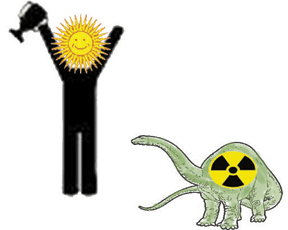
Nuclear energy as dead as dinosaurs
Dave Horsfall, North Gosford, August 6, 2024, https://coastcommunitynews.com.au/central-coast/news/2024/08/nuclear-energy-as-dead-as-dinosaurs/
Those in the anti-renewables lobby don’t give up, do they?
One could be excused for thinking that they have shares in the fossil-energy industry (and for the record, I do not have shares in the renewables industry, nor indeed any shares at all, as I do not believe in gambling upon the fortunes of a nation).
The latest offering is presented in CCN 449 (Time to rethink nuclear power), where not only is the since-discredited myth that wind turbines affect whales promulgated – which they do not, but I guess that alleged dangers to whales always make for a good story.
Apparently we are expected to believe that said turbines can suddenly uproot themselves and go cruising around of their own accord; either that, or ships’ captains are stupid or something.
Of course, no mention is made of how to safely dispose of the highly dangerous waste, nor indeed the reactor vessel itself once it’s reached its commercial end of life; then again, I guess these are just inconvenient truths.
Do these individuals really believe that they are more qualified than Australia’s peak scientific body – viz the CSIRO – which found that nuclear energy is the most expensive of all sources, and renewables the cheapest?
Nuclear energy is as dead as the dinosaurs; get used to it.
TODAY. 6th August – a day of respectful remembrance, and a day of absurd nuclear hypocrisy
https://www.youtube.com/watch?v=gVunlJOyfB0

Respectful remembrance of the atomic bombing of Hiroshima is happening – in places world-wide, and especially in Hiroshima.
But at the same time, the reality is that the nuclear nations, led by the USA, are all busy spending the taxpayers’ money on nuclear weapons. And the tax-payers don’t seem to care much – Nuclear-weapons -making provides jobs – doesn’t it?, and shares in it provide financial security don’t they? And nuclear weapons provide security and safety from the evil other people, don’t they?
And people continue to believe the spin. The spin that has gone on ever since that evil decision to atomic bomb Hiroshima, and that next evil decision, to atomic bomb Nagasaki.
Now – while pious statements about Hiroshima abound – the world’s leaders are gearing up for the next bombing. There’s a load of nonsense about “tactical nuclear weapons”, and a “limited nuclear war” – as if, somehow it would be OK to annihilate just a few billion civilians, rather than the whole 8 billion.
The hypocrisy about it being OK to bomb civilians is equalled by the hypocrisy that believing in increasing nuclear weaponry will deter wars. It sure has not prevented them over the past 79 years.
The “Western” World leaders seem fine with the idea of gearing up for a war against China and Russia. And now gearing up for a war against Iran? And Israel, led by a fanatic Zionist clique, looks ready to get that started.
It is hard to believe that Mutually Assured Destruction is still an accepted policy. ( I always thought it was a strange idea – that knowing of the deaths of billions of the “others” would be any consolation to us as we were ourselves annihilated.)
So – the whole nuclear weapon thing is a load of hypocrisy spun by imbecilic macho men.
But the next load of hypocrisy is the pretense that the “civil” nuclear industry has any real purpose beyond supporting the nuclear weapons industry. (Yes, nuclear medicine has a role, but it’s a two-edged sword, being itself a contributor to cancer)
Which brings me to that ultimate lie – that “nuclear power will solve climate change”
Amongst the many global threats to human and animal life, the big one is global heating.
Nuclear energy’s role in dealing with global heating has just one purpose- to stop the development of renewable energy and energy conservation.
The breath-taking hypocrisy of it all
Australian Conservation Foundation’s X account suspended after apparent ‘report bombing’

‘I do believe we are being targeted and they are trying to silence us out of this space,’ ACF spokesperson says
Graham Readfearn, Mon 5 Aug 2024 https://www.theguardian.com/australia-news/article/2024/aug/05/australian-conservation-foundation-acf-x-account-suspended-report-bombing
The X account of the Australian Conservation Foundation was suspended for more than 24 hours with the charity saying it believes it is being “report bombed by pro-nuclear groups” seeking to remove negative commentary.
The environment charity’s X account @AusConservation was suspended on Sunday morning, sparking outrage among supporters. The account was reinstated late on Monday, but without the charity’s 32,000 followers.
An explanatory note on its account had said that “after careful review” the account had been suspended for breaking “X Rules”.
The founder of one Australian pro-nuclear group, Nuclear for Australia, celebrated the suspension on X – the social media company owned by free speech advocate and US billionaire Elon Musk.
Major companies last year suspended their advertising on the platform, formerly known as Twitter, after Musk said he agreed with an antisemitic tweet on the platform.
Musk later apologised and called the post his “dumbest”
The ACF’s director of engagement, Jane Gardner, said the organisation had been posting more nuclear content since the Coalition revealed it wanted to lift the country’s ban on nuclear reactors and build seven nuclear plants.
She said: “We have noticed on our posts [about nuclear] there’s plenty of people disagreeing with us, with people threatening to report our content. I do believe we are being targeted and they are trying to silence us out of this space.”
ACF has received another suspension on X for no reason. I believe we’re being report bombed by pro-nuclear groups.
This is not isolated: factual nuclear info from @renew_economy & @climatecouncil has also been removed from Facebook and TikTok recently.On X, Gardner wrote: “As Australia’s largest and oldest environment advocacy group, our content is always evidence based and never in breach of any platform’s rules.
“It’s no coincidence that pro-nuclear proponents are today publicly boasting about these repeated attempts to silence us.”
Conservation charity Friends of the Earth said on X the suspension was “ridiculous” and that “no environmental group is safe from censorship here”.
An economist at The Australia Institute, Greg Jericho, said the suspension was “an absolute disgrace”.
Gardner said after the account was reinstated: “I hope our followers will be re-instated, but we are still to hear from X about why our account was withdrawn, We’ve had no explanation.
“We are worried this could happen again and, if it does, we will have to make some decisions about whether we want to be on the platform.”
ACF’s X account was also suspended briefly last month, again after posting nuclear content. The account was reinstated, without explanation, within a day of that suspension.
Guardian Australia asked X in an email why ACF’s account was suspended and if the suspension related to complaints about particular content. An automated reply said: “Busy now, please check back later.”
Last month the not-for-profit Climate Council had a video critical of nuclear energy temporarily removed from the social media platform TikTok.
The renewable energy media outlet RenewEconomy last month had an opinion article written by the University of Queensland economics professor John Quiggin on the costs of nuclear removed from Facebook.
The Impact of Nuclear Weapons on Children

Content warning: This report includes graphic stories, illustrations and photographs of extreme violence committed against children; detailed descriptions of children’s injuries, suffering and deaths; references to mental illness, suicide and child neglect; and stories of harm inflicted on pregnant women resulting in miscarriages and stillbirths.
Contents
Part I The Children of Hiroshima and Nagasaki
Part II Children Harmed by Nuclear Testing
Every day, children are killed or injured in armed conflicts around the world. Thousands of children – including many babies – are now counted among the dead in the ongoing wars in Gaza and Ukraine: a blight on humanity.
In both cases, the main perpetrators of violence against children are states armed with nuclear weapons; and in any war involving one or more such states, there is an inherent risk of nuclear catastrophe.
As this report shows in compelling and often gut-wrenching detail, it is children who would suffer the most in the event of a nuclear attack against a city today.
The Impact of Nuclear Weapons on Children is a dire warning to the governments of all nuclear-armed states and to the global public that urgent action is needed to rid the world of nuclear weapons.
By sharing the stories of children killed or injured in the US atomic bombings of Hiroshima and Nagasaki in 1945 and of children harmed by nuclear tests, we hope to honour them and ensure that no one else ever suffers as they have.
Hon. Melissa Parke, Executive Director, ICAN, August 2024
Executive Summary
Nuclear weapons are designed to destroy cities; to kill and maim whole populations, children among them.
In a nuclear attack, children are more likely than adults to die or suffer severe injuries, given their greater vulnerability to the effects of nuclear weapons: heat, blast and radiation. The fact that children depend on adults for their survival also places them at higher risk of death and hardship in the aftermath of a nuclear attack, with support systems destroyed.
Tens of thousands of children were killed when the United States detonated two relatively small nuclear weapons (by today’s standard) over the Japanese cities of Hiroshima and Nagasaki in 1945.
Many were instantly reduced to ash and vapour. Others died in agony minutes, hours, days or weeks after the attacks from burn and blast injuries or acute radiation sickness. Countless more died years or even decades later from radiation-related cancers and other illnesses. Leukaemia – cancer of the blood – was especially prevalent among the young.
In Hiroshima and Nagasaki, the scenes of devastation were apocalyptic: Playgrounds scattered with the dead bodies of young girls and boys. Mothers cradling their lifeless babies. Children with their intestines hanging out of their bellies and strips of skin dangling from their limbs.
At some of the schools close to ground zero, the entire student population of several hundred perished in an instant. At others, there were but a few survivors. In Hiroshima, thousands of school students were working outside to create firebreaks on the morning of the attack. Approximately 6,300 of them were killed.
Those children who, by chance, escaped death carried with them severe physical and psychological scars throughout their lifetimes. What they witnessed and experienced on 6 August and 9 August 1945 and in the days that followed was permanently seared into their memories.
Thousands of children lost one or both parents, as well as siblings. Some “A-bomb orphans” were left to roam the streets, with orphanages exceeding capacity.
Many of the babies who were in their mothers’ wombs at the time of the atomic bombings were also harmed as a result of their exposure to ionising radiation. They had a greater risk of dying soon after birth or suffering from congenital abnormalities such as brain damage and microcephaly, as well as cancers and other illnesses later in life.
Pregnant women in Hiroshima and Nagasaki also experienced higher rates of spontaneous abortions and stillbirths.
In communities around the world exposed to fallout from nuclear testing, children have experienced similar harm from radiation.
Since 1945, nuclear-armed states have conducted more than two thousand nuclear test explosions at dozens of locations, dispersing radioactive material far and wide.
Among the general population, children and infants have been the most severely affected, due to their higher vulnerability to the effects of ionising radiation. Young children are three to five times more susceptible to cancer in the long term than adults from a given dose of radiation, and girls are particularly vulnerable.
In the Marshall Islands, where the United States conducted 67 nuclear tests, children played in the radioactive ash that fell from the sky, unaware of the danger. They called it “Bikini snow” – a reference to the atoll where many of the explosions took place. It burned their skin and eyes, and they quickly developed symptoms of acute radiation sickness.
For decades after the tests, women in the Marshall Islands gave birth to severely deformed babies at unusually high rates. Those born alive rarely survived more than a few days. Some had translucent skin and no discernible bones. They would refer to them as “jellyfish babies”, for they could scarcely be recognised as human beings.
Similar stories have been told by people living downwind or downstream of nuclear test sites in the United States, Kazakhstan, Ma’ohi Nui, Algeria, Kiribati, China, Australia and elsewhere.
We have a collective moral duty to honour the memories of the thousands of children killed in Hiroshima and Nagasaki, as well as those harmed by the development and testing of nuclear weapons globally. And we must pursue the goal of a nuclear-weapon-free world with determination and urgency, lest there be any more victims, young or old.
Under international humanitarian law and the Convention on the Rights of the Child, governments have a legal obligation to protect children against harm in armed conflict. To fulfil this obligation, it is imperative that they work together now to eliminate the scourge of nuclear weapons from the world.
In this report, we describe how nuclear weapons are uniquely harmful to children, based on the experiences of children in Hiroshima and Nagasaki and those living near nuclear test sites. We share their first-hand testimonies and depictions of the toll of nuclear weapons on their lives. And we explain how the ever-present fear of nuclear war – the possibility that entire cities might be destroyed at any given moment – causes psychological harm to children everywhere.
Finally, we make an urgent appeal to all governments to protect current and future generations of children by eliminating nuclear weapons, via the landmark UN Treaty on the Prohibition of Nuclear Weapons, which entered into force in 2021.
Key findings
So long as nuclear weapons exist in the world, there is a very real risk that they will be used again, and that risk at present appears to be increasing.
In the event of their use, it is all but certain that many thousands of children – perhaps hundreds of thousands or more – would be counted among the dead and injured, and they would suffer in unique ways and out of proportion to the rest of the population.
In a nuclear attack, children would be more likely than adults:
- To die from burn injuries, as their skin is thinner and more delicate and burns deeper, more quickly and at a lower temperature;
- To die from blast injuries, given the relative frailty of their smaller bodies;
- To die from acute radiation sickness, as they have more cells that are growing and dividing rapidly and are significantly more vulnerable to radiation effects;
- To be unable to free themselves from collapsed and burning buildings or take other steps in the aftermath that would increase their chances of survival;
- To suffer from leukaemia, solid cancers, strokes, heart attacks and other illnesses years later as a result of the delayed effects of radiation damage to their cells; and
- To suffer privation in the aftermath of the attacks, as well as psychological trauma leading to mental disorders and suicide.
Furthermore, babies who were in their mothers’ wombs at the time of the attack would be at greater risk of:
- Death soon after birth or in early childhood;
- Microcephaly, accompanied by intellectual disability, given the higher vulnerability of the developing brain to radiation damage;
- Other developmental abnormalities;
- Growth impairment due to the reduced functioning of the thyroid; and
- Cancers and other radiation-related illnesses during childhood or later in life.
These horrifying realities should have profound implications for policy-making in countries that currently possess nuclear weapons or those that support their retention as part of military alliances.
They should also prompt organisations dedicated to the protection of children and the promotion of their rights to work to address the grave global threat posed by nuclear weapons.
While children played no part in developing these doomsday devices, it is children who would suffer the most in the event of their future use – one of the myriad reasons why such weapons must be urgently eliminated………………………………………………………………………………………………………………………………………………………….. more https://www.icanw.org/children?utm_campaign=2024_children_launch_an&utm_medium=email&utm_source=ican
“Disgraceful:” Bowen demands answers as social media giants remove EV and nuclear articles

Giles Parkinson, Aug 5, 2024, https://reneweconomy.com.au/disgraceful-bowen-demands-answers-as-social-media-giants-remove-ev-and-nuclear-articles/
Federal energy and climate minister Chris Bowen has demanded answers from social media giants, and Facebook owner Meta in particular, after a series of articles supportive of electric vehicles and critical of the federal Coalition’s nuclear policy were removed from their platforms.
Last month, Renew Economy published an analysis on the soaring cost of nuclear power by leading economist John Quiggin. We attempted to post it in our feed on social media but Facebook removed it without explanation.
Other posts critical of the Coalition’s nuclear claims have also been removed, and readers report that their attempts to post the articles on their Facebook feeds had also failed.
On Friday, the Australian Conservation Foundation – which has also been critical of the Coalition’s nuclear policies, also had its page on X, formerly twitter, frozen, much to the delight of the pro-nuclear zealots, including the schoolboy funded by the deep-pocketed renewable critic Dick Smith.
“ACF has received another suspension on X for no reason,” the ACF’s head of engagement Jane Gardiner wrote on her account, which has not been suspended.
“I believe we’re being report bombed by pro-nuclear groups. This is not isolated: factual nuclear info from @renew_economy & @climatecouncil has also been removed from Facebook and TikTok recently. We are under attack.”
Last week, Renew Economy’s EV-focused sister site The Driven also had a post removed from Facebook by Meta. This time it was about the start of a new price war on electric cars, this time driven by MG. Facebook said it was because the article breached community standards.
Bowen said he was not impressed.
“This is disgraceful,” he wrote on X. “A news outlet publishes a straight and factual article about EV prices coming down and @Meta bans it.
“Social media has the responsibility to police disinformation and facilitate factual updates. Social media is of course full of climate disinformation. There is no excuse for Meta blocking this factual article. I look forward to Meta justifying this decision.”
Researchers have pointed to a network of so-called think tanks and fossil fuel ginger groups who have been ramping up their presence on social media, attacking renewable and EV technologies, and promoting coal and nuclear. Yet it appears these posts, often laughably wrong, are not taken down.
The fossil fuel industry is largely behind these actions because nuclear serves two purposes for coal and gas – it delays action on climate and emissions reduction by several decades, and causes coal fired power generators to stay open for longer and for new gas generation to be built. The social media giants appear to have taken sides.
Giles Parkinson is founder and editor of Renew Economy, and is also the founder of One Step Off The Grid and founder/editor of the EV-focused The Driven. He is the co-host of the weekly Energy Insiders Podcast. Giles has been a journalist for more than 40 years and is a former business and deputy editor of the Australian Financial Review. You can find him on LinkedIn and on Twitter.
About Peter Dutton’s claim that nuclear is cheaper than renewables.

Philip White – (letter to The Advertiser) 5 Aug 24
Nuclear proponents go to great lengths in an attempt to show that nuclear energy is cheaper than renewables. For example, in Monday’s Advertiser former Australian Nuclear Science and Technology Organisation boss Ali Paterson is quoted comparing France’s electricity rates with Australia’s.
That is like comparing apples with pears. There is a huge difference in the impact on electricity prices of existing reactors that have already been paid for, and new reactors that won’t generate electricity for another 15 plus years.
I would put much greater faith in an estimate by Monash University’s Roger Dargaville that power bills could rise by $1,000 a year under the Coalition’s nuclear plan.
And by the way, the only French nuclear reactor to be built this century is 12 years behind scheduled and more than 4 times over budget and it still hasn’t started operating.
This week: The other side of news on nuclear and related issues

Some bits of good news– Trees Reveal Climate Surprise: Bark Removes Methane from the Atmosphere
Global population predictions offer ‘hopeful sign’ for planet, UN says. UNICEF and UNWRA work together in Gaza.
TOP STORIES.
79 years since the unthinkable.
The Great Global Computer Outage Is a Warning We Ignore at Our Peril .
Eastern Europe’s purchase of US nuclear reactors is primarily about military ties, not climate change.
How Many Nuclear Bombs Has The US Air Force Lost?
Climate. Extreme ‘heat dome’ hitting Olympics ‘impossible’ without global heating. Largest wildfire in US grows to cover area bigger than Los Angeles
Noel’s notes. “People of a generally nervous disposition” worry about mishaps with nuclear bombs. Who will honestly face up to the problem of nuclear wastes? Rolling Stewardship as a practical option.
*******************************
AUSTRALIA. Nuclear is a toxic idea … here’s why. Australia should avoid small nuclear reactors until 2040s, engineers warn. AUKUS servility just one facet of poor governance. Israel lobby ramps up scare campaigns in fear of truth. America’s war machine: Unless Australia acquires nuclear weapons, why acquire AUKUS subs? Lots more Australian nuclear news at https://antinuclear.net/2024/08/01/australian-nuclear-news-headlines-29-july-5-august-2/
| ARTS and CULTURE. 2-3 August, and 6-8 August Hiroshima Seen: Survivors and Witnesses Picture the Nuclear Age. The pictures worth a thousand words. | CLIMATE. Atomic Fallacy: Why Nuclear Power Won’t Solve the Climate Crisis. Californians defy evacuation orders as wildfire threatens homes. As record heat risks bleaching 73% of the world’s coral reefs, scientists ask ‘what do we do now?’ |
ECONOMICS.
- Point Lepreau nuclear station – a heavy financial burden that keeps getting heavier-ALSO AT https://nuclear-news.net/2024/07/30/3-b1-point-lepreau-nuclear-station-a-heavy-financial-burden-that-keeps-getting-heavier/
- NuScale Power plunges after report says it is under SEC investigation.
- U.S. company HOLTEC approaches South Yorkshire with £1.3bn offer to start Small Nuclear Reactor production.
- Rolls Royce – the “burning platform”? Rolls-Royce to sell stake in mini-nukes arm ALSO AT https://nuclear-news.net/2024/08/05/1-b1-rolls-royce-to-sell-stake-in-mini-nukes-arm/
- Government partnership is needed if Dutch pension fund PME is to make “risky” nuclear investment.
- ‘Ultra-cheap energy for every household’: could a different kind of tariff change everything?.
| EDUCATION. Some UK higher education rejoices in the nuclear and military partnership. | ENERGY. UK Electricity System Operator (ESO)s Future Energy Scenarios for a green UK – nuclear power is uncertain. This. nuclear waste site could soon host a massive solar installation. California achieves 100% renewable energy for 100 days. How much electricity comes from the Sun on summer days in the UK? Renewables are crushing gas-fired power. |
| ENVIRONMENT. Oceans. Link between unexploded munitions in oceans and cancer-causing toxins determined. | ETHICS and RELIGION. Project 2025 – A New Pax Romana | LEGAL. Assange, CIA Surveillance and Spain’s Audencia Nacional. |
MEDIA. Mass Media Goons Are Still Reporting That Biden Is Getting Tough On Netanyahu.
The Hidden Ties Between Google and Amazon’s Project Nimbus and Israel’s Military.
OPPOSITION to NUCLEAR . Japan, U.S. urged to work for nuclear abolition at symposium.
Blackwater Against New Nuclear Power Group (BANNG)campaigners say company’s claims over Bradwell B are false.
PERSONAL STORIES.
‘True horror’: Japan’s Hiroshima atomic bomb survivor campaigns for a nuclear-free world.
Canada and the Atom Bomb: Remembering As an Act of Resistance.
| POLITICS. US Congressmen Say ‘No War With Iran!’ Trump could win back the nuclear codes-Biden should put guardrails on the nuclear arsenal—now. Americans! How to make your vote count in November, and save the world in the process. Kamala: We need a ceasefire and arms embargo NOW! UK – the Ed Milliband Nuclear Nonsense Show. Generic Design Assessment Step 1 of the Holtec SMR: statement of findings. Bruce County Council nuclear endorsement undermines local democracy. | POLITICS INTERNATIONAL and DIPLOMACY. Putin warns the US of Cold War-style missile crisis. Nagasaki decides against inviting Israel to commemorate nuclear bombing of Japan amid war on Gaza. Understanding China’s Approach to Nuclear Deterrence. The Abrahamic Alliance: Reality or work of fiction? Behind a Nuclear Cooperation Agreement With Washington -Singapore not committed to nuclear power |
| SAFETY. Japan nuclear watchdog panel decides against restarting Tsuruga reactor. US nuclear plant unfit for quick resurrection, former lead engineer says. | SECRETS and LIES. Greasing Palms: The Thales Blueprint for Corruption. Britain’s nuclear submarine software built by Belarusian engineers. | TECHNOLOGY. Is the dream of nuclear fusion dead? Why the international experimental reactor is in ‘big trouble’ |
WASTES. Burying radioactive nuclear waste poses enormous risks.
Is Manitoba willing to accept nuclear waste risks?
Japan continues search for its first nuclear waste disposal site by screening tiny rural town.
WAR and CONFLICT.
- US Will ‘Certainly’ Defend Israel If Attacked By Iran In Wake Of Haniyeh Killing. US deploys 12 warships to Middle East as Israel escalates attacks in region.
- Iran vows revenge after Hamas leader Ismail Haniyeh killed in Tehran. Major escalation’: Israel bombs densely populated area of Beirut, Hezbollah says commander survived the attack.
- Israeli Forces Have Killed 366 UN Workers and Family Members in Gaza: Leaked Report. “Unspeakable”: Doctors Back from Gaza Say Death Toll “Much Higher,” Push Harris, Biden for Ceasefire.
- Where Is the Biden Plan to End the War in Ukraine?
- Putin often cites Russia’s ‘nuclear doctrine’ governing the use of atomic weapons. But what is it?
- The US might lose a war with China, congressional commission says.
WEAPONS and WEAPONS SALES.
First NATO F-16’s delivered to Ukraine (nuclear capable).
Replacing the UK’s nuclear deterrent: The Warhead Programme– without appropriate Parliamentary scrutiny.
‘Nuclear weapons money could tackle climate change‘- Martha Wardrop, Scottish Greens.
1 This month.

Australians deserve the truth
about
AUKUS – https://aukuspublicinquiry.com/
30 July – WEBINAR (Free) – Is Nuclear Power the Solution to Climate Change? https://my.acaw.org.au/event/acaw-is-nuclear-power-the-solution-to-climate-change
18:30 – 19:45 ACST
19:00 – 20:15 AEST


PETITION – To: Prime Minister Anthony Albanese and the Australian Labor Government

of the week – Australians for War Powers Reform (AWPR)
To see nuclear-related stories in greater depth and intensity
 Antinuclear