Julian Assange’s five-year battle against extradition to the US continues as he WINS last-ditch legal battle to lodge appeal
‘Today is a victory, but part of the victory only.’
‘Today marks a turning point. We went into court and we sat and heard the United States fumbling through their arguments, trying to paint lipstick on a pig.
‘We are relieved as a family that the courts took the right decision today but how long can this go on for?
Daily Mail, By GEORGE ODLING and ELIZABETH HAIGH, 21 May 24
WikiLeaks founder Julian Assange‘s five-year battle against extradition to the US for espionage charges continues after he won a last-ditch legal battle to appeal.
‘Well, the judges were not convinced. Everyone can see what is going on here. The United States’ case is offensive.
‘It offends our democratic principles, it offends our right to know, it’s an attack on journalists everywhere.
‘We are relieved as a family that the courts took the right decision today but how long can this go on for? Our eldest son just turned seven.
‘All their memories of their father are in the visiting hall of Belmarsh prison, and as the case goes along, it becomes clearer and clearer to everyone that Julian is in prison for doing good journalism, for exposing corruption, for exposing the violations on innocent people in abusive wars for which there is impunity.
There were gasps of relief from the Australian’s wife and other supporters in the High Court as Dame Victoria Sharp said she and Mr Justice Johnson had decided they were not satisfied with assurances given by US prosecutors.
The judges had last month dismissed most of Assange’s legal arguments but said he would be able to bring an appeal on three grounds unless the US provided ‘satisfactory assurances.’
These were that Assange would be protected by and allowed to rely on the First Amendment, that his trial would not be prejudiced by his nationality and that the death penalty would not be imposed.
Dame Victoria told the court they were not satisfied Assange was guaranteed protection under the First Amendment.
Speaking outside court, Assange’s wife Stella said the judges had made the ‘right decision’, adding: ‘He should be given the Nobel prize and he should walk freely with the sand beneath his feet. He should be able to swim in the sea again. Free Assange.’
Delivering the ruling, Dame Victoria told the court: ‘We have carefully considered the submissions made in writing and orally.
‘First, in respect of the appeal under section 103 of the Extradition Act, we have decided to give leave to appeal on grounds four and five.’
Assange’s lawyer, Edward Fitzgerald KC, said he was satisfied with assurances that if the WikiLeaks founder was extradited and convicted he would not face the death penalty.
But lawyers for the US said that the fact that Assange is accused of illegally obtaining and disseminating confidential defence information means he was not guaranteed protection by the First Amendment regardless of nationality.
In written submissions, he said: ‘The position of the US prosecutor is that no-one, neither US citizens nor foreign citizens, are entitled to rely on the First Amendment in relation to publication of illegally obtained national defence information giving the names of innocent sources to their grave and imminent risk of harm.’
This principle applies to both US and non-US citizens irrespective of their nationality, he added.
The US has provided an assurance that if extradited, Assange ‘will be entitled to the full panoply of due process trial rights, including the right to raise, and seek to rely upon, the first amendment as a defence.’
Assange’s wife, Stella, has previously dismissed this pledge as ‘weasel words.’
The ruling will no doubt increase calls in Assange’s native Australia for the government to intervene on his behalf.
More than a hundred supporters gathered outside the Royal Courts of Justice to wave banners emblazoned with logos including ‘If Assange goes, free speech goes with him.’
Assange declined to attend the hearing but Mrs Assange sat next to his father John Shipton in the well of court 4.
Supporters of Julian Assange cheered as news of the decision to allow his appeal against extradition to the United States filtered out of the courtroom.
Hundreds of people gathered outside the Royal Courts of Justice in London, with many holding signs, flags and banners, while a band is also playing music.
Several speakers addressed crowds on a stage erected adjacent to the court building, with one telling supporters: ‘Today is a victory, but part of the victory only.’
Following the decision, one man with a megaphone said to Assange supporters: ‘We have to do more.’
Among the supporters chanting ‘Free Julian Assange’ were former Labour leader Jeremy Corbyn and Labour MP Apsana Begum.
Kaylaa Sandwell travelled from east London to attend the rally and said: ‘It was obvious from the beginning that they want to silence him and I think he’s a very honest man, and he’s spoken up for us, so we need to really support that.
‘He needs to be freed because he hasn’t done anything wrong.
‘If he doesn’t get freed, we won’t have a free press anymore.’
Speaking outside the Royal Courts of Justice after Julian Assange won a bid to bring an appeal against his extradition to the United States, his wife, Stella Assange, said that judges ‘reached the right decision’ and called on the US to drop the ‘shameful’ case.
She said: ‘Today marks a turning point. We went into court and we sat and heard the United States fumbling through their arguments, trying to paint lipstick on a pig.
‘Well, the judges were not convinced. Everyone can see what is going on here. The United States’ case is offensive.
‘It offends our democratic principles, it offends our right to know, it’s an attack on journalists everywhere.
‘We are relieved as a family that the courts took the right decision today but how long can this go on for? Our eldest son just turned seven.
‘All their memories of their father are in the visiting hall of Belmarsh prison, and as the case goes along, it becomes clearer and clearer to everyone that Julian is in prison for doing good journalism, for exposing corruption, for exposing the violations on innocent people in abusive wars for which there is impunity.
On top of that impunity they have gone after the man who put that impunity onto the public record.
‘The Biden administration should distance itself from this shameful prosecution, it should have done so from day one, but it may be running out of time to do the right thing.
‘Everyone can see what should be done here. Julian must be freed. The case should be abandoned. He should be compensated.
‘He should be given the Nobel prize and he should walk freely with the sand beneath his feet. He should be able to swim in the sea again. Free Assange.’
She continued: ‘The judges reached the right decision. We spent a long time hearing the United States putting lipstick on a pig, but the judges did not buy it.
‘As a family we are relieved, but how long can this go on? The United States should read the situation and drop this case now.’
The 52-year-old was indicted by a US grand jury in 2018 on 17 espionage charges and a charge of unlawful use of a computer, which Assange’s lawyers claim could see him sentenced to 175 years in jail.
American prosecutors allege that the Australian encouraged and helped former US army intelligence analyst Chelsea Manning to steal the cables, which they claim put the lives of covert sources around the globe at risk.
President Joe Biden has faced persistent pressure to drop the case filed by his predecessor Donald Trump.
Assange had previously lived inside the Ecuadorian Embassy in Knightsbridge, west London, for almost seven years until he was eventually dragged out in 2019 when the Ecuadorian government withdrew his asylum.
He entered as a fugitive in 2012 to avoid extradition to Sweden on sexual assault charges, which he denied and which Sweden dropped in 2019………………………………………………………………………. more https://www.dailymail.co.uk/news/article-13438235/julian-assange-wikileaks-death-penalty-high-court.html
The nuclear lobby’s education invasion – masters of the weasel word.

Look it’s just one little word – or sort of two-bit word – “DE-RISK”.
I came across it today, and puzzled over it. T’was in a rapturous article about Sheffield University, launching a major new manufacturing and testing facility in South Yorkshire, in partnership with Rolls Royce.
“SMRs are advanced nuclear reactors that are designed to be factory-built and transported to operational sites for installation. The technology is seen as a clean energy solution that is easier to deliver, scale and is more affordable than building new larger nuclear power stations. Each Rolls-Royce SMR could provide enough low-carbon electricity to power a million homes for more than 60 years.“
There were other words to ponder about – for example “The technology is seen as a clean energy solution” – seen by whom?
But I will stay with “de-risk”, because it’s a lovely word – chosen to impress, – and also to confuse and obfuscate the financial realities of the situation.
These are the meanings that I found
- To de-risk to take steps to make (something) less risky or less likely to involve a financial loss.
- De-Risking is a strategy that companies apply when they cannot manage the money laundering risks that they have obligations to.
- De–risking. means mitigating the risks of doing business in high-risk environments through concessionary finance or investment guar- antees.
- The de-risking process involves a strategic assessment by companies to reduce exposure to high-risk activities in order to minimize compliance- and operations-related risks
Well, to cut to the chase.
ECONOMICS. There is a wealth of information about the costs of small nuclear reactors (SMRs). Those in submarines are not suitable for electricity production. The only operating SMRs are in China (The HTR-PM) and Russia (The KLT-40S), and they’re not doing too well.
Meanwhile we have the fiasco of the NuScale SMR venture in the USA – . And with dozens of SMR designs on paper – none are even licensed let alone operative.
And here’s what that radical industrial journal Utility Dive has to say:
“Small modular reactors are at an economic disadvantage. The lower power output of these reactors, less than 300 MW per unit by definition as compared to the roughly 1,000 MW for the typical reactors that have been constructed for over four decades, means less revenue for the owning utility. But the cost of construction is not proportionately smaller. Engineers call this economies of scale. In terms of cost per unit (megawatt) of generation capacity, SMRs and the electricity they produce will be more expensive than power from large nuclear plants currently under construction. As the Lazard estimates show, these large plants are themselves not competitive with renewables.“
In Mirage News’ glowing regurgitation of nuclear hype for small nuclear reactors – not a word about their relatively more toxic radioactive wastes, not a word about their military and weapons, connection not a word about the long time scale, that makes them irrelevant to action on climate change.
But the military-industrial-nuclear-media-complex juggernaut rolls on – conning us with their weasel words – like “de-risk”.
Assange Wins Right to Appeal on 1st Amendment Issue
The High Court in London ruled Monday that Julian Assange can appeal his extradition to the U.S. on the grounds that he is being denied his First Amendment rights.
May 20, 2024, By Joe Lauria in London Consortium News, https://consortiumnews.com/2024/05/20/assange-wins-right-to-appeal-on-1a-issue/—
The High Court in London on Monday granted Julian Assange the right to appeal the order to extradite him to the United States on the grounds that the U.S. did not satisfy the court that it would allow Assange a First Amendment defense in a U.S. court.
“We spent a lot of time listening to the United States putting lipstick on a pig, but the judges didn’t buy it,” Stella Assange told reporters outside the court building. “As a family we are relieved but how long can this go on? The United States should read the situation and drop the case now.”
Assange has been imprisoned in London’s notorious Belmarsh Prison for more than five years on remand pending the outcome of his extradition. He must now spend an untold number of more months in the maximum security prison awaiting the start of his appeal.
In that sense it was a bitter victory for Assange. He gets to stay in prison another year or more, Joe Biden doesn’t have to worry about a journalist showing up in chains in Alexandria, VA during a presidential campaign and of course Assange could lose his appeal and arrive in the U.S. at a more opportune time for Biden.
In another sense, it was a victory for the supremacy of European law when it comes to free speech,
Background to Monday’s Action
The High Court in London on March 26 had ruled that Assange had three grounds to appeal, because 1). his extradition was incompatible with his free speech rights enshrined in the European Convention on Human Rights; 2.) that he might be prejudiced because of his nationality (not being given 1st Amendment protection as a non-American) and 3). because he had inadequate protection against the death penalty. (Without such protection Britain cannot extradite him.).
Rather than proceed with the appeal on those three grounds, the High Court gave the U.S. the chance, fours years after the extradition process began, to promise it would not use the death penalty, and to guarantee his free speech rights.
Because it is an executive branch decision, the U.S. was able to assure the British government that it would not seek the death penalty, and Assange’s lawyers on Monday said they did not contest that. Left unexplained, however, was why the British home office waited four years to seek what is normally a routine assurance in an extradition case.
The free speech issue was more complicated because a decision about Assange asserting a First Amendment defense at trial will be up to a U.S. federal court and not the Department of Justice. Therefore the DOJ could not issue such an assurance on the free speech issue.
That ultimately led the two judges, Justice Jeremy Johnson and Victoria Sharp, to allow Assange to launch a formal appeal of his extradition because of an apparent violation of British extradition law, based on the European Convention on Human Rights, that requires the receiving country to allow an extradited person the right to free speech.
Johnson and Sharp did not buy the convoluted argument of James Lewis KC for the United States, on why the U.S. should get their hands on Assange despite being unable to guarantee his freedom of expression.
Edward Fitzgerald KC, and Mark Summers KC, barristers for Assange, easily picked apart three pieces of Lewis’ somewhat desperate presentation:
- pointing out how Lewis had misled the court by saying the U.S. assurance would allow Assange to rely on the First Amendment, when in fact it says he can “seek to rely” on it;
- how none of a slew of case law Lewis cited to supposedly bolster his argument actually dealt with a trial, which of course Assange will, if he goes to the U.S.;
- that saying Chelsea Manning was not able to invoke First Amendment rights in defense of leaking classified defense information meant Assange shouldn’t either was “nonsense” because Manning was a government whistleblower who had signed non-disclosure agreements and Assange is a publisher.
The judges apparently also rejected a drawn-out, arcane and overly lawyered argument from Lewis about the difference between citizenship and nationality that to most laymen was nearly incomprehensible.
A Watershed Moment
“This was a watershed moment in this very long battle,” said WikiLeaks Editor-in-Chief Kristinn at an event following the hearing. “Today marked the beginning of the end of the persecution. The signaling from the courts here in London was clear to the U.S. government: We don’t believe your guarantees, we don’t believe in your assurances.”
1st Amendment & Espionage Act
The First Amendment is at the core of the unconstitutionality of the Espionage Act, which makes no exception for a journalist to possess and disseminate defense information.
The Assange case could lead to a constitutional challenge of it, said Marjorie Cohn, former president of the National Lawyers’ Guild. That may be one reason the Department of Justice does not want Assange to invoke the First Amendment in court.
The U.S.-U.K. Extradition Act “bars extradition if an individual might be prejudiced due to his nationality and due to the centrality of the First Amendment to his defense,” Cohn told CN Live! last month. “If he’s not permitted to rely on the First Amendment because of his status as a foreign national, he’ll thereby be prejudiced, potentially very greatly prejudiced by reason of his nationality.”
Assange contends that if he’s given First Amendment rights, “the prosecution will be stopped,” Cohn said. “The First Amendment is therefore of central importance to his defense.”
Cohn added: ‘If he has the right to free expression and freedom of speech, then what he did, what he’s accused of doing, would not violate the law.”
[See: 1st Amendment Authorized Assange’s Possession of Classified Data]
Though allowing First Amendment rights at trial would be ultimately a judge’s decision, and not the executive branch’s, Assistant U.S. Attorney Gordon Kromberg, who is prosecuting Assange, has not only not indicated that he wouldn’t file a motion against it in court, but has said explicitly that non-U.S. citizens do not have First Amendment rights in the U.S. for acts committed abroad.
A date has not yet been set for Assange’s appeal to begin.
Dutton’s nuclear would spike electricity bills when (if) they start in the 2040s
Odd that Peter Dutton hasn’t mentioned the commencement of the latest nuclear reactor in the US — or the big price hike it has caused consumers.
BERNARD KEANE AND GLENN DYER, MAY 20, 2024, https://www.crikey.com.au/2024/05/20/peter-dutton-nuclear-power-proposal-energy-bills-usa/
Why has Peter Dutton pulled another disappearing act — this time with his major policy, nuclear power?
In March, the Coalition’s media arm “exclusively” revealed he “will announce the Coalition’s signature energy policy before the May federal budget”. A few weeks later, we were told that timeline was abandoned, with Nationals leader David Littleproud complaining the Coalition was being “bullied” into announcing it before the budget, but that it could be announced “as soon as June or July”. When you live in the fantasy world of The Australian, the calendar’s a very flexible thing.
Dutton mentioned nuclear power several times in his budget reply speech last week. He did claim that “because of nuclear power, residents in Ontario, Canada pay up to a quarter of the cost of what some Australians pay for electricity”. But there was no detail — especially the electorates he wants to locate nuclear power plants in.
We know the Coalition is split over nuclear power, but you would have thought recent events in the United States would be encouraging Dutton to push forward. At the end of April, the most recent new nuclear reactor, in Georgia, began operating. “Georgia Power announced this week that the 1,114-megawatt (MW) Unit 4 nuclear power reactor at Plant Vogtle near Waynesboro, Georgia, entered into commercial operation after connecting to the power grid in March 2024,” the US Energy Information Administration (IEA) announced on May 1. Vogtle 3 began operating in mid-2023.
Good news, surely? Why wouldn’t Dutton be mentioning Vogtle (OK, it’s a little hard to pronounce) in his budget reply — rather than Canada?
Well, for one thing, the two new reactors have cost around US$35 billion to construct — that’s around US$20 billion over budget — and were completed seven years late. The final cost makes them the most expensive nuclear power plants in history, and they were only completed because Donald Trump provided $12 billion in loan guarantees to the ailing project.
Preliminary construction began on the two Vogtle reactors in 2009. On that timetable — remembering Australia has no nuclear power regulatory structures or industry expertise to draw on — a Dutton government’s first nuclear power would become available in 2040, assuming building started the day after the election.
But mammoth delays and massive cost blowouts are neither here nor there to the Coalition, remembering that nuclear power is actually all about keeping coal-fired power going, not building any nuclear power stations. The reason Dutton might not want to mention Vogtle is what the enormous cost of the new reactors has done to power prices: cause a permanent 10% increase in electricity bills for consumers across Georgia and beyond. According to the Associated Press:
Regulators in December approved an additional 6% rate increase on Georgia Power’s 2.7 million customers to pay for $7.56 billion in remaining costs at Vogtle, with the company absorbing $2.6 billion in costs. That’s expected to cost the typical residential customer an additional $8.97 a month in May, on top of the $5.42 increase that took effect when Unit 3 began operating.
That means consumers have faced a total 9.6% increase in electricity costs to pay for the new reactors.
That’s not modelling or estimates — that’s cold hard cash that American consumers are having to fork out, every quarter, forever, to pay for nuclear power.
Who would bear the cost of the inevitable budget blowouts of Dutton’s reactors? There is literally no major infrastructure project in Australia in recent years that has not experienced major cost blowouts. Consumers would be looking at similar increases in their power bills as the residents of Georgia — or higher.
This is why, as the IEA said, “no nuclear reactors are under construction now in the United States”. American electric utilities have learned from Vogtle’s delays, cost overruns, regulatory problems and massive lift in power costs for consumers. They have shelved plans for 24 other reactors proposed between 2007 and 2009.
The much-vaunted — by the Coalition — NuScale small modular reactor in Idaho was abandoned earlier this year amid cost blowouts that saw the likely consumer price of electricity produced by the plant rise by more than 50% to US$89/MWh. Two half-built reactors under construction in South Carolina were abandoned in 2017.
Westinghouse, whose technology is used in the Vogtle 4 station, is focused on trying to sell its reactor design abroad, as Americans come to realise that, even despite having had a nuclear power industry since the 1950s, more nuclear power plants are too costly for consumers to wear. But the penny hasn’t dropped with Dutton and his media champions yet.
Anthony Albanese accuses Coalition of hiding key details on nuclear policy
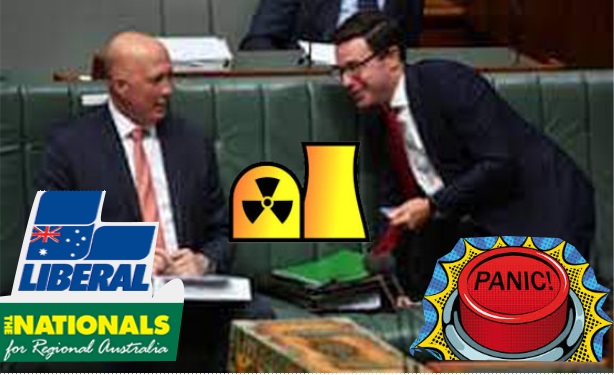
The prime minister has lashed out at the opposition for failing to reveal where nuclear power plants after ‘extensive’ polling was done in potential electorates.
Eleanor Campbell, May 19, 2024 , https://www.news.com.au/finance/business/other-industries/anthony-albanese-accuses-coalition-of-hiding-key-details-on-nuclear-policy/news-story/4869e764cab8286dc57a0883412c89c4
Anthony Albanese has attacked the coalition for failing to reveal key details of its controversial nuclear energy policy, which now looks be delayed until the end of the year.
Opposition Leader Peter Dutton’s reply to the federal budget last Thursday omitted key details of the signature energy policy, including the total costs and locations of the six nuclear power plants slated to replace a retiring fleet of coal-fired power stations.
Nationals leader David Littleproud on Sunday said it would not have been “appropriate” for Mr Dutton to outline the full costs in his budget reply speech, but confirmed the policy would “of course” be released before the end of 2024.
“We have done extensive polling of the electorates, we’ll be looking at six or seven sites … and they have been very supportive of a nuclear future,” Mr Littleproud told Sky Sunday Agenda.
Describing the opposition’s nuclear idea as “shocking policy” when asked at a press conference on the NSW Central Coast, the Prime Minister accused Mr Littleproud of intentionally hiding details from the public because the plan “didn’t stack up”.
“David Littleproud has said that they have done polling in the areas where the nuclear reactors are going to be built,” Mr Albanese said.
“So he clearly has full knowledge of where these reactors will be built, but he won’t tell Australians where it will be.
“Earlier this week, he said he’d look Australians in the eye and tell them where it would be, what it would cost, who would build them and who would finance them.
“Today, he’s saying, ‘We’ve got polling, but we’re not going to tell you’.
UK High Court rules that Julian Assange can appeal against extradition to USA.
The Conversation, Erin Cooper-Douglas, Deputy Politics + Society Editor 21 May 24 |
Late last night, Wikileaks founder Julian Assange had a win in the UK High Court: he can now appeal his extradition order to the United States
Legal efforts to keep Assange from being sent to the US, where he potentially faces a 175-year jail term for publishing sensitive government documents, have been some of the most protracted in recent memory. Just getting complete permission to appeal took three highly publicised hearings.
As Holly Cullen explains, one of the key grounds for appeal is freedom of expression. And that’s what makes yesterday’s decision, and the appeal that will now follow, legally groundbreaking. Never before has a UK court, nor the European Court of Human Rights, decided whether a potential violation of freedom of expression can stop someone from being extradited.
While the decision will please Assange’s team and his many supporters, the extradition threat still looms. If the appeal, which is likely to be held later this year, is unsuccessful, he could still find himself in the US.
Counteracting the spin of the military-industrial-nuclear-complex this week

Some bits of good news.
Instead of Taking Millions for Their Land, Texas Family Makes a Park Instead
Beavers Are Back in London — and They’re Thriving. Moroccan Farmers Are Banking Traditional Seeds for a Hotter, Drier Future
**************************************
TOP STORIES Julian Assange faces judgment day over US extradition. ‘Bring Julian home’: the Australian campaign to free Assange. https://www.goodnewsnetwork.org/instead-of-taking-millions-for-their-land-texas-family-makes-a-park-instead/
Noel’s notes. A DISAPPOINTING NETFLIX SERIES – Turning Point -the bomb and the cold war. Netflix’s “Turning point. The bomb and the cold war”- Episode 2 – Poisoning the Soil. Dominic Cummings the “evil gnome” who makes us think.
****************************************
AUSTRALIA. Nuclear subs are coming to Australia -Now the Coalition wants reactors, too-We’re not ready for it. Australia and the AUKUS nuclear waste-dump clause. Australia risks being ‘world’s nuclear waste dump’ unless Aukus laws changed, critics say. Nuclear waste from AUKUS nations could be on cards .
Dutton’s nuclear would spike electricity bills when (if) they start in the 2040s. Going nuclear on power and wages may not be the election winner Peter Dutton thinks it is. Anthony Albanese accuses Coalition of hiding key details on nuclear policy. ‘Hugely expensive’ nuclear a ‘Trojan horse’ for coal, NSW Liberal says as energy policy rift exposed. The 13 leading sites for a nuclear reactor in Australia – including a dam that supplies drinking water for a major city.
Australian war crimes whistleblower David McBride jailed for six years. David McBride goes to prison – and Australian democracy takes a hit.
NUCLEAR ISSUES
| CLIMATE. Mycle Schneider: Nuclear power is not an option. | CULTURE. Amidst genocide and war, anti-Zionism protesters are demonised as ‘extremists‘. War Culture Hates the Ethical Passion of the Young. | ECONOMICS. Nuclear Weapons at Any Price? Congress Should Say No. Nuclear power station risks hitting taxpayers with £20bn bill. Pension funds need ‘compelling’ returns from UK nuclear projects to invest. |
| EDUCATION. UK nuclear lobby further infiltrates universities with government grants for nuclear fusion. | EMPLOYMENT Warning that Dounreay could be facing ‘prolonged’ industrial action over pay dispute. | ENERGY. Tech firms claim nuclear will solve AI’s power needs – they’re wrong. Think before you click – and three other ways to reduce your digital carbon footprint. |
| HEALTH. Radiation. New Brunswick’s nuclear reactor emits high levels of radioactivity, increasing cancer risk. | MEDIA. Nuclear War Will Only Kill People Already Impacted By Nuclear Weapons. That’s Everyone.. https://www.youtube.com/watch?v=GeMZcgD8PmA | OPPOSITION to NUCLEAR . Protest. RAF Lakenheath protest to make airbase nuclear-free zone. Together Against Sizewell C vows to continue fight after legal challenge rejected by Supreme Court – as the nuclear plant welcomes the news. Indonesia civil society groups raise concerns over proposed Borneo nuclear reactor. |
PERSONAL STORY. The plutonium connection: Why I no longer conduct my research at the University of New Brunswick.
| POLITICS. Ontario’s nuclear option is the wrong path to meet green energy targets. Sen. Lindsey Graham suggests nuking Gaza, says nuking Hiroshima was ‘the right decision’. UK plans new nuclear plant in Scotland despite Scottish government opposition. UK government about to overrule Scotland and impose nuclear stations? UK government planning nuclear site in Scotland – Jack. Scotland’s First Minister Swinney condemns Jack’s menacing idea for nuclear plant in Scotland . We’re all right Jack: No need for nuclear in Scotland. The last thing that Scotland needs is new nuclear power, small or otherwise. LABOUR MUST RULE OUT NEW NUCLEAR REACTOR FOR SCOTLAND. Top Labour donor joins campaign to stop Hinkley nuclear plant. Nuclear Free Local Authorities welcome commitment to recruit new Theddlethorpe GDF Community Partnership Chair at less cost who is local. Welsh Nuclear Free Local Authorities welcome Traws abandonment from New Nuclear plans. | POLITICS INTERNATIONAL and DIPLOMACY. US Says It Won’t Let Iran Build Nuclear Bomb. Dominic Cummings: Zelensky’s no Churchill and Ukraine’s corrupt. Xi outlines solution to Ukraine conflict. US bans China crypto-miner from nuclear base area. China urges US, UK and Australia to stop AUKUS nuclear submarine deal: FM spokesperson. China and Russia Disagree on North Korea’s Nuclear Weapons. |
| PLUTONIUM ALL reactor-produced plutonium is usable in nuclear weapons. | SAFETY. Greenpeace Central and Eastern Europe (CEE) condemn Russian government plans to restart nuclear reactors at the Zaporizhzhia nuclear plant. Military activities near Zaporizhzhya Nuclear Power Plant (ZNPP). MISTAKES THAT CAUSED THE CHERNOBYL DISASTER. https://nuclear-news.net/2024/05/20/1-b-all-reactor-produced-plutonium-is-usable-in-nuclear-weapons/). | SPACE. EXPLORATION, WEAPONS. New report to Congress shows US determined to militarize space |
| SPINBUSTER. “Bouncing-back” and other resilience neologisms championed by the state are inherently at odds with the irreversibility of nuclear waste. Promising the Impossible: Blinken’s Out of Tune Performance in Kyiv. | TECHNOLOGY. EU rebuffs UK attempt to continue collaborating on nuclear fusion experiment -ALSO AT https://nuclear-news.net/2024/05/16/1-b1-eu-rebuffs-uk-attempt-to-continue-collaborating-on-nuclear-fusion-experiment/ Renewable Energy company Neoen to build its biggest battery to shift energy to evening peak in nuclear-dominated Ontario. Small Modular Nuclear Five Times The Price (letter). Canada’s plutonium mishap in India was 50 years ago this week – is history repeating itself now? | URANIUM. Russian uranium ban reopens threat of uranium mining escalation in US. Congress must stop Biden from fueling a Saudi nuclear bomb . |
| WASTES. Nuclear waste to be buried 650ft under the English countryside. ALSO AT https://nuclear-news.net/2024/05/19/2-a-nuclear-waste-to-be-buried-650ft-under-the-english-countryside/ Japan starts 6th discharge of Fukushima nuclear-contaminated wastewater. | WAR and CONFLICT. 450,000 Palestinians flee Rafah as Israeli tanks move in. Israel ‘Has Gone to War Against the Entire Palestinian People‘: Sanders. The US a Direct Partner in the Israeli War. Only ‘two countries’ would survive nuclear war after ‘5 billion die in 72 hours‘, says expert. U.S. rejects China’s proposal to ban first use of nuclear weapons. This is what nuclear war in 2024 would look like. Christmas Island veterans receive nuclear testing medals | WEAPONS and WEAPONS SALES. The Arsenal of Genocide: the U.S. Weapons That Are Destroying Gaza. Biden Moves Forward Over $1 Billion in Weapons for Israel as Tanks Push Deeper Into Rafah. Blinken to Zelensky: ‘Here’s another $2 billion to get thousands more Ukraine troops killed for nothing. U.S. conducted first subcritical nuclear test since September 2021. Fifty years after Canada’s plutonium mishap in India, is history repeating itself?. G7 goal of nuclear-free world increasingly challenged. |
‘Bring Julian home’: the Australian campaign to free Assange
Assange’s supporters say what Wikileaks revealed about power and access to information is as relevant today as ever.
Aljazeera, By Lyndal Rowlands 19 May 2024
Melbourne, Australia – At home in Australia, Julian Assange’s family and friends are preparing for his possible extradition to the United States, ahead of what could be his final hearing in the United Kingdom on Monday.
Assange’s half-brother Gabriel Shipton, who spoke to Al Jazeera from Melbourne before flying to London, said he had already booked a flight to the US.
A filmmaker who worked on blockbusters like Mad Max before producing a documentary on his brother, Shipton has travelled the world advocating for Assange’s release, from Mexico City to London and Washington, DC.
Earlier this year, he was a guest of cross-bench supporters of Assange at US President Joe Biden’s State of the Union address.
The invitation reflected interest in his brother’s case both in Washington, DC and back home in Australia. Biden told journalists last month he was “considering” a request from Australia to drop the US prosecution.
Assange rose to prominence with the launch of Wikileaks in 2006, creating an online whistleblower platform for people to submit classified material such as documents and videos anonymously. Footage of a US Apache helicopter attack in Baghdad, which killed a dozen people, including two journalists, raised the platform’s profile, while the 2010 release of thousands of classified US documents on the wars in Afghanistan and Iraq, as well as a trove of diplomatic cables, cemented its reputation.
Shipton told Al Jazeera the recent attention from Washington, DC had been notable, even as his brother’s options to fight extradition in the UK appeared close to running out.
“To get attention there on a case of a single person is very significant, particularly after Julian’s been fighting this extradition for five years,” Shipton told Al Jazeera, adding that he hoped the Australian prime minister was following up with Biden.
We’re always trying to encourage the Australian government to do more.”
A test for US democracy
Assange’s possible extradition to the US could see freedom of expression thrown into the spotlight during an election year that has already seen mass arrests at student antiwar protests.
Shipton told Al Jazeera the pro-Palestinian protests had helped bring “freedom of speech, freedom to assembly, particularly in the United States, front of mind again”, issues he notes have parallels with his brother’s story.
While Wikileaks published material about many countries, it was the administration of former US President Donald Trump that charged Assange in 2019 with 17 counts of violating the Espionage Act.
US lawyers argue Assange is guilty of conspiring with Chelsea Manning, a former army intelligence analyst, who spent seven years in prison for leaking material to WikiLeaks before former US President Barack Obama commuted her sentence.
“It’s an invaluable resource that remains utterly essential to understand how power works, not just US power, but global power,” Antony Loewenstein, an independent Australian journalist and author, said of the Wikileaks archive.
“I always quote and detail [Wikileaks’s] work on a range of issues from the drug war, to Israel/Palestine, to the US war on terror, to Afghanistan,” Loewenstein said, noting that Wikileaks also published materials on Bashar al-Assad’s Syria and Vladimir Putin’s Russia.
“It’s just an incredible historical resource,” he said.
Loewenstein’s most recent book, the Palestine Laboratory, explores Israel’s role in spreading mass surveillance around the world, another issue Loewenstein notes, that Assange often spoke about.
“One thing that Julian has often said, and he’s correct, is that the internet is on the one hand an incredibly powerful information tool… but it’s also the biggest mass surveillance tool ever designed in history,” said Loewenstein……………………………………………. more https://www.aljazeera.com/features/2024/5/19/bring-julian-home-the-australian-campaign-to-free-assange
Solar and wind generation will soon pass nuclear, hydro

Australia is a global pathfinder because, unlike in Europe, it cannot share electricity across national boundaries to reduce the effects of variable weather and demand. Australia must go it alone. Australia is convincingly demonstrating that change can happen quickly with good policies. Over the period 2020 to 2030, fossil generation is falling from 75% to 18%, while solar and wind generation is rising from 19% to 75%.
In a new monthly column for pv magazine, the International Solar Energy Society (ISES) explains how solar and wind are dominating power plant construction.
MAY 20, 2024 INTERNATIONAL SOLAR ENERGY SOCIETY (ISES) Authors: Prof. Ricardo Rüther (UFSC), Prof. Andrew Blakers /ANU https://www.pv-magazine.com/2024/05/20/solar-and-wind-generation-will-soon-pass-nuclear-and-hydro/
Our ISES pv magazine column in April showed that the fastest energy change in history is continuing. In 2023, solar and wind together constituted 80% of global net power capacity additions. Growth in power capacity is followed by growth in annual energy generation.
Over the past decade, global solar generation has grown ninefold to reach 1,500 TWh per year while wind generation has tripled to 2300 TWh per year (Figure 1 on original). This corresponds to compound growth rates of 22% and 11% per year respectively. In contrast, hydro, nuclear and coal generation had growth rates of about 1% per year, and gas 3%.
The solar growth rate of 22% per year is equivalent to doubling every 3 years. At this growth rate, solar generation will reach 100,000 TWh per year in 2042 which is enough to fully decarbonize the global economy.
Nuclear has a global average capacity factor of 74%, followed by coal (50% to 70%), combined cycle gas (40% to 60%), wind (30% to 60%), large hydro (30% to 50%), and solar photovoltaics (12% to 25%).
Despite its relatively low capacity factor, solar generation is tracking to surpass nuclear generation in 2026, wind in 2027, hydro in 2028, gas in 2030 and coal in 2032.
Solar and wind are strongly dominating powerplant construction, whereas construction of all other generation technologies is both small and stagnant. Coal, gas and nuclear could be mostly gone by mid-century once retirements outpace new construction.
The leading countries for per capita solar and wind generation are all in Europe, except Australia (Figure 2 on original). Also shown in Figure 2 is global per capita generation from hydro and nuclear. Combined generation from solar and wind in the leading countries is now fourfold larger than the global average generation from hydro and nuclear combined.
Australia is a global pathfinder because, unlike in Europe, it cannot share electricity across national boundaries to reduce the effects of variable weather and demand. Australia must go it alone. Australia is convincingly demonstrating that change can happen quickly with good policies. Over the period 2020 to 2030, fossil generation is falling from 75% to 18%, while solar and wind generation is rising from 19% to 75%.
Brazil and Chile are middle income pathfinder countries, with about 81% and 60% respectively of electricity generation coming from hydro, wind and solar. Pathfinder countries are driven by a desire to reduce both electricity prices and emissions. There are few serious concerns about future grid stability because there will be sufficient investment in storage, transmission, and demand management.
Christmas Island veterans receive nuclear testing medals
By Isaac Ashe & Steve Beech, BBC News, Derbyshire, 16 May 24
Derbyshire veterans who conducted nuclear tests for the British armed forces in the 1950s have been recognised at a ceremony.
Operation Grapple saw a series of British nuclear weapons tests carried out close to Christmas Island, in the Pacific Ocean, between 1957 and 1958.
The bomb tests assured British military power during the Cold War.
Four members of the armed forces who took part in the testing and one widow were presented with medals on Friday…………………………………………………………. more https://www.bbc.com/news/uk-england-derbyshire-69028261
Nuclear more than 6 times the cost of renewables – report

20 May 2024, https://www.aumanufacturing.com.au/nuclear-more-than-6-times-the-cost-of-renewables-report
An independent report by consulting and engineering firm Egis and commissioned by the Clean Energy Council has confirmed that nuclear is the most expensive form of new energy in Australia.
The review analysed the CSIRO and Australian Energy Market Operator (AEMO)’s GenCost report against the Lazard Review and the Mineral Council of Australia (MCA)’s research into Small Modular Nuclear Reactors.
The report found that nuclear energy is up to six times more expensive than renewable energy and even on the most favourable reading for nuclear, and that renewables remained the cheapest form of new-build electricity.
Nuclear may be even higher cost than forecast as waste management and decommissioning of nuclear plants had been omitted in cost calculations.
The report also found:
- The safe operation of nuclear power requires strong nuclear safety regulations and enforcement agencies, none of which exist in Australia
- And the economic viability of nuclear energy will further diminish as more wind, solar and battery storage enters the grid.
“Put simply, nuclear plants are too heavy and too slow to compete with renewables and can’t survive on their own in Australian energy markets.”
Clean Energy Council Chief Executive Kane Thornton, said households would need to pay a hefty price to subsidise nuclear reactors.
Thornton said: “Taxpayers also need to understand the costs that will be borne if they are forced to foot the bill for building a nuclear industry from scratch over a period of decades.
“Nuclear power is also a poor fit with our increasingly renewable power system.
“Nuclear power stations are expensive and have to run constantly in order to break even – but that doesn’t work in a world with an abundance of cheap renewables.”
The Egis report also found the MCA’s research on Small Modular Reactors (SMRs) did not anticipate the current long delay in SMR projects around the world.
Going nuclear on power and wages may not be the election winner Peter Dutton thinks it is

Guardian, Paul Karp, 20 May 24
Opposition leader has laid fertile ground for progressive attack ads to grow in policy-lite budget reply
Peter Dutton’s budget reply sets the Coalition up for an election campaign focused on migration and law and order. At least, that’s the election he wants because it’s one he thinks he could win.
But Dutton’s policy-lite speech contains the seeds of campaigns that will inevitably be deployed by the progressive side of politics: on nuclear and wages.
The nuclear debate has been a train wreck in slow motion for months now.
So many front page stories in the Australian promised the policy before the budget with such juicy details as the type of technology, the number of reactors, their putative location.
Then, a deferral. All in good time.
In Thursday’s speech, Dutton made the case that nuclear is popular. Bob Hawke supported it, so does John Howard, the Australian Workers Union and “65% of Australians aged 18 to 34 years of age”.
One couldn’t help but wonder: if it’s so popular, why not make it the centrepiece of the speech and actually announce the policy?
Perhaps because it’s so expensive that it completely fails the Coalition’s new test for Future Made in Australia projects – that they must be commercially viable without taxpayer support. Perhaps because the friendlier-sounding small modular reactors are not commercially available.
Or perhaps because it is not, in fact, that popular.
Labor are increasingly cocky that the nuclear thought-bubble is an exploding cigar for the opposition. On Thursday the energy minister, Chris Bowen, gleefully cited choice anonymous quotes from Coalition backbenchers in question time that the policy is “madness on steroids” and within the ranks there is “a sudden sense of bewilderment” about the idea.
A few months ago I wrote a slightly trolling column about the possibility of a plebiscite on nuclear power to accompany the next election. Labor see Dutton doing everything in his power to turn the next election into a straw poll on his big bad idea anyway.
The attack ads write themselves. I can see the bunting wrapped around schools on election day already, with nuclear cooling towers, yellowcake, plutonium rods and Dutton’s face.
In his post budget reply press conference the education minister, Jason Clare, said simply: “If he won’t tell you where he’s going to put all the nuclear reactors, why would you vote for him?”
This is the obvious scare campaign. Let’s also look at the slower burn issue: wages.
An easy win – but not for him
In his speech Dutton promised to “remove the complexity and hostility of Labor’s industrial relations agenda, which is putting unreasonable burdens on businesses”…………………
It’s absolutely fine for Dutton to create some policy differentiation with Labor, but if he doesn’t set out chapter and verse what’s in and what’s out, the unions will paint him as against all of it………………………………………………………………
The minor themes of the speech have the greatest potential to develop into major problems for him https://www.theguardian.com/australia-news/article/2024/may/20/going-nuclear-on-power-and-wages-may-not-be-the-election-winner-peter-dutton-thinks-it-is
The president of the ACTU, Michele O’Neil, said: “Dutton committed to getting rid of the workplace laws that are finally seeing real wages grow, after 10 years of wage stagnation by the last Coalition government.”
Dutton “told workers that if he is elected, he will again commit the Coalition to running an economy based on low wages” and “turn secure jobs into casual jobs”.
The Heroism of David McBride
By John Kiriakou https://consortiumnews.com/2024/05/16/john-kiriakou-the-heroism-of-david-mcbride/
By 2014 McBride had compiled a dossier into profound command failings that saw examples of potential war crimes in Afghanistan overlooked and other soldiers wrongly accused. On Tuesday he was sentenced to nearly six years in jail.
Sometimes a whistleblower does everything right. He or she makes a revelation that is clearly in the public interest. The revelation is clearly a violation of the law. And then he or she is even more clearly abused by the government. It would be great if these stories always had happy endings. Unfortunately, they don’t.
In this case, the whistleblower, the hero, Australian David McBride has been sentenced to five years and eight months in prison for telling the truth. He will not be eligible for parole for 27 months.
David McBride is former British Army officer and a lawyer with the Australian Special Forces who blew the whistle on war crimes committed by Australian soldiers in Afghanistan, specifically the killing of 39 unarmed Afghan prisoners, farmers, and civilians in 2012.
After failing to raise a response through official channels, McBride shared the information with the Australian Broadcasting Corporation (ABC), which published a series of major reports based on the material.
The ABC broadcasts in 2017 led to a major inquiry that upheld many of the allegations. Despite this, the ABC and its journalists themselves came under threat of prosecution for their work on the story.
The ABC offices in Sydney were raided by the national police, but in the end the government did not prosecute an ABC journalist because it was not in the public interest. McBride himself, however, was prosecuted for dissemination of official information.
Two Tours in Afghanistan
Let’s go back a few years. McBride at the time already was a seasoned attorney. After studying for a second law degree at Oxford University, he joined the British military and eventually moved back to Australia where he became a lawyer in the Australian Defence Forces (ADF). In that role he had two tours in Afghanistan in 2011 and 2013.
While on deployment, McBride became critical of the terms of engagement and other regulations that soldiers were working under, which he felt were endangering military personnel for the sake of political imperatives determined elsewhere.
By 2014 McBride had compiled a dossier into profound command failings that saw examples of potential war crimes in Afghanistan overlooked and other soldiers wrongly accused. His internal complaints were suppressed and ignored.
McBride’s reports also looked at other matters, including the military’s handling of sexual abuse allegations. After his use of internal channels had proven ineffective, McBride gave his report to the police. And eventually, he contacted journalists at ABC.
ABC’s Afghan Files documented several incidents of Australian soldiers killing unarmed civilians, including children, and questioned the prevalent “warrior culture” in the special forces. Subsequent to McBride’s disclosures, the behavior of other Coalition Special Forces in Afghanistan also came under sustained investigation.
In many ways, McBride’s reports went further than the issues identified by ABC. Amid prevalent rumors that Australian troops were responsible for war crimes, questionable deaths in Afghanistan had led to calls for investigations.
Report Vindicated McBride & ABC
In November 2020, the Brereton report (formally called the Inspector General of the Australian Defence Force Afghan Inquiry report) was published, utterly vindicating McBride and the ABC. Judge Paul Brereton found evidence of multiple incidents involving Australian personnel that had led to 39 deaths. Among his recommendations were the investigation of these incidents for possible future criminal charges.
There would be almost no criminal charges, however. At least, there would be only one eventual criminal charge against one single soldier in the murder of Afghan civilians. There have been no charges against the officers who covered up the war crimes.
Instead, though, there would be serious charges against McBride for “theft of government property” (the information) and for “sharing with members of the press documents classified as secret.” He faced life in prison.
McBride’s sentence illustrates the challenges that Australian whistleblowers face when reporting evidence of waste, fraud, abuse, illegality, or threats to the public health or public safety.
First, just like in the United States, there are no protections for national security whistleblowers. McBride took his career — indeed, his life — into his hands when he decided to go public with his revelations. But what else could he do?
Second, as in the United States, there is no affirmative defense. McBride, like Edward Snowden, Jeffrey Sterling, Daniel Hale and like me, was forbidden from standing up in court and saying, “Yes, I gave the information to the media because I witnessed a war crime or a crime against humanity. What I did was in the public interest.”
Those words are never permitted to be spoken in a court in the United States or Australia.
Recalling Nuremberg
Third, Australia is in dire need of some legal reforms. The judge in McBride’s case said at sentencing that McBride, “had no duty as an army officer beyond following orders.” That defense was attempted at Nuremberg and it failed. It’s time for the Australian judiciary to get into the 21st century.
There are a couple points of light in this whole fiasco. The Brereton Commission did indeed recommend that 19 members of the Australian Special Forces be prosecuted for war crimes. So far, one has been charged with a crime. He is accused of shooting and killing a civilian in a wheat field in Uruzgan Province in 2012.
Indeed, Andrew Wilkie, a former Australian government intelligence analyst-turned-whistleblower, and now member of Parliament, says that “the Australian government hates whistleblowers” and that it wanted to punish David McBride and to send a signal to other government insiders to remain silent, even in the face of witnessing horrible crimes. I would say exactly the same thing about the United States.
I’m proud to call David McBride a friend. I know exactly what he’s going through right now. But his sacrifice will not be in vain. History will smile on him. Yes, the next several years will be tough. He’ll be a prisoner. He’ll be separated from his family. And when he gets out of prison, well into his 60s, he’ll have to begin rebuilding his life. But he is right and his government is wrong. And future generations will understand and appreciate what he did for them.
John Kiriakou is a former C.I.A. counterterrorism officer and a former senior investigator with the Senate Foreign Relations Committee. John became the sixth whistleblower indicted by the Obama administration under the Espionage Act — a law designed to punish spies. He served 23 months in prison as a result of his attempts to oppose the Bush administration’s torture program.
And McBride will be allowed to appeal his conviction. Still any other light at the end of the tunnel is likely an oncoming train, rather than relief for the whistleblower.
But the bottom line is this. There is a war against whistleblowers in Australia just like there is in the United States.
This is what nuclear war in 2024 would look like

ABC RN, Broadcast Thu 16 May 2024, https://www.abc.net.au/listen/programs/latenightlive/this-is-what-nuclear-war-in-2024-would-look-like/103840906
In 1985, President Ronald Reagan and Soviet General Secretary Mikhail Gorbachev cautioned the world “a nuclear war cannot be won and must never be fought”. Decades later, we’re closer to nuclear Armageddon than ever before, and investigative journalist Annie Jacobsen paints a devastating picture of exactly what that would look like.
Guest: Annie Jacobsen – investigative journalist and New York Times bestselling author. She also writes and produces TV, including Tom Clancy’s Jack Ryan. Her latest book is Nuclear War: A Scenario.
Credits
Nuclear option costs ‘six times more’ than renewables
By Marion Rae, May 18 2024, https://www.canberratimes.com.au/story/8632826/nuclear-option-costs-six-times-more-than-renewables/—
The high upfront costs and burden on consumers of adding nuclear to Australia’s energy mix have been confirmed in an independent review.
Building nuclear reactors would cost six times more than wind and solar power firmed up with batteries, according to the independent report released on Saturday by the Clean Energy Council.
“We support a clear-eyed view of the costs and time required to decarbonise Australia and right now, nuclear simply doesn’t stack up,” the industry body’s chief executive Kane Thornton said.
Taxpayers needed to understand the decades of costs if they were forced to foot the bill for building a nuclear industry from scratch, Mr Thornton warned.
The analysis prepared by construction and engineering experts Egis also found nuclear energy had poor economic viability in a grid dominated by renewable energy.
Renewable energy will provide 82 per cent of the national electricity market under current targets for 2030, which is at least a decade before any nuclear could theoretically be operational.
Further, nuclear power stations are not designed to ramp up and down to align with renewable energy generation.
Adding to the cost challenges, Australia has no nuclear energy industry because it is prohibited under commonwealth and state laws, which would all need to be changed.
Mr Thornton said the analysis confirmed that building nuclear power stations instead of renewables would cause power prices to “explode”.
The analysis was based on the CSIRO’s GenCost 2023-24 consultation draft, the Mineral Council of Australia’s Small Modular Reactors study and the industry benchmark Lazard Levelized Cost of Energy Report.
These reports did not include waste management and decommissioning of a nuclear plant in cost calculations, which meant the true cost could be even higher, Mr Thornton said.
1 This month
7 April – WEBINAR – Australia and the Doomsday Clock – Preventing nuclear war through NoFirstUse and other policies
Online | Tuesday April 7, 4:00-5:30pm, Australian Eastern Time / 8:00-9:30am Central Europe Time
– Access the registration link
15 April – Zoom –Nuclear Power is Not the Solution
Apr 15, 2026 01:00 AM in Canberra, Melbourne, Sydney

Join the International Physicians for the Prevention of Nuclear War (IPPNW) on Tuesday, April 14th for a timely webinar exploring the risks associated with nuclear power and challenging the myth that it offers a simple, safe, carbon-free solution to the climate crisis

of the week – Australians for War Powers Reform (AWPR)
To see nuclear-related stories in greater depth and intensity
 Antinuclear