Australia’s ‘carbon budget’ may blow out by 40% under the Coalition’s nuclear energy plan – and that’s the best-case scenario
The Conversation, Sven Teske, Research Director, Institute for Sustainable Futures, University of Technology Sydney July 2, 2024
The Coalition’s pledge to build seven nuclear reactors, if elected, would represent a huge shift in energy policy for Australia. It also poses serious questions about whether this nation can meet its international climate obligations.
If Australia is to honour the Paris Agreement to limit global average temperature rise to 1.5˚C by mid-century, it can emit about 3 billion tonnes, or gigatonnes, of carbon dioxide (CO₂) over the next 25 years. This remaining allowance is what’s known as our “carbon budget”.
My colleagues and I recently outlined the technological options for Australia to remain within its carbon budget. We did this using a tool we developed over many years, the “One Earth Climate Model”. It’s a detailed study of pathways for various countries to meet the 1.5˚C goal.
So what happens if we feed the Coalition’s nuclear strategy into the model? As I outline below, even if the reactors are built, the negative impact on Australia’s carbon emissions would be huge. Over the next decade, the renewables transition would stall and coal and gas emissions would rise – possibly leading to a 40% blowout in Australia’s carbon budget.
Australia has a pathway to 1.5˚C
Earlier this year, my colleagues and I analysed the various ways Australia could reduce emissions in line with the 1.5˚ goal…………………………………………………………………………. more https://theconversation.com/australias-carbon-budget-may-blow-out-by-40-under-the-coalitions-nuclear-energy-plan-and-thats-the-best-case-scenario-233108
Queensland LNP excludes nuclear from agenda at conference ahead of state election

ReNeweconomy, Fraser Barton, Jul 5, 2024
There are 173 items on the discussion list for the annual Queensland LNP conference, but nuclear energy is not one of them.
The three-day event starting in Brisbane on Friday is not due to canvass the major policy which has sparked a divide between some federal and state Liberal and Nationals party members.
Queensland-based federal Opposition Leader Peter Dutton has unveiled plans to build seven nuclear power plants if the federal coalition wins government in 2025.
The policy was backed by Queensland based Nationals leader David Littleproud, who is due to join Mr Dutton at the LNP conference on Saturday, and by another Queensland-based LNP member, the federal energy spokesman Ted O’Brien.
Their approach to nuclear is not supported by Queensland’s Liberal National Party leader David Crisafulli.
Ahead of Queensland’s October election, Mr Crisafulli has confirmed nuclear is “not part of our plan” when asked about Mr Dutton’s policy.
The state convention’s list of resolutions is lengthy but makes no mention of nuclear energy, although Mr Dutton and Mr Littleproud might raise the issue during their addresses to the conference on Saturday.
Mr Crisafulli will address the event on Sunday.
“When you see hundreds of people coming to a venue to be able to debate the future of the state, the future of party, that’s really, really healthy,” Mr Crisafulli said ahead of the convention. ………………… https://reneweconomy.com.au/queensland-lnp-excludes-nuclear-from-agenda-at-conference-ahead-of-state-election/
Federal Coalition urged to retract claims linking medical technologies to nuclear power plans.
Margaret Beavis, Thursday, July 4, 2024,
Introduction by Croakey: Traditional owners of the Jabiluka uranium site in the Northern Territory are concerned the Federal Opposition’s plans for nuclear energy will increase demand for mining on their land, according to an ABC report.
As Croakey has previously reported, the Coalition’s nuclear plans have also been slammed by health, medical and scientific experts, with particular concerns for impacts upon First Nations peoples’ health and wellbeing.
In the article below, Dr Margaret Beavis OAM, Vice President of the Medical Association for Prevention of War (MAPW), calls on the Opposition to retract “patently false” claims made about a link between nuclear power and radiology, radiotherapy and nuclear medicine, which seek to “misrepresent nuclear medicine for political gain”. She also notes the likely derailing of climate action, and the problems of toxic waste and the potential for accidents and nuclear proliferation.
Meanwhile, Independent MP Dr Monique Ryan has urged Prime Minister Anthony Albanese to call an early election, warning that the Coalition has “recklessly jammed a stick into the spokes of the Australian economy by refusing to reveal a 2030 emissions reduction target and confusing the country with a threadbare nuclear energy announcement”.
Margaret Beavis writes:
The proposal for nuclear power in Australia needs more scrutiny from the public health perspective.
There are three aspects that are particularly problematic.
Firstly, investment in renewables will be damaged, making urgently needed decarbonisation much harder, worsening the very well documented health impacts of climate change.
No-one is pretending nuclear power can be implemented quickly. But for those who feel optimistic, looking at democracies similar to ours demonstrates the reality. The Hinkley Point plan in the United Kingdom, Flamanville in France, and Vogtle and VC Summer (abandoned after spending USD 9 billion) in the United States all have had both massive delays and major cost blowouts.
Slower roll out means even more coal and gas, and all the climate and health impacts that go with that. Compounding these delays will be the need in Australia for legislation at both state and federal level, and our lack of expertise and established workforce.
Secondly, the Coalition claims made about radiology, radiotherapy and nuclear medicine are patently false and deliberately misleading.
A letter sent by Coalition MPs to their constituents last month claimed that: “Nuclear energy already plays a major role in medicine and healthcare, diagnosing and treating thousands of Australians every day.”
We do not have, and have never had, nuclear power in Australia, and nuclear power has no connection to our world class nuclear medicine sector.
Australians will continue to benefit from diagnostic and therapeutic nuclear medicine irrespective of whether Australia’s future is powered by reactors or renewables. Nuclear power is not nuclear medicine, it is not X-Rays, and it is not radiotherapy.
X-Rays and radiotherapy do not use a nuclear reactor at all. Nuclear medicine in Australia – used to diagnose and treat some types of heart disease, thyroid conditions, infections, injuries, and cancers – involves radioactive elements (isotopes) that are made using a small research nuclear reactor at Lucas Heights in NSW.
Lucas Heights cannot and has not produced commercial power. But, like all nuclear reactors, it does produce radioactive waste that remains highly toxic for 10,000 years.
The Coalition also claims, on a website promoting the “need” for nuclear energy in Australia, that: “Research and advancements in radiation technology continue to evolve, providing new and improved methods for both diagnosing and treating diseases…”
False connections
Advancements to improve health outcomes and to reduce the size and risks of radiation exposures will occur whether or not Australia has nuclear power. With renewable energy, nuclear medicine will still exist and advance – our loved ones will still be treated and be cared for.
It’s disappointing that the Coalition has chosen to misrepresent nuclear medicine for political gain, and to make false connections between nuclear power and health.
Finally, it is important to consider the problems of waste and the risk of accidents, attacks and weapons proliferation.
Nuclear power poses significant risks to the health of people and the planet.
It is far from the zero emissions technology its acolytes claim it to be.
As noted, reactor waste is highly toxic for over 10,000 years. It remains globally an unsolved problem. The failure over decades to find a site for Australia’s existing limited amount of intermediate waste illustrates communities’ concerns.
First Nations communities have been repeatedly targeted. They have suffered enough from the impacts of British nuclear testing in the fifties and sixties.
Accidents can and do occur. There have been many near misses and at least 15 accidents risking uncontrolled radioactive release, involving fuel or core damage in Canada, Germany, Japan, Slovakia, the UK, Ukraine and the US.
Attacks on facilities could also cause extensive releases of radiation. A significant radiation release would require major long-term evacuation.
In addition, nuclear power is clearly linked with nuclear proliferation. Tilman Ruff, formerly at the Nossal Institute for Global Health in the School of Population and Global Health at University of Melbourne and co-founder of the International Campaign to Abolish Nuclear Weapons (ICAN), wrote in 2019:
South Africa, Pakistan and North Korea have primarily used the HEU (highly enriched uranium) route to build nuclear weapons, India and Israel primarily a plutonium route. All have used facilities and fuel that were ostensibly for peaceful purposes.”
Indeed, the possibility of acquiring nuclear weapons was part of former Australian Prime Minister John Gorton’s reasoning when considering a nuclear power plant at Jervis Bay.
In summary, building nuclear power in Australia will have significant long term adverse public health impacts. Extravagant claims that existing medical technologies and medical advances are somehow linked to plans for nuclear power are plainly wrong.
We urge the Coalition to retract these statements and remove inaccurate information from its marketing materials. We also urge they reconsider this policy, given its major health impacts both locally and globally.
Dr Margaret Beavis OAM is Vice President of the Medical Association for Prevention of War (MAPW) and a former GP who teaches medicine at Melbourne University. She has lectured on nuclear medicine and nuclear waste in Melbourne University’s MPH program.
Coalition parties asked to respond
Croakey has asked Federal Opposition Leader Peter Dutton and Leader of the Nationals Party David Littleproud for responses to the below questions raised in three articles Croakey has published on the Coalition’s nuclear energy plan.
- Health, medical and scientific experts have rejected your nuclear energy plans as dangerous and a way to delay climate action. What is your response?
- Aboriginal and Torres Strait Islander organisations and communities have raised concerns that nuclear energy would harm their health, wellbeing and connection to Country. What is your response?
- Additionally, health professionals have called for the Coalition to retract claims that medical technologies are linked to nuclear power plans. What is your response?
- Will you continue with your nuclear energy plan if local communities oppose reactors?
- How will you manage harms to health by delaying action on climate change and decarbonisation?
- Who will provide disaster insurance (Fukushima clean up estimated at $470-$660 billion)?
Trusting the ‘Five Eyes’ Only

For Their Eyes Only
The “Five Eyes” (FVEY) is an elite club of five English-speaking countries — Australia, Canada, New Zealand, the United Kingdom, and the United States — that have agreed to cooperate in intelligence matters and share top-secret information. They all became parties to what was at first the bilateral UKUSA Agreement, a 1946 treaty for secret cooperation between the two countries in what’s called “signals intelligence” — data collected by electronic means, including by tapping phone lines or listening in on satellite communications. (The agreement was later amended to include the other three nations.) Almost all of the Five Eyes’ activities are conducted in secret, and its existence was not even disclosed until 2010. You might say that it constitutes the most secretive, powerful club of nations on the planet.
Anglo-Saxon solidarity supersedes all other relationships.
JULY 5, 2024 By Michael Klare / TomDispatch, https://scheerpost.com/2024/07/05/trusting-the-five-eyes-only/
Wherever he travels globally, President Biden has sought to project the United States as the rejuvenated leader of a broad coalition of democratic nations seeking to defend the “rules-based international order” against encroachments by hostile autocratic powers, especially China, Russia, and North Korea. “We established NATO, the greatest military alliance in the history of the world,” he told veterans of D-Day while at Normandy, France on June 6th. “Today… NATO is more united than ever and even more prepared to keep the peace, deter aggression, defend freedom all around the world.”
In other venues, Biden has repeatedly highlighted Washington’s efforts to incorporate the “Global South” — the developing nations of Africa, Asia, Latin America, and the Middle East — into just such a broad-based U.S.-led coalition. At the recent G7 summit of leading Western powers in southern Italy, for example, he backed measures supposedly designed to engage those countries “in a spirit of equitable and strategic partnership.”
But all of his soaring rhetoric on the subject scarcely conceals an inescapable reality: the United States is more isolated internationally than at any time since the Cold War ended in 1991. It has also increasingly come to rely on a tight-knit group of allies, all of whom are primarily English-speaking and are part of the Anglo-Saxon colonial diaspora. Rarely mentioned in the Western media, the Anglo-Saxonization of American foreign and military policy has become a distinctive — and provocative — feature of the Biden presidency.
America’s Growing Isolation
To get some appreciation for Washington’s isolation in international affairs, just consider the wider world’s reaction to the administration’s stance on the wars in Ukraine and Gaza.
Following Russia’s invasion of Ukraine, Joe Biden sought to portray the conflict there as a heroic struggle between the forces of democracy and the brutal fist of autocracy. But while he was generally successful in rallying the NATO powers behind Kyiv — persuading them to provide arms and training to the beleaguered Ukrainian forces, while reducing their economic links with Russia — he largely failed to win over the Global South or enlist its support in boycotting Russian oil and natural gas.
Despite what should have been a foreboding lesson, Biden returned to the same universalist rhetoric in 2023 (and this year as well) to rally global support for Israel in its drive to extinguish Hamas after that group’s devastating October 7th rampage. But for most non-European leaders, his attempt to portray support for Israel as a noble response proved wholly untenable once that country launched its full-scale invasion of Gaza and the slaughter of Palestinian civilians commenced. For many of them, Biden’s words seemed like sheer hypocrisy given Israel’s history of violating U.N. resolutions concerning the legal rights of Palestinians in the West Bank and its indiscriminate destruction of homes, hospitals, mosques, schools, and aid centers in Gaza. In response to Washington’s continued support for Israel, many leaders of the Global South have voted against the United States on Gaza-related measures at the U.N. or, in the case of South Africa, have brought suit against Israel at the World Court for perceived violations of the 1948 Genocide Convention.
In the face of such adversity, the White House has worked tirelessly to bolster its existing alliances, while trying to establish new ones wherever possible. Pity poor Secretary of State Antony Blinken, who has made seemingly endless trips to Asia, Africa, Europe, Latin America, and the Middle East trying to drum up support for Washington’s positions — with consistently meager results.
Here, then, is the reality of this anything but all-American moment: as a global power, the United States possesses a diminishing number of close, reliable allies – most of which are members of NATO, or countries that rely on the United States for nuclear protection (Japan and South Korea), or are primarily English-speaking (Australia and New Zealand). And when you come right down to it, the only countries the U.S. really trusts are the “Five Eyes.”
For Their Eyes Only
The “Five Eyes” (FVEY) is an elite club of five English-speaking countries — Australia, Canada, New Zealand, the United Kingdom, and the United States — that have agreed to cooperate in intelligence matters and share top-secret information. They all became parties to what was at first the bilateral UKUSA Agreement, a 1946 treaty for secret cooperation between the two countries in what’s called “signals intelligence” — data collected by electronic means, including by tapping phone lines or listening in on satellite communications. (The agreement was later amended to include the other three nations.) Almost all of the Five Eyes’ activities are conducted in secret, and its existence was not even disclosed until 2010. You might say that it constitutes the most secretive, powerful club of nations on the planet.
The origins of the Five Eyes can be traced back to World War II, when American and British codebreakers, including famed computer theorist Alan Turing, secretly convened at Bletchley Park, the British codebreaking establishment, to share intelligence gleaned from solving the German “Enigma” code and the Japanese “Purple” code. At first an informal arrangement, the secretive relationship was formalized in the British-US Communication Intelligence Agreement of 1943 and, after the war ended, in the UKUSA Agreement of 1946. That arrangement allowed for the exchange of signals intelligence between the National Security Agency (NSA) and its British equivalent, the Government Communications Headquarters (GCHQ) — an arrangement that persists to this day and undergirds what has come to be known as the “special relationship” between the two countries.
Then, in 1955, at the height of the Cold War, that intelligence-sharing agreement was expanded to include those other three English-speaking countries, Australia, Canada, and New Zealand. For secret information exchange, the classification “AUS/CAN/NZ/UK/US EYES ONLY” was then affixed to all the documents they shared, and from that came the “Five Eyes” label. France, Germany, Japan, and a few other countries have since sought entrance to that exclusive club, but without success.
Although largely a Cold War artifact, the Five Eyes intelligence network continued operating right into the era after the Soviet Union collapsed, spying on militant Islamic groups and government leaders in the Middle East, while eavesdropping on Chinese business, diplomatic, and military activities in Asia and elsewhere. According to former NSA contractor Edward Snowden, such efforts were conducted under specialized top-secret programs like Echelon, a system for collecting business and government data from satellite communications, and PRISM, an NSA program to collect data transmitted via the Internet.
As part of that Five Eyes endeavor, the U.S., the United Kingdom, and Australia jointly maintain a controversial, highly secret intelligence-gathering facility at Pine Gap, Australia, near the small city of Alice Springs. Known as the Joint Defence Facility Pine Gap (JDFPG), it’s largely run by the NSA, CIA, GCHQ, and the Australian Security Intelligence Organization. Its main purpose, according to Edward Snowden and other whistle-blowers, is to eavesdrop on radio, telephone, and internet communications in Asia and the Middle East and share that information with the intelligence and military arms of the Five Eyes. Since the Israeli invasion of Gaza was launched, it is also said to be gathering intelligence on Palestinian forces in Gaza and sharing that information with the Israeli Defense Forces. This, in turn, prompted a rare set of protests at the remote base when, in late 2023, dozens of pro-Palestinian activists sought to block the facility’s entry road.
Anglo-Saxon Solidarity in Asia
The Biden administration’s preference for relying on Anglophone countries in promoting its strategic objectives has been especially striking in the Asia-Pacific region. The White House has been clear that its primary goal in Asia is to construct a network of U.S.-friendly states committed to the containment of China’s rise. This was spelled out, for example, in the administration’s Indo-Pacific Strategy of the United States of 2022. Citing China’s muscle-flexing in Asia, it called for a common effort to resist that country’s “bullying of neighbors in the East and South China” and so protect the freedom of commerce. “A free and open Indo-Pacific can only be achieved if we build collective capacity for a new age,” the document stated. “We will pursue this through a latticework of strong and mutually reinforcing coalitions.”
That “latticework,” it indicated, would extend to all American allies and partners in the region, including Australia, Japan, New Zealand, the Philippines, and South Korea, as well as friendly European parties (especially Great Britain and France). Anyone willing to help contain China, the mantra seems to go, is welcome to join that U.S.-led coalition. But if you look closely, the renewed prominence of Anglo-Saxon solidarity becomes ever more evident.
Of all the military agreements signed by the Biden administration with America’s Pacific allies, none is considered more important in Washington than AUKUS, a strategic partnership agreement between Australia, the United Kingdom, and the United States. Announced by the three member states on Sept. 15, 2021, it contains two “pillars,” or areas of cooperation — the first focused on submarine technology and the second on AI, autonomous weapons, as well as other advanced technologies. As in the FVEY arrangement, both pillars involve high-level exchanges of classified data, but also include a striking degree of military and technological cooperation. And note the obvious: there is no equivalent U.S. agreement with any non-English-speaking country in Asia.
Consider, for instance, the Pillar I submarine arrangement. As the deal now stands, Australia will gradually retire its fleet of six diesel-powered submarines and purchase three to five top-of-the-line U.S.-made Los Angeles-class nuclear-powered submarines (SSNs), while it works with the United Kingdom to develop a whole new class of subs, the SSN-AUKUS, to be powered by an American-designed nuclear propulsion system. But — get this — to join, the Australians first had to scrap a $90 billion submarine deal with a French defense firm, causing a severe breach in the Franco-Australian relationship and demonstrating, once again, that Anglo-Saxon solidarity supersedes all other relationships.
Now, with the French out of the picture, the U.S. and Australia are proceeding with plans to build those Los Angeles-class SSNs — a multibillion-dollar venture that will require Australian naval officers to study nuclear propulsion in the United States. When the subs are finally launched (possibly in the early 2030s), American submariners will sail with the Australians to help them gain experience with such systems. Meanwhile, American military contractors will be working with Australia and the UK designing and constructing a next-generation sub, the SSN-AUKUS, that’s supposed to be ready in the 2040s. The three AUKUS partners will also establish a joint submarine base near Perth in Western Australia.
Pillar II of AUKUS has received far less media attention but is no less important. It calls for American, British, Australian scientific and technical cooperation in advanced technologies, including AI, robotics, and hypersonics, aimed at enhancing the future military capabilities of all three, including through the development of robot submarines that could be used to spy on or attack Chinese ships and subs.
Aside from the extraordinary degree of cooperation on sensitive military technologies — far greater than the U.S. has with any other countries — the three-way partnership also represents a significant threat to China. The substitution of nuclear-powered subs for diesel-powered ones in Australia’s fleet and the establishment of a joint submarine base at Perth will enable the three AUKUS partners to conduct significantly longer undersea patrols in the Pacific and, were a war to break out, attack Chinese ships, ports, and submarines across the region. I’m sure you won’t be surprised to learn that the Chinese have repeatedly denounced the arrangement, which represents a potentially mortal threat to them.
Unintended Consequences
It’s hardly a surprise that the Biden administration, facing growing hostility and isolation in the global arena, has chosen to bolster its ties further with other Anglophone countries rather than make the policy changes needed to improve relations with the rest of the world. The administration knows exactly what it would have to do to begin to achieve that objective: discontinue arms deliveries to Israel until the fighting stops in Gaza; help reduce the burdensome debt load of so many developing nations; and promote food, water security, and other life-enhancing measures in the Global South. Yet, despite promises to take just such steps, President Biden and his top foreign policy officials have focused on other priorities — the encirclement of China above all else — while the inclination to lean on Anglo-Saxon solidarity has only grown.
However, by reserving Washington’s warmest embraces for its anglophone allies, the administration has actually been creating fresh threats to U.S. security. Many countries in contested zones on the emerging geopolitical chessboard, especially in Africa, the Middle East, and Southeast Asia, were once under British colonial rule and so anything resembling a potential Washington-London neocolonial restoration is bound to prove infuriating to them. Add to that the inevitable propaganda from China, Iran, and Russia about a developing Anglo-Saxon imperial nexus and you have an obvious recipe for widespread global discontent.
It’s undoubtedly convenient to use the same language when sharing secrets with your closest allies, but that should hardly be the deciding factor in shaping this nation’s foreign policy. If the United States is to prosper in an increasingly diverse, multicultural world, it will have learn to think and act in a far more multicultural fashion — and that should include eliminating any vestiges of an exclusive Anglo-Saxon global power alliance.
Liberal National Party to debate nuclear despite ‘intriguing’ omission from Queensland state convention.

the omission of nuclear from the more than 170 resolutions has perplexed Queensland’s federal Coalition MPs, given the energy pitch has become a headline election policy for Opposition Leader Peter Dutton.
AFR, James Hall, Queensland correspondent, Jul 4, 2024 –
A senior federal Queensland MP has warned the party faithful will be “white-hot angry” if the Liberal-National Party’s state convention omits debating nuclear energy this weekend.
The alternative energy source has been left off the official running sheet for the three-day event in Brisbane, which the LNP hopes will serve as a celebratory launch for state leader David Crisafulli ahead of the October state election.
But the omission of nuclear from the more than 170 resolutions has perplexed Queensland’s federal Coalition MPs, given the energy pitch has become a headline election policy for Opposition Leader Peter Dutton.
They insist the energy source will be keenly discussed and debated despite efforts to minimise conflict between the federal and state branches following Mr Crisafulli’s refusal to support the policy.
There is an expectation among many that nuclear will be brought late to the convention floor as an urgent resolution, with Nationals MP Keith Pitt warning the base will react furiously to its possible exclusion.
He said members would be “white-hot angry” if a resolution on nuclear wasn’t considered, with the former minister insisting: “I’ve never been at a [LNP] conference when nuclear wasn’t discussed.”
“I’d be very surprised if there wasn’t a single branch, SEC [State Electorate Council], FDC [Federal Divisional Council] or others that hadn’t put forward a nuclear resolution,” Mr Pitt told The Australian Financial Review.
“There’s been one at every convention for as long as I can remember, so that would be a shock.”
Another MP told the Financial Review the omission “begs the question” whether a nuclear resolution had been put forward and rejected during the selection process by the agenda committee.
“It does seem a bit unusual that there wouldn’t be any,” they said.
“It’s intriguing for me because cost of living and energy are virtually one and the same at the moment, but energy is a very big issue for us federally.
“I know a lot of people are passionate about it [nuclear], so it not being on the agenda is intriguing.”
Mr Crisafulli’s repeated refusal to support the nuclear push has infuriated federal party figures, including Nationals leader David Littleproud and most vocally MP Colin Boyce, who previously said the state leader should “put his big girl pants on and face the energy issues”.
But state party figures are eager to hose down any suggestion of conflict.
They told the Financial Review the event would serve as a crucial opportunity for members to see “there’s no bad blood” between Mr Dutton and Mr Crisafulli at the LNP’s last convention before both the Queensland and federal elections………………………. more https://www.afr.com/companies/energy/lnp-to-debate-nuclear-despite-intriguing-omission-20240704-p5jr3s
If you don’t know, vote ‘No’ to Dutton’s nuclear plan
The CSIRO has investigated this carefully and has produced a detailed report saying that nuclear energy is not feasible. So, too, has Australia’s former chief scientist, Alan Finkel.
The L-NP has rejected both these reports and attacked the credibility of the scientists who prepared them, without offering any details themselves that counter the two reports.
By Craig Hill | 4 July 2024,
OPPOSITION LEADER Peter Dutton still refuses to release any details about how he will introduce nuclear energy into Australia. Therefore let’s look at some details of why it won’t work.
The first clue should be that there are no private investors who have expressed an interest in building a nuclear power plant.
All the energy companies in Australia have rejected nuclear energy as not being feasible and have invested billions of dollars in transitioning to renewables.
Secondly, all nuclear reactors take a long time to build. We wouldn’t be able to have one online until 2040 at the earliest.
You can’t just build them anywhere. Dutton’s plan to build them on the sites of existing coal-fired power plants is ill-informed and reckless.
Existing plants are built near coal mines with underground tunnels prone to subsidence. The soil is also contaminated which has caused changes in the silt layer, increasing the chance of subsidence. The last thing we want is nuclear power plants sinking into the ground.
Nuclear power plants also need to be built near large freshwater supplies. The water supplies that exist near coal-fired plants are not large enough and are also contaminated.
The ideal place to build nuclear plants would be near large existing dams that supply water for our major cities. I don’t think anybody would be agreeable to the possibility of a nuclear power plant contaminating the water supply.
Also, take into account that nuclear power plants were first built in the USA in 1955. Since then, 255 plants have been built and today, only 60 continue to operate commercially, with the last one going online in 2018. There are no new plants under construction in the USA.
Of the 60 that are operating commercially, only 30 are operating at a profit. After 70 years of nuclear power plant construction, nuclear energy only provides 18.6 per cent of America’s electricity supply.
Compare this to renewable energy which first came online in the USA in 2008. Today, renewable energy is responsible for 21.4 per cent of electricity production in the United States.
Nuclear is on the way out in America and renewables are replacing it. Even the Americans have realised that nuclear energy production is far more expensive than renewables.
The CSIRO has investigated this carefully and has produced a detailed report saying that nuclear energy is not feasible. So, too, has Australia’s former chief scientist, Alan Finkel.
The L-NP has rejected both these reports and attacked the credibility of the scientists who prepared them, without offering any details themselves that counter the two reports.
Best we Forget – Australia’s 70 year old nuclear contamination secrets about to be exposed

by Sue Rabbitt Roff | Jun 28, 2024 https://michaelwest.com.au/best-we-forget-australias-70-year-old-nuclear-contamination-secrets-about-to-be-exposed/?utm_source=newsletter&utm_medium=email&utm_term=2024-07-04&utm_campaign=Michael+West+Media+Weekly+Update
While Peter Dutton gets headlines for his nuclear fairytale and the Labor Government presses on with its AUKUS submarines, the fallout from nuclear bomb testing in the Pilbara in 1956 finally reaches court. Sue Roff reports from London.
In 1956, on the remote Montebello Islands off Western Australia, an atomic bomb was tested. It was supposed to be no more than 50 kilotons, but in fact measured 98 kilotons, or more than six times the strength of the bomb dropped over Hiroshima in 1945.
Ever since then, Australian and UK Governments have suppressed the facts and denied compensation to the victims. That may finally be about to change.
Three months ago, veterans of Britain’s Cold War radioactive weapons tests formally launched proceedings against the UK Ministry of Defence, alleging negligence in its duty of care to the men themselves and their families before, during and after the tests that began at the Montebellos in 1952.
MWM, “The opening phase seeks the full disclosure by the Ministry of Defence of all records of blood and urine testing conducted during the weapons trials, with compensation sought for MoD negligence and recklessness if they were lost or destroyed.”
At the same time, the veterans have made an offer to resolve their claim through the creation of a Special Tribunal with statutory powers to investigate and compensate if decades of cover-up are established.
A very big bomb
In October 1955, the Director of British atomic and thermonuclear tests in Australia, Professor William Penney, wrote to the Chair of the United Kingdom Atomic Energy Authority about the two detonations that were planned for the Montebello Islands in May and June 1956:
‘Yesterday I think I gave you the impression that the second shot at Montebello will be about 80 K.T. [kilotons]. This is the figure to which we are working as far as health and safety are concerned. We do not know exactly what the yield is going to be because the assembly is very different from anything we have tried before.
We expect that yield will be 40 or 50, but it might just go up to 80 which is the safe upper limit.
In fact, in recent years, it has been listed on the website of ARPANSA [the Australian Radiation Protection and Nuclear Safety Agency] as 98 kilotons.
The politics
A UK memo found in the UK National Archives that is undated but filed around August 1955, states:
“TESTS IN Montebello ISLANDS (CODE NAME ‘MOSAIC’) 25 7.
“We had agreed with the Australian Government that we would not test thermo-nuclear weapons in Australia, but [Australian Prime Minister] Mr. Menzies has nevertheless agreed to the firings taking place in the Montebello Islands (off the North-West coast of Western Australia), which have already been used before for atomic tests [emphasis added].”“As already explained, the Australians are very sensitive on the question of thermo-nuclear explosions, and although the true character of these tests is understood by the authorities immediately concerned, knowledge of the trials is restricted to a very small circle and no public statement has so far been made; when it is made, it will therefore require very careful handling.”
“Apparently it is still being very carefully handled by government agencies. 70 years after the British atomic and thermonuclear tests started in Australia scores of files held in the Australian National National Archives are marked ‘Not yet examined’. We urgently need to create an independent archive of Australia’s nuclear past.”
The falloutIn Roeboure, some 200km away from the blast, a witness – then seven-year-old John Weiland wrote later of “hearing and feeling the blast before going outside to see the cloud. My mother said she remembers material falling on her. I was in primary school at the time and we all stood out on the verandah to watch the cloud.”
Weiland later wrote to ARPANSA asking “if any testing was done or any follow up done particularly with the 30 or so children of the school. But I was told there was no radiation blown across from the islands.”
In December 1957, eighteen months after the second G2 Operation Mosaic blast at the Montebellos, the five scientific members of the Atomic Weapons Safety Committee (AWSC) appointed by the Australian government published a report titled ‘Radioactive Fallout in Australia from Operation ‘Mosaic’ in The Australian Journal of Science.
without approaching the mainland of Australia.’ However ‘a pronounced stable layer produced a marked bulge on the stem which trapped a small quantity of particulate material and this was spread to the south-east of the Montebello Islands …The more finely suspended material’ or ‘debris’ was dispersed in the first 48 hours …’ although there was light rain over Marble Bar.
Thirty years after this AWSC report, the Royal Commission into British Nuclear Tests in Australia issued its 1987 report after 18 months of hearings around Australia and in London. In relation to Mosaic G2 it reported:“7.4.25 The post-firing winds behaved similarly to those after Gl, i.e. they weakened and then began to blow to the south and east. An analysis of the trajectories of fallout particles showed that fallout at Port Hedland occurred 24 hours after the explosion and consisted of particles that originated from 20,000 feet in the region of the top of the stem and the bottom of the cloud….[RC 270, T24/57).”
“Clearly part of the main cloud did cross the mainland.”
The Royal Commission also concluded, “The Safety Committee communications with the Minister for Supply soon after the second explosion, when it reported that the cloud had not crossed the coast, with the implication that there was no fallout on the mainland, were misleading.”
Nearly forty years later, in January 2024, John Weiland submitted a query to the Talk to A Scientist portal of ARPANSA, asking for information. The unsigned response four days later referred him to Appendices B & C of a 32 year old document attached to the official response. A report, ‘Public Health Impact of Fallout from British Nuclear Tests in Australia, 1952-57, has a diagram annotated ‘Trajectories taken by radioactive clouds across Australia for the nuclear tests in the Mosaic and Antler Series. The main debris clouds from Mosaic Rounds 1 and 2 are not shown as they remained largely over the Indian Ocean, moving to the northeast parallel to the coast.’ (emphasis added).This diagram [ on original) doesn’t correlate with the maps in the Royal Commission Report north of Broome nor those of the AWTSC report in 1957 south of Port Hedland.
I have published extensive archival evidence about the score of coverups that have occurred over the past 70 years.The cover-up
They range from the agreement of Prime Minister Menzies to the progressive testing of hydrogen/thermonuclear devices in preparation for the full assembly in 1957 for the Grapple tests at Christmas Island, including testing less than two months before the start of the 1956 Olympic Games in downwind Melbourne, and Menzies’ hope of getting tactical nuclear weapons for Australia by his collusion.
They also include the submission of ‘sanitised’ health data on Australian test participants to the 1985 Royal Commission into British Nuclear Tests in Australia.I presented my concerns about the role of UK official histories of the tests in a seminar hosted by the Official Historian of the UK Foreign, Commonwealth and Development Office by invitation in February 2024.
Representing the victims, Oli Troen adds that “The Veterans previously sought redress through the English Courts, losing in the Supreme Court in 2012 when they could not prove they experienced dosages of radiation exposure. This meant they could not demonstrate their injuries resulted from that exposure.”
Blood tests taken at the time and in the years after presence at a test site are key to proving whether the legacy of rare illnesses, cancer and birth defects reported by the veterans is due to radiation from the nuclear tests and whether the government is culpable and can now be held accountable for their suffering.
A Freedom of Information tribunal has ordered the handing over of the blood tests of veteran and decorated hero Squadron Leader Terry Gledhill, who led ‘sniff planes’ into the mushroom clouds of thermonuclear weapons on sampling missions. This new case seeks to force the government to hand over such records for up to 22,000 UK veterans.
Dick Smith enters nuclear debate but CSIRO analysis shows his argument in meltdown
Graham Readfearn, https://www.theguardian.com/environment/article/2024/jul/03/dick-smith-enters-nuclear-debate-but-csiro-analysis-shows-his-argument-in-meltdown
The entrepreneur claims agency exaggerated the costs of the Coalition plan despite it using best-case scenario South Korea as the benchmark
High-profile entrepreneur Dick Smith entered the ongoing radioactive debate on nuclear energy this week, accusing government agencies of misleading ministers over the costs of reactors and the practicalities of renewables.
But Smith’s complaints about what the Australian Energy Market Operator’s plan for the future of the grid says, or how CSIRO calculated the costs of nuclear, are themselves misleading.
Smith placed an advert in the Australian and gave an interview to the newspaper, saying: “What you would have to do if you wanted to try and use wind and solar, you’d need the most incredible expenditure in batteries. “But if you have a wind drought or unusual cloud cover, the batteries go flat. You have no power.”
Except, Aemo’s plan for the future development of the electricity grid does not rely only on wind, solar and batteries, but also includes major pumped hydro storage projects, (think Snowy 2.0 or Queensland’s Borumba project) and an increase in the amount of electricity available from gas for times when solar and wind output is low.
This increase in the capacity of gas (up to 15GW in the future, compared with 11.5GW now, according to AEMO) does not actually mean more electricity being generated by gas.
Dr Dylan McConnell, an energy systems analyst at the University of NSW, says the future scenario that Aemo thinks is most likely sees the amount of gas generation electricity roughly at today’s levels by the late 2040s.
Aemo’s latest blueprint for the electricity system says: “This gas generation is a strategic reserve for power system reliability and security, so is not forecast to run frequently.”
Exaggerated costs?
Smith claimed CSIRO had exaggerated the costs of nuclear “by looking at the worst-case scenarios everywhere” – but did it?
CSIRO produces an annual report on the costs of different generation technologies, called GenCost, and for the first time this year included both large-scale nuclear reactors and small modular reactors, which are not yet commercially available.
For smaller reactors, CSIRO based its numbers on one of the only detailed set of costings available anywhere – a project in Utah that published detailed figures before it folded in November due to the high price of the electricity it would produce.
For larger reactors, GenCost benchmarked potential costs in Australia to one of the most successful and lowest cost nuclear builders anywhere – South Korea. This is, arguably, the opposite of choosing a “worst-case scenario”.
Tennant Reed, the climate and energy director at Ai Group and an energy systems expert, said the GenCost report was “very clearly not taking a worst case approach.”
Rather than look at South Korean nuclear costs, Reed said it would have been defensible for CSIRO to consider much higher nuclear costs in the US, UK, France or Finland – countries that had restarted nuclear building after a long pause, and therefore more similar to Australia’s situation.
He said: “A fair reading of GenCost makes clear that CSIRO have been pretty careful, if not generous, to avoid any overestimation of nuclear capital costs.”
Dutton’s Nuclear Push

DEAR News Of The Area,
I HAVE read with interest your correspondents’ comments on the proposed nuclear power initiative championed by the Federal Opposition.
They all seem quite focused on the legitimacy of the Coalition implementing the plan.
Mr Dutton states our first nuclear power plant can be operating by the mid 2030s.
Australia’s truly independent experts in the field from the CSIRO say that the unveiling date is more likely to be closer to 2040, but only if the work starts soon.
Putting aside the massive costs, social disruption, discord, and division this intention will create, I ask your readers to consider what Australia will be like in 2040?
Peter Dutton will be 70 years of age and no doubt very much enjoying his generous Federal Parliamentary pension.
He will certainly not be around to publicly account for or justify the mess this proposal may lead us to in terms of taxpayer debt, the safe storage of nuclear waste and the estimated huge per kilowatt cost of nuclear power to the consumer.
For this so-called necessary initiative, we will be billions of dollars in debt for decades (the plan is for the nuclear power plants to be owned by taxpayers), for a contribution to our energy needs provided by all these nuclear power plants of an estimated mere four percent of total national electricity supply.
The small modular reactors this plan is partly relying upon have not even been invented yet, and there are none currently producing nuclear power anywhere in the world, a carbon copy, spin doctor creation remarkably like the often-touted ‘carbon capture technology’.
They are both half-baked thought bubbles, con jobs without supporting science and ones that are entirely unaligned with either feasibility or reality.
By 2040 it is highly likely that advances in renewable energy generation, power storage in batteries and pumped hydro, and yet to be invented technological developments in generating power from clean, green renewable energy systems, such as ‘green hydrogen’, solar and wind, will continue to grow and increasingly dominate electricity markets, providing ever cheaper forms of power that don’t burn fossil fuels and are least damaging to our planet.
There will be an abundance of cheap electricity and we simply will not need that extra four percent nuclear power.
I cannot help but feel this nuclear energy push is little more than a white elephant charade, with the real intention being to undermine, and possibly even destroy confidence in the economic investment planning and accelerating adoption of the rapidly growing sustainable energy industry, and to allow the coal and gas giants to continue to quietly peddle and profit from their enormously destructive and dirty industries.
This nuclear energy proposal is the standard political dodge, kicking the can of important energy reform a little further down the road for someone else to pick up later, a ruse that conservatives often expertly adopt to benefit existing interests.
Our country, indeed, our world, cannot afford to wait.
Your sincerely,
Martin SMITH,
Fernbrook.
Australian conservation groups slam Federal Coalition’s “nuclear fantasy” plan as “a poison pill”

Craig Duncan, South Western Times, 4 July 24 https://www.swtimes.com.au/news/south-western-times/australian-conservation-groups-slam-federal-coalitions-nuclear-fantasy-plan-as-a-poison-pill-c-15218900
Conservation groups across Australia have slammed the Federal Coalition’s nuclear plans, describing them as “a poison pill” locking the country into fossil fuels for decades to come.
Opposition Leader Peter Dutton announced the party’s nuclear plans last month, which would see a reactor built at Collie’s Muja Power Station and several other locations across the country if the Coalition returns to power at the next Federal election.
Soon after the plans were revealed, conservation groups from across the country called out the proposal.
Conservation groups across Australia have slammed the Federal Coalition’s nuclear plans, describing them as “a poison pill” locking the country into fossil fuels for decades to come.
Opposition Leader Peter Dutton announced the party’s nuclear plans last month, which would see a reactor built at Collie’s Muja Power Station and several other locations across the country if the Coalition returns to power at the next Federal election.
Soon after the plans were revealed, conservation groups from across the country called out the proposal.
The Conservation Council of WA stated nuclear was no climate solution, with campaign director Mia Pepper calling the proposal a clear plan to distract and delay real action on climate change.
Conservation groups across Australia have slammed the Federal Coalition’s nuclear plans, describing them as “a poison pill” locking the country into fossil fuels for decades to come.
Opposition Leader Peter Dutton announced the party’s nuclear plans last month, which would see a reactor built at Collie’s Muja Power Station and several other locations across the country if the Coalition returns to power at the next Federal election.
Soon after the plans were revealed, conservation groups from across the country called out the proposal.
The Conservation Council of WA stated nuclear was no climate solution, with campaign director Mia Pepper calling the proposal a clear plan to distract and delay real action on climate change.
Journalism for the curious Australian across politics, business, culture and opinion.READ NOW
“Nuclear power is expensive, slow and dangerous, and simply cannot deliver the energy needed in the time frame we have to decarbonise,” she said.
“We have cheaper, safer, cleaner alternatives that are already delivering energy to hundreds of thousands of Australians.”
Ms Pepper said all West Australians had every right to be alarmed and concerned by the plan, which she said showed a complete disregard for the Collie community’s safety and input into future energy options.
“So, if you’re promoting nuclear, you are prolonging the use of fossil fuels,” she said.
Ms O’Shanassy said nuclear power was also dramatically more costly than investment in solar or wind.
“CSIRO modelling shows nuclear power is five to 10 times more expensive to generate than solar or wind power,” she said.
“Be in no doubt that extra costs of nuclear would be passed on to electricity users.
“On environmental and economic grounds, our energy future is renewable, not radioactive.”
Also dismissing the nuclear plans was Greenpeace Australia Pacific, which also described the plan as a bad-faith tactic to prop up climate-wrecking coal, oil and gas for as long as possible.
Chief executive David Ritter said there was not a “shred of credibility” to the Federal Coalition’s claims nuclear was a climate solution in Australia.
“Australians want and need credible climate action from their elected leaders,” he said.
Conservation groups across Australia have slammed the Federal Coalition’s nuclear plans, describing them as “a poison pill” locking the country into fossil fuels for decades to come.
Opposition Leader Peter Dutton announced the party’s nuclear plans last month, which would see a reactor built at Collie’s Muja Power Station and several other locations across the country if the Coalition returns to power at the next Federal election.
Soon after the plans were revealed, conservation groups from across the country called out the proposal.
The Conservation Council of WA stated nuclear was no climate solution, with campaign director Mia Pepper calling the proposal a clear plan to distract and delay real action on climate change.
Get in front of tomorrow’s news for FREE
Journalism for the curious Australian across politics, business, culture and opinion.READ NOW
“Nuclear power is expensive, slow and dangerous, and simply cannot deliver the energy needed in the time frame we have to decarbonise,” she said.
“We have cheaper, safer, cleaner alternatives that are already delivering energy to hundreds of thousands of Australians.”
Ms Pepper said all West Australians had every right to be alarmed and concerned by the plan, which she said showed a complete disregard for the Collie community’s safety and input into future energy options.
“There is no workforce, there are huge complexities with safety and security, the need for new laws and regulators who understand them,” she said.
“We don’t have 15 years to wait for an energy option that is dirty, dangerous, thirsty and increasingly insecure in a changing climate.”
The Australian Conservation Foundation was also quick to critique the Coalition’s proposal, pointing out the significant costs associated with the development of reactors and the increased reliance on fossil fuels which would be in place during their development.
Chief executive Kelly O’Shanassy said there was no chance a nuclear power station could be built before the mid-2040s.
“So, if you’re promoting nuclear, you are prolonging the use of fossil fuels,” she said.
Ms O’Shanassy said nuclear power was also dramatically more costly than investment in solar or wind.
“CSIRO modelling shows nuclear power is five to 10 times more expensive to generate than solar or wind power,” she said.
“Be in no doubt that extra costs of nuclear would be passed on to electricity users.
“On environmental and economic grounds, our energy future is renewable, not radioactive.”
Also dismissing the nuclear plans was Greenpeace Australia Pacific, which also described the plan as a bad-faith tactic to prop up climate-wrecking coal, oil and gas for as long as possible.
Chief executive David Ritter said there was not a “shred of credibility” to the Federal Coalition’s claims nuclear was a climate solution in Australia.
“Australians want and need credible climate action from their elected leaders,” he said.
“It is impossible to take the Coalition seriously on climate while it backs a doomed-to-fail technology like nuclear, while threatening to scrap renewable projects if elected.”
Mr Ritter said Greenpeace had a long and proud history of fighting against nuclear power and would continue to challenge the technology when cleaner, safer and cheaper renewable solutions existed.
“Let’s name the Coalition’s nuclear fantasy for what it is,” he said.
“A poison pill that claims to reduce emissions but instead locks us into coal and gas for decades.”
French nuclear giant scraps SMR plans due to soaring costs, will start over
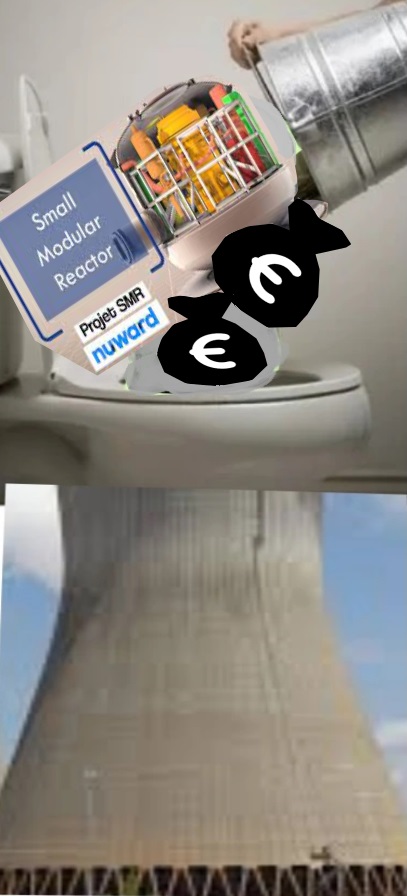
Another Small Modular Nuclear Reactor project goes down the toilet
This time it’s that great nuclear poster boy France that is facing the humiliation and embarrassment of wasting billions on “New Nuclear”
Last time it was the USA with the NuScale fiasco
Giles Parkinson Jul 2, 2024, https://reneweconomy.com.au/french-nuclear-giant-scraps-smr-plans-due-to-soaring-costs-will-start-over/
The French nuclear giant EdF, the government owned company that manages the country’s vast fleet of nuclear power stations, has reportedly scrapped its plans to develop a new design for small nuclear reactors because of fears of soaring costs.
EdF, which is now fully government owned after facing potential bankruptcy due to delays and massive cost over-runs at its latest generation large scale nuclear plants, had reportedly been working on a new design for SMRs for the last four years.
The French investigative outlet L’Informé reported on Monday that EdF had scrapped its new internal SMR design – dubbed Nuward – because of engineering problems and cost overruns. It cited company sources as saying EdF would now partner with other companies to use “simpler” technologies in an attempt to avoid delays and budget overruns.
Reuters confirmed the development, citing an email from a company spokesman that confirmed the program had been abandoned after the basic design had been completed.
“The reorientation consists of developing a design built exclusively from proven technological bricks. It will offer better conditions for success by facilitating technical feasibility,” an EDF spokesperson told Reuters via email.
It’s the latest problem to hit SMR technology, which the federal Coalition wants to roll out in Australia – starting with reactors in South Australia and Western Australia – as part of its goal of keeping coal plants open, building more gas, stopping renewables and putting clean energy hopes on nuclear.
The federal Coalition says it can have the first SMR up and running by 2035, but no SMRs have been built in the western world, and none have even got a licence to be built.
The closest to reach that landmark, the US-based NuScale, abandoned its plans after massive cost overruns and push back from its customers, who refused to pay high prices.
The EdF plans appears to have run into similar problems. Its potential customers, the European energy companies Vattenfall, CEZ and Fortum, wanted guarantees that the SMRs would not have a levelised cost of energy of more than €100 a megawatt hour ($161/MWh) and EdF decided that that was not possible.
It is now not expected to produce its first SMR until the 2030s, at the earliest – even though France is desperate for new reactors to replace its ageing power plants. Because of the costs, it expects to significantly reduce the share of nuclear in its energy mix as it focuses more on large scale solar and offshore wind.
EdF has run into similar problems with its large scale technology. The Flammanville project in France was announced in 2004 with a budget of €3 billion and a deadline of 2012. It is still not in operation and its costs have soared at least four-fold to €13.2 billion.
The Hinkley C project in the UK has been an even bigger disaster. EdF had promised in 2007 that it would be “cooking Christmas turkeys” in England by 2017, at a cost of £9 billion, but is already delayed to 2031 with a spiralling cost of £48 billion when inflation is taken into account, or $A93 billion.
EdF announced another impairment charge of €12.9 billion ($A20.7 billion) from Hinkley earlier this year. It had to be bailed out by the government last year after suffering record losses in 2022 caused by outages at nearly half of its nuclear power plants due to maintenance at its reactors across France.
Tim Buckley, from Climate and Energy Finance, seized on the news and called on Opposition leader Peter Dutton and energy spokesman Ted O’Brien to provide more details of their nuclear plans beyond the one page press release they released last month.
“Come’on guys, how naive do you take the average Australian voter for?” Buckley wrote.
“In your alternate fact world, who do you think will pay for the permanent around 50% increase in Australian energy prices for consumers? Are you really intent on destroying the international competitiveness of Australian industry purely in the service of your fossil fuel funders?”
Numerous cost assessments, particularly by the CSIRO and the Australian Energy Market Operator, have put the cost of nuclear at more than double the cost of wind, solar and storage. But they also point out that first of their kind projects in Australia could cost double that amount, and SMR technology is likely to be even more expensive.
The Coalition has attacked those reports, and the reputation of the CSIRO and AEMO – in concert with a group of so-called “think tanks” and the Murdoch media – but the latest polling from Essential Media suggests that the public might not be buying it.
The poll found that votes believe renewables are the most desirable (59 per cent) and the best for the environment (55 per cent). Nuclear energy was regarded by more as the most expensive (38 per cent versus 35 per cent for renewables).
An overwhelming majority of people aged 18 to 54 thought Peter Dutton’s nuclear energy plan “is just an attempt to extend the life of gas and limit investment in large-scale renewables”, while a majority of those aged over 55 thought the nuclear plan is serious and should be part of the future energy mix, Essential Media’s Peter Lewis wrote.
The federal Coalition has argued that nuclear might be expensive to build, but will deliver cheaper power to consumers. It has not explained how, but it has said that its reactors would be government owned, suggesting that – like France and Ontario – the costs would be borne by taxpayers and the supply of power to customers would be heavily subsidised.
Giles Parkinson is founder and editor of Renew Economy, and is also the founder of One Step Off The Grid and founder/editor of the EV-focused The Driven. He is the co-host of the weekly Energy Insiders Podcast. Giles has been a journalist for more than 40 years and is a former business and deputy editor of the Australian Financial Review. You can find him on LinkedIn and on Twitter.
Coalition nuclear policy leaves traditional owners of Kakadu uranium mine worried

ABC News, By Jane Bardon, 3 July 24
In short:
Kakadu traditional owners are worried the Coalition’s nuclear policy will drive demand for uranium mining on their land at Jabiluka.
Energy Resources of Australia (ERA) and traditional owners have asked the NT and federal governments to decide whether to extend the Jabiluka uranium mining lease.
What’s next?
ERA’s majority shareholder Rio Tinto is worried the Jabiluka lease stoush could drive up the costs of rehabilitating its closed Ranger Uranium Mine.
Mirarr traditional owner Corben Mudjandi is desperate for his spectacular land at Jabiluka to be incorporated into Kakadu National Park, which surrounds it, rather than mined for its uranium.
“Its sacred to us, and it’s a piece of human history, 65,000 years, we want Jabiluka not mined; we want to show people the beauty of nature, and what we call home,” he said.
Mr Mudjandi is worried the federal Coalition’s plan to open nuclear plants if it wins government could drive demand for Jabiluka’s uranium.
The Mirarr are also concerned that almost a year after Energy Resources of Australia (ERA) applied to extend its uranium mining lease over Jabiluka for another decade, the Northern Territory and federal governments have not yet decided whether to reject or approve it.
ERA’s current lease expires on August 11.
“The government are following process, but of course we hope they don’t support the application extension,” Mr Mudjandi said.
Senior Mirarr traditional owner Yvonne Margarula said she was worried that although ERA’s Jabiluka lease agreement enabled traditional owners to veto mining, they felt under constant pressure to change their minds.
“The mining companies might come back asking again and again, it’s annoying them asking more, enough is enough, so I hope the government is going to help us,” she said………………………………..
……………………….Professor of Archaeology at Griffith University Lynley Wallis said the Mirarr had a strong case for Jabiluka to be incorporated into Kakadu instead of mined, because of its 65,000 year-old-evidence of occupation.
“Archaeologically the escarpment that’s encapsulated within the Jabiluka mineral lease is unparalleled,” she said.
“There are hundreds of rock shelter sites, almost all of which have paintings in them, of which are incredibly well preserved, and then there are amazing objects that have been cached in those rock shelters, ceremonial wooden objects, grinding stones, spear points and scrapers.
………. the lease agreement includes a traditional owner right to veto mining……………
Lynley Wallis said the Jabiluka mining lease did not provide adequate protection.
“While a company holds a mineral lease over Jabiluka it is possible for them to apply to develop the resources in that land, and any development would pose imminent threat to the cultural sites that are within the lease,” she said.
While some of ERA’s minority shareholders want to keep the Jabiluka lease, which they estimate is worth $50 billion, its majority shareholder Rio Tinto does not.
Jabiluka is ERA’s only potentially valuable asset, but Rio Tinto estimates the rehabilitation costs would be much more than potential profits.
The cost of ERA’s rehabilitation of its neighbouring closed Ranger Uranium Mine on the Mirarr’s land has now blown out to more than $2.5 billion.
ERA is expected to run out of funds by September, and Rio Tinto has promised to fund Ranger’s rehabilitation.
But the ABC understands Rio Tinto is concerned ERA’s application to extend the Jabiluka lease is worrying Mirarr traditional owners so much, that they could delay further agreements needed on how the Ranger mine rehabilitation continues, adding to the project’s soaring costs.
Dave Sweeney, the Australian Conversation Foundation’s nuclear policy spokesman, has called on both governments to end the prospect of mining at Jabiluka.
“ERA are not making any money,” he said.
“They should be focused on getting the assured financial capacity on delivering on their legal obligations rather than appeasing minority shareholders in a fanciful push for a project that will never happen, but increases pressure on traditional owners who’ve had too much for too long.”
A spokesman for the federal Resources Minister Madeleine King said it was up to the NT government whether to renew ERA’s lease.
The spokesman said when Ms King provides her advice to NT government, she would “consider information about Jabiluka in good faith and with appropriate consultation”.
The NT Mining Minister Mark Monaghan would not explain why his government had not made a decision on the lease.
“We’re not delaying the decision, the decision is going through what is a process,” he said.
NT Opposition leader Lia Finocchiaro has backed ERA’s argument on why the lease should continue.
“Importantly that maintains the veto rights for the Mirarr people which we believe continues to be a very important right for them to have,” she said. worried
The nuclear and renewable myths that mainstream media can’t be bothered challenging

Mark Diesendorf, Jul 4, 2024, https://reneweconomy.com.au/the-nuclear-and-renewable-myths-that-mainstream-media-cant-be-bothered-challenging/
Nuclear energy proponents are attempting to discredit renewable energy and promote nuclear energy and fossil gas in its place. This article refutes several myths they are disseminating that are receiving little or no challenge in the mainstream media.
Myth: Renewables cannot supply 100% electricity
Denmark, South Australia and Scotland already obtain 88, 74 and 62 per cent of their respective annual electricity generations from renewables, mostly wind. Scotland actually supplies 113 per cent of its electricity consumption from renewables; the difference between its generation and consumption is exported by transmission line.
All three jurisdictions have achieved this with relatively small amounts of hydroelectricity, zero in South Australia. Given the political will, all three could reach 100% net renewables generation by 2030, as indeed two northern states of Germany have already done. The ‘net’ means that they trade some electricity with neighbours but on average will be at 100% renewables.
Computer simulations by several research groups – using real hourly wind, solar and demand data spanning several years – show that the Australian electricity system could be run entirely on renewable energy, with the main contributions coming from solar and wind. System reliability for 100% renewables will be maintained by a combination of storage, building excess generating capacity for wind and solar (which is cheap), key transmission links, and demand management encouraged by transparent pricing.
Storage to fill infrequent troughs in generation from the variable renewable sources will comprise existing hydro, pumped hydro (mostly small-scale and off-river), and batteries. Geographic dispersion of renewables will also assist managing the variability of wind and solar. For the possibility of rare, extended periods of Dunkelflaute (literally ‘dark doldrums’), gas turbines with stores of biofuels or green hydrogen could be kept in reserve as insurance.
Myth: Gas can fill the gap until nuclear is constructed
As a fuel for electricity generation, fossil gas in eastern Australia is many times more expensive per kilowatt-hour than coal. It is only used for fuelling gas turbines for meeting the peaks in demand and helping to fill troughs. For this purpose, it contributes about 5% of Australia’s annual electricity generation. But, as storage expands, fossil gas will become redundant in the electricity system.
The fact that baseload gas-fired electricity continues temporarily in Western Australia and South Australia is the result of peculiar histories that will not be repeated. Unlike the eastern states, WA has a Domestic Gas Reservation Policy that insulates customers from the high export prices of gas.
However, most new gas supplies would have to come from high-cost unconventional sources. South Australia’s ancient, struggling, baseload, gas-fired power station, Torrens Island, produces expensive electricity. It will be closed in 2026 and replaced with renewables and batteries.
Myth: Nuclear energy can co-exist with large contributions from renewables
This myth has two refutations:
- Nuclear is too inflexible in operation to be a good partner for variable wind and solar. Its very high capital cost necessitates running it constantly, not just during periods of low sun or wind. Its output can only be ramped up and down slowly, and it’s expensive to do that.
- On current growth trends of renewables, there will be no room for nuclear energy in South Australia, Victoria or NSW. The 2022 shares of renewables in total electricity generation in each of these states were 74%, 37% and 33% respectively.
Rapid growth from these levels is likely. It’s already too late for nuclear in SA. Provided the growth of renewables is not deliberately suppressed in NSW and Victoria, these states too could reach 100% renewables before the first nuclear power station comes online.
As transportation and combustion heating will be electrified, demand for electricity could double by 2050. This might offer generating space for nuclear in the 2040s in Queensland (23% renewables in 2022) and Western Australia (20% renewables in 2022). However, the cost barrier would remain.
Myth: There is insufficient land for wind and solar
The claim by nuclear proponents that wind and solar have “vast land footprints” is misleading. Although a wind farm can span a large area, its turbines, access road and substation occupy a tiny fraction of that area, typically about 2%.
Most wind farms are built on land that was previously cleared for agriculture and are compatible with all forms of agriculture. Off-shore wind occupies no land.
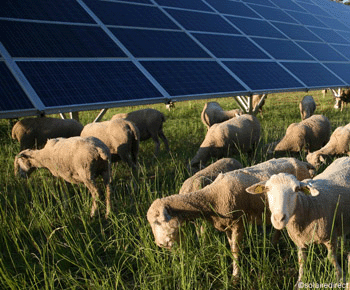
Solar farms are increasingly being built sufficiently high off the ground to allow sheep to graze beneath them, providing welcome shade. This practice, known as agrivoltaics, provides additional farm revenue, which is especially valuable during droughts. Rooftop solar occupies no land.
Myth: The longer lifetime of nuclear reactors hasn’t been taken into account
The levelised cost of energy method – used by CSIRO, AEMO, Lazard and others – is the standard way of comparing electricity generation technologies that perform similar functions.
It permits the comparison of coal, nuclear and firmed renewables. It takes account automatically of the different lifetimes of different technologies.
Myth: We need baseload power stations
The recent claim that nuclear energy is not very expensive “when we consider value” is just a variant of the old, discredited claim that we need baseload power stations, i.e. those that operate 24/7 at maximum power output for most of the time.
The renewable system, including storage, delivers the same reliability, and hence the same value, as the traditional system based on a mix of baseload and peak-load power stations.
When a nuclear power reactor breaks down, it can be useless for weeks or months. For a conventional large reactor rated at 1000 to 1600 megawatts, the impact of breakdown on electricity supply can be disastrous.
Big nuclear needs big back-up, which is expensive. Small modular reactors do not exist––not one is commercially available or likely to be in the foreseeable future.
Concluding remarks
We do not need expensive, dangerous nuclear power, or expensive, polluting fossil gas. A nuclear scenario would inevitably involve the irrational suppression of renewables.
The ban on nuclear power should be maintained because nuclear never competes in a so-called ‘free market’. Renewables – solar, wind and existing hydro – together with energy efficiency, can supply all Australia’s electricity.
Mark Diesendorf is Honorary Associate Professor at the Environment & Society Group in the School of Humanities & Languages and Faculty of Arts, Design & Architecture at UNSW. First published in Pearls and Irritations. Republished with permission of the author.
Why Julian Assange couldn’t outrun the Espionage Act

the grave threat the Espionage Act poses to journalism and the First Amendment
SOTT, Jordan Howell The FIRE, Wed, 26 Jun 2024
Julian Assange spent seven years in self-exile in London’s Ecuadorian Embassy avoiding arrest, and five more in prison, for publishing classified documents on WikiLeaks.
Julian Assange is a free man, and one of the most contentious press freedom controversies in living memory may finally be coming to a close.
The WikiLeaks founder reached a plea deal with the Department of Justice on Monday after spending five years in an English prison fighting extradition to the United States. Federal officials sought to charge Assange with conspiracy to obtain and disclose national security information under the Espionage Act of 1917.
Assange and WikiLeaks shocked the world in 2010 by publishing hundreds of thousands of secret military documents and diplomatic cables related to the wars in Iraq and Afghanistan that were leaked by Army intelligence analyst Chelsea Manning. Months later, Assange was on the run and Manning was in jail.
Assange claimed that by receiving and publishing confidential information, what he did was no different than the type of routine news reporting that journalists around the world engage in every day. As the Supreme Court ruled in New York Times Co. v. United States (1971), better known as “The Pentagon Papers” case, publishing leaked documents is protected under the First Amendment.
FIRE has long opposed use of the Espionage Act to curtail the rights of journalists to source information. And in December 2022, FIRE signed an open letter organized by the Committee to Protect Journalists along with 20 other civil liberties groups calling on the federal government to drop its charges against Assange.
“We are united . . . in our view that the criminal case against him poses a grave threat to press freedom both in the United States and abroad,” we argued. “[J]ournalists routinely engage in much of the conduct described in the indictment: speaking with sources, asking for clarification or more documentation, and receiving and publishing official secrets. News organizations frequently and necessarily publish classified information in order to inform the public of matters of profound public significance.”
Assange’s 12 year ordeal, including seven years in self-exile in the Ecuadorian Embassy in London before his arrest and imprisonment, underscores the continued threat that the century-old Espionage Act still poses to civil liberties today — and not just in the United States. Assange is not a U.S. citizen, nor was he ever a resident. But because of modern extradition treaties, there were few places in the world where he could travel to escape the Act’s reach,
Under the terms of Monday’s deal, Assange pleaded guilty to the charges and was sentenced to 62 months incarceration, but with credit for time served, according to documents filed with the U.S. District Court for the Northern Mariana Islands.
Ultimately, freedom of the press is what was at stake with the government’s case against Assange. It was never only about him. The precedent that would have been set by his extradition and trial would have sent a chilling message to journalists across the country and the world: You can run, but you can’t hide from the Espionage Act.
What is the Espionage Act?……………………………………………………………………………………….Based on the Defense Secrets Act of 1911, the Espionage Act of 1917 included much stiffer penalties — including the death penalty — for sharing secret or confidential information or otherwise interfering with the operations of the U.S. military.
The Espionage Act made it a crime to obtain information regarding national defense “with intent or reason to believe” that doing so would hurt the U.S. or to advantage another country. While subsequent amendments and court decisions have refined its language and scope, its core purpose remains the same.
Espionage Act and the Supreme Court
The law was immediately controversial because its use was not limited to actual acts of espionage. Rather, the Espionage Act allowed the government to clamp down on anyone who opposed the war effort.
In Schenck v. United States, in 1919, the Supreme Court upheld the conspiracy conviction against socialist Charles Schenck under the Espionage Act for distributing anti-war leaflets that urged people to boycott the draft.
The problem with the Court’s ruling in Schenck, as subsequent decisions would affirm, is that Schenk’s speech was not calling for violence or even civil disobedience. Rather, his speech was precisely the kind of political expression that decades of subsequent Supreme Court decisions would ultimately uphold. Numerous convictions under the Espionage Act would make their way to the Court, including that of socialist presidential candidate Eugene Debs, who was arrested for giving a speech opposing the war.
Since then, one of the most nefarious uses of the Espionage Act has been to silence journalists. At least insofar as publishing the leaked documents on the Wikileaks website, what Assange did was little different than what The New York Times and The Washington Post did in 1971 when they published and reported on thousands of pages from a classified report about the war in Vietnam.
……………………………………….As the Supreme Court has ruled, freedom of the press is a foundational principle, enshrined in the Bill of Rights. And though Julian Assange is finally free, FIRE continues to have serious concerns about the grave threat the Espionage Act poses to journalism and the First Amendment. https://www.sott.net/article/492768-Why-Julian-Assange-couldnt-outrun-the-Espionage-Act
1 This month.

Australians deserve the truth
about
AUKUS – https://aukuspublicinquiry.com/
30 July – WEBINAR (Free) – Is Nuclear Power the Solution to Climate Change? https://my.acaw.org.au/event/acaw-is-nuclear-power-the-solution-to-climate-change
18:30 – 19:45 ACST
19:00 – 20:15 AEST


PETITION – To: Prime Minister Anthony Albanese and the Australian Labor Government

of the week – Australians for War Powers Reform (AWPR)
To see nuclear-related stories in greater depth and intensity
 Antinuclear
