Solar and wind generation will soon pass nuclear, hydro

Australia is a global pathfinder because, unlike in Europe, it cannot share electricity across national boundaries to reduce the effects of variable weather and demand. Australia must go it alone. Australia is convincingly demonstrating that change can happen quickly with good policies. Over the period 2020 to 2030, fossil generation is falling from 75% to 18%, while solar and wind generation is rising from 19% to 75%.
In a new monthly column for pv magazine, the International Solar Energy Society (ISES) explains how solar and wind are dominating power plant construction.
MAY 20, 2024 INTERNATIONAL SOLAR ENERGY SOCIETY (ISES) Authors: Prof. Ricardo Rüther (UFSC), Prof. Andrew Blakers /ANU https://www.pv-magazine.com/2024/05/20/solar-and-wind-generation-will-soon-pass-nuclear-and-hydro/
Our ISES pv magazine column in April showed that the fastest energy change in history is continuing. In 2023, solar and wind together constituted 80% of global net power capacity additions. Growth in power capacity is followed by growth in annual energy generation.
Over the past decade, global solar generation has grown ninefold to reach 1,500 TWh per year while wind generation has tripled to 2300 TWh per year (Figure 1 on original). This corresponds to compound growth rates of 22% and 11% per year respectively. In contrast, hydro, nuclear and coal generation had growth rates of about 1% per year, and gas 3%.
The solar growth rate of 22% per year is equivalent to doubling every 3 years. At this growth rate, solar generation will reach 100,000 TWh per year in 2042 which is enough to fully decarbonize the global economy.
Nuclear has a global average capacity factor of 74%, followed by coal (50% to 70%), combined cycle gas (40% to 60%), wind (30% to 60%), large hydro (30% to 50%), and solar photovoltaics (12% to 25%).
Despite its relatively low capacity factor, solar generation is tracking to surpass nuclear generation in 2026, wind in 2027, hydro in 2028, gas in 2030 and coal in 2032.
Solar and wind are strongly dominating powerplant construction, whereas construction of all other generation technologies is both small and stagnant. Coal, gas and nuclear could be mostly gone by mid-century once retirements outpace new construction.
The leading countries for per capita solar and wind generation are all in Europe, except Australia (Figure 2 on original). Also shown in Figure 2 is global per capita generation from hydro and nuclear. Combined generation from solar and wind in the leading countries is now fourfold larger than the global average generation from hydro and nuclear combined.
Australia is a global pathfinder because, unlike in Europe, it cannot share electricity across national boundaries to reduce the effects of variable weather and demand. Australia must go it alone. Australia is convincingly demonstrating that change can happen quickly with good policies. Over the period 2020 to 2030, fossil generation is falling from 75% to 18%, while solar and wind generation is rising from 19% to 75%.
Brazil and Chile are middle income pathfinder countries, with about 81% and 60% respectively of electricity generation coming from hydro, wind and solar. Pathfinder countries are driven by a desire to reduce both electricity prices and emissions. There are few serious concerns about future grid stability because there will be sufficient investment in storage, transmission, and demand management.
Christmas Island veterans receive nuclear testing medals
By Isaac Ashe & Steve Beech, BBC News, Derbyshire, 16 May 24
Derbyshire veterans who conducted nuclear tests for the British armed forces in the 1950s have been recognised at a ceremony.
Operation Grapple saw a series of British nuclear weapons tests carried out close to Christmas Island, in the Pacific Ocean, between 1957 and 1958.
The bomb tests assured British military power during the Cold War.
Four members of the armed forces who took part in the testing and one widow were presented with medals on Friday…………………………………………………………. more https://www.bbc.com/news/uk-england-derbyshire-69028261
Nuclear more than 6 times the cost of renewables – report

20 May 2024, https://www.aumanufacturing.com.au/nuclear-more-than-6-times-the-cost-of-renewables-report
An independent report by consulting and engineering firm Egis and commissioned by the Clean Energy Council has confirmed that nuclear is the most expensive form of new energy in Australia.
The review analysed the CSIRO and Australian Energy Market Operator (AEMO)’s GenCost report against the Lazard Review and the Mineral Council of Australia (MCA)’s research into Small Modular Nuclear Reactors.
The report found that nuclear energy is up to six times more expensive than renewable energy and even on the most favourable reading for nuclear, and that renewables remained the cheapest form of new-build electricity.
Nuclear may be even higher cost than forecast as waste management and decommissioning of nuclear plants had been omitted in cost calculations.
The report also found:
- The safe operation of nuclear power requires strong nuclear safety regulations and enforcement agencies, none of which exist in Australia
- And the economic viability of nuclear energy will further diminish as more wind, solar and battery storage enters the grid.
“Put simply, nuclear plants are too heavy and too slow to compete with renewables and can’t survive on their own in Australian energy markets.”
Clean Energy Council Chief Executive Kane Thornton, said households would need to pay a hefty price to subsidise nuclear reactors.
Thornton said: “Taxpayers also need to understand the costs that will be borne if they are forced to foot the bill for building a nuclear industry from scratch over a period of decades.
“Nuclear power is also a poor fit with our increasingly renewable power system.
“Nuclear power stations are expensive and have to run constantly in order to break even – but that doesn’t work in a world with an abundance of cheap renewables.”
The Egis report also found the MCA’s research on Small Modular Reactors (SMRs) did not anticipate the current long delay in SMR projects around the world.
Going nuclear on power and wages may not be the election winner Peter Dutton thinks it is

Guardian, Paul Karp, 20 May 24
Opposition leader has laid fertile ground for progressive attack ads to grow in policy-lite budget reply
Peter Dutton’s budget reply sets the Coalition up for an election campaign focused on migration and law and order. At least, that’s the election he wants because it’s one he thinks he could win.
But Dutton’s policy-lite speech contains the seeds of campaigns that will inevitably be deployed by the progressive side of politics: on nuclear and wages.
The nuclear debate has been a train wreck in slow motion for months now.
So many front page stories in the Australian promised the policy before the budget with such juicy details as the type of technology, the number of reactors, their putative location.
Then, a deferral. All in good time.
In Thursday’s speech, Dutton made the case that nuclear is popular. Bob Hawke supported it, so does John Howard, the Australian Workers Union and “65% of Australians aged 18 to 34 years of age”.
One couldn’t help but wonder: if it’s so popular, why not make it the centrepiece of the speech and actually announce the policy?
Perhaps because it’s so expensive that it completely fails the Coalition’s new test for Future Made in Australia projects – that they must be commercially viable without taxpayer support. Perhaps because the friendlier-sounding small modular reactors are not commercially available.
Or perhaps because it is not, in fact, that popular.
Labor are increasingly cocky that the nuclear thought-bubble is an exploding cigar for the opposition. On Thursday the energy minister, Chris Bowen, gleefully cited choice anonymous quotes from Coalition backbenchers in question time that the policy is “madness on steroids” and within the ranks there is “a sudden sense of bewilderment” about the idea.
A few months ago I wrote a slightly trolling column about the possibility of a plebiscite on nuclear power to accompany the next election. Labor see Dutton doing everything in his power to turn the next election into a straw poll on his big bad idea anyway.
The attack ads write themselves. I can see the bunting wrapped around schools on election day already, with nuclear cooling towers, yellowcake, plutonium rods and Dutton’s face.
In his post budget reply press conference the education minister, Jason Clare, said simply: “If he won’t tell you where he’s going to put all the nuclear reactors, why would you vote for him?”
This is the obvious scare campaign. Let’s also look at the slower burn issue: wages.
An easy win – but not for him
In his speech Dutton promised to “remove the complexity and hostility of Labor’s industrial relations agenda, which is putting unreasonable burdens on businesses”…………………
It’s absolutely fine for Dutton to create some policy differentiation with Labor, but if he doesn’t set out chapter and verse what’s in and what’s out, the unions will paint him as against all of it………………………………………………………………
The minor themes of the speech have the greatest potential to develop into major problems for him https://www.theguardian.com/australia-news/article/2024/may/20/going-nuclear-on-power-and-wages-may-not-be-the-election-winner-peter-dutton-thinks-it-is
The president of the ACTU, Michele O’Neil, said: “Dutton committed to getting rid of the workplace laws that are finally seeing real wages grow, after 10 years of wage stagnation by the last Coalition government.”
Dutton “told workers that if he is elected, he will again commit the Coalition to running an economy based on low wages” and “turn secure jobs into casual jobs”.
The Heroism of David McBride
By John Kiriakou https://consortiumnews.com/2024/05/16/john-kiriakou-the-heroism-of-david-mcbride/
By 2014 McBride had compiled a dossier into profound command failings that saw examples of potential war crimes in Afghanistan overlooked and other soldiers wrongly accused. On Tuesday he was sentenced to nearly six years in jail.
Sometimes a whistleblower does everything right. He or she makes a revelation that is clearly in the public interest. The revelation is clearly a violation of the law. And then he or she is even more clearly abused by the government. It would be great if these stories always had happy endings. Unfortunately, they don’t.
In this case, the whistleblower, the hero, Australian David McBride has been sentenced to five years and eight months in prison for telling the truth. He will not be eligible for parole for 27 months.
David McBride is former British Army officer and a lawyer with the Australian Special Forces who blew the whistle on war crimes committed by Australian soldiers in Afghanistan, specifically the killing of 39 unarmed Afghan prisoners, farmers, and civilians in 2012.
After failing to raise a response through official channels, McBride shared the information with the Australian Broadcasting Corporation (ABC), which published a series of major reports based on the material.
The ABC broadcasts in 2017 led to a major inquiry that upheld many of the allegations. Despite this, the ABC and its journalists themselves came under threat of prosecution for their work on the story.
The ABC offices in Sydney were raided by the national police, but in the end the government did not prosecute an ABC journalist because it was not in the public interest. McBride himself, however, was prosecuted for dissemination of official information.
Two Tours in Afghanistan
Let’s go back a few years. McBride at the time already was a seasoned attorney. After studying for a second law degree at Oxford University, he joined the British military and eventually moved back to Australia where he became a lawyer in the Australian Defence Forces (ADF). In that role he had two tours in Afghanistan in 2011 and 2013.
While on deployment, McBride became critical of the terms of engagement and other regulations that soldiers were working under, which he felt were endangering military personnel for the sake of political imperatives determined elsewhere.
By 2014 McBride had compiled a dossier into profound command failings that saw examples of potential war crimes in Afghanistan overlooked and other soldiers wrongly accused. His internal complaints were suppressed and ignored.
McBride’s reports also looked at other matters, including the military’s handling of sexual abuse allegations. After his use of internal channels had proven ineffective, McBride gave his report to the police. And eventually, he contacted journalists at ABC.
ABC’s Afghan Files documented several incidents of Australian soldiers killing unarmed civilians, including children, and questioned the prevalent “warrior culture” in the special forces. Subsequent to McBride’s disclosures, the behavior of other Coalition Special Forces in Afghanistan also came under sustained investigation.
In many ways, McBride’s reports went further than the issues identified by ABC. Amid prevalent rumors that Australian troops were responsible for war crimes, questionable deaths in Afghanistan had led to calls for investigations.
Report Vindicated McBride & ABC
In November 2020, the Brereton report (formally called the Inspector General of the Australian Defence Force Afghan Inquiry report) was published, utterly vindicating McBride and the ABC. Judge Paul Brereton found evidence of multiple incidents involving Australian personnel that had led to 39 deaths. Among his recommendations were the investigation of these incidents for possible future criminal charges.
There would be almost no criminal charges, however. At least, there would be only one eventual criminal charge against one single soldier in the murder of Afghan civilians. There have been no charges against the officers who covered up the war crimes.
Instead, though, there would be serious charges against McBride for “theft of government property” (the information) and for “sharing with members of the press documents classified as secret.” He faced life in prison.
McBride’s sentence illustrates the challenges that Australian whistleblowers face when reporting evidence of waste, fraud, abuse, illegality, or threats to the public health or public safety.
First, just like in the United States, there are no protections for national security whistleblowers. McBride took his career — indeed, his life — into his hands when he decided to go public with his revelations. But what else could he do?
Second, as in the United States, there is no affirmative defense. McBride, like Edward Snowden, Jeffrey Sterling, Daniel Hale and like me, was forbidden from standing up in court and saying, “Yes, I gave the information to the media because I witnessed a war crime or a crime against humanity. What I did was in the public interest.”
Those words are never permitted to be spoken in a court in the United States or Australia.
Recalling Nuremberg
Third, Australia is in dire need of some legal reforms. The judge in McBride’s case said at sentencing that McBride, “had no duty as an army officer beyond following orders.” That defense was attempted at Nuremberg and it failed. It’s time for the Australian judiciary to get into the 21st century.
There are a couple points of light in this whole fiasco. The Brereton Commission did indeed recommend that 19 members of the Australian Special Forces be prosecuted for war crimes. So far, one has been charged with a crime. He is accused of shooting and killing a civilian in a wheat field in Uruzgan Province in 2012.
Indeed, Andrew Wilkie, a former Australian government intelligence analyst-turned-whistleblower, and now member of Parliament, says that “the Australian government hates whistleblowers” and that it wanted to punish David McBride and to send a signal to other government insiders to remain silent, even in the face of witnessing horrible crimes. I would say exactly the same thing about the United States.
I’m proud to call David McBride a friend. I know exactly what he’s going through right now. But his sacrifice will not be in vain. History will smile on him. Yes, the next several years will be tough. He’ll be a prisoner. He’ll be separated from his family. And when he gets out of prison, well into his 60s, he’ll have to begin rebuilding his life. But he is right and his government is wrong. And future generations will understand and appreciate what he did for them.
John Kiriakou is a former C.I.A. counterterrorism officer and a former senior investigator with the Senate Foreign Relations Committee. John became the sixth whistleblower indicted by the Obama administration under the Espionage Act — a law designed to punish spies. He served 23 months in prison as a result of his attempts to oppose the Bush administration’s torture program.
And McBride will be allowed to appeal his conviction. Still any other light at the end of the tunnel is likely an oncoming train, rather than relief for the whistleblower.
But the bottom line is this. There is a war against whistleblowers in Australia just like there is in the United States.
This is what nuclear war in 2024 would look like

ABC RN, Broadcast Thu 16 May 2024, https://www.abc.net.au/listen/programs/latenightlive/this-is-what-nuclear-war-in-2024-would-look-like/103840906
In 1985, President Ronald Reagan and Soviet General Secretary Mikhail Gorbachev cautioned the world “a nuclear war cannot be won and must never be fought”. Decades later, we’re closer to nuclear Armageddon than ever before, and investigative journalist Annie Jacobsen paints a devastating picture of exactly what that would look like.
Guest: Annie Jacobsen – investigative journalist and New York Times bestselling author. She also writes and produces TV, including Tom Clancy’s Jack Ryan. Her latest book is Nuclear War: A Scenario.
Credits
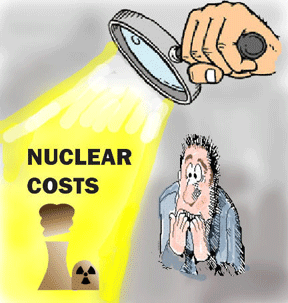
Nuclear option costs ‘six times more’ than renewables
By Marion Rae, May 18 2024, https://www.canberratimes.com.au/story/8632826/nuclear-option-costs-six-times-more-than-renewables/—
The high upfront costs and burden on consumers of adding nuclear to Australia’s energy mix have been confirmed in an independent review.
Building nuclear reactors would cost six times more than wind and solar power firmed up with batteries, according to the independent report released on Saturday by the Clean Energy Council.
“We support a clear-eyed view of the costs and time required to decarbonise Australia and right now, nuclear simply doesn’t stack up,” the industry body’s chief executive Kane Thornton said.
Taxpayers needed to understand the decades of costs if they were forced to foot the bill for building a nuclear industry from scratch, Mr Thornton warned.
The analysis prepared by construction and engineering experts Egis also found nuclear energy had poor economic viability in a grid dominated by renewable energy.
Renewable energy will provide 82 per cent of the national electricity market under current targets for 2030, which is at least a decade before any nuclear could theoretically be operational.
Further, nuclear power stations are not designed to ramp up and down to align with renewable energy generation.
Adding to the cost challenges, Australia has no nuclear energy industry because it is prohibited under commonwealth and state laws, which would all need to be changed.
Mr Thornton said the analysis confirmed that building nuclear power stations instead of renewables would cause power prices to “explode”.
The analysis was based on the CSIRO’s GenCost 2023-24 consultation draft, the Mineral Council of Australia’s Small Modular Reactors study and the industry benchmark Lazard Levelized Cost of Energy Report.
These reports did not include waste management and decommissioning of a nuclear plant in cost calculations, which meant the true cost could be even higher, Mr Thornton said.
Focus on Australian news

This site is now to focus on Australian news, rather than including significant international news.
I’m trying this out, because of time pressures.
For international news, please go to https://nuclear-news.net/
David McBride goes to prison – and Australian democracy takes a hit
Peter Greste, Professor of Journalism and Communications, Macquarie University, 17 May 24, https://theconversation.com/david-mcbride-goes-to-prison-and-australian-democracy-takes-a-hit-230007—
Governments and their agencies wield awesome power. At times, it is quite literally the power over life and death. That is why in any functioning democracy, we have robust checks and balances designed to make sure power is exercised responsibly and with restraint.
So, what message does a sentence of more than five years in prison for someone who exposed credible allegations of war crimes by Australian soldiers send?
On Tuesday, ACT Supreme Court Justice David Mossop despatched the former military lawyer David McBride to prison for five years and eight months, for passing classified military documents to journalists. Those documents formed the basis of the ABC’s explosive “Afghan Files” investigation, revealing allegations that Australian soldiers were involved in the unlawful executions of unarmed civilians.
It is hard to think of any whistleblowing more important.
McBride’s case forced us to confront the way our own troops had been conducting the war in Afghanistan, as well as the government’s ongoing obsession with secrecy over the public interest.
McBride had been concerned about what he saw as systemic failures of the SAS commanders, and their inconsistency in dealing with the deaths of “non-combatants” in Afghanistan. In an affidavit, he said he saw the way frontline troops were being –
improperly prosecuted […] to cover up [leadership] inaction, and the failure to hold reprehensible conduct to account.
He initially complained internally, but when nothing happened he decided to go public. In 2014 and 2015, McBride collected 235 military documents and gave them to the ABC. The documents included 207 classified as “secret” and others marked as cabinet papers.
It is hard to deny the truth of what McBride exposed. The Brereton Inquiry later found what a parliamentary briefing described as “credible information” of 23 incidents in which non-combatants were unlawfully killed “by or at the direction of Australian Special Forces”. The report said these “may constitute the war crime of murder”.
Brereton went on to recommend prosecutions of the soldiers who were allegedly responsible. Yet, the first person to face trial and be sent to prison in the whole debacle is not any of those who might have been responsible for alleged killings, but the man who exposed “misconduct” in the Australian Defence Force.
Much has been made of McBride’s reasons for going to the media, but this focus on motives is a form of misdirection. Whistleblowers take action for a host of reasons – some of them less honourable than others. But ultimately, what matters is the truth of what they expose, rather than why.
That is why we recognise media freedom as an essential part of a healthy democracy, including the right – indeed the responsibility – of journalists to protect confidential sources. Unless sources who see wrongdoing can confidently expose it without fear of being exposed and prosecuted, the system of accountability falls apart and gross abuses of power remain hidden.
It is also why the formal name for Australia’s whistleblower protection law is the “Public Interest Disclosure Act”.
This law is designed to do what it says on the tin: protect disclosures made in the public interest, including those made through the media. It recognises that sometimes, even when the law imposes certain obligations of secrecy on public servants, there may be an overriding interest in exposing wrongdoing for the sake of our democracy.
As a highly trained and experienced military lawyer, McBride knew it was technically illegal to give classified documents to the media. The law is very clear about that, and for good reason. Nobody should be able to publish government secrets without a very powerful justification.
But nor should the fact that a bureaucrat has put a “secret” stamp on a document be an excuse for covering up serious crimes and misdemeanours.
In McBride’s case, the judge accepted the first premise, but rejected the second.
This is why my organisation, the Alliance for Journalists’ Freedom, is advocating for a Media Freedom Act. The act would oblige the courts to weigh up those competing public interests – the need for secrecy in certain circumstances against the sometimes more compelling need to publish and expose wrongdoing – rather than assume secrecy as a given.
It is hard to overstate the impact this case is likely to have on anybody with evidence of government misdeeds. Do they stay quiet and live with the guilt of being complicit, or do they speak up like McBride and others, and risk public humiliation, financial ruin and possibly even prison?
Attorney-General Mark Dreyfus has committed to reforming the whistleblower protection regime, and before the last election, promised to set up an independent Whistleblower Protection Authority. Those commitments are laudable, but they ring hollow while McBride sits in prison and another prominent whistleblower, Richard Boyle from the Australian Taxation Office, faces trial later this year.
It is hard to see the former military lawyer being locked in a cell, and say Australia is either safer, or better because of it.
Australia and the AUKUS nuclear waste-dump clause

By Michelle Pini | 16 May 2024, https://independentaustralia.net/politics/politics-display/australia-and-the-aukus-nuclear-waste-dump-clause,18609
Australia has entered into a toxic agreement that can only leave us – and the planet – worse off than the sum of our greatest fears.
There may be times when friendships with powerful and dangerous entities, who may also be bullies, can be advantageous. But like most perilous alliances, they will eventually benefit the bully over the weaker link.
This is overtly true in the school playground and carries over in a less obvious way into the adult world. While most of us learn early on that bullies need to be called out and are best avoided, some oppressors are able to amass enough power so as to be almost indiscernible. This is true of vested interests dictating government policy – such as the enormously powerful fossil fuel lobby – and the strategic alliances we form with superpowers, such as the AUKUS agreement.
In this way, the very grown-up (in terms of size and strength) and obscenely well-funded fossil fuel and arms corporations, and foreign superpowers are the same as schoolyard bullies: they target the insecurities of others to advance their own interests.
In the case of the AUKUS agreement, Australia is the little kid with the obvious insecurities that must do the bullies’ bidding.
Australia, a nation that has historically sought protection for perceived insecurities from its allies, following them into endless conflicts and geopolitical strategies, is now careering into freefall with an agreement that is, by definition, poisonous at its core. The AUKUS agreement demands of Australia more than it can ever deliver. This is because its power brokers are known world bullies, supported by massive corporations with a hunger for money and power that no amount of nuclear submarine production or blind allegiance can ever assuage.
So, we are not only expected to spend as much as $368 billion over two decades, or $14,000 for every person in Australia, on nuclear submarines that will be obsolete before they are completed. We are not only expected to follow our masters into any bloody conflict they deem necessary. But we are also expected to dispose of any unwanted toxic waste, as commanded.
This means that:
As a responsible nuclear steward, Australia will manage all radioactive waste generated by its own Virginia Class and SSN-AUKUS submarines, including radioactive waste generated through operations, maintenance and decommissioning.’
A strange use of the term “responsible”, but considering we will be creating this radioactive waste, this section seems reasonable.
However, the arrangement may also mean, that should our AUKUS masters decide they have generated more of their own nuclear waste than they can be bothered dealing with, they can unceremoniously dump it on our shores. After all, what are willing sidekicks for but to do the dirty work for their bosses?

While Defence Minister Richard Marles has said the Government would not accept nuclear waste from other nations, in a bizarre fine-print clause, the AUKUS legislation deals with ‘managing, storing or disposing of radioactive waste from an AUKUS submarine’ — defining an AUKUS submarine as ‘an Australian or a UK/U.S. submarine’.
Given the inability of our tougher associates to deal with their own toxic radioactive waste, this is not the first time they have tried to dump it here, of course, usually covertly encouraged by Coalition governments cosying up to the big boys, as we have detailed over the years.
Now, with the AUKUS covenant extending well into the future and taking into account the Coalition’s nuclear zealotry, not to mention an undercurrent of U.S. political instability that may well see Trump reinstated, they may well succeed.
As Australian Conservation Foundation’s anti-nuclear campaigner, Dave Sweeney, so aptly described it, our bigger tougher friends could well turn Australia into their very own “radioactive terra nullius”.
And as Sweeney has detailed in IA:
‘Nothing about the nuclear industry, especially nuclear waste, is clean or uncomplicated.’
Australia has entered into a toxic agreement that can only leave us – and the planet – worse off than the sum of our greatest fears.
“Picking losers:” Choosing nuclear over renewables and efficiency will make climate crisis worse

Giles Parkinson, May 15, 2024, https://reneweconomy.com.au/picking-losers-choosing-nuclear-over-renewables-and-efficiency-will-make-climate-crisis-worse/
One of the world’s leading energy experts, and the man dubbed the “Einstein of energy efficiency” has debunked the claims that nuclear energy is essential to meet climate goals, saying that choosing nuclear over renewables and energy efficiency will make the climate crisis worse.
“Carbon-free power is necessary but not sufficient; we also need cheap and fast,” says Lovins, the co-founder of the Rocky Mountain Institute, now known as RMI, and who has been advising governments and companies on energy efficiency for half a century.
“We therefore need to count carbon and cost and speed. At actual market prices and deployment speeds, new nuclear plants would save manyfold less carbon per dollar and per year than cheaper, faster efficiency or modern renewables, thus making climate change worse
“The more urgent you think climate change is, the more vital it is to buy cheap, fast, proven solutions—not costly, slow, speculative ones.”
The comments by Lovins, made in a keynote presentation at the annual Energy Efficiency Summit in Sydney on Wednesday, are particularly relevant in Australia, where one side of politics is threatening to stop wind, solar and storage, and tear up Commonwealth contracts, and keep coal generators open until such time that nuclear can be built.
The federal Coalition, and its conservative boosters in the media and so called think tanks, argue that nuclear is the best way to get to net zero by 2050, ignoring the pleas and warnings from climate scientists who say that unless emissions cuts are accelerated, then the planet has little chance of keeping average global warming below 2.0° or even 2.5°c.
A common refrain from the Coalition, and conservative parties across the world for that matter, is that nuclear should be included as part of an “all of the above” strategy. To be fair, it is also used by Labor when justifying their infatuation with fossil gas and its proposed future beyond 2050.
“When someone says climate change is so urgent that we need “all of the above,” remember Peter Bradford’s reply: “We’re not picking and backing winners. They don’t need it. We’re picking and backing losers.”
“That makes climate change worse,” Lovins says,. No proposed changes in size, technology, or fuel cycle would change these conclusions: they’re intrinsic to all nuclear technologies.”
He noted that renewables add as much capacity every few days as global nuclear power adds in a whole year. “Nuclear is a climate non-solution (that) isn’t worth paying for, let alone extra.
“Nuclear power has no business case or operational need. It offers no benefits for grid reliability or resilience justifying special treatment. In fact, its inflexibility and ungraceful failures complicate modern grid operations, and it hogs grid and market space that cheaper renewables are barred from contesting.”
Lovins says that grids in Europe have shown that renewable dominated grids can be run with great reliability “like a conductor with a symphony orchestra” with comparatively little storage, and little is needed if politicians and grid operators embraced the full potential of energy efficient and demand site incentives.
Giles Parkinson Giles Parkinson is founder and editor of Renew Economy, and is also the founder of One Step Off The Grid and founder/editor of the EV-focused The Driven. He is the co-host of the weekly Energy Insiders Podcast. Giles has been a journalist for 40 years and is a former business and deputy editor of the Australian Financial Review.
China urges US, UK and Australia to stop AUKUS nuclear submarine deal: FM spokesperson

By Global Times May 15, 2024 https://www.globaltimes.cn/page/202405/1312342.shtml
China will continue to utilize platforms such as the International Atomic Energy Agency (IAEA) and the Nuclear Non-Proliferation Treaty (NPT), review process to thoroughly discuss the political, legal, and technical issues related to the AUKUS nuclear submarine deal, a spokesperson from China’s Ministry of Foreign Affairs said on Wednesday. Until the international community reaches a clear conclusion, the US, UK, and Australia should halt the advancement of the initiative, the spokesperson noted.
The remarks were made by Wang Wenbin, spokesperson for China’s foreign ministry, when asked to comment on a workshop titled “AUKUS: A Case Study about the Development of IAEA Comprehensive Safeguards” organized by the Permanent Mission of China in Vienna recently.
On May 10th, the Permanent Mission of China in Vienna hosted a seminar on AUKUS. Representatives from nearly 50 countries’ permanent missions in Vienna, the International Atomic Energy Agency (IAEA) Secretariat, and experts think tanks from both China and other countries attended the meeting, with over 100 participants in total, said Wang, noting that the participants engaged in lively discussions on the supervision and security of AUKUS, highlighting the widespread attention and concern of the international community on this issue.
The AUKUS nuclear submarine deal undermines efforts to maintain regional peace and security. US, UK and Australia are forming a trilateral security partnership, advancing cooperation on nuclear submarines and other cutting-edge military technologies, stimulating an arms race, undermining the international nuclear non-proliferation regime, stirring up blocs, and opposing and disrupting regional peace and stability, Wang said.
The spokesperson said China and other relevant countries in the region have repeatedly expressed serious concerns and strong opposition.
Wang stated that AUKUS also triggered widespread concern about nuclear proliferation internationally. It involves the transfer of nuclear propulsion technology and a large volume of weapons-grade highly enriched uranium, which the existing safeguards and supervision system of the IAEA cannot effectively implement.
There is a significant controversy in the international community over the interpretation and application of relevant safeguards and monitoring clauses. If the three countries insist on advancing cooperation on nuclear submarines, it will create a huge risk of nuclear proliferation and have far-reaching negative impacts on the resolution of nuclear hotspots in other regions, said Wang.
Wang said China has called on the international community to take seriously the impact of AUKUS on the authority and effectiveness of NPT, as well as the deal’s negative effects on the institutional safeguards and oversight mechanisms. China will continue to utilize platforms such as the IAEA and the NPT review process to thoroughly discuss the political, legal, and technical issues related to the trilateral nuclear submarine cooperation. Until the international community reaches a clear conclusion, the US, UK, and Australia should halt the advancement of their nuclear submarine cooperation.
Mycle Schneider: Nuclear power is not an option

“The idea that we could go from zero to 10 reactors in 10 or even 20 years is a completely distorted idea of the feasibility of nuclear programmes,” said Schneider. “I think that’s probably the worst part of the nuclear myths currently.”
Instead, he said, it is well established that a single nuclear project, from conceptual idea to grid connection, can take up to 25 years to finalise. It’s precisely this timeline that makes nuclear energy an unfeasible solution to the climate emergency—a crisis on which we cannot afford to wait.
https://rightlivelihood.org/news/mycle-schneider-nuclear-power-is-not-an-option/— 14 May 24
Independent energy policy and nuclear analyst Mycle Schneider, recipient of the 1997 Right Livelihood Award for educating the public on the unparalleled risks of nuclear materials, has released the World Nuclear Industry Status Report annually since 2007.
Recently, he visited Stockholm to engage with the Swedish press, academics and politicians on the findings of the 2023 Report. In an interview with Right Livelihood, Schneider busts the Swedish right wing’s assertion that nuclear energy is an indispensable tool for overcoming the climate crisis.
Since Sweden’s right-wing parliamentary faction took power in October 2022, a national debate on the role of nuclear energy in balancing the energy mix and combating the climate crisis has taken centre stage.
This debate came to a head late last year when the Swedish parliament passed a bill removing the country’s 10 nuclear reactor cap and announced its plan to build and start up two new reactors by 2035.
In response to whether nuclear energy has a place in balancing Sweden’s energy mix and combating the climate crisis, Schneider’s answer is resoundingly clear: absolutely not.
But, it’s not for the reasons you may think. Arguing that any debate on nuclear’s environmental or economic costs or benefits is useless, Schneider insists that expanding nuclear energy under the given time constraints is simply not possible.
“The idea that we could go from zero to 10 reactors in 10 or even 20 years is a completely distorted idea of the feasibility of nuclear programmes,” said Schneider. “I think that’s probably the worst part of the nuclear myths currently.”
Instead, he said, it is well established that a single nuclear project, from conceptual idea to grid connection, can take up to 25 years to finalise. It’s precisely this timeline that makes nuclear energy an unfeasible solution to the climate emergency—a crisis on which we cannot afford to wait.
Nuclear energy’s costliness is another barrier that prevents it from being a means of tackling the climate crisis.
“It’s the combination of money and time,” said Schneider. “In order to respond to this challenge, nuclear power is not an option. It’s not a bad or a good option. It’s not an option. It’s too expensive and, above all, it’s too slow to be eligible as an effective instrument to deal with the climate emergency.”
Only ‘two countries’ would survive nuclear war after ‘5 billion die in 72 hours’, says expert

Journalist Annie Jacobsen says ‘most of the world would be covered in sheets of ice’.
Anish Vij 15 May 2024, https://www.ladbible.com/news/politics/nuclear-war-countries-survive-annie-jacobsen-diary-ceo-302018-20240515
There is a chance that around five billion people will die in just 72 hours in the event of nuclear war.
Happy Wednesday, everyone.
Though I’m sure you read the headline beforehand and are well prepared for some depressing insight into the future of humanity.
In this case, we have Annie Jacobsen to thank, an investigative journalist, New York Times bestselling author, and a 2016 Pulitzer Prize finalist.
The 56-year-old from Connecticut, US, has spent years researching the possible effects of nuclear war and she claims that there are only two countries where you might, I repeat, might survive.
The reason being that nuclear attacks would cause a thick smoke from burning fires to spread across the three continents, ultimately causing a mini ice-age.
This would most likely kill five billion of the eight billion people on earth within 72 hours.
She explained on Steven Bartlett’s Diary Of A CEO podcast: “Most of the world, certainly the mid-latitudes would be covered in sheets of ice …places like Iowa and Ukraine would be just snow for 10 years.
“Agriculture would fail, and when agriculture fails people just die.
“On top of that you have the radiation poisoning because the ozone layer will be so damaged and destroyed that you couldn’t be outside in the sunlight – people will be forced to live underground.”
Jacobsen said that Professor Brian Toon, a leading expert on climate and atmospheric science, told her that only two countries could potentially survive a nuclear winter – New Zealand and Australia, who can ‘sustain agriculture’.
The expert also opened up about the story of former US Secretary of Defence Bill Perry and the idea of a nuclear war happening by accident.
“He was on the night watch during the Carter Administration … he was told by the National Military Command Centre, which is the bunker beneath the Pentagon, that there were ballistic missiles on the way from Soviet Russia,” she said.
“This was confirmed by the nuclear bunker beneath Offutt Air Force Base in Nebraska the STRATCOM (Strategic Command) bunker.
“Not only were intercontinental ballistic missiles flying at the United States but there were sub-launched ballistic missiles coming at the United States. It was a massive motherlode of warheads.
“Within a matter of minutes he got word that it was a mistake – how does a mistake like that happen?
“What he told me was that there was a VHS tape of a simulated attack by the Soviet Union against the United States and the VHS tape had mistakenly been inserted into a machine in the nuclear bunker beneath the Pentagon and because it is linked to STRATCOM it was seen in both places.
Perry said to me it looked real because it was meant to look real.”
1 This month


Help Aunty Sue Protect Her Land and Sacred Sites From Destructive Rocket Testing.
.

Australians deserve the truth
about
AUKUS – https://aukuspublicinquiry.com/

PETITION – To: Prime Minister Anthony Albanese and the Australian Labor Government

of the week – Australians for War Powers Reform (AWPR)
To see nuclear-related stories in greater depth and intensity

