Mycle Schneider: Nuclear power is not an option

“The idea that we could go from zero to 10 reactors in 10 or even 20 years is a completely distorted idea of the feasibility of nuclear programmes,” said Schneider. “I think that’s probably the worst part of the nuclear myths currently.”
Instead, he said, it is well established that a single nuclear project, from conceptual idea to grid connection, can take up to 25 years to finalise. It’s precisely this timeline that makes nuclear energy an unfeasible solution to the climate emergency—a crisis on which we cannot afford to wait.
https://rightlivelihood.org/news/mycle-schneider-nuclear-power-is-not-an-option/— 14 May 24
Independent energy policy and nuclear analyst Mycle Schneider, recipient of the 1997 Right Livelihood Award for educating the public on the unparalleled risks of nuclear materials, has released the World Nuclear Industry Status Report annually since 2007.
Recently, he visited Stockholm to engage with the Swedish press, academics and politicians on the findings of the 2023 Report. In an interview with Right Livelihood, Schneider busts the Swedish right wing’s assertion that nuclear energy is an indispensable tool for overcoming the climate crisis.
Since Sweden’s right-wing parliamentary faction took power in October 2022, a national debate on the role of nuclear energy in balancing the energy mix and combating the climate crisis has taken centre stage.
This debate came to a head late last year when the Swedish parliament passed a bill removing the country’s 10 nuclear reactor cap and announced its plan to build and start up two new reactors by 2035.
In response to whether nuclear energy has a place in balancing Sweden’s energy mix and combating the climate crisis, Schneider’s answer is resoundingly clear: absolutely not.
But, it’s not for the reasons you may think. Arguing that any debate on nuclear’s environmental or economic costs or benefits is useless, Schneider insists that expanding nuclear energy under the given time constraints is simply not possible.
“The idea that we could go from zero to 10 reactors in 10 or even 20 years is a completely distorted idea of the feasibility of nuclear programmes,” said Schneider. “I think that’s probably the worst part of the nuclear myths currently.”
Instead, he said, it is well established that a single nuclear project, from conceptual idea to grid connection, can take up to 25 years to finalise. It’s precisely this timeline that makes nuclear energy an unfeasible solution to the climate emergency—a crisis on which we cannot afford to wait.
Nuclear energy’s costliness is another barrier that prevents it from being a means of tackling the climate crisis.
“It’s the combination of money and time,” said Schneider. “In order to respond to this challenge, nuclear power is not an option. It’s not a bad or a good option. It’s not an option. It’s too expensive and, above all, it’s too slow to be eligible as an effective instrument to deal with the climate emergency.”
Only ‘two countries’ would survive nuclear war after ‘5 billion die in 72 hours’, says expert

Journalist Annie Jacobsen says ‘most of the world would be covered in sheets of ice’.
Anish Vij 15 May 2024, https://www.ladbible.com/news/politics/nuclear-war-countries-survive-annie-jacobsen-diary-ceo-302018-20240515
There is a chance that around five billion people will die in just 72 hours in the event of nuclear war.
Happy Wednesday, everyone.
Though I’m sure you read the headline beforehand and are well prepared for some depressing insight into the future of humanity.
In this case, we have Annie Jacobsen to thank, an investigative journalist, New York Times bestselling author, and a 2016 Pulitzer Prize finalist.
The 56-year-old from Connecticut, US, has spent years researching the possible effects of nuclear war and she claims that there are only two countries where you might, I repeat, might survive.
The reason being that nuclear attacks would cause a thick smoke from burning fires to spread across the three continents, ultimately causing a mini ice-age.
This would most likely kill five billion of the eight billion people on earth within 72 hours.
She explained on Steven Bartlett’s Diary Of A CEO podcast: “Most of the world, certainly the mid-latitudes would be covered in sheets of ice …places like Iowa and Ukraine would be just snow for 10 years.
“Agriculture would fail, and when agriculture fails people just die.
“On top of that you have the radiation poisoning because the ozone layer will be so damaged and destroyed that you couldn’t be outside in the sunlight – people will be forced to live underground.”
Jacobsen said that Professor Brian Toon, a leading expert on climate and atmospheric science, told her that only two countries could potentially survive a nuclear winter – New Zealand and Australia, who can ‘sustain agriculture’.
The expert also opened up about the story of former US Secretary of Defence Bill Perry and the idea of a nuclear war happening by accident.
“He was on the night watch during the Carter Administration … he was told by the National Military Command Centre, which is the bunker beneath the Pentagon, that there were ballistic missiles on the way from Soviet Russia,” she said.
“This was confirmed by the nuclear bunker beneath Offutt Air Force Base in Nebraska the STRATCOM (Strategic Command) bunker.
“Not only were intercontinental ballistic missiles flying at the United States but there were sub-launched ballistic missiles coming at the United States. It was a massive motherlode of warheads.
“Within a matter of minutes he got word that it was a mistake – how does a mistake like that happen?
“What he told me was that there was a VHS tape of a simulated attack by the Soviet Union against the United States and the VHS tape had mistakenly been inserted into a machine in the nuclear bunker beneath the Pentagon and because it is linked to STRATCOM it was seen in both places.
Perry said to me it looked real because it was meant to look real.”
Renewable Energy company Neoen to build its biggest battery to shift energy to evening peak in nuclear-dominated Ontario
Giles Parkinson & Joshua S Hill, https://reneweconomy.com.au/neoen-to-build-its-biggest-battery-to-shift-energy-to-evening-peak-in-nuclear-dominated-ontario/ 14 Mar 24
French renewable energy company Neoen has announced plans to build its biggest battery project to date – a 400 MW, four hour battery (1600 MWh) to shift excess energy to the evening peak in the nuclear dominated Canadian state of Ontario.
Neoen has created a new subsidiary company called Shift Solar to build the Grey Owl battery project, which was one of 10 storage projects that won capacity contracts offered by Ontario’s Independent Electricity Systems Operator (IESO) in the largest battery storage procurement in Canada’s history.
The Grey Owl Storage project will boast a total nameplate capacity of 400MW/1,600MWh, of which 380MW and four hours of storage (1520 MWH) has been contracted to the IESO over a period of 20 years, providing grid stability and reliability services.
“The battery will be able to charge during off-peak hours and redistribute the stored energy back into the grid at peak times, when it is needed most,” Neoen said in a statement.
Ontario’s grid is dominated by nuclear power, which provides 53 per cent of its electricity. Solar provides less than one per cent of grid production and wind less than 8.2 per cent, underlying the fact that even grids dominated by less flexible “baseload” power need, or want, battery storage to shift excess power to where it is needed most.
The IESO has been seeking up to 2,500MW of energy storage capacity (with multiple hours of storage) as well as some gas capacity to help meet projected shortfalls in electricity supply, made worse by the multi-year outages required to refurbish most of the state’s ageing nuclear plants.
In the tender results announced late last week, a total of 1.8 GW of battery storate capacity (it did not provide storage duration) was awarded, at an average price of $C672 per megawatt per day. A further 790 MW of storage capacity was awarded last year.
The Grey Owl battery will be one of the biggest in the world, and the second largest battery in Canada.
Neoen says it will be the largest in its own portfolio, bigger than the recently announced Collie 2 battery in Western Australia, which will be sized at 341 MW and 1363 MWh, and will have a similar role to the Grey Owl battery, except the W.A. battery will time shift excess solar rather than excess nuclear.
It should be noted, however,. that the Collie facility also included the 219 MW/877 MWh Collie Battery 1 facility that – combined with stage 2 – will create an overall battery project of 560 MW and 2240 MWh.
Neoen has also built the Hornsdale Power Reserve, the Victoria Big Battery (still the country’s largest operating battery), the Bulgana battery, and is building big batteries at Western Downs, Blyth and in the ACT.
“We are thrilled to have been awarded this major contract with the IESO,” said Emmanuel Pujol, CEO of Neoen Americas.
“The province’s energy and capacity needs are massive, and Neoen’s ambition is to be a key contributor, by developing a broad portfolio of renewable energy and storage projects for the years to come.”This is an important step for Neoen in Ontario and Canada, where we are accelerating our development.”
The Grey Owl project will be built in Arran-Elderslie, Bruce County, in Ontario, and is expected to begin operations in early 2028.
Giles Parkinson & Joshua S Hill
https://embed.global-roam.com/containers/68bbef3b-8764-457d-8310-f4f613b4cba0
A DISAPPOINTING NETFLIX SERIES – Turning Point -the bomb and the cold war.

I’ve just watched the final episode of this overall excellent documentary. I have previously written about how unbiased it is.
Not any more.
The final episode of the 9 part series deals with Russia and Ukraine
It sure tells us what a harsh and nasty piece of work Putin is. And does give some explanation of his point of view. Well, we knew that anyway.
The episode largely covers the history of Ukraine from 2000 to now. Yes, we knew that Ukrainians valued their culture and sovereignty. Yes, we knew that they have been fighting valiantly against the Russian invasion.
And yes, we knew that Russia wanted Ukraine to be in its “sphere of influence” , and that Russia’s wholesale invasion of Ukraine is illegal, and was a mistake.
BUT. The whole episode is pretty much a glorification of Ukraine and its saintly leader Zelensky. The speakers involved come mainly from USA Republican political heavies, and Ukrainian media. We see how barbaric are the Russian soldiers.
WHAT WE DON’t SEE:
Any mention of the 8 years’ war Ukraine government against the Donbass region up until 2022. Any mention of the Minsk agreement of 2015 that would give that area autonomy within Ukraine. Any mention of genuine separatists there.
Any mention of repression and of barbaric actions by Ukrainians against the Russian-only-speaking population.
Any mention (other than a brief denial) of CIA involvement in Ukrainian politics. Any mention of Nazi sections in Ukraine, and Nazi involvement in the military. The Russian takeover of Crimea is depicted as a military invasion, though it was done by a referendum with a resounding pro-Russia result.
It’s as though historical events in Ukraine just did not exist – except where events happen that can be blamed on Putin.
There’s no mention of the the U.S. military bases almost surrounding Russia, and with nuclear weapons ready to aim at Russian cities. No wonder Russia is nervous about NATO. Any Russian leader would not want Ukraine to complete the arc of NATO military bases to the South of Russia.

Early in this Netflix series, we were told that the USA was preoccupied with threatening Russia. Now we’re expected to believe that the whole Ukraine thing is Russia’s fault – that the USA had no part at all in provoking this invasion.
In fact there is a legal case for a “Special Military Intervention” on behalf of autonomy for the beleaguered territory of the Donbass. Putin’s mistake in the onslaught on Ukraine can be seen as his falling into a trap set by the USA, for a proxy war – aimed at weakening Russia and enriching USA’s military-nuclear-industrial- media-complex at the expense of Ukrainian lives.
“Turning Point – the bomb and the cold war” ends with a lot of pious statements about how bad nuclear bombs are, and they should never be used.
But it’s a pity that they had to falsify history to get this message safely across. It was permissible to criticise America in the early episodes – apparently that was OK. But to be acceptable – the old anti-Russia bias must prevail in 2024.
I’ll be reviewing the entire series later.
Australian Greens’ dissenting report on The Australian Naval Nuclear Power Safety Bill .

1.1The Australian Naval Nuclear Power Safety Bill 2023 (the Bill or ANNPS) is deeply flawed legislation that is only being progressed because of the deeply flawed trilateral agreement that is AUKUS.
1.2The Bill proposes a seriously flawed regulatory model for the dangers of naval nuclear reactors and associated waste.
1.3 The proposed regulator lacks genuine independence, the process for dealing with nuclear waste is recklessly indifferent to community or First Nations interests and the level of secrecy is a threat to both the environment and the public interest.
1.4 Any amendments proposed to improve the many deficiencies of this legislation should not be interpreted as support for the Bill itself or for the AUKUS deal.
1.5 This Bill establishes a new defence naval nuclear regulator that will oversee all aspects of the nuclear production and waste cycle associated with Australian nuclear-powered submarines (and with regard to waste but not the operational activities of UK and US submarines) that operate, are constructed or decommissioned in Australia and Australian territorial waters.
1.6 This regulator will be entirely separate from the existing and long-standing nuclear regulation framework in Australia, which currently sits under the Australian Radiation Protection and Nuclear Safety Act 1998 (ARPANS Act).
Independence
1.7This Bill fails to meet the fundamental international principles of regulatory independence for safely addressing the inherent risks of nuclear power and nuclear waste.
1.8In this Bill, the proposed Australian Naval Nuclear Power Safety Regulator reports directly to the Minister of Defence. The Defence Minister is also responsible, through the Australian Defence Force, for the operation of those same nuclear submarines.
1.9 This is widely out of step with international standards of legal and functional independence for nuclear safety and is contrary to current practice on civil nuclear regulation in Australia.
1.10This is also in direct opposition to the International Atomic Energy Agency in its Fundamental Safety Principles that state: An effective legal and governmental framework for safety, including an independent regulatory body, must be established and sustained.[1]
1.11It is also not in line with the current regulation of nuclear waste in Australia. The regulator, called the Australian Radiation Protection and Nuclear Safety Agency (ARPANSA) sits in the Ministry of Health whereas the Australian Nuclear Science and Technology Organisation (ANSTO) (which operates the Lucas Heights reactor) sits in the Ministry of Industry and Science. This is to ensure the regulator is independent of the industry it oversees.
1.12As the majority report notes in some detail, the proposed model under this Bill is distinct from either the UK or US naval nuclear regulators.
1.13 In the UK, while the main naval nuclear regulator does report through the Ministry of Defence, there is a significant ongoing role for the independent civilian Office for Nuclear Regulation (ONR) in overseeing defence nuclear activities. This is formalised in the General Agreement between the Ministry of Defence and the Office for Nuclear Regulation. This agreement clearly delineates the relationship between the Ministry of Defence and the ONR in discharging their respective roles and responsibilities for the UK’s defence nuclear operations. There is no equivalent role for ARPANSA in this Bill.
In the US, the regulator is known as the Naval Nuclear Propulsion Program (NNPP). This is not run solely by Defense but rather is jointly managed and self-regulated by the civilian National Nuclear Security Administration (NNSA) that reports to the Department of Energy, and the Department of the Navy. By contrast, under this Bill the regulator will be entirely within the Department of Defence and the Defence Minister will have sole ministerial responsibility.
1.15The importance of regulatory independence was outlined in a letter to the CEO of ARPANSA from the Radiation Health and Safety Advisory Council in October 2022 that stated:
Independence of the regulator is a critical part of its effectiveness. The regulator should be independent of the operators and departments overseeing any aspect of purchase, manufacture, maintenance, and operation of the program. It is noted that some of the more significant global nuclear and radiation incidents have arisen from inadequate separation of responsibilities from regulatory capture. More than functional separation, it is important that the independent regulator can operate without influence, and with a strong voice. If a regulatory body cannot provide information on safety and incidents at licensed facilities without the approval of another organisation, issues of independence and transparency will arise. Reporting arrangements should therefore enable the regulatory body to be able to provide safety related information to the Government and the public with the maximum amount of transparency.[2]
1.16During a committee hearing, these concerns were put to the Royal Institution of Naval Architects (RINA), concerning the importance of independence in ‘social licence’:
Senator SHOEBRIDGE: We have good examples, though, of independence. ANSTO is an operator. The regulator of ANSTO reports to a different minister, and that is part of how ANSTO gets social licence. That’s a good example, isn’t it, of structural independence?……………………………………………………
ARPANSA also acknowledged that the key to their social licences was independence through reporting to a minister not associated with the industry they are regulating
1.18In further questioning concerning how this independence can be achieved with the Defence Minister having both the regulator and the body it’s regulating reporting to them, ARPANSA stated:
Senator SHOEBRIDGE: Do you agree it’s a weakness in this bill to have the operator and the regulator both report to the same minister? Or if you don’t want to adopt my phrase, tell me how you would respond to the fact that the regulator and the operator both report to the same minister, given the fundamental importance of independence?
Dr Hirth: I think it’s important to go back to the IAEA, and I think the comments made by RINA in your questions to them this morning around undue influence. Establishing reporting arrangements in order that there isn’t undue influence of interested parties does present a challenge for the Minister for Defence…………………………….
1.19Furthermore, there were concerns raised about the development of a new regulatory body, with all the concerns of independence with the ANNPS Bill, which may also lack the expertise needed……………..
The ability of the Minister through proposed section 105 to issue directions to the regulator further blurs the independence of the new regulator. This was a concern for the Australian Shipbuilding Federation of Unions (ASFU),……………………………………………
1.21Another aspect of the lack of independence concerns the staffing and leadership of the new regulator. It is true that neither the Director-General nor Deputy Director-General can be an active member of the ADF (Australian Defence Force) as specified in proposed section 109.
1.22 However, there is nothing stopping someone from immediately stepping out of the ADF and the next day becoming the Director-General or Deputy Director-General, as this exchange with Defence made clear:……………………………………………………..
1.23 Furthermore, there are no such restrictions on the staff of the regulator, which may all be drawn from active ADF personnel.
1.24 This means the supposed independent regulator of Defence can be run by someone who, the day before was in the Defence, staffed by the Defence and report to the Minister of Defence.
Recommendation 1
1.25 It is recommended that the Bill be amended to ensure a genuinely independent regulator and that the regulator reports to the Minister of Health rather than the Minister of Defence.
1.26 Alternatively, that the regulator more closely reflects the arrangements in the United States and jointly reports to both the Minister of Health and the Minister for Defence, with these Ministers jointly holding Ministerial responsibility under the Bill.
Recommendation 2
1.27 It is recommended that for transparency any direction issued under section 105 be tabled in Parliament within three days where the direction may, or will, negatively impact public health or safety.
Recommendation 3
1.28 It is recommended that section 109 be amended to:
prohibit the Director General from being a current or former member of the ADF or Department of Defence, and;
that the Deputy Director General not be a current member of the ADF or Department of Defence or have been a member of the ADF or Department of Defence for at least two years prior to any appointment.
No public or First Nations consultation
1.29This Bill allows the Minister of Defence to establish ‘designated zones’ for the storage, management and disposal of low, medium and high-level nuclear waste in any part of Australia the Minister chooses by regulation.
1.30This Bill establishes an initial two zones, one at HMAS Stirling at Garden Island in Western Australia and another at the Osborne Naval Shipyard in South Australia. Both zones are close to major metropolitan centres.
1.31Concerning future nuclear waste dumps, the Minister for Defence has indicated that they will only be on Defence land, however, that includes large parcels of land within every major population centre in the country. The Minister also said this can include ‘future’ Defence land.[9]
1.32However, the Bill does not provide even this limitation on where nuclear waste can be located. In fact, the Bill says in bold terms the waste can be on defence land or ‘any other area in Australia’ identified in the regulations. This means, with the flick of the Minister’s pen, any location in Australia can be made into a high-level nuclear waste dump.
1.33This completely excludes any consultation with the local impacted community or with First Nations people whose land and water will be targeted by Defence. With this Bill, neighbours to large defence sites like Holsworthy in Sydney or Greenbank in Brisbane are right to be concerned that they may wake up one morning, with no notice, to find they back onto a high-level nuclear waste dump.
1.34 We have seen from decades of failed attempts to set up nuclear waste sites across the country, most recently at Kimba, that Federal governments have routinely sought to override First Nations people’s claims to the land on this issue. The United Nations Declaration on the Rights of Indigenous Peoples (UNDRIP) specifies the importance of free, prior and informed consent before any such action is taken. This Bill does not even pretend to engage with these principles.
1.35 As the submission from Friends of the Earth stated:
First Nations communities have repeatedly defeated thuggish, racist governments in relation to radioactive waste facilities but that has come at a huge cost in terms of physical and mental health.[10]
1.36The few protections that the law currently gives to First Nations people over their land are removed by this Bill. The Independent and Peaceful Australia Network raised this during a hearing, stating:
There doesn’t seem to have been any notice taken of the United Nations Declaration on the Rights of Indigenous Peoples. They should have the right to prior informed consent on this issue and have full consultation before any designations are made for nuclear waste.[11]
1.37Multiple submissions also raised the comments by Dr Marcos Orellana, UN Special Rapporteur on Toxics and Human Rights, in 2023 on this issue, saying:
It is instructive that all siting initiatives by the Government for a radioactive waste repository have failed, leaving a legacy of division and acrimony in the communities. The loss of lives and songlines resulting from exposure of Indigenous peoples to hazardous pesticides in the Kimberley region, from asbestos exposure in Wittenoom in Western Australia, and from the radioactive contamination following nuclear weapons testing in South Australia, are all open wounds. Alignment of regulations with the UN Declaration on the Rights of Indigenous Peoples is a critical step in the path towards healing open wounds of past environmental injustices.[12]
1.38Concerning the proposed nuclear ‘designated zone’ in Perth, Nuclear Free WA and Stop AUKUS WA noted the importance of the areas around HMAS Stirling, stating in their submission:
Cockburn Sound and Garden Island have significant cultural value for First Nations Peoples … The ecological values of Garden Island, the proximity to Cockburn Sound make radioactive waste disposal here incompatible.[13]
1.39 It is remarkable that on an issue so vital to communities, the potential location of a nuclear waste dump, there is zero public consultation required under this Bill. Compare this to existing laws such as the National Radioactive Waste Management Act 2012, where a site must be voluntarily nominated, evaluated against technical, economic, social and environmental criteria, and offered for public consultation.
1.40 This, together with the express inclusion of the UNDRIP principles, is the minimum standard that should be expected under this Bill for public and First Nations consultation.
Recommendation 4
1.41 It is recommended that the Bill must ensure that there is free, prior and informed consent from First Nations people and the communities impacted before any designated zone is established for low, medium or high-level naval nuclear waste.
Recommendation 5
1.42 It is recommended that the Bill should expressly include reference to, and compliance with, Australia’s international obligations including the United Nations Declaration on the Rights of Indigenous Peoples.
Recommendation 6
1.43 It is recommended that the Bill should adopt the requirements for public consultation and site identification for designated nuclear zones found in the National Radioactive Waste Management Act 2012.
Transparency and collaboration
1.44 The ARPANS Act has key elements to ensure the management of nuclear waste is done in collaboration with other experts and bodies, as well as openly with the public. This Bill fails on both of these fronts……………………………………………………………………………………………
1.47 By creating a legally and functionally separate naval nuclear regulator this Bill ignores decades of experience in both the UK and the US where there is a co-regulatory civil and defence regime. This not only ignores international experience, it also ignores the decades of experience held in Australia’s civilian nuclear regulators and advisers. This is a reckless proposal that will leave Defence to be both the nuclear operator and the nuclear regulator without having ongoing advice from an independent body.
Recommendation 7
1.48 It is recommended that the Bill should require close co-operation and consultation between the proposed naval nuclear regulator and the civilian regulator ARPANSA.
Recommendation 8
1.49 It is recommended that the Bill should be amended to ensure that the Director General receives advice from the relevant nuclear safety advisory groups including the Radiation Health and Safety Advisory Council, Radiation Health Committee and the Nuclear Safety Committee.
UK and US nuclear waste dumping ground
1.50 As noted above the Bill is drafted to allow the UK and US to dump nuclear waste, including high-level nuclear waste, from their existing and decommissioned nuclear submarines in Australia.
1.51 Despite Minister Marles rejecting this as ‘fear-mongering’ when first raised, this fact was admitted by multiple witnesses, including Defence officials and BAE Systems Australia. It also flows from any even moderately close reading of the Bill.[16]
1.52 It turned out to be significantly more than this with numerous organisations confirming that this Bill indeed does allow for the dumpling of nuclear waste in Australia from UK and US submarines.
1.53 Mr Peter Quinlivian, Senior Legal Counsel, BAE Systems Australia admitted the law would permit the dumping of nuclear waste from UK nuclear submarines in the following exchange:…………………………………………………………………………………………………………………….
1.54 Mr Adam Beeson, General Counsel, Australian Conservation Foundation, further corroborated this information said:………………………………………………………………………….
1.55 Mr Kim Moy, Assistant Director-General of the Domestic Nuclear Policy Branch, Department of Defence also admitted that this Bill would allow for the dumping of foreign nuclear waste:……………………………………………………
1.56 Question on Notice 1 from Defence during this hearing also made clear that the current definition is not just limited to low-level nuclear waste, but high-level nuclear waste too.[20]
1.57 This is particularly disturbing given the UK currently has no plan to dispose of the nuclear waste from their nuclear submarines. In the UK there are now six decades of decommissioned rusting nuclear submarines that are filled with high and medium-level nuclear waste for which they have no solution.
1.58 To be clear, under this Bill, there is a real and present danger that either this government or a future government will allow UK nuclear waste to be brought to Australia. This is an extraordinary proposal and is so clearly not in Australia’s interests, let alone the interests of communities and First Nations peoples on whose land this toxic waste will be dumped.
1,59 Mr Dave Sweeny, Nuclear Policy Analyst, Australian Conservation Foundation addressed these concerns ………………………………………………………..
1.60If the AUKUS nuclear submarine deal is to splutter on, then it must not be allowed to become a back door entry for the world’s most toxic nuclear waste.
Recommendation 9
1.61 The Bill must be amended to ensure that no UK or US nuclear waste can be stored or disposed of in Australia.
Overrides other laws
1.62 This Bill also seeks to override or disregard other laws and international obligations.
1.63 For example, the Bill allows for the Minister to override State and Territory laws that might limit where the Federal Government proposes nuclear waste will be stored through proposed section 135 which reads:
If a law of a State or Territory, or one or more provisions of such a law, is prescribed by the regulations, that law or provision does not apply in relation to a regulated activity.
1.64 This issue has been noted by local communities and environmental groups including David J Noonan who stated in his submission:
The Bill is undemocratic and disrespectful to the people of SA in a proposed power under Section 135 “Operation of State and Territory laws” to over-ride any SA Laws or provisions of our Laws effectively by decree, a fiat of unaccountable federal agents to annul our Laws by naming then in Regulations.[22]
Recommendation 10
1.68 It is recommended that section 135 of the Bill should be removed to retain existing State and Territory protections for the safe treatment of nuclear materials.
Recommendation 11
1.69 It is recommended, to ensure the Bill meets the existing requirements for Australia’s nuclear safety regime to be consistent with international standards, that section 136 be amended to require functions performed to be in accordance with, rather than simply to have regard to, prescribed international agreements.
1.70 Each of the above amendments are intended to strengthen a dangerously undercooked bill. Taken together they would significantly strengthen the proposed regulatory regime to make it more independent and to ensure the public interest, public consultation and First Nations’ rights are respected.
1 .71 However, even if all were adopted, the Bill’s express purpose is to facilitate Australia spending some $368 billion to obtain a handful of nuclear submarines. This entire project comes at an eye-watering cost that strips vital public resources from addressing the climate challenge, the housing crisis and rising economic inequality in our country.
1.72 For all these reasons the Bill should be rejected by the Parliament in its entirety.
Recommendation 12
1.73 It is recommended that the Bill be rejected in full.
Senator David Shoebridge, Substitute member, Greens Senator for New South Wales
Footnotes ………………………………………………………………………………………………………………………….. https://www.aph.gov.au/Parliamentary_Business/Committees/Senate/Foreign_Affairs_Defence_and_Trade/ANNPSBills23/Report/Australian_Greens_dissenting_report?fbclid=IwZXh0bgNhZW0CMTAAAR05CTHduGYDKKcA97g2CvxUE5GZijeBqCITeyjzP0E6YtRmwA_t1EDhwE0_aem_AfsyqQjkM1ez6NUjpa-gSqQ_S_XuhvR6d41rhpWq5VIanWmfHvNRjs3Fqrq_uzaOhVymvSX39Jdbj-LRRbQGamPl
RADIATION. Euratom Treaty requires continuous monitoring radioactive discharges from nuclear facilities

Study on monitoring of radioactive discharges from nuclear facilities in
the EU. Chapter three of Title II of the Euratom Treaty, Article 35 states:
‘Each Member State shall establish the facilities necessary to carry out
continuous monitoring of the level of radioactivity in the air, water and
soil and to ensure compliance with the basic standards’.
This study focuses on the facilities that have the authorisation to discharge a
significant amount of radioactivity in the environment. With this
authorisation, the nuclear facilities are required to have technical
systems in place to carry out continuous or batch-wise monitoring of these
discharges.
During this study, 11 nuclear facilities in nine Member States
(covering nuclear power plants with different technologies, a spent fuel
reprocessing plant, medical isotope production facilities, and a nuclear
plant under dismantling) were visited for a detailed assessment of the
monitoring of liquid and gaseous radioactive discharge systems.
EU (accessed) 15th May 2024
Australian war crimes whistleblower David McBride jailed for six years
Eight years after Australia began investigating alleged war crimes in Afghanistan, a whistleblower is the first to be punished.
By Al Jazeera Staff, 14 May 2024
Former Australian Army lawyer David McBride has been sentenced to five years and eight months for revealing information about alleged Australian war crimes in Afghanistan.
Supporters of McBride have long expressed his concern that the Australian government was more interested in punishing him for revealing information about war crimes rather than the alleged perpetrators.
“It is a travesty that the first person imprisoned in relation to Australia’s war crimes in Afghanistan is not a war criminal but a whistleblower,” said Rawan Arraf, the executive director of the Australian Centre for International Justice, in a statement released after the sentencing.
“This is a dark day for Australian democracy,” Kieran Pender, the acting legal director of the Melbourne-based Human Rights Law Centre, said in the same statement, noting McBride’s imprisonment would have “a grave chilling effect on potential truth-tellers”.
McBride, who arrived at the Supreme Court in Canberra, Australia this morning with his pet dog and surrounded by supporters, will remain behind bars until at least August 13, 2026, before he is eligible for parole.
In an interview with Al Jazeera before his trial began last year, McBride said he had never made a secret of sharing the files.
“What I want to be discussed is whether or not I was justified in doing so,” McBride stressed.
The former Australian Army lawyer’s sentencing comes almost seven years after Australian public broadcaster, the ABC, published a series of seven articles known as the Afghan Files based on information McBride provided.
The series led to an unprecedented Australian Federal Police raid on ABC headquarters in June 2019 but details published in the series were also later confirmed in an Australian government inquiry, which found there was credible evidence to support allegations war crimes had been committed.
A Spokesperson for the Office of the Special Investigator (OSI) told Al Jazeera that a former Australian Special Forces soldier who was charged with one count of the war crime of murder on March 20, 2023, is on bail with a mention scheduled for July 2, 2024.
“This is the first war crime arrest resulting from [joint investigations between the Office of the Special Investigator (OSI) and the Australian Federal Police]”, the spokesperson said.
The spokesperson also said the investigations were “very complex” and “expected to take a significant amount of time” but that they were conducting them as “thoroughly and expeditiously as possible”.
In a separate case last year, an Australian judge found Australia’s most decorated soldier Ben Roberts-Smith was “complicit in and responsible for the murder” of three Afghan men while on deployment. The finding was made in defamation proceedings brought by Roberts-Smith against three Australian newspapers who had reported on the allegations against him.
Roberts-Smith has appealed against the defamation ruling.
‘Greyer, murkier, messier’
McBride’s sentencing comes four months after Dan Oakes, one of two ABC journalists who wrote the Afghan Files, was awarded an Order of Australia Medal, with the citation simply saying he was recognised “for service to journalism”.
Oakes was quoted by the ABC at the time as saying, “I’m very proud of the work we did with the Afghan Files and I know that it did have a positive effect in that it helps bring some of this conduct to light………………………………………………………………….
In a joint statement from several Australians issued after the hearing, Peter Greste, the executive director of the Alliance for Journalists’ Freedom, said that “press freedom relies on protections for journalists and their sources”. He also noted that Australia had recently dropped to 39th in the global press freedom rankings.
Greste is a former Al Jazeera reporter who was jailed with two colleagues in Egypt from 2013 to 2015 on national security charges brought by the Egyptian government.
“As someone who was wrongly imprisoned for my journalism in Egypt, I am outraged about David McBride’s sentence on this sad day for Australia,” said Greste.
McBride is one of several Australians facing punishment for revealing information, while high-profile Australian Julian Assange will face hearings on his potential extradition from the United Kingdom to the United States later this month.
New report to Congress shows US determined to militarize space

Drago Bosnic, independent geopolitical and military analyst, 8 May 24, https://infobrics.org/post/39611
Back in mid-February, the mainstream propaganda machine bombarded us with a slew of reports about “big bad Russian space nukes“, claiming that Moscow is using its technological prowess to build strategic space-based weapons. And while it’s true the Eurasian giant is a cosmic superpower and that it certainly has the know-how to accomplish such a feat, the mainstream propaganda machine conveniently “forgot” to explain why the Kremlin would make the decision to expand its space capabilities. Namely, Russia is indeed planning to deploy a nuclear-powered anti-satellite weapon (ASAT), but there’s a massive difference between having thermonuclear warheads pointed at Earth from space and having a nuclear-powered spacecraft. The Russian military is already in possession of the former, as it was the world’s first operator of the FOBS back in the early 1960s.
FOBS, an acronym for the Fractional Orbital Bombardment System (СЧОБ in Russian), is a thermonuclear weapon system found on intercontinental ballistic missiles (ICBMs), designed to make their range effectively limitless. China tested its own version of the technology only in 2021, while the United States has been unable to create anything similar. Thus, Moscow has had this capability for well over half a century, so why is there such hype over a supposed nuclear-powered ASAT all of a sudden? It’s exceedingly difficult to ignore the fact that this is being used as yet another excuse to push several warmongering agendas at once. First, it furthers the idea that there “cannot be peace” with the Kremlin, and second, it gives Washington DC the perfect excuse to continue militarizing space, started years (or, in reality, even decades) before the special military operation (SMO).
Apart from making sure that its economic issues spill over to the rest of the world, where impoverished and heavily exploited countries pay the price of US imperialism, the belligerent thalassocracy keeps militarizing and creating enemies in order to feed the monstrosity called the American Military Industrial Complex (MIC). Back in late March, as the debt ceiling crisis was unfolding, General Mark Milley, Chairman of the Joint Chiefs of Staff, stated that the Pentagon would be doubling its military budget. At the time, Milley kept parroting about “a looming global conflict”, but clearly “forgot” to explain that if there were to ever be one, its sole cause would be the US itself, as it’s the only country on the planet with an openly stated strategy of “full spectrum dominance”. However, the only way to accomplish this is to keep spending funds that Washington DC simply doesn’t have.
Global military spending for 2022 was around $2.1 trillion, meaning that the US is already at over 40% of the world’s total with its current budget. Doubling it, even over the next several years (also taking into account that other superpowers would certainly respond to it), could push that figure close to 60%. In terms of the US federal budget, it would also require further cuts to investment in healthcare, infrastructure, education, etc. As the military currently spends approximately 15% of the entire US federal budget, obviously, doubling it would mean the percentage would go up to (or even over) 30%. Such figures are quite close to what the former Soviet Union was spending, which was one of the major factors that contributed to its unfortunate dismantlement and the later crisis in all post-Soviet countries that needed approximately a decade to recover.
As previously mentioned, such a move would also force others to drastically increase their own military spending in response to US belligerence. If China were to follow suit, its military budget would then rise to approximately $500 billion, while Russia’s military budget would be close to $200 billion. In fact, Moscow is already in the process of doing this, as it recently increased its defense spending by 70% in 2024 alone in order to tackle NATO aggression in Europe. As we can see, this is causing a military spending “death spiral” that’s extremely difficult to control and is leading the world into an unprecedented arms race. However, it seems that’s exactly what Washington DC wants. On October 12, the US Congress Strategic Posture Commission issued its final report and called for further expansion of America’s already massive arsenal of thermonuclear weapons.
It should be noted that the reasoning (although there’s hardly anything reasonable in it) behind such a decision is a simultaneous confrontation with both Russia and China. This includes massive investment into new weapons systems such as the B-21 “Raider” strategic bomber/missile carrier and Columbia-class SSBN (nuclear-powered ballistic missile submarine), as well as the replacement of the heavily outdated “Minuteman 3” ICBMs (intercontinental ballistic missiles) with new LGM-35 “Sentinel” missiles. All three types are in different stages of development and are expected to be fully operational by the early 2030s. However, with the US debt projected to reach over $50 trillion in less than ten years (the best-case scenario), the viability of such a massive expansion in American military spending is highly questionable (if possible at all).
By 2027, interest payments alone are expected to surpass the Pentagon’s entire budget. What’s more, America’s ability to keep up with the technological advances of its geopolitical adversaries is also falling short, particularly in the development of hypersonic weapons, a field in which Russia has an absolute advantage, despite spending approximately 20-25 times less on its armed forces. The only way for the US to avoid bankrupting itself is to finally leave the world alone and focus on the mountain of domestic issues that keep piling up.
Source: InfoBrics
TODAY. Dominic Cummings the “evil gnome” who makes us think.

I am NOT a fan of Dominic Cummings, (described as the evil gnome on the shoulder of former British prime minister Boris Johnson)
He’s the one who scandalised Britain with bizarre ideas on Covid vaccination. He has harsh anti-immigration views, has promoted small nuclear reactors, and was largely responsible for Britain’s decision to leave the European Union.
And now, Dominic Cummings is starting a new political party – with a mixture of what seem to me to be some good ideas and some terrible ideas.
AND YET, AND YET ……. Cummings has something to give us.
He is an independent thinker. At a time when we desperately need independent thinking. We are stuck with world leaders rigidly sticking to their doctrines, no matter what. With political party leaders who have no aim except to fight the other side, no matter what. The media love this conflict-obsessed culture, the military-industrial-nuclear-complex is orgiastic about it.
Cummings has a great interest and knowledge of ancient and modern history, has lived in Russia, and speaks Russian, -he does bring to politics a different view from that of the usual business-oriented politicians . He certainly has had a chequered career, (to put it kindly!) in British politics, and has made lots of enemies on both the Right and the Left.
Who knows whether Dominic Cummings’ new “start-up” political party will become a reality?
I’m certainly not advocating for that party. But many of Cumming’s ideas and policies are developed from a deep understanding of European history. And that is refreshing. In the current Ukraine mess, very few leaders and journalists show any grasp of history.
Even if you hate Dominic Cummings, you would have to concede that he has brought a highly individual and independent view on politics and world affairs.
And that is a valuable gift and example for us – as against slavishly following political parties, and dogmas like the “rules based international order”.
The 13 leading sites for a nuclear reactor in Australia – including a dam that supplies drinking water for a major city.
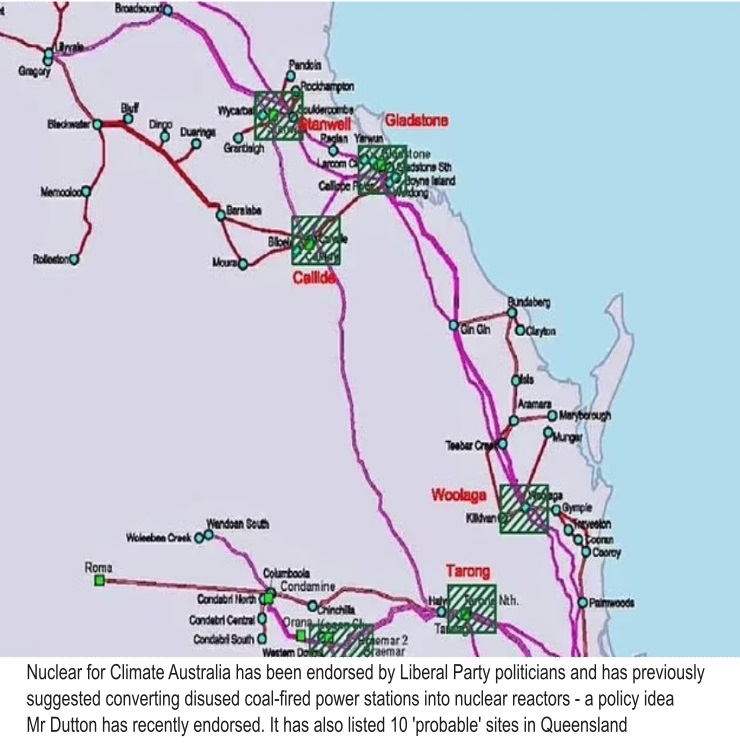
- Nuclear for Climate has Liberal Party endorsements
- It favours turning coal stations into nuclear reactors
- Also suggested Brisbane’s Wivenhoe Dam as site
By STEPHEN JOHNSON, ECONOMICS REPORTER FOR DAILY MAIL AUSTRALIA,12 May 2024
A dam that supplies drinking water near a major city could be used to cool a reactor should Australia embrace nuclear power.
Opposition Leader Peter Dutton is expected to use his upcoming Budget in Reply speech to provide more detail on potential sites for nuclear reactors, with the Coalition arguing Australia cannot solely rely on renewable energy to meet its climate change targets.

Nuclear for Climate Australia has been endorsed by Coalition MPs and its founder, a disillusioned former Labor candidate, is now advising the Opposition on nuclear energy policy.
Nuclear plants use the process of fission – splitting atoms – to heat water from the dam to create steam, which powers a turbine that creates electricity.
The dam’s water would also be used to cool down the nuclear system, with the water then recirculated back into the reactor.
‘While recirculating systems don’t add heat to the river or lake, they do consume water through evaporation,’ Nuclear for Climate Australia said……………………………
Robert Parker said Wivenhoe Dam offered cooling qualities during a drought.
‘You need to ensure that you got sufficient water in the highest demand, hot periods when everyone’s got their air conditioners going, you do not want your plant losing cooling ability,’ Mr Parker told Daily Mail Australia.
‘Smaller nuclear power plants would need to be able to get an allocation of water, particularly in the hot-weather periods out of those dams to cool themselves.
‘If the water allocation can be given to the power station, it would be a phenomenally good resource for cooling a nuclear power plant.’
This site was one of 10 ‘probable’ sites in Queensland along with another three ‘possible’ sites in the home state of Mr Dutton and the Coalition’s energy spokesman Ted O’Brien.
Opponents of nuclear power argue it is too risky to put a plant near any population centre because of the risk of meltdown, even though nuclear medical isotopes for cancer treatment are produced at Lucas Heights in suburban Sydney.
The meltdown at the Soviet-era Chernobyl plant in Ukraine in 1986 resulted in a mass leakage of radiation that devastated surrounding areas for decades, while the effects of the 2011 earthquake on the Fukushima plant in Japan also caused a major radiation event.
Other possible nuclear power plant sites
Nuclear for Climate’s 13 recommended potential reactor sites include seven existing coal-fired power stations: Callide, Stanwell, Tarong, Gladstone, Millmeran, Kogan Creek and Collinsville, along with gas-fired Swanbank in suburban Ipswich.
‘In Queensland coal fired plants were constructed adjacent to available coal mines and other infrastructure,’ it said.
‘New nuclear plants will where possible take advantage of the resource used for cooling at these plants.’
Mr Dutton has flagged the idea of potentially converting five disused coal-fired power stations into nuclear energy reactors, arguing Australia could not entirely rely on wind and solar energy to meet its target of net zero carbon dioxide emissions by 2050.
The Coalition argues the existence of electricity transmission lines from these sites meant nuclear power could be delivered affordably – unlike Labor’s $20billion Rewiring the Nation plan……………………………………….
Nuclear for Climate has also suggested Ross River in north Queensland, the existing site of a solar farm near Townsville that is also close to the sea.
The three ‘possible’ sites included Stockleigh in suburban Logan south of Brisbane, Samsonvale west of Brisbane, and the Burdekin regional in north Queensland.
Mr Parker compiled that list in 2022 but since then he has revised it to drop two sites too far inland, citing droughts……………………………………………….
Nuclear advocacy group
Nuclear for Climate was influential within Coalition circles even before Mr Dutton in March revealed a government led by him would push for a nuclear power industry.
Mr Parker, who ran as a New South Wales state Labor candidate in 2007, said he was now providing advice to the federal Coalition……………………………
In 2022, he addressed the Parliamentary Friends of Nuclear Industries, chaired by Nationals backbencher David Gillespie.
Coalition senators in 2022 also cited Mr Parker in their dissenting report on the government’s plan for Australia to source 82 per cent of its energy from renewable sources by 2030.
Hollie Hughes, Ross Cadell and Bridget McKenzie wrote their report as members of a Senate environment and communications committee who opposed the Climate Change Bill 2022, which Labor and the Greens backed.
Mr Parker’s Nuclear for Climate group had made a submission to this bill arguing Australia could not rely on renewable energy for power generation……………………………….
Mr Parker has also been endorsed in Parliament by Liberal MP Rick Wilson.
In November 2022, the assistant shadow minister from Western Australia hailed his expertise on small modular reactors that can produce 300 megawatts, or 300million watts of power.
‘Speakers like Robert Parker, founder of Nuclear for Climate Australia, described the journey of Canada’s expanding nuclear power using SMR technology,’ he said.
SITES EARMARKED FOR NUCLEAR POWER
’10 PROBABLE SITES’
COLLINSVILLE: coal-fired plant in Whitsunday region of north Queensland
MILLMERRAN: coal-fired plant in Darling Downs region of south Queensland (dropped)
CALLIDE: coal-fired plant at Biloela in central Queensland
GLADSTONE: coal-fired plant in central Queensland
TARONG: coal-fired plant in South Burnett region of south Queensland (scaled back)
STANWELL: coal-fired plant near Rockhampton in central Queensland
KOGAN CREEK: coal-fired plant north-west of Toowoomba in south Queensland (dropped)
SWANBANK: gas-fired plant in Ipswich in south-east Queensland
WIVENHOE: hydro plant north-west of Brisbane in south-east Queensland
ROSS RIVER: solar farm near Townsville in north Queensland
‘3 POSSIBLE SITES’
STOCKLEIGH: rural area west of Logan
BURDEKIN: pumped hydro in north Queensland
SAMSONVALE: rural area west of Moreton Bay in south-east Queensland
Source: Nuclear for Climate Australia’s 2022 list which founder Robert Parker has reconsidered in 2024 https://www.dailymail.co.uk/news/money/article-13394175/13-sites-nuclear-reactor-Australia.html
Nuclear waste from AUKUS nations could be on cards

Greens senator David Shoebridge, who sits on the committee, said the laws would allow the defence minister to designate any area as a nuclear waste facility.
“This runs roughshod not just over local communities but also First Nations peoples who have a long history of protecting their land from nuclear waste, from Muckaty to Kimba,” he said
“This just shows the lengths the Albanese government will go to try and keep the failing AUKUS nuclear submarine deal sputtering along.”
Andrew Brown, May 13, 2024, https://www.thenewdaily.com.au/news/2024/05/13/nuclear-waste-from-aukus-nations-could-be-on-cards
Nuclear safety laws should allow for Australia to accept low-level waste from the UK and US as part of the AUKUS submarine deal, a Senate committee has found.
An inquiry looking at how nuclear safety would be carried out as part of the $368 billion submarine deal found that while Australia should not accept high-level nuclear waste, low-level waste from the submarine programs of AUKUS nations would be accepted.
The Senate committee on Monday recommended the safety laws pass Parliament and extra oversights should be set up for nuclear regulators.
However, opponents say the laws would allow Australia to become a dumping ground for nuclear waste.
Greens senator David Shoebridge, who sits on the committee, said the laws would allow the defence minister to designate any area as a nuclear waste facility.
“This runs roughshod not just over local communities but also First Nations peoples who have a long history of protecting their land from nuclear waste, from Muckaty to Kimba,” he said
“This just shows the lengths the Albanese government will go to try and keep the failing AUKUS nuclear submarine deal sputtering along.”
However, while the committee in its report acknowledged the concern of what would happen to the nuclear waste as part of AUKUS, proper processes would be in place.
“Terms like ‘dumping ground’ are not helpful in discussing the very serious question of national responsibility for nuclear waste of any kind,” the report said.
“There is an important distinction between the categories of nuclear waste which spans from waste with lower levels of radioactivity generated by day-to-day submarine operations … to waste with higher levels of radioactivity, such as spent fuel produced when submarines are decommissioned.”
As part of the AUKUS deal, the US will sell Australia three second-hand Virginia-class submarines in the next decade before a new class of vessels will be used that are co-designed by all three nations in the pact.
In a dissenting report to the inquiry, the Greens also took aim at the oversight of the proposed Australian Naval Nuclear Power Safety Regulator.
Senator Shoebridge said the regulator reporting to the defence minister was out of step with similar bodies set up in other countries.
He said the body should instead report to the federal health minister to ensure its independence.
The report’s findings are set to be considered by the government before being brought back for debate in Parliament.
Sam Altman-backed nuclear start-up crashes after Wall Street debut

NEW YORK, https://www.malaymail.com/news/money/2024/05/11/sam-altman-backed-nuclear-start-up-crashes-after-wall-street-debut/133694 ― The share price of nuclear energy start-up Oklo, chaired by OpenAI boss Sam Altman, fell sharply yesterday on its first day of trading on Wall Street.
At around 3.40pm (1940GMT), the stock was down 53.9 per cent to US$8.40 (RM39.80).
Founded in 2013 by graduates of the Massachusetts Institute of Technology (MIT), Oklo went public by merging with AltC Acquisition Corp, a listed company.
The latter is a SPAC (special purpose acquisition company), a company whose sole purpose is to enable another firm to enter Wall Street through a merger.
Since the deal with Oklo was announced in July last year, AltC’s share price has soared, gaining over 72 per cent.
But transactions involving a SPAC are often highly volatile, partly because they are more exposed to speculation than traditional IPOs.
Altman is involved in several cutting-edge sectors and invested in Oklo in 2015, also becoming its chairman.
According to company documents, Altman directly controls around three per cent of the capital.
Oklo plans to build small modular reactors (SMRs), which are theoretically quicker to build than conventional power plants and less complicated to construct in remote areas. Oklo also wants to offer nuclear fuel recycling.
Conventional nuclear reactors are hugely expensive and take a long time to construct, with major projects having become notorious for their budget and schedule overruns.
The startup does not yet have a site of its own, and in January 2022 was refused a licence to build an SMR in Idaho by the Nuclear Regulatory Agency (NRC).
The NRC rejected the application on the grounds that there was a lack of information on the risks of accidents and the responses planned in such cases.
With the merger with AltC, Oklo raised US$306 million, which will be used to build the company’s first fission reactor, Aurora, in Ohio. ― AFP
Constellation Energy looks to small nuclear reactors for the gross, ever-increasing energy needs of great steel data containers.

Constellation Energy eyes new nuclear for unprecedented data center power
demand.
Constellation Energy (CEG.O), opens new tab is considering building
next-generation nuclear plants on its existing sites to meet soaring demand
from data centers, executives with the Baltimore-based power company said
on Thursday. The largest operator of U.S. nuclear energy said it is looking
at adding new small modular reactors and other energy technologies to
deliver electricity to large load customers like data centers.
Reuters 9th May 2024
“Nuclear comes last”

the tail-between-legs exit of the Nuclear Summit conferees declared in a headline: “Taxpayers are needed to foot the bill to achieve 2050 targets.”

Banks reject nuclear funding, stocks nosedive and the industry says it should, believe it or not, slow down
By Linda Pentz Gunter https://beyondnuclearinternational.org/2024/03/31/nuclear-comes-last/

NuScale, the company whose small modular reactor project collapsed so spectacularly last November, is “burning cash at the rate of $185 million per year”. On March 22, the company’s CEO, John Hopkins, sold 59,768 of his shares in the company. This is the same CEO who declared NuScale’s SMR project, aptly named VOYGR, “a dead horse.” It’s clearly on a journey to nowhere.

Wells Fargo, with an eye on prudent investments, has declared, “We think investor enthusiasm for SMR is misguided”. As The Motley Fool reported, “NuScale’s VOYGR nuclear power product has ‘no secure customers’ and is ‘not cost competitive’ says the analyst.”
The splashy cheerleading Nuclear Energy Summit organized by the International Atomic Energy Agency in Brussels on March 21 proved to be just that. The participants arrived floating on the hot air of their misplaced enthusiasm but “left humbled by the tepid reaction of bankers assessing the price tag of their ambitions”.
European Investment Bank Vice President Thomas Ostros, told Summit attendees to their face that “The project risks, as we have seen in reality, seem to be very high”. Representatives from the European and Latin American banking worlds said that “their lending priorities lean toward renewables and transmission grids” and that “nuclear comes last”.
Even the US Nuclear Regulatory Commission couldn’t quite bring itself to slam down its rubber stamp on Oklo’s chalet-in-the-woods micro reactor, the Aurora, which remains about as real as its namesake fairy tale princess.
In January 2022, the NRC denied Oklo’s license application outright because it “continues to contain significant information gaps in its description of Aurora’s potential accidents as well as its classification of safety systems and components,” wrote the NRC.
Oklo reapplied nine months later but according to the NRC docket there is “no further action”.
Nevertheless, Oklo brags on its website that it “made history” simply by developing “the first advanced fission combined license application to the U.S. Nuclear Regulatory Commission”, which sums up the second nuclear “renaissance” perfectly: Make a drawing. Hit ‘send’.
Meanwhile, the US military canceled its contract for an Aurora reactor originally intended for the Eielson Air Force Base near Fairbanks, Alaska.
And finally, an executive from the industry that has consistently delivered its latest new reactors decades late and billions over the original budget — in one case $20 billion over — suggested they should all just slow down. Said Ian Edwards, chief executive of Canadian reactor producer, Atkins Realis, “we all become too optimistic. We have this optimism bias towards being able to deliver faster. Really we should probably slow things down a little bit.”
But nuclear power is the answer to our current climate crisis! Ya think?
It’s tempting to ask whether things can get any worse for the nuclear power industry, but they almost certainly will. Unless we end up paying for it all. As the Bloomberg article that related the tail-between-legs exit of the Nuclear Summit conferees declared in a headline: “Taxpayers are needed to foot the bill to achieve 2050 targets.”
At the moment, a majority in the US Congress seem intent on making sure that is exactly what will happen. Because after all, why should multi-billionaire, Bill Gates, be forced to pay for his own nuclear toys when he can milk (read ‘bilk’) US taxpayers instead?

The US government has already pledged $2 billion of our money to Gates for his proliferation-friendly liquid sodium-cooled molten salt fast reactor produced by his company, TerraPower (more properly, TerrorPower). Gates can’t wait to export it the United Arab Emirates. Nuclear weapons anyone?
The strokey-white-beard-named ADVANCE Act, has been passed by the US House with 365 voting in favor and only 36 Democrats-with-a-conscience voting against it. By its own description, the ADVANCE ACT aims to “advance the benefits of nuclear energy by enabling efficient, timely, and predictable licensing, regulation, and deployment of nuclear energy technologies.” In other words, do away with burdensome — and expensive — safety regulations.
Indeed, New Mexico Democrat, Senator Martin Heinrich, told E&E News in January that “These regulatory timelines do not lend themselves to fighting the climate crisis.” Oh those wascally wegulations!
Meanwhile, Democratic senator Joe Manchin of West Virginia doesn’t want to seat any new NRC commissioners who might be “too focused on safety.”
The NRC’s motto is “protecting people and the environment,” a mandate it demonstrably endeavors to avoid already, but even some vestige of interest in safety is probably better than none. Not that safety oversight will be needed of course because, hey, SMRs are “walkaway safe” and “meltdown proof” and any new light water reactors are too “advanced” to be a safety risk.

This makes the insistence by SMR manufacturers that they must be covered by the Price-Anderson Act (PAA) all the more curious. Price-Anderson, due to expire in 2025, was culled out of the ADVANCE ACT, now moving out of Senate committee and working its way through the reconciliation process, and handled separately. The Senate adopted the House version of the PAA, giving it a 40-year extension to 2026, and expanded limited liability for a major accident to just over $16 billion per reactor.
President Biden duly signed it into law, marking another misstep on what is becoming an increasingly problematic presidency.
Ed Lyman, Nuclear Power Safety Director at the Union of Concerned Scientists, told Nuclear Intelligence Weekly that “The nuclear industry’s push for a 40-year Price-Anderson Act extension is a sure sign that it doesn’t believe its own messaging about how safe the next generation of nuclear reactors is going to be.”
But in a joint statement, Senator Shelley Moore Capito (R-W.Va.) and Senator Tom Carper (D-Del.) declared that “The extension of the Price-Anderson Act in the minibus sends a clear message that we are committed to the advancement of this safe and reliable power source.”
The “clear message” this actually sends is that, in the event of a major nuclear accident, US taxpayers will be thrown under that minibus. The $16 billion coverage will be chicken feed and we will all be stuck with the bill. Let’s remember that the Chornobyl and Fukushima nuclear disasters are each racking up costs in the hundreds of billions of dollars and counting. We have been warned.
But a bi-partisan group of Representatives and Senators think it’s perfectly fine for all of us to pay for such an eventuality. Meanwhile, if you own a home and are forced to abandon it in the path of a nuclear accident, you cannot claim a dime off your homeowner’s insurance. It will just be a total loss. Think about that for a moment.
Are we outraged yet?
Linda Pentz Gunter is the international specialist at Beyond Nuclear
Dominic Cummings: Zelensky’s no Churchill and Ukraine’s corrupt

Former Brexit campaign chief says the West is ‘getting f**ked’ by supporting Ukraine.
BY NOAH KEATE, MAY 9, 2024 https://www.politico.eu/article/dominic-cummings-volodymyr-zelenskyy-ukraine-war-corruption/
LONDON — Boris Johnson’s former top adviser Dominic Cummings launched a sweary attack on Western support for Ukraine Thursday.
In an interview with the i newspaper, Cummings — who led Britain’s Vote Leave Brexit campaign and spectacularly fell out with Johnson in 2020 — declared that the West “should have never got into the whole stupid situation” and claimed sanctions against Russia have had a greater impact on European politics than in Moscow.
The former adviser was scathing of Ukrainian President Volodymyr Zelenskyy and comparisons with World War II.
“This is not a replay of 1940 with Zelenskyy as the Churchillian underdog,” he said.
“This whole Ukrainian corrupt mafia state has basically conned us all and we’re all going to get f**ked as a consequence. We are getting f**ked now right?”
In a follow-up tweet, Cummings later branded Zelenskyy a “potemkin” leader — but denied he’d called him a “pumpkin” as originally quoted in the interview.
He argued that war would only strengthen the relationship between Russia and China, saying Western nations “pushed [Russia] into an alliance with the world’s biggest manufacturing power.”
Cummings has long been critical of support for Ukraine, a stance that puts him sharply at odds with his old boss Johnson, a vocal supporter of Zelenskyy and Ukraine’s war effort.
He told the paper the West had failed to send Russian President Vladimir Putin a worthwhile signal which would deter him from invading another country.
“What lesson have we taught him? The lesson we’ve taught Putin is that we’re a bunch of total f**king jokers,” Cummings asserted, saying the war had “broadcast it to the entire world what a bunch of clowns we are.”
It comes as the former Vote Leave Brexit campaign chief tests the water for a new political party to replace the Tories.
POLITICO reported on Thursday that Cummings has organized a series of focus groups to get the public’s views about a new anti-establishment outfit.
Cummings told the i his “Start Up Party” would be “ruthlessly focused on the voters not on Westminster and the old media.”
1 This month


Help Aunty Sue Protect Her Land and Sacred Sites From Destructive Rocket Testing.
.

Australians deserve the truth
about
AUKUS – https://aukuspublicinquiry.com/

PETITION – To: Prime Minister Anthony Albanese and the Australian Labor Government

of the week – Australians for War Powers Reform (AWPR)
To see nuclear-related stories in greater depth and intensity

