The horrors of nuclear weapons testing

I think that enough time has gone by that the longer-term dangers of nuclear weapons, such as radioactive fallout, have largely disappeared from the public consciousness—much to the agony and despair of those afflicted to this day.
Radioactive fallout and its long-term effects—things that the average person today does not really appreciate—would be the result from any future nuclear weapons explosion that touched the Earth’s surface. Fallout does not just affect the target, but also the surrounding areas—which could be as far as hundreds of miles away. And the effects could last for years, if not decades thereafter.
Bulletin By Walter Pincus, March 7, 2024
There has been talk in the national security community lately about the so-called “merits” of resuming underground or even atmospheric nuclear weapons tests. I think this would be a grave mistake for many reasons—chief among them is that it forgets the horrific health effects that resulted from some previous nuclear tests.
To be clear, since 1963, atmospheric tests of nuclear weapons have been banned, as have tests in outer space and under water. And underground explosive tests have been banned ever since the 1996 Comprehensive Nuclear Test Ban Treaty, or CTBT. (Technically speaking, while the United States and China have signed the CTBT, neither has ratified it. Russia did both sign and ratify the treaty but on November 2, 2023 Russia announced it had rescinded its ratification. All three countries, however, have so far abided by the CTBT treaty.)
Meanwhile, sub-critical nuclear tests—which use tiny amounts of plutonium but do not create self-sustaining, exponentially-growing, nuclear chain reactions—have continued to this day, in laboratories or in specially constructed underground tunnels. The US is building new tunnels for sub-critical tests at the Nevada Nuclear Test Site where they are expected to help in designing the new, US W93 nuclear warhead now under development.
Presumably, then, what we are referring to when we talk about the possible resumption of nuclear testing is not the latter sub-critical testing, but some version of atmospheric, outer space, underwater, or underground explosives testing.
And here things get tricky.
Because I think that enough time has gone by that the longer-term dangers of nuclear weapons, such as radioactive fallout, have largely disappeared from the public consciousness—much to the agony and despair of those afflicted to this day.
I believe that the more people understand and even can visualize the immediate and long-term dangers of nuclear weapons use, the less likely it is that they may be used. Several nuclear scientists have told me they have memories of specific past nuclear atmospheric tests, most memorably two who were involved in the Manhattan Project—Harold Agnew and Hans Bethe.
Agnew photographed the Hiroshima mushroom cloud from the US aircraft that followed the Enola Gay that dropped the atomic bomb. Agnew almost always brought up the effect that had on him when we met.
For his part, Bethe, at 88—on the 50th anniversary of the birth of the atomic bomb—wrote: “I feel the most intense relief that these weapons have not been used since World War II, mixed with horror that tens of thousands of such weapons have been built since that time—one hundred times more than any of us at Los Alamos could ever imagine.”
In an interview years earlier at Cornell University where he was teaching, Bethe had told me something similar—and at 91, I have never forgotten those words.
The closer you are to nuclear weapons, the more you are aware of the dangers if they were to be used again. However, I believe, most people today have forgotten, if they ever knew, what a single nuclear weapon could do.
Seeing is believing. But believing in this case should make you work to oppose their use, as can be seen in a very rough sort of timeline of my own life…………………………………………………………………………………………………………………
It was in February 1966, well after the 1963 atmospheric test ban treaty, that I first wrote about the impact of nuclear weapons. It was a rather flip, three-paragraph note in The Reporter Magazine, which no longer exists. The story concerned a law that had passed Congress the previous month, a measure which required the US Government to pay $11,000 to each of the 82 men, women and children—or their survivors—who had been on Rongelap Atoll in the Marshall Islands in the central Pacific on March 1, 1954 when the United States detonated Test Bravo from a tower on an artificial island built within Bikini Atoll, more than 120 miles west of Rongelap.
Bravo was the first US test of a deliverable thermonuclear bomb and was expected to have a six-megaton yield, the equivalent of six million tons of TNT. In fact, the explosion was more than double that—15 megatons—and one thousand times more powerful than the atomic bomb that destroyed Hiroshima.
Thanks in good part to thousands of documents on nuclear weapons declassified and released during the Clinton Administration, I was able to describe details about the Bravo explosion two years ago in my book, Blown To Hell: America’s Deadly Betrayal of the Marshall Islanders, as follows:
In a few seconds the fireball, recorded at one hundred million degrees, had spread nearly three miles in diameter, then quickly spread to ten miles. The sandspit and nearby reef where Bravo had stood, along with coral island areas, were vaporized down almost two hundred feet into the sea, creating a crater about one mile in diameter.
It was estimated that three hundred million tons of vaporized sand, coral and water shot up into the air as the fireball rose, and one-hundred-mile-an-hour winds created by the blast pulled additional debris up into the fireball. Within one minute, the fireball had gone up forty-five thousand feet with a stem four miles wide filled with radioactive debris. It continued to zoom upward, shooting through the troposphere and into the stratosphere within five minutes.
Later data showed the cloud bottom was at fifty-five thousand feet, the secondary mushroom cloud bottom was at one-hundred-fourteen thousand feet, and the upper cloud hit one-hundred-thirty thousand feet.
Ten minutes after detonation the mushroom cloud had widened and measured seventy-five miles across just below the stratosphere.
Original projections had predicted Bravo radioactive fallout would emanate from a fifteen-mile-wide cylinder that could stretch into the stratosphere. Instead, it turned out to be a one-hundred-mile-wide cloud where “debris was carried up and dispersed over a much larger area than was thought possible,” wrote Dr. William Ogle, the test’s task force commander of the scientific group that dealt with radioactivity.
Radioactive fallout and its long-term effects—things that the average person today does not really appreciate—would be the result from any future nuclear weapons explosion that touched the Earth’s surface. Fallout does not just affect the target, but also the surrounding areas—which could be as far as hundreds of miles away. And the effects could last for years, if not decades thereafter. These effects are worth spelling out in detail, using what happened downwind of the test as an example.
That March 1, 1954 morning, the Japanese fishing boat Lucky Dragon, with a crew of 23 aboard, was trawling its nets 90 miles east-northeast of Bikini. A crewman at the stern rail saw a whitish flare in the west that briefly lit up the clouds and the water. It grew in size, turned to yellow-red, then orange. After a few minutes, the colors faded and shortly thereafter the ship was rocked by the blast of an explosion.
The Lucky Dragon’s captain and the fishing master, who had read ship warnings before they left port, realized they might have strayed into a nuclear test area. They quickly decided to haul in their fishing nets and head back to Japan, almost 2,500 miles away.
It was another two or three hours before a fine white dust began to come down on the boat. With a light rain, the radioactive dust continued to settle on crewmen and the fish on the deck as they worked for another two hours to bring in their lines.
On Rongelap about 30 miles further east, at about 11:30 a.m., a similar powdery, radioactive ash began falling in the area. It stuck to the Marshallese people’s skin, hair, and eyes; many walked barefoot and the powder stuck to their toes; it fell on fish drying on wooden racks that would be eaten that night. Rain briefly fell as the fallout continued into afternoon, dissolving the powdery ash on roofs and carrying it down drains into water barrels that provided drinking water to each household.
On parts of Rongelap Island, where most people lived, the almost five hours of fallout led to drifts of up to one-inch or more high on the ground, on roofs, and along the beach. People recalled that when the moon broke through the clouds that night, it looked like patches of snow on the ground.
It would be two days before the Marshallese were evacuated from Rongelap and taken to the Kwajalein Navy Base by a US Navy destroyer. By then, most of the Rongelapese people had suffered from acute radiation exposure and nausea; some had experienced skin lesions as well.
Since the Bravo test was highly classified, a decision was made in Washington to keep the fallout incident secret, although the Atomic Agency Commission (AEC) had released a statement on March 1, 1954 that a nuclear test had taken place in the Marshall Islands Pacific Proving Ground. That had generated a small front page story in the March 2, 1954, edition of The New York Times. It was not until March 11, 1954, that the AEC admitted people “unexpectedly exposed to some radioactivity” had been moved to Kwajalein “according to a plan as a precautionary measure.”
Two weeks passed before the Lucky Dragon returned to its home port in Japan. It was only then that on March 16, 1954, the first story appeared in the Japanese Yomiuri Shimbun newspaper of what had happened to the boat’s crew and their fish—not what happened to the Marshallese. That story immediately triggered initial worldwide attention to the dangers of fallout from nuclear weapons.
However, it was not until President Eisenhower’s March 31, 1954 press conference that AEC Chairman Lewis Strauss, who had just returned from observing post-Bravo nuclear tests, admitted publicly that the Bravo test was “in the megaton range” and “the yield was about double that of the calculated estimate.” ……………………………………………………………………………………………………….
The early part of the 1955 report described the blast and heat effects of early atomic bombs detonated in the air, before discussing fallout from Bravo and other detonations. “In the air explosion, where the fireball does not touch the earth’s surface, the radioactivity produced in the bomb condenses only on solid particles from the bomb casing itself and the dust which happens to be in the air. In the absence of materials drawn up from the surface, these substances will condense with the vapors from the bomb and air dust to form only the smallest particles. These minute substances may settle to the surface over a very wide area—probably spreading around the world—over a period of days or even months. By the time they have reached the earth’s surface, the major part of their radioactivity has dissipated harmlessly in the atmosphere and the residual contamination is widely dispersed.”
The report then turned to what fallout would occur if the fireball hit the ground. “If however the weapon is detonated on the surface or close enough so that the fireball touches the surface, then large amounts of material will be drawn up into the bomb cloud. Many of the particles thus formed are heavy enough to descend rapidly while still intensely radioactive. The result is a comparatively localized area of extreme radioactive contamination, and a much larger area of some hazard. Instead of wafting down slowly over a vast area, the larger and heavier particles fall rapidly before there has been an opportunity for them to decay harmlessly in the atmosphere and before the winds have had an opportunity to scatter them.”
It described the Bravo fallout as looking like snow “because of calcium carbonate from coral,” and then noted its “adhesive” quality thanks to moisture picked up in the atmosphere as it descended. In the end it contaminated “a cigar-shaped area extending approximately 220 statute miles downwind, up to 40 miles wide,” from Bikini. It “seriously threatened the lives of nearly all persons in the area who did not take protective measures,” the report said.
The report then talked about radioactive strontium in fallout as having a long, average lifetime of nearly 30 years, noting it could enter the human body either by inhaling or swallowing. Deposited directly on edible plants, the strontium could be eaten by a human or animal. While rainfall or human washing of the plants would remove most of the radioactive material, radioactive strontium deposited directly on the soil or in the ocean, lakes, or rivers could be taken up by plants, animals, or fish. There it would lodge in their tissue where it could later be eaten by humans…………….
The other radioactive element in fallout described specifically as a threat in the report was radioactive iodine. Even though the average life of radioactive iodine was only 11.5 days, it was described as a serious hazard because, if inhaled, it concentrated in the thyroid gland where it could damage cells, depending on dosage………………………………………………………………………………………………………………………………………………………………..
Back on Rongelap, despite some cleanup, there are few in residence. A study published in the Proceedings of the National Academy of Sciences in July 2019, done by researchers from Columbia University, found that levels of plutonium and cesium in the soil on Rongelap and other Marshall Island atolls were “significantly higher” than levels that resulted from fallout existing from the July 1986 Chernobyl nuclear power accident—which occurred 28 years after US nuclear tests had ended in the Marshalls.
The Rongelap Marshallese as well as the Japanese seamen who were exposed to fallout on March 1, 1954, can be seen as surrogates for anyone caught in a future nuclear war. Rongelap Atoll, as well as Bikini Atoll, for the most part still cannot be inhabited despite attempts to decontaminate them. Think of what today’s cities would be like if hit by a thermonuclear weapon whose fireball struck the ground and created radioactive fallout.
Within weeks it will be 70 years since the Bravo test. The more the US public and the world are reminded of that test and the resulting Rongelap story, the more they should work to deter any potential use of nuclear weapons. https://thebulletin.org/premium/2024-03/the-horrors-of-nuclear-weapons-testing/?utm_source=Newsletter&utm_medium=Email&utm_campaign=ThursdayNewsletter03072024&utm_content=NuclearRisk_NuclearTestingHorrors_03072024
[Episode #219] – Nuclear Illusions
Energy Transition Show 6th March 2024 https://xenetwork.org/ets/episodes/episode-219-nuclear-illusions/—
In Episode #209, we peeled back the layers on civilian nuclear power, revealing its history as a facade for the nuclear weapons industry with a corresponding legacy of deception.
Yet, the allure of small modular reactors (SMRs) has recently been touted as the nuclear industry’s saving grace and a beacon of hope with the potential to sidestep a muddled past. Despite all the fanfare and substantial investments, the crumbling of prominent SMR initiatives exposes the continuation of the industry’s tradition of overpromising and underdelivering, a pattern all too familiar to those who’ve been watching closely.
Joining us in this episode is Jim Green from Friends of the Earth Australia, a seasoned nuclear journalist with three decades of experience in critiquing nuclear energy. Jim offers an unparalleled depth of insight into the industry’s persistent shortcomings and the realities behind the SMR hype. Together, we delve into the track record of conventional nuclear power, the latest trends in nuclear plant construction and retirements worldwide, and examine the companies at the forefront of the SMR push, offering a candid exploration of the nuclear power industry’s claims versus its actual performance.
Guest:
Jim Green is the National Nuclear-Free Campaigner with Friends of the Earth Australia, a member of the Nuclear Consulting Group (nuclearconsult.com), and former editor of the World Information Service on Energy’s ‘Nuclear Monitor’ newsletter. He has a First Class Honours degree in Public Health and a Doctorate in Science and Technology Studies for his thesis on the debates over the replacement of Australia’s nuclear research reactor.
Shock as Australian Prime Minister learns that he is not above international law

the Prime Minister would be wise to seek independent advice from one of several influential Australians who have significant expertise in the field of international humanitarian law.
By Margaret ReynoldsMar 7, 2024, https://johnmenadue.com/shocked-australian-pm-learns-he-is-not-above-international-law/
Prime Ministers are too often monopolised by people telling them what they want to hear. Most political advisers can’t see beyond the latest opinion poll and the Australian bureaucracy has become equally reluctant to offer frank and fearless advice. It appears that the Attorney General, Defence and Foreign Affairs and Trade Departments have each failed to alert the Prime Minister and his government to the risks inherent in ignoring international law when responding to the Gaza crisis.
However, many members of Australian civil society have indeed urged the Federal Government to act strongly to uphold humanitarian standards and avoid crimes against humanity They have demanded the Federal Government restore funding to the United Nations Relief and Works Agency and ban arms sales to Israel. More than 100 non-government organisations have communicated their alarm that Australia could in any way be contributing to the ongoing atrocities being inflicted on the Palestinians. Since January 27th, many Australians have anticipated a public official response to the International Court of Justice interim ruling that a case of genocide against Israel is plausible Yet this weight of urgent correspondence and advocacy has failed to alert the Prime Minister’s staff to Australia’s responsibilities as a signatory of the Genocide Convention.
Today more than 100 Australian lawyers endorsed the referral of Anthony Albanese, together with other members of his government and the Opposition leader, Peter Dutton to the International Criminal Court as Accessory to Genocide in Gaza alleging political and material support to the Israel government and military over the past five months.
The 92-page document sets down specific ways in which this allegation can be upheld.
– Freezing of funding to the United Nations Relief and Works Agency amid a humanitarian crisis
– Providing military aid and approving defence exports to Israel
– Ambiguously deploying an Australian military contingent to the region where its location and exact role have not been disclosed
– Permitting Australians to travel to Israel to join the Israeli Defence Force and take part in its attacks on Gaza.
In response, the Prime Minister has dismissed the referral to the International Criminal Court as “lacking credibility” and it is unsurprising he would go into a defensive denial mode. However, it would be a brave leader who did not now demand detailed briefings on these allegations from those departments that have failed to respond to the International Court of Justice genocide warning. Furthermore, the Prime Minister would be wise to seek independent advice from one of several influential Australians who have significant expertise in the field of international humanitarian law.
Regardless of the long-term future of this and comparable allegations against other western leaders, the Australian Government has been given the chance to review its commitment to international law. It can continue to ignore calls for transparency and Australian independence in foreign policy, or it can start to seriously examine why the allegations of complicity have been made.
There is no doubt that many nations are much more actively concerned about the charge of genocide brought against Israel by the South African government. In February more than fifty countries including Indonesia, Malaysia, Fiji, Japan, Great Britain and Ireland sent official legal delegations to the Hague to present their nations opinions to the International Court of Justice., but Australia was not represented.
In contrast, the Australian Government has avoided any detailed public response to its responsibilities as a signatory to the Genocide Convention. Indeed, it has recently twice closed down parliamentary debate that could lead to a comprehensive House of Representatives discussion. There has been no debate about how Australia may assist in future medical rehabilitation of Palestinians nor how it will contribute to the rebuilding of Gaza. While the Foreign Minister may refer to a “two state solution “ there has been no official announcement that Australia finally recognises the State of Palestine.
Furthermore, the failure of the Australian public service to maintain or prioritise current independent information about the continuing assault in Gaza amounts to negligence. In a recent meeting, United Nations Relief and Works Agency in Gaza, Director Tom White was advised “the Australian Government wanted to be sure UNRWA Gaza aid funding will go to those who need it “! This bland indeed inhuman statement clearly reflects that there is something seriously wrong with how the government is currently managing its international responsibilities.
Of course, it is embarrassing for the current Australian Government to be named as an “accessory to genocide”, but all members of parliament should not be too quick to dismiss the allegation until they have reviewed why and how such a charge could be made. The parliament hears too many simplistic speeches giving loyalty to allies who blatantly ignore international law and it’s time our representatives faced this reality.
Australia has a proud record as a founding member of the United Nations, which is responsible for developing international law. So many well-known Australian names have contributed to a great variety of United Nations achievements, yet few parliamentarians speak up for the importance of the international body. International law is being undermined by governments choosing militarism ahead of the rule of law, so it is imperative that the Australian government and parliament commit to prioritising its international responsibilities. Many Australians will be watching closely, demanding that humanitarian leadership is restored.
Margaret Reynolds is a former councillor and Federal Minister for Local Government. She chaired the Advisory Board of the Australian Centre of Excellence in Local Government at the University of Technology, Sydney 2008-2012.
She has a long history in the peace movement starting during the Vietnam War. As a Labor senator she supported the Pine Gap Women’s Peace camp and visited Greenham Common to support anti-nuclear campaigners . She represented Parliamentarians for Global Action at several human rights and peace conferences in the 1990s. After leaving parliament she taught International Relations at the University of Queensland.
Margaret is the National President of the Women’s International League for Peace and Freedom
Nuclear power: Peter Dutton changes gear in favour of big reactors not small modular ones,

Mr O’Brien told The Australian Financial Review in June 2022 that SMRs, not large-scale power plants, were the future of nuclear.
Mr Dutton is now saying modern giant power plants would be the backbone of the Coalition’s energy policy.
Phillip Coorey, https://www.afr.com/politics/federal/dutton-changes-gear-on-nuclear-plans-pm-dismissive-20240305-p5f9vg 5 Mar 24
Plans by the Coalition to build large nuclear reactors on the sites of old coal-fired power stations would be prohibitively expensive, take more than a decade to implement, and would not work in most cases because such reactors need to be near water, Prime Minister Anthony Albanese said.
Mr Albanese, who as shadow environment minister two decades ago fought plans by John Howard to consider nuclear power plants near populated coastal communities, said little had changed in terms of the political difficulties of such a proposal.
“He is now speaking about large nuclear reactors. They need to be near populations, they need to be near water,” he said of Mr Dutton.
“I look forward to him announcing the locations for nuclear reactors in Australia and for there to be an appropriate debate about that.”
Mr Dutton and his energy spokesman Ted O’Brien are proposing nuclear power be used to provide baseload power to firm renewable energy and ensure Australia can achieve new zero emissions by 20250.
Rather than build, as Labor is intending to do, 28,000 kilometres of poles and wires to transmit renewable energy from wind and solar farms, Mr Dutton is proposing building nuclear power pants on the sites of coal fired plants as they are decommissioned.
The proposal builds on the original plan, which would involve a strong focus on small modular reactors.
Mr O’Brien told The Australian Financial Review in June 2022 that SMRs, not large-scale power plants, were the future of nuclear.
“Nobody wants old Soviet technology, you wouldn’t touch it with a barge pole,” he said.
But SMR technology is still embryonic, and Mr Dutton is now saying modern giant power plants would be the backbone of the Coalition’s energy policy.
“It doesn’t resemble anything that you’ve seen in the past. It’s like comparing a motor vehicle you’re driving off the showroom floor today in 2024, compared to something in 1954,” he said.
“So, the technology is unbelievable compared to what it was 50 or 70 years ago.”
He said bipartisan support for nuclear-powered submarines under the AUKUS deal had removed any opposition to nuclear power on the basis of their needing to have a high-level nuclear waste dump.
Mr Albanese said the nuclear argument had changed little since Mr Howard had businessman and nuclear physicist Ziggy Switkowski examine the option in 2006.
“Every 10 years, there are these proposals, we’ve seen the Switkowski report come and go,” he said.
“What never comes is any investment, because it simply doesn’t stack up commercially.
“I look forward as well to him arguing where the financing will come [from] for such reactors, or whether taxpayers will be expected to pay for this.”
The Opposition argues Mr Albanese should lift the moratorium on nuclear power and let the market decide.
Mr Dutton said Mr Albanese was out of touch with public opinion which, according to opinion polls, is warming to nuclear power.
“It’s … supported by a lot of younger people because they’re well-read, and they know that it’s zero emissions, and it can firm up renewables in the system,” he said.
“The government’s got sort of a wing and a prayer at the moment where they think if we have 100 per cent renewables in the system, the costs will go down, or there can be reliability. Neither of those things will happen, in fact, the opposite.”
Australia has had many significant inquiries into nuclear power, over the past 60 years

Paul Richards, 6 Mar 24
Peter Dutton and his Coalition opposition party keep calling for a “mature” debate on nuclear power, as if no-one has ever discussed it seriously. But Australia has had many “mature” inquiries and discussions related to nuclear energy, uranium mining, and the nuclear fuel cycle over the past 60 years. Here are some notable ones:
1.] Radium Hill Royal Commission (1953):
This inquiry examined the safety and health concerns related to uranium mining at Radium Hill in South Australia. It investigated radiation exposure for workers and nearby communities and made recommendations for improved safety measures.
2.] McMahon Report (1955):
Commissioned by the Australian government, this report explored the potential for nuclear power generation in Australia. It assessed the feasibility, costs, and benefits of establishing nuclear power plants and considered the country’s uranium resources.
3.] Fox Report (1976):
The report, officially titled “Uranium Mining, Processing, and Radiation Safety”, was commissioned by the Australian government to investigate the health and safety aspects of uranium mining and processing. It examined radiation exposure risks for workers and surrounding communities and recommended regulatory measures.
4.] Joint Select Committee on the Environment (1980-1981):
This parliamentary committee inquired into the environmental and health impacts of uranium mining and processing in Australia. It examined issues such as radiation contamination, waste management, and rehabilitation of mining sites.
5.] Commonwealth Government Inquiry into Nuclear Energy (2006):
This inquiry examined the potential for Australia’s involvement in the nuclear fuel cycle, including uranium mining, nuclear power generation, and waste management. The resulting report, known as the Switkowski Report, provided analysis and recommendations on these issues.
6.] South Australian Nuclear Fuel Cycle Royal Commission (2015-2016):
This inquiry was established by the Government of South Australia to investigate the potential for the state’s further involvement in the nuclear fuel cycle, including uranium mining, enrichment, energy generation, and waste management. The final report provided a comprehensive analysis and recommendations regarding these issues.
7.] Federal Government Inquiry into Nuclear Energy (2019):
The Australian Federal Parliament’s Standing Committee on the Environment and Energy conducted an inquiry into the prerequisites for nuclear energy in Australia. It examined the economic, environmental, and safety implications of nuclear power generation and assessed public opinion and regulatory frameworks.
These inquiries reflect Australia’s ongoing evaluations and debates surrounding nuclear energy, uranium mining, and the broader nuclear fuel cycle, considering various economic, environmental, social, and political factors over the past 60 years.
Dutton’s nuclear option would condemn us to pricey power and blackouts.

Simon Holmes à Court, Businessman and political activist, March 6, 2024 ,
https://www.theage.com.au/national/dutton-s-nuclear-option-condemns-us-to-pricey-power-and-blackouts-20240306-p5fa99.html
Australia’s climate wars will not end – to paraphrase former Liberal prime minister Malcolm Turnbull – until the Coalition chooses engineering and economics over ideology and idiocy.
Over the past two decades, the Coalition has made a series of look-over-there attempts to prolong the life of coal: first carbon capture and storage, then HELE (High Efficiency, Low Emissions) “clean coal”, followed by the “gas-fired recovery” and now small modular nuclear reactors (SMRs). Not one was a serious proposal backed by analytic rigour. All were just fig leaves to cover embarrassingly small policies.
By proposing we turn to nuclear, the Coalition signals loudly that it does not understand Australia’s massive natural advantages. We have the world’s most abundant wind and solar resources, putting us on track to produce the world’s cheapest energy. Blend our clean-energy advantages with our abundant reserves of critical minerals and add a generous dollop of nation-building vision and Australia can deliver great prosperity to its citizens.
In a decarbonising 21st century, Australia is well placed to be a winner. We can become a clean-energy superpower. Yet the Coalition’s blinkered vision and political gamesmanship would see us squander this great country’s unparalleled natural advantage.
Some might be surprised that I have a deep interest in nuclear energy. In recent years, I’ve visited five nuclear power stations and met four companies hoping to build SMRs. I’ve attended a course on nuclear at the Massachusetts Institute of Technology, a nuclear conference in Dubai and met nuclear venture capitalists in New York.
I have no doubt there’s a strong and important role for nuclear power in parts of the world less well-endowed than Australia, and I can imagine that one day – if critical barriers are addressed – nuclear could even play a role in Australia.
Meanwhile, Australia’s energy transition continues apace. Twelve years ago, renewables made up just 10 per cent of the national electricity market. Today we’re at 39 per cent and the Australian Energy Market Operator’s biennial scenario plan projects that, just 12 years from now, 95 per cent of our power will come from renewables – wind and solar, firmed with storage and backed up with gas.
There are four key reasons that nuclear won’t play a role in our current energy transition.
First, there’s no conceivable pathway to seeing a single kilowatt-hour generated from nuclear before the early 2040s. Small modular reactors are years away from becoming a commercial reality. It’s quite possible they never will. Gigawatt-scale reactors are a safer bet. A pair I visited six months ago in Waynesboro, Georgia have taken 18 years from announcement to operation and each cost more than the combined valuation of Origin Energy, AGL and Energy Australia.
Of the four other nuclear projects commenced this century in Western Europe and North America, none were faster. Assuming the industry has learnt from all these mistakes, construction here could not begin until a proper regulator and regulatory system were stood up, a site selected, planning permissions granted, appeals lodged and dismissed, the project put out to tender, and the technology and suppliers selected and contracted. All doable, but no chance of the very first unit contributing to our energy mix before the vast majority of our aged coal fleet is long gone.
Second, nuclear cannot compete economically with our clean-energy resources. The CSIRO has calculated that an SMR starting construction in 2030 would produce power for $212–$353/MWh, while power from new wind and solar would cost $69-101/MWh. For the consumer, that translates to a 20c/kWh premium for nuclear. Larger nuclear reactors may produce cheaper power – or may not if recent UK experience is a guide – but there’s no credible sign that anything close to market could come close to any of AEMO’s least-cost pathways.
Third, the politics are currently intractable. A ban on nuclear power exists not only federally – introduced by the Howard government – but in each of the three states with sufficiently large grids: NSW, Victoria and Queensland. Nuclear could not be built without very significant government involvement, most likely as the proponent. Without bipartisan enthusiasm at all levels of government, no investor, let alone contractor, would touch Australia.
The Greens, who more often than not hold the balance of power in the Senate, object to nuclear. A critical mass within Labor is implacably opposed, and I suspect their strategists are delighted for the Coalition to speak about nuclear every day between now and the federal election. And while many in the Coalition’s base go gaga for nuclear, survey after survey shows that a significant number of their voters are uncomfortable with the technology.
Lastly, it will be technically difficult to shoehorn nuclear into our grid. Like coal, nuclear is designed – economically and technically – to stay switched on. Constant output is its sweet spot, yet the need for this output profile is dropping with every passing year. Modern grids value flexibility to meet the difference between variable renewable supply and consumer demand which is why there’s an ongoing boom in large grid battery construction projects in Australia.
Is nuclear power a fix for climate change? Experts think it’s too dangerous

Because of the inevitable production of long-lived radioactive wastes, nuclear power cannot be defined as sustainable,”
“Because of the inevitable production of long-lived radioactive wastes, nuclear power cannot be defined as sustainable,”
Some climate activists are pushing for expanded nuclear power — most experts think the risk is too high
By MATTHEW ROZSA, Staff Writer, https://www.salon.com/2024/03/04/is-nuclear-power-a-fix-for-climate-change-experts-think-its-too/
As the climate crisis grows worse every year, alternative energy options are increasingly important. Much recent debate has focused on nuclear energy, which has an understandably troubled reputation after the disasters at Chernobyl, Three Mile Island and Fukushima, and is further tarnished by its association with the devastating potential of nuclear weapons. Nuclear energy is definitely “cleaner” than fossil fuels in terms of carbon emissions, but most experts Salon contacted were skeptical that it can offer a path to climate salvation.
Some climate activists “promote nuclear power as a possibility to battle climate change,” said Nikolaus Muellner, a professor of safety and risk sciences at the University of Natural Resources and Life Sciences in Vienna. while others are eager “to avoid the risks associated with nuclear power.”
M.V. Ramana, a physicist at the University of British Columbia’s School of Public Policy and Global Affairs and author of the upcoming book “Nuclear Is Not the Solution: The Folly of Atomic Power in the Age of Climate Change,” made clear in an email response to Salon that he falls into the latter camp. “If one evaluates nuclear energy as a way to deal with climate change,” Ramana said, it actually plays “a negative role in reducing emissions.”
There are two reasons for that, he continued: “First, the money invested in nuclear energy — even in the case of keeping old and possibly dangerous plants operational — would save far more carbon dioxide if it were invested in renewables and associated technologies.” So he sees “an economic opportunity cost to investing in nuclear energy.” Furthermore, building new nuclear reactors can take years or decades, compounding the opportunity cost, because “the reduction in emissions from alternative investments would not only be greater, but also quicker.”
Ramana also cited the “variety of risks and environmental impacts” associated with nuclear energy, including catastrophic accidents, the fact that fuel for nuclear power can be diverted to weapons programs, and the production of radioactive waste, which can remain hazardous to human health for thousands of years.
“Because of the inevitable production of long-lived radioactive wastes, nuclear power cannot be defined as sustainable,” Ramana said. As for accidents, he believes they are “inevitable … even with newer reactor designs,” and that the risk “is far higher than proponents of nuclear power admit.”
Also responding by email, Muellner offered a more nuanced and technical view, focusing on the much lower “calculated emission costs” of nuclear power generation compared to electricity generated with fossil fuels. Emissions over the life cycle of a nuclear plant, he said, “are of the same order of magnitude as life cycle emissions from renewable generated electricity.”
Still, Muellner did not deny that the environmental downsides are significant. “Nuclear power plants generate power by splitting uranium atoms — or, more precisely, nuclei — and the fragments of the split uranium are highly radioactive” and generate heat, he explained. In a severe accident such as the infamous Chernobyl disaster, that intense heat and radioactivity could “destroy the barriers that are designed to contain those fission products, the fission products could be released and large areas of land could become inhabitable.” Storing those dangerous fusion products, potentially for millennia into the future, “:is a highly challenging task.”
Benjamin K. Sovacool, director of the Institute for Global Sustainability at Boston University, sounded a similar note of caution, warning that “nuclear power has high future costs, made more expensive by accidents” and that the nuclear industry “still doesn’t have a solution to its waste problem.” Because the process of nuclear fission does not burn or oxidize anything, nearly all the fuel used in producing energy at nuclear plants becomes waste without reducing its mass.
“Typically, a single nuclear reactor will consume an average of 32,000 fuel rods over the course of its lifetime, and will also produce 20 to 30 tons of spent nuclear fuel per year,” Sovacool told Salon. That equates to “about 2,200 metric tons annually for the entire U.S. nuclear fleet, and almost 10,000 metric tons of high-level spent nuclear fuel” around the world. Most of that waste, he observed, is not reprocessed, and ends up stored on site at nuclear power plants, “because no community wishes to host long-term nuclear storage facilities.” Finding a final resting site for all that nuclear waste is “a pernicious problem in search of a solution,” and plans to build a permanent underground storage repository at Yucca Mountain, Nevada, “have been indefinitely suspended.”
It’s no surprise that states, regions or communities are less than eager to host nuclear waste storage facilities, Sovacool noted. “The nuclear fuel cycle involves some of the most hazardous elements known to humankind, including more than 100 dangerous radionuclides and carcinogens,” he said. “These are the same toxins found in the fallout from nuclear weapons.”
Finally, there are the security risks of nuclear energy, also mentioned by Ramana. Several countries “have tried or succeeded in developing nuclear weapons under the guise of civilian nuclear weapons programs,” Sovacool said, quoting Nobel-winning physicist Hannes Alfven’s observation that “Atoms for peace and atoms for war are Siamese twins.” The four world nations with the largest nuclear reprocessing capacity, said Sovacool — those being Belgium, France, Germany and the U.K. — “have acknowledged that they possess at least 190 tons of separated plutonium,” enough material to manufacture more than 20,000 nuclear weapons.
“If we double the number of nuclear reactors worldwide,” Sovacool said, “we double the possibility that countries without nuclear weapons might obtain them. No other energy system has such an acute link to weapons of mass destruction.”
The West has set itself on a path of collective suicide — both moral and economic.

the conjectured deployment of NATO troops in Ukraine – would provoke a military response from Moscow. The extreme risks of the ensuing hostilities spiraling out of control to the nuclear threshold are self-evident.
Michael Brenner: The West’s Reckoning? March 6, 2024, https://scheerpost.com/2024/03/06/michael-brenner-the-wests-reckoning/
The West has set itself on a path of collective suicide — both moral and economic
Western leaders are experiencing two stunning events: defeat in Ukraine, genocide in Palestine. The first is humiliating, the other shameful. Yet, they feel no humiliation or shame. Their actions show vividly that those sentiments are alien to them – unable to penetrate the entrenched barriers of dogma, arrogance and deep-seated insecurities. The last are personal as well as political. Therein lies a puzzle. For, as a consequence, the West has set itself on a path of collective suicide. Moral suicide in Gaza; diplomatic suicide – the foundations laid in Europe, the Middle East and across Eurasia; economic suicide – the dollar-based global financial system jeopardized, Europe deindustrializing. It is not a pretty picture. Astoundingly, this self-destruction is occurring in the absence of any major trauma – external or internal. Therein lies another, related puzzle.
Some clues for these abnormalities are provided by their most recent responses as deteriorating conditions tighten the vise – on emotions, on prevailing policies, on domestic political worries, on ginger egos. Those responses fall under the category of panic behavior. Deep down, they are scared, fearful and agitated. Biden et al in Washington, Macron, Schulz, Sunak, Stoltenberg, von der Leyen. They lack the courage of their stated convictions or the courage to face reality squarely. The blunt truth is that they have contrived to get themselves, and their countries, in a quandary from which there is no escape conforming to their current self-defined interests and emotional engagement. Hence, we observe an array of reactions that are feckless, grotesque and dangerous.
Feckless
Exhibit 1 is French President Emmanuel Macon’s proposed plan to station military personnel from NATO members within Ukraine to serve as a tripwire. Arrayed as a cordon around Kharkov, Odessa and Kiev they are meant to deter advancing Russian forces from moving on those cities for fear of killing Western soldiers – thereby risking a direct confrontation with the Alliance. It is a highly dubious idea that defies logic and experience while tempting fate. France long has deployed members of its armed forces in Ukraine where they programed and operated sophisticated equipment – in particular, the SCALP cruise missiles. Scores were killed by a Russian retaliatory strike a few months ago that destroyed their residence. Paris cried ‘holy murder’ for Moscow’s unsporting conduct in shooting back at those attacking them. It was retaliation for the French participation in the deadly bombing of the Russian city of Belgorod. Why then should we expect that the Kremlin would abandon a costly campaign involving what they see as vital national interests if uniformed Western troops were deployed in a picket line around cities? Would they be intimated into passivity by spiffy uniforms assembled under outsized banners inscribed with the slogan: “DON’T MESS WITH NATO”?
Moreover, there already are thousands of Westerners bolstering the Ukrainian armed forces. Roughly 4 – 5,000 Americans have been performing critical operational functions from the outset. The presence of a majority predates by several years the onset of hostilities 2 years ago. That contingent was augmented by a supplementary group of 1,700 last summer which was as a corps of logistic experts advertised as mandated to seek out and eradicate corruption in the black-marketing of pilfered supplies. The Pentagon people are sown thought the Ukrainian military from headquarters planning units, to advisers in the field, to technicians and Special Forces.

It is widely understood that Americans have operated the sophisticated HIMARS long-range artillery and the Patriot air defense batteries. This last means that members of the U.S. military have been aiming – perhaps pulling the trigger on – weapons that kill Russians. In addition, the CIA has established a massive, multipurpose system able to conduct a wide range of Intelligence and operational activities- independently as well as in conjunction with the Ukrainian FSB. That includes tactical Intelligence on a day-by-day basis. We don’t know whether they had a role in the campaign of targeted assassinations inside Russia.
A critical role also has been played by Britain. Their specialized personnel have been operating the Storm Shadow missiles (counterpart to the French SCALP) employed against Crimea and elsewhere. Too, MI-6 has taken a lead role in designing multiple attacks on the Kerch Bridge and other critical infrastructure. The principal lesson to be drawn from this overview is that the positioning of European troops at key sites as human hostages in not wholly original. Their presence has not deterred Russia from attacking them in the field or, as in the French case, hunting them down in their residences.
Feckless: Exhibit 2 is the American airdrop of a paltry load of humanitarian aid in the sea off of Gaza. This bizarre action overlaps the silly and the grotesque. The United States has been the major accomplice in the Israeli ravaging of Gaza. Its weapons have killed 30,000 Gazans, wounded 70,000+, and devastated hospitals. Washington has actively blocked any serious attempt at aid by the UNWRO in withholding the funds necessary to finance its operations, while staying silent as Israel blocks entry points from Egypt and massacres residents awaiting the arrival of a food convoy. Furthermore, it has vetoed every attempt to end the carnage through ceasefire resolutions of the UN Security Council. This absurd gesture of kicking pallets out an airplane hatch simply underscores American disregard for Palestinian lives, its contempt for world opinion and its shameless subjugation to dictates from Israel.
Feckless: Exhibit 3 is provided by Rishi (Sage) Sunak, interim Prime Minister of the U.K. An ardent backer of Israel, he consistently has criticized Peace demonstrations protesting the assault on Gazans as obstacles to achieving a long-term ceasefire and political settlement. In this, he continues the long tradition of British fealty to its American overlord. Last week, he escalated the attack in denouncing them as tools of Hamas who have been taken over by terrorists – terrorists who threaten to tear the country apart. He likened it to ‘mob rule’ – as punctuated by the electoral victory of maverick George Galloway who crushed the Tories (and Labour) in a by-election. No evidence, of course, as to how half a million peaceable citizens are a Trojan horse for Muslim jihadis. This fecklessness is recognizable for those familiar with the haughty manner cultivated by the English upper crust – infecting even an arriviste in those exalted circles whose origins were in the Indian Raj. Condescension toward the lower ranks, instruction as to where the boundaries of acceptable behavior lie. That attitude often is laced with cute disparagements of groups or nationalities that don’t conform. The fact that Sunak himself is unabashed at now making snide accusations – however implied – about Muslims demonstrates the durability of cultural prejudices along with the historical openness of England’s upper class to those with money or cachet. These days, even a rishi. I suppose that’s social progress.
The dangerous element in Sunak’s unbecoming demagoguery is not its aggravating effect on the West’s culpability in the Palestine. The regional protagonists, as well as the rest of the world, smile at Britain’s grand rhetorical flourishes knowing that it counts only as America’s Tonto. Rather, it opens a breach in the country’s dedication to free speech and assembly. For it comes close to saying that any public disagreement with HMG’s policy is tantamount to treason.
Grotesque
Insofar as violent ethnic cleansing of the Palestinians is concerned, it is fair to say that the Western governments’ complicity via its arming and unqualified backing for Israel’s gruesome actions constitutes grotesque behavior. To single out individual elements among individual governments is superfluous. The entire episode is grotesque. So it is seen by nearly the entire world outside the countries of the collective West. That represents about 2/3 of humanity. Still, our nations’ political elites appear oblivious and/or disdainful of that judgment. It matters little to them that they are seen by the ‘others’ as inhumane, arch hypocrites and racists. Those strong impressions are reinforced in many places by traumatic memories of how they themselves were subjugated, trodden upon and exploited over the centuries by people who righteously instructed them on the superiority of Western values – just as they do today.
There are actions that manifestly represent a clear and future danger of an expanding war in Europe. Jens Stoltenberg, NATO’s belligerent Secretary-General, boldly stated last week that the Western allies should give Ukraine the green light to use the cruise missiles they have acquired to attack targets in Russia proper. Those weapons include the Storm Shadow, the Scalp, the long-range Tauras that Germany may soon dispatch and similar hardware to be provided by the U.S. (perhaps launched from the F-16s already arriving). Such a drastic move has been hinted at by other Western leaders, and pushed by hardline factions in Washington. Putin has warned that such escalation by the West – as with the conjectured deployment of NATO troops in Ukraine – would provoke a military response from Moscow. The extreme risks of the ensuing hostilities spiraling out of control to the nuclear threshold are self-evident.
Taken together, the actions by Western leaders – supported by their nations’ political elites – are indicative of a behavior pattern that has parted ways with reality. They derive deductively from dogmas unsubstantiated by objective fact. They are logically self-contradictory, impervious to events that shift the landscape, and radically unbalanced in weighting benefits/costs/risks and probabilities of success. How do we explain this ‘irrationality’? There are background conditions that are permissive or encouraging of this flight from sound reasoning. They include: the nihilistic socio-cultural trends in our contemporary post-modern societies; their susceptibility to collective hysteria/overwrought emotional reactions to unsettling events – 9/11, Islamic terrorism, the fable about Russian interference in the 2016 Presidential election among other political matters, the conjuring of the menacing Chinese dragon, scary predictions of inevitable war with the PRC, outlandish claims that Putin is planning to launch an all-out campaign to conquer Europe up to the English Channel.
The last two are fed by the free-floating anxieties, i.e. dread, engendered by the earlier bouts of mass psychopathology. Those allegations, in fact pure fictions, have gained currency among senior military figures, heads of government, and among strategic ‘thinkers.’
Back to the ingredients of panic. We noted fear – of both the identifiable and the unknown, and sub-conscious feelings of insecurity. Those feelings derive from a matrix of disorienting shifts in the global environment inhabited by Western societies. They, in turn, grow in reciprocation with unsetting domestic developments. The outcome is two-fold: a stultifying of any reasonable debate about dubious policies – leaving premises and purposes untested, and opening opportunities for willful persons or factions who harbor audacious objectives of remaking the world’s geo-political space according to American hegemonic specifications. To that end, our leaders manipulate and exploit conditions of emotional disorientation and political conformity. The outstanding example are the so-called ‘neo-cons’ in Washington (who number Joe Biden as a comrade-in-arms) who have crafted a network of like-minded true believers in London, Paris, Berlin and at both ends of Brussels.
What of the puzzle we noted as to the near complete absence of feelings of guilt or shame – especially over Gaza, of being humiliated in the eyes of the world? In conditions of nihilism, matters of conscience are moot. For the implicit rejection of norms, rules and laws frees the individual self to do whatever impulses or ideas or selfish interests impel it. With the superego dissolved, there is no felt obligation to judge oneself in reference to any external or abstract standard. Narcissistic tendencies flourish. A similar psychology obviates the requirement for experiencing shame. That is something that can only exist if we subjectively are part of a social grouping wherein personal status, and sense of worth, depend on how others view us and whether they grant us respect. In the absence of such a communal identity, with its attendant sensitivity to its opinion, shame can exist only in the perverse form of regret that one has been unable to meet the demanding, all-consuming need for self-gratification. That applies to nations as well as its individual leaders.
Aiding Those We Kill: US Humanitarianism in Gaza

“We have a situation where the US is airdropping aid on day one, and Israel is dropping bombs on day two. And the American taxpayer is paying for the aid and the bombs.”
March 7, 2024, by: Dr Binoy Kampmark, https://theaimn.com/aiding-those-we-kill-us-humanitarianism-in-gaza/
The spectacle, if it did not say it all, said much of it. Planes dropping humanitarian aid to a starving, famine-threatened populace of Gaza (the United Nations warns that 576,000 are “one step from famine”), with parachuted packages veering off course, some falling into the sea. Cargo also coming into Israel, with bullets, weaponry and other ordnance to kill those in Gaza on the inflated premise of self-defence. Be it aid or bullets, Washington is the smorgasbord supplier, ensuring that both victims and oppressors are furnished from its vast commissary.
This jarring picture, discordant and hopelessly at odds, is increasingly running down the low stocks of credibility US diplomats have in either the Israel-Hamas conflict, or much else in Middle Eastern politics. Comments such as these from US Vice President Kamala Harris from March 3, made at Selma in Alabama, illustrate the problem: “As I have said many times, too many innocent Palestinians have been killed. And just a few days ago, we saw hungry, desperate people approach aid trucks, simply trying to secure food for their families after weeks of nearly no aid reaching Northern Gaza. And they were met with gunfire and chaos.”
Harris goes on to speak of broken hearts for the victims, for the innocents, for those “suffering from what is clearly a humanitarian catastrophe.” A forced, hammed up moral register is struck. “People in Gaza are starving. The conditions are inhumane. And our common humanity compels us to act.”
It was an occasion for the Vice President to mention that the US Department of Defense had “carried out its first airdrop of humanitarian assistance, and the United States will continue with these airdrops.” Further work would also be expended on getting “a new route by sea to deliver aid.
It is only at this point that Harris introduces the lumbering elephant in the room: “And the Israeli government must do more to significantly increase the flow of aid. No excuses.” They had to “open new border crossings”, “not impose any unnecessary restrictions on the delivery of aid” and “ensure humanitarian personnel, sites, and convoys are not targeted.” Basic services had to be restored, and order promoted in the strip “so more food, water, and fuel can reach those in need.”
In remarks made at Hagerstown Regional Airport in Maryland, President Joe Biden told reporters that he was “working with them [the Israelis] very hard. We’re going to get more – we must get more aid into Gaza. There’s no excuses. None.”
In a New Yorker interview, White House National Security spokesman John Kirby keeps to the same script, claiming that discussions with the Israelis “in private are frank and very forthright. I think they understand our concerns.” Kirby proceeds to fantasise, fudging the almost sneering attitude adopted by Israel towards US demands. “Even though there needs to be more aid, and even though there needs to be fewer civilian casualties, the Israelis have, in many ways, been receptive to our messages.”
The other side of this rusted coin of US policy advocates something less than human. The common humanity there is tethered to aiding the very power that is proving instrumental in creating conditions of catastrophe. The right to self-defence is reiterated as a chant, including the war goals of Israel which have artificially drawn a distinction between Hamas military and political operatives from that of the Palestinian population being eradicated.
Harris is always careful to couple any reproachful remarks about Israel with an acceptance of their stated policy: that Hamas must be eliminated. Hamas, rather than being a protean force running on the fumes of history, resentment and belief, was merely “a brutal terrorist organization that has vowed to repeat October 7th again and again until Israel is annihilated.” It had inflicted suffering on the people of Gaza and continued to hold Israeli hostages.
Whatever note of rebuke directed against the Netanyahu government, it is clear that Israel knows how far it can go. It can continue to rely on the US veto in the UN Security Council. It can dictate the extent of aid and the conditions of its delivery into Gaza, which is merely seen as succour for an enemy it is trying to crush. While alarm about shooting desperate individuals crowding aid convoys will be noted, little will come of the consternation. The very fact that the US Airforce has been brought into the program of aid delivery suggests an ignominious capitulation, a very public impotence.
Jeremy Konyndyk, former chief of the USAID’s Office of Foreign Disaster Assistance during the Obama administration gives his unflattering judgment on this point. “When the US government has to use tactics that it otherwise used to circumvent the Soviets and Berlin and circumvent ISIS in Syria and Iraq, that should prompt some really hard questions about the state of US policy.”
In his remarks to The Independent, Konyndyk finds the airdrop method “the most expensive and least effective way to get aid to a population. We almost never did it because it is such an in-extremis tool.” Even more disturbing for him was the fact that this woefully imperfect approach was being taken to alleviate the suffering caused by an ally of the United States, one that had made “a policy choice” in not permitting “consistent humanitarian access” and the opening of border crossings.
Even as this in extremis tool is being used, US made military hardware continues to be used at will by the Israel Defence Forces. The point was not missed on Vermont Democratic Senator Peter Welch: “We have a situation where the US is airdropping aid on day one, and Israel is dropping bombs on day two. And the American taxpayer is paying for the aid and the bombs.”
The chroniclers of history can surely only jot down with grim irony instances where desperate, hunger-crazed Palestinians scrounging for US aid are shot by made-in-USA ammunition.
TODAY. Oh for a bit of sanity and genuine leadership!

I couldn’t resist this facebook comment. It encapsulates the madness of what America and its allies – the Anglosphere and Europe, are doing about the Israeli genocide in Gaza.
Does the “West” – slavish followers of the USA – understand that they are observing and apparently accepting a repeat of genocidal atrocities, as they did in the 1930s about Nazi Germany? (At least there was some excuse in the 30’s. that “they didn’t know about it”)
We all know about it now. We know that Joe Biden and co are supplying Israel with the weapons and know-how for its mass murder of Gazans, while mouthing pious statements about humanitarian aid, and about ending the atrocity that they are in fact prolonging.
That lovely word “zeitgeist” – I’m not sure what it means really. But I think it’s time to change the zeitgeist that says that the important goal for human beings is the individualistic one, to make ever-increasing profit. You see, making and selling weaponry is America’s big export industry – and it provides ever-increasing shareholders’ profits, – and jobs and industry and pride and blah blah blah.
So – the Israeli’s disastrous genocide in Gaza is after all – good for business.
And so is the interminable war in Ukraine – in which “negotiation” “diplomacy” “agreement” are dirty words, never to be contemplated. Ukraine is being steadily destroyed militarily, environmentally, humanly, under the messianic Zelenksy cult. The Raytheon, Norhrop Grumman, Lockheed Martin, Boeing, Halliburton etc etc celebrations party on…………

Who knows how much money from these, and many other corporations, goes to the USA’s Republican and Democratic parties? Does any politician get in, without that backing? At the moment – all the USA fuss about Biden versus Trump. It is irrelevant. Whoever gets to be president will be the puppet of the corporations and especially of the military-industrial-nuclear complex.
All of which means that getting a decent leader in the USA is an impossible task – as he or she must always be beholden to big business.
It is probably a pretty difficult task anywhere, with the power of corporate lobbies to influence politicians, and the USA’s history of CIA-backed removal of leaders in other countries.
Still – we’d better try. If we can’t change from the paradigm of individualism, and ever-increasing profit – to a paradigm of collective action for human and environmental good, – well, we’ve had it!
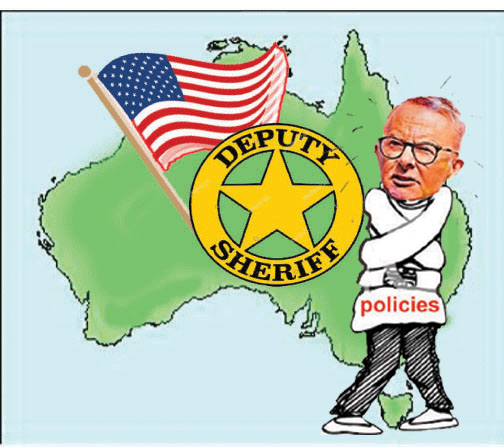
Prime Minister of Australia, and Henchmen, Referred to International Criminal Court for Support of Gaza Genocide
By Birchgrove Legal, March 5, 2024, https://worldbeyondwar.org/prime-minister-of-australia-and-henchmen-referred-to-international-criminal-court-for-support-of-gaza-genocide/
Australian Prime Minister Anthony Albanese has been referred to the International Criminal Court as an accessory to genocide in Gaza, making him the first leader of a Western [Western?] nation to be referred to the ICC under Article 15 of the Rome Statute.
A team of Australian lawyers from Birchgrove Legal, led by King’s Counsel Sheryn Omeri, have spent months documenting the alleged complicity and outlining the individual criminal responsibility of Mr Albanese in respect to the situation in Palestine.
The 92-page document, which has been endorsed by more than one hundred Australian lawyers and barristers, was yesterday submitted to the Office of ICC Prosecutor, Karim Khan KC.
The document sets out a number of actions taken by the PM and other ministers and members of parliament, including Foreign Minister Wong and the Leader of the Opposition, for the Prosecutor to consider and investigate. These include:
- Freezing $6 million in funding to the primary aid agency operating in Gaza – UNRWA – amid a humanitarian crisis based on unsubstantiated claims by Israel after the International Court of Justice had found it plausibly to be committing genocide in Gaza.
- Providing military aid and approving defence exports to Israel, which could be used by the IDF in the course of the prima facie commission of genocide and crimes against humanity.
- Ambiguously deploying an Australian military contingent to the region, where its location and exact role have not been disclosed.
- Permitting Australians, either explicitly or implicitly, to travel to Israel to join the IDF and take part in its attacks on Gaza.
- Providing unequivocal political support for Israel’s actions, as evidenced by the political statements of the PM and other members of Parliament, including the Leader of the Opposition.
Ms Omeri KC said the case was legally significant because it focused exclusively on two modes of accessorial liability.
“The Rome Statute provides four modes of individual criminal responsibility, two of which are accessorial,” Omeri said.
“In relation to accessorial liability, a person may be criminally responsible for a crime set out in the Rome Statute if, for the purpose of facilitating the commission of that crime, that person aids, abets or otherwise assists in the commission of the crime, or its attempted commission, including by providing the means for its commission.
“Secondly, if that person in any other way contributes to the commission of the crime or its attempted commission by a group, knowing that the group intends to commit the crime.”
Ms Omeri KC said the Article 15 communication had been carefully drafted by those instructing her and was now a matter for the Prosecutor to consider.
“The Office of the Prosecutor of the ICC is already pursuing an ongoing investigation into the situation in the State of Palestine, which it has been conducting since March 2021,” Omeri said.
“That includes investigating events which have occurred since 7 October 2023. This Article 15 communication will add to the evidence available to the Prosecutor in relation to that situation.
“The Article 15 communication is of a piece with recent domestic legal cases brought against Western leaders in a number of countries such as in the US, against President Biden, and most recently, in Germany, against, among other senior government ministers, Chancellor Scholz.
“These cases demonstrate a growing desire on the part of civil society and ordinary citizens of Western countries to ensure that their governments do not assist in the perpetration of international crimes, especially in circumstances where the ICJ has found a plausible case of genocide in Gaza.”
Principal solicitor at Birchgrove Legal, Moustafa Kheir, said his team had twice written to Mr Albanese, putting him on notice and seeking a response on behalf of the applicants who make up a large consortium of concerned Australian citizens, including those of Palestinian ethnicity.
Mr Kheir said communications were ignored on both occasions.
“Since October we have attempted communications with our Prime Minister as we reasonably believe that he and members of his cabinet are encouraging and supporting war crimes committed by Israel against Palestinian civilians through their political and military assistance,” Kheir said.
“The Prime Minister has ignored our concerns and given the limited avenues we have for recourse under national law, we have been left with little option but to pursue this Article 15 communication to the International Criminal Court.
“Our communication has been endorsed by King’s Counsel Greg James AM and well over 100 senior counsel and barristers, retired judges, law professors and academics from around Australia who wish to test the strength of international law to hold their own democratic leaders accountable given the barriers we face to do it nationally.
“As lawyers and barristers, it is impossible to sit back and watch sustained breaches of international law while Albanese continues to refer to the perpetrator as “a dear friend.”
A copy of the application can be viewed here: ICC-Referral-Australian-Government-Ministers-and-Opposition-Leader-04032024_BLG.pdf
Or here.
Nuclear slow and expensive, renewables fast and cheap: Bowen slaps down Coalition “fantasy”
Giles Parkinson, Mar 7, 2024, https://reneweconomy.com.au/nuclear-slow-and-expensive-renewables-fast-and-cheap-bowen-slaps-down-coalition-fantasy/—
Federal climate and energy minister Chris Bowen has again slammed the federal Coalition’s “nuclear fantasy”, describing it as a deliberate distraction and the latest “desperate effort” to keep the culture war over energy and climate alive.
“(They say) renewable energy is all too hard, we’ll just have to go nuclear,” Bowen said in comments at the Smart Energy Council conference in Sydney, adding that the technology is “utterly uneconomic.”
Bowen was asked why the government would not support a lifting of the ban against nuclear power and allow – as the Coalition and others suggest – to let the “market decide.” He pointed to the fact that it would take a decade to develop a regulatory regime, and three states also had their own bans in place.
“They say ‘lift the ban’ and the market will sort it,” Bowen said.
“Well, the market hasn’t sorted it out anywhere else in the world, there is not a market in the world where nuclear isn’t subsidised substantially by government. So this idea that we lift the ban and all these foreign investors are going to suddenly come to help Australia’s nuclear sector is just fantasy.”
Bowen said three states would also have to lift their bans, and only then could a regulatory process be put in place which he said would require at least 10 years, before deciding on location, environmental approvals and the question of subsidies.
“It would be a massive distraction,” Bowen said. “And it would send the signal somehow to the market that Australia and the Australian Government are interested in nuclear, when we’re not because it uneconomic, utterly uneconomic.
Coalition leader Peter Dutton and energy spokesman Ted O’Brien had favoured small modular reactors, and dismissed large “Soviet era” reactors, but appear to have now changed their mind and flipped back towards large scale nuclear after the only prospective SMR in the western world was cancelled because of soaring costs.
Bowen says the push to nuclear is simply an extension of the culture war over climate and energy issues.
“We know the sorts of arguments they run. It’s a desperate effort to keep the culture war alive. Renewable energy is all too hard. We’ll just have to go nuclear.”
Federal Labor has adopted a target to reach 82 per cent renewables by 2030, and most energy experts suggest all remaining coal fired power stations would be closed by around 2035.
Nuclear is seen as impossible to deliver in Australia before 2040, notwithstanding its costs, and energy experts question how an essentially “baseload” energy supply can be jammed into what will by then be a grid dominated by wind and solar, and particularly rooftop solar, which will require storage and flexible capacity.
The federal government’s Capacity Investment Scheme is likely to seek 10 GW of new wind and solar capacity in a series of auctions in 2024, and likely a similar amount in 2025, along with at least 3 GW of long durations storage in each of the next three years.
Bowen said a formal announcement is expected soon. He said the result of the first CIS auction, for 600 MW of long duration storage (defined as a minimum four hours) had elicited a very good response and the results would be announced in coming months.
Market has ‘made its decision’ about nuclear energy being too expensive
Labor MP Andrew Charlton says the market has “made its decision” about nuclear energy being too expensive.
Mr Charlton joined Sky News Australia to discuss the latest developments in nuclear energy across the world.
“We saw recently the small nuclear reactor in Idaho was cancelled because of rising costs – that was a market decision to say no to nuclear,” he said.
“Let’s remember, this small nuclear reactor in Idaho is the one that the Liberal Opposition called the future of clean energy – it’s now being cancelled, it’s being scrapped.
“The truth is that the market has made its decision about nuclear energy; it knows that nuclear energy is by far the most costly type of new energy that we could add into the grid, and that’s why it’s not part of the government’s plan.”
Top scientist explains nuclear process and risks: Sunshine Coast previously considered for facility
Sunshine Coast News, STEELE TAYLOR, 6 MARCH 2024
A leading local academic has detailed the risks posed by nuclear power, amid revelations the Sunshine Coast was, in 2007, put on a shortlist of possible sites for a facility.
Emeritus Professor Ian Lowe says there are multiple problems with nuclear energy, including high costs, lengthy builds, health threats and international tension.
Professor Lowe explained the process of nuclear energy production, and the potential for accidents.
“In a nuclear reactor, the process of fission (breaking up of unstable large atoms like uranium) releases heat energy, which is used to boil water,” he said.
“It is basically just a more complicated way of boiling water than burning coal or gas.
“The steam produced by the boiling water is used to turn a turbine and generate electricity.
“In normal operation, nuclear reactors have a good safety record but there have been a series of large-scale accidents like the Windscale fire, the Three Mile Island meltdown, the Chernobyl explosion and the destruction of the Fukushima reactor by a tsunami.
Those accidents have made people nervous about living near a nuclear power station.
“In the cases of Chernobyl and Fukushima, whole regions have been made permanently uninhabitable because the radiation levels are not safe for people to live there.
“As well as the small but non-zero risk of serious accidents, nuclear reactors produce radioactive waste that will need to be safely stored for thousands of years.
“This is a problem that is causing real headaches for all the countries that have nuclear power stations, with only one – Finland – being on the path to a solution.”
Professor Lowe says nuclear energy production has multiple requirements, and locations for power plants have been considered.
“If we were to build a nuclear power station in Australia, the need for massive amounts of cooling water would demand a coastal site,” he said.
“It would also need to be connected to the electricity grid and ideally be near a major power user like a capital city.”
The Australia Institute used a checklist of the needs to produce a shortlist of possible sites for nuclear power plants, for a research paper that was produced in late 2006 and released in early 2007.
The Sunshine Coast, where Professor Lowe has lived for the past 20 years, was among the locations named.
“In a nuclear reactor, the process of fission (breaking up of unstable large atoms like uranium) releases heat energy, which is used to boil water,” he station.
“In the cases of Chernobyl and Fukushima, whole regions have been made permanently uninhabitable because the radiation levels are not safe for people to live there.
“As well as the small but non-zero risk of serious accidents, nuclear reactors produce radioactive waste that will need to be safely stored for thousands of years.
“This is a problem that is causing real headaches for all the countries that have nuclear power stations, with only one – Finland – being on the path to a solution.”
Professor Lowe says nuclear energy production has multiple requirements, and locations for power plants have been considered.
“If we were to build a nuclear power station in Australia, the need for massive amounts of cooling water would demand a coastal site,” he said.
“It would also need to be connected to the electricity grid and ideally be near a major power user like a capital city.”
The Australia Institute used a checklist of the needs to produce a shortlist of possible sites for nuclear power plants, for a research paper that was produced in late 2006 and released in early 2007.
The Sunshine Coast, where Professor Lowe has lived for the past 20 years, was among the locations named.
“It is worth adding that the tsunami of panic among sitting members of parliament when that list was released had to be seen to be believed,” he said.
“But we do now have a local member (Fairfax MP Ted O’Brien), promoting nuclear energy with great enthusiasm.”
There is no indication that the Sunshine Coast is on a current shortlist of possible sites………..
Mr O’Brien has previously said, via ABC Radio National, that he would welcome a nuclear facility in his electorate or any other electorate, “where it is proven to be technologically feasible, has a social licence and is going to get prices down”.
But he also told Sunshine Coast News that a nuclear facility would probably be better placed somewhere other than the Coast………………..
Legalities and history
Professor Lowe says there would be legal hoops to jump through to make nuclear power production possible in the country.
“Nuclear power is not legal in Australia. To get support for its Environmental Protection and Biodiversity Conservation Act in 1999, the Howard government included clauses that specifically prohibit uranium enrichment, fuel fabrication and the building of power reactors,” he said.
“So, any proposal for nuclear power would require repealing that prohibition.
“The current government has no interest in doing that; neither did the Coalition at any point in their nine years in office.
“Since the 2007 report, no Australian government – national or state, Coalition or ALP – has shown any serious interest in nuclear power………… there is certainly enough opposition to make any politician very nervous about the chances of the community supporting it.”…………………………………………….. https://www.sunshinecoastnews.com.au/2024/03/06/academic-outlines-risks-of-nuclear-power-coast-on-shortlist/?fbclid=IwAR2I76u7tz5tjM31QVgAq3P_UBlTk8qySjV7dflzmrLmWai10-bUq65Cq9Q—
New York Times: Nuclear Risks Have Not Gone Away

The overriding question is how to reduce the risk of nuclear war, a topic that will no doubt be addressed as the Times series continues to be rolled out
William Hartung, https://www.forbes.com/sites/williamhartung/2024/03/06/new-york-times-nuclear-risks-have-not-gone-away/?sh=1a2848863efe
For most Americans, nuclear weapons are a relic of the Cold War, out of sight and out of mind. But a surge of attention over the past year may put these world-ending weapons on the public agenda again, in a way that has not been seen since the rise of the disarmament movement of the 1980s.
First came the announcement that the Doomsday Clock of the Bulletin of the Atomic Scientists – which expresses the view of a panel of experts of how close we are to ending life as we know it through a nuclear conflagration or the accelerating impacts of climate change – was maintained at an uncomfortably close 90 seconds to midnight.
Then came the release a few months later of Christopher Nolan’s biopic Oppenheimer, which told the story of the man pundits of his time called “the father of the atomic bomb.” The film followed the arc of Oppenheimer’s life and career, including his support for the dropping of the bombs on HIroshima and Nagasaki because he thought that once their sheer destructive power was understood, the human race would abandon war as a way of resolving disputes. He was tragically wrong, but the success of Oppenheimer and its prominent place in Hollywood’s awards season offers an opportunity to reflect anew on the history and consequences of the bomb, including issues that were largely ignored in the film, like the plight of the people exposed to lethal radiation from bomb tests in the U.S. and the Pacific, the devastating health problems of uranium miners, and, most terribly of all, the bombing of Hiroshima and Nagasaki, with a death toll estimated by independent experts of over 140,000 people.
In the wake of these reminders of the nuclear danger, The New York Times NYT +1.2% has come out with a timely and urgently important series called At the Brink, which looks at current day nuclear risks based on nearly a year of reporting and research. It is a much needed corrective to our false sense of security regarding the continued presence and costly “modernization” of the world’s nuclear arsenals.
The opening essay of the series, written by longtime national security journalist and current New York Times opinion writer W.J. Hennigan, notes up front that “In the fall of 2022, a U.S. intelligence assessment put the odds at 50-50 that Russia would launch a nuclear strike to halt Ukrainian forces if they breached its defense of Crimea.” He later notes that the risk of nuclear escalation in Ukraine is now relatively low, but that the overall state of the world has created the greatest risk of the use of nuclear weapons since the height of the Cold War. Hennigan also gives a graphic presentation of the devastating impact of even a relatively small nuclear weapon – the exact kind of sobering depiction that was omitted from Oppenheimer.
The Times piece reminds us of the vast scope of the Cold War nuclear arms race, as well as the current one among the U.S., Russia, and China – a competition that is all the more dangerous because the last U.S.-Russia nuclear arms control treaty, New START, is hanging by a thread, set to expire in February 2026.
The overriding question is how to reduce the risk of nuclear war, a topic that will no doubt be addressed as the Times series continues to be rolled out. The only way to be truly safe from nuclear weapons is to eliminate them altogether, as called for in the Treaty on the Prohibition of Nuclear Weapons, which entered into force in January 2021 and has been ratified by 70 nations. Conspicuously missing from that list are the world’s nuclear weapons states, which still hold onto the illusion that a nuclear balance of terror can be sustained indefinitely. As wars proliferate from Ukraine to Gaza to Sudan and beyond, the added risk posed by nuclear weapons underscores the need to move beyond outmoded rationales for continuing to build and deploy these devastating weapons. As the issue of nuclear weapons returns to public consciousness after years of denial, there is an opportunity to have a serious debate about whether and how to eliminate them before they eliminate us. We can’t afford to miss that chance.
1 This month
Chernobyl: The Lost Tapes – A good documentary on Chernobyl on SBS available On Demand for the next 3 weeks– https://www.sbs.com.au/ondemand/tv-program/chernobyl-the-lost-tapes/2352741955560
15 April – Zoom –Nuclear Power is Not the Solution
Apr 15, 2026 01:00 AM in Canberra, Melbourne, Sydney

Join the International Physicians for the Prevention of Nuclear War (IPPNW) on Tuesday, April 14th for a timely webinar exploring the risks associated with nuclear power and challenging the myth that it offers a simple, safe, carbon-free solution to the climate crisis

21 April Webinar: No Nuclear Weapons in Australia
Start: 2026-04-21 18:00:00 UTC Canberra, Melbourne, Sydney (GMT+10:00)
End: 2026-04-21 19:30:00 UTC Canberra, Melbourne, Sydney (GMT+10:00)
Event Type: Virtual
A virtual link will be communicated before the event.
Host Contact Info: australia@icanw.org

of the week – Australians for War Powers Reform (AWPR)
To see nuclear-related stories in greater depth and intensity
 Antinuclear