TODAY The tiresome spin of the nuclear lobby in Australia.

It used to be the pro-nuclear pronouncements of Dr Adi Paterson of ANSTO – going on about the wonderful small nuclear reactors (SMRs). He made a sudden departure from ANSTO – who knows why, but possibly because SMRs are turning out to b a flop, and a shocking waste of tax-payers’ money.
But there have always been the spinners. You can’t count the Liberal and National Party politicians. They are probably an embarrassment to the nuclear lobby, as they repeatedly demonstrate their ignorance of the issues.
I don’t know who funds these sham charities, but they pop up all the time.
The latest is, of course “Nuclear for Australia”, now posing as a charity, and running a petition. It was supposedly started by a 16 year old boy – in keeping with the current enthusiasm for nuclear as “young” “new” “clean” and “lively”. But of course it is strongly backed by those youthful organisations – the World Nuclear association, the International Atomic Energy Agency – and a few somewhat less prestigious agencies.
A few of the previous sham charities:



TODAY. Sellafield scandals – a case study in why the nuclear industry must be shut down.

If you had any illusions about the nuclear industry being “clean” and “safe” and “honest”, the latest bit of news in the tawdry saga of UK’s Sellafield nuclear waste dump might cause you to stop and think.
It doesn’t seem that much – “prosecution for alleged cybersecurity offences” and “no suggestion that public safety has been compromised”.
But if you bother to do your homework on this sprawling rubbish dump, the world’s most complex nuclear site, with the world’s largest stockpile of plutonium – you will find a litany of alarming nuclear stories:
- Sellafield: ‘bottomless pit of hell, money and despair’ at Europe’s most toxic nuclear site
- secrecy valued more than public safety.
- Cracks in ponds holding highly radioactive fuel rods. wastes pumped into the seas. Irish Sea contaminated with plutonium.
- US, Norway and Ireland anxious over risk of a devastating accident.
- sudden changes in security leadership.
- Office for Budget Responsibility – site poses a “material source of fiscal risk” to the country.
- a toxic workplace culture.
- site hacked by groups linked to Russia and China. Dishonesty:
- British authorities knew it was wrong to proceed with the thermal oxide reprocessing plant (Thorp) at Sellafield.

And what does the world nuclear authority, the International Atomic Energy Agency (IAEA) have to say about all this? –
“World nuclear chief praises Sellafield progress”
Wake up world!
I’m sorry to have to say this, – but you can’t depend on the world leaders and the nuclear authorities to tell you the truth about this ghastly industry. So many depend on it for their livelihood, for their local economy – etc etc. But the truth must be told.

The political and business leaders are waiting till after their retirement – hoping that the shit won’t hit the fan while they might cop the blame. Like the security bosses at Sellafield, they might have to get out in time. I wonder how long Rafael Grossi can last, can keep up the pretense.
Sellafield is arguably the worst case of nuclear danger and corruption. But then there are the horrors of the Russian nuclear industry, including City 40. Then there’s Japan, with its eternal Fukushima calamity, and its many nuclear reactors close to earthquake zones.

It’s really only thanks to Anna Isaac and Alex Lawson, of the Guardian, that we get to find out about Sellafield.

And to others, like Kate Brown. revealing the reality of the nuclear waste-plutonium disaster endangering the planet
And I wonder, as the USA prepares to lock up Julian Assange forever, how long will the powerful allow these intrepid writers to spill the beans on nuclear scandals?
Liberal Coalition twisting itself into knots over nuclear policy
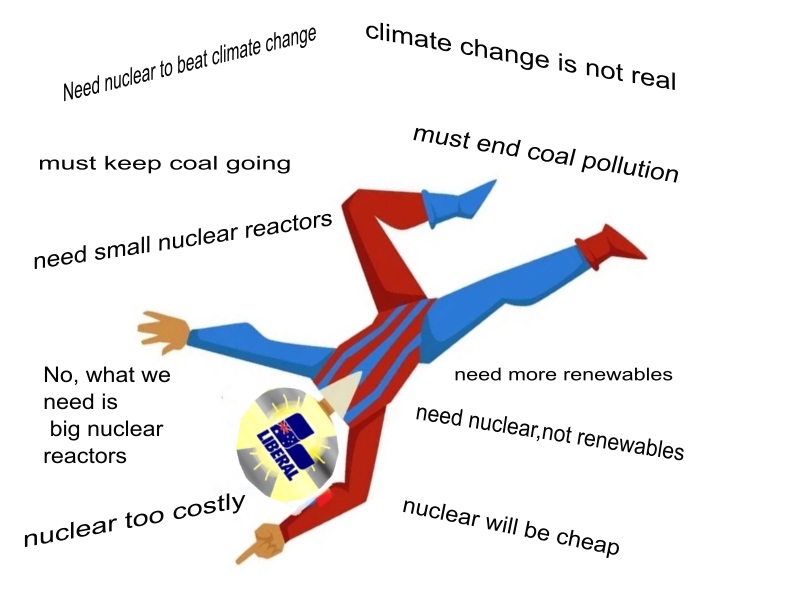
Liberal MP warns Dutton on nuclear energy as Labor steps up attacks
By Paul Sakkal, March 28, 2024 , https://www.smh.com.au/politics/federal/liberal-mp-warns-dutton-on-nuclear-energy-as-labor-steps-up-attacks-20240326-p5ff92.html
Liberal MP Bridget Archer has issued her colleagues a caution on the political risk of the party’s nuclear energy plans, which the backbencher claims have been catapulted into political debate partly to keep climate change doubters on board with the Coalition’s net zero emissions policy.
While there is widespread support within Peter Dutton’s opposition for a conversation on nuclear energy, several Coalition MPs speaking confidentially to detail private concerns said they were worried the opposition was moving too quickly and creating an easy target for Labor attacks.
As the first Liberal to ask questions about the Coalition’s approach, Archer argued fiscally conservative opposition MPs, including herself, would be uneasy with the massive government investment required to build multibillion-dollar plants.
Nuclear energy, which Archer — a leading moderate voice within the party — says she is open to, should be pursued only if coupled with a rapid surge in renewables, she said, a contrast with Dutton and other Coalition MPs, who suggest extending the life of coal until nuclear availability in 10 or 20 years.
Dutton and the shadow cabinet MP leading the nuclear push, Ted O’Brien, are expected to detail their energy plans, including about six plant sites, by the budget in May, but Archer said the initial policy should be limited to lifting Australia’s nuclear moratorium.
“I’m very agnostic about it and I don’t think we should be afraid to just have conversations. But there are a lot of things that need to line up,” she said, noting technological and economic factors that might inhibit private investment even if the decades-old moratorium was overturned.
The opposition has spoken in favour of nuclear energy since losing government in 2022, and escalated its commitment this year as it declared support for large-scale nuclear on top of new-age small modular reactors.
Its backing of the new energy source has guaranteed that climate change and energy will be a key election issue. Voters will be presented with a choice between Labor’s renewables-heavy path to a zero emissions future and one complemented by nuclear energy, amid doubts over Labor’s emissions-reduction targets and expensive energy bills.
Signalling Labor’s future election attacks, Prime Minister Anthony Albanese compared Dutton to the contentious energy source in parliament on Wednesday, saying: “One is risky, expensive, divisive and toxic; the other is a nuclear reactor. The bad news for the Liberal Party is that you can put both on a corflute, and we certainly intend to do so.”
Dutton has been open about the potential need for government investment in nuclear plants, which Labor says have cost tens of billions overseas.
Archer, a member of an influential parliamentary inquiry into nuclear energy last term, said she would be uncomfortable with a “big government” approach to energy investment, which she said might irk Liberals with a fiscally conservative bent.
O’Brien has emphasised nuclear as a zero-emissions option to smooth Australia’s bumpy transition to net zero. However, some of the strongest voices for nuclear energy are MPs such as Barnaby Joyce, who oppose renewables and have questioned scientific orthodoxy on climate change.
Earlier this month O’Brien said, “we should not be closing our coal-fired power stations prematurely” because under Labor’s plans 90 per cent of baseload energy would exit the grid by 2034.
Archer, who Dutton this week congratulated for winning the McKinnon Prize for political leadership, said nuclear energy should not be used as an excuse to prolong fossil fuel reliance.
“There is no point even having a nuclear discussion if you don’t accept a need to decarbonise, to transition away from coal and gas,” she said. “There only is a case for nuclear if there is a fairly rapid transition to large-scale renewables, otherwise why are you doing it?”
“I think part of the reason for having the discussion is to keep people in the tent on net zero.”
Allegra Spender, a teal MP who some Liberals believe should be recruited to the party in future, said nuclear “may have a role in the distant future”.
But it is too slow, too expensive and the UK Hinkley [nuclear power station] experience shows the costs are too uncertain for it to be relevant to our current energy plans,” she said.
“AGL Energy, Alinta, EnergyAustralia and Origin Energy have all dismissed nuclear.
“The community does not trust the Coalition’s commitment to climate action, and their current stance reinforces it.”
Nuclear energy everywhere costs an arm and a leg

By Jean-François Julliard, Mar 30, 2024, https://johnmenadue.com/nuclear-energy-everywhere-costs-an-arm-and-a-leg/
The contribution of nuclear power to electricity generation is the lowest for thirty years and its price twice that of renewables.
It crackles like a Geiger counter in a uranium mine: in 2023, Emmanuel Macron announced plans for six additional EPR [European Pressurised Reactor] nuclear power plants. Hang on, no, perhaps fourteen in the long term.
In reviving nuclear in the name of the struggle against global warming, the European Union has followed suit. Japan is promising new developments on the nuclear front. The US is experimenting with miniature reactors. China is building with gusto … All these ‘ionising’ projects seem to indicate that fission-based nuclear power is in full swing.
In fact, it is to the contrary. A report of experts published in December 2023, the World Nuclear Industry Status Report 2023 [549pp!], using data supplied by the International Atomic Energy Agency and national states, provides the evidence. The part of electricity generation due to nuclear power is the lowest in 30 years (9.2 percent), compared to near double that figure in the 1990s.
Over twenty years, the cost of a nuclear kilowatt hour has increased slightly, whereas the cost of solar and wind has plummeted (‘melted’), these days coming in at roughly half that of nuclear. In 2022, the report highlights, €35 billion has been invested in nuclear globally, compared to … €455 billion in renewables.
France is still trying to recover from an annus horribilis in 2022. In addition to higher costs associated with the war in Ukraine, reactor shutdowns have multiplied. In August 2023, 60 % of France’s 56 reactors were dysfunctional. During 2023, production has augmented, but it has stayed at the level of … 1995.
Showcases of French savoir-faire, the EPR reactors are not ‘making sparks’, accumulating shutdowns, delays (twelve years for Flamanville, on the English Channel, and thirteen years for Olkiluoto, in Finland) as well as cost blowouts (the bill multiplied by 1.7 [for now] at Hinkley Point, in Great Britain, by 3 at Olkiluoto and by 6 at Flamanville!).
During this time, plutonium (for which every gram is of fearsome toxicity), an essential fuel for these ‘toys’, piles up. The accumulated stock for France has reached an unprecedented level of 92 tonnes.
Small problem: how can EDF [Électricité de France], which has acquired a debt of €65 billion, finance the announced projects? This question doesn’t stop Brussels from supporting them – in spite of the industrial disaster on course. No matter that, for several years, within the EU, renewable energy (hydraulic, wind and solar) has generated the most electricity, ahead of nuclear, followed by gas and coal.
South Korea was formerly one of the principal international competitors of EDF for conquering foreign markets. These days South Korea shows itself more reluctant, especially after a calamitous 2022. Kepco, the national electrician, has lost more than €22 billion, adding to a debt of €131 billion – a record. Nuclear contributes 29.6 % to production, currently less than coal. But the promises – within ten years coal’s contribution is supposed to be cut in half and that of renewables tripled. As for nuclear, it will grow by … 5 %.
Japan only starts to pick up with the atom after the closure of several reactors following Fukushima. To the subsequent shortage of electricity add the financial dimension of the catastrophe: in 2021, the government estimated it at more than €200 billion. Thirteen years after the event, the Prime Minister, Fumio Kishida, wants to rekindle nuclear (‘accelerate the particles’) but furnishes no details on new reactors.
Last year, production in Japan was at its lowest level (equivalent to that of the 1970s), and only 6 % of electricity was of nuclear origin. In spite of announcements, distrust persists, especially since the discovery of misrepresentations (modification of results of chemical analyses, falsification of measures of resistance of materials) of Japan Steel Works, manufacturer of components for reactors, selling them worldwide and notably to France.
China is the country the most committed to the atom. On 58 reactors currently under construction globally, 23 (40 %) are in the Middle Kingdom. However, if nuclear trots, renewables gallop, flat out. Nuclear represents 5 % of electricity, whereas wind and solar furnish 15 %, progressing more quickly than coal, which remains far and away the main ‘source of the juice’. Other vexation: Beijing exports little of its savoir-faire. This because the US, among others, which have blacklisted Chinese enterprises, accused of having siphoned American technology for its military ambitions. Slanderous!
The United States remains the champion of nuclear energy but its brainpower has not kept pace (‘their neutrons are not very quick’). In 2022, the contribution of nuclear to electricity generation has fallen to 18.2 % – the lowest rate since 1987 – less than coal and renewables, the latter passed for the first time to pole position. American reactors are on average the oldest in the world (42 years), and only two reactors have been brought into service in the last twenty-five years.
And what a debut! The AP1000 (variation of the EPR) of Vogtle (Georgia) began operation in March 2023, eight years later than planned and, above all, at an estimated cost of €28.5 billion, more than double the initial estimate. Les Echos [French business newspaper] (25/1/22) has kindly described the feat as a local ‘Flamanville’. This financial debacle has much contributed to the failure of Westinghouse, giant of nuclear reactor manufacture. The event has also provoked the shutdown of the construction site (nine years work) of two other AP1000s in South Carolina. Living fossils!
As a consequence, the US is paying more attention to mini reactors, or SMR [small modular reactors]. Save that NuScale, the champion of the type, last November, cancelled a vast construction program of six of these miniatures, for which the budget had almost tripled …
Russia is the veritable world champion of the ‘civil atom’. That said, however, it produces only 20 % of the country’s electricity. Rosatom, the Russian EDF, foreshadows a small increase to 25 %, but in … 2045. It is overseas where business is booming. Russia, a nation at war, is building reactors in countries as peaceful as Iran, Egypt, India or Turkey. Without forgetting China, one of Russia’s best customers.
Russia’s commercial secret? Its discounted prices, its turnkey packages and, above all, its control of the indispensable enriched uranium. Russia furnishes much of the latter to Europe but also to the US, 31 % of its supplies coming from Russia. All this while imposing sanctions on Putin’s country, which toys with the nuclear threat, going so far as to bomb the vicinity of Ukraine’s nuclear reactor at Zaporizhzhia – the largest such in Europe.
Israel Lies About Being A Victim So That It Can Victimize
CAITLIN JOHNSTONE, MAR 30, 2024, https://www.caitlinjohnst.one/p/israel-lies-about-being-a-victim?utm_source=post-email-title&publication_id=82124&post_id=143090068&utm_campaign=email-post-title&isFreemail=true&r=ln98x&triedRedirect=true&utm_medium=email
The Washington Post reports that in recent days the Biden administration has quietly signed off on sending Israel billions of dollars worth of fighter jets and the 2,000-pound bombs that have been causing so much death and destruction in Gaza, even as Israel prepares to launch a bloody assault on the strip’s densely-populated southernmost point.
Literally just completely ignore every single thing US officials say about the need to protect civilians and how Biden’s feelings are privately “frustrated” with Netanyahu. Just ignore their entire narrative about what their goals are in Gaza. Their actions make it clear.
Protesters from Palestine Action have forced Israel-based arms dealer Elbit Systems to permanently close one of its factories in the UK as demonstrators have made it too difficult for the factory to operate. We’ll never vote the empire away, but we might someday be able to direct action it away.
Video footage has surfaced of IDF troops murdering two unarmed Palestinians in cold blood and then burying their bodies with bulldozers to conceal their crime. This is surely not anywhere close to the first time such a thing has happened in Gaza, and is yet another sign that the death toll from this onslaught is probably a massive undercount.
Israel’s assault on Gaza features heavy earth-moving equipment more extensively than any other military operation anyone’s ever seen. One reason is because it’s a great way to destroy Palestinian homes. Another reason is because it’s a great way to hide dead Palestinian bodies.
An IDF commander has told Israeli media that on October 7 he made the decision to fire on vehicles he knew could have Israelis in them because “it’s better to stop the abduction and that they not be taken,” adding more weight to the mountain of evidence that Israeli troops fired on Israelis on October 7 to prevent them from being taken hostage. Israeli bombs and blockades have been picking off the remaining hostages ever since, with Israel now estimating that only 60 to 70 of the 134 hostages are still alive.
Whenever you run into an Israel apologist who is defending against criticisms of Israel’s actions in Gaza by saying “Hamas just needs to release the hostages and this all ends,” maybe go ahead and remind them of this.
ADL chief Jonathan Greenblatt just went on MSNBC’s Morning Joe and compared wearing a Palestinian keffiyeh to wearing a Nazi armband. The mass media keep having this lunatic on as an expert analyst and he keeps saying the most bat shit insane things imaginable. Any screaming schizophrenic off the street would be just as qualified as Greenblatt.
❖
A former ranking IDF officer has told Haaretz that Israel is conducting “a war of cruel rich people” which is causing many times more destruction than necessary to accomplish its stated objectives against Hamas.
“In principle, it would be possible to arrive at similar achievements with 10 percent of the destruction we have caused,” the unnamed source told Haaretz.
Ten percent. Israel is causing ten times more damage than it needs to to achieve its stated objectives because its stated objectives are false — Israel’s real goal is not to defeat Hamas, it’s to grab a bunch of land from a Palestinian territory.
Of all the pants-on-head idiotic things Israel and its apologists ask us to believe, “The UN just hates Israel for no good reason so all its claims should be dismissed” is definitely among the dumbest.
Israel apologists constantly claiming the UN is antisemitic and treats Israel unfairly remind you of a boy who never does any homework and keeps saying his bad grades are because his teacher hates him. The UN talks about Israel a lot because Israel is a murderous criminal regime.
❖
If you still have any doubt that we live in a profoundly sick dystopia as deranged as anything that’s ever been imagined in fiction, take note of the fact that the most powerful empire in history is currently trying to propagandize you into thinking an obvious genocide is fine.
They lied about decapitated babies so that they could kill babies.
They lied about rape so that they could rape.
They lied about Hamas using civilians as human shields so that they could use civilians as human targets.
They lie about being victims so that they can victimize.
UN expert says she faces threats after Israel-Gaza genocide report
Francesca Albanese had stated there were clear indications Israel has violated three acts in the UN Genocide Convention.
A United Nations expert who published a report saying there were reasonable grounds to believe Israel has committed genocide in its war on Gaza says she has received threats throughout her mandate.
Francesca Albanese, the special rapporteur on the human rights situation in the occupied Palestinian territories, presented a report entitled “Anatomy of a Genocide” to the UN Human Rights Council on Tuesday, which Israel said it “utterly rejects
In the report, Albanese said there are clear indications that Israel has violated three of the five acts listed under the UN Genocide Convention in its war on Gaza.
Asked whether her work on the report had caused her to receive threats, Albanese said: “Yes, I do receive threats. Nothing that so far I considered needing extra precautions. Pressure? Yes, and it doesn’t change either my commitment or the results of my work.”
Albanese, who has held the position since 2022, did not elaborate on the nature of the threats, nor did she say who had issued them.
“It’s been a difficult time,” she said. “I’ve always been attacked since the very beginning of my mandate.”
27:55
Israel has criticised Albanese, saying she was “delegitimising the very creation and existence of the State of Israel”. Albanese denied the accusation.
Albanese said one of her key findings was that Israel’s executive and military leadership and soldiers have intentionally “subverted their protection functions in an attempt to legitimise genocidal violence against the Palestinian people”.
“The only reasonable inference that can be drawn from the unveiling of this policy is an Israeli state policy of genocidal violence toward the Palestinian people in Gaza,” she said, adding that it was a “long-standing settler colonial process of erasure”.
She called for the “ongoing Nakba” to stop, referring to the ethnic cleansing of Palestine in 1948.
Israel’s diplomatic mission in Geneva said the use of the word genocide was “outrageous” and said the war was against Hamas and not Palestinian civilians.
Albanese, an Italian lawyer and academic, is one of dozens of independent human rights experts mandated by the United Nations to report on specific themes and crises.
The views expressed by special rapporteurs do not reflect those of the global body as a whole.
Purgatorial Torments: Assange and the UK High Court

Australian Independent Media, March 27, 2024, by: Dr Binoy Kampmark
What is it about British justice that has a certain rankness to it, notably when it comes to dealing with political charges? The record is not good, and the ongoing sadistic carnival that is the prosecution (and persecution) of Julian Assange continues to provide meat for the table.
Those supporting the WikiLeaks publisher, who faces extradition to the United States even as he remains scandalously confined and refused bail in Belmarsh Prison, had hoped for a clear decision from the UK High Court on March 26. Either they would reject leave to appeal the totality of his case, thereby setting the wheels of extradition into motion, or permit a full review, which would provide some relief. Instead, they got a recipe for purgatorial prolongation, a tormenting midway that grants the US government a possibility to make amends in seeking their quarry.
A sinking sense of repetition was evident. In December 2021, the High Court overturned the decision of the District Court Justice Vanessa Baraitser to bar extradition on the weight of certain assurances provided by the US government. Her judgment had been brutal to Assange in all respects but one: that extradition would imperil his life in the US penal system, largely due to his demonstrated suicidal ideation and inadequate facilities to cope with that risk.
With a school child’s gullibility – or a lawyer’s biting cynicism – the High Court judges accepted assurances from the Department of Justice (DOJ) that Assange would not face the crushing conditions of detention in the notorious ADX Florence facility or suffer the gagging restrictions euphemised as Special Administrative Measures. He would also receive the appropriate medical care that would alleviate his suicide risk and face the prospect of serving the balance of any sentence back in Australia. The refusal to look behind the mutability and fickle nature of such undertakings merely passed the judges by. The March 26 judgment is much in keeping with that tradition.
The grounds for Assange’s team numbered nine in total entailing two parts. Some of these should be familiar to even the most generally acquainted reader. The first part, comprising seven grounds, argues that the decision to send the case to the Home Secretary was wrong for: ignoring the bar to extradition under the UK-US Extradition Treaty for political offences, for which Assange is being sought for; that his prosecution is for political opinions; that the extradition is incompatible with article 7 of the European Convention on Human Rights (ECHR) noting that there should be no punishment without law; that the process is incompatible with article 10 of the ECHR protecting freedom of expression; that prejudice at trial would follow by reason of his non-US nationality; that the right to a fair trial, protected by article 6 of the ECHR, was not guaranteed; and that the extradition is incompatible with articles 2 and 3 of the ECHR (right to life, and prohibiting inhuman and degrading treatment).
The second part of the application challenged the UK Home Secretary’s decision to approve the extradition, which should have been barred by the treaty between the UK and US, and on the grounds that there was “inadequate specialty/death penalty protection.”
In this gaggle of imposing, even damning arguments, the High Court was only moved by three arguments, leaving much of Baraitser’s reasons untouched. Assange’s legal team had established an arguable case that sending the case to the Home Secretary was wrong as he might be prejudiced at trial by reason of his nationality. Following from that “but only as a consequence of that”, extradition would be incompatible with free speech protections under article 10 of the ECHR. An arguable case against the Home Secretary’s decision could also be made as it was barred by inadequate specialty/death penalty protection.
What had taken place was a dramatic and savage pruning of a wholesome challenge to a political persecution garishly dressed in legal drag. On the issue of whether Assange was being prosecuted for his political opinions, the Court was happy to accept the woeful finding by Baraitser that he had not. The judge was “entitled to reach that conclusion on the evidence before her, and on the unchallenged sworn evidence of the prosecutor (which refutes the applicant’s case).” While accepting the view that Assange “acted out of political conviction”, the extradition was not being made “on account of his political views.” Again, we see the judiciary avoid the facts staring at it: that the exposure of war crimes, atrocities, torture and various misdeeds of state are supposedly not political at all.
………………………………………………………………………………………….. Of enormous, distorting significance was the refusal by the High Court to accept “fresh evidence” such as the Yahoo News article from September 2021 outlining the views of intelligence officials on the possible kidnapping and even assassination of Assange.
…………….Imaginatively, if inexplicably, the judges accepted her finding that the conduct by the CIA and UC Global regarding the Ecuadorian embassy had no link with the extradition proceedings. With jaw dropping incredulity, the judges reasoned that the murderous, brutal rationale for dealing with Assange contemplated by the US intelligence services “is removed if the applicant is extradited.” In a fit of true Orwellian reasoning, Assange’s safety would be guaranteed the moment he was placed in the custody of his would-be abductors and murderers.
The High Court was also generous enough to do the homework for the US government by reiterating the position taken by their brother judges in the 2021 decision. Concerns about Assange’s mistreatment would be alleviated by granting “assurances (that the applicant is permitted to rely on the First Amendment, that the applicant is not prejudiced at trial (including sentence) by reason of his nationality, that he is afforded the same First Amendment protection as a United States citizen, and that the death penalty not be imposed).” Such a request is absurd for presuming, not only that the prosecutors can be held to their word, but that a US court would feel inclined to accept the application of the First Amendment, let alone abide by requested sentencing requirements.
The US government has been given till April 16 to file assurances addressing the three grounds, with further written submissions in response to be filed by April 30 by Assange’s team, and May 14 by the Home Secretary. Another leave of appeal will be entertained on May 20. If the DOJ does not provide any assurances, then leave to appeal will be granted. The accretions of obscenity in the Assange saga are set to continue. more https://theaimn.com/purgatorial-torments-assange-and-the-uk-high-court/
IFM Investors steers clear of nuclear projects
Jenny Wiggins, Infrastructure reporter, AFR, 28 May 24
IFM Investors, which manages some $217 billion for Australian superannuation funds, is steering clear of investments in nuclear projects due to the difficulties of managing nuclear waste.
While IFM Investors believes “energy security is fundamental,” it hasn’t invested in any nuclear projects to date, global head of infrastructure Kyle Mangini told The Australian Financial Review.…………… (Subscribers only) https://www.afr.com/companies/infrastructure/ifm-investors-steers-clear-of-nuclear-projects-20240325-p5ff1h
‘They don’t have a plan’: Chris Bowen slams Opposition push for nuclear
Climate Change and Energy Minister Chris Bowen has slammed the Opposition over its push for nuclear because they “don’t have a plan”.
“Rolling out renewables and storage over this decade is critical not just for reducing emissions … but because it’s the cheapest form of energy available,” Mr Bowen said during Question Time on Wednesday.
“It is important for jobs and job creation, and also it’s very important for reliability.
“The alternative approach that’s been proposed by those opposite is nuclear.
“Any sort of nuclear plan is irresponsible and incorrect.
“Maybe they got it right because they’ve got a thought bubble, but they certainly don’t have a plan.”
ChatGPT’s boss claims nuclear fusion is the answer to AI’s soaring energy needs. Not so fast, experts say

CNN, 26 Mar 24,
Artificial intelligence is energy-hungry and as companies race to make it bigger, smarter and more complex, its thirst for electricity will increase even further. This sets up a thorny problem for an industry pitching itself as a powerful tool to save the planet: a huge carbon footprint.
Yet according to Sam Altman, head of ChatGPT creator OpenAI, there is a clear solution to this tricky dilemma: nuclear fusion.
Altman himself has invested hundreds of millions in fusion and in recent interviews has suggested the futuristic technology, widely seen as the holy grail of clean energy, will eventually provide the enormous amounts of power demanded by next-gen AI.
“There’s no way to get there without a breakthrough, we need fusion,” alongside scaling up other renewable energy sources, Altman said in a January interview. Then in March, when podcaster and computer scientist Lex Fridman asked how to solve AI’s “energy puzzle,” Altman again pointed to fusion.
Nuclear fusion — the process that powers the sun and other stars — is likely still decades away from being mastered and commercialized on Earth. For some experts, Altman’s emphasis on a future energy breakthrough is illustrative of a wider failure of the AI industry to answer the question of how they are going to satiate AI’s soaring energy needs in the near-term.
It chimes with a general tendency toward “wishful thinking” when it comes to climate action, said Alex de Vries, a data scientist and researcher at Vrije Universiteit Amsterdam. “It would be a lot more sensible to focus on what we have at the moment, and what we can do at the moment, rather than hoping for something that might happen,” he told CNN.
A spokesperson for OpenAI did not respond to specific questions sent by CNN, only referring to Altman’s comments in January and on Fridman’s podcast.
The appeal of nuclear fusion for the AI industry is clear. Fusion involves smashing two or more atoms together to form a denser one, in a process that releases huge amounts of energy.
It doesn’t pump carbon pollution into the atmosphere and leaves no legacy of long-lived nuclear waste, offering a tantalizing vision of a clean, safe, abundant energy source.
But “recreating the conditions in the center of the sun on Earth is a huge challenge” and the technology is not likely to be ready until the latter half of the century, said Aneeqa Khan, a research fellow in nuclear fusion at the University of Manchester in the UK.
“Fusion is already too late to deal with the climate crisis,” Khan told CNN…………………………………
As well as the energy required to make chips and other hardware, AI requires large amounts of computing power to “train” models — feeding them enormous datasets —and then again to use its training to generate a response to a user query.
As the technology develops, companies are rushing to integrate it into apps and online searches, ramping up computing power requirements. An online search using AI could require at least 10 times more energy than a standard search, de Vries calculated in a recent report on AI’s energy footprint.
The dynamic is one of “bigger is better when it comes to AI,” de Vries said, pushing companies toward huge, energy-hungry models. “That is the key problem with AI, because bigger is better is just fundamentally incompatible with sustainability,” he added.
The situation is particularly stark in the US, where energy demand is shooting upward for the first time in around 15 years, said Michael Khoo, climate disinformation program director at Friends of the Earth and co-author of a report on AI and climate. “We as a country are running out of energy,” he told CNN.
In part, demand is being driven by a surge in data centers. Data center electricity consumption is expected to triple by 2030, equivalent to the amount needed to power around 40 million US homes, according to a Boston Consulting Group analysis.
“We’re going to have to make hard decisions” about who gets the energy, said Khoo, whether that’s thousands of homes, or a data center powering next-gen AI. “It can’t simply be the richest people who get the energy first,” he added…………………………………………………………………..
There has been a “tremendous” increase in AI’s efficiency, de Vries said. But, he cautioned, this doesn’t necessarily mean AI’s electricity demand will fall.
In fact, the history of technology and automation suggests it could well be the opposite, de Vries added. He pointed to cryptocurrency. “Efficiency gains have never reduced the energy consumption of cryptocurrency mining,” he said. “When we make certain goods and services more efficient, we see increases in demand.”
In the US, there is some political push to scrutinize the climate consequences of AI more closely. In February, Sen. Ed Markey introduced legislation aimed at requiring AI companies to be more transparent about their environmental impacts, including soaring data center electricity demand.
“The development of the next generation of AI tools cannot come at the expense of the health of our planet,” Markey said in a statement at the time. But few expect the bill would get the bipartisan support needed to become law…………https://edition.cnn.com/2024/03/26/climate/ai-energy-nuclear-fusion-climate-intl/index.html
Israel Remains Intent on Genocide Despite World Court Orders

After the ICJ told Israel not to commit genocide, it killed, wounded and denied aid to tens of thousands of Gazans.
By Marjorie Cohn , TRUTHOUT, 27 Mar 24
srael is continuing its genocidal campaign against the Palestinians in Gaza and hindering humanitarian relief efforts despite specific orders from the International Court of Justice (ICJ), or the World Court, to refrain from these very actions.
On January 26, in South Africa’s genocide case against Israel, the ICJ ordered the following provisional measures be taken:
- Israel shall prevent the commission of all genocidal acts, especially (a) killing Palestinians in Gaza; (b) causing serious bodily or mental harm to Palestinians in Gaza; (c) deliberately inflicting on Palestinians in Gaza conditions of life calculated to bring about their physical destruction in whole or in part; and (d) imposing measures intended to prevent Palestinian births in Gaza;
- Israel shall immediately ensure that its military does not commit any of the acts listed above;
- Israel shall punish the direct and public incitement to commit genocide;
- Israel shall immediately enable urgently needed basic services and humanitarian assistance to Palestinians in Gaza;
- Israel shall prevent the destruction and ensure the preservation of evidence; and
- Israel shall submit a report to the ICJ on all measures taken to carry out this order within one month.
Since the ICJ issued the order, Israel has consistently flouted its mandate.
Israel Continues to Kill, Wound and Deny Humanitarian Aid
Gaza’s Health Ministry reported that between January 26 and February 23, more than 3,400 Palestinians in Gaza had been killed. Israeli forces repeatedly killed and wounded civilians fleeing or taking shelter in areas the Israeli military had declared “safe zones.” As of this writing, more than 32,000 Palestinians have been killed and nearly 75,000 have been wounded in Gaza.
One month after the ICJ’s ruling, Human Rights Watch reported that, “Israel continues to obstruct the provision of basic services and the entry and distribution within Gaza of fuel and lifesaving aid, acts of collective punishment that amount to war crimes and include the use of starvation of civilians as a weapon of war. Fewer trucks have entered Gaza and fewer aid missions have been permitted to reach northern Gaza in the several weeks since the ruling than in the weeks preceding it,” citing a study by the United Nations Office of the Coordination of Humanitarian Affairs.
“The Israeli government is starving Gaza’s 2.3 million Palestinians, putting them in even more peril than before the World Court’s binding order,” said Omar Shakir, who is Israel and Palestine director at Human Rights Watch. “The Israeli government has simply ignored the court’s ruling, and in some ways even intensified its repression, including further blocking lifesaving aid.”
On March 18, the Integrated Food Security Phase Classification, the world’s leading tracker of humanitarian crises, reported that a state of famine is “imminent” in Gaza unless there is an immediate ceasefire and full access granted to protect civilians; provide food, water and medicine; and restore health, water, energy and sanitation services.
Euro-Med Human Rights Monitor found that “The ongoing Israeli massacre in Gaza City’s Al-Shifa Medical Complex and surrounding areas has left at least 100 Palestinians dead, many of whom were victims of extrajudicial executions after their arrest. The international community must intervene immediately to put an end to this atrocity.”
South Africa Asks the ICJ to Order Additional Measures……………………………………………
TODAY. A world run by 11 year-old boys?

They can be delightful people, full of fun, curiosity, competitiveness and inventiveness. They come up with the bright ideas, sometimes daring and a bit risky, but always interesting.
Neuroscience tells us that the part of the brain, the frontal lobe, that deals with judgement and inhibition, develops fully only later in the male , – up to nearly age 30 – compared to, in females, a lot earlier. Also the male brain is, by and large, better at focussing on one thing, as compared with the female, where the electric impulses dart around the brain – considering various aspects.
These differences must have been useful in the past, when sabretooth tigers were a big danger – the larger, less inhibited young male person being more likely to rush out and fight this predator. Less useful now, when the danger is other aggressive male persons.

Which brings me to my thought. I was looking at this picture of Sam Altman – of ChatGPT fame. He’s actually 38, but he’s got that bright-eyed 11 year-old boyish look.
In fact, I reckon that they all do – Elon Musk, Bill Gates – and the rest of the billionaire tech entrepreneurs. Gee – they’re brilliantly clever, and daring, and wow! – they do great stuff, and a lot of it brings us a lot of benefits.
And they’re a lot more fun than boring old fogies, people like Ralph Nader, who warned about automobile safety, and nuclear danger.
AND YET … AND YET ……
Sam Altman is enthused about Artificial Intelligence – needing an orgy of electricity. But no worry – nuclear fusion will solve that! (only nuclear fusion is many decades away).
They all seem to love nuclear energy, and endless AI, and rockets to Mars – and all that wow stuff. Things like nuclear waste apparently are not that important, nor are ideas like energy conservation to address global heating, nor the growth of devastating weaponry – in space as well as on Earth, nor the consequences of all this for the environment, the fragile ecosystem that supports our species, as well as all those other species such as the insects, that don’t matter.
The world’s leaders seem to hang on every word from these guys. I think they are making a big mistake.
I postulate that the tech billionaires had such fun when they were 11, that they never left that persona behind. Inside, they are still 11. The super- confidence, the risk-taking, the narrow brain focus – it’s all still there.
Meanwhile, ordinary mortals, and that includes women with their more generalised thinking, are pondering about the climate, biodiversity, the environment, wars, the heritage for our grandchildren. I think that we need to listen more to ordinary mortals, more likely to be co-operative rather than competitive, and to men like boring old Ralph Nader, who is older than 11 inside.
AUKUS Public Meeting Sat 20 April 2 PM St Bede’s Semaphore
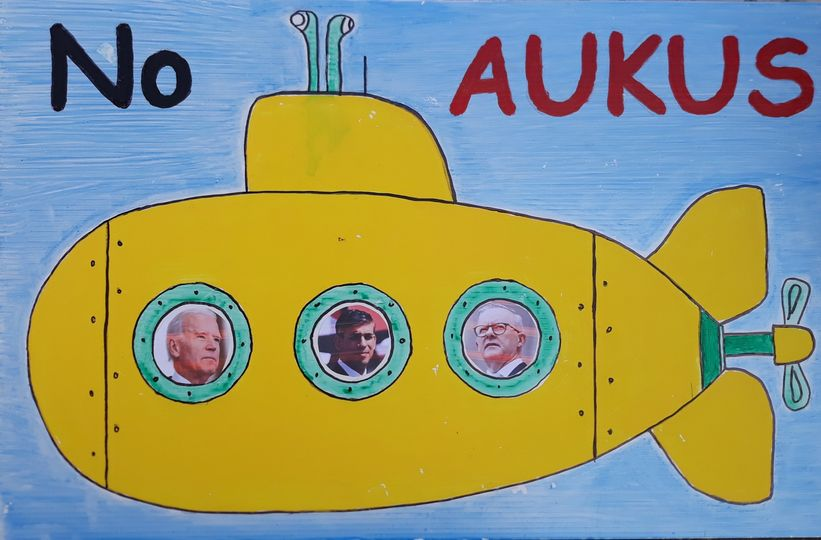
Invite to a Public Meeting:
To consider the implications of the AUKUS pact for the residents of Port Adelaide.
Saturday April 20th, 2 p.m. St Bede’s, 200 Military Rd, Semaphore.
Speakers: Rex Patrick, former Senator and submariner,
Prof. Al Rainnie, political economist,
Sen. David Shoebridge, Federal Greens’ spokesperson on Defence,
Dr Amanda Ruler, Medical Assoc. for the Prevention of War,
David Noonan, conservationist with expertise on nuclear issues,
The speakers will address: • the likelihood of a “jobs bonanza”;
• the national and international political ramifications;
• the need (or lack of ) for nuclear submarines;
• the health impacts of AUKUS and the possibility of nuclear accident or war;
• the implications of the manufacture and operation of nuclear subs, and the problem of waste disposal.
Australia’s move on nuclear submarines raises concern

Editor : Li Yan, https://www.ecns.cn/news/military/2024-03-28/detail-ihcyyfhe2567871.shtml
Despite growing concerns over costs, capabilities, and risks to national interests, Australia has committed to collaborating with the United States and the United Kingdom to advance the AUKUS nuclear-powered submarines, a move experts predicted would escalate domestic opposition and heighten regional tensions.
Australia has pledged $3 billion to support British industry in constructing nuclear-powered submarines, ensuring the timely delivery of its new fleet, as announced by both countries last Friday.
Grant Shapps, British defense secretary, emphasized the ongoing importance of AUKUS while drawing attention to the so-called “China threat” in his remarks.
However, the trilateral agreement has faced domestic criticism and protests from the outset. On March 18, local unions and environmental groups in Australia urged the government to abandon plans for a base while holding a protest outside the parliament house, the latest demonstration in a series, some of which drew as many as 5,000 protesters.
The establishment of the base is a key component of AUKUS, Australia’s largest defense initiative since World War II. In total, the submarine project could cost up to $240 billion over the next 30 years.
“We don’t want to be part of someone else’s belligerent nuclear plans,” said Arthur Rorris, head of the South Coast Labor Council, comprising unions representing 50,000 workers in the area.
They fear the base could choke an infant clean energy sector by taking up scarce land and ushering in security curbs, as well as the permanent presence of U.S. warships. Faced with strong opposition, the government said it hadn’t decided on Port Kembla, a favorable location for the base, as local media had reported.
Chen Hong, director of the Australian Studies Centre at East China Normal University in Shanghai, said the protests against AUKUS signify a growing awareness among Australians of the detrimental consequences of the military pact on national interests and regional stability.
“By taking part in the U.S.-led trilateral military pact, Australia hopes to get nuclear submarine technologies and more security promises from the United States and the United Kingdom. However, this move will drag the country and its people into a potential war as the Australian government keeps supporting U.S. hegemony and surrenders its land for U.S. warships,” Chen said.
AUKUS, established in 2021, aims to bolster Australia’s military capabilities by providing it with nuclear-powered submarines.
Fueling tensions
“Through AUKUS, the U.S. and its Western allies are trying to weaponize Australia and force the country to join its ‘anti-China’ bloc. Plus, the U.S. has kept pushing forward its ‘Indo-Pacific’ strategy, which also involves Australia, fueling tensions in the whole region,” he said.
Daryl Guppy, an international financial technical analyst and former national board member of the Australia China Business Council in Melbourne, said that some Australian politicians have moved closely with the U.S. on the assumption that U.S. and Australian interests are largely the same, which has undermined Australia’s sovereign independence.
Apart from the political turbulence, Chen also said the nuclear submarine pact will raise concerns over nuclear proliferation and cause environmental influences that will damage the health of local communities.
“Australia has long championed nuclear-weapon-free zones and was a founding member of the South Pacific Nuclear Free Zone Treaty. However, Australia’s attempt to acquire nuclear submarines will undermine its nuclear-free promise,” Chen said.
As Chinese Foreign Minister Wang Yi visited Australia recently, experts are expecting that the two countries can collaborate to improve the bilateral relationship.
“China and Australia can work together to find more common grounds and build a more stable, mature and fruitful comprehensive strategic partnership, which will benefit the peoples of the two countries,” Chen said.
Opposition’s nuclear policy must be based on facts
Mike Quirk, Garran (ACT) https://www.smh.com.au/national/nsw/opposition-s-nuclear-policy-must-be-based-on-facts-20240327-p5ffkc.html 27 Mar 24
The Coalition’s stance on nuclear power and vehicles emissions standards has again demonstrated it is captive to the fossil fuel industry (“Labor’s low emission car plan stalls”, March 27). They are spoilers and have no commitment to real action on climate change. Labelling the new vehicle efficiency standard as a “ute tax” that will push up the cost of many models is the latest scare in the tradition of “electric vehicles will end the long weekend” and carbon pricing would result in the “$100 Sunday roast”. Who will it govern for, the fossil fuel industry or all Australians? For the good of the country and its own credibility and electability the Coalition needs to base its policy on evidence not exaggeration and misinformation.
1 This month


Help Aunty Sue Protect Her Land and Sacred Sites From Destructive Rocket Testing.
.

Australians deserve the truth
about
AUKUS – https://aukuspublicinquiry.com/

PETITION – To: Prime Minister Anthony Albanese and the Australian Labor Government

of the week – Australians for War Powers Reform (AWPR)
To see nuclear-related stories in greater depth and intensity

