The Government will dictate where the high level nuclear dump will be.
@MrRexPatrick, ·Mar 13
The Govt has refused to provide #FOI access to its high level radioactive waste site selection process. But it turns out we don’t need to know because, as uncovered by @DavidShoebridge examining #AUKUS legislation today, the Govt will just tell us where the site will be
Nuclear power in Australia — a silver bullet or white elephant?
ABC News, By political reporters Tom Crowley and Tom Lowrey 16 Mar 24
“It’s time to talk nuclear,” Ted O’Brien declared in a video message filmed on an isolated beach last February.
Appointed shadow energy spokesperson a few months earlier, Mr O’Brien’s enthusiasm for nuclear power was already well known, but not yet fully formed as Coalition policy. By many in Canberra, it had been regarded with idle curiosity.
But it was the choice of beach that raised eyebrows on this occasion: Mr O’Brien was in Fukushima.
The small Japanese city was the site of an infamous nuclear accident in 2011, when the Daiichi power plant was damaged by an earthquake and tsunami.
Mr O’Brien had travelled to visit the plant at his own expense as a myth-busting exercise.
“I’ve heard many stories about the Fukushima Daiichi Nuclear Power Plant, including some unfounded horror stories and wildly untrue claims. I therefore decided to travel to Fukushima to find out for myself,” he said.
“I discovered a beautiful place and wonderful people, and I returned home with enormous optimism for their future.”
A year on, nuclear energy for Australia has firmed as Coalition policy, and Mr O’Brien’s “enormous optimism” has earned derision from Energy Minister Chris Bowen.
“Tell him he’s dreaming,” Mr Bowen said last Sunday when asked about the Coalition’s plans. His concern was not safety, where there have been significant improvements since Fukushima, but cost and practicality.
“I don’t know what expert he’s talking to … The average build time of a nuclear power plant in the United States has been 19 years. Ted O’Brien thinks he can do it in Australia from 10 [years] with a standing start,” he said……………………………………………………………………………………….
Nice work if nuke can get it
………………………..setting up in the Australian context would be a different proposition, and would present several hurdles.
First, large-scale nuclear power plants are expensive. The cheap power produced by plants in Europe comes only after decades of operation, enough time for the operators to have recouped their significant upfront capital costs.
It would take a long time – the Coalition hopes for a decade, but Labor says it would be at least twice that – to get them up and running, and an even longer time to bring costs down.
Second, the CSIRO and the AEMO doubt that large-scale nuclear plants are the right fit for Australia’s energy needs.
The east coast electricity market is relatively small by global standards, owing to Australia’s small population.
A single large plant of the sort used in Europe, according to CSIRO and AEMO, would account for such a huge chunk of our power needs that it would be inadvisable, since the whole grid would falter if the plant went offline for maintenance, or due to some fault.
Instead, the agencies say we would need more than one plant working together, like the coal plants currently do. But that would be even more expensive.
Some have called instead for “small modular reactors” (SMRs) – mini nuclear plants, assembled in a factory, which can be set up quickly. Unlike large plants, they can also be switched on and off quickly, which means they could “pinch hit” to provide power alongside renewables or other power sources.
If this sounds appealing, cool your jets – the technology to do this on any notable scale doesn’t exist. Attempts to build them elsewhere, such as in the US, have so far run into fatal cost barriers.
None of that has dimmed the enthusiasm of SMR optimists, including Bill Gates, Rolls Royce and for a time the Coalition.
But the latter’s embrace of nuclear has shifted away from its early focus on SMRs and it now appears set to land on advocating larger-scale nuclear plants on decommissioned coal sites.
A radioactive political issue
This points to a political challenge on top of the practical one.
The Liberal Party has tried, and failed, to start a conversation on nuclear power on more than a few occasions.
John Howard took a nuclear policy to the 2007 federal election, hoping public perception of the industry had shifted. It hadn’t.
Nearly two decades on, the Coalition is hoping it is right this time.
Coalition backbenchers have been agitating on the issue for years, urging the former Morrison government to take up the idea.
Those pleas weren’t heeded, beyond a very low-key parliamentary inquiry, as the party feared a scare campaign on nuclear reactors in the suburbs.
But the change in leadership after the 2022 election saw a surprisingly rapid shift — with new Nationals leader David Littleproud openly calling for nuclear power to be on the table just weeks after polling day.
Peter Dutton also flagged early enthusiasm, although at first only in principle. Then, shortly after the Dunkley by-election loss a fortnight ago, he confirmed this would become official Coalition policy.
An announcement is expected before the budget, which Mr Dutton has hinted will include a list of possible sites for nuclear, likely large-scale nuclear.
Prime Minister Anthony Albanese can scarcely contain his glee at the prospect of a nuclear fight.
“I’ll give you this tip, when they release their policy, you’ll hear a very clear response … [from] the communities where these giant nuclear reactors are going to go,” he said this week.
“[Peter Dutton] is a guy who’s scared of a solar panel but thinks that a nuclear reactor will be well received. I’ll wait and see.”
But Coalition MPs are confident they can sell the idea to voters, insisting the issue plays well with younger voters in particular.
They point to published opinion polls, which suggest more than half of Australians are now either supportive of nuclear or at least open to the idea.
The most prominent such poll was The Australian’s Newspoll, which suggested approval from 65 per cent of 18- to 34-year-olds.
That poll question asked about SMRs and described them as “zero-emissions energy on the sites of existing coal-fired power stations once they are retired”.
Nuclear in my backyard
But if this has created some optimism in the Coalition, the announcement of locations looms as an early political hurdle.
Just a handful of regions have coal-fired power stations that could fit the bill. This includes the Hunter, Gippsland and Central Queensland.
MPs in those areas would have the difficult task of selling a nuclear reactor to their electorate. So far, they seem cautiously enthusiastic, though some want assurances the technology is safe. Gippsland MP Darren Chester warned community concerns would need to be “ameliorated”.
There’s also the question of where to put the waste. Mr Dutton has sought to “put things in perspective” by pointing out the waste generated in the US since the 1950s “would fit in the area the size of a football field, to a depth of about nine metres”.
But if selling locals a nuclear plant is challenging, selling them a nuclear dump would be even more so – although as Mr Dutton points out, the same challenge awaits on waste from nuclear submarines under the AUKUS agreement.
Bonanza or boondoggle?
Even if the Coalition can convince enough voters to back nuclear power and put them in government, that won’t be the last of the political hurdles.
Next comes the question of money.
Labor’s Chris Bowen has suggested “eye-watering” amounts of taxpayer money would be needed to make nuclear viable.
“Every country in the world with nuclear has required massive transfers of taxpayer wealth to the nuclear constructors,” he said.
The Coalition has been coy on whether its policy will include a taxpayer subsidy, but has hinted at details to come in its forthcoming announcement.
And energy experts say that realistically, any private sector contribution would only come if investors had enough confidence the project would make it through to completion. That would require bipartisan support.
Bipartisan support may also be needed to overturn the federal ban on nuclear power. State-level bans in NSW, Victoria and Queensland would need to be overturned too.
Labor’s national platform currently includes an explicit ban on nuclear power, and some key unions are resolutely opposed to the industry.
‘Niche’ at best
All of that points to a difficult road ahead. And it’s one many energy experts say it would lead to a small benefit at best.
Alison Reeve from the Grattan Institute does not see nuclear as part of the mix, but says that if anything SMRs could play a “last resort” role, supplementing renewables during winter troughs.
“That would be the only possible niche I could see for nuclear … but you’re having to build generation that’s only used for a couple of weeks every year,” she said.
“At the moment it looks like the most economic opportunity for that role is gas, with offsets to cover the emissions.”………………………………….. https://www.abc.net.au/news/2024-03-16/nuclear-power-in-australia-silver-bullet-white-elephant/103571824
UN report finds Israel deliberately targeted journalists – Reuters
https://www.rt.com/news/594254-israel-attack-journalists-lebanon/ 14 Mar 24
The news agency has obtained a copy of an investigation into the killing of one of its staff in Lebanon last October
An Israeli tank fired two shells at a group of international journalists clearly marked as such, in violation of international law, a UN investigation has reportedly found. The deadly incident happened in Lebanon in mid-October.
The conclusions, published by Reuters on Wednesday, are part of a seven-page report dated February 27, obtained by the news agency. They coincided with what it had found on its own while looking into the death of its employee Issam Abdallah and the injuries of six other journalists, including those working for Agence France-Presse (AFP) and Al Jazeera.
The report was produced by the United Nations Interim Force in Lebanon (UNIFIL), the peacekeeper mission deployed on the border between Israel and Lebanon in 2006 as part of a deal that ended the Israeli occupation of the southern part of its neighbor. Tracking and investigating presumed violations of the truce is part of its job.
The attack happened on October 13, in the early days of Israel’s siege of Gaza in retaliation for a large-scale incursion by the Palestinian militant group Hamas. Tensions ramped up at the Lebanese border as well, with sporadic attacks launched by the Israel Defense Forces (IDF) and Hezbollah militants.
Abdallah, a Reuters photographer, was part of a group of journalists covering the situation from a hill in Lebanon. An IDF Merkava tank fired two shots at them, the UNIFIL report confirmed. It called the attack a violation of the truce it is mandated to uphold and of international law.
”It is assessed that there was no exchange of fire across the Blue Line at the time of the incident,” the report noted, referring to the de facto border. “The reason for the strikes on the journalists is not known.”
An IDF spokesperson told Reuters that Israeli forces do not target civilians on purpose, including journalists, when asked about the UN investigation. He added that the incident is being examined by the General Staff’s Fact Finding and Assessment Mechanism – a body responsible for reviewing exceptional events.
Reuters released its findings in early December, based on eyewitness accounts, forensic analysis of evidence found at the scene and interviews with officials.
The UNIFIL report was sent to the UN on February 28 and shared with the Israeli and Lebanese governments, Reuters said citing a source. The mission’s investigations are normally not made public.
Nuclear power and Artificial Intelligence – a dystopian vision of the future.

Susan O’Donnell Fredericton, 15 Mar 24
Re “Nuclear power and artificial intelligence: the perfect marriage” (Report on Business, March 12): I read with genuine horror the detailing of artificial intelligence’s voracious appetite for energy.
This is presented as a positive development, and it is suggested that more Canadian uranium could be mined to fuel small nuclear reactors and provide power for gluttonous AIs. This dystopian vision of the future looks devoid of humanity.
Environmentalists and everyone concerned with a sustainable future are thinking about how we will power a livable world, so that more than eight billion people will have a decent standard of living as the fossil fuel era comes to an end. I am sickened to contemplate that AI might gobble up much of the available energy that will be desperately needed for basic humanitarian needs.
Susan O’Donnell Fredericton
TODAY. A morally bankrupt organisation – the International Atomic Energy Agency

I do not know how this guy can sleep at night – his main job is propaganda- telling the world to trust in the “safety of the nuclear industry” – the latest effort is conning the Japanese.
The International Atomic Energy (IAEA) was set up in 1957 for the purpose of promoting the “peaceful” nuclear industry.
Already that was morally dubious, as the real reason was to distract attention from the guilt of the Hiroshima and Nagasaki atrocities, and from the industry’s true purpose – making nuclear weapons.
Over the decades, the IAEA has successfully pitched itself as the watchdog for nuclear safety. And to a certain extent, that is true. The IAEA’s inspection system does monitor nuclear facilities for safety, and compliance with commitments, under the Non-Proliferation Treaty. Obviously, given the nuclear industry’s potential for catastrophic accidents, and for spreading nuclear weapons and the danger of catastrophic wars, – it needed some sort of safety body to be able to continue to exist.
But when the crunch comes – what do we find?
We find the IAEA pushing for “safe” new nuclear power while the Zaporizhzhia Nuclear Power Station, the biggest nuclear power station in Europe , is in the middle of a war.
We find the IAEA pretending that it is environmentally OK to permanently pour nuclear irradiated water into the oceans, from the wrecked Fukushima power plant, – thereby legitimising the ocean dumping of radioactive wastes
And now – the latest, (but I’m sure not the last), straw – the IAEA is pushing for the restart and regrowth of the nuclear industry in Japan.
Should Japan ever have set up a nuclear industry?

“An earthquake-and-tsunami zone crowded with 127 million people is an unwise place for 54 reactors”– Amory Lovins

So why did they do it?
To assuage USA’s guilt over the bombing of Hiroshima and Nagasaki. To turn a bad thing into a “good thing”: “Many Americans are now aware…that the dropping of the atomic bombs on Japan was not necessary. How better to make a contribution to amends than by offering Japan…atomic energy” – Washington Post, 23 September 1954, p. 18, “A Reactor for Japan”
But now – the 2011 and never-ending Fukushima nuclear disaster is still there.. No worries – the nuclear lobby is all for restarting Kashiwazaki-Kariwa, the world’s biggest nuclear power station, with its 7 reactors, just about 200 km away for Tokyo, with its population of 37 million.
But the bit that gets me is: Rafael Gross is not only pledging IAEA technical assistance for the restart of Kashiwazaki-Kariwa., he is “sending a team of experts to assist Tepco’s effort to gain public trust.” The IAEA’s job clearly is to mislead the public on the dangers of nuclear energy
Reversing Europe’s and Australia’s slide into irrelevance & insecurity – National Press Club of Australia speech- Yanis Varoufakis

First, Australia must restore a reputation tainted by blindly following America into lethal adventures in Iraq, Afghanistan and, today, via its active and crucial complicity in Israel’s deliberate war crimes in Gaza, East Jerusalem and the West Bank.
Children are not starving in Gaza today. No, they are being deliberately starved. Without hesitation or remorse. The famine in Gaza is no collateral damage. It is an intentional policy of starving to death thousands until the rest agree to leave their ancestral homeland.
Second, Australia has a duty to de-escalate the New Cold War. To understand that this can only be done if Australia ends its servility to a United States’ actively creating the threats that they then make us pay through the nose to protect us from.
Imagine an Australia that helps bring a just Peace in Ukraine, as opposed to a mindless forever war. A non-aligned Australia that is never neutral in the face of injustice but, also, not automatically aligned with every warmongering adventure decided in Washington.
Imagine an Australia which, having re-established its credentials as a country that thinks and acts for itself, engages with China in the spirit of peaceful cooperation – a far better way of addressing Beijing’s increasing authoritarianism toward its own peoples than buying useless, hyper-expensive submarines that only succeed in forcing China’s political class to close ranks around a more authoritarian core.
Imagine a truly patriotic Australian Prime Minister who tells the American President to cease and desist from the slow murder of Julian Assange for the crime of journalism – for exposing American war crimes perpetrated behind the back of US citizens in their name.
To conclude, if Europe and Australia are to escape gross irrelevance, we need separate but well-coordinated European and Australian Green New Deals.
DiEM25, our paneuropean movement, is working toward this goal.
Yanis Varoufakis – 14/03/2024
Europe and Australia are facing a common existential threat: a creeping irrelevance caused, on the one hand, by our failure properly to invest and, on the other hand, by our ill-considered slide from a strategic dependence on the United States to a non-strategic, self-defeating servility to Washington’s policy agenda.”
Yanis Varoufakis’s address at the National Press Club in Canberra on Wednesday 13 March, 2024
…………………………………. The three post-war phases that shaped Australia’s and Europe’s habitat
Our present moment in Europe and in Australia has been shaped by three distinct postwar phases.
The first was the Bretton Woods system. America exited the war as the only surplus, creditor country. Bretton Woods, a remarkable recycling mechanism, was, in effect, a dollar zone built on fixed exchange rates, sustained by capital controls, and erected on the back of America’s trade surplus. With quasi-free trade as part of the deal, Washington dollarised Europe, Japan and Australia to generate aggregate demand for the products of its factories – whose productivity had skyrocketed during the war. Subsequently, the US trade surplus sucked the exported dollars back into America. The result was twenty years of high growth, low unemployment, blissfully boring banking and dwindling inequality. Alas, once the United States lost its trade surplus, Bretton Woods was dead in the water.
The second phase was marked by the violent reversal of this recycling mechanism. The United States became the first hegemon to enhance its hegemony by boosting its trade deficit. Operating like a powerful vacuum cleaner, the burgeoning US trade deficit hoovered up the world’s net exports. And how did America pay for them? With dollars which it also hoovered up from the rest of the world as German, Japanese and later Chinese capitalists sent to Wall Street 70% of dollar profits made from their net exports to the US. There, in Wall Street, these foreign capitalists recycled their dollar profits into Treasuries, real estate, shares and derivatives.
This audacious inverted recycling system, built on US deficits, required ever increasing American deficits to remain stable. In the process, it gave rise to even higher growth than the Bretton Woods era, but also to macroeconomic and financial imbalances as well as mind-numbing levels of inequality. The new era came complete with an ideology (neoliberalism), a policy of letting finance rip (financialisation), and a false sense of dynamic equilibrium – the infamous Great Moderation built on hugely immoderate imbalances.
Almost inevitably, on the back of the perpetual tsunami of capital rushing in from the rest-of-the-world to Wall Street, financiers fashioned gigantic pyramids of complex wagers – Warren Buffet’s infamous Weapons of Mass Financial Destruction. When these crashed, to deliver the Global Financial Crisis, two things saved Wall Street and Western capitalism:
- The G7 central banks, that printed a total of $35 trillion on behalf of the financiers from 2009 to last year – a peculiar socialism for bankers. And,
- China, which directed half its national income to investment, thus replacing much of the lost aggregate demand not only domestically but also in Germany, Australia and, of course, in the United States.

The third period is more recent. The era of technofeudalism, as I call it, which took root in the mid-2000s but grew strongly after the GFC in conjunction with the rapid technological change that caused capital to mutate into, what I call, cloud capital – the automated means of behavioural modification living inside our phones, apps, tablets and laptops. Consider the six things this cloud capital (which one encounters in Amazon or Alibaba) does all at once:

- It grabs our attention.
- It manufactures our desires.
- It sells to us, directly, outside any actual markets, that which will satiate the desires it made us have.
- It drives and monitors waged labour inside the workplaces.
- It elicits massive free labour from us, its cloud-serfs.
- It provides the potential of blending seamlessly all that with free, digital payments.
Is it any wonder that the owners of this cloud capital – I call them cloudalists – have a hitherto undreamt of power to extract? They are, already, a new ruling class: today, the capitalisation of just seven US cloudalist firms is approximately the same as the capitalisation of all listed corporations in the UK, France, Japan, Canada and China taken together!
Continue reading‘The most beige person’: The man behind the Coalition’s nuclear plans
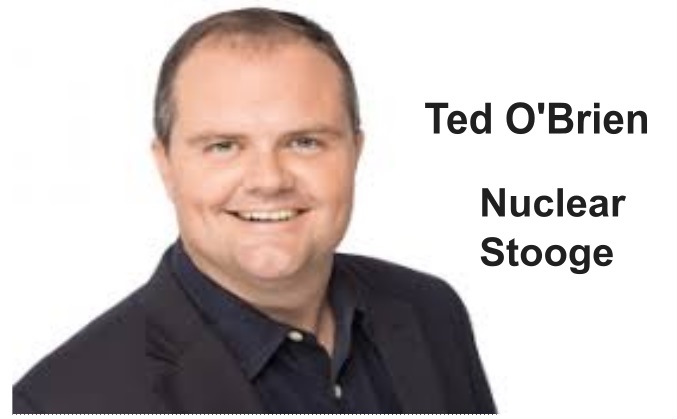
The Coalition’s spokesman for climate change and energy, Ted O’Brien.
Mike Seccombe is The Saturday Paper’s national correspondent. March 16, 2024Just two months after the 2019 election, Barnaby Joyce was making trouble for the new Morrison government. The dumped Nationals leader was part of a group of maverick MPs pushing for nuclear power. He reckoned he knew a way to make such a policy saleable.
The Joyce plan, as articulated in The Sydney Morning Herald on July 21, was this: “If you can see the reactor [from your house], your power is for free. If you are within 50 kilometres of a reactor, you get power for half price.”
People living or working up to 75 kilometres away would get a 25 per cent reduction on their electricity bills, he told the paper. By his reckoning, communities across the country would be lining up to get reactors.
Scott Morrison didn’t want a bar of the idea, or of nuclear power. Inquiring media were assured the position taken by the Coalition to the election still held: there were no plans to build nuclear power plants and there would be none unless and until there was evidence they could stack up economically.
Still, the problem persisted. The split on energy policy was boiling over between moderates and right-wingers in the [Coalition] government’s ranks – the latter mostly from Queensland, mostly climate change sceptics and proponents of more coal-fired power as well as nuclear.
A number of the pro-nuclear members, prominently including Keith Pitt and James McGrath, had long been calling for a parliamentary inquiry into the prospect of taking Australia nuclear.
A few weeks later, Morrison gave them one, although technically the August referral to the Standing Committee on the Environment and Energy was from the then minister for energy and emissions reduction, Angus Taylor.
The chair of the committee was Ted O’Brien, the Liberal member for Fairfax on Queensland’s Sunshine Coast, a relative neophyte elected to the parliament only three years prior, on the slogan “Time for Ted”.
To him fell the difficult task of steering through a report that would pacify the pro-nuclear zealots without undermining the Coalition leadership’s “no nukes” policy.
In some respects, O’Brien is typical of Queensland’s conservative party, a unique amalgam of the Liberals and Nationals.
Like many in the Liberal National Party, he is the scion of a family business with agricultural links, Defiance Mills. He began his working life as a trainee baker, before moving into management.
In other ways, though, he differs from the norm. ——— (subscribers only) https://www.thesaturdaypaper.com.au/news/environment/2024/03/16/the-most-beige-person-the-man-behind-the-coalitions-nuclear-plans#mtr
CSIRO chief warns against ‘disparaging science’ after Peter Dutton criticises nuclear energy costings

Douglas Hilton says he will ‘staunchly defend’ scientists as opposition leader repeats incorrect claim that CSIRO report does not accurately represent cost of renewables
Guardian, Paul Karp and Graham Readfearn,15 Mar 24
Australia’s science agency, CSIRO, has rejected Peter Dutton’s claim its estimates of the cost of renewables are unreliable.
CSIRO chief executive, Douglas Hilton, has warned that maintaining trust “requires our political leaders to resist the temptation to disparage science”, rejecting Dutton’s comments about its GenCost report.
But the opposition leader has doubled down, repeating his incorrect claim on Friday that the report does not properly cost renewables and transmission required to integrate them into the grid.
On Tuesday, Dutton claimed the annual CSIRO report that had included estimates of costs for small modular reactors – which are not yet available commercially – was “discredited” because it “doesn’t take into account some of the transmission costs, the costs around subsidies for the renewables”.
Despite Dutton’s claim, the most recent GenCost report does include the cost of integrating renewables such as solar and wind into the electricity grid. That is, it includes the cost of building new transmission lines and energy storage such as batteries.
On Friday Hilton said that he would “staunchly defend our scientists and our organisation against unfounded criticism”.
“The GenCost report is updated each year and provides the very best estimates for the cost of future new-build electricity generation in Australia,” he said in a statement………………………………
Hilton insisted that “CSIRO’s scientists and engineers can be relied on by the community to work creatively, assiduously and with integrity”.
On Friday Dutton doubled down on the comments, despite the rebuke, telling Channel Nine his point was “we need to compare apples with apples”.
“And at the moment that report … doesn’t take into consideration all of the costs around renewables,” he claimed, repeating his original error…………………………………………
The climate change and energy minister, Chris Bowen, has repeatedly rebuffed Dutton’s nuclear push, citing cost – including an estimate from the energy department that replacing fossil fuels with nuclear could cost $387bn.
Bowen has accused the Coalition of using “the rightwing playbook of 2023 – populism, polarisation and post-truth politics” in making false claims about the potential for nuclear power in Australia. https://www.theguardian.com/australia-news/2024/mar/15/csiro-peter-dutton-gencost-report-nuclear-energy-renewables-cost
Japan Ramps Up Drive to Restart World’s Biggest Nuclear Plant

Stephen Stapczynski and Aya Wagatsuma, Bloomberg News, 15 Mar 24
Japan’s government is ramping up an effort to secure local approval to resume operations at the world’s biggest nuclear power plant, according to a report, amid a wider push by the nation to restart its idled fleet of reactors.
Minister of Economy, Trade and Industry Ken Saito will next week request Niigata Governor Hideyo Hanazumi to endorse the restart of Tokyo Electric Power Co’s Kashiwazaki-Kariwa nuclear power station, according to the Niigata Nippo newspaper. METI didn’t respond to a request for comment.
The governor’s approval is one of the last hurdles before the nuclear plant can resume…………………………….
The head of the International Atomic Energy Agency this week said that the organization would provide technical assistance for the plant, and send a team of experts to assist Tepco’s effort to gain public trust.
Kashiwazaki Kariwa, which has seven reactors totaling 8.2 gigawatts in capacity, is located about 250 kilometers (155 miles) north of Tokyo. The nation’s regulator said in 2017 that reactor units 6 and 7 met post-Fukushima safety protocols.
–With assistance from Winnie Hsu and Shoko Oda. https://www.bnnbloomberg.ca/japan-ramps-up-drive-to-restart-world-s-biggest-nuclear-plant-1.2047179—
The ideology of war in Ukraine and Israel
by Thierry Meyssan, https://www.voltairenet.org/article220527.html 14 Mar 24
The wars in Ukraine and Gaza are more similar than you might think, at least if you know their histories. The Ukrainian war didn’t start with the Russian military operation, but with the massacres in the Donbass, while the Gaza war didn’t start with the Al-Aqsa deluge, but 75 years earlier with the Nakhba. In the long term, those responsible for both wars share the same ideology.
Generally speaking, every war defines who “we” are and who “they” are. “We” are Good, while “they” are Evil.
Western leaders, while declaring that war itself is bad, claim that it is indispensable today in the face of aggression from Russia and Hamas. According to them, Russia, or rather its president Vladimir Putin, dreams of seizing our property and destroying our political system. After invading Ukraine, he will invade Moldavia and the Baltic states, then continue westwards. Hamas, on the other hand, is a hate-filled sect that begins by raping and beheading Jews out of anti-Semitism, and will continue by invading the West in the name of its religion.
It’s worth noting that both Israel and the USA were founded by their armies, the Haganah and the Continental Army. Today, the vast majority of their political leaders have spent their careers in the armed forces or secret services. But they’re not the only ones, since Xi Jinping is a military man and Vladimir Putin is a former member of the Soviet secret service (KGB).
One wonders what feeds the phantasms of the political West and how they prevent us from grasping reality. Russia didn’t invade Ukraine any more than France invaded Rwanda. Moscow and Paris stopped the massacre of Ukrainians in the Donbass and Rwandan Tutsis. Both were driven by their “responsibility to protect” and implemented Security Council resolutions. Palestinians don’t rape and behead anyone for pleasure, even if some of them belong to a secret society that does. They don’t fight the Jews out of anti-Semitism, except for the historic branch of Hamas, but against the apartheid system of which they are victims.
Perhaps the first function of collective blindness is to erase our previous crimes: it was the “democracies” of the United States and members of the European Union who organized the overthrow of Ukraine’s elected president, Viktor Yanukovych, in 2014. It was Germany and France that signed the Minsk Accords to guarantee peace for Ukrainians in Donbass (2015), but never intended to implement them and, according to the confessions of Chancellor Angela Merkel and President François Hollande, used them to arm Ukraine against Russia. This violation of our word and signature constitutes, according to the Nuremberg Tribunal, the gravest of all crimes, that “against peace”.
Similarly, it is the “greatest democracy in the Middle East”, Israel, which has stolen, metre by metre, by occupation and nibbling, most of the Palestinian Territories established by Security Council resolution 181 (1947).
These conflicts are not about resources, but territories. Since 1917, Dmytro Dontsov’s Ukrainian integral nationalists have consistently claimed sovereignty over Nestor Makhno’s anarchist Novorossia and the Bolshevik Donbass and Crimea. Of course, these territories were merged into Soviet Ukraine by Ukrainian Nikita Khrushchev, but Kiev cannot invoke recent history to claim them as its own. Similarly, since 1920, Vladimir Ze’ev Jabotinsky’s revisionist Zionists have claimed sovereignty over the whole of Palestine, and eventually over the Egyptian Sinai, Lebanon, Jordan and Syria – in short, all the territories from the “Nile to the Euphrates”. Of course, the ancient kingdom of Jerusalem consisted of the city and its suburbs, but that doesn’t allow them to evoke history for all these conquests.
It is often said that the age pyramid determines the aggressiveness of states. States with a majority of young people between the ages of 15 and 30 would by nature be inclined to war. But this is neither the case in Ukraine, nor in Israel. What’s more, it’s Palestine, not Israel that the age pyramid could push towards war.
The ideological question is probably the most important. Dmytro Dontsov and his henchman Stepan Bandera glorified the Ukrainian fighters, heirs to the Swedish Vikings, the Varegues, who had to slaughter the “Muscovites” to be able to feast in Valhalla. Today, it’s the “White Führer”, Andriy Biletsky, who has commanded the troops of the Azov Division in Mariupol, the 3rd Assault Brigade in Bakhmut/Artiomovsk and most recently in Avdeyevka/Avdiyevka. Similarly, Benjamin Netanyahu, son of Vladimir Jabotinsky’s private secretary, has not hesitated to compare the Palestinians to the ancient Amalekites. The implication is that they must all be exterminated as Yahweh commands, or else their race will re-emerge against the Hebrews. In the same way, the IDF has systematically destroyed all the universities and schools in the Gaza Strip and massacred 30,000 civilians under the pretext of fighting Hamas.
Dmytro Dontsov formed an alliance with Adolf Hitler as early as 1923, i.e. before he came to power, and became one of the administrators of the Reinhard Heydrich Institute, responsible for carrying out the Final Solution of the Jewish and Gypsy question. Vladimir Jabotinsky, who had formed an alliance with Dontsov in 1922, founded the Betar cadre school in Civitavecchi (Italy) with the help of Duce Benito Mussolini in 1935. He was unable to play a major role in the Second World War, dying in August 1940. There can be no doubt about the adherence of Ukrainian integral nationalists to Nazism and revisionist Zionists to fascism.
Incidentally, we find the territorial logic of fascist and Nazi regimes in the current discourse of Ukrainian President Volodymyr Zelensky and Israeli Prime Minister Benjamin Netanyahu. At the same time, the Russian and Palestinian presidents, Vladimir Putin and Mahmoud Abbas, constantly claim to be defending their peoples.
To find out more about Dmytro Dontsov’s integral nationalism, read:
“Who are the Ukrainian integral nationalists?“, by Thierry Meyssan, Réseau Voltaire, November 15, 2022.
For more on Volodymyr Jabotinsky’s revisionist Zionists read:
“The veil is being torn: the hidden truths of Jabotinsky and Netanyahu“, by Thierry Meyssan, Voltaire Network, January 23, 2024.
and “In Jerusalem, the ’Conference for the Victory of Israel’ threatens London and Washington“, by Thierry Meyssan, Voltaire Network, February 13, 2024.
ABC interview- Sarah Ferguson and Tom O’Brien – a case study in exposing Trumpian-style deceptive spin
Greg Phillips 13 Mar 24
We need a proper transcript of this – Ferguson made a great point (11m25s) that Bill Gates said we should take advantage of our bountiful wind and solar potential. (Plus there are so many things that O’Brien said that I want to add to my “wacky nuclear predictions” file.) – Ferguson: I asked Bill Gates on this program whether Australia should get involved with nuclear energy – this was his answer – “Australia doesn’t need to get engaged on this, Australia should aggressively take advantage of Australia’s natural endowment to do solar and wind, that’s clear cut and beneficial to Australia”
Greg Phillips In the interview, Ted O’Brien employs logical fallacies to support the Coalition’s position on nuclear energy:
O’Brien appeals to the authority of experts and government agencies, such as ANSTO [Australian Nuclear Science and Technology Organisation], to support his argument for nuclear energy.
O’Brien presents a false dichotomy by framing the energy debate as a choice between nuclear energy and renewables, suggesting that nuclear is necessary due to the perceived failure of renewable energy targets.
O’Brien engages in ad hominem attacks by criticising the Labor Party’s energy policies and accusing them of lacking transparency and effectiveness, rather than directly addressing the interviewer’s concerns about nuclear energy.
O’Brien misrepresents the interviewer’s arguments by suggesting that they are arguing against the attractiveness of nuclear energy to investors, rather than questioning its feasibility and cost-effectiveness in the Australian context.
O’Brien selectively then cites examples of successful nuclear energy projects in other countries, such as Canada and the United States, while ignoring instances of cost overruns and delays in countries like the United Kingdom and France.
These logical fallacies detract from the soundness of O’Brien’s arguments and undermine the credibility of the Federal Coalition’s stance on nuclear energy.
AUKUS anniversary brings a sinking feeling.

The Age, By Matthew Knott, March 13, 2024 —
As anniversaries go, this one has turned out to be quite a downer.
A year since Anthony Albanese, Joe Biden and Rishi Sunak stood at a naval base in San Diego to unveil Australia’s plan to acquire a fleet of nuclear-powered submarines, critics of the AUKUS pact are cock-a-hoop and its backers are on the defensive.
It’s a turnaround from December, when AUKUS’s champions were celebrating the fact that the notoriously dysfunctional and divided United States Congress had passed legislation authorising the sale of three Virginia-class submarines to Australia.
“This is a very significant accomplishment for all the parties involved,” declared US Congressman Joe Courtney, co-chair of the Congressional Friends of Australia Caucus.
“A lot of people have been holding their breath to see whether Congress takes this seriously.”
Yet in the lead-up to the one-year milestone, prominent commentators have been promoting a sense of gloom around the submarine plan.
“Dead in the water: the AUKUS delusion,” screams the bright yellow cover of the current edition of the Australian Foreign Affairs journal.
In the lead essay, defence expert and longtime AUKUS sceptic Hugh White argues the submarine plan will “almost certainly fail”, effectively reading AUKUS’s last rites before the pact has even reached teething age.
After laying out multiple ways in which the submarine plan could fall apart, White predicts the crunch is “perhaps most likely to come in Washington, where a number of hurdles could prove fatal to America’s willingness to sell us Virginia-class subs”.
Esteemed Financial Times foreign affairs columnist Gideon Rachman ventilated these anxieties to an international audience in February in a piece titled, “The squawkus about AUKUS is getting louder”.
Then came the Tuesday release of the Biden administration’s 2025 defence budget request, revealing it was only seeking funding for one Virginia-class submarine to built in the coming year. That is down from the two previously expected and well below the production rate of 2.33 subs a year the US says is necessary to sell any submarines to Australia.
As it tries to compete with China for supremacy in the Indo-Pacific, the US Navy is currently 17 attack submarines below its target of 66 – raising obvious questions about whether it will agree to hand over three boats to Australia beginning in 2032.
The legislation passed by Congress last year requires the president of the day to certify that the transfer of the submarines “will not degrade the United States undersea capabilities” and would be contingent on the US “making sufficient submarine production and maintenance investments” to meet its own needs.
The US navy is struggling to cope with supply chain blockages and worker shortages, so much so that the defence sector bought prime-time advertisements during the Oscars telecast to convince welders, forklift drivers, plumbers and marine biologists to help make AUKUS a reality.
Far from elated, AUKUS’s biggest champion in the US Congress is now furious. Describing the budget request as a “hard rudder turn”, Courtney said the decision to produce just one Virginia-class boat in a year “makes little or no sense” and would have a profound impact on both the US and Australian navies.
Former prime minister Malcolm Turnbull, who has long argued Australia would be better off under the deal he struck with France to acquire conventional diesel submarines, leapt onto ABC radio to say he told us so.
“This is really a case of us being mugged by reality,” Turnbull said.
“We are bobbing along as a cork in the maelstrom of American politics…Unless the Americans are able to dramatically change the pace at which they’re producing submarines, and there’s no reason to believe they will be able to do so, we will not ever get the submarines that were promised.”
The Australian and US governments have tried to push back on the doubters, with Defence Minister Richard Marles insisting the three nations “remain steadfast in our commitment to the pathway announced last March”.
The US Navy argues it is pouring $11 billion into the US industrial base over five years, with a plan to produce two Virginia-class submarines by 2028 and the 2.33 required to meet its AUKUS commitments soon after that.
……………………………………………………….. depends on how optimistic you feel about the American political system and the strength of the US-Australia alliance. Meanwhile, we have to contend with the possibility of Donald Trump’s return to the White House and no one knows what he would do about AUKUS…………………………….
From the moment it was announced a year ago, it has been clear the submarine plan was courageous in the Yes, Minister sense of the word: a hugely ambitious and risky endeavour that could come unstuck in several ways. While it is vastly premature to declare AUKUS dead, immense challenges remain.
Ultimately, only the delivery of the promised submarines will silence the doubters – not soothing words from Washington and Canberra. https://www.theage.com.au/politics/federal/aukus-anniversary-brings-a-sinking-feeling-20240313-p5fc0y.html
Pentagon sparks fresh AUKUS doubts on anniversary of Australia’s nuclear-powered submarine plans
ABC, By defence correspondent Andrew Greene, 13 Mar24
- In short: Defence Minister Richard Marles says AUKUS partners are working to help Australia acquire nuclear-powered submarines despite changes to procurement plans in the US.
- The US Navy says it will order just one fast-attack nuclear submarine in 2025, rather than two.
- What’s next? As part of the AUKUS deal, Australia will provide more than $4.5 billion to bolster America’s submarine industrial base
………………………………………Already the US is struggling to ramp up its submarine production rate to an annual target of 2.33 so it can replace retiring boats in its own fleet and begin transfers of second-hand stock to Australia in the early 2030s.
At present, the US is only achieving around 1.2 to 1.3 boats each year due to labour shortages and supply chain delays following the COVID-19 pandemic, with the Navy not expected to consistently hit a two-per-year target until 2029.
Former prime minister Malcolm Turnbull told the ABC Australia’s future defence had become completely dependent on the United States.
…………………………………….. This week marks one year since Prime Minister Anthony Albanese joined British counterpart Rishi Sunak and US president Joe Biden at a San Diego Naval Base to outline the AUKUS “optimal pathway” for Australia to acquire nuclear-powered submarines.
Greens senator David Shoebridge described the latest US defence budget request as a failure for the AUKUS partnership that was “almost too big to wrap your head around” and predicted Australia would end up with “nothing”.
“When the US passed the law to set up AUKUS they put in kill switches, one of which allowed the US to not transfer the submarines if doing so would ‘degrade the US undersea capabilities’. Budgeting for one submarine all but guarantees this,” he warned
………………………….Budget changes under new proposal
As part of the AUKUS deal, Australia will provide more than $4.5 billion to bolster America’s submarine industrial base, while the US aims to contribute a similar amount contingent on congressional negotiations over defence spending that are complicated by the Ukrainian war.
However, this week’s Pentagon budget proposal requests Congress to appropriate a further $US4 billion for the US submarine industrial base in 2025, and $US11.1 billion over five years, for a “historic” investment to expand production.https://www.abc.net.au/news/2024-03-13/us-defence-announcement-raises-questions-on-aukus-anniversary/103578408
Victorian Premier blasts nuclear plan as renewable appeals curbed
Canberra Times, By Callum Godde and Rachael Ward, March 14 2024
Opponents of solar and wind farms will be stripped of the power to appeal approvals to a Victorian tribunal, as the premier blasts the federal opposition’s nuclear pitch as a cartoon-inspired distraction.
The Victorian government will remove the ability for third parties to appeal planning decisions for renewable energy projects through the Victorian Administrative Appeals Tribunal.
From April 1, shovel-ready renewable energy projects will be eligible for an accelerated pathway under an expansion of a development facilitation program.
The change will remove the planning panel process and third-party appeal rights at VCAT amid the rise of the not-in-my-backyard (NIMBY) movement.
Premier Jacinta Allan said more than one in five planning applications had ended up in VCAT since 2015, with the overwhelming majority of the initial decisions being upheld.
“Eventually these projects are getting built but it’s taking far too long,” she told reporters at a wind farm in Mount Wallace on Thursday.
“We want to spend more time on projects being build and less time on it being caught up in red tape.”……………………………
Ms Allan also took the opportunity to hit out at the federal opposition’s pre-election policy to establish nuclear reactors at retiring coal-fired power plants……………………
Ms Allan accused the federal coalition of deliberately “whipping up anxiety” over renewable projects in their backyards and pushing the nuclear debate to “distract” from Australia’s transition to net zero by 2050…………
Victoria has an estimated $90 billion worth of renewable projects in the pipeline and is targeting 95 per cent renewable energy generation by 2035 and net zero emissions by 2045………………… https://www.canberratimes.com.au/story/8555578/premier-blasts-nuclear-plan-as-renewable-appeals-curbed/
Opposition eyeing off six sites for nuclear reactors
New Daily, Poppy Johnston, Mar 12, 2024
Households and businesses close to the six nuclear power reactors the opposition hopes to see built could have their energy bills subsidised.
Teasing the coalition’s yet-to-be-unveiled energy policy at the Australian Financial Review Business Summit in Sydney on Tuesday, opposition leader Peter Dutton said the plan would likely include six nuclear plant sites.
Tasmania has been ruled out as a potential host state.
Dutton said the coalition would seek a social licence by incentivising close-by communities with subsided energy, a model he said was used in the United States.
“It provides incentive for industry to establish jobs,” he told the audience.
The opposition is expected to release its energy policy ahead of the federal budget in May, with the plan likely to include overturning the moratorium on nuclear technology and possible sites for reactors on old coal station locations to take advantage of existing transmission infrastructure…………….
The Albanese government has dismissed nuclear as an unsuitable technology for Australia that has a high price tag and will take too long to roll out.
Energy experts also say it’s difficult to estimate the cost of transitioning to nuclear given the technology is not currently commercially available.
Dutton addressed a number of what he described as “straw man arguments” against nuclear, including cost.
He used other regions with nuclear in the energy mix – South Korea and the Ontario region of Canada – to make his case for the system-wide cost of the energy source and its influence on power bills.
Reactors also produce a “small amount of waste” and Dutton said the government had already signed up to deal with nuclear waste via the AUKUS agreement……………………………. https://www.thenewdaily.com.au/news/politics/australian-politics/2024/03/12/dutton-six-sites-nuclear-reactors
1 This month


Help Aunty Sue Protect Her Land and Sacred Sites From Destructive Rocket Testing.
.

Australians deserve the truth
about
AUKUS – https://aukuspublicinquiry.com/

PETITION – To: Prime Minister Anthony Albanese and the Australian Labor Government

of the week – Australians for War Powers Reform (AWPR)
To see nuclear-related stories in greater depth and intensity

