Australians Being Massacred Shouldn’t Bother Us More Than Palestinians Being Massacred
Caitlin Johnstone, 16 Dec 25, https://www.caitlinjohnst.one/p/australians-being-massacred-shouldnt?utm_source=post-email-title&publication_id=82124&post_id=181738154&utm_campaign=email-post-title&isFreemail=true&r=1ise1&triedRedirect=true&utm_medium=email
On March 16 of this year, Reuters published an article titled “Israeli strikes kill 15 people in Gaza over past day, Palestinian medics say”.
Does anyone remember the 15 Palestinians who died on March 16, 2025?
Does that day stand out in anyone’s memory as particularly significant in terms of mass murder?
No?
Same here.
I honestly can’t remember it at all. This would have been during the tail end of the first fake “ceasefire”, a couple of days before Trump signed off on Israel resuming its large-scale bombing operations in Gaza, so this wasn’t one of those days with huge massacres and staggering death tolls. It doesn’t exactly stand out in the memory.
I have no idea who those people were. I don’t know their names. I never saw their pictures flashing across my news feed. I never saw any western officials denouncing their deaths, or media institutions giving wall-to-wall coverage to the news of their killing. So I don’t remember them.
I saw a tweet from Aaron Maté yesterday:
“15 civilians were killed in the massacre targeting Sydney’s Jewish community. A day in which Israel massacres 15 Palestinian civilians in Gaza would be at the low end of the average in 2+ years of genocide.
“Israel’s atrocities and the impunity they receive are undoubtedly the number one driver of anti-Semitism worldwide. And to show how little Israel and its apologists care about anti-Semitism, many are exploiting the Sydney massacre to justify Israel’s rejection of a Palestinian state; baselessly blame Iran; and demand more censorship of anti-genocide protests.”
Indeed, the worst people on earth are using the Bondi Beach shooting to argue for crackdowns on free speech and freedom of assembly to silence Israel’s critics online and on the streets, in Australia and throughout the western world. And when 15 Palestinians were killed by Israel on March 16, the west barely noticed.
I don’t remember the 15 Palestinians who died during that 24-hour period in mid-March, but I will always remember the Bondi Beach shooting. Someone could mention it to me thirty years from now and I’ll know exactly what they’re talking about. My society made an infinitely bigger deal about the deaths of 15 westerners in Sydney, Australia than the deaths of 15 Palestinians in Gaza, so it will always stick in my memory.
Hell, I can’t blame it all on society; if I’m honest I made a much bigger deal about it myself. I’ve felt sick thinking about the shooting ever since it happened, partly because I know it’s going to be used to roll out authoritarian measures and stomp out free speech in my country, but also partly because I’ve felt so bad for those who died and their loved ones. Even after spending two years denouncing the way western society normalizes the murder of Arabs and places more importance on western lives than Palestinian lives, I’m still basically doing the same thing myself. I’m a damn hypocrite.
I wasn’t born this way. This was learned behavior. If I had my slate cleaned and could see the world through fresh eyes it would never occur to me that I and my society would ever see 15 people being murdered in Australia as more significant than 15 people being murdered in Palestine. I would expect them to be viewed as exactly as terrible.
And they should be. Palestinians don’t love their families any less than Australians do. Australian lives aren’t any more significant or valuable than Palestinian lives. There is no valid reason for the world to have focused any less on the 15 people who were killed in Gaza on March 16 than on the 15 people who were murdered on Bondi Beach. But it did.
Sunday was an awful, dark day. Hundreds of lives have been directly devastated by this tragedy, thousands more indirectly, and in some ways the nation as a whole has been changed. The trauma will reverberate in the victim’s families for generations. The sorrow is palpable and ubiquitous. It’s everywhere; in the streets, at the supermarket. There is catastrophe in the air, and people around the world are feeling it.
And this is appropriate. This is what 15 deaths ought to feel like. This is what it feels like when you see mass murder inflicted upon a population whose murder hasn’t become normalized for you.
That’s all I’ve got to offer right now. Just the humble suggestion that every massacre of Palestinians should shake the earth just as much as the Bondi massacre has. Every death toll out of Gaza should hit us just as hard as the death toll out of Sydney did. Feel how hard this hits, and then translate it to the people of Gaza. This is happening there every single day.
In trying to get people to care about warmongering and imperialism what we’re really trying to do is get people to widen their circle of compassion to the furthest extent possible. To extend their care for the people around them to include caring about violence and abuse against people even on the other side of the world, who might not look and speak and live as they do. Maybe even extending it so far as caring about the non-human organisms who share our planet with us.
As Einstein wrote in a condolence letter toward the end of his life,
“A human being is a part of the whole, called by us ‘Universe,’ a part limited in time and space. He experiences himself, his thoughts and feelings as something separated from the rest — a kind of optical delusion of his consciousness. This delusion is a kind of prison for us, restricting us to our personal desires and to affection for a few persons nearest to us. Our task must be to free ourselves from this prison by widening our circle of compassion to embrace all living creatures and the whole nature in its beauty. Nobody is able to achieve this completely, but the striving for such achievement is in itself a part of the liberation and a foundation for inner security.”
Humanity won’t survive into the distant future unless we grow into a conscious species, and part of that growth will necessarily include widening our circles of compassion to include our fellow beings around the world. If we can’t do that, we’re not going to make it. We’re too destructive. We hurt each other and our environment too much. We destroy everything around us trying to shore up wealth and resources for ourselves, and it simply is not sustainable. It’ll get us all killed eventually.
We’ve got to become better. We’ve got to become more caring. More emotionally intelligent. Less susceptible to the manipulations of propaganda. A society driven by truth and compassion rather than lies and the pursuit of profit.
That’s the only way we’re making it out of this awkward adolescent transition stage with these large, capable brains still wound up in vestigial evolutionary fear-based conditioning. That’s the only way we achieve our true potential and build a healthy world together.
Wait, What?!

Racket cartoons, by Daniel Medina, https://racketcartoons.substack.com/p/wait-what?utm_source=post-email-title&publication_id=549592&post_id=181841928&utm_campaign=email-post-title&isFreemail=true&r=ln98x&triedRedirect=true&utm_medium=email, Dec 17, 2025
After the devastating massacre at Bondi Beach on Sunday, Australia’s PM and leaders promised to tighten gun laws to help make sure it never happens again. As an American reading this, and hearing more than just “thoughts and prayers,” I sat at my desk and felt deeply sad. Our country is so dysfunctional that we cannot handle even the basics of governing, let alone face the leading cause of death for American children: firearms.
What stood out to me was how quickly Australia’s leaders responded and how they seemed to agree that the government should act after something so terrible. In the United States, mass shootings are often followed by sadness but no action. It can feel like we accept these deaths as normal instead of trying to prevent them. Seeing another country treat gun violence as a problem they can fix makes our inaction even harder to understand.
Bondi demands grief, respect, fairness and empathy
15 December 2025 David Tyler, https://theaimn.net/bondi-demands-grief-respect-fairness-and-empathy/
A massacre demands clarity, not opportunism. Honouring the dead means resisting the rush to weaponise grief and insisting on evidence before politics raises its voice.
Australia’s Bondi Beach massacre demands grief, respect, fairness and empathy before anything else. As of the afternoon of 15 December, fifteen people are dead, murdered while gathered to mark Hanukkah. Families are shattered. A community has been targeted.
Politics Ebook
Nothing written in these first days should forget that, or rush past it.
But grief does not require silence, and it does not require surrendering the dead to political theatre. Within hours of the attack, familiar scripts were already being dusted off. Foreign leaders, local ideologues and media provocateurs moved quickly to bend fresh blood into proof of arguments they had long prepared. That reflex is not analysis. It is cheap, cynical, opportunism.
What we know, and what we do not
Police have confirmed that two men, a father and son, carried out the attack and were confronted by NSW Police within minutes. The elder was killed at the scene. The younger remains critically injured and under guard. Authorities are examining motive, movements, digital traces and licensing history. At the time of writing, no public finding has established foreign direction, state sponsorship or organisational command. That work belongs to investigators, not to commentators with deadlines.
What is clear is that the victims were Jewish Australians gathered for a religious celebration, and that antisemitism must be named plainly where it exists. There is no moral ambiguity about that.
Jews were targeted because they were Jews.
That fact alone is grave enough without being conscripted into other causes.
The moment that breaks the script
Police have confirmed that two men, a father and son, carried out the attack and were confronted by NSW Police within minutes. The elder was killed at the scene. The younger remains critically injured and under guard. Authorities are examining motive, movements, digital traces and licensing history. At the time of writing, no public finding has established foreign direction, state sponsorship or organisational command. That work belongs to investigators, not to commentators with deadlines.
What is clear is that the victims were Jewish Australians gathered for a religious celebration, and that antisemitism must be named plainly where it exists. There is no moral ambiguity about that.
Jews were targeted because they were Jews.
That fact alone is grave enough without being conscripted into other causes.
The moment that breaks the script
Against the horror stands a moment that should have arrested the rush to caricature. Ahmed al Ahmed, a Muslim Australian, fruiterer, father of two, ran toward danger. Video shows him confronting a gunman, disarming him, placing the weapon aside, raising a bloodied hand. He was shot and seriously injured. He survived. Others did not die because he intervened.
This matters. Not as sentiment, but as evidence. The attack was antisemitic.
The act that saved lives was Muslim.
Anyone who cannot hold both truths at once is not interested in understanding what happened, only in exploiting it.
The politics that arrived too quickly
Even before victims were formally identified, the blame industry went to work. Overseas figures folded Bondi into broader regional conflicts, pressing it into service as proof of distant enemies and permanent wars. Locally, others rushed to claim that Australia’s foreign policy settings, recognition debates or protest movements had “sent signals” and invited murder.
This does not withstand scrutiny. Over 140 UN member states recognise Palestinian statehood in some form, many for decades, without suffering massacres on their beaches. The attackers did not target Parliament, ministers or symbols of state. They targeted Jewish civilians at prayer.
Turning that into an argument for diplomatic reversal or communal suspicion is not security analysis. It is retrospective storytelling.
Bob Katter’s predictable calls for racial crackdowns and collective punishment follow on cue. They always do. Such politics does not make Australians safer. It corrodes trust, narrows cooperation, and teaches whole communities that silence is safer than engagement.
That is how information dries up, not how it flows. We do not need a smaller, meaner, whiter Australia.
Media and the hunger for immediacy
The media environment bears responsibility too. In the first 24 hours, speculation raced ahead of verification. Some outlets responsibly reported confirmed facts and official statements. Others leapt straight into imagined foreign command chains, proxy wars and ideological pipelines before evidence existed. Guidelines on reporting mass violence exist for a reason.
Premature conjecture does not inform the public. It inflames it.
There is a difference between naming antisemitism and conscripting it into every geopolitical conflict on the map. The first is necessary. The second is reckless.
What honouring the dead requires
Honouring the victims means insisting on facts over fury. It means allowing investigators to do their work without political interference or media frenzy. It means refusing to let grief be converted into justification for ‘forever wars’, domestic panic or the erosion of civic trust.
There will be time to ask hard questions about gun licensing, early warning and prevention. Intelligence. Those debates matter. They will be stronger if they are grounded in what actually happened, not in whatever story we most want to tell.
And it means holding onto the image that should endure from Bondi. Not the slogans, not the hot takes, not the scramble to assign blame, but a man who ran toward gunfire to save strangers whose faith was not his own.
That act does not erase antisemitism.
It rebukes the idea that violence must harden us into camps. In the long struggle against extremism, solidarity like that starves hatred far more effectively than all the pious goodwill rhetoric of a lifetime.
Coda: facts, not appetite
Here are the facts as they stand.
- Fifteen people were killed at a Hanukkah gathering on Bondi Beach. Two men carried out the attack. One was killed by police. One remains under guard. Police are not seeking a third suspect.
- The victims were targeted because they were Jewish. That is the crime. Nothing else needs to be smuggled into it.
- No public finding has established foreign direction, state sponsorship or organisational command. Those questions belong to investigators, not to press conferences.
- One man intervened.
- Ahmed al Ahmed disarmed a gunman, was shot, and survived. His actions saved lives.
- Everything beyond this is commentary.
A serious country knows the difference between evidence and appetite.
A resilient country resists the urge to conscript grief.
A decent country insists on grief, respect and empathy before politics raises its voice.
Politics Ebook
That is not timidity. It is how democracies hold their shape when they are tested hardest.
In moments like these, when fear tempts us toward smaller versions of ourselves, the work is to stay open, stay decent, stay human. We owe all of this to all others in their inconsolable, inconceivably painful, grieving.
Above all, we must expect it of ourselves; surely, this is how we realise our common humanity.
A Wave of Action to Demilitarise Newcastle
| Margie at Wage Peace , 14 Dec 25 |
We are so proud of the Muloobinba/Newcastle Crew who organised 7 actions last week to draw attention to their town supporting the genocide in Palestine. Newcastle is key to the transport of F35 parts. Folx travelled from all across the country to support Demilitarise Newcastle to say no to the community’s transition from coal to weapons.
A Week of Actions: Earth Care Not Warfare
Lockheed Martin in Williamtown is the logistics hub for the supply of ‘just-in-time’ F35 consumable parts for Israel. From here the F35 parts & components are sent direct to Sydney, then via commercial Thai Airways flights to TelAviv. We say NO! The F35=Genocide!
During the Weapons Outta Newy Week a SLOW bike tour was organised through all the weapons sites at the airport via BAE, LOCKHEED, BOEING, KONGSBERG, and a new greenfield development, ASTRO AEROLAB.
On Tuesday we attended the office of the Council, which owns the AEROLAB site.
And on Wednesday we walked from the old coal infrastructure down to Varley Engineering to symbolise the shift from coal to weapons. Varley are increasing the weapons side of their business. Varley could stick with ambulances and move into renewables, but instead are taking Newcastle into the dangerous arena of weapons exports.
During the Weapons Outta Newy Week a SLOW bike tour was organised through all the weapons sites at the airport via BAE, LOCKHEED, BOEING, KONGSBERG, and a new greenfield development, ASTRO AEROLAB.
On Tuesday we attended the office of the Council, which owns the AEROLAB site.
And on Wednesday we walked from the old coal infrastructure down to Varley Engineering to symbolise the shift from coal to weapons. Varley are increasing the weapons side of their business. Varley could stick with ambulances and move into renewables, but instead are taking Newcastle into the dangerous arena of weapons exports. https://linktr.ee/disruptwars
How long will the American Moronocracy last in the New Year?

Noel Wauchope, 15 Dec 25, https://theaimn.net/how-long-will-the-american-moronocracy-last-in-the-new-year/It’s hard to grab hold of the idea – of which of the morons in the USA administration will crack first?
I think that it has to be Pete Hegseth, the Minister for War. Perhaps “crack” is not the appropriate word. “Be thrown under the bus” might be more accurate.
The immediate problem is the rather gripping thought – of the vision of injured fishermen hanging desperately onto the debris, the wreckage, of their bombed boat. And then getting bombed again, and killled. Now, apparently, there exists a video of this wretched event.
CBS reported on December 4th, that U.S. lawmakers met behind closed doors, and viewed a video of a second strike on the boat. Well we, the public, are not allowed to see this video. Democrat Rep. Jim Himes said:
“what I saw in that room was one of the most troubling things I’ve seen in my time in public service.“
“You have two individuals in clear distress without any means of locomotion, with a destroyed vessel, who are killed by the United States.”
Even without seeing the video, our imaginations are struck with the horror of this event. And if it was not so terrible, why the need to cover it up?
And it’s not just that picture which is covered up. There’s also the trail of denials, blames, contradictory statements about that attack, – an incident that clearly breached international law, in the Geneva Conventions , The International Covenant on Civil and Political Rights, and also the Defense Department’s Law of War Manual .
https://www.youtube.com/watch?v=np1dG7qjzZM
The Washington Post reported that Pete Hegseth had given the order to “kill everybody,” but this was later denied by Admiral Bradley, who was in charge of the operation, and also by Hegseth and the White house.
The family of Colombian fisherman Alejandro Carranza Medina, believed killed by the US military in a boat bombing in the Caribbean Sea on Sept. 15, has filed a formal complaint with the Inter-American Commission on Human Rights accusing US Secretary of Defense Pete Hegseth of murder over the unlawful attack. The complaint also notes that President Donald Trump the commander in chief of the US military, “ratified the conduct of Secretary Hegseth described herein”.
That legal initiative mightn’t get anywhere, but the entire chain of command could be held liable for killing the survivors of the boat strike. The United States clearly imposes a duty to refuse unlawful orders.
That thought must be striking a bit of terror in the minds of the military officers involved, – and indeed in any U.S. military officer who might one day be given a similar order.
Anyway, wriggle around as he might, Pete Hegseth is at the top of decision-making on the whole illegal bombing of civilian boats in international orders. Unless you count Donald Trump as the top decision-maker. Trump would like this issue to just fade away. But if it doesn’t – well, then, perhaps a head should roll.
In his first presidency, Trump made a record number of his associates’ heads roll. But here’s the difference – some of them were quite skilful, and capable.
Not these days. Some examples :
Notably RFK Jr, is totally unsuited for Secretary of Health and Human Services. Tulsi Gabbard , with no strong background in Intelligence, is Director of National Intelligence, Attorney General, Pam Bondi has a background in criminal law, but is most notable for unflinching dedication to Donald Trump, no matter what. Director of DOGE, Elon Musk – well, he had to go in the inevitable clash between two grandiose egos. Steve Witkoff’s background as real estate developer, gave him no expertise to qualify him as Special Envoy to the Middle East. Marco Rubio as Secretary of State does have experience in politics, but is notable for having a fanatical war-hawk’s hatred of Cuba and China,
What all Trump appointees do have in common is unswerving devotion to Donald Trump. And that’s not going to be enough to sort out the Trump administration’s messes, with more surely to come.
But now, to come back to Pete Hegseth. Yes, he does have university degrees in politics. But even with university degrees you can still behave moronically. And Pete Hegseth sure does. He has a history of alcoholism, and an accusation against him of sexual assault. Even his mother accused him of being an abuser of women (though she later retracted this).
Hegseth was forced out of two veterans groups, due to his alcoholism, and accusations of financial mismanagement. Colleagues at his former employment at Fox News reported his drinking problem there.
Apparently Hegseth promised to stop drinking if confirmed in the job as Defense Secretary. There are rumours that he hasn’t stopped. But anyway that’s not his only problem. There was his careless use of commercial messaging app Signal to talk about an impending operation in Yemen.
All this has got Republican law-makers worried. And the mid-term elections will be coming up. Trump might just have to start the head-rolling, if this boat-bombing issue doesn’t go away.
And Pete Hegseth is the obvious first candidate.
By the way, the Internet is awash with stuff about Trump being not only a deranged narcissistic megalomaniac (which we all knew anyway), but on top of that, claims that dementia is setting in on him. (How long will the moron-in-chief last, anyway)
Israel Apologists Hasten To Use Bondi Shooting To Attack Anti-Genocide Activists
Caitlin Johnstone, Dec 15, 2025, https://www.caitlinjohnst.one/p/israel-apologists-hasten-to-use-bondi?utm_source=post-email-title&publication_id=82124&post_id=181641440&utm_campaign=email-post-title&isFreemail=true&r=1ise1&triedRedirect=true&utm_medium=email
Two shooters attacked a Jewish Hanukkah celebration at Bondi Beach on Sunday, killing fifteen people and injuring dozens of others. Police report that the shooters were a father and his son; the father was killed by police, and the son was captured.
The shooters appear to have been Muslim, but, much to the inconvenience of those who would like to use this incident to fan the flames of western Islamophobic hysteria, the man who selflessly risked his life to disarm one of them was also a Muslim father of two named Ahmed al-Ahmed.
As usual we’re seeing a lot of speculation about false flags and psyops regarding this incident, but I prefer to hang back from such commentary until I’ve seen some solid evidence.
I do have some thoughts about the public discourse we are seeing about the shooting right now, though.
Point 1: Obviously it is evil to massacre civilians for being Jewish.
Point 2: Obviously Israel’s massacring of civilians must continue to be opposed, and will continue to be opposed.
Today the worst people in the world are trying to pretend Point 1 and Point 2 are contradictory.
It’s so gross watching the tail-wagging excitement of Israel supporters in response to this shooting. They’re so happy they have another rhetorical weapon with which to bludgeon pro-Palestine voices into silence. They can barely contain their glee.
Benjamin Netanyahu immediately scrambled to hold a press conference proclaiming that the attack was the result of Australia taking some steps toward the recognition of a Palestinian state.
New York Times warmonger Bret Stephens penned an article titled “Bondi Beach Is What ‘Globalize the Intifada’ Looks Like,” arguing that the shooters “were taking to heart slogans like ‘resistance is justified,’ and ‘by any means necessary,’ which have become ubiquitous at anti-Israel rallies the world over.”
Iraq-raping war propagandist David Frum wrote a similar article for The Atlantic titled “The Intifada Comes to Bondi Beach,” saying the beach “has been repeatedly targeted by pro-Palestinian demonstrators” and denouncing the fact that “Many in the western world have interpreted post-October 7 anti-Israel actions within the framework of free speech.”
The virulently Islamophobic Australian senator Pauline Hanson swiftly slapped together a statement claiming that “the weekly anti-semitic protests across our nation” and “our obnoxious universities” were “warning signs” that such an attack was coming.
Sky News hastened to give a platform to Israeli Deputy Minister of Foreign Affairs Sharren Haskel in an interview where she declared that “this is what it means” to allow protesters to chant “globalize the intifada”, saying that “if you let that continue and run in your streets” you are inviting further terrorist attacks. Haskel has previously called pro-Palestine protesters in Australia “useful idiots” for Hamas.
Political dynasty princeling Chris Cuomo took to Twitter to assert that people who’ve been accusing Israel of genocide helped “fuel the hatred on bondi beach.”
The Jewish Chronicle’s Stephen Pollard tweeted a video of pro-Palestine protesters in Birmingham with the caption “It you deny the connection between this and what happened at Bondi Beach you are part of the problem.”
A viral tweet from Australian right wing social media personality Kobie Thatcher features a video of a pro-Palestine protest with the caption “This was Sydney, Australia just 6 months ago. These scenes should have been an urgent warning.”
Opposition Leader Sussan Ley has used the attack to demand that Prime Minister Albanese shove through the authoritarian speech suppression plan put forward by Australia’s “antisemitism envoy” Jillian Segal earlier this year, arguing that “We have seen public landmarks turned into symbols of antisemitic hate. We have seen campuses occupied and Jewish students made to feel afraid.”
From the earliest moments after this attack Israel apologists have taken it as a given that it was an act of terrorism in response to Israel’s genocidal atrocities in Gaza, but then framing the people peacefully protesting those atrocities as the problem.
They’re openly acknowledging that the genocide is violently radicalizing people, but instead of coming to the obvious conclusion that Israel should therefore not commit genocide, they’re citing it as evidence that people should stop protesting the genocide.
The Shadow Cabinet: How Encrypted Lobbying and the Erosion of Record-Keeping Are Undermining Australian Democracy

14 December 2025 Andrew Klein AIM , https://theaimn.net/the-shadow-cabinet-how-encrypted-lobbying-and-the-erosion-of-record-keeping-are-undermining-australian-democracy/
This article examines a developing crisis in Australian public integrity: the systematic use of encrypted and unminuted communications between lobbyists and the highest levels of government to evade transparency laws. Drawing on recent investigative reporting and parliamentary analysis, it argues that this practice, occurring alongside legislative efforts to weaken the Freedom of Information (FOI) framework and a failure to implement robust anti-corruption measures, represents a calculated retreat from ethical transparency. This creates a “dark space” in policymaking, fundamentally at odds with the stated mission of the National Anti-Corruption Commission (NACC) and the basic democratic contract of public trust. The article concludes that this constitutes a form of institutionalised obscurity that protects political interests at the expense of democratic accountability.
Introduction: The Promise and the Practice
The election of the Albanese government was heralded with a promise to restore trust and integrity after a decade of scandals. The establishment of the NACC was its cornerstone. However, a parallel track of conduct suggests a different priority: the management of political risk through the control of information. This article synthesises evidence revealing a pattern where commitments to transparency are actively undermined by operational secrecy, creating a profound dissonance between public rhetoric and private practice.
The Architecture of Evasion: “Going Non-Traceable”
At the heart of this issue is a reported, routine practice within the Prime Minister’s office. Lobbyists and stakeholders are advised to use encrypted messaging applications (such as Signal) and direct phone calls for substantive policy discussions, explicitly to avoid creating a discoverable record under the Freedom of Information Act 1982 (Cth). This guidance creates a two-tiered communication system: a formal, sanitised record for public consumption, and a shadow, substantive dialogue where real influence and negotiation occur. The justification – protecting “fluid thoughts” – is a stark departure from the principle that the formation of public policy should be a matter of public interest, not private conjecture.
Weakening the Scaffolding: Legislative and Systemic Failures
This operational evasion is not occurring in a vacuum. It is reinforced by systemic and legislative actions that degrade the infrastructure of transparency:
- The FOI Amendment Bill: The government is pursuing amendments that experts from the Australian Law Council and the Grattan Institute describe as “the most significant retrenchment” of transparency in decades. Key changes include a strict 40-hour processing cap – a logistical impossibility for complex requests – and the introduction of new, subjective grounds for refusal. This legally enshrines the difficulty of access.
- Chronic Record-Keeping Failure: A 2023 National Archives of Australia report found systemic failure across the Commonwealth in managing digital records. In 90% of recent audits, agencies received negative comments. Only one agency had a clear policy on capturing ministerial and departmental messaging for the official record. This is not negligence; it is a pervasive institutional disregard for the archival compact.
- Rejecting Anti-Cronyism Reforms: The government sat for two years on a review into “jobs for mates” in public appointments. When released, it rejected core recommendations to depoliticise the process, such as banning last-minute appointments before elections. This demonstrates a preference for preserving patronage networks over implementing substantive integrity reform.
The NACC in the Dark: An Integrity Watchdog Without a Trail
The establishment of the NACC was meant to be a circuit-breaker. However, its efficacy is premised on the existence of evidence – a paper trail, a digital record, a minute of a meeting. The practices detailed above are designed to eliminate that trail. The NACC’s own definition of “serious or systemic corrupt conduct” includes breaches of public trust and any conduct perverting the impartial exercise of official functions. Influencing policy through hidden channels, deliberately shielded from public and archival scrutiny, aligns precisely with this definition. The NACC’s first major survey, finding 15% of public officials were aware of corrupt conduct in their area, hints at the scale of the challenge it faces in a culture of obscurity.
Analysis: The “Trust Gap” and the Corruption of Process
The outcome is a critical “trust gap.” The public is asked to trust in institutions that are architecturally designed to avoid being held to account. This goes beyond traditional corruption (bribes for favours). It represents a corruption of process, where the very mechanisms for democratic oversight – FOI, archives, parliamentary scrutiny – are rendered inert. The government controls not only policy but the narrative of how that policy was formed, presenting a fait accompli to the public while hiding the machinery of influence. This creates a space where the lines between lobbying, policy development, and undisclosed conflicts of interest dangerously blur.
Conclusion: Gestures Versus Substance in the Democratic Contract
Australia is at an integrity crossroads. It has the gesture – the NACC – but is dismantling the substance required for that gesture to be meaningful. A democracy cannot function on a “need-to-know” basis where the government decides the public does not need to know how it is governed. The use of encrypted lobbying and the erosion of record-keeping are not administrative quirks; they are political strategies that sacrifice long-term public trust for short-term political convenience. Rebuilding trust requires not just new institutions, but a radical recommitment to transparency as the default, not the exception. Until the “dark space” of policymaking is illuminated, the promise of integrity will remain, like the lost records themselves, unfulfilled.
References……………………..
Grief is not a licence for hate
15 December 2025 AIMN Editorial, By Helen Reynolds https://theaimn.net/grief-is-not-a-licence-for-hate/
Australia is grieving.
The mass killing at Bondi has shaken Sydney and stunned the nation. In the immediate aftermath, there should have been space for mourning, solidarity, and quiet reflection. Instead, the noise arrived almost instantly – loud, cruel, and deeply familiar.
Within hours, social media filled with demands that Muslims be deported, that whole communities be treated as suspects, that fear be repackaged as policy. As if a tragedy can be explained by pointing at a faith followed peacefully by more than a billion people worldwide, including hundreds of thousands of Australians who are our neighbours, colleagues, doctors, teachers, and friends.
This reflex is not about safety. It never is.
It is about finding someone convenient to blame before the bodies are even buried.
Australia has walked this road before. We know where it leads. Collective punishment does not prevent violence – it multiplies it. Bigotry does not heal trauma – it extends it. And scapegoating minorities in moments of national shock is not strength; it is moral cowardice.
As if this wasn’t enough, a second chorus joined in from overseas. Americans – many of them – took it upon themselves to lecture Australia about gun laws. According to them, our strict firearms regulations “don’t work”.
This claim is not just wrong. It is offensive.
Australia reformed its gun laws after Port Arthur. The result was not theoretical, ideological, or symbolic. It was measurable and human: mass shootings largely disappeared. Gun deaths fell. Families were spared the kind of routine horror that now barely registers as news in the United States.
To be told, in the wake of fresh Australian bloodshed, that these laws “failed” is grotesque. What the critics really mean is that such laws would never survive the political system they are trapped in – a system paralysed by gun lobbies, identity politics, and a mythology that mistakes firepower for freedom.
Australia chose fewer coffins.Australia reformed its gun laws after Port Arthur. The result was not theoretical, ideological, or symbolic. It was measurable and human: mass shootings largely disappeared. Gun deaths fell. Families were spared the kind of routine horror that now barely registers as news in the United States.
To be told, in the wake of fresh Australian bloodshed, that these laws “failed” is grotesque. What the critics really mean is that such laws would never survive the political system they are trapped in – a system paralysed by gun lobbies, identity politics, and a mythology that mistakes firepower for freedom.
Australia chose fewer coffins.
America chose excuses.
There is a deeper sickness at work here, one that connects the Islamophobia at home with the gun evangelism abroad. It is the refusal to accept evidence when it conflicts with ideology. The refusal to sit with complexity. The demand that every tragedy confirm a pre-existing narrative.
Violence is not a religion.
Grief is not a policy platform.
And shock is not permission to abandon our values.
If there is anything to be defended in moments like this, it is not borders, weapons, or slogans. It is the fragile idea that a decent society responds to horror with humanity – not hate, not smugness, and not lies dressed up as certainty.
Australia can grieve without turning on itself.
We have done it before.
We must do it again.
AUKUS Caucus
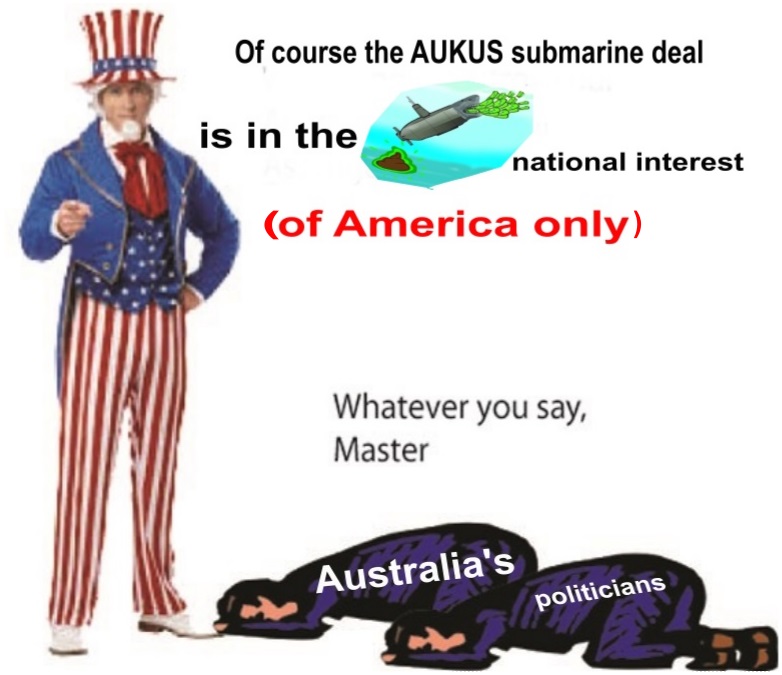
The AUKUS agreement allows any party to withdraw with one year’s notice. But here’s the lethal asymmetry: Australia’s payments are subsidies, not deposits; they are not refundable, and there is no guarantee that the submarines will ever be delivered.
How the AUKUS Caucus built a cargo cult and called it strategy.
14 December 2025 David Tyler Australian Independent Media
There’s a certain kind of Australian politician who never quite grew out of childhood. You know the type: Richard Marles, Tony Abbott, Christopher Pyne. Peter Pan to a man. Their eyes light up whenever a Pentagon staffer remembers their name. They sit bolt upright like kelpie pups on the back of the ute, ears pricked for master’s return. They mistake condescension for intimacy, patronage for partnership, obedience for relevance.
Marles, Pat Conroy (Defence Industry), and Brendan O’Connor (Veterans’ Affairs) along with “Rear Admiral-Albo” and Wayfinder Penny Wong make up the AUKUS Caucus: a dream team. Not bound by evidence, timelines, or arithmetic; only by faith. Faith that if Australia sends enough money, bases and deference across the Pacific, the Great Mate in the Sky will someday descend bearing nuclear submarines and strategic salvation.
Australia’s $368 billion imaginary friend.
The Cargo Cult Playbook
Cargo cults arise when isolated societies witness advanced powers arrive with miraculous technology. Locals build imitation runways; light signal fires hoping the planes will return. The AUKUS Caucus has updated the ritual for the modern age. Our runways are ports. The offerings are our sovereignty. The signal fires are AUSMIN pressers. And the planes, as ever, do not land.
Richard Marles, Labor’s embattled Defence Minister, is the cult’s high priest. Asked about implementation delays, he smiles wanly and intones the sacred words: “Full steam ahead.” Full steam ahead to where is never explained.
AUKUS is sold as strategic realism. In practice, it operates as faith: belief substituted for capacity, ritual for delivery, loyalty for leverage.
The Hegseth Problem
This week Marles and Wong flew to Washington for the annual, ceremonial abasement known as AUSMIN. Their opposite number is Pete Hegseth. Former Fox News shouter, veterans’ charity mismanager, and a chap once carried from a strip club by mates after trying to storm the stage. Now improbably directing US defence as Secretary of War.
Hegseth’s character matters because AUKUS asks us to entrust our strategic future to decision-makers whose judgment, attention span and institutional grip are already demonstrably strained. His own mother calls him as an “abuser of women” who “belittles, lies and cheats,” urging him to “get some help and take an honest look at yourself.”
When a nation stakes $368 billion on the judgment of a man disqualified by his own mother from trust, it has crossed from strategy into pathology.
8 December, Marles and Wong are pictured nodding earnestly as Hegseth endorses a $368 billion submarine fantasy he cannot possibly deliver. He barks approval of AUKUS as “pragmatic hard power.” Wong, cryptic as ever, merely echoes Trump’s mantra: “full steam ahead.” The boats are not coming, so who cares what fuels the boiler?
The Pragmatic Hard Power Con
Pragmatic hard power? It could be a new brand of laundry detergent. The absurdity runs deeper than performance.
Australia is trading real sovereignty for imaginary submarines.
AUKUS legislation effectively transfers operational priority and access over key Australian military bases to the US. The terminology is pure institutional dissemblance: “expanded US rotational presence” and “integrated command arrangements.” In plain English: we concede control over our own strategic assets. We slip a few lazy billion to US and British shipyards to “expedite” production; meaning we subsidise their accumulated backlogs. We bind our “defence posture” so thoroughly into US command that when Washington sneezes, Canberra catches cold.
But we do get to wave flags. Hum anthems. Pay invoices.
Each concession merits national debate. Yet, the AUKUS Caucus has sealed the deal without meaningful parliamentary inquiry, without detailed public costings, only an “oversight” committee denied subpoena power, denied independent costing, and so carefully neutered it might as well be chaired by a shredder.
The Legal Trap
And yes, the legal architecture is exactly what critics feared. Under the agreement, Australia provides $4.7 billion (with more coming) to US and UK submarine builders, and according to questioning in Senate Estimates, there is no clawback provision; Australia does not get its money back if the US fails to transfer nuclear submarines.
The AUKUS agreement allows any party to withdraw with one year’s notice. But here’s the lethal asymmetry: Australia’s payments are subsidies, not deposits; they are not refundable, and there is no guarantee that the submarines will ever be delivered.
The US and UK can walk away at any time. They keep the cash, the upgrades, the expanded industrial bases and the sovereign right to prioritise their own needs. Which, as serious countries, they will do.
Australia, meanwhile, is padlocked like a rental fridge in a share-house. Jiggle the handle all you like, but the thing won’t open unless the bloke with the key decides you’ve paid up.
A Big Perhaps
At some point, the more unsettling explanation has to be entertained. Perhaps the submarines are not delayed. Perhaps they are not even expected. Perhaps AUKUS is not failing at all, but performing exactly as intended. The money flows early and without clawback. The bases open. Command structures integrate. Strategic dependency is formalised. The submarines remain permanently over the horizon, always promised, never required. If this were a ruse designed to secure American basing access and regional posture while outsourcing the political pain to future governments, it would be hard to design it differently. Whether Australia’s political class believes its own story, or merely finds it convenient, becomes almost beside the point. The outcome is the same.
And whatever the truth of the submarines, Defence needs a bit of a rescue.
Defence’s House of Horrors
Marles’ predicament worsens when you look at Defence itself: a moral, administrative and institutional nightmare he inherited and, like his predecessors, Linda Reynolds and Peter Dutton, has failed to master. Could anyone? Australia’s predicament worsens also.
The Brereton inquiry exposed 39 unlawful killings in Afghanistan. The stain remains. Atop this moral wreckage sits administrative farce: a Defence official leaked confidential information before walking straight into a job with a private weapons contractor.
The Hunter class frigates tell the broader story. What began life as a $45 million per ship concept has metastasised into $2.6 billion per ship, with hundreds of millions in variations already locked in, and the program at least 18 months late due to design immaturity.
When Labor took office, 28 major Defence projects were running a combined 97 years behind schedule, with roughly a quarter of procurement unfunded. Over it all looms $368 billion we’ve agreed to throw at AUKUS, as a $60 billion annual defence budget swells toward $100 billion by 2034, absorbing failure without correcting it. (AUKUS costs are a guess, announced without consulting Treasury, Parliament or any other authority.)
What Do We Actually Get?
And what does Australia receive for this tithe?
- Not submarines.
- Not even capability.
- A promise.
Five SSN AUKUS boats to be built in Adelaide at some conveniently indeterminate date. Early 2040s if all goes well. If Britain remembers how to build submarines at scale. If the US has spare industrial capacity. If history pauses politely to accommodate our fantasy.
The BAE Systems Track Record
BAE Systems, cast as AUKUS’s industrial saviour, spent two decades struggling to deliver the UK’s Astute class submarines……………………………………………………..
The Pillar Two Mirage
When reality intrudes, the faithful point to Pillar Two, the sideshow of defence tech collaboration; AI, cyber and hypersonics; meant to suggest strategic depth where there is only debt. Scott Morrison dubbed it “AUKUS in Space,” as if adding a preposition and some stars transformed a lopsided submarine purchase into visionary strategy.
But the real achievement is rhetorical: substituting buzz-words for credible policy. In this sense, AUKUS is Scott Morrison’s most enduring legacy.
The Question Marles Won’t Answer
No-one likes a smart-arse but the pitiful Richard Marles still cannot explain why nuclear submarines are worth this ruinous spend when modern diesel-electric boats exist.
Modern diesel-electric submarines provide maximum range, endurance and stealth, operating underwater before having to resurface to snorkel and recharge batteries. Australia’s own Collins-class diesel submarines demonstrated during 2003 multinational exercises that they were comparable in underwater warfare to US Los Angeles-class nuclear-powered attack submarines, trading roles and achieving , successful attacks despite being smaller and less powerful……………………………………………………………………………………………………………………………………………………………………………………………..
The Runway at Dusk
For $368 billion, AUKUS is not a procurement program. It is a wager on dependency.
Australia is paying staggering sums for submarines that do not yet exist, to be built by industries in chronic difficulty, on timelines that belong to fantasy, while ceding real autonomy over real assets in the present. In return, we receive reassurance. Access. Attention. The comforting sense that someone larger, louder and more heavily armed is standing somewhere behind us………………………………………………………………………………
History will not ask whether the submarines eventually arrived. It will ask why a nation willingly surrendered so much, so early, for so little certainty in return. And it will judge us not by the promises we believed, but by the choices we made when the risks were already plain. https://theaimn.net/aukus-caucus/
The Israel Lobby’s War on Aussie Doctors
Since recording this video, the Victor Change Cardiac Research Institute has finally allowed Professor Macdonald to return to work. Thank you to everyone who helped achieve this important victory for free speech and our healthcare system.
The non-corporate nuclear news – week to 13 December

Some bits of good news –
What Happened When Tennessee Unleashed Its River.
Giving Away Money Is Good for You.
1 Million Turtle Nests Counted on India’s Coast– ‘Crazy High’ Number is 10x More Than Decades Ago
TOP STORIES.
Nuclear power will never be “beneficial”.
Britain’s nuclear submarine fleet ‘no longer fit for purpose’-ALSO AT https://nuclear-news.net/2025/12/09/1-a-britains-nuclear-submarine-fleet-no-longer-fit-for-purpose/
When it all comes crashing down: The aftermath of the AI boom.
Israel’s biggest con trick: Hiding the true numbers it has killed in Gaza. U.S. Military Budget Bill Would Ramp Up Israel Aid to Fill In ‘Gaps’ When Other Countries Impose Embargoes Over Genocide.
The Moral Urgency of Compromise in Ukraine.
Climate. Climateflation: the food system in crisis.
Environment. UN environment report ‘hijacked’ by US and others over fossil fuels, top scientist says.
AUSTRALIA.
- Marles’ new Defence agency – rearranging deck chairs on the HMAS Titanic.
- The people and environment of South Australia must be protected from Federal imposed storage of AUKUS High-Level nuclear waste.
- The Colby Review, AUKUS and Lopsided Commitments.
- Segal Secrets: docs reveal Antisemitism Envoy’s big pay day.
- Will the lights go out if we don’t have baseload? – “No, absolutely not,” say those whose job it is to keep them on.
NUCLEAR-RELATED TOPICS
ECONOMICS.
- Cashing in on war: Why stealing Russia’s assets actually makes things worse for the EU.
- Reeves’ £150 cut in UK’s energy bills will be nuked by Sizewell costs, ex-Labour donor claims.
- Japan pulls out of Vietnam nuclear project, complicating Hanoi’s power plans.
- American-owned consortium assumes control of Canada’s premier nuclear research facility.
- Why this nuclear energy stock could face a meltdown in 2026. South Carolina’s abandoned nuclear plants could be revived as company offers $2.7 billion.
- Oil and gas industries join with nuclear to fight renewable energy.
- Nuclear power?- Its account is (almost) OK.
- Schemes of Bankruptcy: The United Nations, Funding Dues and Human Rights.
| EMPLOYMENT. Fears raised that specialist Vulcan MoD work could shift to Sellafield |
| ENERGY.Nuclear (in)flexibility, nearly 100% electricity from solar PV and offshore wind surge! Claims that we can go back to some of old tech for a better future! Report: Small Modular Distractors: Why a European SMR strategy hinders the energy transition. Britain’s AI boom is running straight into an energy wall. Renewables deliver nearly two thirds of power fed to grid in Germany, not including self-consumption. Building energy resilience in an uncertain world. |
| ENVIRONMENT. As the UK looks to invest in nuclear, here’s what it could mean for Britain’s environment. |
| HEALTH. Nuclear Kills Kids. |
| HISTORY. Manufactured Narratives: A Century of Distortion and Dispossession in Palestine |
| INDIGENOUS ISSUES. The ‘Nuclearity’ of the Marshall Islands, and the Threat of US Testing |
| LEGAL. Sizewell C sea defences at centre of High Court challenge. Activists fight plans for nuclear power station over threat to rare bird- ALSO AT https://nuclear-news.net/2025/12/11/1-b1-activists-fight-plans-for-nuclear-power-station-over-threat-to-rare-bird/ |
| MEDIA. New York Times Wants The US Military Built Up For War With China. |
| OPPOSITION to NUCLEAR . Delays in constructing Hinkley C nuclear power station highlighted by protestors. Campaigners call for absolute protection for Welsh national parks from nuclear plants. Nuclear Free Local Authorities Policy Briefing 330: NFLA Progress Report, October – December 2025. |
| POLITICS. Nuclear Notebook: The changing nuclear landscape in Europe.Ontario’sNuclear Folly. Tony Blair’s digital ID dream, brought to you by Keir Starmer. The UK wants to unlock a ‘golden age of nuclear’ but faces key challenges in reviving historic lead. U.S. Nuclear Fusion Industry Asks for Federal Help. Zelensky’s rush to elections is an effort to cling to power and keep the money flowing. |
| POLITICS INTERNATIONAL and DIPLOMACY. A New UN Secretary-General Needs the Blessings of the US–or Get Vetoed. The Authoritarian Stack –How Tech Billionaires Are Building a Post-Democratic America — And Why Europe Is Next. Russia says it awaits an answer from the US on New START as nuclear treaty ticks down. THE NEXT WARS WERE ALWAYS HERE: How Post 9/11 Law and the Monroe Doctrine Converged in the Caribbean. Trump’s Monroe Doctrine 2.0 Outlines Imperial Intentions for Latin America. Venezuela and the colonial enterprise. Trump gives Zelensky ‘days’ to respond to peace plan – Financial Times. Zelensky resists ceding Donbas, after abandoning it years ago. US House passes $800mn aid package for Ukraine. Trump says Ukraine should hold elections . Trump scores an own goal for FIFA. Perfectly Appropriate: Trump, Infantino and the FIFA Peace Prize .Across the world we are marking 5 years since the Treaty on the Prohibition of Nuclear Weapons became international law. |
| RADIATION. All French nuclear power plants are releasing tritium, according to Criirad. |
| SAFETY. Japan inspects nuclear sites as seismologists warn of another large quake.Iran says bombed nuclear sites present radiation risk. |
| SECRETS and LIES.The Story They Forgot to Tell: Ten Years of Ukraine’s Corruption and the Media’s Convenient Timeline. Zelensky ‘systematically sabotaged’ Ukraine anti-corruption efforts: Report. FBI Labels Antifa a Major Terror Threat, but Lawmakers Say Evidence Is Lacking as Trump’s Obsession Distracts From Far-Right Extremism. |
| TECHNOLOGY. Search for UK fusion plant engineering partner to restart in 1-2 years after failed first attempt. |
| WASTES. Further delay in Finnish repository licence review. |
| WAR and CONFLICT. Mayors for Peace Briefing . Venezuela charges Washington with ‘theft, piracy’ after seizure of oil tanker. War Crimes Prosecutor Reed Brody on Trump’s Boat Strikes – https://www.youtube.com/watch?v=0uswKsQ4q2g US should exit lost Ukraine war, obsolete NATO – ALSO AT https://nuclear-news.net/2025/12/13/1-b1-us-should-exit-lost-ukraine-war-obsolete-nato/ THE EUROPEANS: BLIND TO REALITY, DEAF TO ALL WARNINGS & HEADED FOR DISASTER |
| WEAPONS and WEAPONS SALES. Britain’s “borrowed bombs”. Rosyth earmarked as temporary repair base for new fleet of UK submarines. Submarines in for repairs at Rosyth could contain nuclear weapons. China’s New Underwater Drones Could Blindside the U.S. Navy.Danger of letting AI into the nuclear weapons chain of command. The War Department Unleashes AI on New GenAI.mil Platform. Israel firm Elbit to help build Trump’s Golden Dome. ‘Genocide is not an Oakland value:’ inside Oakland’s grassroots campaign to end military shipments to Israel. Making Sense of The Après-Ukraine. |
Will the lights go out if we don’t have baseload? “No, absolutely not,” say those whose job it is to keep them on

Giles Parkinson, ReNewEconomy, Dec 12, 2025
Australia’s green energy transition is continuing apace – not as quickly as many would hope, and possibly not as fast as we could. But it is certainly happening more quickly than nearly everyone imagined a decade ago, and at a speed some still find hard to digest.
The release of the Australian Energy Market Operator’s latest multi-decade blueprint, the draft 2026 Integrated System Plan, underlines what nearly everyone now accepts to be true – that the lowest cost option to replace Australia’s ageing fleet of coal generators is with wind, solar, battery storage, a bit more gas capacity and some transmission.
It’s been the case since the first ISP was produced in 2018, at the instigation of the then Coalition government, and the main thrust of the ISP has varied little since then (three were produced under the Coalition and this is the second under Labor).
Nicola Falcon, now the executive general manager of system design at AEMO, has been working on the ISP since the first was finalised in 2018, and points to its remarkable consistency, despite – or even perhaps because of – the technology changes that have occurred in that time.
“Even with those changes that are going on around us, it continues to be that that least cost mix is renewable generation, connected with networks firmed by storage and backed by gas,” Falcon tells Renew Economy in the latest episode of its weekly Energy Insiders podcast.
See: Energy Insiders Podcast: A blueprint to quit coal, and go green
Yet the biggest hurdle to the ISP’s success remains political – whether it be the political rhetoric and misinformation from the Coalition at the federal level that proves a lightning road for local opposition, or the destructive acts of new conservative state governments such as the LNP in Queensland.
The basis of this is almost entirely dependent on a red herring – that the future of Australia’s economy and the reliability of its electricity supplies can only be guaranteed by what they call “baseload”, by which they mean existing coal and future nuclear.
That’s not what the energy industry says, unless they have a particular vested interest in perpetuating that myth. The future is now focused on bulk renewables – wind and solar – supported by storage, mostly batteries but also some pumped hydro and other technologies – and some peaking gas as the last fall-back.
The big energy players, and the market operator itself, have been consistent with this line, but on Energy Insiders we wanted to hear it again, and asked Falcon if the absence of “baseload” means the lights will go out.
“No, absolutely not,” Falcon replied.
………………………………………………………………………………….. the plunging cost of battery storage has had profound implications – both for its ability to store excess power and send it into the grid in the evening peaks, create demand in the middle of the day, and provide lower cost “virtual transmission” instead of new power lines.
The latest ISP models more battery storage, more solar and battery hybrids, more household PV (backed by more batteries), and less wind, less gas, and fewer new transmission lines.
But the fundamental story remains the same.
“There’s still going to be in a five fold increase in solar and wind that we need from now, where we’ve got about 23 gigawatts on the system to 120 gigawatts by 2050,” Falcon says……………………………………………………………………………………………………….
Then, of course, are the customers themselves, with households expected to host some 87 gigawatts of capacity.
“By 2050 the consumer energy resources that we call them, which is your rooftop PV, your batteries and your electric vehicles, combined, will be providing half of the capacity supplied for the entire NEM, so, you know, a huge role,” Falcon says.
“They’re really at the heart of the transition. And to be fair, they’re setting the pace at the moment. As Australians, we’ve got 4 million households with rooftop PV on them.
We’ve seen with their household home batteries, huge uptake in the amount of CzeR storage and so forth. We’ve got, from a power system perspective, there’s opportunity through those investments, opting in to really provide value, not just for themselves, but also for all Australians……………….. https://reneweconomy.com.au/will-the-lights-go-out-if-we-dont-have-baseload-no-absolutely-not-say-those-whose-job-it-is-to-keep-them-on/
Venezuela and the colonial enterprise
When Captain Cook arrived in Australia, there were around one million blackfullas. This number was swiftly and efficiently reduced to a far more manageable size. In Tasmania, the number of full-blood blackfullas was reduced to zero. In Victoria, it was reduced to three. Yet it still took nearly 200 years before the interlopers felt safe enough to grant the last indigenous remnants their democratic rights.
By Ben Laycock | 11 December 2025, https://independentaustralia.net/politics/politics-display/venezuela-and-the-colonial-enterprise,20471
When small nations resist the United States, democracy becomes a game of pressure, writes Ben Laycock.
U.S. PRESIDENT DONALD TRUMP claims his belligerence towards Nicolás Maduro is in the noble cause of restoring democracy to Venezuela, but history shows us that the U.S. is no friend of democracy in Latin America.
The U.S. is renowned for interfering in the democratic process in every single country south of the border of America. It is common knowledge that it is nigh on impossible to maintain power in any Latin American democracy if the U.S. decides it is time for you to go.
The way the world economy works like this rich countries make products that poor countries need, like technology. To afford those products, poor countries must offer something the rich folks need. This is usually minerals or fossil fuels. If the rich folks don’t like the way you run your country, basically, if you don’t run your country the way they tell you to, they use their immense economic power to cripple your economy by cutting off the most vital thing you need, finance. The rich folks control the money supply. They turn off the tap. Your country goes broke, the people get angry and throw you out. The U.S.-backed mob get in, the tap is turned on again. The anger of the masses subsides, the status quo returns, without a shot being fired, all perfectly democratic.
A nation cannot maintain its independence via democratic means if the powers-that-be object to that independence, as they so often do.
The only way to maintain your independence is to suspend normal democratic rights and be prepared to defend your country via military means. If you take this drastic course of action, you will face the approbation of the entire “democratic” world. You will no longer be seen as a legitimate state. That is when they really turn the screws, imposing an economic blockade on your struggling little country. This forces you to turn to less popular regimes for life support, thus placing you firmly in the enemy camp, ripe for full-scale military invasion.
The U.S. imposed an extremely strict economic blockade on Cuba in 1962. That blockade is ongoing, the longest economic blockade in history. No company that trades with Cuba can trade with the U.S., full stop.
But only a fool would think these actions have anything to do with democracy. Here in the rich world, democracy is a game we play. If we are losing the game, that’s when things get serious. The USA is going through the painful process of shedding long-held notions of democracy at this very moment.
Donald Trump’s best friends are not leaders of democracies: Mohamed Bin Salman, his present best friend, is a Prince. Saudi Arabia and all the other Gulf states are monarchies, ruled by kings. His other bosom buddy is Benjamin Netanyahu, a man who runs a brutal military dictatorship over many of his subjects, divided along racial lines. Israel reserves democratic rights for Jews only, plus a small minority of arabs that they neglected to exterminate long ago (something they have come to regret). The rest of their subjects are subject to military dictatorship. All Jewish people are allowed to vote, no matter where they live in Palestine. Arabs citizens are allowed to vote unless they live in Gaza or the West Bank. There are 9.5 million citizens in Israel (this includes Jewish settlers in the West Bank), two million of them are Arabs. Until recently, there were over two million people living in Gaza. (The I.D.F. is going to extraordinary lengths to reduce that number). There are 2.5 million people living in the West Bank. That makes a total population under Israeli control of 14 million, 9.5 million of whom have the right to vote, the other 4.5 million are living in an extremely brutal military dictatorship, and have been for generations.
So we can say that the land of Israel is 63 per cent democracy and 37 per cent military dictatorship.
This is not so different to how Australia was run until quite recently.
Our nation began as a military dictatorship. Eventually, the invaders and settlers were allowed to vote, while the indigenous population continued to be ruled by a brutal military dictatorship right up until 1967. The “blackfullas” were seen as the enemy, to be shot on sight. The last recorded massacre was the Conniston Massacre in 1928. It is a rule of thumb for any self-respecting colonising power to keep the local indigenous population out of the democratic process until you have reduced their numbers to the point where they no longer pose a threat to your idea of “civilisation.”
A colonial enterprise must reduce the ratio of locals to interlopers. This is achieved by two simultaneous methods: Reducing the population of locals via extermination, whilst flooding the place with immigrants from “the home country.”
When Captain Cook arrived in Australia, there were around one million blackfullas. This number was swiftly and efficiently reduced to a far more manageable size. In Tasmania, the number of full-blood blackfullas was reduced to zero. In Victoria, it was reduced to three. Yet it still took nearly 200 years before the interlopers felt safe enough to grant the last indigenous remnants their democratic rights.
To return to Palestine. The interlopers arrived en masse around 1947-8. They immediately set about adjusting the ratio of locals to invaders (following the colonial textbook to the letter) via a campaign of mass terror. The Zionists expelled over one million Palestinians from their homes, at gunpoint, with nothing more than they could carry on their backs. They then blew up their homes and planted booby traps so they could never return. This is how the state of Israel was founded, on ethnic cleansing. Since that time, some 80 years ago, the Palestinians have lived under brutal military rule, but until now, there has been little attempt to get rid of them altogether. That policy has changed. The Arab Palestinian cohort is growing faster than the Jews. Partly because the Arabs are outbreeding the Jews about 3-1, well done team! But also because Israel is no longer such a popular place to come and live, for obvious reasons. The Israeli regime is aware that it cannot maintain a Jewish state once the Arab population approaches parity. So they are now talking about expelling the Arabs from the Israeli enclave, as well as from Gaza and the West Bank. In their eyes, this would reduce the threat of violence that is putting off potential immigrants, whilst freeing up new lands to give them, problem solved!
Marles’ new Defence agency – rearranging deck chairs on the HMAS Titanic
Look how much taxpayers’ money is gobbled up by weaponry, compared to all other services
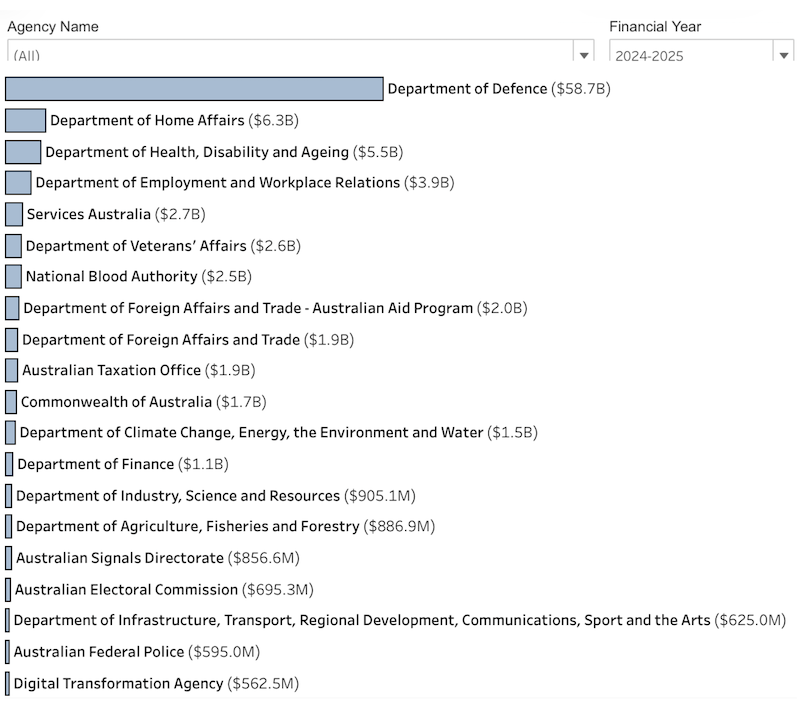
Earlier this week Defence Minister Richard Marles announced a big reform in Defence Procurement. Except it wasn’t a big reform, rather a rearranging of deck chairs. Former senator Rex Patrick reports.
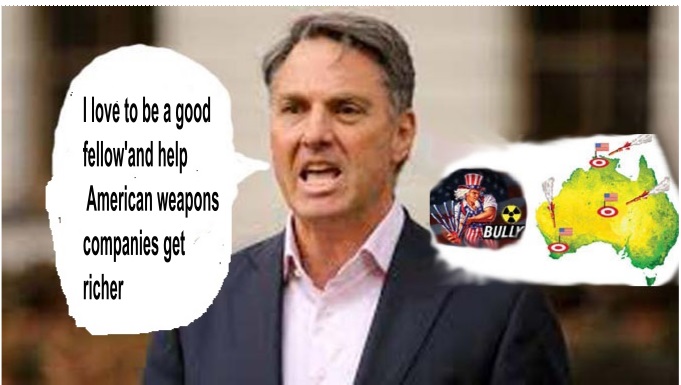
by Rex Patrick | Dec 7, 2025 https://michaelwest.com.au/marles-new-defence-agency-rearranging-deck-chairs/
And the needle returns to the start of the song …
On 22 June 2000, then Minister for Defence John Moore approved the establishment of the Defence Materiel Organisation (DMO), a single organisation that was to be charged with the responsibility of acquisition and through life support of equipment and systems used by the Australian Defence Force.
But the DMO didn’t work.
On 01 April 2015, then Minister for Defence Kevin Andrews announced that he had accepted the recommendations of a Defence First Principles Review and that the DMO would be disbanded – it wasn’t working – and that its functions would be transferred to a new Capability Acquisition and Sustainment Group (CASG).
But the CASG didn’t work.
On 01 December the Defence Minister, Richard Marles, announced he was merging CASG, Defence’s Guided Weapons and Explosives Ordinance Group and the Naval Shipbuilding & Sustainment Group into a single organisation to be called the Defence Delivery Agency (DDA).
DDA won’t work
Rearranging deck chairs
During the week Marles sought to assure that there would be no job losses as a result of his reforms and, in an absolute admission that all he was doing was rearranging the deck chairs, he advised that existing public servants who worked for Defence would simply be transferred over to the new agency.
The biggest problem that Defence has, and which Marles doesn’t have the ability to solve, is the fact that the very senior uniformed people who are running Defence acquisition, while undoubtedly being good war-fighters, don’t have the experience in project management to understand that it is risk that brings down projects.
You would not take an experienced project manager and assigned them command responsibility of a warship, and you should not take a warship captain and assign them responsibility for a large project. But the latter is exactly what happens inside Defence.
Political risk (political change), economic risk (pressure on budgets), management risk (inexperience) and technical risk (novelty, uncertainty and complexity) – that’s what causes projects to go off the rails.
Changing the label on the front door of the equipment procurement office won’t do a thing to get better value-for-money or reliable capable equipment for our defence force.
E.G. AUKUS
AUKUS is classical Defence risk taking.
It’s not a hidden fact that the United States is not building enough Virginia class submarines to meet US Navy needs, let alone supply the Royal Australian Navy with some. The US Government’s AUKUS review report is now with the Australian Government. The Minister is talking up the contents, albeit in very general detail.
“If the US were honest, they’d tell us to do something different.”
But with $1.6 billion already paid to the US Department of War and another billion dollars set to be gifted to the US in the next couple of weeks, the temptation would be difficult.
Senate Estimates this week was instructive. When Senator David Shoebridge read from the evidence given by Lord Case, the Chair of ‘Team Barrow’ (the organisation entrusted with ensuring the town of Barrow is able to support the UK’s and AUKUS submarine build needs) telling the UK Parliament he was not happy with his team’s progress, Vice Admiral Jonathon Mead indicated he did not know about it.
Experienced project managers spend their time looking for bad news – looking for risk that is materialising. That doesn’t seem to be happening. ‘Talking’ AUKUS is the order of the day, not ‘walking’.
Real change
If Marles knew what he was doing he would look to the culture in Defence procurements.
“No more ‘special’ or ‘expensive monolithic’ projects.“
Defence needs to develop a force optimised first for Defence-of-Australia and second for near regional security (and conduct other work from that order-of-battle). It needs to focus on proven designs/capabilities when fulfilling Defence Force needs.
This is something that has been recommended to Defence in the past, in the 2003 Kinnaird Review and the 2008 Mortimer Review. They are not new ideas; they are old ideas ignored.
Even those not currently interested in Defence need to be a little bit interested. Putting national security imperatives to one side, so much public money is spent on Defence.
One of the most telling signals that nothing substantive will come from Minister Marles’ announced changes came when Senator Shoebridge asked the question of Defence Secretary Greg Moriarty will the new ‘National Armament Director’ come from outside the current organisations?
There was no way Moriarty was going to answer that question. He employed bureaucratic doublespeak and avoided a direct answer. The secretary is an experienced public service hand, and will want someone in the seat that he can ‘guide’.
Marles needn’t worry too much though. He has what he needs – a dodge over failing projects for the rest of the parliamentary term, and possibly the next as well. “All those problems were caused by the old system,” Marles will say.
Segal Secrets: docs reveal Antisemitism Envoy’s big pay day
by Stephanie Tran | Dec 9, 2025, https://michaelwest.com.au/segal-secrets-docs-reveal-antisemitism-envoys-big-pay-day/
Jillian Segal, Australia’s controversial Antisemitism Czar and Israel lobbyist, procured an extra $12.9m funding from PM Anthony Albanese, heavily redacted FOI documents show. Stephanie Tran reports.
The Albanese government has blocked key details about the appointment of Jillian Segal as Australia’s special envoy for antisemitism, with freedom of information documents (FOI) revealing a process almost entirely obscured by redactions.
The documents, released by the Department of Home Affairs in response to an FOI request, show the government relied on wide-ranging secrecy exemptions to withhold internal briefings, candidate assessments, deliberative advice to ministers, and all correspondence between Segal and the Prime Minister’s Office.
Beyond a set of boilerplate terms of reference, the documents shed little light on why Segal was chosen. What’s deliberately missing, however, is the real story.
Selection process almost entirely redacted
One of the key questions the FOI sought to answer was how Segal came to be selected. In correspondence to staff in March 2024, Home Affairs officials described an intention to provide the Prime Minister with “up to 6 candidates” reflecting “the demography of Australia”, diverse identities and gender, and “trusted relationships” in their communities.
But every document detailing assessments or the rationale for selection was either heavily redacted or withheld in full, primarily under the FOI Act’s deliberative processes exemption under s47C.
The Information Officer’s decision letter notes that Home Affairs undertook “extremely thorough” searches, but still located no resume, no risk assessments and no evaluation criteria.
The Department’s claim that it could not locate a copy of Jillian Segal’s CV appears to be at odds with the government’s own records. In a June 2024 letter to the Prime Minister, Immigration Minister Andrew Giles explicitly stated that Segal’s “Curriculum Vitae, Private Interest Declaration and Appointments Details pro-forma are at Attachment D.”
(Original article copiously shows the government documents)
Urgency and budget blowouts
What survives the redactions paints a picture of a high-speed, politically sensitive process.
The documents reveal the existence of an “Israel Hamas Social Cohesion Taskforce” within Home Affairs, headed by Giles.
In February 2024, Giles wrote to Anthony Albanese seeking “urgent agreement” to appoint envoys to combat Antisemitism and Islamophobia, citing the “immediate and significant rise in Antisemitism and Islamophobia … exacerbated by the 7 October 2023 Hamas terrorist attacks on Israel [and] the ongoing conflict and the dire humanitarian situation in Gaza.”
On 21 June 2024, Giles personally recommended Segal as the preferred candidate for the Special Envoy to Combat Antisemitism.
In a letter dated 25 June 2024, Albanese agreed to Segal’s appointment. Albanese also approved an additional $12.9 million of funding for the two envoy roles.
“The 2024-25 Budget provided $4.0 million over two years from 2023-24 for the appointment of the Special Envoys, as a decision taken but not yet announced. Noting the appointments will now be for three years instead of one and additional support staff may be required, I agree to provide up to an additional $12.9 million in total over three years from 2024-25 for up to 12 staff, with offsets to be agreed in the 2024-25 Mid-Year Economic and Fiscal Outlook (MYEFO) context, subject to agreement with the Department of Finance.”
Public interest outweighed by need for secrecy
In its decision, Home Affairs argued that releasing deliberative material would hinder officials’ ability to provide “full and frank advice” on future appointments, and that releasing names or details of candidates would be an unreasonable breach of personal privacy.
The Department explicitly acknowledged that disclosure would “promote the objects of the FOI Act” and “inform debate on a matter of public importance” but still maintained the public interest favoured secrecy, particularly to avoid “prejudicing” internal government processes.
The information officer stated the following:
“I consider that the public interest in protecting the process of the provision of free and honest confidential advice by a Department to its Minister has, on balance, more weight, than the public interest that might exist in disclosing the deliberative matter. Endangering the proper working relationship that a Department has with its Minster and its ability to provide its Minister with honest advice confidentially would be contrary to the public interest.”
1 This month
Chernobyl: The Lost Tapes – A good documentary on Chernobyl on SBS available On Demand for the next 3 weeks– https://www.sbs.com.au/ondemand/tv-program/chernobyl-the-lost-tapes/2352741955560
15 April – Zoom –Nuclear Power is Not the Solution
Apr 15, 2026 01:00 AM in Canberra, Melbourne, Sydney

Join the International Physicians for the Prevention of Nuclear War (IPPNW) on Tuesday, April 14th for a timely webinar exploring the risks associated with nuclear power and challenging the myth that it offers a simple, safe, carbon-free solution to the climate crisis

21 April Webinar: No Nuclear Weapons in Australia
Start: 2026-04-21 18:00:00 UTC Canberra, Melbourne, Sydney (GMT+10:00)
End: 2026-04-21 19:30:00 UTC Canberra, Melbourne, Sydney (GMT+10:00)
Event Type: Virtual
A virtual link will be communicated before the event.
Host Contact Info: australia@icanw.org

of the week – Australians for War Powers Reform (AWPR)
To see nuclear-related stories in greater depth and intensity
 Antinuclear