Victorian Premier blasts nuclear plan as renewable appeals curbed
Canberra Times, By Callum Godde and Rachael Ward, March 14 2024
Opponents of solar and wind farms will be stripped of the power to appeal approvals to a Victorian tribunal, as the premier blasts the federal opposition’s nuclear pitch as a cartoon-inspired distraction.
The Victorian government will remove the ability for third parties to appeal planning decisions for renewable energy projects through the Victorian Administrative Appeals Tribunal.
From April 1, shovel-ready renewable energy projects will be eligible for an accelerated pathway under an expansion of a development facilitation program.
The change will remove the planning panel process and third-party appeal rights at VCAT amid the rise of the not-in-my-backyard (NIMBY) movement.
Premier Jacinta Allan said more than one in five planning applications had ended up in VCAT since 2015, with the overwhelming majority of the initial decisions being upheld.
“Eventually these projects are getting built but it’s taking far too long,” she told reporters at a wind farm in Mount Wallace on Thursday.
“We want to spend more time on projects being build and less time on it being caught up in red tape.”……………………………
Ms Allan also took the opportunity to hit out at the federal opposition’s pre-election policy to establish nuclear reactors at retiring coal-fired power plants……………………
Ms Allan accused the federal coalition of deliberately “whipping up anxiety” over renewable projects in their backyards and pushing the nuclear debate to “distract” from Australia’s transition to net zero by 2050…………
Victoria has an estimated $90 billion worth of renewable projects in the pipeline and is targeting 95 per cent renewable energy generation by 2035 and net zero emissions by 2045………………… https://www.canberratimes.com.au/story/8555578/premier-blasts-nuclear-plan-as-renewable-appeals-curbed/
Opposition eyeing off six sites for nuclear reactors
New Daily, Poppy Johnston, Mar 12, 2024
Households and businesses close to the six nuclear power reactors the opposition hopes to see built could have their energy bills subsidised.
Teasing the coalition’s yet-to-be-unveiled energy policy at the Australian Financial Review Business Summit in Sydney on Tuesday, opposition leader Peter Dutton said the plan would likely include six nuclear plant sites.
Tasmania has been ruled out as a potential host state.
Dutton said the coalition would seek a social licence by incentivising close-by communities with subsided energy, a model he said was used in the United States.
“It provides incentive for industry to establish jobs,” he told the audience.
The opposition is expected to release its energy policy ahead of the federal budget in May, with the plan likely to include overturning the moratorium on nuclear technology and possible sites for reactors on old coal station locations to take advantage of existing transmission infrastructure…………….
The Albanese government has dismissed nuclear as an unsuitable technology for Australia that has a high price tag and will take too long to roll out.
Energy experts also say it’s difficult to estimate the cost of transitioning to nuclear given the technology is not currently commercially available.
Dutton addressed a number of what he described as “straw man arguments” against nuclear, including cost.
He used other regions with nuclear in the energy mix – South Korea and the Ontario region of Canada – to make his case for the system-wide cost of the energy source and its influence on power bills.
Reactors also produce a “small amount of waste” and Dutton said the government had already signed up to deal with nuclear waste via the AUKUS agreement……………………………. https://www.thenewdaily.com.au/news/politics/australian-politics/2024/03/12/dutton-six-sites-nuclear-reactors
Aid Wars over Gaza: Resuming Funding to UNRWA

March 12, 2024, by: Dr Binoy Kampmark https://theaimn.com/aid-wars-over-gaza-resuming-funding-to-unrwa/
The steady and ruthless campaign by Israel to internationally defund the UN Relief and Works Agency for Palestine Refugees in the Near East (UNRWA), is unravelling. The lynchpin in the effort was a thin, poison pen dossier making claims that 12 individuals were Hamas operatives who had been involved in the October 7 attacks. Within a matter of days, two internal investigations were commenced, various individuals sacked, and US$450 million worth of funding from donor states suspended.
As the head of the agency, Philippe Lazzarini, explained at a press conference on March 4, he has “never been informed” or received evidence of Israel’s claims substantiating their assertions, though he did receive the prompt about the profane twelve directly from Israeli officials. Every year, both Israel and the Palestinian authorities were furnished with staff lists, “and I never received the slightest concern about the staff that we have been employing.”
Had Israeli authorities signed off on these alleged participants in bungling or conspiratorial understanding? Certainly, there was more than a pongy whiff of distraction about it all, given that Israel had come off poorly in The Hague proceedings launched by South Africa, during which the judges issued an interim order demanding an observance of the UN Genocide Convention, an increase of humanitarian aid, and the retention of evidence that might be used for future criminal prosecutions for genocide.
An abrupt wave of initial success in starving the agency followed, with a number of countries announcing plans to freeze funding. In the United States, irate members of Congress accused the agency of having “longstanding connections to terrorism and promotion of antisemitism.” A hearing was duly held titled “UNRWA Exposed: Examining the Agency’s Mission and Failures” with Richard Goldberg, a senior advisor of the Foundation for Defense of Democracies frothing at an agency that supposedly incited “violence against Israel, subsidizes US-designated terrorist organizations, denies Palestinians their basic human rights, and blocks the pathways to a sustainable peace between Israel and the Palestinians.”
The attempt to cast UNRWA into gleefully welcomed oblivion has not worked. Questions were asked about the initial figure of twelve alleged militants. News outlets began questioning the numbers.
The funding channels are resuming. Canada, for instance, approving “the robust investigative process underway”, also acknowledged that “more can be done to respond to the urgent needs of Palestinian civilians.” The initial cancellation of funding to the agency, charged Thomas Woodley, president of Canadians for Justice and Peace in the Middle East, had been “a reckless political decision that never should have been made.”
The Swedish government was also encouraged by undertakings made by UNRWA “to allow independent auditing, strengthen internal supervision and enable additional staff controls”, promising an initial outlay of 200 million kroner (US$19 million).
The Minister for International Development Cooperation and Foreign Trade, Johan Forssell, promised that it would “monitor closely to ensure UNRWA follows through on what it has promised.” Aid policy spokesperson for the Christian Democrats, Gudrun Brunegård, also conceded that, given the “huge” needs on the part of the civilian population, that UNRWA was “the organisation that is best positioned to help vulnerable Palestinians.”
Much the same sentiment was expressed by the European Union, with the Commission agreeing to pay 50 million euros to UNRWA from a promised total of 82 million euros on the proviso that EU-appointed experts audit the screening of staff. “This audit,” a European Commission statement explains, “will review the control systems to prevent the possible involvement of its staff and assets in terrorist activities.” Having been found wanting in her screeching about-turn, the European Commission president Ursula von der Leyen insisted that the EU stood “by the Palestinian people in Gaza and elsewhere in the region. Innocent Palestinians should not have to pay the price for the crimes of [the] terrorist group Hamas.”
Commissioner Olivér Várhelyi was stiffly bureaucratic in expressing satisfaction at “the commitment of UNRWA to introduce robust measures to prevent possible misconduct and minimise the risk of allegations.” At no point was Israel’s own contribution to the calamity, and its insatiable vendetta against the agency, mentioned.
The bombast and blunder of the whole effort by Israel was further discoloured by claims that UNRWA staff had been victims of torture at the hands of the IDF in drafting the dossier. In a statement released by the agency, a grave accusation was levelled: “These forced confessions as a result of torture are being used by the Israeli Authorities to further spread misinformation about the agency as part of attempts to dismantle UNRWA.” In doing so, Israel was “putting our staff at risk and has serious implications on our operations in Gaza and around the region.”
For its part, the IDF, through a statement, claimed that this was all exaggerated piffle: “The mistreatment of detainees during their time in detention or whilst under interrogation violates IDF values and contravenes IDF [sic] and is therefore absolutely prohibited.”
Increasingly on the losing side of that battle, Israeli authorities decided to cook the figures further, declaring with crass confidence that 450 URWA employees in Gaza were members of militant groups including Hamas. Sticking to routine, those making that allegation decided that evidence of such claims was not needed. Those employees, claimed Rear Adm. Daniel Hagari, “are military operatives in terror groups in Gaza”. “This was no coincidence. This is systematic. There is no claiming, ‘we did not know’.”
In the fog of war, mendacity thrives with virile vigour; but the current suggestion on the part of various donor states is that the humanitarian incentive to ameliorate the suffering of the Gaza populace has taken precedence over Israel’s persistently lethal efforts. That, at least, is the case with certain countries, leaving the doubters starkly exposed.
Radioactive waste, baby bottles and Spam: the deep ocean has become a dumping ground

The ocean’s depths are not some remote alien realm, but are in fact intimately entangled with every other part of the planet. We should treat them that way
by James Bradley. Guardian 12 Mar…….
“…………………………………………………………………………………………..The ocean’s depths have also been used as the final resting place for large amounts of nuclear material.
A 2019 study found at least 18,000 radioactive objects scattered across the bottom of the Arctic Ocean, many of them dumped there by the Soviet Union. These objects include vessels such as the K-27, the 110-metre nuclear submarine powered by an experimental liquid-metal-cooled reactor, which was scuttled in 1982 with its reactor still on board (when the explosive charges that were supposed to sink the K-27 failed to fully detonate, it had to be rammed with a tug); the wreck of the K-141 Kursk, which sank in the Barents Sea in 2000 during a naval exercise, killing all 118 on board and bearing its reactor and fuel to the bottom; and the K-159 attack submarine, which sank while being towed near Murmansk in 2003 with 800kg of spent uranium fuel on board. The head of Norway’s Nuclear Safety Authority says it is only a matter of time before these objects begin to release their toxic legacy into the water; others have called the situation a “Chornobyl in slow motion on the sea floor”.
While the Soviet Union dumped more nuclear waste on the sea floor than any other country, it was certainly not alone. Between 1948 and 1982, the British government consigned almost 70,000 tonnes of nuclear waste to the ocean’s depths, and the US, Switzerland, Japan and the Netherlands are just a few of the nations that have used the ocean to dispose of radioactive material, albeit in much smaller quantities. And while international treaties now prohibit the dumping of radioactive material at sea, the British government is exploring plans to dispose of up to 750,000 cubic metres of nuclear waste, including more than 100 tonnes of plutonium, beneath the sea floor off Cumbria. British officials argue this sort of geological disposal offers a way of keeping waste stable and secure over hundreds of thousands of years, although incidents such as the 2014 leak of radioactive material at a waste disposal facility half a kilometre beneath salt beds in New Mexico suggests that like many of the assurances offered by the nuclear industry, this claim should be approached with great caution.
The dumping of nuclear waste in the ocean is only one part of a far larger story of carelessness and greed. Human waste in the form of plastics and other objects is everywhere in the deep ocean, a fact that is made brutally apparent by the Japan Agency for Marine-Earth Science and Technology’s Deep-sea Debris Database, which documents the presence of tyres, fishing nets, sports bags, mannequins, beach balls and baby’s bottles spread across the sea floor at depths of many thousands of metres. In some regions, the number of such objects exceeds 300/sq km.
This tide of garbage has even reached the deepest and most remote parts of the ocean: …………………………………………………………………………………….
Possibly more disturbing, though, is the growing accumulation of microplastics in the ocean depths………………………………………………..
Nor is plastic the only thing that drifts downwards. In 2019 Chinese scientists discovered radioactive carbon-14 from the detonation of nuclear bombs in the 1940s and 50s in the bodies of amphipods living at the bottom of the Mariana Trench, borne into the deep not by ocean circulation, but in the rain of organic matter from above. More recent studies have found radioactive caesium from the Fukushima nuclear disaster in sediment more than 7,000 metres down in the Japan Trench……………………………………………………….. more https://www.theguardian.com/environment/2024/mar/12/radioactive-waste-baby-bottles-and-spam-the-deep-ocean-has-become-a-dumping-ground
Hollywood stars put their name to a good message, but it’s the messengers who are problematic.

Nuclear Threat Initiative’s CEO is, yes, Ernest Moniz, the former US Energy Secretary, who is at the forefront of promoting nuclear power to anyone and everyone who wants it
Moniz is one of the chief architects behind the pro-nuclear infiltration of the COP28 climate summit
Make (some) nukes history, Hollywood stars put their name to a good message, but it’s the messengers who are problematic
By Linda Pentz Gunter, https://beyondnuclearinternational.org/2024/03/11/make-some-nukes-history/
A handful of Hollywood celebs, some highly recognizable including Jane Fonda, Barbra Streisand, Lily Tomlin, Emma Thompson and Michael Douglas, as well as musicians such as Jackson Brown and Graham Nash, just signed their names to a letter published in the LA Times urging that we “Make Nukes History”.
Hooray, right? Well, only half hooray.
The Hollywood letter was part of a quickly launched campaign to coincide with the Oscar buzz around the successful feature film, Oppenheimer, in order to leverage attention for the need to abolish nuclear weapons. The Make Nukes History campaign aims to raise public awareness about the civilization-ending risks posed by today’s nuclear arsenals. It reminds us that while Oppenheimer is a history lesson, nuclear weapons are very much still with us, but that we can put an end to what J. Robert Oppenheimer started.
So far, all so good. Far too few of us are thinking about nuclear weapons and the threat they pose, let alone doing something about getting rid of them. It’s an important message that needs reiterating.
Meanwhile, Oppenheimer duly swept seven Academy Awards on Sunday. We waited hopefully for one of the winners to say something about the effect of Oppenheimer’s bomb down the ages. It came only from Cillian Murphy at the end of his Best Actor acceptance speech. “We made a film about the man who created the atomic bomb and for better or for worse we are all living in Oppenheimer’s world so I would really like to dedicate this to the peacemakers, everywhere,” Murphy said.
The Make Nukes History message did not make it to the Oscar stage and the LA Times letter was surprisingly skimpy, failing to get at the heart of the two key takeaways missed in the Oppenheimer film: the unwilling, unrecognized and still uncompensated victims of Oppenheimer’s original Trinity bomb; and the on-going harm down generations to all peoples whose lands were seized and used for atomic tests.
The letter includes a quote from President John F. Kennedy, then states:
“At a time of great uncertainty, even one nuclear weapon—on land, in the sea, in the air, or in space—is too many. To protect our families, our communities, and our world, we must demand that global leaders work to make nuclear weapons history—and build a brighter future.”
Demand indeed. Some of us have been doing this for decades. And we have a treaty for that. But thank you for waking up.
But what does “build a brighter future” actually mean? That, it turns out, is the slogan of the organization behind the orchestration of the Hollywood letter and Oscar campaign — the Nuclear Threat Initiative.
Let’s first take a look at who actually signed the letter. With two exceptions, all the signatories are white. There are no Native Americans on there. No US Marshall Islanders. Almost none of the Oppenheimer film cast and crew signed it. The last four signatures belong to the board of NTI.
NTI was the brainchild of Fonda’s ex, Ted Turner. NTI’s CEO is, yes, Ernest Moniz, the former US Energy Secretary, who is at the forefront of promoting nuclear power to anyone and everyone who wants it. Turner is also a firm supporter of nuclear power (I know because I tried to challenge him on it in person and was quickly deflected by a very large gentleman in possession of an impressive set of muscles.)
Moniz is one of the chief architects behind the pro-nuclear infiltration of the COP28 climate summit and its ridiculous “let’s triple global nuclear power capacity by 2050” proclamation. He will be in Brussels later this month, headlining the International Atomic Energy Agency’s propaganda-fest, billed as the First Ever Nuclear Energy Summit. So will Charles Oppenheimer, Robert Oppenheimer’s grandson and another signatory to the LA Times letter.
So here we have a slightly star-studded short-lived campaign to proclaim an end to one kind of nuke, while behind the scenes the same organization is working hard to promote the other kind of nuke, thus ensuring that the door to nuclear weapons development stays firmly open.
So sorry, no two thumbs up for this bit of Hollywood theatre.
Linda Pentz Gunter is the international specialist at Beyond Nuclear and writes for and edits Beyond Nuclear International. All opinions are her own.
Why the US is trying to imprison Assange: Report from inside the Court

But even if what the United States is saying were true, these documents were not published first by Assange. John Young, the owner of a website called cryptome.org testified to the court that he was the one who published the documents first, and the United States never prosecuted him or asked him to take them down.
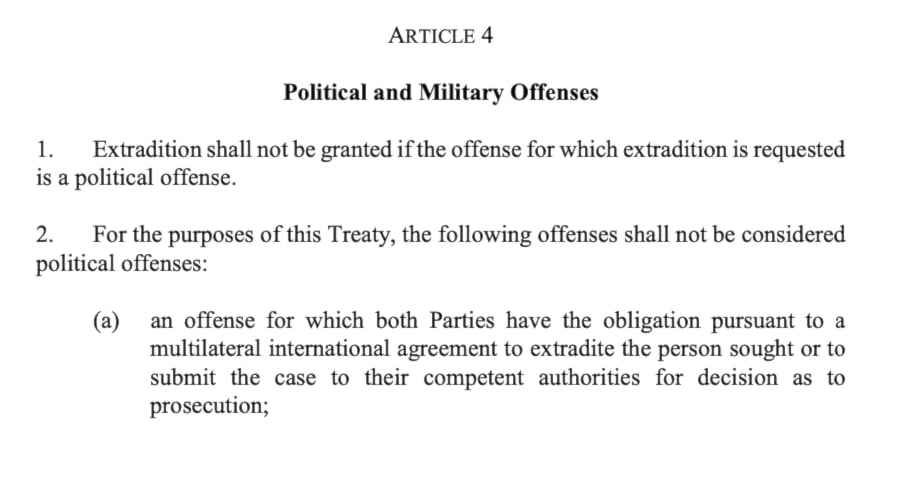
Extraditions for political offenses are forbidden under Article 4 of the US-UK Extradition Treaty 2003
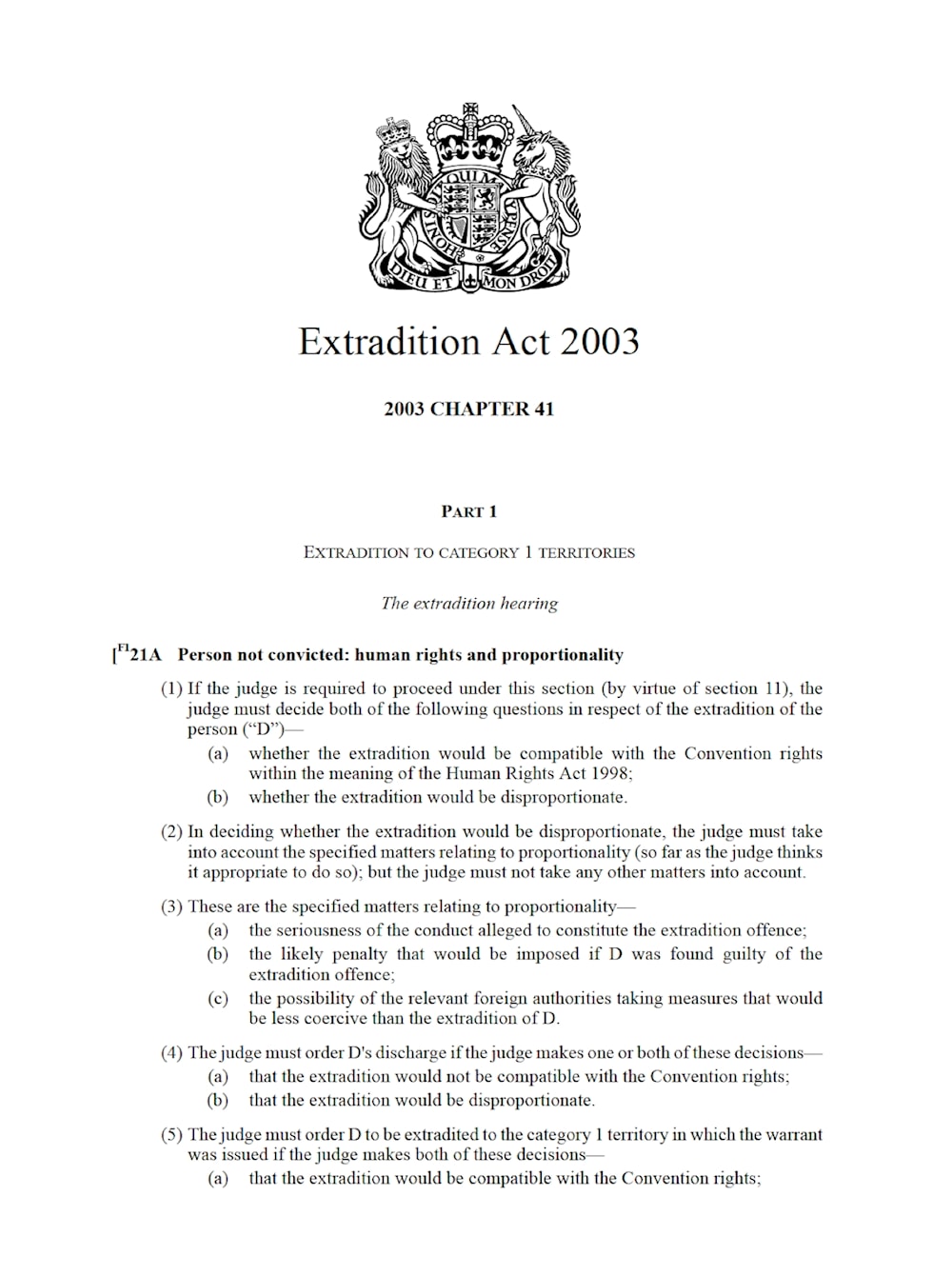
The Extradition Act, which is the implementation of the US-UK treaty inside British law, is missing this section. This is likely due to the fact it was passed at the height of the “War on Terror” in 2003, giving the Americans carte blanche to snatch people, drag them to the US and throw them in dungeons
Richard Medhurst Al Mayadeen English, 7 Mar 2024, https://english.almayadeen.net/articles/analysis/why-the-us-is-trying-to-imprison-assange–report-from-inside
Richard Medhurst is a British journalist who has covered Julian Assange’s extradition case from inside the court since 2020. In this article, he explains what took place in the latest hearings, why the United States is trying to extradite the WikiLeaks founder, and why everyone should care.
Julian Assange is an Australian journalist in the United Kingdom, and the founder of WikiLeaks. He published documents that were given to him by a US soldier called Chelsea Manning, which showed US war crimes in Iraq, Afghanistan, and much more.
The United States want to extradite Assange from the UK to America, and put him on trial for publishing these classified documents. They are threatening him with 175 years in prison.
The reason this case is so serious is because it essentially makes journalism illegal.
The United States claims Assange asked Manning for classified documents and that this is a crime. It’s not.
The US alleges that Assange having classified documents in his possession and publishing them is a crime. It’s not.
Asking for classified documents; protecting sources, these are things journalists do every single day around the world.
But because these files were so embarrassing to the United States and exposed the brutality of their war crimes, they are threatening Assange with almost two centuries in prison; and to do it, they are accusing him of being a “spy” and a “hacker”, charging him with 17 counts under the “Espionage Act”, and with one count of “Conspiracy to Commit Computer Intrusion”.
The goal of this indictment is to make an example out of Assange, and make other journalists afraid to publish things that the public has a right to know.
If extradited, Assange would be placed in the worst prison conditions imaginable, “Special Administrative Measures” (or SAMs): A strict regime of solitary confinement, no contact with other prisoners allowed, and barely any contact with your family. SAMs are internationally recognized as torture. Julian would be sent to the worst prison in America, ADX Florence, a super-maximum security facility in Colorado.
On January 4, 2021, British judge Vanessa Baraitser blocked Assange’s extradition because US prison conditions would be so oppressive in his current state as to drive him to suicide.
Nevertheless, despite blocking the extradition on health grounds, she agreed with all the political and trumped-up charges.
I have attended all of Assange’s court hearings and saw the smears against him debunked by dozens of expert witnesses. But the judge still chose to side with the United States. She chose to essentially criminalize journalism, even drawing dangerous equivalences between the US Espionage Act and Britain’s Official Secrets Act (OSA).
After this, the United States went to the English High Court to appeal her ruling and won by providing empty promises that they would supposedly treat Assange well– even though the United States has a history of violating extradition assurances. I exposed this when I published classified documents from David Mendoza’s extradition from Spain to the US, a case previously cited in court by Julian’s lawyers.
After the US succeeded in overturning the lower court’s ruling in Dec 2021, there was only one thing left: A signature from the Home Secretary, who allowed the extradition to go ahead.
The above is everything that took place between 2020 and 2024, which brings us to the latest hearings at the Royal Courts of Justice in February 2024.
Point 1: To appeal the ruling of the lower court from Jan 4, 2021.
Assange’s lawyers argued that the judge was correct to block Assange’s extradition on health grounds, but she was wrong to agree with all the political charges (equating him with a “hacker” and a “spy”).
They’re saying very plainly: This case is undemocratic, it criminalizes journalism, and doesn’t take into account the fact that the documents Assange published expose enormous US war crimes that the public had the right to know about.
(See for example the “Collateral Murder” video published by Julian Assange’s WikiLeaks: Footage from a US gunship crew laughing as they slaughter Iraqi civilians, among them children and reporters).
Another claim made by the United States is that Assange “harmed informants” by publishing unredacted cables. Ironically, this was proven false by the United States’ own military when they court-martialed Chelsea Manning (the soldier that gave the files to Assange). The US military couldn’t find a single example of anyone having been harmed by the disclosures.
The assertion by the United States that Julian Assange simply published all these documents without censoring or redacting names simply isn’t true: I listened to many journalists tell the court how they spent countless hours meticulously redacting names with Assange.
Assange’s lawyers are also arguing that the judge in the lower court failed to undertake a balancing act. She blindly accepted the United States’ premise that the lives of informants– who weren’t even harmed– are more important than the people killed and tortured by the United States. This is tantamount to saying: The United States should be allowed to continue committing these war crimes in secret; that it’s somehow okay for them to butcher people in Iraq and Afghanistan, and the public have no right to know.
But even if what the United States is saying were true, these documents were not published first by Assange. John Young, the owner of a website called cryptome.org testified to the court that he was the one who published the documents first, and the United States never prosecuted him or asked him to take them down.
This demonstrates that the whole case against Assange is selective, political, and has nothing to do with the law.
Assange’s lawyers are also arguing that the judge in the lower court failed to undertake a balancing act. She blindly accepted the United States’ premise that the lives of informants– who weren’t even harmed– are more important than the people killed and tortured by the United States. This is tantamount to saying: The United States should be allowed to continue committing these war crimes in secret; that it’s somehow okay for them to butcher people in Iraq and Afghanistan, and the public have no right to know.
But even if what the United States is saying were true, these documents were not published first by Assange. John Young, the owner of a website called cryptome.org testified to the court that he was the one who published the documents first, and the United States never prosecuted him or asked him to take them down.
This demonstrates that the whole case against Assange is selective, political, and has nothing to do with the law.
The Espionage Act that Assange is being charged under was created during World War I, in 1917. It has always been used as a political tool against dissidents such as Eugene Debs, or whistleblowers like Daniel Ellsberg and Edward Snowden, who exposed the true extent of the US war in Vietnam, and NSA mass surveillance.
If you’re charged under the Espionage Act, you’re also forbidden from arguing a public interest defense. This means that even if you expose colossal government crimes, you still go to prison.
Point 2: The Home Secretary was wrong to allow the extradition
This constitutes the second part of Assange’s appeal: It is illegal in Britain to extradite someone to another country, knowing they could face the death penalty.
If the Home Secretary, who has the final say on extraditions, is aware of such a risk, they are compelled to bar the extradition.
It is inconceivable that Priti Patel was unaware of who Julian Assange is, and the likelihood he would be killed in the United States. Once in US jurisdiction, the US could pile on additional charges, or simply execute him, as espionage is a capital offense.
Even without a specific death sentence, at 52 years old, even a 30-year bid is akin to a death sentence.
The hollow assurances given by the United States do not preclude the death penalty. And on top of that, the Home Secretary didn’t even bother asking for assurances that would.
So how could the Home Secretary agree to send Assange to a foreign country that so clearly wants to see him dead?
Mike Pompeo, who back then was head of the CIA, and then-president Donald Trump, launched this legal case against Julian Assange. In the past, Donald Trump had called for Assange to be given the death penalty, while Mike Pompeo proclaimed Assange “has no First Amendment rights”. After WikiLeaks published a trove of CIA documents, dubbed the Vault 7 files, Mike Pompeo declared war on WikiLeaks by publicly labeling it a “non-state hostile intelligence service”
All these political denunciations of WikiLeaks and Assange were then followed up with threats against him and his family. As we heard in court in 2020 from protected witnesses, the CIA had drawn up plans to potentially kidnap or assassinate Julian.
The United States is accusing Julian Assange of “espionage”. Normally, this is where the case should be thrown out, because espionage is considered a textbook political offense. And it is forbidden to extradite someone for a political offense under the US-UK Extradition Treaty, Art 4.
Customary extradition treaties have always forbidden extradition for political offenses such as “espionage” and “treason”. And this line of defense has been used before in court to successfully block extraditions.
- Extraditions for political offenses are forbidden under Article 4 of the US-UK Extradition Treaty 2003
Here is where the problem arises:
The Extradition Act, which is the implementation of the US-UK treaty inside British law, is missing this section. This is likely due to the fact it was passed at the height of the “War on Terror” in 2003, giving the Americans carte blanche to snatch people, drag them to the US and throw them in dungeons.
At the time of its passage, many criticized the Extradition Treaty as being extremely one-sided in favor of the United States.
No matter how you look at Assange’s case, it is unfair and illegal.
The United States wants to prosecute Julian Assange under US law, but at the same time deny him any protections under US law, such as free speech. If Assange has no First Amendment rights as a foreign national, then how can he be punished as a foreign national – who is not even in the US? This is such a flagrant double standard, and selective application of the law.
The European Convention on Human Rights (ECHR) is incorporated into British law through the Human Rights Act. Upon examination, it is clear that Julian’s rights are being flagrantly violated
Article 5 protects one from arbitrary detention.
Because this is a political case, it would be a violation of the Extradition Treaty to send Julian to America. Therefore, he has no reason to be in prison right now, and is therefore being arbitrarily detained in violation of his Article 5 rights.
Article 6 guarantees the right to a fair trial.
We know the United States spied on Assange’s conversations with his lawyers when he was inside the Ecuadorian embassy; stole his electronic devices; and collected medical and legal records.
In 2020, I sat in court with Fidel Narvaez, the former Consul to the Ecuadorian embassy in London. We listened to the submissions of two protected witnesses who confirmed they had spied on Assange because the security company they worked for, UC Global, had been contracted by the CIA to do so. They also discussed plans to potentially kidnap and poison Julian Assange and harvest DNA from his baby.
To spy on someone’s privileged conversations with their lawyers, and to use tainted evidence in court is scandalous beyond words, and violates the fundamentals of due process in any jurisdiction. Any judge would have thrown this case out from day one.
We also know Assange will not get a fair trial in America because the jury will be selected from a pool of people who work for the CIA, NSA, or have friends and family working in the intelligence community. These are the very same people whose crimes Julian Assange exposed.
The court in Virginia that issued the charges and would hold this trial is used specifically for this reason; because the jury is biased and the government knows it can’t lose. It is already 100% guaranteed that he will get convicted and go to prison.
Additionally, the United States could use secret evidence against Julian Assange, that he wouldn’t even be allowed to view due to it being “classified”.
Article 7 protects one from being punished retroactively. The case against Julian Assange is unprecedented: No publisher in America has ever been prosecuted, let alone convicted for publishing classified documents.
This case criminalizes journalism, and therefore violates Article 10, which guarantees freedom of expression.
Assange’s lawyers went over the ECHR repeatedly because it is incorporated into British law, meaning the court is obliged to follow it. Not only that, but this was their way of hinting to the judges: If you don’t give us permission to appeal, we will go to the European Court of Human Rights (ECtHR) in Strasbourg, and that court will look upon your decision unfavorably.
(The United Kingdom is a founding and current member of the European Council, which is separate from the European Union).
Assange’s lawyer, Mark Summers, argued very clearly: The Strasbourg court will see that a) these US war crimes were real; b) they were happening on the ground at the time, and; c) by publishing these documents Assange altered the United States’ behavior: The helicopter massacres like in the “Collateral Murder” video stopped, and the Iraq war came to an end.
Assange’s team put together a very compelling defense during this week’s hearing.
Continue readingTODAY. AUKUS nuclear pact – a lame duck?

What is AUKUS? It’s a weird nuclear pact – loftily described as a trilateral security pact for the Indo-Pacific region.
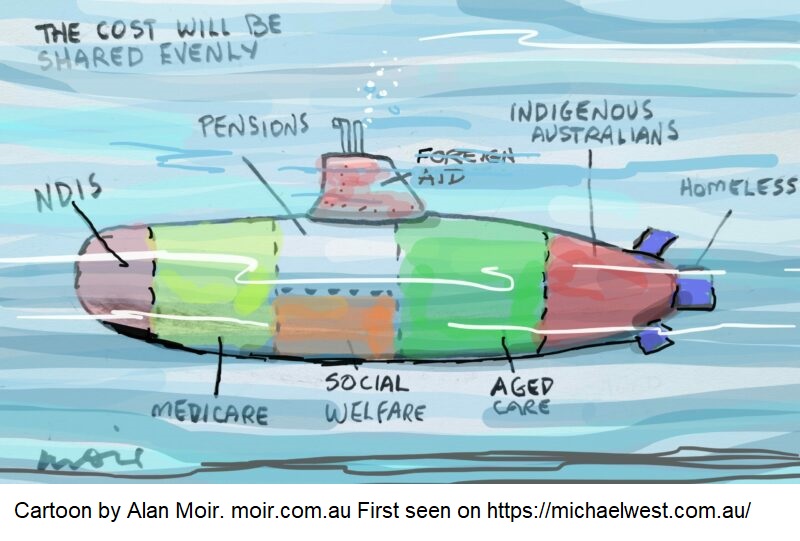
In reality it’s an agreement made without the knowledge of the Australian people, without discussion in Parliament , to make Australia pay close to $400 billion for second-hand nuclear attack submarines, including their radioactive trash.
How did this agreement come about?

In 2021, Australia’s then Prime Minister, Scott Morrison was a Trump-like figure, basically incompetent, but willing to do anything to get his face on the international media. He organised this extraordinary agreement, much to the joy of the nuclear lobby and Western war-hawks in general.
Morrison caused an international incident, in breaking Australia’s contract with France for non-nuclear submarines, (which would be much better suited for Australia’s coastal security monitoring”)
Is there opposition in Australia to this costly boondoggle?
Yes, but not enough. With the media about 70% owned by Murdoch outlets, the Australian public was fed a steady diet of what a threat China is to us, and how the AUKUS nuclear submarine will save us and blah blah.
And then, we got a new Prime Minister – Labor’s Anthony Albanese, (who has a history of opposition to nuclear). It was a national sigh of relief to get rid of the narcissistic and unpredictable Morrison. But ’twas too much to hope that Albanese would have the guts to stand up to the USA, or indeed to appear “weak” to the Australian public.
What is the present situation with AUKUS?
Well, apart from the misgivings of Australia’s near neighbours, like Indonesia, and the Nuclear-Free Zone, now there’s even trouble in the USA camp. On 12 March came the Tuesday release of the Biden administration’s 2025 defence budget request, – with reduced funding, well below the production rate of 2.33 subs a year the US says is necessary to sell any submarines to Australia. They got cold feet about the deal, as the USA is struggling to build the nuclear submarines that it needs for itself.
Meanwhile the American opposition, whatever you think of Donald Trump, is at the moment less keen on the idea of waging war against China. I mean – they probably do want to, – but they don’t like spending the money on making military stuff for another country.
There are, of course, other problems with the AUKUS nuclear submarine plan. Like the fact these subs will almost certainly be obsolete before they ever get under the water. China, with its shallow coastal waters, is making lots of small drones , that could detect and destroy these nuclear submarines. The AUKUS sub and its peers are intended for surveillance only. but they could be fitted with nuclear warheads. Perhaps that’s the plan. Who knows?
Meanwhile – is there a chance that Australia could avoid this costly boondoggle? And actually have the money to meet some real needs?
Refuting Peter Dutton’s recycled nuclear contamination
By Michelle Pini | 14 March 2024, https://independentaustralia.net/politics/politics-display/peter-duttons-recycled-nuclear-contamination,1841
Nuclear power is one hell of a way to boil water.
~ Albert Einstein
MANY AUSTRALIANS are accustomed to the Coalition’s deliberate lies and obfuscation on most issues, which is why they are no longer in power, at least for now.
The lengths to which the “friendly” media’s ongoing Right-wing public relations campaign is prepared to go in support of such obvious nonsensical blathering is, however, alarming.
In recent days, Opposition Leader Peter Dutton has been running free all over the countryside spruiking nuclear energy. Who cares? We hear you say. Well, apparently, every mainstream media platform, since they are not only publicising his outright lies, but in many cases, promoting them as credible policy.
Despite the current political state of play in Australia, in which the Labor Party has been elected federally and in every mainland state and territory, plus his “popularity” continuing to dwindle towards complete extinction, Peter Dutton appears mired to the outdated policies of generations past.
After yet another election loss, this time in the Dunkley by-election, Dutton has sprung up on every media platform, keeping the climate denial fires burning and rambling about nuclear as if it were a new idea, rather than the stale, worn-out dance with annihilation that it actually is.
According to Pete, nuclear is:
“…The only credible pathway we have to our international commitments to net zero by 2050.”
And proving yet again that facts never stood in the way of a good PR campaign, the Fourth Estate say: Facts be damned! We already had to (mostly) give up on climate denial so let’s give nuclear a good old-fashioned, vested-interests-funded, radioactive show of support!
This week, the usual suspects flooded our screens, radio waves and Google searches with headlines such as:
‘Nuclear will help Australia reduce emissions by 2050’ ~ Sky News
‘Shadow Energy Minister Ted O’Brien floats 10-year timeframe to get nuclear up and running in Australia’ ~ The West Australian
And the winner of the Most Creative Bullshit Headline award, once again, goes to that much-awarded Murdoch rag…
‘There’s no rational reason for maintaining the nuclear ban’ ~ The Australian
We may currently have a Labor Government, which has canned nuclear energy, but the media barons’ collective power to keep greenhouse gases spewing, corporate donors’ pockets overflowing and public minds contaminated should not be underestimated.
And so in answer to the Coalition and its nuclear-friendly media disciples, here are a few, by no means exhaustive, rational reasons to maintain Australia’s nuclear ban, keep nuclear energy firmly out of the energy mix and out of everyone’s backyard.
LIE #1: IT’S CHEAP
Even in the U.S., which boasts the biggest nuclear energy sector in the world, nuclear power costs have escalated. As recently as mid-2021, despite huge government subsidies, the target price for nuclear power increased by 53 per cent, to almost twice the price of utility-scale solar PV systems with battery storage.
Climate Change and Energy Minister Chris Bowen has estimated that the Coalition’s nuclear plan will carry a price tag of $387 billion – 20 times more than Labor’s current renewables investment fund – and would not be delivered before 2040. Nuclear energy, then, does not appear to be cost-effective.
LIE #2: IT’S QUICK
We (thankfully) don’t have nuclear reactors in Australia and thus there is no established nuclear reactor industry in place.
Nonetheless, back in 2023, Dutton first claimed:
“New nuclear technologies can be plugged into existing grids and work immediately.”
In their more recent ramblings, Dutton, his current Shadow Energy Minister Ted O’Brien and the unnamed “experts” to whom they refer claim Australia can have large nuclear reactors – magically – ready to go within ten years.
In the U.S., which boasts the largest nuclear industry in the world, it currently takes 19 years to achieve this.
According to Ted, the UAE produced a nuclear reactor from go to whoa in “ten years”. In reality, however, even with the UAE being an autocracy with a command economy, where communities are not permitted to object to reactors in their backyards, it actually took 13 years.
But what’s three extra years and a few more glow-in-the-dark communities between climate-denying friends?
Nuclear energy does not appear to be fast, either.
LIE #3: IT’S CLEAN AND GREEN
Even before we get to the radioactive leaks part of why nuclear power isn’t “clean”, there is the small matter of the Coalition’s stated need to maintain coal-fired power stations until all these nuclear reactors magically emerge, which even in Dutton’s plan, requires at least ten more years, but which based on the U.S. experience, we know will take more like 20.
This is, of course, at the heart of the Coalition’s nuclear push. This is the reason the Coalition gets energetic (pardon the pun) about most things. Nuclear energy generation takes a long time to develop at great cost, which would prohibit further investment in renewables and necessitate the extension of coal-fired power stations, currently set to be phased out by 2040.
According to its own Nuclear Regulatory Commission, in 2017, out of 61 operating – and self-regulating – nuclear power plant sites in the United States, 43 have had leaks or spills involving groundwater contamination above the EPA’s safe drinking water threshold.
So, nuclear energy does not appear to be “clean” or “green” or, as we indicate below, safe.
LIE #4: IT’S SAFE
There is still no answer to nuclear waste disposal or the toxic bi-products of nuclear storage. There is no safe way of “recycling” it.
There is still no answer to the “management” of radioactive leaks.
Nuclear waste, depending on its elemental composition, takes between 290 to a few hundred billion years to decompose. High-level nuclear waste consisting of spent fuel from nuclear reactors – of the type Peter Dutton and co would like to build – accounts for most radioactive waste and needs to be safely stored for up to a million years.
And then there are unplanned natural disasters, such as Fukushima.
As Dave Sweeney recently explained on IA, despite its established technical sophistication and even after 13 years, the best Japan can do with Fukushima’s ongoing radioactive waste is ‘pump and dump’ it into our oceans.
LIE #5: THE LIGHTS WILL GO OUT
According to self-styled nuclear energy mastermind Ted O’Brien, if we “prematurely” shut down coal-fired energy generators and implement nuclear reactors right now, “the lights will go out”.
Unsurprisingly, there is no factual basis for this claim. However, the lights may well go out if we do as his party is suggesting since natural disasters affecting nuclear reactors on a scale like Fukushima cannot be anticipated or prevented. Then there’s the “slight” problem of global warming, which, if we continue to accelerate by burning fossil fuels, will, indeed, result in all the lights going out.
To sum up – rationally – we repeat, nuclear power isn’t safe, it’s not cost-effective and it certainly ain’t green, unless you count glowing in the dark.
Issues Changing the Nation: Never Ending AUKUS Submarine Policy Sagas

March 14, 2024 : The AIM Network, By Denis Bright
The issue of AUKUS has resurfaced from the murky depths of undersea politics. ABC News graphics remind readers of the latest additional payment to fast track the AUKUS deal with its proposed cost of at least $US368 billion.
Public policy interest in the AUKUS submarine saga is now being propelled by doubts about US construction deadlines for the high technology nuclear-powered submarines. The US Navy confirmed that it will halve the number of nuclear-powered submarines on offer in its 2025 budget. Second-hand LA Class submarines will not be available for sharing with Australia as they will be needed in the USA. Even the construction schedule for AUKUS-class submarines in Adelaide is now in doubt (ABC News 13 March 2024).
For readers who are new to this issue, I might restate some background to the AUKUS deals. The commercial military industrial complexes do not advertise their hidden details. Making a request to Gemini-Google Bard provided this summary for verification by readers:
- US Virginia-class submarines: Australia will acquire at least three (and potentially up to five) Virginia-class nuclear-powered attack submarines from the US. The first of these might be in early 2030s. The leading corporations from the US military industrial complexes are General Dynamics and Huntington Ingalls Industries (Newport News Shipbuilding). Numerous supportive technology companies engage in preparations for these developments including involvement from Boeing.
- AUKUS-class submarines: Provided through US and British commercial providers of a new class of nuclear-powered attack submarines during the 2040s. The British firms particularly embedded in the AUKUS Programme are:
: BAE Systems will play a critical role in the construction of the AUKUS submarines.
: Babcock International will be involved in construction and maintenance.
: Rolls-Royce will be involved in design and delivery of the nuclear reactors.
- Temporary Rotational Deployment UK Astute-class and US Virginia-class submarines are planned on a rotational basis to HMAS Stirling in Western Australia.
The US Studies Centre in Sydney (9 February 2024) offered commentary by its Director Professor Peter Dean and research associate Alice Nason:
AUKUS has become a case study in generational politics. Public opinion polling reveals only 33 per cent of Gen Z and millennial voters believe it’s a good idea for Australia to have nuclear-powered submarines, compared with 66 per cent of voters aged sixty-five and over.
Still, on some things, all generations agree: a plurality of Australian voters feel nuclear-powered submarines are not worth the cost to Australian taxpayers. Only 21 per cent of voters believe the submarines warrant their $368bn price tag.
These apprehensions, especially among young people, should alarm our policymakers. The people who are expected to staff Australia’s new submarine enterprise as of now don’t support it. This is only the tip of the iceberg for Australia’s workforce challenge.
Australia will build up a sizeable military industrial complex over the next half-century if the AUKUS deals proceed as planned. Lobbying in support of AUKUS has attracted retired political leaders from both sides of politics who are committed to the goal of a more militarized Australia (Anton Nilsson Crikey.com 23 January 2024).
From the far-off United States, Anna Massoglia and Dan Auble from the Open Secrets site were able provide details of lobbying by major corporations in during 2023 just in support of AUKUS. Boeing, Lockheed Martin and General Dynamics topped the lobbying spending with a combined expenditure of over $US80 million.
David Hardaker of Crikey.com exposed the roles of conservative lobbyists in support of the efforts of the military corporates (31 May 2023). This is an exercise in investigative journalism at its best:
A Crikey investigation into the power of conservative political lobbyists CT Group has revealed that two US companies represented by CT are set to be among the biggest winners of the “forever” AUKUS defence deal hatched by former prime minister Scott Morrison.
One of the companies, General Dynamics, is the lead contractor for constructing the US navy’s fleet of nuclear-powered submarines. The other company, Centrus Energy, is the leading provider of nuclear fuel for US national security purposes and for naval reactors.
CT’s US entity, CTF Global LLC, has acted as a lobbyist for General Dynamics and Centrus Energy since it set up shop in Washington in 2018, taking on the client list of long-term lobbyist Larry Grossman who was seeking to extend the global reach of his firm.
The evolution of the CIT Group as defence lobbyists came as it reached the peak of its political influence in Australia at the end of 2018 with its then-Australian CEO Yaron Finkelstein joining Morrison’s staff as principal private secretary.
In parallel with Australia, the CT Group also enjoyed the closest of relationships with then-UK prime minister Boris Johnson. David Canzini, a former CT executive, was part of Johnson’s team as a deputy chief of staff.
Readers can follow the investigative trails offered through Crikey.com:
Explore the Series
In this era of cost-of-living politics, no one on either side of politics seems to worry about the irregular additional costs of the AUKUS deals. There was an unexpected allocation of $A835 million to France was imposed on the Labor Government for breach of contract from the cancellation of Malcolm Turnbull’s submarine deal.
- Crosby Textor: the pollsters that took over the Liberal Party and became a global power.
- Mere coincidence? Crosby Textor is the common link in Morrison’s AUKUS deal.
- Scott Morrison issues blanket denial on nuclear submarine questions.
- Spooks and spies: Crosby Textor moves into shadowy territory.
- Crosby Textor group’s influence on the Liberals has been pervasive. Is it time to cut the link?
- Crosby Textor’s influence on prime ministers helped it dominate the Anglosphere.
The Register of Lobbyists and the Foreign Influence Transparency Scheme (the Scheme) from the Attorney-General’s Department do not provide easy access to the specific roles played by lobbyists for firms associated with military industrial complexes. Just knowing which lobbyists have an association with a company like the CT Group is of little practical purpose in investigative journalism. This is a sample register extract for the CT Group which was mentioned in the Crikey.com articles.The LinkedIn site offers more clues by showing which ex-politicians or former military personnel and policy advisers with links to Australian and global military industrial companies through both lobbying activities or the convening of forum events or other corporate links. There is nothing sinister about the openness of the opportunities offered through LinkedIn which opens a new world of connections for further investigation by journalists.
Here are just three examples. Arthur Sinodinos, Joel Fitzgibbon, Lynton Crosby
…….. Critical discussion might be painful to political elites. Armed conflicts in a nuclear age are even worse. Let’s pause for some reflection before more jingoism gets Australia into real trouble through over-commitment to global corporate military industrial complexes and the expansion of a stronger home-grown variant in Australia. https://theaimn.com/issues-changing-the-nation-never-ending-aukus-submarine-policy-sagas/
Dutton’s blast of radioactive rhetoric on nuclear power leaves facts in the dust

Graham Readfearn, Guardian, 14 Mar 24
Coalition’s claim of cheap power and quickly built reactors is at odds with real world experience of other countries.
We may not yet be entering a nuclear age in Australia, but we would all be best advised to handle the rhetoric around the issue as carefully as we would radioactive waste.
This week opposition leader Peter Dutton said an annual CSIRO report that had included estimates of costs for small modular reactors – which are not yet available commercially – was “discredited” because it “doesn’t take into account some of the transmission costs, the costs around subsidies for the renewables”.
Dutton is referring to a report known as GenCost, which calculates the cost of generating electricity from different technologies when fuel, labour and capital are included. This metric is known as the levelised cost of electricity.
Despite Dutton’s claim, the most recent GenCost report does include the cost of integrating renewables such as solar and wind into the electricity grid. That is, it includes the cost of building new transmission lines and energy storage such as batteries.
The most recent GenCost report estimates a theoretical small modular reactor built in 2030 would cost $382 to $636 per megawatt hour. It says this is much more expensive than solar and wind, which it puts at between $91 and $130 per MWh even once integration costs are included.
The calculations in GenCost don’t include subsidies for any generating technologies – including renewables or future SMRs.
The cost estimates for SMRs are challenging because no commercial plant has been built. But the closest a project has got to existing – the Carbon-Free Power Project in Utah – was cancelled late last year primarily because the cost of the power would have been too high. And that project was given more than $2bn from the US Department of Energy.
Mycle Schneider is an independent nuclear expert and coordinator of the annual World Nuclear Industry Status report that tracks nuclear power development around the globe. He points to research from US financial group Lazard that says in the US, the costs of unsubsidised solar and wind including firming costs, such as batteries, range from US$45 to $141 per MWh compared to new-build nuclear at US$180 per MWh.
Ramping up the nuclear rhetoric
On Tuesday, Dutton said he would soon reveal six potential sites for nuclear reactors around Australia – likely to be close to, current or retiring coal-fired power stations.
Shadow energy minister Ted O’Brien claimed this week Australia could have nuclear power “up and running” within a decade.
“Nuclear ‘up and running within a decade’ does not fit with the experience we have seen elsewhere,” said Prof MV Ramana, a nuclear expert at the University of British Columbia and a contributor to the nuclear industry status reports.
Ramana points to Finland that has operated reactors since the 1970s, where parliament voted in 2002 to add a fifth reactor to the country’s fleet. Work started in 2005 but the reactor didn’t connect until 2022 “almost exactly 20 years after the parliamentary vote,” he said.
“We can see similar long periods of time between decisions to build reactors and when they start operating, again in countries that already have nuclear plants, in countries like the United States and the United Kingdom.”
Dutton and O’Brien have both said there are 30 economies around the world using nuclear and “50 more” that want to.
But Schneider says there are actually 32 countries with nuclear reactors, “but the top five generators produced 72% of the nuclear electricity in the world.”
“Over the past 30 years, only four countries started nuclear programs (Romania, Iran, Belarus, UAE) and three phased out their programs (Kazakhstan, Lithuania, Germany). There are reactors under construction in three more newcomer countries (Bangladesh, Egypt, Turkiye). Most other ‘plans’ are vague.”
The UAE – a model case study?
On Sky News, O’Brien pointed to the United Arab Emirates as a country that had commissioned South Korea’s Kepco to build four reactors of the size that could be considered for Australia in less than a decade.
In fact, each of the 1.4GW UAE plants was expected to be delivered in five years, but took eight, according to the industry status report. And it took 12 years from the announcement of the plan in 2008, to the first unit coming online in 2020.
The problem with using the UAE as a case study is that it is not a democracy, but an autocracy.
“The UAE is not a good model for Australia,” Ramana said………………………………………..
Reactor reactions
Experts have told the Guardian that even if Australia were to remove its federal and state bans on nuclear energy, it would be unlikely to see reactors generating power until the 2040s – at which point most, if not all, of Australia’s coal-fired power will have been turned off years earlier. One nuclear advocate questioned whether Australia could actually find a company to build reactors.
This week one political journalist said on Sky that “Canada is about to put in small modular reactors” and had selected a site in Ontario.
While Ontario Public Generation does plan to build a fleet of four small modular reactors, the company doesn’t yet have a licence to construct them.
If it does go ahead, OPG has said it doesn’t expect the first-of-its-kind unit – each about one-tenth the size of Australia’s biggest coal-fired power plant – to be working commercially until the end of 2029.
Expertise needed to make giant leap
O’Brien and Dutton have rejected the notion that Australia would be “starting from scratch” on nuclear, citing the existence of the tiny reactor at Lucas Heights near Sydney, the country’s existing reserves of uranium and the agreement to buy nuclear-powered submarines in the future.
Glenne Drover, the secretary of the Victorian branch of the Australian Institute of Energy and a broad supporter of nuclear power, said it was “quite a step up” from the 20MW Lucas Heights research reactor “to 1,000MW+ and to build, own and operate a pressure reactor”………………………more https://www.theguardian.com/environment/2024/mar/14/peter-dutton-nuclear-power-comments-csiro-small-modular-reactors
Surf Coast federal member rejects nuclear reactor in region
March 14, 2024 BY Angus Smith, Surf Coast Times,
CORANGAMITE Labor federal member Libby Coker has slammed suggestions a nuclear power station could be built in her electorate.
Since September last year, the Coalition has been promoting former coal-fired power station sites, such as Anglesea and the Latrobe Valley, as ideal locations for nuclear power, and will soon launch an energy policy with sites for six nuclear power stations.
Speaking on Sunrise last week, Opposition Leader Peter Dutton highlighted the potential of such sites…………………………………
Critics, including environmental and community groups, say nuclear power stations are very expensive, other alternatives are better, and adopting the technology could bring Australia into the global nuclear waste market, with other countries potentially sending their waste here.
Ms Coker demanded clarity on the proposed location of a nuclear reactor and its waste disposal in the Geelong area.
“Peter Dutton and the Liberals must tell us exactly where on the Surf Coast they’re planning to build this nuclear reactor and put its waste,” she said.
“Anyone who has done their homework knows nuclear is not viable.
“The alleged boom in Small Modular Reactors is a furphy.
“Renewables will bring down emissions so much faster and without the radioactive waste.”
Greens Member for Western Victoria Sarah Mansfield said the government should be focused on ensuring Australia was better placed to prevent and respond to climate disasters in the future.
“Nuclear is just a distraction being put forward by those who fundamentally don’t support renewable energy – the time and cost alone mean that nuclear isn’t a viable option.” https://timesnewsgroup.com.au/surfcoasttimes/news/coker-rejects-nuclear-reactor-in-region/
Dead in the Water- The AUKUS Delusion

Australian Foreign Affairs – February 2024
The latest issue of Australian Foreign Affairs examines Australia’s momentous decision to form a security pact with the United States and the United Kingdom that includes an ambitious, expensive and risky plan to acquire nuclear-power submarines – a move that will have far-reaching military and strategic consequences.
Dead in the Water looks at whether the AUKUS deal will enhance or undermine Australia’s security as tensions between China and the US rise, at the impact on Australia’s ties with its regional neighbours, and at whether the submarines plan is likely to ever be achieved….. more https://www.australianforeignaffairs.com/
Observing the 45th Anniversary of the Worst U.S. Commercial Nuclear Power Plant Accident

March 13th, 2024, https://nuclearactive.org/
Thursday, March 28th marks the 45th anniversary of the Three Mile Island nuclear power plant accident in Pennsylvania. A new documentary, “RADIOACTIVE: The Women of Three Mile Island,” tells the harrowing story of the 1979 accident involving the release of radioactive and toxic materials into the air, soils, water and into bodies young and old. As official evacuation orders were delayed, people received much larger radioactive doses than if the evacuation orders were issued immediately.
Forty-five years later four women continue to challenge what the company and government say about the accident.
One review explained how the documentary “uncovers the never-before-told stories of four intrepid homemakers who take their local community’s case against the plant operator all the way to the [U.S.] Supreme Court –- and a young female journalist who’s caught in the radioactive crossfire.”
It also breaks the story of a “radical new health study that may finally expose the truth of the meltdown. For over forty years, the nuclear industry has done everything in their power to cover up their criminal actions, claiming, as they always do, ‘No one was harmed and nothing significant happened.’”
The director of the outstanding documentary is Heidi Hutner. She is a professor of Literature, Sustainability, Women’s and Gender Studies at Stony Brook University New York, and a scholar of nuclear and environmental history, literature, film, and ecofeminism. Hutner chaired the Sustainability Studies Program for six years.
Beginning on March 12th, the documentary is being streamed on Apple + and Amazon Prime for $3.99. Search for The Women of Three Mile Island.
After you watch the film, be sure to register for the historic webinar coming up on Thursday, March 28th at 6 pm Mountain Time with the director Heidi Hutner and her team: Anna Rondon, who is Diné and founder of the New Mexico Social Justice and Equity Institute; Krystal Curley, who is Diné and director of Indigenous Life Ways; Mary Olson, founder of the Gender and Radiation Impact Project; and Professor Mark Jacobson, Stanford University. Cindy Folkers, of Beyond Nuclear, will moderate. The Sierra Club and Beyond Nuclear host the webinar.
In March and April, seven in-person screenings will be held in the U.S. and Canada. CCNS saw the film last weekend at the International Uranium Film Festival in Window Rock, Arizona. It received the Best Investigation Documentary award. We highly recommend watching this story about how the nuclear industry operates and covers up the truth.
EVENTS:……………………………………………….
Australia’s biggest smelter to launch massive wind and solar tender, says nuclear too costly

Giles Parkinson, Renew Economy, Mar 13, 2024
A massive tender for wind and solar projects is to be launched next week to help repower Australia’s biggest aluminium smelter Tomago, near Newcastle, with its majority owner saying nuclear is out of the question because it is too slow and too expensive.
The tender will be a landmark event for the Australian renewable energy transition, because the Tomalgo smelter – with annual demand of more than 8 terawatt hours, is the biggest single energy consumer in the country.
Majority owner Rio Tinto this year has already announced two record-breaking contracts for wind and solar farms in Australia to provide power for its Boyne Island smelter in Gladstone, Queensland, and its two alumina refineries in the same port city.
Those contracts included one for the first gigawatt scale solar project in Australia, the 1.1 GW Upper Calliope solar project in central Queensland, and the 1.4 GW Bungapan wind project to be developed by iron ore billionaire Andrew Forrest’s majority owned Windlab.
In an interview on Renew Economy’s popular and weekly Energy Insiders podcast this week, the head of Pacific Repowering in Rio Tinto’s energy and climate division, Vik Selvaraja, says the first steps towards a new tender will be launched next week.
“Next week, we’re launching an RFP (request for proposals) for Tomago,” Selvaraja told the podcast.
“And we are very, very keen to go down a very similar process of assessing what projects exist in New South Wales that we can partner with to bring to the market.”………………………………..
The switch from fossil fuels to renewables for the country’s biggest consumers of energy makes a nonsense of the claims that such facilities can only prosper on so-called “base-load” power, a claim the federal Coalition uses to justify its plans to extend the life of coal fired generators and replace them with nuclear.

Opposition energy spokesman Ted O’Brien has been claiming that while nuclear is expensive to build, it is somehow cheap to consume. But that too is a nonsense claim, and only made possible in some countries by government ownership and massive subsidies.
Asked about the nuclear option, Selvaraja said: “As far as we can see … all validated and independent data that exists on costs say that it (nuclear) is a very expensive source of energy. And I think in Australia, certainly, we’ve got low cost wind and solar, and we were going to run with that.”
Rio Tinto, it should be noted, was once one of the major producers of uranium, but no more following the closure of the Ranger mine in the NT, owned by Energy Resources of Australia.
You can listen to the full interview with Selvaraja here, along with our weekly commentary of all things energy. You can find past episodes of the Energy Insiders and other RenewEconomy podcasts here. https://reneweconomy.com.au/australias-biggest-smelter-to-launch-massive-wind-and-solar-tender-says-nuclear-too-costly/
TODAY. Julian Assange, atrocities, nuclear war, AI, “Oppenheimer”, and the whole damn thing.
Julian Assange languishes in his solitary confinement cell for 23 hours a day in a British dungeon. He awaits the decision of the High Court on whether to let him appeal against extradition to the USA., for trial on the trumped up charges of espionage. Doesn’t really matter – even if he wins this one- then his appeal won’t be heard for months. Either way, the USA is killing this man – dragging out the whole abusive process.
It’s an atrocity against an individual. But the, the USA, especially under the Biden administration, (and I’m sure, under a Trump one) – is cool with atrocities.
Indeed – that’s why they’re persecuting Assange – because he exposed the USA’s military atrocities to the world. That is investigative journalism. The USA MUST kill Assange (probably slowly and “respectably”) so that the world will accept that no-one is to call the USA to account for military atrocities.
It’s almost comic – right now the USA is sending aid to starving Gazans with one hand, and with the other hand, sending to Israel weapons and money for the mass killing of Gazans.

America is participating in this atrocity –
and doing the profitable business that it loves most – selling killing machines to the world. I was fascinated to find the USA Naval Institute enthusiastically welcome a new murder toy a “transnational coalition kill chain”, for war against China.
America’s military-industrial-nuclear-complex is ecstatic with this system, already used , in the Navy’s own word in the “kill chain architecture leveraged against Russia”. Now they’re selling it to Taiwan – Link 16 – a system for kinetic warfare which will allow the Taiwan/ROC military to integrate and coordinate all its warfighting platforms with US, NATO, Japanese, Korean, Australian militaries in combined arms warfare. – sea, air, and land forces linked for lethal effect. All to be linked with low-earth orbit satellites and other Space Force assets. Taiwan can lead a multinational war offensive against China.

This war could involve a nuclear first strike. “The United States should consider nuclear first use if conventional forces cannot stop a Chinese invasion force from reaching Taiwan.“
If we’re talking about atrocities, I think that for the USA to make a nuclear strike on China – would be an atrocity. Deputy Secretary of State Kurt Campbell sees Ukraine as a “unified field” of war with China. He revels in the possibility of a “magnificent symphony of death” in Asia.
With Julian Assange dead – what journalist would dare investigate and expose these plans and events?
Now, what about AI? New military AI technology is being developed in the name of national security. “The U.S. has stated a very active interest in integrating AI across all warfighting functions,” said Benjamin Boudreaux, a policy researcher at the RAND Corporation. It’s a bit of a worry. Previous near-nuclear-attacks were prevented by the instinctive actions of individuals like Stanislav Petrov. Is AI going to be intelligent in that way?
The film “Oppenheimer” swept seven Academy Awards. Certainly a great film, but now being used by the nuclear lobby in this case The Nuclear Threat Initiative, to promote nuclear power, pretending that this industry has nothing to do with nuclear weapons. By the way, “Barbie’s $1.4 billion gross far exceeds Oppenheimer’s $950 million gross. But then “Barbie” was the story of Barbie finding the real world to be dominated by men (not perhaps the message to appeal to the men who run things like the Oscars, and just about everything else)
What do do about all this? Just let it all happen?
Well, there are millions of people who don’t want this insane militaristic system- so we all should be able stop the madness controlled by a relatively small phalanx world-wide. But how?
1 This month


Help Aunty Sue Protect Her Land and Sacred Sites From Destructive Rocket Testing.
.

Australians deserve the truth
about
AUKUS – https://aukuspublicinquiry.com/

PETITION – To: Prime Minister Anthony Albanese and the Australian Labor Government

of the week – Australians for War Powers Reform (AWPR)
To see nuclear-related stories in greater depth and intensity