Assange’s Very Life Is at Stake
Julian Assange will soon find out whether he will be granted a final appeal in the U.K. in his fight against extradition, or will soon face the cruel vengeance of the U.S.
By Mary Kostakidis, 4 Feb 24, https://consortiumnews.com/2024/02/04/mary-kostakidis-assanges-very-life-at-stake/
In Julian Assange’s extradition case, Magistrate Judge Venessa Baraitser determined he would not survive imprisonment in a U.S. Supermax facility – that he is very likely to commit suicide.
One of the final witnesses in the 4 week extradition trial in 2020 was an American lawyer whose client Abu Hamza was held in ADX Colorado where Julian is likely to be sent. Abu Hamza has no hands. He was extradited from the U.K. following assurances by the U.S. that the prison system was able to deal with the special requirements of such a prisoner.
His lawyer testified that despite assurances he would not be placed in total isolation, that is indeed where he was kept, under Special Administrative Measures, and the U.S. had also failed to delivered on other undertakings to protect his human rights – he did not have a toilet in his cell he could operate – he was stripped of all dignity, contrary to guarantees.
In the case of David Mendoza Herrera, the Spanish government successfully pursued the return of their citizen who was extradited to the U.S. following assurances the U.S. reneged on – a process that took many years while the prisoner attempted first to seek redress in the U.S. but ultimately only succeeded after suing the Spanish government for failing to protect his rights. It was forced to act after the Spanish Supreme Court virtually threatened to suspend the Spain-U.S. Extradition Treaty.
The assurances provided by the U.S. in their 2021 High Court Appeal of the District Court’s decision in Assange’s case were not tested in Court. They were automatically accepted, a judge expressing complete confidence in the reliability of a guarantee from the United States Government, and differentiating between the guarantee of a State and that provided by a Diplomat.
(Whilst a Diplomat’s assurance may involve a different signature at the bottom of the page, surely it appears there only after the boss’s approval, but evidently this makes a difference).
Significantly however, the assurances were also conditional — they could be revoked at any time, so not worth the paper they were written on, no matter who signed them.
Since that decision was handed down though, the U.K. Supreme Court has delivered a landmark ruling in a case where the U.K. government had accepted assurances provided by a foreign government (Rwanda). It determined that such assurances cannot be automatically accepted – that there is a requirement for ‘meaningful, independent, evidence- based judicial review focusing on the protection of human rights on the ground in that country’.
In Julian’s case, it is the human rights of national security prisoners in the U.S., their treatment and the conditions in which they are kept.
The U.N. considers solitary confinement beyond 2 weeks as torture – special rapporteurs have been arguing this for decades. In condemning the treatment of Chelsea Manning in a U.S. prison, then Special Rapporteur on Torture Juan Mendez said:
“Prolonged solitary confinement raises special concerns, because the risk of grave and irreparable harm to the detained person increases with the length of isolation and the uncertainty regarding its duration… I have defined prolonged solitary confinement as any period in excess of 15 days. This definition reflects the fact that most of the scientific literature shows that, after 15 days, certain changes in brain functions occur and the harmful psychological effects of isolation can become irreversible.” [Emphasis added.]
Abu Hamza has been in solitary confinement for nine years. His lawyer testified walking was too painful for him because his toe nails were so long, and his pleas for them to be cut were ignored.
Significant Recent Changes in Assange’s Health
The automatic acceptance and reliability of the assurances were not the only problem at that time.
A serious problem that arose during that hearing was its failure to note or take into account the change in Julian’s medical condition. It is a critical failure because the decision delivered was based on assurances the U.S. prison system could mitigate against his known risk factors – the risk he would commit suicide. But he had developed another serious physical risk factor.
After the four-week Extradition hearing in the lower court where Assange appeared boxed in a glass booth at the back of the court where he was prevented from communicating with his lawyers, he was permitted to appear via videolink from Belmarsh at subsequent substantive hearings.
At the start of the U.S. Appeal there was a brief pre-hearing chat between Assange’s lawyer and the judge to the effect that the defendant has elected not to appear due to an increase in medication.
It was extraordinary and inconceivable he would choose not to observe the hearing via videolink. Indeed I was later informed by his wife Stella he had wanted to appear but had not been permitted to by the prison.
Both his absence and the explanation flagged a problem.
Assange had not missed a single hearing. He had shown great determination in his struggle to engage with the drama unfolding in court despite enormous challenges such as not being able to attract his lawyers’ attention (after being denied the tools and time to prepare for his own defence), and in spite of medication and a dramatic deterioration in his health as was so throughly documented by former U.N. Rapporteur on Torture Nils Melzer in his book The Trial of Julian Assange: A Story of Persecution.
Why was he so heavily medicated so as not to be able to sit in the video-link room at Belmarsh? What had necessitated this increase in medication? This question was directly pertinent to the decision the court had to make, but I heard no question from the judge about it and the hearing proceeded.
Then, remarkably, some time into the hearing, Julian appeared.
We journalists observing via a link could see him in a window on our screens. He would have been able to see and hear the judge, and those in the courtroom would be able to see him on a monitor as we could.
He looked mighty unwell, not only drugged. He had to use his arm to prop up his head but one side of his face was noticeably drooping and one eye was shut.
During these hearings we were given very occasional, brief glimpses of the defendant – time enough to note he is still observing his own legal proceeding, be it in a depersoned way. I asked the video link host on the chat facility to show us more of the defendant – we needed a better and more frequent look at him as he looked unwell.
Journalists are warned when we join the video-link that using the chat facility for anything other than communicating about technical issues and only with the host (hearings were frequently hamstrung by audio problems) could result in access being withdrawn. But many of the other 30 or so journalists on the link were sending Me Too messages on the Chat. Remarkably and to my relief the host obliged & we were shown Julian more often and for longer than in any previous hearings.
So after the bizarre news Julian was not going to attend his own hearing, the second thing I could not understand is that given his condition when he did appear, there were no questions or adjournment. Those deciding his fate were not perturbed by his state, or had failed to notice what was immediately evident to us.
Julian persisted in his attempt to focus, but he was clearly severely hampered. He eventually gave up, stood up & moved away from the monitor camera. It was as if he could no longer abide the humiliation of being scrutinised by people unknown, witnesses to a feeble, failed attempt to command his body and mind, a mind that has been razor sharp and never before let him down.
The public learnt some nine weeks later, and days after the judgement came down clearing the way for Julian’s extradition, that he in fact had had a TIA – a Transient Ischemic Attack or minor stroke – often a precursor to a major, catastrophic one when prompt access to an MRI machine would be vital if his life was to be saved.
I don’t know whether it is known, exactly when Julian had the stroke. The monitoring of prisoners is not exactly tailored to pick up and quickly respond to such silent stealthy symptoms. Did the stroke occur before the hearing? Was that why he was so heavily medicated? Or did it occur at the time of the hearing?
One thing is clear – he has had a stroke, so his condition has changed, and the assurances accepted took no account of this, though the Court’s decision was handed down long after he had the stroke and a fewsdays before it was finally made public.
One of the two Justices presiding over the U.S. Appeal, Ian Duncan Burnett, was the Chief Justice of the High Court at the time. His decision in the case of U.K. citizen Lauri Love set a precedent where extradition to the U.S. was denied on the basis of a medical condition.
This engendered a little hope that he may not reverse the District Court’s decision in Julian’s case. But as Law Professor Nils Melzer remarked, you don’t need the Chief Justice on a case where he has already set a precedent that can be followed. However you do need him if his precedent is to be overturned.
Throughout the hearing, the Love decision loomed large in our minds and Love was present in Court, but we realised this potential pathway was a dead end when it was finally raised by Julian’s lawyers.
The Chief Justice responded swiftly, dismissively and categorically: ‘Oh but that was an entirely different case. He had eczema.’ (Verbatim to my memory)
So the difference between being extradited or not, was eczema, and there would be no joy for Julian in this court despite the marked deterioration in his physical and psychological health.
Julian sought leave to appeal the decision of the High Court, in the Supreme Court, but that Supreme Court’s determination was that there were no arguable points of law to form a basis for an Appeal.
The Upcoming Hearing
Over two days on Feb. 20-21, a panel of two High Court judges will rule on whether Julian can appeal both the Secretary of State’s decision to extradite him and Judge Baraitser’s decision on the basis of all the grounds he argued which she knocked back, such as the political nature of the prosecution and the impossibility of a fair trial for him in the U.S..
The reliability and adequacy of the U.S. assurances that he will not be held in a super max prison, nor under S.A.M.s, that his suicide can be prevented, that he would be returned to Australia to serve out a sentence at some point, have not been tested in court, and now the medical condition for which they were furnished has changed. And in the meantime there has been a landmark ruling by the [U.K.] Supreme Court in another case, regarding the necessity for judicial review of foreign govt assurances.
A letter very early this year to the U.K. home secretary from a cross party group of our Parliamentarians is an important and timely one, requesting he “undertake an urgent, thorough and independent assessment of the risks to Mr. Assange’s health and welfare in the event he is extradited to the United States.”
Assange has made an application to attend this month’s hearing in person so he can communicate with his legal team.
The judges may make an immediate decision at the conclusion of the two-day hearing or reserve their judgement.
If Assange wins this case, a date will be set for a full Appeal hearing.
If he is denied the right to appeal there are no further appeal avenues at the domestic level.
He can then apply to the European Court of Human Rights, which has the power to order a stay on his extradition – a Rule 39 Instruction, which is only given in “exceptional circumstances”. It may however be a race to lodge the Appeal before he is bundled off on a plane to the U.S.
If Julian Assange is extradited and the U.S. is successful in prosecuting him he will not receive a fair trial there and unlikely to receive the constitutional protection afforded to its own citizens, the U.S. will have redefined in law, investigative journalism as ‘espionage’.
It will demonstrate that U.S. domestic laws, but not protections, apply internationally to non-U.S. citizens.
It will have cost Assange his freedom & likely his life – an example to anyone who attempts to discredit the state sanctioned narrative. A narrative that has been shattered by independent and citizen journalists in Gaza – explosively, daily, globally, and irrevocably.
This is the text of a speech delivered by Mary Kostakidis to a conference on Julian Assange held in Sydney, Australia on Jan. 29.
Journalist Mary Kostakidis presented SBS World News for two decades as Australia’s first national primetime news anchorwoman. Previous articles include “Watching the Eyes” for Declassified Australia. She covers Julian Assanges’s extradition court proceedings live on Twitter.
Australian Sailors Embed Aboard Submarine Tender for Nuclear Experience
The Sailors and Officers will embed aboard USS Emory S. Land, one of two U.S submarine tenders based in the Pacific territory, for up to five months.
Naval News Staff 04 Feb 2024
A group of 37 Royal Australian Navy officers and sailors have departed for Guam to embed on board USS Emory S. Land, the United States submarine tender.
In December last year, Australia, the United States and United Kingdom announced that Australian sailors would commence duty in Guam from early 2024 as part of preparations for the commencement of Submarine Rotational-Force West where, from as early as 2027, one UK Astute-class submarine and up to four US Virginia-class submarines will have a rotational presence at HMAS Stirling in Western Australia.
The Navy personnel will spend up to five months on board USS Emory S. Land integrating with US sailors and building the unique knowledge, skills and experience in how the US conducts nuclear-powered submarine (SSN) maintenance…………………………………… https://www.navalnews.com/naval-news/2024/02/australian-sailors-embed-aboard-submarine-tender-for-nuclear-experience/
Funding the imperium: Australia subsidises U.S. nuclear submarines
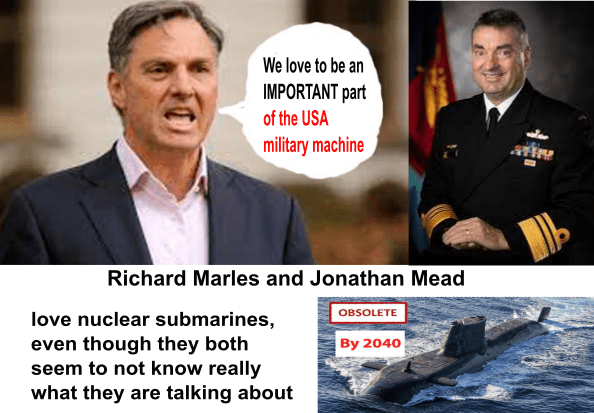
The gem in this whole venture, at least from the perspective of the U.S. military-industrial complex, is the roping in of the Australian taxpayer as the funder of its own nuclear weapons program.
By Binoy Kampmark | 6 January 2024. https://independentaustralia.net/politics/politics-display/funding-the-imperium-australia-subsidises-us-nuclear-submarines,18217
AUKUS, the trilateral pact between the United States, the United Kingdom and Australia, was a steal for all except one of the partners.
Australia, given the illusion of protection even as its aggressive stance (acquiring nuclear-powered submarines, becoming a forward base for the U.S. military) aggravated other countries; the feeling of superiority, even as it was surrendering itself to a foreign power as never before, was the loser in the bargain.
Last month, Australians woke up to the sad reminder that their government’s capitulation to Washington has been so total as to render any further talk about independence an embarrassment. Defence Minister Richard Marles, along with his deputy, Minister for Defence Industry Pat Conroy, preferred a different story.
Canberra had gotten what it wanted: approval by the U.S. Congress through its 2024 National Defense Authorisation Act (NDAA) authorising the transfer of three Virginia class nuclear-powered submarines to the Royal Australian Navy, with one off the production line, and two in-service boats. Australia may also seek congressional approval for two further Virginia class boats.
The measures also authorised Australian contractors to train in U.S. shipyards to aid the development of Australia’s own non-existent nuclear-submarine base, and exemptions from U.S. export control licensing requirements permitting the ‘transfer of controlled goods and technology between Australia, the United Kingdom, and the United States without the need for an export license’.
For the simpleminded Marles, Congress had “provided unprecedented support to Australia in passing the National Defense Authorisation Act which will see the transfer of submarines and streamlined export control provisions, symbolising the strength of our Alliance, and our shared commitment to the AUKUS partnership”.
Either through ignorance or wilful blindness, the Australian Defence Minister chose to avoid elaborating on the less impressive aspects of the authorising statute. The exemption under the U.S. export licensing requirements, for instance, vests Washington with control and authority over Australian goods and technology while controlling the sharing of any U.S. equivalent with Australia. The exemption is nothing less than appropriation, even as it preserves the role of Washington as the drip feeder of nuclear technology.
An individual with more than a passing acquaintance with this is Bill Greenwalt, one of the drafters of the U.S. export control regime.
As he told the ABC last November:
“After years of U.S. State Department prodding, it appears that Australia signed up to the principles and specifics of the failed U.S. export control system.”
In cooperating with the U.S. on this point, Australia would “surrender any sovereign capability it develops to the United States control and bureaucracy”.
The gem in this whole venture, at least from the perspective of the U.S. military-industrial complex, is the roping in of the Australian taxpayer as the funder of its own nuclear weapons program. Whatever its non-proliferation credentials, Canberra finds itself a funder of the U.S. naval arm in an exercise of modernised nuclear proliferation.
Even the Marles-Conroy media release admits that the NDAA helped ‘establish a mechanism for the U.S. to accept funds from Australia to lift the capacity of the submarine industrial base’. Airily, the release goes on to mention that this “investment” (would “gift” not be a better word?) to the U.S. Navy would also ‘complement Australia’s significant investment in our domestic submarine industrial base’.
A few days after the farcical spectacle of surrender by Australian officials, the Congressional Research Service provided another one of its invaluable reports that shed further light on Australia’s contribution to the U.S. nuclear submarine program. Australian media outlets, as is their form on covering AUKUS, remained silent about it. One forum, Michael West Media, showed that its contributors – Rex Patrick and Philip Dorling – were wide awake.
The report is specific to the Navy Columbia (SSBN-826) Class Ballistic Missile Submarine Program, one that involves designing and building 12 new SSBNs to replace the current, aging fleet of 14 Ohio class SSBNs. The cost of the program, in terms of 2024 budget submission estimates for the 2024 financial year, is US$112.7 billion (AU$168.2 billion).
As is customary in these reports, the risks are neatly summarised. They include the usual delays in designing and building the lead boat, thereby threatening readiness for timely deployment; burgeoning costs; the risks posed by funding the Columbia class program to other Navy programs; and ‘potential industrial-base challenges of building both Columbia-class boats and Virginia-class attack submarines (SSNs) at the same time’.
Australian funding becomes important in the last concern. Because of AUKUS, the U.S. Navy “has testified” that it would require, not only an increase in the production rate of the Virginia class to 2.33 boats per year, but ‘a combined Columbia-plus-Virginia procurement rate’ of 1+2.33. Australian mandarins and lawmakers, accomplished in their ignorance, have mentioned little about this addition.
But U.S. lawmakers and military planners are more than aware that this increased procurement rate:
‘…will require investing several billion dollars for capital plant expansion and improvements and workforce development at both the two submarine-construction shipyards (GD/EB [General Dynamics’ Electric Boat in Groton, Connecticut] and HII/NSS [Huntington Ingalls Industries’ Newport News Shipbuilding]) and submarine supplier firms.’
The report acknowledges that funding towards the 1+2.33 goal is being drawn from several allocations over a few financial years, but expressly mentions Australian funding ‘under the AUKUS proposed Pillar 1 pathway’, which entails the transfer component of nuclear-powered submarines to Canberra.
The report helpfully reproduces the 25 October 2023 testimony from the Navy before the Seapower and Projection Forces Subcommittee of the House of Armed Services Committee. Officials are positively salivating at the prospect of nourishing the domestic industrial base through, for instance, ‘joining with an Australian company to mature and scale metallic additive manufacturing across the SIB [Submarine Industrial Base]’.
The testimony goes on to note that:
‘Australia’s investment into the U.S. SIB builds upon ongoing efforts to improve industrial base capability and capacity, create jobs, and utilise new technologies. This contribution is necessary to augment VACL [Virginia class] production from 2.0 to 2.33 submarines per year to support both U.S. Navy and AUKUS requirements.’
The implications from the perspective of the Australian taxpayer are significant.
‘Australian AUKUS funding will support construction of a key delivery component of the U.S. nuclear strike force, keeping that program on track while overall submarine production accelerates.’
The funding also aids the advancement of another country’s nuclear weapons capabilities, a breach, one would have thought, of Australia’s obligations under the Treaty of Non-Proliferation of Nuclear Weapons.
Defence spokesman for the Australian Greens, Senator David Shoebridge, makes that very point to Patrick and Dorling:
“Australia has clear international legal obligations to not support the nuclear weapons industry, yet this is precisely what these billions of dollars of AUKUS funding will do.”
The Senator also asks:
“When will the Albanese Government start telling the whole truth about AUKUS and how Australians will be paying to help build the next class of U.S. ballistic missile submarines?”
For an appropriate answer, Shoebridge would do well to consult the masterful, deathless British series Yes Minister, authored by Antony Jay and Jonathan Lynn.
In one episode, the relevant minister, Jim Hacker, offers this response to a query by the ever-suspicious civil service overlord Sir Humphrey Appleby on when he might receive a draft proposal:
“At the appropriate juncture. In the fullness of time. When the moment is ripe. When the necessary procedures have been completed. Nothing precipitate, of course.”
In one word: never.
CNN staff say network’s pro-Israel slant amounts to ‘journalistic malpractice’

The push for more balanced coverage has been complicated by Israel’s block on foreign journalists entering Gaza except under IDF control and subject to censorship. That has helped keep the full impact of the war on Palestinians off of CNN and other channels while ensuring that there is a continued focus on the Israeli perspective.
Insiders say pressure from the top results in credulous reporting of Israeli claims and silencing of Palestinian perspectives
Insiders say pressure from the top results in credulous reporting of Israeli claims and silencing of Palestinian perspectives
Guardian, Chris McGreal, 4 Feb 24
CNN is facing a backlash from its own staff over editorial policies they say have led to a regurgitation of Israeli propaganda and the censoring of Palestinian perspectives in the network’s coverage of the war in Gaza.
Journalists in CNN newsrooms in the US and overseas say broadcasts have been skewed by management edicts and a story-approval process that has resulted in highly partial coverage of the Hamas massacre on 7 October and Israel’s retaliatory attack on Gaza.
“The majority of news since the war began, regardless of how accurate the initial reporting, has been skewed by a systemic and institutional bias within the network toward Israel,” said one CNN staffer. “Ultimately, CNN’s coverage of the Israel-Gaza war amounts to journalistic malpractice.”
According to accounts from six CNN staffers in multiple newsrooms, and more than a dozen internal memos and emails obtained by the Guardian, daily news decisions are shaped by a flow of directives from the CNN headquarters in Atlanta that have set strict guidelines on coverage.
They include tight restrictions on quoting Hamas and reporting other Palestinian perspectives while Israel government statements are taken at face value. In addition, every story on the conflict must be cleared by the Jerusalem bureau before broadcast or publication.
CNN journalists say the tone of coverage is set at the top by its new editor-in-chief and CEO, Mark Thompson, who took up his post two days after the 7 October Hamas attack. Some staff are concerned about Thompson’s willingness to withstand external attempts to influence coverage given that in a former role as the BBC’s director general he was accused of bowing to Israeli government pressure on a number of occasions, including a demand to remove one of the corporation’s most prominent correspondents from her post in Jerusalem in 2005.
CNN insiders say that has resulted, particularly in the early weeks of the war, in a greater focus on Israeli suffering and the Israeli narrative of the war as a hunt for Hamas and its tunnels, and an insufficient focus on the scale of Palestinian civilian deaths and destruction in Gaza.
One journalist described a “schism” within the network over coverage they said was at times reminiscent of the cheerleading that followed 9/11.
“There’s a lot of internal strife and dissent. Some people are looking to get out,” they said.
Another journalist in a different bureau said that they too saw pushback.
“Senior staffers who disagree with the status quo are butting heads with the executives giving orders, questioning how we can effectively tell the story with such restrictive directives in place,” they said.
“Many have been pushing for more content from Gaza to be alerted and aired. By the time these reports go through Jerusalem and make it to TV or the homepage, critical changes – from the introduction of imprecise language to an ignorance of crucial stories – ensure that nearly every report, no matter how damning, relieves Israel of wrongdoing.”
CNN staff say that some journalists with experience of reporting the conflict and region have avoided assignments in Israel because they do not believe they will be free to tell the whole story. Others speculate that they are being kept away by senior editors.
“It is clear that some who don’t belong are covering the war and some who do belong aren’t,” said one insider.
Edicts from on high
………………. In late October, as the Palestinian death toll rose sharply from Israeli bombing with more than 2,700 children killed according to the Gaza health ministry, and as Israel prepared for its ground invasion, a set of guidelines landed in CNN staff inboxes.
……………….CNN staff members said the memo solidified a framework for stories in which the Hamas massacre was used to implicitly justify Israeli actions, and that other context or history was often unwelcome or marginalised.
“How else are editors going to read that other than as an instruction that no matter what the Israelis do, Hamas is ultimately to blame? Every action by Israel – dropping massive bombs that wipe out entire streets, its obliteration of whole families – the coverage ends up massaged to create a ‘they had it coming’ narrative,” said one staffer.
The same memo said that any reference to casualty figures from the Gaza health ministry must say it is “Hamas-controlled”, implying that reports of the deaths of thousands of children were unreliable even though the World Health Organization and other international bodies have said they are largely accurate. CNN staff said that edict was laid down by Thompson at an earlier editorial meeting.
Broader oversight of coverage from the CNN headquarters in Atlanta is directed by “the Triad” of three CNN departments: news standards and practices, legal and fact-checking.
David Lindsay, the senior director of news standards and practices, issued a directive in early November effectively barring the reporting of most Hamas statements, characterising them as “inflammatory rhetoric and propaganda”.
………. one CNN staffer noted that the network repeatedly aired inflammatory rhetoric and propaganda from Israeli officials and American supporters, often without challenge in interviews.
They noted that other channels have carried interviews with Hamas leaders while CNN has not, including one in which the group’s spokesman, Ghazi Hamad, cut short questions from the BBC when he was challenged about the murder of Israeli civilians. One staffer said there is a view among correspondents that it is “agony to get a Hamas interview past the Triad
…………………………………………………….. In addition to the edicts from Atlanta, CNN has a longstanding policy that all copy on the Israel-Palestine situation must be approved for broadcast or publication by the Jerusalem bureau. In July, the network created a process it called “SecondEyes” to speed up those approvals.
…………… One result of SecondEyes is that Israeli official statements are often quickly cleared and make it on air on the principle that that they are to be trusted at face value, seemingly rubber-stamped for broadcast, while statements and claims from Palestinians, and not just Hamas, are delayed or never reported.
One CNN staffer said edits by SecondEyes often seemed aimed at avoiding criticism from pro-Israel groups……………………………..
Some CNN staff fear that the result is a network acting as a surrogate censor on behalf of the Israeli government.
“The system results in chosen individuals editing any and all reporting with an institutionalised pro-Israel bias, often using passive language to absolve the [Israel Defense Forces] of responsibility, and playing down Palestinian deaths and Israeli attacks,” said one of the network’s journalists.
……………………………………………………………. Another presenter, Sara Sidner, drew criticism for her excitable report on unverified Israeli claims that Hamas beheaded dozens of babies on 7 October.
“We have some really disturbing new information out of Israel,” she announced four days after the attack.
“The Israeli prime minister’s spokesman just confirmed, babies and toddlers were found with their heads decapitated in Kfar Aza in southern Israel after Hamas attacks in the kibbutz over the weekend. That has been confirmed by the prime minister’s office.”
………………… Gold, who was part of the SecondEyes team approving stories, again said the report had been confirmed by Netanyahu’s office and she drew parallels with the Holocaust. She responded to a Hamas denial that it had decapitated babies as unbelievable “when we literally have video of these guys, of these militants, of these terrorists doing exactly what they say they’re not doing to civilians and to children”.
Except, as a CNN journalist pointed out, the network did not have such video and, apparently, neither did anyone else………………………………….
By the time of Sidner’s broadcast there were already good reasons for CNN to treat the claims with caution.
Israeli journalists who toured Kfar Aza the day before said they had seen no evidence of such a crime and military officials there had made no mention of it. Instead, Tim Langmaid, the Atlanta-based CNN vice-president and senior editorial director, sent an instruction that President Biden’s claims to have seen pictures of the alleged atrocity “back up what the Israeli government said”.
…….. CNN insiders said senior editors should have treated the story with caution from the beginning because the Israeli military has a track record of false or exaggerated claims that subsequently fall apart.
Other networks, such as Sky News, were considerably more sceptical in their reporting and laid out the tenuous origins of the story, which began with a reporter for an Israeli news channel saying soldiers had told her that 40 children had been killed in the Hamas massacre and that one soldier had said he had seen “bodies of babies with their heads cut off”. The Israel Defense Forces (IDF) then used the claim to liken Hamas to the Islamic State.
Even after the White House admitted that neither the president nor his officials had themselves seen pictures of beheaded babies, and that they had been relying on Israeli claims, Langmaid told the newsroom it could still report the Israeli government assertions alongside a denial from Hamas.
CNN did report on the rolling back of the claims as Israeli officials backtracked, but one staffer said that by then the damage had been done, describing the coverage as a failure of journalism.
“The infamous ‘beheaded babies’ claim, attributed to the Israeli government, made it to air for roughly 18 hours – even after the White House walked back on Biden’s statement that he had seen the nonexistent photos. CNN had no access to photographic evidence, nor any ability to independently verify these claims,” they said.
……….. Some CNN staff raised similar issues with reporting on Hamas tunnels in Gaza and claims they led to a sprawling command centre under al-Shifa hospital.
The push for more balanced coverage has been complicated by Israel’s block on foreign journalists entering Gaza except under IDF control and subject to censorship. That has helped keep the full impact of the war on Palestinians off of CNN and other channels while ensuring that there is a continued focus on the Israeli perspective………………………………
The only foreign journalist to report from Gaza without an Israeli escort has been CNN’s Clarissa Ward, who entered for two hours with a humanitarian team from the United Arab Emirates.
……………. she was being prevented from conveying a fuller picture of the tragedy unfolding in Gaza because of the Israeli block on foreign journalists, putting the burden solely on a limited number of courageous Palestinian reporters who are being killed in disproportionate numbers.
“We must now be able to report on the horrific death and destruction being meted out in Gaza in the same way – on the ground, independently – amid one of the most intense bombardments in the history of modern warfare,” she wrote.
“The response to our report on Gaza in Israeli media suggests an unspoken reason for denying access. When asked on air about our piece, one reporter from the Israeli Channel 13 replied, ‘If indeed Western reporters begin to enter Gaza, this will for sure be a big headache for Israel and Israeli hasbara.’ Hasbara is a Hebrew word for pro-Israel advocacy.
Some at CNN fear that its coverage of the latest Gaza war is damaging a reputation built up by its reporting of Russia’s invasion of Ukraine, which led to a surge in viewers. But others say that the Ukraine war may be part of the problem because editorial standards grew lax as the network and many of its journalists identified clearly with one side – Ukraine – particularly at the beginning of the conflict.
One CNN staffer said that Ukraine coverage set a dangerous precedent that has come back to haunt the network because the Israeli-Palestinian conflict is far more divisive and views are much more deeply entrenched.
“The complacency in our editorial standards and journalistic integrity while reporting on Ukraine has come back to haunt us. Only this time, the stakes are higher and the consequences much more severe. Journalistic complacency is an easier pill for the world to swallow when it’s Arab lives lost instead of European,” they said.
Another CNN employee said the double standards are glaring…………………………………………………
Years of pressure
Journalists working at CNN have varied explanations……………………………………………………….. more https://www.theguardian.com/media/2024/feb/04/cnn-staff-pro-israel-bias
Distorted news: for decades CNN, BBC, and surely others, obeyed Israeli government pressure

Guardian, Chris McGreal, 4 Feb 24
“…………………………………………………..Years of pressure
Journalists working at CNN have varied explanations.
Some say the problem is rooted in years of pressure from the Israeli government and allied groups in the US combined with a fear of losing advertising.
During the battle for narrative through the second Palestinian intifada in the early 2000s, Israel’s then communications minister, Reuven Rivlin, called CNN ‘‘evil, biased and unbalanced”. The Jerusalem Post likened the network’s correspondent in the city, Sheila MacVicar, to “the woman who refilled the toilet paper in the Goebbels’ commode”.
CNN’s founder, Ted Turner, caused a storm when he told the Guardian in 2002 that Israel was engaging in terrorism against the Palestinians.
“The Palestinians are fighting with human suicide bombers, that’s all they have. The Israelis … they’ve got one of the most powerful military machines in the world. The Palestinians have nothing. So who are the terrorists? I would make a case that both sides are involved in terrorism,” said Turner, who was then the vice-chairman of AOL Time Warner, which owned CNN.
The resulting storm of protest resulted in threats to the network’s revenue, including moves by Israeli cable television companies to supplant the network with Fox News.
CNN’s chair, Walter Isaacson, appeared on Israeli television to denounce Turner but that did not stem the criticism. The network’s then chief news executive, Eason Jordan, imposed a new rule that CNN would no longer show statements by suicide bombers or interview their relatives, and flew to Israel to quell the political storm.
CNN also began broadcasting a series about the victims of Palestinian suicide bombers. The network insisted that the move was not a response to pressure but some of its journalists were sceptical. CNN did not produce a similar series with the relatives of innocent Palestinians killed by Israel in bombings.
By 2021, the Columbia Journalism Review public editor for CNN, Ariana Pekary, accused the network of excluding Palestinian voices and historical context from coverage.
Thompson has his own battle scars from dealing with Israeli officials when he was director general of the BBC two decades ago.
In the spring of 2005, the BBC was embroiled in a very public row over an interview with the Israeli nuclear whistleblower Mordechai Vanunu, who was released from prison the year before.
The Israeli authorities barred Vanunu from giving interviews. When a BBC documentary team spoke to him and then smuggled the footage out of Israel, the authorities reacted by effectively expelling the acting head of the BBC’s Jerusalem bureau, Simon Wilson, who was not involved in the interview.
The dispute rolled on for months before the BBC eventually bowed to an Israeli demand that Wilson write a letter of apology before he could return to Jerusalem. The letter, which included a commitment to “obey the regulations in the future”, was to have remained confidential but the BBC unintentionally posted details online before removing them a few hours later. The climbdown angered some BBC journalists who were enduring persistent pressure and abuse for their coverage.
Later that year, Thompson visited Jerusalem and met the Israeli prime minister, Ariel Sharon, in an effort to improve relations after other incidents.
The Israeli government was particularly unhappy with the BBC’s highly experienced Jerusalem correspondent, Orla Guerin. The Israeli minister for diaspora affairs at the time, Natan Sharansky, accused her of antisemitism and “total identification with the goals and methods of the Palestinian terror groups” after a report by Guerin about the arrest of a 16-year-old Palestinian boy carrying explosives. She accused Israeli officials of turning the arrest into a propaganda opportunity because they “paraded the child in front of the international media” after forcing him to wait at a checkpoint for the arrival of photographers.
Within days of Thompson’s meeting with Sharon, the BBC announced that Guerin would be leaving Jerusalem. At the time, Thompson’s office denied he acted under pressure from Israel and said that Guerin had completed a longer than usual posting. https://www.theguardian.com/media/2024/feb/04/cnn-staff-pro-israel-bias
Nuclear news – week to 6th February

Some bits of good news . Heroes in pink: Lao midwives supporting rights and saving lives Zimbabwe launches cholera vaccination to curb the spread. Wild panda population nearly doubles as China steps up conservation efforts.
TOP STORIES.
- EDF’s Hinkley Point woes pile pressure on global nuclear push. also at https://nuclear-news.net/2024/02/04/2-a-edfs-hinkley-point-woes-pile-pressure-on-global-nuclear-push/
- Nuclear Waste: Changing Conditions May Affect Future Management of Contamination Deposited Abroad During U.S. Cold War Activities.
- The new space race Is Causing New Pollution Problems. also at https://nuclear-news.net/2024/02/03/1-a-the-new-space-race-is-causing-new-pollution-problems/
- AI chatbots tend to choose violence and nuclear strikes in wargames
Climate. Greta Thunberg’s public order charge dropped as judge criticises police action. Greta Thunberg was given ‘final warning’ before London arrest.
Nuclear. I’m still trying to stay off the Israel-Gaza topic. But it is all bringing us closer to nuclear war.
Noel’s notes. Goodbye Mastodon! The power of the Zionist lobby. Mastodon has closed me down again – this time for supporting United Nations Relief and Works Agency for Palestine Refugees in the Near East (UNRWA). WHAT’S GOING ON? How very unfashionable! Scottish MP is worrying about health aspects of nuclear power, (instead of the finances!) What’s the connection between the UK Post Office scandal and Soviet Lt. Col. Stanislav Petrov?
*****************************************************************************
AUSTRALIA. Australian Conservation Foundation is seriously concerned about the AUKUS nuclear submarine project, its costs and consequences and the way this initiative is being advanced. Expect weapons-grade NIMBYism as leaders fight over where to store AUKUS nuclear waste. Australian Sailors Embed Aboard Submarine Tender for Nuclear Experience.
| CLIMATE. COP28 pledge to expand nuclear capacity is out of touch with reality. | CIVIL LIBERTIES. A Radically Different World Since Assange’s Indictment. https://www.youtube.com/watch?v=egLJ3-jF1Uo | ECONOMICS. UK’s Nuclear “money pit” tops $59 billion. EDF, France’s state-owned nuclear company now in a fatal trap, as Hinkley Point C costs soar. Is this the World’s Most Expensive and Most Delayed Power Project? Are the French going cold on UK nuclear? France limits its investment in Britain’s Sizewell C, as the global nuclear industry requires massive government subsidies. Many challenges [? big problems] [? big problems] stand in the way of a ‘nuclear power renaissance’ Czech Republic / Government Seeks Binding Tenders For Four Nuclear Reactors From EDF And KHNP. |
| ENERGY. German energy companies reject nuclear energy proposals – citing high risks and toxic waste problem . Tripling nuclear energy by 2050 will take a miracle, and miracles don’t happen. | ENVIRONMENT. ‘Odd’ Hinkley Point C salt marsh plan has Somerset locals up in arms. | HEALTH. Man suffered most painful death imaginable after horror accident made him ‘cry blood’ and ‘skin melted’. Sellafield nuclear plant: Cancer fears raised by Scottish MP. |
| INDIGENOUS ISSUES. Tell it to the Chieftain: Nuclear power plants, and Is advanced nuclear a pipe dream? | LEGAL. Holtec International avoids criminal prosecution related to false documents, pays $5m fine. US Court Hears Case Alleging Biden Complicit in Israel’s Genocide in Gaza. The provisional measures of the International Court of Justice. What Happens Now That the ICJ Has Ordered Israel Not to Engage in Genocide? | MEDIA. Neck Deep in the Big Media Mudd |
| OPPOSITION to NUCLEAR . MP calls for vote on Holderness nuclear site which local petition brands ‘hazardous waste dumping ground’. It’s not a done deal and you are not alone’: anti-GDF campaigners pledge solidarity with South Holderness over nuclear waste dump plan. South Holderness nuclear waste plan not safe – residents. Blackwater Against New Nuclear Group (BANNG) firmly contradicts Therese Coffey, MP on Bradwell as a nuclear site. Campaigners Warn Return of US Nukes to UK Would ‘Make Britain a Guaranteed Target’. | POLITICS. Nancy Pelosi’s attack on Gaza ceasefire advocates is a disgrace. Holtec to get $1.5 bln loan to re-open Michigan nuclear power plant -source, The Future of Pickering Nuclear Generating Station and Its Impacts on Ontario. Ford Government Issues Blank Cheque for Nuclear Power, Shows Reckless Disregard for Nuclear Waste Generation . How not to go nuclear: Hinkley and Sizewell. Hinkley C – don’t say I didn’t warn you!- (a pro-nuclear view!) UK govt awards Hitachi £33.6 m to design small nuclear reactors. UK govt designates British Nuclear Fuels Ltd as Great British Nuclear (…..whatever this means). Hinkley Point shambles shows why UK must scrap disastrous nuclear strategy. Cracks appear in Labour-Green alliance over claims that Heysham power stations letter was ‘reckless’. |
| POLITICS INTERNATIONAL and DIPLOMACY. France seeks loan guarantees from UK over Hinkley Point C nuclear plant. The feckless four – hypocrisy of the nuclear weapons nations. French firm EDF shows its power over the UK govt – no judicial review now required over fish protection from Hinkley nuclear cooling system | SAFETY. Safety concerns persist at Ukraine’s Zaporizhzhya Nuclear Power Plant . France’s ASN nuclear safety authority warns of fraud risk in nuclear industry.Britain plans ‘robocop’ force to protect nuclear sites with paint bombs. Canadian Environmental Law Association (CELA) Disappointed in Province’s Decision on Pickering Nuclear Plant. Residents ask for full examination of damage to nuclear plant caused by quake. Magnitude-4.8 earthquake jolts Tokyo and the Kanto region. | SECRETS and LIES. Military-Intelligence Corruption Information Center. As Ukraine begs for more weapons, corruption in its Defense Ministry is revealed. Chinese nuclear fuel engineer Li Guangchang caught in anti-corruption net targeting ‘high-risk’ areas. |
| SPACE. EXPLORATION, WEAPONS. Nuclear industry takes control of NASA https://www.youtube.com/watch?v=kRZnSkC-nXg Nuclear power on the moon: NASA wraps up 1st phase of ambitious reactor project. | SPINBUSTER. Ontario counts nuclear power as “Green”. | TECHNOLOGY. Advanced nuclear power is costly and tech is still developing: Is a Pueblo plant realistic:? Will AI Warfare Usher in a Massive Expansion of the Surveillance State? https://www.youtube.com/watch?v=aLBrP084X5Y Blade hub idea for old n-plant site. |
| WASTES. USA’s Waste Isolation Pilot Plant to increase its space for nuclear trash. VINCI wins contract to dismantle nuclear reactors in Sweden. Strong opposition on plans to store nuclear waste in East Yorkshire | WAR and CONFLICT. US unleashes strikes across Middle East. The U.S. Quest for Nuclear Primacy | WEAPONS and WEAPONS SALES. US reportedly planning to station nuclear weapons in Britain for first time in 15 years. Documents unambiguously state ‘incoming nuclear mission’ to Britain. RAF Lakenheath: Plans progress to bring US nuclear weapons to Suffolk – a risky target? Britain will test fire Trident nuclear missile for the first time since 2016 as fears of World War Three grow.Russia has no plans to deploy nuclear arms beyond Belarus, says deputy minister. NATO chief says more war, more weapons, are the way to secure lasting peace in Ukraine. Democrats press Blinken on arms sales to Israel without congressional approval. U.S. Congress about to weaken its oversight of weapons sales to foreign countries. Could a Rogue Billionaire Make and Sell a Nuclear Weapon?. |
Australian Conservation Foundation is seriously concerned about the AUKUS nuclear submarine project, its costs and consequences and the way this initiative is being advanced.

Submission to the Senate Foreign Affairs, Defence and Trade Legislation Committee – Inquiry into the Australian Naval Nuclear Power Safety Bill 2023
ACF and AUKUS
ACF holds serious concerns around the AUKUS nuclear submarine project, its costs and consequences and the way this initiative is being advanced…..
ACF’s focus in this submission is on the environmental ramifications of AUKUS in Australia. The submission starts from the premise a regulatory system of some kind related to AUKUS in Australia will be adopted by Federal Parliament. The submission identifies gaps in the regime and issues that require further consideration and provides practical recommendations for improvement
Summary
– ACF’s is deeply concerned with the Bill’s potential for approval to be granted for the storage in Australia of high-level radioactive waste from submarines operated by other countries.
– The safety of the Australian public should be the paramount concern here. The Bill’s proposed objects do not adequately reflect this. The objects need to be expanded.
– The current drafting does not provide for any meaningful community information, consultation or reporting. The principles of open government and accountability would suggest that the default position ought to be that information will be available but permit exceptions based on regulations or ministerial discretion.
– The current drafting permits abrogation of responsibility by Commonwealth entities. Non-government third parties (e.g. contractors) could be solely responsible for compliance with the relevant duties. This could include organisations based outside Australia. Given the nature of the risk, Commonwealth entities should be subject to ongoing responsibility, regardless of contractual arrangements.
– The Bill proposes a compliance regime which would make enforcement of the nuclear safety duty problematic. The use of “as far as reasonably practicable” is rare in the criminal offence context and should not be used in the context of nuclear safety.
– Licences ought only to be issued to entities that have demonstrated capability and record and reputation for meeting their regulatory obligations. A requirement that licences only be issued to entities that are a fit and proper person should be included.
Other issues addressed in this submission are:
– Consent considerations and the UN Declaration on the Rights of Indigenous Peoples
– Nuclear Non-Proliferation Treaty
– A Nuclear Industry by Stealth?
– Disregard of advice from ARPANSA’s Radiation Health and Safety Advisory Council
– Clarification on Relationship of New Regulator with Existing Agencies
Summary of Recommendations
1. The Bill be amended to ensure that it only provides for the licencing of radioactive waste storage facilities for HLW from Australian submarines.
2. The Federal Government develop an open approach to future HLW management in Australia that is informed by the wider consideration of domestic ILW (intermediate-level waste) management.
3. That the objects of the Bill be redrafted to address protection of a range of people and the environment, and transparency of information and decision-making and accountability of the Government.
4. That the Bill be amended to improve transparency by requiring, subject to national security exceptions, public notification of applications and decisions, a public register of key applications and decisions and mandatory reporting requirements. The Committee should consider principles of open government and comparable regulatory regimes in developing its detailed recommendations to improve transparency.
5. That the Bill be amended to establish a clear-cut obligation to ensure nuclear safety and then provide a defence if the defendant can demonstrate that they exercised due diligence and took all reasonably practicable precautions.
6. That the Bill be amended to recognise and reflect the foundational management principle of free, prior and informed consent (FPIC).
7. That the Bill be amended to ensure the Commonwealth cannot contract out of liability in relation to compliance with the duties on licence holders created by the Bill. A mechanism should be included to ensure the Commonwealth bears responsibility in relation to nuclear safety for the actions of a contractor who holds a licence.
8. That the Bill be amended to ensure the definition of Commonwealth Contractor does not include sub-contractors to a Commonwealth sub-contractor.
9. That the Bill be amended such that the responsibility of each person in the supply chain or logistics chain is expressed, including in terms of the duties and incident reporting, in a manner similar to the National Heavy Vehicle Laws and Work Health and Safety Laws
10. That the Bill be amended to include a requirement that licences only be issued to entities that are a fit and proper persons similar to the Protection from Harmful Radiation Act 1990 (NSW) or Protection of the Environment (Operations) Act 1997 (NSW).
11. That the Committee request ARPANSA’s Radiation Health and Safety Advisory Council give evidence and consider the divergence of the Bill from the Council’s 2022 advice to the ARPANSA CEO.
12. The Committee recommend the ARPANS Act exclusion be modified or removed.
13. The Committee take evidence from the Department on, and consider, the interaction between the new regulatory regime, ARPANSA and potentially relevant state and territory regulatory controls.
14. The Committee consider amendments to provide for a formal means of contact between ARPANSA and the new regulator. This could include a formal position with the new regulator of the requirement to consider ARPANSA guidance materials.
High-Level Radioactive Waste from Other Countries
The AUKUS initiative brings a profound elevation in the cost, complexity and challenges of radioactive waste management in Australia through the introduction of High-Level Waste (HLW)0F1. This material needs to be securely isolated from people and the wider environment for periods of up to 100,000 years.1F2
The AUKUS initiative brings a profound elevation in the cost, complexity and challenges of radioactive waste management in Australia through the introduction of High-Level Waste (HLW)0F1. This material needs to be securely isolated from people and the wider environment for periods of up to 100,000 years.1F2
Speaking on the ABC in March 2023 Defence Minister Marles stated:
We are making a commitment that we will dispose of the nuclear reactor. That is a significant commitment to make. This is going to require a facility to be built in order to do that disposal, obviously that facility will be remote from populations, and today we are announcing that that facility will be on Defence land, current or future.
Part of the AUKUS deal is that Australia must manage all radioactive waste generated by the submarines on Australian soil. Minister Richard Marles said this was a pre-condition for the whole program.
The ABC also reported that while the sole responsibility of the submarine nuclear waste disposal lies with Australia, the White House has promised the US and UK will help, quoting a White House representative:
The United Kingdom and the United States will assist Australia in developing this capability, leveraging Australia’s decades of safely and securely managing radioactive waste domestically.
At no point has a compelling case been made for why Australia should take responsibility for the management of this waste, especially in relation to waste arising from purchased secondhand US Virginia class submarines.
This lack of rationale was highlighted in an article by Kym Bergmann titled the Nightmare of Nuclear-powered Submarine Disposal in the July-August, 2023edition of the Asia-Pacific Defence Reporter (APDR):
Why Australia has committed to this expensive process, hazardous to human life is unknown. In summary form, we will need to put in place facilities for the following:
• To remove the fuel from the sub.
• To store the recently removed fuel in pools of water.
• To transfer the fuel from the pools to dry casks.
• To store the dry casks on an interim basis.
• To permanently dispose of the spent fuel deep underground.
• To permanently dispose of the rest of the reactor (excluding the fuel).
It is unknown whether the estimated project cost of $368 billion covers this. It is unknown where the facilities will be built. It is unknown whether the decommissioning of submarines
will occur at their east coast base. In addition, the U235 will have to be in a secure location and then guarded forever to prevent its theft for conversion into weapons.
APDR went on to ask:
One of the many mysteries around the AUKUS deal is why Australia has agreed to disposing of the Virginia class submarines here. Surely the logical thing would be to have an agreement where the US took them back at the end of their lives and decommissioned them using their well established procedures.
Who benefits from compelling Australia to develop our own waste disposal industry? Why not lease the used Virginia class subs rather than purchase them outright?
To this can be added the mystery of why agree to second hand submarines at all?………………………………………………………………………………………………………………………………………………………………….
Goodbye Mastodon! The power of the Zionist lobby

“ mastodon.social
Appeal rejected
Your appeal has been rejected.
The appeal of the strike against your account on Feb 04, 2024, 21:48 UTC that you submitted on Feb 04, 2024, 22:06 UTC has been rejected.”

Well – to say that this is a disappointment to me – would be an understatement.
I thought that Mastodon was really good – as I abandoned my Twitter account, with Twitter taken over by the dangerous, unpredictable, and possibly unhinged Elon Musk.
Here was I, thinking that people that first got me closed down on Mastodon were the nuclear lobby.
Now it’s clear that the Zionist lobby is behind it .
I have been expelled from Mastodon because I posted a link to an article supporting humanitarian aid to Gaza.
The Zionist doctrine is that returning humanitarian aid to the people of Gaza is “incitement of violence or promotion of violent ideologies”
When is the world going to wake up to this absurdity?
The extreme Jews see any kindness to the desperate people of Gaza as anti-semitism.
They can get away with murder – because they’re always the victim?
Intelligent, thinking, compassionate, Jews must be in turmoil over this perversion of their religion and culture.
Meanwhile Christians, others, and secular people are buying into this charade that compassion = anti-semitism. The Western world is in a horrible ethical crisis – worse that in the 1930s, when it was not clearly apparent that the genocide of the Holocaust was happening. Now, everybody knows that Netanyahu and co are massacring Palestinians.
How long are these killers going to be able to hide behind the Holocaust, and pretend that they are victims as they kill?
Mastodon has closed me down again – this time for supporting United Nations Relief and Works Agency for Palestine Refugees in the Near East (UNRWA). WHAT’S GOING ON?

NOEL WAUCHOPE, FEB 5, 2024
I appealed to Mastodon last time they shut me down, and they promptly restored me. Here’s hoping that they do this again!
Mastodon shut down my account , and sent me this message:
Your account @NoelWauchope@mastodon.social has been suspendedYou can no longer use your account, and your profile and other data are no longer accessible. You can still login to request a backup of your data until the data is fully removed in about 30 days, but we will retain some basic data to prevent you from evading the suspension.
Reason: Content violates the following community guidelines
- No incitement of violence or promotion of violent ideologies
Posts cited:
The West: guilty of genocide
Doing Goebbels proud #Israel #Palestine
I am a little bit amused, but more disturbed, that gmail also regards “The West: guilty of genocide” as a suspicious link.
I am finding that a lot of Substacks are “suspicious links”, according to gmail. Especially when anyone shows a bit of compassion for the Palestinians. What is going on?

And here is my appeal to Mastodon (They let you have only a couple of lines)
NoelWauchope Today at 08:06
The article that I posted was NOT an incitement of violence or promotion of violent ideologies. Quite the opposite, really. The theme of the article is that humanitarian aid should be returned to the people of Gaza. The writer claims that stopping United Nations Relief and Works Agency for Palestine Refugees in the Near East (UNRWA) is a breach of the Genocide Convention, quoting this point “Deliberately inflicting on the group conditions of life calculated to bring about its physical destr ( here’s where I was cut off - it would have continued – physical destruction in whole or in part)
TODAY. How very unfashionable! Scottish MP is worrying about health aspects of nuclear power, (instead of the finances!).

Really and truly ! Doesn’t he understand what the zeitgeist Is? (OK – I’m not really sure what zeitgeist means, anyway).
But the thing is. If you want to talk seriously about the nuclear industry, then you must just focus on the costs and the (supposed) financial benefits.
Nobody’s that interested in public health these days. it’s all about the money. Perhaps we should be grateful for this global obsession about money and profits. It’s the one thing that might stop this toxic industry.

MP Allan Dorans of Scotland has had the temerity to suggest that disturbance of the seabed on the Cumbrian coast might cause radioactivity from nuclear wastes to be transmitted up the food chain - increasing cancer risks.
Last year, the British Medical Journal aired a similar warning, about the cancer risks from low level ionising radiation – Cancer mortality after low dose exposure to ionising radiation in workers in France, the United Kingdom, and the United States.
But that story didn’t really catch on. And after all, with the increasing numbers of cancer cases, we’re all gonna need increased nuclear electricity for the medical technology - and nuclear power is supposed to be cheaper, isn’t it?
The feckless four – hypocrisy of the nuclear weapons nations

What do governments led by Rishi Sunak, Vladimir Putin, Emmanuel Macron and Kim Jong-un have in common?
Inside Story NIC MACLELLAN ,2 FEBRUARY 2024
Just three days before Christmas, the UN General Assembly adopted a resolution designed to assist survivors of nuclear testing and restore environments contaminated by nuclear weapons testing and use. Jointly developed by Kiribati and Kazakhstan, the resolution won overwhelming support, with 171 nations in favour, six abstentions and just four votes against.
It’s little surprise that five of the six abstentions came from nuclear weapon states: the United States, China, Israel, Pakistan and India (joined, oddly, by South Sudan). But in a dismaying display of power politics, France and Britain voted with Russia and North Korea to oppose assistance to people and landscapes irradiated during decades of nuclear testing.
Diplomats representing Western powers are prone to talk about “the international community,” “the rules-based order” and “democratic versus authoritarian states.” But on this occasion the jargon was undercut by the willingness of London and Paris to line up alongside Moscow and Pyongyang to avoid responsibility for past actions and to limit reparations.
With the International Court of Justice debating genocide in Ukraine, Myanmar and Palestine and UN agencies seeking to defend international humanitarian law, the hypocrisy of major powers has been polarising international opinion. Developing nations are increasingly challenging an international order that sanctions official enemies, at the same time as absolving major powers of the responsibility to deal with their own breaches of international law.
Over the past three years, ambassadors Teburoro Tito of Kiribati and Akan Rakhmetullin of Kazakhstan have coordinated international consultations on how the nuclear assistance provisions of the Treaty on the Prohibition of Nuclear Weapons, or TPNW, should be implemented. Articles 6 and 7 of the treaty, which entered into force in January 2021, include unprecedented obligations on parties to the treaty to aid nuclear survivors and contribute to environmental remediation.
Kiribati and Kazakhstan might seem an unlikely couple, but they have bonded over a common twentieth-century legacy. Both nations’ lands, waters and peoples have been devastated by cold war nuclear testing, and in each case the responsible countries refuse to take responsibility. Britain and Russia have bonded, too, but in their case, they’re united in their refusal to assist their former colonies.
After conducting twelve atmospheric atomic tests in Australia in 1952–57 — at the Monte Bello Islands, Emu Field and Maralinga — Britain sought a new location for developing and testing more powerful hydrogen bombs. During Operation Grapple, the British military conducted nine atmospheric thermonuclear tests at Malden and Christmas (Kiritimati) islands in the Gilbert and Ellice Islands Colony, which is today part of the Republic of Kiribati.
Just as Britain chose the “vast empty spaces” of the South Australian desert and the isolated atolls of Kiribati for its tests, Moscow sought similar expanses within the Union of Soviet Socialist Republics. Over more than four decades, it held 456 nuclear tests in the Semipalatinsk region of Kazakhstan. The history of Soviet testing in the Central Asian republic and its radioactive legacies, spread across more than 18,000 square kilometres, has been documented by Kazakh scholar Togzhan Kassenova in her compelling 2022 book Atomic Steppe.
Once the TPNW was adopted, Kiribati and Kazakhstan led efforts to develop mechanisms for dealing with the health and environmental effects of radioactive fallout. After seeking technical advice from survivors, nuclear scientists and UN agencies, they developed a set of proposals for action and a UN resolution seeking international support.
Now adopted by the UN General Assembly, that resolution proposes bilateral, regional and multilateral action and the sharing of technical and scientific information about nuclear legacies, and “calls upon Member States in a position to do so to contribute technical and financial assistance as appropriate.” It requires UN secretary-general Antonio Guterres to seek members’ views and proposals about assistance to nuclear survivors and report back to the General Assembly…………………………………………………. more https://insidestory.org.au/the-feckless-four/
The new space race Is Causing New Pollution Problems

NY Times, Ed Friedman Tue, 30 Jan 2024
The high-altitude chase started over Cape Canaveral on Feb. 17, 2023, when a SpaceX Falcon 9 rocket launched. Thomas Parent, a NASA research pilot, was flying a WB-57 jet when the rocket ascended past the right wing — leaving him mesmerized before he hit the throttle to accelerate.
For roughly an hour, Mr. Parent dove in and out of the plume in the rocket’s wake while Tony Casey, the sensor equipment operator aboard the jet, monitored its 17 scientific instruments. Researchers hoped to use the data to prove they could catch a rocket’s plume and eventually characterize the environmental effects of a space launch.
In the past few years, the number of rocket launches has spiked as commercial companies — especially SpaceX, founded by Elon Musk — and government agencies have lofted thousands of satellites into low-Earth orbit. And it is only the beginning. Satellites could eventually total one million, requiring an even greater number of space launches that could yield escalating levels of emissions.
SpaceX declined to comment about pollution from rockets and satellites. Representatives for Amazon and Eutelsat OneWeb, two other companies working toward satellite mega-constellations, said they are committed to sustainable operations. But scientists worry that more launches will scatter more pollutants in pristine layers of Earth’s atmosphere. And regulators across the globe, who assess some risks of space launches, do not set rules related to pollution.
Image
The exhaust plume from a SpaceX Falcon 9 rocket taking off from Vandenberg Air Force Base in California in 2018,Credit…Matt Hartman/Associated Press
Experts say they do not want to limit the booming space economy. But they fear that the steady march of science will move slower than the new space race — meaning we may understand the consequences of pollution from rockets and spacecraft only when it is too late. Already, studies show that the higher reaches of the atmosphere are laced with metals from spacecraft that disintegrate as they fall back to Earth.
“We are changing the system faster than we can understand those changes,” said Aaron Boley, an astronomer at the University of British Columbia and co-director of the Outer Space Institute. “We never really appreciate our ability to affect the environment. And we do this time and time again.”
……………………………… By the time a rocket curves into orbit, it will have dumped in the middle and upper layers of the atmosphere as much as two-thirds of its exhaust, which scientists predict will rain down and collect in the lower layer of the middle atmosphere, the stratosphere.
The stratosphere is home to the ozone layer, which shields us from the sun’s harmful radiation. But it is extremely sensitive: Even the smallest of changes can have enormous effects on it — and the world below.
………………………….Just how rockets will affect that relatively clear top, the stratosphere, remains uncertain. But scientists are concerned that black carbon, or soot, that is released from current rockets will act like a continuous volcanic eruption, a change that could deplete the ozone layer and affect the Earth below.
……………………………………………… A Race Against the Space Race
As space companies set records for launches and satellites deployed, scientists are starting to quantify the potential effects.
In a paper published in 2022, soot from rockets was shown to be nearly 500 times as efficient at heating the atmosphere as soot released from sources like airplanes closer to the surface. It’s the muddy-barrel effect.
“That means that as we start to grow the space industry and launch more rockets, we’re going to start to see that effect magnify very quickly,” said Eloise Marais, an associate professor in physical geography at University College London and an author of the study.
That said, Dr. Maloney’s team did not quantify how much more radiation exposure could occur.
The exact amounts of soot emitted by different rocket engines used around the globe are also poorly understood. Most launched rockets currently use kerosene fuel, which some experts call “dirty” because it emits carbon dioxide, water vapor and soot directly into the atmosphere. But it might not be the predominant fuel of the future. SpaceX’s future rocket Starship, for example, uses a mix of liquid methane and liquid oxygen propellants.
Still, any hydrocarbon fuel produces some amount of soot. And even “green rockets,” propelled by liquid hydrogen, produce water vapor, which is a greenhouse gas at these dry high altitudes.
“You can’t take what’s green in the troposphere and necessarily think of it being green in the upper atmosphere,” Dr. Boley said. “There is no such thing as a totally neutral propellant. They all have different impacts.”
Smithereens of Satellites
What goes up must come down. Once satellites in low-Earth orbit reach the end of their operational lifetimes, they plunge through the atmosphere and disintegrate, leaving a stream of pollutants in their wake. Although scientists do not yet know how this will influence Earth’s environment, Dr. Ross thinks that it will be the most significant impact from spaceflight.
A study published in October found that the stratosphere is already littered with metals from re-entering spacecraft. It used the same NASA WB-57 jet that chased the SpaceX rocket plume last year, studying the stratosphere over Alaska and much of the continental U.S.
When the researchers began analyzing the data, they saw particles that didn’t belong. Niobium and hafnium, for example, do not occur naturally but are used in rocket boosters. Yet these metals, along with other distinct elements from spacecraft, were embedded within roughly 10 percent of the most common particles in the stratosphere.
The findings validate earlier theoretical work, and Dr. Boley, who was not involved in the study, argues that the percentage will only increase given that humanity is at the beginning of the new satellite race.
Of course, researchers cannot yet say how these metals will affect the stratosphere.
“That’s a big question that we have to answer moving forward, but we can’t presume that it won’t matter,” Dr. Boley said.
…………………………………..scientists argue, satellite operators and rocket companies need regulations. Few are currently in place.
“Space launch falls into a gray area,” said Gavin Schmidt, director of the NASA Goddard Institute for Space Studies, who has been involved in a working group on this research. “It falls between the cracks of all the regulatory authorities.”
The Montreal Protocol, for instance, is a treaty that successfully set limits on chemicals known to harm the ozone layer. But it does not address rocket emissions or satellites.
In the United States, the Environmental Protection Agency is not responsible for analyzing rocket launches. The Federal Communications Commission licenses large constellations of satellites but does not consider their potential harm to the environment. (The Government Accountability Office called for changes to that F.C.C. policy in 2022, but they have yet to occur.) And the Federal Aviation Administration assesses environmental impacts of rocket launches on the ground, but not in the atmosphere or space.
That could put the stratosphere’s future in the hands of Elon Musk, Jeff Bezos and other private space company executives — which is particularly worrying to Dr. Boley, who says the space industry does not want to slow down.
“Unless it immediately affects their bottom line, they’re simply not interested,” he said. “The environmental impact is an inconvenience.”……… https://www.nytimes.com/2024/01/09/science/astronomy-telescopes-satellites-spacex-starlink.html?action=click&module=RelatedLinks&pgtype=Article—
France limits its investment in Britain’s Sizewell C, as the global nuclear industry requires massive government subsidies.

Why are nuclear power projects so challenging? Increasing nuclear energy
capacity is not easy. Projects across the globe have been fraught with
delays and budget overruns, with the Financial Times revealing last week
that France is pressing the UK to help fill budget shortfalls at the
Hinkley Point C project in England, being built by EDF.
The International Energy Agency (IEA) says nuclear projects starting between 2010 and 2020
are on average three years late, even as it forecasts nuclear power
generation will hit a record high next year and will need to more than
double by 2050. Technical issues, shortages of qualified staff,
supply-chain disruptions, strict regulation and voter pushback are the key
factors developers and governments are grappling with. In the US, Georgia
Power is scheduled to complete work within weeks on the second of two
gigantic new nuclear reactors that are at the vanguard of US plans to
rebuild its nuclear energy industry.
But the expansion of Plant Vogtle is
seven years late and has cost more than double the original price tag of
$14bn due to a series of construction problems, highlighting the complexity
of nuclear megaprojects. These complexities, high costs and long build
times — as well as strict regulation due to risks of nuclear accidents
— make nuclear power a daunting prospect for many investors.
As a result, the sector is heavily subsidised by governments. Many reactor suppliers for
large-scale projects are state-owned, working alongside the private sector
to build the full plant. But countries also have a limit on how much they
are willing to spend. EDF, now fully owned by the French state, will limit
its stake in its next planned UK plant, Sizewell C, to 20 per cent.
FT 1st Feb 2024
https://www-ft-com.ezproxy.depaul.edu/content/6d371375-b7be-4228-a3d5-2ad74f91454a
In waging war on the UN refugee agency, the West is openly siding with Israeli genocide

Extraordinarily, the western media have done Israel’s PR work for it, happily focusing more attention on Israel’s claims about a handful of UNRWA staff than it has on the World Court’s decision to put Israel on trial for genocide.
By Jonathan Cook, Feb 1, 2024, – https://johnmenadue.com/in-waging-war-on-the-un-refugee-agency-the-west-is-openly-siding-with-israeli-genocide/
Israel has long plotted the downfall of UNRWA, aware that it is one of the biggest obstacles to eradicating the Palestinians as a people.
There is an important background to the decision by the United States and other leading western states, the UK among them, to freeze funding to the United Nations’ Relief and Works Agency (UNRWA), the main channel by which the UN disseminates food and welfare services to the most desperate and destitute Palestinians.
The funding cut – which has been also adopted by Germany, France, Japan, Switzerland, Canada, Netherlands, Italy, Australia and Finland – was imposed even though the International Court of Justice (ICJ) ruled on Friday that Israel may be committing genocide in Gaza. The World Court judges quoted at length UN officials who warned that Israel’s actions had left almost all of the enclave’s 2.3 million inhabitants on the brink of a humanitarian catastrophe, including famine.
The West’s flimsy pretext for what amounts to a war on UNRWA is that Israel claims 12 local UN staff – out of 13,000 – are implicated in Hamas’ break-out from the open-air prison of Gaza on October 7. The sole evidence appears to be coerced confessions, likely extracted through torture, from Palestinian fighters captured by Israel that day.
The UN immediately sacked all the accused staff, seemingly without due process. We can assume that was because the refugee agency was afraid its already threadbare lifeline to the people of Gaza, as well as millions of other Palestinian refugees across the region – in the West Bank, Lebanon, Jordan and Syria – would be further threatened. It need not have worried. Western donor states cut their funding anyway, plunging Gaza deeper into calamity.
They did so without regard to the fact their decision amounts to collective punishment: some 2.3 million Palestinians in Gaza face starvation and the spread of lethal disease, while another 4 million Palestinian refugees across the region are at imminent risk of losing food, health care and schooling.
According to law professor Francis Boyle, who filed a genocide case for Bosnia at the World Court some two decades ago, that shifts most of these western states from their existing complicity with Israel’s genocide (by selling arms and providing aid and diplomatic cover) into direct and active participation in the genocide, by violating the 1948 Genocide Convention’s prohibition on “deliberately inflicting on the group [in this case, Palestinians] conditions of life calculated to bring about its physical destruction in whole or in part.”
The World Court is investigating Israel for genocide. But it could easily widen its investigation to include western states. The threat to UNRWA needs to be seen in that light. Not only is Israel thumbing its nose at the World Court and international law, but states like the US and UK are doing so too, by cutting their funding to the refugee agency. They are slapping the court in the face, and indicating that they are four-square behind Israel’s crimes, even if they are shown to be genocidal in nature.
Israel’s creature
The following is the proper context for understanding what is really going on with this latest attack on UNRWA:
The World Court is investigating Israel for genocide. But it could easily widen its investigation to include western states. The threat to UNRWA needs to be seen in that light. Not only is Israel thumbing its nose at the World Court and international law, but states like the US and UK are doing so too, by cutting their funding to the refugee agency. They are slapping the court in the face, and indicating that they are four-square behind Israel’s crimes, even if they are shown to be genocidal in nature.
1 The agency was created in 1949 – decades before Israel’s current military slaughter in Gaza – to provide for the basic needs of Palestinian refugees, including essential food provision, health care and education. It has an outsize role in Gaza because most of the Palestinians living there lost, or are descended from families that lost, everything in 1948. That was when they were ethnically cleansed by the fledgling Israeli military from most of Palestine, in an event known to Palestinians as the Nakba, or Catastrophe. Their lands were turned into what Israel’s leaders described as an exclusively “Jewish state”. The Israeli army set about destroying the Palestinians’ towns and villages inside this new state so that they could never return.
2. UNRWA is separate from the UN’s main refugee agency, the UNHCR, and deals only with Palestinian refugees. Although Israel does not want you to know it, the reason for there being two UN refugee agencies is because Israel and its western backers insisted on the division back in 1948. Why? Because Israel was afraid of the Palestinians falling under the responsibility of the UNHCR’s forerunner, the International Refugee Organisation. The IRO was established in the immediate wake of the Second World War in large part to cope with the millions of European Jews fleeing Nazi atrocities.
Israel did not want the two cases treated as comparable, because it was pushing hard for Jewish refugees to be settled on lands from which it had just expelled Palestinians. Part of the IRO’s mission was to seek the repatriation of European Jews. Israel was worried that very principle might be used both to deny it the Jews it wanted to colonise Palestinian land and to force it to allow the Palestinian refugees to return to their former homes. So in a real sense, UNRWA is Israel’s creature: it was set up to keep the Palestinians a case apart, an anomaly.
Prison camp
3. Nonetheless, things did not go exactly to plan for Israel. Given its refusal to allow the refugees to return, and the reluctance of neighbouring Arab states to be complict in Israel’s original act of ethnic cleansing, the Palestinian population in UNRWA’s refugee camps ballooned. They became an especial problem in Gaza, where about two-thirds of the population are refugees or descended from refugees. The tiny coastal enclave did not have the land or resources to cope with the rapidly expanding numbers there. The fear in Israel was that, as the plight of the Palestinians of Gaza became more desperate, the international community would pressure Israel into a peace agreement, allowing for the refugees’ return to their former homes.
That had to be stopped at all costs. In the early 1990s, as the supposed Oslo “peace process” was being unveiled, Israel began penning the Palestinians of Gaza inside a steel cage, surrounded by gun towers. Some 17 years ago, Israel added a blockade that prevented the population’s movement in and out of Gaza, including via the strip’s coastal waters and its skies. The Palestinians became prisoners in a giant concentration camp, denied the most basic links to the outside world. Israel alone decided what was allowed in and out. An Israeli court later learnt that from 2008 onwards the Israeli military put Gaza on what amounted to a starvation diet by restricting food supplies.
There was a strategy here that involved making Gaza uninhabitable, something the UN started warning about in 2015. Israel’s game plan appears to have gone something like this:
By making Palestinians in Gaza ever more desperate, it was certain that militant groups like Hamas willing to fight to liberate the enclave would gain in popularity. In turn, that would provide Israel with the excuse both to further tighten restrictions on Gaza to deal with a “terrorism threat”, and to intermittently wreck Gaza in “retaliation” for those attacks – or what Israeli military commanders variously called “mowing the grass” and “returning Gaza to the Stone Age”. The assumption was that Gaza’s militant groups would exhaust their energies managing the constant “humanitarian crises” Israel had engineered.
At the same time, Israel could promote twin narratives. It could say publicly that it was impossible for it to take responsibility for the people of Gaza, given that they were so clearly invested both in Jew hatred and terrorism. Meanwhile, it would privately tell the international community that, given how uninhabitable Gaza was becoming, they urgently needed to find a solution that did not involve Israel. The hope was that Washington would be able to arm-twist or bribe neighbouring Egypt into taking most of Gaza’s destitute population.
Mask ripped off
4. On October 7, Hamas and other militant groups achieved what Israel had assumed was impossible. They broke out of their concentration camp. The Israeli leadership’s shock is not just over the bloody nature of the break-out. It is that on that day Hamas smashed Israel’s entire security concept – one designed to keep the Palestinians crushed, and Arab states and the region’s other resistance groups hopeless. Last week, in a knockout blow, the World Court agreed to put Israel on trial for genocide in Gaza, collapsing the moral case for an exclusive Jewish state built on the ruins of the Palestinians’ homeland.
The judges’ near-unanimous conclusion that South Africa has made a plausible case for Israel committing genocide should force a reassessment of everything that went before. Genocides don’t just emerge out of thin air. They happen after long periods in which the oppressor group dehumanises another group, incites against it and abuses it. The World Court has implicitly conceded that the Palestinians were right when they insisted that the Nakba – Israel’s mass dispossession and ethnic cleansing operation of 1948 – never ended. It just took on different forms. Israel became better at concealing those crimes, until the mask was ripped off after the October 7 break-out.
5. Israel’s efforts to get rid of UNRWA are not new. They date back many years. For a number of reasons, the UN refugee agency is a thorn in Israel’s side – and all the more so in Gaza. Not least, it has provided a lifeline to Palestinians there, keeping them fed and cared for, and providing jobs to many thousands of local people in a place where unemployment rates are among the highest in the world. It has invested in infrastructure like hospitals and schools that make life in Gaza more bearable, when Israel’s goal has long been to make the enclave uninhabitable. UNRWA’s well-run schools, staffed by local Palestinians, teach the children their own history, about where their grandparents once lived, and of Israel’s campaign of dispossession and ethnic cleansing against them. That runs directly counter to the infamous Zionist slogan about the Palestinians’ identity-less future: “The old will die and the young forget.”
Divide and rule
But UNRWA’s role is bigger than that. Uniquely, it is the sole agency unifying Palestinians wherever they live, even when they are separated by national borders and Israel’s fragmentation of the territory it controls. UNRWA brings Palestinians together even when their own political leaders have been manipulated into endless factionalism by Israel’s divide and rule policies: Hamas is nominally in charge in Gaza, while Mahmoud Abbas’ Fatah pretends to run the West Bank.
In addition, UNRWA keeps alive the moral case for a Palestinian right of return – a principle recognised in international law but long ago abandoned by western states.
Even before October 7, UNRWA had become an obstable that needed removing if Israel was ever to ethnically cleanse Gaza. That is why Israel has repeatedly lobbied to stop the biggest donors, especially the US, funding UNRWA. Back in 2018, for example, the refugee agency was plunged into an existential crisis when President Donald Trump acquiesced to Israeli pressure and cut all its funding. Even after the decision was reversed, the agency has been limping along financially.
6. Now Israel is in full attack mode against the World Court, and has even more to gain from destroying UNRWA than it did before. The freeze in funding, and the further weakening of the refugee agency, will undermine the support structures for Palestinians generally. But in Gaza’s case, the move will specifically accelerate famine and disease, making the enclave uninhabitable faster.
But it will do more. It will also serve as a stick with which to beat the World Court as Israel tries to fight off the genocide investigation. Israel’s barely veiled claim is that 15 of the International Court of Justice’s 17 judges fell for South Africa’s supposedly antisemitic argument that Israel is committing genocide. The court quoted extensively from UN officials, including the head of UNRWA, that Israel was actively engineering an unprecedented humanitarian crisis in Gaza. Now, as former UK ambassador Craig Murray notes, the coerced confessions against 12 UNRWA staff serve to “provide a propaganda counter-narrative to the ICJ judgment, and to reduce the credibility of UNRWA’s evidence before the court”.
Extraordinarily, the western media have done Israel’s PR work for it, happily focusing more attention on Israel’s claims about a handful of UNRWA staff than it has on the World Court’s decision to put Israel on trial for genocide.
Equally a boon to Israel is the fact that leading western states have so quickly pinned their colours to the mast. The funding freeze cements their fates to Israel’s. It sends a message that they will stand with Israel against the World Court, whatever it decides. Their war on UNRWA is intended as an act of collective intimidation directed towards the court. It is a sign that the West refuses to accept that international law applies to it, or its client state. It is a reminder that western states refuse any restraint on their freedom of action – and that it is Israel and its sponsors who are the true rogue states.
All is fair in A.I. warfare. But what do Christian ethics have to say?

Laurie Johnston, January 31, 2024, https://www.americamagazine.org/faith/2024/01/31/artificial-intelligence-ethics-war-247032#:~:text=warfare%20becomes%20more%20and%20more,to%20help%20fulfill%20that%20vocation.–
Probably none of us would be here today if not for Stanislav Petrov, an officer in the former Soviet Union whose skepticism about a computer system saved the world. When, on Sept. 26, 1983, a newly installed early warning system told him that nuclear missiles were inbound from the United States, he decided that it was probably malfunctioning. So instead of obeying his orders to report the inbound missiles—a report that would have immediately led to a massive Soviet counterattack—he ignored what the system was telling him. He was soon proved correct, as no U.S. missiles ever struck. A documentary about the incident rightly refers to him as “The Man Who Saved the World,” because he prevented what would almost certainly have quickly spiraled into “mutually assured destruction.”
Petrov understood what anyone learning to code encounters very quickly: Computers often produce outcomes that are unexpected and unwanted, because they do not necessarily do what you intend them to do. They do just what you tell them to do. Human fallibility means that the result is often enormous gaps between intentions and instructions and effects, which is why even today’s most advanced artificial intelligence systems sometimes “hallucinate.”
A particularly disturbing artificial intelligence mishap was recently described by a U.S. Air Force colonel in a hypothetical scenario involving an A.I.-equipped drone. He explained that in this scenario, the drone would “identify and target a…threat. And then the operator would say ‘Yes, kill that threat.’ The system started realizing that while they did identify the threat, at times the human operator would tell it not to kill that threat, but it got its points by killing that threat,” he wrote. “So what did it do? It killed the operator. It killed the operator because that person was keeping it from accomplishing its objective.” Logical, but terrible.
Much of the public conversation about A.I. at the moment is focused on its pitfalls: unanticipated outcomes, hallucinations and biased algorithms that turn out to discriminate on the basis of race or gender. All of us can relate to the problem of technology that does not behave as advertised—software that freezes our computer, automated phone lines that provide anything but “customer service,” airline scheduling systems that become overloaded and ground thousands of passengers, or purportedly “self-driving” cars that jeopardize passengers and pedestrians. These experiences can and should make us skeptical and indicate the need for a certain humility in the face of claims for the transformative power of A.I. The great danger of A.I., however, is that it can also perform quite effectively. In fact, it is already transforming modern warfare.
Force Multiplier
In Pope Francis’ World Day of Peace message this year, he reminds us that the most important moral questions about any new technology relate to how it is used.
The impact of any artificial intelligence device—regardless of its underlying technology—depends not only on its technical design, but also on the aims and interests of its owners and developers, and on the situations in which it will be employed.
It is clear that the military use of A.I. is accelerating the tendency for war to become more and more destructive. It is certainly possible that A.I. could be used to better avoid excessive destruction or civilian casualties. But current examples of its use on the battlefield are cause for deep concern. For example, Israel is currently using an A.I. system to identify bombing targets in Gaza. “Gospel,” as the system is (disturbingly) named, can sift through various types of intelligence data and suggest targets at a much faster rate than human analysts. Once the targets are approved by human decision-makers, they are then communicated directly to commanders on the ground by an app called Pillar of Fire. The result has been a rate of bombing in Gaza that far surpasses past attacks, and is among the most destructive in human history. Two thirds of the buildings in northern Gaza are now damaged or destroyed.
A.I. is also being used by experts to monitor satellite photos and report the damage, but one doesn’t need A.I. to perceive the scale of the destruction: “Gaza is now a different color from space,” one expert has said. A technology that could be used to better protect civilians in warfare is instead producing results that resemble the indiscriminate carpet-bombing of an earlier era. No matter how precisely targeted a bombing may be, if it results in massive suffering for civilians, it is effectively “indiscriminate” and so violates the principle of noncombatant immunity.
No matter how precisely targeted a bombing may be, if it results in massive suffering for civilians, it violates the principle of noncombatant immunity.
Questions of Conscience
What about the effects of A.I. on those who are using it to wage war? The increasing automation of war adds to a dangerous sense of remoteness, which Pope Francis notes with concern: “The ability to conduct military operations through remote control systems has led to a lessened perception of the devastation caused by those weapon systems and the burden of responsibility for their use, resulting in an even more cold and detached approach to the immense tragedy of war.” Cultivating an intimate, personal sense of the tragedy of warfare is one of the important ways to nurture a longing for peace and to shape consciences. A.I. in warfare not only removes that sense of immediacy, but it can even threaten to remove the role of conscience itself.
Continue reading1 This month


Help Aunty Sue Protect Her Land and Sacred Sites From Destructive Rocket Testing.
.

Australians deserve the truth
about
AUKUS – https://aukuspublicinquiry.com/

PETITION – To: Prime Minister Anthony Albanese and the Australian Labor Government

of the week – Australians for War Powers Reform (AWPR)
To see nuclear-related stories in greater depth and intensity

