Labor’s new AUKUS bill declares Osborne in SA, Stirling in WA as nuclear zones.
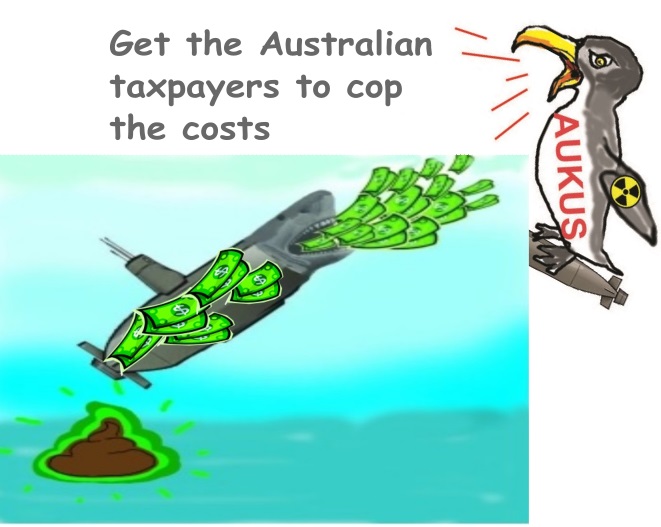
AUKUS’ claims of “nuclear stewardship” with US nuclear submarines and retaining the US origin high-level nuclear wastes are a farce.
The US has been unable to dispose of its own high-level wastes.
David Noonan, Kaurna Yerta/Adelaide, December 12, 2023, Issue 1396 https://www.greenleft.org.au/content/labors-new-aukus-bill-declares-osborne-sa-stirling-wa-nuclear-zones
Labor introduced a bill on November 16, which cites Osborne as the first designated zone for the AUKUS nuclear-powered submarines.
The Australian Naval Nuclear Power Safety (Transitional Provisions) Bill 2023 allows for naval nuclear reactors at Port Adelaide under a new “Australian Naval Nuclear Power Safety Regulator”. That entity is to report directly to Minister for Defence Richard Marles.
Nuclear submarines have never used this port.
Alarmingly, Section 132 of the bill over-rides the Australian Radiation Protection and Nuclear Safety Act 1998 and the military regulator is given powers over the civilian Nuclear Safety Agency ARPANSA.
The Medical Association for Prevention of War has sounded the alarm. “Naval nuclear reactors — like all nuclear reactors — pose potentially serious risks for people and the environment. But unlike other reactors, most information about naval reactors is kept classified, and it can be difficult to say how safe they are.

Marles told parliament he will hold the power to direct the military nuclear regulator during a “national security” emergency.
Stirling Naval Base, near Fremantle in Western Australia, is the second nuclear zone to be declared in this bill.
The South Australian and Port Adelaide communities have the right to have a say on nuclear safety and the risks in bringing naval nuclear reactors into the port.
Key public interest questions are yet to be answered.
They include: Will communities be consulted on accident response plans? What is the existing radiation emergency capability in current and proposed nuclear sub port sites? Will local health and medical services be consulted? How will communities be properly informed about the risks of naval nuclear reactors? How will safety issues be monitored and communicated? How will the public interest in safety issues be protected? When will accident scenarios for nuclear subs at base be modelled and made public? How can the public verify the quality of emergency management plans and systems? How can authorities demonstrate their capacity to respond to radiation emergencies, and other accident scenarios?
The bill has now gone to a Senate Foreign Affairs, Defence and Trade Legislation Committee inquiry, which is open for public submissions and is due to report next April.
The bill proposes to override state laws.
Section 135, “Operation of State and Territory laws”, states: “If a law of a State or Territory, or one or more provisions of such a law, is prescribed by the regulations, that law or provision does not apply in relation to a regulated activity.”
The bill provides for regulated activities in “nuclear waste management, storage and disposal” at AUKUS facilities in future nuclear zones, to be authorised under Section 135.
According to media reports in August, the Woomera rocket range is understood to be the “favoured location” for the storage and disposal of submarine nuclear waste.
If the federal government wants to locate an AUKUS nuclear waste dump in South Australia, it will have to over-ride existing law to impose this.
This AUKUS bill is a threat to the people of SA. AUKUS locks Australia into buying existing US military nuclear reactors in second-hand 10-12 year old submarines, loaded with intractable US-origin weapons grade high-level nuclear wastes.
US Vice Admiral Bill Houston has said in-service Virginia class submarines would be sold in 2032 and 2035 and a newly-produced submarine in 2038.
AUKUS’ claims of “nuclear stewardship” with US nuclear submarines and retaining the US origin high-level nuclear wastes are a farce. The US has been unable to dispose of its own high-level wastes.
Marles said in March there would be an AUKUS announcement by early 2024 on a process to manage high-level nuclear waste and to site a waste disposal facility.
The storage and disposal of nuclear wastes compromises the safety and welfare of the people of SA. That is why it is prohibited by the state’s Nuclear Waste Storage (Prohibition) Act 2000.
This law covers public interest issues, including health, safety and welfare as well as “to protect the environment in which they live by prohibiting the establishment of certain nuclear waste storage facilities in this State”.
The import, transport, storage and disposal of high-level nuclear reactor waste is prohibited in SA.
This AUKUS bill must be challenged. The SA Premier is yet to say if he will support an Indigenous right to say “No” to an AUKUS dump. South Australians have a right to decide their own future and to say “No”.
[Dave Noonan is a long-term anti-nuclear campaigner. For more information see the Medical Association for Prevention of War’s Safety Brief. Contact the Committee Secretariat on 02 6277 3535 or email fadt.sen@aph.gov.au. Upload your submission here.]
Liberal Coalition’s strategy – support fossil fuels by delaying renewables and pushing for nuclear energy

they’ve come up with the perfect strategy to ensure no climate action is taken – advocate the bypassing of renewables in favour of small nuclear modular reactors.
It’s the old strategy of “why put off until tomorrow what you can put off forever”?
Or, as Malcolm Turnbull put it at the COP28 meeting: “Nuclear’s only utility is as … a means of supporting fossil fuels by delaying and distracting the rollout of renewables”.
Energy transition needs gas not nuclear, https://www.afr.com/policy/energy-and-climate/energy-transition-needs-gas-not-nuclear-20231203-p5eola 11 Dec 23, Craig Emerson, Former Labor minister and economist
A rational decarbonising energy policy offers a middle path between the absolutists and the denialists.
A civilisation is in decline when logical thinking and evidence-based policy are angrily dismissed in favour of tribal dogma. Western civilisation is lurching in this dangerous direction. Bravery is needed from those who remain capable of rational thought.
A prime contemporary example is the energy transition. Arguing about the energy transition are the absolutists and the denialists.
The absolutists demand that Australia open no new coal mines or gas fields. They require the governments of poor countries to shut their coal-fired power stations forthwith, despite no affordable alternative source of electricity being available.
In these countries, solar and wind power can play a role in electricity generation, but not totally and immediately. Renewable generation requires firming capacity in the nights and evenings, which can be provided by gas generators.
In fact, gas peaking and standby can hasten the closure of coal-fired power stations, which is desirable for the planet. But the neocolonial absolutists demand gas be excluded from the energy mix in poor countries.
The absolutists also oppose carbon capture and storage as a matter of dogma. The same goes for carbon offsets, regardless of their integrity.
Gas is also used to produce synthetic fibres; the kind Absolutists like to wear in preference to thirsty cotton and the wool of methane-emitting sheep.
Coking coal is used to produce steel. Absolutists oppose new coking coal mines. People in poor countries are not to have access to steel products, the type that rich-country absolutists use every day.
Denialists, on the other hand, such as former prime minister Tony Abbott, speak of the global warming hoax and describe believers in climate change as members of a cult. Denialists believe that not just absolutists are involved in this conspiracy against the western way of life, but so too are the United Nations, the NASA space agency and the world’s bureaus of meteorology.
Denialists have learned not to speak so loudly of these alleged hoaxes, cults and conspiracies, operating on the assumption that most voters under the age of 40 have been brainwashed into believing climate change is real and will cast their votes accordingly.
To address this electoral quandary, they’ve come up with the perfect strategy to ensure no climate action is taken – advocate the bypassing of renewables in favour of small nuclear modular reactors.
With cost blowouts precipitating the recent collapse of a flagship US project working on a small modular reactor, the prospects of this technology supplying electricity at competitive prices are highly questionable.
In any event, former NSW treasurer Matt Kean, though favourably disposed to small nuclear modular reactors, has pointed out that none would be ready for commercial deployment before 2040.
By that time, Australia’s fleet of ageing coal-fired power stations will be clapped out.
The Peter Dutton-led opposition voted against the Albanese government’s safeguard mechanism, the latest attempt to put a price on carbon for major emitters, despite the Business Council of Australia calling it “a very good policy”.
In an effort to continue the debilitating climate wars that have been raging for more than a decade, Dutton labelled the safeguard mechanism a “carbon tax 2.0”.
With no emissions-reduction strategy, plenty of hostility towards renewables and a promise of small modular reactors from 2040 at the earliest, the denialists have only one remaining option – to use taxpayers’ money to fund the construction of new coal-fired power stations. The private sector certainly won’t risk it.
It’s the old strategy of “why put off until tomorrow what you can put off forever”?
Or, as Malcolm Turnbull put it at the COP28 meeting: “Nuclear’s only utility is as … a means of supporting fossil fuels by delaying and distracting the rollout of renewables”.
There is a middle path between the absolutists and the denialists.
A rational decarbonising energy policy would include the legislated safeguard mechanism, solar and wind energy, and – for firming capacity – the use of gas, big batteries and, where economically viable, pumped hydro.
Where gas producers can make carbon capture and storage feasible, they should be encouraged to do so. Trading in high-integrity carbon offsets should be part of the solution, especially for countries that lack viable renewable energy resources.
In various combinations, these features of a rational climate policy have been adopted by the Rudd, Gillard, Turnbull and Albanese governments. They were opposed by the Abbott government and, largely, by the Dutton-led Coalition.
Between them, absolutists and denialists would oppose most – if not all – of these sensible features.
Finding a demilitarised zone between these warring tribes is as elusive as it was when the Senate voted down a carbon price 14 years ago. Yet, it seems that most of the voting public feels the policy approach now being taken by federal and state governments lies along that narrow path.
The lesson from this story is to let warring tribes slug it out and get on with sound policy in the national interest.
Going nuclear would be a costly mistake
Graeme Lechte, The Age, 12 Dec 23
The article ″Coalition MP talks up triple nuclear option at climate summit″ (11/12) raises disturbing issues in regard to Australia’s future energy production and our pathway to net zero. A group of Coalition MPs have backed a pledge to increase nuclear energy output and overturn the current policy of no nuclear energy in Australia. If the Coalition is returned, its energy policy will flip the focus from renewables to nuclear. After all the hard work and investment to establish a secure power system based around renewables, under a Coalition government, renewables would play second fiddle to establishing an expensive nuclear industry that would take at least 10 years to come on line. Aside from the safety issues and emissions from mining uranium, this policy would see renewables sidelined and the path to net zero become a confusion of opposing strategies.
Labor’s attempts to base our energy supply around renewables would be in tatters under a future Coalition government and our path to net zero even more difficult – not to mention the huge costs associated with establishing a fledgling nuclear industry.
Ted O’Brien’s nuclear love-in at COP28 gets a brutal reality check.

Ed note. I was pretty surprised that Rafael Grossi who usually downplays all the risks of nuclear (safety, terrorism, weapons proliferation, wastes) went so far as to claim that nuclear is not even a financial risk !
Jim Green 11 December 2023, https://reneweconomy.com.au/ted-obriens-nuclear-love-in-at-cop28-gets-a-brutal-reality-check/—
The nuclear lobby has been out in force at the COP28 climate conference in Dubai. Their main initiative was a ‘declaration’ promoting a “global aspirational goal of tripling nuclear energy capacity from 2020 by 2050”, signed by 22 countries and supported by 120 companies.
The 22 countries are Bulgaria, Canada, the Czech Republic, Finland, France, Ghana, Hungary, Japan, South Korea, Moldova, Mongolia, Morocco, the Netherlands, Poland, Romania, Slovakia, Slovenia, Sweden, Ukraine, the UAE, the UK and the USA.
David Appleyard, editor of Nuclear Engineering International, did the math: “Now 2050 still sounds like a long way off, but to triple nuclear capacity in this time frame would require nuclear deployment to average 40 GW [gigawatts] a year over the next two and half decades. The cruel reality is that’s more than six times the rate that has been seen over the last decade.”
A dominant feature in the declaration — and all the nuclear lobbying surrounding COP28 — is the perceived need to find new methods of financing nuclear plants. In the words of the declaration, participants “commit to mobilize investments in nuclear power, including through innovative financing mechanisms”.
Nuclear power as a commercial venture is very nearly dead, and thus the participants “invite shareholders of the World Bank, international financial institutions, and regional development banks to encourage the inclusion of nuclear energy in their organizations’ energy lending policies”.
In a parallel initiative announced during COP28, the US plans to “jump start” the development of small modular reactor (SMR) exports despite the recent collapse of NuScale Power’s flagship project in Idaho. The US Export-Import Bank has approved a resolution to fund applications for the export of US SMR systems and components.
International Atomic Energy Agency director-general Rafael Grossi recently said — apparently without irony — that international financial institutions, development banks and private banks and investors should take a fresh look at the “winning” investment of financing new nuclear power plants.
In fact, US giant Westinghouse declared bankruptcy in 2017 following its disastrous reactor construction projects in South Carolina and Georgia; the British nuclear power industry went bankrupt years ago and was sold to the French, then the French nuclear industry went bankrupt and has been fully nationalised; South Korean utility KEPCO’s debt has climbed to A$224 billion; the Japanese nuclear industry is essentially a pile of ashes in the aftermath of the Fukushima disaster; and so on.
Ted O’Brien says a bunch of silly things
The federal Coalition’s shadow energy minister Ted O’Brien was the lead speaker at a forum on the sidelines of COP28 titled ‘Australia’s Nuclear Energy Potential: Joining the Global Journey’.
The forum also heard from representatives of the (so-called) Coalition for Conservation (which flew seven Liberal and National MPs to the summit), the World Nuclear Association, Emirates Nuclear Energy Corporation, the US Nuclear Industry Council; and an Italian SMR start-up called Newcleo.
O’Brien said that a Coalition government would sign the 22-nation declaration with its aspirational goal of tripling nuclear power capacity by 2050.
The Labor government last week joined more than 120 countries in backing a pledge to triple renewable energy and double the rate of energy efficiency by 2030 — a pledge opposed by the Coalition. O’Brien reiterated the Coalition’s opposition to the Labor government’s target of 82 per cent renewable power supply by 2030.
Speaking to The Guardian, former NSW treasurer Matt Kean said “obviously nuclear is a long way away” and Australia should back renewable energy now: “Who knows what might be available in another 20 years — we may have flying cars in 20 years — but that doesn’t mean you base your whole transport around it.”
O’Brien told the COP sideline forum that Australia’s legislation banning nuclear power is “bizarre”. That would be the legislation introduced by John Howard’s Coalition government and left untouched by the Abbott, Turnbull and Morrison Coalition governments over nearly a decade.
O’Brien said Australia’s track record on renewables is something to be “enormously proud of” without noting the Coalition’s decades-long efforts to slow the growth of renewables and to promote fossil fuel power generators.
He failed to mention that fellow Queenslander and Nationals leader David Littleproud recently said he wants a “pause” to the roll out of wind and solar and transmission links and a stop to the “reckless pursuit” of the government’s 82 percent renewables target by 2030.
O’Brien showed a photo of his children, whose existence apparently demonstrates his commitment to a low-carbon, environmentally sustainable future. In case anyone thought he was serious, he said that Australia needs more gas-fired power generation.
O’Brien said nuclear power is one of the fastest ways to decarbonise; that nuclear waste is “so miniscule”; that Australia should develop “capabilities in other areas of the nuclear fuel cycle”; that the Coalition was not interested in old nuclear but rather Generation 3+ (i.e. mostly non-existent) nuclear power; and that COP28 will be remembered as the “nuclear COP”.
World Nuclear Industry Status Report
The December 6 release of the World Nuclear Industry Status Report (WNISR) provided a welcome relief to all the nuclear nonsense at COP28, including O’Brien’s. For over 30 years, these annual reports have provided factual information that irritates the nuclear industry no end.
Continue readingAustralia’s Opposition Coalition opposes Australia tripling renewable energy, backs nuclear power pledge at Cop28

Ted O’Brien declares global climate summit ‘the nuclear Cop’ despite only 11% of nations backing the pledge
Guardian Australia, Adam Morton in Dubai 10 Dec 23
The federal Coalition has declared at the Cop28 climate summit that it will back a global pledge to triple nuclear energy if the opposition leader, Peter Dutton, becomes prime minister, but will not support Australia tripling its renewable energy.
Speaking on the sidelines of the conference in Dubai, the opposition’s climate change and energy spokesperson, Ted O’Brien, also said a Coalition government would consider supporting Generation III+ large-scale nuclear reactors, and not just the unproven small modular reactors it has strongly touted.
The statement at the global summit confirmed the Coalition was on a markedly different path to Labor. The Albanese government last week joined more than 120 countries in backing a pledge to triple renewable energy and double the rate of energy efficiency by 2030, but did not sign up with 22 countries that supported tripling nuclear power by 2050.
While only 11% of countries at the talks – mostly nations that already have a domestic nuclear energy industry – backed the nuclear pledge, O’Brien declared “Cop28 will be known as the nuclear Cop”.
“Under a Dutton-led Coalition, at our first Cop in office we would sign Australia up to that pledge, together with our allies and our friends,” he said.
O’Brien’s speech was at a side event hosted by the World Nuclear Association and the Australian group Coalition for Conservation, which flew seven Liberal and National MPs to the summit. About 30 people attended, including Coalition members Bridget McKenzie, Andrew Bragg, Perrin Davey, Dean Smith and Kevin Hogan.
Asked if the Coalition would back the pledge to triple renewable energy by the end of the decade, O’Brien said he would not support Australia acting on it. “What we don’t need is all of our eggs in one basket, we need a balanced mix of technologies, and that includes renewables,” he said.
The Australian climate change minister, Chris Bowen, gave a different vision for Australia’s electricity future in his national statement to the summit, urging countries “not to drift further apart” and said those such as Australia with “massive renewable potential” had a responsibility to share it with others.
Hence Australia’s determination to become a global renewable energy superpower,” Bowen said. “We must look at our future and our fates and redouble our efforts to bring down our emissions and get our world back on track.”
In his speech, O’Brien said the Coalition would advocate for removing bans on uranium mining and exploration because Australia had “a moral obligation” to provide it to the world.
Asked why he did not accept the advice of the Australian Energy Market Operator, which found the country’s optimal future electricity grid would run on more than 90% renewable energy backed by firming support, O’Brien said he had looked at operator’s integrated system plan “in great detail”, but a Cop was “probably not the right place for going through it”.
“Nevertheless, if your question is ‘do we agree with Labor’s plan for 82% renewables in the grid by 2030?’ Well, no, we don’t,” he said.
Some observers questioned how the Coalition’s plan to slow renewable energy expansion would avoid power blackouts as old and increasingly failing coal-fired power plants closed over the next decade. O’Brien acknowledged in his speech that 80% of Australia’s “baseload power” was expected to leave the grid by 2035.
Experts say the country would not have a nuclear industry before 2040 even if the national ban on the technology was lifted now, and nuclear energy is more expensive than alternatives.
New South Wales Liberal MP Matt Kean, a former state treasurer, acknowledged O’Brien’s commitment to reaching net zero emissions but said “obviously nuclear is a long way away” and the country should back renewable energy now.
“Who knows what might be available in another 20 years – we may have flying cars in 20 years – but that doesn’t mean you base your whole transport around it,” he said.
The chief executive of the Australian Renewable Energy Agency, Darren Miller, said there would be no room for nuclear energy if the country was headed towards 80% renewable energy by 2030. “It is not a flexible technology that helps you go from 80% to 100%,” he said………………………………………………………………….. more https://www.theguardian.com/australia-news/2023/dec/10/coalition-tells-cop28-it-will-tback-tripling-of-nuclear-energy-if-peter-dutton-becomes-prime-minister
US Defense funding bill to include OK for nuclear subs, AUKUS tech for Australia
Riotat, December 2023 | Andrew McLaughlin
The US Congress is set to approve the 2024 National Defense Authorization Act (NDAA) this week, green-lighting the transfer of at least two Virginia-class nuclear-powered submarines to the Royal Australian Navy.
Democratic Senator Joe Courtney (left) and Australian Ambassador to the US Kevin Rudd (centre) at the General Dynamics Electric Boat shipyard in Groton, Connecticut. Photo: Senator Courtney LinkedIn.
The US Congress is set to approve the 2024 National Defense Authorization Act (NDAA) this week, green-lighting the transfer of at least two Virginia-class nuclear-powered submarines to the Royal Australian Navy.
After months of wrangling, the $US874.2 billion ($A1.324 trillion) bill will put into US law the AUKUS Pillar 1 agreement between Australia, the UK and the US. It will also clear the way for a $US 3bn ($A 4.5 billion) investment by the Australian Government in US shipyards to expand their submarine manufacturing capacity and the release of sensitive US technologies to Australia.
The bill still needs to be voted on by Congress, but apart from pushback by the Republican ‘Freedom Caucus’, which has seen many of its proposed amendments unrelated to AUKUS removed, passing the largely bipartisan bill is expected to be a formality and completed before Congress rises for the Christmas break.
Importantly, the bill includes four key authorisations that are needed to enact the AUKUS agreement into law.
These include more time to approve a ”defense supplemental spending request’’ required to expand US submarine production capacity; the acceptance of the $US3 billion payment from Australia, allowing Australian industry personnel to train on the maintenance and use of nuclear-powered submarines; and an exemption for Australia and the UK from the US export control regimen if both countries develop comparable laws of their own.
That last authorisation will not only cover the nuclear reactors and other systems for Australia’s submarines but also a large number of technologies that will be required to develop many of the planned AUKUS Pillar 2 capabilities, including cyber, quantum computing, autonomous systems, artificial intelligence, space-based capabilities and hypersonics.
The bill will also give Australian and British companies access to US federal grants under the Defense Production Act…………………………………………………….. https://the-riotact.com/us-defense-funding-bill-to-include-ok-for-nuclear-subs-aukus-tech-for-australia/729587
Australia’s nuclear brawl spills over into Dubai climate summit
AFR, Hans van Leeuwen 10 Dec 23
Mr Holmes à Court, convener of Climate 200, told Nine journalists that tripling nuclear energy was “a pretty easy pledge to sign onto, because three times zero is zero”.
Dubai | Australia’s domestic debate over nuclear energy has spilled over into the COP28 climate summit in Dubai, as the opposition set out its stall and drew flak both from the government and Liberal Party dissenters.
Opposition climate change and energy spokesman Ted O’Brien is leading a delegation of Liberal and National parliamentarians to COP28 for a five-day visit focused heavily on promoting nuclear energy as a future part of Australia’s energy mix.
He vowed that in government the Coalition would join a 22-country partnership pledging to triple nuclear energy capacity by 2050, which was inked during COP28. And he expanded his party’s nuclear vision to include potential grid-scale reactors in NSW’s Hunter region and other ex-coalmining areas.
But Climate Change and Energy Minister Chris Bowen launched a blistering broadside against his opponents, describing the nuclear policy as “a pipe dream”. And senior Liberal figures at COP28, including former prime minister Malcolm Turnbull and former NSW treasurer Matt Kean, questioned the policy………………
The debate broke out into the open after Mr O’Brien appeared on a COP28 panel entitled “Australia’s nuclear energy potential: Joining the global journey”.
“COP28 will be known as the nuclear COP,” he said. He described the Coalition’s policy as an “all of the above” plan, involving renewables, coal, gas and nuclear………………..
On nuclear, Mr O’Brien envisioned a role not just for small modular reactors that can be used for mines, city-level power or industrial processes, but for big reactors to firm up renewable electricity’s intermittent, variable feed into the grid.
“When it comes to nuclear technologies, we are looking at all-of-the-above for generation three-plus and beyond. So that is micro reactors, that is small reactors, that is large reactors,” he said.
Mr Bowen responded that at COP28, “nuclear energy is not involved in the multilateral conversations”.
“When I meet with counterparts, even those who are nuclear countries, they say ‘if I had your renewables, your renewable potential, I wouldn’t go down the nuclear road’,” he said. “It’s a pipe dream wrapped in a fantasy accompanied by an illusion … and I don’t have time for distractions.”……………
Mr O’Brien’s former boss, Mr Turnbull, told the Financial Review he was sceptical.
“I don’t have a problem with lifting the legislative ban on nuclear generation. But unless somebody genuinely shows a strong commitment to building it, why would you set up the whole nuclear regulation infrastructure you would need?” he said.
“The test on nukes is this: who is going to finance it or build it? Where are the energy companies demanding the right to do it? They don’t exist.”
Mr Kean said he was open to small modular reactors, but the technology would not be available until almost the 2040s.
“Just as you wouldn’t base your entire transport strategy around flying cars, nor should you base your entire energy policy around technology that won’t be available for at least 15 years,” he told the Financial Review.
“We need to get on with the job of modernising our electricity system now. And that means deploying technology that we know works, and can help lower household bills – that’s renewables backed up by household storage.”……………………………………
Mr Holmes à Court, convener of Climate 200, told Nine journalists that tripling nuclear energy was “a pretty easy pledge to sign onto, because three times zero is zero”………………….. https://www.afr.com/policy/energy-and-climate/australia-s-nuclear-brawl-spills-over-into-dubai-climate-summit-20231210-p5eqbq
Americanization of International Law: Legitimizing Palestinian Genocide and Promoting Nuclear Self-Defence

Nafees Ahmad, DECEMBER 10, 2023 Edited by: Hayley Behal | U. Pittsburgh School of Law, US https://www.jurist.org/commentary/2023/12/nafees-ahmad-americanization-international-law/
Nafees Ahmad, Ph.D., LL.M., Associate Professor, Faculty of Legal Studies at South Asian University, New Delhi, India, discusses the failure of international law and policy to address the sitiation in Palestine and Israel…
The 21st century is marked by globalization and Americanization, with transnational law under US dominance and a strong American influence on human rights. This Americanization of international law often conflates with modern neoliberal hegemonies, which downplay historical arrangements and change rights and injustices. The evolution of international law in this era differs from previous generations, and hegemonic international law has emerged as the primary language for asserting dominance. Studying the Americanization of international law is crucial, as discussions have recently emerged regarding actions taken by the US on behalf of NATO and Israel that seem to violate international law. Israel’s 55-year-long occupation of the Palestinian Territories is a saga of occupation to annexation that subjected the Palestinians to colonialism, apartheid, the legitimacy of occupation, and possible international criminal culpability. The harsh reality of Palestinians living under Israeli occupation for an extended period has a direct and tangible influence on international legal frameworks and legal obligations.
Travesty of Liberal International Order
The liberal international order (LIO), which has influenced US international relations since World War II, is declining due to President Biden’s rejection, criticism of US allies, and support for authoritarian leaders. The order has deteriorated for at least 15 years, with Russia and China aiming to challenge it through substitute regional organizations and alternative standards. Weaker states seek security cooperation and patronage from non-member countries like Saudi Arabia and China, which lack the same liberal political and economic conditions as the US and its democratic allies. A new wave of transnational networks emphasizing nationalism, illiberalism, and right-wing principles is also challenging the LIO. The Biden presidential campaign slogan, “Let’s finish the job,” accelerates these processes, undermining the US’s global standing.
Accountability for International Humanitarian Law
The use of force by Israel on Gaza is considered genocide and a grave international crime. More than 9,800 people have died in the ongoing Israel-Palestine conflict, including 8,306 Palestinians and 1,538 Israelis. Tel Aviv has struck at UN buildings, schools, hospitals, medical convoys, refugee camps, and religious facilities. The UN has ordered the forced evacuation of 1.1 Palestinians from the northern region of Gaza, treating those unable or unwilling to flee as supporters of Hamas. The destruction inflicted upon Gaza is astounding, with an estimated 2.3 million Palestinians navigating dangerous waters for 16 years to survive the harsh economic and social blockade since 2007. Israel’s targeting of forbidden locations and the use of incendiary phosphorus bombs in heavily populated civilian areas are war crimes. Western leadership fails to convince the world that adherence to its rules-based order has anything to do with the UN Charter or international humanitarian law (IHL), demonstrating a calculus of friends and enemies. Occupation situations are officially classified as international armed conflicts under IHL, which is another way of saying they are armed confrontations between two or more states. Human rights law is still relevant in occupation settings in addition to IHL. As a result, an Occupying Power is required by international law to guarantee the local populace’s access to the full range of human rights. The West Bank has been classified as occupied territory under the Fourth Geneva Convention and the Hague Regulations by the UN Security Council, the Supreme Court of Israeli, and the International Court of Justice (ICJ).
Whither Responsibility to Protect and US Culpability?
The Palestinians have been denied legal redress, and the UN should bear more responsibility for implementing the partition plan and Security Council Resolution 242, which demanded the departure of the Israeli military presence. The UN can report on moral and legal wrongdoing but cannot carry out its recommendations without a Security Council resolution. The UN General Assembly can only make recommendations with a two-thirds majority vote, and the global legal system’s remedies are futile if the US culpability does not exempt Israel from accountability under international law. Despite having the law on their side since 1948, Palestinians have been subjected to Israel’s lawlessness for years. The UN’s policy processes can be effectively employed if there is political will. The Responsibility to Protect (R2P) standard was established after the 1999 Kosovo War, requiring UN accountability in situations like Gaza. In 2011, NATO countries turned a limited humanitarian mandate into a regime-changing intervention, leading to the execution of a leader and worsening the situation in Libya. Effective UN action without political will could exacerbate the problem. Israel has never stopped using excessive force, and the international community has not warned or pressured it to leave the occupied Palestinian territories. The UN’s responsibility to protect R2P is to address the suffering of Gazans by establishing a peace force. This force could potentially halt Israeli aggression, strengthen protection for Palestinians, and maintain peace. The Palestinians are currently the most vulnerable people in need of international forced protection. However, the UN cannot stop Israeli brutality without the political will of the five permanent members of the Security Council. Under the current Israeli administration, operationalizing R2P is unfeasible due to the complex context of the situation.
Western Media Defending Israeli War Crimes?
The Western media, particularly in the US and UK, has a biased stance toward Israel’s ongoing violence, supporting Israel’s claim to eradicate Hamas and find its leaders. This divide has led to a lack of proper protection for Palestinians. However, the footage of Israeli aggression toward women, children, and injured individuals has partially removed the mask of state propaganda. Under IHL, Israel is the Occupying Power and defines Gaza as an occupied area, which is irreconcilable with Israel’s discretion. 2.3 million innocent civilians living in Gaza, with 76% either refugees or descendants of refugees, were denied their international legal right of return. Despite attempts to challenge this right, violent Israeli suppression often occurs. This extra-legal impunity leaves Palestinians with no recourse for proper protection.
Ukraine-Palestine: The Crisis of Morality in International Law
There is significant humanitarian hypocrisy in the Western response to the Israeli attack on the Gaza population and the Russian attack on Ukraine. Israel enjoys impunity, while Russia is held responsible for NATO’s double standards and moral and legal dishonesty. This shows that international law is a manipulated set of standards that suit geopolitical players’ goals and frequently conflicting strategic objectives rather than a framework for governing nations on the premise of sovereign equality as essential to the international rule of law. Industrialized countries have no inherent incentive to abide by international law; instead, all international law is constrained by the logical decisions of self-serving parties. This argument dictates that efforts to enhance international collaboration must yield; governments cannot bootstrap cooperation by passing laws and enacting regulations, even though these measures may produce better results. States that find it advantageous to uphold international law tend to act quite haughtily when denouncing those who violate it. However, suppose it serves their interests to condone these grave breaches of IHL. In that case, they will either remain silent or, in this instance, provide unconditional and primarily, but not entirely, indirect support to the government and nation that is engaging in these egregious abuses. Such a dualistic view of international law undermines any argument that it is authoritative and worthy of respect, mainly concerning peace and security. It can be used as a tool of aggressive lawfare against enemies and legalistic evasion for strategic partners and friends. When international law is broken, enemies are hunted out and punished, but vital allies are given a shot of impunity.
Arming Israeli Self-Defense with Nuclear Weapons
The five most powerful nations in the world, who also happened to be the winners of World War II and the first five to develop nuclear weapons, were granted veto power since the UN was intended to be weak in this area. The significance and efficacy of the veto force lie in giving these most potent and dangerous nations, led by the US, the unbridled ability to disregard international legal obligations for nuclear weapons and the UN Charter. Whenever a proposed UN Security Council action conflicts with their strategic objectives, these five deinstitutionalize and defunct international law institutional framework against the very principles and purposes of the UNO. The ICJ ruled that nuclear bomb use is not reconcilable with IHL. However, the ICJ couldn’t make a definitive decision on the legitimacy of the state using nuclear weapons in self-defense situations. Several nuclear-armed states, including the US and the UK, claimed that treaty rules didn’t regulate or prohibit nuclear weapons use when hostilities rules were fully codified in 1977 in the First Protocol Additional to the Geneva Conventions.
Several legal authorities support varying interpretations of what is permissible because the boundaries of self-defense with nuclear weapons are hotly debated in international law. However, it is prohibited to attack a hostile civilian population with excessive force. Over the years, Israel has been guilty of using military force in many ways that, under any circumstances, whether or not justified and rationalized, would not be allowed as exercises of self-defence and would, therefore, constitute war crimes. This use of force in Gaza during the past few weeks has been particularly spectacular. Beyond this, it is debatable if Israel may legitimately rely on self-defence in Gaza, an occupied territory governed by Geneva Convention IV limitations. It is not reasonable for Israel, the Occupying Power, to assert that it is protecting itself against itself. Accepting this mishandled interpretation of the concept of self-defense in the context of an opponent society’s belligerent occupation—in whole or in part—by the international discourse is genuinely puzzling.
War Crimes Trial in International Criminal Court
At least 1,400 persons in Israel and 5,000 in Palestine have died since Hamas began its onslaught in Israel on October 7, 2023, which prompted an immediate and forceful military retaliation from Israel. Although Hamas militants carried out the first crime, the hospital explosion’s cause is yet unknown. The International Criminal Court (ICC) may look at potential war crimes in Israel and Palestine. Palestine joined the court in 2015. Recent appeals have also been made for the US to ratify the ICC treaty. The ICC faces challenges due to its inaction and political weakness in holding powerful Western nations accountable, particularly Israel. The lack of political will to prosecute Israel makes its practical application improbable. Despite not being signatories to the Rome Statute, the ICC has jurisdiction to investigate, indict, and bring charges against anyone who claims to be a victim of crimes committed on its territory. Palestine is one of the ICC Statute’s parties. Following the current wave of unchecked violence, attempts will be made to strengthen the ICC in light of geopolitics. While it would be unrealistic to expect accountability from Israel’s authorities, the desire to present evidence and accusations of Israeli wrongdoing would be persuasive to public opinion outlets and criminalizing civil society activists. In symbolic politics, proving or disproving the veracity of assertions has a significant political impact, and mere submission plays a crucial role.
Way Forward
The UN, governments, and people worldwide are facing a crisis due to the extreme abuse of state power, resulting in one of the most severe instances of genocide since 1945. Observers argue that Israel is using force against Gaza in an ongoing genocide, which is considered the most serious international crime. Preventing genocide is a shared responsibility of all governments, and establishing a Peoples Tribunal on Genocide Prevention in Gaza or on Israel’s War Against the People of Gaza can contribute to a world governed by law. The 1948 UN Convention on the Prevention and Punishment of the Crime of Genocide has been extensively approved, including by parties involved in the bloodshed in Gaza and its diplomatic interactions.
Nafees Ahmad, Ph.D., LL.M., is an Associate Professor, Faculty of Legal Studies at South Asian University, New Delhi, India. Professor Ahmad teaches IHRL, IRL, CCL, and International Media Law.
Ralph Nader on Israeli Government’s War Crimes – Enabled & Defended by Biden & Congress

By Ralph Nader / Nader.org, more https://scheerpost.com/2023/12/10/ralph-nader-on-israeli-governments-war-crimes-enabled-defended-by-biden-congress/
The humiliation of the U.S. government, which is actively complicit in providing the weaponry, funding, and UN vetoes backing the Israeli government’s attack on the civilian Palestinians/Arabs in tiny Gaza, is in plain view daily. All in the name of the unasked American people and taxpayers.
Earlier this week, at a House of Representatives’ hearing, Trump toady Rep. Elise Stefanik (R-NY) repeatedly assailed three University presidents with the question of would they discipline students calling for the genocide of Jews, without any evidence that this hateful speech is prevalent on campus.
Pursuing her fulminations, Stefanik was cruelly oblivious to the real ongoing genocide in Gaza with her support of unconditional shipment of American F-16s, 155mm. missiles and other weapons of mass destruction used to kill children, women and the elderly who had nothing to do with the preventable October 7th Hamas violence.
Meanwhile, a State Department spokesman continues to say that the Israeli government does not intentionally target civilians. With U.S. drones over Gaza daily, Secretary of State Antony Blinken has visual proof that the overwhelming bombing on civilian structures is killing innocent civilians.
The evidence is in the rubble of hospitals, health clinics, ambulances, schools, libraries, places of worship, marketplaces, water mains, homes, apartment buildings, and piles of unburied corpses being eaten by stray dogs. All this information is in the possession of bomber Biden’s regime.
The Bidenites and their bloodthirsty cohorts in Congress were forewarned when the Israeli Defense Minister Yoav Galant and other Israeli officials on October 8th shouted these chilling genocidal orders to their army: “No electricity, no food, no fuel, no water.… We are fighting human animals and will act accordingly.” (See, Convention on the Prevention and Punishment of the Crime of Genocide). Add an already illegal 16-year Israeli blockade of 2.3 Palestinians suffering from dire poverty, with 40% of their children down with anemia.
Now, about half of Gaza’s population are children, 85% of the entire population is homeless, wandering helplessly into nowhere, afflicted with pending starvation, sickened by spreading infectious diseases and dirty drinking water. There is little or no medicines for diabetics and cancer patients. No surgery, no anesthesia, no emergency transport, no shelter from cold weather, only American-made bombs and missiles blowing up Palestinians into bits with Israeli snipers everywhere.
The Palestinians cannot flee from their open-air prison. They cannot surrender – the Israeli government wants them gone. Bear in mind, the population that is not yet blown up is sick and dying, denied needed outside humanitarian aid. Defying feeble Biden’s wishes, Netanyahu only allows a trickle of aid trucks to enter Gaza, and those that do enter can scarcely reach their destinations.
All this raises the issue of the gross undercount of casualties. The Hamas Health Authority has restricted its count to the names of the deceased and injured supplied by hospitals and morgues. These locations are now largely rubble or inoperative. Bodies under the rubble, many of them children, can’t be counted. Thousands of missing people cannot be counted. The Ministry’s suspended count is over 17,000 fatalities, plus 45,000 injuries. With the far larger carnage unable to be tabulated, the actual fatality toll may reach 100,000 soon.
Nonetheless, about two weeks ago, the New York Times reported the death undercount of children in Gaza in two months was ten times greater than the deaths of Ukrainian children in nearly two years of Russian bombings. One of its headlines – “Smoldering Gaza Becomes a Graveyard for Children.”
There are about 50,000 pregnant women in Gaza and about 5,500 of them are due to give birth. Where are they going to do that? How can they be cared for and be nurtured? These mothers are sick and starving. Add the babies to the terrorists toll.
Gaza’s area is about the size of Philadelphia. How many dead, injured, and dying people would there be if 20,000 bombs were dropped on civilians and civilian structures in Philadelphia? Philadelphians trapped without food, water, medicine or any escape route. Imagine 85% of 1.5 million residents homeless, wandering in the streets and alleys. And with virtually no humanitarian aid coming from outside the city. There wouldn’t be any fire trucks or water to extinguish spreading fires.
There are courageous Jewish groups (e.g., Jewish Voice for Peace and If Not Now) and rabbis calling for an end to the slaughter, demanding a ceasefire. There are protestors at all of Biden’s public events/trips reminding him of next November.
Veterans for Peace and other veteran groups are engaged in non-violent civil disobedience in front of the Scranton, Pennsylvania factory producing 155mm missiles for Israel. (Scranton is Biden’s hometown.) Public opinion is turning against the Biden/Israel war without limits on the Palestinians.
Biden wouldn’t want to poll the American people about his $14.3 billion genocide tax, charging American taxpayers to further prosperous Israel’s war of extermination in Gaza. They’ll likely tell Biden that poor children, unaffordable health facilities and other necessities in America need that money first.
There are some 30 Democratic Senators demanding that this Biden bill contain conditions and safeguards so that the money is not used to blow up more Palestinian children and women. But what else are these funds for other than to expand Israel’s military budget? The Israeli extremist ruling coalition under Netanyahu has made no secret of wanting to take over all of remaining Palestine as part of their “Greater Israel” mission to include what they call Judea and Samaria. As Israel’s Founder, David Ben-Gurion, frankly declared referring to the Palestinians, “We have taken their country.” (As quoted in The Jewish Paradox(1978) by Nahum Goldmann.)
It is a cruel irony of history that Israeli state terrorism is producing a Palestinian Holocaust. Netanyahu’s regime has killed over 60 journalists—three of them Israelis—120 United Nations relief workers and instituted total blackouts to keep the grisly events in Gaza out of the news in real time. Netanyahu, to shield his colossal failure to defend Israel on October 7thand to keep his job, is making sure that his country joins the world community of savage, slaughtering regimes, exemplified by the Bush/Cheney unlawful criminal destruction of Iraq and Afghanistan, followed by Hillary Clinton toppling Libya into permanent violence and chaos since 2011. (Obama later called his conceding to Hillary’s demands as his worst foreign policy decision).
Capitol Hill and the White House don’t wait for any blood-guilt to be recognized. That will surely come later with the judgment of history and the nightmarish visions of innocents being vaporized because of Washington’s unconditional backing of the Israeli blitzkrieg against what the Israeli newspaper Haaretz has repeatedly called the “totally defenseless people” of Gaza.
US Blocks Gaza Peace Proposal at UN for 3rd Time, Holding World Hostage
The US government has paralyzed the United Nations, voting against the rest of the world and preventing peace in Gaza by vetoing three different resolutions in the Security Council. Meanwhile, Washington continues giving weapons to Israel.
By Ben Norton / Geopolitical Economy Report
The United States has used its veto power in the United Nations Security Council three times in less than two months to kill resolutions calling for peace in Gaza.
Meanwhile, Washington is sending billions of dollars worth of weapons to Israel, directly assisting the country as it commits war crimes against Palestinian civilians.
On December 8, the Security Council voted on a resolution that called for an “immediate humanitarian ceasefire” and the unconditional release of all hostages.
The United States was the only country on the 15-member council that voted against the measure.
Close US ally the United Kingdom was the only country to abstain in the vote.
The United States helped to design the United Nations after World War II, concentrating power in the Security Council and giving permanent seats with veto power to the victors: the US, UK, France, USSR (now Russia), and China.
Many countries in the Global South have called to expand the Security Council and to eliminate the veto.
China and Russia have repeatedly expressed support for expanding the council. But Washington has adamantly opposed the initiative.
Global South leaders are particularly frustrated by the fact that the UK and France, each of which has a population of fewer than 70 million people, both have permanent seats on the Security Council, but not many of the most populous countries on Earth, such as India, Pakistan, Bangladesh, Indonesia, Nigeria, or Brazil.
Brazil’s left-wing President Lula da Silva stressed this November that the failure of the UN to bring peace to Palestine demonstrates that the system is “broken” and has a “lack of credibility”.
“The UN needs change”, Lula said, calling to expand the Security Council and remove the veto.
“The UN of 1945 does not work in 2023”, the Brazilian leader added.
US rebukes UN secretary-general’s historic invocation of article 99
UN Secretary-General António Guterres has publicly called for a ceasefire in Gaza, but was rejected by Washington.
Guterres took the extraordinary measure of invoking article 99 of the UN Charter, for the first time in five decades.
Article 99 states, “The Secretary-General may bring to the attention of the Security Council any matter which in his opinion may threaten the maintenance of international peace and security”.
The Associated Press noted, “Article 99 is extremely rarely used. The last time it was invoked was during fighting in 1971 that led to the creation of Bangladesh and its separation from Pakistan”.
In the case of the Bangladeshi national liberation war of 1971, Pakistan’s right-wing military regime ethnically cleansed and committed genocide against Bengalis, with the support of the US government – specifically President Richard Nixon and National Security Advisor Henry Kissinger.
The genocidal situation in Palestine is strikingly similar today.
This November, top UN experts warned that “grave violations committed by Israel against Palestinians… point to a genocide in the making”.
The UN experts wrote:
[Israeli officials] illustrated evidence of increasing genocidal incitement, overt intent to “destroy the Palestinian people under occupation”, loud calls for a ‘second Nakba’ in Gaza and the rest of the occupied Palestinian territory, and the use of powerful weaponry with inherently indiscriminate impacts, resulting in a colossal death toll and destruction of life-sustaining infrastructure.
The Wall Street Journal reported on December 1 that the “U.S. has provided Israel with large bunker buster bombs, among tens of thousands of other weapons and artillery shells”.
In less than two months, Washington sent Israel approximately 15,000 bombs and 57,000 artillery shells.
In fact, Gaza is now one of the most heavily bombed areas in history, according to a report in the Financial Times.
US vetoed two other Security Council resolutions on Gaza
The United States voted against two similar resolutions in October.
On October 16, the US and its allies the UK, France, and Japan voted against a measure introduced by Russia that called for a humanitarian ceasefire in Gaza.
Two days later, the US unilaterally vetoed a resolution introduced by Brazil that urged “humanitarian pauses” in Gaza.
The UK abstained in that vote. Russia did too, but as a form of protest, arguing that the resolution was too weak, instead urging a ceasefire.
At the Security Council meeting on December 8, Russia’s UN representative, Dmitriy Polyanskiy, warned that the United States was “leaving scorched earth in its wake”.
China’s ambassador, Zhang Jun, stated, “The task required of the Council is very clear and definitive – act immediately, achieve a ceasefire, protect civilians and avoid a human catastrophe on a larger scale”.
139 of the 193 members of the United Nations recognize Palestine as a sovereign state, but it is not officially a UN member state – because the United States has prevented it from becoming one.
Palestine does however have observer status in the UN (along with the Vatican).
The representative of the observer state of Palestine, Riyad Mansour, participated in the December 8 Security Council session.
“Millions of Palestinian lives hang in the balance, every single one of them is sacred and worth saving”, he cautioned.
By failing to approve a ceasefire, the Security Council is ensuring that Israeli “war criminals are given more time to perpetrate their crimes”, Mansour added.
The Palestinian representative asked, “How can this be justified? How can anyone justify the slaughter of an entire people?”
The Chris Hedges Report: The Weapons Israel Tests on Palestinians Will Be Used Against All of Us
byEDITORDecember 11, 2023
As Antony Loewenstein explains, Palestine has been a testing ground for repressive technologies exported around the world, from spy software to killer drones.
By Chris Hedges / The Real News Network
Whether it’s drone technology or the infamous Pegasus spy software, Israel has long developed and refined repressive technologies used by governments around the world by testing them on Palestinians. Antony Loewenstein, journalist and author of The Palestine Laboratory: How Israel Exports the Technology of Occupation Around the World, joins The Chris Hedges Report for a deep dive into the disturbing links between Israeli Apartheid, the arms industry, and global repression of civilian populations.
Inside the Coalition’s nuclear crusade at COP28
Opposition climate change and energy spokesman Ted O’Brien brought half a dozen other Liberal and National parliamentarians to COP28 in Dubai. What were they doing there?
AFR , 10 Dec 23
……………………………………Ted O’Brien has been talking about nuclear non-stop in Dubai for two days, and has several more days to go – including a whistle-stop tour of one of the United Arab Emirates’ four nuclear reactors.
Many of his meetings are with nuclear engineers, entrepreneurs and assorted experts, who are gathered in and around COP28 in force despite nuclear not having much prominence on the formal agenda………………………….
The delegation includes opposition trade spokesman Kevin Hogan, senators Perin Davey, Bridget McKenzie, Andrew Bragg and Dean Smith, and MP David Gillespie. They have met conservative politicians from the US, Britain and Scandinavia, and are engaging in a daily marathon of panel debates and networking events.
………….. the outfit behind his trip, Coalition for Conservation, held a public session on whether Australia should go nuclear, alongside a group of nuclear executives and lobbyists. O’Brien’s impassioned speech included PowerPoint pictures of his kids, and of a literal fork in the road.
O’Brien has been walking into nuclear’s embrace for most of his seven years as a federal parliamentarian. But it is now nothing short of a bear hug…………………………………….
Climate Change and Energy Minister Chris Bowen says nuclear is too expensive, and it is unnecessary. Even if it was a good baseload option for the grid, he says, it won’t arrive in time to make a difference.
Other sceptics at COP28 – teal financier Simon Holmes a Court, former prime minister Malcolm Turnbull, and former NSW Liberal treasurer Matt Kean – all make the same point.
“You won’t be able to get those [reactors] built, let alone the workforce to run then, for 20 years. But we don’t have 20 years because coal is running out in 10,” Kean says.
By 2035, the only coal-fired power plant left in NSW will be Mt Piper, he says, which runs out in 2040. “If you’re waiting for a solution that won’t be ready for 20 years, that’s just a recipe for blackouts.”
Holmes a Court makes a similar point about small modular reactors, which could be used to power factories, industrial parks, towns or remote communities.
“We could throw a trillion dollars at SMRs today, and they still wouldn’t be operating in the time that we need the energy to replace the coal power stations that have reached end of life,” he tells reporters after watching O’Brien speak.
“It’s lovely to talk about being technology-agnostic, but the nuclear technology that would be applicable to Australia simply does not exist yet.”
………………………………………. Turnbull and Bowen both can’t see any clamour from the industry, saying there is no evidence of energy companies wanting to launch the sector in Australia. Again, though, O’Brien got a gee-up from COP28.
………………………..Turnbull, meanwhile, makes a broader point that nuclear can’t be used to “firm” renewables – that is, switch on and provide back-up power when it isn’t sunny or windy – because reactors have to run constantly rather than flex to support solar or wind.
……………………………………………https://www.afr.com/policy/energy-and-climate/inside-the-coalition-s-nuclear-crusade-at-cop28-20231210-p5eqbt
The week in nuclear news

A bit of good news – Deforestation rates plummeted in the Amazon
TOP STORIES.
Americanization of International Law: Legitimizing Palestinian Genocide and Promoting Nuclear Self-Defence.
Sellafield: ‘bottomless pit of hell, money and despair’ at Europe’s most toxic nuclear site. We will be paying for these crumbling dangerous nuclear monoliths for generations.
Nuclear Power Pushing at the UN’s COP28 Climate Change Conference. What Do COP28 Double Down, Triple Up & Nuclear Commitments Mean?
Nuclear’s share of world power output at multi-decade low – report. A damning new report on the present and future of nuclear power.
FROM THE ARCHIVES. Exposed! Extinction Rebellion fact checks pro-nuclear front. Rising temperatures, rising seas – the growing climate change menace to nuclear power.
Climate. World predicted to break 1.5°C warming limit for first time in 2024. Talks at Cop28 set to intensify in bid to break impasse over fossil fuels.
Nuclear. Last month the big nuclear news story was the economic story of the failure of NuScale’s small nuclear reactors. This month – it’s the revelations, by the Guardian UK, of the dangerous state of affairs at the largest nuclear site in Europe – Britain’s Sellafield.
Christina notes. The International Atomic Energy Agency (IAEA) at COP 28. – let’s call it what it really is – a nuclear marketing company. As the global corporate media fawns over the nuclear industry, The Guardian has the guts to do some REAL INVESTIGATIVE JOURNALISM.
***************************************************
AUSTRALIA. Ted O’Brien’s nuclear love-in atCOP28 gets a brutal reality check. Australia’s Opposition Coalition opposes Australia tripling renewable energy, backs nuclear power pledge at Cop28. Coalition delivers the same old tired nuclear talking points at COP28.
Indonesia ratifies nuclear weapons ban treaty. Australia should too. US Defense funding bill to include OK for nuclear subs, AUKUS tech for Australia. Australian government funding Adelaide University to train students for a nuclear-powered defence-force.
CLIMATE. John Kerry furthering his career as nuclear lobbyist, at COP 28. 20-plus countries pledge to triple the world’s nuclear energy by 2050. United Arab Emirates is using COP 28 Climate Summit to promote small nuclear reactor industry, as well as fossil fuel industries. Summary of the nuclear push at COP 28. ‘Spotlight on nuclear power’ – a questionable proposition.
The German Environment Agency shows that a global tripling of nuclear capacity by 2050 is neither realistic nor needed to achieve climate goals. Nuclear sector must overcome decades of stagnation to meet COP28 tripling goal. COP28: Is a tripling of nuclear energy workable?
CIVIL LIBERTIES. UN Launches Gates-Funded Global Digital ID Program as Experts Warn of ‘Totalitarian Nightmare’. The US Condemned Stalin’s Prosecution of Journalists. Now It Uses His Playbook, to prosecute Julian Assange..
ECONOMICS. Cancelled NuScale contract weighs heavy on new nuclear. Nuclear lobby gets EU approval as ‘strategic net-zero’ technology: its next battle is to get EU funding. Marketing: U.S. government continues to pour $billions into the failing Small Nuclear Reactors business, in the hopes of exporting SMRs.
EDUCATION. Estonian universities anticipate high costs of training nuclear experts.
ENVIRONMENT. Sellafield has contaminated the Irish Sea with plutonium. Atomic Kittens! Locals invaded by ‘radioactive’ cats after workers at UK’s most hazardous site nicknamed ‘nuclear Narnia’ feed 100 strays…but are they a myth? The beautiful little UK seaside village torn apart by nuclear power station fight. The Radioactive Pacific Ocean.
ETHICS and RELIGION. Nuclear disarmament a ‘critical pro-life issue,’ warns Archbishop Wester. 95 Democrats and 216 Republicans Support Resolution Conflating Anti-Zionism and Antisemitism.
HEALTH. Air Force expanding review of cancers for members who worked on nuclear missiles. Fund for Nuclear Waste Exposure Victims in Limbo as Congress Balks at Cost.
LEGAL. Former chair of Ohio’s utility regulator indicted in nuclear bailout law scandal.
MEDIA. The Guardian view on Sellafield scandals: ministers must put public safety before secrecy. Apocalypse Then: 40 Years Ago, A TV Movie Saved the World from Nuclear Annihilation. Digital Rights Groups Urge Meta to Stop Silencing Palestine.
OPPOSITION to NUCLEAR . A resounding rejection of ‘nuclearism’.
PERSONAL STORIES. One Family’s Harrowing Journey Out of Gaza City. Fears of a major leak at Sellafield nuclear plant should be taken seriously.
POLITICS. UK minister demands answers for security failings at Sellafield. Scotland government adamant in rejection of nuclear power. Scotland’ Energy Secretary Neil Gray points to safety risks as he rejects nuclear power attempts. A Scotland without nuclear power would be safer for people and planet. COP28: Global nuclear pledge casts further doubt on UK’s capabilities.
New Mexico’s delegation outraged at removal of expand nuclear radiation compensation from proposal. Poland’s nuclear plans in question after negative assessment by security agency.
POLITICS INTERNATIONAL and DIPLOMACY.
- How’s the nuclear ban treaty doing?
- Chinese Nuclear Weapons and Canada: An Uncivil-Military Connection.
- 4 East African countries are going for nuclear power – why this is a bad idea.
- Boastful International Atomic Energy Agency – announces a “Nuclear Energy Summit” like a climate event, for 2024.
- Sweden signs pact granting US access to all its bases.
SAFETY. Any future accident at the Sellafield nuclear site could be worse than Chernobyl, according to experts. Incidents. Canadians should be afraid of radiation: Frank Greening.
SECRETS and LIES. Sellafield nuclear site hacked by groups linked to Russia and China. Sellafield nuclear site workers claim ‘toxic culture’ of bullying, sexual harassment and drugs could put safety at risk. UK nuclear police and workers share WhatsApp jokes about paedophilia, racism and homophobia. UK nuclear revelations: how bad could they get and could they affect the US and Europe?
Recent Nuclear Declassifications and Denials: The Good, the Bad and the Ugly.
SPINBUSTER. Pro nuclear lies abound at COP 28 – Bill Gates’ push for his shonky sodium -cooled Natrium reactor .
WASTES. ‘Dirty 30’ and its toxic siblings: the most dangerous parts of the Sellafield nuclear site. Revealed: Sellafield nuclear site has leak that could pose risk to public. Extended Licence given for the storage of highly radioactive waste at Chernobyl. Nuclear tomb plan at Blind River criticized .
WAR and CONFLICT. US Defense Secretary Austin should resign over scurrilous attack on peace community. Suffering and killing in Gaza must stop now.
WEAPONS and WEAPONS SALES. China, the U.S., AI and Autonomy in Nuclear Command and Control. Would A Nuclear Weapon Make South Korea Safer? New information tool on nuclear weapons seeks to identify the next arms control strategies. B-2 Spirit stealth plane cleared to use B61-12 nuclear bombs. US aid to Ukraine laundered back to military-industrial complex – congressman. British government to send surveillance planes to facilitate Israel’s genocide. Not a Penny Nor a Bullet Off the Table. ‘Moral Insanity’: Biden Admin Bypasses Congress to Rush Tank Shells to Israel.
Indonesia ratifies nuclear weapons ban treaty. Australia should too.
MARIANNE HANSON, https://www.lowyinstitute.org/the-interpreter/indonesia-ratifies-nuclear-weapons-ban-treaty-australia-should-too
Why does the government remain at odds with the vast majority of its neighbours?
Indonesia’s parliament last month agreed to ratify the United Nations Treaty on the Prohibition of Nuclear Weapons (TPNW). This is an important political development, and it deserves attention – across the region and in Australia. The approval of ratification was done very symbolically, just ahead of the second meeting of States Parties of the TPNW at the United Nations, held last week. The meeting at UN headquarters in New York was attended by most of the TPNW’s 69 parties, as well as by representatives from 35 non-parties, including Australia as well as NATO members Belgium, Norway and Germany.
Indonesia will soon deposit its instrument of ratification at the UN, formally becoming a state party. By ratifying the TPNW, Indonesia is making it clear that it rejects the most destructive of all weapons of mass destruction, nuclear weapons. That is good news. It’s a recognition that there are still around 12,500 nuclear weapons in existence, many of them vastly more destructive than the Hiroshima bomb, and a reminder that the world still lives under the very real – indeed growing – threat of complete annihilation.
Indonesia is a leading member of the Association of Southeast Asian Nations, a grouping which, decades ago, made its stance against nuclear weapons clear by creating the Southeast Asian Nuclear Weapon Free Zone (SEANWFZ). Nine of the ten ASEAN members have signed or ratified the TPNW (as has ASEAN observer Timor-Leste), but Indonesia’s ratification is especially important because it signals a clear commitment by one of the world’s largest states to work towards the global elimination of these inhumane weapons.
Indonesia is also a founding member of the 120 nation Non-Aligned Movement, a grouping which marshals considerable collective diplomatic clout on the international stage. For the great majority of non-aligned states, nuclear weapons are seen not just as weapons of horrific destruction, but also as instruments of continuing domination and exploitation. Many formerly colonised states are asking the large and powerful countries to listen to them and to consider their security preferences. They have a point: nuclear weapon states effectively hold the entire world to ransom.
Indonesia’s ratification should make Australians ask why its government remains at odds with the vast majority of its neighbours. Most of the South Pacific states, Southeast Asia, and New Zealand clearly oppose the threat of nuclear weapons. The TPNW makes these inhumane weapons illegal, as other treaties do for biological and chemical weapons, landmines, and cluster munitions.
Prime Minister Anthony Albanese has supported the TPNW, stating that “nuclear weapons are the most destructive, inhumane, and indiscriminate weapons ever created”, and that “the struggle for nuclear disarmament is the most important struggle for the human race”. Labor’s national policy platform, repeated in August this year, commits Australia to signing and ratifying the TPNW. But the government is yet to do so, leaving Australia now out of step with its largest neighbour and the region more broadly.
The AUKUS arrangement with the US and the UK signals a faith in the old-fashioned militarism of the Anglosphere more than the promising dynamics and peaceful potential of the region. Indonesia, Malaysia, and other states expressed concern about Australia’s plan to acquire nuclear-powered submarines. Proceeding with AUKUS makes it even more important that Australia credibly reassure the world it has no intention of acquiring nuclear weapons. Signing the TPNW would make that commitment concrete.
Clearly there has been pressure from the United States on Canberra not to sign. But fears of endangering the ANZUS alliance are overblown; Washington will be displeased when Australia signs the TPNW, but Canberra can remain an invaluable (conventional weapons) partner for the United States in the Asia-Pacific region. Signing the TPNW does not void the ANZUS alliance, nor does it mean Australia cannot proceed with AUKUS, although this pact would have to be managed carefully.
Several US allies have already signed the TPNW and even some NATO states have explored the option of joining. Australia can take a principled stand. Nuclear weapons are immoral and threaten the existence of everyone, the environment and life on Earth.
And a closer alignment by Canberra with the views of Australia’s region will be important.
Indonesia has a population of around 280 million people and is a secular democratic country with a Muslim-majority population, the largest in the world. Its economic growth is strong, with predictions that it will be among the top five world economies within a few decades. It has a growing middle-class, with an overwhelmingly young population (a quarter are aged under 14). Indonesia is a vibrant and vital part of Australia’s local geography and will become an increasingly important trading partner. All this suggests that Canberra should be paying more attention to the security wishes of its near neighbours. By signing the TPNW, Australia will be on the right side of history and be more in sync with its region.
Indonesia and other Asia-Pacific neighbours are showing the way. It’s time to work towards a common future with them, not a future blighted by the danger of nuclear annihilation.
Radiation leaked from cancer treatment room at Monash Medical Centre in Melbourne, documents reveal
ABC By Danny Tran,8 Dec 23
- In short: Monash Medical Centre discovered a cancer treatment room did not have adequate shielding to prevent radiation exposure to staff
- It self-reported to the Victorian health department, which told the hospital it had provided misleading information about the thickness of the concrete slabs separating the building’s floors
- What’s next? A doctor has raised concerns about radiation risk to hospital staff, however the health department says radiation levels are too low to be of concern
……………………………………………………………………………………………more https://www.abc.net.au/news/2023-12-08/monash-medical-centre-radiation-leak-cancer-treatment-room/103201728
1 This month


Help Aunty Sue Protect Her Land and Sacred Sites From Destructive Rocket Testing.
.

Australians deserve the truth
about
AUKUS – https://aukuspublicinquiry.com/

PETITION – To: Prime Minister Anthony Albanese and the Australian Labor Government

of the week – Australians for War Powers Reform (AWPR)
To see nuclear-related stories in greater depth and intensity

