Summary of the nuclear push at COP 28

As the FT <https://www.ft.com/content/bc486d67-8f92-46b3-9072-f0357d7f0336>
puts it, one thing is clear about COP28, the spotlight is on nuclear power
with an unprecedented amount of attention at this year’s gathering. Over 20
countries, including the US, UK, and United Arab Emirates, have signed a
declaration to triple nuclear capacity
<https://www.france24.com/en/environment/20231202-more-than-110-countries-join-cop28-deal-to-triple-renewable-energy-by-2030>
by 2050. Whether the world can deliver on these nuclear promises is
questionable — the sector is notorious for high construction costs and
lengthy project timelines, not to mention hazardous waste. The goal of
tripling the world’s nuclear output would require deploying an average of
40 gigawatts of nuclear power
<https://www.canarymedia.com/articles/nuclear/20-plus-countries-pledge-to-triple-the-worlds-nuclear-energy-by-2050>
every year through 2050, according to the World Nuclear Association.
Despite the hype, global nuclear power generation declined 4 per cent in
2022 to its lowest level in four decades, according to the new World
Nuclear Industry report <https://www.worldnuclearreport.org/>
.
Not a Penny Nor a Bullet Off the Table

Hundreds more civilians have been slaughtered since Blinken’s remarks. In other words, Israel ignored him. As long as it’s only talk, Israel can afford to.
So far not one bullet, nor one penny has been withheld from Netanyahu’s vicious regime
The U.S. vice president, secretary of state and defense secretary are using unusually blunt language against Israel’s massacres of Palestinians. But the money and weapons keep flowing, says Joe Lauria.
By Joe Lauria / Consortium News, December 8, 2023,,
more https://scheerpost.com/2023/12/08/not-a-penny-nor-a-bullet-off-the-table/
In the midst of an Old Testament-style genocide against the Palestinian people, there is a paraphrased line from the Book of Daniel that has come into full view for the Biden administration: “The writing is on the wall.”
Everywhere in the U.S. that prominent administration officials go, they are hearing it from a public increasingly alarmed about their complicity in genocide. It is not criticism they can easily ignore.
For one thing, if they have a shred of conscience left they cannot avoid seeing that Israel’s military campaign is “deliberately inflicting on the group [Gazans] conditions of life calculated to bring about its physical destruction in whole or in part,” as the Convention on the Prevention and Punishment of the Crime of Genocide defines the supreme crime.
But even if their hearts are stones, political warnings are scratched on the wall in a fast-approaching presidential election in which increasing numbers of Democrats are affixing “genocide” to Biden’s first name.
Thus Biden, though not Biden himself, was spurred in the past few days to dispatch his top deputies to deliver the sternest message to Israel.
At the climate summit in Dubai on Saturday, Vice President Kamala Harris told a press conference: “The United States is unequivocal: International humanitarian law must be respected. Too many innocent Palestinians have been killed.”
On the same day Harris spoke, in what appears to have been coordinated by the White House, Defense Secretary Lloyd Austin said in a speech at the Reagan National Defense Forum in Simi Valley, CA, that, “I have repeatedly made clear to Israel’s leaders that protecting Palestinian civilians in Gaza is both a moral responsibility and strategic imperative.”
“In this kind of a fight, the center of gravity is the civilian population,” Austin said. “And if you drive them into the arms of the enemy, you replace a tactical victory with a strategic defeat.” Even then, Austin couched his remarks in military and not moral terms. Still the message was clear to Israel: Stop killing so many civilians.
Harris’s and Austin’s remarks followed by two days comments by Secretary of State Antony Blinken during his third jaunt to Jerusalem since Oct. 7.
After meeting Israeli Prime Minister Benjamin Netanyahu, Blinken told the press:
“We discussed the details of Israel’s ongoing planning and I underscored the imperative for the United States that the massive loss of civilian life and displacement of the scale that we saw in northern Gaza not be repeated in the South. …
As I told the prime minister, intent matters, but so does the result. … Israel has one of the most sophisticated militaries in the world. It is capable of neutralising the threat posed by Hamas, while minimising harm to innocent men, women and children. …
That means taking more effective steps to protect the lives of civilians, including by clearly and precisely designating areas and places in southern and central Gaza, where they can be safe and out of the line of fire.”
Israel responded with some maps supposedly outlining safe areas for civilians to go to. But the bombing in the south of Gaza, where 1.8 million Gazans are displaced from the north, has been among the most intense in two months of Israeli attacks.
Hundreds more civilians have been slaughtered since Blinken’s remarks. In other words, Israel ignored him. As long as it’s only talk, Israel can afford to.
An unconfirmed report from Israel’s Channel 12 following Blinken’s meeting with Netanyahu said the secretary of state supposedly “linked American military support to certain conditions, including proof that the I.D.F. plans to take into consideration the civilian population in Gaza, reduce civilian evacuations from their homes to a minimum, and provide more safe areas for non-combatants.”
Leverage
On Monday, Sen. Bernie Sanders, a Biden ally, said according to the AP: “’The truth is that if asking nicely worked, we wouldn’t be in the position we are today,’ Sanders said in a floor speech. It was time for the United States to use its ‘substantial leverage’ with its ally, the Vermont senator said. ‘And we all know what that leverage is,’ he said, adding, ‘the blank-check approach must end.’”
Until such leverage is used — and Washington has let two months go by with more than 16,000 dead, 7,000 missing and 40,000 injured — these are mere words.
Such talk from these Biden officials and allies will not fool many people, except for fools, and will not scare Netanyahu.
So far not one bullet, nor one penny has been withheld from Netanyahu’s vicious regime.

This is Biden’s quandry: continue to support Israel’s genocide and see his poll numbers continue to plummet. The dilemma he must answer is: what would damage him more, sticking with Israel through its murderous campaign or risk the Israel Lobby’s consummate skill at destroying American politicians?
On Nov. 5, 2024, American voters will weigh Biden in the balance and, as Daniel told King Belshazzar, he may be found wanting.
 | |||
| |||
The International Atomic Energy Agency (IAEA) at COP 28. – let’s call it what it really is – a nuclear marketing company.

IAEA Director General Rafael Grossi was at a COP28 event on 1 December 2023 in Dubai. He kicked off the nuke lobby push the IAEA Statement on Nuclear Power as a climate solution .
This slimy, silver-tongued propagandist is adept at couching the nuclear push in mealy-mouthed weasel words that are blandly acceptable to the public. The mantra will be “making use of all low-carbon energy sources”. The theme will be nuclear-not as the major star of climate action, but “part of the energy mix”, – and of course – requiring tax-payer funding.

You’ve got to hand it to Grossi – a master at deceptive language . He will cover himself, mouthing some concerns about proliferation, about the safety of the Zaporizhzhia Nuclear Power Station, but his essential message is that nuclear is safe, clean, and deserves government funding. He minimises nuclear power’s history of accidents.
This UN agency wields huge influence internationally. It was set up – post the Hiroshima bombing, to make the nuclear industry look good.
At the climate summit The UK and USA governments eagerly jumped on the bandwagon, pushing for a tripling of nuclear power by 2050. Another 20 governments joined the push, but 179 other governments did not.
The sad reality is – that Mr Grossi and all these currently powerful politicians do not know how to cope with the obscene costs and horror of scrapping the world’s old toxic crumbling nuclear facilities . So forf thdem, their best option is to push on with the nuclear madness.
After all, they’ll soon retire on their fat superannuations, and leave the next generation with this horrible problem in a heated world.
A damning new report on the present and future of nuclear power

Nuclear who? https://www.pv-magazine.com/2023/12/06/nuclear-who/
Authors of the “World Nuclear Industry Status Report 2023” define the future role of nuclear energy in the global energy mix as “irrelevant” and “marginal.” The authors add that there were 407 operational reactors producing 365 GW in the middle of the year, which is less than installed capacity predictions for solar by the end of the year.
DECEMBER 6, 2023 ANGELA SKUJINS AND EMILIANO BELLINI
The “World Nuclear Industry Status Report 2023” overseen by French nuclear energy consultant Mycle Schneider shows that despite the significant global presence of the nuclear industry, which produced 2,545 TWh of energy last year, the sector is shrinking, with renewables looming large due to cheap costs and popularity.
Schneider told pv magazine that as costs between solar and nuclear continue to widen PV continues to come out on top.
“In the longer term, soft costs determine solar electricity prices and their key factor is the density of installations,” he said.
“This is no doubt the main reason why China was able to add over two-thirds of its gigantic 85 GW 2022 solar additions as decentralized, mainly rooftop, installations, systematically implementing programs through entire counties thus super high density of projects.”
Diverging LCOEs
Schneider said the levelized cost of electricity (LCOE) for solar and wind projects is lower than nuclear. He cited 2022 data collected by US-based Lazard showing the LCOE for combined solar and wind can be $45–130/MWh which is well below nuclear’s estimated mean of $180/MWh.
Schneider said there has only been one nuclear reactor construction license awarded in the United States, given to the NuScale with Utah Associated Municipal Power Systems (UAMPS), but operations were terminated in November as the project “did not identify enough subscribers for the projected power output at the projected price.”
“Estimated construction costs, long before construction starts, as the design has not been certified yet by the safety authorities hit $20,000/kW, which is about twice the cost estimate of the most expensive European pressurized reactors (EPRs) in Europe,” he said.
Schneider said fourth-generation reactors, described as “PowerPoint Reactors”, would not be able to compete with renewables as they “hardly exist on the drawing board” and have not been certified by licensing authorities.
“How can we discuss potential competitiveness if there is no design, no existing fuel chain, no safety analysis?” he said. “However, these ideas are decades away from implementation at any scale if ever. Many of these conceptual ideas, like fast neutron reactors or molten salt reactors, have been talked about for decades. The probability that they will ever exist is shrinking with the widening cost gap of existing designs with renewables.”
New reactors
Schneider said renewable energy and nuclear energy will never be complementary energy sources. He used Olkiluoto-3, the first European enterprise resource planning project, as an example. The nuclear facility had “hardly” started commercial operations in April 2023 when its output was reduced in May due to unprofitable wholesale market energy prices. It could not compete with the flexibility of renewables, Schneider said.
“Increasing penetration of variable renewables like wind and solar need fine-tuned, flexible, complementary elements like demand-response, storage, efficiency, sufficiency, hydro, and biomass,” he said. “Nuclear power needs to run as many hours as possible to amortize the huge upfront investment.”
Schneider said wind and solar technologies work well together and can produce a large chunk of the energy grid’s base load. Not only this, he said, but they also “eat” into nuclear’s profitability. “There are many systemic characteristics that clearly illustrate that not only are renewables and nuclear not complementary but they are increasingly contradictory as renewables increase their share,” Schneider said.
What is in the “World Nuclear Industry Status Report 2023”
The report states that renewable technologies – consisting of solar, hydropower, and wind – are the main area of “optimism” for energy security. “Nuclear power remains, at best marginal and all too often irrelevant to the challenges ahead,” the document reads.
The report also states last year and this year were pivotal for examining and improving the international energy sector. Insecurities exposed by the Ukraine war and the climate emergency forced countries to develop new industrial and economic strategies to strengthen domestic supply chains and manufacturing.
As a result, solar’s total installed capacity at the end of 2022 reached 1,047 GW. The industry increased its annual production at an “unprecedented” speed, with an annual production of 1,309 TW/h. In more than a decade the LCOE for utility-scale solar projects has decreased by 83% but rose by 47% for nuclear, meaning that nuclear power is “the most expensive generator.”
“Aside from natural gas peaking plants at discount rates of less than 5.4 percent, nuclear turned out always the most expensive resource on an LCOE basis,” the analysts said. “The growth of renewable energy is now not only outcompeting nuclear power but is rapidly overtaking fossil fuels and has become the source of economic choice for new generation.”
Nuclear fleet
Global energy power generation for nuclear dropped by 4% last year, according to the report. This is despite a net addition of 4.3 GW in operating nuclear power capacity and four reactors being decommissioned.
As of the end of June, however, 58 new reactors were under construction, which is five more reactors than last year, the document states. The share of the nuclear global commercial gross electricity generation fell to 9%, which, according to the report authors, is the largest dip since 2012 – the year following the major Fukushima nuclear accident.
“At the end of 2022, the nominal net nuclear electricity generating capacity had peaked at 368 GW, two having added 5.3 GW during the year, 1 GW more than the previous 2006 record of 367 GW, but it dropped again to 364.9 GW by mid-2023,” the authors of the report stressed.
They also explained that at the end of June, 407 operational reactors in 32 countries produced 365 GW. This is less than the 413 GW of installed solar capacity expected to be reached by the end of 2023, according to forecasts provided by New York-based research firm BloombergNEF.
Construction time
Reactor construction times now average six years, which is a drop since last year, the report states. Despite the expedited process, however, other challenges loom, such as year-long delays, “lengthy” licensing procedures, complex financing negotiations and site preparations.
China is developing the most new nuclear facilities, clocking in 39 from 2012 to 2021. The country also deployed the only SMRs in 2023: the twin-High Temperature Gas Cooled Reactor units, according to the report. But the authors write they were subject to a “historical pattern of cost escalations and time overruns,” meaning it will be “less likely” for SMRs to be commercialized in the future
“Despite optimistic numerical targets for expansion, the proposed role for nuclear power in a decarbonized world faces continued competitive pressures on both cost and technical capabilities,” according to the report.
“This includes the economics of operating reactors and the funding of new ones.”
COP28: Where Fossil Fuel Industries Go to Gloat

December 6, 2023, by: Dr Binoy Kampmark, https://theaimn.com/cop28-where-fossil-fuel-industries-go-to-gloat/
The sequence of COP meetings, ostensibly a United Nations forum to discuss dramatic climate change measures in the face of galloping emissions, has now been shown for what it is: a luxurious, pampered bazaar for the very industries that fear a dip in their profits and ultimate obsolescence. Call it a drugs summit for narcotics distributors promoting clean-living; a convention for casino moguls promising to aid problem gamblers. The list of wicked analogies is endless.
Reading the material from the gathering that is known in its longer form as the United Nations Climate Change Conference, one could be forgiven for falling for the sweetened agitprop. We find, on the UN website explaining the role of COP28, that the forum is “where the world comes together to agree on ways to address the climate crisis, such as limiting global temperature rise to 1.5 degrees Celsius, helping vulnerable communities adapt to the effects of climate change, and achieving net-zero emissions by 2050.”
Then comes the boggling figure: 70,000 delegates will be mingling and haggling, including the parties of the UN Framework Convention on Climate Change (UNFCCC). “Business leaders, young people, climate scientists, Indigenous Peoples, journalists, and various other experts and stakeholders are also among the participants.”
The view from outside the conference is a matter of night and day. Fernando Racimo, evolutionary biologist and member of the activist group Scientist Rebellion, sums up the progress of ever bloating summitry in this field since 1995: “Almost 30 years of promises, of pledges,” he told Nature, “and yet carbon emissions continue to go up to even higher levels. As scientists, we’re recognizing this failure.”
In Dubai, where COP28 is being held, representatives from the coal, oil and gas industries have come out in numbers to talk about climate change. They, it would seem, are the business leaders and stakeholders who matter. And such representatives have every reason to be encouraged by the rich mockery of it all: the United Arab Emirates is a top league oil producer and member of the Organisation of Petroleum Exporting Countries.
According to an analysis from the environmental Kick Big Polluters Out (KBPO) coalition, 2,456 fossil fuel lobbyists were granted access to the summit. “In a year when global temperatures and greenhouse gas emissions shattered records, there has been an explosion of fossil fuel lobbyists heading to UN talks, with nearly four times more than were granted last year.”
The breakdown of the attendee figures makes for grim reading. In the first place, fossil fuel lobbyists have outdone the number delegates from climate vulnerable nations: the number there comes to a mere 1,509. In terms of country delegations, the fossil fuel group of participants is only outdone by Brazil, with 3,081 people.
In contrast, the numbers of scientist presents are minimal to the point of being invisible. Climate change activists, the young, and journalists serve in decorative and performative roles, the moralising priests who give the last rites before the execution.
-ADVERTISEMENT-
The theme of the conference had already been set by COP president Sultan al-Jaber, who felt, in his vast wisdom, that he could simultaneously host the conference with high principle and still conduct his duties as CEO of the Abu Dhabi National Oil Company (Adnoc).
This, after all, presented a wonderful chance to gossip about climate goals in hazy terms while striking genuine fossil fuel deals with participating countries. This much was shown by leaked briefing documents to the BBC and the Centre for Climate Reporting (CCR).
The documents in question involve over 150 pages of briefings prepared by the COP28 team for meetings with Jaber and various interested parties held between July and October this year. They point to plans to raise matters of commercial interest with as many as 30 countries. The CCR confirms “that on at least one occasion a nation followed up on commercial discussions brought up in a meeting with Al Jaber; a source with knowledge of discussions also told CCR that Adnoc’s business interests were allegedly raised during a meeting with another country.”
The COP28 team did not deny using bilateral meetings related to the summit to discuss business matters. A spokesperson for the team was mightily indifferent in remarking that Jaber “holds a number of positions alongside his role as COP28 President-Designate. That is public knowledge. Private meetings are private, and we do not comment on them.”
The Sultan proved to be more direct, telling a news conference that such “allegations are false, not true, incorrect, are not accurate. And it’s an attempt to undermine the work of the COP28 presidency.” Jaber went on to promise that he had never seen “these talking points that they refer to or that I ever even used such talking points in my discussions.” No need for notes, then, when advancing the fossil fuel interests of country and industry.
Concerned parties are attempting to find various ways of protesting against a summit that has all the hallmarks of gross failure. Scientists and environmentalists are choosing to voice their disagreement in their respective countries, thereby avoiding any addition to the increasingly vast carbon footprint being left by COP28. As well they should: Dubai is, essentially, hosting an event that could be best described as a museum piece of human failings.
Currently, delegates are poring over a draft of the final agreement that proposes “an orderly and just phase-out of fossil fuels.” What is just here is a fascinating question, given the lobbying by the fossil fuel advocates who have a rather eccentric notion of fairness. As Jean Paul Prates, CEO of Brazil’s state-run oil company Petrobras declared, “The energy transition will only be valid if it’s a fair transition.” The prospects for an even more grandiose, stage-managed failure, helped along by oil and gas, is in the offing.
With the figures of science essentially excluded from these hot air gatherings in favour of industries that see them as troubling nuisances best ignored, the prospect for local and domestic reform through informed activism becomes the only sensible approach. There are even heartening studies suggesting that climate protest can warm frigid public opinion, the only measure that really interests the vote getting politician. Unfortunate that this seems a last throw for much of humanity and the earth’s ecosystem.
Suffering and killing in Gaza must stop now
December 6, 2023, The AIM Network
Plan International Australia Media Release
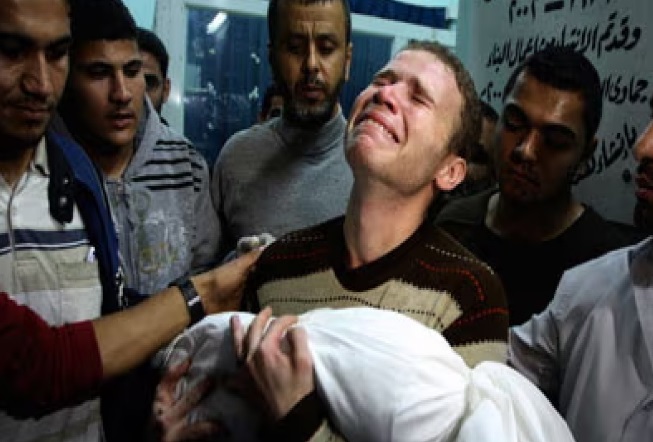
STATEMENT: The horror and trauma children are facing in Gaza right now is indescribable and unconscionable – suffering and killing must stop now.
After a pause in fighting for just one week, Plan International is devastated by the resumption of violence in Gaza over the weekend and the shocking number of civilians and children being killed in a matter of days.
Following the week-long pause and the release of 110 hostages from Gaza and 240 Palestinian prisoners, hopes held out by humanitarian agencies of a permanent and lasting ceasefire were crushed when Israel’s bombardments across the Gaza Strip resumed on Friday 1 December.
More than 500 civilians – including children – have been killed since bombing resumed, according to the Palestinian health ministry, as of Monday 4 December. Of those killed, 70% been women and children. The UN says more than 1.9 million people in Gaza are now displaced from their homes.
This sudden escalation of violence reverses the limited gains made in terms of humanitarian assistance during the pause. The devastating number of deaths, total destruction of health facilities and lack of basic sanitation and clean water, and other lifesaving and life-sustaining infrastructure and materials bring a grave risk of more children dying of disease and starvation. Sustained bombing is causing emotional distress and trauma amongst children that no words can truly explain.
With Israel expanding its ground military operations in the south of the Gaza Strip on Sunday, millions of people who had previously fled from the north have been left with nowhere to go. The health system in Gaza has now collapsed and UNICEF staff have described the few hospitals that remain in operation as “warzones”.
There is never any justification for the killing or maiming of children. In war and conflict, children are always innocent and must not be targeted. The horror and trauma children are facing in Gaza right now is indescribable and unconscionable.
While limited humanitarian assistance is being provided, the intensifying violence makes the situation in Gaza immensely dangerous for humanitarians and civilians alike.
Plan International is closely monitoring the situation in Gaza and is preparing to scale up operations through our offices in Egypt, Jordan and Lebanon and through local partners. Plan International Egypt are supporting the Egyptian Red Crescent to deliver supplies including food and first aid kits via the Rafah crossing, while Plan International Jordan have signed an MoU with Terre Des Hommes to support their work in Gaza. In the south of Lebanon, where cross-border tensions have led to widespread internal displacement, Plan International Lebanon are providing a range of support to displaced children and their families including non-food items, food, and household hygiene kits.
With the two-month mark of this terrible escalation of violence approaching, Plan International continues to call on all parties involved for an unconditional, immediate, sustained and complete ceasefire and improved humanitarian access. We also call for the release of all civilian hostages and Palestinian children held as prisoners.
About Plan International
About Plan International
Plan International is the charity for girls’ equality. Working across 83 countries, we tackle the root causes of poverty, support communities through crises, campaign for gender equality, and help governments do what’s right for children and particularly for girls. We believe a better world is possible. An equal world; a world where all children can live happy and healthy lives, and where girls can take their rightful place as equals. www.plan.org.au
We will be paying for these crumbling dangerous nuclear monoliths for generations

Interesting graph from above article shows that Europe and N America now have the legacy of hundreds of nuclear power station either decommissioned or due to be decommissioned. It takes about 100 years to clear a nuclear site depending on the tech used.
We will be paying for these crumbling dangerous monoliths for generations
United Arab Emirates is using COP 28 Climate Summit to promote small nuclear reactor industry, as well as fossil fuel industries

Following the launch of a programme aimed at leveraging its experience in
successfully delivering a nuclear power plant project, the UAE’s Emirates
Nuclear Energy Corporation (ENEC) has signed a number of agreements with
small modular reactor and micro-reactor vendors to explore opportunities
for the commercialisation and global deployment of their designs.
World Nuclear News 5th Dec 2023
https://www.world-nuclear-news.org/Articles/ENEC-to-evaluate-deployment-of-SMRs-and-microreact
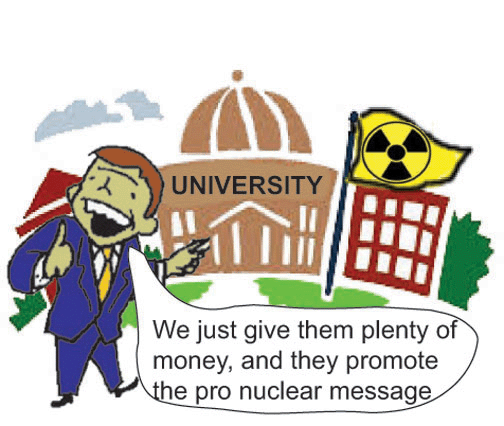
Australian government funding Adelaide University to train students for a nuclear-powered defence-force
Undergraduate funding to support nuclear-powered industry
5 December 2023, https://www.australiandefence.com.au/news/news/undergraduate-funding-to-support-nuclear-powered-industry
The University of Adelaide announced on 29 November that it has received Federal Government commitment to fund the training of hundreds more domestic undergraduate students to join the future defence workforce.
Under the Federal Government’s Nuclear-Powered Submarines (NPS) program the University of Adelaide has received an allocation of $38,634,835 between 2024 and 2030 to deliver an additional 700 Commonwealth Supported Places (CSPs).
“The University of Adelaide is pleased to receive this commitment of funding from the Federal Government to help train the defence workforce of the future,” said Professor Peter Høj AC, Vice-Chancellor and President, the University of Adelaide.
“This is a massive endorsement of the University’s capability to support the Australian Government’s plans to become a nuclear-powered defence-force under the AUKUS program.
“The University will lead developments in defence-related education as well as invest in research and research infrastructure to support the training of the best and brightest minds.”
The University of Adelaide received the largest number of places allocated to any university under this announcement. The 700 additional places at the University of Adelaide will deliver more graduates from STEM disciplines.
The Commonwealth and South Australian Government will also be funding schemes that will support eligible students to take up these new opportunities. These schemes include degree apprenticeships and scholarships, announced recently as part of the South Australian Defence Industry Workforce and Skills Action Plan
DOUBLING DOWN ON NUCLEAR POWER IS NO SOLUTION TO CLIMATE CRISIS

https://greens.scot/news/doubling-down-on-nuclear-power-is-no-solution-to-climate-crisis 3 Dec 23
Nuclear power is costly, inefficient and leaves a long and toxic legacy.
Doubling down on nuclear power will not solve the climate crisis, says the Scottish Greens climate spokesperson Mark Ruskell.
Mr Ruskell was responding to the announcement from the COP climate summit that 22 countries, including the US, France and the UK, have signed a declaration to triple nuclear capacity by 2050.
Mr Ruskell said: “Nuclear energy is costly, dangerous and out of date. It’s no kind of solution, and will leave a long and toxic legacy for generations to come. The UK experience of Hinkley Point underlines all of these problems, with delay after delay and ever-ballooning costs.
“The climate emergency is happening all around us. We simply don’t have time to waste on overpriced and dirty solutions like nuclear energy.”
Mr Ruskell welcomed the announcement that 118 countries have pledged to triple renewable energy, saying: “This is a significant step in the right direction and could be key to our shift away from climate-wrecking fossil fuels.
“Locally sourced renewable energy is the cheapest and greenest energy available. We have more and better technology available to us than ever before, all that is missing is the political will.
“I hope that this summit can be when leaders finally turn a corner and start to give renewables the investment and support that they deserve.”
Chris Hedges: Israel Reopens the Gaza Slaughterhouse

Nothing is off limits. Hospitals. Mosques. Churches. Homes. Apartment blocks. Refugee camps. Schools. Universities. Media offices. Banks. Sewer systems. Telecommunications infrastructure. Water treatment plants. Libraries. Wheat mills. Bakeries. Markets. Entire neighborhoods. Israel’s intent is to destroy Gaza’s infrastructure and daily kill or wound hundreds of Palestinians. Gaza is to become a wasteland, a dead zone that will be incapable of sustaining life.
Secretary of State Antony Blinken visited Israel this week, and while calling for Israel to protect civilians, refused to set conditions that would disrupt the $3.8 billion Israel receives in annual military assistance or the $14.3 billion supplemental aid package.
https://scheerpost.com/2023/12/01/chris-hedges-israel-reopens-the-gaza-slaughterhouse/
Phase One of Israel’s genocidal campaign on Gaza has ended. Phase Two has begun. It will result in even higher levels of death and destruction.
By Chris Hedges / Original to ScheerPost
The skies over Gaza are filled — after a seven-day truce — with projectiles of death. Warplanes. Attack helicopters. Drones. Artillery shells. Tank shells. Mortars. Bombs. Missiles. Gaza is a cacophony of explosions and forlorn screams and cries for help beneath collapsed buildings. Fear, once again, is coiling itself around every heart in the Gazan concentration camp.
By Friday evening, 184 Palestinians — including three journalists and two doctors — had been killed by Israeli air strikes in the north, south and central Gaza, and at least 589 injured, according to the Ministry of Health in Gaza. Most of them are women and children. Israel will not be deterred. It plans to finish the job, to obliterate what is left in the north of Gaza and decimate what remains in the south, to render Gaza uninhabitable, to see its 2.3 million people driven out in a massive campaign of ethnic cleansing via starvation, terror, slaughter and infectious diseases.
The aid convoys, which brought in token amounts of food and medicine — the first batch was shrouds and coronavirus tests according to the director of al-Najjar hospital — have been halted. No one, least of all President Joe Biden, plans to intervene to stop the genocide. Secretary of State Antony Blinken visited Israel this week, and while calling for Israel to protect civilians, refused to set conditions that would disrupt the $3.8 billion Israel receives in annual military assistance or the $14.3 billion supplemental aid package. The world will watch passively, muttering useless bromides about more surgical strikes, while Israel spins its roulette wheel of death. By the time Israel is done, the 1948 Nakba, where Palestinians were massacred in dozens of villages and 750,000 were ethnically cleansed by Zionist militias, will look like a quaint relic of a more civilized era.
Nothing is off limits. Hospitals. Mosques. Churches. Homes. Apartment blocks. Refugee camps. Schools. Universities. Media offices. Banks. Sewer systems. Telecommunications infrastructure. Water treatment plants. Libraries. Wheat mills. Bakeries. Markets. Entire neighborhoods. Israel’s intent is to destroy Gaza’s infrastructure and daily kill or wound hundreds of Palestinians. Gaza is to become a wasteland, a dead zone that will be incapable of sustaining life.
Israel began to bomb Khan Younis on Friday after dropping leaflets warning civilians to evacuate further south to Rafah, located on the border crossing with Egypt. Hundreds of thousands of displaced Palestinians had sought refuge in Khan Younis. Once Palestinians are pushed to Rafah, there is only one place left to flee — Egypt. The Israeli Ministry of Intelligence, in a leaked report, calls for the forcible transfer of Gaza’s population to Egypt’s Sinai Peninsula. A detailed plan to intentionally displace the Palestinians in Gaza and push them into Egypt has been embedded in Israeli doctrine for five decades. Already, 1.8 million Palestinians in Gaza have been driven from their homes. Once Palestinians cross the border into Egypt — which the Egyptian government and Arab leaders are seeking to prevent despite pressure from the U.S. — Palestinians will never return.
This is not a war against Hamas. It is a war against Palestinians.
Israeli strikes are generated at a dizzying rate, many of them from a system called “Habsora” — The Gospel — which is built on artificial intelligence that selects 100 targets a day. The AI-system is described by seven current and former Israeli intelligence officials in an article by Yuval Abraham on the Israeli sites +972 Magazine and Local Call, as facilitating a “mass assassination factory.” Israel, once it locates what it assumes to be a Hamas operative from a cell phone, for example, bombs and shells a wide area around the target, killing and wounding tens, and at times hundreds of Palestinians, the article states.
“According to intelligence sources,” the story reads, “Habsora generates, among other things, automatic recommendations for attacking private residences where people suspected of being Hamas or Islamic Jihad operatives live. Israel then carries out large-scale assassination operations through the heavy shelling of these residential homes.”
Some 15,000 Palestinians, including 6,000 children and 4,000 women, have been killed since Oct. 7. Some 30,000 have been wounded. Over six thousand are missing, many buried under the rubble. More than 300 families have lost 10 or more members of their families. More than 250 Palestinians have been killed in the West Bank since Oct. 7, and more than 3,000 injured, although the area is not controlled by Hamas. The Israeli military claims to have killed between 1,000 and 3,000 of some 30,000 Hamas fighters, a relatively small number given the scale of the assault. Most resistance fighters shelter in their vast tunnel system.
Israel’s playbook is the “Dahiya Doctrine.” The doctrine was formulated by former Israel Defense Forces (IDF) Chief of Staff Gadi Eizenkot, who is a member of the war cabinet, following the 2006 war between Israel and Hezbollah in Lebanon. Dahiya is a southern Beirut suburb and a Hezbollah stronghold. It was pounded by Israeli jets after two Israeli soldiers were taken prisoner. The doctrine posits that Israel should employ massive, disproportionate force, destroying infrastructure and civilian residences, to ensure deterrence.
Daniel Hagari, spokesman of the IDF, conceded at the start of Israel’s most recent attack on Gaza that the “emphasis” would be “on damage and not on accuracy.”
Israel has abandoned its tactic of “roof knocking” where a rocket without a warhead would land on a roof to warn those inside to evacuate. Israel has also ended its phone calls warning of an impending attack. Now dozens of families in an apartment block or a neighborhood are killed without notice.
The images of mass destruction feed the thirst for revenge within Israel following the humiliating incursion by Hamas fighters on Oct. 7 and the killing of 1,200 Israelis, including 395 soldiers and 59 police officers. There is a sadistic pleasure voiced by many Israelis over the genocide and a groundswell of calls for the murder or expulsion of Palestinians, including those in the occupied West Bank and those with Israeli citizenship.
The savagery of the air strikes and indiscriminate attacks, the cutting off of food, water and medicine, the genocidal rhetoric of the Israeli government, make this a war whose sole objective is revenge. This will not be good for Israel or the Palestinians. It will fuel a conflagration throughout the Middle East.
Israel’s attack is the last desperate measure of a settler colonial project that foolishly thinks, as many settler colonial projects have in the past, that it can crush the resistance of an indigenous population with genocide. But even Israel will not get away with killing on this scale. A generation of Palestinians, many of whom have seen most, if not all, of their families killed and their homes and neighborhoods destroyed, will carry within them a lifelong thirst for justice and retribution.
This war is not over. It has not even begun.
Nuclear, and climate, news to 4th December

Some bits of good news. England’s rainforests breathed easier. Treaty on the Prohibition of Nuclear Weapons: A Bright Constellation in a Very Dark Sky.
TOP STORIES
Plot to Triple Nuclear Power by 2050 Decried as ‘Dangerous Distraction’ at COP28.
Ralph Nader -on Israel’s Genocidal Antisemitism Against the Arab Civilians of Gaza.
Small modular nuclear reactors: a history of failure.
Drones Target Ukrainian, Russian Nuclear Facilities.
******************
Climate. “We cannot afford to have a bad COP” – Mary Robinson. COP28: UAE planned to use climate talks to make oil deals. Climate summit in an oil state: can COP28 change anything?Bah Humbug!– to COP Climate Conference sponsored by Dubai, an oil & natural gas nation. COP28: Hopes of fossil fuel ‘phase out’ hit by revelations of Saudi plan to boost oil demand. Cop28: what to expect from the Dubai climate change conference- (behind a pay wall, but read it on nuclear-news.net) How wealthy countries, l(ike U.S., Canada, Australia, and Norway), evade responsibility for their fossil fuel exports. Why the UN Report is right to say we’re heading for at least 3 degrees of warming. ‘Progress this decade is critical’: Why a 1.5C world hinges on doubling down on energy efficiency.
Christina notes. Have you noticed? The nuclear lobby is swamping the news media with its false “nuclear for climate”message. COP 28 A sorry tale of climate hypocrisy.
Nuclear. It’s full on nuclear propaganda time. It’s all in the wording. At COP 28, 20 countries signed up to promote nuclear. 179 COUNTRIES DID NOT SIGN UP TO PROMOTE NUCLEAR.
******************
AUSTRALIA. Sovereignty Surrendered: Subordinating Australia’s Defence Industry. Australia’s AUKUS nuclear submarines could fuel regional arms race despite assurance. Karina Lester addresses the Second Meeting of States Parties to the TPNW.
‘Part of a balanced mix’: Coalition continues nuclear energy push. Australia backs Cop28 promise to triple renewables but not nuclear capacity pledge. Online event: Heart of Country: online film screening and panel discussion.
******************
CLIMATE. DOUBLING DOWN ON NUCLEAR POWER IS NO SOLUTION TO CLIMATE CRISIS. Nuclear vs. Climate: Is nuclear power needed to contain the climate crisis? John Kerry at Cop28 to lobby for the nuclear industry. Nuclear lobby’s big push to ‘shine’ at COP28.
ECONOMICS.
- The nuclear power renaissance has some way to run.
- France goes for its own costly small nuclear reactor, following the USA NuScale flop, and UK’s lagging Rolls Royce one. French nuclear tax is leap into the dark – analysts. EDF to “build 1 reactor a year in 2030s” – CEO.
- The President of the Canadian Nuclear Safety Commission spent $288,000 on travel in 19 months. Hydro- Quebec decides against restarting Gentilly 2 nuclear station.
- NuScale cancels first planned SMR nuclear project due to lack of interest.
- Why Britain’s mini-nukes dream is hanging by a thread. Failure of USA’s NuScale small nuclear reactors (SMRs) not a good omen for Rolls Royce and other UK SMR developers. UK’s first small nuclear reactor deal ‘poised’ for signing but not with Rolls-Royce.
- Operators extend Finnish, Swedish nuclear reactor outages.
EMPLOYMENT. Swiss nuclear power plants are running out of staff.
ETHICS and RELIGION. Holy See advocates collaboration on nuclear disarmament.
LEGAL. Musk’s Lawsuit Is About Destroying Free Speech. Portland nuclear power startup NuScale hit with investor lawsuit.
NUCLEAR TECHNOLOGY. Nuclear Power Expansion Predictions Failed. SMRs two examples: NuScale in the US, NUWARD in France . Can thorium solve the nuclear problem? That’s doubtful.
OPPOSITION to NUCLEAR . Halt the US-Philippines Nuclear Deal –Sign on to Letter to US Congress – Full statement and sign on: tinyurl.com/haltUSPHdeal
PERSONAL STORIES. ‘Let us be a lesson’, say Kazakhs wary of return to nuclear testing.
POLITICS. UK government hopes that United Arab Emirates will invest in Sizewell C nuclear power plan. Energy-rich Scotland does not require any nuclear power stations. Nuclear energy in Philippines? Group says there’s not even a Filipino expert on safety, radiation. Sweden to slug tax-payers for the costs of small nuclear reactors, and big ones.
POLITICS INTERNATIONAL and DIPLOMACY. Second meeting of states parties agrees nuclear deterrence is the problem. UK’s Sizewell C Nuclear stake seized from China may go to United Arab Emirates. (behind a pay wall, but read it on nuclear-news.net) TELL THE UNITED ARAB EMIRATES NOT TO INVEST IN SIZEWELL C.
PUBLIC OPINION. Renewable or nuclear? What your energy preference says about you – public opinion.
SAFETY. Closer to nuclear plant than ever, latest Korean quake renews calls to retire aging reactors. Olkiluoto 3 nuclear power station shuts down again. Incidents. IAEA experts record explosions near two Ukrainian nuclear power plants. Zaporizhzhia nuclear plant suffered power outage, energy ministry says. Freezing consequences for Mississippi River as nuclear units down.
SPACE. EXPLORATION, WEAPONS. SpaceX rockets keep tearing blood-red ‘atmospheric holes’ in the sky, and scientists are concerned.
SPINBUSTER. Nuclear lobby’s latest gimmick – making nuclear BEAUTIFUL !
WASTES. A blank cheque for France’s Industrial Centre for Geological Disposal (Cigéo) does not prove that it is safe. How to Scrap the First-Ever Nuclear-Powered Aircraft Carrier: USS Enterprise? A sobering analysis of the Canadian plan for small modular nuclear reactors (SMRs) and their toxic waste problem..
WAR and CONFLICT. President Biden has morphed into the Murder Monster. The New York Times Reports Gaza Civilians ‘Are Being Killed at Historic Pace’. Israel’s Savagery Is So Shocking It’s Sometimes Hard To Take In.
A Nuclear Attack by Design — or by Accident — Must Never Happen. A planned US-Israeli attack on Iran is contemplated. AI and the Bomb: Nuclear Strategy and Risk in the Digital Age. URANIUM WARHEAD POISONING IS THE SPECIALTY OF US AGAINST RUSSIANS, ISRAEL AGAINST PALESTINIANS.
WEAPONS and WEAPONS SALES. US nuclear bombs ‘set to return to UK‘ for first time in 15 years – making Lakenheath a “nuclear target”. U.S. to Develop Unanticipated New Nuclear Bomb. Pentagon struggling to pay for Middle East buildup – Politico. The Military’s Big Bet on Artificial Intelligence. ‘The Gospel’: how Israel uses AI to select bombing targets in Gaza. US Sent Israel 15,000 Bombs Since October 7.
Australia’s AUKUS nuclear submarines could fuel regional arms race despite assurance
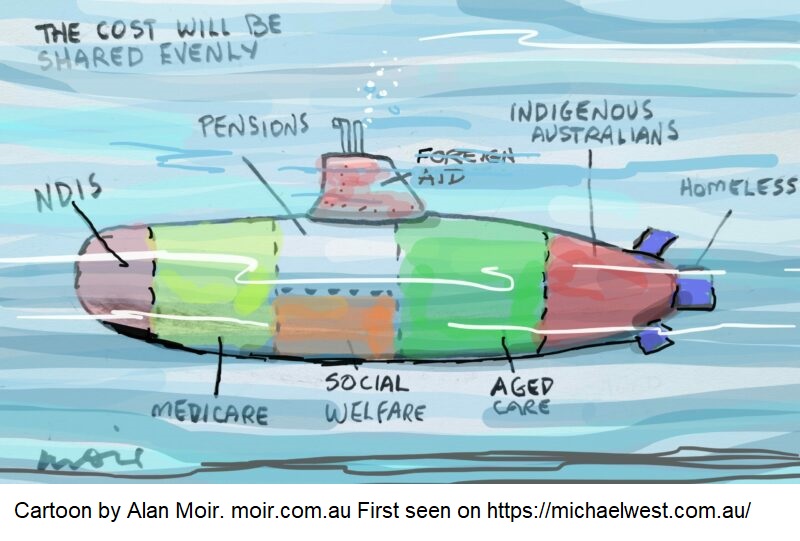
“AUKUS is designed to shore up American power in East Asia, not de-escalate tensions,”
By Su-Lin TanDec 4, 2023, https://johnmenadue.com/australias-aukus-nuclear-submarines-could-fuel-regional-arms-race-despite-assurance/
Defence Industry Minister Pat Conroy says Australia is not worsening the arms race and gives assurance about the submarines’ nuclear reactors. The deal could still spark a defence build-up in Asia-Pacific while Australia lacks the facilities to deal with nuclear waste, analysts say.
Australia may have asserted that its acquisition of nuclear-powered submarines under AUKUS is not aggravating the “arms race”, but the deal and the three-nation alliance could still fuel a defence build-up in the Asia-Pacific and heighten regional tensions, security analysts say.
At the national press club in Canberra on Tuesday, Australian Defence Industry Minister Pat Conroy reiterated the importance of the submarines to the country’s defence while debunking “myths” about the trilateral deal struck with Britain and the United States, which is largely seen as a countermeasure targeting China.
“The arms race is the greatest it’s been since 1945, and that is why I reject assertions … that Australia is somehow fuelling that arms race,” he said, adding that rising tensions in the Asia-Pacific had posed the most challenging strategic environment for Australia since World War II. “We are responding to it in a responsible and mature manner, like Australian governments should.”
Australia will own at least eight submarines over the next three decades through the A$368 billion (US$243 billion) deal. First announced in 2021 and finalised earlier this year, the controversial pact has raised concerns in the region.
Collin Koh, a senior fellow at the S. Rajaratnam School of International Studies in Singapore, said Conroy’s comment was not a surprise as countries including China and others in Asia-Pacific often couched their arms acquisitions in “defensive terms”.
Most countries would do so in the name of national security interests but it did not mean such actions ensured peace or safety, he said.
Even before AUKUS was announced in 2021, China and other regional countries had already embarked on significant military build-up since the 1990s, Koh said.
“Conroy may not be necessarily wrong to say AUKUS responds to this already ongoing condition, yet at the same time, it’s also not wrong to say that AUKUS … may not only be used by Beijing to legitimise its naval build-up, it also could be exploited as a justification for other regional countries’ military build-up programmes,” Koh said.
Australia’s acquisition of the submarines might trigger new problems as other countries could argue that they should also acquire similar capabilities, said Maria Rost Rublee, a nuclear politics expert at Monash University.
These countries are not limited to “dangerous actors”, for instance, in South Korea where the majority of its people have expressed a desire for their country to own nuclear weapons, Rublee added.
“Just having this type of technology in the hands of a country where you have strong popular support for nuclear weapons could be an issue,” she said.
In an analysis earlier this month, Ankit Panda, the Stanton Senior Fellow in the Nuclear Policy Programme at the Carnegie Endowment for International Peace, warned the accumulation of weapons such as missiles could potentially lead to unintended attacks.
“The Indo-Pacific region has entered a new missile age … each nation individually seeking deterrence while as a whole steering the region into ever more dangerous waters,” he said. “A particular risk concerns the prospects of attacks on the nuclear forces of countries like North Korea and China, by US or allied forces in ways that may not be intended.”
By the 2030s, the Indo-Pacific region would be “full of thousands of new missiles that can be expected to be used widely in the context of a major regional war”, Panda said.
Responding to Conroy’s comments, the national convenor of Labor Against War in Australia, Marcus Strom, said: “If your answer to growing regional tension is to add offensive weaponry, you create a logic towards war.
“AUKUS is designed to shore up American power in East Asia, not de-escalate tensions,” he added.
While Conroy has given assurances about the safety of sealed nuclear reactors within the submarines, analysts argued that the lack of facilities in Australia for the eventual disposal of these reactors is worrying.
“The strength of this agreement is that the reactor module comes to us sealed. It comes sealed, designed to be never opened over the life of a submarine. You don’t have to refuel it, you don’t have to insert new fuel rods … [over] the life of the submarine,” Conroy said.
But nuclear waste expert Ian Lowe said in an analysis on The Conversation website earlier this year that Australia has failed for decades to find long-term storage solutions for small quantities of low- and intermediate-level nuclear waste.
Even Australia’s allies and AUKUS partners, the US and the UK, do not have long-term solutions for nuclear waste storage, according to Lowe.
“This should be concerning. To manage the waste from our proposed nuclear submarines properly, we’ll have to develop systems and sites which do not currently exist in Australia,” Lowe said.
Australian states such as Victoria, Queensland and South Australia have said they would not accept a nuclear waste facility within their borders.
While it will be another 30 years before Australia has to worry about dumping the submarine’s nuclear reactors, it is not a long time, Rublee said.
“If they take their nuclear stewardship obligations seriously, they must immediately begin working on the long-term storage of high-level nuclear waste,” she added.
‘Part of a balanced mix’: Coalition continues nuclear energy push.

They did it with the “Voice to Parliament referendum – Dutton and the rest of the mindless right-wing dinosaurs just kept to the script (written for them by the ATLAS network) – “If you don’t know. vote No“
That was a meaningless lie. (If you didn’t know, it should be Undecided)
Now the nuclear lobby comes up with “Part of a balanced mix”. Nothing balanced about including super-expensive, dangerous, ever too late-for-climate nuclear power into climate action strategies.
ABC Listen 4 Dec 23, Thousands have gathered in Dubai this week for the COP28 climate summit, with more than 100 countries this year pledging to triple world renewable energy use by 2030.
20 countries have also pledged to triple nuclear energy capacity by 2050, a move the opposition Climate Change spokesperson Ted O’Brien supports, but still can’t say how much it would cost taxpayers to build.
Australia backs Cop28 promise to triple renewables but not nuclear capacity pledge
More than 115 countries vow to triple renewable energy capacity by 2030 – though not China and India
Adam Morton and Katharine Murphy, Guardian, Sun 3 Dec 2023
Australia has backed a pledge at Cop28 climate summit to triple global renewable energy capacity and double the annual rate of energy efficiency improvements by 2030.
The climate change minister, Chris Bowen, said the Albanese government had joined 117 other countries in making the pledge, reiterating an agreement reached by G20 countries in September.
The renewable energy agreement was one of a series of headline declarations made as more than 100 global leaders arrived in the United Arab Emirates for the opening days of the two-week conference.
Anthony Albanese is not attending, and Bowen is not due to fly to Dubai until later this week for the event’s final week, when ministers will attempt to wrangle a consensus position on how to lift action to tackle the climate crisis in the face of rising geopolitical tensions. Australia was represented at the opening plenary by its climate change ambassador, Kristin Tilley.
Bowen said Australia had joined other major energy exporters, including the US, Canada and Norway, in supporting the renewables and energy efficiency push.
“We know that renewables are the cleanest and cheapest form of energy, and that energy efficiency can also help drive down bills and emissions,” he said in a statement. “For emissions to go down around the world, we need a big international push. Australia has the resources and the smarts to help supply the world with clean energy technologies to drive down those emissions while spurring new Australian industry.”
The renewable energy pledge was welcomed by climate campaigners and analysts. Tim Buckley, director of the independent think tank Clean Energy Finance, said it was excellent to see Australia backing the commitment. He said falling costs had made the transition to renewables “an entirely economically sensible and viable commitment”………………………………………………………………………..
Australia is the chair of the “umbrella group” of countries at the talks, which includes the US, UK, New Zealand, Canada, Ukraine, Israel and Norway. Bowen said he intended “to be quite an active chair” and that meant “bringing other countries with us” to help reach a consensus.
An initial draft Cop text released on Saturday listed included a range of expressions to be debated, including that either fossil fuels or coal should be “phased out” or “phased down”. The same applied to fossil fuel subsidies. Saudi Arabia, China and India have previously resisted calls to agree that all fossil fuels should be phased out.
Australia was also among more than 100 countries to back declarations pledging to strengthen climate action in healthcare and farming. It did not sign up to a commitment by 22 countries, including the US, Canada, Japan and Britain, to triple nuclear energy capacity by 2050.
The Albanese government is hoping to win support for Australia to host Cop31 in 2026 with Pacific countries, but it is unclear whether a decision will be made in Dubai. The UN climate process faces a more pressing decision on where next year’s annual summit will be held. It is due to be hosted in eastern Europe but Russia has blocked agreement on which country will take the reins.
1 This month


Help Aunty Sue Protect Her Land and Sacred Sites From Destructive Rocket Testing.
.

Australians deserve the truth
about
AUKUS – https://aukuspublicinquiry.com/

PETITION – To: Prime Minister Anthony Albanese and the Australian Labor Government

of the week – Australians for War Powers Reform (AWPR)
To see nuclear-related stories in greater depth and intensity

