Plot to Triple Nuclear Power by 2050 Decried as ‘Dangerous Distraction’ at COP28

“Investing now in nuclear energy is an inefficient route to take to reduce emissions at the scale and pace needed to tackle climate change,” said one campaigner.
JON QUEALLY, Dec 02, 2023
Climate campaigners scoffed Saturday at a 22-nation pledge to triple nuclear power capacity by mid-century as a way to ward off the increasing damage of warming temperatures, with opponents calling it a costly and “dangerous” distraction from the urgent need for a fossil fuel phaseout alongside a rapid increase in more affordable and scaleable renewable sources such as wind and solar.
The Declaration to Triple Nuclear Energy—backed by the United States, Canada, France, the Czech Republic, and others—was announced as part of the Climate Action Summit taking place in Dubai as a part of the two-week U.N. climate talks known as COP28.
While the document claims a “key role” for nuclear energy to keep “a 1.5°C limit on temperature rise within reach” by 2050 and to help attain the so-called “net-zero emissions” goal that governments and the fossil fuel industry deploy to justify the continued burning of coal, oil, and gas, critics say the false solution of atomic power actually harms the effort to reduce emissions by wasting precious time and money that could be spent better and faster elsewhere.
“There is no space for dangerous nuclear power to accelerate the decarbonization needed to achieve the Paris climate goal,” said Masayoshi Iyoda, a 350.org campaigner in Japan who cited the 2011 Fukushima disaster as evidence of the inherent dangers of nuclear power.
Nuclear energy, said Iyoda, “is nothing more than a dangerous distraction. The attempt of a ‘nuclear renaissance’ led by nuclear industries’ lobbyists since the 2000s has never been successful—it is simply too costly, too risky, too undemocratic, and too time-consuming. We already have cheaper, safer, democratic, and faster solutions to the climate crisis, and they are renewable energy and energy efficiency.”
When word of the multi-nation pledge emerged last month, Mark Jacobson, professor of civil and environmental engineering at Stanford University and co-founder of The Solutions Project which offers a roadmap for 100% renewable energy that excludes nuclear energy, called the proposal the “stupidest policy proposal I’ve ever seen.”
Jacobson said the plan to boost nuclear capacity in a manner to avert the worst impacts of the climate crisis “will never happen no matter how many goals are set” and added that President Joe Biden was getting “bad advice in the White House” for supporting it.
In comments from Dubai, U.S. climate envoy John Kerry said that while he agrees nuclear will be a “sweeping alternative to every other energy source,” but claimed that “science and the reality of facts” shows the world cannot “get to net-zero by 2050 with some nuclear.”
Numerous studies and blueprints towards a renewable energy future, however, have shown this is not established fact, but rather the position taken by both the nuclear power industry itself and those who would otherwise like to slow the transition to a truly renewable energy system.
Pauline Boyer, energy transition campaign manager with Greenpeace France, said the scientific evidence is clear and it is not in favor of a surge in nuclear power.
“If we wish to maintain a chance of a trajectory of 1.5°C, we must massively reduce greenhouse gas emissions over the coming years, but nuclear power is too slow to deploy in the face of the climate emergency,” she said.
Climate campaigners scoffed Saturday at a 22-nation pledge to triple nuclear power capacity by mid-century as a way to ward off the increasing damage of warming temperatures, with opponents calling it a costly and “dangerous” distraction from the urgent need for a fossil fuel phaseout alongside a rapid increase in more affordable and scaleable renewable sources such as wind and solar.
The Declaration to Triple Nuclear Energy—backed by the United States, Canada, France, the Czech Republic, and others—was announced as part of the Climate Action Summit taking place in Dubai as a part of the two-week U.N. climate talks known as COP28.
While the document claims a “key role” for nuclear energy to keep “a 1.5°C limit on temperature rise within reach” by 2050 and to help attain the so-called “net-zero emissions” goal that governments and the fossil fuel industry deploy to justify the continued burning of coal, oil, and gas, critics say the false solution of atomic power actually harms the effort to reduce emissions by wasting precious time and money that could be spent better and faster elsewhere.
“There is no space for dangerous nuclear power to accelerate the decarbonization needed to achieve the Paris climate goal,” said Masayoshi Iyoda, a 350.org campaigner in Japan who cited the 2011 Fukushima disaster as evidence of the inherent dangers of nuclear power.
“There is no space for dangerous nuclear power to accelerate the decarbonization needed to achieve the Paris climate goal.”
Nuclear energy, said Iyoda, “is nothing more than a dangerous distraction. The attempt of a ‘nuclear renaissance’ led by nuclear industries’ lobbyists since the 2000s has never been successful—it is simply too costly, too risky, too undemocratic, and too time-consuming. We already have cheaper, safer, democratic, and faster solutions to the climate crisis, and they are renewable energy and energy efficiency.”
When word of the multi-nation pledge emerged last month, Mark Jacobson, professor of civil and environmental engineering at Stanford University and co-founder of The Solutions Project which offers a roadmap for 100% renewable energy that excludes nuclear energy, called the proposal the “stupidest policy proposal I’ve ever seen.”
Jacobson said the plan to boost nuclear capacity in a manner to avert the worst impacts of the climate crisis “will never happen no matter how many goals are set” and added that President Joe Biden was getting “bad advice in the White House” for supporting it.
In comments from Dubai, U.S. climate envoy John Kerry said that while he agrees nuclear will be a “sweeping alternative to every other energy source,” but claimed that “science and the reality of facts” shows the world cannot “get to net-zero by 2050 with some nuclear.”
Numerous studies and blueprints towards a renewable energy future, however, have shown this is not established fact, but rather the position taken by both the nuclear power industry itself and those who would otherwise like to slow the transition to a truly renewable energy system.
Pauline Boyer, energy transition campaign manager with Greenpeace France, said the scientific evidence is clear and it is not in favor of a surge in nuclear power.
“If we wish to maintain a chance of a trajectory of 1.5°C, we must massively reduce greenhouse gas emissions over the coming years, but nuclear power is too slow to deploy in the face of the climate emergency,” she said.
“The announcement of a tripling of capacities is disconnected from reality,” Boyer continued. Citing delays and soaring costs, she said the nuclear industry “is losing ground in the global energy mix every day” in favor of renewable energy options that are cheaper, quicker to deploy, and more accessible to developing countries.
Climate campaigners scoffed Saturday at a 22-nation pledge to triple nuclear power capacity by mid-century as a way to ward off the increasing damage of warming temperatures, with opponents calling it a costly and “dangerous” distraction from the urgent need for a fossil fuel phaseout alongside a rapid increase in more affordable and scaleable renewable sources such as wind and solar.
The Declaration to Triple Nuclear Energy—backed by the United States, Canada, France, the Czech Republic, and others—was announced as part of the Climate Action Summit taking place in Dubai as a part of the two-week U.N. climate talks known as COP28.
While the document claims a “key role” for nuclear energy to keep “a 1.5°C limit on temperature rise within reach” by 2050 and to help attain the so-called “net-zero emissions” goal that governments and the fossil fuel industry deploy to justify the continued burning of coal, oil, and gas, critics say the false solution of atomic power actually harms the effort to reduce emissions by wasting precious time and money that could be spent better and faster elsewhere.
“There is no space for dangerous nuclear power to accelerate the decarbonization needed to achieve the Paris climate goal,” said Masayoshi Iyoda, a 350.org campaigner in Japan who cited the 2011 Fukushima disaster as evidence of the inherent dangers of nuclear power.
“There is no space for dangerous nuclear power to accelerate the decarbonization needed to achieve the Paris climate goal.”
Nuclear energy, said Iyoda, “is nothing more than a dangerous distraction. The attempt of a ‘nuclear renaissance’ led by nuclear industries’ lobbyists since the 2000s has never been successful—it is simply too costly, too risky, too undemocratic, and too time-consuming. We already have cheaper, safer, democratic, and faster solutions to the climate crisis, and they are renewable energy and energy efficiency.”
When word of the multi-nation pledge emerged last month, Mark Jacobson, professor of civil and environmental engineering at Stanford University and co-founder of The Solutions Project which offers a roadmap for 100% renewable energy that excludes nuclear energy, called the proposal the “stupidest policy proposal I’ve ever seen.”
Jacobson said the plan to boost nuclear capacity in a manner to avert the worst impacts of the climate crisis “will never happen no matter how many goals are set” and added that President Joe Biden was getting “bad advice in the White House” for supporting it.
In comments from Dubai, U.S. climate envoy John Kerry said that while he agrees nuclear will be a “sweeping alternative to every other energy source,” but claimed that “science and the reality of facts” shows the world cannot “get to net-zero by 2050 with some nuclear.”
Numerous studies and blueprints towards a renewable energy future, however, have shown this is not established fact, but rather the position taken by both the nuclear power industry itself and those who would otherwise like to slow the transition to a truly renewable energy system.
Pauline Boyer, energy transition campaign manager with Greenpeace France, said the scientific evidence is clear and it is not in favor of a surge in nuclear power.
“If we wish to maintain a chance of a trajectory of 1.5°C, we must massively reduce greenhouse gas emissions over the coming years, but nuclear power is too slow to deploy in the face of the climate emergency,” she said.
“The announcement of a tripling of capacities is disconnected from reality,” Boyer continued. Citing delays and soaring costs, she said the nuclear industry “is losing ground in the global energy mix every day” in favor of renewable energy options that are cheaper, quicker to deploy, and more accessible to developing countries.
In 2016, researchers at the University of Sussex and the Vienna School of International Studies showed that “entrenched commitments to nuclear power” were likely “counterproductive” towards achieving renewable energy targets, especially as “better ways to meet climate goals”—namely solar, wind, geothermal, and hydropower–were suppressed.
In response to Saturday’s announcement, Soraya Fettih, a 350.org campaigner from France, which relies heavily on nuclear power, said it’s simply a move in the wrong direction. “Investing now in nuclear energy is an inefficient route to take to reduce emissions at the scale and pace needed to tackle climate change,” said Fettih. “Nuclear energy takes much longer than renewable energy to be operational.”
Climate campaigners scoffed Saturday at a 22-nation pledge to triple nuclear power capacity by mid-century as a way to ward off the increasing damage of warming temperatures, with opponents calling it a costly and “dangerous” distraction from the urgent need for a fossil fuel phaseout alongside a rapid increase in more affordable and scaleable renewable sources such as wind and solar.
The Declaration to Triple Nuclear Energy—backed by the United States, Canada, France, the Czech Republic, and others—was announced as part of the Climate Action Summit taking place in Dubai as a part of the two-week U.N. climate talks known as COP28.
While the document claims a “key role” for nuclear energy to keep “a 1.5°C limit on temperature rise within reach” by 2050 and to help attain the so-called “net-zero emissions” goal that governments and the fossil fuel industry deploy to justify the continued burning of coal, oil, and gas, critics say the false solution of atomic power actually harms the effort to reduce emissions by wasting precious time and money that could be spent better and faster elsewhere.
“There is no space for dangerous nuclear power to accelerate the decarbonization needed to achieve the Paris climate goal,” said Masayoshi Iyoda, a 350.org campaigner in Japan who cited the 2011 Fukushima disaster as evidence of the inherent dangers of nuclear power.
“There is no space for dangerous nuclear power to accelerate the decarbonization needed to achieve the Paris climate goal.”
Nuclear energy, said Iyoda, “is nothing more than a dangerous distraction. The attempt of a ‘nuclear renaissance’ led by nuclear industries’ lobbyists since the 2000s has never been successful—it is simply too costly, too risky, too undemocratic, and too time-consuming. We already have cheaper, safer, democratic, and faster solutions to the climate crisis, and they are renewable energy and energy efficiency.”
When word of the multi-nation pledge emerged last month, Mark Jacobson, professor of civil and environmental engineering at Stanford University and co-founder of The Solutions Project which offers a roadmap for 100% renewable energy that excludes nuclear energy, called the proposal the “stupidest policy proposal I’ve ever seen.”
Jacobson said the plan to boost nuclear capacity in a manner to avert the worst impacts of the climate crisis “will never happen no matter how many goals are set” and added that President Joe Biden was getting “bad advice in the White House” for supporting it.
In comments from Dubai, U.S. climate envoy John Kerry said that while he agrees nuclear will be a “sweeping alternative to every other energy source,” but claimed that “science and the reality of facts” shows the world cannot “get to net-zero by 2050 with some nuclear.”
Numerous studies and blueprints towards a renewable energy future, however, have shown this is not established fact, but rather the position taken by both the nuclear power industry itself and those who would otherwise like to slow the transition to a truly renewable energy system.
Pauline Boyer, energy transition campaign manager with Greenpeace France, said the scientific evidence is clear and it is not in favor of a surge in nuclear power.
“If we wish to maintain a chance of a trajectory of 1.5°C, we must massively reduce greenhouse gas emissions over the coming years, but nuclear power is too slow to deploy in the face of the climate emergency,” she said.
“The announcement of a tripling of capacities is disconnected from reality,” Boyer continued. Citing delays and soaring costs, she said the nuclear industry “is losing ground in the global energy mix every day” in favor of renewable energy options that are cheaper, quicker to deploy, and more accessible to developing countries.
In 2016, researchers at the University of Sussex and the Vienna School of International Studies showed that “entrenched commitments to nuclear power” were likely “counterproductive” towards achieving renewable energy targets, especially as “better ways to meet climate goals”—namely solar, wind, geothermal, and hydropower–were suppressed.
In response to Saturday’s announcement, Soraya Fettih, a 350.org campaigner from France, which relies heavily on nuclear power, said it’s simply a move in the wrong direction. “Investing now in nuclear energy is an inefficient route to take to reduce emissions at the scale and pace needed to tackle climate change,” said Fettih. “Nuclear energy takes much longer than renewable energy to be operational.”
Writing on the subject in 2019, Harvard University professor Naomi Orseskes and renowned author and psychohistorian Robert Jay Lifton observed how advocates of nuclear power declare the technology “clean, efficient, economical, and safe” while in reality “it is none of these. It is expensive and poses grave dangers to our physical and psychological well-being.”
“There are now more than 450 nuclear reactors throughout the world,” they wrote at the time. “If nuclear power is embraced as a rescue technology, there would be many times that number, creating a worldwide chain of nuclear danger zones—a planetary system of potential self-annihilation.”
Nuclear lobby’s latest gimmick – making nuclear BEAUTIFUL !

Making nuclear power plants look great, World Nuclear News, 01 December 2023

They must be desperate. They’ve tried – renewable, -clean, – safe – cheap, – nothing-to-do-with weapons
They’re still lying their heads off about –fixes climate change
Nobody believes them. Now they’re going for beautiful and feel-good.
Good luck with that.
Amber Rudd, a previous UK Minister for Energy tried that, years ago, and it went down like a lead balloon.
We hear from an award-winning architect on the benefits of designing nuclear power plants that make people feel good ..
Technology and function, ensuring their reliable and safe operation have long been the priorities when designing nuclear power plants. But why can’t they look beautiful too? Dutch architect and designer Erick van Egeraat says that part of the way to continue to build public support for nuclear energy is to make nuclear power plants look good, “to make people feel good” when they see them.
The award-winning professor and director of Design Erick van Egeraat outlined his thinking at World Nuclear Symposium, explaining the background to the work he is doing at Akkuyu nuclear power plant, which is being built in Turkey.
Israel Planning for Gaza War To Last Over a Year

In either case, the Israeli military operations have killed more children, at least 6,000, than members of Hamas.
https://news.antiwar.com/2023/12/01/israel-planning-for-gaza-war-to-last-over-a-year/
One source said, “This will be a very long war . . . We’re currently not near halfway to achieving our objectives.”
The Financial Times reported speaking with sources who said that Israel plans to wage war on Gaza for over a year. In a little less than two months, Israel has killed at least 15,000 people, damaged 100,000 buildings, displaced 1.7 million Palestinians, and destroyed most of Gaza’s medical facilities.
On Friday, FT reported sources said Israel was preparing for a multi-phase conflict in Gaza that will last at least a year. “This will be a very long war…We’re currently not near halfway to achieving our objectives,” said one person familiar with the Israeli war plans.
According to the sources, Israel’s goals include “killing the three top Hamas leaders — Yahya Sinwar, Mohammed Deif, and Marwan Issa — while securing a decisive military victory against the group’s 24 battalions and underground tunnel network and destroying its governing capability in Gaza.”
Israel does not appear close to achieving these goals. US sources have said that Israel’s military operations in Gaza have failed to impact high or even mid-level Hamas members. On Sunday, the Guardian reported that Israeli officials estimated that 1,000 – 2,000 Hamas members had been killed. However, FT spoke with an Israeli military source who gave an estimate of 5,000 dead Hamas members. It is unclear why there is such a large discrepancy in the numbers, as both were given during the week-long pause in fighting.
In either case, the Israeli military operations have killed more children, at least 6,000, than members of Hamas. The massive civilian toll has led to mounting world opinion against Israeli military operations.

Secretary of State Antony Blinken attended a meeting of the Israeli war cabinet on Thursday and warned that Tel Aviv will lose more international support as the conflict continues. Gen. Herzi Halevi, the Israeli Defense Forces (IDF) chief of staff, said military operations in Gaza will take “more than a few additional weeks,” suggesting Tel Aviv did not plan to follow Washington’s advice. Still, America’s top diplomat said Washington was still firmly committed to arming Tel Aviv.
The first phase of the war, an intense bombing campaign and ground invasion, is expected to last well into 2024. One source said the first phase of the war is about 40% complete. “Gaza City isn’t finished yet, nor fully conquered. It’s probably 40% done,” the person explained. “For the north as a whole, it will probably require another two weeks to a month.”
The second phase will be an operation with fewer military operations aimed at stabilizing Gaza. While the sources told FT that the second phase is projected to continue until late 2024, Israeli officials say they cannot predict a firm endpoint to the conflict.
The Biden administration has pushed Israeli Prime Minister Benjamin Netanyahu to agree to allow the Palestinian Authority to control Gaza after Hamas is defeated. However, one source told FT that Tel Aviv will not listen to Washington, even as the US provides Israel with billions of dollars in weapons. “No one, not even the US, can talk to them about this,” said one of the sources familiar with the matter. That person emphasized that this point was crucial to Netanyahu keeping his far-right war cabinet together.
University of Melbourne welcomes student places to support Nuclear-Powered Submarines Student Pathways

The University of Melbourne has welcomed the allocation of 300 domestic engineering and science student places under the Australian Government’s Nuclear-Powered Submarines (NPS) Student Pathways program.
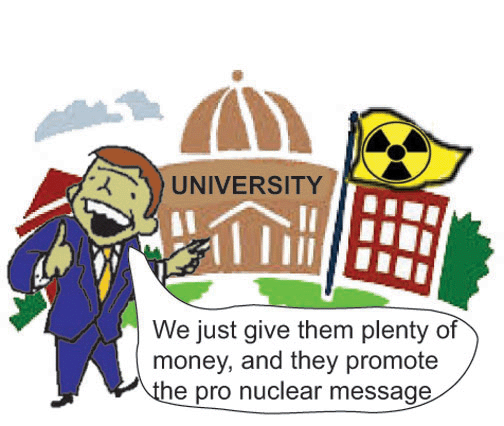
Overall, the NPS offers 4,001 Commonwealth supported places in STEM courses to help grow the skilled workforce required to deliver the AUKUS nuclear-powered submarine pathway, starting in 2024.
These places will be offered in identified priority areas including electrical engineering systems, mechanical engineering systems, chemical engineering systems, physics, chemistry, and mathematics and statistics.
Graduates from the NPS will form part of the future workforce needed to operate and build advanced technologies, including nuclear-powered submarines, that Australia will acquire from the United States and United Kingdom and build in South Australia.
The University of Melbourne students will study elective subjects including nuclear physics, Indo-Pacific relations and defence and legal policy. They will undertake an undergraduate science degree focusing on key areas in science and engineering needed to support the future workforce capabilities and then be eligible to transition straight into a postgraduate degree in engineering or science.
The first cohort will start in Semester 1, 2024. The program concludes in 2030………………………………………….
Professor Moira O’Bryan, Dean of the Faculty of Science, said: “The University of Melbourne is a strategic partner to the Australian government on issues of national importance. ………………. https://www.unimelb.edu.au/newsroom/news/2023/november/university-of-melbourne-welcomes-student-places-to-support-nuclear-powered-submarines-student-pathways
Have you noticed? The nuclear lobby is swamping the news media with its false “nuclear for climate”message

It’s a concerted effort.
It’s all over the media. Despite the obvious failure of small nuclear reactors.
Despite the fact that new nuclear reactors of any size will not be up and running in time to have any effect on global heating.
Yet the corporate media dutifully regurgitates these nuclear lies, all outlets using the same wording, the same optimistic “nuclear renaissance” lies
Who orchestrates this media blitz ? It could be the Atlas Network?

How wealthy countries, (like U.S., Canada, Australia, and Norway)evade responsibility for their fossil fuel exports

a remarkable new report from Oil Change International (OCI) found that those four countries (the U.S., Canada, Australia, and Norway), along with the U.K., account for just over half of the planned expansion in oil and gas between now and mid-century. In most cases the project licenses have already been granted, and unless officials intervene, the damage (enough carbon and methane to take us past the Paris climate targets) is locked in.
Bulletin, By Bill McKibben | November 30, 2023
When the world convenes in the United Arab Emirates for the next round of the endless climate slog, much attention will be paid to the pledges of individual nations to cut their emissions. This has been the basic scorecard of climate talks almost since the start. But it’s a wildly incomplete scorecard, in ways that are becoming ever clearer as we enter the endgame of the energy transition. We’ve been measuring it wrong.
That’s because a country’s exports of fossil fuel don’t count against its total. But it’s those exports that are driving fossil fuel expansion around the world, coming as they do from some of the most diplomatically powerful and wealthy nations on Earth.
To give the most obvious, and largest, example: the United States is, fitfully, cutting back on its carbon emissions; its envoys will be able to report, honestly, that the Inflation Reduction Act should soon actually be trimming our domestic use of oil, gas, and coal, as we subsidize heat pumps and build out EV charging networks. But at the very same moment, the U.S. production of fossil fuels is booming. That means, of course, that much of that supply is headed overseas.
And the numbers are truly staggering. If the liquefied natural gas (LNG) buildout continues as planned, for instance, by 2030 U.S. LNG exports will be responsible for more greenhouse gases than every house, car, and factory in the European Union. The emissions, under the U.N. accounting system, will show up on the scorecards of the EU and the dozens of mostly Asian nations that will buy the gas. But if you could see them in the atmosphere, they would be red, white, and blue.
Exactly the same thing is true of a handful of other nations — in fact, some are even more grotesque in their hypocrisy, if not their impact. Norway has, arguably, done as good a job as any country on earth on moving past oil and gas; almost every new car in the country runs on electricity. But it’s planning one of the dozen biggest expansions in national oil and gas production, almost all of it for export. Canada and Australia fall into the same basket. Indeed, a remarkable new report from Oil Change International (OCI) found that those four countries (the U.S., Canada, Australia, and Norway), along with the U.K., account for just over half of the planned expansion in oil and gas between now and mid-century. In most cases the project licenses have already been granted, and unless officials intervene, the damage (enough carbon and methane to take us past the Paris climate targets) is locked in…………………………………………………………………………………………………….
the real question here may be, how do politics work? The fossil fuel industry demonstrated its firm grip on power in the U.S. in 2015 when it got the export ban lifted. Now the industry is flush with cash: Exxon reported a quarterly profit of $9.1 billion last month. It’s using its cash to buy up even more fracking real estate; clearly it concludes it has the political juice to enable it to face Biden down and keep on pumping gas for the planet.
………………………………. Canada’s huge contribution to our global crisis is its exports. Trudeau quite honestly summed up his nation’s position in 2017 in a talk to Texas oilmen, when he told the truth about the country’s vast tar sands complex: “No country would find 173 billion barrels of oil in the ground and just leave them there.” Canada couldn’t burn 173 billion barrels of oil if everyone in the country kept their car idling 24 hours a day, and they couldn’t burn the enormous quantity of natural gas that’s been found further north in Alberta if they all turned their thermostats to 115 and wore bathing suits all winter. That’s why they’re busy building pipelines to take the oil and the gas to the Pacific.
I could do the same math for Australia or the U.K. or Norway. No matter what they stand up and say in the UAE over the next month, remember: They’ve decided to hold a fire sale at the end of the world. https://thebulletin.org/2023/11/how-wealthy-countries-evade-responsibility-for-their-fossil-fuel-exports/?utm_source=Newsletter&utm_medium=Email&utm_campaign=ThursdayNewsletter11302023&utm_content=ClimateChange_WealthyCountries_11302023
The nuclear power renaissance has some way to run
EDF is vowing to build one reactor a year but challenges range from funding to a lack of skilled workers.
SARAH WHITE
https://www.ft.com/content/aaa33c5c-70e8-4f05-a45a-a45c7d2aba72 1 Dec 23
When France first hosted a nuclear power trade fair about a decade ago, in the wake of the Fukushima disaster, it was a low-key affair. Two years ago, organisers’ main worry was to avoid anti-nuclear protesters marring proceedings.
This week, the buzz at the vast salon on the outskirts of Paris was unequivocal. Miss America 2023, a nuclear engineering student, was on hand to help the event court the limelight, and champagne flowed on the stands displaying radioprotective gloves and designs for cutting-edge small reactors. The message was clear: nuclear power is back, and France, Europe’s atomic power champion with its 56 reactors, intends to be at the heart of this revival.
“We’re coming out of a period of taboos [over nuclear],” said Sylvie Bermann, a former French ambassador to China and Russia who heads the Paris show.
The industry and its low-emission technology would also have its moment for the first time at the COP28 climate summit in the United Arab Emirates, with a dedicated event, she added.
After years in the doldrums, mindsets over nuclear have shifted, spurred by climate worries and an energy crisis last year when Russia launched its full-scale invasion of Ukraine and cut gas supplies to Europe. Even Japan, home to the Fukushima meltdown of 2011, has restarted idled reactors, while a host of other nations are considering new plants, giving suppliers reasons to feel more optimistic.
What is less obvious will be the move from aspirations to reality, in a sector where building reactors is costly and slow, especially after decades without projects drained the industry of skilled workers.
Part of the promotional push by France and other pro-nuclear nations is aimed at solving some big obstacles. Chief among them, according to the head of the UN’s nuclear watchdog Rafael Grossi, is the financing, including from multilateral bodies.
Paris, which is riding high on recent EU wins to gain some subsidies for its existing plants, originally opposed by staunchly anti-nuclear Germany, has campaigned for instance for the European Investment Bank to help fund the construction of new reactors. “Nuclear has been constructed very fast when the money’s there,” said the International Atomic Energy Agency’s Grossi, citing the United Arab Emirates, which had gone from “zero to champions” in roughly eight years with a $20bn-plus project for four Korean-built reactors. They are almost all now online.
There’s also a lot to prove on the industrial front. France’s state-controlled nuclear power operator EDF aims to build roughly one 1.6 Gigawatt reactor a year once it gets going with its new orders for at least six new ones in France by the mid-2030s, according to chief executive Luc Rémont.
Considering its prototype in northern France known as Flamanville 3 has been 16 years in the making, it is an extremely ambitious goal. Rémont argues that parallel projects (the state-owned group is bidding for projects in India and the Czech Republic) would help EDF become better and faster.
There are other challenges. Many nations have long been dependent on Russian nuclear fuel, including the US reactor fleet, and finding sufficient alternative supplies could take years.
Meanwhile, the IAEA forecasts that over the next 20 years the industry’s share in the global energy mix — roughly 10 per cent of the world’s electricity generation today — will remain flat, if not decrease slightly, unless there are even more ambitious construction plans.
Developers argue, however, that the hardest battle is getting political buy-in to give them the visibility they need. Judging by the upbeat messaging coming out of Paris this week, that part of the complex nuclear equation at least is some way towards being solved.
COP 28 A sorry tale of climate hypocrisy

Yeah, we’re all whingeing about United Arab Emirates hosting the COP28 Climate Summit, while quietly making sure that their oil industry booms on.
Because we, the righteous Western nations are doing so much to slow down global heating. And we are. the USA has its worthy Inflation Reduction Act- cuts down on the home use of oil gas and coal, and USA promotes renewable energy, heat pumps, electric cars.
Canada has its Net-Zero Emissions Accountability Act, cutting down on domestic greenhouse gas emissions. Australia is promoting renewable energy and electric cars at home. Norway is big on electric cars, and encouraging climate-friendly systems, at home.
But the reality is- take Australia as an example – the world’s largest exporter of coal, and big exporter of liquefied natural gas (LNG). USA is a huge exporter of LNG. Canada – oil and natural gas exports. Norway – huge supplier of oil and gas.
All of these national governments approve and support the expansion and export of fossil fuels, while sanctimoniously bleating about “net zero” at home.
Sure, let’s criticise Sultan Ahmed Al Jaber and his lot. But the big Western players are in reality even bigger polluters.
Karina Lester addresses the Second Meeting of States Parties to the TPNW
Karina Lester, second-generation nuclear test survivor and ICAN Ambassador addresses the delegates at the UN Second Meeting of States Parties to the Treaty on the Prohibition of Nuclear Weapons in NYC, November 28th, 2023.
She said “People still suffer to this day. We know our lands are poisoned. We know the fallout contaminated our country and our families, our people who move through those traditional lands…
We want recognition by governments of the day of the harms and what they’ve imposed on our people and on our traditional lands… We want respect and we want to start the conversations on repair. How do we work together to fix the damages that are there?”
She called on states parties to get to work on Articles 6 & 7 and for observers to double their efforts to sign and ratify the #nuclearban. She called on Australia, in particular, to make joining the treaty a top priority.
“Nuremberg Trial” for Israel’s Crimes Against Palestinians?
, https://www.thepostil.com/a-nuremberg-trial-for-israels-crimes-against-palestinians/
Make no mistake. Israel has committed massive crimes in Gaza and in the West Bank against the Palestinians. When will the thousands killed get justice? Or are we all supposed to just go on with our lives and pretend that it’s all the pursuit of “the right of self-defense?” Who are these IDF snipers who anonymously shoot children, and no one is even curious to know who these killers are? Is this the way of war now, according to the “international rules based order” that we should be so proud of in the West, which is supposedly the hallmark of our “civilization?”
A day of reckoning will come. There are good men and women who are wokring to make that a reality.
And what are we to make of our politcal class that utters not a peep about the slaughter that Netanyahu is doing, but who earlier could not get the ICC to issue an arrest warrant for President Putin fast enough, because Putin was assumed to have “kidnapped” Ukrainian orphans that they might have a decent life in Russia. But Netanyahu can kill as many children as he wants, since that is not a crime according to the “rule of law,” so the “jurists” at the ICC stay busy identifying “Russian crimes” that might be spotted at the backs of their cereal boxes.
Kurt Tucholsky was paraphrasing a French joke when he observed that “the death of one person: that’s a catastrophe. One hundred thousand dead: that’s a statistic!”
What Israel has done for over a month in Gaza is now a matter of statistics, for they have killed over 15,000 so far, more than 4000 of them children. It is the Palestinian Holocaust, because there are many more thousands buried under all those pancaked buildings where people once lived. And now that the Israeli assault continues, many thousands more will die.
Given these grim statistics, it becomes more and more important to remember the one person, rather than mention in passing the vast number of the now faceless thousands dead.
One such person was Elham Farah, a Christian Palestinian, living in Gaza, where she had taught music all her life. She was 84 years old and was the daughter of the Palestinian poet, Hannah Farah.
On November 12, 2023, an Israeli sniper shot her in the leg, as she came out of the Holy Family Church in Gaza City, where she had been sheltering to escape the bombing. She wanted to make sure that her home had not been hit. A sniper was waiting who are trained to shoot in the leg.
Those inside the church tried to rescue her, as she cried out for help, but people were afraid of Israeli snipers who long have had a reputation for being merciless. Elham Farah bled to death over several days. No one came to help her because of the sniping. She had just survived the bombing of Saint Porphyrios, the 850-year-old church in Gaza, which took the lives of 18 other Christians. Is such a death for a gentle old lady acceptable to those who see themselves as “civilized?” And why no one even knows about the crimes of Israeli snipers is unimaginable.
The hell unleashed by the Herod of our time in the Holy Land escapes the mind’s ability to describe horror—to see little children torn apart by bombs, dropped by pilots in their sophisticated flying machines is beyond the reach of words…
Then Herod perceiving that he was deluded by the wise men, was exceeding angry: and sending killed all the menchildren that were in Bethlehem, and in all the borders thereof, from two years old and under, according to the time which he had diligently inquired of the wise men.
Then was fulfilled that which was spoken by Jeremias the prophet, saying:
A voice in Rama was heard, lamentation and great mourning; Rachel bewailing her children, and would not be comforted, because they are not (Matthew 2:16-18).
Rama” or “Ramah” is the name of several Palestinian towns, and “Rachel” stands in for all mothers whose children have been slaughtered by the powerful. Such killing was “righteous revenge” because the Hamas razzia of October 7th was fabricated as brutal, with beheaded babies and babies in ovens, when it was the IDF that did most of the slaughter of Israelis that day. Why the need to lie by Israel? The full truth about what really happened on October 7th is now coming out: Hamas killed IDF soldiers in combat. It was not a “terrorist” attack:
Thus on October 7th:
The IDF killed anything that moved;- Many Israeli captives were still alive, two days after October 7;
- Israelis were killed by the IDF with heavy shelling of houses and cars;
- Most of the civilian deaths happened because of the IDF;
- It was a razzia by Hamas because most of the captives taken were IDF officers.
And in the West, we have the war enthusiasts, eagerly cheering on Netanyahu and his ilk to kill more, to kill without compunction, for there will be no red lines drawn, because Israel is for “civilization,” because that is how you fight wars, by killing as many babies as you can with bombs.
Perhaps in the months or even years ahead, there will come a time for a “Nuremberg Trial” for the murderers that are now in power in Israel—and for the IDF soldiers snipers who shot down Elham Farah and the two liitle Christian Palestinian boys, and also for the many “journalists” and “scholars” who justified and whitewashed the crimes against humanity now permanently recorded for the world to see. Remember, they did hang Julius Streicher, even though he perosnally had killed no one.
Climate summit in an oil state: can COP28 change anything?

You are going to be hearing a lot about COP28 over the next two weeks. The
world’s most important climate meeting, beginning on Thursday, is being
hosted in Dubai by the United Arab Emirates (UAE) – one of the world’s top
ten oil producers. COP28 will be the biggest gathering of world leaders of
the year. King Charles III and Rishi Sunak will be there, along with dozens
of other world leaders and some 70,000 other attendees.
Hosting a climate
conference in a petrostate was already controversial – but the BBC’s
evidence that the UAE team planned to use climate talks ahead of COP28 to
do oil and gas deals has heightened concerns. So, can a summit in one of
the world’s richest oil states deliver meaningful action on climate change?
Campaigner Greta Thunberg has said these UN climate summits are just “blah,
blah, blah” – meaning all talk and no action. But if the COP process did
not exist, we would certainly want something like it.
BBC 30th Nov 2023
https://www.bbc.co.uk/news/science-environment-67557533
Special Report: Managing Climate Change. As world leaders meet in Dubai for
the COP28 climate summit, success will depend on whether there is an
agreement to dump fossil fuels. Plus: China under pressure; African nations
unite; EU rewilding plans; cleantech advances; rising sea levels.
FT 30th Nov 2023
Nuclear lobby’s big push to ‘shine’ at COP28.
The nuclear energy industry will be highly visible at the 28th Conference of the Parties (COP28), taking place in Dubai over the coming weeks, World Nuclear Association Director General Sama Bilbao y León told delegates at the World Nuclear Exhibition 2023 in Paris.
………..” certainly we are seen as a positive force at the COP meetings”.”

…….. At COP27, held in Sharm El-Sheikh in 2022, there was the first Atoms for Climate Pavilion, a collaboration between the International Atomic Energy Agency and global nuclear trade associations. Bilbao y León said this was “truly a turning point in how nuclear is presented at COP meetings”.
…………….. in order to achieve a trebling in nuclear capacity, the industry needs to “turn this political good will that we are starting to see into actionable and pragmatic policies”. Licensing and regulatory processes need to streamlined and affordable financing must be secured. In addition, the supply chain and human resources must be expanded.
“We are going to need to bring together governments because at the end of the day our policymakers are the ones that are going to set these bold and pragmatic policies and energy markets,”……… https://www.world-nuclear-news.org/Articles/Nuclear-to-shine-at-COP28,-says-Bilbao-y-Leon
Treaty on the Prohibition of Nuclear Weapons: A Bright Constellation in a Very Dark Sky

By John Reuwer, World BEYOND War, December 1, 2023 https://worldbeyondwar.org/treaty-on-the-prohibition-of-nuclear-weapons-a-bright-constellation-in-a-very-dark-sky/
For those of us unable to bury ourselves completely in our ordinary lives of family, friends, and work to avoid seeing the tragedies of horrific violence unfold all around us, these are dark times indeed. The multiple wars that started after September 11, 2001 have only multiplied, and rarely end, imparting suffering to tens of millions of people around the globe. The risk of nuclear war is greater than anytime since the Cuban missile crisis, with all nine nuclear states building new nuclear weapons, several increasing their totals for the first time in 35 years, and several practicing nuclear war games on each other’s borders. At least one is threatening to use nuclear weapons if anyone challenges its aggression. The global military budget is well over $2 trillion dollars a year to wage current wars and prepare for the next ones. Two nuclear armed alleged democracies seem determined to carry out genocide in Gaza.
So it was wonderful to spend three days at the United Nations in New York amid hundreds of bright people attending the second meeting of states parties to the Treaty on the Prohibition of Nuclear Weapons (TPNW). The 63 governments who have ratified the Treaty, for whom it is now international law to eschew any activity supporting nuclear weapons and to try to remediate the enormous harms already done by them, meet yearly to see how they are doing, help each other implement the law, and encourage others to join.
Accompanying the diplomats are doctors, lawyers, scientists, activists, scholars, and victims from many organizations, living the antidote to despair – each working hard to advance the sanity of this treaty among a world awash in nuclear madness. Leading the dozens of civil society efforts was the International Campaign to Abolish Nuclear Weapons, which was the ten-year driving force behind the negotiation of the TPNW in 2017. This was a major international treaty driven primarily by civil society, and a potent reminder that ordinary people can make a huge difference in a world usually dominated by the rich and powerful.
Leaders of civil society organizations were allowed to present their views in the plenary sessions along with the government representives. These statements were supplemented by educational sessions on dozens of topics. Most powerful for me were the young students from many countries who condemned nuclear weapons as creating insecurity and violating their right to life, who demanded more inclusion of youth and women in policy making. Scientists reminded us of the climate and agriculture research predicting that even a limited regional nuclear war will darken the earth’s skies enough to cause mass starvation of billions after the blast and fallout kills the first hundred million people. Representatives of the indigenous peoples who were harmed by weapons production and testing in the U.S., Australia, Khazakstan, and the Pacific gave stirring testimony of the loss of their land and multigenerational health, demanding justice for what they have suffered. The parties to the TPNW formally agree to address their concerns for healing and remediation. Several of the remaining Hibakusha (nuclear bomb survivors) from Japan shared their incredible stories and pleas for never again. Lining the hallways were works of beautiful art from the dawn of the nuclear age to the present. Concerts, vigils, prayer services, and protest marches were held at city venues nearby.
Representatives from the organizations that we count on to rescue us during disasters all made statements that there will be no meaningful help after multiple nuclear explosions . This included the International Federation of the Red Cross and Red Crescent, the World Medical Association, the International Council of Nurses, and the World Federation of Public Health Associations. All of these bodies agree with International Physicians for the Prevention of Nuclear War that the only way to assure that nuclear weapons will not cause an unmitigated disaster for humanity is to eliminate them. The principle means of doing that will be educating as many people and leaders as we possibly can about the threat these weapons pose.
I noticed among the many statements decrying nuclear weapons a sentiment that I heard less frequently at antinuclear events in the past – that war itself is the problem, and that we would do well to oppose all war rather than expend energy supporting one side or the other in any given war. This created the opportunity to introduce folks to World BEYOND War, whose mission is replace war with a just and sustainable peace.
Mingling with capable people dedicated to preserving life and our future through the TPNW illuminated the world that often seems dark with hatred and killing, and energized me to continue the current work of creating space for peace and human dignity.
Sovereignty Surrendered: Subordinating Australia’s Defence Industry

Bureaucratic red tape will be slashed – for the Australian Defence industry and the AUKUS partners.
the broader object here is unmistakably directed, less to Australian capabilities than privileged access and a relinquishing of control to the paymasters in Washington.
“Whenever it cooperates with the US Australia will surrender any sovereign capability it develops to the United States control and bureaucracy.”
November 30, 2023, Dr Binoy Kampmark, https://theaimn.com/sovereignty-surrendered-subordinating-australias-defence-industry/
One could earn a tidy sum the number of times the word “sovereignty” has been uttered or mentioned in public statements and briefings by the Australian Prime Minister, Anthony Albanese.
But such sovereignty has shown itself to be counterfeit. The net of dependency and control is being increasingly tightened around Australia, be it in terms of Washington’s access to rare commodities (nickel, cobalt, lithium), the proposed and ultimately fatuous nuclear-propelled submarine fleet, and the broader militarisation and garrisoning of the country by US military personnel and assets. (The latter includes the stationing of such nuclear-capable assets as B-52 bombers in the Northern Territory.)
The next notch on the belt of US control has been affirmed by new proposals that will effectively make technological access to the Australian defence industry by AUKUS partners (the United States and the United Kingdom) an even easier affair than it already is. But in so doing, the intention is to restrict the supply of military and dual-use good technology from Australia to other foreign entities while privileging the concerns of the US and UK. In short, control is set to be wrested from Australia.
The issue of reforming US export controls, governed by the musty provisions of the US International Trade in Arms Regulations (ITAR), was always going to be a feature of any technology transfer, notably regarding nuclear-propulsion. But even before the minting of AUKUS, Canberra and Washington had pondered the issue of industrial integration and sharing technology via such instruments as the Defense Cooperation Treaty of 2012 and Australia’s addition to the National Technology and Industrial Base in 2017.

This fundamentally failed enterprise risks being complicated further by the latest export reforms, though you would not think so, reading the guff streaming from the Australian Defence Department. A media release from Defence Minister Richard Marles tries to justify the changes by stating that “billions of dollars in investment” will be released. Bureaucratic red tape will be slashed – for the Australian Defence industry and the AUKUS partners. “Under the legislation introduced today, Australia’s existing trade controls will be expanded to regulate the supply of controlled items and provision of services in the Defence and Strategic Goods List, ensuring our cutting-edge military technologies are protected.”
Central to the reforms is the introduction of a national exemption that will cover trade of defence goods and technologies with the US and UK, thereby “establishing a license-free environment for Australian industry, research and science.” But the broader object here is unmistakably directed, less to Australian capabilities than privileged access and a relinquishing of control to the paymasters in Washington. A closer read, and it’s all got to do with those wretched white elephants of the sea: the nuclear-powered submarine.
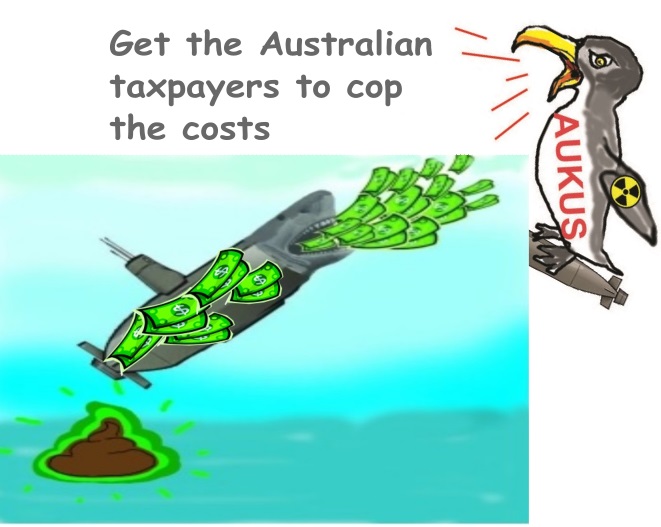
As the Minister for Defence Industry, Pat Conroy, states, “This legislation is an important step in the Albanese Government’s strategy for acquiring the state-of-the-art nuclear-powered submarines that will be key to protecting Australians and our nation’s interests.” In doing so, Conroy, Marles and company are offering Australia’s defence base to the State Department and the Pentagon.
With a mixture of hard sobriety and alarm, a number of expert voices have voiced concern regarding the implications of these new regulations. One is Bill Greenwalt, a figure much known in the field of US defence procurement, largely as a prominent drafter of its legal framework. He is unequivocal in his criticism of the US approach, and the keen willingness of Australian officials to capitulate. “After years of US State Department prodding, it appears that Australia signed up to the principles and specifics of the failed US export control system,” Greenwalt explained to the Australian Broadcasting Corporation. “Whenever it cooperates with the US it will surrender any sovereign capability it develops to the United States control and bureaucracy.”
The singular feature of these arrangements, Greenwalt continues to elaborate, is that Australia “got nothing except the hope that the US will remove process barriers that will allow the US to essentially steal and control Australian technology faster.”
In an email sent to Breaking Defense, Greenwalt was even more excoriating of the Australian effort. “It appears that the Australians adopted the US export control system lock, stock and barrel, and everything I wrote about in my USSC (US Studies Center) piece in the 8 deadly sins of ITAR section will now apply to Australian innovation. I think they just put themselves back 50 years.”
The paper in question, co-authored with Tom Corben, identifies those deadly sins that risk impairing the success of AUKUS: “an outdated mindset; universality and non-materiality; extraterritoriality; anti-discrimination; transactional process compliance; knowledge taint; non-reciprocity; and unwarranted predictability.”
When such vulgar middle-management speech is decoded, much can be put down to the fact that dealing with Washington and its military-industrial complex can be an imperilling exercise. The US imperium remains fixated, as Greenwalt and Corben write, with “an outdated superpower mindset” discouragingly inhibiting to its allies. What constitutes a “defence article” within such export controls is very much left to the discretion of the executive. The archaic application of extraterritoriality means that recipient countries of US technology must request permission from the State Department if re-exporting to another end-user is required for any designated defence article.
The failure to reform such strictures, and the insistence that Australia make its own specific adjustments, alarms Chennupati Jagadish, president of the Australian Academy of Science. The new regulations may encourage unfettered collaboration between the US and UK, “but I would require an approved permit prior to collaborating with other foreign nationals. Without it, my collaborations could see me jailed.” The bleak conclusion: “it expands Australia’s backyard to include the US and UK, but it raises the fence.” Or, more accurately, it incorporates, with a stern finality, Australia as a pliable satellite in an Anglo-American arrangement whose defence arrangements are controlled by Washington.
Bah Humbug! – to COP Climate Conference sponsored by Dubai, an oil & natural gas nation.

Only the quick, fast buck are what matter. Sustainability, “Bah, Humbug!”
paulrodenlearning 29 Nov 23
I sincerely doubt a positive outcome from this COP23 Conference. The fact that it takes place in Dubai, an oil & natural gas nation state, hosting & sponsoring this Conference is the first fact. The profit addicted, fossil fuel companies & nation states want to extract & burn every barrel of oil, cubic foot of natural gas and ton of coal on the planet before they deem “renewable energy” as ready to power the planet.
The very idea of the halting or even reduction in the exploration, extraction & burning of any fossil fuel is just uphorrent to them. They don’t give a damn about the planet or the impact of the continued extraction and burning of any fossil fuel. The “maximizing of profits,” or “return on equity to their investors,” and “stock options” for their CEO’s & Boards of Directors is all that matters to them.
The environment, the ecosytem of the planet be damned. Only the quick, fast buck are what matter. Sustainability, “Bah, Humbug!”
1 This month


Help Aunty Sue Protect Her Land and Sacred Sites From Destructive Rocket Testing.
.

Australians deserve the truth
about
AUKUS – https://aukuspublicinquiry.com/

PETITION – To: Prime Minister Anthony Albanese and the Australian Labor Government

of the week – Australians for War Powers Reform (AWPR)
To see nuclear-related stories in greater depth and intensity

