Why NuScale Power Stock Got Thrashed on Thursday

Nasdaq October 19, 2023 Eric Volkman for The Motley Fool
A short-seller report gave investors plenty to worry about with NuScale Power (NYSE: SMR) stock on Thursday. On the back of that document, which criticized the nuclear reactor maker harshly at times, the company’s share price fell at double-digit rates. It ended the day nearly 12% lower, while the gloomy S&P 500 index only sank by 0.9%.
A short seller vented on NuScale
That morning, a firm called Iceberg Research published that NuScale Power report. This came not long after NuScale announced earlier this month that it had signed a contract to build a pair of its reactors for a U.S. company called Standard Power.
Iceberg poured freezing cold water on this arrangement, describing the deal as having no chance of being completed. In its view, Standard Power does not have the means to fulfill contracts of such size; it also said that Standard Power’s managing director, Adam Swickle, was found guilty of securities fraud some time ago.
While NuScale has what Iceberg describes as a “more credible contract” with Utah Associated Municipal Power Systems, the short seller does not feel that NuScale has a good chance of completing it.
According to Iceberg’s analysis, NuScale has only 15 months or so left of cash to finance its operations — quite a narrow window for a dramatic turnaround in fortunes.
A short-seller report gave investors plenty to worry about with NuScale Power (NYSE: SMR) stock on Thursday. On the back of that document, which criticized the nuclear reactor maker harshly at times, the company’s share price fell at double-digit rates. It ended the day nearly 12% lower, while the gloomy S&P 500 index only sank by 0.9%.
A short seller vented on NuScale
That morning, a firm called Iceberg Research published that NuScale Power report. This came not long after NuScale announced earlier this month that it had signed a contract to build a pair of its reactors for a U.S. company called Standard Power.
Iceberg poured freezing cold water on this arrangement, describing the deal as having no chance of being completed. In its view, Standard Power does not have the means to fulfill contracts of such size; it also said that Standard Power’s managing director, Adam Swickle, was found guilty of securities fraud some time ago.
While NuScale has what Iceberg describes as a “more credible contract” with Utah Associated Municipal Power Systems, the short seller does not feel that NuScale has a good chance of completing it.
According to Iceberg’s analysis, NuScale has only 15 months or so left of cash to finance its operations — quite a narrow window for a dramatic turnaround in fortunes.
Accusations of low-value equity
Iceberg doesn’t see a good way out with NuScale. It wrote in conclusion that “The company is struggling and we believe its equity has little to no value without government support.”
“Even if that support continues, the DOE’s usual policy is that costs have to be shared with the private sector, meaning that existing shareholders will be diluted,” the short seller added.
NuScale has not yet publicly responded to the report……. https://www.nasdaq.com/articles/why-nuscale-power-stock-got-thrashed-on-thursday #nuclear #antinuclear #nuclearfree #NoNukes
 | |||
| |||
Mechanism for toxic radioactive water release sought

“What I find problematic is that TEPCO, the Japanese government and the IAEA are not addressing the long-term environmental impacts and the accumulation in the environment resulting from individual data. In the case of long-term releases, there is a concern about accumulation in the marine environment and concentration through the ecosystem, but this aspect is not being adequately evaluated.”
By JIANG XUEQING in Tokyo 2023-10-24 https://global.chinadaily.com.cn/a/202310/24/WS65372116a31090682a5ea51d.htmll
Experts urge long-term intl monitoring and participation of all stakeholders
Experts call for the establishment of a long-term international monitoring mechanism with substantive participation from stakeholders, as Japan and the International Atomic Energy Agency are both criticized for not addressing the long-term environmental impacts of the dumping of nuclear-contaminated water into the sea.
The IAEA is sending its team to Japan to continue its safety review of the release from the crippled Fukushima Daiichi Nuclear Power Plant.
Starting Tuesday, the IAEA will conduct a safety review of the activities carried out at the Fukushima plant to make sure these activities are consistent with the international safety standards, said Lydie Evrard, IAEA deputy director-general and head of the agency’s department of nuclear safety and security.
A report on the review is expected to be finalized by the end of 2023, she told a news conference in Tokyo on Monday.
Chinese Foreign Ministry spokesman Wang Wenbin on Oct 11 said the collection of marine samples near Fukushima, analysis by laboratories and comparison of those samples were carried out by the IAEA Secretariat under its bilateral arrangement with Japan. Therefore, he said, it falls short of an international monitoring arrangement with the full and substantive participation of all stakeholders.
“The international community requires the immediate establishment of an international monitoring arrangement with substantive participation of all stakeholders, including Japan’s neighboring countries, that will stay effective for the long haul,” Wang said, urging the IAEA to play its due role and take the responsibility of providing rigorous supervision on Japan’s discharge.
The key issue is how to establish an international monitoring mechanism for the real-time and long-term effective management of nuclear-contaminated water being discharged, said Zhang Yulai, vice-president of the Japan Institute of Nankai University.
Major challenge
“Information disclosure is a major challenge because the Japanese government and TEPCO share common interests, making genuine monitoring difficult,” he said.
There are also technical challenges, as certain radionuclides that the Advanced Liquid Processing System cannot remove still exist, he said.
Fukushima plant operator TEPCO announced pre-discharge test results on Thursday, showing that the third batch of nuclear-contaminated water to be released during Japan’s next round of ocean discharge contains seven radionuclides, namely tritium, carbon-14, cobalt-60, strontium-90, yttrium-90, iodine-129 and cesium-137. Among them, strontium-90 and yttrium-90 were not detectable before the second round of discharge.
The measured quantity of strontium is relatively low, but given its 29-year half-life, it will persist in the environment to a certain extent. Strontium is a significant radionuclide that tends to accumulate in bones when ingested by fish or humans, said Hideyuki Ban, a renowned Japanese nuclear expert and co-director of the Tokyo-based Citizens’ Nuclear Information Center.
“What concerns me is the lack of information about the measurement times and methods. I believe that rapid measurements may lack precision,” Ban said.
“What I find problematic is that TEPCO, the Japanese government and the IAEA are not addressing the long-term environmental impacts and the accumulation in the environment resulting from individual data. In the case of long-term releases, there is a concern about accumulation in the marine environment and concentration through the ecosystem, but this aspect is not being adequately evaluated.”
Many Japanese said they do not believe the data disclosed by TEPCO and the Japanese government.
Chiyo Oda, co-director of KOREUMI, also known as the Citizens’ Conference to Condemn Further Pollution of the Ocean, said those who have experienced the nuclear disaster have developed distrust in the government and TEPCO.
The promise not to release the water without first understanding the concerns of fishermen and citizens, as stated just before the release, has been disregarded. Though they have announced monitoring results immediately after the release, the data is not trustworthy, Oda said.
“It is evident that the marine environment will be contaminated over a long period of time, and there is potential for long-term impacts on human health,” she said. #nuclear #antinuclear #nuclearfree #NoNukes
Walk for Peace and a Nuclear Free Cockburn Sound – Sunday 29 October

Sunday 29 October 2023 8.30am – 4.30pm
Walk schedule and key media opportunities:
8:30am – meeting at BAE Systems security gate at the northern end of the BAE compound Quill Way, Henderson walking south towards Kwinana Beach
1pm – lunch break at Wells Park, Kwinana Beach, the walk will continue along the Rockingham foreshore
4.30pm – finish at the HMAS Stirling Pass Office, Peron
On Sunday 29 October, concerned community members from the Cockburn Sound area will be joined by anti-nuclear, anti AUKUS and peace activists to walk approximately 24 kilometres from BAE Systems in Henderson to the HMAS Stirling Pass Office at Peron, opposite Garden Island.
The Walk is hosted by Nuclear Free WA and Stop AUKUS WA and aims to raise awareness of the nuclear and safety risks of the AUKUS trilateral security agreement between the US, UK and Australia.
The walk demonstrates strong opposition to the planned increased visits and future rotations (as of 2027) of US and UK nuclear powered submarines and the further AUKUS plan to home port* Australia’s acquired 3-5 Virginia Class nuclear powered submarines (as of 2030’s) at HMAS Stirling in Cockburn Sound.BAE Systems is one of the world’s largest weapons corporations and Australia’s largest defence contractor. BAE Systems UK is the key designer-builder of the new UK and Australian SSN-AUKUS class nuclear powered submarines.
KA Garlick, walk organiser and Co-Convenor of Nuclear Free WA said “The AUKUS pact was signed without a debate in Parliament. It threatens to undermine the Nuclear Non-Proliferation Treaty to which Australia is a signatory.
“We oppose the nuclearisation of Australia. The war in Ukraine has been a constant reminder of the devastation of war and the risks associated with nuclear reactors. Nuclear Powered submarines house naval reactors and the AUKUS ones use highly enriched uranium.
“We need dialogue and peace in our region – not to further increase the arms race which only benefits weapons companies. Current global tensions and the horrific genocide of Palestinians by a nuclear armed state as is Israel makes a Peace Walk in these times so important.”
Chris Johansen from Stop AUKUS WA’s Nuclear Free Cockburn Sound campaign said “Nuclear powered (and possibly armed) submarines and warships place our communities, public health and safety, marine life and environment at risk. If there is an incident the impacts will be huge and intergenerational.
“The increased presence of these submarines will change our access to Cockburn Sound for fishing and boating and there has been no assessment of the environmental impacts from the upgrades to HMAS Stirling and increased traversing of nuclear submarines through Cockburn Sound.
“Nuclear powered submarines in Cockburn Sound risks making us a military target should hostilities break out in our region involving the US.”
Rockingham resident and Stop AUKUS campaigner, Heike Kavanagh is concerned “people in Rockingham sit at cafes and swim at the Rockingham foreshore just a several kilometres from HMAS Stirling, oblivious to the risks of accidents, being a military target and possible future access restrictions in some areas in Cockburn Sound.”
“Our hospital and health workers are already under enormous strain without the increased probability of a radiation emergency brought about by foreign nuclear submarines. People are unaware of the response and emergency plans. Our community needs to be better informed about the risks and the emergency response plans.
“You don’t stop war by increasing arms.”
The Walk acknowledges the lands and waters of Derbal Nara (Cockburn Sound) are unceded and is a timely call for Peace.
Details about the walk can be found here: https://nuclearfreewa.com/event/peacewalk/
UN Agency Warns Humanitarian Operations in Gaza on Verge of Total Collapse
October 23, 2023 https://scheerpost.com/2023/10/23/un-agency-warns-humanitarian-operations-in-gaza-on-verge-of-total-collapse/
“Without fuel, there will be no water, no functioning hospitals and bakeries,” said the UNRWA. “Without fuel, aid will not reach those in desperate need. Without fuel, there will be no humanitarian assistance.”
By Jon Queally / Common Dreams
The U.N. agency responsible for humanitarian aid and protections in the occupied Gaza Strip—battered relentlessly by Israeli airstrikes for the past two weeks—said Sunday that if fuel supplies are not restored within a matter of days, its operations will collapse entirely.
“In three days, UNRWA will run out of fuel, critical for our humanitarian response across the Gaza Strip,” said Philippe Lazzarini, the Commissioner-General of the United Relief and Works Agency for Palestine Refugees in the Near East.
“Without fuel, there will be no water, no functioning hospitals and bakeries,”
Lazzarini continued. “Without fuel, aid will not reach those in desperate need. Without fuel, there will be no humanitarian assistance. No fuel will further strangle the children, women, and people of Gaza.”
Noting that the UNRWA runs the largest humanitarian operation in the Gaza Strip, he said that without fuel, “we will fail the people of Gaza whose needs are growing by the hour, under our watch.”
Following the first “totally insufficient” convoy of aid trucks allowed to enter Gaza from Egypt on Saturday, another 17 trucks were permitted Sunday. Neither of the deliveries contained fuel, which medical personnel on the ground have said is vital if the health system is to remain capable of keeping the wounded and sick alive.
With Israeli officials saying the bombardment is set to intensify, not lessen, a global demand for a cease-fire has gone unheeded by the government of Prime Minister Benjamin Netanyahu and its powerful allies, including the United States.
With large demonstrations in numerous U.S. and European cities over the weekend delivering the same message for a cease-fire also ringing out across the Middle East and beyond, U.N. Secretary-General Antonio Guterres on Saturday called for a stop in Israel’s bombardment of Gaza alongside a much larger delivery of aid.
“We must act now to end the nightmare,” Guterres said at the so-called Peace Summit in Cairo, Egypt.
Despite U.S. President Joe Biden’s continued backing of Israeli policy, including it’s bombardment of Gaza which legal scholars have said may amount to genocide—a poll last week showed two-thirds of U.S. voters back the call for a cease-fire.
As the civilian death toll continues to mount—with the latest weekend figures from the Gaza Ministry of Health putting the number killed at more than 4,600, nearly half of them children, and more than three times that wounded—UNRWA confirmed earlier on Saturday that 29 of its own staffers and volunteers, half of them school teachers, have been killed since the Israel bombing campaign began on Oct. 7.
“We are in shock and mourning,” the agency said in a social media post. “As an Agency, we are devastated. We are grieving with each other and with the families.”
In his statement on Sunday, Lazzarini called on “all parties and those with influence over them to immediately allow fuel supplies into the Gaza Strip and to ensure that fuel is strictly used to prevent a collapse of the humanitarian response.” #Israel #Palestine
A wall of silence: atom bosses remain tight-lipped over Fukushima whistleblower claims
collaboration between the IAEA and the Japanese Government over the Fukushima radioactive water releases was imperative as the continuation of sea dumping regardless of the adverse impact to the marine environment represents a ‘make or break issue’ for the nuclear industry.
Over seven weeks have passed without an acknowledgement or reply to a letter the UK/Ireland Nuclear Free Local Authorities co-signed which was sent to the UN International Atomic Energy Authority calling for transparency over claims that the organisation collaborated with the Japanese Government to ‘manage the message’ over the ocean dumping of 1.3 million tonnes of radioactive water from the Fukushima nuclear disaster site.
On 28 June, an anonymous whistleblower posted a document, seemingly issued by the Department of Nuclear Safety at the IAEA, to the website/blogsite dunrenard[1]. If genuine, the document, titled ‘IAEA REVISION PROPOSAL FOR THE FINAL REPORT OF HANDLING ALPS TREATED WATER AT TEPCO’S FUKUSHIMA DAIICHI NUCLEAR POWER STATION’, appears to indicate that the international agency has actively sought to downplay the dangers associated with discharging millions of barrels of water which remain contaminated with highly toxic tritium.
The NFLA’s first covered this story and our disquiet at the revelations in a media release dated 3 July:
https://www.nuclearpolicy.info/news/cover-up-did-atom-bosses-collude-to-manage-message-of-japanese-plan-to-poison-pacific/
One of the recipients of the leaked document was Mr Tim Deere-Jones, a graduate in Marine Studies from Cardiff University. Tim, an independent marine pollution researcher and consultant since 1983, is highly regarded by the many international organisations who have engaged him in their campaigns against the damage caused to our oceans and inland waterways by radioactive and other contaminants.
Tim was incensed that the Japanese Government was quick to condemn the claim that Japan had pressurised the IAEA to remove ‘negative information’ about the environmental impact that would result from the radioactive waste discharges from the final report, but also noted that on the claims themselves the IAEA made no comment.
Keen to seek clarification and action on the veracity of the whistleblower’s claims, Tim went right to the top of the IAEA and penned a letter to the head of the management office for the Deputy Director General. Here he explains why:
“To date there has been no detectable independent action to investigate and test the veracity of the whistleblower’s claims against the claim of non-interference made by the Government of Japan.
“I fear that if this is scenario is allowed to continue the whistleblower’s action and disclosure will be historically characterised by the Government of Japan statement, sink into obscurity and be forgotten and the whistleblower’s heroic action will have been wasted, while he/she is still under threat of investigation, identification, and penalty.
“My disclosure request to the IAEA is intended to elicit a direct response from the agency to the claims made by the whistleblower as to date my online media searches have yet to reveal any related statement made by the organisation.
“This creates the impression that the Government of Japan has been acting as the IAEAs mouthpiece in respect of the whistleblower disclosure and that the IAEA would prefer NOT to be associated in anyway with the issue, to the extent that it has not made any public statement”.
Tim’s request for disclosure, submitted by registered post to the IAEA’s Vienna office and by email to the official account on 1 September, was backed by five British anti-nuclear groups and individuals from Europe and the Pacific Ocean, representing commercial fishers, other marine stakeholders, and coastal zone and Pacific Island communities.
Although the registered letter was tracked as received at the Vienna office on 9 September, Tim has yet to receive any response from the agency, and on 16 October sent a reminder:
“I have concluded that the absence of a receipt or response is a clear indication of the IAEA’s resistance to any discussion of the issues raised.
“My reading critique of the IAEAs final report to TEPCO re the issue of the ALPs treated water release certainly supports the drift of the whistleblower statement”.
Amongst the co-signatories to the letter, which is reproduced at the end of this press release, were the NFLAs, which have objected in letters to Japanese Ministers, senior officials at TEPCO (the nuclear operator), and the United Nations to the discharge of radioactive water from Fukushima, and signed a partnership agreement with its counterparts, Mayors for a Nuclear Power Free Japan, to collaborate in opposing the plan.
Though disappointed at the continued wall of silence, Chair Councillor Lawrence O’Neill is unsurprised that the IAEA remains tight-lipped:
“Sadly, the duties of disclosure required of public bodies in the UK through the Freedom of Information Act do not apply to an international agency based in Vienna and the IAEA’s statutes appear to contain no provisions for transparency or external accountability, despite the agency being funded by the member states, and so the taxpayers, of the United Nations.
“Although the organization claims to want to become more open, the lack of a response, or even an acknowledgement, to our legitimate request for information belies the fact that, on controversial issues, a culture of secrecy still prevails.”
Tim believes that collaboration between the IAEA and the Japanese Government over the Fukushima radioactive water releases was imperative as the continuation of sea dumping regardless of the adverse impact to the marine environment represents a ‘make or break issue’ for the nuclear industry. He has produced a short paper explaining his reasoning, which also appears at the end of this media release.
For further information about this media release please contact NFLA Secretary Richard Outram by email to richard.outram@manchester.gov.uk or telephone 07583097793
1. https://dunrenard.wordpress.com/2023/06/28/will-this-whistleblower-be-heard-by-anyone/
Notes to Editors:
The reminder sent to Ms Margaret Doane, Head, Department of Management Office of the Deputy Director General, IAEA, 16 October 2023


#nuclear #antinuclear #nuclearfree #NoNukes
White House Seeks $105 Billion To Arm Israel, Ukraine, and Taiwan

The Biden administration released details about its massive proposal to provide arms to Israel and Ukraine, as well as funds to build up military assets in the region surrounding China.
SCHEERPOST By Kyle Anzalone / Antiwar.com, October 21, 2023
On Friday, the White House rolled out its proposed $105 billion bill to arm Ukraine, Israel, and Taiwan. The legislation also includes funding for the border and humanitarian assistance. US officials say over $50 billion will go to American weapons manufacturers.
The Biden administration is proposing a massive aid package as it has struggled to get Congress to appropriate more funds for the proxy war in Ukraine. The largest portion of money is for Ukraine at $61.4 billion. The White House wants enough money for Ukraine to fund Kiev through the 2024 election.
National Security Adviser Jake Sullivan described the aid as critical to American national security and demanded Congress pass the bill. “This budget request is critical to advancing America’s national security and ensuring the safety of the American people,” Sullivan said. “The world is closely watching what Congress does next.”
Israel will receive $14.3 billion in assistance, with $10.6 billion for air and missile defense support.The aid would be in addition to the $3.8 billion Tel Aviv from Washington in security assistance annually……………………………………………
The bill includes $7.4 billion for several initiatives to increase Washington’s military posture in the Indo-Pacific. That includes $2 billion in grants for foreign governments to buy American weapons. Taiwan will receive a portion of that money, although US officials did not provide a detailed breakdown.
Director of the Office of Management and Budget, Shalanda Young, explained that nearly half of the money will go to American arms makers. “This supplemental request invests over $50 billion in the American defense industrial base, ensuring our military continues to be the most ready, capable, and best-equipped fighting force the world has ever seen,” she said.
Young claimed that the spending would bolster the American economy and create jobs. However, a study indicated that military spending costs more jobsthan it creates……………..
A small number of Republican represenatives have hindered Congress from passing additional funds for Ukraine. The Biden administration hopes to push several GOP members of Congress to vote for the bill by combining funding for Taiwan, Israel, and the border with Ukraine. https://scheerpost.com/2023/10/21/white-house-seeks-105-billion-to-arm-israel-ukraine-and-taiwan/ #nuclear #antinuclear #nuclearfree #NoNukes
Ralph Nader: Biden Returns Empty-handed, Except for a Huge Bill for the American Taxpayers

Biden wants Congress to approve $14 billion for Israel to address the colossal failure of Netanyahu’s extremist coalition to protect its own citizens on the border.
By Ralph Nader / Nader.org https://scheerpost.com/2023/10/22/ralph-nader-biden-returns-empty-handed-except-for-a-huge-bill-for-the-american-taxpayers/
If President Joe Biden were a pony, instead of a perennial warhorse (e.g., gung-ho for Bush/Cheney’s criminal destruction of Iraq), he would have his tail between his legs on his return from a one-day trip to Israel. He failed to achieve any immediate, critical objectives while the ongoing destruction of Gaza and the defenseless Palestinians continues.
Did Biden get Israel and Egypt to allow the exit of hundreds of American citizens fleeing the Gazan firestorm? No!
Did Biden open up corridors for humanitarian aid to the babies, children, women, elderly and other civilians in Gaza who had nothing to do with the October 7th Hamas homicide/suicide attack on Israelis? No!
To the contrary, earlier in the week he cruelly ordered his UN Ambassador to veto a widely supported resolution calling for a humanitarian ceasefire.
Did he forcefully double down on his earlier counsel to the Israeli government to obey the laws of war, then and now, being openly violated? No! He continued his silence after the Israeli Defense Minister ordered his soldiers with the genocidal command, “No electricity, no food, no fuel, no water…” That death sentence includes patients in hospitals who must endure the carpet bombing of this long-time blockaded tiny strip of desert land holding 2.3 million people. (See, Convention on the Prevention and Punishment of the Crime of Genocide).
Did Biden press for the exchange of Hamas’ hostages for the release of Palestinian prisoners, including young Palestinians, who have been in Israeli jails for years without due process or charges? No! Worse, Biden failed to object to the Israeli military stating that the release of over 200 Israeli hostages is a “secondary priority” to smashing Hamas and Gaza “into the Stone Age.” This policy flouts the moral codes of many venerable Judaic sages described in an October 19, 2023, New York Timescolumn by Mikahel Manekin titled “The Safety of the Hostages Must Come First.” Israel conducted two prisoners for hostages’ exchanges, one in 2004 and one in 2011.
Did Biden, in strong terms, tell the Israeli politicians that they have already exacted revenge many times over on the stateless people of Gaza – in civilian lives lost, injuries, related spread of disease, destitution and destruction? Did he say it is inhumane and counterproductive to bomb hospitals, clinics, schools, mosques, churches, apartment buildings, water mains, electric networks and ambulances, all of which is in violation of civilized norms and rules of war? Of course not. He greenlighted Israel’s genocidal warfare from the beginning of the Israeli assault and sent U.S. weaponry. He is enabling other actions of “co-belligerency” against the defenseless Palestinians in the West Bank and Gaza.
Did he even get the 20 trucks of humanitarian aid waiting at the Rafah crossing – also bombed by the Israelis – from Egypt into Gaza before he left? No!
Biden did come back with a bill for the American taxpayers – who for decades have been forced to pay for these Israeli wars. Now Biden wants Congress to approve $14 billion for Israel to address the colossal failure of Netanyahu’s extremist coalition to protect its own citizens on the border. (Adding only $100 million for Palestinian relief).
That sum of money, to be authorized without any Congressional hearings or Congressional oversight, is greater than the combined annual budgets of the FDA, OSHA, NHTSA and the section of HHS, whose missions are to reduce the loss of hundreds of thousands of preventable American fatalities in the workplace, on the highways, and in the marketplace and the hospitals. (See, the 2016 peer-reviewed study from the John Hopkins University of Medicine).
Lastly, still not calling a ceasefire, Biden is disregarding his own military’s private advice against an Israeli ground invasion of Gaza as raising the risk of a larger war in the Middle East that would clearly be against the national interests of the American people and U.S. security.
He could have done what President Eisenhower did in 1956, when he demanded that the Israeli, British and French attack on Egypt stop immediately.
And stop, they did!
After all, the U.S. has some influence over Israel, to put it mildly. The U.S. endorses all Israeli aggressions (including Israel’s admission to bombing hundreds of sites in Syria, mired in its civil war and no threat, in addition to striking Damascus International Airport). All with U.S. advanced weapons, and billions of dollars in annual aid to Israel, a prosperous military, technological and economic superpower. In fact, Israel’s social safety net is better than that of the U.S.!
Biden provides total diplomatic cover in the U.S. with Washington’s automatic UN vetoes, and pressures allies to follow the party line.
Moreover, Biden seems unwilling to recognize the historical origins of this conflict that now has mighty Israel occupying, colonizing, brutalizing and stealing land and water from the twenty-two percent of the original Palestine left for millions of Palestinians under Israeli daily control.
Biden should take a moment in the Oval Office to read page 121 of the book “The Jewish Paradox” by Nahum Goldman (January 1, 1978), the head of the World Zionist Organization. He quotes the leading Founder of the Israeli state, David Ben-Gurion as candidly saying to him: “If I were an Arab leader, I would never sign an agreement with Israel. It is normal; we have taken their country. It is true God promised it to us, but how could that interest them? Our God is not theirs. There has been Anti-Semitism, the Nazis, Hitler, Auschwitz, but was that their fault? They see but one thing: we have come and stolen their country. Why would they accept that?”
Today’s Israeli leaders refuse to demonstrate this degree of empathy. Instead, they provoke and deny the creation of a Palestinian state, envisioned by the Oslo Accords they signed in 1993, hurl the most racist epithets (“animals,” “vermin,” “snakes,”), and make sure the politicians in the U.S. Congress never utter the words “Palestinians also have a right to defend themselves” as violently subjugated victims of Israel the superpower.
Many members of Congress who demand giving Israel whatever money and weaponry it wants for whatever it does, violating human rights under international law in its illegal occupations and blockade, turn around and vote against the child tax credit, worker health and safety, universal healthcare, paid family leave and daycare for Americans. Their viciousness – as with the homicidal outburst of Gen. Lindsey Graham (R-SC) against all Palestinians, and Senator Tom Cotton (R-AR) a Harvard Law graduate, saying “As far as I’m concerned, Israel can bounce the rubble in Gaza…” set new levels of depravity.
A few Senators see it differently, especially Senator Bernie Sanders (D-VT) who noted “…it is no secret that Gaza has been an open-air prison” with “horrendous living conditions,” and that “children and innocent people do not deserve to be punished for the acts of Hamas.”
Little known is that Israel and the U.S. fostered and funded the rise of Hamas as a religious counterpoint to the secular Palestinian Liberation Organization (PLO). It was established in 1987 following the first intifada uprising. A 2009 The Wall Street Journal article titled: “How Israel Helped to Spawn Hamas” noted:
“Instead of trying to curb Gaza’s Islamists from the outset, says Mr. Cohen, Israel for years tolerated and, in some cases, encouraged them as a counterweight to the secular nationalists of the Palestine Liberation Organization and its dominant faction…”
To Biden and the Congressional “howlers” for the death of civilian innocents, historical facts matter little. Hamas’ lethal attack on October 7th was preceded by far greater numbers of Israeli violent attacks over the past decades taking four hundred times the number of innocent Palestinian lives, injuries and other casualties than inflicted on innocent Israelis.
Israel’s carpet bombing of Gaza will take twenty times or more lives of innocent Palestinians than those killed by Hamas on October 7th with the casualty toll of direct fatalities and the loss of life from the devastation of life-sustaining water, food, medicine, shelter and other hospital/clinic emergency infrastructure.
Also conveniently forgotten is the detailed peace offer to Israel in 2002, by 22 member states of the Arab League to establish diplomatic and trade relations with a recognized Israel in return for its retreating to the 1967 borders and creation of a Palestinian two-state solution. The Israel extremists in Congress and President G.W. Bush declined even to respond to this proposal. (See, the March 29, 2002 New York Times article: Mideast Turmoil; Text of the Peace Proposals Backed by the Arab League).
It is incumbent on the supreme military superpower in the region to take the initiative for peace over the powerless victims under its thralldom. That country is, of course, high-tech Israel, bristling with the latest weapons and nuclear atomic bombs.
Both the brave Israeli human rights groups and those courageous human rights Israelis standing shoulder to shoulder over the years striving to conduct non-violent civil disobedience at the besieged Palestinian village level, only to be dispersed by Israeli soldiers, know the real obstacle to peace. It is the plan by the right-wing Israeli parties to annex the entire Palestinian West Bank (nearly attempted under Donald Trump) and forcefully drive Palestinians into Jordan and Egypt.
Joe Biden is skilled at shedding tears at memorials of grief in this country. But he runs dry when the recurring catastrophes befalling Palestinians beg for his presidential compassion and actual deeds.
He will not escape history’s judgment. #Israel #Palestine
Multiple radionuclides detected in Fukushima nuke wastewater planned for 3rd round of ocean discharge
Xinhua 21 Oct 23 https://www.chinadaily.com.cn/a/202310/21/WS65339e99a31090682a5e9ef2.html
TOKYO — The third batch of Fukushima nuclear-contaminated water to be released during Japan’s next round of ocean discharge contains carbon-14, cobalt 60, strontium-90 and other radionuclides, according to pre-discharge test results released by the Tokyo Electric Power Company (TEPCO).
Despite mounting concerns and opposition among local fishermen as well as from other countries, TEPCO said that preparations for the third round of ocean discharge will begin after the second round of discharge is completed and relevant maintenance and confirmation operations are carried out.
The nuclear-contaminated wastewater from the crippled Fukushima Daiichi nuclear power plant, after advanced liquid processing system (ALPS) treatment, must enter the measurement and confirmation facility and wait for pre-discharge test results before being discharged into the ocean.
The measurement and confirmation facility is split into three groups of 10 tanks with each of the groups used on a rotating basis as receiving tanks, measurement and confirmation tanks, and discharge tanks.
At present, the 10 tanks in Group B were emptied in the first round of discharge starting on Aug 24. Meanwhile, the 10 tanks in Group C were confirmed to meet the discharge standards on Sept 21, and the discharge started on Oct 5.
The sampling of the nuclear wastewater stored in Group A tanks for the third round of discharge was completed on July 10. The analysis results showed that they contained trace amounts of carbon-14, cobalt 60, strontium-90, iodine-129 and cesium-137, of which strontium-90 was not detected in the second round of discharge from Oct 5, according to reports released on Thursday by TEPCO.
TEPCO claims that its ALPS facility, a multi-nuclide removal system, can remove 62 radioactive substances except tritium, but it was found that about 70 percent of the water in the storage tanks contained non-tritium radionuclides at a concentration exceeding the regulatory standards applicable for discharge into the environment. #nuclear #antinuclear #nuclearfree #NoNukes
How Big Media Facilitate Israeli War Crimes in Gaza
Corporate media’s dehumanization of Palestinians, lack of historical context, and repeating hearsay as fact make the current tragedy unintelligible to Americans.
By Robin Andersen / Project Censored, October 22, 2023 https://scheerpost.com/2023/10/22/how-big-media-facilitate-israeli-war-crimes-in-gaza/
On October 6, 2023, Hamas broke out of Gaza, lobbed rockets, and sent fighters into Israeli territory. The attacks killed hundreds of Israeli soldiers and civilians. Images of violence and brutality were recorded and distributed widely over broadcast news over and over again, repeatedly showing abused, bloodied, and crying women and children. The violence was presented with voices of US and Israeli officials asserting that the attack was “unprecedented.” Israel retaliated immediately and bombed the Gaza Strip, one of the most densely populated places on the globe. Photographs of death and destruction ran side by side, each with only brief captions about location. Many news outlets reported that the violence came out of nowhere, offering no historical context. The attacks therefore were without motivation, attributed only to the pure evil of Hamas and Palestinian terrorists.
German media scholar Hektor Haarkötter, who partners with Project Censored for his work with the News Enlightenment Initiative, was recently in the US speaking on an international roundtable at a critical communication conference and said he was stunned by the coverage: “When I saw the images of such violence repeated many times, on rotation, I was shocked. This would not be considered news in Germany. It would have been seen as little more than sensationalism.”
On October 7, the AP reported that US President Joe Biden told Israeli Prime Minister Benjamin Netanyahu that the United States “stands with the people of Israel in the face of these terrorist assaults. Israel has the right to defend itself and its people, full stop.” On October 9, The Times of Israel quoted Defense Minister Yoav Gallant saying, “We are fighting human animals, and we are acting accordingly.” Maj. Gen. Ghassan Alian directed his threat at all Gazans on October 10, declaring, “Kidnapping, abusing and murdering children, women and elderly people is not human.” He then announced, “There will be no electricity and no water. There will only be destruction. You wanted hell; you will get hell.”
In a piece published on October 8 titled “Media Calls The Attack On Israel Unprovoked: Experts Say That’s Historically Inaccurate,” the Huffington Post pointed to the Israeli government’s “apartheid against Palestinians” as a provocation. It quoted IfNotNow, an American Jewish group that opposes Israeli apartheid, expressing their dread for the loss of life and loved ones, Israelis and Palestinians alike. It continued, “Every day under Israel’s system of apartheid is a provocation. The strangling siege on Gaza is a provocation. Settlers terrorizing entire Palestinian villages, soldiers raiding and demolishing Palestinian homes, murdering Palestinians in the streets, Israeli ministers calling for genocide and expulsion” are all provocations.
Indeed, multiple international human rights groups have defined the long-term Israeli occupation of Palestinian lands as a system of apartheid. The death toll on each side exposes the false assertion that Israeli violence is always retaliatory and that of Palestinians is “unprecedented.” The UNOCHA documents 6,407 Palestinian deaths since 2008, compared to 308 Israeli fatalities. Gregory Shupak reported that since 2001, more than ten thousand Palestinians have been killed by Israeli forces, with “nearly 9 out of 10 deaths this century have been on the Palestinian side.” In addition, the Israelis have made daily life in Gaza miserable. As UK journalist Jonathan Cook wrote, “[Gaza’s] inhabitants—one million of them children—are denied the most basic freedoms, such as the right to movement; access to proper health care, drinkable water, and the use of electricity because Israel keeps bombing Gaza’s power station.” But voices such as Shupak and Cook are virtually absent from US establishment news coverage of the violence.
The Hamas attacks were taken out of the context of ongoing violence, presented without cause, and in narratives that see only Hamas violence but have rarely featured or condemned equivalent Israeli violence against Palestinians. Establishment media’s one-sided pro-Israel coverage, established over many years, fed into the growing consensus that a major retaliation by Israelis would be forthcoming. Early corporate news reporting seemed to confirm its inevitability, with almost no voices of reason or caution allowed to enter the militarized revenge frame coalescing around a major attack.
The verbiage used by the New York Times on the Tribe of Nova music festival also illustrates Big Journalism’s sensationalized, inaccurate reporting. The Times wrote that the “massacre of its youth” and Israel’s “75-year-old quest for some carefree normalcy” met the “murderous fury of those long-oppressed Palestinians who deny the state’s right to exist.” The language of the Times’ report—using “murderous” and denial of Israel’s “right to exist,” with “long-oppressed Palestinians”—makes a mockery of what Gazans have experienced. Additionally, it is not true that Palestinians deny Israel’s right to exist. A quick look at the US State Department’s summation of the 1993 Oslo Accords states that the Palestinian Authority “renounced terrorism and recognized Israel’s right to exist in peace” and “Israel accepted the PLO as the representative of the Palestinians,” concessions that undergirded the two-state solution between Israel and Palestine. But Rashid Khalidi has called out the “empty words about a two-state solution while providing money, weapons and diplomatic support for systematic, calculated Israeli actions that have made that solution inconceivable.”
Most important among the systemic violence against Palestinians is the growing weaponization of Israeli settlers. As Israel was dropping bombs on Gaza, Common Dreams reported that the California-based Institute for Middle East Understanding (IMEU) accused Israel’s far-right National Security Minister, Itamar Ben-Gvir, of enabling settler attacks by handing out thousands of military assault rifles to settlement residents. “The extremist settlers Israel is arming have spent years attacking Palestinian cities in lynch mobs, with full backing from the Israeli government.” IMEU continued, “This year alone, they have killed Palestinian civilians and set fire to cars and homes with families inside.” Such stories are virtually absent from establishment media.
Gregory Shupak examined the editorial pages of major US newspapers from October 7 to 9, concluding that none of them provided readers with “information necessary to comprehend what is happening and why, and they consistently mislead readers about key facts.” Some papers were openly ravenous in their demonization of Palestinians. For example, the Wall Street Journal ran an op-ed titled “The Moral Duty to Destroy Hamas,” telling its readers that “Israel is entitled to do whatever it takes to uproot this evil, depraved culture that resides next to it.” Calling for the destruction of Hamas and extending the call to exterminate the “culture” is a call for genocide. It mirrored and promoted Israeli announcements that they would turn Gaza into “hell,” “rubble,” and a “city of tents.”
Ironically, on October 8, the Israeli newspaper Ha’aretz offered more explanation and context than most US papers when it criticized Prime Minister Benjamin Netanyahu’s attempts to “annex the West Bank” and “to carry out ethnic cleansing in…the Hebron Hills and the Jordan Valley.” It pointed to the massive expansion of settlements and increasing Jewish presence on Temple Mount, near Al Aqsa Mosque. In April 2022, Mondoweiss reported that the Israeli military attacked Palestinians on their way to pray at the Al Aqsa Mosque seven times in eight days, injuring dozens of worshipers and arresting hundreds of Palestinians. Israeli forces used remote-controlled drones to drop teargas inside the mosque. Meanwhile, Israel facilitated the entrance of thousands of Jewish settlers for the Passover holiday.
War Propaganda: Babies were Decapitated and Women were Raped
Sensationalized repetition and media saturation of decontextualized Hamas violence quickly evolved into full-blown atrocity propaganda with horror stories claiming that Hamas had slit the throats of forty Israeli babies, decapitating many of them. Visceral baby slaughter is classic war propaganda, first used in World War I with false claims that German soldiers joyfully bayonetted babies. Similar stories convincedskeptical Americans to support the First Persian Gulf War, with the fake news story about Iraqi soldiers tossing over three hundred Kuwaiti babies out of their incubators. Roundly debunked after the war, journalists published the story uncritically, just as they eagerly circulated the unverified decapitation story.
Alan MacLeod investigated the story that Hamas had slaughtered Israeli babies, finding that it came from an anonymous Israeli military source and was originally reported by Israeli i24 News.
Without verification, Fox News, CNN, MSN, Insider, and the New York Post picked up and repeated the incendiary propaganda in the US. The UK’s largest newspapers screamed outrage as the salacious story was flung across the front pages of the Times of London, the Independent, the Financial Times, and the Scotsman (as documented by Mint Press News).
The key source for the false claim was an Israeli soldier, David Ben Zion, a fanatical settler who has incited riots against Palestinians, describing them as “animals” who need to be “wiped out.”
Another propaganda trope circulated to justify war is the rape of women, made more devious by its actual use as a military strategy. The Intercept noted that unverified claims that Hamas was raping women had gone viral online, and President Biden claimed that women were “raped, assaulted, paraded as trophies.” Caitlin Johnstone noted, “We’re seeing claims about mass rapes being uncritically pushed by the mass media, only to see them retracted as unverified after the narrative has taken hold.”Any legitimate journalist should recognize such war tropes, and if not, should at least track the stories’ origins and refrain from publication until those sources are verified. President Biden was forced to walk back his lie about seeing “confirmed pictures of terrorist beheading children,” while talking to leaders of US Jewish organizations at the White House.
What was the purpose of perpetrating such lurid fake news, the stuff of visceral propaganda? The Hamas attacks that killed civilians were met with outrage and widely condemned, even by those who advocate for Palestinian rights, express criticism of the “unprovoked” news frame, or have criticized Israel’s growing violence and worked to create humanitarian spaces amidst the cruelty. Certainly, the attacks alone could be considered justifications for Israeli retaliation. But as Caitlin Johnstone argued, that was not enough. Israel’s response was about to dwarf the initial Hamas offensive. Israel and its allies needed to frame the attack in “the most shocking and rage-inducing discourse in order to make Israel’s ongoing murder of civilians in Gaza look appropriate.”
War Crimes and Wiping Out Gaza
Writing for Declassified UK, Jonathan Cook detailed how Israel’s retaliatory attacks on Gaza violated numerous international laws and the Geneva Convention, pointing out that the Israel Defense Forces (IDF) were committing war crimes. “One of the fundamentals of international law—at the heart of the Geneva Conventions—is a prohibition on collective punishment: that is, retaliating against the enemy’s civilian population, making them pay the price for the acts of their leaders and armies.” He continued, “What Israel is doing to Gaza is the very definition of collective punishment.”
Two days earlier on October 11, US Secretary of State Anthony Blinken spread what can only be called “fake news” on Sky News when he claimed, “What separates Israel, the US and other democracies…is our respect for international law and the laws of war.” By October 14, Al Jazeera reported that in the first seven days of the conflict, an estimated one million Gazans had been displaced, according to the UN, and aid groups said the situation in the besieged enclave was “catastrophic,” as fourteen Palestinians were being killed every hour. Israel had dropped the equivalent of “a quarter of a nuclear bomb on Gaza,” accordingto the Geneva-based Euro-Med Human Rights Monitor. And by October 16, Euro-Med posted, “The Stench of Death Looms Everywhere in #Gaza, Immediate Halt to the Killing of Civilians Required.”
The saturation bombing of Gaza, where entire apartment buildings filled with residents are destroyed, taking out entire families, amounts to horrific collective killings. Israelis are committing numerous violations of international law, as hospitals are on the verge of collapse, and food, water, and electricity are blocked along with humanitarian aid to Gaza. An Israeli air strike targeted a convoy, killing seventy-three Palestinians and injuring 130 others as they attempted to move south. Euro-Med Monitor condemned the deliberate targeting of civilians being forcibly displaced after Israel’s orders to leave. It was an open practice of forced transfer (transference) outside international law and a “blatant violation of Article 49 of the Fourth Geneva Convention.” NBC News reported the airstrike on the convoy but failed to report it as a war crime. A PBS news brief softened the blow with a baseless speculation that it was not clear “whether militants were among the passengers.”
Just as President Biden left for Israel, a bomb hit the Al-Ahli Arab Hospital in Gaza, killing five hundred people, including patients and doctors: a war crime. Israel claimed that Hamas or Islamic Jihad was responsible for the precision strike and huge explosion. From the AP to the New York Times, establishment media framed the story as a dispute between Hamas and the IDF or as an exchange of air strikesbetween them. Jonathan Cook called it Western propaganda, saying, “If Hamas or Islamic Jihad could cause the kind of damage that happened last night, you would hear about it happening in Tel Aviv or Ashkelon too. You don’t, because they can’t.” Caitlin Johnstone included the text of a phone conversation presented by Israel and also argued the unlikely veracity of the evidence. Using altered or invented audio and video, Israel has succeeded in the past in delaying and planting doubt about their role in such violence, at least long enough to allow the story to do its damage. For example, an altered video was used to “prove” that an Israeli sniper did not assassinate Al Jazeera journalist Shireen Abu Akleh or the unprovoked Israeli violence perpetrated at her funeral.
It took time for the dozens of investigations to counter the gaslighting, and the delay facilitated President Biden’s failure to hold the Israeli military accountable. For the time being, once again, the denial allowed Biden to re-confirm US support for Israel, this time allowing Israel to carry on with the massacre of Palestinians in Gaza.
Choosing Humanity Over Killing and Destruction
While condemning the Hamas attacks as a crime against humanity, the Center for Constitutional Rights also stated, “It is our commitment to human dignity and the preciousness of life that has long led our organization to stand with Palestinians as they resist Israeli colonization, occupation, and apartheid.” The Center’s statement expressed grief for “the many Israeli civilians killed in the assault on their communities on October 7,” while also decrying “Israel’s slaughter in Gaza, which is in danger of becoming a genocide.”
Common Dreams reported on protests calling for a ceasefire and an end to the genocide in Gaza, organized by IfNotNow and Jewish Voices for Peace. IfNotNow has stated, “We absolutely condemn the killing of innocent civilians and mourn the loss of Palestinian and Israeli life, with numbers rising by the minute. Their blood is on the hands of the Israeli government, the US government which funds and excuses their recklessness, and every international leader who continues to turn a blind eye to decades of Palestinian oppression, endangering both Palestinians and Israelis.”
US establishment media should consider these humanitarian narratives, in contrast to their standard militarized revenge frames, which only fan the flames of genocide that imperil the Palestinian people. #Israel #Palestine
Nuclear news – week to 23rd October

A bit of good newsUNICEF: First deliveries of life-saving supplies for children enter Gaza. Prepositioned emergency supplies. UNICEF has prepositioned additional emergency supplies for up to 250,000 people at the Rafah crossing that can be brought into Gaza in a matter of hours, with more enroute. Humanitarian supplies must be allowed to safely reach children and families in need wherever they are, in accordance with the rules of war.
TOP STORIES
How Media Outlets Work With Israel To Control Gaza Narrative.
Ralph Nader: Biden Returns Empty-handed, Except for a Huge Bill for the American Taxpayers.
Nuclear power is a dead end as a climate solution.
NUSCALE POWER ($SMR): A FAKE CUSTOMER AND A MAJOR CONTRACT IN PERIL CAST DOUBT ON NUSCALE’S VIABILITY.
Christina notes. Voices for decency. Atoms4NetZero – the International Atomic Energy Agency is deceiving the world on climate change
**************************************************
AUSTRALIA. Australian Red Cross calls on the Australian Government to sign and ratify the Treaty on the Prohibition of Nuclear Weapons. Australia needs ‘drastic’ renewables boost as nuclear not an option for decades, says centre-right thinktank. Albanese’s nuclear submarine plans in disarray as he visits USA in the midst of a Republican Congressmen’s brawl. Radioactive instrument missing at South Australian steel plant.
ECONOMICS. Why NuScale Power Stock Got Thrashed on Thursday. Germany caves in to French demands for government subsidies to the nuclear industry in the EU electricity market. Fukushima plant water release: Russia follows China, suspends all Japanese seafood .imports.
EDUCATION. The nuclear industry continues to encroach on education.
ENERGY. World may have crossed solar power ‘tipping point’. Dunkelflaute (or… can we keep the lights on when the wind doesn’t blow and the sun doesn’t shine?)
ENVIRONMENT. Oceans. China highlights marine radiation monitoring in draft law revision. Multiple radionuclides detected in Fukushima nuke wastewater planned for 3rd round of ocean discharge.
ETHICS and RELIGION. Israel’s Violence Will Never Bring “Safety” to Anyone, Including Jews. Holy See urges renewed efforts to advance nuclear disarmament.
HISTORY. Declassified Soviet files reveal horror crimes of Ukrainian Nazi collaborators.
HUMAN RIGHTS. Amnesty Probe Finds ‘Damning Evidence of War Crimes’ by Israel in Gaza.
LEGAL. Two Men Plead Guilty to Falsifying Documents Related to Testing of Equipment at Nuclear Power Plants. St. Louis businessman charged with kickback scheme involving nuclear weapons parts.
MEDIA. Atrocity Propaganda. Mass Media Reporters Aren’t Buying Israel’s Hospital Bombing Story. The Mainstream Press Keep Slamming Israel’s Hospital Bombing Story. How Big Media Facilitate Israeli War Crimes in Gaza.
NUCLEAR TECHNOLOGY. UK small nuclear competition: Rolls Royce in, Bill Gates snubbed. Small modular nuclear reactors: Unlikely, unaffordable, dirty and dangerous. Why are Small Modular Nuclear Reactors a Dog’s Breakfast of Designs? Many years before floating nuclear power plants could become viable.
PERSONAL STORIES. Nuclear Weapons and New Mexico’s Downwinders: Tina Cordova on “the legacy for us that no one ever talks about”.
POLITICS. Poland’s $40 billion plan for 2 nuclear reactors, built by 2043. Ukraine, Taiwan, Israel: Biden’s treasure squandering trifecta. Bulgaria abandons Belene NPP project.
POLITICS INTERNATIONAL and DIPLOMACY.
- US vetoes UN Security Council action on Israel, Gaza.
- Israel. Hamas conflict: US President Joe Biden heading to Israel as Iran threatens ‘action within hours’.
- Russia takes the first step towards revoking ratification of the nuclear test ban treaty.
- Existence of Nuclear Weapons Creates Temptation, Risk of Use,
- First Committee Hears as It Unpacks Assumptions about Complex Path to Peace.
- Can the UN Help the Nuclear Victims, At Last?
- France insists on nuclear for green hydrogen.
- Antipodean Nuclear Free Zones: Testing Times for Antarctica and the South Pacific.
SPACE. EXPLORATION, WEAPONS. Burned-up space junk pollutes Earth’s upper atmosphere, NASA
planes find. Nuclear companies sign up for space technology missions.
WAR and CONFLICT.
- Ukraine’s counteroffensive is over – Moscow.
- Israel postpones ground operation in Gaza – NYT. Jewish Voice for Peace Holds Massive Rally at Capitol for Israel-Gaza Ceasefire. Evidence That an Israeli Jet Dropped an Air Burst Bomb on the al-Ahli Hospital Courtyard.
- NTI Releases New Paper on Global Effects of Nuclear Conflict: Implications for Nuclear Policymaking, Then and Now.
- Historian Peter Kuznick Warns of WW3, Nuclear War If Conflicts Don’t De-Escalate.
WEAPONS and WEAPONS SALES.
- Biden to America: “Give me $100 billion for perpetual wars in Ukraine and Gaza”. White House Seeks $105 Billion To Arm Israel, Ukraine, and Taiwan. Israel asks US for ‘emergency’ $10 billion military funding– New York Times. Yellen Says the US Can Afford to Fund Wars in Gaza and Ukraine.
- China expanding nuclear arsenal much faster than predicted, US report says. China rejects Pentagon report that claimed China was starting a nuclear arms race.
- Congress calls for third US nuclear submarine yard to meet American and AUKUS obligations. China-Russia in a nuclear sub counter to AUKUS.
- Does Israel have effective nuclear weapons? Chinese military experts have doubts.
- Large scale U.S. military buildup in the Middle East: Is America preparing to launch World War III? ‘Nuclear power, weapons inextricably linked’.
Albanese’s nuclear submarine plans in disarray as he visits USA in the midst of a Republican Congressmen’s brawl
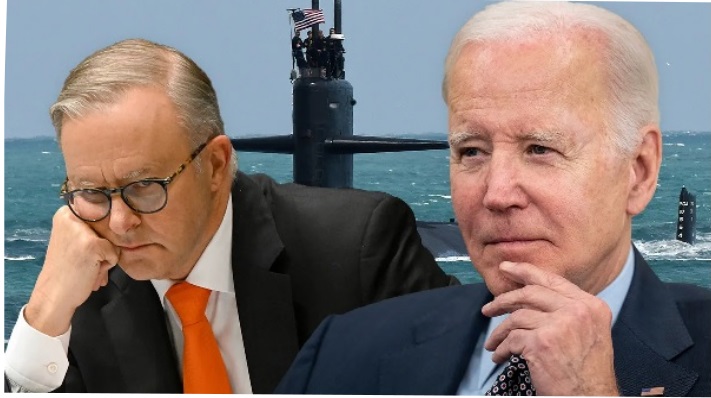
Congressional brawl threatens to overshadow Anthony Albanese’s US trip
The Age David Crowe. October 20, 2023
A political brawl in the United States is hurting Australian plans to persuade legislators to support the AUKUS pact on nuclear-powered submarines by casting doubt over whether Prime Minister Anthony Albanese will be able to meet senior Congressional leaders next week.
Albanese is due to fly to Washington DC on Sunday to hold talks with US President Joe Biden on the alliance and broader security issues as well as attending a state dinner at the White House on Wednesday night, the first for an Australian leader in four years.
The agenda for the state visit includes stronger cooperation on climate change, critical mineral supplies as well as the sharing of nuclear secrets for the AUKUS plan, which needs Congress to approve changes to the International Traffic in Arms Regulations, or ITAR, to allow the export of US knowledge and technology.
But the upheaval in the US capital, with the Republicans in disarray over whether Jim Jordan of Ohio should become Speaker of the House of Representatives, means there is no authority to approve an address to Congress and limited time for Albanese to meet top leaders…………..
Albanese is seeking meetings with Congressional leaders and the Australian ambassador to the US, Kevin Rudd, is planning a formal opening of the new embassy on Scott Circle, with guests including political and corporate leaders, and a business delegation from Australia.
While former prime minister John Howard addressed a joint sitting of Congress in 2005 and Julia Gillard did the same in 2011, a similar event appears unlikely for Albanese given the challenges with the Republican leadership…………………………………………………………………………..
Albanese is also due to meet Biden in the Oval Office and join the president in a meeting with cabinet secretaries at the White House, as well as meeting Secretary of State Antony Blinken at the State Department. https://www.theage.com.au/politics/federal/congressional-brawl-threatens-to-overshadow-anthony-albanese-s-us-trip-20231020-p5eds1.html
—
Antipodean Nuclear Free Zones: Testing Times for Antarctica and the South Pacific
October 19, 2023 https://nonproliferation.org/antipodean-nuclear-free-zones-testing-times-for-antarctica-and-the-south-pacific/
Australia and New Zealand have historically promoted strong anti-nuclear policies at both a global, regional, and sub-regional level. They joined with the United States and the other original parties to the 1959 Antarctic Treaty to make Antarctica nuclear free.
Both countries also took France to the International Court of Justice in 1973 in order to bring about a halt to France’s nuclear testing program in the South Pacific, and actively promoted the South Pacific Nuclear Free Zone in the 1985 Treaty of Rarotonga.
However, in 2021 Australia along with the UK and US announced the AUKUS initiative, which in March 2023 was finalized in San Diego. Australia will eventually acquire AUKUS nuclear-powered submarines during the 2030s.
This has placed a spotlight on Australia’s anti-nuclear credentials and its international law commitments and has attracted criticism from within the Asia Pacific, including from New Zealand, Pacific island states, and China. This seminar considers these issues through the lens of international law.
VIDEO – on original
Chapters:
00:00:00 Moderator: Avner Cohen, Professor, Nonproliferation and Terrorism Studies, Middlebury Institute of International Studies
00:01:44 Speaker: Donald R. Rothwell, Professor of International Law, ANU College of Law, Australian National University
00:57:07 Q&A
Australia needs ‘drastic’ renewables boost as nuclear not an option for decades, says centre-right thinktank
Blueprint Institute says nuclear ban should be lifted, but disagrees with Coalition opposition to green energy rollout
Guardian Adam Morton, 20 oct 23
A centre-right thinktank is calling for “drastically accelerated deployment” of renewable energy, batteries and electricity transmission infrastructure and acknowledged there is no prospect of nuclear energy playing a role in Australia before 2040.
The report by the Blueprint Institute, not yet released but seen in draft form by Guardian Australia, says the ban on nuclear energy should be repealed and argues small modular nuclear reactors (SMRs) could play a “small but vital role” in minimising costs in reaching net zero emissions in the power grid by 2050.
The report, due to be published soon, is set to land during a polarised debate about the future of energy and the pace of decarbonisation.
The Coalition and parts of the media have attacked the Albanese government’s renewable energy policy and have called for the rollout to be slowed, a position at odds with scientific warnings that emissions cuts need to accelerate. The opposition leader, Peter Dutton, has suggested SMRs could be built on the site of old coal plants.
The Blueprint Institute report says reaching the government’s target of 82% renewable energy by 2030 will be a major challenge, but does not provide support for those challenging the goal. It says the country has “no choice, at least in the short-term”, but to “double down on renewable energy” and proven “firming” technology to avoid “calamitous blackouts” as old coal plants close.
“This means a drastically accelerated deployment of batteries, solar, onshore wind, pumped hydro, and gas, along with a corresponding build out of transmission infrastructure,” the report says.
The report says the potential role of nuclear energy in Australia is “strictly limited to a decade or more from now – specifically, from 2040”……………………………….
Bruce Mountain, director of the Victoria Energy Policy Centre, said the report’s findings had “no great policy weight” because it was impossible to accurately predict the cost of cutting emissions from the grid in the long-term given technological change was happening so rapidly…………………..
He said nuclear energy was not well suited to playing a minor role in a grid already overwhelmingly running on renewable energy, and its introduction would be “likely to require the abandonment of a good deal of already existing renewable generation”………………….. more https://www.theguardian.com/environment/2023/oct/19/australia-needs-drastic-renewables-boost-as-nuclear-not-an-option-for-decades-says-centre-right-thinktank
NTI Releases New Paper on Global Effects of Nuclear Conflict: Implications for Nuclear Policymaking, Then and Now
Forty years ago, findings on the global climatic effects of nuclear war first introduced the prospect of “nuclear winter.” In the decades since, the consequences of nuclear use have remained only incidental to considerations of nuclear policy. A new paper from NTI, “Global Effects of Nuclear Conflict: Implications for Nuclear Policymaking, Then and Now,” highlights the need for renewed attention to the catastrophic effects of nuclear conflict as a crucial step toward reducing the risk of nuclear use.
The paper provides historical context and describes how the scientific revelation of “nuclear winter” was first received by the U.S. defense community in the 1980s. It sheds light on the debate that emerged over how U.S. nuclear policy should account for the implications of the global effects of nuclear use, as many of the questions posed then are even more important to consider in the context of today’s interconnected and economically interdependent world. The complexity of modern global systems creates new vulnerabilities and introduces risks of cascading societal, economic, industrial, and political failures that countries are dangerously unprepared to address.
Both a reflective analysis and a forward-looking call for renewed investigation into and consideration of the global effects of nuclear conflict, the paper outlines several critical questions for experts and policymakers to confront, including:
- How does the recognition of global nuclear effects change the role and perceived utility of nuclear weapons in national security strategies?
- How should the cascading effects of nuclear war shape nuclear planning?
- Why has research into cascading nuclear effects been neglected in nuclear policy discussions?
Without answers to these important questions, nuclear weapons policy will continue to be premised on an incomplete understanding of the consequences of nuclear use, risking catastrophic miscalculations and endangering national and global security.
Biden to America: “Give me $100 billion for perpetual wars in Ukraine and Gaza”

Walt Zlotow, West Suburban Peace Coalition, Glen Ellyn IL 20 Oct 23
Last night President Biden doubled, tripled, quadrupled down on squandering US treasure on US provoked, enabled and perpetuated warfare. A piece of that cool hundred billion goes to Taiwan in furtherance of America’s potential nuclear confrontation with China in an area having not the slightest connection to American security interests. Combined with potential nuclear war with Russia that could erupt any day, Biden reminds me of a Samsonite strongman struggling to pull down the pillars of human existence.
But that hundred billion is D.O.A. as long as House Republicans continue their circular firing squad preventing any significant action in Congress on funding those perpetual wars Biden relishes with every second of his dwindling time in power. Keep fighting amongst yourselves Republicans, you’re gumming up the perpetual war works.
In his 51st year promoting US exceptionalism worldwide which is collapsing before our eyes, Biden remains blind to the horrific death toll his policies have promoted and enabled. Apparently, there will be no Biden epiphany inspiring him to pivot toward peace. Instead of going out in a blaze of glory, Biden risks us all going out in a blaze of mushroom clouds.
Only thing more frightening? There is no one remotely in contention for president likely to change Biden’s self-destructive war policies. #nuclear #antinuclear #nuclearfree #NoNukes
1 This month.

Australians deserve the truth
about
AUKUS – https://aukuspublicinquiry.com/

30 July – WEBINAR (Free) – Is Nuclear Power the Solution to Climate Change? https://my.acaw.org.au/event/acaw-is-nuclear-power-the-solution-to-climate-change
18:30 – 19:45 ACST
19:00 – 20:15 AEST


PETITION – To: Prime Minister Anthony Albanese and the Australian Labor Government

of the week – Australians for War Powers Reform (AWPR)
To see nuclear-related stories in greater depth and intensity
 Antinuclear