South Korea does not need nuclear submarines (very like Australia!)

The waters around the Korean peninsula are relatively shallow, which favors the employment of quiet conventional subs. South Korea now operates seven Son–Won II–class diesel-electric submarines, powered by a hybrid diesel‐electric/fuel cell with air-independent propulsion technology. These subs are extremely quiet; they can travel up to 20 knots when submerged and remain under water for seven weeks. They are perfectly suited for operations around the Korean Peninsula.
the country could acquire three state-of-the-art conventional submarines for less than the cost of one nuclear-powered sub.
The Hill BY DOV S. ZAKHEIM, OPINION CONTRIBUTOR – 11/24/23
South Korea is again debating whether to develop and build a nuclear-powered submarine.
During a National Assembly confirmation hearing that took place last week, Admiral Kim Myung-Soo, the nominee for chairman of South Korea’s Joint Chiefs of Staff, responded positively to a question about the utility of nuclear-powered submarines, stating that “those capabilities are needed.” He noted, however, that the current U.S.-Korean nuclear agreement restricts the use of nuclear materials for military purposes.
Nevertheless, there appears to be a growing sentiment on the part of both of South Korea’s leading parties and the general public in favor of Seoul acquiring nuclear-powered boats. The government should resist the temptation to do so.
In theory, South Korea could avoid America’s restrictions by turning to France to help it develop or acquire a nuclear-powered submarine. France could help South Korea develop its own nuclear-powered sub, much as Paris has assisted Brazil with its own nuclear-powered submarine program.
However, there are many reasons why Seoul should not imitate the Brazilians and forge ahead with its own program. To begin with, it was only in April of this year that President Biden and South Korean president Yoon Suk Yeol reached an agreement that not only calls for greater consultation on nuclear matters between the two countries, in the form of a newly created nuclear consultative group, but also provides for an enhanced American nuclear presence around the peninsula to deter North Korean aggression…………………………………………………..
In any event, it is not clear how Seoul could afford to undertake a nuclear-submarine program unless it were to dramatically increase its defense spending beyond current levels…………………………………
…………………… Lastly, there are good operational reasons why South Korea should continue to acquire conventionally powered submarines rather than nuclear powered boats. The waters around the Korean peninsula are relatively shallow, which favors the employment of quiet conventional subs. South Korea now operates seven Son–Won II–class diesel-electric submarines, powered by a hybrid diesel‐electric/fuel cell with air-independent propulsion technology. These subs are extremely quiet; they can travel up to 20 knots when submerged and remain under water for seven weeks. They are perfectly suited for operations around the Korean Peninsula.
The South is currently planning both to upgrade the Son-Won II for about $100 million per boat and is proceeding with a new Son-Won III class at about $900 million per submarine. In other words, the country could acquire three state-of-the-art conventional submarines for less than the cost of one nuclear-powered sub.
The costs, the technologies, and operational realities all weigh against South Korea acquiring nuclear-powered submarines. If that were not enough, America’s recent commitment to bolster the nuclear umbrella that it has long provided to South Korea and that is so critical to its deterrent should settle the argument once and for all.
Dov S. Zakheim is a senior adviser at the Center for Strategic and International Studies and vice chairman of the board for the Foreign Policy Research Institute. He was undersecretary of Defense (comptroller) and chief financial officer for the Department of Defense from 2001 to 2004 and a deputy undersecretary of Defense from 1985 to 1987. https://thehill.com/opinion/international/4324038-south-korea-does-not-need-nuclear-subs/
Soaring death rates raise concerns about Portsmouth nuclear plant

A low-cancer county has now become a high-cancer county.
Joseph Mangano, 26 Nov 23, https://www.cincinnati.com/story/opinion/contributors/2023/11/26/reports-raise-concerns-about-radiation-exposure-from-portsmouth-plant/71664443007/
Death rates in southern Ohio, especially in Pike County, are rising sharply and are among the highest in the U.S., according to two recent reports, which raises concerns about past, present and future exposures to toxic radiation from the Portsmouth nuclear plant in Piketon.
Beginning in 1954, the Portsmouth plant enriched uranium for fuel, first for nuclear weapons and later for nuclear power reactors. The enrichment process involves the creation of various radioactive chemicals, including americium, neptunium, plutonium, technetium, and several forms of uranium.
Each of these toxins, which are among the most dangerous on the planet, have been detected in the local environment, raising questions about exposures to workers and residents, and whether their health has been affected. And while uranium enrichment at Portsmouth ceased in 2001, various operations proposed for the site by federal officials would create additional radioactive products, and pose new health threats.
Health studies have never been a priority in Portsmouth’s long history. A federal analysis of plant workers only looked at deaths before 1991. Another federal study near U.S. nuclear plants, including Portsmouth, only used data from 1950 to 1984. Both are outdated.
Last year, the Ohio Nuclear Free Network supported a current, updated and detailed evaluation of trends in cancer and other health measures in and around Pike County. Two reports have been issued, using statistics made public by the U.S. Centers for Disease Control and Prevention and the Ohio Cancer Registry.
The first report found the Pike County cancer death rate was below the U.S. rate for decades, but has exceeded the U.S. since the early 1990s, with the greatest excess (33% higher) occurring in the most recent period. Pike County also has the highest rate of cancer incidence (newly-diagnosed cases) of all 88 Ohio counties. A low-cancer county has now become a high-cancer county.
The report also reviewed death rates for all causes combined. Until the mid-1990s, the Pike County rate was slightly higher than the U.S. rate. But ever since the gap has grown, especially for premature deaths (persons dying before age 75); the current rate is a staggering 85% above the U.S. − among the highest of all U.S. counties.
A second report addressed several questions. One question was whether the unexpectedly high disease and death rates stopped at the Pike County border. The answer was a clear “no” − as similar trends occurred in six counties bordering Pike (although none quite as dramatic as Pike). Local death rates for persons are especially high for those in their mid-20s to mid-50s − the prime of life − more than double the U.S. rate.
Another question was whether socioeconomic needs could explain the decline in health, as Pike has high poverty rates, relatively low access to medical care, and higher unemployment rates. But increases in death rates in six equally-needy Ohio counties were much lower; thus, “it’s just Appalachia” could not explain most of the increases.
Pike County and surrounding areas consist of small towns and rural areas. Few large industries which pollute the environment exist locally. The exception is the Portsmouth nuclear plant, which creates the most hazardous chemicals known on earth. Other factors can increase risk of disease and death, but decades-long environmental radioactivity exposures must be regarded as a factor, even a major factor, in the sharp increase in local disease and death rates.
Currently, the U.S. Energy Department has proposed or is considering additional nuclear-related operations at the Portsmouth site. These include reprocessing, modular reactors, molten salt reactors, uranium enrichment and uranium purification.
Knowing a large decline in local health for decades means extra caution should be taken to protect residents from any health hazards. Expanding an industry that may have already harmed many who live near Portsmouth is not the answer. Public officials entrusted with reducing harm to the public should act accordingly, and oppose these new initiatives.
Joseph Mangano is executive director of the Radiation and Public Health Project and serves as a consultant to the Ohio Nuclear Free Network.
K-219: Russia’s Worst Submarine Ever (And a Nuclear Disaster)?

This article is all about the sinking of a ballistic missile submarine, carrying 6 nuclear missiles.
But – not a word about the radioactive pollution that must still be emanating from the undersea wreck nearly 30 years later.
The K-219 was clearly faulty and the crew did not react well to the emergency. It should be considered one of the worst submarines of all time because it carried nuclear missiles and there was a fire on board.
National Interest, Brent M. Eastwood 26 Nov 23
-219: The Worst or Most Dangerous Submarine of All Time? When it comes to figuring out what is the worst submarine of all time, it is difficult to blame the sub itself or the bad actions of the crew. Such is the case with the sinking of the Soviet submarine K-219. K-219 was a Yankee-class boomer, or ballistic missile submarine, that carried nuclear weapons.
On October 3, 1986, the K-219, with 16 R-27 nuclear missiles, sunk within 700 miles off the coast of Bermuda.
One of the missile tubes sprung a leak and seawater rushed in and blended with the missile fuel. This volatile combination made for a deadly mix that created dangerous levels of heat and gas. This is where the crew reacted slowly without the sailors exhibiting teamwork and conducting damage control.
Only one crew member moved to do something by venting the tube. A short circuit cropped up in the main power line that created a spark. Then a blast in the silo occurred that sent the missile and the warheads into the water. That’s when the sailors finally sprang into action. They battled the fire on board, eventually putting it out.
They had to shut down the nuclear reactors by hand because the control mechanisms were damaged. Three sailors died.
A Soviet ship tried to rescue the sub by pulling it to safety. But that did not work because the tow cord broke. The captain of the sub, Igor Britanov, decided to abandon ship. The sub sunk to the bottom of the ocean and the missiles were lost. The whole encounter lasted three days.
The Reagan administration even offered to help the Soviets and American officials appreciated that the Soviets informed them of the tragedy the day it happened. Fortunately, no radioactivity or nuclear explosion happened. The surviving sailors made it out and Captain Britanov was the last to leave the sub alive, in accordance with naval customs………………………………………………………………………………….
The K-219 was clearly faulty and the crew did not react well to the emergency. It should be considered one of the worst submarines of all time because it carried nuclear missiles and there was a fire on board. This made it one of the most dangerous submarines to ever float. Gorbachev feared the worst and he was correct to blame the crew. They reacted slowly to the original leak and did not check the power system before engaging the water pump.
They should have known that gas was present and that employing electrical power would be dangerous. This was one of the most hazardous maritime situations in the Cold War. The Soviets and the Americans were lucky it was not worse. https://nationalinterest.org/blog/buzz/k-219-why-russias-worst-submarine-ever-and-nuclear-disaster-207495
COP28 must stick to 1.5°C target to save ice sheets, urge scientists

A report warns that 2°C of global warming would mean losing most of the world’s ice sheets and glaciers, leading to catastrophic sea level rise
By Alec Luhn, 16 November 2023
The world must stick to its target to limit climate warming to 1.5°C to avoid catastrophic melting of ice sheets and glaciers, according to a report.
The International Cryosphere Climate Initiative (ICCI), a group of scientists who study ice-covered parts of the world, warns that a rise of 2°C would liquidate most tropical and mid-latitude glaciers and set off long-term melting of the Greenland and Antarctic ice sheets, leading to 12 to 20 metres of sea level rise.
In the 2015 Paris Agreement, all countries committed to holding global average temperature to “well below 2°C” over pre-industrial levels and “pursuing efforts” to limit it to 1.5°C. Our still-rising greenhouse gas emissions have already caused almost 1.2°C of warming and put us on track to exceed 3°C.
More than 350 cryosphere scientists have signed an open letter calling on countries to commit to the 1.5°C limit at the upcoming COP28 climate summit in Dubai.
“From the cryosphere point of view, 1.5°C is not simply preferable to 2°C or higher. It is the only option,” Iceland’s prime minister Katrín Jakobsdóttir said in a statement.
Earth’s regions of snow and ice are melting faster than we expected and already approaching tipping points, says Jonathan Bamber at the University of Bristol, UK, who reviewed the ICCI report, while otherspoint to the rapid uptake of solar and wind energy as reason for continued hope. https://www.newscientist.com/article/2403404-cop28-must-stick-to-1-5c-target-to-save-ice-sheets-urge-scientists/
No Ceasefire in the Propaganda War

https://www.craigmurray.org.uk/archives/2023/11/no-ceasefire-in-the-propaganda-war/
I have had BBC News on in the background for the last two hours. In that time there have been three lengthy interviews with different relatives of Israeli hostages held by Hamas. There has not been a single interview with a Palestinian relative of a Palestinian prisoner held by Israel.
Today 13 Israeli prisoners and 39 Palestinian prisoners are due to be released. 90% of the BBC mentions of prisoner releases do not include the Palestinians at all. Just finished is a ten minute interview of a Professor in Kent on the psychological effects on Israeli hostages. Earlier there was an expert from Tel Aviv on the psychological impact on Israeli hostages’ families. There has been no report whatsoever of the impact on Palestinian prisoners and their families.
The BBC simply does not treat the Palestinians as human, whereas the emphasis on Israeli personal victimhood is incessant and unrelenting.
Of the 300 Palestinian women and children prisoners on the list possibly to be released during the ceasefire, 252 have never been charged with any crime. 23 were charged with stone throwing.
Since October 8 over 200 Palestinian children have been taken prisoner, none of whom had anything to do with the October 7 attacks. That rather puts the possible release of 33 children and six women today into perspective. But it is not a perspective the BBC would ever give you.
Over 2,000 Palestinians are held by Israel in “administrative detention”, without charge or trial. Some for over twenty years.
Since 1967 Israel has made over 1 million arrests of Palestinians. This “justice” system is an essential part of the imposition of apartheid and the slow genocide, which did not just start this autumn. The BBC won’t tell you that either, and appears to have no problem with permanently showcasing its Israel based correspondents churning out the Israeli propaganda narrative, with no attempt at either perspective or balance.
Mercifully shorter nuclear news this week
This news roundup has become too long. I am going to try to limit the headlines about the Israeli and Ukraine wars, as not being actually “nuclear” news. That’s harder than you might think, as in each case we are brought closer to the brink of nuclear wars. (Those excluded items will still appear on nuclear-news.net.
*********************************

Some bits of good news. Blue whales have returned to a region of the Indian Ocean, where they were wiped out by commercial whalers. Millionaires implored the UK government to tax them.
Some Good News About Climate: Costs for renewables have plummeted and growth is exceeding expectations
************************
TOP STORIES. A new Palestinian state could never be free as long as its neighbor, Israel, possesses nuclear weapons.
What Would It Mean to ‘Absorb’ a Nuclear Attack?- nuclear missile silos as a “sponge”.
The Shape of Nuclear Abolition.
Soaring death rates raise concerns about Portsmouth nuclear plant .
Climate. COP28 must stick to 1.5°C target to save ice sheets, urge scientists. The great carbon divide: On the trail of the super-polluters.
Christina notes. The international political system of nuclear bullying must change, or it will kill us all. Rafael Grossi’s and the IAEA’s breath-taking hypocrisy , as the nuclear lobby revs up for COP 28.
AUSTRALIA. Independents pressure Australia on nuclear ban treaty ahead of UN meeting. Fine print bombshell – share information which “undermines trust in government”, face jail. Nuclear protesters in hazmat suits heckle Peter Dutton before they’re evicted from NSW Liberal Party conference in Sydney.
***********************
CLIMATE. For climate summit the desperate nuclear lobby will pretend that nuclear fusion is a real solution . Energy and Climate Scenarios Paradoxically Assume Considerable Nuclear Energy Growth.
CIVIL LIBERTIES. First Tel Aviv Anti-War Demonstration Reveals the Limits on Protest in Today’s Israel.
ECONOMICS.
- Rolls Royce panicking, as UK government and investors are lukewarm about its small nuclear reactor project? Poor nuclear prospects in UK.
- Finland extends nuclear reactor outage, pushing up power price.
- The Russian nuclear industry during wartime, 2022 and early 2023.
- Etopia Report: the nuclear problem – economic realities.
- Engie demands close scrutiny of French nuclear power deal to ensure competition.
- Xcel’s Prairie Island nuclear plant will be out of commission until January.
ENVIRONMENT. Oceans. Japan’s Fukushima plant completes third water release.
INDIGENOUS ISSUES. The Members of This Reservation Learned They Live with Nuclear Weapons. Can Their Reality Ever Be the Same?
NUCLEAR TECHNOLOGY. Small Nuclear Reactors (SMRs) : Failed U.S. Nuclear Project Raises Cost Concerns for Canadian SMR Development . Small nuclear reactors are NOT emissions-free. Military revokes planned contract for small nuclear reactor plant at Eielson AFB.
OPPOSITION to NUCLEAR . South Texans are publicly fighting SpaceX after second Starship launch.
POLITICS. New Brunswick Premier Higgs says Canada’s federal government should give funding for small nuclear reactor projects. Malaysian Govt urged to halt Australian company Lynas’ thorium extraction plan. Revealed: Biden’s ‘nuclear football’ contains BOOK that tells president how to launch attack by contacting ‘Looking Glass’ plane and spherical bunker where four keys ignite missiles
POLITICS INTERNATIONAL and DIPLOMACY.
- Czech Republic, France and others will use “Declaration to Triple Nuclear Energy” to push for EU funding to the nuclear industry.
- UK’s Foreign Secretary urged to send observers to nuclear ban meeting in New York.
- IAEA urges Countries in Mideast, Israel to join nuclear ban treaty, open facilities for inspection.
- Second Meeting of State Parties to Treaty on Prohibition of Nuclear Weapons to Be Held at Headquarters, 27 November–1 December.
- In softening on China, the West may be trying to avoid a nuclear arms race.
- Japanese and Chinese top envoys eye more talks on Fukushima row.
SAFETY. Incidents. Nuclear submarine scare for 140 British crew due to ‘faulty’ gauge. Hacktivists breach U.S. nuclear research lab, steal employee data. K-219: Russia’s Worst Submarine Ever (And a Nuclear Disaster)?
SECRETS and LIES. Possibly irradiated items stolen at site 3 km from Fukushima plant.
WASTES. The Deeper Dig: A plan for what’s left of Vermont Yankee nuclear power plant. Decommissioning: Nuclear Power: UK’s Financial Challenge Unveiled. Tories, Labour clash over Milton Keynes nuclear waste claims. A Photographer Goes Inside the Ruins of the Fukushima Nuclear Power Plant.
WAR and CONFLICT. Israel expands Gaza operation amid hostage deal talks. Gaza Massacre could lead to Nuclear War.
We’re long past nuclear deterrence: Bring on mutually assured prevention. Disarmament Grows More Distant as US Plans Another “Upgrade” to Nuclear Bomb.
WEAPONS and WEAPONS SALES. Why is the US ramping up production of plutonium ‘pits’ for nuclear weapons?
What do we know about Israel’s nuclear weapons? Nuclear tinderbox’: Kim’s threats put North Korea on wrong side of history. South Korea does not need nuclear subs. Beyond Current Chaos: The Escalating Risks of Nuclear War.
TODAY. The international political system of nuclear bullying must change, or it will kill us all

The normalisation of mass killing of civilians really got underway in February 1945, with the fire-bombing of Dresden. This normalisation was re-authorised in August 1945 with the atomic bombing of Hiroshima and Nagasaki.
Mass killing can be done in other ways – “normal” bombing, starvation, … and behind all that, the threat that nuclear weapons can be used if the victims resist.
Ray Acheson has beautifully explained this. So – we all live under that threat – at any time a so-called political leader might decide to use nuclear weapons.
So we live under the “international rules-based order” – which is backed up by this nuclear threat.
*******************************************
It all doesn’t make sense.
Not only do we have to accept that it’s OK for our side to massacre civilians of the other side. We’re also agreeing to the massacre of our own civilians, because the USA has set up numerous missile bases as targets ,so that some of them will attract the nuclear bombing by the enemy. That’s supposed to “dilute” the power of the enemy’s nuclear attack across the nation.
That’s just one bit of the craziness of an international relationship system that is based on nuclear bullying.
********************************
Further insanity, illogic of the system – Ray Acheson quotes Martin Amis:
What is the only provocation that could bring about the use of nuclear weapons? Nuclear weapons. What is the priority target for nuclear weapons? Nuclear weapons. What is the only established defence against nuclear weapons? Nuclear weapons. How do we prevent the use of nuclear weapons? By threatening to use nuclear weapons. And we can’t get rid of nuclear weapons, because of nuclear weapons.
They call it “deterrence”, but as Acheson points out – the possession of nuclear weapons does not deter war and violence. In fact it enables war. The nation possessing nuclear weapons (and there are more of such nations now) can intimidate others – cower them into not standing up to aggression and war crimes.
*****************************
Not to be forgotten in our consumer society, with its gospel of eternal growth, and profit as the most virtuous goal – the success of the nuclear business. Financial investments in nuclear weapons provide profits for weapons manufacturers that also build conventional bombs, missiles, guns, fighter jets, and other technologies of war.
********************************
Can the world change from this madness?
Surely so. Let’s remember the conclusion of Anne Frank, 13 year old victim of the Nazi death chambers- “I still believe that people are really good at heart “
The Second Meeting of States Parties (2MSP) to the Treaty on the Prohibition of Nuclear Weapons (TPNW) will take place from 27 November to 1 December 2023 at UN Headquarters in New York City.
Independents pressure Australia on nuclear ban treaty ahead of UN meeting
November 24th, 2023
11 independent parliamentarians have issued a public call on the Prime Minister to keep Labor’s promise to sign and ratify the UN Treaty on the Prohibition of Nuclear Weapons, ahead of the treaty’s Second Meeting of States Parties on 27 November – 1 December in New York.
The letter, which is signed by Kate Chaney MP, Zoe Daniel MP, Dr. Helen Haines MP, Senator David Pocock, Dr. Monique Ryan MP, Dr. Sophie Scamps MP, Allegra Spender MP, Zali Steggall OAM MP, Senator Lidia Thorpe, Kylea Tink MP, and Andrew Wilkie MP, states that “nuclear weapons do not promote security, they undermine it. We don’t accept the everlasting presence of these weapons.” They “urge the Government to advance its signature and ratification of the Ban Treaty without delay, to bring Australia in line with our South-East Asian and Pacific island neighbours.”
In regards to the letter, Federal Member for Goldstein, Zoe Daniel MP, said: “Voters supported Labor at the election, believing in good faith that they would implement their platform.
“Signing and ratifying was Labor Party policy before the election and has been reaffirmed since.
“In the most perilous times since the height of the Cold War this treaty is needed more than ever; voters want it and so do the vulnerable nations of the Pacific whose backyards were used for nuclear testing without their permission.
“Look at what Labor does, not what it says.”
Australia will attend the Second Meeting of States Parties as an observer, with a parliamentary head of delegation, after attending the first Meeting of States Parties in June 2022. It is expected that several states, including Indonesia, will ratify the treaty during the meeting, bolstering universalisation efforts. Around 100 countries will attend, along with over 400 civil society delegates.
Gem Romuld, ICAN Australia Director, welcomed the independents’ statement and Australia’s attendance at the meeting, but said the Albanese Government must do more, in line with their policy platform to sign and ratify the treaty.
“We welcome the Australian government’s engagement with the Treaty on the Prohibition of Nuclear Weapons, but observing meetings isn’t enough. There is clearly broad support for signing on to this treaty in the Australian Parliament, as indicated by the independents’ statement to the PM.
“Labor needs to make good on their promise to join the majority of our South East Asian and Pacific neighbours and sign and ratify the TPNW. We hope that Australia’s attendance at this meeting will spur efforts towards this urgent goal.”
Romuld is joining the international ICAN delegation at the meeting, including Yankunytjatjara-Anangu woman and second-generation nuclear test survivor Karina Lester, and current ICAN Executive Director, former Labor MP Melissa Parke.
Malaysian Govt urged to halt Australian company Lynas’ thorium extraction plan

https://www.thestar.com.my/news/nation/2023/11/24/govt-urged-to-halt-lynas-thorium-extraction-plan
SEVERAL DAP lawmakers have urged the government to review Lynas Malaysia’s license and stop the plan for thorium extraction from the waste produced at the factory of the rare earth producer.Chow Yu Hui (PH-Raub) said that he remains unconvinced that Lynas Malaysia was capable of extracting thorium.
“Let us not forget that the amount of waste from the Lynas plant was as large as five hills behind its factory. Will the new thorium extraction technology and Lynas be able to manage the radioactive waste which is expected to reach 1.2 million metric tonnes?” he asked reporters at the parliament media centre yesterday.
Oct 24, Science, Technology and Innovation Minister Chang Lih Kang announced that Lynas Malaysia would be allowed to import lanthanide concentrates until its licence expires in March 2026.
He also said that the Atomic Energy Licensing Board (AELB) decided to amend Lynas Malaysia’s license conditions after the company made a proposal to the licensing board about its thorium extraction technology.
With this, Chang said radioactive waste will not be produced after extraction and cracking and leaching activities are carried out on the lanthanide concentrate.
Khoo Poay Tiong (PH-Kota Melaka) said the Science, Technology and Innovation Ministry had announced on May 10 regarding the renewal of Lynas Malaysia’s license until Dec 31.
However, Khoo said that within a period of five months, the government, via AELB, had reviewed Lynas’ licence conditions.
“This matter has raised many concerns regarding the radioactive pollution and safety of locals,” said Khoo, who also wanted to know the parties that came up with the idea of thorium extraction.“We also want clarification from the government on what the possible market for thorium is,” he said.
Tan Hong Pin (PH-Bakri) also pointed out that thorium extraction technology was still in its initial phases, even at the international level.
“To what extent can thorium be extracted, used and commercially extracted? What are the effective measures that can be taken by the government to address the issue and ensure that Lynas will adhere to all the international standards in managing radioactive waste?” asked Tan.
On Nov 16, Chang promised that AELB will closely monitor the thorium extraction process from Lynas Malaysia’s waste material.
The Shape of Nuclear Abolition

Nuclear Ban Daily, Vol. 4, No. 1 https://reachingcriticalwill.org/disarmament-fora/nuclear-weapon-ban/2msp/reports/17072-nuclear-ban-daily-vol-4-no-1
Editorial: The Shape of Nuclear Abolition
24 November 2023, By Ray Acheson
Writer Martin Amis describes nuclear weapons as instruments of blood and rubble. These days, blood and rubble seems to be everywhere, most of all, for the moment, in Gaza. Thousands of bombs dropped on apartment buildings, hospitals, bakeries. And still, this is apparently not enough blood or rubble. The genocidal bombing continues, as do the shipments of weapons to continue the genocidal bombing. And in the midst of all this bombing, an Israeli minister found it appropriate to muse about dropping a nuclear weapon on Gaza. His remarks have been condemned by many governments, but are they surprising, when the practice of nuclear-armed states is to commit massive amounts of violence wherever and whenever they desire?
Nuclear weapons are part of the spectrum of violence—at the possibly-world-ending end of the spectrum. Daniel Ellsberg recognised this, describing how the firebombing of Dresden, London, and Tokyo in World War II led to the atomic bombings of Hiroshima and Nagasaki, normalizing the concept of cities on fire, of civilians as targets. In this world of blood and rubble, every day that nuclear weapons exist is a day that they might be detonated, dropped on a city or a missile silo, tested on an island or in a desert, unleashing terrible forces of blast, heat, fire, and radiation on people’s bodies, into the land, water, and air. Every day that nuclear weapons exist is a day that a so-called political leader might decide to use them.
Blood and rubble are policy choices. Blood and rubble are planned for by all of those who shape and propagate the dangerous doctrine of nuclear deterrence. In his introduction to Einstein’s Monsters, Amis writes:
What is the only provocation that could bring about the use of nuclear weapons? Nuclear weapons. What is the priority target for nuclear weapons? Nuclear weapons. What is the only established defence against nuclear weapons? Nuclear weapons. How do we prevent the use of nuclear weapons? By threatening to use nuclear weapons. And we can’t get rid of nuclear weapons, because of nuclear weapons.
This is the relentless circular (il)logic of deterrence, the principal tenant of which is that the possession of nuclear weapons makes their use impossible and thus prevents war. But whether it is the United States attacking Iraq, Russia invading Ukraine, or Israel committing genocide in Palestine, it should be clear to all that nuclear weapons do not prevent war. They enable it.
Whether nuclear weapons are used or not, they facilitate other forms of violence. They are the backbone of a mentality that security can best be achieved through building up the capacity to commit mass destruction, and by committing mass destruction. Nuclear weapons are used as shields to prevent others from standing up to their possessors’ acts of aggression, to their war crimes. Financial investments in nuclear weapons provide profits for weapons manufacturers that also build conventional bombs, missiles, guns, fighter jets, and other technologies of war. Nuclear weapons provide sustenance to the war machine, and exist as the overarching, final threat of that machine.
The possession of nuclear weapons drives the development of self-destructive plans masquerading as national security. Governments willfully put people and the planet in harm’s way, arrogantly asserting that this is the best way to protect them. One example is the land-based missile silos in the United States, which are intended to serve as targets for enemy nuclear weapons with no concern for the communities or land upon which they are based. As part of his new ground-breaking project examining the US government’s plan to modernise its nuclear forces, Sébastien Philippe of Princeton University’s Program on Science and Global Security writes in Scientific American, “a key argument for the continued existence—and now the replenishment—of the land-based missiles is to provide a large number of fixed targets meant to exhaust the enemy’s resources.” Yet the most recent, 3000-page report from US government on these silos does not mention what happens if the missiles are attacked. But as Philippe’s modelling of these “sacrifice zones” shows:
A concerted nuclear attack on the existing U.S. silo fields—in Colorado, Wyoming, Nebraska, Montana and North Dakota—would annihilate all life in the surrounding regions and contaminate fertile agricultural land for years. Minnesota, Iowa and Kansas would also probably face high levels of radioactive fallout. Acute radiation exposure alone would cause several million fatalities across the U.S.—if people get advance warning and can shelter in place for at least four days. Without appropriate shelter, that number could be twice as high. Because of great variability in wind directions, the entire population of the contiguous U.S. and the most populated areas of Canada, as well as the northern states of Mexico, would be at risk of lethal fallout—more than 300 million people in total. The inhabitants of the U.S. Midwest and of Alberta, Saskatchewan, Manitoba and Ontario in Canada could receive outdoor whole-body doses of radiation several times higher than the minimum known to result in certain death.
“Higher than the minimum known to result in certain death.” How can anyone read these words and think, “No, this is not relevant for a study on the impacts of our weapon systems.” Or, more broadly, that “No, this is not relevant for our consideration of the possession and deployment of these weapons at all. In fact, we will base our security strategy on the possibility of mass death and unspeakable suffering, and this is normal and fine for us and a few select others—this is how we will dominate. This is how we ‘win’.”
The irrationality of basing national security on the ability to execute or absorb catastrophic events like genocide is not lost on states parties and signatories to the Treaty on the Prohibition of Nuclear Weapons (TPNW). These governments understand that security must be provided for through other means. That it is both immoral and illogical to threaten to melt people, to turn them into shadows, or to subject them to a protracted, painful death from radiation poisoning, in order to—what, exactly? Exercise dominance within the so-called world order? Be able to wage wars of aggression against whomever one wants, whenever one wants?
The governments that join the TPNW are not just pledging against acquiring nuclear weapons themselves—they are also committed to achieving the abolition of all nuclear weapons, and to building a world that does not rely on massive nuclear violence for security. When these governments gathered with activists and others in 2017 to prohibit nuclear weapons, they changed the world. Not just rhetorically, but materially. The creation of a legally binding treaty outlawing the possession, use, and threat of use of atomic bombs has enabled unprecedented financial divestment and political stigmatisation of these weapons. It has changed discourse, even if it has not yet changed doctrines. But one follows the other.
Six years after the adoption of the TPNW, the nuclear-armed states and nuclear-supportive allies are still clinging to their arsenals of mass destruction. But the horrors these governments have collectively wrought upon the world are clearer—and more condemned—than ever. The masks are off, the wizards are no longer behind the curtain. Political leaders that condone mass death are being denounced; global inequalities are being exposed and opposed. The tide may not yet have fully turned, but the wave of opposition to permanent war and violent aggression is growing every single day. People are organising and getting organised. There is no time to waste, not when it comes to genocide and not when it comes to nuclear weapons.
This meeting of TPNW states parties is an opportunity to advance collective action against the bomb. The governments that have signed and ratified this treaty must adopt a strong declaration condemning nuclear deterrence and the continued possession and modernisation of nuclear arsenals. They must continue to implement last year’s action plan and work to get more countries onboard the treaty, especially those still trying to hide behind the false security promised by nuclear-armed states in exchange for sharing the economic and political burdens of nuclearism. The governments that aid and abet nuclear-armed states must relinquish this immoral space and join the rest of the world in renouncing the policies and practices of mass death.
But this meeting of states parties is not just about governments, it’s about people. It’s about the Indigenous Peoples upon whose bodies and lands nuclear weapons have been detonated, again and again and again. It’s about the communities who have been forced, without their consent or knowledge, to host uranium mines, nuclear laboratories, missile silos or bomber and submarine fleets, radioactive waste dumps. It is about all of us living with radiation from nuclear testing in our bodies, contaminated for generations by the hubris of political and corporate leaders who put their profits and sense of power above everything else. This meeting will be filled with people from affected communities, activist organisations, scientific groups, academic institutions, and more. Nuclear weapons have never just been about states. Nuclear weapons, fundamentally, are about human life, about all life. The nuclear-armed states have refused to acknowledge, let alone include, most people in conversations or policy making about their bombs. But the TPNW is a space for everyone to have a voice, to participate, and to determine how we fight for nuclear abolition, together.
“Nuclear weapons are mirrors in which we see all the versions of the human shape,” writes Amis. What shape do we want to reflect?
Second Meeting of State Parties to Treaty on Prohibition of Nuclear Weapons to Be Held at Headquarters, 27 November–1 December

NEW YORK, 24 November (Office for Disarmament Affairs) — The second Meeting of States Parties to the Treaty on the Prohibition of Nuclear Weapons will be held at the United Nations Headquarters from 27 November-1 December 2023. Juan Ramón de la Fuente (Mexico) was elected as President of the Meeting.
The Treaty, the first multilateral nuclear disarmament treaty to be negotiated in more than two decades, was adopted on 7 July 2017 at the United Nations and entered into force on 22 January 2021. United Nations Secretary-General António Guterres has called the Treaty “an important step towards the goal of a world free of nuclear weapons and a strong demonstration of support for multilateral approaches to nuclear disarmament.”
The second Meeting of States Parties is expected to hold a thematic debate on the humanitarian impact of nuclear weapons. States parties will also consider the status and operation of the Treaty, addressing issues that include universality; the total elimination of nuclear weapons; and victim assistance, environmental remediation and international cooperation and assistance. Other topics will include scientific and technical advice for the effective implementation of the Treaty, the complementarity of the Treaty with the existing nuclear disarmament and non-proliferation regime and implementing the gender provisions of the Treaty.
The Meeting is expected to adopt a political declaration. The period since the conclusion of the first Meeting of States Parties in April 2022 saw the appointment of a Scientific Advisory Group, which will present its initial reports at the second Meeting of States Parties. Since the first Meeting of States Parties, seven States signed the Treaty, three ratified it and one acceded to it.
The Treaty contains, inter alia, a comprehensive set of prohibitions on participating in any nuclear-weapon-related activities. This includes undertakings not to develop, test, produce, acquire, possess, stockpile, use or threaten to use nuclear weapons. The Treaty also prohibits the deployment of nuclear weapons on national territory as well as the provision of assistance to any State in the conduct of prohibited activities.
The Treaty requires States parties to assist individuals affected by the use or testing of nuclear weapons, as well as to take environmental remediation measures in areas under their jurisdiction or control that have been contaminated due to the testing or use of nuclear weapons. States parties are required to cooperate with one another to facilitate the Treaty’s implementation.
To date, 69 States have ratified or acceded to the Treaty and 93 have signed it.
Media contacts for the second Meeting of States Parties to the Treaty on the Prohibition of Nuclear Weapons: Suzanne Oosterwijk, United Nations Office for Disarmament Affairs, UN Secretariat, S-30FW, telephone: +1 917-367-2556, email: suzanne.oosterwijk@un.org.
Nuclear waste bags Fukushima – slowly falling apart
“Contaminated soil bags in Fukushima prefecture. The life span of these bags is about 5 years. No government plan to do anything with these so they are slowly falling apart.”
Arkadiusz Podniesinski was in Fukushima Prefecture.

TODAY. Rafael Gross’ and the IAEA’s breath-taking hypocrisy , as the nuclear lobby revs up for COP 28

There is no limit to their bravado and hypocrisy. They know that nuclear power is really for the weapons industry. They know it is not really safe. That it emits radiation – causes cancer. That there’s no solution for its eternal toxic wastes. That it is obscenely expensive.
And – they know that even if nuclear works against climate change (which it doesn’t), it would never be up and running in time to make any difference, as climate change is upon us now.
Does that stop these shameless hypocrites?
“In his opening statement to the IAEA’s Board of Governors today, Director General Rafael Mariano Grossi spoke of the importance of food security in a world where hunger is on the rise, and in many cases is worsening due to climate change.

“Over the past three years the number of people who go hungry in the world has increased by almost a fifth,” Mr Grossi said in his statement to the Board, which is meeting at the IAEA’s Vienna headquarters from 22-24 November. The IAEA and Food and Agriculture Organization of the United Nations (FAO) have joined forces in response to this challenge. Mr Grossi and FAO Director General Qu Dongyu launched Atoms4Food at the World Food Forum last month in Rome. The joint initiative aims to increase global food security and tackle growing hunger through the use of nuclear techniques………..
COP28

Looking ahead to the 28th Session of the Conference of the Parties (COP28) to the United Nations Framework Convention on Climate Change (UNFCCC) in Dubai next month, Mr Grossi noted the growing global momentum on nuclear energy. “For the first time in the history of COP, nuclear countries will be able to say ‘yes, we are here, yes nuclear energy is part of the solution for this global climate crisis that we have’.”
The IAEA will showcase initiatives such as Atoms4NetZero and Atoms4Food at COP28 as well as other aspects of its work in helping the world monitor, mitigate and adapt to climate change.
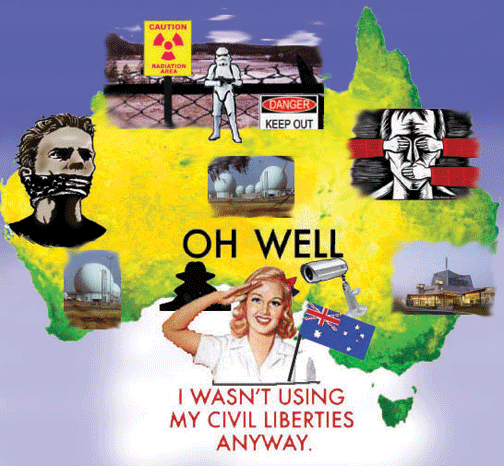
Fine print bombshell – share information which “undermines trust in government”, face jail
by Rex Patrick | Nov 21, 2023 https://michaelwest.com.au/government-review-of-secrecy-provisions-an-assault-on-democracy/?utm_source=newsletter&utm_medium=email&utm_term=2023-11-23&utm_campaign=Michael+West+Media+Weekly+Update
The Government has released its ‘Review into Secrecy Provisions’ whose fine print contains the greatest assault on democracy and accountability in many years, writes Rex Patrick.
Secrecy is woven into the fabric of the Australian Government. There are eleven general secrecy offences in the criminal code, 295 non-disclosure duties in 102 laws that attract criminal liability, and 569 specific secrecy offences in 183 laws.
A rationalisation and a review of secrecy laws was long overdue.
But buried in this review is a bombshell. Carried out by the Attorney-General’s Department, the review report makes a key recommendation that disclosure of information that could cause a loss of trust in Government should be criminalised.
Paragraph 146 states:
“… disclosure of information that harms the effective working of Government undermines the Australian community’s trust in government and the ability of Commonwealth departments and agencies to deliver policies and programs. It is appropriate that conduct which causes or is likely to cause prejudice to the effective working of government be covered [by secrecy provisions enforceable under the criminal code]”
The national security bureaucrats’ view seems to be that secrecy is essential to ensure trust in government!
The infamous character of Sir Humphrey Appleby in the Yes Minister TV show would be so proud.
If implemented, this recommendation would raise for public servants a criminal penalty for anything embarrassing, anything that might put a question in the way of policy information or even any wrongdoing by officials to the extent that revealing such might undermine confidence in government.
Review origins
The review stemmed from a report of the Parliamentary Joint Committee on Intelligence and Security looking into the 2019 ABC and the Smethurst media raids.
The review was intended to be the first step in a process that would ensure that these laws protect and are consistent with essential public interests, including the public interest in transparency in government decision-making, parliamentary scrutiny and accountability, and effective media investigations and reporting.
The recommendation of the Review that the Government create a new sweeping secrecy offence is quite at odds with the original objectives of this exercise, and is indeed quite contrary to proper principles of transparency, scrutiny and accountability of government.
While the review recommends the repeal of some redundant and outdated secrecy offences and non-disclosure duties, this very modest wind back of secrecy will be completely submerged by the development of “a new general secrecy offence” for inclusion in the Criminal Code Act 1995.
Protecting the leaders
To be clear, public servants already have a duty not to disclose information unless they are authorised to do so, or they are required/permitted to disclose it by law.
But it’s one thing to say that public servants should operate in a ‘privacy of government’ environment, it’s completely another thing to say that everything they discuss or write about is confidential and they should go to jail if they reveal anything.
Under the current ‘privacy of government’ arrangements, we are supposed to let the government quietly get on with business overseen by Parliament, the Auditor-General, the Ombudsman, the National Anti-Corruption Commission (NACC) and law enforcement, the Freedom of Information Regime and whistleblower protection.
This all sounds good; except the Parliament is very weak on oversight, the Auditor-General and Ombudsman are underfunded, the NACC operates in complete secrecy, the FOI regime is totally broken and whistleblower protections are simply non-existent.
Secrecy overreach
But even if the accountability of government systems did work, the Secrecy Review’s recommendation is overreach. It just re-enforces a culture of secrecy inside government that is already in need of a secrecy exorcism.
The much better view is that of former Sir Anthony Mason, AC KBE GBM KC in the High Court Case of Commonwealth v John Fairfax & Sons Ltd (“Defence Papers case“) [1980], before he was Chief Justice, when he said:
“It is unacceptable in our democratic society that there should be a restraint on the publication of information relating to government when the only vice of that information is that it enables the public to discuss, review and criticize government action.
His judicial pronouncement trumps the bureaucratic authors of a review that presses a recommendation that aims to protect senior leadership and ministers from embarrassment and the exposure of incompetence using the threat of criminal punishment. But his views only last until new laws are passed.
A captured Attorney General
The next question, of course, is whether the Attorney-General and the Government will act on this recommendation and remain beholden to his national security bureaucrats?
If his past record of betraying whistleblowers and his refusal to pursue Freedom of Information reforms is any guide, there aren’t any grounds for optimism.
Proceeding down this path would deal a great blow to democratic accountability and public interest journalism.
Proceeding down this path would deal a great blow to democratic accountability and public interest journalism.
It would embed the already harmful secrecy culture that exists across a vast expanse of government activity and could also blow a hole in Australia’s already weak and failing FOI regime.
But does the Government and the Attorney General want a political fight over a move towards excessive and unjustified secrecy? We will have to see, but if they do go down this path it’s a fight they’re sure to get.
What Would It Mean to ‘Absorb’ a Nuclear Attack?- nuclear missile silos as a “sponge”

Scientific American , By Ella Weber on November 22, 2023
The missiles on the Fort Berthold Reservation in North Dakota make it a potential target for a nuclear attack. And that doesn’t come close to describing what the reality would be for those on the ground.
This podcast is Part 4 of a five-part series. Listen to Part 1 here, Part 2 here, and Part 3 here. The podcast series is a part of “The New Nuclear Age,” a special report on a $1.5-trillion effort to remake the American nuclear arsenal.…..
Ella Weber: Members of my tribe live with nuclear missiles on the Fort Berthold Reservation. The weapons sit in underground concrete silos that are surrounded by antennas in small, fenced-off areas. The missiles are armed and ready to launch in 60 seconds. This is one reason they are called Minutemen missiles…………………………….
Weber: After learning that the Air Force had not explained to my tribe what the new nuclear missiles were for–which the Air Force intended to deploy for another 60 years on our reservation–I decided to dig deeper.
I wanted to know what role the missiles and their silos play today in U.S. nuclear strategy and what the risks for the tribe were in hosting them—something that the tribe never agreed to in the first place………………….
I wasn’t really clear on what Secretary Jim Mattis meant by the ICBM force providing a “cost-imposing strategy,” so I talked to Leonor Tomero to get some clarity. She used to serve as deputy assistant secretary of defense for nuclear and missile defense policy in the Biden administration in 2021…………
Weber: Leonor explained to me that should the U.S. face a potential nuclear attack, the president would have two choices with regards to the ICBMs: launch them preventively before the missiles possibly got destroyed, or decide to absorb the attack and retaliate later.
Weber (tape): What do you mean by absorbing an attack?
Tomero: I think, you know, it’s, you know, they’re considered a sponge.
Weber (tape): So it’s kind of like making these ICBMs, like, a target ….
Tomero: Yes…
Weber (tape): …. rather than, like, these other major cities or other places…
Tomero: Right.
Weber: In case you don’t know — the role of the ICBM is to force an adversary to use many nuclear weapons if they decided to attack the U.S. The silos are basically meant to divert and absorb the incoming nuclear missiles from important and critical areas in the country, like cities.
But what would that mean for the Fort Berthold reservation?……………………………………………………………………
Frank Von Hippel: Basically the secretary of defense had come in and testified to Congress. When one of the senators asked how many people would such an attack kill, he estimated 15,000 to 25,000. And he said, ‘Well, that would be terrible, but it would be not what you would expect from a major nuclear attack.’
That seemed low to, actually, the senator from New Jersey [Clifford Case]. And he asked for a peer review of the Defense Department calculations, and, and I was then asked to be an unpaid consultant to look into that. And, in fact, I went over to the Pentagon to talk to the people who have done the calculations.
Weber: Frank found something unexpectedly horrifying.
Von Hippel: The Defense Department had assumed that explosions of the warheads over the ICBM silos would be so high that they would not cause fallout. They pointed out they would also not damage the silos.
Weber: Basically, the Department of Defense hadn’t calculated properly. The DOD had made incorrect assumptions about the altitude of nuclear explosions aimed at destroying the silos. Initially, it had thought the nuclear explosions would need to be at an altitude. But–they actually needed to be at ground level.
Von Hippel: The DoD was forced to go back and do new calculations reflecting these points, and they came out about 1,000 times higher: 20 million—on the order of 20 million people killed.
Weber (tape): Wow.
…………………………………. Von Hippel: Well, you know, the, I don’t know who coined this term about the silos being a nuclear sponge, but the local….I think there would be annihilation of the local population around the silos. Wouldn’t just be the fallout—would also be the, the blast effects, and so on. So they would be the worst affected.
Weber (tape): My grandma only lives two and a half miles away from an ICBM silo. What would happen to her and her place?
Von Hippel: I think she would be within the blast radius … and the fire radius…. I don’t know how flammable… her house would be presumably burned after being knocked flat. And then there would be the fallout. These explosions would have to be low enough to hit the set of silos with sufficient overpressure to destroy the missiles inside. It would have to be low enough for, for the dirt to be and debris to be sucked up into the cloud. And then that would bring down some of the radioactivity in a very intense patch around the silo. So … multiple ways in which she might die. I’m sorry.
Weber (tape): I mean, she didn’t make the decision to have them there. So …
Von Hippel: Yeah, I know
Weber: Being treated as expendable isn’t new to Indigenous communities. As far as I could tell, members of the Mandan, Hidatsa and Arikara Nation don’t see themselves as living in a sacrifice zone.
This designation treats certain areas and people as acceptable losses; they bear the brunt of the risks and consequences associated with nuclear weapons and decisions made by others. Maybe if members of the tribe had a better understanding of what the risks were, they could challenge the deployment of these silos on our land…………………………….
Sébastien Philippe: Now I’m going to put the whole image of the entire areas that can be impacted by the fallout, and I can walk you through the color coding, but that’s basically the worst case possible for every single person on the map.
Edmund Baker: Okay. Holy crap. Even Disneyland’s not immune. Disney World’s out. New York—there’s no safe place.
So that batch there, North Dakota, the white sort of color…?
Philippe: Yeah.
Baker: That’s 100 percent fatality in that zone?
Philippe: Times 10. Yeah, ten times what you would need to die—and that’s just from the radioactivity.
Baker: Okay, so that’s not in the EIS, I figure, or is it?
Philippe: Uh, no.
Weber: By the way, Edmund’s talking about an environmental impact statement, or EIS—a two-volume report released by the U.S. Air Force that is meant to analyze, “the potential effects on the human and natural environments from the deployment of the Sentinel intercontinental ballistic missile system.”
This was the report that the Air Force had presented to my reservation—in a different place than it had initially advertised. And in the entire 3,000 pages of the report and its appendices— which cost $33 million to write, by the way — Sébastien had found that the consequences of a nuclear war that could impact my tribe were kind of glossed over.
The EIS mentioned the “casualties” and “grave implications” of such a war but they didn’t really go beyond that.
Here’s Frank again, speaking about the military’s attitudes toward the consequences of war in general.
Von Hippel: They talk about people like your grandmother as being collateral damage. I mean…, they try to desensitize themselves to what the consequences are, what they’re talking about—and, in fact, I remember when I first went over to the Pentagon to talk to people, I learned—the first time I heard this word called “collateral damage,” that is—“We, you know, we didn’t intend to kill your grandmother…. She’s, unfortunately, collateral damage.”…………………………………………………………………………………………………………………………………………….
Weber: If anyone could advise the U.S. on resilience and survivability, it would be us: the MHA Nation. And I have a feeling that keeping ICBM silos operating across our land may not be part of our preferred strategy.
In the next and final episode, I go back to the rez and report what I found to my family and members of the tribe. We sit down and discuss: What happens now?
This show was reported by me, Ella Weber, produced by Sébastien Philippe and Tulika Bose. Script editing by Tulika Bose. Post-production design and mixing by Jeff DelViscio. Thanks to special advisor Ryo Morimoto and Jessica Lambert. Music by Epidemic Sound.
I’m Ella Weber, and this was The Missiles on Our Rez, a special podcast collaboration from Scientific American, Princeton University’s Program on Science and Global Security, Nuclear Princeton, and Columbia Journalism School. https://www.scientificamerican.com/podcast/episode/what-would-it-mean-to-absorb-a-nuclear-attack/
1 This month


Help Aunty Sue Protect Her Land and Sacred Sites From Destructive Rocket Testing.
.

Australians deserve the truth
about
AUKUS – https://aukuspublicinquiry.com/

PETITION – To: Prime Minister Anthony Albanese and the Australian Labor Government

of the week – Australians for War Powers Reform (AWPR)
To see nuclear-related stories in greater depth and intensity

