Small nuclear reactors in Canada: at what cost?

Transparency requirements in the U.S. forced NuScale proponents to disclose the projected costs of electricity to potential investors on a regular basis. This is not the case in Canada.
none of the Canadian nuclear proponents have laid out the projected costs of electricity production. In New Brunswick, the government has changed legislation to force the electricity utility to purchase power from new nuclear reactors even when it is not the lowest cost option.
Canadian Coalition for Nuclear Responsibility https://crednb.ca/2023/11/13/small-nuclear-reactors-in-canada/
In collaboration with and endorsed by:
Clean Green Saskatchewan, Coalition for Responsible Energy Development in New Brunswick, Friends of the Earth Canada, Inter-Church Uranium Committee Educational Cooperative (Saskatchewan), Ontario Clean Air Alliance, Prevent Cancer Now Le Regroupement des organismes environnementaux en énergie, (Quebec), The Society of High Prairie Regional Environmental Action Committee (Alberta) 23 Nov 23
The sudden cancellation last week of the first small nuclear reactor project in the United States, the NuScale project, calls into question the economic viability of Canada’s plans to develop and deploy small modular reactors.
Potential customers in Utah balked at the soaring projections for the cost of electricity the NuScale reactor would generate, and the project was unable to recruit other customers to buy its power.
Today, in response, civil society groups across Canada are demanding transparency and accountability for the costs of other small nuclear reactor designs planned in this country.
“Canada should stop writing blank cheques to nuclear promoters who cannot deliver on their promises of cheap, reliable electricity,” said Gordon Edwards, President of the Canadian Coalition for Nuclear Responsibility.
Transparency requirements in the U.S. forced NuScale proponents to disclose the projected costs of electricity to potential investors on a regular basis. This is not the case in Canada.
Earlier this year, the target price for electricity from the NuScale project rose by over 50 percent to $89 US per MWh ($122.99 Canadian) with indications that future increases would be forthcoming. Investor confidence was shaken, and the project was scrapped.
The NuScale reactor design has been in development for more than 15 years and the company’s first commercial joint venture with electrical utilities in Utah was launched in 2015.
Governments in New Brunswick, Ontario, Saskatchewan and Alberta have committed to building small reactors, while the Quebec government is conducting feasibility studies.
However, none of the Canadian nuclear proponents have laid out the projected costs of electricity production. In New Brunswick, the government has changed legislation to force the electricity utility to purchase power from new nuclear reactors even when it is not the lowest cost option.
Three years ago, more than 140 civil society groups across Canada signed a statement calling the proposed new reactors a “dirty, dangerous distraction,” from real climate action.
Nuclear critics have consistently said these new reactor designs will take too long to develop, and will cost too much compared with existing proven renewable energy option, to deal effectively with the climate crisis that requires immediate action.
To date, federal and provincial taxpayers have subsidized these reactors through a $970 million low interest loan to Ontario Power Generation, more than $100 million in grants to private companies and public utilities in Ontario, New Brunswick, Saskatchewan and Alberta, and millions more to research fuelling requirements for small reactors at Chalk River.
Civil society groups are demanding accountability for these costly nuclear developments. Without full transparency, taxpayers and ratepayers will be forced to subsidize these experimental reactor projects and pass on an unwanted economic debt legacy to our children and grandchildren, along with the radioactive waste legacy that all nuclear reactors are adding to every day.
Quotes:
Michael Poellet, President, Inter-Church Uranium Committee Educational Cooperative:
“Small Modular Reactors (SMRs) were meant to remedy the grossly excessive, over-budget costs of nuclear power generation. With the price of renewables dropping precipitously the economics of SMRs has only worsened. The cancellation of the NuScale project with its utility partner Utah Associated Municipal Power Systems demonstrates that commercial electrical generation with SMRs is not economically viable. Canadian federal and provincial governments must allow the economic realities to break the spell that enchantment with SMRs has over them.”
rix ?
Media release from CRED-NB and collaborators. Le français suit…
From:
Canadian Coalition for Nuclear Responsibility
In collaboration with and endorsed by:
Coalition for Responsible Energy Development in New Brunswick
Inter-Church Uranium Committee Educational Cooperative (Saskatchewan)
Le Regroupement des organismes environnementaux en énergie (Quebec)
The Society of High Prairie Regional Environmental Action Committee (Alberta)
For immediate release
November 13, 2023
Small nuclear reactors in Canada: at what cost?
The sudden cancellation last week of the first small nuclear reactor project in the United States, the NuScale project, calls into question the economic viability of Canada’s plans to develop and deploy small modular reactors.
Potential customers in Utah balked at the soaring projections for the cost of electricity the NuScale reactor would generate, and the project was unable to recruit other customers to buy its power.
Today, in response, civil society groups across Canada are demanding transparency and accountability for the costs of other small nuclear reactor designs planned in this country.
“Canada should stop writing blank cheques to nuclear promoters who cannot deliver on their promises of cheap, reliable electricity,” said Gordon Edwards, President of the Canadian Coalition for Nuclear Responsibility.
Transparency requirements in the U.S. forced NuScale proponents to disclose the projected costs of electricity to potential investors on a regular basis. This is not the case in Canada.
Earlier this year, the target price for electricity from the NuScale project rose by over 50 percent to $89 US per MWh ($122.99 Canadian) with indications that future increases would be forthcoming. Investor confidence was shaken, and the project was scrapped.
The NuScale reactor design has been in development for more than 15 years and the company’s first commercial joint venture with electrical utilities in Utah was launched in 2015.
Governments in New Brunswick, Ontario, Saskatchewan and Alberta have committed to building small reactors, while the Quebec government is conducting feasibility studies.
However, none of the Canadian nuclear proponents have laid out the projected costs of electricity production. In New Brunswick, the government has changed legislation to force the electricity utility to purchase power from new nuclear reactors even when it is not the lowest cost option.
Three years ago, more than 140 civil society groups across Canada signed a statement calling the proposed new reactors a “dirty, dangerous distraction,” from real climate action.
Nuclear critics have consistently said these new reactor designs will take too long to develop, and will cost too much compared with existing proven renewable energy option, to deal effectively with the climate crisis that requires immediate action.
To date, federal and provincial taxpayers have subsidized these reactors through a $970 million low interest loan to Ontario Power Generation, more than $100 million in grants to private companies and public utilities in Ontario, New Brunswick, Saskatchewan and Alberta, and millions more to research fuelling requirements for small reactors at Chalk River.
Civil society groups are demanding accountability for these costly nuclear developments. Without full transparency, taxpayers and ratepayers will be forced to subsidize these experimental reactor projects and pass on an unwanted economic debt legacy to our children and grandchildren, along with the radioactive waste legacy that all nuclear reactors are adding to every day.
Quotes:
Michael Poellet, President, Inter-Church Uranium Committee Educational Cooperative:
“Small Modular Reactors (SMRs) were meant to remedy the grossly excessive, over-budget costs of nuclear power generation. With the price of renewables dropping precipitously the economics of SMRs has only worsened. The cancellation of the NuScale project with its utility partner Utah Associated Municipal Power Systems demonstrates that commercial electrical generation with SMRs is not economically viable. Canadian federal and provincial governments must allow the economic realities to break the spell that enchantment with SMRs has over them.”
David Geary, Writer and Researcher, Clean Green Saskatchewan:
“Our group, Clean Green Saskatchewan, was always confident that NuScale and all other SMR startup enterprises, GE-Hitachi included [a new reactor design selected for Ontario and Saskatchewan], would fail because of the ‘bottom line’ … i.e., the economics, the ‘financials’. They simply cannot compete in the energy marketplace…compared to any other electrical energy producing technology.”
Jack Gibbons, Chair, Ontario Clean Air Alliance
“The failure of the most advanced small nuclear project in the U.S. to come even remotely close to being financially viable should be a wake-up call for politicians in Canada dreaming about castles in the sky. Counting on unproven new nuclear technology to provide low-cost power is like counting on snow in July. It is time for Premier Ford to follow Hydro Quebec’s example and develop a financially prudent plan to meet all of Ontario’s future electricity needs by investing in energy efficiency, renewables and storage. It doesn’t make sense to waste public money on high-cost, high-risk nuclear projects when we have much cleaner, safer and lower cost options to keep our lights on.”
Susan O’Donnell, Spokesperson, Coalition for Responsible Energy Development in New Brunswick
“Our provincial government is backing two nuclear start-ups and their experimental small reactor designs. These two designs are based on earlier reactors that never operated successfully commercially despite billions of dollars in public subsidies in other countries. We believe that despite the tens of millions of public dollars given to the start-ups so far, their costly boondoggles will never be built. In effect, our government is kicking the can down the road, delaying real climate action by betting on unicorns and fairy dust.”
Gordon Edwards, President, Canadian Coalition for Nuclear Responsibility
“Public utilities are owned by the government. People elect the government. So every citizen is a shareholder in the utility company and deserves to be kept informed of all business decisions that they will ultimately have to pay for. In the midst of a climate crisis and crippling inflation, Spending Money Recklessly (SMR) is a terrible strategy. We should not delay climate action by wasting our time, our money, and our political will on speculative reactors that are all ‘first-of-a-kind’ experiments.”
Jean-Pierre Finet, Porte-parole, Regroupement des organismes environnementaux en énergie
“There is no social acceptability for nuclear energy in Quebec. Small modular reactors are not only costly, they take away government funding that would be better used on proven technologies such as heat pumps and heat storage. It is time that the Canadian government comes clean about the cost of this pseudo clean energy.”
Classified! The secret radiation files


most of the exposure people received came in the form of internal exposures from ingesting radioactivity, not from external, ambient gamma rays in the environment.
Medical examinations of people in contaminated regions showed a significant increase in the general number of chromosomal mutations in newborns, and the frequency of birth defects in southern Belarus was found to be significantly higher than the control. In terms of general health, Konoplia reported, adults showed an increase in diseases of the circulatory system, hypertension, coronary illness, heart attacks, and myocardial problems, plus a rise in respiratory diseases.
Researchers on the UN team who had security clearances had access to classified studies that showed that 79 percent of children in the Marshall Islands exposed to American bomb blasts under the age of ten had developed thyroid cancer. Seventy-nine percent of several hundred children had thyroid cancer when the background rate was one in a million.
Health physicists fear lawsuits more than nuclear accidents
By Kate Brown, 12 Nov 23, https://beyondnuclearinternational.org/2023/11/12/classified-the-secret-radiation-files/
In 1987, a year after the Chernobyl accident, the US Health Physics Society met in Columbia, Maryland. Health physicists are scientists who are responsible for radiological protection at nuclear power plants, nuclear weapons plants, and hospitals. They are called on in cases of nuclear accidents. The conference’s keynote speaker came from the Department of Energy (DOE); the title of his talk drew on a sports analogy: “Radiation: The Offense and the Defense.” Switching metaphors to geopolitics, the speaker announced to the hall of nuclear professionals that his talk amounted to “the party line.” The biggest threat to nuclear industries, he told the gathered professionals, was not more disasters like Chernobyl and Three Mile Island but lawsuits.
After the address, lawyers from the Department of Justice (DOJ) met in break-out groups with the health physicists to prepare them to serve as “expert witnesses” against claimants suing the US government for alleged health problems due to exposure from radioactivity issued in the production and testing of nuclear weapons during the Cold War. That’s right: the DOE and the DOJ were preparing private citizens to defend the US government and its corporate contractors as they ostensibly served as “objective” scientific experts in US courts.
Health physics is an extremely important field for our everyday lives. Health physicists set standards for radiation protection and evaluate damage after nuclear emergencies. They determine where radiologists set the dial for CT scans and X-rays. They calculate how radioactive our food can be (and our food is often radioactive) and determine acceptable levels of radiation in our workplaces, environments, bodies of water, and air. Despite its importance, as it is practiced inside university labs and government organizations, health physics is far from an independent field engaged in the objective, open-ended pursuit of knowledge.
Compromised Science
The field of health physics emerged inside the Manhattan Project along with the development of the world’s first nuclear bombs. From the United States, it migrated abroad. For the past seventy-five years, the vast majority of health physicists have been employed in national nuclear agencies or in universities with research underwritten by national nuclear agencies. As much as we in the academy like to make distinctions between apolitical, academic research and politicized paid research outside the academy, during the Cold War those distinctions hardly made sense. From the end of World War II until the 1970s, federal grants paid for 70 percent of university research. The largest federal donors were the Department of Defense, the US Atomic Energy Agency, and a dozen federal security agencies.
Historian Peter Galison estimated in 2004 that the volume of classified research surpassed open literature in American libraries by five to ten times. Put another way, for every article published by American academics in open journals, five to ten articles were filed in sealed repositories available only to the 4 million Americans with security clearances. Often, the same researchers penned both open and classified work. Health physics benefited from the largesse of the Pentagon and the Atomic Energy Commission, which produced nuclear weapons for US arsenals. Correspondingly, the field suffered from a closed circle of knowledge that has had a major impact on our abilities to assess and respond to both nuclear emergencies and quotidian radioactive contamination.
Tracking the production of knowledge in the field of health physics shows how the effective renunciation of facts has played a major role in this branch of science. More generally, it demonstrates how the boundary between open and classified research is critical yet rarely acknowledged. The response of international health physicists to the Chernobyl disaster, which occurred in Soviet Ukraine in April 1986, shows heavily politicized science in action. History reveals that the official, federally sponsored cultivation of “alternative facts” is not new but has deep roots in the twentieth century.
Chernobyl came at an unfortunate time for nuclear professionals. As the Cold War creaked to an end, lawsuits abounded. In the 1980s, Marshall Islanders—their homes blasted in nuclear tests, their bodies subjected to classified medical study by scientists contracted by the Atomic Energy Agency—went to court. In Utah and Nevada, those who lived downwind from the Nevada Test Site were lining up for lawsuits. Meanwhile, the Metropolitan Edison Company in Pennsylvania faced lawsuits from plaintiffs living near the Three Mile Island nuclear power plant, which suffered a partial meltdown in 1979.
In the late 1980s, reporters and congressional investigators began to inquire into US government agencies’ wide-scale engagement in human radiation experiments, which included exposing tens of thousands of soldiers to nuclear blasts. These legal actions and investigations constituted an existential threat for nuclear industries, civilian and military. Chernobyl cast into doubt industry statements that nuclear energy is safer than coal, than flying, than living in high-altitude Denver. If another nuclear accident were to occur, UN International Atomic Energy Agency (IAEA) head Hans Blix told the IAEA board of governors a few weeks after the Chernobyl explosions, “I fear the general public will no longer believe any contention that the risk of a severe accident was so small as to be almost negligible.”
Because radioactivity is insensible, society relies on scientists and their technologies to count ionizing radiation and analyze its effect on biological organisms. In 1986, the three-decades-old Life Span Study of Japanese bomb survivors served in the West as the “gold standard” for radiation exposure. It became the chief referent in lawsuits over health damage from radioactive contaminants. The Life Span Study started in 1950. In subsequent decades, American and Japanese scientists followed bomb survivors and their offspring, looking for possible health effects from exposure to the bomb blasts. By 1986, the group had detected a significant increase in a handful of cancers and, surprisingly, no birth defects, though geneticists had expected them.
The Life Span Study told scientists a great deal about the effects of a single exposure of a terrifically large blast of radiation lasting less than a second but little about the impact of chronic, low doses of radioactivity—the kind of exposures served up by the Chernobyl accident and related to the ongoing lawsuits in the United States. At the time, like now, scientists confessed they knew very little about the effects of low doses of radioactivity on human health. For that reason, after Chernobyl, leading scientific administrators in UN agencies and national health agencies called for using the Chernobyl accident to carry out a long-term, large-scale epidemiological study to determine the effects of low doses of radiation on human health. Unfortunately, those requests went nowhere at first because Soviet officials asserted that health damage was limited to the two dozen firefighters who died from acute radiation poisoning. They insisted that they were monitoring the health of neighboring residents and found no change in their health. Soviet spokespeople told the international community that they did not need help, thank you very much.
Silos of Knowledge
Health physics, a moribund field in the West and a secretive field in the Soviet Union, suddenly appeared in the spotlight after the Chernobyl accident. Archival records show that two silos of knowledge about the effects of low doses of radiation on human health emerged in the wake of the Chernobyl accident. Western health physicists oriented around the Life Span Study, while Soviet health physicists worked from specialized, closed clinics producing literature that mostly was filed in classified libraries. A few months after the accident, Western health physicists— extrapolating from Hiroshima—announced that, given the reported levels of radioactivity released in the accident, they expected to see no detectable health problems as a result. From the Soviet side, spokespeople gave vague assurances, but scientists were silent. For security reasons, Soviet health physicists did not take the podium. Anyway, they were busy.
Behind the Iron Curtain, Soviet scientists near the accident quietly got to work figuring out the extent of the damage. A few days after the accident, Anatolii Romanenko, minister of health in Ukraine, called up medical brigades to examine evacuees and villagers in contaminated areas. Several thousand doctors and nurses fanned out across the Soviet countryside. The effort would have been unimaginable outside of a socialist state highly skilled in the art of mass mobilization. In Ukraine alone, doctors examined seventy thousand children and over one hundred thousand adults in the summer following the accident. People judged to have received high doses were sent to hospitals in Kiev, Leningrad, and Moscow. By late May, the number of hospitalized citizens rose to the tens of thousands.
For the subsequent five years, the last years of the Soviet Union, doctors and medical researchers in Ukraine and Belarus tracked health statistics in contaminated regions. They reported the results in classified documents each year. Their reports show that after the accident, frequencies of health problems in five major disease categories grew annually. Soviet doctors did not have access to ambient measurements of radioactivity in the environment and the food chain because that information was classified, so doctors did what they had long done in the Soviet Union. They used their patients’ bodies as biological barometers to determine doses of radioactivity. Medical practitioners counted white and red blood cells, held radiation detection counters to the thyroids of their patients, measured blood pressure, and scanned urine. They looked for chromosomal damage in blood cells and counts of radioactivity in tooth enamel. Using these biomarkers, Soviet doctors determined the doses of radioactivity their patients had encountered externally and ingested internally. Doctors calculated the range of radioactive isotopes lodged in their patients’ bodies. A KGB general who ran his own KGB clinic in Kiev for KGB agents and their families counted twelve different radioactive isotopes in organs and tissue of his patients.
In 1986, in neighboring Belarus, which received the majority of Chernobyl fallout, scientists at the Belarusian Academy of Science set up case-control studies to track the impact in real time on the health of children and pregnant women, two populations judged to be especially vulnerable. The academy also commissioned dozens of studies of radioactive contamination in the atmosphere, soils, plants, agricultural products, and livestock. They drew on a body of knowledge that Soviet scientists had clandestinely developed over four decades in clinics stationed near secret nuclear installations that had suffered a large number of accidents and spills of radioactive effluents during the Cold War rush to produce weapons. In April 1989, the respected president of the Belarusian Academy of Science sent to Moscow a twenty-five-page report that reflected the renaissance of science in the fields of radioecology and radiobiology that had flourished in the contaminated regions as a result of the Chernobyl disaster. Evgenii Konoplia laid out what his Institute of Radiobiology had found.
Almost the entire territory of Belarus had been contaminated, Konoplia wrote, except for a few northern regions.
Continue reading‘Operation Al-Aqsa Flood’ Day 37: Al-Shifa Hospital No Longer Functioning as Israeli Ground Troops Surround the Hospital
Thousands of lives are at risk as Al-Shifa Hospital becomes non-operational, with ICUs and incubators shutting down due to lack of fuel, and medical staff and patients trapped waiting to die. Israeli forces continue to shell hospitals in north Gaza.
SCHEERPOST, By Mustafa Aby Sneineh / Mondoweiss, November 13, 2023
Casualties
- 11,078 killed*, including 4,506 children, and 27,490 wounded in Gaza
- 184 Palestinians killed in the occupied West Bank and East Jerusalem
- Israel revises its estimated October 7 death toll down from 1,400 to 1,200
*The casualty numbers from Gaza have not been updated in at least 2 days, as the “collapse of services and communications” has made it nearly impossible for the health ministry to document and update the numbers
Key Developments
- Israeli heavy fire targeting Al-Shifa trapped thousands of people who were displaced, wounded, sick, and medical staff inside it, without electricity, food, water, or fuel.
- Al-Jazeera reported that Israeli forces are located approximately 700 meters from the Al-Shifa hospital’s gates, and firing, and armed clashes could be heard in the distance.
- WHO: “There are reports that some people who fled the hospital have been shot at, wounded and even killed.”
- Al-Quds Hospital in Gaza City stopped working completely after running out of fuel to generate electricity.
- Doctors at al-Ahli Arab Hospital say it is now the last functioning hospital in Gaza City and the northern areas and that it is “overwhelmed” with casualties.
- Israeli forces are surrounding the medical quarter in the center of Gaza City, where three major hospitals are located, including Al-Nasr Medical Complex, Al-Rantisi, and St John of Jerusalem Eye Hospital.
- Israel said 43 soldiers were killed since October 28, and Hamas released footage of targeting tanks in Gaza.
- Hamas’s Izz el-Din al-Qassam Brigades spokesperson said that fighters documented the destruction, completely or partially, of 160 Israeli military vehicles, which includes tanks, bulldozers and personnel carriers.
- The Israeli army said that it killed 150 Hamas fighters last week during battles in the Al-Shati refugee camp northwest of Gaza City, and claimed that it captured a station of Hamas’s Badr unit.
- Thousands protest worldwide while Israel carries on arrest campaign in the occupied West Bank.
Al-Shifa Hospital ‘completely out of service’: Patients dying, bodies piling up outside
Following days of relentless attacks from the air and land on northern Gaza’s hospitals, the healthcare system in the north has seen a near-complete collapse, with only one hospital, the previously-bombed Al-Ahli Arab Hospital, remaining functional.
Gaza’s largest hospital, Al-Shifa Hospital, is“completely out of service”, Gaza’s health ministry spokesperson Ashraf al-Qudra told Al Jazeera. Several people, including at least two premature infants and five ICU patients, have already died due to a lack of oxygen, medical supplies, and the inability of doctors and medical staff to perform life-saving surgeries as a result of power outages and no fuel.
The Ramallah-based Palestinian Ministry of Health spokesperson Mai al-Kaila released a statement on Sunday detailing the desperate conditions at the Al-Shifa hospital.
“The Israeli occupation army does not evacuate hospitals, but rather throws the wounded and sick into the street to certain death,” al-Khaila said, referring to reports and eyewitness testimony that Israeli forces were shooting at people inside the hospitals, as well as those attempting to evacuate.
“This is not an evacuation, but an expulsion at gunpoint,” she said.
Among the patients dying or facing imminent death, al-Kaila said, are children and adults on kidney dialysis who “die in their homes without receiving dialysis sessions.”
Al-Kaila confirmed the death of 12 patients inside the Al-Shifa Medical Complex so far. She added that all 3,000 cancer patients who were being treated at the Al-Rantisi and Al-Turki Hospital in Gaza “have now been left to die” after they were forcibly expelled from the hospitals due to Israeli bombardment.
“All pregnant women and those with dangerous pregnancies are at risk, as women do not find anyone to provide them with treatment and medical services in Gaza. Every woman about to give birth will not find anyone to provide her with any medical service,” Al-Kaila went on to say.
Early on in Israel’s bombardment, medical officials reported that there were an estimated 50,000 pregnant women in Gaza, including around 5,000 expecting mothers due to deliver at any moment. Over the weeks, several reports have emerged of pregnant women among those killed by Israeli airstrikes, causing doctors to have to cut out their unborn fetuses in an attempt to save the babies.
In addition to sick patients in the hospital who can’t be treated, as well as chronically ill patients being left to die, hundreds of Palestinians who are becoming wounded and sick as a result of Israeli bombardment cannot reach the hospital itself. Over the past month of Israeli bombardment, Gaza’s infrastructure, including roads around hospitals, have been decimated, making it nearly impossible for ambulances to move to and from the hospital to reach bombed-out buildings and the wounded.
Additionally, medical staff inside the hospital cannot physically move inside the hospital, as Israeli drones and ground forces “fire at everyone who moves inside the complex.” Doctors and staff, as well as the sick and displaced, have little to no food, while water has been completely cut off in the complex.
Medical waste is piling up inside the departments, while the hospital’s blood reserves have spoiled due to power outages, meaning that needy patients can no longer receive life-saving blood transfusions.
Outside the hospital, bodies of Palestinian martyrs are piling up, with medical teams unable to reach them safely without coming under Israeli fire.
According to al-Kail, the bodies have begun to decompose in the hospital courtyard. She added that stray dogs have “mauled” some of the bodies.
Wafa news agency’s correspondent reported Sunday that dozens of martyrs’ bodies were still lying in the hospital’s courtyard and the surrounding area. Paramedics could not reach them due to the intensity of Israeli fire, and since 9 p.m. local time on Saturday, up until 9 a.m. on Sunday, no ambulances were seen leaving or arriving at Al-Shifa Hospital.
Patients, medical staff unable to evacuate al-Shifa
Al-Shifa Hospital saw a mass exodus of Palestinians over the weekend, including patients, their families, some medical staff, and thousands of Palestinians who were seeking shelter at the hospital.
It remained unclear exactly how many people, including patients, medical staff, and internally displaced persons, remained inside the hospital, but several reports put that number around several thousand. …………………………………………………………………………………………………………
Al-Qudra said the only safe way to evacuate the 650 patients at al-Shifa would be to Egypt, not to southern Gaza, as the hospitals there are overwhelmed and are also under imminent threat of shutting down due to fuel shortages.
According to the International Committee of the Red Cross, among the patients still at Al-Shifa are nearly 60 patients in ICUs, dozens of premature babies in incubators, and more than 500 patients in the dialysis department.
Calling for an immediate ceasefire, the WHO said: “Patients seeking health care should never be exposed to fear, and health workers who have taken an oath to treat them should never be forced to risk their own lives to provide care.”……………………………………………………………………………
Al-Quds Hospital in Gaza City stopped working completely
On Sunday morning, the Palestine Red Crescent Society (PRCS) announced that Al-Quds Hospital in Gaza City stopped working completely after running out of fuel to generate electricity………………………………………………………………………………………………
Israeli forces shell UN agency headquarters as thousands of Palestinians take shelter
On Sunday morning, Israeli forces shelled the compound of the United Nations Development Programme (UNDP), where thousands of Palestinians are sheltering in Gaza City, in the northern Gaza Strip.
UNDP said that it was “deeply distressed” upon hearing the development. It vacated its staff from the location on 13 October.
“The shelling has reportedly resulted in a significant number of deaths and injuries,” the UNDP said in a statement. Wafa reported that at least five were killed till Sunday afternoon. ……………
Israel says 43 soldiers killed, Hamas releases footage targeting tanks in Gaza………………………………………………………………………………………………………………..
Thousands protest worldwide while Israel carries on arrest campaign in occupied West Bank
Hundreds of thousands of people marched in Europe’s major cities and in the U.S., calling for a ceasefire in the Gaza Strip, and showing their support and solidarity with the Palestinians.
Pro-Palestine protests rallied near U.S. President Joe Biden’s home in Wilmington, Delaware, as frustration grew at his administration’s failure to call for a ceasefire and the unwavering support of Israel……………………………………………………………………………..
The Archbishop of Canterbury, Justin Welby, tweeted on Saturday that “the relentless bombardment of hospitals and civilians in Gaza is intolerable. It’s against international humanitarian law – it must stop and stop now.”…………..
Arrests continue in the West Bank
In the occupied West Bank, Israel has continued its mass arrest campaign. ……………………………………………………………………………………………… more https://scheerpost.com/2023/11/13/operation-al-aqsa-flood-day-37-al-shifa-hospital-no-longer-functioning-as-israeli-ground-troops-surround-the-hospital/
Nuclear news (still too long) this week

Some bits of good news – An Indigenous-led effort in Canada offers a hopeful alternative to traditional conservation practices. Kauai, Hawaii rapidly transitioned to greener energy by shifting from a for-profit utility to a locally owned cooperative. Portugal made great strides in renewable energy.
TOP STORIES. Classified! The secret radiation files.
‘We’re a War Machine as a Nation’: The Truth About American Politics. https://www.youtube.com/watch?v=jTP-W9VoFKA US Says It’s Powerless To Stop The Genocide That It Is Directly Funding And Supplying. Israel Wages War Against Gaza’s Remaining Hospitals.
‘Buying influence’: top US nuclear board advisers are tied to arms business.
NuScale Power, UAMPS agree to terminate small modular nuclear reactor project. Failed U.S. Nuclear Project Raises Cost Concerns for Canadian Small Modular Reactor (SMR) Development. Small Nuclear Reactor Contract Fails, Signaling Larger Issues with Nuclear Energy Development in U.S.Climate. THE CRISIS IN OUR OCEANS THREATENS ALL LIFE AS WE KNOW IT – INCLUDING OUR OWN.
Nuclear. Industry in crisis as NuScale’s small nuclear reactor fails.
Christina notes. “Suspicious website” -Hooray -I have earned this award. The absurdity, and the sinister situation, surrounding small nuclear reactors (SMRs).
AUSTRALIA.
The USA cancellation of NuScale’s small nuclear reactor project is a blow to Australia’s Coalition opposition political party. US reactor project fail heats up Australia’s nuclear power debate. First newly built nuclear-powered submarine under AUKUS likely to be sold in 2038, US admiral reveals.
Pacific Islands Forum – time to reinvigorate the Treaty of Rarotonga, the nuclear weapons-free pact ?
ABC journalists criticise broadcaster’s coverage of Gaza invasion – not allowed to use the word “Palestine“.
CLIMATE. Is Nuclear Energy Really the Solution for a Greener Future? Investing in nuclear energy is bad for the climate, NGOs say.
CIVIL LIBERTIES. Detained Under UK Terrorism Law, Whistleblower Says Police Questioned His Support for Assange. ‘Israel targets journalists intentionally’: Gaza reporters share their stories with RT. Alison McDermott’s Courageous Whistleblower Journey at Sellafield Nuclear Site https://www.youtube.com/watch?v=rsIxR5gVFnQ
ECONOMICS. NuScale shares plunge as it cancels flagship small nuclear reactor project. The First Small-Scale Nuclear Plant in the US Died Before It Could Live. Deal to build pint-size nuclear reactors canceled, ‘avoiding a giant financial debacle.’ Uncertainties in estimating production costs of future nuclear technologies: A model-based analysis of small modular reactors. No American money left for Ukraine – USAID.
EDUCATION. Nuclear lobby and NASA propagandising to schoolkids.
EMPLOYMENT. Accident proves Japan’s toxic water plan dubious.
ENERGY. Portugal made great strides in renewable energy.
ENVIRONMENT. Oceans. Pacific island nations express concern over Fukushima water release.
ETHICS and RELIGION. Chris Hedges: The Horror, The Horror. Getting Called A Nazi For Opposing A Genocide.
LEGAL. Court of Appeal: Together Against Sizewell v Sec of State for Energy Security. Anti-Nuclear Activist Goes on Trial Amid the Fallout of Oppenheimer’s Legacy.
MEDIA. Propaganda Blitz: How Mainstream Media Is Pushing Fake Palestine Stories. ‘Movement Media Has Really Emerged in Its Own Right’.
NUCLEAR TECHNOLOGY. UK small nuclear competition: Rolls Royce in, Bill Gates snubbed.
OPPOSITION to NUCLEAR . 20 years after campaign began, the fight to ban deadly depleted uranium weapons goes on.
POLITICS.
- Republicans and Democrats Unite to Push for Assange’s Freedom.
- Senator Durbin did not call for an immediate ceasefire in Gaza.
- White House Aides “Simply Cannot Stomach” Biden’s Israel Policy, Dissent Memos Leak, Revolt At State Dept.
- Small nuclear reactors are a bad bet for the British government. EU to launch industrial alliance on small nuclear reactors – great timing! – NOT.
- Taiwan ELECTION 2024/Presidential aspirants agree on renewables, diverge on nuclear energy.
POLITICS INTERNATIONAL and DIPLOMACY.
- European Commission to create SMR Industrial Alliance dedicated to small modular nuclear reactors (SMRs).
- Why France’s Emmanuel Macron is courting Central Asia.
- Showboating for War: Johnson and Morrison in Israel. Patrick Lawrence: Biden’s Frankenstein.
- Biden Moves To Reduce U.S. Reliance On Russian Nuclear Supply Chain.
- Collective calls on Pacific leaders to oppose Fukushima nuclear wastewater discharge
PROTESTS. 300,000 March in Washington, D.C. for Palestine.
SAFETY. Disputes over safety, cost, swirl a year after California OK’d plan to keep last nuke plant running. Accidents/Incidents. Top 9 Worst Nuclear Disasters of All Time
SECRETS and LIES. Wikileaks cable: Israeli intelligence chief encouraged Hamas takeover of Gaza Strip.
SPACE. EXPLORATION, WEAPONS. Book Review: Are We Ready to Head to Mars? Not So Fast. At SpaceX, worker injuries soar in Elon Musk’s rush to Mars. U.S. Space Force and the dangerous clutter of human-produced stuff in space. US military gives Lockheed Martin $33.7 million to develop nuclear spacecraft.
SPINBUSTER. Nuclear energy is not ‘clean’ or ‘green’ in the European Union’s taxonomy.
WASTES. Russia raises alarm about nuclear waste storage in Ukraine reaching unsafe levels.
WAR and CONFLICT . No possibility of Gaza ceasefire – Biden. ‘Can You Hear the Screams?’ Physician Says Western Leaders Complicit in Israeli Attacks on Gaza Hospitals. ‘We Are Being Killed Here, Please Do Something’: Nurses and Doctors Plead for Gaza Cease-Fire. Iran warning: Israel provoking ‘inevitable expansion’ of war after IDF conducts flag-raising ceremony in Gaza . The moniker ‘Genocide Joe’ beginning to fit President Biden. Biden’s Pathetic Response to Israel’s Bombing of Gaza (w/ Chris Hedges). Biden Could End All This With One Phone Call.
Ukraine’s counteroffensive is finished – governor.
WEAPONS and WEAPONS SALES.
- “Doomsday weapon” Israel’s worst kept secret . Does Israel pose a nuclear threat to the world? Why are US weapons transfers to Israel shrouded in secrecy — but not the weapons to Ukraine?
- Chess, cards and catnaps in the heart of America’s nuclear weapons complex.
- Preventing AI Nuclear Armageddon.
- A Middle East Free of Weapons of Mass Destruction: A Utopia?
- China’s Misunderstood Nuclear Expansion,
ABC journalists criticise broadcaster’s coverage of Gaza invasion – not allowed to use the word “Palestine”.

This bit appeared in the print version, but not in the online version:
Another issue raised related to a concern among journalits that there was a ban on reporters using the word Palestine and general confusion about what language the broadcaster had signed off on.
By Osman Faruqi and Calum Jaspan, November 8, 2023
More than 200 ABC journalists participated in a mass meeting about the public broadcaster’s coverage of the war in Gaza, with a number of grievances raised leading to a possible shift in how the conflict is reported on, according to several people who attended.
The meeting on Wednesday afternoon, which ABC staff described as emotional and at times heated, took place in person and online and was initiated by Mark Maley, the ABC’s editorial policy manager.
“Our coverage of the war in Gaza is one of the most important and difficult stories imaginable to cover,” Maley wrote in an email to staff. “It affects many of our staff in a deeply personal way and raises complex humanitarian, legal and journalistic issues.”
The meeting was framed as an opportunity to discuss and get feedback on the “editorial challenges this story poses and how we have navigated it so far, and how we can continue to in coming weeks”.
At the beginning of the meeting, Maley acknowledged the conflict had led to “challenging discussions” with both Muslim and Jewish journalists at the ABC, particularly those with connections to Palestine and Israel.
A key issue raised by staff related to the language used to describe elements of the conflict. Journalists argued that the ABC’s coverage of Israel’s ground invasion of Gaza was too heavily reliant on the talking points of the Israel Defence Forces.
“There is no single, easy universally recognised definition of apartheid that is necessarily fulfilled by what Israel is doing,” Maley said in the meeting.
They also raised concerns around the ABC’s unwillingness to use language such as “invasion”, “occupation”, “genocide”, “apartheid” and “ethnic cleansing” regarding Israeli government policy and allegations made by human rights groups.
 | |||
| |||
Small Nuclear Reactor Contract Fails, Signaling Larger Issues with Nuclear Energy Development in U.S.

Statement by Dr. Edwin Lyman, Director of Nuclear Power Safety, Union of Concerned Scientists, Nov 9, 2023
https://www.ucsusa.org/about/news/small-nuclear-reactor-contract-fails-signaling-larger-issues-nuclear-energy-development
NuScale Power Cooperation, the first company in the United States to secure approval for the design of a small modular nuclear reactor (SMR), ended its contract with the Utah Associated Municipal Power Systems (UAMPS) on Wednesday. The companies cited rising costs as the reason for terminating the contract.
Throughout the development process, NuScale made several ill-advised design choices in an attempt to control the cost of its reactor, but which raised numerous safety concerns. The design lacked leak-tight containment structures and highly reliable backup safety systems. It also only had one control room for 12 reactor units despite the Nuclear Regulatory Commission (NRC) typically requiring no more than two units per control room.
Additionally, the company led efforts to sidestep critical safety regulations, including requirements for offsite emergency response plans to protect nearby communities. But NuScale’s justification for all this regulatory corner-cutting—that the design is “passively safe”—was undermined when concerns about its passive emergency core cooling system arose late in the design certification process.
The end of the project reflects the fragility of the advanced nuclear power industry in the U.S., which has been driven by an oversupply of reactor developers and a lack of genuine demand. As new reactor developers look for utilities and other end users to buy their products, the high cost and risks of their experimental, untested technologies are proving too onerous.
Below is a statement by Dr. Edwin Lyman, the director of nuclear power safety at the Union of Concerned Scientists (UCS).
“The termination of NuScale’s contract signals the broader challenges of developing nuclear energy in the United States. Placing excessive reliance on untested technologies without adequate consideration of economic viability, practicality, and safety concerns is irresponsible and clearly won’t work. The failure of this project underscores the need for decision makers to work diligently to ensure that the pursuit of nuclear energy aligns with the imperatives of public safety and financial feasibility.
“For all its problems, NuScale is one of the designs with the best prospects for commercialization because of its similarity to conventional light-water reactors, which allowed the company to learn from extensive operating experience and to leverage much of the existing nuclear power supply chain. Thus, the failure of the NuScale project with UAMPS does not bode well for the dozens of other, more exotic reactor types in various stages of development that are being touted as the next best thing in nuclear power, such as sodium-cooled fast reactors, gas-cooled reactors and molten-salt reactors. These reactors, which are based on much less mature designs and generally require fuels and materials that are not readily available, will be even riskier bets than NuScale for the foreseeable future. There are currently no other new nuclear power reactor designs under NRC licensing review.
“As private interests continue to turn their attention to emerging nuclear energy technology, lessons from this project should be held top of mind.” #nuclear #antinuclear #nuclearfree #NoNukes
Nuclear energy is not ‘clean’ or ‘green’ in the European Union’s taxonomy

In the end, however, the poor economics of nuclear technology raise doubts that any labeling of nuclear energy as “clean” or “green” will spur private sector investment. Today, despite the industry’s self-proclaimed nuclear renaissance, private investment in nuclear technologies is minimal, and nuclear proponents are pinning their hopes on massive public sector handouts.
BY SUSAN O’DONNELL, MADIS VASSAR | November 8, 2023 https://www.hilltimes.com/story/2023/11/08/nuclear-energy-is-not-clean-or-green-in-the-european-unions-taxonomy/402401/
As calls are increasing for Finance Minister Chrystia Freeland to release the government’s “transition taxonomy” of energy sources aligned with climate goals, misinformation is circulating about the role of nuclear energy in the European Union’s taxonomy.
The Canadian government is expected to identify technologies for priority private sector investment to help Canada meet its “net-zero” targets.
An Oct. 13 letter to MPs from the Canadian Nuclear Association, a nuclear lobby group, states that “The European Union (EU) formally voted to include nuclear energy in its EU taxonomy.” This statement is partially true, but misleading.
On May 16, at a meeting of the House Natural Resources Committee, Bloc Québécois MP Mario Simard asked if Canada was one of the only countries that considers nuclear to be clean energy. In response, Mollie Johnson, assistant deputy minister of Natural Resources, said “under the taxonomy of the European Union, they have classified it as clean energy as well.” This statement is incorrect.
The European Commission (EC) established its Technical Expert Group on Sustainable Finance to develop scientific guidelines for the taxonomy. The group was asked to develop recommendations for technical screening criteria for economic activities that can make a major contribution to climate change mitigation and adaptation, while at the same time avoiding significant harm to sustainable use and protection of water and marine resources, transition to a circular economy, address pollution prevention control, and protection and restoration of biodiversity and ecosystems.
After the report excluded nuclear because of the generated toxic radioactive waste, the lobby group convinced the EC to commission another report by the nuclear-friendly Joint Research Centre which concluded that nuclear was eligible. After weeks’ more lobbying, a slight majority of the European Parliament voted in favour of adding nuclear and fossil gas in the taxonomy only as “transitional technologies”—definitely neither as green, clean, nor sustainable. Also, the members of the European Parliament did not approve any public investments in nuclear energy.
The transitional technology classification requires a country seeking funding for nuclear energy to fulfill stringent safety criteria. This means having solid plans within five years, including financing, for an operational deep geological disposal for used fuel and high-level waste in 2050. This criteria will be a huge challenge for states other than Sweden, France and Finland. The Onkalo used nuclear fuel repository in Finland was built at a cost of 5-billion euros, and after some 40 years, is still not licenced. Most other countries do not have those funds available, meaning that potential nuclear power-plant operators would have to contribute to the costs, making nuclear even less competitive in the energy market.
A similar political power play lacking wider environmental considerations surrounds another recent document, the Net-Zero Industry Act. The aim is to promote investments in the production capacity of products key to meeting the EU’s climate neutrality goals, and, again, nuclear was initially not included. Once again, strong lobby efforts won the reintroduction of nuclear, first as a “non-strategic” technology due to its long build times and staggering costs—factors that push any tangible climate benefits far into the future, as opposed to “strategic” climate mitigation options such as solar panels, batteries, and heat pumps. In the latest text, however, any distinction between different technologies is gone. As the Greens in the European Parliament commented, the Act has lost the initial focus, and it’s now for just about any technology.
Given that nuclear energy is not considered “green” in the EU taxonomy, financial analysts have questioned its value as a global “gold standard” because investors might prefer to use other taxonomies that value their real green investments. Canada has the opportunity to learn from these blunders.
In the end, however, the poor economics of nuclear technology raise doubts that any labeling of nuclear energy as “clean” or “green” will spur private sector investment. Today, despite the industry’s self-proclaimed nuclear renaissance, private investment in nuclear technologies is minimal, and nuclear proponents are pinning their hopes on massive public sector handouts.
However, aside from the Canada Infrastructure Bank’s $970-million ‘low-interest loan’ for Ontario Power Generation to develop an American design for a small modular nuclear reactor, the public funds for new nuclear proponents from Innovation, Science and Economic Development Canada have been just under $100-million in the past three years. Those funds require matching private sector funding that has not materialized. This is a far cry from the billions of dollars required to develop just one small modular nuclear reactor, and where that money will come from is still an open question. #nuclear #antinuclear #nuclearfree #NoNukes
Susan O’Donnell, PhD, is lead investigator for the CEDAR project at St. Thomas University. Madis Vasser, PhD, is senior expert on SMRs for Friends of the Earth Estonia.
The First Small-Scale Nuclear Plant in the US Died Before It Could Live

“One of the stories they’ve kept telling people was that the SMR was going to be a lot cheaper than large-scale nuclear,” David Schlissel, an analyst at the nonprofit Institute for Energy Economics and Fiscal Analysis, told WIRED last month. “It isn’t true.”
Wired. 10 Nov 23
Six nuclear reactors just 9 feet across planned for Idaho were supposed to prove out the dream of cheap, small-scale nuclear energy. Now the project has been canceled.
The plan for the first small-scale US nuclear reactor was exciting, ambitious, and unusual from the get-go. In 2015, a group of city- and county-run utilities across the Mountain West region announced that they were betting on a new frontier of nuclear technology: a mini version of a conventional plant called a “small modular reactor” (SMR).
Advocates said the design, just 9 feet in diameter and 65 feet tall, was poised to resurrect the US nuclear industry, which has delivered only two completed reactors this century. It was supposed to prove out a dream that smaller, modular designs can make splitting atoms to boil water and push turbines with steam much cheaper. But first that reactor, the Voygr model designed by a startup called NuScale, had to be built. A six-reactor, 462-megawatt plant was slated to begin construction by 2026 and produce power by the end of the decade.
On Wednesday, NuScale and its backers pulled the plug on the multibillion-dollar Idaho Falls plant. They said they no longer believed the first-of-its-kind plant, known as the Carbon Free Power Project (CFPP) would be able to recruit enough additional customers to buy its power.
Many of the small utilities underwriting the pioneering project, members of a group called the Utah Associated Municipal Power Systems (UAMPS) saw the pint-sized nuclear plant as a potential solution to pressure to reduce their carbon emissions. The Department of Energy, which was due to host the plant at Idaho National Lab, awarded $1.4 billion to the project over 10 years.
But as WIRED reported in February, the utilities backing the plant were spooked late last year by a 50 percent increase in the projected costs for the project—even after factoring in substantial funds from the Inflation Reduction Act. The Idaho Falls reactors’ chances of survival began to look slimmer.
At the time, commitments in place to buy the reactor’s future power covered less than 25 percent of its output. UAMPS set itself a year-end deadline to bump that figure to 80 percent by recruiting new customers. Reaching that number was seen as key to ensuring the project’s long-term viability. As the project moved into site-specific planning and construction, its costs were poised to become more difficult to recoup if the plant ultimately failed, heightening the risks for the members.
Atomic Homecoming
As recently as last month, local officials returned to their communities from a UAMPS retreat with a reassuring message that the Idaho Falls project was on track to secure the new backers it needed, according to local meetings reviewed by WIRED.
That appeared to be good news in places like Los Alamos, New Mexico, where an official this spring described the project as a “homecoming” for atomic technology. The project was due to arrive just in time to help the county meet its goal of decarbonizing its electrical grid and adjusting to the retirement of aging fossil fuel plants nearby. At the time, locals expressed concern about where they would find clean and consistent power if the first-of-its-kind plant was to go away, given limited capacity to connect to new wind and solar projects in the region.
Now that the project is dead, SMR skeptics say the municipalities should find those cleaner power sources and focus on proven technologies. “One of the stories they’ve kept telling people was that the SMR was going to be a lot cheaper than large-scale nuclear,” David Schlissel, an analyst at the nonprofit Institute for Energy Economics and Fiscal Analysis, told WIRED last month. “It isn’t true.”
UAMPS spokesperson Jessica Stewart told WIRED that the utility group would expand its investments in a major wind farm project and pursue other contracts for geothermal, solar, battery, and natural gas projects………………………………………………………………………………………………….. more https://www.wired.com/story/first-small-scale-nuclear-plant-us-nuscale-canceled/
‘Israel targets journalists intentionally’: Gaza reporters share their stories with RT
Rt.com 10 Nov 23
Local journalists say Israel’s war is ‘unprecedented’ but it won’t stop them from doing their work
Reporters in Gaza are struggling to do their jobs with severely limited internet access, and a fuel shortage which prevents them from moving around. They are working in constant danger from airstrikes, which have claimed more than 10,000 lives so far.
It’s been more than a month since Hamas militants infiltrated Israel in the deadliest attack on the Jewish state since its inception in 1948.
More than 1,400 Israelis were brutally murdered on October 7, and over 7,000 were wounded. In retaliation, Israel waged war on Hamas, vowing to kill all those responsible for the massacre. It also promised to uproot the Islamic movement, which has been ruling Gaza since 2007.
For the past five weeks, Israel has been pounding Gaza, home to 2.3 million of people, with thousands of bombs. The death toll in the Palestinian coastal enclave has exceeded 10,000. Thousands are still under the rubble and unaccounted for. Among those killed are Palestinian journalists. According to the latest data, at least 40 have lost their lives in the current wave of violence. RT spoke with two men reporting from Gaza to gauge their opinions on the conflict and what it’s like to work under fire. One of them, Rami Almughari, is a veteran in the field. The other, Mansour Shouman, is a newcomer to the profession, but both described the fear and constant smell of death that accompany their work…………………………………………………………………………………………………………………………………. more https://www.rt.com/news/586914-interview-with-gaza-reporters/
NuScale shares plunge as it cancels flagship small nuclear reactor project

BY DAVID MEYER, November 10, 2023
Rafael Grossi, the head of the International Atomic Energy Agency, yesterday warned that nuclear energy has to be part of the energy shift away from fossil fuels. However, while the UN agency is increasing its forecasts for nuclear energy production, Grossi also said this was contingent on “a better investment playing field.”……………. (behind a paywall, of course) more https://fortune.com/2023/11/09/nuscale-shares-smr-small-modular-reactor-cfpp-utah-rolls-royce-microsoft/ #nuclear #antinuclear #nuclearfree #NoNukes
TODAY. The absurdity, and the sinister situation, surrounding small nuclear reactors (SMRs)


Absurdity. In one fell swoop, the American commercial dream of a booming future for small nuclear reactors has just been blown out of the water.
NuScale’s much hyped contract with the Utah Associated Municipal Power Systems (UAMPS) for small modular nuclear reactors has suddenly ended, because of rising costs.
This project was the poster boy for the future of the whole nuclear energy industry world-wide. Governments and media slavishly promoted NuScale’s publicity handouts, It’s been as if the whole world swallowed the story that small nuclear reactors are the solution to global energy needs and to the climate crisis
The NuScale project was the first commercialisation of SMRs, was due for $billions in tax credits. Lawyers are now investigating NuScale on behalf of investors over “possible violations of federal securities laws.” It looks like “it’s over, red rover” for commercial nuclear power.
Sinister side

Sinister side. The real usefulness of SMRs has always been military. But the rage for commercial SMRs has been a fine cover for its weapons industry use. Governments could happily subsidise this peaceful private industry, subsidise universities for nuclear training , courses, convince enthusiastic young students to go for this “public benefit” “climate action” type profession.
The other sinister thing is – what happens from now on? The blanket mainstream government and media endorsement of small nuclear reactors to fight climate change has been a big bet on getting private investment to pay for it all.

Are we now going to see a blanket government and media endorsement of a tax-payer funded small nuclear reactor industry?
Today, the corporate media is still awash with articles promoting SMRs. But from now on, they’ll have to work harder, and much more deceptively to get that pearl of great price – public acceptance .
US reactor project fail heats up Australia’s nuclear power debate
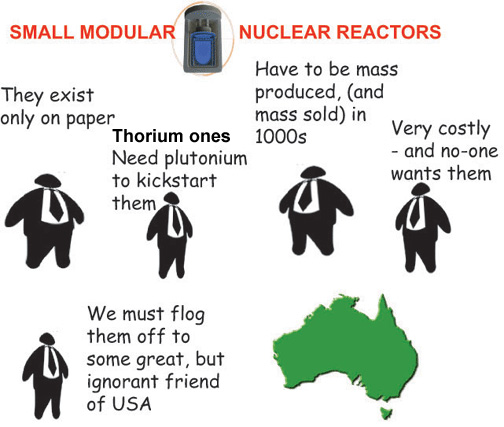
ByMike Foley, November 10, 2023 — https://www.smh.com.au/politics/federal/us-reactor-project-fail-heats-up-australia-s-nuclear-power-debate-20231109-p5eisu.html
A nuclear energy developer championed by the Coalition has canned its most advanced project in the United States, raising questions over the viability of the technology in Australia.
NuScale Power, which was developing small modular reactors at a US government-owned site in Idaho with plans to sell electricity to suppliers across the regional network by 2029, on Thursday said it had abandoned the project due to a lack of customer sign-ups.
The federal opposition, which wants Australia to overturn its longstanding ban on nuclear energy, claims small modular reactors – the next generation of nuclear power plants – are the only viable backup for renewable energy as the country transitions away from fossil fuels.
But Climate Change and Energy Minister Chris Bowen said NuScale’s announcement was further proof that small modular reactors were not viable for Australia.
“The opposition’s only energy policy is small modular reactors,” Bowen said. “Today, the most advanced prototype in the US has been cancelled. The [opposition’s] plan for energy security is just more hot air from Peter Dutton.”
NuScale’s small modular reactor design was the first to be approved by the US Nuclear Regulatory Commission in January. It was awarded more than $US1 billion ($1.56 billion) in government funding to support its development.
The company said in 2021 it would supply power from its small modular reactor plant for $US58 a megawatt hour. Since then, that figure has more than doubled to $US89 a megawatt hour.
Mason Baker, the chief executive of NuScale’s government-owned partner, Utah Associated Municipal Power Systems, said it was working with the company and the US Department of Energy to wind down the project.
“This decision is very disappointing given the years of pioneering hard work put into the [project],” Baker said.
Opposition Leader Peter Dutton has said small modular reactors could easily replace Australia’s coal-fired power plants.
“Australians must consider new nuclear technologies as part of the energy mix,” he said in July. “New nuclear technologies can be plugged into existing grids and work immediately.”
Opposition climate change and energy spokesman Ted O’Brien said in May that NuScale’s designs offered “exceptional flexibility” and would allow a “simple expansion” for Australia’s energy grid.
“North America has done the maths. It has mapped its course to a net-zero future, and it’s one that sensibly includes next-generation, zero-emissions nuclear energy.”
But recent Energy Department modelling found more than 70 small modular reactors, which are forecast to generate 300 megawatts each, would be needed to replace all of Australia’s coal plants at an estimated cost of $387 billion.
O’Brien said on Thursday that Bowen had applied “faulty logic” to NuScale’s announcement and if he applied the same test to renewables, they too would be considered a failure.
“Is Bowen arguing that wind power is dead because the world’s leading supplier, Siemens, is seeking a €15 billion government bailout, or the days of solar are over because plans for the world’s largest solar plant, Sun Cable, have run into trouble,” O’Brien said.
“If Australia is serious about reaching net-zero emissions by 2050 while keeping the lights on and getting prices down, we cannot afford to take any option off the table.”
‘Buying influence’: top US nuclear board advisers are tied to arms business

“What we’ve consistently seen is the nuclear weapons industry buying influence and that means we cannot make serious decisions about our security when the industry is buying influence through thinktanks and commissioners that are skewing the debate,” said Susi Snyder, program coordinator at the International Campaign to Abolish Nuclear Weapons.
“Instead of having a debate about the tools and materials we need to make ourselves safe,” she added, “we’re having a debate about which company should get the contracts. And that doesn’t make the American people safe or anyone else in the world.”
None of the potential conflicts of interest between commissioners’ financial interests and the policy proposals laid out in their final report were disclosed by the CCSPUS itself within its final report or at any public event highlighting its findings.
Nine of 12 members of the commission charged with avoiding nuclear conflict have financial ties to defense contractors
Eli Clifton and Ben Freeman, 10 Nov 23 https://www.theguardian.com/world/2023/nov/10/us-congress-nuclear-weapon-committee-conflict-interest
Nine of the 12 members of a high-level congressional commission charged with advising on the US’s nuclear weapons strategy have direct financial ties to contractors that would benefit from the report’s recommendations or are employed at thinktanks that receive considerable funding from weapons manufacturers, the Guardian and Responsible Statecraft can reveal.
While the Congressional Commission on the Strategic Posture of the United States (CCSPUS) purports to recommend steps to avoid nuclear conflict, it does nothing to disclose its own potential conflicts of interest with the weapons industry in its final report or at rollout events at thinktanks in Washington.
The United States will soon face “a world where two nations [China and Russia] possess nuclear arsenals on par with our own”, warned the commission’s final report, released in mid-October. “In addition,” the report charged, “the risk of conflict with these two nuclear peers is increasing. It is an existential challenge for which the United States is ill-prepared.”
According to the CCSPUS, this potential doomsday scenario requires the US to make “necessary adjustments to the posture of US nuclear capabilities – in size and/or composition”, a policy shift that would steer billions of taxpayer dollars to the Pentagon and nuclear weapons contractors.
“What we’ve consistently seen is the nuclear weapons industry buying influence and that means we cannot make serious decisions about our security when the industry is buying influence through thinktanks and commissioners that are skewing the debate,” said Susi Snyder, program coordinator at the International Campaign to Abolish Nuclear Weapons.
The CCSPUS was established two years ago via the annual defense policy bill, and conflicts of interest on the commission were apparent from the beginning. But an analysis by the Guardian and Responsible Statecraft found deep ties between the commission and the weapons industry.
The most recognizable member of the CCSPUS is its vice-chair, Jon Kyl, who served as a senator from Arizona from 1995 to 2013, and again in 2018 after the death of John McCain. While this is included in his biography in the commission’s report, what’s left out is his more recent employment as a senior adviser with the law firm Covington & Burling, whose lobbying client list includes multiple Pentagon contractors that would benefit from the commission’s recommendations.
In 2017 Kyl, personally, was registered to lobby for Northrop Grumman, which manufactures the B-21 nuclear bomber that the commission recommends the US should purchase in greater numbers, at a cost to taxpayers of nearly $700m each.
Kyl did not respond to questions about his employment status with Covington & Burling, but the former senator was listed as a “senior adviser” on the firm’s website until at least 1 December 2022, nearly 10 months after the commissioner selections for the CCSPUS were announced in March 2022.
Another commissioner, Franklin Miller, is a principal at the Scowcroft Group, a business advisory firm that describes Miller as having expertise in “nuclear deterrence”, and acknowledges its work in the weapons sector.
“The Scowcroft Group successfully advised a European defense leader on a strategic acquisition opportunity,” says the consulting firm in the “Defense/Aerospace” section of its website. “We have also assisted a major defense firm in pursuing global partnerships and co-production opportunities.”
Miller did not respond to a request for comment about the identity of the Scowcroft Group’s clients.
Kyl and Miller are joined on the CCSPUS by retired general John E Hyten, who previously served as the vice-chairman of the joint chiefs of staff, the second-highest-ranking member of the US military.
While Hyten’s biography in the commission’s report lauds his extensive military service, in retirement he has worked closely with a number of firms that could benefit immensely from the commission’s recommendations.
This March he was appointed as special adviser to the CEO of C3 AI, an artificial intelligence company that boasts of working with numerous agencies at the Department of Defense. In June 2022, Hyten was named executive director of the Blue Origins foundation, called the Club for the Future, and as a strategic adviser to Blue Origin’s senior leadership. Blue Origin is wholly owned by the Amazon founder Jeff Bezos, and works directly with the National Aeronautics and Space Administration (Nasa), the air force and the space force on space launch-related capabilities.
Hyten’s ties to these firms are notable given the CCSPUS report’s repeated overtures for improving and investing in space and artificial intelligence capabilities. Specifically, the report recommends the United States “urgently deploy a more resilient space architecture” and take steps to ensure it is “at the cutting edge of emerging technologies – such as big data analytics, quantum computing, and artificial intelligence (AI)”.
Hyten did not respond to a request for comment.
The CCSPUS also included thinktank scholars whose employers receive significant funding from the arms industry. Two commission members work at the Hudson Institute, which, according to its most recent annual report, received in excess of $500,000 from Pentagon contractors in 2022. This includes six-figure donations from some of the Pentagon’s top contractors, including Lockheed Martin, Northrop Grumman and BAE Systems.
On Monday, 23 October, the Hudson Institute held an event to highlight the CCSPUS’s report that included the two Hudson Institute employees who also served as commissioners. The event unabashedly promoted recommendations from the report that would be a financial windfall for Hudson’s funders. The landing page for the event features a photo of a B-21 stealth bomber, the same photo used in the commission report that also recommended that the US strategic nuclear posture be modified to “increase the planned number of B-21 bombers and tankers an expanded force would require”.
Neither at the event nor in the report is it noted that the plane’s manufacturer, Northrop Grumman, is in the Hudson Institute’s highest donor tier, contributing in excess of $100,000 in 2022.
The Hudson Institute staff who served as commissioners did not respond to requests for comment.
Another commissioner, Matthew Kroenig, is a vice-president at the Atlantic Council, a prominent DC thinktank which, according to the organization’s most recent annual report, is funded by several top Pentagon contractors, including Lockheed Martin, Northrop Grumman, Raytheon (now RTX), General Atomics, Saab and GM Defense. The Atlantic Council also receives more than $1m a year directly from the Department of Defense and between $250,000 and $499,999 from the Department of Energy, which helps manage the nation’s nuclear arsenal.
These seeming conflicts of interest were not mentioned at any point in the CCSPUS’s report or at an Atlantic Council event promoting the report and featuring the same photo of the B-21 used by the Hudson Institute and the commission.
Kroenig did not respond to a request for comment.
Even commissioners whose careers had included positions that were notably critical of nuclear weapons had recently established ties with firms that profit from the nuclear and conventional weapons industry.
Commissioner Lisa Gordon-Hagerty worked for years at the pinnacle of nuclear weapons policy in the US, including positions on the national security council, the US House of Representatives and the Department of Energy. She was also the director of the Federation of American Scientists, a non-profit organization known for advocating for reductions in nuclear weapons globally. Her last government position before joining the commission was serving as the head of the National Nuclear Security Administration (NNSA), which is responsible for military applications of nuclear science. She resigned from the post in 2020, allegedly after heated disagreements with the secretary of energy, who tried to cut NNSA funding.
While much of her career is mentioned in the commission report, what’s left out is that Gordon-Hagerty has also been cashing in on her nuclear expertise. After leaving the NNSA, in 2021 she joined the board and became director of strategic programs at Westinghouse Government Services, a nuclear weapons contractor that has been paid hundreds of millions of dollars for work with the Department of Defense and Department of Energy.
Gordon-Hagerty did not respond to a request for comment.
Like Gordon-Hagerty, fellow commissioner Leonor Tomero had a distinguished career at the highest levels of nuclear weapons policy. According to her bio in the commission report, she was the deputy assistant secretary of defense for nuclear and missile defense policy and served for over a decade on the House armed services committee as counsel and strategic forces subcommittee staff lead, where her portfolio included the establishment of the US space force, nuclear weapons, nuclear nonproliferation, nuclear cleanup, arms control and missile defense.
Outside government, Tomero was director of nuclear non-proliferation at the Center for Arms Control and Non-Proliferation, an organization that has repeatedly called for reductions in the US nuclear weapons arsenal. Tomero is also on the board of the Council for a Livable World, which explicitly states that its goal is to eliminate nuclear weapons.
Yet, in September, Tomero became a vice-president of government relations at JA Green & Company, a lobbying firm whose client list includes a host of military contractors that could see revenues soar if the CCSPUS’s recommendations are adopted. SpaceX, for example – which pays $50,000 every three months to JA Green for lobbying related to “issues related to national security space launch” – would probably benefit mightily from the commission recommendation that “the United States urgently deploy a more resilient space architecture and adopt a strategy that includes both offensive and defensive elements to ensure US access to and operations in space”.
“No clients of JA Green & Company sought to influence the work of the Commission or the Commission’s recommendations in any way,” said Jeffrey A Green, president of JA Green, in an email. “We follow all applicable ethics rules and there are no conflicts of interest.”
None of the potential conflicts of interest between commissioners’ financial interests and the policy proposals laid out in their final report were disclosed by the CCSPUS itself within its final report or at any public event highlighting its findings.
While many commissioners did not respond to requests for comment, the commission’s executive director, William A Chambers, provided a statement on behalf of the CCSPUS and its members.
“Members of [the commission] were chosen and appointed by Members of Congress based on their national recognition and significant depth of experience in such professions as governmental service, law enforcement, the Armed Forces, law, public administration, intelligence gathering, commerce, or foreign affairs,” wrote Chambers. “Before they began performing their role as Commissioners, they were instructed on the ethics rules that govern congressional entities and were required to comply with rules set forth by the Select Committee on Ethics of the Senate and the Committee on Ethics of the House of Representatives.”
Chambers did not respond to a request for a copy of the ethics rules.
But the opacity about potential conflicts of interest leaves some experts questioning the CCSPUS’s recommendations.
“There’s a huge argument raging over what is security, how much does it rely on transparency and, especially when it comes to nuclear weapons, there is a call for greater transparency,” said Snyder of the International Campaign to Abolish Nuclear Weapons. “That light they’re asking to shine on China, North Korea and Iran is a light they also need to shine on their own decision-making.”
Co-published with Responsible Statecraft
Investing in nuclear energy is bad for the climate, NGOs say

7 November 2023 https://eeb.org/investing-in-nuclear-energy-is-bad-for-the-climate-ngos-say/
Today, EU nuclear energy stakeholders are meeting at the European Nuclear Energy Forum. The nuclear industry and certain EU countries call for more support and subsidies for nuclear power, particularly for Small Modular Reactors (SMRs), in the name of reaching the EU’s climate goals.
Environmental NGOs join voices to contest this claim, arguing that investing in new nuclear power plants will delay decarbonisation and that SMRs fail to answer the industry’s problems. Governments should rather focus on cheap renewable energy, grids and storage.
At the European Nuclear Energy Forum, NGOs call on the EU and its member states to subsidise energy sources that can reliably and cheaply achieve our climate goals, not nuclear power. Rather, investing in new nuclear power plants may prove detrimental to EU climate goals:
Prolonged delays: The latest nuclear plants built in Europe have experienced delays of over a decade. We cannot risk such delays on our path to reduce fossil fuel emissions.
Cost overruns: Nuclear power plants have faced huge cost overruns. The nuclear industry seeks to pass these high costs on to taxpayers and households via state and EU subsidies. The French nuclear industry has been nationalised.
Geostrategic interests: Nuclear energy is being pushed by powerful lobbies and geostrategic interests. Several EU states’ nuclear energy relies on the state-owned Russian nuclear firm Rosatom, importing uranium from unstable countries outside the EU.
Decentralised transition: To quickly decarbonise, we must choose cheap technologies, easy to deploy at scale, like solar panels and windmills. Nuclear power contradicts the vision of a decentralised energy system with citizen engagement.
Environmental impact: According to the IPCC report published in March 2023, nuclear power is one of the two least effective mitigation options (like Carbon Capture and storage). It’s an inefficient option that poses serious contamination risks during use and for future generations due to everlasting toxic waste
Small Modular Reactors (SMRs) do not answer any of the industry’s fundamental problems:
- Unproven technology: Even the simplest designs used today in submarines will not be available at scale until late next decade, if at all.
- Waste and proliferation risks: SMR designs fail to address the persistent nuclear waste problem and pose new risks associated with the proliferation of nuclear materials.
Quotes
Luke Haywood, from the European Environmental Bureau, said:
“It is highly unlikely that small modular reactors will change anything about the poor economics of investments in nuclear energy. Our focus should be on what we know works to rapidly reduce emissions: energy savings and renewables. Every euro invested in nuclear could help replace fossil fuels faster and cheaper if directed to renewables, grids and energy storage. This would also reduce air pollution, radioactive waste, and energy bills while allowing for more citizen participation.”
Marion Rivet, from Réseau Sortir du nucléaire, said:
“New nuclear power plant projects in France are estimated to cost around 52 billion euros. All this money should be invested in immediate and effective solutions for a real energy transition. The reduction of the greenhouse gas our countries produce has to be effective in the next 10 years and has to come from a source fully sustainable (meaning that does not create long-term wastes, that does not rely on uranium.”
Antoine Bonduelle, from Virage Energie, said:
“Small reactors are not an option for the Climate Crisis. At best, they cost double or more per kWh than other nuclear options, and even much more than efficiency or renewables, as shown extensively in the models and in the consensus of the recent AR6 IPCC report. Small reactors would produce more waste than classical reactors, and use more materials and fuels. Accidents are still possible and proliferation risks are much higher. In France, several proposed projects are shady arrangements aimed at using more public money or justifying unproductive research teams. In the end, it is a costly impasse, a loss of time and public money.”
Antoine Gatet, from France Nature Environnement, said:
“For France Nature Environnement, energy choices must be discussed democratically taking on board citizens in general and organized civil society in particular. Discussions must be based on transparent economic, social and environmental data. Discussions must include the whole lifecycle from mining to waste management. To this day, the nuclear renaissance has fallen flat every time, and the 100% renewables options are winning. When will we move to environmental democracy?”
Signatories
European Environmental Bureau (EU), Foundation for Environment and Agriculture (Bulgaria), France Nature Environnement (France), Global Chance (France), Klimaticka Koalicia (Slovakia), Réseau Sortir du Nucléaire (France), Virage Énergie (France), NOAH Friends of the Earth Denmark, Védegylet/Protect the Future (Hungary), Estonian Green Movement – Friends of the Earth Estonia, MKG – Swedish NGO Office for Nuclear Waste Review (Sweden), Milkas – The Swedish Environment Movement`s Nuclear Waste Secretariat (Sweden).
Contact persons in Bratislava:
- Luke Haywood, European Environmental Bureau, Luke.Haywood@eeb.org
- Albena Simeonova, Foundation for Environment and Agriculture (Bulgaria), ealbenas@gmail.com, agroecobg@gmail.com
- Antoine Bonduelle, Virage Énergie (France), contact@ee-consultant.fr
- Jan Haverkamp, WISE (Netherlands), jan@wisenederland.org
- Lucia Szabová, Klimaticka Koalicia (Slovakia), luia.szabova@gmail.com #nuclear #antinuclear #nuclearfree #NoNukes
Failed U.S. Nuclear Project Raises Cost Concerns for Canadian Small Modular Reactor (SMR) Development
“Once you’re on a dead horse, you dismount quickly. That’s where we are here.”
“the massively expensive SMR projects in Canada will eventually face the same reckoning”
Primary Author: Mitchell Beer, The Energy Mix, November 10, 2023 more https://www.theenergymix.com/2023/11/10/failed-u-s-nuclear-project-raises-cost-concerns-for-canadian-smr-development/
NuScale and its customer, Utah Associated Municipal Power Systems (UAMPS), announced they were cancelling the project earlier this week, after its anticipated cost increased 53% over earlier estimates, Bloomberg reports. “The decision to terminate the project underscores the hurdles the industry faces to place the first so-called small modular reactor into commercial service in the country.”
But a clear-eyed assessment of the project’s potential was really made possible by a level of accountability that doesn’t exist in Canada, said Gordon Edwards, president of the Canadian Coalition for Nuclear Responsibility.
“Private investors in Utah forced NuScale to divulge financial information regarding the cost of electricity from its proposed nuclear plant,” and “cost became the deal-breaker,” Edwards told The Energy Mix in an email. “Publicly-owned utilities in Canada are not similarly accountable. The public has little opportunity to ‘hold their feet to the fire’ and determine just how much electricity is going to cost, coming from these first-of-a-kind new nuclear reactors.”
In the U.S., the business case started to fall apart last November, when NuScale blamed higher steel costs and rising interest rates for driving the cost of the project up from US$58 to $90 or $100 per megawatt-hour of electricity. The new cost projection factored in billions of dollars in tax credits the project would receive under the Biden administration’s Inflation Reduction Act, amounting to a 30% saving.
At the time, the Institute for Energy Economics and Financial Analysis (IEEFA) estimated the total subsidy at $1.4 billion. This week, Bloomberg said NuScale had received $232 million of that total so far.
The cost increase meant that UAMPS “will not hit certain engineering, procurement, and construction benchmarks, allowing participants to renegotiate the price they pay or abandon the project,” Utility Dive wrote.
Scott Hughes, power manager for Hurricane City Power, one of the 27 municipal utilities that had signed on to buy power from the six NuScale reactors, said the news was “like a punch in the gut when they told us.” Another municipal utility official called the increase a “big red flag in our face.”
Nearly a year later, NuScale had to acknowledge that UAMPS would not be able to sell 80% of the output from the 462-MW project to its own members or other municipal utilities in the western U.S., Bloomberg writes. “The customer made it clear we needed to reach 80%, and that was just not achievable,” NuScale CEO John Hopkins said on a conference call Wednesday. “Once you’re on a dead horse, you dismount quickly. That’s where we are here.”
In Canada, “the massively expensive SMR projects in Canada will eventually face the same reckoning” predicted Susan O’Donnell, an adjunct research professor at St. Thomas University and member of the Coalition for Responsible Energy Development in New Brunswick. While the Canadian Energy Regulator’s modelling assumes SMRs could be built at a cost of C$9,262 per kilowatt in 2020, falling to $8,348 per kilowatt by 2030 and $6,519 by 2050, the latest cost estimate from NuScale exceeded $26,000 per kilowatt in Canadian dollars, O’Donnell said—and the technology had been in development since 2007.
“Too bad our leaders have chosen to pursue an energy strategy which is too expensive, too slow, and too costly in comparison with the alternatives of energy efficiency and renewables—the fastest, cheapest, and least speculative strategies,” Edwards wrote. He added that waste disposal and management challenges and costs for SMRs will be very different from what Canadian regulators have had to confront with conventional Candu nuclear reactors.
The news from NuScale landed just days after civil society groups in the European Union warned that SMR development won’t help the continent reach its climate goals. Citing prolonged project delays and cost overruns, the long time frame to develop unproven technologies, and the risks associated with radioactive waste disposal and proliferation of nuclear materials, they urged EU governments to focus on renewable energy, power grid development, and energy storage.
“Nuclear energy is being pushed by powerful lobbies and geostrategic interests,” with several EU states relying on Russian state nuclear company Rosatom for their uranium supplies, the groups said. “To quickly decarbonize, we must choose cheap technologies, easy to deploy at scale, like solar panels and windmills.”
But in the U.S., proponents are still holding out hope for future SMR development. “We absolutely need advanced nuclear energy technology to meet ambitious clean energy goals,” the U.S. Department of Energy said in a statement. “First-of-a-kind deployments, such as CFPP, can be difficult.”
1 This month


Help Aunty Sue Protect Her Land and Sacred Sites From Destructive Rocket Testing.
.

Australians deserve the truth
about
AUKUS – https://aukuspublicinquiry.com/

PETITION – To: Prime Minister Anthony Albanese and the Australian Labor Government

of the week – Australians for War Powers Reform (AWPR)
To see nuclear-related stories in greater depth and intensity

