Nuclear subs challenge trains 10 year old children for war

By Sue WarehamSep 11, 2023 https://johnmenadue.com/nuclear-subs-challenge-trains-10-year-old-children-for-war/
It’s time for education ministers across the country to show leadership and protect our children from vested interests and pro-war propaganda.
On 19 June, the Defence Department launched its Nuclear-Powered Submarine Propulsion Challenge, for years 7 – 12 students across the nation. The program seeks to engage the enthusiasm of young people for the complex and hugely controversial nuclear submarine program, in the hope that some of the students will want to contribute to this form of war-fighting when they leave school.
The nuclear submarine proposal has implications that go far beyond the understanding of the students targeted for this program (which include those as young as 11 years). They include the nuclear weapons proliferation potential, the consequences of a war – possibly nuclear war – with China, for which the submarines are planned, the problem of high-level, long-lived nuclear waste for which there is no solution anywhere, and the matter of what else will suffer financially as we attempt the gargantuan task of paying for this program. In the absence of any awareness or understanding of this context, the schools program is little more than propaganda.
The program fits with the growing prevalence of private weapons company-sponsored STEM (science, technology, engineering and maths) programs in schools. Their purpose is to create positive brand name associations, such as happy memories, from which can flow varying degrees of attachment to the corporate brand. Company logos are displayed on all materials, and there is often direct contact between students, teachers and company representatives. An underfunded public education system is perfect for the companies’ purposes, because overstretched teachers will welcome material that might make their job a little easier.
There is ample evidence that children are very susceptible to the creation of positive associations with an advertised product. Even into adolescence, children don’t necessarily have the skills to critically assess the intentions behind persuasive marketing tactics, or understand what a brand or product really represents.
The militarisation of STEM education is not confined to our schools (and universities, which comprise a huge network in themselves of weapons company partnerships). The National Youth Science Forum has as its primary sponsor Lockheed Martin, the world’s biggest weapons maker. The Questacon National Science and Technology Centre in Canberra receives major funding for its Engineering is Elementary program from the Defence Department, with ADF engineers being actively involved in delivering the program.
The industry’s need is for a workforce socialised to accept warfare as inevitable and the industry itself as always a force for good. The “Minors and Missiles” report of the Medical Association for Prevention of War outlines the problem, its extent in Australia and how it can be addressed. The new organisation Teachers for Peace works to this end also.
In relation to the nuclear submarine challenge for schools, on 1 July the Adelaide Advertiser published an article “Kids, 10, training for to build a workforce for AUKUS, SA’s $368bn nuclear submarine project”, about the Beacon program in some schools, run in conjunction with weapons giant BAE Systems. Among other activities, it allows students to virtually load and fire weaponry, one student stating “It’s a lot more fun, it’s like playing a video game but it’s a lot more educational”. Such presentation of warfare and its associated hardware to children as a game – which extends also to our war commemoration – is an abuse of their right to aspire to live in a peaceful society.
An additional concern with the Nuclear-Powered Submarine Propulsion Challenge is that it anti-democratically circumvents strong community opposition to a technology – nuclear power – which has been consistently rejected by the Australian people. Barely a person in the country, including in our parliament, was even asked about the nuclear submarines, and yet the opposition to the proposal is strong, with much highly critical commentary. To ignore all that and go straight to the next generation with exciting prizes is reprehensible.
On 31 August, the Federal Executive of the Australian Education Union (AEU) passed a strong resolution reaffirming the AEU’s deep commitment to peace and its opposition to militarism. In relation to the nuclear submarine challenge, the resolution stated that the AEU “condemns this program, and the use of Australian schools by the Defence Department, in drawing secondary students into the government’s development of new industries focused on armament manufacture and industries associated with warfare.”
It continued “A politicised pro-AUKUS curriculum has no place in our schools, alongside other private industries who attempt to use schools as a vehicle for promotion of their own products and profits hidden behind spurious educational benefits for students.”
The AEU is to be applauded. It’s time for education ministers across the country to show the same leadership in protecting our children from vested interests and pro-war propaganda.
Nuclear energy remains weapon of choice for climate deniers and coal lobby.
ReNeweconomy, Giles Parkinson 11 September 2023
The Nationals, and the Liberal Party coalition partners, are in furious
agreement: They are not the slightest bit serious about strong climate
action, and the only difference between former National leader Barnaby
Joyce and current leader David Littleproud is that Joyce wants to stop the
pretence.
Littleproud, let’s remember, believes that net zero 2050 means
not having to do much any time soon. Like too many corporates, and the
fossil fuel industry in particular, it’s an excuse to sit around and do
nothing – make some grand promises and wait for some new technology to come
along that doesn’t disrupt their business plan. Nuclear, and small modular
reactors, are a perfect tool for this. SMRs don’t exist in any western
country, do not have a licence to exist, and no-one – even in the nuclear
industry – seriously believes they will be in commercial production within
a decade, if then.
Renew Economy 11th Sept 2023
Waste site: Govt reveals bill for dumped Kimba nuclear facility

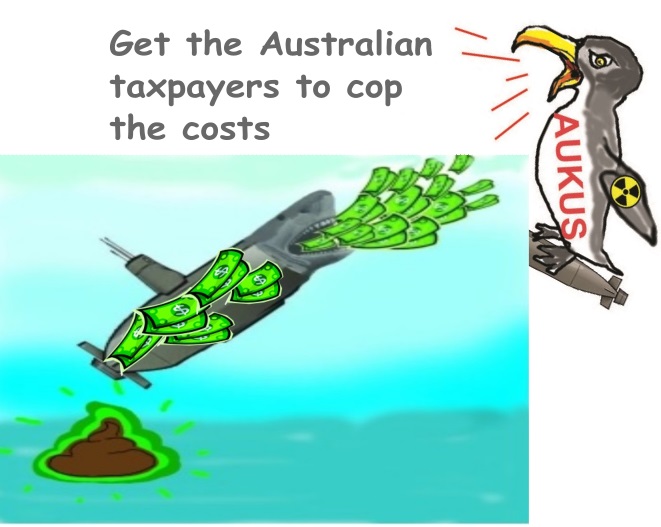
Former SA senator Rex Patrick was concerned the money “wasted” on the failed repository could be replicated with the AUKUS nuclear submarine program.
The high cost of the federal government’s failed bid for a national nuclear waste storage site on South Australia’s Eyre Peninsula has been revealed.
Resources Minister Madeleine King says that $108.6 million was spent on preparations for establishing the now dumped National Radioactive Waste Management Facility near Kimba between July 1, 2014, and August 11, 2023.
The figure was given in response to a Senate Question lodged by Liberal Senator Gerard Rennick on August 11, but information relating to his questions about further expected expenditure of taxpayer dollars around the project was not provided.
King was asked whether the government planned to select a new site before May 17, 2025 – the last date before Prime Minister Anthony Albanese can call a federal election – or whether the Woomera Prohibited Area in SA’s outback was being considered.
“Information on expenditure and site selection will be available once the government has considered options and made decisions in due course,” SA Labor Senator Don Farrell said while answering the question on behalf of King.
The news comes after the federal government announced in August it was walking away from the Napandee plan after seven years of consultation and promises of around $31 million in incentives for the Kimba region.
Its decision was triggered by a Federal Court ruling in favour of the Barngarla Determination Aboriginal Corporation’s battle to stop the low-level waste repository on the Eyre Peninsula.
The costly court battle centred on the Barngarla arguing that Indigenous owners were not consulted by the former Morrison Government when it announced it had won “majority support” of 61 per cent in the community for the Napandee site.
Justice Natalie Charlesworth quashed former Liberal Federal Resources Minister Keith Pitt’s decision to build the National Radioactive Waste Management Facility in Kimba, saying it was affected “by bias”.
InDaily reported last year that in reply to questions on notice, SA senator Barbara Pocock heard that since January 1, 2017, the Commonwealth Government had spent at least $9,905,737 on legal work for the nuclear waste dump and the Australian Radioactive Waste Agency.
Work has now been halted at the Napandee site and King said work already completed would be reversed.
Former SA senator Rex Patrick was concerned the money “wasted” on the failed repository could be replicated with the AUKUS nuclear submarine program.
“It was clear back in February 2018, when I initiated a Senate Inquiry into the selection process for a national radioactive waste management facility in South Australia, that the selection process had gone off the rails,” Patrick said.
“The then government were cautioned about the flawed nature of the process, but ignored the findings and recommendations of the inquiry.
“There is a $110 million dollar lesson for the current Government in the need to engage the community and listen when dealing with these sorts of programs.”
He called on the federal government to be more open with the community with its AUKUS nuclear submarine program in relation to what will happen in relation to nuclear stewardship, operational radioactive waste and dealing with spent nuclear fuel rods.
Federal government spent $100 million on now abandoned nuclear waste dump near Kimba

ABC News, By Ethan Rix, 12Sept 23,
Key points:
- The Federal Resources Minister said the government had spent $108.6 million
- The Commonwealth abandoned plans to build the facility after a Federal Court ruling
- Former SA senator Rex Patrick said the “waste” of taxpayer money could have been avoided
………………………. Senator Rennick also questioned whether the government would find a new location for the NRWMF before May 17, 2025 and if the government would consider placing the facility within the Woomera Prohibited Area.
Ms King said that information about a future site and any further spending would be available once the government had “considered options and made decisions in due course”……………………………………………………………
Former resources minister had ‘foreclosed mind’
Federal Court Justice Natalie Charlesworth found there had been apprehended bias in the decision-making process under then-resources minister Keith Pitt.
Justice Charlesworth found that Mr Pitt — who formally declared the site in 2021 — could be seen to have had a “foreclosed mind” on the issue “simply because his statements strongly conveyed the impression that his mind was made up”.
The court set aside the declaration from 2021 that the site at Napandee, a 211-hectare property, be used for the facility.
Following the Federal Court ruling, Ms King told federal parliament in August that Australia still needed a nuclear storage facility and that the government remained committed to finding a solution that did not involve the Napandee site.
………………………………Mr Patrick said he was concerned that the current Labor government had not learnt any lessons from the recent Federal Court ruling.
“The lesson that needs to be learned, in relation to this, is you need to properly engage [with] a community to get a social licence,” he said.
He said it was clear the government “has their eye on” the Woomera Prohibited Area as a potential location for the facility, which is a military testing range more than 400 kilometres north of Adelaide.
“They are simply not being transparent — they’re not talking about it and that’s going to end up in tears in several years’ time.”
A spokesperson for Ms King said she has instructed her department to develop “policy options” for managing Commonwealth radioactive waste into the future. https://www.abc.net.au/news/2023-09-11/commonwealth-kimba-napandee-nuclear-waste-dump-100-million/102840994
Sovereignty mocked in the ‘proxy war’ in Ukraine
By William Briggs | 11 September 2023 https://independentaustralia.net/politics/politics-display/sovereignty-mocked-in-the-proxy-war-in-ukraine,17887
The cliché that truth is the first casualty of war may be a tired one but it is still true.
But in the war in Ukraine, if truth loses out, then hypocrisy is surely the biggest winner. The war shows this to be the case. Sides get taken in war. The protagonist states win allies to their banner. Third-party countries quickly “prove” to their people that right rests with one side or another. The media quickly step in to do their bit and heaven help any dissenting voice. Such has been the trajectory of the protracted war in Ukraine.
Our own government, in close alignment with the USA, NATO and the majority of the West, quickly made the determination that it was a relatively black-and-white affair. There is a “goody” and a “baddy” and that is as much as the people need to know. The media speak with one voice. There is more than a hint of Animal Farm in this. ‘Four legs good, too legs bad.’ Russia, we must believe, invaded Ukraine to grab territory, to grow an empire, and to return to a faded imperial past.
The courageous Ukrainian people, we must believe, are yearning for freedom, for justice and so they fight back to preserve democracy. It is a nice story, but as more and more authoritative but “dissident” voices have shown, there is a whole lot more to it than cheap slogans.
Three names among these “dissidents” stand out in the current propagandised media world. Seymour Hersch, Jeffrey Sachs and John Pilger. It is a terrible indictment on how distorted reality has become that these most eminent writers and multiple award-winning truth-tellers have been shunted to the sidelines, made virtual pariahs, and ridiculed in some rather important circles.
Who controls the past controls the future: who controls the present controls the past.’ Orwell was warning against the rise of authoritarianism and of the manipulation of thought. Both seem to have arrived.
Those giant figures have repeatedly stated a simple fact and a fact made more obvious with every passing blood-stained week of this unnecessary war. The fact, which cannot be denied is that the war is a proxy war between the USA, NATO and its allies including Australia on one side, and Russia on the other.
The forces that are waging this war may not have committed battle troops to Ukraine, but they train their forces, both in Ukraine and abroad, have special forces units inside Ukraine, and have spent well over $100 billion on providing materiel to ensure that the war, is, if not won, then will result in the economic and social destruction of Russia. Ukraine, in such a scenario, is simply collateral damage.
The hypocrisy, the propagandising, the manner that collective thought is created and dissent is silenced is complete. This Orwellian view of the world would be questioned by Orwell as being too improbable. No country, regardless of its own worldview is permitted to interact with the “enemy”. There has been much said about whether the government of the Democratic Republic of Korea (DPRK) will or will not enter into an arms deal with Russia.
The DPRK has been effectively the subject of sanctions since 1950. It believes that its existence is only guaranteed by perpetually building a deterrence to attack. It sees almost endless war games and drills close to its borders. It believes its sovereignty; its very existence is threatened. It sees no problem with dealing with an enemy of the United States.
White House security adviser Jake Sullivan in a press briefing promised that if Pyongyang provides weapons to Moscow, it is ‘not going to reflect well on North Korea and they will pay a price for this in the international community’.
The two recalcitrant states in this case are both sovereign nations, are both represented at the United Nations and if such a deal eventuates will be doing no more than what 49 nations are doing in pouring weapons, munitions and expertise into Ukraine to assist in the proxy war.
If the media were not quite so blinkered and committed to their role as propagandists for the war, then such a hypocritical position would be clear. Australian Foreign Minister Penny Wong recently stated that “Russia cannot be allowed to infringe upon another country’s sovereignty”. She is quite right. But in the spirit of hypocrisy and hyperbole, the U.S. pledge to impose all manner of penalties on the DPRK for exercising its own sovereign rights is to admit that the world has run mad.
Australian drones have been used in attacks on Russia. Apparently, this is not an “infringement” of sovereignty.
The war is a fact of life. It is a lamentable fact of life. It would be preferable for the war not to have begun. Reason, logic and humanity would demand that the war end. Every call to sense and humanity has been rejected. The most obvious and possible call came from China and its 12-point peace plan. The USA and its allies would not consider it.
Russia, rightly or not, believes that it is facing an existential crisis. The giants of investigative journalism, who have been all but cancelled, silenced from mainstream media and deemed to be irrelevant agree with the basis of Russia’s claims and are wary of the way this proxy war is being prosecuted. The Ukrainian people have been “sold a pup”. They are being used and manipulated by the West, NATO, and primarily by the USA.
Truth died on day one of this awful war. In its place, hypocrisy has unfurled its banner over the battlefield.
A new French fairy tale: “Cheap” nuclear electricity in France is not what it appears.

The French public are paying for their nuclear addiction — and will pay even more when the plants need decommissioning.
By Axel Mayer, 11 Sept 23, https://beyondnuclearinternational.org/2023/09/11/a-new-french-fairy-tale/—
“Bread and games”(Panem et circenses) were the enforcement strategies in the Roman Empire to maintain power. “Cheap petrol, cheap electricity and football” are popular campaign strategies under a democracy, says Axel Mayer, Vice-President of the Trinational Nuclear Protection Association (TRAS).
In France, the nuclear industry is in decline and the nuclear company EDF is heavily in debt. At the same time, President Macron is once again promising cheap nuclear power and wants to have new small nuclear power plants built. A small part of the French nuclear industry’s financial problems is to be solved with EU money.
In this context, the fairy tale of cheap French nuclear power is happily spread in France and also in Germany and the use of nuclear energy is praised as the miracle weapon in the losing war against nature and the environment. However, the price of electricity in France is only apparently cheap.
According to a report of the supreme audit court in France, the research and development, as well as the construction of the French nuclear power plants, cost a total of 188 billion euros. Since in France the “civilian” and the military use of nuclear power cannot be separated, the sum is probably much higher. Retrofitting France’s outdated reactors will cost over 55 billion euros. Liberation magazine reports retrofitting costs of nearly 100 billion euros by 2030.
People of France are paying for expensive nuclear power with their taxes
According to a report by the French Ministry of Economy, the semi-state-owned EDF had debts of about 41 billion euros at the end of 2019, an amount that is expected to be nearly 57 billion euros by 2028. To avoid domestic political problems, EDF is not allowed to raise the price of electricity for political reasons. EDF liabilities are driving up France’s national debt massively. The people of France (and especially their grandchildren) are paying for the seemingly cheap, but in reality expensive nuclear power with their taxes.
This cost does not include the dismantling of the nuclear power plants or any costs of a severe accident. A serious nuclear accident would have devastating consequences in France. A government study estimates the cost at 430 billion euros.
Demolition costs of over 100 billion euros
In France, EDF operates 56 outdated reactors that are now becoming old and decrepit almost simultaneously, but the company has built up almost no reserves for decommissioning. In Germany, the government is very optimistic about a 47 billion euros cost for decommissioning and final storage. The decommissioning of the large number of French nuclear power plants could cost well over 100 billion euros as costs rise, if no savings are made on safety. There is a distinct possibility that the nuclear industry could bankrupt the French state even without a nuclear accident that could happen at any time.
A “European Pressurized Water Reactor” (EPR) has been under construction on France’s Atlantic coast in Flamanville since 2007. The flagship project was originally scheduled for completion in 2012 at a fixed price of 3.2 billion euros. Since then, the start of operation has been postponed again and again, and the Court of Auditors now puts the cost at over 19 billion euros. Whether the EPR can go online in 2024 is questionable. The model reactor will never work economically.
In countries with a functioning market, no new nuclear power plants are building
Swiss nuclear lobbyist and Axpo CEO Christoph Brand puts the kibosh on dreams of cheap nuclear power from new, small nuclear plants. “The production costs for the electricity supplied by new nuclear power plants are currently about twice as high as those of larger wind and solar plants,” Brand said. “No matter how one assesses the risks of nuclear power, it is simply not economical to rely on new nuclear plants,” he said in the pro-nuclear NZZ on Oct. 21, 2021.
In countries with a functioning market, no new nuclear power plants are being built. When in doubt, it always helps to look at EDF’s share price, which has fallen massively over the long term, to assess the market chances of the nuclear renaissance announced by President Macron.
“Bread and games” with artificially low nuclear electricity prices can work in election campaigns. Low-cost, risk-free electricity is generated today with photovoltaics and wind energy. (AM/hcn)
The week in nuclear news

Park in Beijing April 2023
Some bits of good news. Chinese people are living two years longer thanks to ‘war on pollution,’ report says. From Blacktop to Green: Cities Are Depaving for a Cooler Future.
TOP STORIES.
- What’s Behind Talk of a Possible Plea Deal for Assange?
- Crew sailing ‘original peace boat’ reflect on mission to promote end of nuclear weapons.
- Revisiting John Pilger’s 2016 Warnings About US Warmongering Against Russia And China.
- Ukraine’s defeat could mean the end of NATO in its current form.
- Biden’s horse-trading on nuclear technology and fuels is an unprecedented proliferation risk.
- Taiwan’s ‘clear and present’ spent nuclear fuel danger.
Climate. World meteorologists point to ‘vicious cycle’ of heatwaves and air pollution.
Christina notes. Social media is becoming more influential, while corporate media is more than ever in the grip of powerful government and business interests. Trying to make the best use of Substack. Continuing through the maze of social media. About how to use Substack – (I recommend reading their instructions). The labyrinth of social media – The promise and the pitfalls.
AUSTRALIA. Educating the US Imperium: Australia’s Mission for Assange. Lifetime War Abolisher of 2023 award to David Bradbury. Nuclear shift and net zero feud stir Nationals’ leadership tensions. Australia’s Navy Pursues Nuclear Submarines and AI-Powered Ghost Sharks.
ARTS and CULTURE. Exhibition for nuclear-free world opens online.
CLIMATE. The Bugey and Saint-Alban sites could reduce their production due to the heat. The Pentagon is the Elephant In the Climate Activist Room.
ECONOMICS. Today Hinkley C contract would cost £180 per MWh around 3xs the cost of offshore wind. “A Good Investment”: The Ukraine War and the US Arms Racket
EMPLOYMENT. Unite urges employer to pay a fair wage and avoid nuclear plant shutdown. Health and safety concerns raised with Dounreay management.
ENERGY. How a nuclear disaster spurred Fukushima to become a renewables leader. Could new nuclear kill one of the world’s most promising offshore windmarkets?
ENVIRONMENT. Disproportionately High Contributions of 60 Year Old Weapons-137Cs Explain the Persistence of Radioactive Contamination in Bavarian Wild Boars.
ETHICS and RELIGION. Senators brag that only Ukrainians die in US proxy war against Russia. Act, or die: the climate and nuclear juggernaut. The Four Billionaires Who Want to Control the Universe. If Everyone Understood That The US Deliberately Provoked This War. Japan’s Insane Immoral, Illegal Radioactive Dumping.
HEALTH. Radiation. Important new British Medical Journal article increases our perception of radiation risks.
INDIGENOUS ISSUES. Nuclear Waste Dump Threatens Kichi Sìbì (Ottawa River). The deep roots of the Yucca Mountain nuclear waste fight — and why it continues to this day.
LEGAL. RADIOACTIVE TSUNAMIS: NUCLEAR TORPEDO DRONES AND THEIR LEGALITY IN WAR. Japan’s nuclear-contaminated water discharge should consider hazard accountability and compensation mechanisms. Vinci and Bouygues among six firms fined €31m for bid rigging in nuclear work. Residents file suit to halt wastewater release from Fukushima plant.
MEDIA. US Intelligence Official: Media Misleading Americans About Ukraine’s Battlefield Success.
PERSONAL STORIES. Ukrainian POWs Say Families of Dead Denied Compensation. https://www.youtube.com/watch?v=Tn_671tZmLQ
POLITICS. Illinois legislators have a lot to learn about nuclear power. Nuclear energy touted at West Virginia Chamber forum, but key cost, oversight and waste management questions linger. Oregon hasn’t said never to nuclear power, but it should.
Guam nuclear energy ban focus of hearing. Japan announces emergency relief for seafood exporters hit by China’s ban over Fukushima water. Public opinion. USA & NATO responsible for Ukraine war, German & French public say in poll. Ukrainian Dissident Resists NATO’s Proxy War.
POLITICS INTERNATIONAL and DIPLOMACY.
- Ukraine war: Kyiv denounces G20 declaration.
- Poland begins to extradite to Ukraine men who left it after February 24, 2022.
- Germany, Italy highlight growing European nuclear divide. Eastern European NATO Countries Fear Peace Talks Between Ukraine and Russia. Fyodor Lukyanov: Why the ‘world majority’ sees the Ukraine conflict as an example of declining European and North American power.
- Why Swiss Neutrality is essential for American national security.
- The West’s blueprint for goading China was laid out in Ukraine.
PROTESTS. South Korea: Mass protests continue against Fukushima nuclear waste dumping.
SAFETY. IAEA warns of nuclear safety threat as combat spikes near Ukraine power plant. Ukraine war realises predictions of nuclear power plant threat, says Leicester civil safety expert. Nuclear reactors: Malaysia lacks maintenance culture. Generators of Kudangulam nuclear power plant stuck in sea.
SECRETS and LIES. Russian hackers suspected to have leaked sensitive UK military and defence material on the dark web including information about nuclear submarine base and chemical weapons lab. Ukraine wasted $17 million on faulty drones – media.
URANIUM. Does Europe need Niger’s uranium?
WASTES. UK and Japan’s governments funding research on problem of nuclear waste. Plutonium. UK / ‘No Easy Options’ For Disposal Of Plutonium Stockpile, Says Report
WAR and CONFLICT. America is not worried about the huge losses of the Armed Forces of Ukraine . Nation-States as “Business Models”: Ukraine as Another Neoliberal Privatization Exercise. Scott Ritter: A comprehensive Ukrainian defeat is the only possible outcome of its conflict with Russia. NATO isn’t able to help Ukraine win. Ukraine – health care women compulsory military service. Counter-offensive threatened by slow Western aid – Zelenskyy.
NATO Chief Openly Admits Russia Invaded Ukraine Because Of NATO Expansion. Slow mindless grind towards nuclear Armageddon?
WEAPONS and WEAPONS SALES.
- Saudi Arabia could build a nuclear bomb, experts say – and the US might help it.
- US to Arm Ukraine With Toxic Depleted Uranium Ammunition. Depleted Uranium Won’t Bring Peace to Ukraine. Russia says US supplying depleted-uranium shells to Ukraine could lead to war between nuclear powers. Ukraine used cluster munitions against civilians – Human Rights Watch.
- 22 Years of Drone Warfare and No End in Sight.
- Ukraine’s ‘Biggest Arms Supplier’ Orchestrated 2014 Maidan Massacre, Witnesses Say. Is Ukraine’s new long-range missile technology bringing us closer to WW3?
- Russia warns return of US nuclear weapons to UK would be seen as escalation.
- Senators raise concerns over US missing nuclear submarine target.
- US Air Force tests nuclear-capable long-range missile.
Australia’s Navy Pursues Nuclear Submarines and AI-Powered Ghost Sharks

the potential for AI-driven robots to make lethal decisions independently,
https://www.gktoday.in/australias-navy-pursues-nuclear-submarines-and-ai-powered-ghost-sharks 10 Sept 23
Australia’s Navy is adopting two contrasting approaches to advanced submarine technology to address the challenges posed by a rising China. On one hand, Australia is investing in a costly and slow project to acquire up to 13 nuclear-powered attack submarines. On the other hand, Australia is rapidly developing AI-powered unmanned submarines called “Ghost Sharks,” AI-powered subs will be delivered in the near future, offering a cost-effective and swift solution to enhance naval capabilities. The divergent approaches highlight the transformative impact of automation and AI on modern warfare.
How do the cost and delivery timelines of the nuclear submarines and Ghost Sharks differ?
The nuclear submarines are estimated to cost over AUD$28 billion each and will not be delivered until well past the middle of the century. In contrast, Ghost Sharks have a per-unit cost of just over AUD$23 million and will be delivered by mid-2025.
Significance of the Ghost Shark project
The Ghost Shark project illustrates the transformative impact of automation and AI on modern warfare, offering a cost-effective and swift solution to enhance naval capabilities. Such AI-powered unmanned submarines can operate autonomously, descend to greater depths, and be deployed in large numbers without risking human lives. They offer increased flexibility, cost-effectiveness, and the ability to perform maneuvers that might be impossible for crewed submarines.

Link to Geopolitical Challenges?
Australia’s investments in advanced submarine technology are linked to the geopolitical challenges posed by a rising China in the Asia-Pacific region. These developments are part of efforts to maintain military capabilities and respond to regional security concerns.
nfluence of AI
AI technology is influencing the development of various military capabilities, including autonomous weapons, fighter drones, swarming aerial drones, and ground combat vehicles. AI is also playing a role in data analysis and decision support for military commanders.
The AI technology arms race has high stakes in terms of military dominance and geopolitical influence. Winning the race could reshape the global political and economic order, with potential consequences for peace and stability in the Asia-Pacific region.
Challenges of AI
Challenges and concerns include the potential for AI-driven robots to make lethal decisions independently, the need for regulation related to the military application of AI, and the ethical considerations of using AI in warfare, including the targeting of combatants and non-combatants.
Private Sector’s Role

Private companies like Anduril are actively involved in developing AI-powered military technologies. They are contributing to the development of autonomous systems, sensor fusion, computer vision, edge computing, and AI, with applications in various defense domains, including submarines, drones, and counter-drone systems.
Ukraine’s defeat could mean the end of NATO in its current form
The ‘shift focus to another enemy’ narrative is the simplest and most obvious – that will be China. NATO is already trying to expand its influence in Asia, including via a planned ‘liaison office’ in Japan. The ‘China is the real threat’ narrative is bubbling steadily to the surface in Western media.
The bloc has too much riding on Kiev’s highly-unlikely success, and that’s why it’s doing all it can to prolong the conflict
By Chay Bowes, journalist and geopolitical analyst, MA in Strategic Studies, RT correspondent
As the West’s proxy war in Ukraine slips inexorably towards utter failure, the neocons behind the debacle are faced with dwindling avenues of retreat.
Early confidence that Russia, in its current form, would collapse under the pressure of the harshest sanctions regime in history failed to materialize. Early Russian miscalculations on the battlefield were not followed by a military meltdown, but by a pragmatic display of strategic adaptability, which is begrudgingly admired in the military war rooms of the West. The Russian army, far from falling apart, has steeled itself into making bold decisions to retreat when prudent and advance when required, both of which have proven devastating for their Ukrainian opponents. It follows that, as the Western political elites that cultivated this conflict peer into another winter of political, military, and potentially economic discontent, it is now that we potentially face the most dangerous period in Europe since the outbreak of WWII.
The catalyst for a wider war in Europe isn’t, in fact, a limited conflict in Ukraine in itself, one that started in 2014 and, notably, had been largely ignored by Western powers for almost a decade. The real issue is that NATO, which is currently engaged in a proxy War with Russia, is facing a ‘damned if you do and damned if you don’t’ scenario regarding its growing military involvement in Ukraine. If the US-led bloc escalates further as defeat looms, it could likely lead to direct confrontation with Russia. If it doesn’t, its proxy will collapse and leave Russia victorious, a fate once utterly unthinkable in Brussels, Washington, and London, but now becoming a nightmarish reality.
Such a defeat would be devastating and potentially terminal for the prestige and reputation of the whole NATO brand. After all, despite the Soviet Union having long ceased to exist, the bloc still markets itself as an indispensable bulwark against imagined Russian expansionism. In the event of an increasingly likely Ukrainian defeat, that ‘essential partner’ in ‘countering Russia’ will have been proven utterly impotent and largely irrelevant. More cynically, the vast US arms industry would also be denied a huge and lucrative market. So, how does a multi billion-dollar machine that has prophesied absolute victory against Russia even begin to contemplate defeat? And how do senior EU bureaucrats like Ursula Von der Leyen climb down from their quasi-religious devotion to the ‘cause’ of utterly defeating Russia, which she has shamelessly evangelized for over a year and a half? Lastly, how does the American administration, which has gone politically, morally, and economically ‘all in’ against Russia in Ukraine, contemplate what amounts to an increasingly inevitable European version of Afghanistan 2.0?
They will need to do two things: Firstly, find someone to blame for their defeat and secondly, find a new enemy to deflect public opinion onto. The ‘someone to blame’ will be quite easy to identify – the narrative will be flush with attacks on states like Hungary, China, and to some extent India, who will be accused of “undermining the unified effort needed to isolate and defeat Russia.”
Blaming Ukraine itself will also be central to this narrative. Western media will insure it’s singled out as incapable of ‘taking the medicine’ proffered by NATO and therefore suffering the consequences, not listening to Western military advice, failing to utilize Western aid correctly and, of course – given that little has been done by Zelensky to tackle the endemic corruption in Ukraine – this fact will be easily weaponized against him and used to lubricate a slick narrative of ‘we tried to help them, but they simply couldn’t be saved from themselves’.
The ‘shift focus to another enemy’ narrative is the simplest and most obvious – that will be China. NATO is already trying to expand its influence in Asia, including via a planned ‘liaison office’ in Japan. The ‘China is the real threat’ narrative is bubbling steadily to the surface in Western media.
And, most worryingly, should Western powers fail to make their case for ‘plausible deniability’ around the culpability for this war, there is always the option of further escalating it. Such an escalation could rapidly lead to direct confrontation between NATO and Russia, an outcome no lucid observer on either side of the debate could or should be contemplating. The problem is, rational assessment and negotiation seem to have become so rare in Washington and Kiev that a devastating escalation could, quite remarkably, be considered an option by the deluded neocon think-tank advisers wielding disproportionate influence over an increasingly desperate political class in Washington and Brussels. In the event that NATO does indeed sanction a direct intervention into Ukraine, it will, of course, be justified as a ‘peacekeeping’ or humanitarian intervention by Polish or Romanian troops, but the categorization of the ‘mission’ will become gloriously irrelevant when the first clashes with Russian forces occur, followed by a potentially rapid spiral into all-out war between Russia and NATO.
It could be argued that the process to disassociate from Ukraine has already started, beginning with the embarrassment Zelensky faced at the recent NATO summit and progressing with the open spats between Western ‘partners’ over whether to give Ukraine ever deadlier weapons to essentially insure its self-destruction.
From here on out one thing is abundantly clear, nothing will happen by accident when it comes to the EU and NATO’s interaction with the Zelensky regime. Whatever comes next may need to be spun both ways, to either pull out or to escalate. A case in point is the blame game being openly acted out around the obvious failure of Ukraine’s counteroffensive, with open finger-pointing in the Western media by Ukrainian officials like the ambassador to Germany, Aleksey Makeev. Kiev’s top man in Germany recently blamed the West for the bloody failure of the ill-fated project, suggesting it was solely due to European and American delays in shipping weapons and cash to Kiev. According to the ambassador, it was this Western failure that apparently allowed the Russians to build their defenses in eastern Ukraine, where tens of thousands of unfortunate Ukrainian conscripts have met their fate in the past three months.
In the real world, the counteroffensive, which has now become a slow-motion calamity, had been telegraphed to the Russians and the wider world for almost a year and will surely be recalled as one of the greatest military misadventures in history. The fact that the Ukrainian regime openly advertised its intentions, even loudly pointing out the avenue of assault and strategic goals, is conveniently ignored by the likes of Makeev. It now seems apparent that Kiev believed that its overt saber-rattling would stimulate faster and larger weapons shipments from its increasingly concerned partners – it didn’t, and by the time those very same sponsors’ patience ran out with Kiev’s lack of progress on the battlefield, it was glaringly obvious any offensive against long-prepared Russian defenses was doomed to fail. Yet, because of Kiev’s PR need and demands from Western political elites, the counteroffensive began, wiping out entire battalions of Ukrainian troops and burning through a huge portion of the Western heavy weapons previously provided.
The situation evokes a kind of tragic romantic folly, with Ukraine desperate to woo NATO and the EU to the point of suicide, NATO and the EU playing the aloof lover; never having really considered marriage but willing to allow its admirer to throw itself onto the spears of the real object of their attention – Russia. Of course, the real concern now preoccupying the EU-NATO cabal is how to survive this tawdry affair and move on. While the hapless Jens Stoltenberg would have us believe NATO has never been stronger, the reality is far less rosy for the ‘defensive alliance’ that has bombed its way across Europe and the Middle East, and now seeks to expand to the Pacific. The reality is that the Ukraine conflict could destroy NATO. It has become something of a modern day League of Nations, adept at admonishing small fish, but utterly incapable of standing toe to toe with any peer adversary, a failed political institution, posing as a military alliance, that in reality would collapse in the face of a direct challenge from either Russia or China. Of course, it seems that NATO has also willfully fallen under the spell of its own propaganda.
The big question now is whether the bloc would in reality contemplate a direct confrontation with Russia in Ukraine? Or will the Western political elites who built the scaffold the Ukrainian conflict is now blazing on choose to reverse through blame or escalate through desperation?
One thing is indisputable: The fate of NATO and its credibility as a ‘defensive alliance’ is irrevocably intertwined with the outcome of the Ukrainian conflict, yet because NATO is, in reality, a political rather than military institution, these crucial issues will never be debated openly, as the answers would be akin to a priest announcing the nonexistence of God from the pulpit.
USA & NATO responsible for Ukraine war, German & French public say in poll
Most people in Germany and France blame the United States and/or NATO for the war in Ukraine, according to a poll conducted not by a pro-Russian group but rather by anti-Putin activists.
BEN NORTON, SEP 10, 2023, Geopolitical Economy Report
Original shows tables of poll results.
Most people in Germany and France blame the United States or NATO for the war in Ukraine, according to a poll conducted not by a pro-Russian group but rather by anti-Putin activists.
This public opinion is unlikely to have a significant impact on government policy, however.
Germany’s Foreign Minister Annalena Baerbock stated bluntly in a NATO-funded conference in 2022 that Berlin would support Ukraine “no matter what my German voters think”.
In the German poll, respondents were only allowed to pick one answer. In France, the poll was a bit different, and people could blame multiple parties for starting the war in Ukraine. (This explains why the sum of the latter poll is greater than 100%.)
Among the French surveyed, 43% blamed the USA, 36% NATO, 19% Ukraine, and 19% other European countries, while 40% blamed Putin.
These results suggest that many average Europeans can see clearly that the conflict in Ukraine is not merely a battle between Kiev and Moscow, but rather a proxy war that the NATO military alliance, led by the United States, is waging against Russia.
The outcome of these polls is even more striking when one considers who sponsored them.
The so-called “Anti-Corruption Foundation” was founded by Russian opposition politician Alexei Navalny, a regime-change activist who is openly supported by Western governments…………………………………………………………………………………………….more https://geopoliticaleconomy.substack.com/p/us-nato-responsible-ukraine-war-poll?r=nxsz
IAEA warns of nuclear safety threat as combat spikes near Ukraine nuclear power plant

The United Nations atomic watchdog warned of a potential threat to nuclear
safety from a spike in fighting near Europe’s largest nuclear power plant
in Ukraine, whose forces continued pressing their counteroffensive on
Saturday. The International Atomic Energy Agency said its experts deployed
at the Russia-occupied Zaporizhzhia Nuclear Power Plant reported hearing
numerous explosions over the past week, in a possible indication of
increased military activity in the region. There was no damage to the
plant.
PBS 9th Sept 2023
Nuclear submarines are now a core Labor value?
By Margaret Reynolds, Sep 9, 2023, https://johnmenadue.com/nuclear-submarines-are-now-a-core-labor-value/
Perhaps AUKUS should be renamed MAUKUS – the Morrison, Albanese, United Kingdom and United States agreement – to clearly identify those responsible. Indeed, it is surprising that neither Defence Minister Richard Marles nor Defence Industry Minister Pat Conroy invited Australian Labor Party National Conference delegates to support a motion of appreciation to former Prime Minister Morrison for providing a ready-made defence policy for the Labor Government.
Does Kim Beazley support AUKUS as an Historian, Former Defence Minister or Former Ambassador to the United States?
As a former Defence Minister it is entirely predictable that Kim Beazley would be an enthusiastic cheerleader for the massive $368 billion nuclear submarine deal now in place. Writing with Peter Dean for the Australian Strategic Policy Institute, “The Strategist”, Beazley celebrates the success of AUKUS at the recent ALP National Conference in Brisbane.
“There was no rebellion. In the end support for AUKUS was resoundingly endorsed.”
However, as an historian he should be more diligent in presenting evidence to support his claim.
In the lead up to the National Conference, there was considerable angst within government and party hierarchies, anxious about dissent on two fronts, AUKUS and Palestine. The Prime Minister himself led the charge announcing there would be no debate on these policy issues. Clearly this was unacceptable and mobilised many members in Labor branches and trade unions to express their concerns about the way a major defence decision had been taken without open and independent consideration about the risks and costs to the Australian community. The need for an AUKUS debate at the National Conference became a media focus so ultimately of course the ban was withdrawn.
However, it is important to record that at the conclusion of debate the vote was not put to conference delegates for a democratic show of hands to record the numbers in support as that was deemed too politically risky. Instead, this motion of such significance to the future of Australia was passed on the voices and various reports have estimated that about one third of delegates voiced their opposition.
The ALP National Conference focus on AUKUS has revealed grass root activism across Australia questioning our lack of independence, our increased militarisation and unknown agreements which lock us into future American defence policy. Labor Against War, a network of ALP branches, is leading a strong and growing movement against Australia outsourcing its defence policy. Unionists, students, church and peace groups are active in many communities determined that Australia must not be led into another war launched from Washington. The Australian Education Union is leading a revolt against the way the Defence Department is encroaching on schools’ curriculum and university students oppose those staff who welcome defence grants to further the training of nuclear submariners.
Furthermore, a number of these groups are already in contact with our Asia Pacific neighbours who are distressed that so many billions of dollars are being directed into our military infrastructure while Australian dollars are so limited in tackling the impacts of climate change in the region.
The Lowy Institute April 2023 Survey of Australian attitudes reveals that neither the Albanese Government nor the Australian Labor Party can assume their current defence policy is “resoundingly endorsed“ by the community. Polling attitudes to defence policy show widely divergent opinions.
- 48% consider AUKUS will make us safer, while 44% consider the agreement makes us less safe.
- Nuclear powered submarines are supported by 33%, but only 28% consider they will deter conflict, while 30% believe they will contribute to greater risk.
- The cost of Australia’s nuclear powered submarine program is supported by 27% but rejected by 44%.
- 28% consider Australia should invest more in defence to deter our enemies but 40% wanted investment closer to home.
- There was limited support for foreign military to be based in Australia with 22% supporting the UK and 17% the U.S
Neither the Albanese Cabinet nor the defence and security establishments can ignore the increased disquiet many Australians share about the way AUKUS has been imposed on future generations without rigorous scrutiny and independent assessment. We have witnessed two Prime Ministers, Scott Morrison and Anthony Albanese, fail their due diligence test requiring expert analysis of the economic, social and environmental impacts of AUKUS. Perhaps indeed this defence policy should be renamed MAUKUS, -the Morrison, Albanese, United Kingdom and United States agreement to clearly identify those responsible! Indeed, it is surprising that neither Defence Minister Richard Marles nor Defence Industry Minister Pat Conroy invited National Conference delegates to support a motion of appreciation to former Prime Minister Morrison for providing a ready-made defence policy the Labor Government could so easily adopt!
According to the article in “The Strategist”:
“Nuclear powered submarines are now a core Labor value and a critical part of the party’s platform to support both deterrence and self-reliance.”
Really? Just how could nuclear powered submarines be regarded as a core value? How will Australia’s eight nuclear submarines deter an aggressor? And how does an outsourced defence policy make us self-reliant when it ties us closer to allies with a record of warfare?
The US Congressional Research Service has reported 251 American military interventions around the globe 1991 -2021 (Multipolarista, September 2022) so it is only realistic for Australians to worry about our future security depending on a country so preoccupied with military solutions.
Kim Beazley has a proud record of service to the Australian people and long history of commitment to the real values of the Australian Labor Party.
Perhaps as he takes on his new role as chair of the Australian War Memorial, he will need to review his understanding of Australia’s war history, which highlights the tragic consequences of Australia’s subservience to foreign governments.
Nuclear shift and net zero feud stir Nationals’ leadership tensions

SMH, By Paul Sakkal, September 9, 2023
A nuclear policy overhaul backed by a trio of Nationals MPs and a push to ditch the Coalition-backed net zero emissions target has intensified pressure on leader David Littleproud and reignited the party’s long-standing climate feud.
Former deputy prime minister Barnaby Joyce said he wants Australia to talk about building conventional nuclear plants, days after conservative Queenslanders Keith Pitt and Matt Canavan urged Coalition MPs in a private meeting to consider the merits of the technology.
Until now, debate on nuclear energy has been confined to the prospect of what are known as small modular nuclear reactors, which are supported by the Coalition. But Pitt and Canavan put the far more expensive and controversial idea of traditional plants on the agenda in Tuesday’s Coalition party room meeting, according to five MPs who spoke anonymously because the meetings are confidential.
Joyce said debate on large-scale nuclear plants was valid, and claimed Climate Change and Energy Minister Chris Bowen, who strongly rejects nuclear options, was more pro-renewables than climate activist Greta Thunberg, who has criticised the German government for reopening coal mines instead of keeping nuclear plants alive…………………………..
The climate change mitigation policy is hated by right-wingers such as Pitt and Canavan. However, it is supported by Littleproud and politically important for Opposition Leader Peter Dutton to win the votes of those who worry about climate change. Dutton reaffirmed his commitment to net zero on Friday………………………….
Former chief scientist Alan Finkel said last month said it would take decades for Australia to develop a nuclear energy industry, and he and other experts rejected the push to switch focus from renewables to nuclear energy as implausible………………………………………………………………………..more https://www.smh.com.au/politics/federal/nuclear-shift-and-net-zero-feud-stir-nationals-leadership-tensions-20230908-p5e367.html
A Slow mindless grind towards nuclear Armageddon?
Strategic Culture, Fri, 01 Sep 2023
This week saw widespread air strikes on the Russian Federation involving mass aerial drone attacks. Six regions were attacked including the capital, Moscow. Among the targets was the Kursk region where a nuclear plant is located. Several international airports across Russia were temporarily shut down. This is an incredible situation in which Russian territory is being targeted by a military assault not seen since the Great Patriotic War against Nazi Germany.
The U.S. media could barely contain its glee at the surge in air strikes on Russia. The New York Times hailed them as a “morale booster” for Ukraine, while CNN noted cryptically that the Kiev regime was “emboldened” to hit strategic targets inside Russia. The telling question of course not asked by CNN is: emboldened by whom?
Most of the incoming drones were shot down or disabled by Russian air defenses. But that is beside the point that Russian territory is now being targeted by mass attacks. And there can be no doubt that this “emboldened” military campaign is being enabled and directed by the United States and its NATO allies who are arming the Nazi regime in Kiev to the teeth.
The air strike, this week at Pskov airport is particularly revealing. Several Russian military cargo planes were reportedly destroyed. The location is only some 30 kilometers from Russia’s northwestern border with Estonia and over 600 km from Ukraine. It is almost certain that NATO members Estonia and possibly Latvia enabled that attack on Pskov. Russian foreign ministry spokeswoman Maria Zakharova has openly accused NATO of participating in the air assaults on Russian territory. The British publication, The Economist, also reported that NATO hardware, satellite and navigational logistics were vital for the drone campaign.
Dmitry Medvedev, the Deputy Chairman of Russia’s National Security Council, this week stated that Russia now has legal justification for going to war with NATO members directly. He warned that the world is on the brink of a nuclear conflagration.
We need to step back here and see the process of the proverbial boiling-frog scenario.

[CORRECTION: It’s a myth that frogs will stay in water that slowly heats, until they die. In reality, they will try to get out, as soon as the temperature becomes uncomfortable.]
This describes an insidious creeping situation which would otherwise not be tolerated. A frog apparently will jump back from a pot of boiling water but if the frog is placed in the pot of water which is then slowly brought to the boil it will succumb passively to its ill fate.
The process seems apt as a metaphor for the conflict in Ukraine between the U.S.-led NATO bloc and Russia. The Kiev regime was installed in 2014 through a CIA-backed coup against a democratically elected president; it was armed and trained by NATO, despite its vile Nazi battalions, to attack ethnic Russians in Ukraine; when Russia intervened militarily in February 2022 after diplomatic offers were rejected by the U.S. and NATO, the conflict has steadily escalated over the past 18 months to the point where pre-war Russian territory is now coming under mass air strikes.
This mass assault on Russian territory by NATO forces would have been unthinkable only a few months ago. And yet here we are at that astounding point.
There seems little doubt that the air strikes on Russia are a sort of Plan B to compensate for the abject failure of the NATO-backed regime on the battlefields in Ukraine. The much-vaunted “counteroffensive” that started in June has become a debacle for the NATO sponsors. The turn towards drone strikes on Russia appears to be a change in tactic as a way of terrorizing the Russian population and destabilizing the authority of Russian President Vladimir Putin, as well as distracting from NATO’s military incompetence.
Russia’s defense doctrine mandates the use of nuclear weapons if the state’s existential security is threatened. So far, the NATO-backed drone attacks on Russia have not reached that threshold. But the incremental process is dangerously heading in that dreadful direction.
If we were to turn the tables on the situation, the audacity would become even more apparent. Can anyone imagine for a second how the United States would react if a foreign adversary was enabling the launch of air strikes on Washington DC and other strategic centers, whereby airports were shut down and military infrastructure was being destroyed?………………………………………………………………. more https://strategic-culture.su/news/2023/09/01/boiling-frogs-towards-nuclear-armageddon/
Residents file suit to halt wastewater release from Fukushima plant

About 150 residents from prefectures such as Fukushima and Miyagi went to court on Friday to halt the release of treated radioactive water from the crippled Fukushima nuclear plant, making it the first lawsuit of its kind.
In the suit filed with the Fukushima District Court against the central government and plant operator Tokyo Electric Power Company Holdings Inc, the plaintiffs said the water discharge, which started on Aug. 24, threatens citizens’ right to live safely and hinders local fishermen’s businesses.
They are also seeking nullification of nuclear regulators’ approval of facilities installed for the water discharge and a ban to be placed on the release.
An additional lawsuit at the end of October is being planned…………………………………………………………………. https://japantoday.com/category/national/residents-file-suit-to-halt-wastewater-release-from-fukushima-plant
1 This month
17 October, Free Public Talk on Nuclear Issues in South Australia
David Noonan will speak on public interest concerns over the new Roxby Downs Indenture Act 2026 on BHP copper-uranium mining and ore processing in SA, and on how AUKUS may face SA with a High-Level nuclear waste agenda.
Dr Jim Green will discuss international developments in the field of nuclear power including ‘small modular reactors’ and Generation 4 ‘advanced’ nuclear reactor concepts.


Help Aunty Sue Protect Her Land and Sacred Sites From Destructive Rocket Testing.
.

Australians deserve the truth
about
AUKUS – https://aukuspublicinquiry.com/

PETITION – To: Prime Minister Anthony Albanese and the Australian Labor Government

of the week – Australians for War Powers Reform (AWPR)
To see nuclear-related stories in greater depth and intensity

