American, Russians, Ukrainians and Belarusians gather in Vienna to call for peace

By Medea Benjamin, https://beyondnuclearinternational.org/2023/07/02/coming-together-for-peace/
During the weekend of June 10-11 in Vienna, Austria, over 300 people representing peace organizations from 32 countries came together for the first time since the Russian invasion of Ukraine to demand an end to the fighting. In a formal conference declaration, participants declared, “We are a broad and politically diverse coalition that represents peace movements and civil society. We are firmly united in our belief that war is a crime against humanity and there is no military solution to the current crisis.”
To amplify their call for a ceasefire, Summit participants committed themselves to organizing Global Weeks of Action—protests, street vigils and political lobbying—during the days of September 30-October 8.
Summit organizers chose Austria as the location of the peace conference because Austria is one of only a few neutral non-NATO states left in Europe. Ireland, Switzerland and Malta are a mere handful of neutral European states, now that previously neutral states Finland has joined NATO and Sweden is next in line. Austria’s capital, Vienna, is known as “UN City,” and is also home to the Secretariat of the OSCE (the Organization for Security and Cooperation in Europe), which monitored the ceasefire in the Donbas from the signing of the Minsk II agreement in 2015 until the Russian invasion of Ukraine in 2022.
Surprisingly, neutral Austria turned out to be quite hostile to the Peace Summit. The union federation caved in to pressure from the Ukrainian Ambassador to Austria and other detractors, who smeared the events as a fifth column for the Russian invaders. The ambassador had objected to some of the speakers, including world-renowned economist Jeffrey Sachs and European Union Parliament member Clare Daly.
Even the press club, where the final press conference was scheduled, was canceled at the last minute. The Austrian liberal/left newspaper Der Standard piled on, panning the conference both beforehand, during and afterwards, alleging that the speakers were too pro-Russian. Undaunted, local organizers quickly found other locations. The conference took place in a lovely concert center, and the press conference in a local cafe.
The most moving panel of the conference was the one with representatives from Ukraine, Russia, and Belarus, who risked their lives to participate in the Summit. Yuri Sheliazhenko, secretary-treasurer of the Ukrainian Pacifist Movement, is unable to leave the country and therefore spoke to attendees from Kyiv via Zoom.
“Like many Ukrainians, I am a victim of aggression of Russian army, which bombs my city, and a victim of human rights violations by the Ukrainian army, which tries to drag me to the meat grinder, denying my right to refuse to kill, to leave the country for my studies in University of Münster … Think about it: all men from 18 to 60 are prohibited from leaving the country, they are hunted on the streets and forcibly abducted to the army’s serfdom.”
Sheliazhenko told the Summit that the Armed Forces of Ukraine had tried to deny conscientious objector status to Ukrainian war resisters, but relented when international pressure demanded that the Ukrainian military recognize rights secured under the European Convention on Human Rights.
Several groups at the Summit pledged to provide support for conscientious objectors from Ukraine, Russia and Belarus, and also took up a collection for Ukrainian families lacking access to clean water following the recent destruction of the Kakhovka dam.
Highlights of the Summit also included remarks by representatives from the Global South, who came from China, Cameroon, Ghana, Mexico and Bolivia. Bolivia’s Vice President David Choquehuanca inspired the crowd as he spoke of the need to heed the wisdom of Indigenous cultures and their mediation practices.
Many speakers said the real impetus to end this war will come from the Global South, where politicians can see the widespread hunger and inflation that this conflict is causing, and are taking leading roles in offering their services as mediators.
Almost all of Europe was represented, including dozens from Italy, the country mobilizing the continent’s largest peace demonstrations, with over 100,000 protesters. Unlike in the United States, where the demonstrations have been small, Italian organizers have successfully built coalitions that include trade unions and the religious community, as well as traditional peace groups. Their advice to others was to narrow and simplify their demands in order to broaden their appeal and build a mass anti-war movement.
The eight-person U.S. delegation included representatives from CODEPINK, Peace in Ukraine, the Fellowship of Reconciliation and Veterans for Peace. U.S. retired colonel and diplomat Ann Wright was a featured speaker, along with former Congressman Dennis Kucinich, who joined remotely.
Despite the uniform bottom line of the participants, which was a call for peace talks, there were plenty of disagreements, especially in the workshops. Some people believed that we should continue to send weapons while pushing for talks; others called for an immediate end to weapons transfers. Some insisted on calling for the immediate withdrawal of Russian troops, while others believed that should be the result of negotiations, not a pre-condition. Some put more blame on the role of NATO expansion and the interference of the U.S. in Ukraine’s internal affairs, while others said the blame belongs exclusively at the doorstep of the Russian invaders.
Some of these differences were reflected in discussions surrounding the final declaration, where there was plenty of back and forth about what should and should not be mentioned. There were strong calls to condemn NATO provocations and the role of the U.S./UK in sabotaging early attempts at mediation. These sentiments, along with others condemning the West, were left out of the final document, which some criticized as too bland. References to NATO provocations that led to the Russian invasion were deleted and replaced with the following language:
“The institutions established to ensure peace and security in Europe fell short, and the failure of diplomacy led to war. Now diplomacy is urgently needed to end the war before it destroys Ukraine and endangers humanity.”
But the most important segment of the final document and the gathering itself was the call for further actions.
“This weekend should be seen as just the start,” said organizer Reiner Braun. “We need more days of action, more gatherings, more outreach to students and environmentalists, more educational events. But this was a great beginning of global coordination.”
Will this whistleblower be heard by anyone?

RELEASES INTERNAL IAEA DOCUMENT PROVING COLLUSION WITH JAPAN OVER FUKUSHIMA RADIOACTIVE WATER RELEASE
A whistleblower-released document created by the International Atomic Energy Agency (IAEA) on June 1, 2023, shows that “the fix is in” – IAEA is not only is planning to approve the release of 1.3 million tons of radioactive water from Fukushima but to manipulate their communication to the world in support Japan’s position despite facts showing otherwise, eliminating anything that might “be viewed negatively by the public.”
This is outrageous and dangerous for the entire world. Japan, with the IAEA’s support – NOT protection – is planning to commit its own nuclear assault on the world through this radioactive water release.
We’ve suspected and accused the IAEA and Japan of working together in the past, and now we have the proof.
Please, do what you can to get this word out – not just to our echo…
View original post 466 more words
Vice Admiral Jonathon Mead to be Director-General of New Australian Submarine Agency.
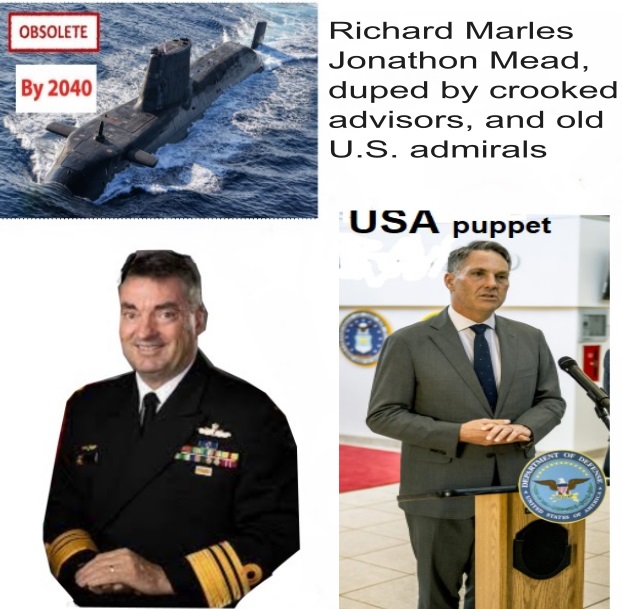
New Australian Submarine Agency to manage nuclear subs, by Brian Hartigan 2 July 23
The Australian Submarine Agency (ASA) – which will be responsible and accountable for the management and oversight of the nuclear-powered submarine program – has been officially established.
Vice Admiral Jonathan Mead is the new agency’s inaugural Director-General.
Minister for Defence Richard Marles said that as chief of the Nuclear-Powered Submarine Taskforce, Vice Admiral Mead demonstrated his leadership and judgement in supporting the establishment of the pathway to acquire this critical capability through the AUKUS partnership.
“This is a significant day, marking our next step towards the acquisition of conventionally-armed, nuclear-powered submarines, which is the single biggest investment in our defence capability in our history,” Mr Marles said……………………..
ASA currently has more than 350 staff from the Australian Defence Force and Australian Public Service, including many who have transitioned from the Nuclear-Powered Submarine Taskforce and others who have joined recently.
It is expected to almost double to more than 680 staff over the next year, drawing on a diverse skillset required to deliver this significant endeavour.
ASA will be headquartered in Canberra, with personnel located across the country and overseas, in the United States and United Kingdom, working with communities, unions, industry and governments to deliver the nuclear-powered submarine program.
ASA is a statutory agency within the Defence portfolio and will report to the Minister for Defence………………………. https://www.contactairlandandsea.com/2023/07/02/new-australian-submarine-agency-to-manage-nuclear-subs/
Recent nuclear news

This newsletter short, as I have been ill in hospital for nearly a week. (Fine now.) It did give me time to think. One thought: people liken the Russian advance on the Donbass, invasion of Ukraine, to the Nazis in WW2. That is so incorrect. So wrong to equate this situation to the evil philosophy of “Aryan superiority” that engulfed Germany from 1933 to 2 Sept 1945.
Climate. Scientists monitoring ‘doomsday’ glacier in Antarctic warn climate change happening faster than ever before. Ecological tipping points could occur much sooner than expected, study finds.
Christina notes. Cool thinking is needed on the Ukraine situation. Would Russia really blow up a nuclear plant that it controls? Two ruthless killer regimes, who hate each other, are now to cosy up for the benefit of the “peaceful” nuclear industry. What could possibly go wrong? https://www.youtube.com/watch?v=pWa7BJAmzYY
TOP STORIES
European Parliamentary Assembly rapporteurs warn against extradition to the United States of Julian Assange. Biden Would Need His Pound of Flesh From Assange.
By excluding Russia from markets in Europe, USA ‘s nuclear industry plans to sell its small and large nuclear reactors to Poland,Romania, Slovakia, Estonia, the Czech Republic and Ukraine .
Daniel Ellsberg’s message to us, and to future generations.
The Silent Slaughter of the Flower of Ukraine’s Youth. 2 important Russo Ukraine war stories: 1 covered 24/7; 1 covered up.
World’s Largest Fusion Project Is in Big Trouble, New Documents Reveal.0
AUSTRALIA. Nuclear indoctrination for Australian school-children – normalising nuclear submarines. Nuclear power safer than wind, Sussan Ley tells Liberal Party meeting. The Labor Party Victorian state conference and AUKUS. Former Labor cabinet minister condemns $368b AUKUS deal.
CLIMATE. A heating world can’t afford a cold war. Nuclear-based fantasies are holding back real climate action. Diversion from urgent climate action. How the European nuclear lobby undermines the EU’s energy future.
CIVIL LIBERTIES. Zelensky bans Russian books.
ECONOMICS. Building nuclear plant would increase costs in the need for guards, police and rescue workers. Marketing. China joins the rush to market nuclear power to Turkey. United Arab Emirates keen to become an exporter of nuclear reactors and nuclear technology. Chinese Boycott Over Fukushima Nuclear Plant Water Release Sinks Japanese Cosmetics.
EMPLOYMENT. Royal Navy struggles to attract recruits for nuclear-armed subs. Big enlistment bonuses offered to UK sailors entering the nuclear field.
ENERGY. NFLA message to energy minister – ‘Community energy is great; back it’.
ENVIRONMENT. What is the new ‘returning zone’ to be created in disaster-hit Fukushima?.
HEALTH. Radiation. Chinese astronauts install radiation-exposure experiment outside Tiangong space station .
INDIGENOUS ISSUES. We need to wake up’: Algonquin leaders sound alarm over planned nuclear waste facility near Ottawa River. A nuclear site is on tribes’ ancestral lands. Their voices are being left out on key cleanup talks.
LEGAL. Judge Who Ruled Against Assange Built Career as Barrister Defending UK Government. Legal challenge against Sizewell C nuclear power plant rejected,
NUCLEAR TECHNOLOGY. Nuclear Fusion: A Clean Energy Revolution Or A Radioactive Nightmare?
OPPOSITION to NUCLEAR. Suffolk campaigners vow to continue fighting Sizewell C. Nuclear Waste Transportation Draws Opposition in West.
PERSONAL STORIES. The Loving Truth-Teller That Was Daniel Ellsberg.
POLITICS. Humza Yousaf vows to rid independent Scotland of nuclear weapons. Starmer must drop support for flagship £20bn nuclear power station, says former Gordon Brown adviser. Sweden reverses its long-standing nuclear-free policy. Riverkeeper celebrates bipartisan Assembly passage of bill to stop radioactive wastewater discharges into the Hudson River; Governor Hochul must sign.
POLITICS INTERNATIONAL and DIPLOMACY. Will upcoming NATO summit launch forever war in Europe? Saudi Arabia demands own nuclear program in exchange for ties with Israel. Central Europe’s nuclear plans – fraught with problems.
SAFETY. Russia asks IAEA to ensure Zaporizhzhia nuclear plant security. IAEA Director General Grossi discusses nuclear safety with Russia’s Director of Rosatom, at Zaporizhzhia, in new consultations. Watchdog group has concerns over nuclear micro-reactor plans.
WASTES. ‘Truly shocking’: UK has enough plutonium to make almost 20,000 nukes. £485m clean-up operation for UK’s 10 nuclear reactors. The Biden administration is pouring billions into the nuclear industry-the payoff isn’t certain, US navy accused of cover-up over radioactive shipyard waste. New Mexico leaders fear nuclear waste could endanger oil and gas in the Permian Basin. Is Fukushima wastewater release safe? What the science says.
WAR and CONFLICT. Key moments of aborted Wagner revolt in Russia. “Brink of catastrophe” should Wagner Group “bandits” get their hands on nuclear weapons. Ukraine sustains massive single-day losses – Russian MOD. Russian MP believes Ukrainian counteroffensive will end in July . Kiev planning strike on Russia with Western-made missiles – Moscow. Ukraine counter offensive – https://www.youtube.com/watch?v=76KAD8djBBg Eyewitness Donbas: Why the Majority Reject Ukraine’s Counter-Offensive. https://www.youtube.com/watch?v=sS4DwwsSIG4Here’s how NATO trainers knowingly sent Ukrainian troops to their deaths in this month’s counteroffensive against Russia. SCOTT RITTER: On Horseradish & Nuclear War. The Reverse Cuban Missile Crisis. Khren Im – To the USA and Biden ….if this continues, it is lights out for humanity. Keep nuclear threats off the table.
WEAPONS and WEAPONS SALES. NATO arsenals ‘empty’ – Stoltenberg (need to ramp up production). Ukraine’s “spring counteroffensive not making progress: will NATO resort to deploying tactical nuclear weapons for Ukraine? Prodding the Pentagon. Is Russia planning to use nuclear weapons? Ukraine Can Develop Nuclear Weapons ‘Within a Short Time’: Ex-Zelensky Aide.
A $31 Billion Missile Program! US Looks To Reintroduce Nuclear Sea-Launched Cruise Missile Costing Equal To 10 Virginia-Class Subs. Amid China Tensions, US Nuclear-Powered Aircraft Carrier, USS Ronald Reagan, To Make A Rare Vietnam Port Call.
Australian media ramps up war-mongering against China, while the government ramps up censorship of social media

Australia Keeps Escalating Its Censorship And Propaganda Campaign
CAITLIN JOHNSTONE, JUN 26, 2023
There’s a frenzied rush by the Australian political/media class to both propagandise Australians as quickly as possible into supporting preparations for war with China, and to ram through legislation that facilitates the censorship of online speech.
Australia’s Communications Minister Michelle Rowland is set to release draft legislation imposing hefty fines on social media companies who fail to adequately block “misinformation” and “disinformation” from circulation in Australia, a frightening prospect which will likely have far-reaching consequences for political speech in the nation………………………………..
The problem with laws against inaccurate information is of course that somebody needs to be making the determination what information is true and what is false, and those determinations will necessarily be informed by the biases and agendas of the person making them. I can substantiate my claim that Russia’s invasion of Ukraine was provoked by NATO powers using an abundance of facts and evidence, for example, but there’s still a sizeable portion of the population which would consider such claims malignant disinformation with or without the supporting data.
When the government involves itself in the regulation of speech, it is necessarily incentivized to regulate speech in a way that benefits itself and its allies. Nobody who supports government regulation of online mis- and disinformation can articulate how such measures can be safeguarded in a surefire way against the abuses and agendas of the powerful.
Under a Totalitarian Regime, your government censors your speech if you say unauthorized things. Under a Free Democracy, your government orders corporations to censor your speech if you say unauthorized things.
At the same time, Australian media have been hammering one remarkably uniform message into public consciousness with increasing aggression lately: there is a war with China coming, Australia will be involved, and Australia must do much more to prepare for this war as quickly as possible.
Australians are remarkably vulnerable to propaganda due to the fact that ownership of our nation’s media is the most concentrated in the western world, with a powerful duopoly of Nine Entertainment and Murdoch’s News Corp controlling most of the Australian press.
Both of these media conglomerates have been involved in the latest excuse to talk about how more military spending and militarisation is needed, this time taking the form of a war machine-funded think tanker publishing a book about how we all need to prepare for war with China.
Nine Entertainment’s Sydney Morning Herald and The Age have an article out titled “Military expert warns of ‘very serious risk’ of China war within five years” by the odious Matthew Knott, who is best known for being told to drum himself out of Australian journalism by former prime minister Paul Keating for his appalling war-with-China propaganda series published earlier this year by the same papers. Readers who follow Australian media would do well to remember Knott’s name, because he has become one of the most prolific war propagandists in the western press.
The “military expert” who warns of the need to prepare for an imminent war with China is a man named Ross Babbage, who as Knott notes is “a non-resident senior fellow at the Centre for Strategic and Budgetary Assessments in Washington.” What Knott fails to disclose to his readers is that the Centre for Strategic and Budgetary Assessments is funded by every war profiteer and war machine entity under the sun, the majority coming straight from the US Department of Defense itself.
As we’ve discussed many times previously, it is never, ever okay for the press to cite war machine-funded think tankers for expertise or analysis on matters of war and foreign policy, and it is doubly egregious for them to do so without at least disclosing their massive conflict of interest to their readers. This act of extreme journalistic malpractice has become the norm throughout the mainstream press, because it helps mass media reporters do their actual job: administering propaganda to an unsuspecting public.
The Murdoch press has also been using Babbage’s book release as an excuse to bang the drums of war, with multiple Sky News segments and articles with titles like “Military analyst Ross Babbage warns Australia of potential war with China in coming years,” “National security expert Ross Babbage warns ‘strong possibility’ of war with China in latest book,” and “‘Running out of time’: Xi may move on Taiwan in next few years.” Again, not one mention of Babbage’s conflict of interests.
All for a news story that (and I cannot stress this enough) is not a news story. A war machine-funded think tanker saying he wants more war is not a news story — it’s just a thing that happens when the war machine is allowed to pay people to be warmongers.
“War Machine-Funded Warmonger Wants More War.” That’s your headline. That’s the one and only headline this non-story could ever deserve, if any.
Propaganda and censorship are the two most important tools of imperial narrative control, and it’s very telling that Australia is ramping them both up as the nation is being transformed into a weapon for the US empire to use against China. Steps are being taken to ensure that the Australian populace will be on board with whatever agendas the empire has planned for us in the coming years, and judging from what we’re seeing right now, it isn’t going to be pretty.
Key moments of aborted Wagner revolt in Russia
https://www.rt.com/russia/578650-recap-failed-coup-wagner/ 25 June 23
RT breaks down how the private military company’s attempted rebellion unfolded
The Wagner private military company led by Evgeny Prigozhin launched an insurrection in Russia that began on Friday evening and lasted through Saturday.
The armed contractors managed to seize an army headquarters in the southern part of the country.
However, they failed to rally other units and eventually aborted their advance towards Moscow after a deal was reached with the authorities.
The agreement, which includes an amnesty for Prigozhin, was brokered by Belarusian leader, Aleksandr Lukashenko.
Simmering Wagner-MOD tensions
The private military company Wagner Group was founded by restaurateur and catering tycoon Evgeny Prigozhin. The group’s members fought alongside regular Russian troops and distinguished themselves in the bloody battle for the Donbass city of Artyomovsk, known to Ukrainians as Bakhmut.
Prigozhin is a vocal critic of the country’s top military brass. He has publicly accused Defense Minister Sergey Shoigu and General Valery Gerasimov, the Chief of the General Staff, of mishandling the military operation in Ukraine. Prigozhin has also refused to sign an official contract with the Russian Defense Ministry.
Prigozhin begins ‘march on Moscow’
Late on Friday, Prigozhin accused the Russian military of striking Wagner’s field camps. The MOD quickly rejected his claim as “informational provocation.” Nevertheless, Prigozhin announced that his forces were beginning a “march for justice” with a plan to reach Moscow.
In the early hours of Saturday, an armored Wagner convoy, which included tanks, rolled into the southern city of Rostov-on-Don. In the city, Wagner members took control of the headquarters of the Southern Military District without a fight. Several gunshots were heard in Rostov later during the day, but no casualties were reported.
Putin condemns revolt
Shortly after Prigozhin declared his “march,” the Federal Security Service accused the Wagner boss of inciting an armed rebellion and opened a criminal case against him. In a video address on Saturday morning, President Vladimir Putin said Wagner’s actions were tantamount to treason, describing them as the “backstabbing of our country and our people.” He called for unity and stated that all necessary steps were being taken to restore order.
Meanwhile, counter-terrorism measures were enacted in Moscow and the surrounding Moscow Region. All public events were canceled in several cities, and traffic along major highways leading to Moscow was suspended.
Meanwhile, Prigozhin’s endeavor failed to attract support from other military units. On the contrary, several high-profile commanders and officials called on Wagner to lay down their arms.
Mutinous unit turns back after deal reached
On Saturday evening, Belarusian President Aleksandr Lukashenko, who had spoken to Prigozhin on Putin’s behalf, said the Wagner boss agreed to end his attempted insurrection in exchange for security guarantees. Prigozhin stated hours later that the Wagner convoys were halting their advance towards Moscow and returning to their bases. After some time, the regional authorities confirmed that Wagner fighters had left Rostov-on-Don.
The Kremlin said that, in order to avoid bloodshed, the case against Prigozhin would be dropped, and that he would “leave for Belarus.” Putin’s spokesman Dmitry Peskov added that Wagner members would not be prosecuted due to “their achievements on the frontline” in Ukraine.
TODAY. Cool thinking is needed on the Ukraine situation. Would Russia really blow up a nuclear plant that it controls?

A leader may popular, brave, hard-working, charismatic, and zealously against the evils of communism, – and a brilliant media performer.
But that does not necessarily mean that we should blindly believe everything that he says, or dutifully act on his advice.
Cool thinking is needed now, more than ever. Is Ukraine really winning this war?
Is it really wise to plan to pretty much encircle Russia with weaponry, with NATO at the nuclear-attack ready?
Russians still remember, and still endure, the effects of the 1986 Chernobyl nuclear disaster – which President Gorbachev blamed for starting the collapse of the Soviet Union.
We are expected now to believe that Putin is stupid enough to blow up the Zaporizhzhia nuclear plant, because Russia is supposedly losing the war in Ukraine?
Really?
Consider the possibility that Putin is not stupid. Consider the possibility that Ukraine’s much-vaunted “counter-offensive” is not bringing about the complete rout of Russia, which is Zelensky’s stated aim. Even consider the possibility that Zelensky and his supporters are zealous enough to do this blowing up themselves, as a last-ditch effort to get NATO to attack Russia.
You do realise that a NATO attack on Russia will bring about World War 3?
p.s. What nobody is telling us about – how many Ukrainian soldiers being killed each day? the total Ukrainian military casualties?
Former Labor cabinet minister condemns $368b AUKUS deal
By Mibenge Nsenduluka June 23 2023 https://www.canberratimes.com.au/story/8245773/former-labor-cabinet-minister-condemns-368b-aukus-deal/
Midnight Oil frontman and former Labor cabinet minister Peter Garrett has again condemned Australia’s security deal with the United States and United Kingdom, calling the $368 billion agreement costly and risky.
Mr Garrett said the decision to purchase a fleet of nuclear-powered submarines was a huge gamble and should not be allowed to proceed, while speaking at a public forum in Melbourne.
“It’s the biggest, it’s the most costly and it’s the riskiest decision ever taken by any Australian government short of governments committing us to war and should not be allowed,” he said on Friday.
He applauded recent backlash from some Labor party members and unions, saying a slew of academic and foreign policy experts also backed the push against AUKUS.
“So we are not alone, a basic and a major objection to AUKUS lies in the aspects of the arrangement which see us reversing our foreign policy and defence posture that’s been generally in place since World War II,” Mr Garrett said.
“We’re going from a focus of direct defence as it is currently constituted to a concentration on forward defence.”
Mr Garrett in March said AUKUS would produce increasing volumes of high-level radioactive waste that would be stored for “tens of thousands of years” in the Australian environment.
It follows stinging remarks by former Labor prime minister Paul Keating earlier this year.
Mr Keating said the new security deal was the worst international decision since conscription during WWI.
Under the deal, which is part of the AUKUS security arrangement, Australia will command a fleet of nuclear-powered submarines within the next three decades.
A number of Labor branches have been agitating for the government to dump its support for nuclear-powered submarines and AUKUS.
But Prime Minister Anthony Albanese said his government remains committed.
“The view of my government is very, very clear and is unwavering in its support for AUKUS, in its support for issues about our national security and about our interests in the defence of this nation,” he told reporters on Thursday.
Biden Would Need His Pound of Flesh From Assange
The case of David Hicks, an Australian imprisoned by the United States in Guantanamo Bay is relevant. Hicks ultimately was released by the U.S., after pressure from the Australian government, when he agreed to a so-called Alford Plea, in which he pled guilty to a single charge, but was allowed to assert his innocence at the same time. on the grounds that he understood he would not receive a fair trial.
The U.S. president would not likely move on the case without some face-saving measure to ward off pressure from the C.I.A. and his own party, writes Joe Lauria.
By Joe Lauria / Consortium News 23 June 23 https://scheerpost.com/2023/06/23/biden-would-need-his-pound-of-flesh-from-assange/
The coming days or weeks could be the most pivotal in imprisoned WikiLeaks publisher Julian Assange’s four-year legal drama. There are five possible scenarios:
- Assange may have his appeal against extradition heard by the High Court;
- He may have his appeal rejected and be put on a plane to the United States;
- That plane may be stopped by an injunction from the European Court of Human Rights;
- A last-minute plea deal may be worked out guaranteeing Assange’s eventual freedom or, least likely
- the U.S. may abruptly drop its charges against him.
Following the decision by High Court Judge Sir Jonathan Swift this month to reject Assange’s application to appeal his ordered extradition to the United States to stand trial on espionage charges, Assange’s legal team filed a new application to the High Court last week. The decision on this application could come any day.
If it is refused, Assange will have run out of legal options in Britain, and could only be saved by the intervention of the European court. There is also still a chance of a plea deal in which President Joe Biden would need to exact punishment of Assange to cover his political posterior.
Given new revelations in the UC Global case in Spain about C.I.A. spying on Assange there’s even an outside chance the Biden administration may drop the case to avoid exposure in the media circus that would ensue in Alexandria, VA if Assange is extradited to stand trial there.
Rollercoaster
Assange and his supporters have been on a rollercoaster since the beginning of May.
Expectations grew in Australia last month that a deal may be in the works to liberate him. The hopes began with the clearest statements yet on the case from Australian Prime Minister Anthony Albanese. On May 4, he said for the first time that he had spoken directly to U.S. authorities about Assange; that he wanted the prosecution to end and that he was concerned for his health.
Optimism grew further when five days later, Caroline Kennedy, the U.S. ambassador to Australia and daughter of slain President John F. Kennedy, agreed to meet a group of six, pro-Assange, Australian MPs, from three different parties, plus an independent.
It is highly unlikely that Kennedy would have invited them to the U.S. embassy for lunch to discuss Assange’s case without approval from at least the State Department, if not the White House.
A few days after that, Albanese said Assange would have to play his part in any deal to be freed. That was widely interpreted to mean that Assange would have to agree to some sort of plea deal, in which he agreed to plead guilty to a lesser charge, perhaps serve a short sentence in Australia and then walk free.
All this was leading up to President Joe Biden’s scheduled May 24 visit to Australia to meet with Albanese. Speculation ran wild that a deal to release Assange might be announced.
A rally in Sydney’s Hyde Park was planned for the day of Biden’s visit. One of his London lawyers, Jennifer Robinson, and Julian Assange’s wife, Stella Assange, made plans to be in Australia, her first ever trip to her husband’s native country.
Biden canceled his trip to Sydney, he said because of the then debt crisis, and met instead with Albanese in a bilateral meeting in Japan on the sidelines of the G7 Summit. There is no indication Assange was discussed.
Stella Assange went to Australia anyway with Robinson and both addressed the National Press Club in Canberra on May 22. Stella Assange called this period the “end-game, the closet my husband has been to release.”
Robinson said for the first time on behalf of Assange’s legal team that they would consider a plea deal.
Robinson said:
“We are considering all options. The difficulty is our primary position is, of course that the case ought to be dropped. We say no crime has been committed and the facts of the case don’t disclose a crime. So what is it that Julian would be pleading to?”
Two days later, Stella Assange and Assange’s brother and father whipped up a huge crowd of Assange supporters at the Hyde Park rally.
The Alford Plea
It is hard to imagine Assange admitting to having done anything wrong, when the case against him, as argued in his extradition hearing, appears to prove no wrongdoing at all.
The case of David Hicks, an Australian imprisoned by the United States in Guantanamo Bay is relevant. Hicks ultimately was released by the U.S., after pressure from the Australian government, when he agreed to a so-called Alford Plea, in which he pled guilty to a single charge, but was allowed to assert his innocence at the same time on the grounds that he understood he would not receive a fair trial.
Can an Alford Plea be a face-saving solution for both Biden and Assange? Can Assange’s team frame it as Assange denying participation in any crime while at the same time having to plead guilty to at least a lesser charge?
FBI Continues Probe
Some of this optimism was punctured on May 31 when The Sydney Morning Herald reported that the F.B.I. was still carrying out its investigation of Assange, three years after issuing its last superseding indictment.
The Herald reported that the F.B.I. in May sought an interview in London with Andrew O’Hagan, who worked as a ghostwriter on Assange’s autobiography in 2011. The London Metropolitan Police’s counterterrorism command sent the letter to O’Hagan, which said: “The FBI would like to discuss your experiences with Assange/WikiLeaks …”
O’Hagan told the Herald: “I would not give a witness statement against a fellow journalist being pursued for telling the truth. I would happily go to jail before agreeing in any way to support the American security establishment in this cynical effort.”
What could this mean in the context of speculation about negotiations over a plea deal? Did the F.B.I. want to bolster its case to make it easier for Assange to accept a plea on the lesser charge of conspiracy to commit computer intrusion? Or was it just trying to strengthen a very weak case against him?
Assange’s Australian lawyer, Stephen Kenny, told the Herald:
“I would think it is of some concern because we have been working to try to secure an arrangement that would see Julian come home. It would be very unusual if the FBI was trying to gather evidence that could help clear his name.”
Judge Rejects Application to Appeal
The rollercoaster plunged further with the news that a single judge on the High Court of England and Wales rejected Assange’s 11-month old request to cross appeal the lower court ruling in his case as well as the home secretary’s decision to extradite him.
Judge Swift, who has manifest conflicts of interest, rejected the 150-page application for appeal of the home secretary’s decision to extradite Assange to the U.S. as well as a cross appeal of the lower court judge who initially released Assange on health grounds and conditions of U.S. prisons but who agreed with the U.S. on everything else.
Swift took just three pages to dismiss the 150-page application to appeal, complaining about the length of the submission in the process. He called Assange’s appeal “new evidence,” which he rejected, while the same court accepted the new evidence of U.S. assurances not to mistreat Assange to overturn the lower court’ decision to release him on health grounds.
Assange’s legal team has one last chance with the court. On Tuesday last week they submitted a 20-page document to the High Court arguing why it should listen to the appeal against extradition. His team will get no more than a humiliating 15 minutes of a 30-minute hearing to argue before two judges on the High Court, according to former British diplomat Craig Murray.
If this application is refused there are no more legal steps for Assange in Britain and he could be theoretically put on a plane to the U.S. that day.
At that point, only an injunction from the European Court of Human Rights can stop the plane from taking off until that court examines the case. Assange’s lawyers filed a submission to the ECHR in December.
But there is also the possibility of a last-minute plea agreement or the U.S. dropping the case.
What Biden Needs
This flurry of bad news for Assange, after weeks of encouraging developments, has buried talk of a plea agreement. But a last minute deal cannot be ruled out.
Biden would need his pound of flesh from Assange if he would allow his administration to offer a plea. Assange would most likely have to plead guilty to something and serve more time, likely in Australia, before Biden would entertain ending the case.
Though he was never charged for the Democratic National Committee or the C.I.A. leaks, Assange is the continuing target of their ire, and would be unlikely to look kindly on Biden letting him go, especially a year before a U.S. presidential election. Biden knows he’s wrong on Assange, if he can remember it. He clearly stated his position on Assange on Meet the Press in December 2010.
Vice President Biden told the program that Assange could only be indicted if it could be proved he conspired to steal the published documents. That could not be proved and the Obama-Biden administration did not indict Assange. The Trump administration did. But only on the original 2010 espionage charges.
The U.S. indictment does not accuse Assange of stealing U.S. government documents, but only receiving them. If Biden stuck to his original principles he would have these charges dropped and let Assange go. But it’s political dynamite for him.
The C.I.A. and DNC would likely be furious with Biden so he will need something in return to show them for letting Assange go. Whether that satisfies them is another matter.
Dropping the Case
The last, long-shot possibility, is that the U.S. drops the case altogether. This is what Assange’s supporters, parliamentarians around the world, human rights and press freedom groups, journalists’ unions and even WikiLeaks‘ five corporate media partners have been calling for.
But until now it’s been like talking to a marble wall in Washington. Yet, developments in the UC Global case in Spain and the upcoming U.S. presidential election might provide conditions for the U.S. to want to get out of its pursuit of Assange.
A recent development in the Madrid criminal trial against UC Global chief David Morales for violating Assange’s privacy by spying on him in Ecuador’s London embassy with 24/7 live surveillance for the Central Intelligence Agency as well on his privileged conversations with his lawyers has solidly confirmed the C.I.A’s role.
Would Langley want that exposed at Assange’s trial federal court in Alexandria, VA, where U.S. media interest would be intense?
Also, would Biden welcome during a presidential campaign the protests in the plaza before the Alexandria courthouse, highlighting his administrations efforts to convict a journalist for publishing accurate information exposing U.S. state crimes, handing his political opponents a cudgel to expose his hypocrisy about defending press freedoms?
It might indeed be in Biden’s and the C.I.A.’s interests to wash their hands of this filthy endeavor once and for all. (There is precedence for this in the Katharine Gun case.)
In one way or the other, the coming weeks appear to be leading to a climax in the extradition phase of arguably the most important press freedom case in U.S. history.
IAEA Director General Grossi discusses nuclear safety with Russia’s Director of Rosatom, at Zaporizhzhia, in new consultations

MOSCOW, June 23 https://english.news.cn/20230624/19c5c0119ce24b04a7ab10e6a08f9a0b/c.html — General Director of Russia’s Rosatom State Corporation Alexey Likhachev discussed the current nuclear safety situation around the Zaporizhzhia nuclear power plant (ZNPP) with the International Atomic Energy Agency (IAEA) Director-General Rafael Grossi in Russia’s Kaliningrad on Friday.
During the discussion, both delegations addressed issues raised by Grossi at the UN Security Council briefing on May 30, in which the official discussed the security situation at the nuclear facility, Rosatom said in a statement.
Likhachev emphasized that the Russian side “expects the IAEA Secretariat to take specific steps to prevent strikes by the Ukrainian armed forces both on the ZNPP and on the adjacent territory,” it added.
He informed Grossi about the specific measures currently being taken by the Russian side to ensure the nuclear facility’s safe operation, particularly its water supply “after the Kakhovka hydroelectric power plant dam was destroyed by the Ukrainian armed forces,” Rosatom said.
Both sides further discussed the outcomes of Grossi’s visit to the plant on June 15. During his visit, Grossi was able to personally verify whether the plant could continue operating safely, and confirm among other things that the water supply in the cooling pond was sufficient for the safe operation of the facility
Russia asks IAEA to ensure Zaporizhzhia nuclear plant security

Reuters, June 23, 2023 https://www.reuters.com/world/europe/russia-asks-iaea-ensure-zaporizhzhia-nuclear-plant-security-2023-06-23/
June 23 (Reuters) – Russia urged the International Atomic Energy Agency on Friday to ensure Ukraine does not shell the Zaporizhzhia nuclear power plant, saying it was otherwise operating safely.
Alexei Likhachev, chief executive of the Russian state nuclear energy firm Rosatom, made the comments at a meeting with IAEA chief Rafael Grossi in the Russian city of Kaliningrad, Rosatom said in a statement, after Grossi visited the plant last week.
“We expect concrete steps from the IAEA aimed at preventing strikes by the Armed Forces of Ukraine, both on the Zaporizhzhia nuclear power plant and on adjacent territory and critical infrastructure facilities,” Rosatom quoted its chief as saying in a statement.
The IAEA said this week that the power plant was “grappling with … water-related challenges” after the destruction of the Kakhovka dam emptied the vast reservoir on whose southern bank the plant sits.
It also said the military situation in the area had become increasingly tense as Kyiv began a counteroffensive against the Russian forces that have seized control of swathes of eastern and southern Ukraine.
Moscow and Kyiv have regularly accused each other of shelling Europe’s largest nuclear power station, with its six offline reactors. International efforts to establish a demilitarised zone around it have so far failed.
Ukraine this week accused Russia of planning a “terrorist” attack at the plant involving the release of radiation, while Moscow on Friday detained five people who it said were planning to smuggle radioactive caesium-137 at the request of a Ukrainian buyer in order to stage a nuclear incident.
Reporting by Reuters; Editing by Kevin Liffey
A $31 Billion Missile Program! US Looks To Reintroduce Nuclear Sea-Launched Cruise Missile Costing Equal To 10 Virginia-Class Subs

By Parth Satam, June 23, 2023, https://eurasiantimes.com/a-31-billion-missile-program-us-looks-to-reintroduce-nuclear-sea-launched-cruise-missile-costing-equal-to-10-virginia-class-subs/
A section of US Congressmen are voting for reintroducing a costly and redundant nuclear program. Republican lawmakers in the House are adopting a measure to institutionalize the Sea-Launched Cruise Missile-Nuclear (SLC)The SLCM was denied funding in last year’s Fiscal Year 2023 budget and concluded to have no battlefield use in the 2022 Nuclear Posture Review (NPR).
The Cold War-era concept envisages a cruise missile with a low-yield tactical nuclear warhead that can be fired from submarines, warships, or naval aircraft on a trajectory that makes it hard to track by radar.
According to a report in Defense News, the House Armed Services Committee “voted along party lines to amend the fiscal 2024 National Defense Authorization Act (NDAA) with a provision that would create a program of record (PoR) for SLCM-N.”
A PoR is a listed ‘line item record’ in current and future defense acquisition plans that make them eligible for continued funding over the years.
Obscene Cost for a Useless Weapon
If the full HASC advances the Fiscal Year 2024 (FY24) and passes the full floor vote in July, it would receive nearly $196 million as research and development funds.
However, political leaders and military experts advise against the astronomical costs and a futile capability, which they say can be invested elsewhere and be performed by other weapons systems.
Representative Courtney, a Democratic Congressman from Connecticut, who chairs the sea power subcommittee, cited May testimony from Chief of Naval Operations Admiral Michael Gilday stating that the warheads needed to make an SLCM-N program would cost at least $31 billion.
“The Navy can do a lot of other things with $31 billion. You can build 15 DDG destroyers with $31 billion, 10 Virginia-class submarines with $31 billion. You put nuclear warheads on these vessels, then you are changing the mission,” Courtney said.
Another Democratic Congressman, Representative Adam Smith of Washington, the top Democrat on the Armed Services Committee, argued that the US already has ballistic submarines in its fleet as well as lower-yield nuclear options from the air.
“It’s walking us down a path of spending enormous money on a capability that we don’t really need that will undermine our ability to build capabilities that we do (need) going forward,” said Smith.
Why Doesn’t the US Need the SLCM-N
Citing the need for flexibility and regional presence, the Trump administration’s 2018 Nuclear Posture Review (NPR) called for re-establishing a sea-launched cruise missile-nuclear capability.
President Biden’s FY 2022 budget continued funding SLCM-N, aiming to deploy it by the late 2020s. However, with the 2022 NPR identifying SLCM-N as “no longer necessary,” Biden’s 2023 budget request did not include SLCM-N funding.
The missile basically saddles important weapons platforms like submarines and warships with a mission set that can be undertaken by US Air Force (USAF) strategic bombers. It takes away the flexibility of employing diverse firepower options with a varied range of platforms.
“Should a geographic combatant commander intend to seek permission to use a nuclear weapon for tactical purposes, selecting bombers would offer more flexibility between mission sets and avoid committing to a weapons load-out decision as far in advance as would be necessary if SLCM-N were chosen” retired US Navy officer, Captain John Moulton writes in a paper.
In other words, an SLCM-N armed naval submarine or warship meets a very “narrow” mission set of destroying hardened enemy ground targets while sacrificing equally important tactical and strategic roles like hunting enemy submarines, destroying surface warships, mine laying or providing Intelligence-Surveillance-Reconnaissance (ISR).
Other currently nuclear weapons capable platforms like the B-2 Spirit, B-52 Stratofortress, B-1B Lancer, and the upcoming B-21 Raider envisaged for the same mission could also reach the warzone quickly.
The cost of revealing its position while firing an SLCM-N would also far outweigh the gains from hitting enemy ground targets with low-yield nuclear missiles, Moulton further explains. Moulton is a Senior Fellow at the Council on Strategic Risks’ Janne E. Nolan Center on Strategic Weapons.
The conditions that would justify using a tactical nuclear-tipped cruise missile would be very rare and would prevent a submarine or a naval vessel from performing optimally in a fluid battlefield situation.
In the Western Pacific, becoming part of a “joint force” in a mutually supporting pushback against a People’s Liberation Army Navy (PLAN) fleet inside China’s dangerous Anti-Access/Area-Denial (A2/AD) zone is a new evolving orientation guiding the US Navy’s submarine arm, explained in a previous EurAsian Times analysis.
Lastly, the risks of unintended nuclear escalation are exponentially higher when an SLCM-N is fired since the country sustaining the attack – China or North Korea – might legitimately retaliate with a nuclear strike, triggering a devastating atomic exchange.
Experts have long pointed out how such exchanges cannot be “controlled” given the tensions and the miscalculation involved.
A US asset firing an SLCM-N also counts as a nuclear first strike, which shifts the diplomatic narrative in the Russian, Chinese, or North Korean favor. None of these countries have ever indicated they plan to use nuclear weapons as a warfighting tool. While China has a clear No-First Use (NFU) policy, Moscow and Pyongyang have maintained they will use nukes only when the physical security of their country faces an existential threat. The author can be reached at satamp@gmail.com
A nuclear site is on tribes’ ancestral lands. Their voices are being left out on key cleanup talks
KNKX Public Radio | By The Associated Press, June 23, 2023
Three federally recognized tribes have devoted decades to restoring the condition of their ancestral lands in southeastern Washington state to what they were before those lands became the most radioactively contaminated site in the nation’s nuclear weapons complex, the Hanford Nuclear Reservation.
But the Yakama Nation, Confederated Tribes of the Umatilla Indian Reservation and Nez Perce Tribe have been left out of negotiations on a major decision affecting the future cleanup of millions of gallons of radioactive waste stored in underground tanks on the Hanford site near Richland.
In May, federal and state agencies reached an agreement that hasn’t been released publicly but will likely involve milestone and deadline changes in the cleanup, according to a spokesperson for the Washington State Department of Ecology, a regulator for the site. As they privately draft their proposed changes, the tribes are bracing for a decision that could threaten their fundamental vision for the site.
“As original stewards of that area, we’ve always been taught to leave it better than you found it,” said Laurene Contreras, program administrator for the Yakama Nation’s Environmental Restoration/Waste Management program, which is responsible for the tribe’s Hanford work. “And so that’s what we’re asking for.”
From World War II through the Cold War, Hanford produced more than two-thirds of the United States’ plutonium for nuclear weapons, including the atomic bomb dropped on Nagasaki, Japan, in 1945. Production ceased in 1989, and the site’s mission shifted to cleaning up the chemical and radioactive waste left behind.
For these tribes, which have served as vital watchdogs in the cleanup process, the area’s history dates back long before Hanford, to pre-colonization. It was a place where some fished, hunted, gathered and lived. It’s home to culturally significant sites. And in 1855 treaties with the U.S. government in which the tribes ceded millions of acres of land, they were assured continued access.

The U.S. Department of Energy, the Environmental Protection Agency and the Washington State Department of Ecology have held confidential negotiations since 2020 on revising plans for the approximately 56 million gallons of radioactive waste stored in 177 underground tanks at Hanford. The discerning eyes of the tribal experts have been kept out, though EPA and Ecology have said there will eventually be opportunities for the tribes to meet with them about this.
The revisions are expected to affect an agreement among the three agencies that outlines the Hanford cleanup. Mason Murphy, program manager for the Confederated Tribes’ Energy and Environmental Sciences program, points out that the tribes also weren’t consulted in that original 1989 agreement.
“It’s an old scabbed-over wound,” Murphy said…………………………………………………….. https://www.knkx.org/government/2023-06-23/a-nuclear-site-is-on-tribes-ancestral-lands-their-voices-are-being-left-out-on-key-cleanup-talks
—
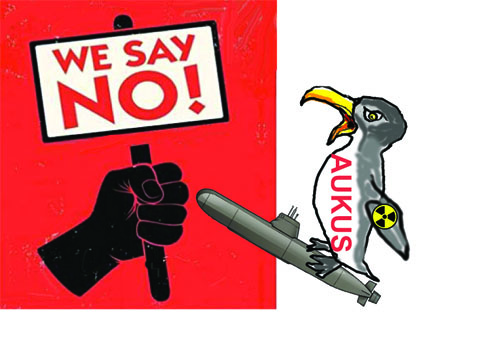
The Labor Party Victorian state conference and AUKUS
By Greg Bailey, Jun 21, 2023, https://johnmenadue.com/the-alp-victorian-state-conference-and-aukus/
An attempt by certain Labor affiliated left-wing unions to put a motion critical of AUKUS at the recent ALP Victorian State Conference was deferred by factional bosses even before it was put. That it was deferred tells us as much about the hierarchy ignoring the rank and file of the party as it does about the massive folly that is AUKUS.
On the weekend of 17-18 of June the Victorian branch of the ALP held its state conference attended by over six hundred delegates, the first one since 2019. Previous conferences had been postponed because of COVID, but also because of federal intervention as a response to branch stacking. Tension had already been built up because some left-wing unions had announced they would ask for a vote against AUKUS, being just the latest of other prominent ALP members and past ministers who have come out strongly against it.
The Age, the AFR and the Guardian began reporting on this four days before the conference began, speculating on who would control the factions and what would happen to the AUKUS motion which had the potential to embarrass the Prime Minister. Even before the conference began Mr Albanese had declared that AUKUS would go ahead, rendering any debate pointless given that there is much support for AUKUS in the federal parliamentary ALP. And rank and file members can be ignored–at least in the short term.
Phillip Coorey had already reported on June 14 that two weeks earlier the Queensland branch of the ALP, at its state conference, had “refused to support a motion congratulating the Albanese government “for investing in the AUKUS agreement”.”
Given that there has been considerable disquiet expressed about the AUKUS decision as a threat to Australian sovereignty and a departure from traditional Labor policy to seek rapprochement as opposed to aggression, it is hardly surprising that some elements of the rank and file expressed their anger about the decision to go with AUKUS. And this especially when it had been essentially imposed upon the party from above, and when prominent former ALP luminaries led by Paul Keating and Bob Carr had decisively spoken out against it.
As Phillip Coorey wrote in the AFR on 18/6, “The motion expressed disappointment with, or criticised, all aspects of the AUKUS deal between Australia, the United Kingdom and the United States, including its quick embrace by Labor in opposition when Scott Morrison announced it. The motion demanded “federal Labor caucus to be more politically diverse and avoid being swept along by the interests and priorities of America’s corporate, political, and military elites”.
Indeed, as Royce Millar and Broede Carmody reported in the Age three days (15/6) before the conference, “AMWU Victorian secretary Tony Mavromatis said he expected his motion would win strong support from the conference floor.” “We will push ahead with our motion, no matter who is at the conference, including prime ministers,” he said. “The AUKUS deal is a terrible arrangement for Australia. It lets down Australian workers, apprentices and trainees and Australian manufacturing. We should not be getting into nuclear.”
In other words, he was expressing the criticisms that have already been made in so many other forums, yet only mutely in most of the main stream media.
Yet in Melbourne the factional leaders got together and voted to defer this motion until the forthcoming Labor National Conference in Brisbane. No doubt there will be sufficient support for the Prime Minister to defeat any such motion going forth, and even if it did go forth would this be enough for the government to withdraw from AUKUS?
If the internal pressure continues building against what is such an obvious foreign affairs folly, one which has so much negative impact on internal spending by the government on social housing, climate change mitigation, education and so forth, will the decision to go with it be reversed? I fear this is unlikely as Mr. Albanese seems to be adopting the practice of his LNP predecessors, never to back down because it will make him look weak in the eyes of the public. Implicitly, this will also be justified by the party hierarchy’s belief that this is what the Australian population wants, irrespective of how little the opposite arguments have been advanced to them.
European Parliamentary Assembly rapporteurs warn against extradition to the United States of Julian Assange

20/06/2023Legal Affairs and Human Rights, https://pace.coe.int/en/news/9145/pace-rapporteurs-warn-against-extradition-to-the-united-states-of-julian-assange?fbclid=IwAR17jfNw-hOFAyBnLaAdYy-4ZurMA8qGK9TdNyYSAILwoezU1K4EmqukTv4
The General Rapporteurs on Human Rights Defenders and Whistleblowers, and on Political Prisoners, of the Parliamentary Assembly of the Council of Europe (PACE), Emanuelis Zingeris (Lithuania, EPP/CD) and Sunna Ævarsdóttir (Iceland, SOC), have warned against the extradition to the United States of Julian Assange.
“The harsh treatment of Julian Assange to date, and the lengthy prison term which he faces in the US if extradited, have a chilling effect on freedom of information, freedom of speech and whistleblowing in general. Daniel Ellsberg, who leaked the ‘Pentagon Papers’, is rightly celebrated as a hero for his contribution to bringing the Vietnam war to an end. Julian Assange, who published accurate information on egregious human rights violations by state agents in Iraq and elsewhere, also deserves recognition, not punishment,” said Mr Zingeris.
“Julian Assange has made powerful enemies in the United States. If extradited, he would risk serious human rights violations, including ill-treatment in detention, and a disproportionate prison sentence. It is therefore with great concern that we learned of the decision issued on 6 June by the High Court in London, denying Julian Assange permission to appeal the decisions authorising his extradition,” said Ms Ævarsdóttir.
“We also call on the international community to take any action likely to put an end to Julian Assange’s extradition proceedings in order to prevent human rights violations, which appear more imminent now than ever before,” the rapporteurs said. Both rapporteurs note that the Assembly has already supported the release of Julian Assange and recall statements by the Council of Europe Commissioner for Human Rights calling on the UK to end the arbitrary detention of Julian Assange and to prevent his extradition.
1 This month.
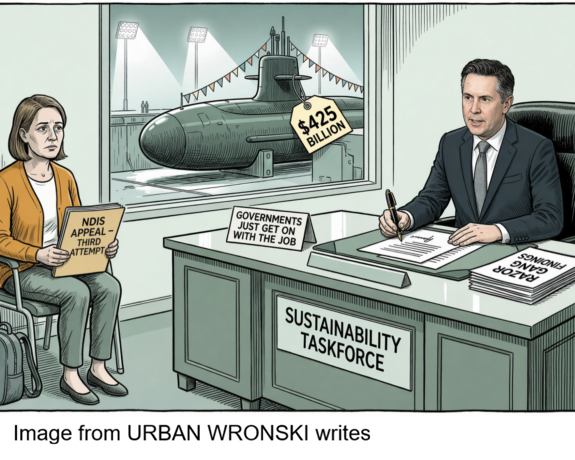

PETITION – To: Prime Minister Anthony Albanese and the Australian Labor Government
Chernobyl: The Lost Tapes – A good documentary on Chernobyl on SBS available On Demand for the next 3 weeks– https://www.sbs.com.au/ondemand/tv-program/chernobyl-the-lost-tapes/235274195556

19 May – Webinar- Webinar: No Nuclear Weapons in Australia
Start: 2026-05-19 18:00:00 UTC Canberra, Melbourne, Sydney (GMT+10:00)
End: 2026-05-19 19:30:00 UTC Canberra, Melbourne, Sydney (GMT+10:00)
20 May – Webinar – The dangerous world of AUKUS, US, military occupation and suppression of dissent

National Webinar, 20th May, 2026, 6.30pm AEST. Confronting laws restricting/suppressing protest speech and action
Speakers: Former Sen. Rex Patrick, Lawyer Nick Hanna ,Arthur Rorris ,Jorgen Doyle, Sen David Shoebbridge,
Facilitator Kelley Tranter.

of the week – Australians for War Powers Reform (AWPR)
To see nuclear-related stories in greater depth and intensity
 Antinuclear