Wishful thinking about nuclear energy won’t get us to net zero
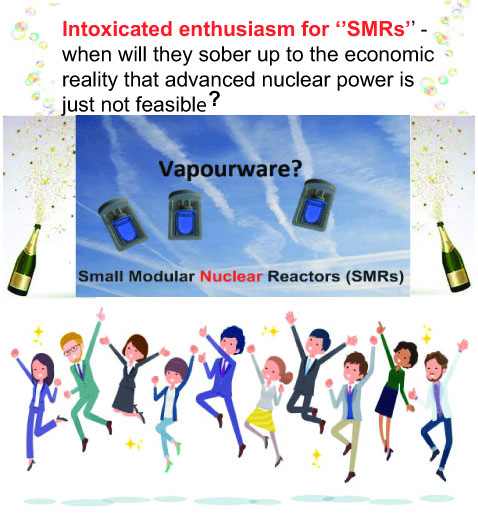
The climate problem is too serious to engage in unrealistic modelling exercises. Wishful thinking about nuclear energy will only thwart our ability to act meaningfully to lower emissions rapidly.
BY M.V. RAMANA AND SUSAN O’DONNELL | July 3, 2023 https://www.hilltimes.com/story/2023/07/03/wishful-thinking-about-nuclear-energy-wont-get-us-to-net-zero/391721/
On June 20, the Canada Energy Regulator (CER) released its 2023 Canada’s Energy Future report, developing scenarios for a path to net zero by 2050. These scenarios project roughly a tripling of nuclear energy generation capacity in Canada by 2050, seemingly reinforcing then-natural resources minister Seamus O’Regan’s statement in 2020 that there is “no path to net zero without nuclear.”
However, underlying both the scenarios and O’Regan’s contention is wishful thinking about the economics of nuclear energy, and how fast nuclear power can be scaled up.
The new nuclear capacity the report envisions consists of so-called small modular nuclear reactors (SMRs), which have so far not been built in Canada. Aside from refurbishing existing CANDU reactors, the CER does not think any more standard sized nuclear reactors will be built in Canada. Most of this buildup is to happen between 2035-2050, meaning that nuclear power will not help meet the government’s stated goal of decarbonizing the electricity grid by 2035.
But can SMRs be built rapidly after 2035? Only two Crown companies in the business of generating electricity for the grid have proposed to build SMRs: NB Power in New Brunswick, and Ontario Power Generation (OPG).
The reactor designs proposed for New Brunswick are cooled by molten salts and liquid sodium metal. Despite decades of development work and billions of dollars invested, major technical challenges have prevented molten salt reactors and sodium-cooled reactors from commercial viability, making it highly unlikely that the New Brunswick designs can be rapidly deployed in the time frame envisioned by the CER.
Assuming that OPG’s chosen design—the 300-megawatt BWRX-300—is the one to be deployed widely, then around 70 SMR units would need to be built and operating effectively on the grid between 2030-2050. The BWRX-300 design is yet to be approved by any safety regulator anywhere in the world.
But the report has an even more serious problem: economics. Nuclear power cannot compete economically, which is why its share of global electricity generation has declined from 17.5 per cent in 1996 to 9.2 per cent in 2022. Because SMRs lose out on economies of scale, they will produce even more expensive electricity.
The CER’s scenarios for nuclear power are based on the Electricity Supply Model, meant to calculate “the most efficient and cost-effective way to meet electricity demand in each region.” Such models are widely used in energy analysis and policymaking, but their utility depends on the validity of the assumptions used; garbage in, garbage out.
Two key parameters underlie the report’s scenarios: the capital cost of an SMR, and how that cost evolves with time. The CER’s assumptions in the two net-zero scenarios are that a SMR costs $9,262 per kilowatt in 2020, falling to $8,348 per kW by 2030, and to $6,519 per kW by 2050. Both these assumptions are ridiculously out of touch with the real world.
Consider the CAREM-25 SMR designed to feed 25 megawatts of electricity into the grid, being built in Argentina since 2014. Its original cost estimate in 2014 of US$446-million has escalated significantly since then, but even using these original costs, the project costs nearly $30,000 per kilowatt in 2022 Canadian dollars.
The NuScale design, arguably the closest to deployment in the United States, has been in development since 2007 with the build not yet begun. The January 2023 cost estimate for six NuScale SMRs with a total capacity of 462 megawatts is $9.3-billion, or over $26,000 per kilowatt in Canadian dollars.
Finally, the cost of the five-megawatt Micro Modular Reactor Project at Chalk River, Ont., was estimated by the proponent in May 2020 to be between $100- and $200-million. In 2022’s Canadian dollars, that works out to $22,000 to $44,000 per kilowatt.
In other words, the CER’s cost assumptions are wild underestimates, two-and-a-half to four times lower than the current evidence.
The second incorrect assumption is that costs will decrease with time. Both in the United States and France, the countries with the highest number of nuclear plants, the trend was the opposite: costs went up—not down—as more reactors were built. In both countries, the estimated construction cost of the most recent reactors being built—Vogtle in the United States and Flamanville-3 in France—have broken new records.
We need government organizations to do better. The climate problem is too serious for such unrealistic modelling exercises. Wishful thinking will only thwart our ability to act meaningfully to lower emissions rapidly.
M.V. Ramana is the Simons Chair in Disarmament, Global and Human Security and professor at the School of Public Policy and Global Affairs at the University of British Columbia. Susan O’Donnell is adjunct research professor and primary investigator of the CEDAR project at St. Thomas University in Fredericton, N.B.
Nuclear Contaminated Water Dumping: IAEA Concludes ‘Absolute Safety of Nuclear Contaminated Water’ – with Japanese Government Money?

Date: June 29, 2023 Author: dunrenard FUKUSHIMA 311 WATCHDOGS
Foreign Ministry official reveals in alleged transcripts of conversations
“More than 1 million euros handed over to IAEA officials, director general, etc.”
“IAEA report conclusion of nuclear contaminated water was ‘absolutely safe’ from the beginning”
Adopting an investigation method that detects only easy-to-detect elements129 etc.
South Korea’s Kim Hong-seok and others “IAEA experts are just decorations”
A memo from a senior official at the Ministry of Foreign Affairs’ 1
A document has surfaced in Japan that raises suspicions that the Japanese government is paying IAEA officials large sums of money to work with each other and “collude” in the dumping of Fukushima nuclear contaminated water into the ocean.
‘Foreign Ministry Executive A Memo’, 1 million euros to IAEA
According to the document, which was obtained by citizen journalist Mindle on Nov. 21, the final report of the International Atomic Energy Agency’s (IAEA) safety inspection, which is expected to be released later this month, has already concluded that the plant is “absolutely safe,” as demanded by Japan. To this end, the Japanese government has paid more than 1 million euros in “political contributions” to IAEA officials, so there is “no need to worry” about opposition from South Korea and China to the dumping of contaminated water into the ocean, which will begin as early as mid to late July, according to “Foreign Ministry official A” in the document.
Date: June 29, 2023Author: dunrenard0 Comments
Foreign Ministry official reveals in alleged transcripts of conversations
“More than 1 million euros handed over to IAEA officials, director general, etc.”
“IAEA report conclusion of nuclear contaminated water was ‘absolutely safe’ from the beginning”
Adopting an investigation method that detects only easy-to-detect elements129 etc.
South Korea’s Kim Hong-seok and others “IAEA experts are just decorations”
A memo from a senior official at the Ministry of Foreign Affairs’ 1
A document has surfaced in Japan that raises suspicions that the Japanese government is paying IAEA officials large sums of money to work with each other and “collude” in the dumping of Fukushima nuclear contaminated water into the ocean.
‘Foreign Ministry Executive A Memo’, 1 million euros to IAEA
According to the document, which was obtained by citizen journalist Mindle on Nov. 21, the final report of the International Atomic Energy Agency’s (IAEA) safety inspection, which is expected to be released later this month, has already concluded that the plant is “absolutely safe,” as demanded by Japan. To this end, the Japanese government has paid more than 1 million euros in “political contributions” to IAEA officials, so there is “no need to worry” about opposition from South Korea and China to the dumping of contaminated water into the ocean, which will begin as early as mid to late July, according to “Foreign Ministry official A” in the document.
A even says that “if the relationship with the IAEA Secretariat is good, the experts are just a decoration.” Thus, the criticism that the Korean inspection team’s visit to Fukushima was nothing more than a bridesmaid to support Japan’s “safety” claims can be found here.
Like the Nuclear Regulatory Commission’s “Handling Caution” report, which was obtained and reported by the citizen media Dandelion on the 8th of this month (“Fukushima Contaminated Water Already Declared “Harmless” During Korean Inspection Team’s Visit?”), this document does not reveal its source or how it was written, but its contents are very specific and in line with the actual situation, so there is a lot of room for insiders to leak confidential documents.

Date: June 29, 2023Author: dunrenard0 Comments
Foreign Ministry official reveals in alleged transcripts of conversations
“More than 1 million euros handed over to IAEA officials, director general, etc.”
“IAEA report conclusion of nuclear contaminated water was ‘absolutely safe’ from the beginning”
Adopting an investigation method that detects only easy-to-detect elements129 etc.
South Korea’s Kim Hong-seok and others “IAEA experts are just decorations”
A memo from a senior official at the Ministry of Foreign Affairs’ 1
A document has surfaced in Japan that raises suspicions that the Japanese government is paying IAEA officials large sums of money to work with each other and “collude” in the dumping of Fukushima nuclear contaminated water into the ocean.
‘Foreign Ministry Executive A Memo’, 1 million euros to IAEA
According to the document, which was obtained by citizen journalist Mindle on Nov. 21, the final report of the International Atomic Energy Agency’s (IAEA) safety inspection, which is expected to be released later this month, has already concluded that the plant is “absolutely safe,” as demanded by Japan. To this end, the Japanese government has paid more than 1 million euros in “political contributions” to IAEA officials, so there is “no need to worry” about opposition from South Korea and China to the dumping of contaminated water into the ocean, which will begin as early as mid to late July, according to “Foreign Ministry official A” in the document.
A even says that “if the relationship with the IAEA Secretariat is good, the experts are just a decoration.” Thus, the criticism that the Korean inspection team’s visit to Fukushima was nothing more than a bridesmaid to support Japan’s “safety” claims can be found here.
Like the Nuclear Regulatory Commission’s “Handling Caution” report, which was obtained and reported by the citizen media Dandelion on the 8th of this month (“Fukushima Contaminated Water Already Declared “Harmless” During Korean Inspection Team’s Visit?”), this document does not reveal its source or how it was written, but its contents are very specific and in line with the actual situation, so there is a lot of room for insiders to leak confidential documents.
‘Memo A from a Foreign Ministry official’ 2
‘Recovered from the meeting table’ external secret (社外秘)
The three-page document exposed this time is titled “Memo of Foreign Ministry Executive A,” and is written in the form of a conversation with a foreign ministry executive named A (hereinafter referred to as A) in which the “person in charge” Asakawa asks questions and A answers. ……………………..
……………………….this document is also marked with a red lettering of “seat recall,” and the words “private secret” in pale large letters are stamped at an angle throughout the document.
The IAEA’s methodology and conclusions were dictated by Japan.
…………………………… Japan provides not only technical but also financial support to the IAEA, handing over “more than 1 million euros (about KRW 1,421.5 million)” to “Mr. Freeman” and “Mr. Grossi” as “political contributions”.
He also claims that the IAEA’s first test of contaminated water during the “release of treated water” (dumping of contaminated water), which is expected to begin in “mid or late July,” is a low-precision “rapid analysis”……………………………
‘Memo A of the Foreign Ministry Executive’ 3
Radioactivity in ALPS coarse contaminated water 30,000 times above the standard
However, he said that the testing of ALPS-treated contaminated water is not perfect due to some constraints, and in 2020, the concentration of strontium 90 in the contaminated water in the J1 tank group that had undergone nuclide filtration was 100,000 Bq/L, which is 30,000 times higher than the standard.
Perhaps more importantly, he said, they still don’t know why it happened. That’s why the IAEA uses rapid analysis, he said, because they don’t know the cause. In Mr. A’s words, the Japanese government and the IAEA are “colluding” not to find and fix the faulty ALPS operation and its cause, but to cover it up with other tricks and present it as safe. The process and results of IAEA final inspections are reported to Japanese officials before IAEA headquarters. One cannot help but suspect that this is also a conspiracy to hide and mislead and, if necessary, to pay off.
“You won’t want to eat fish for a while after the release of treated water”………………………………….
Below [on original] is a translated version of the three-page document in question, which calls for the “immediate retrieval of the statue from the meeting table…………… more https://dunrenard.wordpress.com/2023/06/29/nuclear-contaminated-water-dumping-iaea-concludes-absolute-safety-of-nuclear-contaminated-water-with-japanese-government-money/
IAEA chief Rafael Grossi says he’s satisfied with Japan’s plans to release Fukushima wastewater
[Ed note. In this IAEA’s internal document the IAEA is seen coaching TEPCO about what to tell and what not tell to the public regarding the « treated » water to be soon discharged into the Pacific Ocean.
One thing that can be drawn from that document’s content is that the IAEA and TEPCO have no intention to be fully transparent about the radioactive contamination of the said « treated water », only the one to cushion insidiously the real facts to the public eyes.]


BY MARI YAMAGUCHI, July 5, 2023
FUTABA, Japan (AP) — The head of the U.N. atomic agency toured Japan’s tsunami-wrecked Fukushima nuclear power plant on Wednesday and said he is satisfied with still-contentious plans to release treated radioactive wastewater into the Pacific Ocean…………………………………

The wastewater release still faces opposition in and outside Japan.
Earlier Wednesday, Grossi met with local mayors and fishing association leaders and stressed that the IAEA will be present throughout the water discharge, which is expected to last decades, to ensure safety and address residents’ concerns. He said he inaugurated a permanent IAEA office at the plant, showing its long-term commitment.
The water discharge is not “some strange plan that has been devised only to be applied here, and sold to you,” Grossi said at the meeting in Iwaki, about 40 kilometers (25 miles) south of the plant. He said the method is certified by the IAEA and is followed around the world…………………….
Local fishing organizations have rejected the plan because they worry their reputation will be damaged even if their catch isn’t contaminated. It is also opposed by groups in South Korea, China and some Pacific Island nations due to safety concerns and political reasons.
Fukushima’s fisheries association adopted a resolution on June 30 reaffirming its rejection of the plan.
The fishery association chief, Tetsu Nozaki, urged government officials at Wednesday’s meeting “to remember that the treated water plan was pushed forward despite our opposition.”
Grossi is expected to also visit South Korea, New Zealand and the Cook Islands to ease concerns there. He said his intention is to explain what the IAEA, not Japan, is doing to ensure there is no problem.
In an effort to address concerns about fish and the marine environment, Grossi and Tomoaki Kobayakawa, president of the plant operator, Tokyo Electric Power Company Holdings, signed an agreement on a joint project to determine whether they are impacted by tritium, the only radionuclide officials say cannot be removed from the wastewater by treatment.
In South Korea, officials said in a briefing Wednesday that it’s highly unlikely that the released water will have dangerous levels of contamination. They said South Korea plans to tightly screen seafood imported from Japan and that there is no immediate plan to lift the country’s import ban on seafood from the Fukushima region.
Park Ku-yeon, first vice minister of South Korea’s Office for Government Policy Coordination, said Seoul plans to comment on the IAEA findings when it issues the results of the country’s own investigation into the potential effects of the water release, which he said will come soon.
China doubled down on its objections to the release in a statement late Tuesday, saying the IAEA report failed to reflect all views and accusing Japan of treating the Pacific Ocean as a sewer.
“We once again urge the Japanese side to stop its ocean discharge plan, and earnestly dispose of the nuclear-contaminated water in a science-based, safe and transparent manner. If Japan insists on going ahead with the plan, it will have to bear all the consequences arising from this,” the Chinese Foreign Ministry said.
Grossi said Wednesday he is aware of the Chinese position and takes any concern seriously. “China is a very important partner of the IAEA and we are in close contact,” he said…………………. https://apnews.com/article/japan-fukushima-radioactive-water-a4dcc4457c95f15ac7636fde4aca1df3
—
TODAY. And the prize for HYPOCRISY goes to Rafael Grossi, Director General of the International Atomic Energy Agency


It’s hard to grasp the full level of the hypocrisy of the well-paid staff of this sham institution. They no doubt have swallowed their own propaganda.
The IAEA’s loyalty is to the nuclear industry – NOT to the world’s people.
And, the purpose of small nuclear reactors, the big new thing, is increasingly military.
“The IAEA was founded to promote the peaceful applications of nuclear and to ensure that these civilian applications were not used for military purposes.”
Barngarla people continue their fight against the proposed Kimba nuclear waste dump
Jason Bilney, Chairperson, Barngarla Determination Aboriginal Corporation. 6 July 23
COURT
We have some news regarding the court; the judgement regarding the Kimba case will be delivered on July 18, 2023 at 10.30am at the Commonwealth Law Courts Building in Adelaide.
BARNGARLA ELDER AWARDED
This year’s NAIDOC Theme is a special one ‘For Our Elders’ Barngarla people have many elders who have led the way as leaders and teachers in our community. Enders who fought long and hard for our Native Title rights and also our ongoing battle with the Federal Government against a nuclear waste dump being built in Canberra. This week one of the BDAC Directors Harry Dare was awarded with the Port Augusta NAIDOC Male Elder of the Year, Uncle Harry was recognised for the role he has played in advocating for Barngarla rights, language and land –including his efforts to elevate the voice of Barngarla People over the nuclear waste dump at Kimba. Uncle Harry expressed his thanks to supporters.
PETITION
In other news, we have been blown away by the response to our online petition started by Mahalia Bilney in February. Today we have 13,349 signatures and we hope to see that grow.
The Petition calls on Minister King and Prime Minister Albanese to listen to the Barngarla people and scrap plans to advance the nuclear waste dump at Kimba.
We thank everyone for signing and sharing. Please continue to share the petition and encourage people to support us: https://chng.it/C2zzvDT56K.
Also we have heard that a group of local and EP residents has formed in Whyalla to actively oppose the Kimba plan and the transportation of nuclear waste through the Port of Whyalla.
Aunty Dawn Taylor attended the inaugural meeting to share Barngarla’s concerns.
This continues to be a David and Goliath battle and we will not give up the fight to protect our country.
Please take a minute to watch our message to Canberra here
Fukushima: Anxiety and anger over Japan’s nuclear waste water plan

By Tessa Wong, Asia Digital Reporter, BBC News, 6 July 23
A controversial plan by Japan to release treated waste water from the Fukushima nuclear plant has sparked anxiety and anger at home and abroad.
Since the 2011 tsunami which severely damaged the plant, more than a million tonnes of treated waste water has accumulated there. Japan now wants to start discharging it into the Pacific Ocean.
The UN nuclear watchdog the International Atomic Energy Agency (IAEA), has published a report endorsing Japan’s plan.
But since it was announced two years ago, the plan has been deeply controversial in Japan with local communities expressing concerns about contamination.
Fishing and seafood industry groups in Japan and the wider region have also voiced concerns about their livelihoods, as they fear consumers will avoid buying seafood.
And Tokyo’s neighbours are not happy either. China has been the most vocal, accusing Japan of treating the ocean as its “private sewer”. On Tuesday it criticised the IAEA report, saying its conclusions were “one-sided”.
So what is Japan’s plan and how exactly has it churned the waters?
What does Japan plan to do with the nuclear waste?
Since the disaster, power plant company Tepco has been pumping in water to cool down the Fukushima nuclear reactors’ fuel rods. This means every day the plant produces contaminated water, which is stored in massive tanks.
More than 1,000 tanks have been filled, and Japan says this is not a sustainable long-term solution. It wants to gradually release this water into the Pacific Ocean over the next 30 years, insisting it is safe to be discharged.
Releasing treated waste water into the ocean is a routine practice for nuclear plants – but given that this is the by-product of an accident, this is no ordinary nuclear waste.
Tepco filters the Fukushima water through its Advanced Liquid Processing System (ALPS), which reduces most radioactive substances to acceptable safety standards, apart from tritium and carbon-14……………………………………….
What do critics say?
UN-appointed human rights experts have opposed the plan, as have environmental activists. Greenpeace has released reports casting doubt on Tepco’s treatment process, alleging it does not go far enough in removing radioactive substances.
Critics say Japan should, for the time being, keep the treated water in the tanks. They argue this buys time to develop new processing technologies, and allow any remaining radioactivity to naturally reduce.
UN-appointed human rights experts have opposed the plan, as have environmental activists. Greenpeace has released reports casting doubt on Tepco’s treatment process, alleging it does not go far enough in removing radioactive substances.
Critics say Japan should, for the time being, keep the treated water in the tanks. They argue this buys time to develop new processing technologies, and allow any remaining radioactivity to naturally reduce.
There are also some scientists who are uncomfortable with the plan. They say it requires more studies on how it would affect the ocean bed and marine life.
“We’ve seen an inadequate radiological, ecological impact assessment that makes us very concerned that Japan would not only be unable to detect what’s getting into the water, sediment and organisms, but if it does, there is no recourse to remove it… there’s no way to get the genie back in the bottle,” marine biologist Robert Richmond, a professor with the University of Hawaii, told the BBC’s Newsday programme.
Tatsujiro Suzuki, a nuclear engineering professor from Nagasaki University’s Research Center for Nuclear Weapons Abolition, told the BBC the plan would “not necessarily lead to serious pollution or readily harm the public – if everything goes well”.
But given that Tepco failed to prevent the 2011 disaster, he remains concerned about a potential accidental release of contaminated water, he said.
What have Japan’s neighbours said?
China has demanded that Japan reaches an agreement with regional countries and international institutions before it releases the water.
Beijing has also accused Tokyo of violating “international moral and legal obligations”, and warned that if it proceeded with the plan, “it must bear all consequences”.
The two countries currently have a prickly relationship, with Japan’s recent military build-up and China’s provocative moves around Taiwan raising tensions.
Tokyo has engaged in talks with its neighbours, and hosted a South Korean team of experts on a tour of the Fukushima plant in May. But it is not certain how far it would commit to getting neighbouring countries’ approval before it goes ahead with the plan.
In contrast to China, Seoul – which has been keen to build ties with Japan – has soft-pedalled its concerns and on Tuesday it said it “respects” the IAEA’s findings.
But this approach has angered the South Korean public, 80% of whom are worried about the water release according to a recent poll.
“The government enforces a strong no-littering policy at sea… But now the government is not saying a word (to Japan) about the wastewater flowing into the ocean,” Park Hee-jun, a South Korean fisherman told BBC Korean.
“Some of the officials say we should remain quiet if we don’t want to make consumers even more anxious. I think that’s nonsense.”
Thousands have attended protests in Seoul calling for government action, as some shoppers fearing food supply disruptions have stockpiled salt and other necessities.
In response, South Korea’s parliament passed a resolution last week opposing the water release plan – though it is unclear what impact this would have on Japan’s decision. Officials are also launching “intense inspections” of seafood, and are sticking to an existing ban of Japanese seafood imports from regions around the Fukushima plant.
To assuage the public’s fears, prime minister Han Duck-soo said he would be willing to drink the Fukushima water to show it is safe, while one official said last week that only a small fraction of the discharge would end up in Korean waters.
Elsewhere in the region, several island nations have also expressed concerns with the Pacific Islands Forum regional group calling the plan another “major nuclear contamination disaster”.
How has Japan responded?
Japanese authorities and Tepco have sought to convince critics by explaining the science behind the treatment process, and they would continue to do so with “a high level of transparency”, promised prime minister Fumio Kishida on Tuesday.
In materials published on its foreign affairs ministry website, Japan also pointed out that other nuclear plants in the region – particularly those in China – discharge water with much higher levels of tritium. The BBC was able to verify some of these figures with publicly available data from Chinese nuclear plants.
But the biggest vindication may lie with the IAEA report, released by the agency’s chief Rafael Grossi while visiting Japan…………………………
On Tuesday, Mr Grossi said the plan would have a “negligible radiological impact on people and the environment”.
With the world’s nuclear watchdog giving its stamp of approval, Japan could start discharging the Fukushima water as early as August, according to some reports – setting the stage for an intensified showdown with its critics.
Additional reporting by Yuna Kim and Chika Nakayama. https://www.bbc.com/news/world-asia-66106162
Report Shows How Military Industrial Complex Sets Media Narrative on Ukraine

by EDITOR, July 3, 2023, By Bryce Greene / Fairness and Accuracy In Reporting (FAIR) https://scheerpost.com/2023/07/03/report-shows-how-military-industrial-complex-sets-media-narrative-on-ukraine/
Wealthy donors have long funded think tanks with official-sounding names that produce research that reflects the interests of those funders (Extra!, 7/13). The weapons industry is a major contributor to these idea factories; a recent report from the Quincy Institute (6/1/23) demonstrates just how much influence war profiteers have on the national discourse.
The Quincy Institute—whose own start-up funding came mainly from George Soros and Charles Koch—looked at 11 months of Ukraine War coverage in the New York Times, Washington Post and Wall Street Journal, from March 1, 2022, through January 31, 2023, and counted each time one of 33 leading think tanks was mentioned. Of the 15 think tanks most often mentioned in the coverage, only one—Human Rights Watch—does not take funding from Pentagon contractors. Quincy’s analysis found that the media were seven times more likely to cite think tanks with war industry ties than they were to cite think tanks without war industry ties.
With 157 mentions each, the top two think tanks were the Atlantic Council and the Center for Strategic and International Studies (CSIS). Both of these think tanks receive millions from the war industry. The Atlantic Council has long been the brain trust of NATO, the military organization whose expansion towards Russia’s borders was a critical factor in Russia’s decision to invade Ukraine. (See FAIR.org, 3/4/22.) Both think tanks receive hundreds of thousands of dollars from Raytheon and Lockheed Martin, companies which have already been awarded billions of dollars in Pentagon contracts as a result of the war in Ukraine.
CSIS was revealed in a New York Times expose (8/7/16) to produce content that reflected the weapons industry priorities of its funders. It also “initiated meetings with Defense Department officials and congressional staff to push for the recommendations” of military funders.
Think tank media mentions related to US military support for Ukraine (Quincy Institute, 6/1/23).
In addition to showing think tanks’ enormous influence, the Quincy report highlights how difficult it is to trace just how much war industry funding these think tanks receive, and exactly whose interests they represent. “Think tanks are not required to disclose their funders,” study author Ben Freeman wrote, and “many think tanks list donors without indicating the amount of donations and others just list donors in ranges (e.g., $250,000 to $499,999).”
While the study was not aimed at establishing a causal connection between weapons industry funding and the think tanks’ positions, it acknowledges that funding typically plays a major role in shaping the institutions. “Funders,” Freeman wrote, “are able to influence think tank work through the mechanisms of censorship, self-censorship, and perspective filtering.” In other words, people with points of view antithetical to the funders likely would not last long in these think tanks.
Causal or not, there is a marked correlation between war industry funding and hawkish positions. “Think tanks with financial ties to the arms industry often support policies that would benefit the arms industry,” the report noted. For example, one Atlantic Council article (2/6/23) advocated against “any compromise with the Kremlin,” while another, titled “Equity for Ukraine” (1/16/23), argued that Ukraine has a “right to destroy critical infrastructure in Russia and plunge Moscow and other cities into darkness.”
Earlier this year, the president of the American Enterprise Institute—fifth on the list, with 101 mentions—was cited numerous times in the Wall Street Journal (e.g., 1/20/23, 1/25/23) arguing that “tanks and armored personnel carriers are essential,” and agreeing to provide them will “let Ukraine know that it can afford to risk and expend more of its current arsenal of tanks in counteroffensive operations because it can count on getting replacements for them.” AEI (6/9/23) has gone so far as to suggest that the US give tactical nuclear weapons to Ukraine, something that could easily escalate to all-out nuclear war.
The Quincy Institute did not find a single instance in which a media organization disclosed the fact that its source received funding from the war industry, obscuring how interested parties may be shaping coverage or promoting policy recommendations that directly benefit their funders.
The study found that for the few think tanks that receive little or no Pentagon contractor funding, positions on the war are dramatically different. With less influence from the war industry, the study found, these organizations emphasize “expository rather than prescriptive analysis, support for diplomatic solutions, and a focus on the impact of the war on different parts of society and the region.”
Human Rights Watch, which takes no war industry money, “was agnostic on the issue of providing US military assistance to Ukraine,” and instead “focused on human rights abuses in the conflict.” The Carnegie Endowment, which receives less than 1% of its funding from that industry, was never quoted advocating an increase in military spending or weapons sales during the Ukraine War.
One critical way that corporate news media manufactures consent for US foreign policy is by carefully selecting the sources and voices that they present, and narrowing the spectrum of debate. While this can take the form of uncritically repeating pronouncements from government officials, this research demonstrates that there are more subtle ways in which media outlets can push a corporate/state agenda under the guise of independent journalism.
Germany’s power mix boasts more renewables, lower spot market prices – despite nuclear exit
Germany’s shutdown of nuclear power plants in April did not result in a
ramp-up of lignite-fired power plants, despite concerns. Instead, there has
been a significant increase in the share of renewables in the electricity
mix, and the proportion of coal-generated electricity has fallen by more
than 20%.
Electricity in Germany has become cheaper and cleaner since its
last three nuclear power plants were shut down, according to new data from
the Fraunhofer Institute for Solar Energy Systems ISE. Net electricity
production from lignite and hard coal has decreased by more than 20%, while
natural gas has experienced a minor decline.
In contrast, renewables have
reached a record share of 57.7% of net electricity generation. According to
Fraunhofer ISE, the German energy system successfully managed the nuclear
phase-out. The decommissioned reactors’ reduced output was offset by lower
consumption, decreased exports, and increased imports.
PV Magazine 4th July 2023 https://www.pv-magazine.com/2023/07/04/germanys-nuclear-exit-leads-to-more-renewables-lower-spot-market-prices/
IAEA hypocrisy, and the little Fukushima nuclear radiation mill

Do you remember the old Norwegian folk story? In this, the little salt mill is thrown into the sea, because it won’t stop producing salt. That’s why the sea is salty.
Well, the not-so-little damaged Fukushima nuclear reactor will soon be releasing radioactively-contaminated water (equivalent in volume to about 500 Olympic-size swimming pools) into the sea – and that’s just the start.

The International Atomic Energy Agency’s Director General Rafael Grossi will visit Japan from Tuesday to deliver a final report on the safety of the process.
That is just a formality. Despite the perilous situation at the Zaporizhzhia nuclear power plant, Rafael Grossi and the rest of the well-paid IAEA troop, and Japan’s political big-wigs, and TEPCO -all are happy to release irradiated water ad infinitum into the world’s oceans.
This really should be a wake-up call for the world. The International Atomic Energy Agency doesn’t give a damn about your health, your children’s health, your grandchildren’s health, your great-grandchildren’s health – and so on ad infinitum.
The religious belief that nuclear reactors, and especially small nuclear reactors will save the world from global heating – that is a load of codswallop, and the IAEA knows this.
There are safer alternatives for dealing with the Fukushima nuclear wastewater, and with wastes from other nuclear reactors.
This “permission” – from the ultimate authority whose real job is saving the nuclear industry, this “permission” should be a wake-up call to the world.
Will this whistleblower be heard by anyone?
Date: June 28, 2023, Author: dunrenard, https://dunrenard.wordpress.com/2023/06/28/will-this-whistleblower-be-heard-by-anyone/
RELEASES INTERNAL IAEA DOCUMENT PROVING COLLUSION WITH JAPAN OVER FUKUSHIMA RADIOACTIVE WATER RELEASE
A whistleblower-released document created by the International Atomic Energy Agency (IAEA) on June 1, 2023, shows that “the fix is in” – IAEA is not only is planning to approve the release of 1.3 million tons of radioactive water from Fukushima but to manipulate their communication to the world in support Japan’s position despite facts showing otherwise, eliminating anything that might “be viewed negatively by the public.”
This is outrageous and dangerous for the entire world. Japan, with the IAEA’s support – NOT protection – is planning to commit its own nuclear assault on the world through this radioactive water release.
We’ve suspected and accused the IAEA and Japan of working together in the past, and now we have the proof
Please, do what you can to get this word out – not just to our echo chamber, but to media.
Date: June 28, 2023Author: dunrenard0 Comments
RELEASES INTERNAL IAEA DOCUMENT PROVING COLLUSION WITH JAPAN OVER FUKUSHIMA RADIOACTIVE WATER RELEASE
A whistleblower-released document created by the International Atomic Energy Agency (IAEA) on June 1, 2023, shows that “the fix is in” – IAEA is not only is planning to approve the release of 1.3 million tons of radioactive water from Fukushima but to manipulate their communication to the world in support Japan’s position despite facts showing otherwise, eliminating anything that might “be viewed negatively by the public.”
This is outrageous and dangerous for the entire world. Japan, with the IAEA’s support – NOT protection – is planning to commit its own nuclear assault on the world through this radioactive water release.
We’ve suspected and accused the IAEA and Japan of working together in the past, and now we have the proof.
Please, do what you can to get this word out – not just to our echo chamber, but to media.
**************************************************
Few days ago a well-intentioned whistleblower has sent me an internal document of the IAEA.
In this IAEA’s internal document the IAEA is seen coaching TEPCO about what to tell and what not tell to the public regarding the « treated » water to be soon discharged into the Pacific Ocean.
One thing that can be drawn from that document’s content is that the IAEA and TEPCO have no intention to be fully transparent about the radioactive contamination of the said « treated water », only the one to cushion insidiously the real facts to the public eyes.
« Treated water » is quite an euphemism as it is public knowledge that in 12 years the TEPCO’s ALPs filtering system has never been capable to fully remove all the 64 radionuclides present in that radioactive water. Not even to mention the radioactive mud which has accumulated at the bottom of all those water tanks. For them to mention in their press releases only the tritium as being present in that “treated” water is their habitual lying by omission.
According to the news, Rafael Mariano Grossi, the director general of IAEA, will visit Japan on 4 July. The IAEA’s final report will be published soon and the nuclear water will be discharged into the ocean after the report.
This internal document is quite certainly making us question their future transparency, and their intention to protect truly the marine life and the health of the people. Cheap expediency, lying by omission when not just plain lying, are part of their usual modus operandi.
This whistleblower, who wishes to remain anonymous for his own protection, took a real risk leaking this document out, ascting out of his conscience as he knows from the inside the dangers of such radioactive marine pollution. Will it be enough to wake up the consciences and stop such dumping of radioactive polllution into our ocean?
Time is crucial in this matter, as for sure soon after the visit of the director general of the AIEA TEPCO will start discharging that water, and then it will be impossible to have them to stop.
I am just a blogger blogging on this little blog, I am sending this message in a bottle out to the world in the hope that someone, some journalists will take up this information and use it to influence the various governments to pressure Japan to not use our Pacific ocean as its personal trash backyard. The Asian countries neighboring Japan and the Pacific nations should protect their population from such marine radioactive pollution.
With all my prayerful wishes, asking for your help. Please share this article widely so that document will be of some use.
Many thanks to the anonymous whistleblower who did his part, now it is our turn to do ours.
Chris Hedges: They Lied About Afghanistan. They Lied About Iraq. And They Are Lying About Ukraine.
The U.S. public has been conned, once again, into pouring billions into another endless war.
The playbook the pimps of war use to lure us into one military fiasco after another, including Vietnam, Afghanistan, Iraq, Libya, Syria and now Ukraine, does not change. Freedom and democracy are threatened. Evil must be vanquished. Human rights must be protected. The fate of Europe and NATO, along with a “rules based international order” is at stake. Victory is assured.
The results are also the same. The justifications and narratives are exposed as lies. The cheery prognosis is false. Those on whose behalf we are supposedly fighting are as venal as those we are fighting against.
The Russian invasion of Ukraine was a war crime, although one that was provoked by NATO expansion and by the United States backing of the 2014 “Maidan” coup which ousted the democratically elected Ukrainian President Viktor Yanukovych. Yanukovych wanted economic integration with the European Union, but not at the expense of economic and political ties with Russia. The war will only be solved through negotiations that allow ethnic Russians in Ukraine to have autonomy and Moscow’s protection, as well as Ukrainian neutrality, which means the country cannot join NATO. The longer these negotiations are delayed the more Ukrainians will suffer and die. Their cities and infrastructure will continue to be pounded into rubble.
But this proxy war in Ukraine is designed to serve U.S. interests. It enriches the weapons manufacturers, weakens the Russian military and isolates Russia from Europe. What happens to Ukraine is irrelevant.
“First, equipping our friends on the front lines to defend themselves is a far cheaper way — in both dollars and American lives — to degrade Russia’s ability to threaten the United States,” admitted Senate Republican Leader Mitch McConnell.
“Second, Ukraine’s effective defense of its territory is teaching us lessons about how to improve the defenses of partners who are threatened by China. It is no surprise that senior officials from Taiwan are so supportive of efforts to help Ukraine defeat Russia. Third, most of the money that’s been appropriated for Ukraine security assistance doesn’t actually go to Ukraine. It gets invested in American defense manufacturing. It funds new weapons and munitions for the U.S. armed forces to replace the older material we have provided to Ukraine. Let me be clear: this assistance means more jobs for American workers and newer weapons for American servicemembers.”
Once the truth about these endless wars seeps into public consciousness, the media, which slavishly promotes these conflicts, drastically reduces coverage. The military debacles, as in Iraq and Afghanistan, continue largely out of view. By the time the U.S. concedes defeat, most barely remember that these wars are being fought.
The pimps of war who orchestrate these military fiascos migrate from administration to administration. Between posts they are ensconced in think tanks — Project for the New American Century, American Enterprise Institute, Foreign Policy Initiative, Institute for the Study of War, The Atlantic Council and The Brookings Institution — funded by corporations and the war industry. Once the Ukraine war comes to its inevitable conclusion, these Dr. Strangeloves will seek to ignite a war with China. The U.S. Navy and military are already menacing and encircling China. God help us if we don’t stop them.
…………………………………………………………………………………… And what of the Ukrainian democracy we are fighting to protect? Why did the Ukrainian parliament revoke the official use of minority languages, including Russian, three days after the 2014 coup? How do we rationalize the eight years of warfare against ethnic Russians in the Donbass region before the Russian invasion in Feb. 2022? How do we explain the killing of over 14,200 people and the 1.5 million people who were displaced, before Russia’s invasion took place last year?
How do we defend the decision by President Volodymyr Zelenskyy to ban eleven opposition parties, including The Opposition Platform for Life, which had 10 percent of the seats in the Supreme Council, Ukraine’s unicameral parliament, along with the Shariy Party, Nashi, Opposition Bloc, Left Opposition, Union of Left Forces, State, Progressive Socialist Party of Ukraine, Socialist Party of Ukraine, Socialists Party and Volodymyr Saldo Bloc? How can we accept the banning of these opposition parties — many of which are on the left — while Zelenskyy allows fascists from the Svoboda and Right Sector parties, as well as the Banderite Azov Battalion and other extremist militias, to flourish?
How do we deal with the anti-Russian purges and arrests of supposed “fifth columnists” sweeping through Ukraine, given that 30 percent of Ukraine’s inhabitants are Russian speakers? How do we respond to the neo-Nazi groups supported by Zelenskyy’s government that harass and attack the LGBT community, the Roma population, anti-fascist protests and threaten city council members, media outlets, artists and foreign students? How can we countenance the decision by the U.S and its Western allies to block negotiations with Russia to end the war, despite Kyiv and Moscow apparently being on the verge of negotiating a peace treaty?
I reported from Eastern and Central Europe in 1989 during the breakup of the Soviet Union. NATO, we assumed, had become obsolete. President Mikhail Gorbachev proposed security and economic agreements with Washington and Europe. Secretary of State James Baker in Ronald Reagan’s administration, along with the West German Foreign Minister Hans-Dietrich Genscher, assured Gorbachev that NATO would not be extended beyond the borders of a unified Germany. We naively thought the end of the Cold War meant that Russia, Europe and the U.S., would no longer have to divert massive resources to their militaries.
The so-called “peace dividend,” however, was a chimera……………………
It was universally understood in Eastern and Central Europe following the collapse of the Soviet Union that NATO expansion was unnecessary and a dangerous provocation. It made no geopolitical sense. But it made commercial sense. War is a business.
In a classified diplomatic cable — obtained and released by WikiLeaks — dated Feb. 1, 2008, written from Moscow, and addressed to the Joint Chiefs of Staff, NATO-European Union Cooperative, National Security Council, Russia Moscow Political Collective, Secretary of Defense, and Secretary of State, there was an unequivocal understanding that expanding NATO risked conflict with Russia, especially over Ukraine………………………………………………………..
The Russian invasion of Ukraine would not have happened if the western alliance had honored its promises not to expand NATO beyond Germany’s borders and Ukraine had remained neutral. The pimps of war knew the potential consequences of NATO expansion. War, however, is their single minded vocation, even if it leads to a nuclear holocaust with Russia or China.
The war industry, not Putin, is our most dangerous enemy. https://scheerpost.com/2023/07/02/chris-hedges-they-lied-about-afghanistan-they-lied-about-iraq-and-they-are-lying-about-ukraine/
1 This month.


PETITION – To: Prime Minister Anthony Albanese and the Australian Labor Government
Chernobyl: The Lost Tapes – A good documentary on Chernobyl on SBS available On Demand for the next 3 weeks– https://www.sbs.com.au/ondemand/tv-program/chernobyl-the-lost-tapes/235274195556
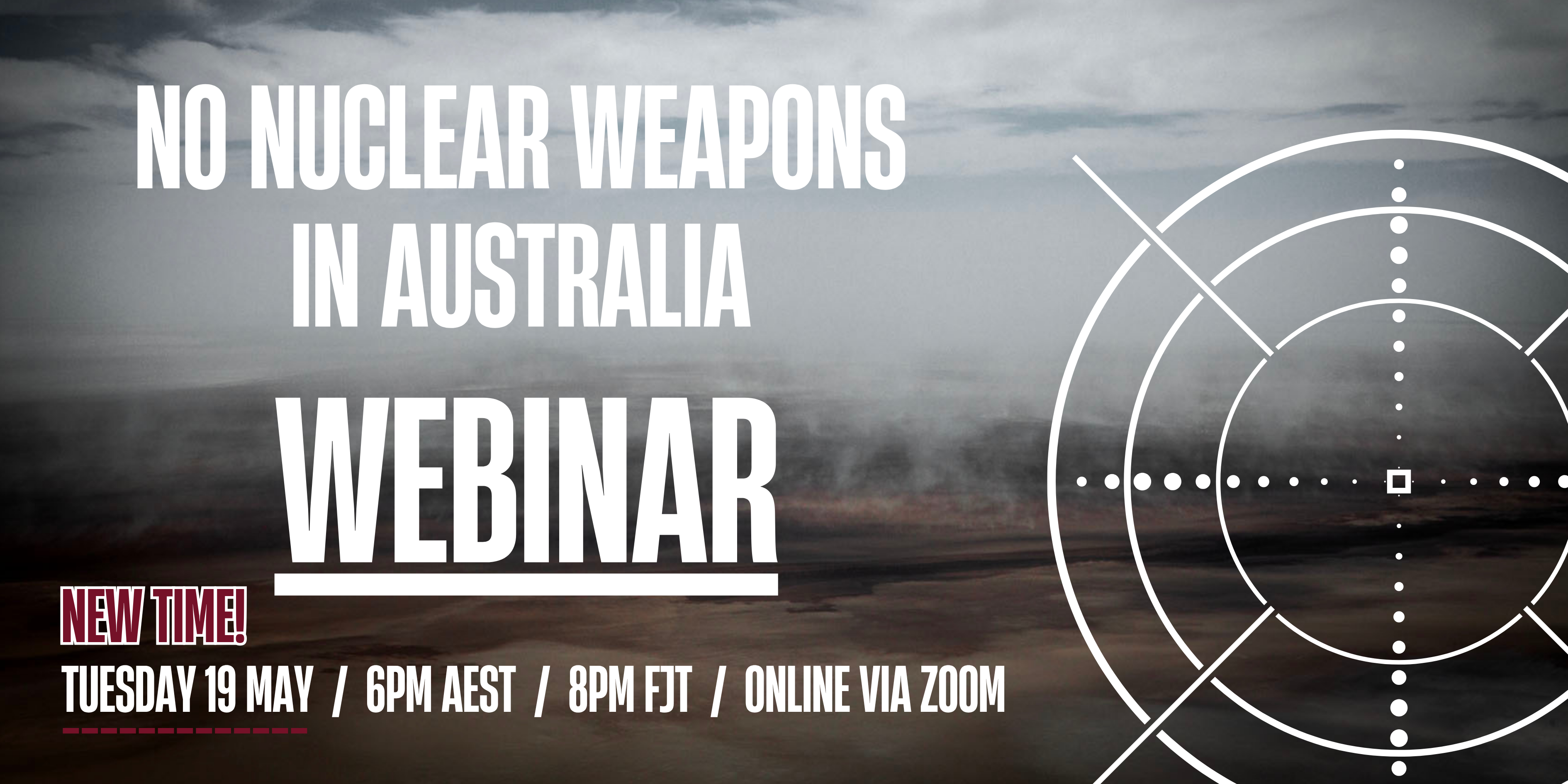
19 May – Webinar- Webinar: No Nuclear Weapons in Australia
Start: 2026-05-19 18:00:00 UTC Canberra, Melbourne, Sydney (GMT+10:00)
End: 2026-05-19 19:30:00 UTC Canberra, Melbourne, Sydney (GMT+10:00)
20 May – Webinar – The dangerous world of AUKUS, US, military occupation and suppression of dissent

National Webinar, 20th May, 2026, 6.30pm AEST. Confronting laws restricting/suppressing protest speech and action
Speakers: Former Sen. Rex Patrick, Lawyer Nick Hanna ,Arthur Rorris ,Jorgen Doyle, Sen David Shoebbridge,
Facilitator Kelley Tranter.

of the week – Australians for War Powers Reform (AWPR)
To see nuclear-related stories in greater depth and intensity
 Antinuclear