Concrete tomb filled with deadly nuclear waste is leaking as it’s starting to crack

Joe Harker, 12 August 2023 https://www.unilad.com/news/world-news/qin-xi-huang-tomb-china-emperor-terracotta-army-345786-20230809
43 years ago a concrete container of nuclear waste was constructed on a tiny island in the Pacific Ocean, but there’s a big problem with that, it’s leaking.
During the Cold War, the US used islands in the Pacific to test nuclear weapons, and between 1946 and 1958 carried out a series of tests on Enewetak Atoll.
Of course, nuclear bombs poison the ground around them and the waste from these weapons is a dangerous commodity in and of itself. So between 1977 and 1980, a concrete dome was built to store the nuclear waste from the bomb tests.
That ended up being called the Runit Dome, because it was located on Runit Island, though it was also referred to as ‘the tomb’.
Housing radioactive debris, including poisonous plutonium, thousands of people scraped nuclear waste into a blast crater and covered it over with concrete to stop it from getting out.
Unfortunately that plan isn’t going quite so well as, according to IFL Science, a report from 2019 warns that changing conditions on the island are causing the concrete dome to crack.
Increasing temperatures are not helping the problem, while a rise in sea levels is also compounding the problem as the dome is not elevated off the ground, and the lapping waters of the sea are eroding it further.
This is all resulting in radioactive material bleeding out into the ground on the rest of the island and leaking out into the sea as well.
As long as the plutonium stays within the crater covered by the dome then it won’t be a major new source of contamination into the ocean.
That could all change if the cracking dome were to give way and seawater was able to flow in and out of the crater.
This concrete tomb could be a cracking nuclear coffin with a monster inside just waiting to be released, but for now things are still within acceptable levels.
According to the Woods Hole Oceanographic Institution, marine radioactivity expert Dr Ken Buesseler said they’d ‘known for years that the dome is leaking’, but for now only a ‘small amount of radioactivity’ was getting out.
For context, this isn’t putting the surrounding area beyond safety standards just yet, and the plutonium sealed beneath the Runit Dome is only a fraction of what was released during nuclear testing.
While he said things were alright at the moment, he warned that they ‘hadn’t considered sea level rise in the 1970s when they built this’, and said the dome would be ‘at least partially submerged by the end of this century’.
TODAY. The “modern” nuclear industry manages its radioactive sewage in a medieval way

The nuclear industry prides itself on being such a “modern” “civilised” industry. However, it is quite happy to deal with its garbage in a medieval way. Just as, centuries ago, in “civilised” Europe it was just fine to pour your sewage into the street – to flow on to public waterways and oceans.
This mendacious industry cons us all into believing that the Fukushima nuclear waste-water is the same as water released from active nuclear power plants. It is not.
Normally, water that is used in cooling a nuclear plant in routine operation and then discharged to the environment has no direct contact with the nuclear reactor fuel cores. In contrast, the contaminated water generated by the Fukushima disaster has come into direct contact with contamination from the melted down cores of three reactors and as such is severely contaminated with many radionuclides. It has greater variety of radioactive materials but also the overall much higher radioactivity.
But that’s not the only deception. With its customary false logic, the nuclear industry claims that because several countries already pour nuclear-irradiated wastewater into the sea, that proves that it is OK to do so. That’s like a medieval person explaining that pouring sewage into the street is fine, because the neighbours do it.
The global ban on ocean dumping of radioactive waste adopted in 1993 applies only to barrels. It has allowed Britain and France to pump billions of gallons of radioactive wastewater into the Irish Sea and the North Sea respectively, for decades. The mind boggles at the thought of what the Russians do with theirs.

It took the Black Plague in 1350 to make people realise that sewage, garbage, and dead bodies in the streets were really a bad idea.
What is it going to take for the world to stop this wonderful “modern” nuclear industry pour its radioactive sewage into the public oceans?
And for that matter, since nuclear power and nuclear weapons are not essential – why allow their toxic sewage to be produced at all?
Woomera looms as national nuclear waste dump site

Financial Review, Phillip Coorey, Political editor, 10 Aug 23,
A federal government decision to scrap plans for a nuclear waste dump outside the South Australian town of Kimba has increased speculation it will instead build a bigger facility on defence land at Woomera that could also accommodate high-level waste from the AUKUS submarines.
More than two decades of work by successive governments to find a site to store low- and medium-level waste ended on Thursday when Resources Minister Madeleine King announced the government would not appeal last week’s Federal Court decision against the dump going ahead.
The court ruled on an action brought by the local Barngarla people, angering the Kimba community which had been bracing for the jobs and revenue the facility would have created.
……………………………………………. The dump was also opposed by the state Labor government.
Local Liberal MP Rowan Ramsey, who holds the federal seat of Grey, lashed Ms King and the government in parliament, calling the decision not to appeal as “cowardly, gutless and lacking moral fibre”.
Liberal Senate leader and SA senator Simon Birmingham concurred, especially as the Federal Court ruling was “very narrow” one……………………………………………………………….
[The dump] was not designed to store high-level waste such as the spent reactors from the nuclear-powered subs Australia will acquire and build under AUKUS.
Favoured location
Earlier this week, Defence Minister Richard Marles reaffirmed that the submarine waste would have to be stored on Defence Department land. The Australian Financial Review understands the favoured location is the Woomera rocket range in remote SA, although the selection process has yet to begin.
A high-level waste dump in Woomera would also store low and medium-level waste, ending the decades of conflict that have been caused by trying to choose such sites as Kimba.
In March, former Howard government minister Nick Minchin told the Financial Review that Mr Marles should cut to the chase and identify Woomera as the site for the high-level nuclear waste dump required under the AUKUS pact.
As industry and science minister between 1998 and 2001, the then Liberal senator for SA fought to establish a repository for low- and medium-level waste after initially choosing Woomera but being rebuffed by the Defence Department because of the stigma associated with nuclear waste.
This was despite tonnes of radioactive soil having been stored at Woomera in barrels for years.
“From my long experience of working on this issue, the Commonwealth would be well-advised putting it on Commonwealth land to avoid the states playing politics,” Mr Minchin said.
“Having previously assessed Woomera, it ticks all the boxes in terms of remoteness, stability and space.”…………………………………………….. https://www.afr.com/politics/federal/woomera-looms-as-national-nuclear-waste-dump-site-20230810-p5dvle
How will they explain themselves to their grandchildren?

August 11, 2023, by: Mark Buckley https://theaimn.com/how-will-they-explain-t
It is hard to understand the stupidity of Australia’s political leaders when it comes to the climate catastrophe. It is a given that the likes of Barnaby Joyce and Tony Abbott will ignore the facts as they unfold, but even they must have noticed what’s going on.
Maybe the political class don’t watch television, or read newspapers, or have relatives living overseas, but the rest of us do.
Two years ago there were horrific floods in Germany and Belgium, in mid-July 2021, which killed more than 220 people. Damage was widespread and was seen as far away as the Netherlands, Austria and Switzerland. In Europe, in summer.
In Australia we know the lasting devastation of floods, and the impossibility of future proofing. The only solution is to re-build, if re-build you must, on higher ground.
Is a flood more real if it happens in Germany rather than in Lismore, or Shepparton? Are wildfires more devastating when they happen in Canada or Greece? Does total destruction of a town in Hawaii mean more than if it happens in Mallacoota?
Ask Matt Canavan why he chooses to ignore the facts of climate destruction in Australia. What does he think of the lack of sea ice in the Antarctic this year? Some scientists think the rise in sea levels, caused by the undermining of the ice in Antarctica, could range from between 2 metres to 10 metres.
Imagine the harm to our coastal cities if it comes in closer to 10 metres. Well, they won’t be there anymore, so it’s not difficult to imagine the damage. It won’t make it hard to get onto the West Gate Bridge, because the West Gate Bridge will be an abandoned arc of empty roadway, and what would be the use of driving to Geelong, because Geelong won’t be there anymore.
Kardinia Park will be an empty reservoir. But enough imagining, already. For our intellectually challenged leaders, the plight of our civilisation is at stake.
Droughts and bushfires will alternate with flooding rains, as the seasons change. Mass starvation will lead to mass migrations, from those lands most affected, to those less affected.
If you think living in the mountains, far away from the mass populations of cities, will make you safe from the changes in the climate, think again.
Towns in the Andes mountains in Peru have reached 38°C or more, while in Argentina’s capital, Buenos Aires, temperatures above 30°C have been recorded; this month. It is winter there now.
Peter Dutton wants to fix the climate crisis with nuclear power. Does he know how long it takes to arrange for a nuclear power station to be approved, planned and built? Does he not own a clock, or a calendar?
On the government’s side of the ledger, more than 2,000 medical professionals have demanded that the Albanese government withdraw $1.5bn funding for the Middle Arm industrial development, in the Northern Territory.
The funding is a handout to assist the development of the huge Beetaloo Basin gas field. Labor is struggling to disguise the funding. Are votes in the short-term worth wrecking the climate?
We have been told that the earth is reaching, and in some cases, passing through “tipping points” for the climate.
It doesn’t take much imagination to recognise the utter failure of almost every government on earth to react to the crisis.
See the piss-ant state governments as they legislate to criminalise the actions of climate activists. Jailing them won’t achieve anything. It is as effective and as ridiculous as trying to stop the tide.
See how the so-called leaders of governments world-wide baulk at the difficult conversations they need to have with their citizens, to convince them that time has almost run out.
Believe it or not, but the scientists need to change their language, from calm reason to barely suppressed terror. We are facing Armageddon, and politicians are worried that people will either panic, or vote them out of power.
They need to get to the front. Show some leadership. Make change. Don’t worry about plans for fifty years in the future, your rubbish plans for nuclear subs and inland rail.
Worry about the end of civilisation as we know it. Worry about our children and their children. I don’t want my grandchildren starving because we had a leadership which valued the chance of a directorship with a gas company over the survival of humanity.
And the leaders of today need to know there is nowhere to hide if it all turns to manure. They were warned, and there is not a mountain high enough to escape to.
Zelensky Fires All Military Enlistment Office Chiefs Over Corruption Allegations

DAILY WIRE, By Zach Jewell, Aug 12, 2023
Ukrainian President Volodymyr Zelensky announced Friday that he will dismiss every single head of the country’s regional military enlistment offices over allegations of abuse of power, fraud, and corruption.
In a statement released by Zelensky’s office, the president said that a recent inspection of “military commissars” revealed that some of the military officials illegally obtained cash or cryptocurrency while others illegally transported people eligible for military service across the border. The inspection began in June after journalists uncovered that the former head of the Odesa Oblast military enlistment office purchased property in Spain worth $4.5 million, according to the Kyiv Independent. ………………….
In all, 112 criminal cases have been opened following the inspection of enlistment offices and 33 people have been charged. …………………….
The Ukrainian president said he will replace the fired commissars with officers who have experience on the battlefield. The replacements will be reviewed by the country’s Security Service.
Earlier this year, Zelensky fired one of his top generals and numerous top officials were fired or resigned after they were hit with allegations of corruption. Many of the officials who were fired or resigned were accused of leaving the country and living lavish lifestyles while their country fought the Russian invaders.
Zelensky’s firing of the enlistment office chiefs comes as President Joe Biden asked Congress to approve more than $24 billion in aid to Ukraine as part of a $40 billion package. In the package, Biden asked for $20 billion more to go to Ukraine than he requested be used to address the ongoing border crisis, POLITICO reported.
The U.S., which is by far the largest supporter of Ukraine’s war effort, has failed to track its shipments of weapons and military equipment to the European country, according to a report last month from the inspector general for the Department of Defense. After describing the inability of the U.S. to track all of the weapons it had sent to Ukraine, the report listed several examples of groups in the country obtaining military equipment for nefarious purposes, though the origin of the equipment remained unclear as the report was heavily redacted.
Americans are becoming increasingly wary of U.S. involvement in the Ukraine-Russia war with a majority of voters now saying they oppose more funding for Ukraine, according to a recent CNN poll. Biden, however, has repeatedly said that the U.S. will support Ukraine for “as long as it takes.”
Secret Pakistan cable documents US pressure to remove Imran Khan
“All will be forgiven,” said a U.S. diplomat, if the no-confidence vote against Pakistan Prime Minister Imran Khan succeeds.
The Intercept, Ryan Grim, Murtaza Hussain, August 9 2023,
THE U.S. STATE DEPARTMENT encouraged the Pakistani government in a March 7, 2022, meeting to remove Imran Khan as prime minister over his neutrality on the Russian invasion of Ukraine, according to a classified Pakistani government document obtained by The Intercept.
The meeting, between the Pakistani ambassador to the United States and two State Department officials, has been the subject of intense scrutiny, controversy, and speculation in Pakistan over the past year and a half, as supporters of Khan and his military and civilian opponents jockeyed for power. The political struggle escalated on August 5 when Khan was sentenced to three years in prison on corruption charges and taken into custody for the second time since his ouster. Khan’s defenders dismiss the charges as baseless. The sentence also blocks Khan, Pakistan’s most popular politician, from contesting elections expected in Pakistan later this year.
One month after the meeting with U.S. officials documented in the leaked Pakistani government document, a no-confidence vote was held in Parliament, leading to Khan’s removal from power. The vote is believed to have been organized with the backing of Pakistan’s powerful military. Since that time, Khan and his supporters have been engaged in a struggle with the military and its civilian allies, whom Khan claims engineered his removal from power at the request of the U.S.
The text of the Pakistani cable, produced from the meeting by the ambassador and transmitted to Pakistan, has not previously been published. The cable, known internally as a “cypher,” reveals both the carrots and the sticks that the State Department deployed in its push against Khan, promising warmer relations if Khan was removed, and isolation if he was not.
The document, labeled “Secret,” includes an account of the meeting between State Department officials, including Assistant Secretary of State for the Bureau of South and Central Asian Affairs Donald Lu, and Asad Majeed Khan, who at the time was Pakistan’s ambassador to the U.S.
The document was provided to The Intercept by an anonymous source in the Pakistani military who said that they had no ties to Imran Khan or Khan’s party. The Intercept is publishing the body of the cable below, correcting minor typos in the text because such details can be used to watermark documents and track their dissemination………………………………………………………………………………………………………………………………………………
The Intercept has made extensive efforts to authenticate the document. Given the security climate in Pakistan, independent confirmation from sources in the Pakistani government was not possible. The Pakistan Embassy in Washington, D.C., did not respond to a request for comment……………………………………………………………………………………………………………………
more https://theintercept.com/2023/08/09/imran-khan-pakistan-cypher-ukraine-russia/—
The US grip on Australia keeps tightening. Can we break free and avoid war?
By Bevan RamsdenAug 9, 2023 https://johnmenadue.com/for-independence-and-peace-the-us-grip-on-australia-must-be-broken/—
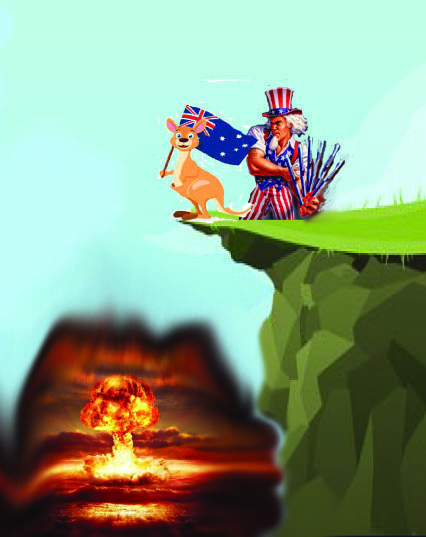
AUSMIN 2023 has further surrendered sovereignty and tightened the US military grip on Australia. The integration of the ADF with the US military, insertion of US intelligence staff in our defence intelligence organisation and the increased military presence of the US including command facilities in Australia has locked us into any war plans of the United States and made us a launching pad for their wars. The US grip on Australia must be broken to give us independence and a peaceful future.
The AUSMIN 2023 talks between the Australian Defence and Foreign Affairs ministers, Richard Marles and Penny Wong and their US counterparts Secretary of State Antony Blinken and Defence Secretary Lloyd Austin, have further tightened the US military grip on Australia.
Australia has become the US southern Indo-Pacific base from which it will launch military operations. Under the US Force Posture Agreement the US has established, or is in the process of establishing, huge fuel, munitions, spare parts, maintenance and equipment storage facilities on our continent. It has also been given unimpeded access to our airports, seaports, RAAF, RAN and Army bases for its military aircraft, warships and nuclear submarines. Sovereignty has been cravenly sacrificed on the altar of the US-Australia military alliance.
These Australian facilities are being massively upgraded largely at Australian taxpayers expense to support these US military operations.
The ADF trains extensively with, and is under the command of, the US military in war exercises such as Talisman Sabre. The ADF is now so integrated with the US military and our foreign policy so tied to that of the US that Australia will be swept into the next US war without a whimper from our political leaders and indeed with their enthusiastic support. That the next US war will be against China, Australia’s major trading partner and that such a war will have a catastrophic impact on every aspect of the Australian people’s lives and those of the people in our region and the world, with the dreadful possibility of a nuclear exchange, apparently has not registered with our leaders.
By agreeing to the outcomes of the AUSMIN 2023 talks, Richard Marles and Penny Wong have shown that they are no more than flunkeys, willing to place the interests of the US above those of the Australian people. Some might even regard them as traitors whose actions border on treason. Either way they have accepted measures which effectively increase the US grip on Australia and infringe our national sovereignty in a most fundamental way, by denying us the ability to decide if, when and against whom we go to war.
Let’s review the decisions reached at AUSMIN 2023.
AUSMIN 2023 re-affirmed a joint commitment to operationalise the Alliance including through enhanced Force Posture Cooperation across land, maritime and air domains as well as through the Combined Logistics, Sustainment and Maritime Enterprise. They declared Enhanced Space Cooperation as a new Force Posture Initiative to enable closer cooperation on this critical operational domain.
There will be a fresh expansion of the deployment of U.S. forces to Australia including amphibious troops and maritime reconnaissance planes.
American intelligence analysts will be embedded within the Defence’s spy agency in Canberra establishing a Combined Intelligence Centre- Australia within Australia’s Defence Intelligence Organisation by 2024.
In addition to upgrading RAAF Tindal and Darwin there will be expansion and “hardening” against attacks of two other RAAF bases in the north, RAAF Scherger near Weipa in Qld and RAAF Curtin near Derby in WA.
Lightning, Super Hornet fighters and C-17 cargo planes. On November 1st 2022 the ABC ‘Four Corners’ program revealed that RAAF Tindal will be upgraded to accommodate up to six nuclear-capable B52 bombers, and on August 4th 2023 it disclosed that a search of US budget filings had revealed plans to build a US Air Force Mission Planning and Operations Centre in Darwin, plans which have never been fully disclosed by the Australian Government. Through Enhanced Maritime Cooperation there will be more and longer visits of US nuclear submarines to HMAS Stirling in WA from 2023. These visits are in preparation for Submarine Rotational Force-West involving UK and US nuclear submarines being berthed and serviced under the AUKUS Agreement.
The Americans will now conduct a “regular rotation” of U.S. army watercraft as well as deploying a US Navy spy plane to conduct surveillance flights.
The US announced its intention to pre-position US Army stores and materiel at Bandiana Army base near Wodonga in Victoria as a precursor for longer term establishment of an enduring Logistics Support Area in Queensland designed to enhance interoperability and accelerate the ability to respond to alleged ‘regional crises’ which are in reality US-perceived threats to its hegemony.
The US will collaborate with Australia in the local production of multiple- launch guided missiles, planned to commence by 2025.
We are in the grip of the US military, which is ever-tightening and underpins US control of our economy. We are indebted to the historian Clinton Fernandes for his analysis showing that of Australia’s twenty largest corporations, 15 are majority US owned. This includes BHP Billiton, once called the “Big Australian” but now 73% US owned and therefore beholden to US shareholders. The four major banks, NAB, ANZ, Westpac and the CBA, once the government- owned peoples’ bank, are all majority owned by US shareholders, a form of ‘foreign influence’ that the Government doesn’t seem to have a problem with.
The huge public expenditure on “defence”, such as the $368 billion for nuclear-powered submarines, $10 billion for Hercules cargo aircraft, $10 billion for armoured vehicles, billions for runway extensions and port upgrades – the list goes on and is at the expense of addressing urgent social needs such as urgent measures to deal with climate change and address the serious crisis in public housing, health care and public education. There is no military threat to Australia. The real beneficiary is the US military-industrial complex which has its presence in Australia through Lockheed Martin, Boeing and other corporations.
If we are to have an independent and hope of a peaceful future, the US grip on our country must be broken. There can be no social or economic justice, no real solution to the ever-worsening crises in housing, public health care, public education, care of children and the aged, and no effective measures to address climate change and no peaceful future until we free ourselves from the grip of the US militarily, politically and economically.
In order to free ourselves we must unite and we can, because increasing numbers of Australians from different walks of life and political persuasions are becoming alarmed at the suicidal direction the present Australian political leadership is taking us. We are many and are powerful when we are united, while the US collaborators and those who profit from US domination are few. We need political leaders who will serve the interests of the Australian people rather than those of the US or any other foreign power. We need a new constitution, one which will respect the people who first walked this land, will forbid the presence of ALL foreign bases and foreign troops on our soil and will give emphasis to the promotion of peace and mutually beneficial relations with all countries.
Only independence can give us back our sovereignty and self-respect and the possibility of a peaceful future.
Melissa Parke to spearhead International Campaign to Abolish Nuclear Weapons, as Oppenheimer thrusts issue into spotlight

ABC News, By David Weber, 11 Aug 23
As the film Oppenheimer and war in Ukraine both draw the world’s attention to the threat of nuclear weapons, Melissa Parke says there is no better time for change.
Key points:
- Melissa Parke says a nuclear weapons ban is urgently needed
- Ms Parke says the film Oppenheimer had raised public awareness around the issue
- She says the war in Ukraine had also made people more aware of the risks
The former West Australian federal politician and UN Human Rights lawyer has been announced as the new executive director of the International Campaign to Abolish Nuclear Weapons.
With the majority of the world’s nations supporting the UN Treaty on the Prohibition of Nuclear Weapons, Ms Parke said there was no better time for Australia to sign up.
“There’s never been a more urgent time with the heightened tensions and conflict around the world to take action to eliminate nuclear weapons,” she said.
The former Labor MP for Fremantle called for “honest negotiations” around disarmament.
“Nuclear weapons do not make the planet safer, they make it an infinitely more dangerous place to be,” she said.
“Australia’s had a proud history of championing nuclear disarmament.
“The Australian Labor Party has made a commitment in its national policy platform … [and] when they were in opposition in 2018, they made a commitment that when Labor was in government it, would sign the treaty.”…………………………………………… more https://www.abc.net.au/news/2023-08-11/melissa-parke-to-spearhead-campaign-to-abolish-nuclear-weapons/102715862
The Coalition’s likely embrace of nuclear energy is high-risk politics
The Conversation. Michelle Grattan, 10 Aug 23
Crazy brave, or just crazy? If, as seems likely, the opposition embraces nuclear power in its 2025 election policy, it will be taking a huge political gamble.
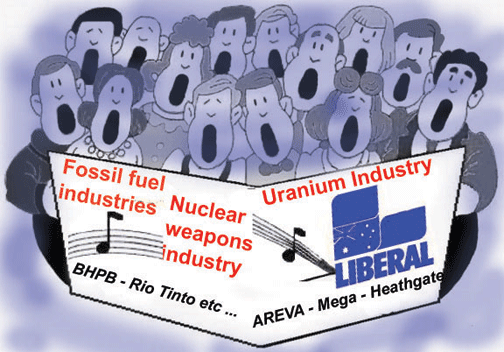
The Coalition might argue this would be the best (or only) way to ensure we achieve net zero by 2050. But “nuclear” is a trigger word in the political debate, and the reactions it triggers are mostly negative.
Opposition Leader Peter Dutton has been open since the election about nuclear energy being on the Coalition’s agenda. It’s a “no surprises” tactic – but one that has allowed the government, especially Climate Change Minister Chris Bowen, to regularly attack and ridicule the idea.
This week opposition climate change and energy spokesman Ted O’Brien was spruiking nuclear power, writing in The Australian about the US state of Wyoming’s plans for a coal-to-nuclear transition.
……………………..O’Brien, a Queensland Liberal, has been a vociferous nuclear advocate; he chaired a parliamentary inquiry under the former government that recommended work to deepen understanding of nuclear technology and a partial lifting of the present moratorium, dating from 1998, on nuclear energy.
Nationals leader David Littleproud has also been central to the push for the Coalition to back nuclear energy.
The Nationals, by their climate scepticism and their deep attachment to coal, held back the Coalition on climate policy for more than a decade. Ahead of the 2022 election they were dragged by Scott Morrison to agree to the 2050 target with a massive financial bribe (some of which they didn’t receive because of the change of government).
Now, in opposition, some of the Nationals’ rump would like the party to ditch the 2050 commitment. The nuclear option would be one means of keeping them in the tent.
The “nuclear” the Coalition is talking about doesn’t involve old-style plants, but “new and emerging technologies” including small modular reactors.
That’s one of the problems for the policy – this is an emerging technology, not a quick fix to Australia’s challenges in transiting from fossil fuels.
That is, however, nothing compared with the challenge of public opinion. Notably, the 2019 parliamentary report was titled Nuclear Energy – Not without your approval.
A 2022 Lowy poll found Australians divided on the issue of nuclear power, although opinion appeared to be softening. Some 52% supported removing the ban, which was a five-point rise from 2021; 45% opposed this – six points down on the year before.
The government would have a ready-made “not in my backyard” campaign to launch against the Coalition’s policy. …………………… https://theconversation.com/grattan-on-friday-the-coalitions-likely-embrace-of-nuclear-energy-is-high-risk-politics-211346
Atomic Bombing of Japan Was Not Necessary to End WWII. US Gov’t Documents Admit It
US government documents admit the atomic bombing of Hiroshima and Nagasaki was not necessary to end WWII. Japan was on the verge of surrendering. The nuclear attack was the first strike in Washington’s Cold War on the Soviet Union.
By Ben Norton / Geopolitical Economy Report August 10, 2023 https://scheerpost.com/2023/08/10/atomic-bombing-of-japan-was-not-necessary-to-end-wwii-us-govt-documents-admit-it/
It is very common for Western governments and media outlets to tell the rest of the world to be afraid of North Korea and its nuclear weapons, or to fear the possibility that Iran could one day have nukes.
But the reality is that there is only one country in human history that has used nuclear weapons against a civilian population – and not once, but twice: the United States.
On the 6th and 9th of August, 1945, the US military dropped atomic bombs on the Japanese cities of Hiroshima and Nagasaki. Around 200,000 civilians were killed.
Today, nearly 80 years later, many US government officials, journalists, and educators still claim that Washington had no choice but to nuke Japan, to force it to surrender and thus end World War Two. Some argue that this horrifying atrocity was in fact a noble act, that it saved even more lives that would have been lost in subsequent fighting.
This narrative, although widespread, is utterly false.
US government documents have admitted that Japan was already on the verge of surrendering in 1945, before the nuclear strikes. It was simply not necessary to use the atomic bomb.
The US Department of War (which was renamed the Department of Defense later in the 1940s) conducted an investigation, known as the Strategic Bombing Survey, analyzing its air strikes in World War II.
Published in 1946, the Strategic Bombing Survey stated very clearly, “Japan would have surrendered even if the atomic bombs had not been dropped”:
… it seems clear that, even without the atomic bombing attacks, air supremacy over Japan could have exerted sufficient pressure to bring about unconditional surrender and obviate the need for invasion.
Based on a detailed investigation of all the facts, and supported by the testimony of the surviving Japanese leaders involved, it is the Survey’s opinion that certainly prior to 31 December 1945, and in all probability prior to 1 November 1945, Japan would have surrendered even if the atomic bombs had not been dropped, even if Russia had not entered the war, and even if no invasion had been planned or contemplated
The nuclear strikes on Japan represented a political decision taken by the United States, aimed squarely at the Soviet Union; it was the first strike in the Cold War.
In August 1945, the USSR was preparing to invade Japan to overthrow its ruling fascist regime, which had been allied with Nazi Germany – which the Soviet Red Army had also just defeated in the European theater of the war.
Washington was concerned that, if the Soviets defeated Japanese fascism and liberated Tokyo like they had in Berlin, then Japan’s post-fascist government could become an ally of the Soviet Union and could adopt a socialist government.
The atomic bombs dropped on Hiroshima and Nagasaki, therefore, were not so much aimed at the Japanese fascists as they were aimed at the Soviet communists.
This expressly political decision to use nuclear weapons against Japan was in fact opposed by several top US military officials.
As one of the most famous generals in US military history, Dwight Eisenhower led operations in the European theater of the war and oversaw the subsequent occupation of what was formerly Nazi Germany.
Eisenhower later became president of the United States, following Harry Truman, the US leader who had nuked Japan.
Eisenhower is renowned worldwide for his leadership in the fight against fascism in Europe. But what is little known is that he opposed the US nuclear attacks on Japan.
After leaving the White House, Eisenhower published a memoir titled Mandate for Change. In this 1963 book, the former top general recalled an argument he had in July 1945 with then US Secretary of War Henry Stimson.
Stimson had notified him that Washington was planning to nuke Japan, and Eisenhower criticized the decision, stating that he had “grave misgivings” and was convinced “that Japan was already defeated and that dropping the bomb was completely unnecessary”.
The incident took place in [July] 1945 when Secretary of War Stimson, visiting my headquarters in Germany, informed me that our government was preparing to drop an atomic bomb on Japan. I was one of those who felt that there were a number of cogent reasons to question the wisdom of such an act. … But the Secretary, upon giving me the news of the successful bomb test in New Mexico, and of the plan for using it, asked for my reaction, apparently expecting a vigorous assent.
During his recitation of the relevant facts, I had been conscious of a feeling of depression and so I voiced to him my grave misgivings, first on the basis of my belief that Japan was already defeated and that dropping the bomb was completely unnecessary, and secondly because I thought that our country should avoid shocking world opinion by the use of a weapon whose employment was, I thought, no longer mandatory as a measure to save American lives. It was my belief that Japan was, at that very moment, seeking some way to surrender with a minimum loss of “face”. The Secretary was deeply perturbed by my attitude, almost angrily refuting the reason I gave for my quick conclusions.
These “completely unnecessary” nuclear attacks on Hiroshima and Nagasaki killed some 200,000 civilians. But they had a political goal, aimed at the Soviet Union.
The political reasons behind the atomic bombing of Japan have been publicly acknowledged by the US Department of Energy’s Office of History, which runs a website with educational information about the Manhattan Project, the scientific initiative that developed the bomb.
The US government website conceded that the Truman administration’s decision to nuke Japan was politically motivated, writing:
After President Harry S. Truman received word of the success of the Trinity test, his need for the help of the Soviet Union in the war against Japan was greatly diminished. The Soviet leader, Joseph Stalin, had promised to join the war against Japan by August 15th. Truman and his advisors now were not sure they wanted this help. If use of the atomic bomb made victory possible without an invasion, then accepting Soviet help would only invite them into the discussions regarding the postwar fate of Japan.
Other historians argue that Japan would have surrendered even without the use of the atomic bomb and that in fact Truman and his advisors used the bomb only in an effort to intimidate the Soviet Union.
…
Truman hoped to avoid having to “share” the administration of Japan with the Soviet Union.
Mainstream historians have acknowledged this fact as well.
Ward Wilson, a researcher at the establishment London-based think tank the British American Security Information Council, published an article in Washington’s elite Foreign Policy magazine in 2013 titled “The Bomb Didn’t Beat Japan. Stalin Did”.
“Although the bombs did force an immediate end to the war, Japan’s leaders had wanted to surrender anyway and likely would have done so before the American invasion planned for Nov. 1. Their use was, therefore, unnecessary”, he wrote.
Wilson explained:
If the Japanese were not concerned with city bombing in general or the atomic bombing of Hiroshima in particular, what were they concerned with? The answer is simple: the Soviet Union.
…
Even the most hard-line leaders in Japan’s government knew that the war could not go on. The question was not whether to continue, but how to bring the war to a close under the best terms possible.
One way to gauge whether it was the bombing of Hiroshima or the invasion and declaration of war by the Soviet Union that caused Japan’s surrender is to compare the way in which these two events affected the strategic situation. After Hiroshima was bombed on Aug. 6, both options were still alive. … Bombing Hiroshima did not foreclose either of Japan’s strategic options.
The impact of the Soviet declaration of war and invasion of Manchuria and Sakhalin Island was quite different, however. Once the Soviet Union had declared war, Stalin could no longer act as a mediator — he was now a belligerent. So the diplomatic option was wiped out by the Soviet move. The effect on the military situation was equally dramatic.
When the Russians invaded Manchuria, they sliced through what had once been an elite army and many Russian units only stopped when they ran out of gas.
…
The Soviet invasion invalidated the military’s decisive battle strategy, just as it invalidated the diplomatic strategy. At a single stroke, all of Japan’s options evaporated. The Soviet invasion was strategically decisive — it foreclosed both of Japan’s options — while the bombing of Hiroshima (which foreclosed neither) was not.
Attributing the end of the war to the atomic bomb served Japan’s interests in multiple ways. But it also served U.S. interests. If the Bomb won the war, then the perception of U.S. military power would be enhanced, U.S. diplomatic influence in Asia and around the world would increase.
…
If, on the other hand, the Soviet entry into the war was what caused Japan to surrender, then the Soviets could claim that they were able to do in four days what the United States was unable to do in four years, and the perception of Soviet military power and Soviet diplomatic influence would be enhanced. And once the Cold War was underway, asserting that the Soviet entry had been the decisive factor would have been tantamount to giving aid and comfort to the enemy.
Thus, before World War II was even over, the United States launched a Cold War against its ostensible “ally”, the Soviet Union – and against the potential spread of socialism anywhere around the world.
US spy agencies began recruiting former fascists and Nazi collaborators. US officials freed Class A Japanese war criminals from prison, some of whom went on to lead the government in Tokyo.
Many of these figures were involved in founding the right-wing Liberal Democratic Party (LDP), which has essentially run Japan as a one-party state since 1955 (excluding a mere five years of opposition rule).
A textbook example of this was Nobusuke Kishi, a notorious war criminal who ran the Japanese empire’s Manchukuo puppet regime and oversaw genocidal atrocities in collaboration with the Nazis. He was briefly imprisoned, but later pardoned by US authorities and, with Washington’s support, rose to become prime minister of Japan in the 1950s.
Kishi’s fascist-linked family still commands significant control over Japanese politics. His grandson, Shinzo Abe, was the longest-serving prime minister in the East Asian nation’s history.
Today, it remains important to correct widespread myths about this history, because they have a profound impact on popular culture.
In July 2023, Hollywood released a blockbuster film, “Oppenheimer”, by award-winning director Christopher Nolan. The movie was a huge commercial success, but was also criticized for its politics.
The film humanized the eponymous physicist who directed the Manhattan Project’s Los Alamos laboratory, J. Robert Oppenheimer, commonly known as the “father of the atomic bomb”.
Later in life, Oppenheimer came to regret the role he played in developing the weapon, and he campaigned against nuclear proliferation.
Ironically, Oppenheimer also became a victim of the US government’s McCarthyism, and was persecuted for his links to left-wing groups.
But while the movie was celebrated for depicting Oppenheimer’s complex internal struggles, it was accused of whitewashing the brutality of the US atomic bombings of Hiroshima and Nagasaki.
The Japanese civilians who lost their lives in these totally unnecessary attacks were eerily absent from the film.
By incessantly repeating the falsehood that nuking 200,000 people was the only way to get Japan to surrender, US officials have normalized this erasure of the civilian victims of its unnecessary, politically motivated war crimes.
…
Chinese UN mission releases working paper on Fukushima nuclear-contaminated wastewater issue, urging Japan to discharge in responsible manner
By Global TimesP Aug 09, 2023 https://www.globaltimes.cn/page/202308/1295954.shtml
Chinese UN mission releases working paper on Fukushima nuclear-contaminated wastewater issue, urging Japan to discharge in responsible manner
China’s Permanent Mission to the United Nations (UN) and Other International Organizations in Vienna has submitted the working paper on the disposal of nuclear-contaminated water of Japan’s Fukushima Daiichi Nuclear Power Station to the First Preparatory Committee for the Eleventh Review Conference of the Treaty on the Non-Proliferation of Nuclear Weapons (NPT).
The disposal of nuclear-contaminated water from Fukushima concerns the global marine environment and public health. There is no precedent for artificially discharging nuclear-contaminated water into the ocean and no internationally recognized disposal standards.
The international community should attach great importance to Japan’s ocean discharge of the nuclear-contaminated water and urge Japan to dispose of the contaminated water in a responsible manner, according to the working paper released on Wednesday.
The working paper pointed out that Japan had previously discussed five ways to dispose of the contaminated water, namely injection into the ground, discharge into the ocean, vapor release, release as hydrogen gas into the atmosphere, and underground burial. However, Japan did not conduct a thorough study of all disposal options and insisted on choosing ocean dumping, which was the lowest cost option, thus transferring the risk of nuclear contamination.
If the so-called ”treated-water” is really safe and harmless, why does Japan not dispose of it within its own territory or use it for industrial and agricultural purposes? The working paper pointed out.
The paper noted that Japan fails to prove the long-term effectiveness and reliability of the purification equipment for treating the contaminated water. According to the data released by Japan, nearly 70 percent of the nuclear-contaminated water treated by Japan’s ALPS (Advanced Liquid Processing System) still fails to meet the discharge standard and needs to be purified again.
Japan has failed to prove the authenticity and accuracy of the data on contaminated water. Fukushima power plant operator TEPCO has repeatedly concealed and falsified nuclear-contaminated water related data in recent years. The IAEA conducted its review and assessment solely based on the data and information provided by Japan, and carried out inter-laboratory comparative analyses of only a small number of nuclear-contaminated water samples collected by Japanese officials, read the working paper.
According to general international law and the provisions of UN Convention on the Law of the Sea, Japan has the obligation to protect and preserve the marine environment. The Convention on the Prevention of Marine Pollution by Dumping of Wastes and Other Matter 1972 (the London Convention) prohibits the dumping of radioactive waste into the sea by means of man-made structures at sea. Japan’s discharging of nuclear-contaminated water into the sea by means of submarine pipelines is in violation of the relevant provisions of the London Convention.
Japan has failed to demonstrate the perfection of the monitoring program. Tokyo must not start discharging until the long-term monitoring mechanism is established, and must stop discharging water once anomalies are detected in the data on the discharge of nuclear contaminated water.
The Chinese UN mission stressed that Japan should not confuse the concept of nuclear-contaminated wastewater with the wastewater from the normal operation of nuclear power plants.
The working paper warned Japan of not making use of IAEA’s comprehensive assessment report on the disposal of Fukushima nuclear-contaminated water as ”shield” or ”greenlight” for the dumping plan.
In addition, the paper urged Japan to fully respond to the concerns of China and the international community, and dispose of the nuclear-contaminated water in a responsible manner in line with its obligations under international law, stop pushing through the dumping plan, fully consult with stakeholders including neighboring countries, make sure to handle the nuclear contaminated water in a science-based, safe and transparent way, and subject itself to rigorous international oversight
TODAY: The Australian Labor Party embraces militarism- has it lost its soul?

Yes, I’m afraid so. Even when I left the Australian Labor Party in 1984, as then Prime Minister Bob Hawke compromised with the nuclear industry, I still had hope for Australia’s party that represented the workers and the ordinary people.
Not any more. What a huge disappointment is Anthony Albanese. Once he seemed to be a champion for the workers, and for peace, and for a nuclear-free Australia. Now he is Joe Biden’s best friend, and leading Australia into militarism with more fervour even than the Liberals and Nationals.
A glimmer of hope. Labor Against War – a newly formed body within the ALP will be pushing for an end to AUKUS, AUSMIN and the whole war-mongering madness. And they’re not a bunch of extremists – they represent some of the brightest minds and most respected people in the ALP, as well as some powerful trade unions and anti-nuclear activists in many ALP branches.
Labor Against War is not going away . The corporate media today is proclaiming their unimportance – “AUKUS is safe – the coming ALP National Conference will not be troubled by such movement”
Well, we will see. No wonder that so many disenchanted Labor voters have moved to the Greens, as I did. But even within Labor, we still have like-minded people who oppose the suicidal lunacy that is AUKUS.
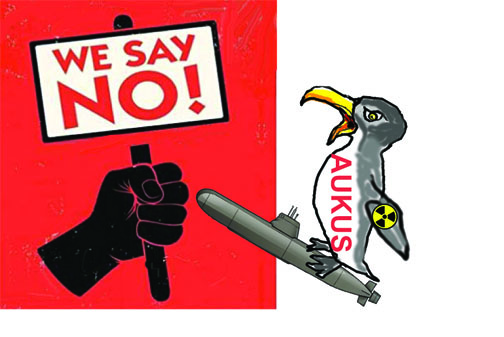
Marcus Strom: AUKUS is a mad, bad and dangerous war policy, Labor Against War
And that’s what Labor Against War is about. We can’t sit silently on this. We only formed only a few months ago. Already, we are working branch by branch, moving motions, winning many, losing some, making alliances with the Maritime Union, the Australian Manufacturing Workers Union, the Electrical Trades Union, the Construction Union. Unions New South Wales has a policy opposed to AUKUS.
By Marcus StromAug 10, 2023 https://johnmenadue.com/marcus-strom-aukus-is-a-mad-bad-and-dangerous-war-policy/
Anthony Albanese likes to think of himself as a Bob Hawke unifying type. But if he keeps dragging us along this war path, he will be remembered as our Tony Blair.
We hear a lot about how AUKUS is going to be about getting the balance right, rebalancing the region as China expands. And yes, China has its interests, and is building a military in the region and that is also to be concerned about. But I wonder about balance. And we’ve just been reminded again the stories from Guam and from Okinawa. There are 343 US bases in East Asia alone. Now, I don’t know how eight nuclear submarines adds to the balance in the region.
AUKUS is a policy of empire. And empire means violence. And I am amazed having worked in Canberra until recently at the blithe, consequence-free approach that our political leaders seem take to this. It’s “just the price of doing business on the world stage” is how it’s presented.
This is not what the Labor Party should be fighting for.
Alongside the obscene violence of joint war games happening in Australia at the moment, we’ve had the AUSMIN meeting between leading Australian ministers and US ministers. I read this in the press yesterday about what AUSMIN means. “Australia is now being asked to pull more of its weight in the alliance, play a bigger role in helping stabilise the regional balance of power and be integrated as a base of operations into US force projections into the region or into US war planning for a possible conflict with China in Asia.”
That’s from the very radical editorial column of the Australian Financial Review. Also from the Australian Financial Review today, “The AUSMIN talks over the weekend continue the trend since the late 1990s of tying Australia more tightly into both American grand strategy and war planning in Asia. The permanent American military presence on Australian soil is now at a scale unprecedented since the Second World War.”
They are preparing us for war.
That is why I could no longer work for this government. Up until February I was press secretary to Ed Husic, and the AUKUS policy is one of the main reasons I resigned from that position.
As I said to somebody coming in, “The secret to never being disillusioned with the Labor Party is never be illusioned with the Labor Party.” But the Labor Party, despite its many flaws, does have a tradition of opposing some unjust wars. This was pointed out by Paul Keating at a recent National Press Club speech he gave.
Labor was against the Vietnam War, eventually; Labor did stand against the second Iraq War. Although Bob Hawke did support the first Iraq war. So there’s a chequered history.
I’m going to talk about Tom Uren. Tom Uren many of you will know was a lone voice to start with against the Vietnam War in the Labor Party.
Keating pointed out that the ALP opposed Vietnam. But that’s not always how it was. Tom Uren points out in an interview he gave in 1996, that he and Jim Cairns, who went on to become treasurer, moved a motion to Labor caucus in 1965 opposing US bombing of North Vietnam. They lost that vote.
The left then of the Labor Party voted against it. But seven years later Gough Whitlam on a wave of anti-war sentiment took power and one of the first acts was to bring the remaining Australian troops home from Vietnam.
So we can fight back and we can make change. While Tom Uren started as a lone voice, on AUKUS in the Labor Party, I can say we are not alone. Already people like Paul Keating, Bob Carr, Carmen Lawrence, Doug Cameron, Peter Garrett are speaking out against the insanity of this policy.
War is a deadly business. It can’t be treated as a gambit against wedge politics from the opposition, but that is how it’s being treated.
The war in Iraq killed hundreds of thousands of people, left millions displaced, sparked regional destabilisation, engendered the ISIS calamity. A war with China would make Iraq look like a tea party; it would threaten nuclear catastrophe. This is what we’re facing with AUKUS.
It is also a threat to Australian sovereignty. AUSMIN and the military interoperability it is producing, means that there will be US soldiers enmeshed with Australian forces on a continual basis.
And this Australian government, this Labor government, is now allowing the rotation of B-52s through the Tindal base in the Northern Territory. Now, those planes carry nuclear weapons. They neither confirm nor deny. Australia’s quite relaxed at that policy. But we know that makes Australia a nuclear target.
It makes Australia not just a target and a victim, but an aggressor in the region; a host to war machines that could slaughter millions of people. We have to say, “No” to that.
I’m reminded of something Henry Kissinger said, “Being an enemy of the United States is very dangerous. Being a friend is fatal.”
Simon Crean was Labor leader when the Iraq war happened, and he bravely stood against the war drums. When Simon Crean died recently, Prime Minister Anthony Albanese said, “History has vindicated Simon’s judgment, but at the time his stance was deeply counter to the prevailing political and media climate.”
We are again looking for such courage in a Labor leader.
Instead, we have meekly inherited a Scott Morrison policy. When I speak at Labor Party meetings I say, “If we’d lost the last election, and Scott Morrison was pursuing this policy, you’d all be up in arms. You’d all be screaming about the injustice of it, the war mongering of it. Just because our guy’s doing it doesn’t mean you should shut up.”
And that’s what Labor Against War is about. We can’t sit silently on this. We only formed only a few months ago. Already, we are working branch by branch, moving motions, winning many, losing some, making alliances with the Maritime Union, the Australian Manufacturing Workers Union, the Electrical Trades Union, the Construction Union. Unions New South Wales has a policy opposed to AUKUS.
The South Coast Labor Council, which is facing having a nuclear submarine base in Port Kembla, has stood up and said, “No”.
Branch by branch anti-war activists are passing resolutions. We’ve now going into National Conference. We are hoping we can force at least a bit of a debate onto that conference. To not even discuss this would be an absolute travesty of Labor Party democracy.
We’re not expecting to win at the first hurdle, but neither did Tom Uren. This is a long campaign to win the Labor Party from being a war party to being a peace party.
Assurances count for nothing. The danger we face in a multi-decade, multibillion-dollar program is we don’t know who will be prime minister in ten years, five years. We don’t know who’s going to be in the White House at the end of next year. And yet we are going to be lumbered with a nuclear alliance with two fading Anglo powers on the other side of the world.
AUKUS is a mad, bad and dangerous war policy. And to borrow from the French, we don’t just think this, we know this. As an aside, I was absolutely gobsmacked by the chutzpah of Macron speaking in the Pacific, complaining about the ‘new imperialism’ recently.
Anthony Albanese likes to think of himself as a Bob Hawke unifying type. But if he keeps dragging us along this war path, he will be remembered as our Tony Blair.
Believe it or not, the ALP is meant to be a democratic socialist party. Read it, it’s in the rules.
It’s meant to fight for a better world. But we should no longer be satisfied for fighting for Chifley’s Light on the Hill. This is a labour of Sisyphus, a goal that we never reach. It is time to bring the light down into the shadows, to enlighten the world, to bring hope to today, not tomorrow.
Capitalism is a war system. We have to oppose capitalism to stop war.
Hope is rising. We will make a difference. Use that anger that you felt to really get active. We are rebuilding a peace movement, an anti-war movement.
I look here today; we need to double, triple our numbers. At our last Labor Against War meeting in Sydney, we had somebody there in their 80s telling us about how they fought against the Vietnam War. And there were people in the room in their school uniforms. Now that is a sign for hope that we can raise our voices fight a really bad policy.
And we have to win this because the alternative is cataclysmic.
These are extracts from a speech by Marcus Strom at a public meeting organised by IPAN at the ANU, Canberra, 1 August 2023
Nuclear waste dump plans scrapped for South Australia
By Andrew Brown August 10 2023 –
Plans for a nuclear waste dump in regional South Australia have been scrapped by the federal government following a court decision blocking its construction.
The waste facility was earmarked to be built on land at Napandee near the town of Kimba in the Eyre Peninsula by the previous coalition government in 2021.
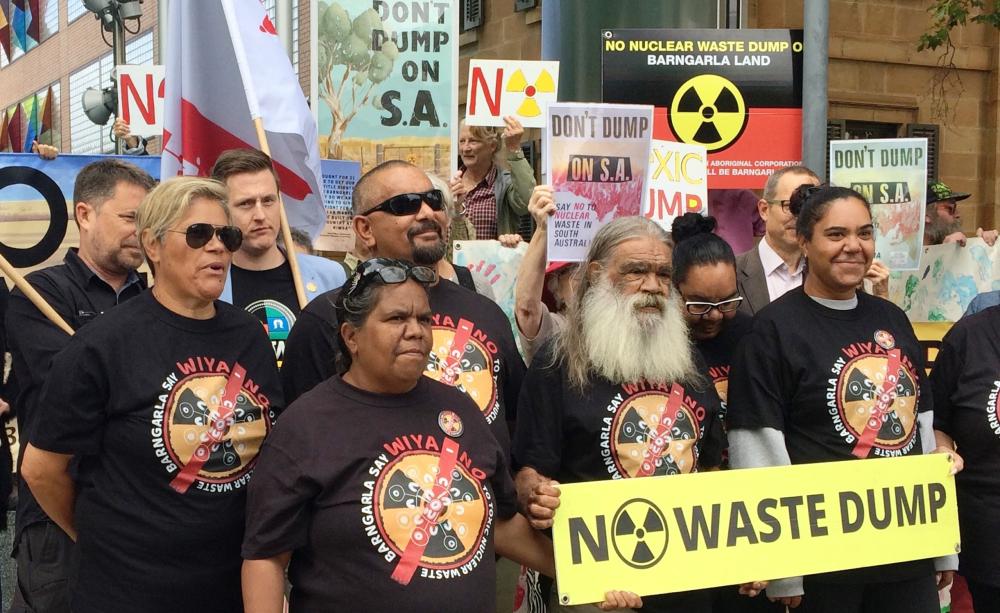
The decision was challenged in the Federal Court by traditional owners, the Barngarla people, who said the decision was made without them being consulted.
The court ruled in July the facility could not be built.
Resources Minister Madeleine King told federal parliament the government would look for a new location for the nuclear waste storage.
“I’m deeply sorry for the uncertainty the process has created for the Kimba community, for my own department, for the Australian Radioactive Waste Agency workers and for the workers involved in the project,” she said.
“I also acknowledge the profound distress this process has caused the Barngarla people.”
Ms King said any work near Kimba had stopped after the court’s decision.
She said the government would not appeal against the court decision.
“We have to get this right. This is long lasting, multi-generational government policy for the disposal of waste that can take thousands of years to decay,” she said.
“We must consult widely and bring stakeholders including First Nations people along with us. We remain bipartisan in our approach.”…………………………………………………………….. https://www.canberratimes.com.au/story/8303272/nuclear-waste-dump-plans-scrapped-for-south-australia/
Australia’s peak environmental body welcomes ‘king hit’ for nuclear waste dump at Kimba.

The Australian Conservation Foundation has welcomed the Albanese government’s decision to fully withdraw the former Coalition government’s proposal to establish a radioactive waste facility on South Australia’s Eyre Peninsula against the wishes of Traditional Owners.
Last month the Federal Court ruled in favour of Barngarla Traditional Owners, setting aside former Resources Minister Keith Pitt’s declaration of the Kimba site.
“This is a welcome and sensible decision by Minister King and federal Labor to scrap this plan, which it inherited from the previous government and which was inconsistent with international best practice and community sentiment,” said ACF’s nuclear free campaigner Dave Sweeney.
“Today’s decision is a credit to the tenacity and courage of the Barngarla people, who have been utterly determined to protect their country.
“Labor’s decision is consistent with the Federal Court ruling and with Labor values on listening to First Nations’ wishes for their Country.
“This divisive and deficient plan has caused a lot of pain and division.
“Today’s announcement signals a different approach.
“ACF looks forward to constructive dialogue with the Albanese government to help develop a new and responsible approach to radioactive waste management in Australia.
“Minister Madeleine King is right to say the previous government’s plan to double-handle the transport of this waste – first from Lucas Heights in Sydney to temporary storage at Kimba, then on to an as-yet undetermined permanent disposal site – raised concerns regarding international best practice and safety.
“The first step to getting something right is to stop getting it wrong.
“Today, the government took that important step.”
Further comment or context: Dave Sweeney 0408 317 812
1 This month
17 October, Free Public Talk on Nuclear Issues in South Australia
David Noonan will speak on public interest concerns over the new Roxby Downs Indenture Act 2026 on BHP copper-uranium mining and ore processing in SA, and on how AUKUS may face SA with a High-Level nuclear waste agenda.
Dr Jim Green will discuss international developments in the field of nuclear power including ‘small modular reactors’ and Generation 4 ‘advanced’ nuclear reactor concepts.


Help Aunty Sue Protect Her Land and Sacred Sites From Destructive Rocket Testing.
.

Australians deserve the truth
about
AUKUS – https://aukuspublicinquiry.com/

PETITION – To: Prime Minister Anthony Albanese and the Australian Labor Government

of the week – Australians for War Powers Reform (AWPR)
To see nuclear-related stories in greater depth and intensity

