Will the small states of Oceania be able to maintain their independence in the face of a new Sino-American Cold War?
The ‘friends to all, enemies to none’ strategy is living its last days as the US and China press the island nations to take sides
By Timur Fomenko, a political analyst, https://www.rt.com/news/580174-friends-to-all-enemies-to-none/ 23 July 23
Papua New Guinea is a gateway between continents. The island, being effectively cut in half, demarcates an artificial boundary between Asia and Oceania. In the past several centuries, the broader island has been carved upon between almost every colonial power going, having been ruled at various points by the Dutch, Spanish, German, Japanese and British empires. Even after gaining its formal independence from Australia in 1975, these legacies continue to scar the island, with half of it still belonging to Indonesia, known as West Papua, which is now a source of unrest and insurgency.
The history of constantly fluctuating overlords only demonstrates the country’s perceived strategic and military importance. That’s because whoever dominates it has direct access to both Australia and the Pacific, and can project into Asia itself. It is of little surprise that Papua New Guinea (PNG) became one of the most gruesome fronts of the Pacific War in World War II, which subsequently brought it firmly into the hands of the Anglosphere, where it has remained ever since, making it an effective dependency of Australia in terms of aid and humanitarian assistance.
Despite this, the island has nothing to show for centuries of colonial dominion, or from being a subordinate of the English-speaking world as a black Melanesian country. It is one of the world’s poorer nations, and is in desperate need of infrastructure to develop itself. Because of this, it has developed a foreign policy it describes as ‘friends to all, enemies to none’, which seeks to attain and exploit as many development opportunities as possible and better sustain its own strategic autonomy. This of course, has drawn interest from China, who sees the islands as an important partner as a post-colonial, Global South country. Thanks to PNG being part of the Belt and Road Initiative, Beijing has built airports, highways, sea ports, and telecommunications infrastructure across the country.
Port Moresby, in turn, sees Beijing as a critical economic partner that can help bolster its own infrastructure and development, the two countries recently having negotiated a free trade agreement. But that doesn’t mean trouble is not afoot. While China seeks to bolster economic relations with the country, the US has other ideas; that is, to forcibly transform Papua New Guinea into a military outpost for the purpose, of course, of containing China. Recently, Washington was able to pry a Defense Cooperation Agreement out of the country, which will give the US access to its bases.
PNG, of course, denies that the is specifically opposing China, and does not rule out security cooperation with Beijing itself. However, it is also a reminder that the country’s weak and vulnerable position, along with its historical subservience to the West, means it does not have the power or political privilege to resist these kinds of overtures, and instead must seek a more delicate balance. In response to this, China is likely to increase its engagement with the country; for example, the Bank of China is working to establish a presence there.
Growing competition over Papua New Guinea also comes amid China’s successes in its relationship with the Solomon Islands, which switched allegiance from Taipei to Beijing in 2019. On July 11, the two countries finally signed a security cooperation pact, which has met with vitriol from Western media and politicians.
What this demonstrates is that the Pacific region has become a ‘cold war’ theater between China and the US, with the latter working through its ally, Australia. The US, after all, has long attempted to make the Pacific an ‘extended backyard’ or ‘ranch’, a large open space over which it seeks to be the exclusive military power. But now, China is expanding into it, and this has led to the emergence of strategic competition.
However, these Pacific countries do not really want to take sides – they are tired of being tossed from one master to the other. This means the fundamental challenge for countries such as Papua New Guinea is to gain benefits to strengthen itself, while nonetheless avoiding subservience. This means it has a fight to continue its ‘friends to all, enemies to none’ approach, while tensions rise and both powers start demanding it take sides on various issues. But if worst-case scenarios can be avoided, and the pace of investment in the country from all sides accelerates, the end product may be that competition could ultimately make PNG and the island countries a lot better off, and therefore a lot more capable of exerting their own will.
Small Modular Nuclear Reactors (SMRs) are supported by ideology alone

The ”tech bro” libertarian culture that valorizes new technology, loathes regulation, and embraces the marketplace has spawned a new generation of, according to the Washington Post, “nuclear bros.”
The media has become an echo chamber, with each outlet clambering over the next to crow about the great benefits of nuclear power in misleading language that suggests this technology is already entirely proven out.
The end of Oppenheimer’s energy dream

iai news, Allison Macfarlane Allison Macfarlane is the director of the School of Public Policy and Global Affairs at the University of British Columbia and former chairman of the US Nuclear Regulatory Commission. 21st July 2023
Nuclear energy is both lauded as a baseload renewable power and decried as risky, expensive and outdated technology. Small modular reactors have received billions in venture capital and unprecedented media attention, but are they a red herring, with philosophy, rather than science, driving our fixation? Professor Allison Macfarlane explores the current sombre state of the technology, where it is falling short, and what philosophy is driving the interest in this unpromising tech.
From the inception of Oppenheimer’s harnessing of the power of the atom, first as a device for war, and later, as a means of peaceful energy production, nuclear energy has possessed both promise and peril. With large nuclear power plants struggling to compete in a deregulated marketplace against renewables and natural gas, small modular reactors (SMRs) offer the promise to save the nuclear energy option. In the past few years, investors, national governments, and the media have paid significant attention to small modular nuclear reactors as the solution to traditional nuclear energy’s cost and long build times and renewable’s space and aesthetic drawbacks, but behind the hype there is very little concrete technology to justify it. By exploring the challenges facing small modular reactor technology, I will demonstrate that this resurgence in nuclear energy speaks to the popular imagination, rather than materializing as actual technological innovation.
News broke last week that Oklo, a company that has designed an advanced micro-nuclear power plant, will go public via a merger with AltC Acquisition Corporation. Co-founder of AltC Acquisition and Chair of Oklo’s board, Sam Altman, hopes to raise US$500 million with this offering. Oklo’s news is a sample of the almost-constant barrage of excitement around the potential of small modular reactors (SMRs) to help mitigate climate change.
But can they?
The Oklo story is intriguing, since its license application to build and operate its Aurora design reactor was outright rejected by the U.S. Nuclear Regulatory Commission, the country’s nuclear safety regulator (full disclosure: I was Chairman of the NRC from 2012-2014). And note that such rejection is an accomplishment: the NRC rarely outright rejects an application, instead working with licensees until they either get the application right or decide to walk away. In this case, Oklo refused to fill “information gaps” related to “safety systems and components.”
Most of these designs are just that: designs. Very few of the proposed SMRs have been demonstrated and none are commercially available.
There are many new SMR companies in the U.S., Canada, U.K., Europe, China, and elsewhere, and the reactor designs themselves are numerous as well. There are smaller versions of existing light water reactors, like those in the U.S., France, Japan, and elsewhere. There are more “advanced” designs like sodium-cooled fast reactors (like Oklo and Bill Gate’s company Terrapower’s design), high-temperature gas reactors, and molten salt reactors.
…………………………….. One U.S. company, NuScale, is the only SMR design in the US to received “design certification” from the NRC. NuScale has an agreement with UAMPS, a consortium of utility companies, to build the first NuScale reactors in Idaho in the U.S. But NuScale won’t build the already-certified design in Idaho; the company has a new application at the NRC to build a larger, and presumably more economic, model of the reactor. Nonetheless, cost estimates for the reactor have risen from US$55/megawatt electric (MWe) in 2016 to $89/MWe in 2023, according to the Institute for Energy Economics and Financial Analysis.
Many of the non-light water SMR designs will likely be even costlier, based on recent analyses. A recent Massachusetts Institute of Technology study suggests that SMRs will run significantly higher in cost than large light water reactors, especially in per MW comparable “overnight” costs (how much it would cost to build a new reactor if one could do so overnight) and operations and maintenance costs.
Advanced reactors do not solve the problems of nuclear waste and may, in fact, exacerbate the problem.
Recent construction experience in the US and Europe does not herald success for SMR new builds. The two French-design evolutionary power reactor (EPR) builds have been far over budget and schedule. The EPR in Finland was originally supposed to cost 3 billion euros and open in 2009. It finally began producing electricity in 2023 at a cost of 11 billion euros. There is a similar story in France, where the EPR at Flamanville was set to begin operation in 2012 at a cost of 3.5 billion euro. Instead, it is still under construction and costs have ballooned to 12.4 billion euros.
And Europe is the rule, not the exception. US – based Westinghouse’s AP-1000, a robust design with passive safety features has suffered similarly. The two units under construction in South Carolina were abandoned in 2017, after an investment of US$9 billion. The two AP-1000 units in Georgia were to start in 2016/2017 for a price of US$14 billion. One unit started in April, 2023, the second unit promises to start later in 2023. The total cost is now over US$30 billion.
SMR designers appeal to factory construction to avoid some of the pitfalls of large reactor construction (thus the “modular” in Small Modular Reactor). But the AP-1000 should provide a cautionary tale: ……………………………………
One of the reasons SMRs will cost more has to do with fuel costs. Most non-light water designs require high-assay low enriched uranium fuel (HALEU), in other words, fuel enriched in the isotope uranium-235 between 10-19.99%, just below the level of what is termed “highly enriched uranium,” suitable for nuclear bombs. Currently, there are no enrichment companies outside of Russia that can produce HALEU, and thus the chicken-and-egg problem: an enrichment company wants assurance from reactor vendors to invest in developing HALEU production. But since commercial-scale SMRs are likely decades away, if they are at all viable, there is risk to doing so. Use of HALEU will also result in increased security and safeguards requirements that will add to the price tag.
The ”tech bro” libertarian culture that valorizes new technology, loathes regulation, and embraces the marketplace has spawned a new generation of, according to the Washington Post, “nuclear bros.”
HALEU fuel is needed to offset the smaller size of the reactor core, which results in increased neutron leakage – and neutrons are the initiators of fission reactions that release the energy harnessed as electrical power. Smaller reactor sizes can also result in comparatively more waste volume, next to existing large light water reactors. In fact, a recent U.S. National Academy of Science analysis noted that advanced reactors do not solve the problems of nuclear waste and may, in fact, exacerbate the problem. Some reactor designs will produce significantly more high-level waste by volume that current light water reactors, other designs will produce waste the requires chemical processing prior to disposal. These types of issues are relatively little examined and will add to the final price tag of the new technology.
With all these potential drawbacks and delays, why would anyone invest in an SMR company? I put a similar question to Ray Rothrock, a venture capitalist, at a meeting of a committee of the National Academy of Engineering that was studying the potential of these new reactors (and of which I was a member). If these reactors won’t be commercially available for a decade or more, how do investors make money? His response? “Even before they sell [energy], they go public and that’s how early investors make money…it fits the model – the company hasn’t made money, but the investors have made money.” He goes on to say that going public opens the door to much more money that is needed.
But all of this in the future. If SMRs are not ready to deploy in the next ten years, what are the implications? There are two significant ones. The first is that, given the development timelines for these new reactor designs, they are not likely to have a significant impact on CO2 emissions reductions for decades, and as a result their relevance to the climate argument shrinks.
The media has become an echo chamber, with each outlet clambering over the next to crow about the great benefits of nuclear power in misleading language that suggests this technology is already entirely proven out.
More significantly, if, as a recent study showed, that SMRs will be significantly more expensive than solar photovoltaic (PV) and on-shore wind, and even geothermal, what will the marketplace look like in 20 or 30 years, when renewables will presumably be even cheaper?
………………….. So why there so much hype around new nuclear power technologies that so far, largely, don’t exist and will likely be very costly? The need to decarbonize energy production plays a role
The advent of large amounts of available venture capital in the past decade is another factor. One analyst told me, “there’s a lot of stupid money out there right now [for investing].”
The ”tech bro” libertarian culture that valorizes new technology, loathes regulation, and embraces the marketplace has spawned a new generation of, according to the Washington Post, “nuclear bros.” Naomi Oreskes notes that an appeal to nuclear power to address our energy needs in a warming world reflects our “technofideism,” the faith that technology will solve our problems.
In the nuclear celebratory mood of the moment, there is little patience or political will for sober voices to discuss the reality that new nuclear power is actually many decades away from having any measurable impact on climate change – if at all. https://iai.tv/articles/the-end-of-oppenheimers-energy-dream-auid-2549
Discarding Illusions,Ending Wars

Eighteen months later Ukraine is in ruins. Its latest counteroffensive achieved nothing. In the last three weeks, an estimated 26,000 Ukrainian soldiers died in pointless attacks against world-class Russian defenses ‘in depth.’
The attempt to extend NATO’s “new globalist world order” to Russia has failed.
By Colonel (ret.) Douglas Macgregor, US Army, THE KENNEDY BEACON JUL 20, 2023 https://thekennedybeacon.substack.com/p/discarding-illusions-ending-wars?utm_source=post-email-title&publication_id=1712557&post_id=135282964&isFreemail=true&utm_medium=email
From the moment the war in Ukraine started, Western reporting on the war was a radical repudiation of the truth. Washington and its NATO allies always knew that NATO expansion to Russia’s borders would precipitate an armed conflict with Moscow, but NATO’s ruling globalist class did not care. For them, Russia in 2022 was unchanged from the weak and incapable Russia of the late 1990s. The risk of failure seemed low. Ergo, Russia could be bullied into submission.
Americans and most Europeans did not bother to question or analyze. Widespread strategic ignorance about Russia and Eastern Europe ensured that most Americans and even West Europeans would react quickly and viscerally to the Western media’s distorted images and lies about Russia. At the same time, tolerance for criticism of Washington’s role in fashioning the corrupt and deceitful conduct of the Volodymyr Zelenskyy Regime and its war was disallowed in the press
Washington’s ruling class was cheered when it dismissed Russian proposals for talks on any grounds that did not recognize NATO’s right to transform Ukraine into a base for U.S. and Allied Military Power aimed at Russia. Ukrainian flags sprouted from the lush grounds of America’s wealthier neighborhoods like flowers in an arboretum and wonders in the form of limitless military assistance, miracle weapons, and cash were promised to President Zelenskyy––promises that strategic reality did not justify.
In 2022 the Biden Administration no longer possessed the military and economic strength to wage high-end conventional warfare that it had in 1991. Waging a major war 10,000 miles from home on the Eurasian continent is impossible without the support of truly powerful Allies on the model of the British Empire during WWII. Washington’s NATO allies are military dependencies, not formidable strategic partners.
Whereas Russian Military Power is still structured for decisive operations launched from Russian soil, U.S. Military power is geared to project limited air, naval, and land power thousands of miles from home to the periphery of Asia and Africa. American military power consists of boutique forces designed for safari in Africa and the Middle East, not decisive combat operations against great continental powers like Russia or China.
Eighteen months later Ukraine is in ruins. Its latest counteroffensive achieved nothing. In the last three weeks, an estimated 26,000 Ukrainian soldiers died in pointless attacks against world-class Russian defenses ‘in depth.’ (Defenses ‘in depth’ mean a security zone of 15 -25 kilometers in front of the main defense, that consists of at least three defense belts twenty or more kilometers deep.)
By comparison, Russian losses were minimal.
Today, more than 100,000 Russian troops are conducting offensive operations along the Lyman-Kupiansk axis. These forces include 900 tanks, 555 artillery systems and 370 multiple rocket launchers. It does not take much imagination to anticipate the breakthrough of these forces to the North where they can encircle Kharkiv.
Once Russian Forces surround the city, they will become an irresistible magnet for Ukraine’s last reserve of 30-40,000 troops. Ukrainian Forces attacking to the East to break through to Kharkov will present the combination of Russian space and terrestrial-based ISR (intelligence, surveillance, reconnaissance) assets and Precision Strike Aerospace, Artillery, Rocket, and Missile Systems with a target array that only a blind man could miss.
None of these developments should surprise anyone in the West. Building a Ukrainian army on the fly with a hotchpotch of hastily assembled equipment from a multitude of NATO members and an officer corps of many courageous, but inexperienced officers had little chance of success even under the best of circumstance.
Wars are decided in the decades before they begin. In war, the sudden appearance of “Silver Bullet” technology seldom provides more than a temporary advantage and strong personalities in the senior ranks do not compensate for inadequate military organization, training, thinking, and effective equipment. A new, leaked memorandum from sources inside Ukraine illustrates these points:
“Units of the Ukrainian Armed Forces are at such terrible states of degradation that soldiers are abandoning their posts, and whilst not mentioned in these documents, a flood of videos have been published from Russian sources claiming Ukrainian service personnel are surrendering at the first opportunity owing to the belief that they are being treated as ‘nothing more than cannon fodder.’”
Events on the ground are beginning to overtake the carefully orchestrated charade in Kiev. There is little that pontificating retired generals and armchair military analysts can do to halt the inevitable. Moscow understands that the war will not end without Russian offensive action. Whatever the Washington’s original goals may have been, theybeen they are unrealizable. Russian Forces will soon fall on the Ukrainian forces with the momentum and the impact of an avalanche.
In view of these points, before all of Ukraine’s manpower is annihilated, or a “Coalition of the Willing” from Poland and Lithuania marches into Western Ukraine, Washington can arrest Ukraine’s downward spiral into total defeat, and Washington’s own irresponsible drift into a regional war with Russia for which Washington and its allies are not prepared.
Cooler heads can prevail inside the beltway. The fighting can stop, but a ceasefire, and the diplomatic talks that must proceed from a ceasefire, will not occur unless Washington and its Allies acknowledge three critical points:
First, whatever form the Ukrainian State assumes in the aftermath of the conflict, Ukraine must be neutral and non-aligned. NATO membership is out of the question. A neutral Ukraine on the Austrian model can still provide a buffer between Russia and its Western Neighbors.
Second, Washington and its Allies must immediately suspend all military aid to Ukraine. Doubling down on failure by introducing more equipment and technology the Ukrainian Forces cannot quickly absorb and employ is wasteful and self-defeating.
Third, all U.S. and allied personnel, clandestine or in uniform, must withdraw from Ukraine. Insisting on some form of NATO presence as a face-saving measure is pointless. The attempt to extend NATO’s “new globalist world order” to Russia has failed.
The point is straightforward. It is time for Washington to turn its attention inward and address the decades of American societal, economic, and military decay that ensued after 1991. It’s time to reverse the decline in American national prosperity, and power; to avoid unnecessary overseas conflict;and to shun future interventions in the affairs of other nation states and their societies. The threats to our Republic are here, at home, not in the Eastern Hemisphere.
Western media as cheerleaders for war
Carried away by the logic of one-upmanship that they impose on the world of politics, the media are co-producing Western countries’ progressive entry into the war against Russia. Everything about the way they treat the conflict suggests that such a confrontation is inevitable. This battle of opinion, which began a year ago, is now being waged on three fronts at once. First, the beatification of Zelensky,
Western journalists are all but unanimous that negotiating with Russia would equal forgiving it its aggression. Nothing short of a crushing victory for Ukraine is conscionable. The risk of escalation is rarely mentioned.
Le Monde Diplomatiqe by Serge Halimi & Pierre Rimbert, Translated by George Miller March 2023
After speeches by British prime minister Rishi Sunak and Ukrainian president Volodymyr Zelensky at a joint press conference on 8 February at a military base in southwest England, it was time for questions. BBC Ukraine correspondent Natalia Goncharova greeted Zelensky with, ‘I would really like to hug you, but I’m not allowed.’ Ignoring his security service, Zelensky got down from the podium and embraced her to general applause. Then Goncharova asked Sunak, ‘You know that Ukrainian soldiers are dying every day. Don’t you think that that decision about warplanes is taking too long?’ In 2003, during the invasion of Iraq, the embedding of journalists with the US military had caused some in the profession to wince; 20 years on, in the Ukraine war, it’s become a journalism of the all-out embrace.
In France, too, the code of conduct set out by Hubert Beuve-Méry, founder of the daily Le Monde (and this publication), counselling ‘contact and distance’, has been set aside. At least when it comes to Volodymyr Zelensky: ‘In real life, he’s nice, quite cool, often funny and not at all grudging with his time,’ said Isabelle Lasserre, Le Figaro’s diplomatic correspondent and darling of the media, France Inter and news channel LCI in particular, since she adopted an uncompromising stance on Ukraine. ‘He has an incredible leadership style, a very intense charisma. He gets straight to the point, he always speaks with conviction,’ she told C politique on France 5 (12 February 2023).
Eulogies, hugs, gushing questions: the Western press’s veneration of this president in khaki fatigues suggests media in thrall to political leaders. But that impression is misleading. Since Donald Trump’s election in 2016, and particularly since Russia’s aggression in Ukraine, ‘journalism’ in the United States and also in Europe has increasingly behaved like an autonomous political force with its own ideological agenda.
Unlike traditional political parties, the media are simultaneously bringing to life and feeding rival tendencies that form two branches of the market for news: one on the hard right (Fox News, The Sun, CNews etc), the other liberal (the New York Times, the Washington Post, CNN, the Guardian, Le Monde etc). With these two audiences, both of which demand their own partisan reading of events, ‘journalism’ is careful not to alienate the faithful by ever making them doubt the bewitching story it serves up.
Media in combat mode have polarised the US around fictitious issues (‘Trump is the Kremlin’s puppet’, ‘Joe Biden’s election victory was rigged’). Since the invasion of Ukraine, they have involved the West in a war against Russia by suppressing any public debate on the risks of military escalation.
This undertaking has been aided by instincts inherited from the cold war: (much-replayed) archive footage of American schoolchildren learning how to protect themselves from a Soviet nuclear attack; a long-standing obsession with communist subversion in the US; and recurrent paranoia about the ‘enemy within’.
It was conceivable, though, that the demise of the Soviet Union and the election of a president who enjoyed strong support in the West, and was almost servile towards it — Boris Yeltsin — would call for more cordial relations between the two former protagonists in a confrontation that had become futile. The Russian people longed for this just as much as their leaders: in the early 1990s, when former Soviet citizens were asked about their favourite international partner, 74% of them picked the US (1).
To ensure US hegemony
This enthusiasm was not mutual. US politicians and media treated Russia as a defeated country, whose role was to not only bend to the rules of then-triumphant neoliberal capitalism, but also to remain strategically weak so that no hostile power could ever again threaten US hegemony. In 1992, only a few weeks after the end of the Soviet Union, the leaked draft Defense Planning Guidance (DPG), better known as the Wolfowitz Doctrine, a Pentagon document that the press published immediately, already had Russia in its sights. It stated that Washington would henceforth need to ‘refocus on precluding the emergence of any future global competitor’. The power of American ‘conviction’ would be all the more compelling because the Pentagon promised to back it up with a military capable of ‘preclud[ing] hostile competitors from challenging our critical interests’ (2). However, ‘the master of the Kremlin’ was then Boris Yeltsin, not Vladimir Putin.
But that barely mattered, because with rare exceptions — notably Saudi Arabia and Israel — the US and its media were almost equally inflexible towards and dismissive of their puppets (Yeltsin), their ‘allies’ (European states) and their enemies (China, Russia, Iran). The idea in the Wolfowitz Doctrine that the international order is ultimately guaranteed by the United States and that the US must be in a position to ‘act independently, as necessary’ when international support is ‘sluggish or inadequate’ was the consensus in the State Department, Washington think tanks and newsrooms. This imperial prism explains the unquestioning acceptance with which all American wars, including the most illegal ones, have been greeted by Fox News and the New York Times.
Journalists have gone back to basics. In the Ukraine war, Chinese, Indian, Latin American, Arab or African viewpoints don’t count?
So Russians gradually became disenchanted with the West…………and NATO’s ongoing expansion, together with the experience of privatisation, finally convinced the Russian public that the US intended, if not to ‘humiliate’ Russia, then at least to subordinate it. ……….
In the US, the construction of the Russian enemy had proceeded in parallel as disagreements and tensions between the two former superpowers grew. ………………………………………….
‘Trump, Putin’s lackey’
Much inanity flowed from this belief. And the European media picked up most of it…………………………………………………….
The US mainstream media’s war on Trump illustrated the transformation of the news business into a political force………………………………………………….
……..journalist Jeff Gerth, who spent three decades on the New York Times, recently published a rolling investigation of the media’s Russiagate coverage in the respected Columbia Journalism Review (5). This mountain of fake news, whose main purveyors were the New York Times, the Washington Post, CNN and MSNBC, asserted that, without collusion between Trump and Putin, Clinton would have been sitting in the Oval Office. Unfortunately for them, after two years of investigation, special prosecutor Robert Mueller, a darling of the Democrats, burst this bubble and disproved any collusion (6). The Washington Post even had to correct several of its scoops and take down the most grotesque fabrications from its website.
The Columbia Journalism Review’s investigation can be read like a textbook of journalistic errors: elision of information that doesn’t corroborate a reporter’s thesis, a competitive race for scoops at the expense of rigour, passing off as ‘Russian disinformation’ stories that are true but embarrassing to the Democrats, the misleading presentation of statistics, misuse of anonymous sources (a thousandfold during the Trump era) vaguely described as ‘administration officials’ or ‘intelligence officials’.
Misleading use of statistics
Even when the agencies corrected or denied the information they had published, the press, acting as an autonomous political force, went on to make doctored ‘revelations’ to keep up the pressure on the White House. ……………………………………………….
As if to confirm this damning indictment of the press, the media outlets involved greeted Gerth’s investigation with stony silence, no doubt confident that their readers would rather have their convictions reaffirmed than be disabused. The result, Gerth explained, is that a profession that is highly influential in public life faces no penalty when it goes wrong……………………………….
Russiagate had turned questions about a ‘Russian threat’ into a domestic political weapon; the media emerged from it discredited. But the war in Ukraine saved them in a sense. It enabled them to recycle their obsession, this time based on real aggression and in a more favourable political context, since both US parties agree that their country should be arming Ukraine against Russia for as long as it takes.
The cult of ‘Western values’

A similar consensus exists in Europe. The 1999 Kosovo war had already seen Germany’s Greens commit themselves wholeheartedly to NATO; even today, the most fervent support for Kyiv is found among the liberal left and environmentalist groups that were once tempted by pacifism. . For these educated sections of society, defending Ukraine is a secular religion: journalists, high priests of the cult of ‘Western values’, preach the salvation of progressive souls at last mobilised against Moscow’s imperialism. Putin’s nationalist diatribes and reactionary traditionalism encourage this militancy, as does the presence of a Democrat in the White House.
The almost total absence of dissenting voices within the ‘progressive’ universe is also partly explained by the price exacted for straying from the bellicose line that is asserted with almost imperceptible shades of difference by LCI and France 2, Médiapart and Paris Match, L’Opinion and Politis, RTL and France Inter. Any reservation expressed about the general mobilisation for Ukraine sparks controversy or scandal,………………………………………………………………
This question gives rise to others. Why do the hosts of this morning show have guests who are almost unanimously in favour of increasing military aid to Kyiv: François Hollande, Bernard Guetta, Isabelle Lasserre, Pierre Servent etc? Why is it that from 8pm on LCI, under the leadership of Darius Rochebin (an admirer of Bernard-Henri Lévy), ‘debates’ on Ukraine assemble panels of Atlanticist journalists (a rotating cast of Pierre Servent, Isabelle Lasserre and Nicolas Tenzer), former NATO researchers (Samantha de Bendern), an exiled ‘former KGB agent’ and Ukrainian activists? Why do magazine covers look like leaflets distributed in Kyiv (‘Ukraine must win’, ran the headline in L’Express on 16 February 2023)? Why do reporters make do so often with simply illustrating a story devised in newsrooms in Paris and why, finally, do editorials only add a patina of respectability to this crusading tone?
It is as if everyone had agreed there is only one possible foreign policy, the policy being pursued by Ursula von der Leyen and the US State Department, and summed up by the German foreign minister on 25 January: ‘We’re waging a war against Russia’. The absence of pluralism is all the more noticeable because any leftwing opponents stay silent or invisible (8). …………….. journalists have gone back to basics. In the Ukraine war, Chinese, Indian, Latin American, Arab or African viewpoints don’t count
Carried away by the logic of one-upmanship that they impose on the world of politics, the media are co-producing Western countries’ progressive entry into the war against Russia. Everything about the way they treat the conflict suggests that such a confrontation is inevitable. This battle of opinion, which began a year ago, is now being waged on three fronts at once. First, the beatification of Zelensky, who has become the most famous influencer on the planet, to the extent that no book fair, film festival or American football match can claim success without his blessing via video link.
……………………………………………………………..The fear of offending Kyiv sometimes borders on self-censorship: when the New York Times ran a story online initially headlined ‘Ukraine corruption scandal stokes longstanding aid concerns in US’ (27 January 2023), it was immediately amended to read: ‘US officials overseeing aid say Ukrainian leaders are tackling corruption.’
The West’s sanctions campaign
The second front is the campaign to destroy Russia economically and militarily through sanctions and stepping up arms deliveries to Ukraine in the form of artillery, missiles, tanks and fighter planes. Not content with brushing aside the debate on the dangers of such a military escalation, the media equate any idea of negotiation with giving Moscow a full pardon (shades of Munich, 1938). As for economic retaliation, they are reluctant to admit their relative failure;…………………………………………………………..
The third front, which is probably most effective because least visible, is the avoidance of any historical perspective on the conflict and unfolding events. When France Inter’s geopolitics commentator Pierre Haski, who is also the president of Reporters Without Borders, rightly accused the Russians of ‘hitting cities and infrastructure’ (14 February 2023), he failed to point out that this is precisely what NATO did during the war in Kosovo. ………………………………………
The idea that other people might compare Russian imperialism to that of the US — wars without a UN mandate in Kosovo and Iraq, Washington’s denunciation of several disarmament agreements with Moscow, embargoes and boycotts against Cuba and Iran, extra-judicial executions by drone, the persecution of Julian Assange and Chelsea Manning — is unwelcome in most newsrooms. As a result, these Western decisions are erased from memory or treated as exceptions, not part of a pattern.
………………………………………………. But the biased presentation of history does not just impoverish Westerners’ ability to judge the ongoing war. It also renders less comprehensible the reaction of other peoples who are aware of facts that their media are willing to tell them. For Arabs, Africans or Latin Americans, the assertion that Ukraine is ‘fighting for our values’ (11) can only reawaken memories of the Iraq war. At the time when the US was preparing to invade that country on a false prospectus, it received the support of eight European leaders — from the Czech Republic, Spain, Portugal, Italy, the UK, Hungary, Poland and Denmark — in the form of a joint letter published in the Wall Street Journal on 30 January 2003. It began, ‘The real bond between the United States and Europe is the values we share: democracy, individual freedom, human rights and the Rule of Law.’ The result: a country destroyed and hundreds of thousands of lives lost.
Does this mean that beyond Ukraine, other acts of aggression, massive destruction, violations of people’s right to self-determination have not aroused the same indignation, the same batteries of sanctions, the same abundance of military assistance to the besieged country? Silence in the ranks! https://mondediplo.com/2023/03/08media
US, Australia Launch Largest-Ever Joint Military Exercise
This year’s Talisman Sabre exercise involved 11 other nations and over 30,000 military personnelby Dave DeCamp Posted on https://news.antiwar.com/2023/07/23/us-australia-launch-largest-ever-joint-military-exercise/
The US and Australia on Friday launched the largest-ever iteration of their Talisman Sabre exercise as the US is increasingly focused on building alliances in the Asia Pacific against China.
The Talisman Sabre started in 2005 as a biennial exercise between the US and Australia. This year’s iteration involves participants from 11 other countries and over 30,000 military personnel.
US Navy Secretary Carlos Del Toro spoke at the opening ceremony on Friday and said the massive drills served as a warning to China. “The most important message that China can take from this exercise and anything that our allies and partners do together is that we are extremely tied by the core values that exist among our many nations together,” he said at a naval base in Sydney.
In a symbolic gesture to demonstrate the growing military ties between the US and Australia, the US on Saturday commissioned a naval vessel in Sydney, the USS Canberra, an Independence-class littoral combat ship. It marked the first time the US ever commissioned a US Navy ship was commissioned in a foreign port.
Del Toro has previously said that the US Navy envisions turning Australia into a full-service submarine hub for the US and its allies in the region under the AUKUS military pact that was signed between the US, Britain, and Australia in 2021 that will result in Canberra acquiring nuclear-powered submarines.
The US and Australia were joined in the Talisman Sabre exercises by militaries from Fiji, France, Indonesia, Japan, South Korea, New Zealand, Papua New Guinea, Tonga, Britain, Canada, and Germany. Personnel from the Philippines, Singapore, and Thailand are attending as observers.
The exercises involve live-fire drills and will conclude on August 4. A Chinese naval vessel was spotted surveilling the drills, which Australian military officials said have happened since 2017.
UPDATE – The Zaporozhiya Nuclear Plant: Zelenskiy’s Next Simulacra?
Russian and Eurasian Politics, by GORDONHAHNJuly 22, 2023
To update my original article “The Zaporozhiya Nuclear Power Plant: Zelenskiy’s Next Simulacara” it is worth noting the following points:
(1) There has been no incident, obviously, at the plant either of Russian origin, as Ukrainian president Volodomyr Zelenskiy claimed was being planned, or of Ukrainian origin, as I argued was possible and the Russians claimed was almost certain in response to the Ukrainian claims. However, there was, as I suspected, clearly another Ukrainian fake, another Zelenskiy simulacra, since there was not ‘Russian nuclear terrorist attack and since the IAEA came out and refuted the Ukrainians’ claims that the Russians had planted explosives at the Zaporozhiya plant.
Second, it appears that this particular Zelenskiy simulacra was an effort to push the failure of the Ukrainian counteroffensive out of the headlines on the eve of NATO’s Vilnius summit. It may be that, as some sources report, that European leaders intervened to prevent the Ukrainians from following through on their supposedly planned false flag.
Third, it is astonishing how the Western media and Wstern governments, which was heavy breathing in its hard work of repeating the Kiev Maidan regime’s talking point about the ‘imminent Russian nuclear terrorism, has shoved the entire episode of Zelenskiy’s ‘Russian nuclear terrorist attack’ into the bottomless ‘memory whole’ that serves this war.
This follows the same pattern of moving on quickly after the numerous controversial and false claims that have come out of Kiev both before and during the war. Regarding the latter, there s already a long list: the Kakhovskii damn attack, the Nord Stream pipeline attack, the ‘Russian massacre’ at Bucha (where is the list of names of those killed and the detailed forensics reports on how and when precisely they died?), the hero Ukrainian pilot ‘The Ghost’ who never existed, the heroic defense of Snake Island that never occurred, the bombing of the Mariupol maternity hospital, among others.
This is part of a larger Western pattern of memory-wholing………………………………………….. The point is not that the West and Ukraine always lie or that lie more than Moscow, which it seems they do, however. The point is that Zelenskiy and his government comprise a serial fake artist, the West is their microphone, and Russia has work to do to compete with its opponents in the sphere of ‘public diplomacy.’
The original article reads as follows:
It appears almost certain that Ukrainian President Volodomyr Zelenskiy and his generals, rather than Russian President Vladimir Putin and his, are considering and preparing a false flag nuclear provocation at the Zaporozhiya nuclear power plant (ZNPP) set for July 7-9 to frame NATO summit and perhaps also to provide political cover for a Polish-Baltic republic move of forces into western Ukraine. Such a nuclear event will not be on a scale even approaching the Chernobyl accident, but it will be sufficient so that it can be framed as grave ‘Russian crime against humanity’ and used by Kiev to gain certain advantages via the West,
The incident likely will occur as a result of a Ukrainian attempt to seize the Zaporozhiya NPP in response to which Russian troops will be accused of detonating explosives creating a dirty bomb effect on a small scale. Ukrainian troops will cross the dried-up Dnepr, seize the ZNPP, detonate explosives there themselves. This will allow Kiev and the West to accuse Moscow of ‘nuclear terrorism’.
The signs of an impending false flag operation have been flashing for weeks, with numerous Ukrainian commentaries to the effect that the Russians were planning a nuclear terrorist operation at the Energodar ZNPP.
. The most recent make things pretty clear. IAEA inspections have never endorsed Ukrainian claims – ongoing for over a year now – that it is Russian forces that fire on the ZNPP. Indeed, Russian forces have occupied all of Energodar and the ZNPP and have for well over a year, and IAEA has a team permanently stationed at the plant along with Russian RosAtom personnel, who now run the plant.
More recently, on June 23rd Ukrainian Main Military Intelligence Directorate chief Kyrylo Budanov reported that Russia had completed preparations for carrying out a nuclear terrorist attack at the ZPNN
(https://twitter.com/TheStudyofWar/status/1673143608315367425?s=20).
On June 29-30, Ukraine held nuclear accident civilian defense exercises in Zaporozhiya and the neighboring region of Kherson simulating the effects of an attack on the Zaporizhiya plant………………………………………………………… IAEA inspector recently refuted Zelenskiy’s claims that Russia had moved explosives into the plant in preparation for its terrorist attack, noting “found “no visible indications of mines or other explosives” at the Zaporizhiya plant (www.newsweek.com/russia-could-blow-nuclear-plant-after-handing-it-ukraine-zelensky-1810318). ………………………………………………………………., the pro-Ukrainian Institute for the Study of War concluded it is unlikely that Russia would undertake such a nuclear gambit, casting doubt on Kiev’s propaganda campaign.
It must be kept firmly in mind that Ukraine is desperate. Desperate men do desperate things. Kiev badly needs additional arms supplies from the West, and it was hoped significant gains of territory in the first month of Kiev’s counteroffensive would be sufficient to market Ukraine’s military as worthy of greater support to the July 11 NATO summit, as Zelenskiy himself has acknowledged (https://t.me/rezident_ua/18566). But such success has not materialized and could not have.
Russian forces have overpowering advantages in air, artillery, drone, heavy ground equipment (tanks, APCs) and are attritting Western supplied Abrams tanks and Bradley fighting vehicles rapidly. Ukrainian forces are now increasingly implementing their counteroffensive without air cover, tanks, and artillery, suffering massive casualties for minimal gains in territory, which are most often quickly lost again. In a recent Washington Post interview Zalyuzhniy recently berated the West for its unrealistic expectations regarding the counteroffensive, particularly in light of Western failure to supply Kiev with F-16s and sufficient numbers of tanks, APCs, artillery, and ammunition……………………………………………………………………….. more https://gordonhahn.com/2023/07/22/update-the-zaporozhiya-nuclear-plant-zelenskiys-next-simulacra/
Japan Doesn’t Want to Fight for Taiwan and Neither Do Other US Allies

if Japan fought alongside the US in a hypothetical conflict with China over Taiwan, the Japanese civilians and economy would suffer greatly. What’s more, in a conflict between two nuclear powers, China and the US, Japan may itself become a nuclear target,
22.07.2023 Ekaterina Blinova https://sputnikglobe.com/20230722/japan-doesnt-want-to-fight-for-taiwan-and-neither-do-other-us-allies-1112066099.html
Despite Japan bolstering its military capabilities under the nation’s new Defense Buildup Program, it appears to have zero appetite to engage in direct confrontation with China over Taiwan, Western media and think tanks say.
US military facilities in Okinawa, Japan, might play a central role in any Taiwan crisis, according to the Western press. Moreover, American military analysts have almost unanimously agreed that Japan is “the most likely US ally to contribute troops” in a potential US conflict with China over the island.
Back in October 2021, War on the Rocks, a US online media outlet, quoted a Japanese poll which appeared to indicate that 74% of respondents would support their government’s military engagement in the Taiwan Strait against China. The report further speculated about the possibilities of circumventing the country’s Constitution, which limits Japan’s ability to participate in conflicts.
Bold statements made by some Japanese officials also seemed to confirm Tokyo’s resolve. One of them, former Minister of Defense Yasuhide Nakayama, insisted in June 2021 that Taiwan is a “red line” and that “we have to protect Taiwan as a democratic country.” Japan and Taiwan are geographically close and any possible military actions over the island could potentially affect Japan’s Okinawa prefecture, Nakayama argued at the time.
Is China Going to Take Taiwan by Force?
The People’s Republic of China, which considers Taiwan its inalienable part, has repeatedly stated that it is going to reunite with the island peacefully, referring to years of fruitful collaboration with the former Taiwanese government formed by members of Kuomintang Party.
The Kuomintang can make a spectacular comeback during the Taiwanese general elections, scheduled for January 2024. The party’s victory could nip the fuss around Taiwan’s secessionism and potential conflict in the bud. Even US lawmakers admit it, considering the Kuomintang’s win a potential “threat” to Washington’s plans in the Asia-Pacific.
Biden Fast-Tracks Arming of Taiwan
For their part, the Biden administration and American legislators have repeatedly issued provocative statements with regard to the island, with the US president claiming time and time again that Washington is ready to “protect” Taiwan “militarily.” The US has also bolstered arms sales to the island.
In late June, Biden approved two potential arms sales totaling $440 million to Taiwan, including ammo and other military equipment. Earlier, in March, the US State Department approved a $619 million sale of hundreds of missiles to Taiwan to arm its new US-made F-16 jet fighters. Moreover, the Biden administration has started to use fast-track authority for accelerating the pace of the arming of Taiwan. The same mechanism has been used by Biden to speed-up Ukraine’s militarization.
Japanese Leadership Seems Unhappy With US Bellicosity
The unfolding situation has apparently given shivers to the Japanese leadership. The Wall Street Journal broke on Monday that the Japanese government is ready to give permission to the US to use bases in Japan in the case of conflict over Taiwan, but Tokyo’s own participation is unlikely.
Per the report, Washington invited Tokyo to consider using its Self-Defense Forces, especially the Maritime Self-Defense Force for hunting for Chinese submarines around the island of Taiwan and for other military missions.
Presently, Japan is home to about 54,000 US troops, according to the Council on Foreign Relations. It also hosts the headquarters of the US Navy’s 7th Fleet and the 31st Marine Expeditionary Unit.
Tokyo’s concerns have certain grounds. In May, Japanese scholar Kiyoshi Sugawa wrote for Responsible Statecraft, the online magazine of the Quincy Institute (a DC-based think tank), that if Japan fought alongside the US in a hypothetical conflict with China over Taiwan, the Japanese civilians and economy would suffer greatly. What’s more, in a conflict between two nuclear powers, China and the US, Japan may itself become a nuclear target, Sugawa warned.
The DC-based think also refers to the recent Japanese polls which indicate that just 11% of Japanese respondents consider it possible to fight alongside the US against China, while 27% said that their forces should not cooperate with the US military at all. The majority (56%) said that providing logistical support to the US would be more than enough in the event of the conflict.
Nobody Wants to Die for Uncle Sam
What’s more, Japan is not the only US ally unwilling to fight with China over Taiwan. The Australian government has recently signaled that it gave no promises to Washington about military participation in a potential conflict. The Philippines does not want to get dragged into the conflict, either.
When it comes to South Korea, it also lacks any enthusiasm of joining the US in a combat operation in the Taiwan Strait. Western observers draw attention to the fact that South Korean President Yoon Suk-yeol avoided meeting with then-US House Speaker Nancy Pelosi in Seoul after her controversial tour to Taiwan. The Diplomat suggested that Seoul has at least three reasons to avoid a possible war over the island. First, the China market accounts for 30% of South Korea’s total trade; second, Seoul fears that a Taiwan conflict would increase “the North Korean threat”; third, for Seoul friendly relations with Beijing is a guarantee against a conflict with Pyongyang.
Still, there is yet another US regional treaty ally, Thailand. However, according to the DC-based think tank, it’s completely impossible to force Bangkok to fight against China for the sake of Taiwan.
While muddying the waters of the Taiwan Strait, the US risks staying face-to-face with China which would mean a defeat in a possible military standoff, judging from the US’ earlier war game simulations.
90 Seconds to Midnight – nuclear weapons are still a threat, not a lesson in history
After a weekend in which Chris Nolan’s new film Oppenheimer opened in UK cinemas to great acclaim, it would be easy to think that nuclear weapons are now a thing of the past – but the UK/Ireland Nuclear Free Local Authorities are all too aware that today’s weapons are infinitely more powerful that the rudimentary ‘gadgets’ dropped on Hiroshima and Nagasaki, and that chillingly many remain on ‘hair-trigger alert’ ready to be fired on warning, targeted at the millions of civilians who live in our cities……………………….
Robert Oppenheimer himself had doubts about the future of humanity should more powerful devices be developed after the war. He called for international control of atomic weapons and for the United States to refrain from developing far more destructive hydrogen bombs; ultimately these actions, contrary to received wisdom in foreign policy and military doctrine, took him from being the darling of the scientific and political elite to its pariah, earning him dismissal from high office and the revocation of his security clearance.
Although the thawing of US-Soviet relations during the Reagan-Gorbachev era and the ending of the Cold War led to a significant reduction in the number of nuclear warheads held by the two superpowers, from a high of around 70,000, the Stockholm International Peace Research Institute (SIPRI) reports in its latest Yearbook that there are still an estimated 12,512 warheads in January 2023, with about 9,576 in military stockpiles for potential use. Of these, an estimated 3,844 warheads are deployed on missiles and aircraft, and around 2,000—nearly all of which belong to Russia or the USA—are kept in a state of high operational alert ready to fire at short notice.
In 2023 we have nine nuclear-armed states (the USA, Russia, UK, France, China, India, Pakistan, North Korea, and Israel). The United States also currently stores air-dropped nuclear bombs in four European nations and in Turkey under a ‘hosting agreement’ to fit them to the nuclear-capable military aircraft of those NATO nations in the event of war, and, with ongoing war in Ukraine and the deployment of Russian nuclear weapons in Belarus, there is a real possibility that US nuclear weapons will soon again be redeployed to USAF / RAF Lakenheath taking us back to Cold War days.
Nuclear weapons are infinitely more powerful and more accurate than the atomic bombs dropped on Japan, and the consequences of their use are too dreadful to contemplate. Brilliant scientist and anti-bomb campaigner Albert Einstein famously said of the impact of any nuclear war that, in addition to the appalling human casualties and the complete destruction of our natural and built environment, human development would be so set back that any Fourth World War would be fought with sticks and stones!
Even the Trinity test itself, played out in a seemingly empty desert, had consequences – for those exposed to the radiation from this and countless further nuclear tests – the so-called Down-winders – suffered terribly from cancers and other fatal illnesses; this even impacted upon some of the leading stars of Hollywood. Literally dying for their art, ninety-two people involved with the production of the 1956 film ‘The Conqueror’ died from cancer. The film depicting the life of a Mongol warlord was shot in the Utah desert chosen as it resembled the vast plains of Mongolia. Unfortunately for the cast and crew, the desert was heavily irradiated from the numerous nuclear tests conducted in neighbouring Nevada, and amongst those who succumbed to the disease were the leading actors John Wayne and Susan Hayward.
The UK/Ireland Nuclear Free Local Authorities was created in response to the threat of nuclear war in the early 1980s. Ironically, its founding member city, Manchester, was the place where the atom was first split, making both nuclear weapons and nuclear power possible, but the City Council was also the first to declare itself a nuclear free city, rejecting any notion of nuclear war and any acceptance that cities are legitimate targets, and to campaign for universal nuclear disarmament.
The NFLAs remain a proud partner in ICAN (the International Campaign to Abolish Nuclear Weapons), the Nobel Peace Prize winning international coalition of campaign groups, scientists, physicians and ‘Hibakusha’ (atomic bomb survivors), which succeeded in outlawing nuclear weapons for the first time in 2021 through the enactment of a UN Treaty on the Prohibition of Nuclear Weapons. We also value our close links with Mayors for Peace, the organisation founded in 1982 by the Mayor of Hiroshima for civic leaders dedicated to working for a peaceful and nuclear weapon free world, with the NFLA Secretary also being the Mayors for Peace UK/Ireland Chapter Secretary.
Reflecting on Oppenheimer, NFLA Steering Committee Chair Councillor Lawrence O’Neill said: “Faced by the awful, awesome might of nuclear weapons, it is understandable for individuals, or even Councils, to feel powerless against the threat, but we can all do something to work to make our world more peaceful and nuclear free. Even Oppenheimer and many of the prominent scientists who played a part in the development of the atomic bomb, such as Albert Einstein and Joseph Rotblat, grew to revile it and to instead dedicate themselves to disarmament.
“I urge anyone watching Oppenheimer who leaves the film with a desire to fight nuclear weapons and the prospect of nuclear war to join their local peace group and become involved with the campaigns of ICAN and I urge all Councillors and Councils who wish to see a nuclear free world to join with the Nuclear Free Local Authorities and with Mayors for Peace to help make that future possible. With the Doomsday Clock now standing at just 90 seconds to midnight, the time to take action is now! As our Japanese friends say: ‘We want to see No More Hibakusha.’”
Ukrainian drone attack on Moscow is ‘international terrorism’ – Russia’s Foreign Ministry
RT.com 24 July 23
Two UAVs crashed into buildings in the Russian capital, with fragments reportedly found not far from the Defense Ministry
The attempted Ukrainian drone attack on Moscow early Monday morning, which damaged several non-residential buildings, is “an act of international terrorism,” Russian Foreign Ministry spokeswoman Maria Zakharova has said.
The spokeswoman condemned the attack on Monday morning while speaking to RTVI TV. Earlier, the Russian Defense Ministry said Ukraine attempted to stage “a terrorist attack” against Moscow using two drones, which were suppressed by electronic warfare systems……………
Kiev applauded the raid, with Mikhail Fedorov, Ukraine’s minister for digital transformation, promising that “there will be more” of these incidents.
Amid the conflict with Russia, Kiev has previously tried to launch drone raids on Moscow and its suburbs. Earlier this month, the Russian Defense Ministry said that air defenses downed four drones in the southeastern districts of the capital, and another UAV was neutralized by electronic warfare systems west of Moscow…………………………… more https://www.rt.com/russia/580185-ukrainian-drone-attack-moscow-international-terrorism/—
CIA-Linked Security Company Targeted Former Ecuador President Who Granted Assange Asylum
By Kevin Gosztola / The Dissenter
In addition to targeting WikiLeaks founder Julian Assange, a CIA-linked private security company based in Spain allegedly spied on former Ecuador president Rafael Correa.
Spanish newspaper El País reported that UC Global director David Morales instructed his employees to collect information from Correa’s 2018 meetings with Latin American leaders that included the “former presidents of Argentina, Brazil and Uruguay—Cristina Fernández de Kirchner, Luiz Inácio Lula da Silva, Dilma Rousseff, and José Mujica.”……………………………………………………………………..
News media that partnered with Assange and WikiLeaks on the publication of documents at issue in the U.S. case—the New York Times, the Guardian, Der Spiegel, and Le Monde—have ignored what has been learned about UC Global and the CIA.
But the uncovered evidence is important and relevant to the U.S. Justice Department’s unprecedented effort to pursue an Espionage Act trial against a journalist and publisher.
Congressional Concerns: Stalling Nuclear Submarines for Australia

Australian Independent Media July 23, 2023, Dr Binoy Kampmark
Any security arrangement with too many variables and multiple contingencies, risks stuttering and keeling over. Critical delays might be suffered, attributable to a number of factors beyond the parties concerned. Disputes and disagreements may surface. Such an arrangement is AUKUS, where the number of cooks risk spoiling any meal they promise to cook.
The main dish here comprises the nuclear-powered submarines that are meant to make their way to Australian shores, both in terms of purchase and construction. It marks what the US, UK and Australia describe as the first pillar of the agreement. Ostensibly, they are intended for the island continent’s self-defence, declared as wholesomely and even desperately necessary in these dangerous times. Factually, they are intended as expensive toys for willing vassals, possibly operated by Australian personnel, at the beckon call of US naval and military forces, monitoring Chinese forces and any mischief they might cause.
While the agreement envisages the creation of specific AUKUS submarines using a British design, supplemented by US technology and Australian logistics, up to three Virginia Class (SSN-774) submarines are intended as an initial transfer. The decision to do so, however, ultimately resides in Congress. As delighted and willing as President Joe Biden might well be to part with such hulks, representatives in Washington are not all in accord.
Signs that not all lawmakers were keen on the arrangement were already being expressed in December 2022. In a letter to Biden authored by Democratic Senator Jack Reed and outgoing Republican Senator James Inhofe, concerns were expressed “about the state of the US submarine industrial base as well as its ability to support the desired AUKUS SSN [nuclear sub] end state.” Current conditions, the senators went on to describe, required “a sober assessment of the facts to avoid stressing the US submarine industrial base to the breaking point.”
On May 22, a Congressional Research Service report outlined some of the issues facing US politicians regarding the procurement of the Virginia (SSN-774) submarine for the Australian Navy……………………………
The report has proven prescient enough. Republicans on the Senate Armed Services Committee have realised that stalling aspects of AUKUS might prove useful, if it entails increasing military spending beyond levels set by the current debt-limit deal………………………………………
Then came another problem: almost 40% of the US attack submarines would be incapable of deployment due to maintenance delays………………………….
The terms, for Wicker, are stark. “To keep the commitment under AUKUS, and not reduce our own fleet, the US would have to produce between 2.3 and 2.5 attack submarines a year.”…………………………………………..
Such manoeuvring has caught the Democrats off guard……………………………………………..
As US lawmakers wrestle over funds and the need to increase submarine production, the Australian side of the bargain looks flimsy, weak, and dispensable. With cap waiting to be filled, Canberra’s undistinguished begging is qualified by what, exactly, will be provided. What the US president promises, Congress taketh. Wise heads might see this as a chance to disentangle, extricate, and cancel an agreement monumentally absurd, costly and filled with folly. It might even go some way to preserve peace rather than stimulate Indo-Pacific militarism. https://theaimn.com/congressional-concerns-stalling-nuclear-submarines-for-australia/
Dutton’s Nuclear Folly: Small Modular Reactors a political mirage

by Rex Patrick | Jul 23, 2023 https://michaelwest.com.au/duttons-nuclear-folly-small-modular-reactors-a-political-mirage/
As Peter Dutton talks up nuclear power, it is not surprising to see Andrew Liveris shifting his pitch from a ‘gas led recovery’ to a call for Small Modular Reactors (SMRs) to be considered for the 2032 Brisbane Olympics. Dutton is engaged in politics, Liveris in fantasy. Rex Patrick reports on the nuclear distraction.
What’s a Small Modular Reactor?
Small modular reactors (SMRs) are nuclear powered reactors with an electrical power output of less than 300 megawatts (MW).
There’s potential for these reactors to be mass produced and deployed at significantly lower costs to traditional nuclear reactors to replace coal and gas fired power plants with low carbon, base-load, synchronous power generation.
But for a sunburnt country with an abundance of space, they will never compete with solar and wind, supplemented by base-load technologies such as batteries, hydro, pumped-hydro and molten salt.
A Liveris’ Fantasy
Liveris’s 2032 suggestion was beyond belief.
Russia has packaged two low powered nuclear ice breaker reactors in a floating barge to claim a first SMR. China has a demonstration SMR in Shidaowan. Apart from that, they don’t exist.
The US is aiming to have its first SMR generating power in 2029. Its proponent, NuScale Power, has assigned a memorandum of understanding with Polish mining firm, KGHM, to deploy a plant to support its copper and silver production in Poland.
While there are over 70 SMR designs being developed across 18 countries, few are even close to being commercially mass produced.
Australia has had some involvement in SMRs through ANSTO, the operator of the Australia’s only 20 MW nuclear reactor used for nuclear medicine, research, scientific and industrial purposes.
Since late 2020 ANSTO has been participating in a three year International Atomic Energy Agency’s co-ordinated research project on the economic appraisal of SMRs. It has assembled a team of its own and other Australian experts to analyse the economics of the technology.
They have also supported a University of Queensland PhD candidate to model the deployment of SMRs across the Australian National Energy Market. The student is due to conclude his PhD work in a few month’s time.
Eight days after Minister Chris Bowen was sworn in he sought an ANSTO briefing on SMRs.
The Politics of Dutton
While ANSTO has been at work, CSIRO has also been working with the Australian Energy Market Operator to work out the Levelised Cost Of Electricity (LCOE) for each technology.
For 2030, wind and solar are sitting on or around $50/MWh while SMRs are somewhere between $150 and $300/MWh
For 2050, wind and solar are sitting on or below $50/MWh while SMRs are somewhere between $125 and $150/MWh.
Peter Dutton is not one to let facts get in the way of a political position.
Turnbull foiled, Teals fuelled
Across 2017 and 2018 Prime Minister Malcolm Turnbull was working up a National Energy Guarantee (NEG) policy to deliver energy to Australia which balanced out cost, reliability and emissions cleanliness. It was policy designed by engineers and economists.
Dutton moved to exploit deep seated division in the Liberal National Party (LNP).
He wasn’t interested in climate change. He wasn’t interested in good policy. He was interested in himself. He used NEG to challenge Turnbull’s leadership and, while he failed, he managed to kill off the policy. A second challenge saw Scott Morrison sworn is as Prime Minister and the NEG abandoned.
Dutton was the person responsible for a moment in time that created opportunity for the Teals, who went on to displace a number of LNP members in the 2022 election.
A lack of vision
Dutton promoting nuclear will appeal to the LNP base. To the informed, he won’t appeal to those concerned about cost of living and, yet again, he’s certainly not offering leadership and vision.
Yes, there is a case for a mix of wind, solar and nuclear (in place of gas and coal), but it is not a case that’s filled with vision. A better future for Australia is one that seeks to capitalise on abundant space and renewables; a mix of wind, solar, batteries, hydro, pumped-hydro, batteries, molten-salt and other technologies.
That’s what Malcolm Turnbull was trying to do with NEG and Snowy Hydro 2.0. Sadly, Snowy Hydro 2.0 is a project that’s turning out to be a good idea poorly executed.
Originally envisaged to cost $2b, new estimates have its final costs sitting at $10b. A value for money re-assessment must occur, with one alternate pumped-hydro solution being Tasmanian with a second cable being funded to clean electrons across the Bass Strait?
Fusion power
Solutions are available as we wait for fusion energy to arrive.
Fusion received international attention in late 2022 when a US based group made more energy that was put into a fusion reaction, showing proof of concept.
It’ a long way off, a source that won’t be fielded until beyond 2050, but something we should be aiming for.
Wasted opportunity
We don’t pass our planet on to our children and grandchildren; it’s actually on loan from them. It should be treated accordingly.
We should cast our mind forward to 2070, when the world has fully embraced base-load renewables and fusion.
A young man named Dutton will be asking himself ‘what exactly was my great-grandfather thinking”, as he grapples with the still controversial and unsolved problem of dealing with high level nuclear waste from AUKUS submarines and a foray into SMRs.
The answer to the young man’s question will be, “folly”.
It really IS a climate emergency – but here is nuclear news, anyway

What went right this week: the good news you should know about. A pathway emerged to an Aids-free future, Deforestation fell in the Colombian Amazon. California Military Base is Being Transformed Into one of the Largest City Parks in the U.S.
TOP STORIES
If Everybody’s Going to Join NATO, Then Why Have the United Nations?
The Empire Knows It’s Pouring Ukrainian Blood Into An Unwinnable Proxy War.
The Forever Dangers of Small Modular Nuclear Reactors.
‘Artificial Escalation’: Imagining the future of nuclear risk. https://www.youtube.com/watch?v=w9npWiTOHX0
Nuclear trash on indigenous land ?- a court decision puts Australia in a very difficult spot. UK campaigners call on Australian PM to withdraw Kimba nuke dump threat.
CLIMATE. Heatwaves are new normal as 50C hits US and China – UN. How deadly are these heatwaves – and how hot will they get? (nb. kids under 5 especially endangered) Europe heatwave: EU sends planes to Greece as thousands flee fires. Highof 48C expected on continent as red spreads across the European weathermap. From body bags of ice to pavement burn: US grapples with new extreme heat reality. Rain fury: Floods batter North Indian states – nearly a foot of rain in 14 hours recorded.
Christina notes. Is it now OK to talk about ethics again? We need decision-making by women, if we’re going to survive in this nuclear age.
Nuclear. Again – it really is the climate that is the overwhelming news this week – while global leaders busily focus on new ways to plan to kill each other’s populations .
AUSTRALIA.
- Prime Minister Albanese must abandon South Australian nuclear waste dump. Examining the impact of the legal decision against the planned Kimba nuclear waste dump. Court rules in favour of Barngala people, preventing nuclear waste facility in Kimba. South Australian Greens Welcome Court Decision to Stop Nuclear Waste Facility in Kimba. Start from scratch call as nuclear dump plan shelved. Time for dump to be dumped for good.
- Black mist memories.
- AUKUS’ nuclear waste dump is the secret no-one talks about. So what’ll it cost? Congressional Concerns: Stalling Nuclear Submarines for Australia.
- Dutton’s Nuclear Folly: Small Modular Reactors a political mirage. Brisbane 2032 Olympics boss Andrew Liveris says nuclear power must be in the mix to make the Games ‘climate-positive’.
- Nevil Shute’s ‘On the Beach’ warned us of nuclear annihilation. It’s still a hot-button issue with a new play at the Sydney Theatre Company.
CLIMATE. “Nuclear Power Is Already a Climate Casualty”
ENERGY. Does Nuclear slow down the scale-up of Wind and Solar? France and Germany can’t agree.
ECONOMICS. Is the UK Government unable to fund its promised nuclear renaissance? These are the companies that will get the British government’s nuclear bribes. US Asset Managers Have ‘Significant Investments’ in Nuclear Weapons and Cluster Bombs: Analysis. France needs to invest 25 billion euros ($28 billion) each year to maintain its nuclear energy programme. The Big Problem With Small Nuclear Reactors.
ENERGY. Not nuclear, but wind and solar still cheapest – CSIRO
ENVIRONMENT. Cesium 180 times limit found in fish at Fukushima nuke plant 12 years after disaster. Hong Kong tightens radiation inspection of Japanese seafood imports.
ETHICS and RELIGION. Will we ban nuclear weapons, or will Biden and Putin get us all cremated equally?
HEALTH. Nuclear power: Is it safe to use nuclear energy ?- there are the health risks with it.
INDIGENOUS ISSUES. Nuclear Projects Torment Life on Earth.
MEDIA. The Nuclear Age Grimly Descends in “Oppenheimer”. ‘Oppenheimer’ is a pitch-dark American nightmare. We cannot look away. What We Can Still Learn From J. Robert Oppenheimer. Anti-nuclear groups welcome Oppenheimer film but say it fails to depict true horror. The Dynamics of War Insanity: NATO’s Ukraine Roulette.
NUCLEAR TECHNOLOGY. UK nuclear future: “China is the world leader in renewables” https://www.youtube.com/watch?v=ob0R-h4GV8s Repeating This Nuclear Power Mistake Will Be Catastrophic For Artificial Intelligence – Venture capitalist Marc Andreessen. Oppenheimer biographer supports US bill to bar use of AI in nuclear launches.
OPPOSITION to NUCLEAR . Best foot forward: Campaigners are marching again for a Nuclear Free Wales. Campaign for Nuclear Disarmament (CND) condemns additional billions for Britain’s nuclear arsenal. Scottish CND hit out over ‘nuclear threat‘ in MPs’ military report. Putting the Nuclear Genie Back in the Bottle.
PERSONAL STORIES. Karina’s father went blind at Emu Field. Now, she’s fighting for a treaty on nuclear weapons.
POLITICS. UK government launches”Great British Nuclear” with big bribes, and big promises, for the “small nuclear reactor” industry. Don’t believe the UK government’s hype about small nuclear reactors and Great British Nuclear. Tory nuclear expansion programme.
Council defers decision over Test of Public Support on the issue of disposal of high level nuclear waste. Ontario – Ford government’s electricity plan takes wrong approach. Ontario opts for high-risk nuclear over low-risk energy sources.
POLITICS INTERNATIONAL and DIPLOMACY.
- Disunity in NATO? Only neutral countries can bring peace to Ukraine – Brazil. NATO Is a Warfare Alliance, Not a Force for Global Peace or Stability.
- Why EU sanctions don’t include Russian nuclear industry
- US Republicans threaten to block AUKUS deal.
- UN proposes elimination of all nuclear weapons as first step under new agenda for peace. The Elders publish new policy paper on nuclear weapons.
- NewsReal: As Ukraine Counter-Offensive Fails, Putin Warns Warsaw Against Joining War.
RADIATION. Science and Global Security Maps Radioactive Fallout from U.S. Nuclear Weapon Tests, Beginning with July 1945 Trinity Test. Backgrounder on health consequences of nuclear radiation fallout and the Anthropocene. China’s blanket radiation testing could spell trouble for Japanese seafood imports.
SAFETY. Safety lapses at Los Alamos National Laboratory. Incidents. A 90 million gallon nuclear tragedy. The US should end its use of nuclear power plants – the intractible problem of dangerous spent fuel rods. An inherent potential for catastrophe.
SECRETS and LIES. Europe’s black hole: How much of the more than $185 billion given by the West to Ukraine has been stolen? Corruption In Ukraine & The U.S. Mutually Rewarding.
SPACE. EXPLORATION, WEAPONS. SpaceX Starlink satellites had to make 25,000 collision-avoidance maneuvers in just 6 months — and it will only get worse. US DOE delivers plutonium-238 for NASA missions.
SPINBUSTER. UK government announces fantasy small modular reactor programme as a cover for Sizewelll C failure. Great British Nuclear: High on hype, Low on substance.
WASTES. Dumping doubts: Releasing Fukushima’s wastewater. To the Pacific islands, the West’s support for Japan’s Fukushima nuclear waste ocean dumping is hypocrisy. The dilemma of continuing to produce nuclear trash which will remain harmful for millennia. Feds digging up nuclear waste in Los Alamos for disposal at Carlsbad-area repository.
WAR and CONFLICT. Ukraine’s Lack of Weaponry and Training Risks Stalemate in Fight With Russia. Ukraine Again Bombs Crimean Bridge. Kiev strikes ammunition depot in Crimea – official. Architect of Annihilation: Oppenheimer’s Deadly Legacy of Nucle ar Terror. Putin warns of Poland’s intentions in Ukraine and Belarus.
WEAPONS and WEAPONS SALES. Nuclear Notebook: French nuclear weapons, 2023. US turning Ukraine into ‘burial ground’ for lethal waste – Russian envoy. In Ukraine, US Adds to Barbaric Cluster-Bomb Legacy. USA government – more money, $19 billion, grant for making deadly plutonium. The True Symbol Of The United States Is The Pentagon.
WOMEN. Brussels: Global Women For Peace United Against NATO Meet With EU Parliament, NATO Representatives.
Nevil Shute’s ‘On the Beach’ warned us of nuclear annihilation. It’s still a hot-button issue with a new play at the Sydney Theatre Company

ABC News The Conversation / By Alexander Howard, 23 Jul 23
“……………………………….. the nuclear threat is still very much at the top of our collective mind.
The Sydney Theatre Company is staging the very first stage adaptation of Shute’s novel “On the Beach”. And Oppenheimer, one of 2023’s two most-hyped films, tells the story of the man referred to as “the father of the atomic bomb”.
‘Australia’s most important novel’
Journalist Gideon Haigh calls On the Beach “arguably Australia’s most important novel — important in the sense of confronting a mass international audience with the defining issue of the age”.
British-born Shute emigrated in 1950 to Australia, where he lived outside Melbourne. As well as writing novels, he worked as an aeronautical engineer.
The title of On the Beach — which started life as a four-part story called The Last Days on Earth — ostensibly referred to a Royal Navy expression for reassignment. (Shute spent time in the Royal Naval Reserve during World War II.) However, as readers of Eliot’s poetry will know, the phrase also appears late in The Hollow Men:
In this last of meeting places
We grope together
And avoid speech
Gathered on this beach of the tumid river.
As in Eliot’s poem, the characters that cluster together in the pages of Shute’s novel, set in and around Melbourne between 1962 and 1963, tend on occasion to avoid speech…………………………
The reason why the guests at Peter’s party are so keen to avoid serious talk is both simple and depressing. They are trying very hard to forget that they are all going to be dead from radiation poisoning in a matter of months.
Shute brings the reader up to speed after the dinner party wraps up. A massive nuclear war has devastated the entire northern hemisphere, wiping out all forms of life there. And the radioactive fallout generated during the conflict is now creeping — slowly but surely — into the southern hemisphere.
Shute makes it clear there is absolutely nothing anyone can do about this. In tonally dispassionate prose, he reveals that vast swathes of Australia have already been rendered uninhabitable due to radiation poisoning. The only thing the characters who remain can do is wait.
…………………………………………………………………………… This is the way Shute’s novel of nuclear extinction ends: not with a bang but with a whimper. Released at the height of the Cold War, On the Beach struck a chord with millions of concerned readers.
………………………………………………………………………Shute’s didactic inclinations are evident towards the end of the novel. “Peter,” the character Mary asks, “why did this all this happen to us?” Even at this late stage, Mary, whose radiation-racked body is spasming uncontrollably, wants to know whether things might have panned out differently. Her husband’s reply is revealing:
“I don’t know … Some kinds of silliness you just can’t stop,” he said. “I mean, if a couple of hundred million people all decide that their national honour requires them to drop cobalt bombs upon their neighbour, well, there’s not much that you or I can do about it. The only possible hope would have been to educate them out of their silliness.”
………………………..While the science in the novel was somewhat flawed, Shute’s cautionary tale undoubtedly spoke to the collective zeitgeist.
………………………………………………..
Shute’s vision of humanity’s self-inflicted destruction is eerily resonant in our time of climate emergency. The nuclear threat remains, too, in our perilous historical moment of democratic backsliding and failing nuclear states.
It seems increasingly likely the world as we know it is coming to an end — if it hasn’t already. The question remains: will it be with a bang or a whimper?
On The Beach runs at the Sydney Theatre Company July 24 to August 12, 2023, with previews July 18–21. https://www.abc.net.au/news/2023-07-23/nevil-shute-on-the-beach-nuclear-annihilation-hot-button-issue/102621052
AUKUS’ nuclear waste dump is the secret no-one talks about. So what’ll it cost?
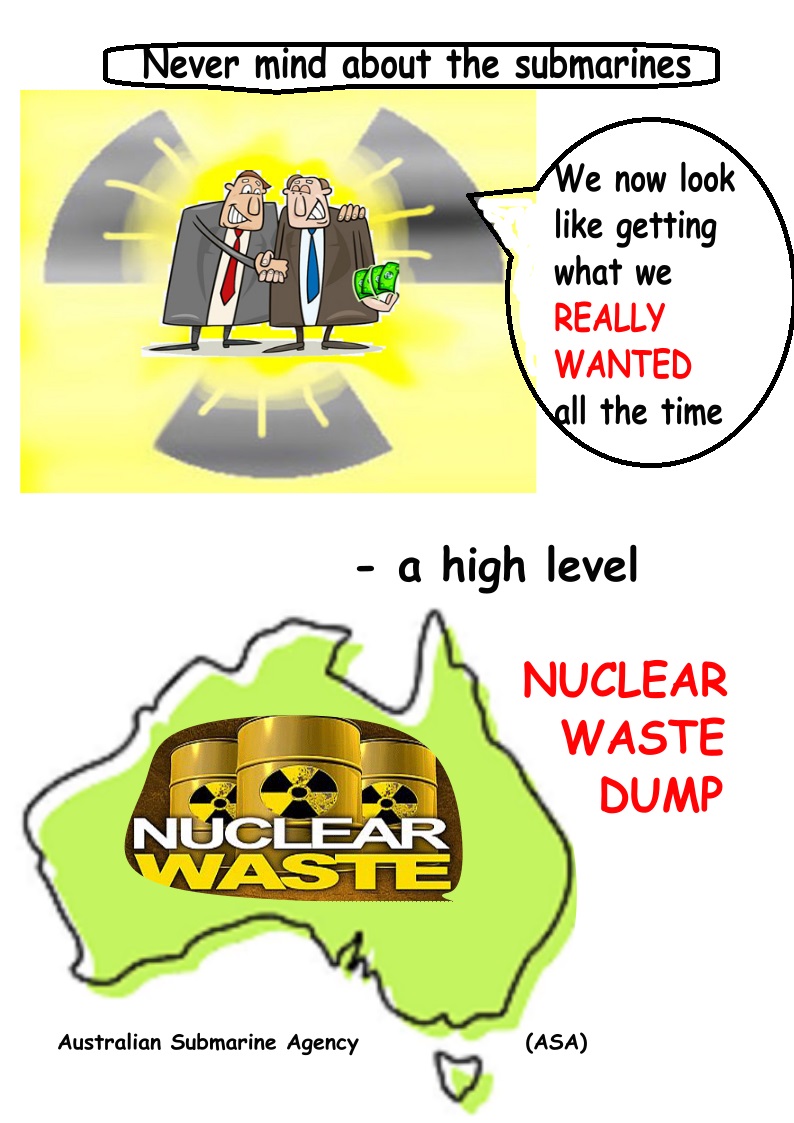
The $360 billion cost of AUKUS might be startling, but on top of that is another undiscussed figure: the cost of building storage for nuclear waste.
Crikey, DAVID HARDAKER, JUL 24, 2023
In late 2021, it came as a shock when Australia woke up to find that its government, under then-prime minister Scott Morrison, had secretly agreed to join the nuclear submarine club with old friends, the US and the UK.
The secret within that secret was that Australia would be responsible for the radioactive waste generated by its involvement in the AUKUS program. For the first time, Australia had signed up to construct a storage facility for high-grade nuclear waste, robust enough to last 1000 years.
Australia had never done it. Nor the US. Nor the UK. Was the iron-clad commitment to building a waste dump part of the deal struck by Morrison when he announced the AUKUS partnership? If so, he didn’t mention it at the time. Nor was it mentioned by US President Joe Biden, UK Prime Minister Rishi Sunak or Australian Prime Minister Anthony Albanese at the official AUKUS announcement in San Diego in March…………. (subscribers only) more https://www.crikey.com.au/2023/07/24/aukus-nuclear-waste-dump-cost-australia/
1 This month
17 October, Free Public Talk on Nuclear Issues in South Australia
David Noonan will speak on public interest concerns over the new Roxby Downs Indenture Act 2026 on BHP copper-uranium mining and ore processing in SA, and on how AUKUS may face SA with a High-Level nuclear waste agenda.
Dr Jim Green will discuss international developments in the field of nuclear power including ‘small modular reactors’ and Generation 4 ‘advanced’ nuclear reactor concepts.


Help Aunty Sue Protect Her Land and Sacred Sites From Destructive Rocket Testing.
.

Australians deserve the truth
about
AUKUS – https://aukuspublicinquiry.com/

PETITION – To: Prime Minister Anthony Albanese and the Australian Labor Government

of the week – Australians for War Powers Reform (AWPR)
To see nuclear-related stories in greater depth and intensity

