TODAY. Jobs! jobs! jobs! – IN THE DEATH INDUSTRY

Quite suddenly, any vestige of Australia being an independent country has disappeared overnight.
An entire continent has been handed over to the American military machine, by Australia’s cowardly and self-serving politicians.
And the Australian media exultantly choruses “ Jobs! Jobs ! Jobs! “
I have often wondered why that chorus is repeated endlessly – in awed, religious, joy?
If you work in a caring industry, or in nurturing animals, plants, the environment, in growing food or in one of the many jobs that support life – you can derive some pride in your work. It’s good to be paid some money, but it’s especially good to be able to derive some dignity, self-respect, genuine joy, in knowing that you are genuinely contributing to well-being – to the common good.
It’s a matter of integrity – dare I mention this? – some spiritual satisfaction. You can hold your head up high.
Where is the integrity in making killing machines, things for massacring thousands of people, destroying the land and animals?

And just to make sure that the Americans really mean it, we have the odious Antony Blinken now emphasising that the USA will certainly punish our courageous Australian truth-teller Julian Assange.
PM Albanese, and wimp Foreign Minister Penny Wong just kow tow and agree!
Nauseating subservience of Australia’s media and politics to American militarism.
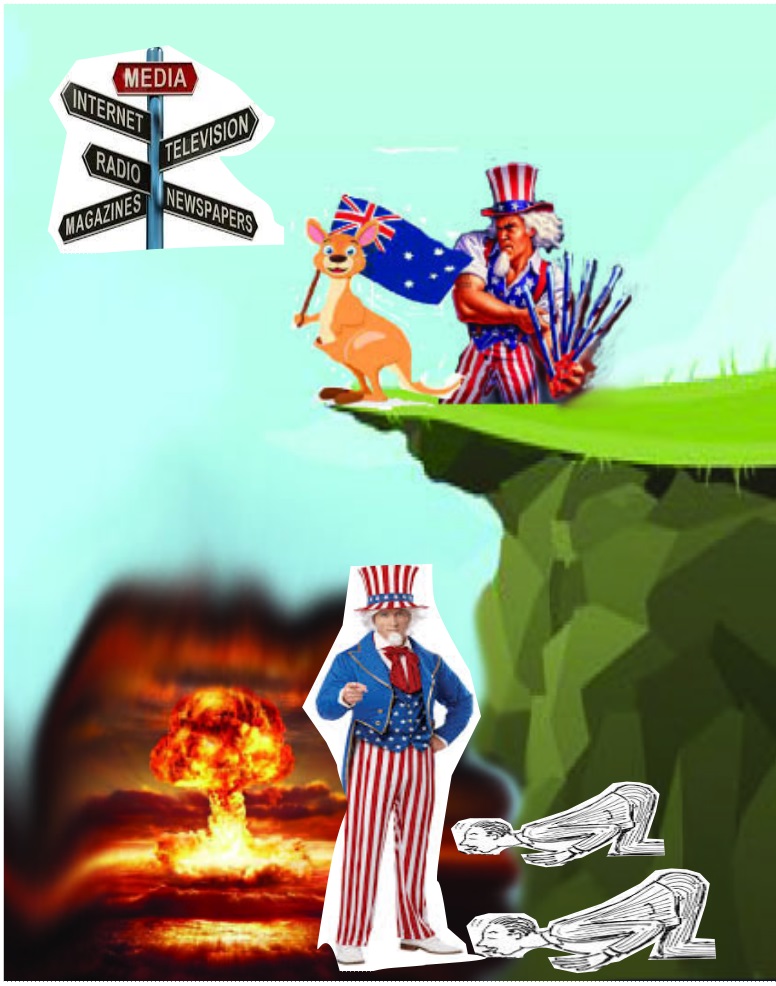
‘Hugely significant’: Australia to manufacture and export missiles to US, Sydney Morning Herald, By Matthew Knott, July 28, 2023
Australia is set to begin manufacturing its own missiles within two years under an ambitious plan that will allow the country to supply guided weapons to the United States and possibly export them to other nations.
( USA sees Australia has seemingly “deep pockets” to do the hard lifting so USA could probably on sell these missiles at a profit or just use Australia as a little America – with the ever present threat of being a security target )
The push to accelerate the creation of a local missile manufacturing industry in co-operation with the US will be one of the centrepiece announcements at the Australia-United States Ministerial (AUSMIN) consultations on Saturday.
Both US and Australian officials are seeking to play down concerns the AUKUS pact could be derailed by division in the US Congress after 23 Senate Republicans warned they would not support the proposal to provide nuclear-powered submarines to Australia unless the US Navy doubled its own production capacity.
The joint missile manufacturing effort is being driven by the war in Ukraine, which has highlighted a troubling lack of ammunition stocks in Western nations including the US.
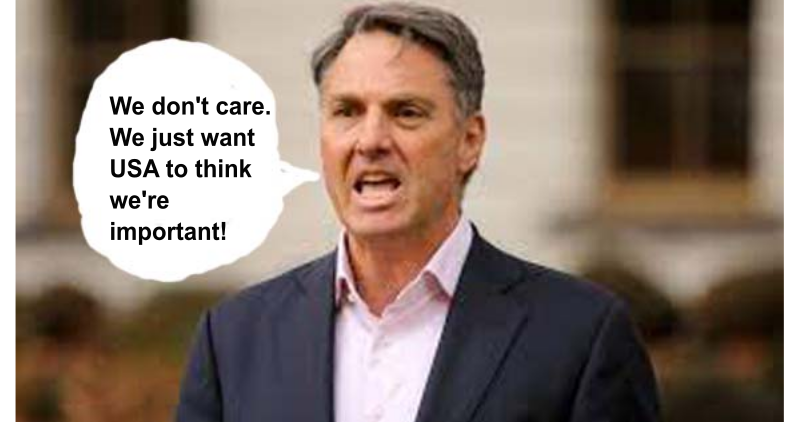
“This is really important for the industrial base of both of our countries,” Defence Minister Richard Marles said on Friday after meeting with US Defence Secretary Lloyd Austin in Brisbane.
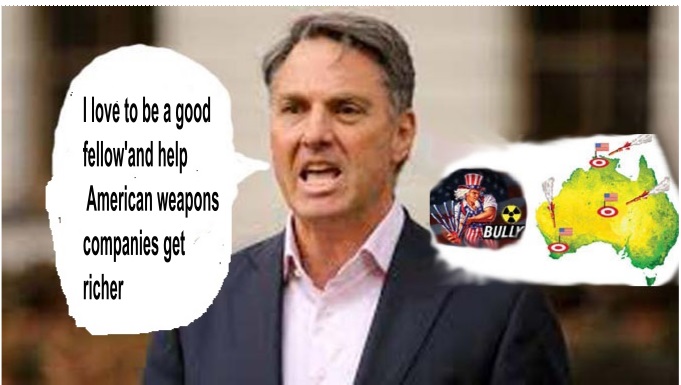
“It is hugely significant in terms of developing Australia’s defence industry. It will be very important in ensuring Australia has the necessary war stocks in the future.”
Marles said the announcement would significantly bring forward the planned opening of local missile factories, which had been expected to take several years to get off the ground.
As well as creating local jobs, a domestic missile manufacturing industry will make Australia less reliant on imports and provide a trusted additional source of munitions for the US.
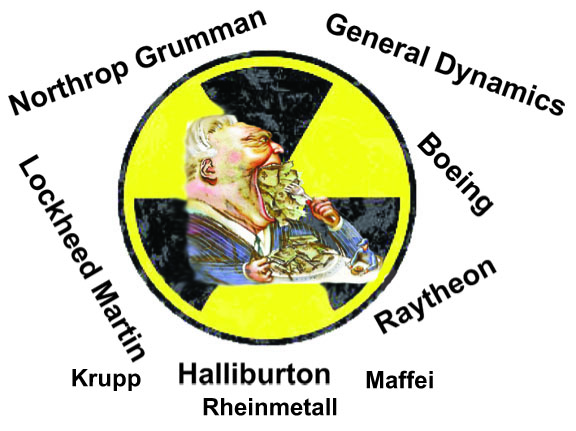
US defence contracting giants Lockheed Martin and Raytheon have been selected by the government as preferred partners for its guided weapons and explosive ordnance enterprise, which was identified as a priority by the recent defence strategic review.
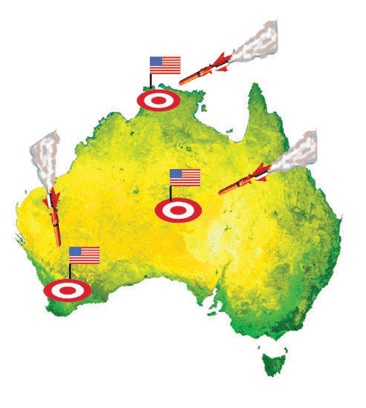
The US and Australia will also announce plans to upgrade air bases in northern Australia so they can be used for training exercises by both Australian and American troops.
(Hands up those people who see the establishment of missile manufacturing in Australia as one – a Red Flag for Warmongering in our Region sending the wrong message in our neck of the woods….and two – a big fat bullseye security target on our back!)
…………………………………………………………….. While noting that AUKUS enjoyed strong in-principle bipartisan support, the USA senators said: “Under the current AUKUS plan to transfer US Virginia-class submarines to a partner nation before meeting the Navy’s own requirements, the number of available nuclear submarines in the US submarine fleet would be lowered further.
“This is a risk we cannot take.”
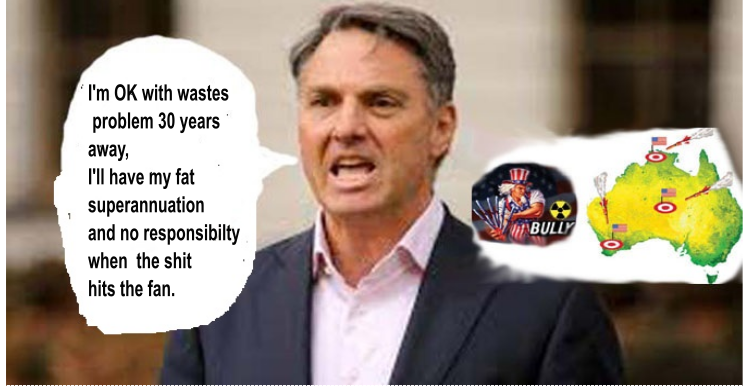
Describing the congressional negotiations as “colour and movement”, Marles said: “We’re not worried about that … I’m confident about the progress of Australia acquiring a nuclear-powered submarine capability. We are encouraged by the progress of legislation through Congress.”
US ambassador to Australia Caroline Kennedy insisted that the submarine plan was “not at risk at all” and dismissed suggestions negotiations had stalled…………..

Speaking before a meeting with Foreign Minister Penny Wong on Friday, US Secretary of State Antony Blinken said: “We have no greater friend, no greater partner, no greater ally than Australia. And I don’t think that alliance or partnership has ever been stronger, at least in my experience.”
Prime Minister Anthony Albanese said he was “very confident” Australia would secure at least three Virginia-class submarines from the US……………..
Ashley Townshend, a senior fellow for Indo-Pacific security at the Carnegie Endowment for International Peace, said it would take several billion dollars in extra investment from the US government to meet the Republican senators’ demand to increase submarine production from 1.2 to 2.5 vessels a year.
The AUKUS legislation was still likely to pass through Congress this year, but the process would be “messy”, he said………… https://www.smh.com.au/politics/federal/hugely-significant-australia-to-manufacture-and-export-missiles-to-us-20230728-p5ds5e.html?fbclid=IwAR0Soi1XPWSzh-QIMTYtQealoEDp7Zrp67jOpW1p_6-1Ms24HBwRn9G8Ed4
Australia’s nuclear waste

finding a national waste repository is not urgent because it has been stored this way for 60 years.
it’s not even clear if centralising the waste is the best option. ..there’s an implicit risk in transporting the waste from the various sites to a new site, and there should be a safety comparison with leaving it where it is.
Courts have quashed a decision to store water in Kimbra, meaning there is still no centralised repository in the country
Guardian. Tory Shepherd, Sat 29 Jul 2023
More than 20 tonnes of reprocessed nuclear fuel will stay at Australia’s only reactor in southern Sydney, while nuclear waste will remain scattered in “cupboards and filing cabinets” around the country, after the federal court blocked plans for a long-term storage site in outback South Australia.
The site in Kimba was selected more than 40 years after Australia started planning for a centralised repository. But this month, that decision was quashed by the courts.
There is currently no live national facility option, and the waste pile is growing.
Successive governments and agencies have said there are more than 100 sites that are storing nuclear waste littered across the land, in hospital basements and universities, on defence and mining sites and in research laboratories.
There’s no definitive list, because of a licensing split between the federal and state governments, but the vast majority is produced and stored at the Australian Nuclear Science and Technology Organisation (Ansto) facility in Lucas Heights.
A national inventory published last year found Australia’s 2,061 cubic metres of intermediate-level waste (ILW) will more than double to 4,377 cubic metres in the next 50 years.
………….The inventory predicted that the 2,490 cubic metres of low-level waste will more than quadruple to 13,287 within the next five decades. LLW includes gloves, paper, gowns and other ephemera used in nuclear medicine. Much of it can be left to “delay and decay”, and can be disposed of as regular rubbish.
Ansto’s waste makes up about 93% of the LLW, and about 96.5% of the ILW.
Ansto is also responsible for the spent fuel rods from its Opal research reactor at Lucas Heights, in Sydney’s south, which are sent to France, the UK or the US for reprocessing.
Last year, the UK shipped two tonnes of ILW to be stored at Sydney’s Lucas Heights facility until it could be transported to a national facility – it was part of a waste-swap deal after Australia sent spent fuel rods from Opal predecessor to be recycled.
In 2015, 25 tonnes of radioactive waste from France was returned to Australia after reprocessing – that too will be housed at Lucas Heights until a dump is selected and built. Since then, Australia has sent more spent fuel rods to France to have the uranium and plutonium extracted, but their return has not been announced, and it’s not clear what will happen with such deals now that Kimba option is off the table.
The current government policy is to build a National Radioactive Waste Management Facility (NRWMF) to dispose of LLW permanently, and ILW temporarily while a permanent dump is built.

The traditional owners of the land around Kimba, the Barngarla people, took the government to court, and won – former resources minister Keith Pitt’s declaration of the site was cast aside because of his “apprehended bias” and “pre-judgement”.
Now, the process is on hold as the government considers the judgement, and as the case continues with final details to be ironed out.
Top nuclear waste expert, emeritus professor Ian Lowe, says waste is kept in “cupboards and filing cabinets in universities and hospitals”…………“It’s clearly not optimal … the reason it hasn’t been a problem is there’s not actually anything very nasty you can do with low level waste. It’s not very radioactive,” Lowe says.
Ansto says such waste needs “minimal shielding”, while some major hospitals use “delay tanks” and other facilities use drums.
So, Lowe says, finding a national waste repository is not urgent because it has been stored this way for 60 years.
Lowe, who is from Griffith University, says it’s not even clear if centralising the waste is the best option. He says there’s an implicit risk in transporting the waste from the various sites to a new site, and there should be a safety comparison with leaving it where it is.
“I haven’t even seen a crude, back of the envelope calculation,” he says.
With the intermediate level waste, which is “much nastier stuff”, he says he “couldn’t see the point of moving it from temporary storage at Lucas Heights to temporary storage at Kimba while we work out a permanent solution”.
The Australian Conservation Foundation (ACF) and the Greens are pushing for it to remain at Lucas Heights for now.
The ACF’s Dave Sweeney says the waste at Lucas Heights is secure, and that keeping it there could be a “circuit breaker” after years of political wrangling. He accepts that Lucas Heights is not set up to permanently dispose of the waste, but points out that the Australian Radiation Protection and Nuclear Safety Agency has said it is safe there.
And, he says, much of the LLW currently being managed in hospitals was never going to get to Kimba anyway. On top of all that, Kimba was only ever going to hold ILW temporarily until a permanent facility was built.
“We need to actually take a breath and get very serious, systematic and credible about how we advance radioactive waste management,” he says.
“[This shows] the need for and a clear ability to deliver a circuit breaker and inject some responsibility, credibility and respect into this process.”
A spokesperson for resources minister, Madeleine King, said it would be inappropriate to comment on the future of a NRWMF while the Barngarla case is still before the court. The government has lodged a submission to the federal court and could appeal the decision……………………………………
Lowe says only Finland and Sweden have managed to solve the issue with long-term waste storage, and they did it by finding communities who are keen to have the waste in return for investment.
He says permanent disposal of all types of waste will need somewhere geologically stable. “That probably means remote parts of SA, WA, NT, but there’s any number of parts of Australia. “The point is finding a community that’s happy to have it there.” https://www.theguardian.com/environment/2023/jul/29/nuclear-waste-australia-how-much-why-kimba-lucas-heights
Money talks: 109 global institutions restrict investments in nuclear weapons

Exciting news in the latest PAX-ICAN report “Moving away from mass destruction” out today: the number of financial institutions across the globe rejecting nuclear weapons keeps growing! The number of financial institutions excluding the nuclear weapons industry from their investments continues to grow year on year, and many are naming the UN nuclear weapons ban treaty as a reason to stop funding the bomb.
The 109 financial institutions profiled in this report know that nuclear weapons represent a systemic reputational and regulatory risk, and are putting policies in place that limit or completely exclude any financial engagement with this controversial industry.
The report shows the financial community is taking a more responsible approach, embracing the positive role they can play in further stigmatising and delegitimizing nuclear weapons. Even with Russia’s illegal invasion of Ukraine, and skyrocketing defence spending, the financial community is holding a firm line against financing weapons of mass destruction.
These policies do more than simply cut off the funding to the individual companies producing nuclear weapons: they signal that doing business off weapons of mass destruction is not a viable business model particularly now the UN Treaty on the Prohibition of Nuclear Weapons is in place. https://www.dontbankonthebomb.com/policy-analysis-report-moving-away-from-mass-destruction/
US admits to pushing Ukraine into a fight it can’t win

the operative Western definition of “Ukrainian courage”, however, is not hard to discern: a willingness to use Ukrainian soldiers as cannon fodder.
the Ukraine war has already yielded a “triumphal summer” for the NATO alliance.
A US “windfall” in Ukraine comes at an unfathomable cost.
AARON MATÉ, JUL 29, 2023 https://mate.substack.com/p/unlocked-us-admits-to-pushing-ukraine?utm_source=post-email-title&publication_id=100118&post_id=135529420&isFreemail=true&utm_medium=email
Nearly one month into Russia’s invasion, the New York Times quietly abandoned any pretense that the US aim was to defend Ukraine and bring the war to a quick end. The White House, the Times reported, “seeks to help Ukraine lock Russia in a quagmire without inciting a broader conflict with a nuclear-armed adversary or cutting off potential paths to de-escalation.”
Eighteen months later, the desired quagmire has been achieved. This is due not only to a massive influx of NATO weaponry, but a Western blockade of every tangible path to de-escalation, most notably the April 2022 Ukraine-Russia peace deal that Boris Johnson nixed.
With a Russian quagmire the overriding goal, the US and its partners have adopted an attendant disregard for the tens of thousands of Ukrainian lives sacrificed for the task.
In the war’s early stages, only the most outwardly enthusiastic proxy warriors, such as Sen. Lindsey Graham, could candidly admit that US support ensured that Ukraine would “fight to the last person.” With Ukraine now struggling to mount a widely hyped counteroffensive, the prevailing indifference to its human toll is more widely acknowledged.
As the Wall Street Journal newly reports:
“When Ukraine launched its big counteroffensive this spring, Western military officials knew Kyiv didn’t have all the training or weapons—from shells to warplanes—that it needed to dislodge Russian forces. But they hoped Ukrainian courage and resourcefulness would carry the day. They haven’t.”
It is unclear how Western officials could have “hoped” that Ukrainian “resourcefulness” would make up for the training and weapons that they did not provide. A war zone, after all, is not an episode of MacGyver or the A-Team, and Ukraine’s adversary happens to be one of the world’s most powerful militaries. The operative Western definition of “Ukrainian courage”, however, is not hard to discern: a willingness to use Ukrainian soldiers as cannon fodder.
“Senior U.S. officials,” the New York Times reports, have “privately expressed frustration that some Ukrainian commanders… fearing increased casualties among their ranks” have recently “reverted to old habits — decades of Soviet-style training in artillery barrages — rather than sticking with the Western tactics and pressing harder to breach the Russian defenses.”
The Times did not ask these same US officials whether it is appropriate to express “frustration” at the decision of another military – the one we claim to support – to avoid “increased casualties” among its ranks. But Andriy Zagorodnyuk, a former Ukrainian defense minister, asked an equally salient question of his US counterparts: “Why don’t they come and do it themselves?”
Frustrated US officials are well aware of Ukraine’s toll. According to the New York Times, Western states now estimate that Ukraine lost about 20 percent of its weaponry in the first weeks of its counteroffensive, a “startling rate of losses… as Ukrainian soldiers struggle against Russia’s formidable defenses.” Oddly, the Times omits any mention of losses in Ukrainian lives – a tacit admission, perhaps, that the human casualties are even more startling.
As is also increasingly admitted, all of this was foreseen. “U.S. Defense Department analysts knew early this year that Ukraine’s front-line troops would struggle against Russian air attacks,” the Wall Street Journal notes. Or as the Washington Post puts it: “Privately, U.S. military officials concede that their expectation from early this year, described in leaked intelligence documents, that Ukraine is likely to make only modest gains in its counteroffensive has not changed, despite public pronouncements seeking to downplay fallout from the disclosure.”
In other words, US “public pronouncements” have entailed lying to the public to “downplay fallout” of fueling a knowingly catastrophic and futile war. The participants in this deception include Secretary of Defense Lloyd Austin, who declared in March that the Ukrainian military had “a very good chance for success,” despite privately being told the opposite.
One reason for Ukraine’s current woes, as President Biden recently admitted to CNN, is that “the Ukrainians are running out of ammunition,” and “we’re low on it” as well. Another major factor, a classified Pentagon assessment noted in February, was Ukraine’s “inability to prevent Russian air superiority.” Or as a senior European official now warns, “everyone worries that the Ukrainians will run out of ammunition and air defenses.”
“America would never attempt to defeat a prepared defense without air superiority, but they [Ukrainians] don’t have air superiority,” John Nagl, a retired U.S. Army lieutenant colonel and professor at the U.S. Army War College, observes. “It’s impossible to overstate how important air superiority is for fighting a ground fight at a reasonable cost in casualties.”
According to the Pentagon, NATO’s latest influx of heavy weaponry will not change the tide. Speaking at a Washington security conference this month, John Kirchhofer, chief of staff at the US Defense Intelligence Agency, claimed that the Ukraine war is at a “stalemate” and that “none of these” newly provided weapons – including Storm Shadow missiles and cluster bombs — “are the holy grail that Ukraine is looking for.”
Accordingly, the Wall Street Journal notes, the unlikelihood of “any large-scale breakthrough by the Ukrainians… raises the unsettling prospect for Washington and its allies of a longer war—one that would require a huge new infusion of sophisticated armaments and more training to give Kyiv a chance at victory.”
For Washington, perhaps that prospect is not unsettling. According to veteran Washington Post columnist David Ignatius, the Ukraine war has already yielded a “triumphal summer” for the NATO alliance.
“The West’s most reckless antagonist has been rocked,” Ignatius writes. “NATO has grown much stronger with the additions of Sweden and Finland. Germany has weaned itself from dependence on Russian energy and, in many ways, rediscovered its sense of values.”
Accordingly, “for the United States and its NATO allies, these 18 months of war have been a strategic windfall, at relatively low cost (other than for the Ukrainians).”
Indeed, it is quite easy to reap a “windfall” from 18 months of war when the US is not itself fighting it. It has instead sacrificed future generations of an entire nation, whose worth is so devalued that their unfolding catastrophe is openly reduced to an afterthought.
Washington’s looming war against China
SOTT – Signs of The Times, Michael Hudson, The Unz Review, Sat, 22 Jul 2023
Economic Logic has been Replaced by National Security Overrides
The July NATO summit in Vilnius had the feeling of a funeral, as if they had just lost a family member – Ukraine. To clear away NATO’s failure to drive Russia out of Ukraine and move NATO right up to the Russian border, its members tried to revive their spirits by mobilizing support for the next great fight – against China, which is now designated as their ultimate strategic enemy. To prepare for this showdown, NATO announced a commitment to extend their military presence all the way to the Pacific.
The plan is to carve away China’s military allies and trading partners, above all Russia, starting with the fight in Ukraine. President Biden has said that this war will be global in scope and will take many decades as it expands to ultimately isolate and break up China.
The U.S.-imposed sanctions against trade with Russia are a dress rehearsal for imposing similar sanctions against China. But only the NATO allies have joined the fight. And instead of wrecking Russia’s economy and “turning the ruble to rubble” as President Biden predicted, NATO’s sanctions have made it more self-reliant, increasing its balance of payments and international monetary reserves, and hence the ruble’s exchange rate.
To cap matters, despite the failure of trade and financial sanctions to injure Russia – and indeed, despite NATO’s failures in Afghanistan and Libya, NATO countries committed themselves to trying the same tactics against China. The world economy is to be split between US/NATO/Five Eyes on the one hand, and the rest of the world – the Global Majority – on the other. EU Commissioner Joseph Borrell calls this as a split between the US/European Garden (the Golden Billion) and the Jungle threatening to engulf it, like an invasion of its well-manicured lawns by an invasive species.
From an economic vantage point, NATO’s behavior since its military buildup to attack Ukraine’s Russian-speaking eastern states in February 2022 has been a drastic failure. The U.S. plan was to bleed Russia and leave it so economically destitute that its population would revolt, throw Vladimir Putin out of office and restore a pro-Western neoliberal leader who would pry Russia away from its alliance with China – and then proceed with America’s grand plan to mobilize Europe to impose sanctions on China…………………..
The US/NATO West has led this global fracture, yet it will be the big loser. NATO members already have seen Ukraine deplete their inventory of guns and bullets, artillery and ammunition, tanks, helicopters weapons and other arms accumulated over five decades. But Europe’s loss has become America’s sales opportunity, creating a vast new market for America’s military-industrial complex to re-supply Europe. To gain support, the United States has sponsored a new way of thinking about international trade and investment. The focus has shifted to “national security,” meaning to secure a U.S.-centered unipolar order.
The world is dividing into two blocs: a post-industrial US/NATO vs the Global Majority
……………………………………………………………………………. By trying to prevent other countries from following this logic, U.S. and European NATO diplomacy has brought about exactly what U.S. supremacists most feared. Instead of crippling the Russian economy to create a political crisis and perhaps breakup of Russia itself in order to isolate it from China, the US/NATO sanctions have led Russia to re-orient its trade away from NATO countries to integrate its economy and diplomacy more closely with China and other BRICS members.
Ironically, the US/NATO policy is forcing Russia, China and their BRICS allies to go their own way, starting with a united Eurasia. This new core of China, Russia and Eurasia with the Global South are creating a mutually beneficial multipolar trade and investment sphere.
By contrast, European industry has been devastated. Its economies have become thoroughly and abjectly dependent on the United States – at a much higher cost to itself than was the case with its former trade partners. European exporters have lost the Russian market, and are now following U.S. demands that they abandon and indeed reject the Chinese market. Also to be rejected in due course are markets in the BRICS membership, which is expanding to include Near Eastern, African and Latin American countries……………………………………………………………………..
Today’s fighting against Russia on the Ukrainian front can be thought of as the opening campaign in World War III. In many ways it is an outgrowth of World War II and its aftermath that saw the United States establish international economic and political organizations to operate in its own national self-interest. The International Monetary Fund imposes U.S. financial control and helps dollarize the world economy. The World Bank lends dollars to governments to build export infrastructure to subsidize US/NATO investors in control of oil, mining and natural resources, and to promote trade dependency on U.S. farm exports while promoting plantation agriculture, instead of domestic food-grain production. The United States insists on having veto power in all international organizations that it joins, including the United Nations and its agencies.
The creation of NATO is often misunderstood. Ostensibly, it depicted itself as a military alliance, originally to defend against the thought that the Soviet Union might have some reason to conquer Western Europe. But NATO’s most important role was to use “national security” as the excuse to override European domestic and foreign policy and subordinate it to U.S. control. Dependency on NATO was written into the European Union’s constitution. Its objective was to make sure that European party leaders followed U.S. direction and opposed left-wing or anti-American politics, pro-labor policies and governments strong enough to prevent control by a U.S.-client financial oligarchy.
NATO’s economic program has been one of adherence to neoliberal financialization, privatization, government deregulation and imposing austerity on labor. EU regulations prevent governments from running a budget deficit of more than 3% of GDP. That blocks Keynesian-type policies to spur recovery. Today, higher military arms costs and government subsidy of energy prices is forcing European governments to cut back social spending. Bank policy, trade policy and domestic lawmaking are following the same U.S. neoliberal model that has deindustrialized the American economy and loaded it down with debt to the financial sector in whose hands most wealth and income is now concentrated.
Abandoning economic self-interest for “national security” dependence on the US
The post-Vilnius world treats trade and international relations not as economic, but as “national security.” Any form of trade is the “risk” of being cut off and destabilized. The aim is not to make trade and investment gains, but to become self-reliant and independent. For the West, this means isolating China, Russia and the BRICS in order to depend fully on the United States. So for the United States, its own security means making other countries dependent on itself, so that U.S. diplomats won’t lose control of their military and political diplomacy…………………………………………………………………………………………………
The world is dividing into two blocs – with quite different economic philosophies……………………………………………………………………………………………………………………………………………
We are witnessing what seems to be an inexorable Decline of the West. U.S. diplomats have been able to tighten their economic, political and military control leadership over their European NATO allies. Their easy success in this aim has led them to imagine that somehow they can conquer the rest of the world despite de-industrializing and loading their economies so deeply in debt that there is no foreseeable way in which they can pay their official debt to foreign countries or indeed have much to offer.
The traditional imperialism of military conquest and financial conquest is ended
……………………………….. The US has only one weapon: Missiles and bombs can destroy, but cannot occupy but not occupy and take over a country.
The second way to create imperial power was by economic power to make other countries dependent on U.S. exports……………………………Control of world oil trade has been a central aim of US trade diplomacy………………………………………………………………………………………………. https://www.sott.net/article/482853-Washingtons-looming-war-against-China
—
If Albanese’s such a buddy of Biden’s, why is Assange still in jail?

An initial refusal from Biden is only an invitation to ask a second time, in a firmer voice
Bob Carr Bob Carr was NSW’s longest-serving premier and is a former Australian foreign affairs minister. 27 jul 23, https://www.theage.com.au/politics/federal/if-albanese-s-such-a-buddy-of-biden-s-why-is-assange-still-in-jail-20230721-p5dqci.html
Julian Assange is in his fourth year in Britain’s Belmarsh prison. If the current appeal fails, he will be shackled and driven off in a prison van and flown across the Atlantic on a CIA aircraft for a long trial. He faces likely life imprisonment in a federal jail, perhaps in Oklahoma.
In 2021, then opposition leader Anthony Albanese said, “Enough is enough. I don’t have sympathy for many of his actions, but essentially, I can’t see what is served by keeping him incarcerated.”
As prime minister, Albanese said he had already made his position clear to the Biden administration. “We are working through diplomatic channels,” he said, “but we’re making very clear what our position is on Mr Assange’s case.”
So we can assume that at one of his seven meetings with US President Joe Biden he has raised Assange, even on the fringes of the Quad or at one of two NATO summits. Or perhaps in San Diego when they launched AUKUS, under which Australia will make the largest transfer of wealth ever made outside this country. This $368 billion is a whopping subsidy to American naval shipyards and to the troubled, chronically tardy British naval builder BAE Systems.
But it clinches Australia’s reputation as a deliriously loyal, entirely gullible US ally. It gives President Biden the justification for telling Republicans or Clinton loyalists in his own party that he had no alternative but to end the pursuit of Assange. “Those Aussies insisted on it. They’re doing us all these favours … we can’t say no.”
In addition to the grandiose AUKUS deal, Biden could list other decisions by the Albanese government that render Australia a military stronghold to help US regional dominance while materially weakening our own security.

Candid words, but they aren’t mine. They belong to Sam Roggeveen of the Lowy Institute in this month’s edition of Australian Foreign Affairs. In a seminally important piece of analysis, Roggeveen nominated Australia’s decision to fully service six American B52 bombers at RAAF Tindal, in the Northern Territory, as belonging on that list. It is assumed these are aimed at China’s nuclear infrastructure such as missile silos. “It is hard to overstate the sensitivity involved in threatening another nation’s nuclear forces,” Roggeveen writes.
In his article, he reminds us we’ve also agreed to host four US nuclear subs on our west coast at something to be called “Submarine Rotational Force-West”. Their mission would be destroying Chinese warships or enforcing a blockade of Chinese ports.
The east coast submarine base, planned most likely for Port Kembla, will also directly support US military operations. It’s another nuclear target. As Roggeveen says, all these locations raise Australia’s profile in the eyes of the Chinese military planners designing their response in the event of war with the US.
In this context, I can’t believe the US president is not on the point of agreeing to the prime minister’s request to drop charges against Assange.
Apart from the titanic strategic favours, two killer facts help our case. One, former US president Barack Obama commuted the sentence of Chelsea Manning, who had supplied Assange with the information he published. The Yank is free, the Aussie still pursued.
Two, the crimes Manning and Assange exposed involved US troops on a helicopter gunning down unarmed civilians in Baghdad. They are directly comparable to the alleged Australian battlefield murders in Afghanistan we are currently prosecuting.
An initial refusal from Biden is only an invitation to ask a second time, in a firmer voice.
It’s possible to imagine an Australian PM – Fraser, Hawke, Keating, Howard or Rudd – being appropriately forceful with a US president. There would be an inflection point in their exchange – prime minister to president – when the glint-eyed Australian says, “Mr President, it’s gone on too long. Both sides of our politics are united. Your old boss commuted Chelsea Manning, an American, in the same case.”
A pause. A beat. Then the killer summation. “Mr President, I speak for Australia.”
Surely this counts.
I don’t believe the president can shake his head and say, “nope”, given all we have gifted – the potent symbolism of B52s, nuclear subs and bases on the east and west coast. It would look like we have sunk into the role of US territory, as much a dependency as Guam or Puerto Rico.
US counter-intelligence conceded during court proceedings there is no evidence of a life being lost because of Assange’s revelations. Our Defence Department reached the same view.
If Assange walks out the gates of Belmarsh into the arms of his wife and children it will show we are worth a crumb or two off the table of the imperium. If it’s a van to the airport, then making ourselves a more likely target has conferred no standing at all. We are a client state, almost officially.
AUKUS nuclear dump deal decades in the making by nuclear evangelists with prescience.
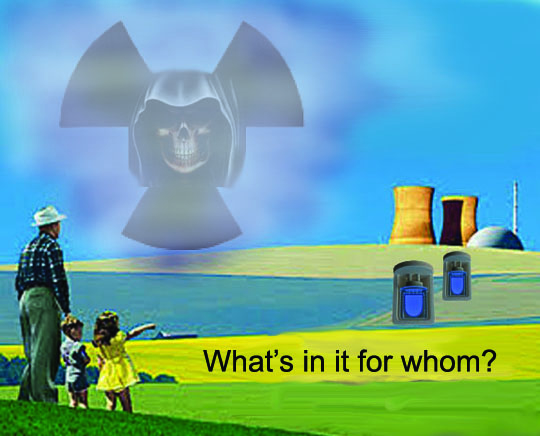
David Hardaker 26 July 23 https://www.msn.com/en-au/news/australia/aukus-nuclear-dump-deal-decades-in-the-making-by-players-with-prescience/ar-AA1elV6p
he story of the long, slow journey to a nuclear waste dump being built in Australia as required by the AUKUS agreement is probably best told through one Jim Voss, a nuclear evangelist from America who has been part of the Australian scene for at least a quarter of a century.
Part of a push which began in 1997, he’s one of a handful of international figures who’ve never gone away. Now, arguably, that push has won the day courtesy of a secret deal struck by the Australian government.
Voss’ most recent appearance was at a parliamentary committee hearing into nuclear legislation on May 15. Courtesy of the government’s AUKUS agreement he was now, finally, able to make a link between the benefits of small modular nuclear reactors — the sort sold by his company — and the nuclear-powered submarines Australia has committed to.
It all went to show, as Voss put it, that “a nuclear culture will be essential for this nation in the future”.
Voss could afford to be just a little triumphant that Canberra day. The inspirational words “If at first you don’t succeed then try, try and try again” could well have been written just for him.
Apart from sheer doggedness, the Voss story tells us much about the close connections between the military and commercial worlds when it comes to nuclear energy, as well as the powerful roles played by the UK and the US governments in seeking a solution for a terrible problem they share: how to permanently store nuclear waste. Australia, it emerges, has been a long-term target.
It was only when Scott Morrison came along — later backed by Prime Minister Anthony Albanese — that all that work paid off, with the bonus that it was all done in secret.
Pangea 1997
Voss first came to public attention in Australia courtesy of a Four Corners investigation in the late 1990s. Voss was then general manager of a company called Pangea which was attempting to realise the idea of building a nuclear waste dump in Australia, catering to an international need for a permanent solution for disposing of radioactive waste. The company considered that outback parts of Western Australia met the checklist for safety, remoteness and geological stability.
Voss was joined by a Pangea scientist, Charles McCombie, who would also go on to become a mainstay of international efforts to have a nuclear waste dump built in Australia.
Other now-familiar connections emerged at this time. Pangea, backed by a multimillion-dollar marketing and lobbying budget, brought on board then-rising star of conservative political polling, Mark Textor. Textor was soon to establish the powerful Crosby-Textor (ClT) group with then Liberal Party director, Lynton Crosby. Textor was reportedly paid some $250,000 for his work. (As we revealed in May, ClT’s American arm acts as a lobbyist for the giant US defence company General Dynamic, which builds the US Navy’s nuclear-powered submarines and is set to play a key role in the AUKUS program. It already hosts a growing Australian workforce at its Connecticut shipyards.)
In America, Pangea had signed up a former US nuclear submarine commander, Ralph Stoll, who helped lobby members of the US Congress to back Pangea’s plans for an Australian dump. Not that the US needed much persuading. Back in 1999, Four Corners reported that Pangea’s case found favour with US security and defence officials when it shifted its focus from a commercial venture to play to America’s strategic preoccupation with growing stockpiles of nuclear warheads.
Former US defence official Jan Lodal who had been responsible for running nuclear policy for the Pentagon put it this way:
There are thousands and thousands of tonnes of [nuclear waste] and thousands of tonnes more coming online each year, so to speak, as well as many thousands of tonnes that are derivative from former nuclear weapons programs. And these have to be stored safely and securely for thousands of years, and the world simply doesn’t have a solution to this. And as long as this waste is stored in an imperfect fashion, in which it is now — virtually everywhere — it represents something of a threat.
The Pangea company drew on American expertise but it was essentially a front for the UK government. It was 80% owned by British Nuclear Fuels Limited (BNFL), which in turn was wholly owned by the British government. BNFL and the UK had the same problem as the US: it held the largest stockpile of high-level radioactive waste in the world (after America) kept in canisters cooling beneath the water at its Sellafield facility in the north of England.


CrikeyFollow
AUKUS nuclear dump deal decades in the making by players with prescience
Story by David Hardaker • Yesterday 8:01 pm

(IMAGE: GETTY IMAGES)© Provided by Crikey
The story of the long, slow journey to a nuclear waste dump being built in Australia as required by the AUKUS agreement is probably best told through one Jim Voss, a nuclear evangelist from America who has been part of the Australian scene for at least a quarter of a century.
Part of a push which began in 1997, he’s one of a handful of international figures who’ve never gone away. Now, arguably, that push has won the day courtesy of a secret deal struck by the Australian government.
Why Seniors with private health cover are losing money
Voss’ most recent appearance was at a parliamentary committee hearing into nuclear legislation on May 15. Courtesy of the government’s AUKUS agreement he was now, finally, able to make a link between the benefits of small modular nuclear reactors — the sort sold by his company — and the nuclear-powered submarines Australia has committed to.
It all went to show, as Voss put it, that “a nuclear culture will be essential for this nation in the future”.
Voss could afford to be just a little triumphant that Canberra day. The inspirational words “If at first you don’t succeed then try, try and try again” could well have been written just for him.
Apart from sheer doggedness, the Voss story tells us much about the close connections between the military and commercial worlds when it comes to nuclear energy, as well as the powerful roles played by the UK and the US governments in seeking a solution for a terrible problem they share: how to permanently store nuclear waste. Australia, it emerges, has been a long-term target.
It was only when Scott Morrison came along — later backed by Prime Minister Anthony Albanese — that all that work paid off, with the bonus that it was all done in secret.
Pangea 1997
Voss first came to public attention in Australia courtesy of a Four Corners investigation in the late 1990s. Voss was then general manager of a company called Pangea which was attempting to realise the idea of building a nuclear waste dump in Australia, catering to an international need for a permanent solution for disposing of radioactive waste. The company considered that outback parts of Western Australia met the checklist for safety, remoteness and geological stability.
Voss was joined by a Pangea scientist, Charles McCombie, who would also go on to become a mainstay of international efforts to have a nuclear waste dump built in Australia.
Other now-familiar connections emerged at this time. Pangea, backed by a multimillion-dollar marketing and lobbying budget, brought on board then-rising star of conservative political polling, Mark Textor. Textor was soon to establish the powerful Crosby-Textor (ClT) group with then Liberal Party director, Lynton Crosby. Textor was reportedly paid some $250,000 for his work. (As we revealed in May, ClT’s American arm acts as a lobbyist for the giant US defence company General Dynamic, which builds the US Navy’s nuclear-powered submarines and is set to play a key role in the AUKUS program. It already hosts a growing Australian workforce at its Connecticut shipyards.)
In America, Pangea had signed up a former US nuclear submarine commander, Ralph Stoll, who helped lobby members of the US Congress to back Pangea’s plans for an Australian dump. Not that the US needed much persuading. Back in 1999, Four Corners reported that Pangea’s case found favour with US security and defence officials when it shifted its focus from a commercial venture to play to America’s strategic preoccupation with growing stockpiles of nuclear warheads.
Former US defence official Jan Lodal who had been responsible for running nuclear policy for the Pentagon put it this way:
There are thousands and thousands of tonnes of [nuclear waste] and thousands of tonnes more coming online each year, so to speak, as well as many thousands of tonnes that are derivative from former nuclear weapons programs. And these have to be stored safely and securely for thousands of years, and the world simply doesn’t have a solution to this. And as long as this waste is stored in an imperfect fashion, in which it is now — virtually everywhere — it represents something of a threat.
The Pangea company drew on American expertise but it was essentially a front for the UK government. It was 80% owned by British Nuclear Fuels Limited (BNFL), which in turn was wholly owned by the British government. BNFL and the UK had the same problem as the US: it held the largest stockpile of high-level radioactive waste in the world (after America) kept in canisters cooling beneath the water at its Sellafield facility in the north of England.
Pangea collapses but the dream lives on
Pangea’s best laid, secret plans came unstuck when the British arm of Friends of the Earth came into possession of a corporate Pangea video which the company had produced for the launch of its Australian venture.
The leaking of the video triggered a federal parliamentary backlash, including from the Howard government’s resources minister Senator Nick Minchin, who denounced the idea of Australia being an international waste dump.
Yet Pangea left a legacy to be reckoned with. It had hit on messaging designed to allay community concerns about safety. One line distilled its argument to house the world’s nuclear waste in remote Australia: “There’s no safer place in the world to make the world a safer place.”
Some influential political voices warned this would not be the end of the matter. Australian Democrats senator Meg Lees told Parliament: “Let us look a couple of years down the track. Knowing the pressure that is coming from Britain, combined with pressure from state governments such as Western Australia, I think we may then have a whole different ball game.”
Then federal MP and former WA Labor premier Dr Carmen Lawrence said: “[Pangea] are serious; they are well-funded. They’re people who’ve worked around the mining industry for a very long time. And I think it would be foolish of anybody — government or people such as me opposed to what they’re proposing — to underestimate their long-term commitment to this proposal.”
Speaking to Four Corners from his office in Seattle, Pangea’s chairman (the late) David Pentz had the most prophetic of words:
The idea of an international repository and the benefits it will bring the world is real. We think we have begun to see how we could put the genie back into the bottle, and you know ideas of this size don’t go away.
Never say never
The big idea never went away. Nor did Jim Voss. Among his voluminous collection of writings and presentations, he has covered some eye-catching topics.
He was joint author of the tantalisingly titled “From subs to mines: what would it take for Australia to develop a nuclear-powered submarine capability?” Written in 2013 — a full decade ago — the paper uncannily anticipated the future.
It canvassed issues relating to “procuring, leasing or assembling a complete military off-the-shelf (MOTS) nuclear-powered submarine in Australia”. This happens to be exactly the AUKUS approach which would see the US provide three of its used nuclear submarines to the Australian Navy to bridge Australia’s capability gap.
The paper continued: “This scenario would likely require Australia to develop a nuclear-powered submarine operations, maintenance, refuelling, waste management and possibly decommissioning capability, without presenting Australia with the considerable upfront challenges of developing a nuclear reactor and fuel enrichment supply chain.”
It also raised the possibility that “procurement, leasing or development of nuclear-powered submarine capabilities in Australia” would potentially open the way to “expansion into other aspects of the high-value nuclear energy supply chain, and provide opportunities for increased nuclear power plant deployment capabilities in the future, for instance, with small modular reactors (SMRs)”.
Voss’s Pangea colleague McCombie also stayed close to the action. As Pangea dissolved, McCombie became part of another international not-for-profit organisation called Arius (Association for Regional and International Underground Storage).
2015, and South Australia calls
The big idea of Australia as the site of an international radioactive waste dump came roaring back into contention in 2015. The South Australian government established the Nuclear Fuel Cycle Royal Commission, chaired not by a judicial figure, as custom has it, but by a retired rear admiral of the Australian Navy, Kevin Scarce, the former governor of South Australia.
A wait worth the while
More than 20 years on and with Australia part of the nuclear submarine club with the US and the UK, Voss is back in town, having taken on the reins of the Melbourne office of the exquisitely named and American-headquartered Ultra Safe Nuclear corporation.
Ultra Safe Nuclear is in the business of selling small modular nuclear reactors. Voss shifted into the managing director’s role in late 2020, about nine months before Morrison announced the AUKUS deal. Given his writings of 2013 which explored the business consequences of Australia acquiring nuclear subs, it appears to be a case of a destiny fulfilled. So how does he feel now about Australia’s nuclear embrace and its pledge to — finally — build a nuclear waste facility?
As a seasoned pro, Voss knows better than to be triumphant. This is not a win for him. It is more an opportunity for Australia:
Australia crossed the Rubicon of needing long-term deep disposal in 1958 [when the Lucas Heights nuclear reactor was established]. Starting at that point, Australia is generating long-lived alpha-bearing waste, in other words, waste with plutonium contaminant in it.”
The waste from Lucas Heights is generally regarded as much lower level than the high-grade waste from nuclear submarines, though Voss says it will also require “a deep disposal solution”. He maintains both can be dealt with by a technique called “very deep borehole disposal”. This is three- to five-kilometres deep at a location where the geography and the physics allowed it to be “absolutely secure for the aeons”.
But what about the 100-tonne spent nuclear reactor of a nuclear sub?
“You’re not putting the entire reactor down,” he says. “You’re putting the most highly radioactive alpha-bearing parts of the reactor down such a hole. So the deep borehole solution is quite amenable to the most highly active waste from a fleet of submarines.”
Australia’s eight submarines would need around six boreholes, he suggests, each costing around $200 million to construct. A snip at $1.2 billion.
But what if the deal to bury Australia’s AUKUS waste is just the start? After all, the cost of a nuclear dump is directly related to the amount of material to be buried. He says:
I would say that I do not personally believe that any part of AUKUS is the thin end of the wedge to an international repository. Two reasons. One is I’ve never heard anybody in any corner suggest that linkage. The second is there is a tried and true premise that a country that generates highly active waste is responsible for its management.
But with the UK and the US still seeking a permanent solution for highly active waste, does he agree it’s not a big step to take the waste of the AUKUS allies? “It would not be a huge leap,” he says. “But again, I cannot see the tea leaves politically lining up to support that path.”
Asked to reflect now on warnings from politicians and others 25 years ago that ultimately Australia may host international nuclear waste, Voss agrees that in some respects those words were prophetic: “Yes, I completely agree. With the problems we face today we are always searching for solutions. And sometimes older solutions have a place where they didn’t 25 years ago.
“But I want to emphasise that nobody that I am aware of in Australia, or frankly in the world, is working on an international disposal solution for all parties for highly active waste.”
Voss says Pangea’s failure was due not to government but to the fact that the social licence or community acceptance to operate a nuclear waste facility was lacking. For the record, he has not seen Textor since Pangea days.
The post AUKUS nuclear dump deal decades in the making by players with prescience appeared first on Crikey.
Aboriginal Australians defeat nuclear dump
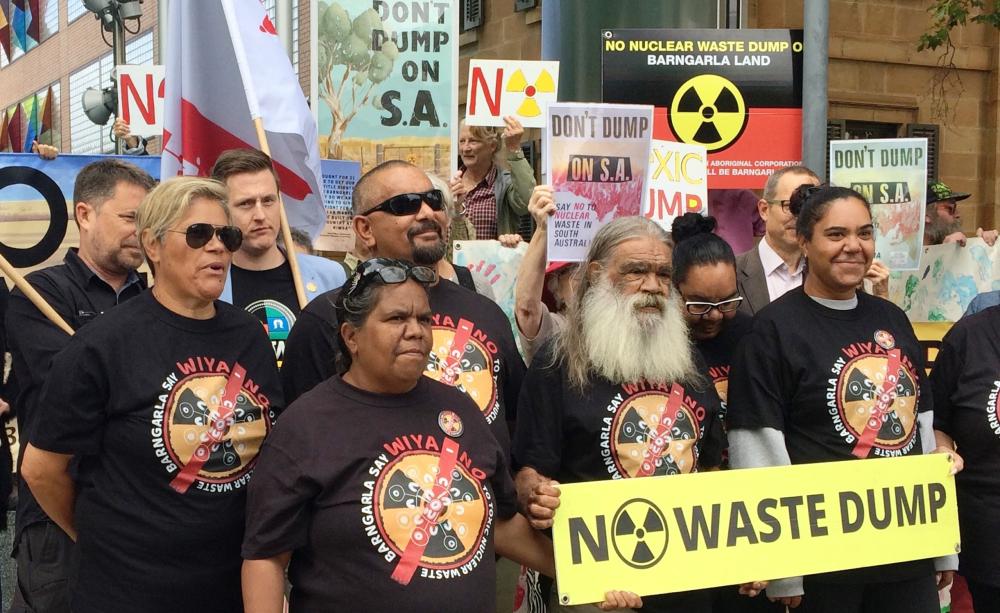
Dr Jim Green 26th July 2023 https://theecologist.org/2023/jul/26/aboriginal-australians-defeat-nuclear-dump
Historic win as South Australian Aboriginal traditional owners defeat nuclear dump plan.
Bipartisan efforts by successive federal governments to impose a national nuclear waste dump on the land of Barngarla Aboriginal traditional owners in South Australia (SA) have been upended by a federal court decision in favour of the Barngarla people.
Australians will have their say in a referendum about whether to change their constitution to recognise the First Nations of Australia by establishing an Aboriginal and Torres Strait Islander Voice later this year.
READ: Radioactive waste and the nuclear war on Australia’s Aboriginal people
The Voice would be an independent and permanent advisory body giving advice to the Australian parliament and government on matters that affect the lives of first nations peoples.
Ignored
Sadly, the federal Labor government has at the same time continued with the plan of the previous regime to establish a national nuclear waste dump near Kimba in South Australia – despite the unanimous opposition of the Barngarla traditional owners.
This plan has now come a-cropper. The Barngarla traditional owners sought to revoke the nomination of the dump site and the federal court this month agreed, arguing that the nomination of the dump site was infected by “apprehended bias” and “pre-judgement”.
The government might yet appeal the decision. However it seems likely that the plan for a nuclear dump on Barngarla country will instead be abandoned.
Aunty Dawn Taylor, a Barngarla elder, said: “I am so happy for the women’s sites and dreaming on our country that are not in the firing line of a waste dump. I fought for all this time for my grandparents and for my future generations as well.”
Jason Bilney, chairperson of the Barngarla Determination Aboriginal Corporation, said: “The Barngarla fought for 21 years for Native Title rights over our lands, including Kimba, and we weren’t going to stop fighting for this. We have always opposed a nuclear waste dump on our country and today is a big win for our community and elders.”
The Kimba site has been targeted for a dump since 2015. In 2021, the conservative Coalition government formally nominated the Kimba dump site, and the Labor government has continued with the plan since winning the May 2022 election.
Violation
Barngarla traditional owners were excluded from a so-called ‘community ballot’ by the Coalition government. An independent and professional ballot of Barngarla traditional owners found absolutely no support for the proposed dump ‒ but it was ignored.
The federal parliament’s joint committee on human rights unanimously concluded in an April 2020 report that the government was violating the human rights of Barngarla people. Even the Coalition members of the committee endorsed the report.
But the Coalition government continued to ignore the human rights of the Barngarla people. The Coalition government also tried to pass legislation which would deny Barngarla traditional owners the right to challenge the nomination of the Kimba dump site in the courts. However the draft legislation was blocked by Labor, minor parties and independent senators.
It was expected ‒ or at least hoped ‒ that the incoming Labor government would abandon the controversial dump proposal after the May 2022 election. But Labor only went as far as pointing out that Barngarla traditional owners could challenge the dump plan in the courts.
The Barngarla Determination Aboriginal Corporation was forced to launch a legal challenge against the previous government’s nomination of the Kimba dump site – and the Labor government fought the case.
Battle
There are at least two problems with Labor’s position. Firstly, the government has vastly greater resources to contest a legal challenge. Indeed, the government has spent A$13 million (£6.8 million) fighting Barngarla traditional owners in the federal court.
Barngarla traditional owners have spent significantly less than A$500,000 – needless to say, they have many pressing demands on their limited resources. There is no other example in recent Australian history of this level of legal attack on an Aboriginal group.
Secondly, the relevant laws are stacked against the interests of traditional owners. In 2007, the conservative Coalition government passed legislation ‒ the Commonwealth Radioactive Waste Management Act ‒ allowing the imposition of a nuclear waste dump on Aboriginal land with no consultation, and no consent from traditional owners.
At the time, Labor parliamentarians described the legislation as “extreme”, “arrogant”, “draconian”, “sordid”, and “profoundly shameful”.
But when the Labor government returned to the legislation in 2012 ‒ and renamed it the National Radioactive Waste Management Act ‒ the amendments were superficial and still allowed for the imposition of a nuclear waste dump with no consultation or consent from Traditional Owners.
Immoral
Regardless of the federal court’s decision, the plan to impose a nuclear dump despite the unanimous opposition of Barngarla traditional owners is immoral. It contradicts the spirit of the Voice to Parliament currently being championed by the Labor government.
Jayne Stinson, chair of the South Australian parliament’s environment, resources and development committee, said: “In this day and age, when we’re talking about ‘voice, treaty and truth‘, we can’t just turn around and say, ‘Oh well, those are our values but in this particular instance, we’re going to ignore the voice of Aboriginal people’.
“I think that’s just preposterous and it’s inconsistent with what most South Australians would think.”
The plan to dump on Barngarla country makes a mockery of Labor’s professed support for the United Nations’ Declaration on the Rights of Indigenous Peoples, which states that “no storage or disposal of hazardous materials shall take place in the lands or territories of indigenous peoples without their free, prior and informed consent”.
There is no informed consent from Barngarla traditional owners: there is informed unanimous opposition.
‘Dreadful’
Dr Susan Close, now the Labor deputy premier of South Australia, has consistently opposed the dump. She said in 2019 that it was a “dreadful process from start to finish” that led to the nomination of the proposed Kimba dump site and that SA Labor is “utterly opposed” to the “appalling” process which led to Kimba being targeted.
Dr Close noted in a 2020 statement, titled ‘Kimba site selection process flawed, waste dump plans must be scrapped’, that SA Labor “has committed to traditional owners having a right of veto over any nuclear waste sites, yet the federal government has shown no respect to the local Aboriginal people.”
She has called for her federal Labor colleagues to abandon the Kimba dump proposal once and for all in the wake of the recent federal court decision.
In February 2008, Labor prime minister Kevin Rudd highlighted the life-story of Lorna Fejo ‒ a member of the stolen generation ‒ in the historic National Apology to Aboriginal People in Parliament House.
At the same time, the Rudd government was attempting to impose a nuclear waste dump on Fejo’s country in the Northern Territory. Lorna said: “I’m really sad. The thing is ‒ when are we going to have a fair go? Australia is supposed to be the land of the fair go. I’ve been stolen from my mother and now they’re stealing my land off me.”
Resistance
Federal Labor’s “nuclear racism” is disgraceful and it diminishes all Australians. And Labor’s nuclear racism is always supported by the conservative Coalition parties, who are still today arguing for a ‘no’ vote in the upcoming referendum on a Voice to Parliament.
But nuclear racism has always met with resistance. Remarkably, community campaigns led by Aboriginal people have stopped five nuclear dump proposals since the turn of the century.
Plans for a national nuclear waste dump in SA have been defeated in 2004, 2019 and 2023 (touch wood), a planned national nuclear dump in the Northern Territory was defeated in 2014, and a plan to turn SA into the world’s high-level nuclear waste dump was defeated in 2016.
Three of the five successful campaigns involved legal challenges that made it much more difficult for governments to override community resistance.
The federal Labor government should abandon the Kimba dump site and apologise for attempting to foist a dump on Barngarla country despite the unanimous opposition of traditional owners.
Veto
The federal Labor government should also adopt SA Labor’s policy that traditional owners should have a right of veto over any proposed nuclear dumps.
That would give traditional owners across the country some confidence that their voice will be heard as the government progresses plans to store and dispose of waste arising from nuclear-powered submarines in the coming decades.
Finally, Labor must commit to amend the shameful and racist National Radioactive Waste Management Act.
This Author
Dr Jim Green is the national nuclear campaigner with Friends of the Earth Australia.
More information:
Radioactive waste and the nuclear war on Australia’s Aboriginal people
Barngarla: Help us Have a Say on Kimba (facebook)
Friends of the Earth nuclear-free campaign
No Radioactive Waste Facility for Kimba District (facebook)
Key British Assange supporter says Wikileaks founder could cut deal to secure freedom
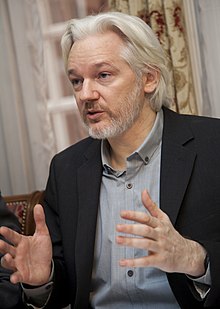
The Age, By Latika Bourke, July 26, 2023
London: One of federal parliament’s leading supporters of Julian Assange says the WikiLeaks founder could cut a deal with prosecutors and plead guilty to “whatever nonsense” necessary to secure his release from prison.
Labor MP Julian Hill, the member for Bruce, tried unsuccessfully to visit Assange in Belmarsh prison, where he has been held since 2019, during a private trip to Europe recently.
Prime Minister Anthony Albanese has directly lobbied US President Joe Biden for the Queenslander’s release but has so far failed to secure it, and has hinted that Assange may have to accept a plea deal.
“The reality is that Australia cannot force the United States to [release Assange], and if they refuse, then no Australian should judge Mr Assange if he chooses to just cut a deal and end this matter,” said Hill.
“His health is deteriorating and if the US refuses to do the right thing and drop the charges then no one would think less of him for crossing his fingers and toes, pleading guilty to whatever nonsense he has to and getting the hell out of there.”
Hill, a member of a cross-party group of MPs who support Assange’s release, also hit out at supporters who he sees as fixated on having Assange suffer as a martyr and continue to languish in prison as he faces extradition to the United States.
“It worries me greatly that there are some Assange supporters who would rather he be a martyr than a free man, but ultimately it’s important for everyone to respect what Julian himself chooses to do,” he said.
His wife Stella Assange has repeatedly warned his health has deteriorated badly due to his incarceration over the last four years…………………………………….
Stella Assange has not said if her husband will accept any plea deal, urging instead that the Biden administration force the US Department of Justice to drop the case, which began under the former Trump administration……………….
Hill said there was only one priority as the case continued to drag on and that was “bringing him home safely to be with his family”.
“I’m not privy to the negotiations that may be occurring but frankly the parliamentarians would back him to the hilt in cutting a deal if that’s what he chose,” he said.
“That’s a message that I wanted to convey personally and hear from him what he wants.”
The Australian High Commission in London tried to help Hill visit Assange on July 1, but the request was denied at the last minute by prison authorities.
“It was incredibly frustrating and disappointing that the Belmarsh Prison authorities failed to approve Mr Assange’s request for me to visit him,” Hill said. “The required paperwork was completed by Julian multiple times.
“However it mysteriously got lost and mislaid until the day before the scheduled visit when they said it was too short notice. It’s up to them to explain whether it’s a conspiracy or a stuff up, but it’s profoundly disappointing to the cross-parliamentary group.”
Jenny Louis, the governor of Belmarsh Prison, was contacted for comment. https://www.theage.com.au/world/europe/key-assange-supporter-says-wikileaks-founder-could-cut-deal-to-secure-freedom-20230725-p5dr7n.html
The Star-Spangled Kangaroo
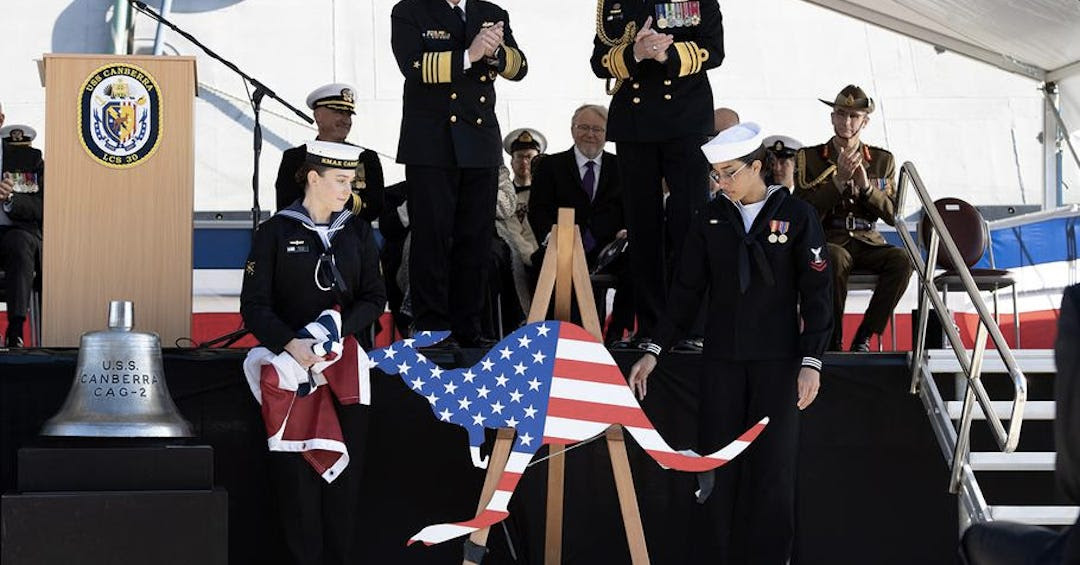
CAITLIN JOHNSTONE, JUL 27, 2023 https://www.caitlinjohnst.one/p/the-star-spangled-kangaroo?utm_source=post-email-title&publication_id=82124&post_id=135485598&isFreemail=true&utm_medium=email
A new US warship has been ushered into service in Sydney. The ship is called the USS Canberra to honor the military union of the United States and Australia, and, if that’s still too subtle for you, it has a literal star-spangled kangaroo affixed to its side.
That’s right: the first US warship ever commissioned in a foreign port has been emblazoned with a kangaroo covered in the stars and stripes of the United States flag. An Australian officer will reportedly always be part of the staff of the ship, to further symbolize the holy matrimony between Australia and the US war machine.
“I can think of no better symbol of this shared future than the USS Canberra,” gushed US ambassador to Australia Caroline Kennedy. “Built by American workers at an Australian company in Mobile, Alabama, her crew will always include a Royal Australian Navy sailor, and from today forward, she will proudly display a star-spangled kangaroo.”
And you know what? She’s right. Not because of her giddy joy over the complete absorption of Australia into the US military apparatus of course — that’s a horrifying nightmare which is increasingly putting this nation on track toward a frontline role in Washington’s war plans against China. But she’s right that the star-spangled kangaroo and the ship which carries it is a perfect symbol for the way these two nations have become inseparably intertwined.
In fact, I’d take it a step further. I’d say the star-spangled kangaroo should be the new symbol for our entire nation.
I mean, we might as well, right? Australia is not a sovereign nation in any meaningful way; we’re functionally a US military/intelligence asset, and according to our defence minister Richard Marles our own military is being moved “beyond interoperability to interchangeability” with the US war machine so they can “operate seamlessly together, at speed.”
The US imprisons Australian journalist Julian Assange for exposing US war crimes like he’s the personal property of the Pentagon, and when the US doesn’t like our Prime Minister because he’s too keen on Australian independence or perceived as too friendly with China, they simply replace him with another one.
We even found out recently that Australians are not permitted to know if the US is bringing nuclear weapons into this country. That is a secret the US keeps from all of us, and our government respects their privacy on the matter.
So I think the star-spangled kangaroo is an entirely appropriate symbol for this country. Put it on our flag. Put it on our money. Put it on all our warships and planes, and on every military uniform. When you walk into an Australian government building, Yankarooey (or whatever stupid Aussie nickname we make up for the thing to mask our own cognitive dissonance) should be the first thing everyone sees.
Undignified? Certainly. Humiliating? Absolutely. An admission that Australia is not a real nation? Of course. But at least it would be honest. If we’re going to act like Washington’s subservient basement gimp, we may as well dress the part.
Seven deadly sins in the Defence industry

In the light of such revelations, and of the fact that nuclear-propelled submarines are really suitable only for deep sea operations, not littoral defence, Richard Marles’s obduracy in continuing to pursue Virginia-Class Attack submarines is astonishing.
It is also about whether the Australian tax payer will be ripped off in the process of acquiring them.
By Richard Broinowski Jul 27, 2023 https://johnmenadue.com/seven-deadly-sins-in-the-defence-industry/
If previous defence acquisitions are any guide, the enormous cost of nuclear-powered submarines for the Royal Australian Navy will almost certainly escalate well beyond the estimated but un-itemised initial price of $A368 billion. The record of corruption of the two US submarine builders suggests that the project will also probably suffer from mismanagement. The final bill is likely to be astronomical.
In my article ‘AUKUS exposes Australia’s incoherent defence policy’, (Pearls and Irritations 14 February 2022), I mentioned the findings of Fred Bennett, Chief of Capital Procurement in the Australian Department of Defence from 1984 to 1988. Bennett listed what he called the seven deadly sins of defence procurement projects – novelty, uncertainty, complexity, interdependence, resource limitations, creative destruction and political constraints. (Security Challenges Vol 6 No 3 Spring 2010).
Bennett claimed that all have been present to a greater or lesser degree in most acquisition projects, and none can be entirely evaded or eliminated. The record over several decades, both in Australia and Britain supports his view.
The Australian Jindalee over the horizon radar system suffered similar delays. The Lockheed Martin F-35 joint strike fighter, designed as a low-cost, lightweight high-performance stealth aircraft, is none of these things, and its project director was sacked in 2010 for cost overruns, schedule delays and a troubling performance record. The BAE Hunter class frigate program has been plagued by design changes which made the ships heavier and slower than intended.
Trying to adhere to a prime contract comprising 22,000 pages with 600 sub contracts, the Collins class submarine all but lost its way in a forest of complexity. This was exacerbated when Wormald, the lead corporation in the submarine consortium changed hands. The head of Wormald was also chair of the Australian Submarine Corporation. The ASC lost its CEO and a period of chaos followed.
But it is not just Bennett’s seven deadly sins we have to worry about with regard to the acquisition of US nuclear powered submarines. Nor is it just about confusion about their primary role, and whether they will be the best possible platform available to realise it. It is also about whether the Australian tax payer will be ripped off in the process of acquiring them.
There are precedents. ……………………………………………………………………………………………………………………………
In the light of such revelations, and of the fact that nuclear-propelled submarines are really suitable only for deep sea operations, not littoral defence, Richard Marles’s obduracy in continuing to pursue Virginia-Class Attack submarines is astonishing. Much cheaper conventional submarines with air-independent propulsion (AIP) are available from Sweden, Germany, Korea or Japan. They are quieter than nuclear submarines, have the capacity to lurk undetected for 30 days or more, are almost as fast, and are very unlikely to suffer the kind of cost blow-outs we are likely to face in nuclear-powered Virginias. We could also get them sooner.
The pro-nuclear lobby in Australia is excited by the prospect that possession of nuclear-powered submarines will lead to the capacity to develop a complete nuclear industry in Australia. This is a pipe dream. Operating experience with ANSTO’s one small Argentinian-designed research reactor at Lucas Heights does not enhance our capacity to enrich uranium, fabricate fuel rods, construct power reactors, or permanently dispose of nuclear waste. Few if any local councils would welcome construction of power reactors in their backyards. Australia still has no designated burial place for low-level medical nuclear waste. A growing number of high-level highly toxic spent fuel rods remain unprocessed at Lucas Heights. Uranium and plutonium residue from rods that have been processed overseas remain in temporary storage.
One can only hope that it is not too late to abandon the purchase of Virginia submarines in favour of much cheaper non-nuclear boats with AIP.
[problems in defence procurement, submarines, corruption, AUKUS, faulty steel plate, nuclear propulsion versus AIP]
Nuclear weapons:“Oppenheimer” won’tmake a difference, but Australia can
The Interpreter GARETH EVANS, 26 July 23
The movie missed a chance to galvanise a renewed campaign, to better protect against existential danger than rely on sheer dumb luck.
Oppenheimer is a big disappointment for those of us who hoped that this super-hyped, all-star-cast new movie might give new life to the nuclear disarmament cause, creating new awareness of nuclear risks and energising popular support for their elimination – maybe even influencing senior policymakers in the way that the 1983 telemovie The Day After was, famously, an epiphany for Ronald Reagan.
…………………………… while making clear that the Hiroshima and Nagasaki bombs were big bangs, and the Edward Teller’s anticipated H-bomb much bigger still, it is no part of the film’s mission to convey the sheer flesh and blood horror of these most indiscriminately inhumane weapons ever devised.
Oppenheimer’s moral qualms about massive civilian death tolls, and the catastrophic potential of an internationally unregulated post-war nuclear arms race, are not as clearly or forcefully explained as they could be. And the film takes it as given that the bomb-dropping (not the Soviet Union’s almost simultaneous declaration of war) was the decisive factor in Japan’s surrender – an historically flawed storyline, but one that remains critical to this day in keeping alive belief in the utility of nuclear weapons.
So, with no new help from the cinema, it’s back to the same old frustrating drawing board for nuclear risk reduction and disarmament campaigners.
The need for effective advocacy and action here has never been more compelling. Nearly 13,000 nuclear warheads are still in existence, with a combined destructive capability of close to 100,000 Hiroshima- or Nagasaki-sized bombs, and stockpiles, especially in our own Indo-Pacific region, now growing again. The taboo against their deliberate use is weakening, with Russia’s President Vladimir Putin talking up this prospect in language not heard since the height of the Cold War. Longstanding nuclear arms control agreements are now either dead (ABM, INF, Open Skies) or on life support (New START).
Moreover, the risk of use through human or system error or miscalculation is greater than ever, not least given new developments in AI and cyber-offence capability. That we have not had a nuclear weapon used for nearly 80 years is not a result of statesmanship, system integrity and infallibility, or the inherent stability of nuclear deterrence. It has been sheer dumb luck, and it is utterly wishful thinking to believe that this luck can continue in perpetuity.
…………………………..what can reasonably be hoped for, and sooner rather than later, is a serious global commitment to nuclear risk reduction.
Australia has a more useful role in this enterprise than many may imagine, with our generally strong record on arms control – including bringing to conclusion the Chemical Weapons Convention – and our nuclear credentials burnished by the ground-breaking Keating government-initiated Canberra Commission on the Elimination of Nuclear Weapons, the Howard Government’s role in getting the Comprehensive Test Ban Treaty to a vote, and the more recent Rudd government-initiated Australia-Japan International Commission on Nuclear Non-Proliferation and Disarmament.
The most commonly proposed risk-reduction measures – and central elements in the Australia–Japan commission’s proposed “minimisation” agenda – may be described as the “4 Ds”. They are Doctrine (getting universal buy-in for a No First Use (NFU) commitment), Deployment (drastically reducing the number of weapons ready for immediate use), De-alerting (taking weapons off high-alert, launch-on warning readiness) and Decreased numbers (reducing the overall global stockpile to less than 2,000 weapons).
A world with low numbers of nuclear weapons, with very few of them physically deployed, with practically none of them on high-alert launch status, and with every nuclear-armed state visibly committed to never being the first to use them, would still be very far from perfect. But one that could achieve these objectives would be a very much safer world than we live in now.
What has been most depressing about Australia’s performance in recent years, which it is very much to be hoped will now change, is that even these realistic objectives have not been actively supported. Australia’s status as a close US ally and, as such, one of the “nuclear umbrella” states, gives us a particularly significant potential role in advancing some key elements of the risk-reduction agenda just described.
The most immediately useful step we could take would be to support the growing international movement for the universal adoption of No First Use doctrine by the nuclear-armed states. ………………… At the NPT Review Conference concluded in New York in August 2022, a great deal of support was evident for such No First Use commitments as part of a larger risk reduction agenda. But the delegation of our new Labor government made no contribution to that debate. I live in hope that that position will change. https://www.lowyinstitute.org/the-interpreter/nuclear-weapons-oppenheimer-won-t-make-difference-australia-can
New Zealand’s anti-nuclear stance means it won’t play a role in Australia’s submarine plans
New Zealand’s commitment to remaining nuclear-free means it won’t play a role in Australia’s defense plans to acquire nuclear-powered submarines, the leaders from both countries said Wednesday
ABC News, By NICK PERRY Associated Press, July 26, 2023
WELLINGTON, New Zealand — New Zealand’s longstanding commitment to remaining nuclear-free means it won’t play a role in Australia‘s plans to acquire nuclear-powered submarines, the leaders from both countries said after meeting Wednesday…………………………………………………………. more https://abcnews.go.com/International/wireStory/new-zealands-anti-nuclear-stance-means-play-role-101659242
Why investing in new nuclear plants is bad for the climate

the climate crisis demands urgency and requires such large investments that cost efficiency is of key importance.
Joule, Luke Haywood Marion Leroutier Robert Pietzcker, July 21, 2023
There has been a strong push to promote increased investments in new nuclear power as a strategy to decarbonize economies, especially in the European Union (EU) and the United States (US).
The evidence base for these initiatives is poor. Investments in new nuclear power plants are bad for the climate due to high costs and long construction times. Given the urgency of climate change mitigation, which requires reducing emissions from the EU electricity grid to almost zero in the 2030s (Pietzcker et al.1), preference should be given to the cheapest technology that can be deployed fastest.
On both costs and speed, renewable energy sources beat nuclear. Every euro invested in new nuclear plants thus delays decarbonization compared to investments in renewable power. In a decarbonizing world, delays increase CO2 emissions.
Our thoughts focus on new nuclear power plants (not phasing out existing plants) in the US and Europe. In Europe, new nuclear power plants are planned or seriously discussed in France, Czechia, Hungary, Poland, Bulgaria, Slovenia, Sweden, and the United Kingdom. We do not focus on China, where government-set electricity prices and subsidized capital costs make it more difficult to contrast the profitability of different types of energy sources.
Nuclear energy is expensive
The cost overruns on recent nuclear projects are dramatic. In an international comparative assessment of construction cost overruns for electricity infrastructure, Sovacool et al. 2 find that nuclear reactors are the investment type with the most frequent and largest cost overruns, alongside hydroelectric dams. 97% of the 180 nuclear reactor investment projects included in their analysis suffered cost overruns, with an average cost increase of 117% per project.
More recently, the current estimate of the construction costs of the French Flamanville project stands at €13.2 billion up from an initial €3.3 billion (figures that do not even include financing costs, which the French audit office estimated at €4.2 billion up from an initial €1.2 billion) and those of the recently opened Finish Olkiluoto at €11 billion instead of €3 billion. “Construction costs are high enough that it becomes difficult to make an economic argument for nuclear,” Davis finds. Similarly, Wealer et al.conclude that “investing into a Gen III/III+ nuclear power plant … would very likely generate significant losses.”
Why is nuclear so costly?
Construction costs are driven by safety. Nuclear accidents remain a possibility—and damages may be global. Rangel and Lévêque note that huge damages occurring at “low and uncertain probability” make it difficult to determine whether safety investments are cost-effective. The nuclear plants built relatively quickly in previous decades had lower safety. requirements. Policy makers’ preferences for safety makes sense given that nuclear power plant operators’ private insurance coverage is typically very limited.
Beyond construction costs, the cost of capital is a critical parameter for evaluating the viability of nuclear power. First, the very long construction times and delays generate particularly large financing costs for a given interest rate. Portugal-Pereira et al. report an escalation of capital costs worldwide due to increasing construction delays for the last generation of nuclear reactors constructed since the 2010s. The French court of auditors estimates that the cost of the French nuclear power plant Flamanville will increase from €13.2 billion to €20 billion once financing costs and delays are taken into account. Second, the historically high risk of default translates into higher interest rates. These two factors make the profitability of nuclear projects very dependent on financing conditions.
Finding an economic rationale for continued investment in new nuclear requires optimism regarding costs………………………………………….
Costs are not projected to come down very much even for the six new reactors planned to be built by 2035 (estimated to cost €52 billion in total, or €8.6 billion per reactor). The most recent EPR construction, Sizewell C in the United Kingdom, is also one of the most expensive projects at around €23 billion (£20 billion). This pattern of increasing costs over time has generated some interest in the literature (Lovering et al.7 and Eash-Gates et al.8).
Most of the candidate explanations (in particular, increased safety regulations) do not provide grounds for optimism for the future. In a wide-ranging review of different technologies, Meng et al.9 find nuclear power to be a “notable exception” where progress is overestimated with actual costs consistently higher than expected.

Small modular reactors (SMRs) may not be an exception: their advantages in terms of lower complexity may not translate into sound economics given lower energy production. Glaser et al 10 note that even optimistic estimates require many hundreds of reactors to be built before electricity produced is cost-competitive compared with larger reactor designs. The potential of modularity to reduce costs appears limited in practice.
Nuclear power is not cost-competitive with renewables
Despite poor profitability, nuclear power is advanced as a good investment to fight climate change. However, today, the challenge for nuclear profitability does not come from coal or gas but from renewables. It is hard to overstate how strongly the costs of renewables have decreased (see Figure 1 on original) . Few publications have anticipated these cost decreases, and public debate is often based on outdated cost assumptions.
Baseload and flexibility
…………………………………….Shirizadeh et al. 12 find that costs of storing variable renewable electricity production appear manageable, with storage costs of less than 15% of total costs associated with a fully renewable electricity grid for France. Pietzcker et al.1 find that new nuclear constructions would not decrease the costs of achieving EU climate targets. Shirizadeh and Quirion 13 find that a 100% renewable system is very cost-effective for France.
Taking into account wider economic impacts does not favor nuclear
………………………………….adding non-market benefits to the equation implies that non-market costs should also be considered. This is not easy: how should we account for nuclear waste? Nuclear waste is the unresolved problem of the nuclear industry. Cheap long-term storage for anthropogenic radioactive substances is elusive despite worldwide, decades-old efforts. In absence of any proven low-cost permanent storage technology, nuclear waste will have to be retreated regularly and stored in facilities above the ground.
Costs would arise for many thousands of years. The importance of costs and benefits for future generations in today’s decisions has been a controversial topic for climate change policy, and it appears even more relevant for nuclear waste. Krall et al. 14 argue that SMRs may actually “exacerbate the challenges of nuclear waste management.”
Third, uranium mining causes pollution and radioactive exposure. As a report of the EU’s Scientific Committee on Health, Environmental and Emerging Risks notes, “almost 100% of the total eco-toxicity and human toxicity impacts over the whole nuclear life cycle is connected to mining and milling … While mining and milling is regulated [within the EU], 90% of what the EU need globally comes from 7 countries (none in Europe).” In Niger, for example, the systematic neglect of health and safety procedures in countries producing uranium for EU consumption persists despite evidence of “grave environmental impacts and rampant institutional failures.” 15
Finally, the continued development of nuclear energy could contribute to the risk of proliferation of nuclear weapons, as well as the risk of nuclear power plants being targeted in armed conflict, a permanent risk in Ukraine today.
Building new nuclear takes time we do not have
The business case and economics may be poor, but in light of the very real threat of climate catastrophe, should we not invest in all alternatives to fossil fuels? The problem is that building nuclear plants is slow and delivery is uncertain.
Even the International Atomic Energy Agency and Nuclear Energy Agency—organizations promoting the use of nuclear energy—assume construction times of around one decade, 13 whereas renewables can come online in a fraction of that time. Given lags in planning and regulatory approval, any new nuclear plants would come online too late to help decarbonize our economies on time. However, even this time frame appears optimistic:………………………………………..
Conclusion: In solving the climate crisis, new nuclear is a costly and dangerous distraction
……………………………………………………………….. the climate crisis demands urgency and requires such large investments that cost efficiency is of key importance……………………………… If governments and economic actors believe that nuclear power will come online at a certain date, they will not make alternative plans, and without alternative plans, the current carbon-intensive electricity system will remain in place—rendering climate targets unachievable.
References (many) ……………………….. https://www.cell.com/joule/fulltext/S2542-4351(23)00281-7
1 This month
17 October, Free Public Talk on Nuclear Issues in South Australia
David Noonan will speak on public interest concerns over the new Roxby Downs Indenture Act 2026 on BHP copper-uranium mining and ore processing in SA, and on how AUKUS may face SA with a High-Level nuclear waste agenda.
Dr Jim Green will discuss international developments in the field of nuclear power including ‘small modular reactors’ and Generation 4 ‘advanced’ nuclear reactor concepts.


Help Aunty Sue Protect Her Land and Sacred Sites From Destructive Rocket Testing.
.

Australians deserve the truth
about
AUKUS – https://aukuspublicinquiry.com/

PETITION – To: Prime Minister Anthony Albanese and the Australian Labor Government

of the week – Australians for War Powers Reform (AWPR)
To see nuclear-related stories in greater depth and intensity

