Nuclear waste on Aboriginal land ?- and the Voice to Parliament?
The Australian government is in the process of holding a referendum that would give the indigenous people a Voice to Parliament. Imposing nuclear waste on Aboriginal land is not a good look, is it?

This morning, I heard Professor Ian Lowe, talking to a English journalist, about yesterday’s court decision, which supported the Barngarla people’s opposition to nuclear waste dumping on their land.
Prof Lowe eloquently summarised the importance of this legal decision:
-the Aboriginal people were not consulted when the Morrison Liberal Coalition decided to make a nuclear waste dump on their traditional land.
– this raises problems for the Australian government in selecting any land in this country for nuclear waste dumping
-this has international implications – about any country where the rulers want to impose a nuclear waste dump on indigenous land
-this has implications for the ill-advised (corrupt firm PWC was the advisor) AUKUS decision by the Albanese government to buy U.S nuclear submarines at $369billion. That decision included Australia taking responsibility for the high level radioactive trash from the nuclear submarines. Where to dump that trash?
Of course, the Australian government does have the power to impose the nuclear waste dump anyway, against indigenous wishes, even against South Australian State government wishes,
The Australian government is in the process of holding a referendum that would give the indigenous people a Voice to Parliament. Imposing nuclear waste on Aboriginal land is not a good look, is it?

Labor must hear Indigenous voice against Kimba nuclear site
Jim Green and Michele Madigan, https://indaily.com.au/opinion/2023/07/17/labor-must-hear-indigenous-voice-against-kimba-nuclear-site/—
Ahead of tomorrow’s expected federal court decision on a Barngarla Traditional Owners challenge to the planned Kimba nuclear waste site, Jim Green and Michele Madigan say federal Labor must be consistent on listening to Indigenous concerns.
If the Albanese Labor government wants to restore confidence in its plan for an Indigenous Voice to Parliament, it needs to walk the talk and respect Aboriginal voices.
Currently, the government is ignoring the Barngarla Traditional Owners who are unanimous in their opposition to the government’s plan for a national nuclear waste dump (or ‘facility’) near Kimba on South Australia’s Eyre Peninsula.
Labor inherited the Kimba dump plan from the Morrison Coalition government. Barngarla Traditional Owners were excluded from a so-called ‘community ballot’ by the Morrison government. The results of an independent, professional survey of Barngarla Traditional Owners ‒ which found absolutely no support for the proposed dump ‒ were also ignored.
Jason Bilney, Chair of the Barngarla Determination Aboriginal Corporation, said: “It is a simple truth that had we, as the First People for the area, been included in the Kimba community ballot rather than unfairly denied the right to vote, then the community ballot would never have returned a yes vote.”
Federal parliament’s Joint Committee on Human Rights Committee unanimously concluded in an April 2020 report that the Morrison government was violating the human rights of Barngarla people. Even the Coalition members of the committee endorsed the report.
But the Morrison government continued to ignore the human rights of the Barngarla people.
The Morrison government also tried ‒ but failed ‒ to pass legislation which would deny Barngarla Traditional Owners the right to a judicial review of the nomination of the Kimba dump site. The draft legislation was blocked by Labor, minor parties and independent Senators.
It took 21 years for the Barngarla people to secure Native Title of their country through a court determination. Six months later, the Morrison government nominated Barngarla country for the proposed nuclear waste dump.
It was expected ‒ or at least hoped ‒ that the incoming Albanese Labor government would dump the controversial dump proposal after the May 2022 election. But Labor has pressed ahead with the Kimba dump proposal, led by federal resources minister Madeleine King.
Labor isn’t responsible for the plan to dump nuclear waste on Kimba farming land. But that’s no excuse for continuing with a controversial and strongly-contested proposal.
Labor’s position is that Barngarla Traditional Owners can challenge the dump plan in the courts. And that is what is happening: the Barngarla Determination Aboriginal Corporation launched a legal challenge against the Morrison government’s declaration of the Kimba dump site. The matter is before the Federal Court and a decision is expected on July 18 (with the proviso that an appeal to the full bench of the Federal Court may follow).
There are at least two problems with Labor’s position. Firstly, the government has vastly greater resources to contest a legal challenge. Indeed the government has spent $13 million fighting the Barngarla Traditional Owners in the Federal Court. Barngarla Traditional Owners haven’t even spent half a million dollars; and needless to say they have many pressing demands on their limited resources.
There is no other example in recent Australian history of this level of legal attack on an Aboriginal group.
Secondly, the relevant laws are stacked against the interests of Traditional Owners. In 2007, the Howard Coalition government passed legislation ‒ the Commonwealth Radioactive Waste Management Act ‒ allowing the imposition of a nuclear waste dump on Aboriginal land with no consultation or consent from Traditional Owners.
At the time, Labor parliamentarians described the legislation as “extreme”, “arrogant”, “draconian”, “sorry”, “sordid”, and “profoundly shameful”. But when the Gillard Labor government amended the legislation in 2012 ‒ and renamed it the National Radioactive Waste Management Act ‒ the amendments were superficial and still allowed for the imposition of a nuclear waste dump with no consultation or consent from Traditional Owners.
Even if the Federal Court finds that the government has acted within the law, the plan to impose a nuclear dump despite the unanimous opposition of Barngarla Traditional Owners is immoral.
It contradicts the spirit of the Voice to Parliament currently being championed by the Albanese government. Jayne Stinson, Chair of the SA Parliament’s Environment, Resources and Development Committee, said: “In this day and age, when we’re talking about Voice, Treaty and Truth, we can’t just turn around and say, ‘Oh, well, those are our values but in this particular instance, we’re going to ignore the voice of Aboriginal people’. I think that’s just preposterous and it’s inconsistent with what most South Australians would think.”
The government has spent $13 million fighting the Barngarla Traditional Owners in the Federal Court
It contradicts Labor’s professed support for the United Nations Declaration on the Rights of Indigenous Peoples, which states that “no storage or disposal of hazardous materials shall take place in the lands or territories of indigenous peoples without their free, prior and informed consent”.
Susan Close, now Deputy Premier of South Australia, said in 2019 that it was a “dreadful process from start to finish” that led to the nomination of the proposed Kimba dump site and that SA Labor is “utterly opposed” to the “appalling” process which led to Kimba being targeted.
Close noted in 2020 statement, titled ‘Kimba site selection process flawed, waste dump plans must be scrapped’, that SA Labor “has committed to traditional owners having a right of veto over any nuclear waste sites, yet the federal government has shown no respect to the local Aboriginal people.”
Of course, Close was speaking about the Morrison government but SA Labor continues to call for the federal government to abandon the proposed dump and for Traditional Owners to have a right of veto.
Yet the federal Labor government stubbornly persists.
Sadly, federal Labor has form on these issues. In February 2008, Labor Prime Minister Kevin Rudd highlighted the life-story of Lorna Fejo ‒ a member of the stolen generation ‒ in the historic National Apology to Aboriginal People in Parliament House.
At the same time, the Rudd government was attempting to impose a nuclear waste dump on her country in the Northern Territory. Fejo said: “I’m very, very disappointed and downhearted about that [the National Radioactive Waste Management Act]. I’m really sad. The thing is ‒ when are we going to have a fair go? Australia is supposed to be the land of the fair go. When are we going to have fair go? I’ve been stolen from my mother and now they’re stealing my land off me.”
Labor’s nuclear racism is disgraceful and it diminishes all Australians.
Several steps should be taken to rectify the situation. To date, the issue has been managed by resources minister Madeleine King. There appears to have been little or no input from caucus, Cabinet or the Prime Minister’s Office. That needs to change.
Secondly, Labor will hold its national conference in Brisbane in mid-August. If it hasn’t already done so, Labor should take the opportunity presented by the conference to announce that it will no longer attempt to impose a dump against the opposition of Barngarla Traditional Owners.
So much the better if a national conference resolution adopts SA Labor’s policy that Traditional Owners should have a right of veto over any proposed nuclear dumps. That would give traditional owners across the country some confidence that their voice will be heard as the government progresses plans to store and dispose of waste arising from nuclear submarines in the coming decades.
Court rules in favour of Barngala people, preventing nuclear waste facility in Kimba

Joseph Guenzler – July 18, 2023 https://nit.com.au/18-07-2023/6853/court-rules-in-favour-of-barngala-people-preventing-nuclear-waste-facility-in-kimba
The Barngarla people of South Australia’s Eyre Peninsula are rejoicing as the Federal Court has overturned the decision to construct a nuclear waste facility on their land in Kimba.
The proposed facility was to store radioactive waste categorised as low and intermediate level.
The Barngarla traditional owners took the matter to the Federal Court, seeking a judicial review. They argued that the facility would disrupt a site of great significance and claimed that they were not adequately consulted before the plan received approval in 2021.
“It was important to stop this dump because the Seven Sisters Dreaming goes through there,” said Barngarla Elder Aunty Dawn Taylor, who was born at Kimba.
“Having a waste dump out there would have just destroyed everything.”
The Barngarla native title area covers more than 34,000 square kilometres on Eyre Peninsula, including the town of Kimba.
On Tuesday, the court ruled in favor of the native title group.
As a result, the future of the project is now uncertain as the court has invalidated the federal government’s previous declaration made in 2021, which designated the site for the nuclear waste facility.
Justice Natalie Charlesworth ruled in favor of the Barngarla people, citing a perceived bias in the decision-making process due to “pre-judgment.”
Justice Charlesworth also found there was an error of law, but said it did not have a “material effect” on the outcome of the declaration of the site.
A separate hearing will address the matter of legal costs, which are expected to be substantial.
The decision was met with enthusiasm by opponents of the nuclear facility, who gathered at the Federal Court building and expressed their joy upon hearing the verdict.
Speaking outside the building in Adelaide’s CBD, Barngarla Determination Aboriginal Corporation (BDAC) chairman Jason Bilney said it had been a “David and Goliath” battle that had left him “very emotional”.
“It’s been proud win for Barngarla, as well as other First Nations, to continue this fight and get this message out,” he said.
“The lesson is, it’s about truth telling… and it’s about listening to the First Nations people and who we are today and we’ve prevailed and we’ve won.”
“The money that the government’s spent to take us to court could be better spent for the rest of Australia, everyday Australians and the community, instead of taking First Nations people to court, it’s very disrespectful — we’ve been here over 60,000 years.”
Justice Charlesworth has decided to withhold any definitive orders regarding the judicial review until both parties have had a chance to review her judgment.
However, she has indicated that the most suitable course of action is to invalidate the entire declaration made by former resources minister Keith Pitt concerning the proposed facility.
This week’s nuclear news, but climate is a bigger story

Some bits of good news: Positive tipping points could save the climate – this man is showing us how. Deforestation rates plummeted in Brazil.
Last week it was a “watershed week”. And it seems that this one is also, – though for a largely different reason. The Ukraine-NATO thing is a mess. The Western media continues to religiously recite the story of Ukraine’s successful “counter-offensive”. But there’s whisper of dissension in NATO, and even some whispered criticism of Volodymyr Zelensky .
But really – the big watershed thing is global heating. At last, the media seems to be abandoning the pretense that global heating effects happen to hit one country, then another – sort of separately. It is becoming obvious that global heating is a global event – at least now enveloping the Northern part of the globe. (We in the cooler South are still comfortably preoccupied with sport, as the major event)
Climate. Temperatures above average almost every day this year. UK to see biggest increase in ‘uncomfortably hot’ days in the world as climate change bites. More than 113 million Americans under extreme heat alerts as relentless temperatures continue. The US says it will not “under any circumstances” pay reparations to developing countries hit by climate change-fuelled disasters. Greenpeace: Asset managers are ‘ignoring’ climate impact of bitcoin.
Christina notes. “As long as it takes” – WHAT DOES THIS MEAN? Zelensky mania! – But are cracks appearing in NATO?Nuclear power is SO IRRELEVANT – to climate! It’s almost funny, -but it’s NOT funny.
TOP STORIES
Julian Assange Is “Dangerously Close” to Extradition for Revealing US War Crimes.
Climate Change Threatens U.S. Nuclear Strike Capability.
A Scott Ritter Investigation: Agent Zelensky – Part 1 https://www.youtube.com/watch?v=HLeBb6hPUC8 Will the Ukraine war be the undoing for the European Union?
IN KOSOVO, NATO ALLIES BLAME DEPLETED URANIUM FOR CANCER CASES.
Cuba condemns US deployment of nuclear submarine in its waters.
Failed Fukushima Fixes Falling Like Dominoes.
‘Atomic Fallout’: Records reveal government downplayed, ignored health risks of St. Louis radioactive waste for decades.
AUSTRALIA.
- Labor must hear Indigenous voice against Kimba nuclear site.
- NATO’s talk of further Asian engagement should be feared by Australia. Supporting US military against China could draw Australia into nuclear war, expert warns.
- USA cannot sell nuclear submarines to Australia. Australia on track for exemption to accelerate AUKUS nuclear subs deal. Australia needs a nuclear power school to develop AUKUS capability: Navy chief. .
- Nuclear power too expensive and slow to be part of Australia’s plans to reach net zero, study finds.
- Merri-bek City Council is a Nuclear-Free Zone.
- Dutton wants Australia to join the “nuclear renaissance” – but this dream has failed before. Taiwan solution is diplomacy rather than nuclear hell.
CLIMATE. Extreme weather increasingly disrupted generation of nuclear power in last 30 years: State of the Climate in Europe 2022. Heatwaves: Why this summer has been so hot. High river temperatures to limit French nuclear power production. France Cuts Nuclear Output as Heat Triggers Water Restrictions. How much water do French nuclear plants use? Hungary’s nuclear power plant reduces output due to the hot weather.
ECONOMICS. UK govt discusses sale of Wylfa nuclear site. Michigan ratepayers will foot the bill for Resuscitation of Palisades Nuclear Reactor. Small nuclear reactor industry in big trouble? France to decide on nuclear financing by end of 2024.
EMPLOYMENT. Nuclear safety staffing in the United States: a crisis with no easy fix.
ENERGY. The Path to a Sustainable Civilisation. https://www.youtube.com/watch?v=0hTjLH4T6X8 Welsh campaigners call for Wylfa to be at heart of Ynys Mon ‘green energy’ island.
ENVIRONMENT. Oceans ‘Grave concerns’ as Japan’s plan to release Fukushima wastewater to the Pacific. Safe or septic – Japan’s nuclear wastewater dumping. Dumping Doubts: Releasing Fukushima’s Waste Water. 12 years on, Fukushima’s citizen-scientists continue to test local fish for radioactive substances.. Nuclear bomb plutonium fallout marks dawn of new epoch in which humanity dominates planet.
ETHICS and RELIGION. Archbishop to denounce nuclear arms on Trinity test’s 78th anniversary.
HEALTH. Nuked blood: PM Rishi Sunak is urged to uncover the truth on veterans’ missing health records. Radiation. New Evidence on Tritium Hazards How the world’s most radioactive man cried blood while his skin melted as he was kept alive in 83-day nightmare after horror accident at Japanese nuclear power plant.
INDIGENOUS ISSUES. Nuclear waste issue must be resolved before new facility can be explored, says Saugeen Ojibway Nation.
LEGAL. Sizewell C faces fresh legal action in fall out over water supply.
MEDIA. Terrible truths about nuclear energy exposed. The War on journalism: the Case of Julian Assange. https://www.youtube.com/watch?v=90OIGGpfHDo&t=366s Oppenheimer: what you need to know before watching. A Pro-Nuke Snoozer.
NUCLEAR TECHNOLOGY. Small size, big problems: NuScale’s troublesome small modular nuclear reactor plan. An Unholy Alliance: billionaire technocrats delight in planning Artificial Intelligence to run nuclear reactors and nuclear weapons!
OPPOSITION to NUCLEAR. Kenya has restated its commitment to ensuring nuclear energy and nuclear weapons are not used in the continent. Postpone plans for Kilifi nuclear power, Kenya. Protests stopped nuclear waste dumping at Bradwell in the 80s, and now will likely do so again. Nuclear power is still an option at Comanche 3. These Pueblo activists want to change that. France detonated nearly 200 nuclear ‘tests’ in French Polynesia — now this activist is calling for accountability.
PERSONAL STORIES. Listening to Oppenheimer, Seven Decades Later. Oppenheimer’s tragedy — and ours.
POLITICS.
- U.S. Congress votes down amendment to block cluster bomb shipments to Ukraine. Rep. Gaetz Says He Will Co-Sponsor Amendment to Block Cluster Bombs to Ukraine. BRING IT HOME- Robert F. Kennedy, Jr. Kennedy accuses Biden of preparing for ‘war with Russia’.
- What to expect from NATO Summit 2023.
- UK delays ‘Great British Nuclear’ launch. Rolls-Royce, mini-nuke sector left in dark as Great British Nuclear launch delayed.
POLITICS INTERNATIONAL and DIPLOMACY.
- Cracks in NATO’s Ukraine Project. “War Effort In Shambles As Hawks Turn On Each Other” At NATO Summit. NATO to keep Ukraine at arm’s length. Zelensky slams Biden’s ‘unprecedented and absurd’ stance on NATO membership. SCOTT RITTER: NATO Summit, a Theater of the Absurd. The Dissolution of NATO May Be the Only Way to Prevent WWIII. Nato isn’t defending Ukraine. It’s stabbing it in the back. The Biden doctrine: “As long as it takes,” or “No matter how many die”.
- An Accident Waiting to Happen: NATO Looks to Asia. Biden Keeps Lying About The US “Not Trying To Surround” China. NATO is ‘malicious poison’ – former Australian PM, Paul Keating, (some agreement with this, in Paris) N Korea slams US move to deploy nuclear submarines to peninsula. Asia is rowing about Fukushima nuclear wastewater.
SAFETY. The Zaporizhzhia nuclear power plant is a ‘dirty bomb’ waiting to happen – a nuclear expert explains. Security concerns for Britain as China might be controlling its nuclear power stations. Incidents. Novouralsk Nuclear Plant Blast—What We Know, as Russians Rushed to Hospital. Russia says West is sponsoring ‘nuclear terrorism’ after Ukrainian drone strike.
SECRETS and LIES. White House opposes independent oversight of Ukraine aid. FBI colluded with Ukraine in social media crackdown – lawmakers. China says Japanese govt’s fund subsidizing local fishing industry ‘hush money’.
SPACE: EXPLORATION, WEAPONS. SpaceX’s Starlink satellites are leaking electromagnetic radiation that’s ‘photobombing’ our attempts to study the cosmos.
SPINBUSTER. Exposing the lying claims of pro nuclear shill Zion Lights.
URANIUM. CANATOMIC: Canada’s Neglected Uranium History.
WASTES. Global Impact: Japan, nuclear watchdog under intense scrutiny over discharge of Fukushima nuclear-contaminated water. Dumping Doubts: Releasing Fukushima’s Waste Water. Japan to Release 1.3 Million Tonnes of Water Used During Fukushima Nuclear Accident. US could stop Ukraine conflict instantly – Hungary.
Takeaways from AP’s examination of nuclear waste problems in the St. Louis region. Canada’s Civil Society Groups Call for Public Debate on Radioactive Waste Management Strategy.
WAR and CONFLICT. NATO fails to reduce nuclear risks at Vilnius Summit. The NATO ultimatum to Ukraine – invitation to win by winter or die . Ukraine admits responsibility for terror attack on Crimean bridge. Drone crashes in Russian ‘atomic city’ – governor. Russia prevents Ukraine attack on Crimea’s Sevastopol. Need more cannon-fodder: Ukraine stepping up mercenary recruitment effort . Ukraine’s chances of victory in 2023 are ‘vanishingly small’ https://www.youtube.com/watch?v=rH2mmqhTpi8
Crimea invasion to cost Kiev 200,000 soldiers: Ex-Zelensky aide. WHY ARE AMERICAN SOLDIERS IN UKRAINE? Indonesia Warns Nuclear Weapons Put Southeast Asia a ‘Miscalculation Away’ From Disaster.White House: Ordering the Selected Reserve and Certain Members of the Individual Ready Reserve of the Armed Forces to Active Duty.
WEAPONS and WEAPONS SALES.
- U.S. Cluster Bombs Have Arrived in Ukraine. Cluster Bombs for Ukraine? A Warning From Kosovo. Germany Rejects Cluster Bombs For Ukraine As Clip Surfaces Of Biden Admin Previously Calling Them A ‘War Crime’.
- 20% of Ukrainian weapons destroyed in just two weeks – New York Times.
- France to supply Ukraine with long-range cruise missiles with the ‘capacity to strike deeply’.
- Peace Boat arrives in Albany to raise awareness of dangers of nuclear weapons.
- US to deploy 3 armored brigades to Poland and Romania, positioning B-52s in Alaska, closer to Russia.
- Russia’s Northern Fleet will not send nuclear sub to main Navy parade.
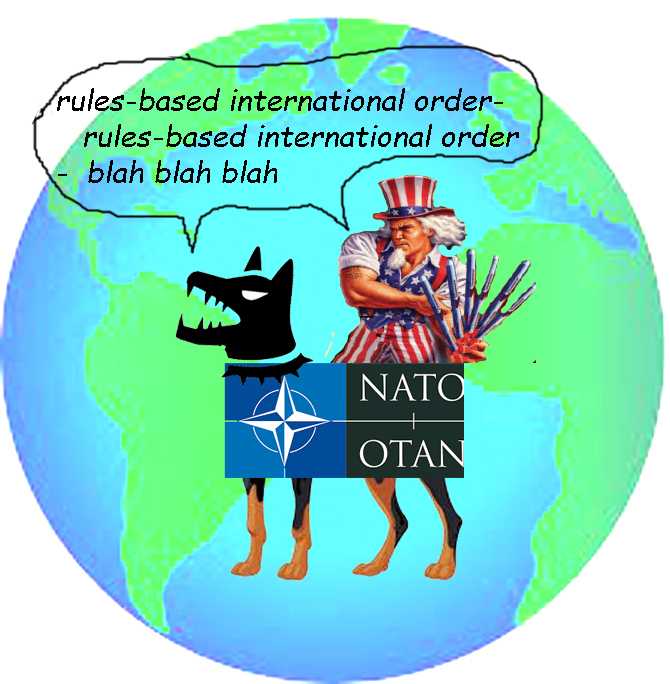
NATO’s talk of further Asian engagement should be feared by Australia
Independent Australia, By Binoy Kampmark | 13 July 2023
The North Atlantic Treaty Organization has undermined its mission to foster stability, becoming a vessel of U.S. power. Where NATO goes, war is most likely — Australia should take note, writes Dr Binoy Kampmark.
SINCE THE end of the Cold War, the North Atlantic Treaty Organization (NATO) has distinctly strayed from its original purpose. It has become, almost shamelessly, the vessel and handmaiden of U.S. power, while its burgeoning expansion eastwards has done wonders to upend the applecart of stability. ………………………………………………………………………………………………………………..
A continent was thereby destabilised. The true beneficiaries proved to be the tapestry of warring rebel groups characterised by sectarian impulses and a voracious appetite for human rights abuses and war crimes.
The Ukraine War has been another crude lesson in the failings of the NATO project. The constant teasing and wooing of Kyiv as a potential future member never sat well with Moscow, and while much can be made of the Russian invasion, no realistic assessment of the war’s origins can excise NATO from playing a deep, compromised role.
The Alliance is also proving dissonant among its members. Not all are exactly jumping at the chance of admitting Ukraine. ………………………………………
– Biden did draw the logical conclusion that bringing Kyiv into an alliance of obligatory collective defence during current hostilities would automatically put NATO at war with Moscow.
With such a spotty, blood-speckled record marked by stumbles and bungles, any suggestions of further engagement by the Alliance in other areas of the globe should be treated with abundant wariness.
The latest talk of further Asian engagement should also be greeted with a sense of dread.
According to a recent July statement:
‘The Indo-Pacific is important for the Alliance, given that developments in that region can directly affect Euro-Atlantic security. Moreover, NATO and its partners in the region share a common goal of working together to strengthen the rules-based international order.’
With these views, conflict lurks.
The form of that engagement is being suggested by such ideas as opening a liaison office in Japan, intended as the first outpost in Asia. It also promises to feature in the NATO Summit to take place in Vilnius on 11 and 12 July, which will again repeat the attendance format of the Madrid Summit held in 2022.
That new format featuring the presence of Australia, Japan, New Zealand and the Republic of Korea – or the AP4 – should have induced much head-scratching. But the Australian Strategic Policy Institute (ASPI), Washington’s beady eyes in Canberra, celebrated this ‘shift to taking a truly global approach to strategic competition’.
NATO Secretary General Jens Stoltenberg is also much in favour of such competition, warning member states of Beijing’s ambitions.“We should not make the same mistake with China and other authoritarian regimes”, he suggested, alluding to a dangerous and flawed comparison between Ukraine and Taiwan.
Cautioned Stoltenberg:
“What is happening in Europe today could happen in Asia tomorrow.”
One of the prominent headscratchers at this erroneous reasoning is French President Emmanuel Macron. Taking issue with setting up the Japan liaison office, Macron has expressed opposition to such expansion by an alliance which, at least in terms of treaty obligations, has a strict geographical limit. ……..
In 2021, Macron made it clear that NATO’s increasingly obsessed approach with China as a dangerous belligerent entailed a confusion of goals:
Said Macron:
“NATO is a military organisation; the issue of our relationship with China isn’t just a military issue. NATO is an organisation that concerns the North Atlantic, China has little to do with the North Atlantic.”
Such views have also pleased former Australian Prime Minister Paul Keating, whose waspish ire has also been trained on the NATO Secretary General.
In his latest statement, Keating condemned Stoltenberg as ‘the supreme fool’ of ‘the international stage’.
Declared Keating:
‘Stoltenberg, by instinct and by policy, is simply an accident on its way to happen.’
China, Keating said,
“… represents 20 per cent of humanity and now possesses the largest economy in the world… and has no record for attacking other states, unlike the United States, whose bidding Stoltenberg is happy to do”.
The record of this ceramic-breaking bloc speaks for itself. In its post-Cold War visage, the Alliance has undermined its own mission to foster stability, becoming Washington’s axe, spear and spade. Where NATO goes, war is most likely. Countries of the Indo-Pacific, take note. https://independentaustralia.net/politics/politics-display/natos-talk-of-further-asian-engagement-should-be-feared-by-australia,17709
The War on Journalism: the Case of Julian Assange
Real Change Is Impossible While Our World Is Shrouded In Secrecy, Caitlin Johnstone, 15 Jul 23
I saw a video clip of Julian Assange speaking in London in 2010 where he made an important observation while explaining the philosophy behind his work with WikiLeaks. He said that all our political theories are to some extent “bankrupt” in our current situation, because our institutions are so shrouded in secrecy that we can’t even know what’s really going on in the world.
“We can all write about our political issues, we can all push for particular things we believe in, we can all have particular brands of politics, but I say actually it’s all bankrupt,” Assange said. “And the reason it’s all bankrupt, and all current political theories are bankrupt and particular lines of political thought, is because actually we don’t know what the hell is going on. And until we know the basic structures of our institutions — how they operate in practice, these titanic organizations, how they behave inside, not just through stories but through vast amounts of internal documentations — until we know that, how can we possibly make a diagnosis? How can we set the direction to go until we know where we are? We don’t even have a map of where we are. So our first task is to build up a sort of intellectual heritage that describes where we are. And once we know where we are, then we have a hope of setting course for a different direction. Until then, I think all political theories — to greater and lesser extents of course — are bankrupt.”
……………………………………………………………………….The fact that all the most important aspects of our civilization’s operation are hidden, manipulated and obfuscated by the powerful makes a joke of the very idea of democracy, because how can people know what government policies to vote for if they can’t even clearly see those policies? How can people know what to vote for when everything about their understanding of the world is being actively distorted for the benefit of the powerful?
We can’t form solid political theories while everything’s hidden from us, and even if we could we’re unable to organize any means to put those theories into action for the same reason. The fact that the nature of our world is being so aggressively obfuscated from our view keeps us from knowing exactly what needs to change, and keeps us from effecting change.
For this reason I often argue that our most urgent priority as a civilization is rolling back all the secrecy and obfuscation, because until that happens we’ll never get change, and we’ll never know what should be changed. I have my ideological preferences of course, but I’m just one person taking their best guess at what needs to happen in a world where so many of the lights are switched off. Not until our society can actually see the world as it really is will we have the ability to begin, as Assange says, “setting course for a different direction.”
And those who benefit from our current course are lucidly aware of this. That’s why we’re not allowed to see what they’re up to behind the veils of secrecy, that’s why our entire civilization is saturated in nonstop propaganda, that’s why the internet is being increasingly censored and manipulated, and that’s why Julian Assange is in prison.
We can only begin fighting this from where we’re at. None of us individually have the power to rip the veil of secrecy away from the empire, but we do each individually have the ability to call out its lies where they can be seen and help wake people up to the fact that we’re being deceived and manipulated. Every pair of eyelids you help open is one more pair of eyes looking around helping to get an accurate picture of what’s going on, and one more pair of eyes helping to open the eyes of others.
Once we have enough open eyes, we will have the potential for a real course of action. https://caityjohnstone.medium.com/real-change-is-impossible-while-our-world-is-shrouded-in-secrecy-89ea0126821
An Unholy Alliance: billionaire technocrats delight in planning Artificial Intelligence to run nuclear reactors and nuclear weapons!

AI to run nuclear reactors?
AI to run weapons?
What could possibly go wrong?
Imagine! if artificial intelligence had run the Soviet Union’s missile system on September 26 1983, all-out nuclear war would have erupted. It took the imaginative thinking of Lt. Col. Stanislav Petrov to prevent that.
With AI in charge, we will not have a Stanislav Petrov to save us.
New Startup Looks To Blend AI And Nuclear Energy, Oil Price, By Haley Zaremba – Jul 15, 2023
- AI’s increasing role in the energy sector is challenged by its own high energy demands.
- Sam Altman proposes a symbiotic relationship between AI and nuclear energy to address this issue.
……The future of the global energy sector is in the hands of Artificial Intelligence. ……..
…………..But the relationship between AI and energy goes two ways. AI doesn’t just present opportunities to the energy sector; it also presents significant challenges – one of which is the huge amount of energy that AI itself needs for operational purposes. In some cases, the energy footprints of singular AI training models have equaled that of 125 New York-Beijing round-trip flights, or the lifetime carbon footprint of five cars.
Sam Altman, the founder of OpenAI – the now (in)famous firm behind ChatGPT – thinks that nuclear energy will play a key role in keeping AI’s carbon footprint in check. “The AI systems of the future will need tremendous amounts of energy and this fission and fusion can help deliver them,” Altman was recently quoted in the Wall Street Journal. Altman also expressed that he thinks that AI will have some positive implications for nuclear-system designs as well, creating a kind of symbiotic AI-nuclear relationship. This is not a new idea – for years now, researchers have been looking into the various ways that AI and machine learning can be integrated into nuclear power production for a more efficient, less expensive, and safer nuclear energy sector.
Altman is clearly serious about his hope for nuclear energy’s role in the future of the energy and technology sectors. Just this week, it was announced that Oklo, an AI-integrated startup specializing in “nuclear microreactors” will go public in 2024.
Oklo is valued at around $850 million, according to the Wall Street Journal. The company expects that its innovative microreactors will be ideal for military applications where connection to an existing power grid isn’t possible,………… Oklo has already secured $50 million in funding, $420,000 in grants from the Department of Energy (DOE), and a permit to build its first microreactor at the Idaho National Laboratory, the nation’s leading center for nuclear research. The pilot project is slated to come online by 2026 or 2027.
…………………………………Altman is the just latest in a long line of tech billionaires investing in nuclear energy. High-profile proponents of nuclear power include Elon Musk and Bill Gates……..more https://oilprice.com/Alternative-Energy/Nuclear-Power/New-Startup-Looks-To-Blend-AI-And-Nuclear-Energy.html
Cuba condemns US deployment of nuclear submarine in its waters
https://morningstaronline.co.uk/article/w/cuba-condemns-us-deployment-nuclear-submarine-its-waters
BEN CHACKO, SUNDAY, JULY 16, 2023
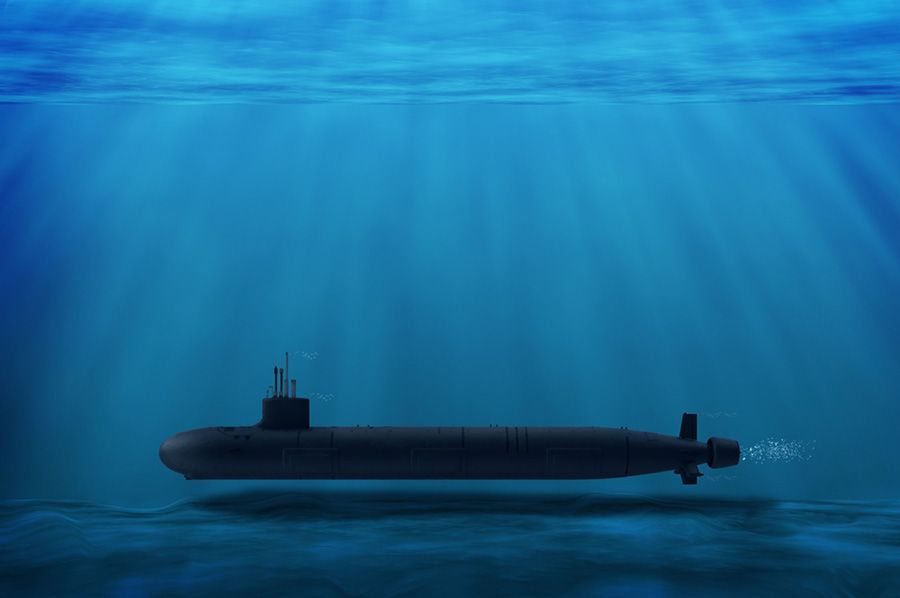
CUBA protested at the weekend over the US deployment of a nuclear-armed submarine to its waters.
The Cuban Foreign Ministry said a nuclear submarine equipped with Trident II ballistic missiles had entered waters around Guantanamo Bay, the illegal US military base imposed on occupied Cuban territory from 1903, at the start of July.
“The presence of a nuclear submarine forces one to question the military reason for its presence in this peaceful region of the world, against what objective it is directed, and what strategic purpose it is pursuing.”
The submarine’s presence in its waters for at least a week “constitutes a provocative escalation by the United States, whose political or strategic motives are unknown,” it added.
But US State Department spokesman Matthew Miller retorted that “the United States will continue to fly and sail as well as move its military forces where it deems appropriate.”
All 33 countries of Latin America and the Caribbean had signed the declaration of the region as a zone of peace in Havana in 2014, Cuba pointed out: but despite this “the United States has established more than 70 military bases in the region.”
The US has nine military bases in Panama, 12 in Puerto Rico, nine in Colombia and eight in Peru.
The country’s Congress — which overthrew elected socialist president Pedro Castillo in December and has waged a crackdown that has killed scores of democracy protesters since — authorised “the entry of naval units and foreign military personnel with weapons of war” in January. Earlier this month, US congresswoman Alexandria Ocasio-Cortez introduced an amendment to the country’s military budget seeking to suspend funds for operations in Peru given their potential role in helping suppress the democracy movement.
The US claims to lease Guantanamo Bay from Cuba for a token rent of $4,085 (£3,120) a year, but Cuba has rejected the agreement since the revolution of 1959 and does not cash the cheques, which are still made out to the pre-revolutionary, now nonexistent post of “treasurer-general of the republic.” Cuban revolutionary leader Fidel Castro once showed journalists a desk in his office stuffed with the uncashed cheques.
Kenya has restated its commitment to ensuring nuclear energy and nuclear weapons are not used in the continent.
Kenya reiterates stand on nuclear weapons during exhibition
Ogola noted that Kenya recently enacted the Nuclear Regulatory Act 29 of 2019.
Star 16 July 23
In Summary
- The Treaty of Pelindaba is the international agreement that establishes Africa as a zone free of nuclear weapons.
- Hence contributing to peace and security in Africa.
Kenya has restated its commitment to ensuring nuclear energy and nuclear weapons are not used in the continent.
This was when stakeholders in the Energy sector convened on Saturday to commemorate the 14th Anniversary of the African Nuclear Weapon Free Zone treaty.
The treaty is called the Treaty of Pelindaba.
The Treaty of Pelindaba is the international agreement that establishes Africa as a zone free of nuclear weapons, hence contributing to peace and security in Africa.
The event took place at the Trademark Hotel in Nairobi under the auspices of the Kenyan government.
Former Prisons Commissioner Wycliffe Ogola, while speaking on behalf of Energy CS Davis Chirchir, reiterated Kenya’s stand against possession of nuclear weapons adding that Kenya recognises the pivotal role the treaty plays in protecting civilians against nuclear weapons.
Ogola noted that Kenya recently enacted the Nuclear Regulatory Act 29 of 2019.
“The Act has committed the country to exclusively exclude uses of nuclear technology, recognising the need to meet Kenya’s obligation under various international considerations and criminalised access to nuclear material and radiation sources,” Ogola said.
He called for more forums to allow for the exchange of ideas on how to ensure nuclear weapons and technology are not used in Africa. ………………………. more https://www.the-star.co.ke/news/realtime/2023-07-16-kenya-reiterates-stand-on-nuclear-weapons-during-exhibition/
How much water do French nuclear plants use?

Figures showing that the cooling of reactors could capture 30% of water resources have been removed from the site of the Ministry of Environment.
Le Monde ,By Perrine Mouterde, March 26, 2023,
How much do nuclear power plants contribute to total water consumption in France? This simple question no longer seems to have a clear answer. At the root of the confusion lies the Ministry of Environmental Transition’s removal of a background paper on the resourcing and use of water in France on around March 10. According to this fact sheet from the statistical service, power plant cooling represented the second most water-consuming activity in the country (31%), behind agriculture (45%) and ahead of drinking water (21%) and industrial use (4%). The annual volume of water consumed in mainland France, over the period 2008-2018, was estimated at 5.3 billion cubic meters.
In the midst of the review of the parliamentary bill to accelerate the construction of new reactors, the figure of 31% was being used by opponents of atomic energy to demonstrate that this energy source was not adapted to climate change. “Once and for all, let’s say it, simply and firmly: at this rate, there will soon not be enough water in our rivers to cool the nuclear power plants!,” stated Marine Tondelier – the national secretary of Europe Ecologie-Les Verts (EELV, Greens) – on March 7, based on this data.
Three days later, the Ministry of Environmental Transition………….(subscribers only)
TODAY. “As long as it takes” – WHAT DOES THIS MEAN?

– it takes cluster bombs (to cause later mutilations and deaths, especially children)

– it takes depleted uranium weapons, (to cause widespread, long-lasting radioactive pollution, cancers in soldiers and citizens of both sides)

– it takes -by December 31 the Ukrainian army will lose between 75,000 and 100,000 dead, and up to 300,000 wounded and out of combat. Russian soldiers killed so far in Ukraine: around 47,000.

– it takes – continued destruction and environmental pollution, the wreckage of the country

–it takes – By May 2023, the U.S. had provided Ukraine nearly $37 billion in military aid . Total with EU funding $46.6 billion and more to come

–it takes– behind-the-scenes wrangling, as European and other leaders try hold it together with USA

“As long as it takes” – to do what?
Defeat Russia militarily, ruin Russia as a world power, return Crimea to Ukraine, make Ukraine a NATO country, holding U.S. weapons aimed at Moscow.
But it might not actually turn out that way.
And it might bring on World War 3.
Taiwan solution is diplomacy rather than nuclear hell
Pearls and Irritations, By Bob CarrJul 15, 2023
I have yet to meet an Australian voter willing to go to war over Taiwan. Further, I haven’t heard of any Australian military leader with a clear idea of Australia’s role in a showdown between China and the US.
Earlier this year, NASA’s survey satellite discovered an Earth-sized world within the habitable zone of a distant star. If it hosts life, its creatures may be listening to our conversations. They are likely amazed that earthlings seem to be sleepwalking towards their first war between nuclear powers.
At the heart of the conflict is the political system that prevails on an island of 23.5 million people because of sovereignty issues left over from two Sino-Japanese wars. These far-off observers might be even more curious if they knew about the availability of a tested formula that for 50 years kept peace in one part of the small blue planet.
I have yet to meet an Australian voter willing to go to war over Taiwan. Further, I haven’t heard of any Australian military leader with a clear idea of Australia’s role in a showdown between China and the US. On the contrary, I’m told their consensus is that our naval assets would be unprotected against ocean-hugging hypersonic missiles.
One former Defence Department official told me if we sent submarines, “we’d better make sure that our submariners had their wills made out”. I’m told one now-deceased former general was fond of saying about our role in the Taiwan Strait: “We’d last three minutes.”
……………………………..The loose war talk over Taiwan led the former US secretary of state , Henry Kissinger to make a solemn warning back in May that we are facing great-power conflict like that which preceded World War I. He used the noun “catastrophe”.
Kissinger had negotiated the 1972 Shanghai Communique, which offers the diplomatic formula that preserved the peace and can go on preserving it until overtaken by any new political and economic reality 100 years off. The communique allows the world to “acknowledge” the Chinese claim that Taiwan is its province without “endorsing” the Chinese claim. And, quickly following, is the principle that “reunification” would not involve an act of war.
For its part, Taiwan steers away from a declaration of independence. Only 13 of the world’s nations see Taiwan as independent. But it has enjoyed self-government with a contestable political system and a prosperous economy. This strategic ambiguity has served us.
A Taiwan that resembles Hong Kong is not desirable. I said in my recent interview with Mark Bouris, it would be preferable to a nuclear war…………………………………….
Any hard-nosed assessment of our national interest would have us redouble – then redouble again – our commitment to guardrails and off-ramps to stop the descent into conflict. There are subtle suggestions that both the US and China have pulled back to earlier red lines, and with the support of the Taiwanese leadership. In that spirit, House Speaker Kevin McCarthy in April met the President of Taiwan, Tsai Ing-wen, on American soil and not in Taipei. The Chinese response was comparatively subdued.
In this month’s Australian Foreign Affairs, Sam Roggeveen of the Lowy Institute delicately etched how recent Canberra decisions had rendered Australian sites more likely nuclear targets. It includes having B52s fly out of RAAF Tindall near Darwin, assumedly with the mission of striking China’s nuclear infrastructure. It may include Submarine Rotational Force-West in the planned nuclear submarine base at HMAS Stirling, and Port Kembla on the east coast.
Roggeveen concludes that in a future crisis, Australia’s profile is going to be much higher in the eyes of Chinese military planners.
……… Without any retreat from deterrence or our values, more spirited diplomacy in our interests, the region’s and Earth’s might be the order of the day. https://johnmenadue.com/taiwan-solution-is-diplomacy-rather-than-nuclear-hell/
Merri-bek City Council is a Nuclear-Free Zone
Council stands against the use of nuclear power and weapons and has declared Merri-bek as a Nuclear-Free Zone. Nuclear weapons pose a significant threat to our world. This decision reflects our commitment to the safety and wellbeing of our community, and our support for global peace and security.
As part of our Nuclear-Free Zone declaration:
- We oppose the storage and transportation of uranium, nuclear waste, or any other materials connected to the nuclear industry in Merri-bek, including nuclear submarines. This excludes the use of radio-isotopes in hospitals.
- We oppose the establishment of nuclear facilities or nuclear submarine repair facilities in Merri-bek.
- We will display signage at the entrances to our municipality declaring our nuclear-free position.
In addition to this declaration, Merri-bek is one of 43 Australian councils that support the Treaty on the Prohibition of Nuclear Weapons and call on the Australian Government to take this action.
Merri-bek has also joined the International Campaign to Abolish Nuclear Weapons’ Cities Appeal. The Cities Appeal includes cities and towns across the world in support of the treaty.
Our nuclear-free stance aligns with Council’s Human Rights Policy 2016-2026. The danger presented by nuclear weapons impacts on humanity, our right to life, international law, and sustainability.
We encourage Merri-bek community members and other councils to join us in advocating for a safer and more sustainable future, free from the risks associated with nuclear power and weapons.
Australia on track for exemption to accelerate AUKUS nuclear subs deal
SMH, By Farrah Tomazin, July 15, 2023
Washington: Australia will be given an exemption from strict US export control laws to help accelerate the delivery of its $368 billion AUKUS submarine deal, under a bipartisan proposal making its way through Congress.
In a boost for the Albanese government, the plan to bolster Australia’s defences in the Indo-Pacific moved a step closer to reality on Friday (AEST) after a powerful US Senate committee approved draft legislation designed to turbocharge the ambitious three-way military pact with the US and UK.
If approved, the proposal, which was given the green light by the Senate Foreign Relations Committee and is expected to be debated more broadly next week, will help facilitate the transfer of Virginia-class ships under the AUKUS agreement and strengthen the submarine industrial base of the three nations involved………………………………………………………………………………………….
But while AUKUS has received broad bipartisan support, questions remain about the lengthy time frame of AUKUS, the extraordinary cost to taxpayers, and the myriad of rules governing the deal. Among them is the International Traffic in Arms Regulations (ITAR) which could delay for years the transfer of crucial
technologies unless the system is reformed or a special waiver is granted.
To that end, the approval by the Foreign Relations Committee, which has jurisdiction over armed export controls and ship transfers, was an important boost for AUKUS, however there is still a long way to go before all the relevant
AUKUS legislation makes it through Congress.
Some US politicians have also raised concerns that AUKUS could stretch America’s industrial base “to breaking point”, given the industry was already struggling to meet its target to build two attack submarines a year. ……………………… https://www.smh.com.au/world/north-america/australia-on-track-for-exemption-to-accelerate-aukus-nuclear-subs-deal-20230715-p5dofd.html
Nato isn’t defending Ukraine. It’s stabbing it in the back

So far, Ukraine’s much-vaunted “spring counter-offensive” has turned into a damp squib, despite western media spin about “slow progress”. Moscow is holding on to the Ukrainian territories it annexed.
More than 110 states – not including the US, of course – have ratified a 2008 international convention outlawing cluster munitions. Many are in Nato.
Middle East Eye, Jonathan Cook. 14 July 2023
The US and its allies are sustaining the very war they now cite as grounds for disqualifying Kyiv from Nato membership .
he Nato summit in Lithuania this week served only to underscore the utter hypocrisy of western leaders in pursuing their proxy war in Ukraine to “weaken” Russia and oust its president, Vladimir Putin.
Both the US and Germany had made clear before the summit that they would block Ukraine’s admission to Nato while it was in the midst of a war with Russia. That message was formally announced by Nato Secretary General Jens Stoltenberg on Tuesday.
Ukrainian President Volodymyr Zelensky fumed that Nato had reached an “absurd” decision and was demonstrating “weakness”. British Defence Secretary Ben Wallace lost no time in rebuking him for a lack of “gratitude”.
The concern is that, if Kyiv joins the military alliance at this stage, Nato members will be required to leap to Ukraine’s defence and fight Russia directly. Most western states balk at the notion of a face-to-face confrontation with a nuclear-armed Russia – rather than the current proxy one, paid for exclusively in Ukrainian blood.
But there is a more duplicitous subtext being obscured: the fact that Nato is responsible for sustaining the war it now cites as grounds for disqualifying Ukraine from joining the military alliance. Nato got Kyiv into its current, bloody mess – but isn’t ready to help it find a way out.
It was Nato, after all, that chose to flirt openly with Ukraine from 2008 onwards, promising it eventual membership – with the undisguised hope that one day, the alliance would be able to flex its military muscles menacingly on Russia’s doorstep.
It was the UK that intervened weeks after Russia’s invasion in February 2022, and presumably on Washington’s orders, to scupper negotiations between Kyiv and Moscow – talks that could have ended the war at an early stage, before Russia began seizing territories in eastern Ukraine.
A deal then would have been much simpler than one now. Most likely, it would have required Kyiv to commit to neutrality, rather than pursuing covert integration into Nato. Moscow would have demanded, too, an end to the Ukrainian government’s political, legal and military attacks on its Russian-speaking populations in the east.
Now the chief sticking point to an agreement will be persuading the Kremlin to trust the West and reverse its annexation of eastern Ukraine, assuming Nato ever allows Kyiv to re-engage in talks with Russia.
And finally, it is Nato members, especially the US, that have been shipping out vast quantities of military hardware to prolong the fighting in Ukraine – keeping the death toll mounting on both sides.
Damp squib
In short, Nato is now using the very war it has done everything to fuel as a pretext to stop Ukraine from joining the alliance.
Seen another way, the message Nato has sent Moscow is that Russia made exactly the right decision to invade – if the goal, as Putin has always maintained, is to ensure Kyiv remains neutral.
It is the war that has prevented Ukraine from being completely enfolded in the western military alliance. It is the war that has stopped Ukraine’s transformation into a Nato forward base, one where the West could station nuclear-tipped missiles minutes from Moscow.
Had Russia not invaded, Kyiv would have been free to accelerate what it was already doing secretly: integrating into Nato. So what is Zelensky supposed to conclude from his exclusion from Nato, after he committed his country to an ongoing war rather than negotiations and neutrality?
So far, Ukraine’s much-vaunted “spring counter-offensive” has turned into a damp squib, despite western media spin about “slow progress”. Moscow is holding on to the Ukrainian territories it annexed.
So long as Kyiv can’t “win the war” – and it seems it can’t, unless Nato is willing to fight Russia directly and risk a nuclear confrontation – it will be precluded from the military alliance. Catch-22.
Do not expect this conundrum to be highlighted by a western establishment media that seems incapable of doing anything other than regurgitating Nato press releases and cheering on bigger profits for the West’s war industries.
War crimes
Another such conundrum is the Biden administration’s decision last week to supply Ukraine with cluster munitions – small bomblets that, when they fail to explode, lie concealed like mini-landmines, killing and maiming civilians for decades. In some cases, as many as a third are “duds”, detonating weeks, months or years later.
Washington’s move follows Britain recently supplying Ukraine with depleted uranium shells, which contaminate surrounding areas with a radioactive dust during and after fighting. Evidence from areas such as Iraq, where the US and Britain fired large numbers of these shells, suggests the fallout can include a decades-long spike in cancer and birth defects.
The White House was all too ready to denounce the use of cluster bombs as a war crime last year – when it was Russia that stood accused of using them. Now it is Washington enabling Kyiv to commit those very same war crimes.
More than 110 states – not including the US, of course – have ratified a 2008 international convention outlawing cluster munitions. Many are in Nato.
Given the high “dud” rate of US cluster bombs, President Joe Biden appears to be breaking US law in shipping stocks to Ukraine. The White House can invoke an exemption only if exporting such weapons satisfies a “vital US national security interest”. Apparently, Biden believes “weakening” Russia – and turning parts of Ukraine into a death zone for civilians for decades to come – qualifies as just such a vital interest.
Desperate stop gap
While the official story is that this latest escalatory move by the US will help Kyiv “win the war”, the truth is rather different. Biden has not shied away from admitting that Ukraine – and Nato – are running out of conventional arms to fight Russia. This is a desperate stop-gap measure. ……………………………………………………………………………………………………………………………..
…………………………….. Tragically, Nato’s malevolence, deceit and betrayal means that the only alternative to Armageddon may be Ukraine’s downfall – and with it, the crushing of Washington’s nefarious ambitions to advance full-spectrum global dominance. https://www.middleeasteye.net/opinion/nato-ukraine-not-defending-stabbing-back?utm_source=substack&utm_medium=email
1 This month
17 October, Free Public Talk on Nuclear Issues in South Australia
David Noonan will speak on public interest concerns over the new Roxby Downs Indenture Act 2026 on BHP copper-uranium mining and ore processing in SA, and on how AUKUS may face SA with a High-Level nuclear waste agenda.
Dr Jim Green will discuss international developments in the field of nuclear power including ‘small modular reactors’ and Generation 4 ‘advanced’ nuclear reactor concepts.


Help Aunty Sue Protect Her Land and Sacred Sites From Destructive Rocket Testing.
.

Australians deserve the truth
about
AUKUS – https://aukuspublicinquiry.com/

PETITION – To: Prime Minister Anthony Albanese and the Australian Labor Government

of the week – Australians for War Powers Reform (AWPR)
To see nuclear-related stories in greater depth and intensity

