Start from scratch call as nuclear dump plan shelved
Yahoo Sport, Tim Dornin, Wed, 19 July 2023
The Commonwealth needs to go back to the drawing board on plans for a nuclear waste dump and put all options back on the table, the South Australian government says.
Following the Federal Court’s move to set aside a decision to build the dump on SA’s Eyre Peninsula, Deputy Premier Susan Close said it was important for the Commonwealth to take a cautious approach to where the facility might best be located.
“I think it’s important they start from the beginning about where it’s most suitable,” she said.
“Where is the material coming from, where is the geological stability and where is the community acceptance?”
Dr Close said the previous coalition government had botched the process, exaggerating the urgency for the facility and excluding the Indigenous community.
“As a result, it’s come a cropper in the court, as it should have,” she said.
The deputy premier said given the level of angst surrounding the Kimba location in SA, it would be best to start from scratch.
The previous government decided to build the dump at Napandee, near Kimba, in November 2021, when it announced it had acquired 211 hectares of land with the proposed facility subject to heritage, design and technical studies…….
But the proposal faced strong opposition from the Barngarla traditional owners and environmental groups.
Earlier this year the Barngarla went to the Federal Court seeking a judicial review of the government’s declaration and on Tuesday Justice Natalie Charlesworth upheld one of their four grounds.
She said the only appropriate order was to set aside the whole of the declaration made by former resources minister Keith Pitt.
The Barngarla Aboriginal Determination Corporation welcomed the decision, describing the fight against the dump as crucial to First Nations people around the country.
Resources Minister Madeleine King said Labor had worked with the Barngarla people in the last term of parliament to ensure they secured the right to seek judicial review of the decision to acquire the site and that she would review the judgment. 2023
https://au.sports.yahoo.com/start-scratch-call-nuclear-dump-072229979.html
Karina’s father went blind at Emu Field. Now, she’s fighting for a treaty on nuclear weapons.

The Yankunytjatjara Anangu woman talked about the devastating effect the testing had on her family, including the loss of her father.
Karina Lester knows the fallout nuclear weapons can cause.
Her father, the late Yami Lester, went blind as a young man after the British tested atomic weapons in Emu Field.
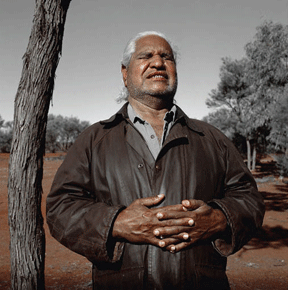
“The scars are still felt on our Country,” said Ms Lester, a Yankunytjatjara Anangu woman from north-west South Australia.
“And the scars are still evident on our people.”
A group of Australian atomic survivors and relatives visited Canberra on Wednesday to speak with government decision-makers about their experiences of the British nuclear testing program in WA and SA.
They are calling on Prime Minister Anthony Albanese to sign the Treaty on the Prohibition of Nuclear Weapons.
In 1953 the British initiated a program of nuclear testing in Australia at the Montebello Islands, off the coast of WA and in Emu Field in South Australia.
Two years later, the British government announced a larger site for the tests at Maralinga.
Ms Lester carries her family’s stories about the impacts of the tests on her people.
“I had a grandmother of mine needing to dig a grave to bury her parents because soon after the radiation fallout, the elderly people started to suffer and die,” she said.
“My father never saw me or my children.
“It’s all because of a decision by governments of the day to say ‘That is no man’s country, go and test your bombs’.
“It’s been a huge, painful journey for us but it’s such an important story that needs to be told.”
Maxine Goodwin is the daughter of an Australian nuclear veteran who became ill as a result of his involvement in the first atomic test in WA.
“Signing the Treaty on the Prohibition of Nuclear Weapons is a significant step towards addressing the harm experienced by individuals and communities,” she said.
In October 1953 when the British detonated the Totem I and II nuclear bombs at Emu Field, Yankunytjatjara, Antikarinya and Pitjantjatjara woman June Lennon was only a few months old.
Her family witnessed the tests and have suffered from ill-health since.
“The government didn’t tell the truth about the nuclear testing program,” she said.
“There were so many lies. They didn’t tell people what they were doing.”
International Campaign to Abolish Nuclear Weapons Australia director Gem Romuld said it was important for policy makers to hear stories firsthand.
“Nuclear survivors are experts on the devastating humanitarian impacts of nuclear weapons,” she said.
“Australia’s experience with nuclear weapons testing is a powerful motivation to join the nuclear weapon ban treaty.”
The delegation will be in Canberra on Wednesday and Thursday to meet parliamentarians, including Foreign Minister Penny Wong and speak at an event hosted by the Parliamentary Friends of the Treaty on the Prohibition of Nuclear Weapons.
Examining the impact of the legal decision against the planned Kimba nuclear waste dump.

Here’s what we know about the Kimba nuclear storage facility decision, By Josephine Lim ABC News 18 Jul 23
This week the federal court ruled in favour of traditional owners who have been fighting against the
development of a nuclear waste facility
The federal government had selected a site in South Australia’s Eyre Peninsula to store low and
intermediate level radioactive waste, but the court’s decision has left the future of the project uncertain.
The uncertainty extends far beyond the court’s decision as the facility will never see the light of day due to i t s c o m p l e t e a n d i n h e r e n t unsuitability which includes the environmental implications and the lack of compliance with international standards and prescriptions relating to nuclear installations and their .safety
Here’s what we know so far. What did the original proposal entail?
In November 2021, Napandee near the town of Kimba, was acquired to be the storage facility for low and
medium-level nuclear waste.
The 211-hectare property was chosen from a shortlist of three sites, including the outback town of
Lyndhurst and Wallerberdina, a property in the northern Flinders Ranges
At the time, Coalition resources minister Keith Pitt said the site would create 45 permanent jobs in
the Kimba community.
Absolute nonsense since based on overseas experience similar but larger facilities employ some 15
people with very minimal external support staff.
T h i s h a s b e e n c o n s t a n t l y disingenuous information by Pitt for which he should be severely taken to task as it developed completely unrealistic expectations by the Kimba community.
Yesterday, he said on ABC’s Afternoon Briefing that he was “incredibly disappointed for the
people of Kimba” following the court’s findings.
If a proper survey were done then
most people of Kimba would be
heartened by and pleased with the
court’s decision as they are
completely against the proposed
facility.
“The piece of land on which this was going to be cited did not have a native title. It is a dryland wheat
farm,” he said.
No, it is not
It is like most of Kimba prone to ground water seepage and basic geological and geophysical surveys
show this to be the case making it grossly unsuitable for the facility
He said more than 60 per cent of the local community supported the project, citing a postal ballot that only local ratepayers were allowed to vote in.
If a proper ballot were now held (which should have been the case in the first place) with the voting accompanied by in favour and a g a i n s t a r g u m e n t s a n d a n unrestricted voting base then the majority against the facility would be significant even if it still excluded the Barngarla people
Why did the Barngarla people fight the plan?
The Barngarla people have a sacred site for women near Kimba, which they fear a facility would destroy.”The Seven Sisters Dreaming is through that area,” Barngarla woman Dawn Taylor said.
“But the Seven Sisters Dreaming means a lot to all of us as women, in each tribe, throughout the country.”
The Barngarla Determination Aboriginal Corporation (BDAC)launched the challenge in the Federal Court in a bid to stop the site from going ahead altogether.
BDAC chairman Jason Bilney said he felt “very emotional” winning a “David versus Goliath” battle.
“It’s the fight that we continue and you feel it from the heart no matter where we are, whether it’s our
Country or other people’s Country,” he said outside court.
D a v i d a n d G o l i a t h is an understatement when the federal government has spent nearly $14
million fighting the application by the Barngarla who have apparently spent less than $700,000 to mount
the review application in totality.
What did the court find?
The Federal Court upheld a complaint by the Barngarla people on the ground there was apprehended bias in the decisionmaking process by former federal minister Keith Pitt in selecting the site
In upholding the apprehension of bias argument, Justice Natalie Charlesworth found that the
Coalition minister, who formally declared the site in 2021, could be seen to have a “foreclosed mind” on
the issue “simply because his statements strongly conveyed the impression that his mind was made
up”
Lawyer for the Barngarla people, Nick Llewellyn-Jones, said findings of apprehended bias against a
minister were “very rare” and the judgement was significant in terms of legal precedent.
“It’s set a precedent for Aboriginal groups to take a stand, it’s set a precedent also in terms, I believe, of what standards are required of Commonwealth ministers,” Mr Llewellyn-Jones said.
“What we’ve had here is a finding of apprehension of bias, we haven’t reviewed the decision fully, but it’s
obviously got some consequence in terms of the conduct the minister did at the time and it will have some authority value in terms of that as well
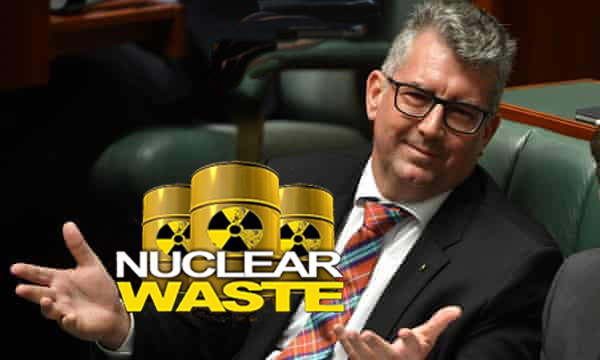
The bias on the part of Pitt may have been even more than apprehended since well before the passing of the enabling legislation for formal decision of the site he had selected and nominated Napandee as the location for the facility and was upset at the delay in passing that legislation for reasons that to him were unnecessary and lengthy
“Our clients have won and it’s obviously a great victory for them but in fact it’s a vindication of the
entire system that we have that people out there do have options when government affects their
lives.”
Justice Charlesworth also found there was an error of law, but concluded it did not have a “material effect” on the outcome of the declaration of the site.
How has the government responded?
Federal Labor Minister for Resources Madeleine King issued a statement that the court’s decision will be reviewed in detail but declined to comment further.
“Labor worked with the Barngarla people in the last term of Parliament to ensure they secured the right to seek judicial review of the decision to acquire the facility site,” she said
That is absolutely untrue since the Barngarla people had to continue with the review application and the enabling legislation as eventually agreed to by Labor was still well short of what was requested and expected of which I have personal knowledge as among other things I had many discussions with various members of parliament and had assisted in drafting an appropriate amendment to the legislation
When the legislation was eventually passed in the Senate I contacted Minister King who was then shadow minister for resources and explained that it was a totally unacceptable piece of legislation which she strongly and quite ignorantly refuted.
I had previously drafted an amendment to the legislation while it was still at the bill stage in the Senate under which the government and the responsible ministers would have been required to adhere completely to the codes and standards and the prescriptions of the International Atomic Energy Agency (IAEA) which was not accepted
Had this amendment been adopted than none of the present litigation with its accompanying acrimony would have been necessary since IAEA would have ensured that the government completely complied with and adhered to its standards and prescriptions.
“The principle of judicial review is an important process that the Albanese Government fully supports.”
The best way to support this application for a review would have been to agree to the review without
any contest. An appeal by the government will be an absolute lie to this proposition.
What have those in favour of the waste facility said?
Kimba farmer Kerri Cliff said the court outcome was ” pretty devastating for the majority of the
community” and expressed concerns about the economic future of the town.
“It’s a decision being made about Kimba, but not by the people that live here,” she said.
Aside from jobs at the facility, an Australian Government economic impact assessment report found the
project would have brought over $95 million to Kimba and the Flinders Ranges in the first 33 years.
Regrettably, the unconvincing notion that the facility would have brought a new economic life to Kimba is
completely misconceived and untrue
If anything it may have well destroyed a well-established and long-standing agricultural industry in the whole of the Eyre Peninsula.
What happens now?
The future of the project is in severe doubt and legal costs are also yet to be determined. The federal government is yet to say whether it would make an appeal against the court’s decision or look at a different location to store nuclear waste.
The government should be careful in considering a possible appeal since it may in any case face fresh legal opposition to its proposals by the general community at Kimba for failing to comply with all the safety codes and requirements of IAEA Local federal member
Rowan Ramsey told ABC Radio Adelaide’s Jules Schiller that the Australian Radiation Protection and Nuclear Safety Agency said that there would be no more room to store nuclear waste at Sydney’s Lucas Heights site “beyond 2028”
“Given that now the government has to find a new site and build a new facility in five years, you may as well be whistling into the wind,” Mr Ramsey said.
But Australian Conservation Foundation campaigner Dave Sweeney said 95 per cent of radioactive waste had been storedsecurely at the Lucas Heights facility and that “material can remain there securely for decades to come”.
He said he hoped the federal government could use this decision to discuss how to better manage nuclear waste in Australia. “It’s a result that will hopefully draw a line under decades of mismanagement of radioactive waste and inject some responsibility, some respect and some recognitioninto future discussions,” he said
“It’s long overdue now, and particularly against a context of AUKUS nuclear submarines and speculation about domestic nuclear power, we need to be serious and stop playing politics and stop looking for a vulnerable community to dump radioactive waste in.”
Australia must far better manage its nuclear waste This lack of proper management stems from the ignorance and incapacity of the federal government from ministerial level through its various departments and agencies failing to accept or acknowledge the international requirements for that
purpose
In conclusion I can only hope that t h e m e m b e r s o f t h e K i m b a community who feel aggrieved by the court’s decision and are seeking the establishment of the facility as an alternative to the district’s economic growth would actually be bitterlydisappointed if that were to occur
In any case, they should realise that the government is attempting to create a false economy which will
not survive and is based on the wholly unsuitable plan for the facility that will not get the necessary approvals for its establishment.
While it was suggested in an interview on Sky News this morning that many people had left the Kimba
district in the past four years this I understand stems from them being unconvinced and even fearful of the facility’s presence.
If the government as the proponent of the facility were prepared to fund a proper and independent expert review of its plans for Kimba then I am sure that those people will be shocked at the result.
Time for dump to be dumped for good.

The state’s peak environment group has strongly welcomed today’s Federal Court judgement that sets aside the declaration of Napandee (Kimba) as the site for the Australia’s nuclear waste facility.
“Today is an extraordinary vindication of the years’ long struggle by the Barngarla people to stand up for their Country, their Dreaming and their right to be heard,” said Conservation SA Chief Executive Craig Wilkins
“This case was never about whether imposing nuclear waste on Kimba was the right thing to do, but now the court has declared that the process the Federal Government undertook was never even legal.
“The Morrison Government, first with Matt Canavan as Minister, then with Keith Pitt, tried to force through a deeply divisive and deeply flawed proposal.
“They stuffed up the process and their relationship with the local community, particularly the Barngarla Traditional Owners.
“Now this comprehensive judgement has been handed down, there is only one appropriate course of action open for the Albanese Government and the Federal Resources Minister Madeleine King: to declare the Kimba waste dump dead and buried.
“It was Labor’s amendment to the Morrison Government’s legislation that gave the Barngarla their day in court today. The Albanese Government now needs to move quickly to reassure the Barngarla they will shelve the project in its entirety.
“Today’s monumental decision offers an exciting opportunity to reset the relationship between the Federal Government, Aboriginal people and nuclear waste.
“In many ways the real work starts now: to find the final resting place for Australia’s long lived radioactive waste – not a deeply deficient and illegal process to park the waste temporarily in above ground sheds in South Australia.
“Huge congratulations to Jason Bilney, Chair of the Barngarla Aboriginal Determination Corporation, Barngarla Elders and the rest of the community for the stunning result, and for standing strong on behalf of all Australians,” he said.
Great British Nuclear: High on hype, Low on substance

“How is Great British Nuclear meant to take forward the SMR competition when it has no operating budget, no legal powers, no permanent staff team, and no base from which to operate?”
“How is GBN meant to take forward the SMR competition when it has no operating budget, no legal powers, no permanent staff team, and no base from which to operate?”
https://www.nuclearpolicy.info/news/great-british-nuclear-high-on-hype-low-on-substance/ 18 Jul 23
Energy Secretary Grant Shapps finally launched ‘Great’ British Nuclear today (18 July), but whilst the minister’s announcement was big on hype, the UK/Ireland Nuclear Free Local Authorities noticed that it was short on substance.
Great British Nuclear was the new body announced by former Prime Minister Boris Johnson in April 2022 as part of his revised energy strategy. GBN is supposed to be front and centre of a ‘rapid expansion of nuclear power at an unprecedented scale and pace’, but the formal launch of the initiative has been put on hold several times, including humiliatingly at the eleventh-hour last week.
Nuclear in the UK has made little progress since April 2022. EDF Energy, which is building the only nuclear plant under construction at Hinkley Point C, has recently announced a further delay in delivery and a huge increase in costs, whilst its reactor design – the EPR-1 – has been beset with serious safety and reliability issues, with an accident at Taishan-1 in China and repeated delays to the start-up of its reactor in Olkiluoto in Finland. And the UK government has so far failed to engender any interest within the financial markets to back its Sizewell C development, meaning that the British and French governments (and ultimately taxpayers) continue to carry the can.
More faith is being placed by ministers on the development of so-called Small and Advanced Modular Reactors, with GBN’s role being to provide oversight to a competition amongst rival designs to select those deemed worthy of government funding to take forward through the regulatory approvals process and onto deployment. Such reactors would be fabricated remotely and then taken in parts for assembly on site, but all is not rosy – developments costs are rising exponentially, none of the designs are proven to be safe or reliable, none have been built, the financial position of some developers is becoming uncertain, and there remains the intractable radioactive waste problem.
NFLA Chair, Councillor Lawrence O’Neill identified some of the remaining challenges following today’s press conference:
“Like much concerning nuclear, once again when we look at GBN there is a noticeable disconnect between the upbeat speech of the Energy Secretary and the actual reality on the ground.
“Mr Shapps announced a further £157 million in government funding for nuclear, but this sum is small beer relative to the billions required to get any plant up and running, and strangely absent, yet again, was any clear indication of where the money to fund the operation of Great British Nuclear would come from. Figures of up to £500 million per year have been bandied about, and the NFLA has previously pointed out that this funding shortfall was also noticeable in the Chancellor’s Spring Budget where much was made of the ‘promise’ of GBN, but with no money to follow it.
“Furthermore, Great British Nuclear still does not have all its legal powers to function, including the power to award funding for future nuclear development. Its powers are contained within the Energy Bill currently in its Reporting Stage before the House of Commons in Parliament, and this still needs to clear its final hurdles before receiving Royal Assent and becoming legislation. As the recess is almost upon us, with MPs leaving for their summer holidays, no further progress can be made before the autumn. In addition, GBN only has an interim staff team and no real headquarters.
“How is GBN meant to take forward the SMR competition when it has no operating budget, no legal powers, no permanent staff team, and no base from which to operate?”
Mostly damningly, Emeritus Professor of Energy Policy at the University of Greenwich, Stephen Thomas, has poured scorn on the ‘promise’ of Small and Advanced Modular Reactors in his recent paper:
which includes quotes:
‘The much-hyped Small Modular Reactors are a long way from being commercially available and the claims for them being cheaper than large reactors are not credible’.
‘Advanced Modular Reactors have all been talked about for 50 years or more. However, they have either been built as unsuccessful prototypes or demonstration plants or not been built at all as power reactors. All AMR designs will require major innovations if they are to be technically viable’.
The NFLAs are at one with Professor Thomas in condemning the British Government’s continued foolhardy obsession with unproven, unreliable and potentially unsafe new nuclear, when renewable technologies already exist that can deliver affordable, sustainable electricity far more quickly and far more cheaply.
Councillor O’Neill concluded:
“Every pound spent on the vainglorious pursuit of nuclear power means a pound denied to investment in a national programme of insulation and energy efficiency measures to bring down energy usage and customer bills or a pound denied to investment in solar, wind, hydro, biomass, geothermal, tidal or wave power projects that, in combination with energy storage solutions, can provide more affordable, sustainable electricity to meet our nation’s energy needs right now.”
Brussels: Global Women For Peace United Against NATO Meet With EU Parliament, NATO Representatives

SCHEERPOST, By Colonel (Ret) Ann Wright / Popular Resistance, July 18, 2023
The weekend before the NATO summit in Vilnius, Lithuania, Global Women for Peace United against NATO representing women in 35 countries met July 6-9, 2023 for three days of peace discussions in Brussels, Belgium.
I am writing with details of each of the excellent panels and webinars to provide a sense of the numbers of women from around the world who participated in the program.
Photos of the various events in the conference are being posted in the media section of the Global Women’s website. Video recordings of the sessions are included for each session, but due to technical problems with the recordings, some are not of as good of quality as we had wished.
Global Women Meet With Members of the European Parliament
On July 6, 2023, twenty Global Women delegates met with members of the European Parliament to express their concern about the war-making role of NATO. The meeting was moderated by Skeyi Koukouma, from Cyprus, Secretary General of the Progressive Women’s Movement POGO. Irish member of the European Parliament Clare Daly and German member of the European Parliament Özlem Demirel spoke to the Global Women delegation about their concerns about NATO. The delegation gave a copy of the founding statement of Global Women to the members of the European Parliament.
MEP Clare Daly forcefully said that war and militarism are anathema to feminism and equality and stressed that equality, justice and peace are the principles that underpin women’s struggle for freedom. She emphasized that there is no place for militarism or the use of violence to achieve geopolitical goals. She underscored that NATO’s purpose is domination, not justice or the defense of human rights. MEP Daly emphasized that women must resist NATO’s policies, calling for its dismantling and the restoration of equality and peace and not allow NATO to co-opt the use of the term “Feminine Foreign Policy” and “Women, Gender and Equality.”
In her speech, MEP Özlem Demirel referred to the need for immediate demilitarization and obtaining peace only through peaceful means. She also stressed that the funds given for the purchase of arms and military equipment are at the expense of having funds for the strengthening of health, education and other services for the people worldwide.
Almost all of the twenty Global Women delegates took turns speaking, each emphasizing the problems faced in their countries because of NATO’s military actions and mandatory military expenditures. The need for world peace, demilitarization, for human services such as health and education and for strengthening the protection of human rights was emphasized by all delegates…………………………………………………………………………………………………………………………
We will continue to meet to strengthen our international/global solidarity and plan for actions July 9-11, 2024 in Washington, DC for the 75th anniversary of NATO. https://scheerpost.com/2023/07/18/brussels-global-women-for-peace-united-against-nato-meet-with-eu-parliament-nato-representatives/
Heatwaves are new normal as 50C hits US and China – UN

The extreme temperatures sweeping the globe this week are the new normal in
a world warmed by climate change, the UN weather agency says. Temperatures
went over 50C (122F) in parts of the US and China on Sunday. The World
Meteorological Organisation warned the heatwave in Europe could continue
into August. Millions around the world are under heat advisories as
officials warn of danger to life from the hot temperatures. Night-time in
Europe and the US is not expected to bring widespread relief as
temperatures stay above 30C in places including Arizona or southern Spain.
BBC 17th July 2023
Only neutral countries can bring peace to Ukraine – Brazil

https://www.rt.com/news/579835-brazilian-fm-weapons-deliveries-ukraine/ 18 Jul 23
Foreign Minister Mauro Vieira told RIA Novosti that several countries are willing to join his nation’s peace efforts
Brazil is against weapons deliveries to either party in the Ukraine-Russia conflict, Foreign Minister Mauro Vieira has said. The diplomat also predicted that peace would eventually be achieved with the help of nations which have not taken sides, such as Brazil and African countries.
In an interview with Russia’s RIA Novosti published on Monday, Vieira stressed that Brasilia has consistently voiced its opposition to arms shipments to Kiev and Moscow.
According to the diplomat, “several countries are ready to join” Brazilian President Luiz Inacio Lula da Silva’s peace efforts. The minister cited the initiatives recently put forward by a group of African nations.
“This will take time, but it’s precisely this that will lead to peace which we are striving for,” Vieira insisted.
While on an official visit to Rome last month, President Lula argued that Russia and Ukraine both need to compromise to end the conflict.
“The two parties both need to get something. Only the Russians and the Ukrainians know what they need to reach peace,” he said at the time.
The Brazilian head of state also called into question the EU’s capacity for mediation, arguing that the bloc is effectively involved in the conflict. Lula went on to name India, Mexico, and African nations as potential neutral peace brokers.
Moscow has blamed Kiev for the lack of peace negotiations, pointing out that last year Ukrainian President Vladimir Zelensky signed a decree that rules out talks for as long as his Russian counterpart, Vladimir Putin, remains in power.
The Ukrainian government insists it will only negotiate after driving Russian forces out from all territories within its 1991 borders. Zelensky has proposed a peace plan of his own, which calls for a Russian withdrawal, reparations, and a tribunal for alleged war criminals.
Moscow has rejected the idea, describing it as detached from reality.
South Australian Greens Welcome Court Decision to Stop Nuclear Waste Facility in Kimba

The Greens have welcomed the decision of the Federal Court to overturn the federal Ministerial declaration to select Napandee near Kimba as the proposed site for a national nuclear waste facility.
The decision comes after the Barngarla people, the traditional owners of Kimba, challenged the proposed facility, arguing that they had failed to be properly consulted and the facility would impact sacred sites.
Quotes attributable to Tammy Franks MLC:
“It was a major concern that the Barngarla people as traditional owners had not consented to this proposed facility, contradicting longstanding SA legislation. The Greens are proud to have stood in solidarity with the Barngarla people in their pursuit of justice.
“It has been a longstanding view of SA Labor that for a nuclear radioactive dump or storage facility the traditional owners should have a right of veto. The Greens look forward to the Malinauskas Government working with traditional owners to ensure their sites and stories are protected.
Not nuclear, but wind and solar still cheapest – CSIRO

By Peter Roberts https://www.aumanufacturing.com.au/not-nuclear-but-wind-and-solar-still-cheapest-csiro 18 July 23
There is a huge amount of hype around new energy sources to replace fossil fuels and none more so than the phenomenon of small modular nuclear reactors (SMR).
But the hype remains just that according to the latest GenCost 2022–23 study released today by CSIRO and Australian Energy Market Operator.
While SMRs are likely cheaper to build that traditional large nuclear power stations, renewable power from onshore wind turbines and solar PV are increasingly important as the cheapest sources of new energy generation capacity according to the report.
This holds true whether the costs of integration into the grid are taken into account, or not.
Each year the two bodies work with industry to give an updated cost estimate for large-scale electricity generation in Australia, and each year wind and solar come out on top
The 2022-23 report found that onshore wind and solar PV are ‘the lowest cost generation technology by a significant margin’, despite cost increases averaging 20 per cent for new-build electricity generation in Australia.
Offshore wind is higher cost but competitive with other alternative low emission generation technologies.
CSIRO Chief Energy Economist Paul Graham said: “Innovation in electricity generation technology is a global effort that’s strongly linked to climate change policy ambitions.
“Technology costs are one piece of the puzzle, providing critical input to electricity sector analysis.
“To limit emissions, our energy system must evolve and become more diverse.”
GenCost said the next lowest cost flexible technology in 2023 is gas generation with carbon capture and storage, but only if it could be financed at a rate that does not include climate policy risk.
Fossil fuels were more expensive and faced hurdles such as government legislation and net zero targets, and historically high energy costs.
GenCost said that with SMRs, ‘achieving the lower end of the nuclear SMR range (of cost estimates) requires that SMR is deployed globally in large enough capacity to bring down costs available to Australia’.
As for SMRs, none of this should not be surprising as even the International Atomic Energy Agency does not claim nuclear power is cheaper.
The agency claims only that SMRs, advanced nuclear reactors that have a power capacity of up to 300 MW(e) per unit or about one-third of typical sizes, provide cheaper power than traditional large nuclear stations.
Their advantage over traditional nuclear is linked to the nature of their design – small and modular.
According to the IAEA more than 70 commercial SMR designs are being developed around the world.
The IAEA says on its website: “Though SMRs have lower upfront capital cost per unit, their economic competitiveness is still to be proven in practice once they are deployed.”
.
Traditional owners win legal challenge to stop nuclear waste facility in Kimba
Key points:
- The federal government selected Kimba as the site for future storage of nuclear waste
- That decision was opposed by the Barngarla traditional owners, who challenged it in court
- The Federal Court today ruled in their favour, setting aside the government’s decision
A Scott Ritter Investigation: Agent Zelensky – Part 2
In the intelligence business, every agent is assigned tasks by his or her handlers. In the case of Agent Zelensky, I’ve identified ten obligations that define his relationship with his foreign intelligence masters. Once you’ve examined each of these, it becomes clear why Zelensky the comedian said one thing, and Zelensky the President did another. What are the true reasons behind the current situation in Ukraine today? What kind of operation has the CIA been running in Ukraine over the course of many years? You will find the answers to these and other questions in Part 2 of my investigative documentary film, “Agent Zelensky.” Click here to watch Part 1.
‘Artificial Escalation’: Imagining the future of nuclear risk
As arms race dynamics push AI progress forward, prioritizing speed over safety, it is important to remember that in races toward mutual destruction, there is no winner. There is a point at which an arms race becomes a suicide race.
Bulletin of the Atomic Scientists, By Anthony Aguirre, Emilia Javorsky, Max Tegmark | July 17, 2023
Imagine it’s 2032. The US and China are still rivals. In order to give their military commanders better intel and more time to make decisions, both powers have integrated artificial intelligence (AI) throughout their nuclear command, control, and communications (NC3) systems. But instead, events take an unexpected turn and spin out of control, with catastrophic results.
This is the story told in a new short film called Artificial Escalation produced by Space Film & VFX for The Future of Life Institute. This plot may sound like science fiction (and the story is fictional), but the possibility of AI integration into weapons of mass destruction is now very real. Some experts say that the United States should build an NC3 system using AI “with predetermined response decisions, that detects, decides, and directs strategic forces.” The US is already envisioning integration like this in conventional command and control systems: the Joint All-Domain Command and Control has proposed connecting sensors from all military services into a single network, using AI to identify targets and recommend the “optimal weapon.” But NC3-AI integration is a terrible idea.
The Stockholm International Peace Research Institute (SIPRI) explored key risks of AI integration into NC3, including: increased speed of warfare, accidental escalation, misperception of intentions and capabilities, erosion of human control, first-strike instability, the unpredictability of AI, the vulnerabilities of AI to adversary penetration, and arms race dynamics. The National Security Commission on AI cautioned that AI “will likely increase the pace and automation of warfare across the board, reducing the time and space available for de-escalatory measures.”
This new rate of warfare would leave less time for countries to signal their own capabilities and intentions or to understand their opponents’ perspectives. This could lead to unintended conflict escalation, crisis instability, and even nuclear war.
As arms race dynamics push AI progress forward, prioritizing speed over safety, it is important to remember that in races toward mutual destruction, there is no winner. There is a point at which an arms race becomes a suicide race. The reasons not to integrate AI into comprehensive command, control, and communications systems are manifold:
Adversarial AI carries unpredictable escalation risk. Even if AI-NC3 systems are carefully tested and evaluated, they may be made unpredictable by design. Two or more such systems interacting in a complex and adversarial environment can push each other to new extremes, greatly increasing the risk of accidental escalation. We have seen this before with the 2010 “flash crash” of the stock market, when adversarial trading algorithms wiped trillions of dollars off the stock exchange in under an hour. The military equivalent of that hour would be catastrophic.
No real training data. AI systems require a lot of data in their training, whether real or simulated. But training systems for nuclear conflict necessitates the generation of synthetic data with incomplete information, because the full extent of an adversary’s capabilities is unknown. This adds another element of dangerous unpredictability into the command and control mix.
Cyber vulnerabilities of networked systems. AI-integrated command, control, and communications systems would also be vulnerable to cyberattacks, hacking, and data poisoning. When all sensor data and systems are networked, failure can spread throughout the entire system. Each of these vulnerabilities must be considered across the systems of every nuclear nation, as the whole system is only as strong as its weakest link.
Epistemic uncertainty. Widespread use of AI to create misinformation is already clouding what is real and what is fake. The inability to discern truth is especially dangerous in the military context, and accurate information is particularly crucial to the stability of command and control systems. Historically, there have been channels of reliable, trustworthy communication between adversaries, even when there were also disinformation campaigns happening in the background. When we automate more and engage person-to-person less, those reliable channels dissipate and the risk of unnecessary escalation skyrockets.
Human Deference to Machines. If an algorithm makes a suggestion, people could defy it, but will they? ……………………………………………………………………………
Integrating AI into the critical functions of command, control, and communication is reckless. The world cannot afford to give up control over something as dangerous as weapons of mass destruction. As the United Nations Security Council prepares to meet tomorrow to discuss AI and nuclear risk, now is the time to set hard limits, strengthen trust and transparency, and ensure that the future remains in human hands. https://thebulletin.org/2023/07/artificial-escalation-imagining-the-future-of-nuclear-risk/
1 This month
17 October, Free Public Talk on Nuclear Issues in South Australia
David Noonan will speak on public interest concerns over the new Roxby Downs Indenture Act 2026 on BHP copper-uranium mining and ore processing in SA, and on how AUKUS may face SA with a High-Level nuclear waste agenda.
Dr Jim Green will discuss international developments in the field of nuclear power including ‘small modular reactors’ and Generation 4 ‘advanced’ nuclear reactor concepts.


Help Aunty Sue Protect Her Land and Sacred Sites From Destructive Rocket Testing.
.

Australians deserve the truth
about
AUKUS – https://aukuspublicinquiry.com/

PETITION – To: Prime Minister Anthony Albanese and the Australian Labor Government

of the week – Australians for War Powers Reform (AWPR)
To see nuclear-related stories in greater depth and intensity

