ASSANGE JUDGE IS 40-YEAR ‘GOOD FRIEND’ OF MINISTER WHO ORCHESTRATED HIS ARREST
Julian Assange’s fate lies in the hands of an appeal judge who is a close friend of Sir Alan Duncan – the former foreign minister who called Assange a “miserable little worm” in parliament.
MATT KENNARD AND MARK CURTIS, 2 DECEMBER 2021, Declassified UK
Lord Chief Justice Ian Burnett, the judge that will soon decide Julian Assange’s fate, is a close personal friend of Sir Alan Duncan, who as foreign minister arranged Assange’s eviction from the Ecuadorian embassy.
The two have known each other since their student days at Oxford in the 1970s, when Duncan called Burnett “the Judge”. Burnett and his wife attended Duncan’s birthday dinner at a members-only London club in 2017, when Burnett was a judge at the court of appeal.
Now the most powerful judge in England and Wales, Burnett will soon rule on Assange’s extradition case. The founder of WikiLeaks faces life imprisonment in the US. ……………………………….
Duncan served as foreign minister for Europe and the Americas from 2016-19. He was the key official in the UK government campaign to force Assange from the embassy.
As minister, Duncan did not hide his opposition to Julian Assange, calling him a “miserable little worm” in parliament in March 2018.
In his diaries, Duncan refers to the “supposed human rights of Julian Assange”. He admits to arranging a Daily Mail hit piece on Assange that was published the day after the journalist’s arrest in April 2019.
Duncan watched UK police pulling the WikiLeaks publisher from the Ecuadorian embassy via a live-feed in the Operations Room at the top of the Foreign Office.
He later admitted he was “trying to keep the smirk off [his] face”, and hosted drinks at his parliamentary office for the team involved in the eviction.
Duncan then flew to Ecuador to meet President Lenín Moreno in order to “say thank you” for handing over Assange. Duncan reported he gave Moreno “a beautiful porcelain plate from the Buckingham Palace gift shop.”
“Job done,” he added. https://declassifieduk.org/assange-judge-is-40-year-good-friend-of-minister-who-orchestrated-his-arrest/
Ukraine rebuffs Vatican peace attempt

https://www.rt.com/russia/577589-ukraine-vatican-peace-meeting/ 9 June 23
An envoy of Pope Francis visited Kiev in search of ways to end the conflict
The only end to the conflict that Kiev considers acceptable is the Ukrainian “peace formula,” President Vladimir Zelensky told the Holy See envoy Cardinal Matteo Zuppi in a meeting on Tuesday.
“Ukraine welcomes the willingness of other states and partners to find ways to achieve peace, but since the war is on our territory, the formula for achieving peace can only be Ukrainian,” Zelensky said after meeting the papal emissary in Kiev.
Zelensky added that he discussed the situation in Ukraine and the humanitarian cooperation with the Vatican “within the framework of the Ukrainian peace formula,” and urged the Holy See to join the efforts to pressure Russia.
Zuppi arrived in Ukraine on Monday, in what the Vatican called a “search for paths to a just and lasting peace.” In addition to Zelensky, he met with other Ukrainian officials, including parliamentary commissioner for human rights Dmitry Lubinets.
“The results of these talks, like those with religious representatives as well as the direct experience of the atrocious suffering of the Ukrainian people as a result of the ongoing war, will be brought to the Holy Father’s attention,” the press office of the Holy See said in a statement on Tuesday evening.
This is the second time in two months that Zelensky has declined an offer by Pope Francis to mediate in the conflict with Russia. After his meeting with the pontiff at the Vatican last month, the Ukrainian president told Italian media outlets that Kiev was only interested in its own vision of peace.
“It was an honor for me to meet His Holiness, but he knows my position: the war is in Ukraine and the [peace] plan must be Ukrainian,” Zelensky told talk show host Bruno Vespa.
The “peace formula” in question is a list of Zelensky’s demands first revealed
The “peace formula” in question is a list of Zelensky’s demands first revealed in November 2022, ranging from Russia’s withdrawal from all territories Ukraine claims – including Crimea and the Donbass – payment of reparations, war crimes trials for the Russian leadership, and Ukraine’s membership in NATO.
Moscow has rejected Zelensky’s “peace platform” as delusional. Russia understands that any peace talks will not be held “with Zelensky, who is a puppet in the hands of the West, but directly with his masters,” Russian Foreign Minister Sergey Lavrov told reporters last month.
Ukrainian dam is destroyed; nuclear plant lives in a ‘grace period’

Bulletin, By François Diaz-Maurin | June 6, 2023
In the early hours of Tuesday, June 6, video footage circulated of a destroyed dam in southern Ukraine with large swaths of water flowing through. The Kakhovka dam—located about 70 kilometers upstream of the city of Kherson—is a critical piece of infrastructure, hosting a hydroelectric power plant and managing a reservoir that supplies water for drinking, irrigation, and cooling of the upstream six-reactor Zaporizhzhia nuclear power plant—Europe’s largest.
It was unclear on Tuesday what or who caused the breach in the dam, which is under Russian control, although it was hard not to blame Russia given the timing of the attack, which happened one day after Ukraine reportedly launched its long-awaited spring counteroffensive. Both countries denied responsibility and have blamed each other throughout the day. Ukraine said Russia was responsible for the explosion of an engine room of the hydroelectric plant, in part to prevent Ukrainian troops from crossing the Dnipro River downstream, while Russia said Ukrainian forces conducted a sabotage attack. Russia’s defense minister Sergei Shoigu made the acrobatic suggestion that because Ukraine wanted to transfer some military units and equipment from Kherson to other parts of the front to help with its counteroffensive, making the river wider downstream would make it easier to defend Kherson with fewer forces.
A third scenario being advanced on Tuesday was that the dam might have suffered from a structural failure after the water level of the Kakhovka reservoir had reached a 30-year high, leading it to be at beyond-design storage capacity since May. No evidence of any of those scenarios had emerged on Tuesday night…………
The destruction of the dam caused immediate life-threatening flooding and evacuation of thousands of people living downstream of the dam along the Ukrainian-controlled right bank of the Dnipro River. Early satellite imagery was showing large areas being flooded a few hours only after the breach. While the water was quickly rising to dangerous levels downstream, the water level in the upstream Kakhovka Reservoir was dropping, which could have severe nuclear safety implications for the nearby plant.
The Kakhovka Reservoir serves as the Zaporizhzhia plant’s ultimate heat sink, an essential safety function of removing the radioactive decay heat generated by the fuel inside the shutdown reactors and spent fuel pools. The plant has a cooling pond that pumps its water from the Kakhovka Reservoir. According to the director general of the International Atomic Energy Agency (IAEA), Rafael Mariano Grossi, the water level of the Kakhovka Reservoir was dropping on Tuesday at a rate of 5 centimeters per hour, adding that “water in the reservoir was at around 16.4 meters at 8 am. If [it] drops below 12.7 meters, then it can no longer be pumped.” This would theoretically leave operators with about three days to pump as much water as possible to fill up the pond. But local Ukrainian military officials estimated that the water level was dropping at the much higher rate of about 15 centimeters per hour; leaving only 24 hours for the operators to do so.
Commenting on Twitter, Edwin Lyman, a nuclear safety expert at the Union of Concerned Scientists, described the situation at the Zaporizhzhia nuclear power plant as a “slow-motion disaster.” “The impact on the plant is something we are going to see unfold over time,” Lyman further explained to the Bulletin. “There is a grace period to address this problem, but it’s not infinite.”………………………………………………
In his statement, Grossi said that there was “no immediate risk to the safety of the plant.” But that is “assuming nothing else happens,” Lyman told the Bulletin. “The plant is stable for now, but it is becoming increasingly more vulnerable.” Grossi conceded that “it is vital that this cooling pond remains intact.”
“Nothing must be done to potentially undermine its integrity.” https://thebulletin.org/2023/06/ukrainian-dam-is-destroyed-nuclear-plant-lives-in-a-grace-period/?utm_source=Newsletter&utm_medium=Email&utm_campaign=ThursdayNewsletter06082023&utm_content=NuclearRisk_UkrainianDam_06072023
‘Minor’ leak at nuclear submarine dock

At a glance
- There has been a “minor” seawater leak at a naval base in Plymouth where nuclear submarines are stored
- A £3m contract has been awarded to repair the leak
- Thirteen decommissioned nuclear submarines are stored at 3 Basin at Devonport dockyard
- The Ministry of Defence said there was no environmental risk from the leak
Jonathan Morris, BBC News, 8 June 2023 https://www.bbc.com/news/articles/cjejyq3e499o
HMS Valiant, a nuclear-powered attack submarine that was decommissioned in 1994, is set to be the first submarine in Devonport to undergo dismantling.
An MoD spokesperson said: “Work is planned at 3 Basin at HMNB Devonport to address minor seawater leakage from the basin and weathered stone edgings.
“The leak does not present an environmental risk and both the basin and entrance gate remain structurally sound.”
The MoD was criticised in 2019 over its failure to dispose of obsolete nuclear submarines.
It said it would dispose of them “as soon as practically possible”.
There are 20 decommissioned submarines in storage at Devonport and Rosyth.
The estimated cost of fully disposing of a submarine is £96m, the National Audit Office has said.
AUKUS coming to dinner

AUKUS dinner guests at the Cosmos Club, Washington: US Secretary for Navy, Carlos Del Toro; Republican Congressman Rob Wittman; Labor MP Meryl Swanson; Australian ambassador, Kevin Rudd; Liberal senator James Paterson; ex-Minister for Defence, lobbyist Christopher Pyne. (Photo: Pyne & Partners)
by Kellie Tranter | Jun 10, 2023 https://michaelwest.com.au/aukus-coming-to-dinner/
Declassified Australia reveals the feast for lobbyists, US defence contractors and hangers-on which is the AUKUS $370bn submarines deal, Kelly Tranter reports.
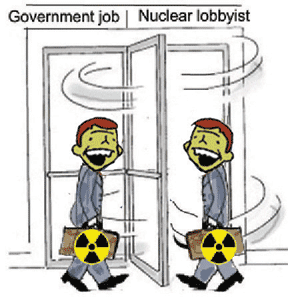
The defence lobbying firm Pyne & Partners – chaired by the former Australian Defence Minister Christopher Pyne – co-hosted an AUKUS reception and dinner in Washington at the swanky Cosmos Club on Embassy Row, with Northrop Grumman Corporation, on 3 April 2023.

Northrop Grumman is one of the largest defence companies in the world, and is the parent company to spin-off Huntington Ingalls, the US’s largest naval shipbuilder and one of the builders of the Virginia-class submarines destined to come to Australia.
The meeting was ‘private’ even though it concerned Australian defence contracts and arrangements and was attended by the Australian Ambassador and two Australian MPs, and senior US defence officials. Without public disclosure of what happened at the gathering, the Australian public once again is left in the dark.
However, Declassified Australia has been able to prise open the locked shutters on the private event to shine in some needed light. With hundreds of billions of dollars at stake through the AUKUS submarine deal, what calibre of people could be expected to attend such an event and what could possibly be their interest?
Documents produced pursuant to Freedom of Information (FOI) laws, by this writer, confirm that Australia’s Ambassador to the USA, Kevin Rudd, was invited to provide a speech, the contents of which journalists had previously reported to be ‘off the record’.
Declassified Australia has obtained the Ambassador’s briefing notes – though somewhat redacted due to national security considerations, ‘for the security of the Commonwealth’ and to avoid ‘damage to the defence, or international relations, of the Commonwealth’.
Rudd’s address was scheduled to follow those of the US Secretary for Navy, Carlos Del Toro, and Congressional Representative Rob Wittman. Rudd was allowed a period of five minutes for his remarks, ‘in between the main course and dessert’.
Congressman Wittman was among a bipartisan group of members of the US House of Representatives who in January sent a letter to President Joe Biden expressing support for the AUKUS deal. He unsurprisingly welcomed the huge AUKUS submarine spend as ‘a unique opportunity to leverage the support and resources possible under AUKUS to grow our industrial base to support both US and Australian submarine construction’.
In January he also was suggesting sending a jointly operated US submarine to Australia, saying, “I think it would be dual-crewed. I think too, that the command of the submarine would be a dual command”. These remarks, of course, raise sovereign control issues.
Another claim to fame of Representative Wittman was being named in a September 2022 analysis by The New York Times as one of at least 97 members of Congress who bought or sold stock, bonds or other financial assets that intersected with their congressional work or reported similar transactions by their spouse or a dependent child.
Rob the insider trader
Although the Times noted that U.S. lawmakers are not banned from investing in any company, including those that could be affected by their decisions, the report confirmed that Congressman Wittman traded shares of three defence contractors while he was a member of the House Armed Services Committee, which incidentally included the AUKUS event co-sponsor, Northrop Grumman
The Congressman’s response to the media revelation was to say: “I have consistently believed members of Congress should not improperly benefit from their role, and I support measures to avoid conflicts of interest.” He went on to say, “This is why I relinquish all control of my investment decisions to my financial adviser to use third-party investment managers who implement trades at their own discretion without my consultation or input,” which, he noted, is allowed under House ethics rules.
The new FOI documents confirm that Congressman Wittman is currently the Vice Chair of the US House Committee on Armed Services, Chair of the Tactical Air and Land Forces Committee and Seapower and Projection Forces Subcommittee, is on the House Select Committee on Strategic Competition between the US and the Chinese Communist Party (sic), and is on the Energy and Mineral Resources Subcommittee of the US Congress.
The FOI documents reference that, ‘Rep Rob Wittman was first elected to serve the first congressional district of Virginia in December 2007. His district is adjacent to Naval Base Norfolk as well as the major shipbuilding facilities in Newport News, Virginia – including one of the shipyards that builds Virginia-class attack submarines (Huntington Ingalls). Many of his constituents are employed either by the shipyards themselves, or by the supporting industry in the region.’
So it’s all just hunky-dory that through his investment advisor he can invest to profit from the success of defence contractors.
As to Secretary of the Navy, The Hon Carlos Del Toro, the FOI document suggests under the sub-heading, ‘Industrial collaboration’, that Ambassador Rudd was specifically tasked to ‘seek Toro’s ongoing support and endorsement’, and to recognise that ‘we continue to work with the US government agencies to overcome barriers to industrial base, supply chain and technology collaboration’.
China’s military modernisation program and its operation of nuclear-powered submarines, including both nuclear and conventionally armed, are mentioned in Ambassador Rudd’s ‘briefing notes’ obtained under FOI, along with this acknowledgement:
‘We do not oppose any nation’s right to invest in and develop defence capabilities. However, a lack of transparency around military capabilities can fuel insecurity.’
Transparency debacle
The stated concern about lack of transparency is at odds with the Australian government’s own lack of transparency to Australian citizens in relation to the entire AUKUS deal. They have yet to make signed copy of the agreement publicly available.
As to the effect of AUKUS on Australia’s defence sovereignty, Rudd’s briefing notes confirm Australia’s generous desire to ‘ease pressure on the US supply chains’ and provide the US submarines with their long-desired Indian Ocean naval base:
‘Australia will build new maintenance and repair capabilities that will directly benefit US submarines rotating through HMAS Stirling [naval base near Perth]’.
The language of the FOI document – ‘aligning national priorities’, ‘collective strength’, ‘mutual strategic benefit’, ‘deeper cooperation’ – all seems to be geared towards a fully integrated strategic and industrial base with little room for Australia’s sovereign defence issues.
And what does it say when a private Australian defence lobbyist funds eight-day international trips for the attendance of two Australian ‘non-Defence’ politicians to a private Washington event it is co-hosting with one of the largest defence companies in the world? And what does it say when the lobbyist invites a US guest speaker who trades in defence company stocks while holding political defence offices? And what does it say when input by senior US military officials and by our own ambassador to the US, until this FOI application, we’re not even permitted to see?
Transparency and integrity of decision-making in relation to AUKUS ought not be shrouded in lavish invitation-only discussions where private interests eye-off the billions in potential profits — and where Australia’s future is on the table.
This story was first published by Declassified Australia
Are We Back to Nuclear Brinkmanship for Good?

It’s not just Putin who has re-embraced nuclear threats. The U.S. and China are also cracking open the door.
By Michael Hirsh, a columnist for Foreign Policy. https://foreignpolicy.com/2023/06/09/nuclear-brinksmanship-arms-control-jake-sullivan-putin-china-russia/
Sixty years ago this week, U.S. President John F. Kennedy gave a speech at American University that transformed the nature of the Cold War, turning the insanity of nuclear brinkmanship into the relative safety of negotiation. Coming just eight months after the Cuban Missile Crisis brought the world harrowingly close to armageddon, Kennedy noted the “ironic but accurate fact that the two strongest powers [on earth] are the two in the most danger of devastation.”
That, he said, had to stop—not to achieve some “infinite concept of universal peace and goodwill” but rather to secure “a more practical, more attainable peace.”
In an act of political courage for the time, Kennedy then delivered a unilateral concession to Moscow, saying the United States “does not propose to conduct nuclear tests in the atmosphere so long as other states do not do so.”
Astonishingly, given the hostility between the United States and the Soviet Union, the Soviet government broadcast Kennedy’s June 10, 1963, address in its entirety, and it was published by the Soviet newspapers Izvestia and Pravda. On July 25, 1963, after only 12 days of negotiations, a nuclear test ban treaty was signed.
Where is the political courage of yesteryear?
In a speech at the Arms Control Association’s annual conference on June 2, U.S. National Security Advisor Jake Sullivan took a very different tack. Sullivan signaled—though he likely didn’t intend to—that there is little hope for restraining the threat of nuclear war in the foreseeable future. Sullivan conceded that there was no meaningful U.S. communication with either Russia or China, that Washington was engaging in tit-for-tat reprisals against Moscow by suspending day-to-day missile operations notification, and that the United States would continue to push for military dominance over both Russia and China for decades to come.
Sullivan, rightly blaming Russian President Vladimir Putin for bringing nuclear brinkmanship back into the conventional war equation, said “the cracks in our post-Cold War nuclear foundation are substantial and they are deep.” But in the end, Matthew Bunn, a nuclear expert at Harvard University, told Foreign Policy, Sullivan “offered nothing, no proposals.”
To be fair, the Biden administration is already being criticized by Republicans for proposing unconditional nuclear talks with both Russia and China. Indeed, U.S. President Joe Biden is clearly avoiding what may be his biggest foreign-policy fear leading up to the 2024 presidential election: the perception of being soft on China. That sort of political pressure at home, combined with Chinese President Xi Jinping’s apparent determination to rapidly build up his nuclear capability, suggests a long-term arms race.
Yet Sullivan did little to ameliorate those fears last week. On the contrary, he announced that the United States is pursuing an arms race in order to prevent an arms race. “Together with our NATO allies, we’ve been laser-focused on modernizing the alliance’s nuclear capabilities,” Sullivan said, including “certifying our F-35 aircraft to be able to deliver modern nuclear gravity bombs. … Together, these modernization efforts will ensure our deterrent capabilities remain secure and strong as we head into the 2030s—when the United States will need to deter two near-peer nuclear powers for the first time in its history.”
Sullivan denied that he was calling for a new arms race, contending the Biden administration was taking a “better” approach rather than a “more” one. “The United States does not need to increase our nuclear forces to outnumber the combined total of our competitors in order to successfully deter them,” he said. But Sullivan was basically telling the Chinese and Russians that Washington will continue to insist on precisely what both Beijing and Moscow have said they can no longer accept: U.S. hegemony in the global system.
As a result, Bunn said, “I’m fairly worried that we have a level of hostility that is the worst since the Cuban Missile Crisis.”
Patrick Lawrence: Neo-Nazis in Ukraine? No, Yes, No–Yes

Stepan Bandera torchlight parade in Kiev, Jan. 1, 2020. (A1/Wikimedia Commons)
As is well-known and documented, the neo–Nazis who infest the Armed Forces of Ukraine, the AFU — among many other national institutions — have made idols of such figures as Stepan Bandera, the freakishly murderous nationalist who allied with the Nazi regime during the war.
A New York Times’ reporter’s job this week is to persuade us that all those Ukrainian soldiers wearing Nazi insignia and marching through Kiev in Klan-like torch parades are not what you think.
June 7, 2023, By Patrick Lawrence, Original to ScheerPost
I tell you, serving as a New York Times correspondent these days cannot be easy.
You have to convey utter nonsense to your readers while maintaining a straight face and a serious demeanor.
You have to suggest the Russians may have exploded a drone over the Kremlin, that they may have blown up their own gas pipeline, that their president is an out-of-touch psychotic, that their soldiers in Ukraine are drunkards using faulty equipment, that they attack with “human hordes” (Orientalism, anyone?) and on and on — all the while affecting the gravitas once associated with the traditional “Timesman.” You try it sometime.
………………….. now we have the case of Thomas Gibbons–Neff, a square-jawed former Marine covering the Ukraine war for the Times — strictly to the extent the Kyiv regime permits him to do so, as he explains with admirable honesty. This guy is serious times 10, he and his newspaper want us to know.
Tom’s job this week is to persuade us that all those Ukrainian soldiers wearing Nazi insignia, idolizing Jew-murdering, Russophobic collaborators with the Third Reich, gathering ritually in Nazi-inspired cabals, marching through Kyiv in Klan-like torch parades are not what you think.
Nah, our Tom tells us. They look like neo–Nazis, they act like neo–Nazis, they dress like neo–Nazis, they profess Fascist and neo–Nazi ideologies, they wage this war with the Wehrmacht’s visceral hatred of Russians — O.K., but whyever would you think they are neo–Nazis?
They are just regular guys. They wear the Wolfsangel, the Schwarze sonne, the black sun, the Totenkopf, or Death’s Head — all Nazi symbols — because they are proud of themselves, and these are the kinds of things proud people wear. I was just wearing mine the other day.
The slipping and sliding starts early in “Nazi Symbols on Ukraine’s Front Lines Highlight Thorny Issues of History,” the piece Gibbons–Neff published in Monday’s editions.
He begins with three photographs of neo–Nazi Ukrainian soldiers, SS insignia plainly visible, that the Kyiv regime has posted on social media, “then quietly deleted,” since the Russian intervention began last year.
“The photographs, and their deletions,” Gibbons–Neff writes, “highlight the Ukrainian military’s complicated relationship with Nazi imagery, a relationship forged under both Soviet and German occupation during World War II.”
Complicated relationship with Nazi imagery? Stop right there, Mr. Semper fi. Ukraine’s neo–Nazi problem is not about a few indiscreetly displayed images. Sorry. The Ukrainian army’s “complicated relationship” is with a century of ultra-right ideology drawn from Mussolini’s Fascism and then the German Reich.
As is well-known and documented, the neo–Nazis who infest the Armed Forces of Ukraine, the AFU — among many other national institutions — have made idols of such figures as Stepan Bandera, the freakishly murderous nationalist who allied with the Nazi regime during the war.
This history is a matter of record, as briefly outlined here, but Gibbons–Neff alludes to none of it. It’s merely a matter of poor image-making, you see. In support of this offensive whitewash, Gibbons–Neff has the nerve to quote a source from none other than Bellingcat, which was long, long back exposed as a C.I.A. and MI6 cutout and which is now supported by the Atlantic Council, the NATO–funded, spook-infested think tank based in Washington.
“What worries me, in the Ukrainian context, is that people in Ukraine who are in leadership positions, either they don’t or they’re not willing to acknowledge and understand how these symbols are viewed outside of Ukraine,” a Bellingcat “researcher” named Michael Colborne tells Gibbons–Neff. “I think Ukrainians need to increasingly realize that these images undermine support for the country.”
[Related: Ukraine Parliament Cheers Nazi Collaborator]
Think about that. The presence of Nazi elements in the AFU is not a worry. The worry is merely whether clear signs of Nazi sympathies might cause some members of the Western alliance to decide they no longer want to support Nazi elements in the AFU.
I am reminded of that Public Broadcasting news segment last year, wherein a provincial governor is featured with a portrait of Bandera behind him. PBS simply blurred the photograph and ran the interview with another of the courageous, admirable Ukrainians to which we are regularly treated.
I hardly need remind paying-attention readers that the neo–Nazis-who-are-not-neo–Nazis were for years well-reported as simply neo–Nazis in the years after the U.S.–cultivated coup in 2014.
[Related: Caitlin Johnstone: What MSM Can No Longer Say]
The Times, The Washington Post, PBS, CNN — the whole sorry lot — ran pieces on neo–Nazi elements in the AFU and elsewhere. In March 2018, Reuters published a commentary by Jeff Cohen under the headline “Ukraine’s Neo–Nazi Problem.”
Three months later The Atlantic Council, for heaven’s sake, published a paper, also written by Cohen, titled, “Ukraine’s Got a Real Problem with Far–Right Violence (And no, RT Didn’t Write This Headline).”
I recall, because it was so surprising coming from the council. The original head on that paper was “Ukraine’s Got a Neo–Nazi Problem,” but that version now seems lost to the blur of stealth editing.
Then came the Russian intervention, and Poof! There are no more neo–Nazis in Ukraine.
There are only these errant images that are of no special account.
And to assert there are neo–Nazis in Ukraine — to have some semblance of memory and a capacity to judge what is before one’s eyes — “plays into Russian propaganda,” Gibbons–Neff warns us.
It is to “give fuel to his”— Vladimir Putin’s — “false claims that Ukraine must be de–Nazified.” For good measure Gibbons–Neff gets out the old Volodymyr-Zelensky-is-Jewish chestnut, as if this is proof of… of something or other.
My mind goes to that lovely Donovan lyric from the Scottish singer’s Zen enlightenment phase. Remember “There Is a Mountain?” The famous lines went, “First there is a mountain/ Then there is no mountain/ Then there is.” There were neo–Nazis in Ukraine, then there were no neo–Nazis, and now there are neo–Nazis but they aren’t neo–Nazis after all.
………………………………….. Gibbons–Neff resolutely avoids dilating his lens such that the larger phenomenon comes into view. It all comes down to those three unfortunate insignia in those three deleted photographs.
The parades, the corridors of neo–Nazi flags, the ever-present swastikas, the reenactments of all-night SS rituals, the glorification of Nazis and Nazi collaborators, the Russophobic blood lust: Sure, it can all be explained, except that our Timesman does not go anywhere near any of this.
Gibbons–Neff resolutely avoids dilating his lens such that the larger phenomenon comes into view. It all comes down to those three unfortunate insignia in those three deleted photographs.
The parades, the corridors of neo–Nazi flags, the ever-present swastikas, the reenactments of all-night SS rituals, the glorification of Nazis and Nazi collaborators, the Russophobic blood lust: Sure, it can all be explained, except that our Timesman does not go anywhere near any of this.
“It is, of course, true that, for instance, the Azov Battalion was originally founded by neo–Nazi and far-right groups (as well as many soccer ultra-fans), which brought along with it the typical aesthetics — not only neo–Nazi insignia but also things like Pagan rituals or names like ‘The Black Corps,’ the official newspaper of Nazi Germany’s major paramilitary organization Schutzstaffel (SS).”
But worry not, readers. It is merely an aesthetic, part of a harmless, misunderstood “subculture”:

Torchlight procession in honor of the 106 anniversary of the birthday of Stepan Bandera, Kiev, Jan. 1, 2015. (All-Ukrainian Union CC BY 3.0, Wikimedia Commons)
…………………………………………….It is always interesting to ask why a piece such as this appears when it does. Dead silence for months on the neo–Nazi question, and then suddenly a long explainer that does its best to avoid explaining anything. Always interesting to ask, never easy to answer.
It could be that a lot of stuff on these awful people is sifting out from under the carpet. Or maybe something big is on the way and this piece is preemptive. Or maybe either Gibbons–Neff or his editors saw the Ponomarenko piece as an opportunity to dispose of one of the Kyiv regime’s most embarrassing features.
Or maybe the larger context counts here. As mentioned in this space last week, the Times’ Steve Erlanger recently suggested from Brussels that NATO might do a postwar Germany job with Ukraine: Welcome the West of the country to the alliance and let the eastern provinces go for an indefinite period, unification the long-term objective.
Late last week Foreign Affairs ran a fantastical piece by Andriy Zagorodnyuk, formerly a Ukrainian defense minister and now, yes indeedy, a distinguished fellow at the Atlantic Council. It appeared under the headline, “To Protect Europe, Let Ukraine Join NATO—Right Now.” ……………………………………….more https://consortiumnews.com/2023/06/07/patrick-lawrence-neo-nazis-in-ukraine-no-yes-no-yes/?fbclid=IwAR2qutGUc886hz22JN9TvBgmNTXCb-dJwB1TvxPfsnvxCTT6d9yuEoeJOH8
Kiev’s Long Term Plans To Blow Up The Kakhovka Dam

June 6, 2023 by Raúl Ilargi Meijer https://www.theautomaticearth.com/2023/06/kievs-long-term-plans-to-blow-up-the-kakhovka-dam/
I had some discussion with Andrew about this article, since the December 2022 WaPo article he refers to was not the first time Kiev’s plans to blow up the dam were mentioned. There was this, for instance, 2 months earlier. Then again, Andrew is right in saying that the WaPo piece is the first where people other than Zelensky mention it. And we agree that now blaming the attack on Russia is really out of left field. Those darn Russkies keep on aiming for their own feet. And that’s the only thing(s) they can hit.
Andrew Korybko:
The partial destruction of the Kakhovka Dam on early Tuesday morning saw Kiev and Moscow exchange accusations about who’s to blame, but a report from the Washington Post (WaPo) in late December extends credence to the Kremlin’s version of events. Titled “Inside the Ukrainian counteroffensive that shocked Putin and reshaped the war”, its journalists quoted former commander of November’s Kherson Counteroffensive Major General Andrey Kovalchuk who shockingly admitted to planning this war crime:
“Kovalchuk considered flooding the river. The Ukrainians, he said, even conducted a test strike with a HIMARS launcher on one of the floodgates at the Nova Kakhovka dam, making three holes in the metal to see if the Dnieper’s water could be raised enough to stymie Russian crossings but not flood nearby villages. The test was a success, Kovalchuk said, but the step remained a last resort. He held off.”
His remark about how “the step remained a last resort” is pertinent to recall at present considering that the first phase of Kiev’s NATO–backed counteroffensive completely failed on Monday according to the Russian Ministry of Defense. Just like Ukraine launched its proxy invasion of Russia in late May to distract from its loss in the Battle of Artyomovsk, so too might does it seem to have gone through with Kovalchuk’s planned war crime to distract from this most recent embarrassment as well.
The abovementioned explanation isn’t as far-fetched as some might initially think either. After all, one of complexity theory’s precepts is that initial conditions at the onset of non-linear processes can disproportionately shape the outcome. In this context, the first failed phase of Kiev’s counteroffensive risked ruining the entire campaign, which could have prompted its planners to employ Kovalchuk’s “last resort” in order to introduce an unexpected variable into the equation that might improve their odds.
Russia had over 15 months to entrench itself in Ukraine’s former eastern and southern regions that Kiev still claims as its own through the construction of various defensive structures and associated contingency planning so as to maintain its control over those territories. It therefore follows that even the most properly supplied and thought-out counteroffensive wasn’t going to be a walk in the park contrary to the Western public’s expectations, thus explaining why the first phase just failed.
This reality check shattered whatever wishful thinking expectations Kiev might have had since it showed that the original plan of swarming the Line of Contact (LOC) entails considerable costs that reduce the chances of it succeeding unless serious happens behind the front lines to distract the Russian defenders. Therein lies the strategic reason behind partially destroying the Kakhovka Dam on Tuesday morning exactly as Kovalchuk proved late last year is possible to pull off per his own admission to WaPo.
The first of Kiev’s goals that this terrorist attack served was to prompt global concern about the safety of the Russian-controlled Zaporozhye Nuclear Power Plant, which relies on water from the now-rapidly-depleting Kakhovka Reservoir for cooling. The International Atomic Energy Agency said that there’s “no immediate nuclear safety risk”, but a latent one can’t be ruled out. Should a crisis transpire, then it could throw Russia’s defenses in northern Zaporozhye Region into chaos.
The second goal is that the downstream areas of Kherson Region, which are divided between Kiev and Moscow, have now been flooded. Although the water might eventually recede after some time, this could complicate Russia’s defensive plans along the left bank of the Dnieper River. Taken together with the consequences connected to the first scenario, this means that a significant part of the riparian front behind the LOC could soon soften up to facilitate the next phase of Kiev’s counteroffensive.
In fact, the geographic scope of Kiev’s “unconventional softening operation” might even expand to Crimea due to the threat that Tuesday morning’s terrorist attack could pose to the peninsula’s water supply via its eponymous canal. The regional governor said that sufficient supplies remain for now but that the coming days will reveal the level of risk. While Crimea still managed to survive Kiev’s blockade of the canal for eight years, there’s no doubt that this development is disadvantageous for Russia.
The fourth strategic goal builds upon the three that were already discussed and concerns the psychological warfare component of this attack. On the foreign front, Kiev’s gaslighting that Moscow is guilty of “ecocide” was amplified by the Mainstream Media in spite of Kovalchuk’s damning admission to WaPo last December in order to maximize global pressure on Russia, while the domestic front is aimed at sowing panic in Ukraine’s former regions with the intent of further softening Russia’s defenses there.
And finally, the last strategic goal that was served by partially destroying the Kakhovka Dam is that Russia might soon be thrown into a dilemma. Kiev’s “unconventional softening operation” along the Kherson-Zaporozhye LOC could divide the Kremlin’s focus from the Belgorod-Kharkov and Donbass fronts, which could weaken one of those three and thus risk a breakthrough. The defensive situation could become even more difficult for Russia if Kiev expands the conflict by attacking Belarus and/or Moldova too.
To be absolutely clear, the military-strategic dynamics of the NATO-Russian proxy war in Ukraine still favor Russia for the time being, though that’s precisely why Kiev carried out Tuesday morning’s terrorist attack in a desperate attempt to reshape them in its favor. This assessment is based on the observation that Russia’s victory in the Battle of Artyomovsk shows that it’s able to hold its own against NATO in the “race of logistics”/“war of attrition” that the bloc’s chief declared in mid-February.
Furthermore, even the New York Times admitted that the West’s sanctions failed to collapse Russia’s economy and isolate it, while some of its top influencers also admitted that it’s impossible to deny the proliferation of multipolar processes in the 15 months since the special operation began. These include German Chancellor Olaf Scholz, former US National Security Council member Fiona Hill, and Goldman Sachs’ President of Global Affairs Jared Cohen.
The military-strategic dynamics described in the preceding two paragraphs will inevitably doom the West to defeat in the New Cold War’s largest proxy conflict thus far unless something major unexpectedly happens to change them, which is exactly what Kiev was trying to achieve via its latest terrorist attack. The reason why few foresaw this is because Kovalchuk admitted to WaPo last December that his side had previously planned to blow up part of the Kakhovka Dam as part of its Kherson Counteroffensive.
It therefore seemed unthinkable that Kiev would ultimately do just that over half a year later and then gaslight that Moscow was to blame when the Mainstream Media itself earlier reported the existence of Ukraine’s terrorist plans after quoting the same Major General who bragged about them at the time. Awareness of this fact doesn’t change what happened, but it can have a powerful impact on the Western public’s perceptions of this conflict, which is why WaPo’s report should be brought to their attention.
France fully nationalises debt-laden nuclear power group EDF, after its record loss last year

EDF quits Paris stock exchange after full nationalisation. French nuclear
power group EDF (EDF.PA) returns to full state ownership on Thursday with
its de-listing from the Paris stock exchange after it suffered a record
loss last year and saw nuclear output fall to a 34-year low.
The government launched a buyout for the 16% stake it did not already own in EDF in late
2022, stumping up around 10 billion euros ($10.9 billion) to take full
control of the debt-laden operator of Europe’s largest fleet of nuclear
power plants.
Reuters 8th June 2023
https://www.reuters.com/business/energy/french-utility-giant-edfs-history-2022-07-08
Mining giant BHP pushes Albanese Government to remove hurdles to nuclear energy
The West Australian, Tue, 6 June 2023
Mining giant BHP has urged the Federal Government to remove its prohibition on nuclear energy to help meet the energy needs of transitioning to a low-carbon economy.
The company lobbied Treasury — ahead of the May 9 Budget — to make the move as it told the Albanese Government that more must be done to protect energy security, affordability and decarbonisation, The Australian reported…………….. (Subscribers only) https://thewest.com.au/business/mining-giant-bhp-pushes-albanese-government-to-remove-hurdles-to-nuclear-energy-c-10896013
Washington Post reported Ukraine conducted a test strike with HIMARS on the Kahovka dam last year
the Washington Post reported in December 2022 that Ukraine had previously carried out a test strike using American HIMARS (High Mobility Artillery Rocket Systems) on a dam located on the Russian-held side of Ukraine along the Dnieper River in Kahovka. They cited Ukrainian Major-General Andriy Kovalchuk.
Human Events Media Group 06/06/2023
A dam on the Dnieper River was destroyed on Tuesday, flooding a substantial amount of the area where Ukrainian and Russian troops are engaged in fighting, after Ukraine launched their much-anticipated counter-offensive. The dam was in Russian control, and has been since shortly after the February 2022 invasion of Ukraine by Russia.
Ukraine claimed Russia blew up the Nova Kakhovka dam and said it was a war crime, while Russia has said that it was Ukraine who “sabotaged the dam, to distract attention from the launch of a major counteroffensive Moscow says is faltering,” Reuters reports.
Ukraine’s counter offensive has been in the works for some time, specifically targeting the Russian-held city of Kherson, and was just recently launched.
“Russian terrorists,” President Volodymyr Zelenskiy said on Telegram. “The destruction of the Kakhovka hydroelectric power plant dam only confirms for the whole world that they must be expelled from every corner of Ukrainian land.”
However, the Washington Post reported in December 2022 that Ukraine had previously carried out a test strike using American HIMARS (High Mobility Artillery Rocket Systems) on a dam located on the Russian-held side of Ukraine along the Dnieper River in Kahovka. They cited Ukrainian Major-General Andriy Kovalchuk.
“Kovalchuk considered flooding the river,” the Washington Post reported. “The Ukrainians, he said, even conducted a test strike with a HIMARS launcher on one of the floodgates at the Nova Kakhovka dam, making three holes in the metal to see if the Dnieper’s water could be raised enough to stymie Russian crossings but not flood nearby villages. The test was a success, Kovalchuk said, but the step remained a last resort.”……………….. https://humanevents.com/2023/06/06/wapo-reported-ukraine-conducted-a-test-strike-with-himars-on-the-kahovka-dam-last-year
The Ukrainian “counter-offensive”: A new stage in the US-NATO war against Russia

Every aspect of the war, including the “counter-offensive,” is being directed by the Biden administration, the Pentagon and NATO. It is being led by forces trained by NATO and armed with NATO weapons, including depleted uranium shells supplied by the UK. Operationally, it is organized from Washington and the Pentagon. The masses of Ukrainians are being exploited as cannon fodder. Among the first divisions thrown into the battle, many are raw draftees with little or no training.
WSWS Joseph Kishore, David North, 5 June 2023
The US-NATO war against Russia over Ukraine is entering a new stage this week, with reports of a significant increase in fighting along a broad front Monday and enormous casualties.
The Russian Defense Ministry reported on its official Telegram channel that Russian forces countered a Ukrainian offensive on the Vremevka outpost in South Donetsk, which is currently controlled by Russia. It stated that over 1,500 Ukrainian soldiers were killed and that Russia seized 28 tanks, including eight German-made Leopard tanks.
Russia also reported an offensive of Ukrainian troops toward the south, against the territory along the coast of the Sea of Azov that connects Crimea and the Donbas, both held by Russia or pro-Russian forces since 2014. A Russian-appointed official in the city of Zaporizhzhia said that the fighting in the south involved extensive shelling and strikes by Ukraine using British-French Storm Shadow missiles.
It is apparent that Monday’s operations mark the beginning of the long anticipated “summer counter-offensive.” While there is, at present, limited information, one thing can be said with certainty: The fighting will result in a vast increase in the number of deaths, both Ukrainian and Russian.

In an interview with the Wall Street Journal Sunday, Ukrainian President Volodymyr Zelensky acknowledged that “a large number of soldiers are going to die,” but “we are going to do it.” Reliable estimates place the death toll of Ukrainians in the war so far at 300,000.
Every aspect of the war, including the “counter-offensive,” is being directed by the Biden administration, the Pentagon and NATO. It is being led by forces trained by NATO and armed with NATO weapons, including depleted uranium shells supplied by the UK. Operationally, it is organized from Washington and the Pentagon. The masses of Ukrainians are being exploited as cannon fodder. Among the first divisions thrown into the battle, many are raw draftees with little or no training.
The US and the NATO powers are determined to inflict a Russian defeat, with dreams of a military parade of NATO troops in the streets of Moscow. The Financial Times wrote on Monday that “there has been a notable change of tone among senior western officials, who have appeared increasingly skeptical about Russian military capabilities. Antony Blinken, the US secretary of state, last week made a clear case for an outright Ukrainian victory based on ‘territorial integrity’ [that is, retaking all territory presently controlled by Russia] in a speech that also disparaged Russia’s military ‘as the second-strongest in Ukraine.’”
The FT also cited comments by Ben Wallace, the UK defense secretary, that Ukraine could take back Crimea as part of the offensive. “What we’ve seen on the battlefield is that, if you punch Russian forces in the wrong place, they’ll actually collapse,” he said.
Such statements combine propaganda with self-delusion. The Ukrainian military has been bled white over the past 15 months. It is entirely reliant on the US and NATO, not only to provide training and weaponry, but increasingly the manpower necessary for escalating the war.
The operations in Ukraine are only one part of a barely disguised, undeclared war between NATO and Russia, which is expanding in intensity and geographical scope.
Developments on the ground in Ukraine have been timed to coincide with a meeting of NATO foreign ministers in Oslo, Norway late last week. This meeting itself was to prepare a full NATO war summit next month in Vilnius, Lithuania, only a short drive from the Russian border. Behind closed doors, the leaders of the NATO powers are discussing and implementing the next stage in the escalation.
Already, Ukraine, operating under the direction of the US, has launched drone strikes targeting Moscow, begun shelling Russian cities, and organized incursions into Russian territory, using vehicles and equipment provided by the US and its NATO allies. Poland has become directly involved in the conflict, with members of the so-called “Polish Volunteer Corps” of Polish citizens participating in cross-border raids from Ukraine into Russia.
An article in the Washington Post (“Defend ‘every inch’ of NATO territory? New strategy is a work in progress”), published Monday, opens with a description of French paratroopers being dropped into Estonia, which borders Russia and is only 150 km from St. Petersburg. The Post notes that the French war exercises in Estonia are “part of a stepped-up rehearsal of what it would take to reinforce a [NATO] battle group” in the country.
Speaking of what can only be described as a massive military mobilization, the newspaper writes, “NATO has bolstered its eastern flank in part by establishing battle groups in four additional countries: Bulgaria, Hungary, Romania and Slovakia,” with 10,000 troops across eight battle groups. Dozens of ships and hundreds of planes, along with ground-based air defense, have been sent to countries on Russia’s border, particularly the Baltic countries of Latvia, Lithuania and Estonia.
War games are taking place currently throughout Europe, including the massive “Defender Europe 2023” exercise, which began on April 22 and involves 26,000 troops from the US and its allies. The final component of the operations, “Saber Guardian 23,” began last week and is centered on the Black Sea, to the south of Ukraine. It involves soldiers and sailors from Albania, Bulgaria, Belgium, France, Greece, Germany, Italy, the Netherlands, Romania, Slovenia and the United States.
Given the statements of leading US and NATO officials that they are committed to the military defeat of Russia, the Putin government will be compelled to interpret all these actions as possible preparations for NATO incursions into Russian territory. The purpose of all these operations is to support the Ukrainian offensive by distracting Russian military commanders from exclusive focus on the Ukrainian front and compelling them to divert forces to other border regions.
In the capitals of the NATO powers, a mood of reckless hysteria prevails. Over the weekend, German Chancellor Olaf Scholz, confronted by protesters at a gathering of his Social Democratic Party outside of Berlin, unleashed a Hitlerian rant against Russia and denounced Putin as a “murderer” and a “warmonger.”
The White House has rejected calls for a ceasefire or negotiated settlement to the conflict that does not include full capitulation by Russia. Encouraged by Russia’s failure to respond to each escalation, the Biden administration has concluded that there is no “red line” that it cannot cross.
In an article published under the headline “Biden Administration Shrugs Off Ukraine’s Attacks in Russia,” the New York Times wrote on Monday that the White House has discarded the pretense of discouraging direct attacks in Russia by Ukraine, using US-supplied weaponry. “Behind closed doors,” the Times wrote, “senior administration officials have seemed even less fazed. ‘Look, it’s a war,’ one senior Pentagon official said last Thursday. ‘This is what happens in a war.’”………………… https://www.wsws.org/en/articles/2023/06/06/pers-j06.htm
Content of radioactive element in fish at Fukushima’s Nuclear Power Plant 180 times of safe limit

CGTN 6 June 23
The radioactive elements in the marine fish caught in the harbor of the Fukushima Daiichi Nuclear Power Plant in Japan far exceed safety levels for human consumption, according to a report issued by the plant’s operator Tokyo Electric Power Company (TEPCO) on Monday. In particular, the data released show that the content of Cs-137, a radioactive element that is a common byproduct in nuclear reactors, is 180 times that of the standard maximum stipulated in Japan’s food safety law.
CGTN downloaded the English version of the report available on TEPCO’s official website. According to the data, the sampled black rockfish contains the radioactive element Cs-137 with a content of 18,000 becquerels per kilogram. Data available on the website of Fukushima Revitalization Station run by Japan’s Fukushima prefectural government shows that Japan’s current limit of radioactive cesium in general food which contains fish is set at 100 becquerels per kilogram.
According to the report, the location where the sampled fish was caught is at the port area of Units 1 to 4 of the Fukushima Daiichi Nuclear Power Plant, where a breakwater is built and nuclear wastewater with a high concentration of radioactive substances flows in. TEPCO said it will set up multiple protective nets to prevent fish from swimming out of the harbor.
A Chinese news website sina.com.cn quoted experts noting that the radioactive elements in the nuclear wastewater could penetrate into fish, shrimp and other seafood, and later accumulate in the human body after consumption. ……………………
TEPCO on Monday started sending seawater into an underwater tunnel to be diluted before releasing the nuclear wastewater into the ocean. The company said that all facilities for the water release system are expected to be completed by the end of this month.
Local fishing communities say their businesses and livelihoods will suffer still more damage. Neighboring countries such as China and South Korea and Pacific Island nations have raised safety concerns. Environmental groups including Friends of the Earth oppose the release. https://news.cgtn.com/news/2023-06-06/Radioactive-element-in-fish-at-Fukushima-plant-180-times-safe-limit-1kpOlJEH9xm/index.html
1 This month


Help Aunty Sue Protect Her Land and Sacred Sites From Destructive Rocket Testing.
.

Australians deserve the truth
about
AUKUS – https://aukuspublicinquiry.com/

PETITION – To: Prime Minister Anthony Albanese and the Australian Labor Government

of the week – Australians for War Powers Reform (AWPR)
To see nuclear-related stories in greater depth and intensity

