Nuclear. Russiamoved small “tactical” nuclear weapons to Belarus, sparking anxiety that the Ukraine war could “go nuclear”. Meanwhile, I have no doubt that Russia propaganda is portraying the war as being won by Russia. And it is also patently obvious that Western media depicts the Ukraine “counter-offensive” as being a winner. What gets me is that we – that’s the USA and all its “like-minded” hangers-on – are not actually at war against Russia. So we don’t really have to have the blanket of anti-Russian spin thrown over every news item of this proxy war, (as is the practice in a real war)
On the 29th of May 2023, our local member demonstrated yet again that he fails to understand the importance and the reasoning behind the Borumba pumped hydro scheme.
Mr O’Brien noted his opposition to the project based on the impact of transmission lines on the environment and members of the local community.
Failing to understand environmental impacts, Mr O’Brien utilised his platform to recommend nuclear power instead!
On cost alone, nuclear power represents over five times the lifetime costs of pumped hydro and solar, as costed by the CSIRO in 2022.
Not to mention the exorbitant costs associated with nuclear waste handling, decommissioning the sites, or that nuclear plants are required to shut down for maintenance periodically.
He also failed to mention that transmission lines would still need to be established at the new site of the reactors.
His increasingly unconstructive and arrogant behaviour during the renewable energy transition boils down to a bad case of ‘not in my backyard’ and political grandstanding.
Mr O’Brien stands yet again in the way of progress for our nation, future jobs and skills for the people of Wide Bay.
The pro-nuclear brigade don’t give up, do they? (Dark times ahead, CCN393)
Despite much correspondence published in the past, I have yet to hear of a realistic scheme to safely dispose of not only the waste, but also the highly-radioactive reactor vessel once the plant has reached its commercial end of life.
Are these people deliberately ignoring this inconvenient truth, hoping that the sheep will not realise this obvious problem?
If and when a suitable scheme is developed then sensible people will no doubt support nuclear energy; unless that happens then it will be the subsequent hazards of fossil fuels all over again.
What exactly is wrong with renewable sources such as water, wind, solar, etc – all of which are free?
I am familiar with the tired old argument that “the sun doesn’t shine all the time”, but that’s why we have proven technologies such as high-capacity batteries (chemical energy), pumped water (potential energy), etc.
The way some of these proponents carry on, you’d think that they had shares in the nuclear industry.
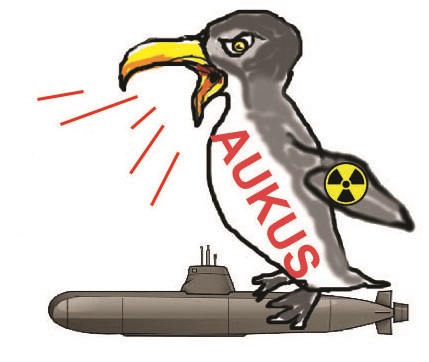
Powerful unions want Labor’s rank and file to formally condemn the $368 billion AUKUS submarine deal this weekend, potentially setting up an awkward clash with Prime Minister Anthony Albanese when he addresses Victorian Labor’s first state conference in four years
Both the prime minister and Premier Daniel Andrews will deliver speeches to party faithful at the conference, according to several state and federal government sources.
The conference will be the first since 2019 – before the pandemic, Melbourne’s long lockdowns, and the federal intervention that followed revelations by The Age about branch stacking, especially by former Labor right powerbroker Adem Somyurek.
The 606 delegates will be asked to vote on a motion from manufacturing union the AMWU seen by The Age, slamming Australia’s decision to acquire a nuclear-powered fleet from the United States and the prospect of the Albanese government “dragging Australia into a new Cold War, rather than pursuing the labour movement’s longstanding commitment to a peaceful and independent foreign and defence policy”.
AMWU Victorian secretary Tony Mavromatis said he expected his motion would win strong support from the conference floor.
“We will push ahead with our motion, no matter who is at the conference, including prime ministers,” he said. “The AUKUS deal is a terrible arrangement for Australia. It lets down Australian workers, apprentices and trainees and Australian manufacturing. We should not be getting into nuclear.”
The AUKUS deal was initially agreed to by former prime minister Scott Morrison and later supported by federal Labor.
While Andrews is expected to receive a hero’s welcome after Labor’s resounding November election victory, the conference is the first opportunity for years for Labor’s rank and file to vent over the big issues facing the state, including the housing crisis.
…………… To be held at the Moonee Valley Racecourse, the conference will also be the first public display of factional muscle since the federal intervention.
………… Some party insiders also see the weekend meeting as an important preparation for the federal conference in Brisbane in August, where the AUKUS submarine deal and stage three tax cuts are expected to feature prominently.
Labor’s national executive has administered the branch since branch stacking revelations were aired in June 2020.
The state conference was traditionally the setting for often passionate public rows over policy and factional grievances, especially in the tumultuous 1970s and ’80s. Conferences have been more stage-managed in recent years.
The move follows a complaint to the party’s dispute tribunal by veteran Labor activist Eric Derricott about the factional control over elections at the conference, but will leave the results of the election unknown for some weeks.
After this conference all such elections will be held by secret ballot.
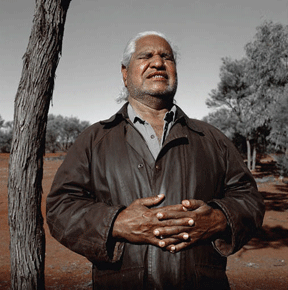
Karina Lester (above) and June Lennon are still affected by the fallout from British nuclear tests on their country 70 years later.
The two First Nations women are part of a delegation of atomic survivors and relatives, which includes veterans, visiting Canberra to call on the government to sign an international treaty to ban nuclear weapons.
“We still see the craters and the scars that were left by those weapons tests, both at Emu Field and also at Maralinga Tjarutja,” Ms Lester, a Yankunytjatjara Anangu woman from north-west South Australia, said.
Greens Senator Jordon Steele-John and Labor MP Josh Wilson co-chair the Parliamentary Friends of the Treaty on the Prohibition of Nuclear Weapons, which heard from the delegation on Wednesday.
“It was so powerful to hear the stories of lived experience and direct connection to the impacts of nuclear testing,” Senator Steele-John said.
“That makes it viscerally real and really brings home the urgent need to eliminate nuclear weapons.”
Ms Lester’s father, the late Yami Lester, (above) went blind as a young man after the British tested atomic weapons in Emu Field.
“The scars are still felt on our country,” she said.
“And the scars are still evident on our people.”
The group of Australian atomic survivors and relatives are calling on Prime Minister Anthony Albanese to sign the Treaty on the Prohibition of Nuclear Weapons.
In 1953 the British initiated a program of nuclear testing in Australia at the Montebello Islands, off the coast of WA and in Emu Field in South Australia.
Two years later, the British government announced a larger site for the tests at Maralinga.
In October 1953 when the British detonated the Totem I and II nuclear bombs at Emu Field, Yankunytjatjara, Antikarinya and Pitjantjatjara woman June Lennon was only a few months old.
No wonder that the poor guy is looking anxious lately.
It must have been kinda fun for Rafael Grossi, being Director General of IAEA, from 2019 to 2022, running around the world, promoting the nuclear industry and the safety of nuclear power plants.
He’s still got that task, but it’s probably not any fun any more.
The shit has hit the fan. Europe’s largest nuclear power plant is, as Grossi is forced to admit, facing “a dangerous situation”. Sitting in a war zone, run by exhausted Ukrainian workers, under control of Russia troops, repeatedly attackedby shelling, now with its essential cooling water threatened – the Zaporizhzhia Nuclear Power Plant is in danger. That means that the region is in danger, Ukraine is in danger, the whole of Europe is in danger.
Grossi got to this top job at a “good” time. Everyone was forgetting the series of nuclear accidents large and small. Chernobyl, which radioactively poisoned large swathes of Europe, was over, wasn’t it? The fun time of midwiving a “nuclear renaissance’ was on – “nuclear to save the climate – blah blah”
Poor Rafael – his contradictory job is impossible – to persuade the world that nuclear power is oh so safe, while at the same time warning the world of its deadly peril.
1 The fate of arms has decided. The moment of truth has spoken. The Ukrainian counter-offensive has failed miserably. NATO’s considerable armaments were useless. The battlefield is littered with corpses. All for nothing. The territories that joined the Russian Federation by referendum will remain Russian.
This “checkmate” not only marks the end of Ukraine as we have known it, but of Western domination that had staked its future on its lies. The multipolar world may be born this summer at several international summits. A new way of thinking in which might no longer makes right.
This article was written on June 10. At that time, the only information available came from Russia and allied headquarters. Ukraine had imposed a total embargo on its counter-offensive. We should therefore have waited before publishing this text. However, we felt that if Ukraine had been able to break through Russia’s first line of defense, even if it hadn’t managed to get into the breach, it would have let us know. We are therefore publishing this analysis.
In six days, from June 4 to 10, 2023, the Ukrainian army launched its counter-offensive and suffered a terrible defeat.
During the summer, Russian forces built two defense lines in the part of Novorossia they liberated and in the Donbass. They prevent the passage of all armored vehicles.
Ukrainian forces have chosen a dozen points of attack to retake “enemy-occupied” territory. Their armored vehicles were unable to get through the first line of Russian defenses and piled up in front of it, where they were destroyed one by one by Russian artillery and suicide drones.
At the same time, the Russian army targeted missiles at command centers and arsenals inside Ukrainian territory and destroyed them.
The Ukrainian air defense system was destroyed by hypersonic missiles as soon as it was installed. In its absence, the Ukrainians were unable to carry out the maneuvers planned by Nato.
Russia did not use any of its new weapons, apart from its NATO weapons jamming system and some of its hypersonic missiles.
The border is now a long graveyard of tanks and men. Airports are full of smoking Mig-29 and F-16 wrecks.
The staffs of the United States, the Atlantic Alliance and Ukraine are passing the buck for this historic disaster. Hundreds of thousands of human lives and 500 billion dollars have been wasted for nothing. Western weapons, which shook the world in the 90s, are now worthless compared to the Russian arsenal of today. Strength has changed sides.
Two conclusions can already be drawn:
DO NOT CONFUSE THE UKRAINIAN ARMY WITH THE “INTEGRAL NATIONALISTS”
While there is no longer a Ukrainian army capable of high-intensity warfare, there are still the forces of the “integral nationalists” (sometimes called “Banderists” or “Ukrainian-Nazis”). But they are only trained for low-intensity warfare. Its leaders went to fight in Chechnya in the late 90s on behalf of the CIA and NATO secret services, and sometimes in Syria in the 2020s. They are trained in targeted assassinations, sabotage and civilian massacres. Nothing more.
They succeeded 1. In sabotaging the Russian-German-French-Dutch Nord Stream gas pipeline, plunging Germany and then the European Union into recession on September 26, 2022. 2. In sabotaging the Kerch Strait bridge (known as the “Crimean Bridge”), on October 8, 2022. 3. In attacking the Kremlin with drones, May 3, 2023 4. In using drones to attack the Ivan Kurs, the intelligence vessel defending the Turkish Stream gas pipeline in the Black Sea, on May 26, 2023. 5. In sabotaging the Kakhovka dam to split Novorossia in two, on June 6, 2023. 6. In sabotaging the Togliatti-Odessa ammonia pipeline to destroy the Russian mineral fertilizer industry, on June 7, 2023.
Just as in the two World Wars and the Cold War, they proved their terrorist capabilities, but played no decisive role on the battlefield.
Now more than ever, we need to distinguish between Ukrainians who thought they were defending their people, and the “integral nationalists” [1], who don’t care about their compatriots and have been trying for a century to eradicate Russians and their culture.
THE UKRAINE WE KNEW IS DEAD
Until now, Ukraine has been above all a power of communication. Kiev succeeded in making people believe that the 2014 coup d’état that overthrew a democratically elected president in favor of integral nationalists was a revolution. Likewise, it has managed to make people forget the way it crushed its citizens in the Donbass, refusing to give them access to public services, to pay civil servants’ salaries and pensions to the elderly and, ultimately, bombing its cities. Finally, it succeeded in convincing Westerners that Ukraine was a homogenous country with a single population living a common history.
As in most wars, there is also a “civil war” aspect [2]. Today, everyone can see that, contrary to what was claimed, Vladimir Putin’s analysis was not a reconstruction of history, but a factual truth. The people of Donbass are profoundly Russian. The people of Novorossia (including Crimea) are of Russian culture, albeit with a different history (they have never known serfdom). Ukraine has never existed as an independent state in history, apart from one decade, during the periods 1917-22 and 1941-45, and three other decades, since 1991.
During these three experiences, Kiev never stopped purging its people and massacring its citizens when the full nationalists were in power (1917-22 with Simon Petliura, 1941-45 with Stepan Bandera, and 2014-22 with Petro Poroshenko and Volodymyr Zelensky). In total, over the course of a century, the “integral nationalists” – as they call themselves – have murdered more than 3 million of their compatriots.
During the First World War, the people of Novorossia had already risen up around the anarchist Nestor Makhno; during the Second World War, the people of Donbass and Novorossia rose up as Soviets; while this time, they are fighting against the “integral nationalists” in Kiev with Russian forces.
The only way to stop these massacres is to separate the “integral nationalists” from the population of Russian culture they want to kill [3]. Since Nato staged a coup in 2014 and put them in power, there’s no other way but to note the country’s current division and leave them in power in Kiev. It is the Ukrainians, and they alone, who will have to overthrow them.
Current military operations have already done so. The part of the country liberated by the Russians voted in a referendum to join the Federation. However, last year’s Russian advance was halted by President Vladimir Putin as part of negotiations with Ukraine, conducted first in Belarus, then in Turkey. Odessa is still Ukrainian in law, even though it is culturally Russian. Transnistria is still Moldavian, even though it is culturally Russian.
The war is technically over. No offensive can alter the current borders. Admittedly, the fighting may drag on and a peace treaty is a long way off, but the die is cast. There is still a problem in Ukraine and Moldavia: Odessa and Transnistria are still not Russian. Above all, there remains a fundamental problem: in violation of their oral and written commitments, the members of the Atlantic Alliance have stockpiled US weapons on Russia’s borders, jeopardizing its security.
Nuclear. The drums of war are beating ever more severely. The break in Ukraine’s Nova Kakhovka dam increases the danger to Zaporizhzhia nuclear power station – all rather doom and gloom this wek.
SPACE. EXPLORATION, WEAPONS.Stealth actions by SpaceX, as 36 space launches approved by California Coastal Commission without a vote, public hearing, or public notice.[ on nuclear-news.net]
WIKILEAKS – After years of running up against a brick wall, the first crack has appeared with the latest ruling on our FOIA case issued by Judge O’Connor. In addition to the ruling, British Labour MP John McDonnell has just obtained new information from the Crown Prosecution Service. McDonnell is calling for an independent inquiry into the CPS’s role in the Assange case.
For the last six years, they have rejected all of our attempts to shed light on the destruction of key documents in the Julian Assange case, even though the emails were deleted when the high-profile, controversial case was still ongoing.
But now the British authorities at the Crown Prosecution Service have to come clean: they must declare whether they hold any information as to when, how and why that documentation was deleted, and if they do hold it, they must either release it to us or clarify the grounds for their refusal.
This order was just issued by the London First-tier Tribunal, chaired by Judge O’Connor, in response to our litigation based on the UK Freedom of Information Act (FOIA), in which we are represented by top-notch FOIA specialist Estelle Dehon, of Cornerstone Barristers in London.
The Crown Prosecution Service must comply with this judicial order by June 23, and any failure on their part to do so could lead to contempt proceedings.
Ever since 2017, when we first discovered that documents had been destroyed, we have consistently run up against a brick wall: the Crown Prosecution Service (CPS) has always maintained that deletion of those documents was in conformity with their standard operating procedure. A previous ruling issued in 2017 by the London First-tier Tribunal – chaired by a different judge, Andrew Bartlett – averred that there was “nothing untoward” about their deletion, and the British body instituted to uphold information rights, the Information Commissioner (ICO), has always been pleased with the decision that there was “nothing untoward” about it.
This new ruling by judge O’Connor is the first crack in the brick wall.
Judge O’Connor has also confirmed that “WikiLeaks is a media organization”, though he rejected all of our requests to access the full correspondence between the Crown Prosecution Service and the U.S. State Department, the U.S. Department of Justice, the Swedish Prosecution Authority and the Ecuadorian authorities on the Julian Assange case from 2010 to 2019.
Relative to the correspondence between the CPS and Ecuador, the judge ruled in favour of the Crown Prosecution Service, maintaining an exemption to “neither confirm nor deny” that the British and the Ecuadorian authorities exchanged emails on the case.
As for the case of all other correspondence between the CPS and the Swedish authorities, between the CPS and the U.S. Department of Justice, and between the CPS and the U.S. State Department, Judge O’Connor ruled that if released, the documentation would risk damaging the relationship of trust and confidence that underlies information sharing between prosecuting authorities, and that it would be likely to have a chilling effect on the relationship with both the Swedish and US authorities, as well as with other foreign authorities.
The ruling was issued in two forms: a decision available to the public, and a separate closed decision which can be accessed only by the UK authorities at the Crown Prosecution Service and by ICO.
The documentation on which the closed ruling is based includes, among other documents, over 552 pages of correspondence between the CPS and the U.S. Department of Justice and between the CPS and the State Department between 2010 and 2019, including “the provision of legal advice and queries on wider strategic matters relating to Mr. Assange’s extradition to that country”.
This correspondence is part of the documentation which we have been requesting under FOIA for years, and which has always been denied to us. And yet accessing it would be crucial, as the British authorities are assisting the U.S. government in extraditing a journalist for revealing war crimes and torture, as if he was a mafia boss or drug dealer. From Amnesty International to the International Federation of Journalists (IFJ), all major organizations for the defense of human rights and freedom of the press have called for the extradition case to be dropped and Assange freed.
Assange remains in prison, however, waiting for British justice to decide on his appeal against extradition to the United States, where he risks 175 years in prison for obtaining and publishing classified U.S. government files.
All requests to drop the charges and free Julian Assange have been ignored by the British and U.S. governments. And all decisions and opinions of highly respected UN bodies like the UN Working Group on Arbitrary Detention (UNWGAD) or the UN Special Rapporteur on Torture from 2016 to 2022, Nils Melzer, have been completely ignored by the British government, if not ridiculed, as occurred with the UNWGAD decision.
Now that Judge O’Connor has rejected our request to access those documents, in particular the correspondence between the U.S. and the U.K., the oversight role that the Fourth Estate should play also risks being severely undermined. And yet we are not alone in our call for public scrutiny.
In addition to the authoritative report by Nils Melzer and our FOIA battle, recently a British Labour member of Parliament, John McDonnell, has also submitted a FOIA request to the CPS, full of detailed questions which were just answered by the Crown Prosecution Service.
Speaking to Il Fatto Quotidiano, John McDonnell told us: “It’s become clear that there must now be an independent inquiry into the role of the CPS in relation to the case of Julian Assange. We need full openness and transparency”.
The role of the Crown Prosecution Service in the Assange case
The mainstream media continues to beat the drums of war while voices of truth and reason are being silenced, writes Dr William Briggs.
JOHN PILGER, in highlighting the manipulation of our media, called on people to ‘speak up’.
The drive to war and the demonisation of China have seen many people speak up and speak out. That same manipulated media has muffled those voices and pushed dissent to the margins. Journals and websites like this one are increasingly becoming almost samizdat publications. The mainstream media has played an important role, not only in silencing dissident voices but in convincing the public that there is little effective opposition.
A glance at the anti-AUKUS website shows that over 1,000 individuals and more than 200 organisations have thus far lent their support for a rational and sane response to the rising threat of war with China and obscene military spending.
There are many important voices among the signatories but their voices are not regularly heard in our media. Their words do not appear in the major daily newspapers, regardless of how well-credentialed they might be. Our former Prime Minister, Paul Keating, has effectively been relegated to the sidelines for voicing a position that does not fit with the official line.
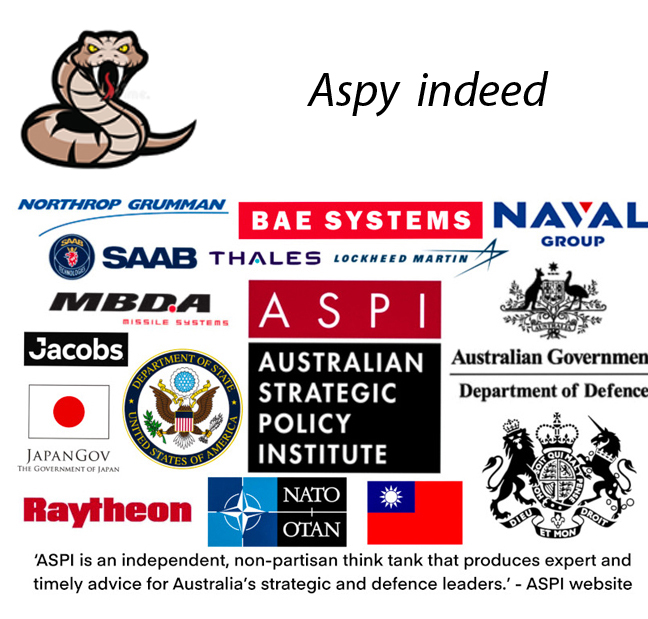
And, while the collective wisdom of so many is ignored, the war-mongers of the Australian Strategic Policy Institute (ASPI) are given free rein.
‘In so many ways, the product of ASPI is critically important, not only in informing the Australian public, but those of us in government who seek to play a role in this space.’
Marles states that the Australian public must be informed. He recognises this to be ‘critically important’ but there is an unhealthy degree of censorship that is impossible to ignore. The information that the public is allowed to see, hear and read is the information that is filtered. There is a strong sense of creeping authoritarianism in all of this………………………………………..
The intellectuals, essayists, poets and novelists that might speak up and speak out remain, either silent or silenced by the mainstream media. It is not that they are not there. It is not that many thousands of ordinary people do not share the view that things are terribly wrong. The media has played and is playing a bad role. It is media in name only. It has abandoned any semblance of independence. It is so hard to speak out if you are kept captive; if ideas are filtered and disinformation passes for truth.
Pilger rightly calls on those with a conscience to speak out. What needs to be remembered is that the marketplace for ideas has shrunk……………………..Truth has become the property of those who control the media.
Pilger has been sidelined. Film-maker David Bradbury, twice nominated for an Academy Award, is now touring his latest documentary, The Road to War, screening it wherever an audience can be found. Even so, its circulation and therefore its audience remains limited.
American vengefulness would see WikiLeaks founder Julian Assange die in prison. Successive Australian governments have behaved equally badly, but the USA calls the shots. Assange’s crime? To report the truth. The truth, however, is not what Richard Marles is thinking of when he talks of the ‘critical importance’ of informing the public.
…………………………John Pilger’s call, for us all to speak up, has never had more urgency. The decades since the end of WWII and the proclamation of the U.S.-inspired rules-based order have seen millions die in American-led wars.
The bombs could not discriminate between combatants and the innocent. As many as one in seven of those killed in Hiroshima were not Japanese but Korean, amounting to roughly 20,000 people, many of whom were forcibly transported from their homes and interred in labor camps. The bombs killed Javanese, Dutch, British, Australian, American, and other prisoners of war. The U.S. survey estimated that over 90 percent of the 200 doctors and 1,800 nurses in Hiroshima were dead or injured, as well as half the personnel and patients at the teaching hospital at Nagasaki. One of the few numbers we know with precision is that, at minimum, the United States killed 4,412 schoolchildren in Hiroshima (a figure we know because teachers kept precise data on their students who were assigned to work crews around the city).
U.S. leaders must take responsibility for past nuclear atrocities.
Foreign Policy, JUNE 10, 2023,
On May 18, U.S. President Joe Biden traveled to Hiroshima, Japan, planning to meet with G-7 leaders—as well as survivors of the nuclear bombs—to discuss, among other things, reducing the risk of nuclear war. He followed in the footsteps of former U.S. President Barack Obama, who visited Hiroshima in his final year as president. In a short speech, Obama mourned the dead—but he did not express regret and, his advisors insisted, he did notapologize. Instead, Obama looked forward to a future that would come to see Hiroshima and Nagasaki “as the start of our own moral awakening.”
Biden and his administration have proven to be uncommonly committed to atoning for past domestic acts of violence and racism that still weaken the moral foundations of the United States. Interior Secretary Deb Haaland has announced a major investigation into ethnic cleansing in federal boarding schools for Native Americans, and the president has reaffirmed the government’s apology for its racist internment of Japanese Americans during the second world war. “That’s what great nations do,” Biden said in a speech commemorating the Tulsa Race Massacre, “come to terms with their dark sides.”
The United States has never had a similar moral awakening on Hiroshima and Nagasaki. On the 75th anniversary of the atomic bombing of Hiroshima, Biden, then a candidate for president, wrote that “the scenes of death and destruction … still horrify us.” For too long, U.S. presidents have used passive language to refer to the bombings, evading responsibility for the act. White House spokesman John Kirby continued this tradition when he said that Biden would “pay his respects to the lives of the innocents who were killed in the atomic bomb that was dropped on Hiroshima.” The language helps Americans think of the bombings as something that happened to cities rather than as something their government did to people.
At Hiroshima, Biden said nothing about the bomb. He did not meet with bomb survivors as planned and did not deliver remarks when visiting the peace memorial. U.S. National Security Advisor Jake Sullivan stressed that Biden would be one of several leaders paying respects and it was not “a bilateral moment.”
After his trip, Biden—and the U.S. government—should begin to atone for the destruction of Hiroshima and Nagasaki, in word and in deed. A moral awakening on nuclear weapons requires that we confront not only the facts of the bombings that killed uncountable thousands of Japanese civilians, but also the policies and principles that still echo in U.S. nuclear weapons policy today.
When Hiroshima was destroyed on Aug. 6, 1945, the city contained more than eight civilians for each soldier. Though a group of senior advisors had recommended that the bomb be aimed at “a military target surrounded by workers’ houses,” they did not issue orders to strike a specific target. The crew of the Enola Gay aimed the atomic bomb at Aioi Bridge, a visible landmark at the center of Hiroshima. The bomb detonated directly over nearby Shima Hospital. By November, the bomb had killed 90 percent of people who had been within one kilometer of its detonation. By the next year, more than one-third of the civilians who had been in the city during the bombing were dead. Nearly as many had been injured and would have to wait hours or days for care. More than 90 percent of the city’s doctors and nurses were killed and only three of 45 civilian hospitals were usable.
Survivors describe burned figures stumbling away from the city center, their skin hanging from their bodies, begging for water, some carrying blackened infants or their own body parts. Hospitals, churches, schools, firehouses, and public utilities all collapsed or succumbed to the flames. While two military headquarters near the center of the city were destroyed, the airfield, ordinance depots, heavy industry, and navy units clustered around the port received less damage. The fire did not reach them. If the bomb were to have been aimed at the city’s military targets, it would have been dropped two miles to the south.
The intended target of the second atomic bomb was Kokura, a city to the north that contained a military arsena………………
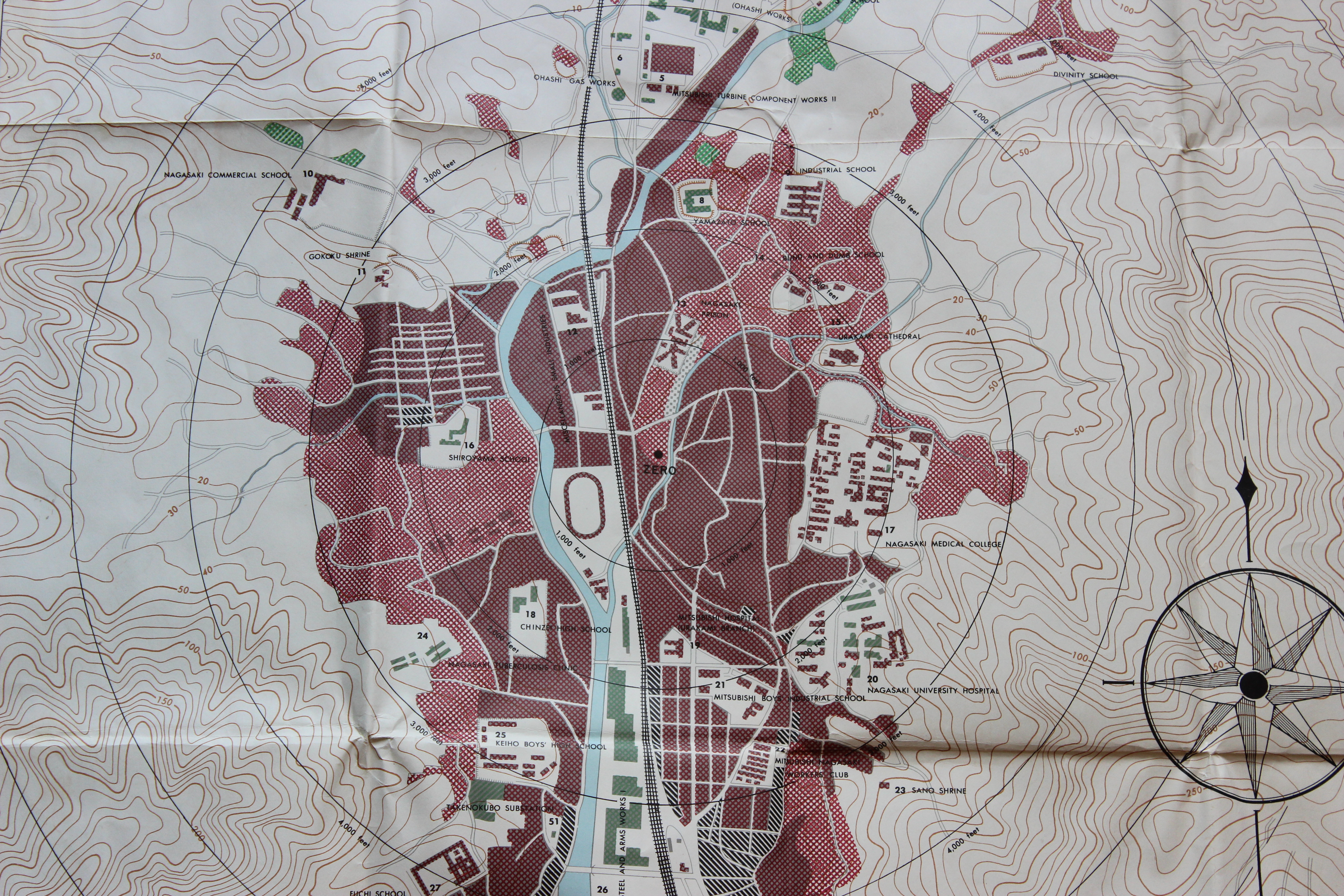
The bomb missed its intended target by three-quarters of a mile and detonated over the Urakami Valley, a residential area that included schools, a prison, a prisoner-of-war camp, a medical college, and a cathedral that served a large population of Catholics in the neighborhood. A half mile to the north and south, at the edges of the damage, there were two arms factories. Some of Nagasaki’s pregnant women and elderly residents had been moved to the valley precisely because it did not contain military factories.
……………. when the first plutonium bomb was ready in only three days, military personnel managing the operation on Tinian Island followed their orders to drop the bomb as soon as it was available. When he learned of Nagasaki, Truman ordered a halt to further use of nuclear weapons, saying, according to accounts of a cabinet meeting, he didn’t like the idea of killing “all those kids.”
………………………. We will never know precisely how many died in the two cities. In 1951, U.S. survey teams estimated that at least 104,000 died; in 1981, a detailed study led by Japanese researchers estimated that 210,000 civilians had died. Most other estimates fall between these figures. In most estimates, the wounded meet or exceed the dead. More than 90% of those seriously injured by the bomb had died by mid-September—but for all of those who survived, the effects of the bomb would continue. Thousands have suffered from injury, trauma, social stigma, and increased rates of miscarriage, birth defects, leukemia, and solid cancersfor decades.
The bombs could not discriminate between combatants and the innocent. As many as one in seven of those killed in Hiroshima were not Japanese but Korean, amounting to roughly 20,000 people, many of whom were forcibly transported from their homes and interred in labor camps. The bombs killed Javanese, Dutch, British, Australian, American, and other prisoners of war. The U.S. survey estimated that over 90 percent of the 200 doctors and 1,800 nurses in Hiroshima were dead or injured, as well as half the personnel and patients at the teaching hospital at Nagasaki. One of the few numbers we know with precision is that, at minimum, the United States killed 4,412 schoolchildren in Hiroshima (a figure we know because teachers kept precise data on their students who were assigned to work crews around the city).
The United States’ bombs also killed American citizens in Hiroshima and Nagasaki. It is not known how many Americans died in the two cities, but before the war more U.S. immigrants had arrived from Hiroshima than any other Japanese prefecture and so were linked to the city by familial ties. After the war, as many as 3,000 Japanese-Americans returned home to the United States as victims of the atomic bombs. Furthermore, around 1,000 Japanese bomb victims would later move to the United States and become U.S. citizens. Many never identified themselves—but others organized to demand recognition and compensation from the U.S. government for medical expenses.
…………….Americans who were injured in Japan when their government dropped a nuclear bomb on them received neither recognition nor compensation.
The United States also did not provide medical care to Japanese atomic bomb victims. The Atomic Bomb Casualty Commission, established to research the effects of radiation on the human body to inform Cold War U.S. civil defense procedures, maintained a policy of not providing medical treatment to the victims. M. Susan Lindee writes, “The United States would not apologize atone for the use of atomic weapons in Japan, and it would therefore not provide medical treatment to the survivors of the bombings who were the subjects of American biomedical research.” Initially, the commission refused to share its data with Japanese physicians treating patients……..
China and Russia account for 70% of new nuclear plants
Exports used as diplomatic card while Western nations fall behind
NAOYUKI TOYAMA, Nikkei staff writerJune 11, 2023
TOKYO — Russia and China are building up an outsized presence in the field of nuclear power, with the countries accounting for nearly 70% of reactors under construction or in planning worldwide.
…………………Notably, 33 of the reactors are being constructed or planned outside each respective country. Russia has the largest number of overseas reactors with 19, and despite growing opposition from Europe and the U.S. following its invasion of Ukraine, it maintains a strong global influence in nuclear power.
In April, Russian President Vladimir Putin participated remotely in a ceremony to mark the arrival of the first fuel at the under-construction Akkuyu nuclear power plant in Turkey………
Russia’s nuclear power diplomacy is extending to other countries as well. In May, Rosatom began full-scale construction on Unit 3 of the Dabaa nuclear plant in Egypt, the country’s first.
Hungarian Prime Minister Viktor Orban met with Rosatom officials this month to discuss the company’s plans to build a new nuclear power plant in the country’s south. Hungary opposes sanctions the European Union has imposed on Rosatom.
“Many developing countries take a positive view of Russia,” Kacper Szulecki of the Norwegian Institute of International Affairs told British scientific journal Nature Energy. Russia’s acceptance of spent nuclear fuel is also attractive to emerging countries.
Meanwhile, China is deepening its engagement with Pakistan………………………………..
China also plans to build a nuclear plant in Argentina…………………………………
The U.S., Japan and Europe are hoping to catch up using small modular reactors (SMRs), considered fourth-generation technology………………………………………..
Another issue is nuclear fuel. Uranium enrichment has become the weak link for Western nations. Enrichment facilities are limited, and Russia is the global leader for that process. In April, the U.S., the U.K., France, Canada and Japan formed a nuclear fuel alliance. While the aim is to shut out Russian fuel from Western reactors, doing so will not be easy.
[Lee Kyong-hee] Fallout from Fukushima radioactive wastewater, By Korea Herald, Jun 8, 2023
“………………….. quoting a diplomatic source, the reports say that President Yoon Suk Yeol vowed to make all-out efforts to remove public concerns in Korea about the wastewater discharge when he met Japanese lawmakers in March during his visit to Tokyo for a summit with Prime Minister Fumio Kishida.
Many Koreans were caught off guard, and this administration’s purported stance is further proof that their president is bent on fence-mending with an unrepentant government at whatever cost.
Yoon has neither confirmed nor denied the reports. Transparency is not a priority of his administration, though his search for avenues of rapprochement with Japan is clear.
As Yoon remains tight-lipped, we can only guess his views about the rationality of the discharge and whether he grasps the potential risks. Hence a confrontation with the main opposition Democratic Party of Korea is underway, each side blaming the other for spreading malicious rumors lacking scientific basis.
Amid the accusations, the science community also has misgivings. Seo Kyun-ryeol, a professor emeritus at Seoul National University’s Department of Nuclear Engineering, is an outspoken critic. He is among several scientists who question the contaminated water filtration process and cautions that sea currents will ultimately bring some of discharged wastewater to Korea’s shores.
…………………….public mistrust is understandable, given TEPCO’s history; a Japanese government investigation report in 2012 said TEPCO had failed to meet initial safety requirements.
………………………. Seo says, “There is no guarantee that all of the system’s many filters for different isotopes will work perfectly all of the time, given the condition and quantity of the water, let alone the period of time required.”
The SNU professor highlights the potential hazards associated with cesium, strontium and plutonium, which were released from the reactors due to the disaster. “These substances not only enter the bloodstream but also penetrate the muscles, bones and brain, leading to the development of solid cancers and tumors,” he said.
Seo has raised concerns that marine life and ocean currents can carry harmful radioactive isotopes across the Pacific. He warns of the potential risks to entire marine ecosystems, from the deep-sea organisms up to invertebrates, fish and marine mammals through the food chain, eventually reaching humans.
Naturally, among the most vocal critics of the ocean discharge is the Pacific Islands Forum, an organization representing 18 island nations. They have already suffered from nuclear tests by the United States and European countries. Their concerns are reasonable as most of their populations are coastal residents who depend on the ocean for their livelihoods.
The International Atomic Energy Agency is expected to release its final assessment later this month before Japan embarks on its plan. The root of the problem, as contended by Ken Buesseler, a marine radiochemist and advisor to the Pacific Islands Forum, is that Japan is moving already with a plan which has not proven workable.
Masashi Goto, a retired nuclear engineer who designed reactor containment vessels for Toshiba for many years, bemoans the “safety culture” he encountered in the industry. In a presentation marking the 10th year after the Fukushima accident, he said, “Risks can be expressed in terms of their potential for damage or probability of occurrence. Many unlikely scenarios run the risk of horrendous consequences.”
Goto’s views concerning the decommissioning of a nuclear reactor are worth heeding. “TEPCO claims to have a decommissioning schedule that can be completed within the next 30 to 40 years, but this is completely unrealistic. Given the severity of what happened and the current state of the reactors, in practice we are looking at a process lasting anywhere from 100 to 200 years.”
“What is the number one priority? It’s the same question that was thrust upon the citizens of Japan 10 years ago. Do we prioritize the economy and convenience at any cost, or do we choose to live modestly in safety and free from worry?” he asked.
All said, Japan should suspend the planned release of the wastewater. Heeding the concerns of the international community, it may well consider other possible options, such as long-term storage and processing through half-lives of isotopes or cement-based solidification. https://www.koreaherald.com/view.php?ud=20230607000843
David Noonan will speak on public interest concerns over the new Roxby Downs Indenture Act 2026 on BHP copper-uranium mining and ore processing in SA, and on how AUKUS may face SA with a High-Level nuclear waste agenda.
Dr Jim Green will discuss international developments in the field of nuclear power including ‘small modular reactors’ and Generation 4 ‘advanced’ nuclear reactor concepts.