Nuclear Fusion: A Clean Energy Revolution Or A Radioactive Nightmare?

By Kurt Cobb – Jun 20, 2023, Oil Price
Fusion reactors, while producing energy, also produce neutron streams that can cause radiation damage, produce radioactive waste, necessitate biological shielding, and even create the potential for weapons-grade plutonium production.
Apart from the aforementioned problems, fusion reactors face issues such as tritium release, intensive coolant demands, and high operating costs, which would require the power plant to have at least a one-gigawatt capacity to balance costs.
Given the time and resources required for fusion power plant construction, the technology might not be feasible for timely carbon emission reduction, and the prospect of fusion energy might be distracting society from immediate solutions to energy scarcity and climate change.
……………………
The reality of fusion power, however, is one of huge scale and vast obstacles according to Daniel Jassby, a former research physicist at the Princeton Plasma Physics Lab. (All of what follows assumes that the remaining obstacles to producing net energy from fusion will be overcome. Addressing that issue would require a seperate and lengthy essay.)
Perhaps the most unexpected revelation Jassby offers runs entirely contrary to the clean image that fusion energy has in the public mind. It turns out that the most feasible designs for fusion reactors will generate large amounts of radioactivity and radioactive waste.
[here much detail on the operation of nuclear fusion]………………………………………………………………………..
To power the enormously energy-intensive process of fusion, a fusion plant will use a lot of energy just to run itself. That means scale will matter. In order to accommodate this so-called parasitic power drain AND produce enough excess electricity to sell to pay for the costs of constructing the plant and for its ongoing operation, fusion plants will have to have a capacity of at least one gigawatt (one billion watts). One gigawatt can supply electricity to 300,000 to 750,000 homes depending on how the calculation is done. And, even much larger capacity per plant will be desirable because it will decrease the percentage of power production devoted to sustaining the fusion reaction and servicing the plant infrastructure. In short, making fusion plants big will be the only way to make them economical. So much for my friend’s fantasy of handheld fusion power units!
In a second article, Jassby addresses the International Thermonuclear Experimental Reactor (ITER) located in France. The project is a cooperative research venture designed to study and perfect fusion. It will not produce any electricity itself, but rather set the stage for so-called demonstration plants which could be built in the second half of this century.
……………………..
just to operate its experiments, ITER will require 600 megawatts of power, a window into the parasitic power requirements of fusion reactors.
The fantasy of cheap, unlimited fusion power arriving soon with no serious side-effects prevents us as a society from grappling with near-term energy depletion and our ongoing dependence on fossil fuels in the accelerated manner required to prevent a major energy crisis. Hope that fusion energy will somehow solve our energy and climate problems is not a real plan. It is just another illusory and far-in-the-future technical fix offered to convince us that we don’t need to alter our way of life in any substantial way to address the serious problems we face. https://oilprice.com/Alternative-Energy/Nuclear-Power/Nuclear-Fusion-A-Clean-Energy-Revolution-Or-A-Radioactive-Nightmare.html
Khren Im – To the USA and Biden ….if this continues, it is lights out for humanity

Khren Im.
Sullivan (above) made it clear to his audience [at the “Arms Control Association,” sic] that the nuclear strategy that the Biden administration approved in October 2022 would remain intact through 2026, when the last remaining U.S.-Russian arms control agreement, the 2010 New START treaty, was set to expire.
Once the New START treaty expires, and barring any agreement replacing it with a new agreement, Sullivan said that, given the state of play between the U.S. and Russia when it came to arms control, the U.S. would have no choice but to develop and deploy newer, more dangerous nuclear weapons [to be made for the foreseeable future using plutonium cores (“pits”) produced by Los Alamos National Laboratory].
Sullivan then laid out the Biden administration’s case against Russia, starting with the Russian suspension of the New START treaty itself. Left unsaid was Russia’s stated reason for this suspension, namely the impossibility from the Russian point of view of engaging in strategic nuclear arms reductions at a time when the United States was pursuing a policy in Ukraine of waging a proxy conflict designed to cause the strategic defeat of Russia.
From the Russian perspective, pursuing the cooperative reduction with the U.S. of the very strategic capability which is, by design, intended to prevent Russia’s strategic defeat at a time when the U.S. was pursuing the strategic defeat of Russia was a non-starter.
If this insanity is allowed to continue unabated, it is lights out for all of humanity.
Chew on that the next time you cheer on the Ukrainian counteroffensive or applaud the use of U.S. taxpayer dollars to fund the Ukrainian military.
It is high time for the American public to recognize that our only hope for a survivable future is one where arms control and nuclear disarmament once again serve as the cornerstone of a U.S.-Russian relationship, and that the shortest possible path toward achieving that objective is for Russia to win its war against Ukraine [which would occur at any time the U.S. said it would not support the war further, thus also saving tens of thousands of lives]
And for those politicians in the U.S. and Europe who have invested their political futures on the suicidal mission of feeding Ukraine’s anti-Russian fantasies? Khren Im.
| https://consortiumnews.com/2023/06/21/scott-ritter-on-horse-radishes-nuclear-war/SCOTT RITTER: On Horseradish & Nuclear War. June 21, 2023 |
When Vladimir Putin was recently asked about the potential use of nuclear weapons in the context of Ukraine, an understanding of back-alley Russian slang was needed to understand his response.
……………………………….During the June 16 discussion period of the plenary session of the 2023 St. Petersburg International Economic Forum, the Russian leader was asked about his views on the potential use of nuclear weapons in the context of the ongoing Ukrainian conflict.“This use of nuclear weapons is certainly theoretically possible,” Putin bluntly answered.
Putin paused, before shrugging and, with a half-smile, saying “Khren Im”.Khren Im is a Russian slang term derived from the word “horseradish” (khren), thus a literal translation of the phrase used by Putin would be “horseradish them.” But khren closely resembles a more salty term …….. khren Im is understood to mean “F*ck them.”“F*ck them, you know?” Putin said, to the obvious mirth of the audience……………….
The “them” in the horseradish reference made by the Russian president is the United States. Two weeks prior to Putin’s man-in-the-street reaction, on June 2, U.S. President Joe Biden’s national security adviser, Jake Sullivan, addressed a conference hosted by the Arms Control Association, in Washington, D.C. The topic, not surprisingly, was the administration’s approach to U.S.-Russian arms control.
Biden’s Nuclear Strategy ……………………………………………………….
Likewise left unspoken was Russia’s contention that the U.S. was in violation of the New START Treaty by keeping some 101 strategic delivery systems from being inspected, despite being required to do so by the provisions of the New START Treaty.Khren Im.
Sullivan called out Russia’s decision to station tactical nuclear weapons in Belarus, without elaborating on either the threats made to Belarus by several NATO members, including Poland and the Baltic states. Nor did he acknowledge that the Russian action parallels a similar U.S. policy in stationing some 100 nuclear B-61 gravity bombs on the territories of five NATO nations. Khren Im.
Sullivan strongly criticized Russia for its total disregard for international law, including arms control treaties such as the Treaty on Conventional Forces in Europe (CFE) from which Russia recently withdrew, without putting the Russian decision in proper historical perspective. This perspective involves the ongoing disregard by the U.S. and NATO of deliberate inequities in the CFE structure that were brought on by the ongoing expansion of NATO.
Nor did the U.S. national security adviser acknowledge that it was the U.S., not Russia, which had withdrawn from the Anti-Ballistic Missile Treaty and the Intermediate Forces Treaty, both of which are considered foundational for all arms control treaties going forward.[Related: U.S. Establishment: Nixing Arms Control]Khren Im.
Sullivan’s presentation ignored such salient matters as the purpose behind NATO’s certification of the F-35 fighter as a nuclear-capable delivery system, and what the deployment of nuclear-capable F-35s to NATO nations not included in the existing shared nuclear defense scheme meant to the scope and scale of the NATO nuclear deterrence model considering the continued NATO Baltic Air Policing and South European Air Policing operations.
Sullivan also failed to address the current “launch-on-warning” posture employed by the Biden administration, which positions the U.S. to carry out a first nuclear strike against Russia, and the role that the continued patrols in Europe and Asia by American nuclear-capable B-52H strategic bombers, including aggressive flight profiles appearing to simulate the launch of nuclear-armed cruise missiles against Saint Petersburg.
Sullivan also ignored the impact of the Biden administration’s ongoing plans to bring back medium- and intermediate-range nuclear-capable missiles to the European theater will be on the overall nuclear balance of power between the U.S.-NATO and Russia.Khren Im.
A day before Putin addressed the St. Petersburg International Economic Forum, Russian Deputy Foreign Minister Sergey Ryabkov spoke to the media about the “opposing, irreconcilable positions” of Russia and the U.S. concerning the resumption of discussions regarding the New START treaty. “[T]he suspension of New START remains in effect,” Ryabkov said, “and this decision may be revoked or reconsidered only if the U.S. demonstrates a willingness to abandon its fundamentally hostile policy toward the Russian Federation.”Khren Im……………………………………………………………………
While people are right to be concerned about the policy recommendations made by prominent Russians such as Karaganov, they must also address the root cause of such pronouncements, namely the policies of the Biden administration to achieve the strategic defeat of Russia in Ukraine, seemingly at whatever cost (especially when the cost is paid in the blood of Ukrainian soldiers)
Russia will not use nuclear weapons to fulfil the tasks set forth in its Special Military Operation. It will use nuclear weapons to preserve Russian territorial integrity. The reality today is that the irresponsible policies of the U.S. and its NATO allies have sought the expansion of NATO up to the Russian borders . As they abandoned every opportunity to prevent a conflict with Russia over Ukraine, there is a war between Russia and Ukraine that has resulted in Ukraine irrevocably losing 20 percent of its territory (the oblasts of Kherson, Zaparizhia, Donetsk and Lugansk, along with the Crimea).
All of that territory has been absorbed into the Russian Federation and makes any effort to strip them away from Russia by definition an existential conflict where, if Russia were to lose, would necessarily trigger the use of nuclear weapons.
And yet Biden and his NATO allies continue to feed a Ukrainian fantasy where the reacquisition of these territories by Ukraine is a desirable outcome.
Has either Biden, his advisers, or the American public considered the potential consequences of this action? Are they willing to trade Boston for Poznan, or sacrifice humanity for the sake of appeasing Ukrainian sensibilities? The answer appears to be “no.”
As for Russia, one is guided by the words of Vladimir Putin: “Khren Im”F*ck them. But in reality, F*ck us. All of us. If this insanity is allowed to continue unabated, it is lights out for all of humanity.
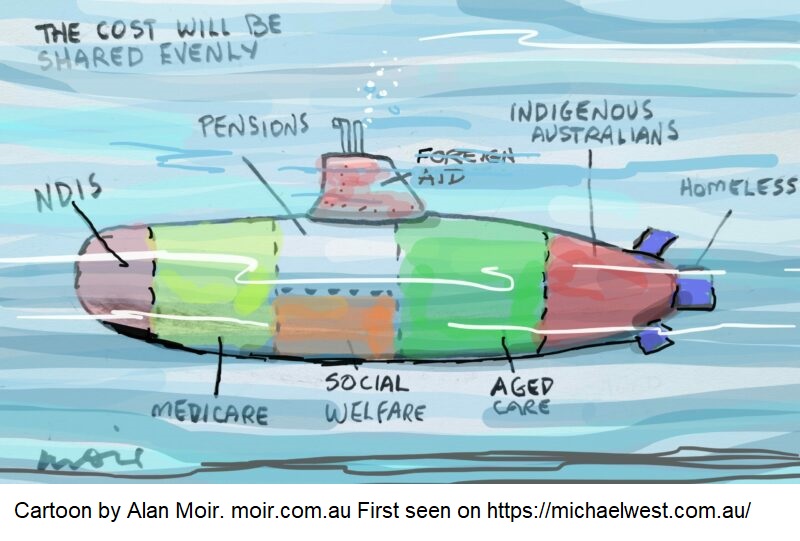
Nuclear indoctrination for Australian school-children – normalising nuclear submarines.

I wonder if they will design a deep geological repository for high level waste too.
Defence takes nuclear propulsion challenge to schools, By APDR Staff, 21/06/2023
Defence has launched a Nuclear-Powered Submarine Propulsion Challenge in Australian high schools, providing a new generation of science, technology, engineering and mathematics (STEM) students the chance to win a trip to HMAS Stirling in Western Australia to see first-hand how submarines work. The introductory-level, nationwide program will provide teachers with learning resources to help students design their own engineering plans for submarine nuclear propulsion……..
Rear Admiral Jonathon Earley, Deputy Chief of Navy said: “The Nuclear-Powered Submarine Propulsion Challenge presents an opportunity for students across Australia to gain a greater appreciation of the STEM principles behind one of the most significant national projects ever undertaken in Australia, as we prepare to deliver nuclear-powered submarines for the Royal Australian Navy……
These students and others like them will be our future submariners, engineers and technicians. The winners will experience a visit to HMAS Stirling in Western Australia, tour a Collins-class submarine, dine with submariners and virtually drive a submarine through Sydney Harbour in the submarine bridge training simulator.” https://asiapacificdefencereporter.com/defence-takes-nuclear-propulsion-challenge-to-schools/
TODAY. Sleeping our way to doom, through the media lies about the Ukraine war

Right now, there’s the Ukraine so-called “counter-offensive” (an interesting new term coined and designed to imply something a lot more substantial than the more familiar term “counter-attack”)
Well according to the Western corporate media, this “counter-offensive” IS something substantial. Indeed, it means that Ukraine is winning, will win, this war. Crimea and the Donbass will be returned to Ukraine, the Russian army will be routed, and the Russian economy crippled. And Ukraine will join NATO. Sure, it’ll take a while, but with more weapons from the West, it will be a success, and the West will fund the post-war repairs and restoration of Ukraine.
The other story, from Russia, is that even if it does take a while, the defeat of Ukraine is assured. And indeed, the Ukrainian “counter-offensive” will probably be over in a few weeks.
Somewhere in the middle, a few brave souls strive for the truth. Being myself a Westerner, I know little about independent thinkers and writers in Russia. But I suspect that any who criticise Putin and the Russian military authorities get punished.
As for Western writers who criticise Zelensky, or cast doubt on the Ukraine success story – well, politicians, academics, and the corporate media have no trouble in discrediting them, branding them as ‘Putin’s puppets’
The tragedy of it all is that we are now on the road to nuclear Armageddon, – and the public cannot trust “respected” media reports – as ill-advised “patriotism” trumps truth, and we just do not get the facts.
Judge Who Ruled Against Assange Built Career as Barrister Defending UK Government
“absurd that a single judge can issue a three-page decision that could land Julian Assange in prison for the rest of his life and permanently impact the climate for journalism around the world.”
Jonathan Swift, the High Court judge who has just rejected Julian Assange’s attempt to halt his extradition to the US, is the government’s former top lawyer and previously defended the Defence and Home Secretaries.
SCHEERPOST, By Mark Curtis / Declassified UK, 19 June 23
- Swift was entrusted to act for the Defence and Home Secretaries in at least nine legal cases
- His “favourite clients were the security and intelligence agencies” while representing the government
onathan Swift, the High Court judge who has rejected Julian Assange’s appeal against extradition to the US, has a long history of working for the government departments that are now persecuting the WikiLeaks founder.
Swift, who ruled against Assange on 6 June, was formerly the government’s favourite barrister.
He worked as ‘First Treasury Counsel’ – the government’s top lawyer – from 2006 to 2014, a position in which he advised and represented the government in major litigation.
Swift acted for the Defence and Home Secretaries in at least nine cases, Declassified has found.
…………………….. It was reported in 2013 that Swift had been paid nearly a million pounds – £975,075 – over the previous three years for representing the government.
Swift now presides over Assange’s extradition case being fought by the Home Office for whom he previously worked.
As with previous judges who have ruled against Assange, the case raises serious concerns about institutional conflicts of interests at the heart of the UK legal system…………………………………………
Ruling
In his rejection of the appeal by Assange’s lawyers, Swift curtly dismissed all eight grounds to their arguments as “no more than an attempt to re-run the extensive arguments made to and rejected by the District Judge”, who previously ruled on the case.
Media freedom group Reporters Sans Frontieres said Swift’s ruling brought Assange “dangerously close to extradition”.
It added it was “absurd that a single judge can issue a three-page decision that could land Julian Assange in prison for the rest of his life and permanently impact the climate for journalism around the world.”
The US government seeks to extradite Assange in order to try him in connection with WikiLeaks’ publication of leaked classified documents that informed public interest reporting around the world.
Assange faces a possible 175 years in prison and would be the first publisher prosecuted under the US Espionage Act. https://scheerpost.com/2023/06/19/judge-who-ruled-against-assange-built-career-as-barrister-defending-uk-government/
The Silent Slaughter of the Flower of Ukraine’s Youth
Now that the Ukrainian counteroffensive is underway, it is clear that the government and its Western allies are maintaining silence to conceal the brutal cost Ukraine’s brave young people are paying.
By Medea Benjamin | Nicolas J.S. Davies / Common Dreams. June 21, 2023
https://scheerpost.com/2023/06/21/the-silent-slaughter-of-the-flower-of-ukraines-youth/
As Ukraine prepared to launch its much heralded but long delayed counteroffensive, the media published a photograph of a Ukrainian soldier with his finger on his lips, symbolizing the need for secrecy to retain some element of surprise for this widely telegraphed operation.
Now that the offensive has been under way for two weeks, it is clear that the Ukrainian government and its Western allies are maintaining silence for quite a different reason: to conceal the brutal cost Ukraine’s brave young people are paying to recover small scraps of territory from Russian occupation forces, in what some are already calling a suicide mission.
Western pundits at first described these first two weeks of fighting as “probing operations” to find weak spots in Russia’s defenses, which Russia has been fortifying since 2022 with multiple layers of minefields, “dragon’s teeth,” tank-traps, pre-positioned artillery, and attack helicopters, unopposed in the air, that can fire 12 anti-tank missiles apiece.
On the advice of British military advisers in Kyiv, Ukraine flung Western tanks and armored vehicles manned by NATO-trained troops into these killing fields without air support or demining operations. The results have been predictably disastrous, and it is now clear that these are not just “probing” operations as the propaganda at first claimed, but the long-awaited main offensive.
A Western official with intelligence access told The Associated Press on June 14, “Intense fighting is now ongoing in nearly all sectors of the front… This is much more than probing. These are full-scale movements of armor and heavy equipment into the Russian security zone.”
Other glimpses are emerging of the reality behind the propaganda. At a press conference after a summit at NATO Headquarters, U.S. General Mark Milley warned that the offensive will be long, violent, and costly in Ukrainian lives.
“This is a very difficult fight. It’s a very violent fight, and it will likely take a considerable amount of time and at high cost,” Milley said.
Russian videos show dozens of Ukrainian tanks and armored vehicles lying smashed in minefields, and NATO military advisers in Ukraine have confirmed that it lost 38 tanks in one night on June 8, including newly delivered German-built Leopard IIs.
Rob Lee of the Foreign Policy Research Institute explained to TheNew York Times that the Russians are trying to inflict as many casualties and destroy as many vehicles as possible in the areas in front of their main defensive lines, turning those areas into lethal kill zones. If this strategy works, any Ukrainian forces that reach the main Russian defense lines will be too weakened and depleted to break through and achieve their goal of severing Russia’s land bridge between Donbas and Crimea.
Russia’s Ministry of Defense reported that Ukraine’s forces suffered 7,500 casualties in the first 10 days of the offensive. If Ukraine’s real losses are a fraction of that, the long, violent bloodbath that General Milley anticipates will destroy the new armored brigades that NATO has armed and trained, and serve only to escalate the gory war of attrition that has destroyed Mariupol, Sievierodonetsk, and Bakhmut, killing and wounding hundreds of thousands of young Ukrainians and Russians.
A senior European military officer in Ukraine provided more details of the carnage to Asia Times, calling Ukraine’s operations on June 8 and 9 a “suicide mission” that violated the basic rules of military tactics.
“We tried to tell them to stop these piecemeal tactics, define a main thrust with infantry support and do what they can,” he said. “They were trained by the British, and they’re playing Light Brigade,” he added, comparing the offensive to a suicidal charge into massive Russian cannon fire that wiped out Britain’s Light Cavalry Brigade in Crimea in 1854.
If Ukraine’s “Spring Offensive” plunges on to the bitter end, it could be more like the British and French Somme Offensive, fought near the French River Somme in 1916. After 19,240 British troops were killed on the first day (including Nicolas’s 20-year-old great-uncle, Robert Masterman), the battle raged on for more than four months of pointless, wanton slaughter, with over a million British, French, and German casualties. It was finally called off after advancing only six miles and failing to capture either of the two small French towns that were its initial objectives.
The current offensive was delayed for months as Ukraine and its allies grappled with the likelihood of the outcome we are now witnessing. The fact that it went ahead regardless reflects the moral bankruptcy of U.S. and NATO political leaders, who are sacrificing the flower of Ukraine’s youth in a proxy war they will not send their own children or grandchildren to fight.
As Ukraine launches its offensive, NATO is conducting Air Defender, the largest military exercise in its history, from June 12 to 23, with 250 warplanes, including nuclear-capable F-35s, flying from German bases to simulate combat operations in and over Germany, Lithuania, Romania, the North Sea, and the Baltic Sea. The exercise has led to at least 15 incidents between NATO and Russian aircraft in the skies near Lithuania.
It seems that nobody in NATO’s foreboding fortress in Brussels has stumbled on the concept of a “security dilemma,” in which supposedly defensive actions by one party are perceived as offensive threats by another and lead to a spiral of mutual escalation, as has been the case between NATO and Russia since the 1990s. Professor of Russian history Richard Sakwa has written, “NATO exists to manage the risks created by its existence.”
These risks will be evident in the upcoming NATO Summit in Vilnius on July 11-12, where Ukraine and its eastern allies will be pushing for Ukraine membership, while the U.S. and western Europe insist that membership cannot be offered while the war rages on and will instead offer “upgraded” status and a shorter route to membership once the war ends.
The continued insistence that Ukraine will one day be a NATO member only means a prolongation of the conflict, as this is a red line that Russia insists cannot be crossed. That’s why negotiations that lead to a neutral Ukraine are key to ending the war.
But the United States will not agree to that as long as President Joe Biden keeps U.S. Ukraine policy firmly under the thumbs of hawkish neoconservative desk warriors like Antony Blinken and Victoria Nuland at the State Department and National Security Adviser Jake Sullivan at the White House. Pressure to keep escalating U.S. involvement in the war is also coming from Congress, where Republicans accuse Biden of “hemming and hawing” instead of “going all in” to help Ukraine.
Paradoxically, the Pentagon and intelligence agencies are more realistic than their civilian colleagues about the lack of any military solution. The Chairman of the Joint Chiefs of Staff, General Milley, has called for diplomacy to bring peace to Ukraine, and U.S. intelligence sources have challenged dominant false narratives of the war in leaks to Newsweek and Seymour Hersh, telling Hersh that the neocons are ignoring genuine intelligence and inventing their own, just as they did to justify the invasion of Iraq in 2003.
With the retirement of Deputy Secretary of State Wendy Sherman, the State Department is losing the voice of a professional diplomat who was President Barack Obama’s chief negotiator for the JCPOA with Iran and urged Biden to rejoin the agreement, and who has taken steps to moderate U.S. brinkmanship toward China. While publicly silent on Ukraine, Sherman was a quiet voice for diplomacy in a war-mad administration.
Many fear that Sherman’s job will now go to Nuland, the leading architect of the ever-mounting catastrophe in Ukraine for the past decade, who already holds the #3 or #4 job at State as Under Secretary of State for Political Affairs.
Other departures from the senior ranks at State and the Pentagon are likely to cede more ground to the neocons. Colin Kahl, the Under Secretary of Defense for Policy, who worked with Sherman on the JCPOA, opposed sending F-16s to Ukraine, and has maintained that China will not invade Taiwan in the near future. Kahl is leaving the Pentagon to return to his position as a professor at Stanford, just as China hawk General C.Q. Brown will replace General Milley as Chairman of the Joint Chiefs when Milley retires in September.
Meanwhile, other world leaders continue to push for peace talks. A delegation of African heads of state led by President Cyril Ramaphosa of South Africa met with President Volodymyr Zelenskyy in Kyiv, and President Vladimir Putin in Moscow on June 17, to discuss the African peace plan for Ukraine.
President Putin showed the African leaders the 18-point Istanbul Agreement that a Ukrainian representative had signed back in March 2022, and told them that Ukraine had thrown it in the “dustbin of history,” after the now disgraced Boris Johnson told Zelenskyy the “collective West” would only support Ukraine to fight, not to negotiate with Russia.
The catastrophic results of the first two weeks of Ukraine’s offensive should focus the world’s attention on the urgent need for a ceasefire to halt the daily slaughter and dismemberment of hundreds of brave young Ukrainians, who are being forced to drive through minefields and kill zones in Western gifts that are proving to be no more than U.S.- and NATO-built death-traps
SCOTT RITTER: On Horseradish & Nuclear War
| Consortium News, June 21, 2023 |
When Vladimir Putin was recently asked about the potential use of nuclear weapons in the context of Ukraine, an understanding of back-alley Russian slang was needed to understand his response.
“……………………………….During the June 16 discussion period of the plenary session of the 2023 St. Petersburg International Economic Forum, the Russian leader was asked about his views on the potential use of nuclear weapons in the context of the ongoing Ukrainian conflict.
“This use of nuclear weapons is certainly theoretically possible,” Putin bluntly answered.
“For Russia, this is possible if a threat is created to our territorial integrity, independence and sovereignty, the existence of the Russian state. Nuclear weapons are created in order to ensure our security in the broadest sense of the word and the existence of the Russian state.”
Putin’s answer reflected long-standing Russian nuclear doctrine, which postulates the use of nuclear weapons in the case of an existential threat, nuclear or otherwise, to the survival of Russia.
Putin then sought to put the audience at ease. “But we, firstly, do not have such a need,” Putin noted, “and secondly, the very factor of reasoning on this topic already lowers the possibility of lowering the threshold for the use of weapons. This is the first part.”
What came next was classic Putin. “The second is that we have more such weapons [i.e., tactical nuclear weapons] than the NATO countries. They know about it and all the time they persuade us to start talks on reductions.”
Putin paused, before shrugging and, with a half-smile, saying “Khren Im”.
Putin paused, before shrugging and, with a half-smile, saying “Khren Im”.Khren Im is a Russian slang term derived from the word “horseradish” (khren), thus a literal translation of the phrase used by Putin would be “horseradish them.” But khren closely resembles a more salty term …….. khren Im is understood to mean “F*ck them.”“F*ck them, you know?” Putin said, to the obvious mirth of the audience……………….
The “them” in the horseradish reference made by the Russian president is the United States. Two weeks prior to Putin’s man-in-the-street reaction, on June 2, U.S. President Joe Biden’s national security adviser, Jake Sullivan, addressed a conference hosted by the Arms Control Association, in Washington, D.C. The topic, not surprisingly, was the administration’s approach to U.S.-Russian arms control.
Biden’s Nuclear Strategy ……………………………………………………….
Likewise left unspoken was Russia’s contention that the U.S. was in violation of the New START Treaty by keeping some 101 strategic delivery systems from being inspected, despite being required to do so by the provisions of the New START Treaty.Khren Im.
Sullivan called out Russia’s decision to station tactical nuclear weapons in Belarus, without elaborating on either the threats made to Belarus by several NATO members, including Poland and the Baltic states. Nor did he acknowledge that the Russian action parallels a similar U.S. policy in stationing some 100 nuclear B-61 gravity bombs on the territories of five NATO nations. Khren Im.
Sullivan strongly criticized Russia for its total disregard for international law, including arms control treaties such as the Treaty on Conventional Forces in Europe (CFE) from which Russia recently withdrew, without putting the Russian decision in proper historical perspective. This perspective involves the ongoing disregard by the U.S. and NATO of deliberate inequities in the CFE structure that were brought on by the ongoing expansion of NATO.
Nor did the U.S. national security adviser acknowledge that it was the U.S., not Russia, which had withdrawn from the Anti-Ballistic Missile Treaty and the Intermediate Forces Treaty, both of which are considered foundational for all arms control treaties going forward.[Related: U.S. Establishment: Nixing Arms Control]Khren Im.
Sullivan’s presentation ignored such salient matters as the purpose behind NATO’s certification of the F-35 fighter as a nuclear-capable delivery system, and what the deployment of nuclear-capable F-35s to NATO nations not included in the existing shared nuclear defense scheme meant to the scope and scale of the NATO nuclear deterrence model considering the continued NATO Baltic Air Policing and South European Air Policing operations.
Sullivan also failed to address the current “launch-on-warning” posture employed by the Biden administration, which positions the U.S. to carry out a first nuclear strike against Russia, and the role that the continued patrols in Europe and Asia by American nuclear-capable B-52H strategic bombers, including aggressive flight profiles appearing to simulate the launch of nuclear-armed cruise missiles against Saint Petersburg.
Sullivan also ignored the impact of the Biden administration’s ongoing plans to bring back medium- and intermediate-range nuclear-capable missiles to the European theater will be on the overall nuclear balance of power between the U.S.-NATO and Russia.Khren Im.
A day before Putin addressed the St. Petersburg International Economic Forum, Russian Deputy Foreign Minister Sergey Ryabkov spoke to the media about the “opposing, irreconcilable positions” of Russia and the U.S. concerning the resumption of discussions regarding the New START treaty. “[T]he suspension of New START remains in effect,” Ryabkov said, “and this decision may be revoked or reconsidered only if the U.S. demonstrates a willingness to abandon its fundamentally hostile policy toward the Russian Federation.”Khren Im……………………………………………………………………
While people are right to be concerned about the policy recommendations made by prominent Russians such as Karaganov, they must also address the root cause of such pronouncements, namely the policies of the Biden administration to achieve the strategic defeat of Russia in Ukraine, seemingly at whatever cost (especially when the cost is paid in the blood of Ukrainian soldiers)
Russia will not use nuclear weapons to fulfil the tasks set forth in its Special Military Operation. It will use nuclear weapons to preserve Russian territorial integrity. The reality today is that the irresponsible policies of the U.S. and its NATO allies have sought the expansion of NATO up to the Russian borders . As they abandoned every opportunity to prevent a conflict with Russia over Ukraine, there is a war between Russia and Ukraine that has resulted in Ukraine irrevocably losing 20 percent of its territory (the oblasts of Kherson, Zaparizhia, Donetsk and Lugansk, along with the Crimea).
All of that territory has been absorbed into the Russian Federation and makes any effort to strip them away from Russia by definition an existential conflict where, if Russia were to lose, would necessarily trigger the use of nuclear weapons.
And yet Biden and his NATO allies continue to feed a Ukrainian fantasy where the reacquisition of these territories by Ukraine is a desirable outcome.
Has either Biden, his advisers, or the American public considered the potential consequences of this action? Are they willing to trade Boston for Poznan, or sacrifice humanity for the sake of appeasing Ukrainian sensibilities? The answer appears to be “no.”
As for Russia, one is guided by the words of Vladimir Putin: “Khren Im”F*ck them. But in reality, F*ck us. All of us. If this insanity is allowed to continue unabated, it is lights out for all of humanity.
Chew on that the next time you cheer on the Ukrainian counteroffensive or applaud the use of U.S. taxpayer dollars to fund the Ukrainian military.
It is high time for the American public to recognize that our only hope for a survivable future is one where arms control and nuclear disarmament once again serve as the cornerstone of a U.S.-Russian relationship, and that the shortest possible path toward achieving that objective is for Russia to win its war against Ukraine.
And for those politicians in the U.S. and Europe who have invested their political futures on the suicidal mission of feeding Ukraine’s anti-Russian fantasies?
Khren Im. https://consortiumnews.com/2023/06/21/scott-ritter-on-horse-radishes-nuclear-war/
Scientists monitoring ‘doomsday’ glacier in Antarctic warn climate change happening faster than ever before.

Collapse of the Thwaites glacier and its accompanying ice sheet could lead to more than three metres of sea level rise. The British Antarctic Survey is hoping to find out how fast it might collapse
i news, By Daniel Capurro, Environment Correspondent, June 20, 2023
Antarctica is changing at “a pace that we’ve never seen before” with the potential collapse of key ice sheets threatening three metres of sea level rise in a century, the British Antarctic Survey (BAS) has warned.
Scientists at the BAS, which is launching a new 10-year strategy, are part of a multinational effort to monitor the Thwaites glacier, which has been dubbed the “doomsday glacier”.
The river of ice has retreated more than eight miles since the 90s and is already responsible for 4 per cent of global sea level rises. Were it to melt entirely, this would cause a rise in the sea level of 65 centimetres.
More worryingly, it is thought to be both the keystone and the “weak underbelly” of the West Antarctic Ice Sheet.
If Thwaites were to pass a tipping point and be lost completely, said the BAS, it could potentially lead other glaciers around it to rapidly disintegrate and eventually to the collapse of the entire ice sheet.
Were that to happen, global sea levels would rise by more than three metres, with Cambridge, the headquarters of the BAS, suddenly finding itself on the edge of saltwater marshes.
“There’s this common perception of sea level changes a few millimetres a year, and therefore we all relaxed thinking what are a few millimetres?” said Dr Dominic Hodgson, head of the Ice Sheets and Climate Change team at the British Antarctic Survey. “But when we look back at the historical record, we can see that in the past when ice sheets melted, they do in very non-linear jumps.”
There are periods of meltwater pulses, where essentially an ice sheet collapses and the sea level rises by several metres in the 100 years or so. It’s really rapid.”
BAS scientists are now racing to understand the composition of the bedrock beneath the glacier. Depending on how hard or soft it is could affect whether the glacier takes just five years to disappear or 500, although Dr Alex Brisbourne, who is part of the bedrock team, said the worst-case scenarios already appeared unlikely.
Even without such a collapse, the picture from the Polar regions is a troubling one. “We’ve seen extreme temperatures in Antarctica in the last couple of years, over 20°C, which is completely unsustainable for keeping ice,” said Dr Hodgson.
“We’ve got serious problems happening, starting in the polar regions and spreading out to the rest of the planet that we have to address now,” he said………….
more https://inews.co.uk/news/environment/scientists-racing-doomsday-glacier-change-faster-ever-2422082

1 This month
17 October, Free Public Talk on Nuclear Issues in South Australia
David Noonan will speak on public interest concerns over the new Roxby Downs Indenture Act 2026 on BHP copper-uranium mining and ore processing in SA, and on how AUKUS may face SA with a High-Level nuclear waste agenda.
Dr Jim Green will discuss international developments in the field of nuclear power including ‘small modular reactors’ and Generation 4 ‘advanced’ nuclear reactor concepts.


Help Aunty Sue Protect Her Land and Sacred Sites From Destructive Rocket Testing.
.

Australians deserve the truth
about
AUKUS – https://aukuspublicinquiry.com/

PETITION – To: Prime Minister Anthony Albanese and the Australian Labor Government

of the week – Australians for War Powers Reform (AWPR)
To see nuclear-related stories in greater depth and intensity

