Nuclear likely to remain part of Coalition’s energy policy as Dan Tehan warns Australia risks being left ‘stranded’

Nuclear power looks set to remain part of the Opposition’s energy policy, with the Liberal MP responsible for developing the Coalition’s policy warning Australia risks being “left stranded” as other countries embrace the technology.
Patrick Hannaford, Digital Reporter, Sky News, September 8, 2025
The Coalition’s energy policy has been under review since its record defeat at the May election, with Opposition Leader Sussan Ley having set Victorian MP Dan Tehan the task of leading a comprehensive review with the aim of developing a policy that lowers energy costs and reduces emissions.
Mr Tehan provided a major signal the Coalition remained committed to nuclear on Monday, after he arrived in the United States for a nuclear-focused fact-finding mission…………………………..
“So we have to make sure that we are absolutely on top of everything that’s going on. And it’s not only in nuclear space, when it comes to SMRs and large scale reactors that are being built globally. But also the latest developments which are taking place in fusion, which could be absolutely groundbreaking in five or 10 years’ time.
“If we’re not on top of this, then as a country, and especially as a nation which needs energy abundance to keep up with the rest of the world, we’re just not going to be in the picture, sadly.”
The Victorian MP said he planned to visit Idaho to investigate developments relating to small modular reactors, before going to Oak Ridge, where research is being done on nuclear fusion. “I’ll also be discussing fusion there, because there will be a fusion reactor, which will be up and trialling in 2027 here in the US,” he said………………………………………………………………… https://www.skynews.com.au/australia-news/politics/nuclear-likely-to-remain-part-of-coalitions-energy-policy-as-dan-tehan-warns-australia-risks-being-left-stranded/news-story/eeabb56aee6aeb681a12da64c2ba72eb
SSN AUKUS – Heading for a quagmire (Part II)

Peter Briggs, September 6, 2025 , https://johnmenadue.com/post/2025/09/ssn-aukus-heading-for-a-quagmire-part-ii/
In the first part, I identified the factors mitigating against the sale of 3-5 Virginia class submarines to cover the gap until the arrival of the British designed SSN AUKUS.
In the final analysis, the USN remains well short of its target of 66 attack submarines and it will be this shortfall in numbers that will be the deciding factor.
Could be SSN AUKUS be fast tracked to fill the gap? SSN AUKUS depends on the UK’s capacity to design and build two new classes of nuclear-powered submarines.
The first priority for the UK’s submarine design and building capability is four of the large, Dreadnought class ballistic missile submarines, to replace the ageing, worn out Vanguard class, which have reached their end of life.
The UK’s second priority, the Astute attack submarine program is late, over-budget and experiencing reliability issues. Of the five submarines delivered currently none are at sea:
- Astute has just entered mid-life refit, joining her sister ship Audacious in Devonport dry docks.
- Ambush is alongside in the submarine base in Faslane and has not been to sea for three years, along with her sister ship, Artful, which has not been to sea for two years.
- The fifth and final operational SSN, Anson, has just returned to Faslane.
Two of the class are yet to be delivered.
The UK’s third priority is SSN AUKUS.
The UK’s Submarine Arm appears to have fallen below critical mass, evidenced by the difficulties they have experienced in replacing the senior submarine leadership. Recovery will be challenging and prolonged. A recent decision to allow rescrubs on the UK’s submarine commanding officer’s course (it was called the “Perisher”, as failure meant exiting the submarine arm) illustrates the compromises in standards now required. An expansion to meet the government’s recently announced goal of 12 new attack submarines, delivered at 18-month intervals, would be a huge challenge. The call comes as the UK struggles to meet higher priority defence challenges in implementing its “ NATO first” policy.
The UK’s submarine design, supply chain and build capability are in no better shape to meet this political goal. Such a program would require:
- Laying down an attack submarine every 18 months.
- Having sufficient space for the resultant production line:
- For example, a delivery interval of 18 months and a build time of say, 10 years, means there will be 6-7 submarines in various stages of construction at the peak of the program.
- A shipyard with sufficient space and equipped to accommodate this is required.
- The second critical input is the workforce to staff the production line and supply chains.
- None of these capabilities exists today.
- Is SSN AUKUS the solution for Australia?
Is SSN AUKUS the solution for Australia?
The new SSN AUKUS is to be over 10,000 tonnes, more than 27% larger than the Virginias proposed to be sold to Australia. Why Australia needs such a large, expensive submarine has not been explained.
The submarine is still being designed – there are no costings, no production schedules and no milestones publicly available to validate “schedule free” assurances that all is well. Earlier talk of a mature design is no longer heard.
The project to manufacture the reactor cores for the new ballistic missile submarines and SSN AUKUS is in serious difficulties. Three successive years of red cards from the UK’s independent auditor, which noted that “Successful delivery of the project appears to be unachievable” – another mess! Unlike its predecessors, no shore base prototype has been built to de-bug and validate the design. Any delay in manufacturing the reactor cores will impact delivery of the new ballistic missile submarines and hence, delay starting on the SSN AUKUS production line.
Based on past performance and the issues set out above, the British program to deliver SSN AUKUS cannot be fast tracked. Indeed, it is highly likely that it will be late, over budget and with the first of class issues which are a feature of any new design.
The final mess: the Australian Government has proved unwilling to increase the Defence vote to fund the program. Instead, funds are being diverted from other important defence capabilities – Australia’s SSN AUKUS program is eating everyone else’s lunch.
Decision-making and funding for essential infrastructure to support the capability is now years behind schedule. This is similar to the situation which has led to Britain’s inability to sustain its submarines.
The existing plan is, therefore, comprised of multiple, serial risks; I would describe it as a quagmire.
With Australia’s access to Virginia class submarines in grave doubt and SSN AUKUS, at this stage, a high-risk design project, Australia is in danger of losing its submarine capability. Far from increasing Allied submarine capability, AUKUS now threatens to reduce both the US and Australian operational submarine forces.
AUKUS Pillar 1, Australia’s transition to a sovereign, nuclear-powered, conventionally armed submarine capability is a good idea. However, the path we are on leads elsewhere, to a series of unmanageable risks, many beyond our control.
The government needs to change course, to avoid others’ unmanageable risks and better manage our own:
- Plan B should settle on one class of submarine, not the impractical, highly unlikely to arrive, Virginia/SSN AUKUS mix now envisaged.
- The submarine selected should be based on a mature design, in production, not, as SSN AUKUS is, a new design from questionable antecedents.
- There are two obvious options; a Virginia derivative, or the French Suffren.
- It will have to be built in Australia; there is no spare capacity in the US, Britain or France. The KISS rule applies.
- Perhaps a competitive process should select the best fit, easiest to build in Australia option?
Australia must control its own destiny, not outsource it to become part of someone else’s unmanageable risk. However, the path we are on leads elsewhere, to a series of unmanageable risks and a drop in Allied submarine capability/deterrence when we can least afford it.
Changing at this late stage would not inject further delay; it will most likely be quicker. The current plan is not going to deliver a sovereign, operational capability any time soon and, given the uncertainties set out above, certainly not as planned and possibly, never. Since we have no accurate, contracted costings for the current plan, it is difficult to conclude that an accurately priced contract for a known design would be more expensive compared to the great unknown and serial delays which await SSN AUKUS. Yes, it would require political courage, but given the growing concerns over the current plan, a change that provides greater sovereignty, increased Allied submarine capability, plus improved certainty over costs and timings would be a welcome.
When ambition meets reality, reality always wins – eventually! Time for Plan B!
Read Part 1 of this series.
Attacks on nuclear plants are being normalised – and the consequences could be disastrous

Nuclear power plants have become significant pawns in the Russia-Ukraine war
Molly Blackall, Global Affairs Correspondent, iNews 29th Aug 2025
Attacks on and around nuclear sites have become increasingly normalised during the war in Ukraine and the consequences could be disastrous, military watchers have warned.
Russia accused Ukraine this week of launching a drone attack which damaged Kursk nuclear power plant, which sits around 37 miles from the Ukrainian border, on Sunday.
The power plant authorities said that air defences shot down a drone that detonated near by just after midnight.
The incident damaged an auxiliary transformer and caused the plant capacity to drop by 50 per cent, they said.
The incident came on the day that Ukraine marked its 34th anniversary of independence from the Soviet Union.
Ukraine has not commented on the incident, but one Ukrainian military insider told The i Paper that troops had been ordered not to attack the plant during previous operations near by.
Another insider indicated it may have been accidental, saying that drone pilots work seven days a week and that unexpected outcomes sometimes cropped up.
There have long been fears of a nuclear incident as a result of the Russian invasion, with fighting taking place close to two major plants: Kursk and Ukraine’s Zaporizhzhia, which is the largest nuclear plant in Europe.
The International Atomic Energy Agency, the UN’s nuclear watchdog, reported that radiation was at normal levels around the Kursk plant following the attack.
‘Previously shocking acts’ are now normal
Military experts said that fighting in and around nuclear plants was becoming increasingly normalised……………..
Dr Marina Miron, a war studies expert at King’s College London, said that attacks on nuclear plants “may becoming somewhat normalised, which is in itself disconcerting”.
“When it happens the first time everyone is shocked and you see all the headlines. Then the IAEA reports that there was no rise in radiation levels and then things calm down and after an nth time this becomes sort of normal.”
The plants have become significant pawns in the war.
“When Ukraine counter-invaded Russia last year, the idea was to take the Kursk power plant and probably exchange it for Zaporizhzhia power plant, so that they could then say, we’ll trade you; give us that one, and we’ll give you yours back,” Miron said.
Darya Dolzikova, a nuclear expert at the Royal United Services Institute (RUSI) in London, previously warned that military activity around nuclear sites “should not be normalised” but that such attacks may become more common.
“The expected growth of the importance of nuclear power in the global energy mix in the coming decades may increase the likelihood that future armed conflict will see greater targeting of nuclear energy infrastructure,” she said.
As well as causing infrastructural damage to an adversary or sending strong military signals, the “psychological salience” of nuclear sites mean they may be used for “escalatory, deterrent or coercive purposes”.
It may also be a deliberate tactic to release radioactive material to make an area into a no-go zone, but could inadvertently expand to “friendly” areas or escalate the conflict it it seeps into a third country.
Attacks on nuclear sites ‘increasing danger’ of radiological accident
Lukasz Kulesa, director of nuclear policy at RUSI, said that while most nuclear reactors were relatively “well protected against attacks and accidents through their reinforced structures, this is not always the case”.
“Some reactors in Russia, including at the Kursk nuclear power plant, lack such a protective concrete dome, which makes them more vulnerable and dangerous in case of an attack,” he said.
“Artillery or drone attacks and other military activities can also threaten staff and personnel working at the site, and damage or destroy support infrastructure crucial for the functioning of the power plant, such as water supply and power grid connections and generators, or spent nuclear fuel storage sites.
“All such attacks disturb the operations of nuclear power plants and increase the danger, and the most serious ones can cause a direct threat of a radiological incident.”
Kulesa warned that “the fact that previous incidents related to the nuclear security of Zaporizhzhia power plant had not resulted in a nuclear accident should not be a reason for complacency”.
“There remains a danger that international norms with regards to the prohibition of military attacks against nuclear power plants, and the efforts by the IAEA to clarify and strengthen nuclear safety and security norms during armed conflicts would be ignored in other conflicts.”
However, Bollfrass said that these attacks were “unlikely to bring about the next Chernobyl”.
“The most serious damage has been to facilities themselves and their ability to deliver electricity, and the integrity of Ukraine’s energy grid as a whole,” he said.
“Something like a missile hitting stored spent fuel or an operating reactor would create a serious radiological hazard, but neither side has shown any interest in doing so. Most hits on or near nuclear power plants have been inflicted by drones with much less powerful warheads.”
https://inews.co.uk/news/world/attacks-nuclear-plants-normalised-consequences-disastrous-3878805
Secret antisemitism research. Envoy Jillian Segal hides evidence?
by Emma Thomas | Aug 31, 2025 https://michaelwest.com.au/secret-antisemitism-research-envoy-jillian-segal-hides-evidence/
Jillian Segal, the government-appointed Special Envoy for Antisemitism, has refused to answer questions from the NSW parliament about her plan. Emma Thomas reports.
The Special Envoy’s Plan to Combat Antisemitism has been heavily critiqued since it was released last month. The plan proposes a suite of interventions across government and civil society, including allowing the Special Envoy to weigh in on immigration issues and to ‘monitor’ public media.
Among the plan’s more controversial (and impractical) recommendations is a proposal to withhold government funding from universities and arts bodies that fail to meet the Special Envoy’s criteria.
Since the plan’s release on 10 July, critics have denounced it as “authoritarian”, “insulting”, designed to “enforce ideological conformity” while risking “deepening community divisions.” The plan is marred by a “biased argument”, “weak evidence”, and silence on Gaza and is “simultaneously too thin [on facts…] and overblown in its recommendations”, commentators say. It has been labelled “one of the worst public policy documents produced in recent years”.by Emma Thomas | Aug 31, 2025 |
The plan’s architect, Jillian Segal, has meanwhile retreated from public view. This follows her seemingly ill-prepared appearance on ABC on 10 July (coinciding with the release of the plan) and a 12 July report detailing her family trust’s $50,000 donation to the right-wing lobby group Advance, which is known for promoting racism and campaigning against an Indigenous Voice to Parliament.
Last week, however, the Special Envoy responded to a series of questions about her plan posed by the parliamentary committee inquiring into antisemitism in NSW.
Evidence-free policy proposals
The plan’s lack of sources, statistics or citations – that is, any evidence that might support its claims and underpin its proposed policies – has been widely noted and critiqued.
Yet, in her response to the NSW parliamentary inquiry, Segal claimed that there is a “wide base of research” behind her plan, which includes “commissioned surveys, consultations with community organisations, and international comparisons.” The plan, she insists, “is a policy framework grounded in both evidence and expert practice.”
She has, however, refused to provide evidence or publicly release any research supposedly conducted by her taxpayer-funded office, citing “security and privacy reasons.”
When asked specifically about what data or evidence supports her claim of systemic antisemitism in Australia’s public sector, Segal simply reasserted the claim that “There is clear evidence of antisemitic discrimination in parts of the public sector.” Although she provides none, she suggests the committee “review publicly available data.” Again, no such data was provided.
When asked for evidence of “foreign funding” supporting “clusters of antisemitism” in Australian universities, Segal pointed only to “credible concerns” that this “could” be happening. Pressed for specific examples of universities failing to act against antisemitism or of media outlets presenting “false or distorted narratives”, she again provided none. Instead, she described that plan as “proactive” and “precautionary”.
Neither in her plan nor in her responses to the NSW inquiry does Segal cite a single study, piece of evidence or expert assessment, from either the national or international context, that might support the efficacy of her plan to combat antisemitism. It’s possible that there are none.
No evidence for IHRA’s effectiveness
Segal’s plan hinges on Australia’s widespread adoption and application of the International Holocaust Remembrance Alliance (IHRA) working definition of antisemitism – “including its illustrative examples”.
The 11 illustrative examples are highly contested because seven of them relate to criticism of the State of Israel, whose prime minister is currently wanted by the International Criminal Court for war crimes and crimes against humanity.
The examples are so contentious that IHRA’s decision-making body, the Plenary, itself has not endorsed them as part of the definition. IHRA itself describes the examples only as “illustrations” that may guide the organisation’s own work. Segal’s suggestion that the definition, along with the examples, be “required” across all levels of government, public institutions and regulatory bodies
“goes well beyond IHRA’s own framework”.
First published in 2005 by the European Union agency, the European Monitoring Centre on Racism and Xenophobia, the definition was intended for use in data collection, not policymaking. In 2013, the definition was abandoned. It was repackaged as the “IHRA’s non-legally binding working definition of antisemitism” in 2016.
In the nine years since the definition’s adoption by IHRA, no evidence has been provided that it is effective in combating antisemitism – not in Segal’s plan, nor in external studies,
There is, however, a wealth of academic and legal critique showing that the definition fosters self-censorship and penalises speech on Israel’s violations of international law and advocacy for Palestinian rights. The definition’s efficacy – like that of Segal’s proposed plan – lies in the “proactive” and “precautionary” implementation. And as historian Avi Shlaim states, it
“has little to do with antisemitism.”
Emma ThomasDr Emma Thomas is a researcher and writer based in the Greater Sydney area. As a historian, she has spent the last fifteen years studying and teaching at universities in Australia and the United States. One of the first things she teaches all her students is that opinions and evidence-based arguments are not the same thing.
This week’s non-corporate nuclear news

Some bits of good news – Small Chinese County Reverses Desertification with Arduous Tree-Planting Method Across 240,000 Acres. WHO Declares Kenya Free of This Deadly Tropical Parasite After Decades of Suffering.
Washington State Protects the Old-Growth Forests of Tomorrow, Creates 77,000 Acres of ‘Legacy Forests’.
TOP STORIES.
The Detached Cruelty of Air Power– From Guernica to Gaza Mass Killers Have Been Above It All.
How France’s nuclear dream became a financial nightmare.
Is the UK’s giant new nuclear power station “unbuildable”? -ALSO AT https://nuclear-news.net/2025/08/30/1-a-is-the-uks-giant-new-nuclear-power-station-unbuildable/
Unaudited Power: The Military Budget That Nobody Controls.
Dauntingly long, and with an inflammatory title, this article is nevertheless a compelling read – Gaza to Donbass: How Israel and Ukraine Built a Fascist, Transnational War Machine.
AUSTRALIA. Think Tanker Demands for AUKUS: What Australia Should do with US Submarines.
Point of Order: Antisemitism Summit raises ethics eyebrows.
NUCLEAR ITEMS
ART and CULTURE. Atomic Bill and the Payment Due.
PATRICK LAWRENCE: Trump & the Russophobes.
ATROCITIES. Entire UN Security Council Except US Says Gaza Famine ‘Man-Made’ as 10 More People Starve to Death.
Eighteen Palestinians Starve to Death in Gaza Over Three Days Due to Israeli Siege – https://www.youtube.com/watch?v=7p5UVrz1KLg
Report: Smotrich Told IDF Chief That Anyone Who Doesn’t Evacuate Gaza City Can ‘Die of Hunger or Surrender’.
Why has Donald Trump not spoken out about the famine in Gaza? | Inside Story.
| ECONOMICS. The World Bank can now fund nuclear energy projects: Here’s what’s next.The lunacy of Britain’s Sizewell C nuclear project – ALSO AT https://nuclear-news.net/2025/08/31/2-a-the-lunacy-of-britains-sizewell-c-nuclear-project/On fusion liability, UK Energy Minister completely sidelines the issue. |
| ENVIRONMENT. ‘It doesn’t make sense’: Marine biologist on Kenya’s proposed nuclear power plant. |
| EVENTS. 2nd September CND Webinar – From Hiroshima to Today: Jeremy Corbyn & Caroline Lucas report back – Register here. 9th September (7 – 8 pm AEST) – ZOOM- What Remains: Nuclear Legacies of the Montebello Islands. Please join us by registering here. 15 September – Webinar -AUKUS – End it Now! – https://events.humanitix.com/aukus-end-it-now |
MEDIA. Israel’s Killing of Journalists Follows a Pattern of Silencing Palestinian Media That Stretches Back to 1967. Israel Bombs Gaza Hospital, Kills 5 Journalists from AP, Al Jazeera, Reuters, NBC – https://www.youtube.com/watch?v=6k9PdldBcwY
Chicago Tribune letters again avoid reality of Ukraine’s impending battlefield defeat.
| OPPOSITION to NUCLEAR . Ecological Justice group explains impacts of the nuclear project on Alberta. |
| PERSONAL STORIES. The evolution of Volodymyr Zelenskyy and the Israel-Ukraine connection. |
| PLUTONIUM. Government allocates £154m for plutonium disposal. |
| POLITICS. Peace in Ukraine spells disaster for mainstream political parties in Europe. Why won’t 519 other congresspersons join Rep. Marjorie Taylor Green and 13 other congresspersons in condemning US enabled Israeli genocide in Gaza? East Lothian Council calls for a study into new nuclear at Torness. |
| POLITICS INTERNATIONAL and DIPLOMACY. Russia outsmarts France with nuclear power move in Niger. Iran accuses Europe of surrendering nuclear deal to Trump’s veto. UN inspectors back in Iran as IAEA chief gets protection over Tehran threat. Iran parliament presses government to apply law limiting IAEA cooperation. |
SAFETY. OUR NUCLEAR WORLD: PICK YOUR TARGET.
Fears are rising about the safety of a nuclear power plant in Russia after a Ukrainian attack overnight. What will happen if the Ukrainian Armed Forces attempt to strike the Kursk Nuclear Power Plant?- ALSO AT https://nuclear-news.net/2025/08/31/2-b1-what-will-happen-if-the-ukrainian-armed-forces-attempt-to-strike-the-kursk-nuclear-power-plant/
Donald Trump’s assault on U.S. nuclear watchdog raises safety concerns- ALSO AT https://nuclear-news.net/2025/08/30/1-b1-donald-trumps-assault-on-u-s-nuclear-watchdog-raises-safety-concerns/
Japan exploring whether AI could help inspect its nuclear power plants.
| SECRETS and LIES. UK aware of Israel’s ‘terror’ for over 20 years.Russian engineer-physicist Ozharovsky spoke about deportation from Mongolian- ALSO AT https://nuclear-news.net/2025/08/31/2-b1-russian-engineer-physicist-ozharovsky-spoke-about-deportation-from-mongolia/ |
| SPACE. EXPLORATION, WEAPONS. Is Nasa’s nuclear moon plan sheer lunacy? |
| SPINBUSTER. Alberta Revives Its Nuclear Energy Dreams. |
| TECHNOLOGY. Indonesia Bets On Thorcon’s Molten Salt Reactor, But History Suggests Trouble Ahead. The nuclear fusion delusion -Government proposals re Nuclear Fusion Siting Policy. How AI and surveillance capitalism are undermining democracy. |
| WASTES. ‘Nuclear Priests’ could warn future people about wastes under the Irish Sea – ALSO AT https://nuclear-news.net/2025/08/27/2-a-nuclear-priests-could-warn-future-people-about-wastes-under-the-irish-sea/ Wastewater release from Fukushima nuclear plant enters third year. Podcast | The 30-year journey to an underground facility for long-term nuclear waste storage. Assessment of Asse storage chamber conditions begins. Radioactive waste burning by nuclear transmutation: CoRWM position paper. |
| WAR and CONFLICT. Russia reports blaze at one of its biggest nuclear power plants. Ukraine Drone Strikes Hit Russia’s Nuclear Plant & Fuel Terminal | War Escalates – https://www.youtube.com/watch?v=bVmxyRaffmU |
| WEAPONS and WEAPONS SALES. An Elbit-Bain Consortium is Nightmare Fuel: the UK Government Must Not Award £2bn Contract to These Corporate Horrors. Biggest nuclear tests in history: Tsar Bomba, Castle Bravo and their global impact. |
9th of September (7 – 8 pm AEST) – ZOOM- What Remains: Nuclear Legacies of the Montebello Islands.

Please join us by registering here.
In the 1950s, the Montebello Islands off the Pilbara coast in Western Australia were the site of three British nuclear tests. The first, in 1952, detonated inside a warship anchored off Trimouille Island, followed in 1956 by two larger blasts as part of Operation Mosaic.
In July 2025, a group of artists, writers, researchers, and nuclear survivors travelled to the Montebello Islands to explore the lasting impacts of British nuclear testing there. Next Tuesday the 9th of September (7 – 8 pm AEST) they will come together in a conversational panel to reflect on what they witnessed and experienced, and discuss what they will carry forward from their time on the islands.
Featuring:
- Jesse Boylan – Artist and ICAN Media and Comms Adviser (Convener).
- Maxine Goodwin – ICAN Ambassador and nuclear veteran descendant.
- Dr Liz Tynan – Writer and Academic. Tynan is author of The Secret of Emu Field: Britain’s Forgotten Atomic Tests in Australia & Atomic Thunder: The Maralinga Story. Her new book on the history of the Montebello Islands nuclear tests is due out in 2026.
- Merilyn Fairskye – Visual artist living in Sydney. Her work explores the relationships between technology, atomic landscapes and community and have taken her on location to the Polygon in Kazakhstan, Sellafield, Chernobyl, and other key nuclear sites.
- Paul Grace, Writer and nuclear veteran descendant. Author of Operation Hurricane: The story of Britain’s first atomic test and the legacy that remains.
- Gary Blinco – Nuclear veteran descendant.
- Tobias Holden – Student.
This discussion is free and open to all.
15 September – Webinar -AUKUS – End it Now!

15 September – Webinar -End it Now – https://events.humanitix.com/aukus-end-it-now
7.30-8.30 pm AEST
Guest speaker: Jim Green (FOE)on AUKUS and nuclear waste. Reports on anti-AUKUS activities around Australia. Discussion on building the movement to Cancel AUKUS and the Force Posture Agreement (FPA)
| Here’s two recent unwanted AUKUS actions by the Australian Government:* Liberal Coalition and Labor voted together to pass a Bill through the Senate to fund housing for 1,000 United States military personnel working on their AUKUS project- what about the thousands of Australians that are homeless? * The Labor Government signed a new AUKUS agreement with the UK government to last 50 years with Australia paying the UK upwards of $47 billion to their shipyards. |
Point of Order. Antisemitism Summit raises ethics eyebrows
Michael West Media, by Wendy Bacon and Yaakov Aharon | Aug 23, 2025
An all expenses paid pro-Israel summit marketed to local government councillors raises concerns about ethics and politics in their local communities. Wendy Bacon and Yaakov Aharon report.
The Australian Mayors Summit Against Antisemitism (CAM Summit) will lobby for the widespread adoption of the IHRA definition of antisemitism and support for Israel, including bans on promoting Boycott, Divestment and Sanctions (BDS) of Israel.
However, hundreds of letters have been sent to local councillors around Australia calling on them not to attend the Summit.
Australian local councillors first heard of the Summit earlier this year when they received letters and texts from the Israel-US-based CAM movement inviting them to an all-expenses-paid National Mayors’ summit on the Gold Coast in early September.
For those who did not respond, there was a follow-up letter signed by CAM’s CEO, Sasha Roytman, who is based in Tel Aviv and previously headed a 25-strong IDF team responsible for the IDF’s digital media strategy.
Ethical concerns raised
Even seasoned Councillors were astonished by the sizeable offer of hospitality. Many experienced it as a ‘hard sell’, which raised an ethical red flag.
In response to three emails, one of which incorrectly addressed him as Mayor, Councillor Gideon Cordover at Kingborough in Tasmania told MWM his personal reaction was that, “We’re talking big money. In my six years on local council in Tasmania, I’ve never come across such a tactic by a lobby group with such a wide-reaching cash splash”.
Not developers, not the miners, not the big salmon farms….they seem to have more funding available for lobbying than those groups.
Local government Codes of Conduct around Australia differ, but all caution Councillors against accepting gifts or benefits that could lead others to think they could be influenced when making future decisions.
Anyone who glanced at the Summit program would know it is all about influencing decisions. Its key goal is to embed the IHRA definition across local government and introduce the Municipal Antisemitism Action Index, which ranks municipalities based on their “effectiveness in combating antisemitism, providing a clear framework to measure progress, identify gaps, and promote best practices in local government action.”
Some councils, including Merri-bek in Melbourne and Sutherland in Sydney, maintain a transparency register that records not only benefits received but also offers that are declined. Other councils only require councillors to register offers that are accepted.
Staff at one council in Sydney sent an email to councillors simply advising them to decline the CAM offer.
There is an exception in some codes for a councillor to accept a ‘benefit’ if approved by council to attend an event as part of official council business. But even then, councillors still need to consider conflict of interest situations that could arise in the future.
In this case, potential conflicts of interest are confused because the invitation letters referred to both ‘partners’ and ‘sponsors’.
Who is attending CAM?
There are more than 500 councils in Australia, while the Summit’s agenda includes speakers from 14 different councils. Statements by CAM claim that 70 councils are involved in the Summit, but CAM has not responded to MWM’s emails seeking to verify the claim.………………………………………………………………………………………………………………….https://michaelwest.com.au/point-of-order-antisemitism-summit-raises-ethics-eyebrows/
Think Tanker Demands for AUKUS: What Australia Should do with US Submarines.
“AUKUS is only going to lead to more submarines collectively in 10, 15, 20 years, which is way beyond the window of maximum danger, which is really this decade.”
26 August 2025 Dr Binoy Kampmark, https://theaimn.net/think-tanker-demands-for-aukus-what-australia-should-do-with-us-submarines/
The moment the security pact known as AUKUS came into being, it was clear what its true intention was. Announced in September 2021, ruinous to Franco-Australian relations, and Anglospheric in inclination, the agreement between Washington, London and Canberra would project US power in the Indo-Pacific with one purpose in mind: deterring China. The fool in this whole endeavour was Australia, with a security establishment so Freudian in its anxiety it seeks an Imperial Daddy at every turn.
To avoid the pains of mature sovereignty, the successive Australian governments of Scott Morrison and Anthony Albanese have fallen for the bribe of the nuclear-powered Virginia Class SSN-774 and the promise of a bespoke AUKUS-designed nuclear–powered counterpart. These submarines may never make their way to the Royal Australian Navy. Australia is infamously bad when it comes to constructing submarines, and the US is under no obligation to furnish Canberra with the boats.
The latter point is made clear in the 2023 National Defense Authorization Act, which directs the US President to certify to the relevant congressional committees and leadership no later than 270 days prior to the transfer of vessels that this “will not degrade the United States underseas capabilities”; is consistent with the country’s foreign policy and national security interests and furthers the AUKUS partnership. Furthering the partnership would involve“sufficient submarine production and maintenance investments” to meet undersea capabilities; the provision by Australia of “appropriate funds and support for the additional capacity required to meet the requirements”; and Canberra’s “capability to host and fully operate the vessels authorized to be transferred.”
In his March confirmation hearing as Undersecretary of Defense Policy, Eldridge Colby, President Donald Trump’s chief appointee for reviewing the AUKUS pact, candidly opined that a poor production rate of submarines would place “our servicemen and women […] in a weaker position.” He had also warned that, “AUKUS is only going to lead to more submarines collectively in 10, 15, 20 years, which is way beyond the window of maximum danger, which is really this decade.”
The SSN program, as such unrealised and a pure chimera, is working wonders in distorting Australia’s defence budget. The decade to 2033-4 features a total projected budget of A$330 billion. The SSN budget of A$53-63 billion puts nuclear powered submarines at 16.1% to 19.1% more than relevant land and air domains. A report by the Strategic Analysis Australia think tank did not shy away from these implications: “It’s hard to grasp how unusual this situation is. Moreover, it’s one that will endure for decades, since the key elements of the maritime domain (SSNs and the two frigate programs) will still be in acquisition well into the 2040s. It’s quite possible that Defence itself doesn’t grasp the situation that it’s gotten into.”
Despite this fantastic asymmetry of objectives, Australia is still being asked to do more. An ongoing suspicion on the part of defence wonks in the White House, Pentagon and Congress is what Australia would do with the precious naval hardware once its navy gets them. Could Australia be relied upon to deploy them in a US-led war against China? Should the boats be placed under US naval command, reducing Australia to suitable vassal status?
Now, yet another think tanking outfit, the Washington-based Center for Strategic and International Studies (CSIS), is urging Australia to make its position clear on how it would deploy the Virginia boats. A report, authored by a former senior AUKUS advisor during the Biden administration Abraham Denmark and Charles Edel, senior advisor and CSIS Australia chair, airily proposes that Australia offers “a more concrete commitment” to the US while also being sensitive to its own sovereignty. This rather hopeless aim can be achieved through “a robust contingency planning process that incorporates Australian SSNs.” This would involve US and Australian military strategists planning to “undergo a comprehensive process of strategizing and organizing military operations to achieve specific objectives.” Such a process would provide “concrete reassurances that submarines sold to Australia would not disappear if and when needed.” It might also preserve Australian sovereignty in both developing the plan and determining its implementation during a crisis.
In addition to that gobbet of hopeless contradiction, the authors offer some further advice: that the second pillar of the AUKUS agreement, involving the development of advanced capabilities, the sharing of technology and increasing the interoperability between the armed forces of the three countries, be more sharply defined. “AUKUS nations should consider focusing on three capability areas: autonomy, long-range strike, and integrated air defense.” This great militarist splash would supposedly “increase deterrence in both Europe and the Indo-Pacific.”
In terms of examples, President Trump’s wonky Golden Dome anti-missile shield is touted as an “opportunity for Pillar II in integrated air defense.” (It would be better described as sheer science fiction, underwritten by space capitalism.) Australia was already at work with their US counterparts in developing missile defence systems that could complement the initiative. Developing improved and integrated anti-missile defences was even more urgent given the “greatly expanding rotational presence of US military forces in Australia.”
This waffling nonsense has all the finery of delusion. When it comes to sovereignty, there is nothing to speak of and Australia’s security cadres, along with most parliamentarians in the major parties, see no troubles with deferring responsibility to the US imperium. In most respects, this has already taken place. The use of such coddling terms as “joint planning” and “joint venture” only serves to conceal the dominant, rough role played by Washington, always playing the imperial paterfamilias even as it secures its own interests against other adversaries.
How France’s nuclear dream became a financial nightmare

Decades of neglect, spiralling costs and political denial have turned France’s once-vaunted nuclear program into a cautionary tale, writes Jean-Luc Porquet (translated by Dr Evan Jones).
By Jean-Luc Porquet | 22 August 2025, https://independentaustralia.net/politics/politics-display/how-frances-nuclear-dream-became-a-financial-nightmare,20076
Translator’s note: The French nuclear power sector is in deep trouble technically and financially. Formally a cheap source of power, embedded costs have not been counted. There has been a dramatic loss of skills over the decades, inhibiting effective maintenance of existing plants and turning the construction of France’s then most powerful reactor at Flamanville on the Normandy coast into a nightmare.

Technological and resource challenges have escalated, including water availability in the face of climate change. The plan to bury accumulated highly radioactive waste at Bure, 250 kilometres east of Paris, remains at an impasse. And the political class lives in denial.

Meanwhile, sections of the Coalition parties cling to nuclear power as Australia’s post-coal salvation. Australia has uranium. However, regarding nuclear power prospects, there is no history, no capacities, no acceptable locations, no acceptable burial sites and no water. In short, local nuclear power adherents have no brains.
EVERYTHING WAS SUPPOSED to work to plan.
The 58 French nuclear reactors built at an accelerated pace between 1977 and 1996 were due to tranquilly finish their life after 30 years of good and faithful service. And the new super-powerful EPRs [European Pressurised Reactors], designed and built by Éléctricité de France, were to effect a seamless transition.
It was estimated that, by 2012, the first French EPR would be put into operation at Flamanville.
Kapow! Not only has its cost, initially fixed at €3.3 billion [AU$5.9 billion], multiplied by six (!), but its construction site has proved a nightmare. The EPR was connected to the grid only in 2024. And it has hardly run since (it is currently in shutdown).
An emergency patch-up job has been necessary on the aged French nuclear park so that its tired reactors can hang on for another 20 years. Total cost of this major overhaul now in progress: €100 billion [AU$180 billion].
At the moment when the urgent necessity to find €40 billion [AU$72 billion] in economies for the 2026 budget obsesses the Bayrou Government [under pressure from Brussels], Reporterre publishes on YouTube a remarkable documentary by journalist Laure Noualhat, titled Nucléaire – Comment il va ruiner la France. (See also Noulhat’s book, Le nucléaire va ruiner la France, Seuil-Reporterre, 224p.) It is noted there that, in the fairytale world that is nuclear energy, billions waltz out by the dozens. The golden rule is: “Whatever it costs!”
Other inescapable costs to come? To prolong the life of the plant at The Hague, where nuclear fuel is processed and which is at the end of its life — rough estimate: €34 billion [AU$61 billion]. To continue to dig deep at Bure, where the most dangerous nuclear waste will be buried 500 metres below ground — estimated cost: €35 billion [AU$63 billion]. To dismantle the 58 reactors, which, even patched up, will finish by being at the end of their life in ten or 20 years — cost: €50 billion. Total: €219 billion [AU$395.8 billion] to find. This is not all.
The EDF has sold an EPR to Finland for €3 billion [AU$5.4 billion] and two others to the United Kingdom for €22 billion [AU$39.7 billion]. And has promised to take care of any additional costs. Such comes in at €12 billion [AU$21.6 billion] for the former, €56 billion [AU$101 billion] for the latter. Do the maths.
Thomas Piquemal, the EDF’s chief financial officer at the time, went into meltdown. And resigned [in March 2016]. And this is not all.
In 2022, President Macron announced that, at his demand, the EDF will launch six “new generation” EPRs [initially, then eight more to 2050]. Hand on heart, it will happen (in fact, one knows nothing about them). Estimated total price: €100 billion [AU$180.7 billion] (more or less). A former EDF Director, Philippe Huet, interviewed by Laure Noualhat, called this a “crazy gamble”.
If ever this delusional program (transparently dismissed by the Cour des comptes [equivalent to the National Audit Office] as inadvisable) sees the day, who will pay for it? Not the EDF, already indebted to the tune of €55 billion [AU$99 billion]. Nor any private investor (not mad!). Guess… https://www.youtube.com/watch?v=rjfHyhkpef8
Jean-Luc Porquet has been a journalist at Le Canard enchaîné since 1994, where this article appeared on 9 July. He writes a column on ecology and technocratic society, as well as theatre reviews. He has written a dozen books, the latest of which, Le grand procès des animaux, is a satirical fictional account of the sixth extinction in progress.
September 13/14 – Global Network 33rd Annual Space Zoom Conference- “NATO-US prepare for war on China

Keynote Speaker K. J. Noh
| Saturday/Sunday September 13/14(Depending on where you live) Registration required |
| Please note the time of the meeting in your part of the world just below. To register just click here Honolulu, HI @ 2:00 pm Sept 13 Los Angeles, CA @ 5:00 pm Sept 13 New York, NY @ 8:00 pm Sept 13 London, United Kingdom @ 1:00 am Sept 14 Stockholm, Sweden @ 2:00 am Sept 14 Delhi, India @ 5:30 am Sept 14 Manila, Philippines @ 8:00 am Sept 14 Seoul, South Korea @ 9:00 am Sept 14 Tokyo, Japan @ 9:00 am Sept 14 Hagåtña, Guam @ 10:00 am Sept 14 Sydney, Australia @ 10:00 am Sept 14 Auckland, New Zealand @ 12:00 noon Sept 14 |
US bases including Pine Gap saw Australia put on nuclear alert, but no-one told Gough Whitlam.
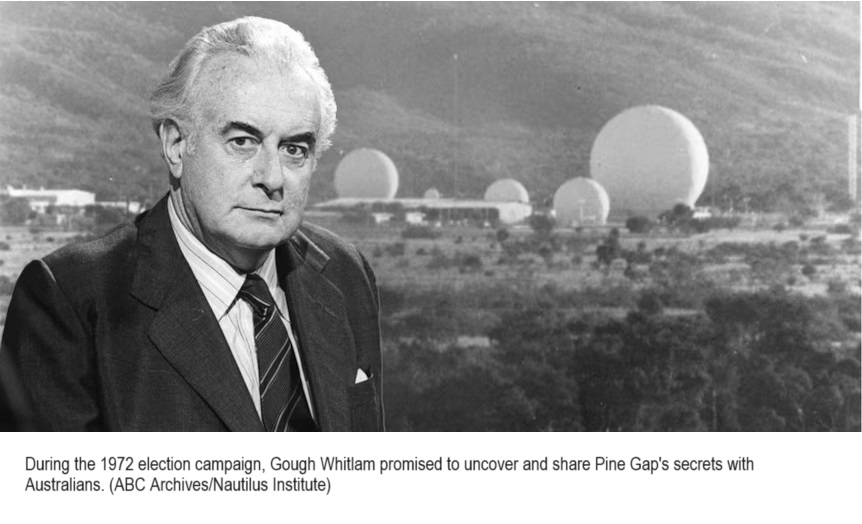
By Alex Barwick for the Expanse podcast Spies in the Outback
When Australia was placed on nuclear alert by the United States government in October 1973, there was one major problem.
No-one had told prime minister Gough Whitlam.
One of the locations placed on “red alert” was the secretive Pine Gap facility on the fringes of Alice Springs.
Officially called a “joint space research facility” until 1988, the intelligence facility was in the crosshairs with a handful of other US bases and installations around Australia.
In fact, almost all United States bases around the world were placed on alert as conflict escalated in the Middle East. Whitlam wasn’t the only leader left out of the loop.
A prime minister in the dark
“Whitlam got upset that he hadn’t been told in advance,” Brian Toohey, journalist and former Labor staffer to Whitlam’s defence minister Lance Barnard, said.
Toohey said Whitlam should have been told that facilities including North West Cape base in Western Australia, and Pine Gap were being put on “red alert”.
“There had been a new agreement knocked out by Australian officials with their American counterparts, that Australia would be given advance warning.”
They weren’t.
Suddenly, the world was on the brink of nuclear war.
Why were parts of Australia on ‘red alert’?
The Cold War superpowers backed opposing sides in the Yom Kippur War.
The Soviet Union supported Egypt and the United States was behind Israel.
As the proxy war escalated in October 1973, United States secretary of state Henry Kissinger believed the crisis could go nuclear and issued a DefCon 3 alert.
A DefCon 3 alert saw immediate preparations to ensure the United States could mobilise in 15 minutes to deliver a nuclear strike.
The aim was to deter a nuclear strike by the Soviets.
And, it simultaneously alerted all US bases including facilities in Australia that a nuclear threat was real.
This level of alert has only occurred a few times, including immediately after the September 11 attacks.
Politics, pressure and protest
The secretive intelligence facility in outback Australia caused Whitlam more trouble beyond the red alert.
During the 1972 election campaign, the progressive politician had promised to lift the lid on Pine Gap and share its secrets with all Australians.
“He gave a promise that he would tell the Australian public a lot more about what Pine Gap did,” Toohey said.
But according to Toohey, the initial briefing provided to Whitlam and Barnard by defence chief Arthur Tange left the prime minister with little to say.
“Tange came along and he said basically that there was nothing they could be allowed to say. And that was just ridiculous,” Toohey said.
“He said, the one thing he could tell them was the bases could not be used in any way to participate in a war. Well, of course they do.”
Whitlam would cause alarm in Washington when he refused to commit to extending Pine Gap’s future.
In 1974 on the floor of parliament he said:
“The Australian government takes the attitude that there should not be foreign military bases, stations, installations in Australia. We honour agreements covering existing stations. We do not favour the extension or prolongation of any of those existing ones.”
According to Toohey, “the Americans were incredibly alarmed about that”.
“As contingency planning, the whole of the US Defence Department said that they would shift it to Guam, a Pacific island that America owned,” he said.
And the following year, allegations would emerge that the CIA were involved in the prime minister’s dismissal on November 11, 1975.
Former Labor defence minister Kim Beazley labels the scuttlebutt as “bulldust”.
“I’d heard that stuff about the Americans getting frightened and therefore getting involved. I put the matter to study, I got a couple of senior public servants to have a look at it, nothing there, nothing there.”
Despite no conclusive evidence, the rumours continue to swirl.
Episode Two of the ABC’s Expanse podcast: Spies in the Outback is now available. This episode explores the wild political tensions surrounding the spy base in Australia’s backyard. Listen here.
Nationals double down on nuclear power policy.
Energy, 25 Aug 25
The Nationals are doubling down on introducing nuclear power to Australia, with leader David Littleproud vowing to take the policy to the next election.
Littleproud told National party members the nuclear policy was at the centre of the party’s fallout with the Liberals following the May federal election………………………..
“We have to have, as part of our energy mix, nuclear in that mix. It was something that we believe in passionately because we see the consequences,” he said.
“There is a sensible way to fix it and that’s what we’re going to take to the next election.”
This move comes despite The House of Representatives Select Committee on Nuclear Energy releasing an interim report in which it has found establishing nuclear power generation would be too late and too costly to support the country’s energy targets.
Committee chair Dan Repacholi MP, Federal Member for Hunter, said, “This interim report focuses on two key issues that have dominated the evidence we’ve received to date: whether nuclear power generation could be rolled out in Australia in an acceptable timeframe, and how affordable it would be—particularly compared to alternative power generation technologies currently available in Australia.”
“From the evidence considered by the Committee to date, it is apparent that it could be well into the 2040s before we might see nuclear energy generated in Australia if that form of energy generation were to be pursued. This would be too late to meaningfully support the achievement of Australia’s climate and energy targets or to help our coal power plant workforce and communities as we transition away from coal power.” https://esdnews.com.au/nationals-double-down-on-nuclear-power-policy/
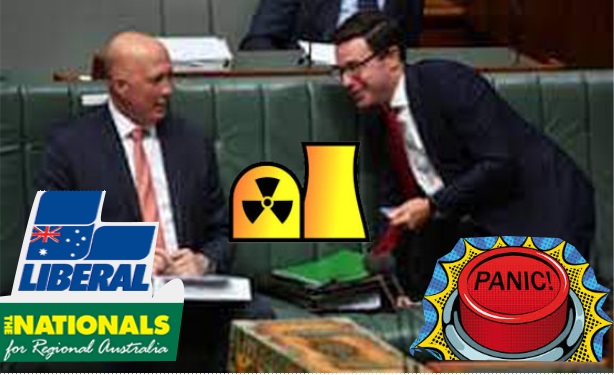
Nationals Leader David Littleproud says nuclear power policy ‘sensible’ next step.
ABC News, Sat 23 Aug, 25
In short:
Nationals Leader David Littleproud told the Liberal National Party annual convention nuclear had to be part of the country’s energy mix.
It would help with food security and the environment, he said.
What’s next?
Nuclear power and energy alternatives dominated discussions at the convention’s opening day on Friday, following the near-unanimous passing of a resolution to abandon net zero by 2050………………………
Coalition practice after an election meant policies taken to the campaign would remain and only be dumped by exception, he told the Liberal National Party annual convention in Brisbane……………………
“We have to have, as part of our energy mix, nuclear in that mix. It was something that we believe in passionately because we see the consequences,” he said……………………………. https://www.abc.net.au/news/2025-08-23/nationals-leader-david-littleproud-says-nuclear-power/105689740
In Alice Springs everyone has an opinion on the Pine Gap spy base, but no-one wants to talk about what happens inside.
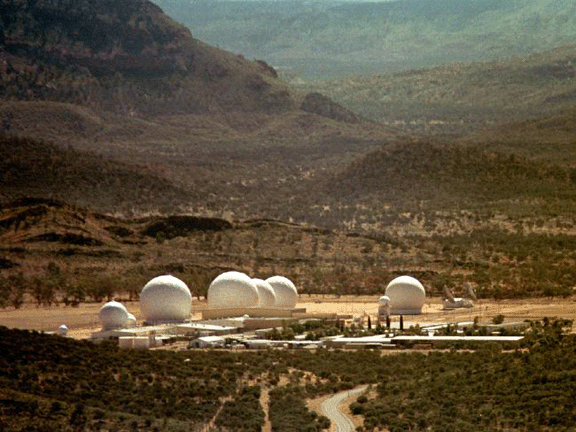
I wanted to hear from the traditional owners of the Arrernte land it was built on, and from the spies tasked with finding targets in Afghanistan and Iraq during the Global War on Terrorism. But how do you investigate something as secretive as Pine Gap when everyone who works there has made a promise never to talk about what they do?
serious claims being made that intelligence gathered at the facility was being used in the Israel-Gaza war.
By Alex Barwick for Backstory, Thu 16 May 2024. https://www.abc.net.au/news/backstory/2024-05-16/backstory-expanse-podcast-spies-in-the-outback-pine-gap-barwick/103844652
In journalism, it’s often politicians who won’t answer your questions.
But in my outback town, it’s just as likely to be the neighbours who won’t, or rather can’t, answer this basic conversation starter: “So, what do you do at work?”
That’s because about 800 of the town’s 25,000 residents are employed at the most secretive intelligence facility in Australia — the Joint Defence Facility Pine Gap — on the edge of Alice Springs/Mparntwe.
When I rolled into this beautiful landscape 16 years ago and began working at the ABC’s Alice Springs bureau, it quickly became clear I wouldn’t hear from this significant section of the community.
Given local radio is all about connecting with the community and sharing people’s stories, this silence felt strange.
My curiosity grew and the book Peace Crimes, written by long-term local journalist Kieran Finnane, motivated me to start looking deeper.
I wanted to know what was going on in my backyard, but I knew trying to make a podcast about a secret military facility hidden in a secluded valley in Central Australia wouldn’t be easy.
Telling this story in a town the size of Alice Springs would undoubtedly feel personal and would likely offend parts of the community.
It’s a line regional journalists walk all the time — telling stories that are in the public interest, while living in the community that is affected by them.
Covering difficult stories in a small town
The words we write as journalists — or say, like in the Expanse: Spies in the Outback podcast — do have real world implications for real people.
That includes everyone from my neighbours, to the parents of my kids’ friends, to people I see regularly at community events.
For them, it’s not a story – it’s their life.
And that can get awkward.
But there are stories in the public interest that the Australian government won’t comment on and this often means they’re shrouded in mystery, or rife with rumour.
Pine Gap is one of those stories.
What goes on beneath the cluster of enormous, oversized-golf-ball-shaped domes covering the military base’s listening antenna on the desert floor, raises big questions for all of Australia, not just my town.
The Pine Gap intelligence-gathering facility is often described as the jewel in the crown of our military partnership with the United States.
But what have we got ourselves into, and do we benefit from it?
Protesters, politicians and spies
Over the past six months, I’ve had lots of off-the-record coffees, trawled the news and library archives, followed some bizarre leads and heard plenty of wild stories, as I have tried to understand the goings-on behind the razor wire.
I wanted to know why America’s Central Intelligence Agency (CIA) decided to build a so-called “space base” in outback Australia in the mid 1960s.
What motivated former prime minister Gough Whitlam to rock the boat and promise to reveal its secrets to the public?
Why were thousands of people so convinced it was a nuclear target they flocked to the desert to demand its closure?
And how had it drawn Australia onto one battlefield after the next through its large-scale surveillance and intelligence gathering?
While plenty of people outside Alice Springs/Mparntwe have never heard of this desert spy base, most people in town have an opinion on it.
There are three main camps: those who say it’s vital for the town’s economy and global peace; those who still see it as a nuclear target and want it shut down; and those who feel generally apathetic to its existence.
And yet, nobody really talks about Pine Gap.
Still, I felt it was important to really understand the diversity of views on this outback spy base as I conducted my research.
I wanted to hear from the traditional owners of the Arrernte land it was built on, and from the spies tasked with finding targets in Afghanistan and Iraq during the Global War on Terrorism.
But how do you investigate something as secretive as Pine Gap when everyone who works there has made a promise never to talk about what they do?
I certainly wasn’t looking to see anyone exiled to Russia like Edward Snowden after he leaked a raft of National Security Agency (NSA) documents, including information on Pine Gap.
In the end, gentle, determined persistence meant I was able to tell the Pine Gap story in a way that lifted the lid but didn’t put national security at risk, and that (I hope) was sensitive to the lives of those in Alice Springs affected by it.
Back in the national spotlight
And then, in late 2023 as I tracked down activists, former spies and politicians … protesters were suddenly blocking the road to Pine Gap again.
There were serious claims being made that intelligence gathered at the facility was being used in the Israel-Gaza war. With Pine Gap back in the spotlight, I knew I had to look deeper.
This spy base, which became operational in 1970 during the Cold War, had expanded through the decades in scale and capability and was more relevant than ever.
The Australian government says Pine Gap is one of the country’s “most longstanding security arrangements” with the United States but it does not comment on its operation.
As each episode of Expanse: Spies in the Outback has been released, I’ve received emails and text messages that confirm why it was an important story to tell.
Some people have been shocked and appalled, while others have been grateful to learn we have this secret intelligence facility in our backyard.
Even in my own town of Alice Springs, where everyone knows someone who works at Pine Gap, there is an appetite to know more – regardless of how uncomfortable that might be.
Follow Expanse: Spies In The Outback on the ABC listen app to hear every episode of season three.
1 This month

of the week – Australians for War Powers Reform (AWPR)
To see nuclear-related stories in greater depth and intensity
 Antinuclear