NSW solar plants top generation charts as coal heads for the exit door — RenewEconomy

New South Wales had a bumper solar month in March, showing off its energy generation chops as the grid prepares for a major coal exit this month. The post NSW solar plants top generation charts as coal heads for the exit door appeared first on RenewEconomy.
NSW solar plants top generation charts as coal heads for the exit door — RenewEconomy
Gupta to stop use of coal in steelmaking at Whyalla, use wind and solar instead — RenewEconomy

Gupta finally delivers on green steel promise, phasing out coal at Whyalla Steelworks and replacing it with renewable-powered technologies. The post Gupta to stop use of coal in steelmaking at Whyalla, use wind and solar instead appeared first on RenewEconomy.
Gupta to stop use of coal in steelmaking at Whyalla, use wind and solar instead — RenewEconomy
Solar crusher: Tin producer wants new Australia mine to run on renewables only — RenewEconomy

UK tin miner proposes big renewable park next to Australian project, and using mostly solar to power crushing operations during the day. The post Solar crusher: Tin producer wants new Australia mine to run on renewables only appeared first on RenewEconomy.
Solar crusher: Tin producer wants new Australia mine to run on renewables only — RenewEconomy
The cost of being wrong — Beyond Nuclear International

The price of nuclear deterrence failure is too great a gamble
The cost of being wrong — Beyond Nuclear International
Deterrence cannot fail and is therefore not a foundation for peace
By Linda Pentz Gunter
Arguments around nuclear deterrence can become quickly convoluted. But the basic premise, according to those who advocate it, is that we are safer with nuclear weapons than without them. The possession of nuclear weapons by the world’s major powers, they say, has kept the peace. The lethality of nuclear weapons is such that they will inevitably never be used, thus preventing nuclear war, the argument goes.
To the rational ear this sounds breathtakingly illogical. But try tangling with the deterrence crowd and both sides will quickly find themselves tied up in a semantic knot of double and triple negatives.
However, it’s all really quite simple, or it seems so when listening to Austrian diplomat Alexander Kmentt explain it. Kmentt, one of the chief architects of the UN Treaty on the Prohibition of Nuclear Weapons (TPNW), just has a knack for framing the argument against deterrence both clearly and compellingly. Here is how he puts it:
“I can’t prove that deterrence doesn’t work. And I can’t prove that it does. But the price of being wrong if it doesn’t work is too high. It cannot fail.”
Kmentt was addressing an audience of European representatives of International Physicians for the Prevention of Nuclear War at their January 2023 conference in Hamburg, Germany. (I was also a presenter there so enjoyed the privilege of hearing Kmentt’s talk, which was delivered live streamed.)
This rationale makes sense. For deterrence to work, it must be 100% foolproof all the time. But anything governed by human beings — and technology invented by them — can guarantee no such thing. And given the price of failure, the choice is obvious: deterrence isn’t worth the risk.
There is a solution to all this and it is contained in the TPNW, of which Kmentt, and many others, can be so rightfully proud. You can indeed guarantee zero chance of a nuclear war if there are zero nuclear weapons in the world. “With the TPNW, deterrence was rejected,” Kmentt said. A first. In another first, “it is the first treaty that recognizes the injustices done.”
Those injustices are invariably meted out to smaller nations, and it was they who lined up in significant enough numbers to both sign and then ratify the TPNW. “If deterrence fails, small states are the collateral damage,” Kmentt pointed out.
In fact, the TPNW is so innovatory — Kmentt referred to it as “an avant-garde treaty”— that it departed from all earlier treaty scripts by encouraging full inclusion and participation. Framing it was “open to outside voices, to civil society and to academia,” Kmentt told the Hamburg audience. “There were observers.” This set it apart from the halls-of-power treaties that preceded it.
And it remains an open process. “We are clear that we are welcoming to whoever wants to engage with us on arguments around the treaty,” said Kmentt. “If countries didn’t show up, it was not a reaction to something we did.”
There has been —and remains — as Kmnett noted, considerable opposition toward the TPNW, particularly from the nuclear weapon countries. The U.S. Ambassador to the UN at the time, Nikki Haley, now apparently running for president on the Republican ticket, was so frightened by the Treaty that, as ICAN reported, “on the first day of treaty negotiations, she hosted a press conference outside the room where negotiations were to take place, criticizing the pursuit of a prohibition treaty.”………………………………… more https://beyondnuclearinternational.org/2023/04/02/the-cost-of-being-wrong/
Moltex vows to help Canada recycle its nuclear waste. Critics say the byproducts would be even worse.
“At best, they’ll end up with a small amount of various types of waste before the project is terminated, that will just create a bigger disposal hazard. And if it’s stuck in the province of New Brunswick, it will be their problem. But there’s zero chance of this cockamamie contraption being useful for generating electricity, or treating radioactive waste in a sound way.”
The Globe and Mail, MATTHEW MCCLEARN, 2 Apr 23,
Less than a kilometre from the western shore of the Bay of Fundy, the Point Lepreau Solid Radioactive Waste Management Facility temporarily houses about 160,000 spent fuel assemblies from New Brunswick’s only nuclear power reactor. Moltex Energy, a Saint John-based startup, proposes to recycle that radioactive waste into fresh fuel for a new 300-megawatt reactor called the Stable Salt Reactor-Wasteburner, or SSR-W.
Moltex promises these facilities will greatly diminish the waste inventory of NB Power, the province’s primary electric utility, beginning in the early 2030s, while at the same time producing electricity. Critics, however, warn the resulting wastes would be harder to dispose of than the assemblies themselves.
Criticisms notwithstanding, Moltex’s proposal appears to be gaining momentum. It has partnered with SNC-Lavalin Group, which holds a minority ownership stake and provides many of Moltex’s 35 employees through secondments – a vote of confidence from a company with deep roots in Canada’s nuclear sector…………….
Premier Blaine Higgs hailed Moltex in a speech in February, stating his government’s support “is positioning New Brunswick as a leader in development of new nuclear.” Mike Holland, Minister of Natural Resources and Energy Development, has extended what he described as “unwavering commitment to seeing this project become a reality.” The province has already supplied $10-million toward that end, while the federal government, through its Strategic Innovation Fund and other channels, has provided $50.5-million.
What these supporters have signed up for, however, isn’t entirely clear. Moltex’s technologies are embryonic; emphasizing that fact, partners that would play crucial roles in implementing them refused to discuss the implications with The Globe and Mail. Citing the need for commercial confidentiality, Moltex chief executive officer Rory O’Sullivan acknowledges the company hasn’t revealed many details about its reprocessing technology (known as Waste To Stable Salts, or WATSS).
Critics, though, say they’ve seen enough to recognize WATSS as merely the latest variations on nuclear waste reprocessing experiments dating back decades. Those experiences revealed reprocessing to be not a solution, they claim, but a curse.
About the size of a fire log, fuel assemblies from Canada’s CANDU reactors consist of rods known as “pencils” that are welded together; each contains cylindrical uranium pellets. Highly radioactive upon removal from a reactor, assemblies are stored in pools of water for about a decade before being warehoused at nuclear power plants in shielded containers. There are now about 3.2 million spent assemblies, which if stacked like cordwood would fill nine hockey rinks up to the boards……………..
WATSS would produce new wastes. By mass, the largest would be leftover uranium plus the metal cladding from CANDU fuel bundles, Mr. O’Sullivan said. This would be placed in the DGR, but in volumes greatly reduced than CANDU fuel bundles.
Then there’s fission products, a term encompassing hundreds of substances produced by nuclear fission inside a reactor. Though some are stable, others (such as cesium, technetium and strontium) are radioactive. These would be contained in salts that could be placed in canisters the same size as CANDU fuel bundles, facilitating storage in the DGR; Mr. O’Sullivan said they’d remain radioactive for up to 300 years………….
critics accuse Moltex of misleading the public. Gordon Edwards, a nuclear consultant and president of the Canadian Coalition for Nuclear Responsibility, said the company’s claim that the fission products would remain radioactive for only three centuries is “outrageous.”
“There are several radioactive materials which are very, very long-lived in the fission products, that have half-lives of not just thousands, but millions of years.”
The leftover uranium would contain leftover plutonium and fission products: “Experience has shown that this uranium is not clean, it’s contaminated,” he said. “You can’t just separate all of the fission products.”
WATSS wouldn’t significantly reduce storage volumes, Mr. Edwards added, as it’s the heat generated by radioactive waste – not the physical space occupied – that determines how large a DGR must be.
Ed Lyman, director of nuclear power safety with the Union of Concerned Scientists, has studied nuclear fuel reprocessing technologies since the 1980s. He said Moltex’s proposal is a variation on schemes that have been explored over many decades.
“All of the available evidence in the whole history of technology development in this area, as well as attempts to commercialize reprocessing in various ways, points to the fact that this is not going to work,” he said.
“At best, they’ll end up with a small amount of various types of waste before the project is terminated, that will just create a bigger disposal hazard. And if it’s stuck in the province of New Brunswick, it will be their problem. But there’s zero chance of this cockamamie contraption being useful for generating electricity, or treating radioactive waste in a sound way.”…………………
M.V. Ramana, a professor at the University of British Columbia’s public policy and global affairs school who researches nuclear issues, said Moltex’s $500-million estimate is highly optimistic. He pointed to Portland, Ore.-based NuScale Power, an early SMR developer, which spent US$1.1-billion over more than two decades developing what is essentially a scaled-down version of light water reactors common in the U.S.
As a molten salt reactor, the SSR-W should be far more difficult to license, Prof. Ramana said. Only two such reactors have ever been built, the last one closing in 1969, and neither generated electricity commercially.
Additionally, a sister company of Moltex, called MoltexFlex, is marketing another molten salt reactor in the Britain. (The companies share key personnel.) And Moltex must separately develop and license the WATSS process…………………..
“While we’re in early discussions with Moltex, they are still in the development phase, so we don’t have sufficient data at this time to respond to your technical questions about fuel waste,” NWMO spokesperson Russell Baker wrote in an e-mail.
All that adds up to a heap of unanswered questions. But having already spent $50-million on the project, Prof. Ramana said the federal government will be under considerable pressure to contribute more. He questioned the due diligence it has conducted to date.
“It’s not clear to me that the Trudeau government is interested in asking some of these hard questions,” he said. https://www.theglobeandmail.com/business/article-moltex-canada-nuclear-waste/
Nuclear Tug of War Intensifies in Brussels
With money and regulations on the table for renewable energy, the EU has become entrenched into two solid blocs with different stances on nuclear power.
Bridget Ryder — April 3, 2023 The European Conservative
With both a package of incentives for green technology and revisions to the Renewable Energy Directive on the table, the fight in Brussels over the place of nuclear power in the ‘green,’ ‘sustainable,’ ‘clean’ energy landscape—and its corresponding regulation—has intensified.
The bloc’s energy ministers met last week to prepare their negotiating points with the EU Parliament over changes to the Renewable Energy Directive. Prior to the March 28th Council meeting, energy ministers pow-wowed in competing breakfast gatherings—one for the French-led nuclear alliance and the other for the Austrian-organised Friends of Renewables group, Euractiv reports.
Nuclear alliance
At the end of their meetings, the nuclear alliance sent out a press release to notify the media—and presumably, both the Commission and their rivals on the EU Council—that they had agreed that nuclear energy was indeed “strategic” in achieving the EU Commission’s environmental goals. This is the opposite position to the one the Commission has taken in the recently proposed Net Zero Industry Act (NZIA), a set of incentives meant to counter U.S. green tech subsidies.
Under French leadership, the nuclear alliance (consisting of Bulgaria, Croatia, the Czech Republic, Finland, Hungary, the Netherlands, Poland, Romania, Slovakia, and Slovenia) first met in February while the Commission was still preparing the NZIA. Its goal was to promote nuclear power as a low-carbon source of electricity and work on “common industrial projects.”
In mid-March, the Commission presented the NZIA draft, but with nuclear power excluded from the list of “strategic” technologies that would qualify for incentives. The one exception was “cutting-edge nuclear” technology, such as small modular reactors (SMRs) which could qualify for some investment incentives. The alliance then met again in March, just before the meeting of energy ministers on March 28th, and announced that they had “fully recognised that nuclear is a strategic technology for achieving climate neutrality.”
The pro-nuclear breakfasts were attended by Italy and Belgium, though only as observers. The two countries made it clear they had not signed on to any agreed position with the group, though they have reasons for desiring a favourable status for nuclear energy.
Belgium, for its part, has had to retract plans to start shutting down the country’s six nuclear reactors. After announcing the closure of a set of nuclear power plants by 2025, the public outcry forced the energy ministry to instead grant them a ten-year extension. ………………..
Friends of renewables
The Friends of Renewables—Estonia, Spain, Germany, Denmark, Ireland, Luxembourg, Portugal, Latvia, and Lithuania, with Austria as leader—are a clear counterweight to the nuclear alliance.
The compromise
After the breakfast gatherings, the two groups had to come together with the rest of the bloc’s member states for the official EU Council Meeting to settle on a negotiating position for the updates to the Renewable Energy Directive (RED).
The nuclear sticking point was whether hydrogen produced using nuclear power should be included in renewable fuel targets. After hours of back and forth, they agreed to label nuclear-produced hydrogen as “low carbon,” in other words, dirtier than ‘green’ hydrogen but better than the ‘brown’ hydrogen linked to fossil fuels.
Nuclear power enters into the debate about renewables in the question of hydrogen gas. Making the gas ‘green,’ a process of separating the hydrogen from water molecules, requires an energy source. When that source is considered ‘green,’ such as solar or wind power, the hydrogen is considered ‘green.’
Negotiators for the EU Parliament then also made room for nuclear power in the Renewable Energy Directive (RED), admitting that it has a “role” to play in reducing carbon emissions and is in a category of its own in the spectrum of environmental friendliness.
The RED now recognizes “the specific role of nuclear power, which is neither green nor fossil,” French MEP Pascal Canfin, chair of the Parliament’s Environment Committee, who participated in the negotiations, tweeted…….
The political agreement reached by the Council and Parliament calls for doubling renewable energy output by 2030.
“The agreement raises the EU’s binding renewable target for 2030 to a minimum of 42.5%, up from the current 32% target and almost doubling the existing share of renewable energy in the EU. Negotiators also agreed that the EU would aim to reach 45% of renewables by 2030,” the Commission said in a statement about the political agreement on the RED.
‘Renewable’ energy currently makes up just over 20% of the bloc’s energy mix.
Further room was made for nuclear by provisions in the agreement by giving member states two options to calculate achieving certain targets: either emission reductions or renewable energy output. This is an advantage for countries like France that have substantial nuclear capacity, as carbon dioxide is not the major by-product of nuclear power production. https://europeanconservative.com/articles/news/nuclear-tug-of-war-intensifies-in-brussels/
Submission to Senate exposes the fake charity group behind the pro nuclear propaganda.

Environment and Other Legislation Amendment (Removing Nuclear Energy Prohibitions) Bill 2022 Submission No. 118 (Name Withheld)
Don’t let the nuclear lobbyists scuttle the clean energy movement to line their bottomless pockets
Senate members may not realise that hundreds of submissions to lift the ban on nuclear power in Australia have come from a so-called environmental protection organisation, RePlanet. This group has broadcast a lengthy pre-prepared submission, advising that lodging it (by simply giving a name and an email address) will “help Australia’s federal politicians understand that there is strong public support for lifting the ban on nuclear energy so that it may be used as part of the clean energy transition”.
This lobby group argues that nuclear has the lowest lifecycle environmental impact, provides reliable 24/7 clean energy, has a very small land use footprint, and provides high paying, long term employment.
Nothing could be further from the truth, on all counts – including ‘strong public support’.
Nuclear’s environmental impact is horrendous (Three Mile Island, Chernobyl, Windscale, Fukushima). It is demonstrably the dirtiest and most dangerous of all forms of energy. Its land use footprint and the employment it provides are irrelevant – a solar panel on a rooftop has a very small footprint, and projects designed around genuinely clean green energy conversions will provide countless high paying long-term job opportunities.
Please don’t be swayed by the hundreds of submissions from this source. Australians on the whole are moving to renewable energy, voting with their rooftops. RePlanet is trying to infiltrate genuine groups caring for the future of this planet. We succumbed to the oil barons’ promises a hundred years ago, and lost an amazing electric car industry.
Don’t let the nuclear lobbyists scuttle the clean energy movement to line their bottomless pockets https://www.aph.gov.au/Parliamentary_Business/Committees/Senate/Environment_and_Communications/Nuclearprohibitions/Submissio
Julian Assange – when “quiet diplomacy” means diddly squat

How could a conversation between President Biden, PM Albanese and PM Sunak, which he was in just two weeks ago, not be the most important kind of quiet diplomacy to use to free Julian Assange? And why wasn’t it used?
by Rex Patrick | Mar 31, 2023 | What’s the scam? https://michaelwest.com.au/julian-assange-when-quiet-diplomacy-means-diddly-squat/
Foreign Affairs Minister Penny Wong has all but confirmed in Parliament the government is doing nothing to bring the world’s foremost political prisoner home. What’s the scam with “quiet diplomacy”?
Despite claiming the government is deploying “quiet diplomacy” to urge the US to free Julian Assange, and despite the government committing to a $368b spend on submarines – the biggest transfer of public money in Australia’s history – to US and UK weapons makers, there is no evidence whatsoever that our elected representatives have even muttered one word on the matter.
Thursday at 2:14 pm, Senator Shoebridge stood up in question time and asked Senator Wong a question about Julian Assange. He asked whether Prime Minster Anthony Albanese had used the opportunity created by the March 14, AUKUS ‘Kabuki Show’ to lobby for the release of Assange.
Senator Wong did all things possible to avoid having to say “no.”
Shoebridge acknowledged the implied “no” when he asked further:
How could a conversation between President Biden, PM Albanese and PM Sunak, which he was in just two weeks ago, not be the most important kind of quiet diplomacy to use to free Julian Assange? And why wasn’t it used?
Wong again ducked and weaved and then said, “We are doing what we can between government and government, but there are limits to what that diplomacy can achieve.”
wo and half hours later, in the last working minute of the day that Parliament was set to rise until May, the Department of Foreign Affairs sent me the response to an FOI request for “all cablegrams sent between the Department of Foreign Affairs and Trade and the Embassy of Australia, Washington DC, since 24 November 2022 that relate to Julian Paul Assange”. They advised:
“Thorough searches conducted by the Consular Operations Branch and the United States, United Kingdom & Canada Branch found no documents.”
The scam is, that while the government purports to be working quietly in background on the release of Julian Assange, the reality is that they are doing nothing.
It’s disgraceful deceit.
Inglorious inertia: The Albanese Government and Julian Assange
Australian Independent Media, April 1, 2023, Dr Binoy Kampmark
The sham that is the Assange affair, a scandal of monumental proportions connived in by the AUKUS powers, shows no signs of abating. Prior to Prime Minister Anthony Albanese assuming office in Australia, he insisted that the matter dealing with the WikiLeaks publisher would be finally resolved. It had, he asserted, been going on for too long.
Since then, it is very clear, as with all matters regarding US policy, that Australia will, if not agree outright with Washington, adopt a constipated, non-committal position. “Quiet diplomacy” is the official line taken by Albanese and Australian Foreign Minister Penny Wong, a mealy-mouthed formulation deserving of contempt. As Greens Senator David Shoebridge remarks, “‘quiet diplomacy’ to bring Julian Assange home by the Albanese Government is a policy of nothing. Not one meeting, phone call or letter sent.”
Kellie Tranter, a tireless advocate for Assange, has done sterling work uncovering the nature of that position through Freedom of Information requests over the years. “They tell the story – not the whole story – of institutionalised prejudgment, ‘perceived’ rather than ‘actual’ risks, and complicity through silence.”
The story is a resoundingly ugly one. It features, for instance, stubbornness on the part of US authorities to even disclose the existence of a process seeking Assange’s extradition from the UK, to the lack of interest on the part of the Australian government to pursue direct diplomatic and political interventions
Former Australian Foreign Minister Julie Bishop exemplified that position in signing off on a Ministerial Submission in February 2016 recommending that the Assange case not be resolved; those in Canberra were “unable to intervene in the due process of another’s country’s court proceedings or legal matters, and we have full confidence in UK and Swedish judicial systems.” Given the nakedly political nature of the blatant persecution of the WikiLeaks founder, this was a confidence both misplaced and disingenuous.
The same position was adopted by the Australian government to the United Nations Working Group on Arbitrary Detention (WGAD), which found that same month that Assange had been subject to “different forms of deprivation of liberty: initial detention in Wandsworth prison which was followed by house arrest and his confinement at the Ecuadorean embassy.” The Working Group further argued that Assange’s “safety and physical integrity” be guaranteed, that “his right to freedom of movement” be respected, and that he enjoy the full slew of “rights guaranteed by the international norms on detention.”………………………….
At the time, such press outlets as The Guardian covered themselves in gangrenous glory in insisting that Assange was not being detained arbitrarily and was merely ducking the authorities in favour of a “publicity stunt”………………………………
The new Australian High Commissioner to the United Kingdom, Stephen Smith, has kept up that undistinguished, even disgraceful tradition: he has offered unconvincing, lukewarm support for one of Belmarsh Prison’s most notable detainees. ……………………………………
As with his predecessors, Smith is making his own sordid contribution to assuring that the WikiLeaks founder perishes in prison, a victim of ghastly process.
As for what he would be doing to impress the UK to reverse the decision of former Home Secretary Priti Patel to extradite the publisher to the US, Smith was painfully predictable. “It’s not a matter of us lobbying for a particular outcome. It’s a matter of me as the High Commissioner representing to the UK government as I do, that the view of the Australian government is twofold. It is: these matters have transpired for too long and need to be brought to a conclusion, and secondly, we want to, and there is no difficulty so far as UK authorities are concerned, we want to discharge our consular obligations.”……………………… https://theaimn.com/inglorious-inertia-the-albanese-government-and-julian-assange/
;
USA CONGRESSIONAL EFFORT TO END ASSANGE PROSECUTION IS UNDERWAY

Rep. Rashida Tlaib is collecting signatures on a letter calling on Attorney General Merrick Garland to end the extradition drive against WikiLeaks’ Julian Assange.
The Intercept Ryan Grim March 31 2023
REP. RASHIDA TLAIB, D-Mich., is circulating a letter among her House colleagues that calls on the Department of Justice to drop charges against Julian Assange and end its effort to extradite him from his detention in Belmarsh prison in the United Kingdom.
The letter, a copy of which was obtained by The Intercept, is still in the signature-gathering phase and has yet to be sent to Attorney General Merrick Garland.
The Justice Department has charged Assange, the publisher of WikiLeaks, for publishing classified information. The Obama administration had previously decided not to prosecute Assange, concerned with what was dubbed internally as the “New York Times problem.” The Times had partnered with Assange when it came to publishing classified information and itself routinely publishes classified information. Publishing classified information is a violation of the Espionage Act, though it has never been challenged in the Supreme Court, and constitutional experts broadly consider that element of the law to be unconstitutional.
“The Espionage Act, as it’s written, has always been applicable to such a broad range of discussion of important matters, many of which have been wrongly kept secret for a long time, that it should be regarded as unconstitutional,” explained Daniel Ellsberg, the famed civil liberties advocate who leaked the Pentagon Papers.
The Obama administration could not find a way to charge Assange without also implicating standard journalistic practices. The Trump administration, unburdened by such concerns around press freedom, pushed ahead with the indictment and extradition request. The Biden administration, driven by the zealous prosecutor Gordon Kromberg, has aggressively pursued Trump’s prosecution. Assange won a reprieve from extradition in a lower British court but lost at the High Court. He is appealing there as well as to the European Court of Human Rights. Assange’s brother, Gabriel Shipton, who has been campaigning globally for his release, said that Assange’s mental and physical health have deteriorated in the face of the conditions he faces at Belmarsh.
Tlaib, in working to build support, urged her colleagues to put their differences with Assange the individual aside and defend the principle of the free press, enshrined in the Constitution. “I know many of us have very strong feelings about Mr. Assange, but what we think of him and his actions is really besides the point here,” she wrote to her colleagues in early March. “The fact of the matter is that the [way] in which Mr. Assange is being prosecuted under the notoriously undemocratic Espionage Act seriously undermines freedom of the press and the First Amendment.”
Tlaib noted that the Times, The Guardian, El País, Le Monde, and Der Spiegel had put out a joint statement condemning the charges, and alluded to the same problem that gave the Obama administration pause. “The prosecution of Mr. Assange, if successful, not only sets a legal precedent whereby journalists or publishers can be prosecuted, but a political one as well,” she wrote. “In the future, the New York Times or Washington Post could be prosecuted when they publish important stories based on classified information. Or, just as dangerous, they may refrain from publishing such stories for fear of prosecution.”
So far, the letter has collected signatures from Democratic Reps. Jamaal Bowman, Ilhan Omar, and Cori Bush. Rep. Ro Khanna said he had yet to see the letter but added that he has previously said Assange should not be prosecuted because the charges are over-broad and a threat to press freedom. Rep. Pramila Jayapal is not listed as a signee but told a Seattle audience recently she believes the charges should be dropped. A spokesperson for Rep. Alexandria Ocasio-Cortez said that she intends to sign before the letter closes.
Chip Gibbons, policy director for Defending Rights & Dissent, said that the relative silence from Congress on the Assange prosecution has undermined U.S. claims to be defending democracy abroad. “In spite of the rhetoric about opposing authoritarianism and defending democracy and press freedom, we really haven’t seen a comparable outcry from Congress — until now,” said Gibbons, whose organization has launched a petition calling on the Justice Department to drop charges. “Rep. Tlaib’s letter isn’t just a breath of fresh air, it’s extremely important for members of Congress to be raising their voices on this, especially those from the same party of the current administration, at this critical juncture in a case that will determine the future of press freedom in the United States.”
A significant number of Democrats continue to hold a hostile view of Assange……………..
The full letter is below [on the original article at] https://theintercept.com/2023/03/30/julian-assange-congress-rashida-tlaib/
Submission to Senate – a trenchant critique of Australia’s pro nuclear fringe
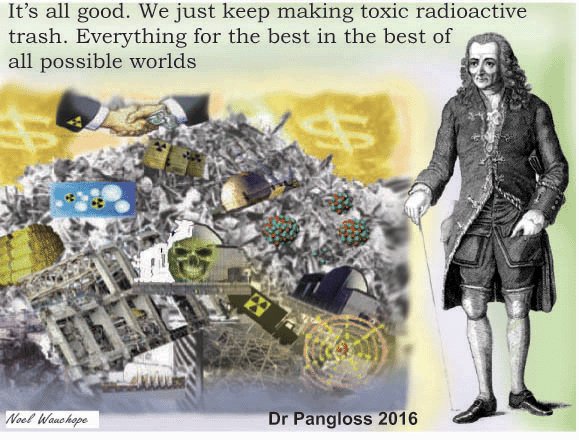
Environment and Other Legislation Amendment (Removing Nuclear Energy Prohibitions) Bill 2022 Submission No. 125 (Name Withheld)
Here we find ourselves with yet ANOTHER inquiry into nuclear power in Australia.
This time the timing couldn’t be better – with all the issues created by nuclear power on full display in Europe.From the extreme example of nuclear power plants being used as a weapon of terror by invading forces (Zaporizhzhia) leading to the unforgettable front page headline on The Weekend Australian of March 5-6, 2022, “Nukes fear: ‘End of Europe'”.
To the more mundane but economically crippling complete failure of the French nuclear power industry during a major European energy crisis caused by the Russian invasion of Ukraine – resulting in the introduction of a new French law requiring all car parking spaces with a capacity of over 80 cars to install solar panels resulting in the potential capacity addition of 11GW. With around half of the French nuclear fleet out of commission, wholesale prices have soared to over Euros 1000/MWh.
However, even these issues won’t soften the enthusiasm of the nuclear fringe – so we have to go through this inquiry process once again. Thank God the country doesn’t have bigger issues to deal with……… https://www.aph.gov.au/Parliamentary_Business/Committees/Senate/Environment_and_Communications/Nuclearprohibitions/Submissio
Australian government always knew that Australia would end up with AUKUS nuclear wastes – they just didn’t let on to the public.

“…………………………………… our ALP federal gov says they will within 12 months make an announcement of a process to dispose of High Level nuclear waste (a feat no other country has achieved) from AUKUS nuclear powered submarines on existing or future defence lands,
this will involve a site study across ‘remote’ areas and likely be by imposition, with compulsory land acquisition and override of State / Territory laws and may be without recognising a right of affected traditional owners to Say No…
Deputy Leader Hon Richard Marles MP has said ‘keeping the waste was always a pre-condition to AUKUS nuclear subs’ – the ALP gov just didn’t let on to the public till after they’d sought to lock in an ‘pathway’ https://cosmosmagazine.com/…/explainer-radioactive…/…
Letter to the Australian Nuclear Science and Technology Organisation (ANSTO), dispelling its deceptions about nuclear medicine and nuclear wastes.
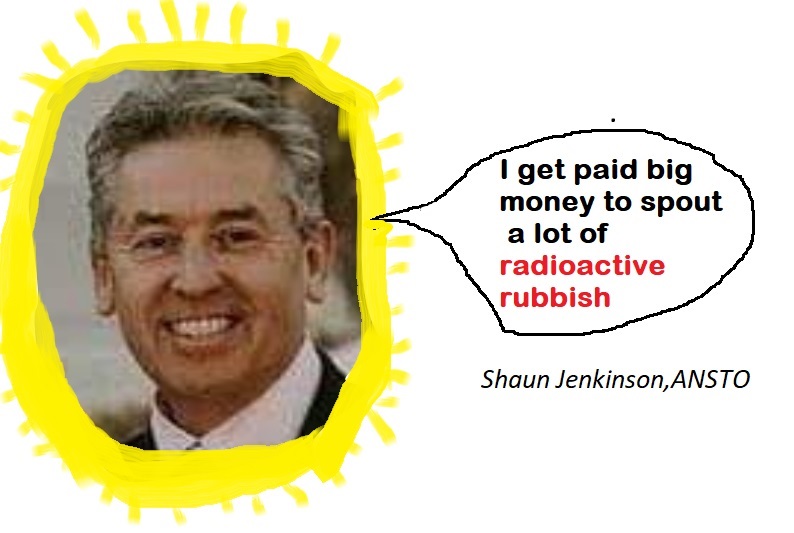
To Mr Shaun Jenkinson , Chief Executive Officer , Australian Nuclear Science and Technology Organisation, 31 Mar 23
Dear Shaun Jenkinson
While I should be congratulating the Australian Nuclear Science and Technology Organisation (ANSTO) on the occasion of its seventieth anniversary I cannot agree with its euphemistic contention that Australia punches above its weight in the international nuclear arena
You know well enough that this is far from the truth in the eyes of many leading experts internationally in all aspects of nuclear science and technology and which is particularly confirmed by various circumstances involving ANSTO in the past few years
This situation relates to the very existence and necessity of ANSTO and no degree of membership of various global committees by its staff can justify the claim that Australia holds its own (presumably through ANSTO) on the international stage among the leading nuclear nations of the world BECAUSE IT SIMPLY DOES NOT
The prime examples of this are the completely misleading contentions by ANSTO as to its its leadership in the production of nuclear medicine and its continued operational problems at Lucas Heights
While you have claimed that the production of nuclear medicine by ANSTO represents 80% of its undertaking the fact is that it relates to reactor generated medicine from which the medical profession worldwide is turning away due to its inherent and dangerous nature
In fact the better medical opinion internationally is that reactor generated nuclear medicine will ultimately be completely replaced by other means of diagnostic and curative treatment based on which a large part of the purpose of ANSTO would be lost
This fact could be readily verified if you and the federal government on your advice allowed a proper independent and internationally based review of the production of nuclear medicine by ANSTO which of course as a comprehensive business case would completely destroy a large part of its commercial undertaking
As far as the operations at Lucas Heights are concerned it is incredible how many times the nuclear reactor breaks down and has to cease its activity and also the number of leakages and mishandling of nuclear material all of which ANSTO hides from public scrutiny but is well-known overseas
However perhaps the most damaging fact to the reputation of ANSTO has been its inapt handling of the proposed but completely unsuitable nuclear waste management facility at Kimba in South Australia which through international peer group pressure will never see the light of day
Although it appears that it has now passed on its functions for Kimba to another entity yet to be legislated ANSTO had previously and seemingly wilfully ignored all of the major and necessary prescriptions of the International Atomic Energy Agency (IAEA) relating to the development of a nuclear installation including principally the lack of a proper safety case from the outset of its intentions
This is viewed internationally as a major breach of human rights and is a devastating blow to the self-proclaimed qualifications of ANSTO internationally
That is why no degree of membership in many instance of not highly relevant international committees for Australia can overcome these major failings by ANSTO
You are no doubt still sticking voodoo pins into me over my exposure of ANSTO by the Senate estimates committee hearing in October 2020 relating to the mistruths – in fact open lies – about the dismissal of its previous chief executive and the underhanded payments to China for the development of small nuclear power generating reactors for local use to which no proper answers have yet been provided
It gave me no pleasure to have to expose these situations and as I have previously told you that in a normal commercial context they would have been tantamount to corporate criminality
Instead of its unrealistic claims of international standing and self appraisement ANSTO would gain far more respect if it addressed these circumstances and heeded external advice and guidance
While the federal government would find it most unpalatable if it were to reduce ANSTO to its true operational and useful existence based on properly justified scientific and commercial reasons rather than involvement in somewhat meaningless committees which have little national relevance this may be necessary for Australia to gain the international respect it so badly seeks
Sincerely
Peter Remta
Canadian First Nations do not want small nuclear reactors on their lands

Decolonizing energy and the nuclear narrative of small modular reactors https://policyoptions.irpp.org/magazines/february-2022/decolonizing-energy-and-the-nuclear-narrative-of-small-modular-reactors/
Kebaowek First Nation is calling for an alternative to a planned SMR project, one that won’t undermine proper consultation and leave a toxic legacy.
by Lance Haymond, Tasha Carruthers, Kerrie Blaise, February 7, 2022 In early 2021, the Canadian Nuclear Safety Commission began reviewing the application from a company called Global First Power to build a nuclear reactor at the Chalk River Laboratories site about 200 kilometres northwest of Ottawa.
This project, known as a micro modular reactor project, is an example of the nuclear industry’s latest offering – a small modular reactor (SMR).SMRs are based on the same fundamental physical processes as regular (large) nuclear reactors; they just produce less electricity per plant. They also produce the same dangerous byproducts: plutonium and radioactive fission products (materials that are created by the splitting of uranium nuclei). These are all dangerous to human health and have to be kept away from contact with people and communities for hundreds of thousands of years. No country has so far demonstrated a safe way to deal with these.
Despite these unsolved challenges, the nuclear industry promotes SMRs and nuclear energy as a carbon-free alternative to diesel for powering remote northern communities. The Canadian government has exempted small modular reactors from full federal environmental assessment under the Impact Assessment Act. Many civil society groups have condemned this decision because it allows SMRs to escape the public scrutiny of environmental, health and social impacts.
The proposed new SMR in Chalk River, like the existing facilities, would be located on Algonquin Anishinabeg Nation territory and the lands of Kebaowek First Nation – a First Nation that has never been consulted about the use of its unceded territory and that has been severely affected by past nuclear accidents at the site.
At this critical juncture of climate action and Indigenous reconciliation, Kebaowek First Nation is calling for the SMR project at Chalk River to be cancelled and the focus shifted to solutions that do not undermine the ability of First Nations communities to be properly consulted and that do not leave behind a toxic legacy.
While these reactors are dubbed “small,” it would be a mistake to assume their environmental impact is also “small.” The very first serious nuclear accident in the world involved a small reactor: In 1952, uranium fuel rods in the NRX reactor at Chalk River melted down and the accident led to the release of radioactive materials into the atmosphere and the soil. In 1958, the same reactor suffered another accident when a uranium rod caught fire; some workers exposed to radiation continue to battle for compensation.
What makes these accidents worse – and calls into question the justification for new nuclear development at Chalk River – is that this colonized land is the territory of the Algonquin Anishinabeg Nation territory (which consists of 11 First Nations whose territory stretches along the entire Ottawa River watershed straddling Quebec and Ontario). Kebaowek First Nation, part of the Algonquin Nation, was among those First Nations never consulted about the original nuclear facilities on their unceded territory, and is still struggling to be heard by the federal government and nuclear regulator. Its land has never been relinquished through treaty; its leaders and people were never consulted when Chalk River was chosen as the site for Canada’s first nuclear reactors; and no thought was given to how the nuclear complex might affect the Kitchi Sibi (the Ottawa River).
History is being repeated at Chalk River today as the government pushes ahead with the micro modular reactor project without consent from Kebaowek. Assessments of the project have been scoped so narrowly that they neglect the historical development and continued existence of nuclear facilities on Kebaowek’s traditional territory. The justification for an SMR at this location without full and thorough consideration of historically hosted nuclear plants – for which there was no consultation nor accommodation – is a tenuous starting point and one that threatens the protection of Indigenous rights.
The narrative of nuclear energy in Canada is one of selective storytelling and one that hides the reality of the Indigenous communities that remain deeply affected, first by land being taken away for nuclear reactor construction, and later by the radioactive pollution at the site. All too fitting is the term radioactive colonialism coined by scholars Ward Churchill and Winona LaDuke, to describe the disproportionate impact on Indigenous people and their land as a result of uranium mining and other nuclear developments. In country after country, the uranium that fuels nuclear plants has predominantly been mined from the traditional lands of Indigenous Peoples at the expense of the health of Indigenous Peoples and their self-determination.
Kebaowek First Nation has been vocal in its objection to the continuation of the nuclear industry on its lands without its free prior and informed consent, as is its right under the United Nations Declaration on the Rights of Indigenous Peoples (UNDRIP). Despite requests for the suspension of the SMR project, pending adequate provisions for Indigenous co-operation and the Crown’s legal duty to initiate meaningful consultation, Kebaowek has yet to see its efforts reflected in government decisions and Crown-led processes.
Nuclear is a colonial energy form, but it is also bio-ignorant capitalism – a term coined by scholars Renata Avila and Andrés Arauz to describe the ways in which the current economic order ignores the planetary climate emergency, human and ecological tragedies, and the large-scale impact on nature. The narrative of nuclear as a “clean energy source” is a prime example of this bio-ignorance. Decision-makers have become fixated on carbon emissions as a metric for “clean and green,” ignoring the radioactive impacts and the risks of accidents with the technology.
It is more than 70 years since Chalk River became the site for the splitting of the nucleus. The continuation of nuclear energy production on unceded Indigenous territory without meaningful dialogue is a telling example of continued colonial practices, wherein companies extract value from Indigenous land while polluting it; offer little to no compensation to impacted communities; and abide by timelines driven by the project’s proponents, not the community affected. We need to move away from this colonial model of decision-making and decolonize our energy systems.
The challenge of climate change is urgent, but responses to the crisis must not perpetuate extractivist solutions, typical of colonial thinking, wherein the long-term impacts – from the production of toxic waste to radioactive releases – lead to highly unequal impacts.
The authors thank Justin Roy, councilor and economic development officer at Kebaowek First Nation, and M.V. Ramana, professor at the School of Public Policy and Global Affairs at the University of British Columbia, for contributing to this article.
An obnoxious clause in Canada’s draft Act for Implementing the United Nations Declaration on the Rights of Indigenous Peoples (UNDRIP).

First -let’s see what the Assembly of First Nations of Canada (AFN) say about Small Modular Nuclear Reactors
The AFN resolution from 2018 against SMRs, available HERE says:
THEREFORE BE IT RESOLVED that the Chiefs-in-Assembly:
1. Demand that free, prior and informed consent is required to ensure that no storage or disposal of hazardous
materials shall take place in First Nations lands and territories.
2. Demand that the Nuclear Industry abandon its plans to operate Small Modular Nuclear Reactors in Ontario and
elsewhere in Canada.
3. Demand that the Government of Canada cease funding and support of the Small Modular Nuclear Reactors
program.
4. Direct that the National Chief and appropriate staff work to ensure that the Nuclear Industry and the Canadian Government abandon this program.
Now see what the Government includes in this draft Act
In the Environment section of Canada’s draft Act for Implementing the United Nations Declaration on the Rights of Indigenous Peoples (UNDRIP)- the specific SMRs text is found, in Chapter 1, Shared priorities. https://www.justice.gc.ca/eng/declaration/ap-pa/ah/p3.html
The Government of Canada will take the following actions……………
44. Increase capacity for Indigenous peoples to meaningfully engage, make informed decisions, and participate financially in clean energy alternatives like Small Modular Reactors (SMRs). SMRs in Canada are developing along three parallel streams including near-term on-grid, next generation and micro/off-grid, and there is potential for multiple benefits including use in remote Indigenous communities for abating emissions of heavy industry and increasing energy security. (Natural Resources Canada)
1 This month
17 October, Free Public Talk on Nuclear Issues in South Australia
David Noonan will speak on public interest concerns over the new Roxby Downs Indenture Act 2026 on BHP copper-uranium mining and ore processing in SA, and on how AUKUS may face SA with a High-Level nuclear waste agenda.
Dr Jim Green will discuss international developments in the field of nuclear power including ‘small modular reactors’ and Generation 4 ‘advanced’ nuclear reactor concepts.


Help Aunty Sue Protect Her Land and Sacred Sites From Destructive Rocket Testing.
.

Australians deserve the truth
about
AUKUS – https://aukuspublicinquiry.com/

PETITION – To: Prime Minister Anthony Albanese and the Australian Labor Government

of the week – Australians for War Powers Reform (AWPR)
To see nuclear-related stories in greater depth and intensity

