Electrical Trades Union of Australia Submission to Senate : Nuclear power a dangerous and costly distraction.
Submission no. 3.
I write on behalf of the Electrical Trades Union of Australia with reference to the Environment and Communications Legislation Committee inquiry into the Environment and Other Legislation Amendment (Removing Nuclear Energy Prohibitions) Bill 2022.
The ETU has a long history of opposing the nuclear industry that began when returning servicemen who were ETU members shared their experiences of the atrocities of World War II and through the democratic processes of our Union voted to adopt the Unions policy of opposition to this industry. That policy has been revisited many times since, as the Union kept abreast of developments in the nuclear industry as well as learned of the far-reaching impacts of the many catastrophic nuclear incidents that have occurred since and the worrying issues of waste management and the connection to weapons industries.
I enclose our September 2019
I enclose our September 2019 submission to a previous federal inquiry into the prerequisites for nuclear energy. All the matters contained in that submission continue to be relevant today. Since our submission, many risk factors such as the high cost and slow build times, the insurance risk and the intractability of waste management have only increased.
This inquiry is a dangerous and expensive distraction from the real effort needed to rapidly decarbonise the Australian economy in a manner that delivers secure jobs, social justice, cheaper energy and lower emissions.
The Australian people neither need, nor want a nuclear future.
See ETU 2018 Submission Electrical trades Union of Australia dispels the hype about Generation IV Nuclear Reactors https://antinuclear.net/2015/09/21/electrical-trades-union-of-australia-dispels-the-hype-about-generation-iv-nuclear-reactors/
Noel Wauchope. Submission to Senate calls for retaining Australia’s nuclear bans.
Submission no. 102 to Senate Standing Committees on Environment and Communications. Regarding Environment and Other Legislation Amendment (Removing Nuclear Energy Prohibitions) Bill 2022 – Noel Wauchope
Australia’s prohibition of the nuclear industry has served us well. We are among the majority of nations that are not burdened with the costs, the toxic wastes, the safety and security problems, and the weapons proliferation risks that burden the minority, the 32 countries that do have nuclear power. Australia is lucky in that regard.
But we’re unlucky in that Australia is the continent most at risk from global heating. We’re experiencing right now the weather extremes that herald rapid climate change. So, the time for Australia to act – is NOW. In 20 or 30 years – it will be too late. But 20 or 30 years is the (optimistic) time frame for getting nuclear reactors operating – whether they be large or small reactors. That is, of course, assuming that nuclear reactors would really be effective in cutting greenhouse emissions, – a questionable assumption, anyway.
The push in Australia is for small nuclear reactors (SMRs) . We must remember that with small nuclear reactors, there needs to be a number of them, to produce anything like the amount of energy that a large nuclear reactor produces. So for Australia the small nuclear reactor plan would mean an absurdly large number of these SMRs to be brought into operation very quickly, across the nation, to have any effect on reducing greenhouse gases.
We also need to remember that these SMRs are still only in the design phase – not operating on any land in the world. Is Australia to be the guinea pig for trying out an expensive experiment?
In the meantime Australia is a leader in adopting renewable energy technologies, both large scale and small. Wind and solar power are here NOW – faster and ever cheaper to install, with constantly improving battery systems for back-up.
My worry is that Australia’s resources,human, financial and physical, could be redirected away from critically needed energy conservation and renewable systems, towards an expensive and untested nuclear power system.
This distraction from practical and clean technologies would also bring the problems of long-lasting radioactive waste, and of nuclear facilities as a target for terrorism.
The experience of other countries should provide a salutary lesson for Australians. France – the much touted nuclear power champion, had a very worrying time in recent summers – nuclear reactors cutting back due to heat problems and water shortage. France is still struggling in their winter, and now has to import electricity. If France’s nuclear fleet can’t cope with summer heat, what hope has Australia got?
All the nuclear countries are struggling with the problem of disposal of nuclear wastes. Finland’s much vaunted underground disposal facility, (at enormous cost) will barely have enough space for Finland’s own nuclear wastes, let alone anyone else’s. Small nuclear reactors do produce a smaller percentage of wastes, but so highly toxic that they form a big problem, too
While most big nuclear reactors world-wide are placed near the coast, vulnerable to sea-level rise, that doesn’t make small nuclear reactors safer. The safety plans for small nuclear reactors are quite confusing. For example, there’s a strong suggestion that they should be placed underground – a supposedly safer and more secure location. But what if there’s a flood?
If Australia maintains its nuclear prohibitions, our direction towards a clean energy future is clear. Removal of these bans would bring not only a plethora of pro-nuclear promotional advertising, but the beginning of a costly experiment in an old technology, nuclear power, whose time is over – the SMR drive is its last gasp. All this at a time when Australia desperately needs to take clean energy actions – to both reduce the rate global warming and adapt to the impacts of climate change. https://www.aph.gov.au/Parliamentary_Business/Committees/Senate/Environment_and_Communications/Nuclearprohibitions/Submissions
The US Can Secretly Rotate Nuclear Warheads Through Australia

And the clear message coming from Moriarty, with the consensus of foreign affairs minister Penny Wong, is that for all Australia knows, the US could run nuclear warheads through the country, without informing anyone, and that’s what governments going back decades have agreed to.
Washington’s proposed rotating of B-52s through the north is understood to be a threat to Beijing, and coupled with the broad US access to our military sites, as well as the joint facilities at Pine Gap and North West Cape, these arrangements likely hardwire us into any US war on China.
22/02/2023 BY PAUL GREGOIRE, https://www.sydneycriminallawyers.com.au/blog/the-us-can-secretly-rotate-nuclear-warheads-through-australia/
After a midmorning break on budget estimate proceedings, defence secretary Greg Moriarty delivered a response to a question put by Greens Senator Jordan Steele-John earlier in the day, which has since escalated the current debate over Australia relinquishing sovereignty to the US.
Steele-John quizzed Moriarty, on 15 February, as to whether B-52 bombers that will be “cycling through” the country, following the US Army having built storage space for six such fighters as part of its upgrade of RAAF Base Tindal, “will be solely conventionally capable, not nuclear capable”.
“It’s clear that stationing of nuclear weapons in Australia is prohibited by the South Pacific Nuclear Free Zone Treaty, to which Australia is fully committed,” advised Moriarty, adding that this treaty, nor that of non-proliferation, prevent foreign aircraft visiting or transiting local airfields or airspace.
According to the defence head, “successive Australian governments have understood and respected the longstanding US policy of neither confirming nor denying the presence of nuclear weapons on particular platforms”.
And the clear message coming from Moriarty, with the consensus of foreign affairs minister Penny Wong, is that for all Australia knows, the US could run nuclear warheads through the country, without informing anyone, and that’s what governments going back decades have agreed to.
Unimpeded access
When Steel-John further queried Moriarty as to whether this could see nuclear weapons transiting, Wong intervened stating that the question involves talk of “rotational forces under an agreement with another government”, so she’d like to provide an answer after the “opportunity to consult”.
The pre-prepared response later delivered by Moriarty included the admission that “US bomber aircraft have been visiting Australia since the early 1980s and have conducted training in Australia since 2005”. And over this time, Canberra has respected Washington’s policy of warhead ambiguity.
Moriarty added that this policy is in line with the 2014 Force Posture Agreement between the two nations, which provides the US with unimpeded access to certain local military facilities, of which it gains operational control over when it’s carrying out any construction activity at such a site.
The FPA officially established that US troops rotate through the north of Australia, with their number now having grown to 2,500 marines annually, as well as having improved interoperability between the nations’ air forces. And it’s this agreement that’s led to the construction of a B-52 storage site.
Washington’s proposed rotating of B-52s through the north is understood to be a threat to Beijing, and coupled with the broad US access to our military sites, as well as the joint facilities at Pine Gap and North West Cape, these arrangements likely hardwire us into any US war on China.
Ambiguity abounds
“As I understand from that, secretary, the government’s reading of Australia’s treaty obligations does not prohibit nuclear armed B-52s from being temporarily present in Australia,” Senator David Shoebridge suggested to Moriarty following his explanation of the opaque US stance on warheads.
However, at this point, Wong cut in on what appeared to be a fairly straightforward assessment coming from the Greens senator in regard to what the defence secretary had just explained.
“There’s no suggestion,” the foreign minister countered. “No one at this table has talked about nuclear armed B-52s.”
Wong then reiterated some of the points made by the defence secretary that clearly led to Shoebridge’s assumption: Canberra has long understood and respected “the longstanding US policy of neither confirming nor denying” and this doesn’t impinge on our international obligations.
Shoebridge then framed it in a different way, as he asked whether Defence considers this nation isn’t under any obligation to prevent nuclear armed US bombers from entering if they’re not a “permanent presence”. However, the minister, again, claimed he was “reading more into it”.
Then, after further reasonable prodding from the Greens member, Wong, quite tellingly, explained that she and the defence secretary weren’t in a position to go any further than the answer that was provided, and she then implied it was unfair to the community to posit further “hypotheticals”.
Whilst initial diplomatic moves made by Wong since taking over the foreign affairs portfolio have served a modicum of hope that the mounting tensions between Beijing and Canberra might be allayed, her December visit to the US saw this dashed.
Wong and defence minister Richard Marles were in Washington to meet with US secretary of state Antony Blinken and defence secretary Lloyd Austin late last year, as part of the annual AUSMIN conference, which had a focus on countering China’s “destabilising military activities” this time.
And the conference saw Austin extend an invitation to Japan – which is a part of the QUAD security arrangement, along with this country, the US and India – to join in the US Force Posture Initiatives, which are the operational arrangements established under the FPA, on Australian soil.
The resurrected QUAD has become of increasing importance with its new focus on Beijing. In fact, Anthony Albanese’s first act as prime minister was to fly to Japan for a QUAD meeting, while the following month saw him in Madrid for a NATO conference, which had China on its agenda.
And while the Albanese administration hasn’t repeated the hawkish ravings that former PM Scott Morrison and defence minister Peter Dutton were spouting at the end of their reign, the US presence in Australia, likely guarantees involvement in a war with China prior to any official decision.
Ending at the starting line
Following Wong’s explanation that all that could be said had been, Shoebridge put it to Moriarty that he understands that Australia doesn’t challenge the US on warhead ambiguity, and he then asked whether our treaty obligations aren’t breached by B-52s potentially carrying nuclear arsenal.
In response, the minister became even more ruffled than she had been prior, and she reiterated that the various treaties aren’t being threatened.
Wong then accused Shoebridge of drumming up concerns, to which he countered that he wasn’t “fearmongering” and put the question to the defence secretary one more time.
“I think the minister has outlined Australia’s treaty obligations,” Moriarty told the Greens senator, as he brought the exchange regarding B-52s to a close.
“As I said, under the South Pacific Nuclear Free Zone Treaty, to which we are fully committed, stationing of nuclear weapons is prohibited.”
Anthony Albanese insists that Australia will control AUKUS nuclear submarines, but others doubt this
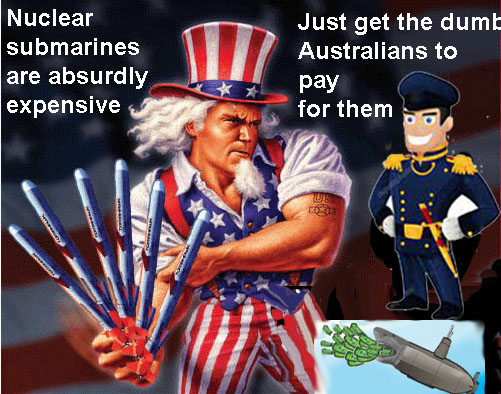
Australia will control nuclear submarines in any conflict with Aukus partners, Albanese says
Guardian, Katharine Murphy and Daniel Hurst, 22 Feb 23
The PM insists Australia will maintain its sovereignty in the event of a disagreement with the US or UK on military strategy
“………………………………….Albanese said the deployment of military assets in the event of any conflict was “a decision for Australia as a sovereign nation, just as the United States will maintain its sovereignty and the United Kingdom will maintain its”.
The prime minister used a speech to the National Press Club on Wednesday to foreshadow increased defence spending as a consequence of the looming government response to the Defence Strategic Review, while characterising the Aukus security arrangement between Australia, the US and the UK as “the future”.
There is persistent speculation the next steps in the Aukus pact will be outlined by the three alliance partners in the US in March.
Paul Keating has previously raised concerns about the potential for Aukus to erode Australian sovereignty. Keating has contended Aukus will see Australia’s strategic sovereignty “outsourced to another state, a North Atlantic state, the United States” which is dangerous, given the US had “no idea what to do with itself in Asia”.
Keating’s concerns about sovereignty are shared by another former prime minister, Malcolm Turnbull. Turnbull has been calling on the government to answer whether nuclear submarines could be “operated, sustained and maintained by Australia without the support or supervision of the US navy”, and whether that effectively meant “sovereignty would be shared with the US”.
Concerns about a diminution of Australian sovereignty were heightened back in 2021 when Biden’s top Indo-Pacific adviser, Kurt Campbell, observed that Aukus would lead to “a deeper interconnection and almost a melding in many respects of our services and working together on common purpose that we couldn’t have dreamed about five or 10 years ago”.
Campbell later clarified his remarks. “I fully understand how important sovereignty and independence is for Australia. So I don’t want to leave any sense that somehow that would be lost,” he said during an Australian webinar ahead of the 2022 election.
The sustained controversy has prompted the defence minister, Richard Marles, to declare in a speech to parliament that acquiring nuclear-powered submarines would “dramatically enhance” Australia’s sovereignty, rather than undermine it.
The head of Australia’s nuclear-powered submarine taskforce says Australia will retain full operational control over the submarines, while potentially having US or British engineers on board to provide technical advice.
During Wednesday’s speech at the National Press Club, Albanese hinted that Australia needed to expand its nuclear research as part of Aukus, saying the arrangement would lead to “greater exchanges as well and greater knowledge buildup”…………..
The prime minister also strongly backed the Asio chief, Mike Burgess, who has stepped up his warnings about espionage and foreign interference…………………. https://www.theguardian.com/australia-news/2023/feb/22/australia-will-control-nuclear-submarines-in-any-conflict-with-aukus-partners-albanese-says
NSW Ports boss backs offshore wind farm plant ahead of nuclear base
ABC Illawarra / By Jessica Clifford, Melinda James, and Tim Fernandez 22 Feb 23
NSW Ports chief executive Marika Calfas has called for the state’s trade needs to be prioritised ahead of a nuclear base, while unveiling plans for an offshore wind farm facility at Port Kembla.
Key points:
- The facility at Port Kembla would support windfarms on the NSW coast
- Port Kembla is adjacent to the federal government’s proposed Illawarra offshore wind development zone
- The project would need significant government investment to proceed.
……………………………. The ABC understands Port Kembla has been identified as the Department of Defence’s preferred site for a nuclear submarine base.
Ms Calfas said she was not aware of the deparment’s plans but said the state’s trade needs should come first.
“We would like to think everyone recognises the importance of ports,” she said.
“Particularly over the last three years with the issues which have occurred globally in terms of supply chains and how important it is that our ports can support the needs of our island nation moving forward.
The Defence Strategic Review was delivered to the government earlier this month with a report expected to be published in March.
Labor Member for Cunningham, Alison Byrnes, recently returned from a tour of a US Submarine base in Connecticut and said the location of the base will not be revealed until after community consultation.
“This process was started by the former government, so they put the three proposed sites on the table,” Ms Byrnes said.
“I have said to our Defence Minister that there needs to be, shortly after the release of the defence strategic review, a community leaders’ consultation to start talking about the way forward … to choose a site for the submarine location.”
Billion-dollar boost to economy
Offshore wind farms have been proposed for parts of the NSW coastline, including the Central Coast, Illawarra and South Coast, but do not yet have final approval.
BlueFloat is among the companies interested in establishing a wind farm off the coast of the Illawarra.
Technical project director David Delamore said the company was looking at establishing two farms about 14 kilometres offshore.
“The project we are looking at is over 100 turbines, this is a huge project it is a billion-dollar project and it needs a large work force as well,” he said.
“We need trained personnel, so we definitely need to be tapping into the local business communities and looking to establish training facilities to address any skills gaps.”
The federal government will begin consultations over the proposed offshore wind farm zones later this year.
Ms Calfas said the lack of certainty for the region makes it difficult for businesses to plan for the future.
“I think the need for clarity and the need for certainty is really important,” she said.
“The sooner we can get that, the sooner everyone can progress with their planning, the sooner everyone can progress with their investment plans and the sooner we can all start delivering on those benefits of jobs and investments.” https://www.abc.net.au/news/2023-02-22/windfarm-future-demands-port-kembla-facilities-planned/102003542
Strict new security rules for Adelaide nuclear submarine-building facility in bid to protect military secrets
Operators of Osborne naval shipyard ordered to guard against ‘deliberate or accidental manipulation’ of critical components.
Daniel Hurst, Guardian, 23 Feb 23,
The Australian government has imposed strict new security rules at the Adelaide site where nuclear-powered submarines will be built, moving to reassure allies that sensitive military secrets will be protected.
The new rules require four operators at the Osborne naval shipyard, including those building the Hunter-class frigates and offshore patrol vessels, to guard against espionage and foreign interference.
These operators have been ordered to prepare for risks such as “deliberate or accidental manipulation” of critical components and the transfer of “sensitive operational information outside Australia”.
According to the new rules, information that must be protected includes layout diagrams, schematics, geospatial information and operational constraints.
The operators must carry out background and suitability checks before people are allowed unescorted access to the shipyard. They must record the date, time and duration of access by every person, whether escorted or unescorted.
The home affairs minister, Clare O’Neil, quietly rolled out the measures last week under the country’s critical infrastructure laws and confirmed the moves when approached by Guardian Australia.
“Our critical infrastructure assets are targets for foreign interference, cybercriminals and other malicious actors who wish to do Australia harm,” O’Neil said in a written response to questions.
“By declaring the Osborne naval shipyard a critical infrastructure asset we can implement security measures and build resilience in the facility and its workforce against these threats.”
The government has said nuclear-powered submarines will be built at Osborne – the first project under the Aukus partnership with the US and the UK – but it remains unclear how soon domestic construction can begin.
The US has previously only shared its naval nuclear propulsion secrets with the UK – in the late 1950s – and US officials are determined to ensure Australia can protect those secrets against foreign spies.
With just weeks to go until the three countries announce the Aukus plans in more detail, the new rules designate the naval shipbuilding and sustainment assets at Osborne as critical infrastructure assets.
The instrument covers areas overseen by four operators – including the government-owned Australian Naval Infrastructure and ASC.
It also applies to the entity trading as BAE Systems Maritime Australia, which will build the Hunter-class frigates, and Luerssen Australia, which has a contract for offshore patrol vessels…………………………….
O’Neil said the country faced “evolving threats” and the Australian government would “continue to use our national security laws to protect the critical infrastructure assets that all Australians should be able to rely on every day”.
In a human rights assessment attached to the new rules, O’Neil acknowledged collecting personal information about employees and contractors had an impact on their right to privacy……………..
The head of Asio, Mike Burgess, warned this week that the online targeting of Australian defence industry insiders had increased since the Aukus announcement a year and a half ago.
Declaring that his agency was taking a “more aggressive counterespionage posture”, Burgess conceded that Australia’s allies and partners were looking for assurances that their military secrets would be protected.
Burgess said one of the reasons he was disclosing the successful operation to expel a “hive of spies” from Australia was because “as we progress Aukus, it’s critical that our allies know we can keep our secrets and keep their secrets”.
He did not disclose the country responsible for the “hive” but said the spies were working undercover – some for years – with sophisticated tradecraft and wanted to steal sensitive information.https://www.theguardian.com/world/2023/feb/23/strict-new-security-rules-for-adelaide-nuclear-submarine-building-facility-in-bid-to-protect-military-secrets
Fury as Japan plans to dump a million tonnes of contaminated water in the Pacific
Japan has a serious problem it can no longer control – and the “solution” has horrified our nearest neighbours, who say a catastrophe is coming.
Alexis Carey@carey_alexis, news.com.au February 23, 2023
Outrage is growing over an “unjust” plan to dump more than a million tonnes of contaminated wastewater on Australia’s doorstep – within months.
In 2011, Japan was rocked by the Fukushima nuclear disaster – the worst of its kind since Chernobyl in 1986.
Responders scrambled to stop damaged reactors at Fukushima’s Daiichi nuclear plant from overheating by pumping massive amounts of water through them, with the contaminated water then being stored in massive tanks at the site.
But now, Japan has run out of space, and in 2021, announced plans to dump 1.3 million tonnes of the contaminated wastewater into the Pacific Ocean.
The water would be treated before being released over a period of several decades, with Prime Minister Yoshihide Suga saying at the time it was “a realistic solution”.
“We will do our utmost to keep the water far above safety standards,” he vowed.
In the almost two years since, Japan has been working out the finer details of the release, which is now due to begin as soon as the northern hemisphere’s spring or summer – Australia’s autumn or winter.
And countries across the Pacific are furious.
Kenichi Takahara, risk communicator of the Fukushima Daiichi decontamination and decommissioning engineering company, visits the Fukushima Daiichi nuclear power plant. Picture: Philip Fong/AFP
‘Catastrophic harm’
Writing for The Guardian soon after the plan was first announced, youth advocates from the region Joey Tau and Talei Luscia Mangioni described it as an “unjust act”.
“To Pacific peoples, who have carried the disproportionate human cost of nuclearism in our region, this is yet another act of catastrophic and irreversible trans-boundary harm that our region has not consented to,” they wrote.
They were referring to the long history of the Pacific being used as the world’s nuclear waste dumping ground, with hundreds of nuclear tests being carried out across the region in the decades since the Second World War.
High-profile individuals and groups from across the Pacific – including from Vanuatu, Fiji, the Marshall Islands and French Polynesia – have also spoken out against Japan’s plan for months on end.
“If it is safe, dump it in Tokyo, test it in Paris, and store it in Washington, but keep our Pacific nuclear-free,” Vanuatu stateswoman and veteran activist of the Nuclear Free and Independent Pacific (NFIP) movement Motarilavoa Hilda Lini said soon after Japan’s plan was unveiled.
“We are people of the ocean, we must stand up and protect it.”
In another moving statement released last year, environmental advocacy group Youngsolwara Pacific likened the release to “nuclear war”.
“How can the Japanese government, who has experienced the same brutal experiences of nuclear weapons in both Hiroshima and Nagasaki, wish to further pollute our Pacific with nuclear waste? To us, this irresponsible act of trans-boundary harm is just the same as waging nuclear war on us as Pacific peoples and our islands.”
But their pleas have fallen on deaf ears – and a string of experts have even voiced support for Japan’s controversial move.
………………………………….But for many critics of the plan, plenty of concerns remain.
“We must prevent actions that will lead or mislead us towards another major nuclear contamination disaster at the hands of others,” the former prime minister of the Cook Islands Henry Puna said just last month, as the deadline for the release looms. https://www.news.com.au/technology/environment/fury-as-japan-plans-to-dump-a-million-tonnes-of-contaminated-water-in-the-pacific/news-story/fbf0c9c3ab7a4414c7e41713a4b0c628
Solar exports and siestas: The energy future where consumers have the power, and can share it too — RenewEconomy

Landmark study looks into Australia’s energy future to see how consumers will use electricity, how they won’t, and how to avoid a potentially bumpy transition. The post Solar exports and siestas: The energy future where consumers have the power, and can share it too appeared first on RenewEconomy.
Solar exports and siestas: The energy future where consumers have the power, and can share it too — RenewEconomy
Korean giant backs plans for Australia’s first commercial solar hydrogen project — RenewEconomy

South Korean industrial giant throws its weight behind Infinite Green Energy plans to develop and build Australia’s first commercial-scale green hydrogen project. The post Korean giant backs plans for Australia’s first commercial solar hydrogen project appeared first on RenewEconomy.
Korean giant backs plans for Australia’s first commercial solar hydrogen project — RenewEconomy
South Australia: Grid with the most wind and solar has the smallest reliability gap
South Australia is leading Australia – and the world – with the amount of
wind and solar within its state grid. And not only is it defying the
skeptics that insisted wind and solar can’t power a modern economy, it’s
also the grid facing the smallest reliability gaps over the coming decade.
South Australia sourced 70 per cent of its local demand from variable
renewables in 2022 – nearly twice the percentage of the second best state
grid (Victoria, with 38 per cent), and more than any other gigawatt scale
grid in the world.
In the December quarter, that average lifted to 80 per
cent wind and solar – and it’s doing this at the end of a long “skinny
grid” that is connected to only one other state – and breaking the
stranglehold that gas generators have over wholesale electricity prices in
Australia and around the world.
Renew Economy 21st Feb 2023
Temperature rise can be stopped. It is a dangerous myth to say that it’s too late to act.

Wildfires raging across Australia. Floodwater submerging an entire third of
Pakistan. Crop-killing droughts striking all corners of the world. For
anyone casting even a passing glance at the news the only conclusion, it
may often seem, is that we’re all doomed.
But beware — that conclusion,
many scientists say, is a fallacy. In fact, the belief that it is too late
for humanity to save itself from climate destruction is a new form of
misinformation that some researchers describe as more dangerous even than
outright denial of global warming. It is a widespread belief, particularly
among the young.
A December 2021 report in the Lancet found that more than
half of 10,000 people aged 16 to 25 surveyed globally agreed that
“humanity is doomed”. Yet Kristina Dahl, a principal climate scientist
at the Union of Concerned Scientists (UCS), says it is a “myth” that we
can do nothing to stop the worst effects of climate change.
“Recent
modelling shows that within about a decade of reaching net-zero current
emissions, we would stop temperature rise,” she says. “It’s things
[like] temperature that are especially responsive to changes in emissions.
There is still a lot that is within our power and there are even parts of
the climate system that respond really quickly to the changes that we make.
So that sense that it’s too late … is really false.”
Times 22nd Feb 2023
TODAY. Painful realisation that our Labor defence minister is even more stupid and subservient to USA than the Liberals were!
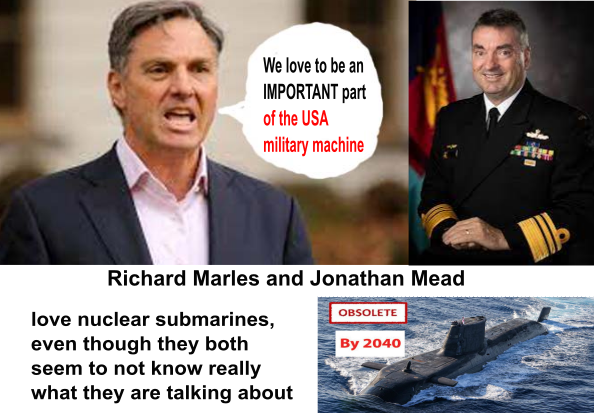
From the Guardian yesterday :
The sustained controversy has prompted the defence minister, Richard Marles, to declare in a speech to parliament that acquiring nuclear-powered submarines would “dramatically enhance” Australia’s sovereignty, rather than undermine it.
I am almost lost for words…. Is Richard Marles really that stupid? (a) to believe this nonsense himself and (b) to think that aware Australians would believe it.
Australia’s “sovereignty” has always been dubious. From 1770 we were absolutely a British colony . From 1901 we were still a British colony in reality, though no longer in name. Australian soldiers went to World War 1, unnecessarily, for the British. I would argue that since 1945, Australia morphed into an American colony, in our gratitude for USA fighting off the Japanese in WW2.
My measure for true colony-status is – going to war on behalf of the boss nation. Australia has enthusiastically (and unnecessarily) sent our young men and women to fight for America’s wars in Korea, Vietnam, Afghanistan – wars that had nothing whatever to do with Australia.
America has got smarter about running wars now. They’ve got Ukraine to try to conquer Russia on USA’s behalf (rather than work out a diplomatic solution to the 8 year war in the Donbass). America just sells Ukraine the weapons . This is a two-way win – both financially and politically – no American lives at risk.
Ukraine is probably a dress rehearsal for the big one – against China. This time Australia will be the patsy.
As a prelude, America sells us $171 billion of nuclear submarines. Which Australia can ill afford. These are so that we can fight China on USA’s behalf, (along with nuclear bombers based in Australia). Once again – the colony practically bankrupts itself, (as in Ukraine), and takes all the risks (as in Ukraine).
Why did I imagine that a Labor government would really be any better that the Liberals, when it comes to international relations?
Instead of macho-muscling up against China, – Australia should be recognising its position as a part of Southern Asia, teaching Asian languages and cultures, and fostering good relations and trade with our neighbours, and honestly expressing our differences. That includes China, which shows no intention to attack Australia militarily. Why should they, when they’re better at spreading influence with trade and culture? The Chinese have a different system, in some ways deplorable, – but evolving, and they are not demons.
NSW Ports prepares to turns Port Kembla into an offshore wind energy hub — RenewEconomy

NSW Ports is planning a futuristic port that can support offshore wind and hydrogen. The post NSW Ports prepares to turns Port Kembla into an offshore wind energy hub appeared first on RenewEconomy.
NSW Ports prepares to turns Port Kembla into an offshore wind energy hub — RenewEconomy
February 22 Energy News — geoharvey

Opinion: ¶ “What Europe Showed The World About Renewable Energy” • One year ago, on the cusp of Russia’s invasion of Ukraine, it seemed unimaginable that renewable energy in Europe could overtake electricity from oil and gas. But not even a year later, it did. By the end of 2022, wind and solar combined overtook […]
February 22 Energy News — geoharvey
Nuclear news- week to 21 February
Some bits of good news – What went right this week: relief for the Great Barrier Reef, plus more. Man Finally Meets Family That Hid Him During Nazi Holocaust 80 Years Ago–And Visits the House.
Coronavirus. Coronavirus Disease (COVID-19): Weekly Epidemiological Update. Current trends in reported COVID-19 cases are underestimates of the true number of global infections and reinfections.
Climate.China provinces top list of regions at risk from climate change. Australian states among world’s most at risk from climate change, extreme weather.
Nuclear. Much the same as last week. USA warmongers panicking about balloons. Nuclear safety issues being downplayed. The media faithfully regurgitating gushing nuclear lobby handouts about small nuclear reactors.
Christina notes: Complacency about nuclear safety – a killer waiting to strike! Bewdy! It’s gonna happen sooner than we thought. Just like Ukraine does against Russia, Australia will fight America’s war against China.
AUSTRALIA
- Submissions to Senate Committee on move to remove Australia’s bans on the nuclear industry – now published.
- Nuclear zealout Jonathan Mead touts nuclear-powered submarines- Australia to have “full control” – (oh yeah?). 7.30 Report: Sarah Ferguson Opens Up New Perspectives on the AUKUS Nuclear Submarine Deal.
- Australian government OK with not knowing whether or not visiting US aircraft carry nuclear weapons! With weasel words, Australia’s top military brass, and sycophant Richard Marles, justify allowing U.S. nuclear weapons in Australia. Irresponsible Politics: Australia’s B-52 Nuclear Weapons Problem, and weasel words from Foreign Minister Penny Wong. The Defence Strategic Review and Australia’s ‘Alliance’ obsession.
- Murdoch Propaganda Pushes Australia To Double Its Military Budget For War With China. Sky News presents rubbishy programme on “preparing Australia for war against China”.
- Kazzi Jai comments on ARPANSA ( The Australian Radiation Protection and Nuclear Safety Agency) and the issue of the mislaid highly radioactive device.
- ANSTO Chief blowing hot air on radioactive waste. French nuclear giant EDF buys massive Australian floating offshore wind project
CLIMATE. Global leaders are dropping the ball on climate change. Rising seas threaten ‘mass exodus on a biblical scale’, UN chief warns. Judge commends Just Stop Oil activists. “No regrets” as UK government portrays nuclear power as “clean” and “green”.
The ‘Icefin’ bore deep into an Antarctic glacier. What it found were temperatures warmer than melting point. Antarctic sea ice level now lowest on record. War is a climate killer.
EARTH EVENTS. Earth Changes Summary – January 2023: Extreme Weather, Planetary Upheaval, Meteor Fireballs.
ECONOMICS. Russia’s Grip on Nuclear-Power Trade Is Only Getting Stronger. EDF’s historic $13.5 billion loss in 2022 – as France became an importer of electricity. Zelensky is literally selling Ukraine to US corporations on Wall Street. https://www.youtube.com/watch?v=2fHZCfRE3n4
EDUCATION. We’ve Forgotton The Potential Horrors of What a Nuclear Winter Would Be Like. Pentagon-Funded Plymouth University Cancels Anti-War Academic: the militarization of higher education.
EMPLOYMENT. Renewable energy workers are in high demand, global survey reveals. At Sellafield nuclear site workers ready to go on strike .
ENERGY. Thousands of solar panels sent to power recovery effort in earthquake devastated Türkiye . France’s nuclear output plummeted in 2022. Small scale renewable technology installations being deployed rapidly in Britain without government subsidies.
ECONOMY.
- EDF posts record net loss after nuclear fleet hit by repairs. Financial disaster looms for France’s nuclear corporation EDF.
- Southern Co boosts cost estimate, delays timing for nuclear reactors.
- Spiralling cost of Hinkley Point C nuclear power station.
- Rolls Royce’s financial problems, as it plans to make small nuclear reactors for the British government.
ENVIRONMENT. Fukushima: Japan insists release of 1.3m tonnes of ‘treated’ water is safe. Campaigners claim permit change at Hinkley Point would kill billions of fish.
INDIGENOUS ISSUES. Some, but not all, First Nations support small nuclear reactors in New Brunswick.
MEDIA. Microsoft Puts New Limits On Bing’s AI Chatbot After It Expressed Desire To Steal Nuclear Secrets. Media Ignores Evidence That West Opposed Ukraine Peace Deal. Pro nuclear film.
NUCLEAR TECHNOLOGY. Checking Back in on China’s Nuclear Icebreaker. Rolls Royce’s “small” nuclear reactor will occupy 5.3 acres..
OPPOSITION to NUCLEAR. Scotland’s campaign groups call on government to reject plans for nuclear power at new Green Freeports.
POLITICS. Coalition for Responsible Energy Development in New Brunswick (CRED-NB) informs Senate with analysis of “advanced” small nuclear reactors. Scotland’s Minister Matheson reassures the Nuclear Free Local Authorities (NFLA) that no small nuclear power station will be permitted near Grangemouth refinery. Small modular nuclear reactors: a good deal for Southwest Virginia? Despite massive losses of nuclear company EDF, and reactor corrosions, France plans to build a new fleet of EPR reactors. France’s government may switch funds from social housing to the cause of propping up the nuclear industry.
POLITICS INTERNATIONAL and DIPLOMACY. Biden says three aerial ‘objects’ US shot down likely not related to China surveillance. EU Commission abandons plans to sanction Russia’s nuclear industry. Ukraine approves second sanctions package targeting Russian nuclear industry Post-war Ukraine – a triumphal land owned by Western business corporations. Iran denies enriching uranium to 84 percent purity amid IAEA row. Iranians Caught Between Optimism, Pessimism Over Nuclear Talks.
SAFETY. Turkey’s Akkuyu nuclear power plant – a useless and dangerous prestige project?. Concerns over the construction of a nuclear power plant in Akkuyu, Turkey, due to its proximity to the 7.8 magnitude earthquake’s epicentre. Quake revives debate over Turkey’s nuclear plant Japan to extend life of nuclear power stations, and also. remove rules specifying the operational periods of reactors. Operational life of Finland’s nuclear reactors extended till 2050, and wastes to be stored onsite till 2090. Sizewell B nuclear station switched off for 66 days for maintenance work. Extending more than two nuclear reactors is dangerous, says deputy prime minister Gilkinet.
SECRETS and LIES. Pentagon testing mass surveillance balloons across the US. Watchdogs File FOIA Request for Holtec’s Secretive “Regulatory Path to Reauthorize Power Operations at Palisades Nuclear Plant”. Ukraine Hawk Who Heads European Commission Has a Nazi Pedigree She Does Not Want You to Know About.
SPACE. EXPLORATION, WEAPONS. NASA Gets High on Its Nuclear Supply. NATO reveals new space fleet.
SPINBUSTER. Japan PM Kishida tells ministers to assuage public concerns over nuclear policy. Object downed by US missile may have been amateur hobbyists’ $12 balloon. What We Know About The US Air Force’s Balloon Party So Far.
WASTES. The World’s Dumping Ground for Nuclear Waste Doesn’t Want Fukushima’s Wastewater. Dumping 1M gallons of radioactive water in Hudson is ‘best option,’ per Indian Point nuclear plant owner.
WAR and CONFLICT. The Horrifying Endgame in Ukraine. Betting on Ukraine victory was ‘suicidal’ – Seymour Hersh. Ukraine ‘peace petition’ backed by nearly half a million Germans. American Architect of the Ukraine War Gives Go Ahead to Attack Crimea. NATO to participate in Ukraine war “for as long as it takes”. Why the US seeks War with China by 2025.
WEAPONS and WEAPONS SALES.
- U.S. military’s newest weapon against China and Russia: Hot air balloon. Alien Balloon Malarkey!
- Setting The Stage For Proxy War Against China? https://www.youtube.com/watch?v=42MGfBIVjkI&t=63s
- U.S. compensates Czech Republic for arms shipments to Ukraine
- Munich: Germany rallies NATO allies, partners to send more tanks to Ukraine
- Germany: Pentagon trains Ukrainian troops on Bradley, Stryker combat vehicles —
- Ukraine Presses US Congress Members for F-16 Jetfighters.
- South Korea’s Nuclear Flirtations Highlight the Growing Risks of Allied Proliferation. South Korea’s First Attempt at Going Nuclear.
- Cities must not be targets.
- N Korea confirms ICBM test, touts nuclear counterattack ability.
- Saudi Arabia says nuclear arms race in the Middle East ‘cannot be ruled out’.
1 This month
17 October, Free Public Talk on Nuclear Issues in South Australia
David Noonan will speak on public interest concerns over the new Roxby Downs Indenture Act 2026 on BHP copper-uranium mining and ore processing in SA, and on how AUKUS may face SA with a High-Level nuclear waste agenda.
Dr Jim Green will discuss international developments in the field of nuclear power including ‘small modular reactors’ and Generation 4 ‘advanced’ nuclear reactor concepts.


Help Aunty Sue Protect Her Land and Sacred Sites From Destructive Rocket Testing.
.

Australians deserve the truth
about
AUKUS – https://aukuspublicinquiry.com/

PETITION – To: Prime Minister Anthony Albanese and the Australian Labor Government

of the week – Australians for War Powers Reform (AWPR)
To see nuclear-related stories in greater depth and intensity

