France what to do as nuclear waste site risks saturation point?

Should saturation happen, France’s reactors would have nowhere to place their spent fuel and would have to shut down
France seeks strategy as nuclear waste site risks saturation point
Reuters, By Benjamin Mallet 3 Feb 23
- Summary
- Macron to chair Council on Nuclear Policy on Friday
- Macron has announced plan for at least six new nuclear reactors
- EDF working on extra refrigerated pool
- France also considering plan to bury waste in clay
LA HAGUE, France, Feb 3 (Reuters) – At a nuclear waste site in Normandy, robotic arms guided by technicians behind a protective shield manoeuvre a pipe that will turn radioactive chemicals into glass as France seeks to make safe the byproducts of its growing reliance on atomic power.

The fuel-cooling pools in La Hague, on the country’s northwestern tip, could be full by the end of the decade and state-owned Orano, which runs them, says the government needs to outline a long-term strategy to modernise its ageing facilities no later than 2025.

While more nuclear energy can help France and other countries to reduce planet-warming emissions, environmental campaigners say it replaces one problem with another.
To seek solutions, President Emmanuel Macron, who has announced plans to build at least six new reactors by 2050, on Friday chairs the first of a series of meetings on nuclear policy that will discuss investments and waste recycling.
“We can’t have a responsible nuclear policy without taking into account the handling of used fuel and waste. It’s a subject we can’t sweep under the rug,” a government adviser told Reuters, speaking on condition of anonymity…….
La Hague is the country’s sole site able to process and partially recycle used nuclear fuel.
France historically has relied on nuclear power for around 70% of its energy, although the share is likely to have fallen last year as the nuclear fleet suffered repeated outages.
Since the launch of the site at La Hague in 1976, it has treated nearly 40,000 tonnes of radioactive material and recycled some into nuclear fuel that can be re-used. The waste that cannot be recycled is mixed with hardening slices of glass and buried for short-term storage underground.
But its four existing cooling pools for spent fuel rods and recycled fuel that has been reused risk saturation by 2030, according to French power giant EDF (EDF.PA), which runs France’s 56-strong fleet of reactors, the world’s second biggest after the United States.
Should saturation happen, France’s reactors would have nowhere to place their spent fuel and would have to shut down – a worst-case scenario that led France’s Court of Audit to designate La Hague as “an important vulnerability point” in 2019.
COOL POOLS AND DEEP CLAY
EDF is hurrying to build an extra refrigerated pool at La Hague, at a cost of 1.25 billion euros ($1.37 billion), to store spent nuclear fuel – a first step before the waste can be treated – but that will not be ready until 2034 at the earliest.
Meanwhile, France’s national agency for managing nuclear waste last month requested approval for a project to store permanently high-level radioactive waste.
The plan, called Cigéo, would involve placing the waste 500 metres (1,640 ft) below ground in a clay formation in eastern France.
Construction is expected in 2027 if it gets approval. Among those opposed to it are residents of the nearby village of Bure and anti-nuclear campaigners
………… Orano, for which EDF accounts for 95% of its recycling business, says it needs clear direction from the government no later than 2025, to give it time to plan the necessary investments.
The costs are likely to be high. Just keeping up with current operations at La Hague costs nearly 300 million euros a year.
Options EDF and Orano are considering include finding a way to recycle the used fuel more than once, but critics say the recycling itself creates more radioactive waste and is not a long-term solution. For now, the backup plan is to fit more fuel containers into the existing pools.
After being cooled in a pool for about seven years, used nuclear fuel is separated into non-recyclable leftovers that are turned into glass (4% of the material), plutonium (1%) to create a new nuclear fuel called MOX, on which around 40% of France’s reactors can run, and reprocessed uranium (95%).
Options EDF and Orano are considering include finding a way to recycle the used fuel more than once, but critics say the recycling itself creates more radioactive waste and is not a long-term solution. For now, the backup plan is to fit more fuel containers into the existing pools.
After being cooled in a pool for about seven years, used nuclear fuel is separated into non-recyclable leftovers that are turned into glass (4% of the material), plutonium (1%) to create a new nuclear fuel called MOX, on which around 40% of France’s reactors can run, and reprocessed uranium (95%).
The uranium in the past was sent to Russia for re-enrichment and return for use in some EDF reactors, but EDF stopped doing that in 2013 as it was too costly.
In spite of the war in Ukraine, which has made many in the West avoid doing business with Russia, EDF is expected to resume sending uranium to Russia this year as the only country able to process it. It declined to confirm to Reuters it would do so.
The facility at La Hague, with its 1980s-era buildings and Star Wars-style control rooms, has its limitations.
“If we had to process MOX fuel in large quantities, the facility today isn’t adapted for it,” Varin said. “For multi-cycle recycling, the technology is not the same, so the modernisation or replacement of installations” would require “significant” investments, he said.
($1 = 0.9098 euros) https://www.reuters.com/business/environment/france-seeks-strategy-nuclear-waste-site-risks-saturation-point-2023-02-03/
Ukraine is sinking. Is the West about to bail out?

Ukraine Is Sinking. Are Western Elites Bailing Out? The UNZ REview, MIKE WHITNEY • FEBRUARY 1, 2023
What makes the RAND Corporation’s latest report on Ukraine so significant, is not the quality of the analysis, but the fact that the nation’s most prestigious national security think-tank has taken an opposite position on the war than the Washington political class and their globalist allies. This is a very big deal.
…………… The RAND Corporation’s new report, “Avoiding a long war: US policy and the trajectory of the Russia-Ukraine conflict”, represents just such a split. It indicates that powerful elites have broken with the majority opinion because they think the current policy is hurting the United States. We believe this shift in perspective is going to gain momentum until it triggers a more-assertive demand for negotiations. In other words, the RAND report is the first step towards ending the war.
Consider, for a minute, this excerpt from the preamble of the report:
“The costs and risks of a long war in Ukraine are significant and outweigh the possible benefits of such a trajectory for the United States.”
This quote effectively sumarizes the entire document. Think about it: For the last 11 months we have been told repeatedly that the US will support Ukraine “for as long as it takes.” The above quote assures us that that’s not going to happen. The United States is not going to undermine its own interests to pursue the unachievable dream of expelling Russia from Ukraine. (Even the hawks no longer believe that is possible.)
Rational members of the foreign policy establishment are going to evaluate Ukraine’s prospects for success and weigh them against the growing likelihood that the conflict could unexpectedly spiral out-of-control. That, of course, would serve no one’s interest and could ignite a direct clash between Russia and the United States. Also, US policymakers will decide whether the ballooning collateral damage is worth the expense. In other words, are the ruptured supplylines, the rising inflation, the increasing energy and food shortages, and the declining weapons stockpiles a fair trade-off for “weakening Russia”. Many would say, “No.”
In some respects, the RAND report is just the first in a long line of falling dominoes. As Ukraine’s battlefield losses mount –and it becomes more evident that Russia will control all the territory east of the Dnieper River– the flaws in Washington’s strategy will become more apparent and will be more sharply criticized. People will question the wisdom of economic sanctions that hurt our closest allies while helping Russia. They will ask why the United States is following a policy that has precipitated a strong move away from the dollar and US debt? And, they will wonder why the US deliberately sabotaged a peace deal in March when the probability of a Ukrainian victory is near zero. The Rand report seems to anticipate all these questions as well as the ‘shift in mood’ they will generate. This is why the authors are pushing for negotiations and a swift end to the conflict. This is an excerpt from an article at RT:
The RAND Corporation, a highly influential elite national security think tank funded directly by the Pentagon, has published a landmark report stating that prolonging the proxy war is actively harming the US and its allies and warning Washington that it should avoid “a protracted conflict” in Ukraine…
(The report) starts by stating that the fighting represents “the most significant interstate conflict in decades, and its evolution will have major consequences” for Washington, which includes US “interests” being actively harmed. The report makes it very clear that while Ukrainians have been doing the fighting, and their cities have been “flattened” and “economy decimated,” these “interests” are “not synonymous” with Kiev’s.” (“Rand calls for swift end to war“, RT)
While the report does not explicitly state that ‘US interests (are) being harmed’, it certainly infers that that is the case. Not surprisingly, the report doesn’t mention any of the collateral damage from Washington’s war on Russia, but, surely, that must have been foremost on the minds of the authors. After all, it is not the $100 billion or the provision of lethal weapons that is costing the US so dearly. It is the accelerating emergence of international coalitions and alternate institutions that has put the US empire on the fasttrack to ruin. We assume that the analysts at RAND see the same things that every other sentient being sees, that Washington’s misguided conflagration with Moscow is a ‘bridge-too-far’ and that the blowback is going to be immense and excruciating. Hence, the urgency to end the war quickly. Here’s a excerpt from the report that was posted in bold print halfway through the text:
“Since avoiding a long war is the highest priority after minimizing escalation risks, the United States should take steps that make an end to the conflict over the medium term more likely.”
…………………………….. Washington’s foolish intervention is clearing the way for the greatest strategic catastrophe in US history. And yet, even now, the vast majority of corporate and banking elites resolutely back the existing policy while shrugging off the obvious signs of failure. Case in point: The World Economic Forum posted a blanket statement of support for Ukraine on its website. Here it is: [on original]
……………………………….. the RAND report may represent the views of the Pentagon and the US Military establishment who believe the United States is racing headlong towards a direct conflagration with Russia. In other words, the report may be the first ideological broadsides against the neocons who run the State Department and the White House. We suspect this split between the War Department and ‘State’ will become more visible in the days ahead. We can only hope that the more judicious faction at the Pentagon prevails.
US makes diplomatic move targeting China
Washington sends diplomats to Solomon Islands after 30-year absence
https://www.rt.com/news/570836-us-embassy-solomon-islands/ 2 Feb 23
The US embassy in the Solomon Islands reopened on Thursday, decades after being shut down as redundant, amid concerns in Washington about the South Pacific archipelago’s overtures to Beijing.
The mission in Honiara will consist of a charge d’affaires, a “couple” of State Department employees and a “handful” of locals, according to Associated Press, which described the reopening as part of an effort to “counter China’s push into the Pacific.”
In a pre-recorded statement, US Secretary of State Antony Blinken said that through its new embassy, Washington will be “better positioned” to advance democracy and “tackle shared challenges.”
Located about 1,800 kilometers northeast of Australia, the Solomons last hosted a US diplomatic mission in 1993, when the State Department decided to downsize due to the end of the Cold War. The US had played a key role in liberating the archipelago from Japanese occupation during the Second World War, in the bloody Guadalcanal campaign.
In 2019, however, Honiara decided to transfer its diplomatic relations with China from the nationalist exiles in Taiwan to the Communist government in Beijing. The decision touched off riots in Guadalcanal, with protesters targeting Chinese businesses and setting fire to the prime minister’s residence.
In 2022, Honiara signed a security agreement with China, causing further alarm in the US and Australia. The State Department informed Congress that reopening the embassy was a priority given China’s “growing influence” and fears of a military build-up in the Solomons.
The US had told the Solomons that Washington would have “significant concerns and respond accordingly” to any “permanent military presence, power-projection capabilities, or a military installation” by China.
The Australian government said any kind of Chinese naval base in the archipelago would be a “red line” for Canberra, while some commentators even called for invading the islands.
In response to those concerns, Solomon Islands Prime Minister Manasseh Sogavare said that Australia remains the “security partner of choice,” and issued assurances that there would be no Chinese military base, insisting the security pact with Beijing “had solely domestic applications.”
Kimba’s “brand” – up till now – praised as Agricultural – but could change to The Nuclear Dump – if the government’s planned facility goes ahead.

Greg Bannon, InDaily, 1 Feb 23, It seems ironic to read that the Kimba District Council is searching for a new brand beyond nuclear waste.
Anyone who has followed this issue of a National Radioactive Waste Management Facility (NRWMF) over the last seven years would know that Kimba has nominated a total of four sites. The first two, along with 23 others Australia-wide, were put up as part of a national invitation to landholders in 2015. Those two were abandoned in 2016, after the Kimba community voted against the proposal.
Members of the community, led by the Council who were unhappy with that decision, applied to the Department of Industry, Innovation and Science (DIIS) for another chance to get the dump, and two new sites were nominated under the Department’s revised guidelines. One of those sites, Napandee, was announced by two previous Coalition Ministers responsible for the decision. DIIS set tight, restrictive guidelines to better control who was considered eligible to in favour of or against the NRWMF. The guidelines were different for the two communities, Flinders Ranges and Kimba, originally vying to be chosen as “host” site.
Minister Matt Canavan originally named Napandee the national winner before resigning to the back bench ahead of the 2019 federal elections. His successor, Keith Pitt, tried to expedite the process by relinquishing Ministerial discretion in favour of having Napandee named in the legislation. If passed, this would have extinguished any legal challenge to the decision. The Bill passed the Lower House but stalled in the Senate due to the Government’s lack of numbers, after which Minister Pitt reverted to the original Ministerial decision to let the Napandee site progress.
Court action by the Barngarla Determination Aboriginal Corporation (BDAC) caused a 12 month halt to the process. A major point of their grievance is that their voice was excluded from the community voting process. A higher court ruling, due in March, is still pending but meanwhile the Adelaide-based Australian Radioactive Waste Agency is pressing ahead with “site characterisation” work. This seems quite a contradiction considering that the new federal Labor Government is committed to legislating a First Australians’ voice nationally, but using its legal powers to fight the Barngarla’s.
Among the reams of propaganda material in support of this nuclear waste facility has been the claim that it would provide a new “industry” for the district. It would be totally unrelated to and independent from agriculture. Originally it promised 15 jobs, before this promise was tripled to 45 including associated tourism and security.
It has never been convincingly explained how 15 jobs became 45 apart, from the fact that the site will temporarily house Australia’s most toxic nuclear waste, intermediate level (needing 10,000 years management), alongside permanent disposal of low level material, which will only need to be managed for 300 years.
It is not hard to see why there is call for the town to be seen as something beyond nuclear. The community has been and still is seriously divided by this issue. If this dump goes ahead there, Kimba will be known forever as the home of Australia’s first national radioactive waste facility. How can something that requires security and management for so long be separated or covered up?
The Kimba district does have many other attractions. The recent harvest has been one of the best, producing high quality grain for the local market and for export. There are such huge areas of Australia that are not suitable for this type of agriculture. https://indaily.com.au/opinion/reader-contributions/2023/02/01/your-views-on-a-sa-towns-non-nuclear-image-and-more/?fbclid=IwAR0tmjuuJuyxrjR8ZP85mfegUCBRxCirHAOg1VPH8faccPAyUBdHwEfp
Missing radioactive capsule found
Authorities in Australia say they have found a tiny radioactive capsule
which went missing last week. Emergency services had “literally found the
needle in the haystack”, authorities in Western Australia said. A huge
search was triggered when the object was lost while being transported along
a 1,400km (870-mile) route across the state.
Mining giant Rio Tinto
apologised for losing the device, which could have posed a serious danger
if handled. The capsule – which is 6mm (0.24 inches) in diameter and 8mm
long – contains a small quantity of Caesium-137, which could cause skin
damage, burns or radiation sickness.
Emergency services used specialised
equipment including radiation detectors during their hunt. Announcing their
find on Wednesday, the state emergency services paid tribute to
“inter-agency teamwork in the face of seemingly insurmountable odds”. The
capsule was found when a vehicle equipped with specialist equipment, which
was travelling at 70 km/h, detected radiation, officials said. Portable
detection equipment was then used to locate the capsule, which was found
about 2 metres from the side of the road, they added.
BBC 1st Feb 2023
https://www.bbc.co.uk/news/world-australia-64481317
Times 1st Feb 2023
https://www.thetimes.co.uk/article/missing-radioactive-capsule-found-australia-search-vk5crqk03
Anthony Albanese supports the AUKUS menage a trois – USA, UK, Australia – despite criticism, and the incompetence in the industry
| CAUCUS ON AUKUS Prime Minister Anthony Albanese says he would’ve signed up to AUKUS had he been leader at the time, Guardian Australia reports, despite calls from former Labor PM Paul Keating to walk away. The diplomatic menage a trois is not just about nuclear submarines, Albo continued — it’s a defence pact between “friends” in an “insecure world”. Incidentally, Defence Minister Richard Marles and Foreign Affairs Minister Penny Wong will meet with their British counterparts today before Marles heads to the US — it’s prep work for the revelations next month about how exactly we will get to own at least eight subs. It comes as the British navy is urgently investigating whether someone repaired one of its nuclear submarines with superglue, the BBC reports, which honestly sounds like a Monty Python skit. |
Ukraine’s Tank Problem – a “game changer” – REALLY?
It is impossible to see how the provision of such weapons, against a larger enemy with no evident sign of capitulation and determined to maintain the fight in the field, however slapdash and ailing, will be a “gamechanger”. That word ought to be scrapped from any credible analysis, but we see it used repeatedly in the tabloid certitude of final victory.
Australian Independent Media February 1, 2023: Dr Binoy Kampmark https://theaimn.com/ukraines-tank-problem/
It seems to be a case of little provision for so much supposed effect. The debates, the squabbles, the to-and-fro about supplying Ukraine with tanks from Western arsenals has served to confirm one thing: this is an ever-broadening war between the West against Russia with Ukraine an experimental proxy convinced it will win through. Efforts to limit the deepening conflict continue to be seen as the quailing sentiments of appeasers, the wobbly types who find democracy a less than lovable thing.
So far, promises have been made to ship the US M1A2 Abrams, Germany’s Leopard 2 and the UK’s Challenger. Others have alluded to doing the same thing – including France regarding its Leclerc tanks – but tardiness fills the ranks, and logistics will make the provision of such weapons a long affair. Re-export licenses will have to be issued, notably regarding the Leopard 2; training Ukrainian tank crews will also need to be undertaken.
All in all, the picture is not as rosy as those in Kyiv think, despite the confident assessment from Ukraine’s Deputy Foreign Minister, Andriy Melnyk that his country’s defence forces would have access to “at least a hundred tanks” within three months.
The US tanks are, for the most part, still grounded in their country of origin, with their deployment potentially delayed for months, if not years. Pentagon deputy spokesperson Sabrina Singh was frank in admitting that, “We just don’t have these tanks available in excess in our US stocks, which is why it is going to take months to transfer these M1A2 Abrams to Ukraine.” Singh, it should also be remembered, expressed the department’s view earlier this month that the tank was hardly suitable for Ukrainian needs, given how its jet turbine engine hungers for JP-8 jet fuel, unlike the diesel engine used by the Leopard and Challenger counterparts.
The engine is also rather tricky to maintain for crews, leaving it susceptible to blowing in the event of error. No less an authority than the Pentagon press secretary US Air Force brigadier general Pat Ryder, admitted that the M-1 “is a complex weapons system that is challenging to maintain, as we’ve talked about. That was true yesterday; it’s true today; it will be true in the future.”
There is also a backlog of orders for the tank. The Lima facility in Ohio, operated by General Dynamics, is the only facility that assembles the Abrams. It can produce a mere 12 tanks per month and must fulfill orders to supply 250 A2 tanks for Poland starting in 2025 to replace the same number of Soviet-era T-72 tanks Warsaw supplied to Kyiv last year. Taiwan also put in an order for 108 M1A2 tanks in 2019. Even getting to work on the 31 units promised by the Biden administration for Ukraine looks to be ambitious.
The wrangling over supplying Ukraine with tanks has been an at times acrimonious affair. This is hardly surprising. European states have their own specific readings, however dark or cautious, about how to approach the supply issue. The magic number being sought by Kyiv is 300. After initial resistance, German Chancellor Olaf Scholz gave in to his peers, both in his coalition outside, to send a company of Leopard 2 tanks and permit countries with the same tanks in their inventories to supply them to Kyiv. A fortnight of aggressive chatter at a number of venues, including Ramstein Air Base, pressing the flesh and breathing down various necks, saw a change of heart and, it has to be said, weak will on the part of the Chancellor.
It is impossible to see how the provision of such weapons, against a larger enemy with no evident sign of capitulation and determined to maintain the fight in the field, however slapdash and ailing, will be a “gamechanger”. That word ought to be scrapped from any credible analysis, but we see it used repeatedly in the tabloid certitude of final victory.
There is Ed Arnold of the Royal United Services Institute, who is confident that this tank transfer “will make a real difference.” But even Arnold attaches a few caveats, noting that much will depend on how Ukraine uses them. “Do they put them straight into the fight as soon as they’re available? Or do they integrate them into larger formations, train and rehearse those larger formations, and spend a bit more time integrating them into the way that they fight to then potentially use in the summer?”
Whatever the answer to such questions, this is a war that will yield no victors and will, in guaranteed fashion, make a mockery of victory. And the only cruel reality here, short of needless oblivion through imbecilic error of judgment, is to get the warring parties to the table to reach an agreement that is bound to cause despair as much as relief. It might, as unpalatable as it seems, require Ukraine to surrender a portion of devastated earth in the east. The unthinkable will have to be entertained.
Australian Radiation Protection and Nuclear Safety Agency (ARPANSA) sends specialist team to Western Australia in search for missing radioactive capsule
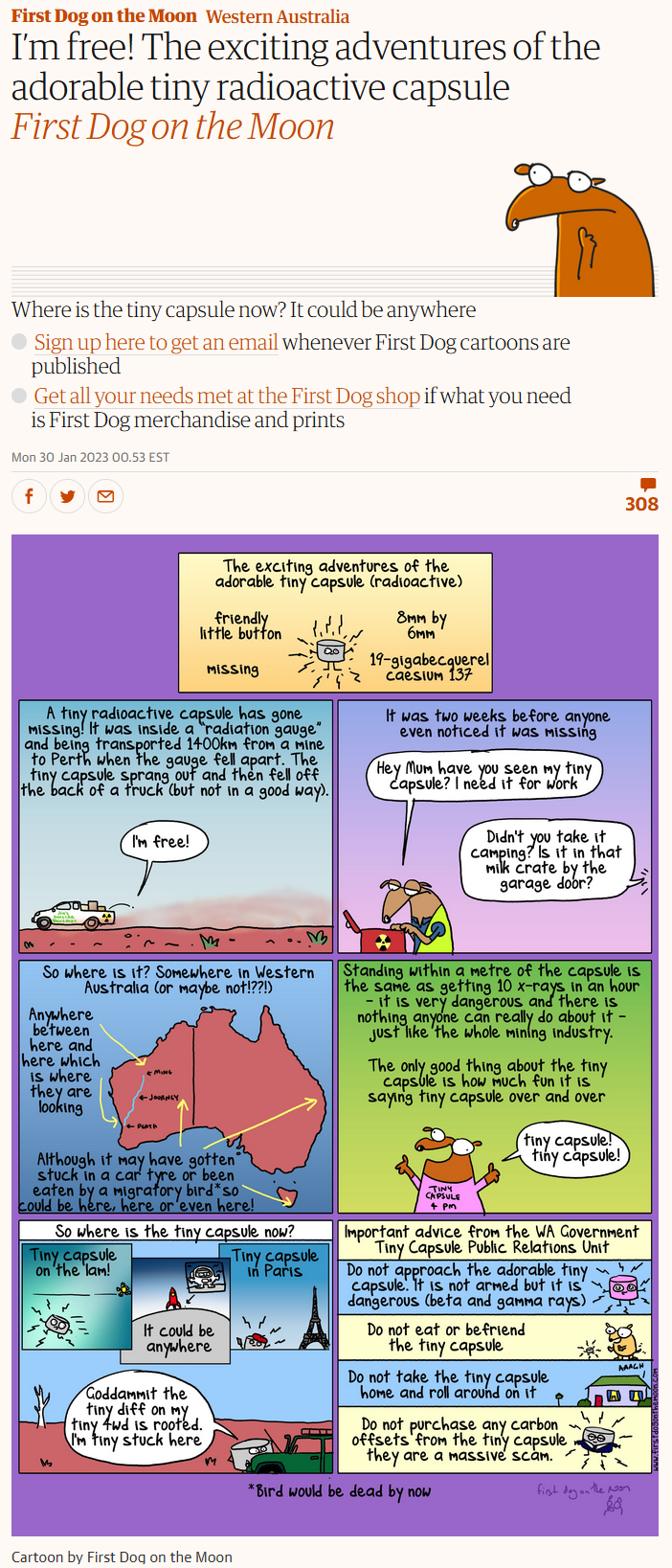
Nuclear safety agency joins radioactive capsule hunt
By Michael Ramsey, January 31 2023 https://www.canberratimes.com.au/story/8067912/nuclear-safety-agency-joins-radioactive-capsule-hunt/
Federal authorities are set to join the massive search for a dangerous radioactive capsule missing in Western Australia.
The 8mm by 6mm item fell out of a density gauge while being trucked from a Rio Tinto mine in the Pilbara to Perth.
Emergency services are searching a 1400km route amid warnings the Caesium-137 in the capsule could cause radiation burns or sickness if handled and potentially dangerous levels of radiation with prolonged exposure.
The Australian Radiation Protection and Nuclear Safety Agency (ARPANSA) on Tuesday said it had sent a deployment team with specialised car-mounted and portable detection equipment to join the search.
Led by WA’s Department of Fire and Emergency Services, the hunt is expected to take five days with vehicles travelling at 50km/h.
Radiation services specialists and detection and imaging equipment are also being sent to WA by the Australian Nuclear Science and Technology Organisation.
Rio Tinto has apologised and ordered an investigation into what went wrong during the haul, which was carried out by a contractor.
Emergency Services Minister Stephen Dawson flagged the WA government was likely to also probe the incident.
“How these are transported does need to be looked at,” he told ABC radio.
“It does puzzle me how such a thing can fall off the back of a truck.”
Rio said a bolt that secured the capsule within the gauge appeared to have sheared off, creating a hole just big enough for the item to escape.
The truck arrived in the Perth suburb of Malaga on January 16 but it wasn’t until nine days later that a technician realised the capsule was missing.
The capsule is smaller than a 10 cent coin but the amount of radiation it emits is equivalent to receiving 10 X-rays in an hour.
Drivers have been warned it could have become lodged in their car’s tyres.
France, NATO enhanced partner Australia to send 1,000s of artillery shells to Ukraine .
AzertagJanuary 31, 2023 France and Australia will send thousands of artillery shells to Ukraine France and Australia will jointly send thousands of 155 mm artillery shells to Ukraine. AZERTAC reports with reference to Anadolu Agency that French Foreign Minister Catherine Colonna, Defense Minister Sebastien Lecornu, Australian Foreign Minister Penny Wong and Defense Minister Richard Marles […]
France, NATO enhanced partner Australia to send 1,000s of artillery shells to Ukraine — Anti-bellum
Despite failure to refit nuclear submarine, UK senior defence officials get £200,000 in performance bonuses!
Three senior ministry of defence officials have received more than
£200,000 in performance bonuses despite not being able to get a
Scottish-based nuclear submarine back in service more than seven years
after it started undergoing a refit and refuelling.
The MoD had hoped that
HMS Vanguard would be returned to Royal Navy service at Faslane last summer
but The Sunday Times has learnt that the repair and refuelling project for
the Trident missile-armed vessel has hit new snags.
However, the three top
executives at the ministry’s Submarine Delivery Agency, which is
responsible for keeping the navy’s submarines in working order, were paid
performance bonuses last year. Its chief executive, Ian Booth, received
£95,000 on top of his £290,000 salary before he retired just before
Christmas, according to the agency’s accounts. Its technical director and
financial officer each received £55,000 bonuses.
Times 29th Jan 2023
https://www.thetimes.co.uk/article/bonus-for-mod-officials-despite-sub-refit-delays-gmqb30s35
The Unwarranted Proxy War:A Year Later

US Big Defence will be the only winner of the proxy war in Ukraine. Not only do these global military contractors arm Ukraine, but they stand to benefit from the re-militarisation of Western European countries, Japan, and new NATO members.
In the view of Big Defence, peace is just a bad business proposition. There’s no money in it.
The World Financial Review, By Dr Dan Steinbock, 27 Jan 23
To Russia and Ukraine, the crisis is an existential issue. To the US and NATO, it’s a regime-change game. To Europe, it means the demise of stability – in the world economy, lost years (and that’s the benign scenario).
That’s how I characterised the US/NATO-led proxy war against Russia in Ukraine back in early March 2022. I argued that it was an “avoidable war that will penalise severely Ukraine, Russia, the US and the NATO, Europe, developing countries and the global economy”.[1]
At the time, the prediction was seen as contrarian. But it has prevailed. However, on January 25 the Ukraine proxy war entered a new, still more dangerous phase. The commitment of some 70 US, German, UK and Polish battle tanks herald lethal escalation, although hundreds more are needed to defeat Russia. For the first time since World War II, German tanks will be sent to the “Eastern front.” In Moscow, it will foster those voices who see the stakes of the war as existential.
Not only will economic and human costs climb even further, but strategic risks, including the potential of nuclear confrontation, will soar. With such escalation in high-tech arms sales to Ukraine, regional and military spillovers are no longer a matter of principle, but a matter of time.
Russia’s economic resilience
In early 2022, Western observers, with rare exceptions, predicted that the Russian economy would default within months as a net effect of sanctions. “Putin’s war” was doomed, they said. Obviously, the sanctions, which have been fuelled by might and economic coercion, have not been inconsequential. But nor were they new.
Already in February 2014, following the Russian annexation of Crimea, international sanctions were imposed against Russia and Crimea by the US, Canada, the EU, and the international organisations they dominate. While the West’s sanctions contributed to the fall of the Russian ruble, they also caused significant economic damage to the EU economy, with total losses at €100 billion in 2015. By mid-2016, Russia had lost an estimated $170 billion due to financial sanctions and another $400 billion in revenues from oil and gas.[2]………………………….
In fact, the Russian economy plunged 3.5 per cent in 2022, whereas inflation amounted to 5.4 per cent. In other words, Western institutions dramatically overestimated the GDP impact. Discrepancies of such magnitude are hard to explain away as simple prediction errors (figure 1 on original).
Proxy war united Russia
Officially, the invasion of Ukraine began as Russia’s “special military operation”. Unofficially, it soon morphed into a US/NATO-led proxy war against Russia in Ukraine. The true political objective of this war has been regime change. Hence the goal “to weaken Russia”, as Secretary of Defence Lloyd Austin acknowledged later. Hence, too, the international media predictions that the Russian economy would “inevitably” default and Putin be overthrown……………………
Today, in the view of ordinary Russians, Russia’s invasion of Ukraine is a defensive response to NATO’s offensive eastward enlargement. They see their country fighting for survival. That’s why the war caused Putin’s ratings to soar to the low 80s. That’s also why over 60 to 70 per cent of Russians support their government and believe the country is on the right track, despite extraordinary hardships. ……………………………………..
Amid this collapse of trust in the US and the EU, it certainly did not help that the Minsk peace process proved to be another Western ruse. Last December, German ex-Chancellor Angela Merkel disclosed in the Zeit newspaper that “the 2014 Minsk agreement was an attempt to give time to Ukraine.” That is, to make Ukraine stronger and for NATO to increase its support to the country in the face of Russia.[4]……………………
In the view of ordinary Russians, there is now a long continuum of betrayals from the pledge that NATO would never expand eastward in the early 1990s to Minsk today. In their view, the West’s recent arms escalation only confirms their worst suspicions.
Contradictory realities
Right before Christmas, President Volodymyr Zelenskyy delivered an emotional wartime appeal to a joint meeting of US Congress, pleading for more military assistance from the lawmakers, who were about to approve $45 billion in additional aid. It was necessary for “eventual victory”.[6]
Yet, there was a huge disconnect between the triumphant declaration and the realities. Earlier in the month, European Commission President Ursula von der Leyen had acknowledged that Ukraine’s losses in the war amounted to 100,000 soldiers and 20,000 civilians, though her tweet was quickly deleted and a new one was released without the true death count (figure 3 on original).[7
Behind the choreographed photo ops and bold sound bites, devastation had been expansive, progressive, and relentless…………..
In September 2022, a month before the Russian winter offensive, a World Bank report estimated that Russia’s invasion had caused over $97 billion in direct damage to Ukraine and it could cost $350 billion to rebuild the country. Worse, Ukraine had also suffered $252 billion in losses through disruptions to its economic flows and production, as well as extra expenses linked to the war.[8] (The report was quiet about the economic and human costs on the Russian side.)
In other words, what Zelenskyy asked in the Congress was less than one-tenth of what is actually needed to rebuild Ukraine.
Ukrainian nightmare
In effect, even as the international media was touting the mirage of Ukraine’s military triumph, the country’s real GDP declined over 35 per cent on an annual basis in the third quarter of 2022; that is, before Russia’s massive infrastructure attack.
Starting on 10 October, Russia’s waves of missile and drone attacks opened a new phase of the war.
The direct physical damage to infrastructure soared to $127 billion already in September; that’s over 60 per cent of Ukraine’s pre-war GDP. The impact on the productive capacity of key sectors, due to damage or occupation, is substantial and long-lasting.[9]
The population share with income below the national poverty line in Ukraine may more than triple, reaching nearly 60 per cent in 2022. Poverty will increase from 5.5 per cent in 2021 to 25 per cent in 2022, with major downside risks if the war and energy security situations worsen.[10] As casualties continue to mount, over a third of the population has been displaced and over half of all Ukrainian children have been forced to leave their homes. The nine months of war have caused massive population displacement. As of October 2022, the number of Ukrainian refugees recorded in Europe was over 7.8 million, and the number of internally displaced people was 6.5 million (figure 4 on original).[11]
As former Pentagon adviser Col. (ret.) Douglas Macgregor has argued, “Washington’s refusal to acknowledge Russia’s legitimate security interests in Ukraine and negotiate an end to this war is the path to protracted conflict and human suffering.”[12]
As former Pentagon adviser Col. (ret.) Douglas Macgregor has argued, “Washington’s refusal to acknowledge Russia’s legitimate security interests in Ukraine and negotiate an end to this war is the path to protracted conflict and human suffering.”[12]
West’s tough 2022 and darker 2023
Currently, the risk of recession casts a dark shadow over the US economy, ……………………………………………..
US and international war funding
In the proxy war, economic and humanitarian aid to Ukraine has been abundant………………………..
Internationally, the US provides the bulk of total aid to Ukraine (62 per cent). Aid from non-US sources amounts to $41.4 billion. The international total of more than $110 billion accounts for more than half of Ukraine’s pre-war GDP ($200 billion).[17] Effectively, these funding arrangements aim to sustain the hostilities and destruction not just in 2023, but at least until the late 2020s.[18] A scenario the West’s recent arms sales escalation could reinforce.
Ailing and indebted, the West cannot afford the proxy war in Ukraine. Hence, the frantic debt-taking. In the Eurozone, government debt to GDP remains close to 100 per cent. Ironically, that’s 40 percentage points higher than the region’s own debt limit. In the UK, the figure has doubled since 2008 to almost 100 per cent. In Japan, it is the worst among all high-income economies – close to 265 per cent, thanks to over two decades of secular stagnation. In the US, the debt ratio has also doubled and is inching toward 140 per cent. (That’s over 20 percentage points higher than that of Italy amid Rome’s 2010 debt crisis.) The rising debt as a percentage of the GDP will slow economic growth, push up interest payments to foreign holders of US debt, and heighten the risk of a fiscal crisis. The periodic debt-limit debacle in the US is just a minor political sideshow to the West’s future debt crisis, which will leave no economy, not even the major ones, unscathed (figure 5 on original).
The post-9/11 wars: the Big Defence bonanza
Ukraine is “absolutely a weapons lab in every sense because none of this equipment has ever actually been used in a war between two industrially developed nations,” said one source familiar with Western intelligence to CNN. “This is real-world battle testing.” Or as Zelenskyy put it more recently, arming Ukraine is a “‘big business opportunity,” as evidenced by his government’s new ties with Blackrock, Goldman Sachs and JP Morgan. In December 2022, he revealed that Ukraine had hired Blackrock to “advice” Kyiv on how to use the West’s reconstruction funds, which he then estimated would have to increase at least to $1 trillion.[19]
As I predicted in March 2022, US Big Defence will be the only winner of the proxy war in Ukraine. Not only do these global military contractors arm Ukraine, but they stand to benefit from the re-militarisation of Western European countries, Japan, and new NATO members. Washington has a great economic interest in such geopolitics. Brussels’ incentives are harder to fathom, especially as the euro area will pay a hefty premium on energy and food, which will also benefit Washington…………………………..
Military Keynesianism to rescue
From the economic standpoint, these military expenditures, including US Ukrainian aid, should be seen as massive, recurrent, multi-year bastard Keynesianism. That is, as a series of military stimulus packages to prop up the American economy (not Ukraine’s). Unlike Keynesian stimuli that can have an accelerator effect in the civilian economy, these packages benefit mainly the Pentagon and Big Defence; that is, the military industrial complex and its revolving-door elites.
Take, for instance, President Biden, Secretary of State Antony Blinken, National Security advisor Jake Sullivan and Blinken’s right-hand, Victoria Nuland. All four were key actors already in the 2014 Ukraine crisis. In one way or another, all are also linked with the Center for a New National Security (CNAS) and its consulting arm WestExec Advisors, which in turn is funded particularly by Big Defence. The same goes for Secretary of Defence Lloyd Austin, a veteran of the US Army and ex-board member of Raytheon, one of the largest defence giants and a big beneficiary of the Ukraine devastation.[22]
what’s good for Big Defence is not necessarily good for either the American people or the global economy. It aggravates income polarisation in America and between the high-income West and the developing Global South, while escalating geopolitical risks worldwide…………………………………
Plunging global growth
Unsurprisingly, global growth is now expected to decelerate sharply to 1.7 per cent in 2023…………………………
The unwarranted war
A year ago, I characterised the Ukraine conflict as an “unwarranted war” because it was avoidable. As declassified files show, a series of security assurances were given to Mikhail Gorbachev and other Soviet leaders against NATO’s eastward expansion at the turn of the 1990s, starting with President George H.W. Bush, followed by a cascade of assurances by German, French, British, and NATO leaders. The betrayal of these pledges was widely condemned already in 1997 by 50 US foreign policy authorities, including the leading Cold War hawks, in an open letter to President Clinton. What has ensued is three decades of NATO eastward expansion, which has made the world poorer and less secure, just as these US experts predicted over 25 years ago.[28]
If in 2022 the proxy war’s costs were disastrous in the West and Russia, 2023 will be worse…………………………….
- The year 2022 turned the Ukrainians’ dream of peace and development to ashes, as over a third of their economy disappeared, perhaps a quarter of the population fled and a generation of young men was sacrificed for the West’s geopolitics. What’s ahead in 2023 will be worse. Reconstruction will require a lot more than $1 trillion, according to Zelenskyy. That’s over five times Ukraine’s pre-war GDP.
- US Big Defence is the big winner of 2022 and, thanks to the military aid arrangements, could reap war profits well into the late 2020s. By then, new big “weapons labs” will be needed elsewhere – North Korea, Taiwan, Iran, perhaps even China, where there’s a will, there’s a way – to ensure new wars that will generate adequate returns.
…………………………………….. In the view of Big Defence, peace is just a bad business proposition. There’s no money in it.
………………………………….. Even in April 2022, after a month of hostilities, Russia and Ukraine tentatively agreed to end the war. Yet, that decision was undermined by former British Prime Minister Boris Johnson. His carefully timed Ukraine visit was designed to stop the talks, which were not acceptable to the US and its allies.[30] Today, in Pentagon, Defense Secretary Lloyd Austin sees the escalation as “a window of opportunity here, between now and the spring.”[31]
Only a year ago, Ukraine, under Zelenskyy’s leadership, was still positioned to play a constructive role as a bridge between Eastern and Western Europe, thanks to its vital position in China’s Bridge and Belt Initiative. Had that future prevailed, Ukraine might today be peaceful. Its GDP would be a third bigger. As a neutral country, its trading relationships would have thrived and it would have attracted investment from Russia and both Western and Eastern Europe. Young men would have good jobs. And Ukrainian refugees would be returning for new opportunities at home. When old sectarian conflicts dissipate, escaping abroad is no longer a necessity and even little children sleep their nights rather than being haunted by nightmares, overshadowed by post-traumatic stress.
Today, all those dreams, too, are in ashes. The proxy war is aimed against Russia. The Ukrainians’ role is to die in it. The puppet masters are the primary beneficiaries.
Chris Hedges: Ukraine: The WarThat Went Wrong

A state of permanent war creates complex bureaucracies, sustained by compliant politicians, journalists, scientists, technocrats and academics, who obsequiously serve the war machine.
This militarism needs mortal enemies — the latest are Russia and China — even when those demonized have no intention or capability, as was the case with Iraq, of harming the U.S. We are hostage to these incestuous institutional structures.
byEDITORJanuary 29, 2023
NATO support for the war in Ukraine, designed to degrade the Russian military and drive Vladimir Putin from power, is not going according to plan. The new sophisticated military hardware won’t help.
By Chris Hedges / Original to ScheerPost
Empires in terminal decline leap from one military fiasco to the next. The war in Ukraine, another bungled attempt to reassert U.S. global hegemony, fits this pattern. The danger is that the more dire things look, the more the U.S. will escalate the conflict, potentially provoking open confrontation with Russia. If Russia carries out retaliatory attacks on supply and training bases in neighboring NATO countries, or uses tactical nuclear weapons, NATO will almost certainly respond by attacking Russian forces. We will have ignited World War III, which could result in a nuclear holocaust.
U.S. military support for Ukraine began with the basics — ammunition and assault weapons. The Biden administration, however, soon crossed several self-imposed red lines to provide a tidal wave of lethal war machinery: Stinger anti-aircraft systems; Javelin anti-armor systems; M777 towed Howitzers; 122mm GRAD rockets; M142 multiple rocket launchers, or HIMARS; Tube-Launched, Optically-Tracked, Wire-Guided (TOW) missiles; Patriot air defense batteries; National Advanced Surface-to-Air Missile Systems (NASAMS); M113 Armored Personnel Carriers; and now 31 M1 Abrams, as part of a new $400 million package. These tanks will be supplemented by 14 German Leopard 2A6 tanks, 14 British Challenger 2 tanks, as well as tanks from other NATO members, including Poland. Next on the list are armor-piercing depleted uranium (DU) ammunition and F-15 and F-16 fighter jets.
Since Russia invaded on February 24, 2022, Congress has approved more than $113 billion in aid to Ukraine and allied nations supporting the war in Ukraine. Three-fifths of this aid, $67 billion, has been allocated for military expenditures. There are 28 countries transferring weapons to Ukraine. All of them, with the exception of Australia, Canada and the U.S., are in Europe.
The rapid upgrade of sophisticated military hardware and aid provided to Ukraine is not a good sign for the NATO alliance. It takes many months, if not years, of training to operate and coordinate these weapons systems………………….
NATO military commanders understand that the infusion of these weapons systems into the war will not alter what is, at best, a stalemate, defined largely by artillery duels over hundreds of miles of front lines. The purchase of these weapons systems — one M1 Abrams tank costs $10 million when training and sustainment are included — increases the profits of the arms manufacturers. The use of these weapons in Ukraine allows them to be tested in battlefield conditions, making the war a laboratory for weapons manufacturers such as Lockheed Martin. All this is useful to NATO and to the arms industry. But it is not very useful to Ukraine.
The other problem with advanced weapons systems such as the M1 Abrams, which have 1,500-horsepower turbine engines that run on jet fuel, is that they are temperamental and require highly skilled and near constant maintenance. They are not forgiving to those operating them who make mistakes; indeed, mistakes can be lethal.
The most optimistic scenario for deploying M1-Abrams tanks in Ukraine is six to eight months, more likely longer. If Russia launches a major offensive in the spring, as expected, the M1 Abrams will not be part of the Ukrainian arsenal. Even when they do arrive, they will not significantly alter the balance of power, especially if the Russians are able to turn the tanks, manned by inexperienced crews, into charred hulks.
So why all this infusion of high-tech weaponry? We can sum it up in one word: panic.
Having declared a de facto war on Russia and openly calling for the removal of Vladimir Putin, the neoconservative pimps of war watch with dread as Ukraine is being pummeled by a relentless Russian war of attrition. Ukraine has suffered nearly 18,000 civilian casualties (6,919 killed and 11,075 injured). It has also seen around 8 percent of its total housing destroyed or damaged and 50 percent of its energy infrastructure directly impacted with frequent power cuts. Ukraine requires at least $3 billion a month in outside support to keep its economy afloat, the International Monetary Fund’s managing director recently said. Nearly 14 million Ukrainians have been displaced — 8 million in Europe and 6 million internally — and up to 18 million people, or 40 percent of Ukraine’s population, will soon require humanitarian assistance. Ukraine’s economy contracted by 35 percent in 2022, and 60 percent of Ukrainians are now poised to live on less than $5.5 a day, according to World Bank estimates. Nine million Ukrainians are without electricity and water in sub-zero temperatures, the Ukrainian president says. According to estimates from the U.S. Joint Chiefs of Staff, 100,000 Ukrainian and 100,000 Russian soldiers have been killed in the war as of last November. …………………………
In desperation, the empire pumps ever greater sums into its war machine. The most recent $1.7 trillion spending bill included $847 billion for the military; the total is boosted to $858 billion when factoring in accounts that don’t fall under the Armed Services committees’ jurisdiction, such as the Department of Energy, which oversees nuclear weapons maintenance and the infrastructure that develops them. In 2021, when the U.S. had a military budget of $801 billion, it constituted nearly 40 percent of all global military expenditures, more than the next nine countries, including Russia and China, spent on their militaries combined.
A state of permanent war creates complex bureaucracies, sustained by compliant politicians, journalists, scientists, technocrats and academics, who obsequiously serve the war machine. This militarism needs mortal enemies — the latest are Russia and China — even when those demonized have no intention or capability, as was the case with Iraq, of harming the U.S. We are hostage to these incestuous institutional structures.
Earlier this month, the House and Senate Armed Services Committees, for example, appointed eight commissioners to review Biden’s National Defense Strategy (NDS) to “examine the assumptions, objectives, defense investments, force posture and structure, operational concepts, and military risks of the NDS.” The commission, as Eli Clifton writes at the Quincy Institute for Responsible Statecraft, is “largely comprised of individuals with financial ties to the weapons industry and U.S. government contractors, raising questions about whether the commission will take a critical eye to contractors who receive $400 billion of the $858 billion FY2023 defense budget.” The chair of the commission, Clifton notes, is former Rep. Jane Harman (D-CA), who “sits on the board of Iridium Communications, a satellite communications firm that was awarded a seven-year $738.5 million contract with the Department of Defense in 2019.”…………………………..
America’s two ruling parties depend on campaign funds from the war industry and are pressured by weapons manufacturers in their state or districts, who employ constituents, to pass gargantuan military budgets. Politicians are acutely aware that to challenge the permanent war economy is to be attacked as unpatriotic and is usually an act of political suicide.
……………………………………………………………………………………………………………….. The plan to reshape Europe and the global balance of power by degrading Russia is turning out to resemble the failed plan to reshape the Middle East. It is fueling a global food crisis and devastating Europe with near double-digit inflation. It is exposing the impotency, once again, of the United States, and the bankruptcy of its ruling oligarchs. As a counterweight to the United States, nations such as China, Russia, India, Brazil and Iran are severing themselves from the tyranny of the dollar as the world’s reserve currency, a move that will trigger economic and social catastrophe in the United States. Washington is giving Ukraine ever more sophisticated weapons systems and billions upon billions in aid in a futile bid to save Ukraine but, more importantly, to save itself. https://scheerpost.com/2023/01/29/chris-hedges-ukraine-the-war-that-went-wrong/
Australian nuclear news – and more
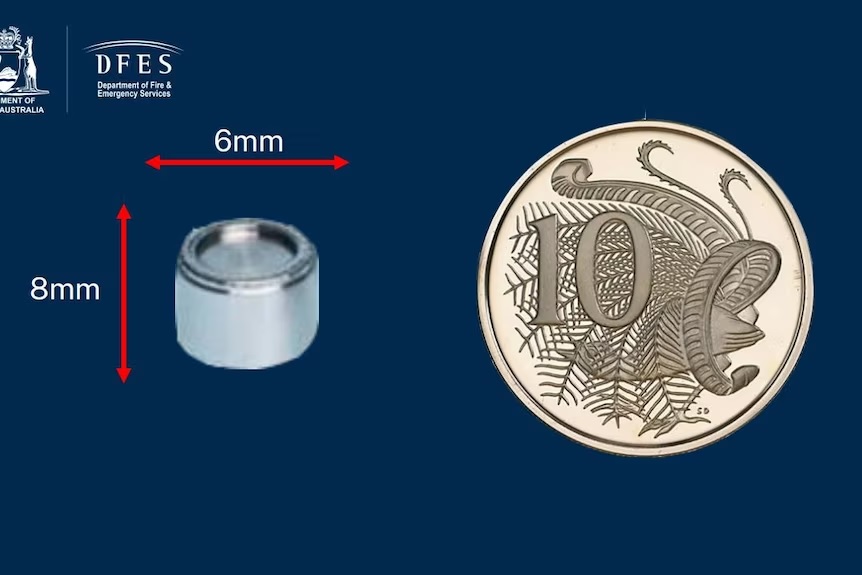
Above – size of the highly radioactive capsule inexplicably mislaid, in Western Australia
Some bits of good news. What went right this week: ‘positive tipping points’. England got a new rewilding site. Cancer Plummets, Guinea Worm Eradicated, Bye-Bye Ebola—3 Huge Wins for Humanity.
The polycrisis is upon us……. pandemic, global heating, nuclear fear, plastic and chemical pollution, biodiversity loss, overpopulation, water shortage ….. all these are interrelated. As Alex Smith shows us, in Radio Ecoshock – this all might develop into a permacrisis. My own thought is that it’s no wonder that many young people have problems of anxiety and depression – in our culture focussed on individualism, money, and endless growth.
Nuclear. This newsletter is miles too long. But it’s a critical time- teetering on the brink of nuclear war. Tanks going into Ukraine – a futile symbol for Zelensky’s dream of conquering Russia, – while underneath it all, rumblings of a cease-fire deal between USA-NATO and Russia, before it all gets a lot worse.
Christina notes: World War 3 danger – it’s getting so like pre World War 1 – can it get any worse? Nuclear toys for the boys. What fun! Nuclear fusion – here’s where history, culture, and nuclear annihilation technology collide.
AUSTRALIA.
- Urgent public health warning issued over lost radioactive capsule in Western Australia. [nb. Kramatorsk radiological accident]. Missing radioactive capsule: WA officials admit it was weeks before anyone realised it was lost.
- Kimba District Council, keen to host nuclear waste dump, but now plans marketing push to get a “brand” different from the nuclear one. Greens Senator Barbara Pocock ‘s reminder that the Kimba nuclear waste storage has no longterm plan for removal of that waste to permanent disposal. Media keeps mum about earthquake near planned nuclear waste dump. Nothing in writing. No guarantees – the planned Kimba waste dump could get highly radioactive nuclear wastes from submarines.
- Nuclear submarines deal an exercise in futility and should be sunk. Nuclear submarines are not going to have ‘any effect’ at all. Australia to become major hub for US submarines, [and target?] Push in US Congress to exempt Australia from International Traffic in Arms Regulations, so that it can import nuclear submarines.
- The Treaty on the Prohibition of Nuclear Weapons is a good step towards a nuclear-free world.
- Bill Gates in Australia – mainly to soft sell his small nuclear reactor business.
Documents show no sign Albanese government lobbied the US to bring Julian Assange home.
CLIMATE. The first breach of 1.5°C will be a temporary but devastating failure. Absurd that we listen to those causing the climate crisis’ in Davos, says Greta Thunberg. https://www.youtube.com/watch?v=EU6vQXif5Xo The ‘all-of-the-above’ story used to sneak nuclear power in as a climate-action technology along with renewables . Suffolk: Sizewell C nuclear ‘should not get licence’ due to coastal erosion.
CIVIL LIBERTIES. Julian Assange and the US government’s war on whistleblowers. https://www.youtube.com/watch?v=QOC-c0QdfEo . The Belmarsh Tribunals Demand Justice for Julian Assange. UK police powers increased, to shut down climate protests. UK govt to tighten anti-protest restrictions, despite criticism from human rights groups .
CULTURE. The dirty secret of US nuclear energy.
ECONOMICS. As the war rages on and military spending booms, the US arms industry is a big winner in Ukraine.
Marketing: South Korea keen to market nuclear technology to United Arab Emirates, and missile technology, too. Poland’s energy company agrees to buy France’s NOT YET DESIGNED so-called “small” Nuward nuclear reactor!
The British government’s Regulated Asset Base – the test case for reviving its nuclear power dream. “Great British Nuclear “- it’s high time that they came clean on what this will cost.
As SMR developer X-energy moves to go public, merger partner Ares cautions investors about risks of small nuclear reactors. David Schlissel: Small modular reactor project likely to end badly for Utah utilities.
EMPLOYMENT. The French nuclear sector up against the wall in terms of recruitment.
ENERGY. Germany aims for faster expansion of wind energy, not nuclear. Prolonged outages of France’s nuclear reactors. Renewable energy is the only credible path forward -António Guterres. Four separate reports show that the UK could save over €120 bn by 2050 by switching to a renewable energy strategy.
ENVIRONMENT. Campaigners fear changes at Hinkley Point C ‘could kill millions of fish every day’. Japan’s Plan To Discharge Water From Fukushima Nuclear Plant Faces Pacific Opposition
HEALTH. Julian Assange’s Biggest Fight in Notorious Prison Isn’t Over Extradition. The WHO is urging countries to start stockpiling medicines for ‘nuclear emergencies’ after the EU’s latest warning on Ukraine war. WHO updates critical medicines list for radiological and nuclear emergencies. Investigation underway after nine nuclear missileers develop non-Hodgkin’s lymphoma. Nuclear strike chief seeks cancer review of launch officers.
LEGAL. Fukushima: court upholds acquittals of three Tepco executives over disaster. UK High Court to hear challenge against plans for Sizewell C nuclear station. The Ohio nuclear scandal: Davis-Besse and Perry power plants in northern Ohio couldn’t cover costs, let alone make a profit. Appeals Court Tosses Suit from Environmentalists, Midland Oil Company Contesting Nuclear Waste Storage Permit.
MEDIA. New documentary film ‘Downwind’ explores why testing, using nuclear weapons makes deadly mistakes .
NUCLEAR TECHNOLOGY. Nuclear Fusion Won’t Save the Climate But It Might Blow Up the World. The Nuclear Fallacy: Why Small Modular Reactors Can’t Compete With Renewable Energy. U.S. approves design for NuScale small modular nuclear reactor, but significant problems remain.
OPPOSITION to NUCLEAR. Demonstrators gather in Hamburg against threat of nuclear confrontation in Ukraine.
PERSONAL STORIES. ‘The day the desert wind cried‘: French nuclear tests cast long shadow in Libyan Sahara.
POLITICS.
- Donald Trump warns of NUCLEAR WAR as Joe Biden sends 31 tanks to Ukraine.
- Ukraine steps up preparations for new nuclear reactors (NO this is not a joke!).
- Military offensives increase nuclear accident odds in Ukraine, warns atomic safety chief.
- Mini nuclear reactor firm snubs Britain for the French: Newcleo blames political chaos for decision to build prototype across Channel. Jeremy in nuclear wonderland. Rolls Royce demands that the UK government decides on tax-payer funding for their small nuclear reactors. 2022 saw the slow demise of the Bradwell B nuclear plan.
- France’s new law on nuclear energy will be a gift to the nuclear lobby. French government moves to fully nationalise the nuclear industry.
- Nuclear Regulatory Commission certifies NuScale’s design for small nuclear reactor, despite predictions on uneconomic costs.
- Canada: Federal gifts for the nuclear and mining industries.
- King Charles wants to honour nuclear test heroes but medals are being delayed by MoD red tape.
POLITICS INTERNATIONAL and DIPLOMACY. The Problem With Primacy – America’s Dangerous Quest to Dominate the Pacific. “Chinese Aggression” Sure Looks An Awful Lot Like US Aggression. Can Talks with China about Nuclear Weapons Be Constructive?
USA tries to prevent a Russian offensive in Ukraine by offering a sort of war endgame deal to Russia. Diplomatic Cables Show Russia Saw NATO Expansion as a Red Line. WikiLeaks cables reveal NATO intended to cross all Russian red lines.
Pacific islands urge Japan to delay release of nuclear plant waste water. France promises to speed up handover of colonial archives and clean up nuclear test sites in Algeria.
SAFETY.
- UK’s ‘Protect and Survive’ nuclear attack advice deemed ‘futile’ in face of modern threats.
- Nuclear power in Ukraine: what would happen if Zaporizhzhia was hit? A reckless response – Ukraine orders more nuclear reactors! Clear and present danger- Ukraine’s reactors remain at risk. The IAEA expands mission in Ukraine to prevent nuclear accident. IAEA sends staff to all Ukraine nuclear plants to reduce risk of accidents. Ukraine says situation deteriorating at Zaporizhzhia nuclear plant. Accident at Russian-controlled Zaporizhzhia nuclear power plant ‘still cannot be excluded’: IAEA . Ukraine storing weapons at nuclear plants.
- Former DEA Nuclear Security Official Says Wyoming Natrium Reactor Not Safe.
- Cracking Under Pressure: Inside the Race to Fix France’s Nuclear Plants. French nuclear safety needs review ahead of reactor lifespan extensions, newbuilds.
- 40 safety incidents with UK nuclear weapons convoys over past 3 years. Call to end practice of transporting nuclear warheads through Cumbria.
- Slovenia Extends Nuclear Plant Operation Until 2043. Slovenia’s nuclear power plant gets permit for a 20 year operating extension.
SECRETS and LIES. In Just Under Three Weeks, Ukrainian-Fired Prohibited “Petal” Mines Maim At Least 44 Civilians, Kill 2, in Donetsk Region. Man arrested on suspicion of terror offences after uranium found at Heathrow.
SPACE. EXPLORATION, WEAPONS. Geopolitics’ New Frontier in Space. NATO activating space war center in France. New NASA Nuclear Rocket Plan Aims to Get to Mars in Just 45 Days. Nuclear-powered rockets to Mars – there are serious safety risks. NASA partners with the military to test nuclear fission-powered spacecraft engine by 2027.
SPINBUSTER. A bit of panic in the UK small nuclear reactor lobby?
TECHNOLOGY. Canadian MP Charlie Angus Questions the Claims of SMRs (Small Modular Reactors) https://www.youtube.com/watch?v=m7nR4P39ALo.
WASTES. Don’t dump on us. China urges Japan to safely dispose of nuclear-contaminated water. France’s nuclear waste agency applies to create a long-term underground storage in Eastern France. France issues a 10,000-page dossier to convince people of the safety of the Cigeo nuclear waste site. US sweetens pot to study siting for spent nuclear fuel. Diluted plutonium disposed of at Carlsbad nuclear waste site as program draws controversy. Many years for removal and disposal of radioactive waste from historic subterranean vaults at Berkeley nuclear power station.
WAR and CONFLICT.
- WAR and CONFLICT. A clear signal to the US leadership that there will be no survivors in any nuclear exchange between the US and Russia. Doomsday Clock reset to 90 seconds to midnight. Doomsday Clock set to 90 seconds to midnight, here’s the plan – ICAN. How Would a Nuclear Winter Play Out?
- US may assist Ukrainian strikes on Crimea – NYT. Ukraine: Is the Hammer About to Fall?. Truth About Tanks: How NATO Lied Its Way to Disaster in Ukraine. NATO’s ‘war against Russia‘ inches ‘closer to direct conflict’. Putin ready for war with NATO and U.S.? Russia plans renewed offensive in Feb over tanks aid https://www.youtube.com/watch?v=mbIwrFgP-VQ Zelenskyy demands more sanctions, as Ukraine reels from Russian bombardment.
- Former US Secretary of State says Pakistan’s 2019 conflict with India almost sparked nuclear war. Israel appears to have been behind drone strike on Iran factory, U.S. official says.
WEAPONS and WEAPONS SALES. SCOTT RITTER: The Nightmare of NATO Equipment Being Sent to Ukraine. CNN: Ukraine Has Become a ‘Weapons Lab’ for Western Arms . Ukraine Narrative Fraying, But Weapons Will Continue To Flow. AP: NATO powers, Ukraine in “fast-track” talks for long-range missiles, warplanes . Ukraine war boon/boondoggle for U.S. arms makers, Pentagon’s warfighting capabilities.
Biden to send 31 Abrams tanks, Germany 14 Leopards for war in Ukraine — . Germany Says US Must Lead Way On Tanks For Ukraine, As Republican Party Also Piles On Pressure . Ukraine: Germany spearheads delivery of 90 tanks from NATO allies, partners . Finnish arms to Turkey in NATO quid pro quo, tanks to Ukraine next. Ukraine intensifies pressure on Georgia to enter war: ruling party leader . German foreign minister: “We are fighting a war against Russia” https://www.youtube.com/watch?v=wCJUf5d6UfE
Nuclear Notebook: United States nuclear weapons, 2023. Pentagon can’t account for $220 billion in govt property, fails fifth audit. It comes down to weapons.
Plutonium Pit Bomb Plans Excoriated by General Accounting Office.
Cost Estimate for Plutonium Pit Project at Savannah River Site Hits $16.5 Billion, $5 Billion above Current Estimate .
US Installs New Nukes in Europe: As Destructive as 83 Hiroshima Bombs.
The US has a new nuclear proliferation problem: South Korea. The Disastrous Downsides of South Korea Building Nuclear Weapons.
1 This month
17 October, Free Public Talk on Nuclear Issues in South Australia
David Noonan will speak on public interest concerns over the new Roxby Downs Indenture Act 2026 on BHP copper-uranium mining and ore processing in SA, and on how AUKUS may face SA with a High-Level nuclear waste agenda.
Dr Jim Green will discuss international developments in the field of nuclear power including ‘small modular reactors’ and Generation 4 ‘advanced’ nuclear reactor concepts.


Help Aunty Sue Protect Her Land and Sacred Sites From Destructive Rocket Testing.
.

Australians deserve the truth
about
AUKUS – https://aukuspublicinquiry.com/

PETITION – To: Prime Minister Anthony Albanese and the Australian Labor Government

of the week – Australians for War Powers Reform (AWPR)
To see nuclear-related stories in greater depth and intensity

