Watchdog estimates civilian death toll from Ukrainian attacks on Donbass
https://www.rt.com/news/568395-us-troops-deployed-estonia/ 14 Dec 22, More than 4,500 people have been killed since mid-February, with supplies of NATO weapons resulting in a surge of deaths, observers claim.
Weapons supplied to Ukraine by NATO countries have allowed Kiev’s military to significantly ramp-up attacks on civilian targets in Donbass, a local watchdog has said.
The group claims that over 4,500 civilians have been killed and 4,000 injured since Ukrainian forces escalated shelling in mid-February.
Military terror has escalated beyond all limits after NATO members started supplying weapons to Ukraine,” the Joint Center for Control and Coordination (JCCC), a monitoring group that tracks attacks on the Lugansk and Donetsk People’s Republics, said on Wednesday.
“We have recorded a four-fold increase in the number of victims among the civilian population,” Natalya Shutkina, a representative from the Donetsk People’s Republic at the JCCC, said as quoted by TASS.
The JCCC held a press conference on Wednesday during which it showed fragments of Western shells and rockets collected after Ukrainian strikes in Donbass and explained the toll these attacks had taken.
Since February 17, 4,527 civilians have been killed, including 154 children, Shutkina stated. Another 4,317 civilians, including 274 children, have been injured, she said, adding that Ukrainian attacks have damaged over 12,000 homes, 128 medical facilities, and 67 sites required for providing basic utilities, such as water and heating.
The record-keeping begins in mid-February when the Donbass republics reported a significant escalation of strikes by Kiev in the lead-up to Russia having recognized the DPR and LPR as sovereign states and pledged to defend them. The two regions have since been incorporated into Russia following referendums in September.
Shutkina pointed out that the weapon systems provided by the US and its allies are supposed to be more accurate than the Soviet-era artillery guns and rocket launchers that Ukraine possessed previously. This leads the JCCC to believe that the Ukrainian attacks on civilian facilities have been intentional rather than being part of indiscriminate strikes, she stressed.
READ MORE: Children injured in Ukrainian shelling of Donetsk – authorities
Darya Morozova, the human rights ombudsman for the DPR, urged international organizations to acknowledge Kiev’s actions, arguing that “if the world community didn’t encourage the Ukrainian leadership with its inaction, the war in Donbass would have stopped a long time ago.” She called on Kiev’s sponsors to stop sending heavy weapons to Ukraine.
Media enthuses over “sexy”high tech nuclear energy, but ignores the really effective one – energy saving.

It’s that time of year when editors seem happy to let a few dubious stories
through. Most of the media ran with this one on yet another nuclear fusion
breakthrough- this one at the Lawrence Livermore labs in California, at the
National Ignition Facility.
Well, with the climate change threat looming,
non-fossil energy is a big issue just now- and its certainly cold out! So
is help at hand? Well no, not for some time at least. And at unknown cost.
Even if this laser based system, which was designed primarily for
replicating the physics of H-bomb ignition, can be made to deliver energy
on a large scale reliably and safely, it’s going to take a while- it’s a
very long shot.
An equally familiar but arguably much more welcome
newspaper article was this one on energy saving. As seems to be said almost
every week now, saving energy saves money. And it’s available now. But no
one seems to notice.
Energy conservation is just not sexy. Not like high
tech fusion or hydrogen- which also these days regularly gets star billing.
Well hydrogen may have some applications, but in a wide ranging critique,
Michael Liebreich, BNEF founder, says not that many.
It’s not the
wonder-fuel it’s been billed as. He is not happy: ‘we are going to waste
huge amounts of money on the wrong use cases for hydrogen and the wrong
infrastructure in the wrong places’. Few seem happy either about the
proposed new coal mine in Cumbria, but support for solar farms seems to be
missing in Tory UK, although, in the EU, there seems to be support for
putting solar in space…What an odd world. With Russia still calling many
of the shots: according to a new Parliamentary Briefing Note, ‘it is
currently the only country capable of commercially providing the more
enriched fuel needed for Advanced Modular Reactors’, which some look to the
replace the current type of nuclear technology.
Renew Extra 17th Dec 2022
https://renewextraweekly.blogspot.com/2022/12/an-end-of-year-whimsy.html
Risen Energy to build its first big battery in Australia with “gamechanger” Arena funding — RenewEconomy

Arena funding means Risen Energy will build its first big battery in Australia, with another three in the company’s project pipeline. The post Risen Energy to build its first big battery in Australia with “gamechanger” Arena funding appeared first on RenewEconomy.
Risen Energy to build its first big battery in Australia with “gamechanger” Arena funding — RenewEconomy
Iberdrola, Abel to build giant renewable hydrogen and green fuels plant in Tasmania — RenewEconomy

Spanish energy giant Iberdrola to work with Abel Energy to build a world-scale green hydrogen and methanol production plant in Tasmania. The post Iberdrola, Abel to build giant renewable hydrogen and green fuels plant in Tasmania appeared first on RenewEconomy.
Iberdrola, Abel to build giant renewable hydrogen and green fuels plant in Tasmania — RenewEconomy
Neoen to add big battery to what is now Australia’s biggest solar farm — RenewEconomy

Neoen to add big battery to what is now the country’s biggest operating solar farm in Queensland. The post Neoen to add big battery to what is now Australia’s biggest solar farm appeared first on RenewEconomy.
Neoen to add big battery to what is now Australia’s biggest solar farm — RenewEconomy
TagEnergy to press go on big renewables hub in north Queensland after battery win — RenewEconomy

Rapidly emerging TagEnergy announces new renewables hub in north Queensland after ARENA battery funding win. The post TagEnergy to press go on big renewables hub in north Queensland after battery win appeared first on RenewEconomy.
TagEnergy to press go on big renewables hub in north Queensland after battery win — RenewEconomy
Star of the South gets head start as Australia’s offshore wind race officially launched — RenewEconomy

Australia’s offshore wind industry launched, with formal declaration of first development zone and a leg-up to the 2.2GW Star of the South project. The post Star of the South gets head start as Australia’s offshore wind race officially launched appeared first on RenewEconomy.
Star of the South gets head start as Australia’s offshore wind race officially launched — RenewEconomy
December 18 Energy News — geoharvey

Science and Technology: ¶ “Satellite Will Measure Most Water On The Planet” • The first mission to survey nearly all of the water on Earth has launched. It is a joint effort of NASA and the French space agency Centre National d’Études Spatiales. It will survey water on more than 90% of the world’s surface, […]
December 18 Energy News — geoharvey
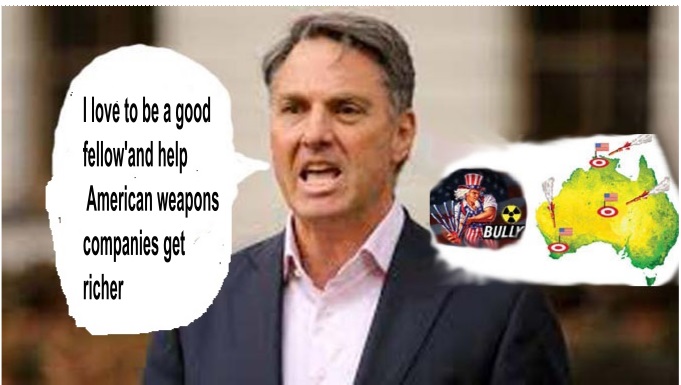
Australia’s defence industry and Minister Richard Marles dazzled by (useless) B-21 Raider Stealth Bomber
US B-21 tempts the Australian security establishment
more https://johnmenadue.com/star-struck-lunacy-the-b-21-tempts-the-australian-security-establishment/
By Binoy KampmarkDec 16, 2022,
The United States does not need it. No air force does. But the lesson of the dazzle from the B-21 Raider Stealth Bomber is that what the US develops and acquires Australia must have. Such a lesson ought to be unlearned as quickly as possible, but there is little chance of it with individuals such as Richard Marles in the defence portfolio.
The fantasy of having a deterrent effect to be projected over thousands of miles is found in a few documents that deserve to gather dust, most notably the 2020 defence strategic update which proved alarmist about Australia having a ten-year threat “window”. Marles, adjusting to the furnishings of his office, claims that the Australian Defence Force “must augment its self-reliance to employ and deliver combat power through impactful material and enhanced strike capability – including over longer distances.”
Marles, in his speech to the Sydney Institute, provides some padding around the commissioned Defence Strategic Review, which will feature war drums, loud signals of threat and existential doom, along with much belligerent hollering. It will, as Marles promises, acknowledge the replacement of “post-Cold War optimism” with “the reality of renewed major power competition.”
This was hardly a bad thing for Marles and other members of the national security state. Such competition made Australia “more relevant now than at any time in our history.” Far better to be relevant to your adversaries in danger than safe and less conspicuous in prosperity and development.
Support is also forthcoming from Marles’ shadow counterpart, Andrew Hastie. In his words delivered at a Business News Breakfast, having such bombers would allow Australia “to hold an adversary at risk beyond the archipelago to our north”, thereby maintaining “a strong deterrent to any regional aggressor”. This would “show that there is a great cost for any unilateral military adventurism. It is simply responsible national security, and is what Australians expect.”
What a novel way of reading the sentiment of Australians, one matched only by Hastie’s own sense of paranoia, which warns of “Chinese influence” and its projection like canker “deep into the Pacific Island chain, ensnaring the heart of at least one national leader.”
The Australian Strategic Policy Institute parrots the strategic delusion: that Australia must employ “the concept of deterrence by denial that is, having sufficiently robust capabilities to convince an adversary that the cost of acting military against Australia isn’t worth any gains that might be made.” It laments the “ADF’s strike cupboard” as being “rather bare.”
To aid this well-funded nonsense, much of it from the US military-industrial complex, the usual psychic disturbances typical among national security types are revealed. “The worst-case scenario for Australia’s military strategy has always been the prospect of an adversary establishing a presence in our near region from which it can target Australia or isolate us from our partners and allies.”
The authors positively salivate at the qualities of an “extremely stealthy bomber”, and while admitting that there is little in terms of clarity about what the B-21 can actually do, extol its “gold standard in strike capability” which “could potentially be delivered by 2032-33.” Yet again, defence fantasists inhabit a future that, when arrived at, tends to be rather different to the astrological version.
In a lunatic turn, the report also suggests the purchase of 12 such bombers. (Yet again, the magic 12 appears, just as it did with the scotched Naval Group-Australian submarine contract.) The price will come in at a foolish, draining, AUD$28 billion (or possibly three million dollars less – but who’s counting?). We can at least be assured that it would be “significantly less than nuclear-powered submarines.”
The authors justify this flight of fancy by suggesting various advantages that “potentially offset” the cost. “A single B-21 can deliver the same effect as many F-35As. The stealth bombers would not require the overhead of supporting capabilities such as air-to-air refuellers when operating in our region.” And wait, another fabulous advantage: such bombers could “prosecute targets from secure bases in Australia’s south, where they would have access to workforce, fuel and munitions.”
Veteran strategist Hugh White, at the very least, offers a voice of balance, opining that thinking about the military, not as a practical tool “but as a symbol of strategic intent” is an “expensive habit”. White advocates, in place of such an overpriced, and essentially irrelevant acquisition, splashing out for “a larger fleet of cheaper aircraft” capable of delivering “more missiles against an enemy fleet than a smaller fleet of more expensive ones. It would be equally capable of launching long-range stand-off attacks on Chinese bases in the Southwest Pacific.”
Such behaviour and decision-making can only suggest how serious Australia’ defence planning should be taken, which is obviously not much. Such an inability to discern real threats, incapable of using delicate diplomacy, and slavishly embracing the latest souped-up trends from Washington, Beijing must surely see those in Canberra as less threatening than habitually foolish.
The revolving door: Kim Beazley, former WA governor, ex Labor defence minister moves quickly on to a Defence industry board
Revolving doors and undue influence
The ‘revolving door’ is a term used to describe the movement of individuals from public roles into related private industry roles and vice versa. Such moves are not illegal and not necessarily problematic. Declassified Australia is not alleging any illegal activity by Kim Beazley. However, given the potential for undue influence and conflicts of interest, global integrity bodies recommend clear guidelines and a transparent process of scrutiny and approval before such appointments take place.
Unfortunately, Australia’s guidelines for managing revolving door appointments are weak and largely unenforced. It is also unclear whether they exist for certain positions, such as state governors.
Bomber’s revolving doorway, By Michelle Fahy Dec 16, 2022
There is a never-ending conga line of politicians, intelligence, military and defence officials quick-stepping through revolving doorways onto the boards of lucrative military weapons companies.
Kim Beazley, former WA governor, ex Labor defence minister, two-time federal opposition leader, and former ambassador to the USA, was known, because of his enthusiasm for all things military, as ‘Bomber Beazley’ during his Defence ministership.
Just two months after his vice-regal role ended on 30 June this year, he joined the board of defence contractor Luerssen Australia. The move is another example in the long list of Australia’s revolving door appointments in the military-industrial sector.
In 2018 the federal government awarded Luerssen Australia, the WA-based subsidiary of the German naval shipbuilder Lürssen, a contract to supply twelve Offshore Patrol Vessels to the navy. The $3.7 billion contract was one of 28 projects listed as a concern in October by new defence minister Richard Marles, and was said to be running a year behind schedule.
Quality issues with the hull of the third vessel, being built by Luerssen’s WA project partner, the engineering firm Civmec, were revealed last month by unnamed defence sources to the Australian Financial Review. The first two vessels were built by Luerssen’s South Australian partner, ASC, at Osborne near Adelaide.
In February this year, Beazley, then WA state governor, made an official visit to Luerssen at Civmec’s facility in the Australian Marine Complex at Henderson, 35 kilometres south of Perth, where the remaining ten vessels are planned to be built.
The Morrison Government invested around $1.5 billion in infrastructure at both the marine complex at Henderson and at Fleet Base West at HMAS Stirling. Just across the waters of Cockburn Sound from Henderson, Stirling, Australia’s largest naval base, has long been coveted by the US military as an Indian Ocean base for its nuclear submarines and other naval ships.
Photos and a story of Beazley’s visit to Henderson were posted on the WA Government House website, including his description of the Luerssen vessel as ‘the ship of the future’.
Then, in early May this year, Governor Beazley met with a delegation of Luerssen executives at WA’s Government House. Present at this meeting were two Australian executives, Jens Nielsen, Luerssen Australia’s chief executive, and Matt Moran, its strategy and government relations executive. More significantly, however, there was also Tim Wagner, the chief executive of Naval Vessels Lürssen (NVL) Group, the German multinational conglomerate that owns Luerssen Australia. Government House downplayed Wagner’s presence, describing him only as the chairman of Luerssen Australia.
The Government House webpage says the Luerssen executives updated the Governor on the offshore patrol vessel program and that discussion then turned to ‘the possibilities of relocating further defence industry works to Western Australia to bolster our sovereign shipbuilding capabilities’. No further details are provided.
There is a wider context that raises questions about what was discussed at this meeting, which took place less than three weeks before the federal election and just four months before Beazley joined Luerssen’s board. In response to a request from Declassified Australia for more details, Beazley said only that, “Discussions centred on the subject on the website”, the subject being the sentence quoted above.
What is Lürssen seeking?
The possibility of a multinational naval shipbuilder relocating potentially billions of dollars of additional works to Henderson is significant. It could become more so if reports in international media of potential consolidation in the German naval shipbuilding industry, including speculation about a possible merger between ThyssenKrupp Marine Systems (TKMS) and Lürssen, prove accurate. TKMS is the large naval shipbuilding subsidiary of German industrial giant ThyssenKrupp. It was one of the three firms shortlisted for Australia’s ill-fated submarine contract, losing out to France’s Naval Group.
Lürssen launched its new NVL Group entity, which Wagner leads, in October 2021 to house its naval shipbuilding businesses, separating them from its super yacht division, a move that indicates it may be positioning itself for future industry consolidation.
In November, executives from TKMS were in Canberra seeking meetings with Australian Navy officials to discuss a potential new shipbuilding project, which the Financial Review said could lead to the Navy scrapping the offshore patrol vessels and replacing them with more heavily armed corvettes.
This may be significant because Lürssen and TKMS are already working in partnership (also see here) supplying the German navy with corvettes. No formal Australian corvette project yet exists, but it’s reported that it is being considered as an option by the Albanese government’s Defence Strategic Review.
Beazley’s term as WA Governor ended on 30 June 2022. Luerssen Australia announced his appointment to its board on 30 August 2022.
Beazley has joined the former chief of navy, Christopher Ritchie, and former Howard government cabinet minister John Sharp on the Luerssen Australia board. Both Ritchie and Sharp have also accepted other board positions with foreign arms manufacturers.
Sharp was with European group Airbus, a significant federal defence contractor, from 2002–2015, prior to joining Luerssen in 2017. Ritchie was a director of Lockheed Martin Australia, local subsidiary of the world’s largest arms manufacturer, from 2013–2020, adding the Luerssen board in 2017.
Ritchie is also chair of the AMDA Foundation, curiously a registered charity, that organises arms industry expos around Australia for local and international defence officials, military representatives, and arms corporations to network and do business.
The Luerssen board appointment is not Beazley’s first move through the revolving door. After returning from Washington DC, where he had been ambassador from 2010 to 2016, he joined Chris Ritchie on the board of Lockheed Martin Australia.
Around this time, Beazley was appointed as co-chairman of the Australian American Leadership Dialogue, a Director and Distinguished Fellow at the Perth USAsia Centre, and president of the Australian Institute for International Affairs
Beazley was also appointed a Distinguished Fellow at the Australian Strategic Policy Institute (ASPI), for whom he wrote and spoke regularly. ASPI is designed to be the federal government’s ‘independent’ primary source of external advice on defence and national security matters, though there are serious questions over its independence, as shown previously by Declassified Australia.
Beazley left Lockheed’s board in April 2018 ahead of taking up the WA governorship. Since resigning as governor, he has taken up the role of chairperson of the Australian War Memorial, which has been sponsored by weapons manufacturers Lockheed Martin, Thales, BAE, and Boeing.
Defending the state
Two months after the Turnbull government signed the offshore patrol vessel contract with Luerssen Australia in late January 2018, WA Labor Premier Mark McGowan visited Lürssen’s Bremen headquarters in Germany. There he discussed the program and Western Australia’s potential as a base for defence exports into the Asia-Pacific region.
McGowan said his government had “identified defence as a key pillar for diversifying Western Australia’s economy, creating more jobs for Western Australians”.
Within days of returning to Australia, McGowan announced Kim Beazley’s appointment as governor. “[He is] a great West Australian, a great advocate for our state, someone respected across the political divide, someone that can represent our state overseas… someone that can represent us interstate and be an advocate for WA in a unique way.” Beazley commenced in the vice-regal role on May 1.
The following year, Governor Beazley undertook his first official visit, to the United Kingdom and Germany, from 25 March–2 April 2019. While in Germany, his official engagements included a site visit to the Lürssen corporation. Beazley and WA Government House both declined to respond to Declassified Australia about the purpose of this visit.
While in London, in addition to meeting with Queen Elizabeth II, some of Governor Beazley’s engagements were specifically defence industry related. He met with Sir Roger Carr, the chair of BAE Systems, the UK’s and Europe’s largest arms manufacturer, and sixth largest globally. He made a site visit to Airbus, a global top 15 arms multinational, which has established a drone launch site in WA. He also gave a keynote address to a gathering at the King’s College London’s Menzies Australia Institute event, Contemporary thinking in Australian defence policy.
Expanding the role of governor into ‘strategic’ advocacy
In May 2019, WA Today reported that Governor Beazley had won an additional $1.4 million in the McGowan government’s 2019 Budget. The budget on page 85 revealed that the extra funding covered the new Governor’s ‘expanded role of advocacy and representation’.
WA Treasurer Ben Wyatt told Perth radio the budget increase was because the Governor would help attract a bigger share of Australia’s defence industry to WA in addition to performing his job under the constitution, the report said. It quoted Wyatt:
The deal is that the Governor is uniquely placed to advocate for WA in respect of doing what we’ve been trying to be doing… in attracting more defence investment into Western Australia…
As a result of that, that’s why three extra staff have been allocated to the Governor.
This is unique, there’s no question about that in respect of roles the Governor has traditionally played. But, because we’re very fortunate to have a Governor that has quite a global background… we want to attract more jobs.
Wyatt said while advocacy was not the Governor’s formal role, the Governor’s expanded responsibilities were ‘not political’: “Under the constitution, this is a broader remit that has been asked of him and it’s one that I think is not in conflict with the constitution.”
The WA Government House website entry for ‘Role of the Governor’ was updated to read: ‘The Governor advocates for the State’s strategic interests and capabilities’, and ‘The Governor has a key role in… promoting the strategic interests and capabilities of the State’.
Premier McGowan said the inclusion of advocacy by Beazley had ‘modernised’ the role of governor.
Revolving doors and undue influence
The ‘revolving door’ is a term used to describe the movement of individuals from public roles into related private industry roles and vice versa. Such moves are not illegal and not necessarily problematic. Declassified Australia is not alleging any illegal activity by Kim Beazley. However, given the potential for undue influence and conflicts of interest, global integrity bodies recommend clear guidelines and a transparent process of scrutiny and approval before such appointments take place.
Unfortunately, Australia’s guidelines for managing revolving door appointments are weak and largely unenforced. It is also unclear whether they exist for certain positions, such as state governors.
The WA Public Sector Commission has developed an integrity strategy for public authorities. It has however advised Declassified Australia it doesn’t issue a code of conduct for the WA Governor. WA Government House declined to respond to questions from Declassified Australia about whether any such guidelines exist for the role of governor.
In 2018, the Grattan Institute produced a report – Who’s in the room? – which notes that Australia is vulnerable to policy capture by vested interests and that a key risk factor is Australia’s “lax revolving door rules [which] permit ‘cosiness’ between politicians and influence-seekers”.
Transparency International advises as follows for revolving door appointments:
Reasonable minimum cooling-off periods (12-18 months) should be adopted by governments to mitigate the risk of conflicts of interest. They should accompany a comprehensive, transparent and formal assessment procedure which assesses whether post-public office employment is compatible with former duties.
In response to Declassified Australia’s questions, Kim Beazley said: “Whilst Governor I visited many industries involved in Defence in Western Australia and industries in other sectors. All were aimed at encouraging investment in WA. With none of them at any stage did I discuss a role with them after my time as Governor.”
Luerssen Australia declined to respond to questions, instead pointing to its August media release announcing Beazley’s appointment to its board.
Fusion. Really?
BY KARL GROSSMAN, https://www.counterpunch.org/2022/12/16/fusion-really/— 16 Dec 22
There was great hoopla—largely unquestioned by media—with the announcement this week by the U.S. Department of Energy of a “major scientific breakthrough” in the development of fusion energy.
“This is a landmark achievement,” declared Energy Secretary Jennifer Granholm. Her department’s press release said the experiment at Lawrence Livermore National Laboratory in California “produced more energy from fusion than the laser energy used to drive it” and will “provide invaluable insights into the prospects of clean fusion energy.”
“Nuclear fusion technology has been around since the creation of the hydrogen bomb,” noted a CBS News article covering the announcement. “Nuclear fusion has been considered the holy grail of energy creation.” And “now fusion’s moment appears to be finally here,” said the CBS piece
But, as Dr. Daniel Jassby, for 25 years principal research physicist at the Princeton Plasma Physics Lab working on fusion energy research and development, concluded in a 2017 article in the Bulletin of the Atomic Scientists, fusion power “is something to be shunned.”
His article was headed “Fusion reactor: Not what they’re cracked up to be.”
“Fusion reactors have long been touted as the ‘perfect’ energy source,” he wrote. And “humanity is moving much closer” to “achieving that breakthrough moment when the amount of energy coming out of a fusion reactor will sustainably exceed the amount going in, producing net energy.”
“As we move closer to our goal, however,” continued Jassby, “it is time to ask: Is fusion really a ‘perfect’ energy source?” After having worked on nuclear fusion experiments for 25 years at the Princeton Plasma Physics Lab, I began to look at the fusion enterprise more dispassionately in my retirement. I concluded that a fusion reactor would be far from perfect, and in some ways close to the opposite.”
“Unlike what happens” when fusion occurs on the sun, “which uses ordinary hydrogen at enormous density and temperature,” on Earth “fusion reactors that burn neutron-rich isotopes have byproducts that are anything but harmless,” he said.

A key radioactive substance in the fusion process on Earth would be tritium, a radioactive variant of hydrogen.
Thus there would be “four regrettable problems”—“radiation damage to structures; radioactive waste; the need for biological shielding; and the potential for the production of weapons-grade plutonium 239—thus adding to the threat of nuclear weapons proliferation, not lessening it, as fusion proponents would have it,” wrote Jassby.
“In addition, if fusion reactors are indeed feasible…they would share some of the other serious problems that plague fission reactors, including tritium release, daunting coolant demands, and high operating costs. There will also be additional drawbacks that are unique to fusion devices: the use of a fuel (tritium) that is not found in nature and must be replenished by the reactor itself; and unavoidable on-site power drains that drastically reduce the electric power available for sale.”
“The main source of tritium is fission nuclear reactors,” he went on. Tritium is produced as a waste product in conventional nuclear power plants. They are based on the splitting of atoms, fission, while fusion involves fusing of atoms.
“If adopted, deuterium-tritium based fusion would be the only source of electrical power that does not exploit a naturally occurring fuel or convert a natural energy supply such as solar radiation, wind, falling water, or geothermal. Uniquely, the tritium component of fusion fuel must be generated in the fusion reactor itself,” said Jassby.

About nuclear weapons proliferation, “The open or clandestine production of plutonium 239 is possible in a fusion reactor simply by placing natural or depleted uranium oxide at any location where neutrons of any energy are flying about. The ocean of slowing-down neutrons that results from scattering of the streaming fusion neutrons on the reaction vessel permeates every nook and cranny of the reactor interior, including appendages to the reaction vessel.”
As to “additional disadvantages shared with fission reactors,” in a fusion reactor: “Tritium will be dispersed on the surfaces of the reaction vessel, particle injectors, pumping ducts, and other appendages. Corrosion in the heat exchange system, or a breach in the reactor vacuum ducts could result in the release of radioactive tritium into the atmosphere or local water resources. Tritium exchanges with hydrogen to produce tritiated water, which is biologically hazardous.”

“In addition, there are the problems of coolant demands and poor water efficiency,” he went on. “A fusion reactor is a thermal power plant that would place immense demands on water resources for the secondary cooling loop that generates steam, as well as for removing heat from other reactor subsystems such as cryogenic refrigerators and pumps….In fact, a fusion reactor would have the lowest water efficiency of any type of thermal power plant, whether fossil or nuclear. With drought conditions intensifying in sundry regions of the world, many countries could not physically sustain large fusion reactors.”

“And all of the above means that any fusion reactor will face outsized operating costs,” he wrote.
Fusion reactor operation will require personnel whose expertise has previously been required only for work in fission plants—such as security experts for monitoring safeguard issues and specialty workers to dispose of radioactive waste. Additional skilled personnel will be required to operate a fusion reactor’s more complex subsystems including cryogenics, tritium processing, plasma heating equipment, and elaborate diagnostics. Fission reactors in the United States typically require at least 500 permanent employees over four weekly shifts, and fusion reactors will require closer to 1,000. In contrast, only a handful of people are required to operate hydroelectric plants, natural-gas burning plants, wind turbines, solar power plants, and other power sources,” he wrote.
“Multiple recurring expenses include the replacement of radiation-damaged and plasma-eroded components in magnetic confinement fusion, and the fabrication of millions of fuel capsules for each inertial confinement fusion reactor annually. And any type of nuclear plant must allocate funding for end-of-life decommissioning as well as the periodic disposal of radioactive wastes.”
“It is inconceivable that the total operating costs of a fusion reactor would be less than that of a fission reactor, and therefore the capital cost of a viable fusion reactor must be close to zero (or heavily subsidized) in places where the operating costs alone of fission reactors are not competitive with the cost of electricity produced by non-nuclear power, and have resulted in the shutdown of nuclear power plants,” said Jassby.
“To sum up, fusion reactors face some unique problems: a lack of a natural fuel supply (tritium), and large and irreducible electrical energy drains….These impediments—together with the colossal capital outlay and several additional disadvantages shared with fission reactors—will make fusion reactors more demanding to construct and operate, or reach economic practicality, than any other type of electrical energy generator.”
“The harsh realities of fusion belie the claims of its proponents of ‘unlimited, clean, safe and cheap energy.’ Terrestrial fusion energy is not the ideal energy source extolled by its boosters,” declared Jassby.
Earlier this year, raising the issue of a shortage of tritium fuel for fusion reactors, Science, a publication of the American Association for the Advancement of Science, ran an article headed: “OUT OF GAS, A shortage of tritium fuel may leave fusion energy with an empty tank.” This piece, in June, cited the high cost of “rare radioactive isotope tritium…At $30,000 per gram, it’s almost as precious as a diamond, but for fusion researchers the price is worth paying. When tritium is combined at high temperatures with its sibling deuterium, the two gases can burn like the Sun.”

Then there’s regulation of fusion reactors. An article last year in MIT Science Policy Review noted: “Fusion energy has long been touted as an energy source capable of producing large amounts of clean energy…Despite this promise, fusion energy has not come to fruition after six decades of research and development due to continuing scientific and technical challenges. Significant private investment in commercial fusion start-ups signals a renewed interest in the prospects of near-term development of fusion technology. Successfully development of fusion energy, however, will require an appropriate regulatory framework to ensure public safety and economic viability.”
“Risk-informed regulations incorporate risk information from probabilistic safety analyses to ensure that regulation are appropriate for the actual risk of an activity,” said the article. “Despite the benefits of adopting a risk-informed framework for a mature fission industry, use of risk-informed regulations for the licensing of first-generation commercial fusion technology could be detrimental to the goal of economic near-term deployment of fusion. Commercial fusion technology has an insufficient operational and regulatory experience base to support the rapid and effective use of risk-informed regulations.”
Despite the widespread cheerleading by media about last week’s fusion announcement, there were some measured comments in media. Arianna Skibell of Politico wrote a piece headed “Here’s a reality check for nuclear fusion.” She said “there are daunting scientific and engineering hurdles to developing this discovery into machinery that can affordably turn a fusion reaction into electricity for the grid. That puts fusion squarely in the category of ‘maybe one day.’”

“Here are some reasons for tempering expectations that this breakthrough will yield any quick progress in addressing the climate emergency,” said Skibell. “First and foremost, as climate scientists have warned, the world does not have decades to wait until the technology is potentially viable to zero out greenhouse gas emissions.” She quoted University of Pennsylvania climate scientist Michael Mann commenting: “I’d be more excited about an announcement that U.S. is ending fossil fuel subsidies.”
Henry Fountain in his New York Times online column “Climate Forward,” wrote how “the world needs to sharply cut [carbon] emissions soon…So even if fusion power plants become a reality, it likely would not happen in time to help stave off the near-term worsening effects of climate change. It’s far better, many climate scientists and policymakers say, to focus on currently available renewable energy technologies like solar and wind power to help reach these emissions targets.”
“So if fusion isn’t a quick climate fix, could it be a more long-term solution to the world’s energy needs?” he went on. “Perhaps, but cost may be an issue. The National Ignition Facility at Livermore, where the experiment was conducted, was built for $3.5 billion.”
The Lawrence Livermore National Laboratory has a long history with fusion. It is where, under nuclear physicist Edward Teller, who became its director, the hydrogen bomb was developed. Indeed, he has long been described as “the father of the hydrogen bomb.” The hydrogen bomb utilizes fusion while the atomic bomb, which Teller earlier worked on at Los Alamos National Laboratory, utilizes fission. The development of atomic bombs at Los Alamos led to a nuclear offshoot: nuclear power plants utilizing fission.
Karl Grossman, professor of journalism at State University of New York/College at Old Westbury, and is the author of the book, The Wrong Stuff: The Space’s Program’s Nuclear Threat to Our Planet, and the Beyond Nuclear handbook, The U.S. Space Force and the dangers of nuclear power and nuclear war in space. Grossman is an associate of the media watch group Fairness and Accuracy in Reporting (FAIR). He is a contributor to Hopeless: Barack Obama and the Politics of Illusion.
“FUSION NET GAIN” is manufactured ignorance.

The only thing limitless and free about fusion power is the hype it generates
ARENA ONLINE, DARRIN DURANT, 16 DEC 2022 On 5 December 2022, fusion power researchers at California’s Lawrence Livermore National Laboratory (LLNL) achieved two technical milestones which by 12 December had encouraged a media-fuelled, gigantically unfounded and exaggerated projection about impending cheap, carbon-free, infinite electricity supply. Yes, ‘ignition’—a sustained, lab-controlled fusion reaction—was achieved. So too was ‘gain’, [?really] as the energy released by the fusion reaction was greater than that required by the lasers used to heat and compress a deuterium-tritium fuel pellet.
But we are light years away, at minimum, from fusion power contributing electricity into a grid and in any way helping to resolve the climate crisis. What is going on in all the pretending otherwise?
Almost every word written about ‘net energy gain’ from a fusion reaction is a species of manufactured ignorance generated by managing uncomfortable knowledge, which is complicated by a tension between the desire to trust fusion experts but the knowledge that those experts operate under powerful incentives to engage in hype.
INERTIAL CONFINEMENT
We have been at the doorstep of fusion hype before. In fact, ever since the 1950s fusion power has been just over the horizon. The fusion illusion has become its own cottage industry, with competing fusion research teams over-calling each other in a series of breakthroughs and decisive advances that generate hype, but no electricity.
For instance, on 9 February 2022 the Joint European Torus (JET) fusion reactor in the UK announced that it had produced 59 Megajoules of energy and that this indicated ‘powerplant potential’. Yet JET consumed significantly more power than it produced. Hence I suggested that the claim of a net power gain was a form of hyped science communication in which future promise colonises present limitations.
Researchers at LLNL’s National Ignition Facility (NIF) are the most recent hype-mongers. In fusion research, there are two main approaches: doughnuts and lasers. The ITER tokamak reactor in France is a doughnut-shaped machine that uses high-temperature magnetic confinement to create a stable and continuous plasma in which fusion can occur. By contrast, in the inertial confinement approach, discrete fusion reactions produce bursts of energy. In NIF experiments, a weak laser pulse is created, split, amplified, converted from infrared to ultraviolet energy, and then, in the form of 192 beams, focused onto a capsule containing deuterium and tritium, heating and compressing (fusing) the nuclear fuel to create alpha particles and release neutrons.
In their 13 December announcement of NIF’s experimental result, the US Department of Energy (DOE) advertised the result as a ‘game changer’ and quoted a host of US politicians directly linking the result to commercial fusion power and the goal of a ‘net-zero carbon economy’. Media outlets which really should adopt stricter editorial standards gushed about the result implying ‘limitless, zero-carbon power’ or stating that it ‘changes everything’ and heralds a decisive step towards ‘carbon-free energy’ for ‘everyone’ for ‘millions of years’.
The only thing limitless and free about fusion power is the hype it generates.
Back in reality, the DOE specified that ‘LLNL’s experiment surpassed the fusion threshold by delivering 2.05 megajoules (MJ) of energy to the target, resulting in 3.15 MJ of fusion energy output’. The DOE suggested ‘there is momentum to drive rapid progress towards fusion commercialization’, but what does that 1.10 MJ ‘gain’ in fact mean?
Even science magazines regurgitated the hype, suggesting the fusion reaction released ‘roughly 54% more than the energy that went into the reaction’. Yet when any of these media sources came up for air, typically late into the triumphant narrative, there were somewhat grudging estimates of total energy input, always attributed to some scientists who otherwise had gushed about technological promise. These scientists estimated that the total energy consumed by NIF’s 192 lasers was between 300 megajoules and 500 megajoules. Multiple credulous sources split the difference at 400 megajoules. As one sceptical physicist noted, ‘consuming 400 MJ and producing 3.15 MJ is a net energy loss greater than 99%’, akin to you giving me $400 and me returning to you $3.15, then trying to pump your tyres about how wealthy you just became.
UNCOMFORTABLE KNOWLEDGE
I am not a particle or theoretical physicist, and am admittedly biased by finding nuclear fission as a commercial electricity option to be a kind of technological creationism, and certainly a white elephant for Australia. Moreover, my field of Science and Technology Studies is known more for deconstructing facts than building them up. But as a sociologist of knowledge interested in theorising the positive, ‘partnership’ role experts can play in democratic decision-making, I ask, could experts with specialist knowledge relevant to fusion engineering be doing a better job of reining in the unwarranted hype about fusion net gain?
Specialist commentators on fusion power could do worse than get more comfortable with uncomfortable knowledge. Uncomfortable knowledge is information or understanding that is available but unevenly distributed or acknowledged, inadvertently or strategically obscured or left undone, and actually or potentially disruptive for the goals and interests of select organisations and institutions.
In fusion research, the fact that net energy gain is not the goal of either magnetic confinement or laser inertial confinement is the most salient piece of uncomfortable knowledge. ITER recently withdrew its claim of net energy gain—of 500 MW of fusion power from 50 MW of input power (a Q value of 10)—and now says that ITER is ‘the investigation and demonstration of burning plasmas’, in which the energy of helium nuclei produced by fusion reactions is enough to maintain plasma temperature.
The LLNL team admitted as much as well, describing the NIF result as a ‘proof of concept [not designed] to plug the NIF into the grid’, with other physicists adding that NIF was designed to be a big laser that could ‘give us the data we need for the [nuclear] stockpile research programme’.
Given the hype about limitless clean energy just over the horizon, another type of uncomfortable knowledge involves the judgements about the feasibility of commercial electrical power from fusion. Put differently, rather than being regaled by hyped milestones and heroic assumptions about future developments, why not cold, hard assessments of uncertainties and obstacles?
While it seemed easy to find a dozen experts willing to gush on record about how remarkable it was to spend $3.5 billion to produce an energy output that might boil a few kettles, frank assessments of future prospects are confined to scattered observations by disconnected critics.
But the list of uncertainties includes: how to increase the fusion reaction frequency from 1 per day to maybe 10 per second; how to reduce the cost of the capsule ‘target’ from tens of thousands of dollars to a few cents, especially as production ramps up from one capsule per week to up to one million per week; how to ensure the laser can reliably fire ten times per second, not once per day; whether energy out can increase versus energy in from 1.54x to 30x; how the heat produced by the fusion will be extracted; whether the efficiency of the yield can be increased by least two orders of magnitude; and whether it is possible to breed enough of the tritium fuel for a commercial industry.
Where such uncomfortable knowledge about feasibility is tackled in depth, it is only by critics. One physicist thus suggested commercial feasibility would demand an increase in fusion output of 100,000 per cent, a mastery of exceedingly strict conditions vis a vis temperature, shape of target capsule and vacuum chamber, a solution to the problem that the machine breaks when it works and requires hours to recover, and an overcoming of the low supply of tritium fuel and its prohibitive cost.
A final form of uncomfortable knowledge includes drawbacks, which are typically managed through practices that include denial (avoiding acknowledging information even if others bring it to collective attention), dismissal (manufacturing justifications for rejecting a counter-claim), diversion (distracting via a decoy issue) and displacement (swapping problems).
Two examples will suffice. One is the deuterium-tritium fuel needed for any future fusion reactor. It scarcely exists in nature (a fact met with denial) and must be produced either in heavy water reactors or by breeding it from enriched lithium-6, which is in short supply (met with dismissal), and, no, it is not solved by speculations about extracting the fuel from sea water (a diversion).
A second drawback is that nuclear fusion may be not the perfect energy source for a climate crisis but, as a former fusion physicist put it, is ‘in some ways close to the opposite’. Put succinctly, the fact that neutron streams comprise 80 per cent of fusion energy output in deuterium-tritium reactions makes it an odd electrical energy source. The neutron streams damage the structure of the machine, produce relatively bulky radioactive waste, require biological shielding, and constitute a proliferation risk (Pu-239). The fusion reactor itself has a high parasitic power consumption, a scarce fuel supply, and likely high operating costs due to continual radiation damage…………………………………… more https://arena.org.au/fusion-net-gain-is-manufactured-ignorance/
The military connection to the fusion experiment.
Frank N. von Hippel December 15, 2022
Below is the letter I sent to the NYTimes:
“The achievement of fusion in a tiny pellet of heavy hydrogen at the National Ignition Facility represents a scientific and engineering but not an energy achievement.
“After an expenditure of about $10 billion over three decades, it converted 80 kilowatt-hours of electric energy into less than one kilowatt-hour of fusion heat. The investment was justified as necessary to check the computer codes used by nuclear-weapon designers in the absence of nuclear weapon test explosions, which the US ended in 1992.
“Extrapolating this achievement to a competitive source of electric power “a few decades” hence, however, is a huge reach. As a source of power, laser fusion is in the same league as lunar power. One could construct a huge mirror and focus moonlight to generate power, but not at a cost comparable to solar power. This achievement should not be used as a pretext to divert precious energy research and development funds to subsidize nuclear-weapon R&D.”
UN committee adopts Russian draft resolution on prevention of arms race in space
https://tass.com/world/1531171 16 Dec 22
The resolution drew support from 124 delegations, while 48 voted against it and 9 abstained
UNITED NATIONS, November 1. /TASS/. The UN General Assembly First Committee on Tuesday adopted Russia’s draft resolution on Further Practical Measures for the Prevention of an Arms Race in Outer Space.
The resolution drew support from 124 delegations, while 48 voted against it and 9 abstained. The resolution is now expected to be considered by a full General Assembly in December. The document underscores the importance of taking urgent measures in order to forever prevent the deployment of weapons in the outer space, use of force or threat of force in the outer space, from space against Earth and from Earth against objects in space. The document calls on all states to achieve via negotiations corresponding legally binding multilateral agreements.
The UN General Assembly First Committee approved the Russian draft resolution “No first placement of weapons in outer space.” The document was supported by 123 delegations, with 50 voting against and 4 abstaining. The draft document is now expected to be reviewed by the General Assembly’s full membership in December.
The document was co-authored by 18 other states. It calls to promptly begin a substantial work based on the updated version of the 2008 draft agreement on prevention of deployment of weapons in space, use of force or threat of force against space objects, introduced by Russia and China. It reaffirms the need for examination and adoption of practical measures during development of agreements for prevention of an arms race in the outer space.
The committee approved without a vote the Russian draft resolution on Transparency and Confidence-Building Measures in Outer Space Activities.
The committee also adopted the Russian draft resolution “Transparency and confidence-building measures in outer space activities” without a vote. The document states that the UN Secretary General must inquire about opinions and proposals of member states on practical implementation of transparency measures, contained in the 2013 report of Group of government experts on transparency and trust-building measures in space.
Mothering a Movement: Notes from India’s Longest Anti-Nuclear Struggle

It was striking how these women activists situated their politics in motherhood and in their responsibility as the guardians for future generations. Prayers to Lourde Matha at the main church, floral tributes to Kadalamma, and protests against the nuclear plant all lie on a continuum as acts of reverence for life. While this politics around maternity might not sit well with a certain progressive outlook, these women are clear about their feminist goals.
A time will come. We will take over the village and remove the nuclear power plant.
Radiowaves Collective, Half-Life, December 2022
‘……………………………………………………………………… Both Idinthikarai and Kudankulam, the other settlement that abuts the northern boundary of the nuclear plant, lie off the beaten path for the tourists that come to Kanyakumari—a narrow strip of “Land’s End” with an old temple, newer memorials to regional and national personages, and the Indian Ocean—located a little over twenty-five kilometers away. Yet in 2011 and 2012, Kudankulam and its nearby villages had commanded significant media attention. Putting aside their caste and religious differences, the locals around Kudankulam had put up a remarkable non-violent resistance against the nuclear establishment. We want to find out what has happened to that movement a decade later.
Next morning, en route to Kudankulam, our bus lurches past the bustling town of Anjugramam and other smaller settlements, surrounded by farmlands and coconut and palmyra trees. But it is the giant windmills, mushrooming all over, that dominate the landscape and serve as a reminder that India is a country hungry for energy. All of this area, Anjugramam onwards, falls under what is called the emergency planning zone: a sixteen-kilometer radius around the nuclear plant that would need evacuation in case of a disaster. Our fellow passengers include some non-locals, who form the bulk of the workforce at the plant. When we do not get off at either the Anuvijay— “Victory of the Atom”— town, a gated community for staff and their families, or the plant some seven kilometers away, the few remaining people on the bus start eyeing us.
Once at the busy main market in Kudankulam, our local guide and a few other men quickly whisk us away to a house where we are scheduled to interview women activists who were involved in the 2012 protests. However, before we can start a conversation with them, a man in a striped blue shirt asks us to write down our names and contact details. “CID [Criminal Investigation Department],” he replies softly when we ask why. “He is a policeman. He is just doing his job,” another man chimes in, matter of factly. The sprawling nuclear plant across the road reaches far into the lives of the people here. Police surveillance is part and parcel of the architecture of the nuclear establishment.
The KKNPP is India’s largest nuclear power plant, housing two Russian VVER-1000 reactors—similar to the ones under siege now in Zaporizhzhya, Ukraine—and has four others in the pipeline. As far as one can tell, it has little to do with nuclear weapons, but the Department of Atomic Energy (DAE)—the agency which oversees all things nuclear in India—makes it easy to indulge in wild speculations. Right from its inception in 1954, the DAE has been notoriously opaque, with little independent or public scrutiny, and prone to misinformation and grandiose statements.
While the US launched its “Atoms for Peace” program in 1953, the motto of the DAE has always been “Atoms in the service of the nation.” But the nebulous nature of these slogans is often put on display. For instance, in 1974, the DAE tested nuclear weapons in the guise of a peaceful nuclear program, calling them “peaceful nuclear explosives” for the development of the nation.1 Things have been equally farcical in the case of the civilian nuclear energy program, where, in the name of national security, the DAE has refused to share details about basic public matters such as energy costs and nuclear safety. And even though the DAE is currently (and consistently) decades behind in meeting its own projections for power generation, it still proclaims a fifty-fold increase in nuclear power by 2050.2 The message is loud and clear: the future is nuclear, and only fools worry about the past—or the present.
“If we say anything against [the plant], they will file a case against us,” says a young woman who teaches science at a nearby school. “We don’t have permission to talk about this issue with the students. We can only teach things that are mentioned in the books,” she continued. While adding that the KKNPP supports some schools in its vicinity, like many others in Kudankulam, she is more concerned about the dismal state of affairs. “We do not have any facilities, we have long power cuts, we receive drinking water only once every ten days, and there are all sorts of diseases. Now, it is not possible to remove the plant, but at least our people should get better jobs. Outsiders have all the permanent positions there.” She is sympathetic to the DAE’s rhetoric of nation-building, but dismayed with the lopsidedness of it all. Why should people who live in metropolitan India receive the benefits of nuclear energy while people from Kudankulam take on the risks?
“People protested a lot, and nothing happened. Many who protested can’t get jobs there. It was a waste,” the teacher concluded. “People have accepted that they must live with the diseases. They have made up their mind to live happily until they die. They have started building bigger houses. And since people have come from other places, the land rates have increased, like in the big cities.” Indeed, right outside the nuclear plant, locals have opened new shops selling food, cellphones, and other sundry items. The area has become a real estate hotspot………………..
The region has seen sporadic protests ever since India and the erstwhile Soviet Union had signed an agreement to build these reactors in 1988, as part of post-Chernobyl nuclear diplomacy.3 With the fall of Soviet Union, the project went nowhere for a decade. In the wake of its Pokhran-II nuclear weapons tests in May 1998 and the sanctions that followed, however, India sought Russia’s help. Construction work at the Kudankulam plant finally began in 2000. However, it was the 2011 Fukushima accident in the aftermath of a tsunami that hit close to home…….
A few days after the Fukushima accident, a senior DAE official announced that “there [was] no nuclear accident or incident [in Fukushima],” instead claiming that “it was purely a chemical reaction and not a nuclear emergency.”4 Such technocratic stonewalling, typical of the DAE, did little to allay the anxieties of people living around the plant. Following a test run at the nuclear plant in July 2011, which involved generating high pressure steam to check safety mechanisms, residents started protesting non-violently. The DAE sought to further counter the heightened fear of locals with high-handedness and by flexing its scientific, economic, and legal authority.
Former Indian president A. P. J. Abdul Kalam—uniquely positioned as both a leading defense scientist and a member of the coastal fishing community in Tamil Nadu—visited KKNPP in November 2011. He declared the nuclear plant to be safe and recommended introducing four-lane highways, hospitals, jobs, and bank subsidies to the area. However, the former President refused to meet those in the village with anti-nuclear sentiments, declaring instead that “history is not made by cowards. Sheer crowd cannot bring about changes. Only those who think everything is possible can create history and bring about changes.”
Months later, tired of intransigent protestors, the state enlisted the help of India’s leading mental health hospital to counsel them. Meanwhile, the police and additional security agencies dealt with dissenting locals in their own style. By the first anniversary of the non-violent protests in August 2012, nearly 7,000 people had been accused of sedition and waging war against the state. Many in Idinthakarai still refuse to forgive the state for how they responded to the protests.
Mildred, a fifty-year-old leader of the Idinthikarai protests with dozens of legal cases against her recounted the day they had marched on the nuclear plant in September 2012. “We were frightened by the gun fire. I was in the front with other women and the hot gas fell between our legs. We couldn’t breathe. We couldn’t see for many days. They captured six other women, but I escaped by swimming into the sea,” For Mildred and other villagers from Idinthikarai, marching on the plant was a last-ditch effort to stop the loading of the nuclear fuel rods and the commissioning of the first reactor at KKNPP.
“That changed everything. We decided to protect the village by destroying the roads. We rang the church bell to warn people about the arrival of the police. We were hurt in our hearts,” Mildred continued. Throughout, the state could only see the irrationality and naïveté of this resistance, with the Prime Minister and Home Minister alleging that “foreign NGOs” were instigating the locals against the KKNPP. However, most apprehensions of the women activists we met in Kudankulam and Idinthakarai were grounded in their personal experience and knowledge…………
In Idinthakarai, this fierce sense of belonging to the soil and sea is a common refrain, even among different generations of women. A senior government official once put this down to their “primitive” mindset—calling them a “sea-tribe”—and to their inability to understand modern society. This framing is, of course, an attempt to dismiss these people as relics of a bygone era. “Mobile phones came around [the protest] time. We started googling the effects [of radiation]. Only then did we realize how dangerous this could be. We saw the fate of Chernobyl, of Fukushima,” a twenty-seven-year-old nurse, Preeka, who was shortly leaving to work at a hospital in Qatar, told us.
…………………there is little substantive dialogue around nuclear safety with the local communities. To date, let alone independent monitoring, plant authorities do not make their environment survey lab reports publicly available.
Albeit without recourse to scientific data, these women read the nuclear plant and its effects on their lives in anecdotal terms and in stories that make sense to them. The fish catch, the illnesses, the changing climate, and the sea all have become signs of things to come. Preeka observed, “the sea is my favorite. But now it is not good and it angers me. Many babies are affected with diseases, such as cancer and thyroid, these diseases are coming to our people… And since people get affected by diseases without doing anything wrong, they can’t control it. It makes me very sad.”
…………………….. these women are not far off from the scholars who see human-made radioactive nuclides as a marker of the Anthropocene.
Even though the authoritarian techniques of the nuclear establishment have prevailed, the activists in Idinthakarai have faith in their own powers………………………………………….. It was striking how these women activists situated their politics in motherhood and in their responsibility as the guardians for future generations. Prayers to Lourde Matha at the main church, floral tributes to Kadalamma, and protests against the nuclear plant all lie on a continuum as acts of reverence for life. While this politics around maternity might not sit well with a certain progressive outlook, these women are clear about their feminist goals.
A time will come. We will take over the village and remove the nuclear power plant…………………………….
A few days before we came, Idinthakarai witnessed a showdown between those who wanted to accept money from the nuclear plant to renovate the village playground and others who remain opposed to any such enticements. Even though the voices of the women activists carried the day, it isn’t clear how long this resistance will last. On our way out, we meet a young engineer, and ask him about his future plans. “I don’t blame others who might work at the plant, but I refused to work there. I have seen the people of my village struggle against it… Our people have no say. I am preparing for a government job. We need to take charge.” Perhaps the hopes of the women aren’t too far-fetched, for people’s movements too have long half-lives. https://www.e-flux.com/architecture/half-life/508409/mothering-a-movement-notes-from-india-s-longest-anti-nuclear-struggle/
1 This month
17 October, Free Public Talk on Nuclear Issues in South Australia
David Noonan will speak on public interest concerns over the new Roxby Downs Indenture Act 2026 on BHP copper-uranium mining and ore processing in SA, and on how AUKUS may face SA with a High-Level nuclear waste agenda.
Dr Jim Green will discuss international developments in the field of nuclear power including ‘small modular reactors’ and Generation 4 ‘advanced’ nuclear reactor concepts.


Help Aunty Sue Protect Her Land and Sacred Sites From Destructive Rocket Testing.
.

Australians deserve the truth
about
AUKUS – https://aukuspublicinquiry.com/

PETITION – To: Prime Minister Anthony Albanese and the Australian Labor Government

of the week – Australians for War Powers Reform (AWPR)
To see nuclear-related stories in greater depth and intensity

